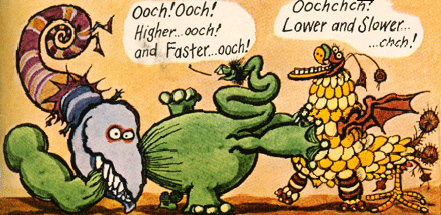
Borborygmi [bawr-buh-rig-mahy] a rumbling or gurgling sound caused by the movement of gas in the intestines. Did you know you could have a whole conversation in borborygmese? But don’t take my word for it:
This page, entitled “Les pois chiches” (Chickpeas), comes from a comics collection called “Tourista”, published in 1984, about, what else? Tourists and their behaviour in foreign climes.
Claire Bretécher is a socio-satirical cartoonist from France, best known for her comics dealing with women and gender-related issues (Les frustrés, Aggripine…) Lots of them have been translated into English. A quick rundown of her career: her work has been published in Spirou and Pilote in 1972, and she co-founded the Franco-Belgian comics magazine “L’écho des savanes” (Echoes of the Savannah) together with Marcel Gotlib and Nikita Mandryka. She also has a pretty good handle on Weird Body Things and how people react to them.
And speaking of odd stomach noises, this pertinent little gem comes to mind:
From Cul de Sac, an awesome comic strip (February 3, 2009) by the tragically deceased and much-missed Richard Thompson (1957-2016).
Alphonso Wong (also known as Wong Chak) is fondly remembered as the creator of Old Master Q, a truly long-running series that first appeared in newspapers/magazines in Hong Kong in 1962, was serialised in 1964, and is still in publication today. When Mr. Wong retired from his strip in the 90s, his son, Joseph Wong, took over the company, and he’s been managing the licensing ever since, as well as directing the team of artists writing and drawing the strip. Wong Chak passed away in 2017, at 93.
I’m no expert (the language barrier doesn’t help!), but people’s love for Old Master Q and Wong Chak is evident. To quote from Lambiek Comiclopedia,
[The strip] inspired its own magazine (“Old Master Q’s Crazy Comics”, 1965), toys, stationary, electronic scales, LED lamps, insulated cups, umbrellas and lunch boxes, as well as seven live-action film adaptations, four animated ones and two TV series. Copies of ‘Old Master Q’ can still be found in many Chinese hairdresser shops or doctor’s waiting rooms. Its success spread to the rest of Asia and translations in Europe, Latin America and Japan. Along with other well-known comic book characters, Old Master Q has his own statue in the “Hong Kong Avenue of Comic Book Stars” in Kowloon Park, Hong Kong. In August 2016 an Old Master-themed café opened on Nathan Road in Prince Edward, Hong Kong.
I prefer the art from the earlier days of OMQ, although I am glad that the strip is still around. (It’s a national institution!) To illustrate:
Please don’t forget to follow the numbers and read these top to bottom, right to left, as appropriate for a Chinese strip:
“Space Monster”, 1970. In panel number 4 , Old Master Q is saying “I am the first person to land on Mars! Hee, hee!”. In panel 5, he says “Friend!” to the aliens; despite his attempts at friendliness, they flee in panel 6, alarmed by “the strange beast that comes from space”.
Judging how often jokes about mermaids crop up, Wong Chak had a thing for them.
“Reminder of love”, 1970.
Wong Chak was impressively ambidextrous and could (and would) draw with either hand!
Here’s a strip from more recent days. As you can see, the reading order of the panels has been adapted to the Western palate, and there are English captions translating the Chinese text.
There’s as many collections of these strips as one would expect from a series so popular, including special-theme collections released for various holidays.
I eagerly await the day I’ll be able to read Old Master Q strips without having to painfully pore over a dictionary over every third character. (Especially given that I’m learning simplified characters, and Old Master Q uses traditional characters. Oof…) If that day ever comes, there’ll be a lot of material to dig into!
The talented pen of Arnold Roth (born 1929, and still alive, hey!) has graced the pages of what will seem like a slightly exaggerated, but in no way exhaustive, list (but no, he’s indeed appeared in all of these): The New Yorker, Sports Illustrated, Esquire and Playboy; Harvey Kurtzman‘s publications Trump, Humbug and Help!; The National Lampoon and Punch (Roth lived in England for a while), and The Progressive.
The topic of Roth’s contributions to Kurtzman’s satirical publications will no doubt crop up at some later juncture, but in the meantime, let’s have a look at some of Roth’s solo lampoonery and comic-form persiflage (not to mention the beauty of his inking line and the dynamism of his compositions).
Roth created a Sunday strip called Poor Arnold’s Almanac for the New York Herald Tribune Syndicate, published from 1959 to 1961. In 1989, it was revived as a Sunday *and* a daily for Creators Syndicate, and lasted until 1990. This strip is from April 24th, 1959.
Speaking of solo work, I also adore his Comick Books of Pets (published in October 1976).
« Found, Raised, Washed, Curried, Combed, Fed, and Cared for in Every Other Way. »
Roth’s art is also rather striking in black-and-white. To wit:
1978. Note the actual Vitruvian Man, L’Uomo Vitruviano, standing in line on the right.
Before midnight strikes and this Tentacle Tuesday waves us a teary goodbye, I shall endeavour to demonstrate that octopuses are vicious, grabby little miscreants who, in their quest for food and fun, don’t discriminate between species!
Oh, what the hell, I’ll just give three examples.
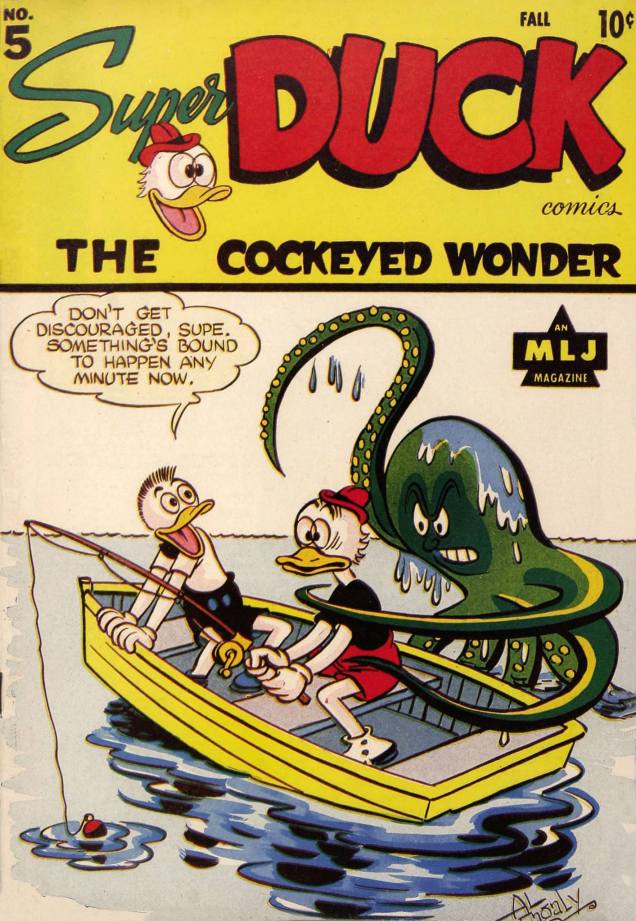
Here’s an octopus attacking a duck (to be more precise, a super duck, which is nevertheless gastronomically similar to its plainer cousin):
Super Duck Comics no. 5, Fall 1945, published by Archie Comics back when they were MLJ. Cover by Al Fagaly.
And here’s one attacking a gorilla… err, sorry, ape.
This is Planet of the Apes no. 15 (December 1975). Art by Bob Larkin.
It’s perhaps worth mentioning that French auteur Pierre Boulle wrote “La planète des singes” in 1963; the latter was translated as “Monkey Planet” in the UK and as “Planet of the Apes” in the US. (For once I’m with the Americans; “ape” sounds considerably more threatening than the childish “monkey”.) Marvel put out both a magazine (29 issues) and a comic book (12 issues) in the 70s – though frankly, there are so many comic tie-ins for this franchise, that I have nor the knowledge nor the desire to figure out what’s what or when or by who it was published. I’ll stick with the “tentacles, girl in bikini, pretty art” bit, though.
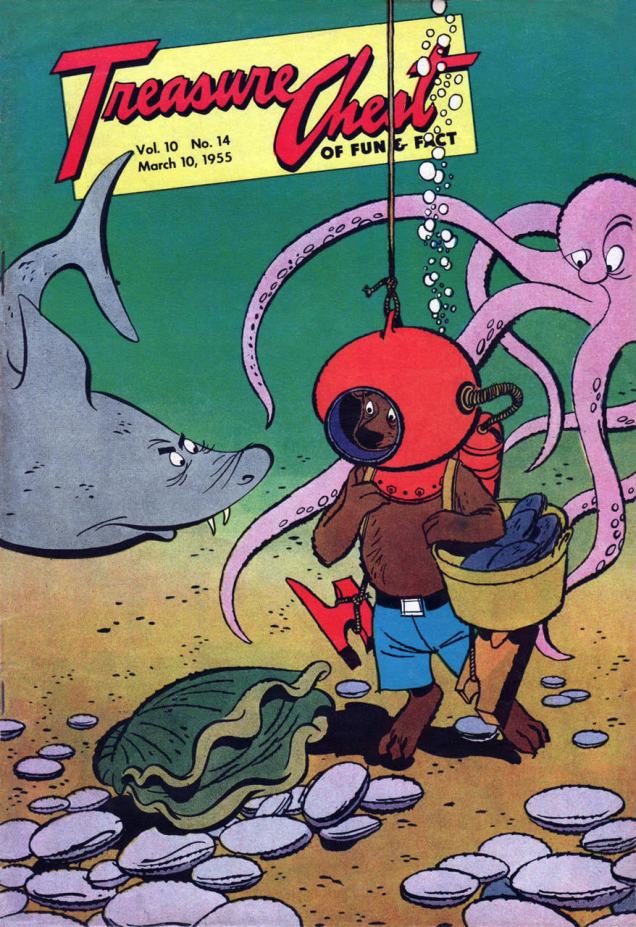
And here’s our last scene for today, an octopus attacking a bear. Actually, on the cover it’s unclear whether it’s attacking or protecting the bear, but having read the story, I can assure you that the pink cephalopod has bear meat on its mind.
Treasure Chest of Fun & Fact, vol. 10, no. 14 (March 19, 1955). The cover story, Pearl Divers, is scripted by Eric St. Clair and illustrated by Paul Eismann.
Treasure Chest of Fun & Fact was a Catholic comic book series distributed in parochial schools from 1946 to 1972… surprisingly, it’s often lots of fun, and occasionally within its pages one stumbles onto the work of a well-known artist like Murphy Anderson.
So whatever anthropomorphic species you may be, remember, don’t get your tuchus too close to the grabby tentacle of a hungry cephalopod!
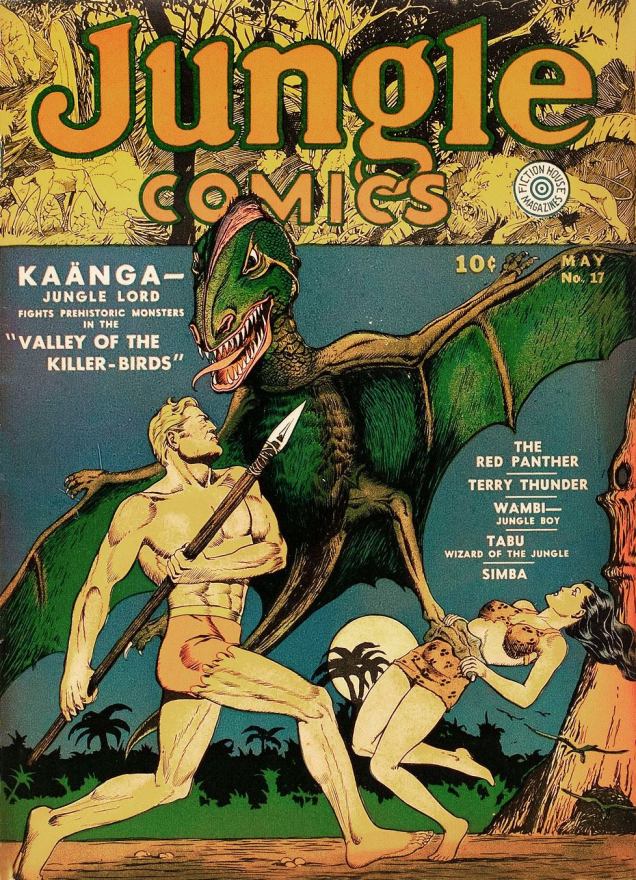
Yes, I’m sure that jungle inhabitants had to fight off vicious, anatomically impossible pterodactyls all the freaking time. Man, has John Celardo, the artist of this cover, ever seen a pterodactyl? … Oh, right, I guess he hasn’t. That still doesn’t justify this monstrosity, though.
Mark Twain comes to mind:
« The less said about the pterodactyl the better. It was a spectacle, that beast! a mixture of buzzard and alligator, a sarcasm, an affront to all animated nature, a butt for the ribald jests of an unfeeling world. »
*This* pterodactyl certainly looks like a butt for jests, given that its spine is twisted like a strand of DNA, and that its head has been put on backwards.
Jungle Comics no. 17 (May 1941). Cover by John Celardo.
The premise of Valley of the Killer-Birds is exactly the same as the raison d’être of all the other ‘Jungle Lord’ comics: Kaänga (who, judging from the umlaut, is probably Danish, just like Häagen-Dazs) has to rescue his damsel-in-distress yet again. I’m sure you are dying to know what the plot is like, so here it is in more detail:
Ann, Kaänga’s mate, is “blown off her perch” (where she was roosting, presumably) by a strong wind, and is carried off by a pterodactyl that just happens to be passing by at the moment, probably on its way to the grocery store. Kaänga tries to follow, but falls off a cliff, is carried (unconscious) through a watery tunnel, and lands in “a weird prehistoric valley”. He then effortlessly kills a a dinosaur that looks like a slightly smaller-than-average T-Rex and climbs into its skin (that somehow fits him perfectly), plays dead, gets carried off by another pterodactyl and dropped off at some random cave, miraculously the same cave where Ann is captive, and even more preposterously just a few meters away from her standing coyly by in a typical “just look at my bikini!” pose. Then he waves at her with his paw (understandably, she doesn’t understand why a dinosaur is waving at her – it’s those super-short front paws, you know), then she gets carried off (again) by a giant ape that shows up from nowhere, and Kaänga, still in T-Rex form, hotly pursues them and kills the ape. Then the hero of our tale, as clean and Arian as he can possibly be (nevermind that he just climbed from the bloody insides of an animal corpse), takes Ann’s hand and leads her out from the tunneled cave, reasoning at some point that if there’s human skulls in the passage, there must be a way out of those tunnels. (Um, no, it just means the pterodactyls and/or giant ape have had a lot of silly little humans for supper that they’ve brought in from elsewhere.)
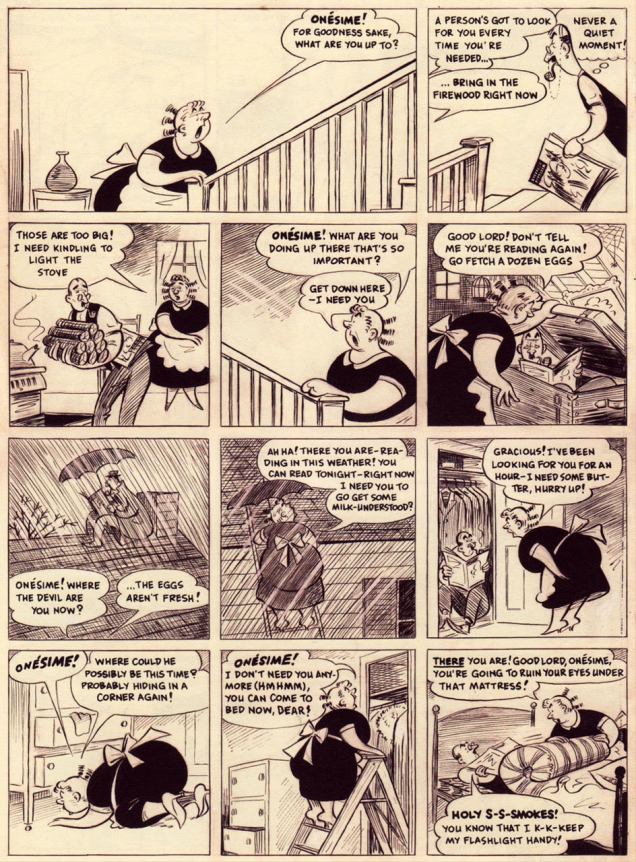
In 1943, Albert Chartier, a French-Canadian cartoonist and illustrator (and commonly accepted as the father of Québec’s “bande dessinée“), was offered the chance of creating his own comic strip for the “Bulletin des agriculteurs” (Farmers’ Bulletin). Thus began Onésime, Chartier’s most popular and enduring œuvre.
Onésime was the perfect strip for the Bulletin’s audience: inspired by life in rural areas of Québec (in particular, picturesque Saint-Jean-de-Matha), it was a charming chronicle of the countryside. It lasted all the way until 2002 (it is said that four generations of Québecois learned to read with Onésime!), and reflected the changes in Quebec’s social landscape, making it a priceless historical document as well an as excellent comic.
This strip (originally published in November 1959) was scanned from Drawn & Quarterly #5 (August 2003). As far as I know, D&Q’s 47 pages of “Albert Chartier – a Retrospective” is the only existing English version of Onésime (the French-to-English translation is credited to Helge Dascher; the redrawn letters, to Dirk Rehm).
While Onésime is Chartier’s best known work, here’s something that’s even harder to come by for your enjoyment – a strip in which Kiki gets carried away. You can meet Kiki in “Une piquante petite brunette” (roughly translated to “a spicy little brunette”), a beautifully done, quite entertaining collection of previously unpublished Chartier strips about a young woman’s adventures (Les 400 coups, 2008).
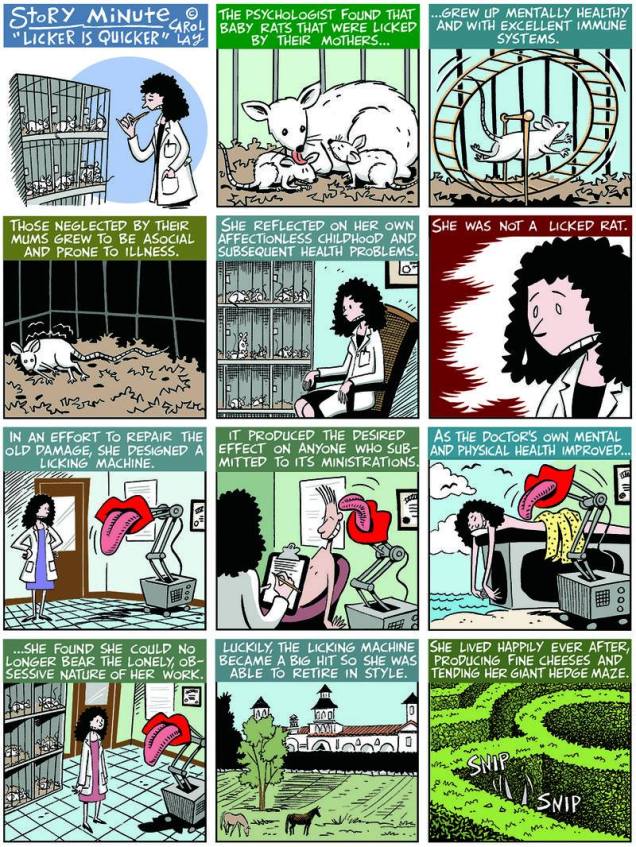
Carol Lay (born 1952) is an illustrator and cartoonist who has done a variety of work – some comic books published, collections of Story Minute (probably the strip she’s best known for), as well as illustrations for The New Yorker and such.
Her drawing style is easily recognizable (and not necessarily up at everyone’s street – some people can’t get past her highly stylized way of drawing mouths, for instance), but what makes her work most appealing to me is Lay’s sense of humour. I’m not even sure that “humour” is the right word for it – her stories have set-ups that are imaginative but often completely surreal, if not far-fetched; yet her characterizations of people ring absolutely true.
She excels at one-pagers, but longer stories are great, too. Here’s an example of the former, a typical Story Minute:
There are four collections of Lay’s weekly strips out there: three paperbacks, published by Kitchen Sink (Joy Ride, Strip Joint and Now, Endsville), are quite out of print, so keep an eye out for used copies in second-hand bookstores. The latest one, Illiterature, was published in 2012 by Boom!Town in hardcover (and I believe there was supposed to be a volume 2… still waiting for that one.)
The Kitchen Sink collections have beautiful painted covers, another reason for seeking them out. They also contain some longer (say, around 20 or 30 pages) stories, for instance one of my favourites, Joy Ride (that gave its name to the whole collection), set in a world where minds can be transferred between bodies, being fat is outlawed, and “drivers” are people whose job involves forcing fat people to get into shape by temporarily taking over their personality.
And this is the back:
You can read Lay’s webcomic (some of it includes coloured Story Minute strips – originally, they were black-and-white – and most of it is longer, new stories) at http://www.gocomics.com/lay-lines
Meet an old man’s pet, Poochy. Like most pets, he gets a little impatient and loud around mealtime, but forgive him – he’s just a healthy animal who needs his calories. Who’s a good boy?
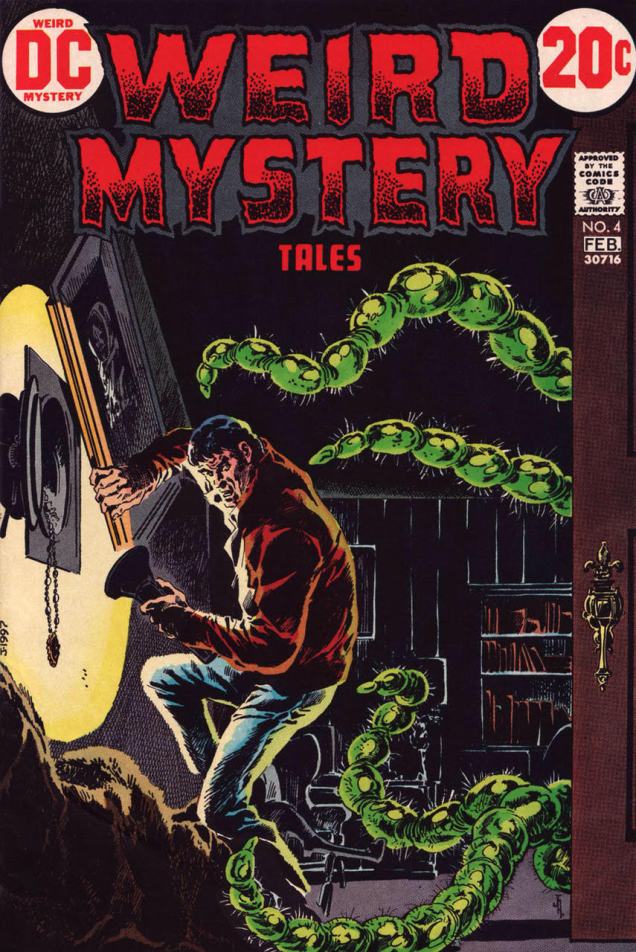
It’s Tentacle Tuesday, and today’s offering is this barking mad (hehe) and delightfully nonsensical story with script and pencils by Jim Starlin and inks by Wayne Howard.
« The Hotel » is a mere 2 pages long, so here it is in its full and unabridged glory:
This is no plebeian octopus. This tentacled horror, this mutated dog-like atrocity, is a force for moral good, dammit, dishing out all the punishment these evil-doers deserve! (Or maybe it’s just hungry.)
This tale of woe comes from Weird Mystery Tales #4 (Jan.-Feb. 1973), with a cover by Jim Aparo. It re-interpreted the story somewhat, making the thug’s comeuppance a little more immediate, but it’s still the same basic plot device: there’s the Deus ex machina, and there’s what I call Sudden Tentacles. Don’t know how to wrap up your story? Bam! tentacles out of nowhere, and everyone forgets that your tale makes no freaking sense.
Continuing this rather disturbing theme of stay-at-home octopuses, we have another contender for someone’s beloved pet: this sweet little (metaphorically speaking) guy from « Dum-Dum’s Basement » (Boris Karloff Tales of Mystery #93, August 1979).
Art by Mel Crawford. Dum-Dum’s pet will soon want flesh instead of fish! (I also like how some people don’t give a shit about having a permanently flooded basement.)
Then we have the prototypical Sudden Tentacles and set at home, too: this panel from a chilling Tom Sutton and Nicola Cuti story called « Those Tentacles! » (inventive title), published in Ghostly Tales #106, August 1973.
“The tree branches remind me of those tentacles… those slimy, winding tentacles squeezing the life from Jake!”
There’s a scene in Nightmare on Elm Street 3: Dream Warriors (at 3:55) that quite terrified me as a kid – a girl reaches over a sink to turn the water on, and the tap sprouts… appendages… and grabs her hand. I wish Freddy Krueger was into tentacles, I would have spent fewer sleepless nights in my youth.
Wishing all of you peaceful nights of slumber… until the next Tentacle Tuesday rolls around – and it will.
This itty-bitty octopus will haunt your nightmares.
« How do you know you’re facing a tough mosquito? You slap him and he slaps you back! »
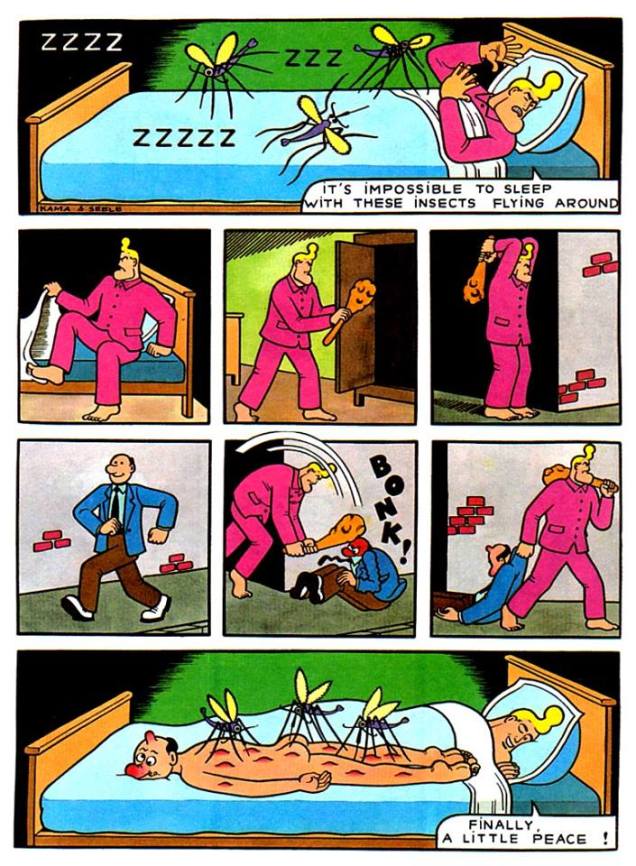
We’re in October, and I’m still getting mosquito bites. I have no polite words to say about that (not in mixed company, anyway). However, the blood-sucking buggers did make me think of a colourful, frequently violent (but also quite funny and oftentimes charming) strip, Cowboy Henk.
What, you don’t keep a drumstick-shaped club in *your* closet?
Written by Belgian cartoonist Kamagurka (a.k.a. Luc Zeebroek) and illustrated by Flemish cartoonist Her Seele (real name Peter van Heirseele), Cowboy Henk ran in the weekly Flemish magazine Humo from 1981 to 2012 (and, once this strip was translated to English, it also appeared in Art Spiegelman’s Raw.)
The strips have been collected in “King of Dental Floss” published by Scissor Books in 1994, which is a tad difficult to find, but quite worth it, in my opinion. Me, I’m lucky to have an anthology in French (published by FRÉMOK in 2013), easier to acquire than the English version. Of course if you speak Dutch, there’s many collections available to you that the rest of us have sadly no use for!
A man in a movie theater noticed what looks like a mosquito sitting next to him.
Gluyas Williams (1888-1982) was an American cartoonist whose work was published in The New Yorker, Life, Collier’s, etc. His charming one-page cartoons show a keen understanding of human nature; sometimes there’s a recurring topic – for instance, “The World At Its Worst” and “Snapshots Of…”*.
So here’s “Snapshots of a woman eating a sundae” (1926) for your enjoyment, but please don’t blame the subsequent weight gain due to ice cream cravings on me.
If you want a catalogue of little annoyances, petty vexations and funny paradoxes of life that will make you chuckle in embarrassment of recognition, you can watch some George Carlin sketches… or read some Williams cartoons, a good selection of which is available here: http://www.gluyaswilliams.com/dailies01.htm (No, this type of humour wasn’t born yesterday, and although technology marches on, the basic stuff stays if not the same, then similar.)
*Somehow I’m reminded of Sergio Aragones’ “Who Knows What Evil Lurks in the Hearts of Men? The Shadow Knows” leitmotif).
~ ds










 Who's Out There?