Here Comes Sally the Sleuth… and There Goes Her Dress!

She’s audacious, savvy, and she’s always cheerful. Here she is, the infamous Sally the Sleuth by Adolphe Barreaux*. First things first, to give us a timeframe: this strip was published in “pulp” magazine Spicy Detective Stories between 1934 and 1943, then moved to Speed Detective Stories in a new format** until 1950 then, finally, to Crime Smashers until the comic’s demise in 1953.

Sally the Sleuth features a tightrope act that’s not that easily achieved: fearless, self-sufficient Sally is so adept at spotting (and landing into the middle of) trouble that she frequently requires outside help to be rescued in the nick of time, with the role of the rescuer oft being played by her boss, the Chief, who usually bursts in through the door. What’s interesting is the way this rather typical damsel-in-distress set-up does not take anything away from our sense of Sally as a take-charge, go-getting kind of gal. She does not hesitate to bat her eyelashes or flash a gam when needed, but she’s neither the usual femme fatale archetype that appeared so often in contemporary comics, nor the innocent-yet-gorgeous victim. When captured, she spits (sometimes literally) in the face of her would-be killers; when she gets rescued, it was because she left instructions with Peanuts, her kid assistant, or schemed to leave the Chief enough clues to locate her if she hit a bad patch.

Strategic panty drop! Page two from “Tourist Trade” (June 1938, Spicy Detective Stories).

It may surprise a modern reader that an American comic from the mid-thirties (1935! consider this number again if it hasn’t sunk in yet!) should be so casual about a topless female when present-day consumers of culture freak out at the very sight of a nipple (and that goes for male nipples as well). Of course pulp magazines and comics weren’t read by staunch defenders of High Morals and Propriety, but it was nevertheless a hugely popular medium, and Spicy Detective Stories, where Sally got her débutante ball, certainly abounded in unclad women in tales of booze, butchery and concupiscence.

The cover of Spicy Detective Stories no. 4 (June 1935), in which The Tiger’s Lair (see below) appeared.

Which brings me to my next point: tension created by the play between the predictable and the unforeseen. Sally always, always ends up in a state of advanced déshabillé. That is an enjoyable given. Much like panties drop to the floor if a woman should be carrying celery, Sally’s dress and underwear fly off at the gentlest of tugs. However, just how it is accomplished varies wildly from week to week. One wouldn’t think that were so many interesting ways of getting accidentally undressed. And these stories are harsh, no doubt about it: scenes of torture and murder vary from the comparatively sedate (getting whipped, slapped, shot) to sensationalist (death by venomous snake or spider) to viscerally uncomfortable (cannibalism with more than a dash of necrophilia, being boiled alive, impalement).
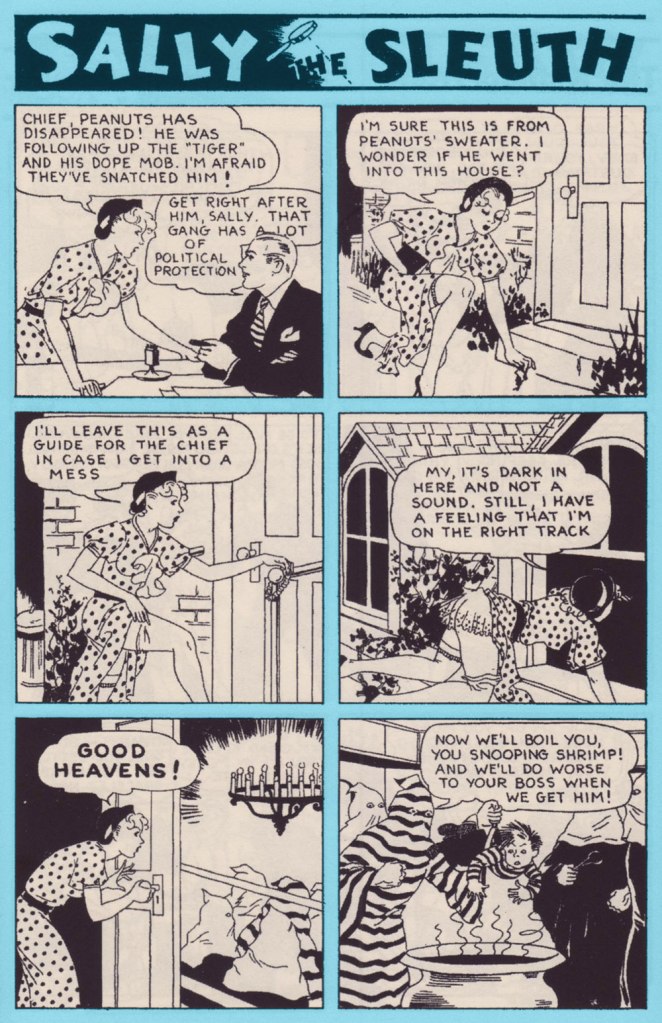
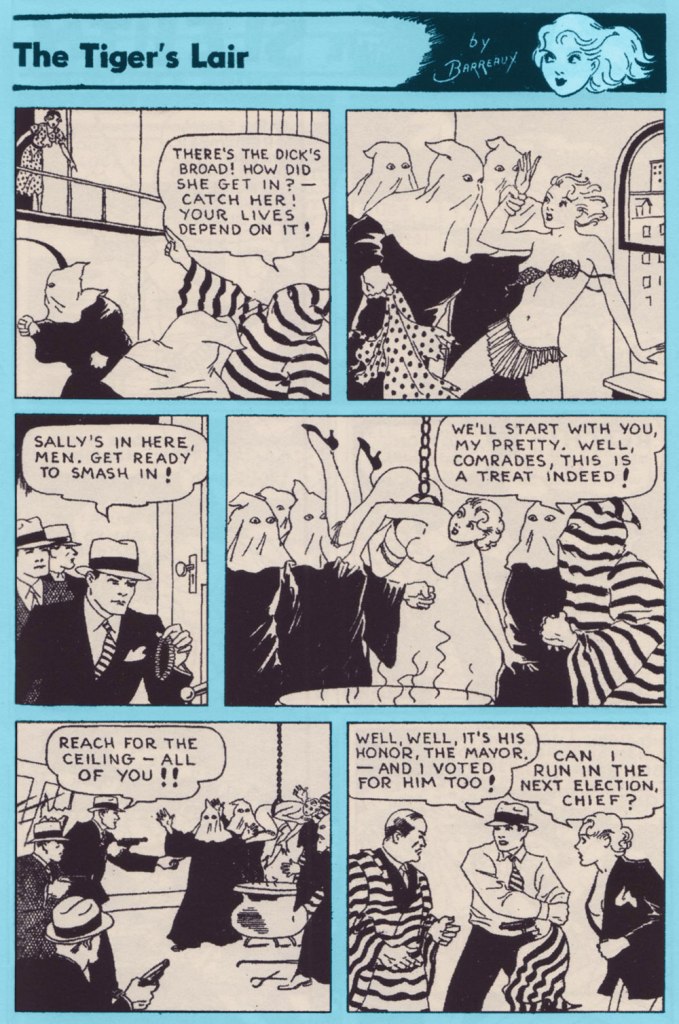
The complete “The Tiger’s Lair” (June 1935, Spicy Detective Stories).
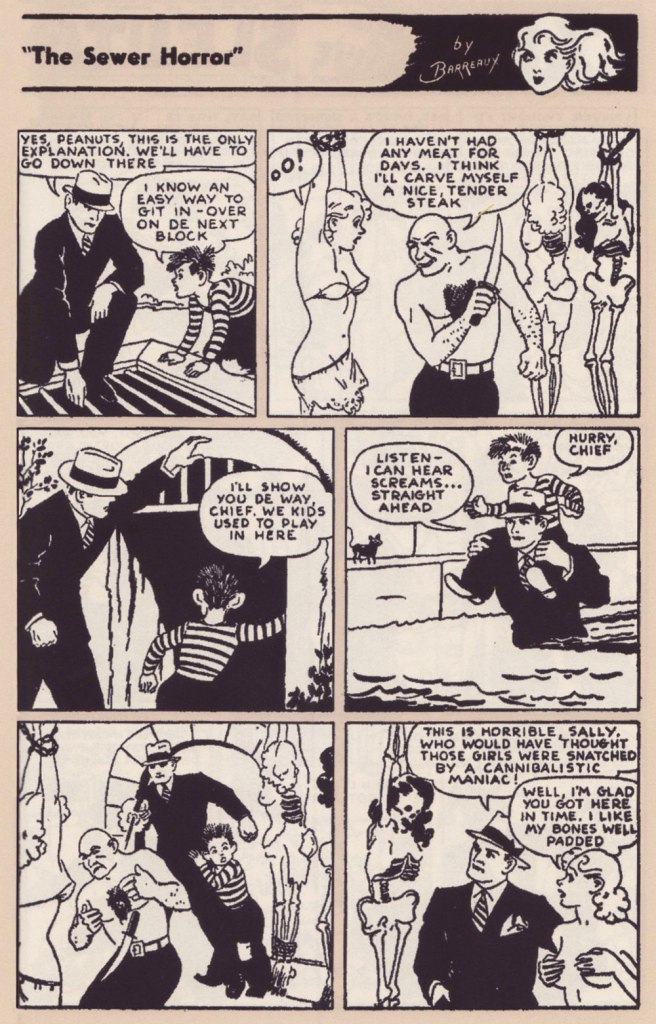
Sally’s stoicism as she’s about to be carved up is nothing short of miraculous. Page two from “The Sewer Horror” (December 1937, Spicy Detective Stories).
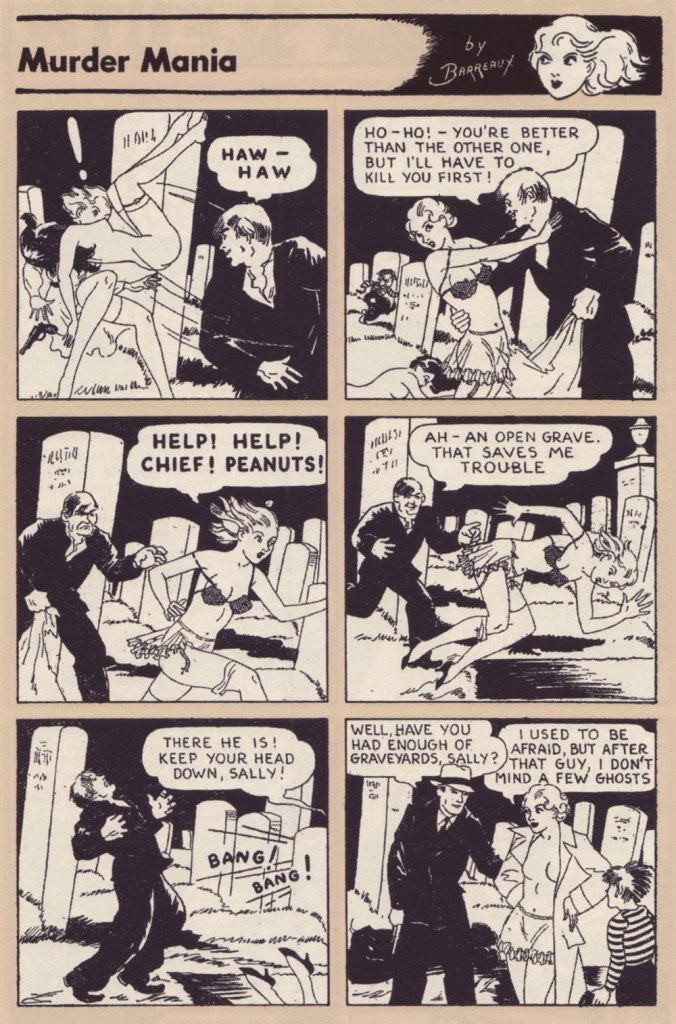
Page two from “Murder Mania” (April 1935, Spicy Detective Stories).
Page two from “The Missing-Models Mystery” (April 1937, Saucy Detective Stories).

Though of course it’s the nudity is sexualised, I love the ease with which Sally does it, completely unperturbed by having a bare chest whether she’s surrounded by hoodlums, talking to her boss, or racing through a crowded hotel. There’s a certain innocence in it, as if we were watching a frolicking Dedini nymph. Despite being so frequently assaulted, she does not at all come off as a victim.

Some top-rate lassoing from Peanuts! They’re trying to make it look like a suicide, but I’m not sure why a woman would want to jump off a roof naked. Page two from “Love Nest Loot” (September 1935, Spicy Detective Stories).

Earlier-day Sally (1934-1943) is supposedly ‘ditzy and naive’ (source), but I think one should not mistake cheerfulness or pragmatism for naïveté. She navigates the seedy parts of town with aplomb and talent, efficiently following clues, taking on many roles to infiltrate criminal organisations or simply glean information. Sally may have to rely on the Chief to extricate her from yet another predicament, but he is a sort of handsome stock figure with little personality, mostly sitting around his office and agreeing when Sally says ‘I should investigate this!’

Page two from “Coke for Co-eds” (January 1938, Spicy Detective Stories).
Sally also doesn’t judge other women; her moral compass is firmly pointed to bringing all manner of crooks to justice, but she’s a no-nonsense kind of girl when it comes to standards of female behaviour. Page two from “Sin Ship” (October 1936, Spicy Detective Stories).
Page one from “Toy of Fate” (January 1937, Spicy Detective Stories).

Sally the Sleuth has historical importance, if only for the panel borrowed by Frederic Wertham for his Seduction of the Innocent report from a Sally the Sleuth: Death Bait (1950) story. In the wonderfully written introduction to the Sally the Sleuth Collection, comics historian Tim Hanley goes a step further, saying “without Sally the Sleuth, there would be no Superman. Without the pulp heroine with a penchant for solving crimes in a state of undress, there would be no Batman either.” It can be (and has been) argued that he is giving this strip too much credit***, but there will be no argument that Sally is an important figure. Because I’m a philistine, what’s most important to me… is that it’s a great read.

~ ds

* As far as Barreaux, born Adolphus Barreaux Gripon, is concerned, there are much better places to read about his biography than on this blog, mostly due to the fact that biographies kind of bore me. I specifically direct you here for a detailed biography, and here for more information about Barreaux’ mixed heritage and the variety of genres he illustrated.

** This post only includes strips from the earlier, 1934-1943 version, because I by far prefer it to what came later, although I may be in the minority. The art got arguably better once Sally moved to Speed Detective stories, and stories also got longer, allowing for more elaborate plots. However, Sally was now some sort of international spy, travelling to ‘exotic’ countries and having to contend with native Hula dancers, superstitious savages in Indian jungles, Nazis, Japanese master-minds, and so on. She got disrobed less frequently, but the charming innocence of the strip, despite its violence and simple but effective art, is what makes Sally so appealing to me.

*** Hanley has been clearly reproached for this by some readers, and so elaborated on his blog:

My introduction begins with the grandiose claim that there would be no Superman without Sally the Sleuth, but it’s true. Long before Harry Donenfeld launched DC Comics, he was a publisher of pulp magazines that featured lurid crime stories. Sex was a major focus, and the dirty stories were a popular product. In 1934, Adolphe Barreaux convinced Donenfeld to expand outside of prose and add some comics to his books, and the “Sally the Sleuth” strip in Spicy Detective was their first attempt. It proved popular and more followed. Eventually, Donenfeld got into the comics game full time in the late 1930s, first with Detective Comics and later with Action Comics. Once Superman and Batman took off with young readers, more series followed and the comic book business became Donenfeld’s priority. But it all started with Sally.
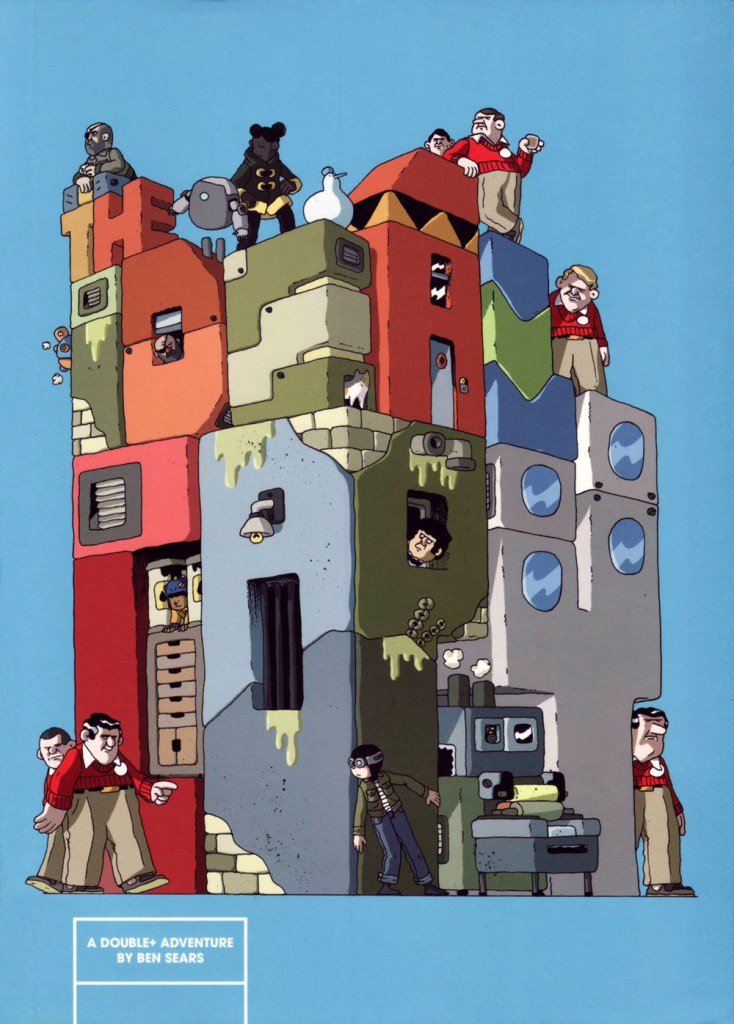
Convivial Meals, Spirited Skirmishes: Ben Sears’ Double+ Adventures

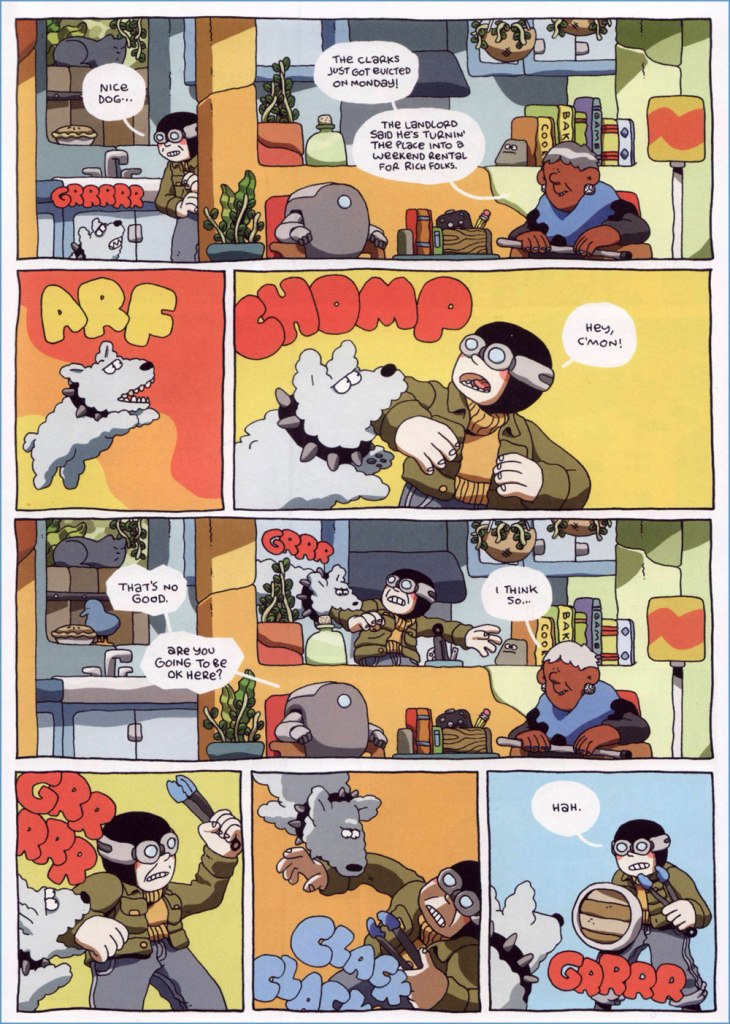
I admit it’s rare for me to discover a new present-day cartoonist I really like, so I was quite thrilled to stumble upon Ben Sears and the adventures of friendly robot Hank and goggles-sporting Plus Man. Sears’ style reminds me of claymation (one of my soft spots), and he is not afraid of bright colours or playfulness – such a contrast to the many ‘serious’, sepia-coloured comics that are just dull as dishwater (although apparently the latter is now an in-demand hair colour).

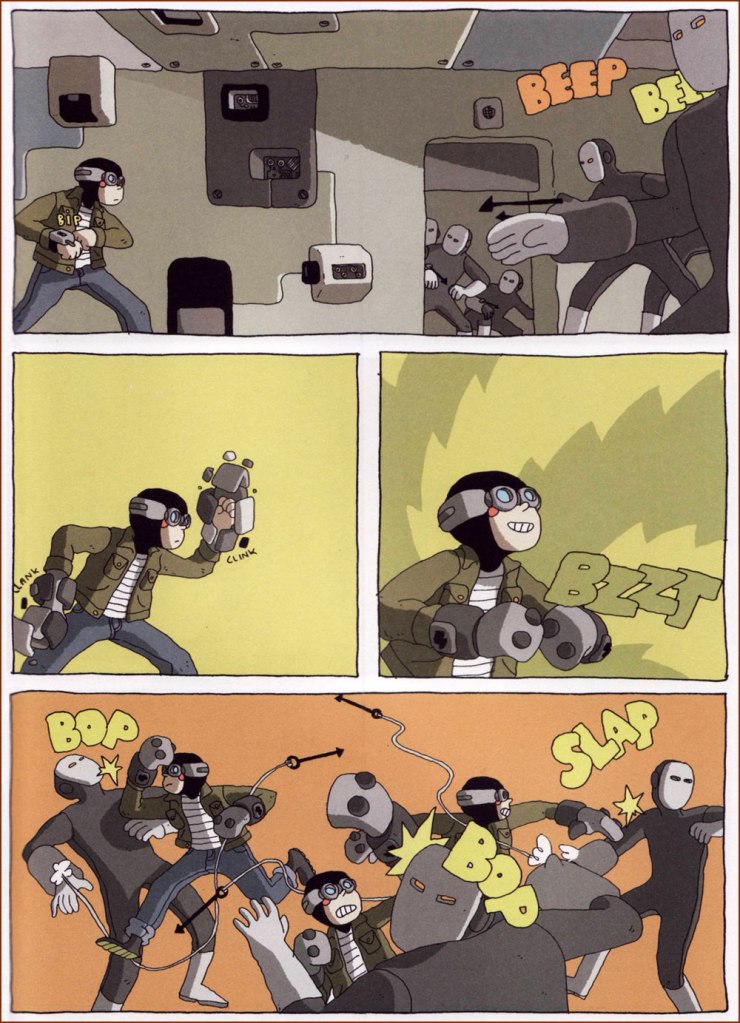
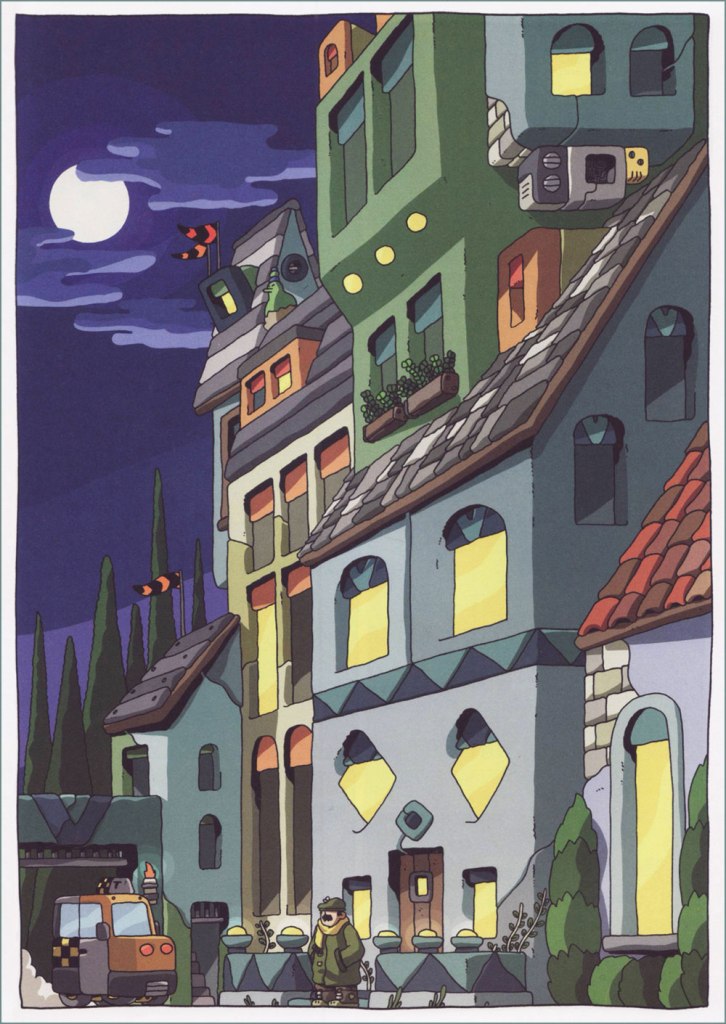
The four ‘A Double Adventure +’ comics Sears has given us so far (Night Air, 2016; Volcano Trash, 2017; The Ideal Copy, 2018; and House of the Black Spot, 2019), published by Koyama Press*, brim with interesting details – plants are everywhere, rooms are full of intriguing trinkets, and cats are perched on counters and rooftops. This is a world not devoid of danger (Hank and Plus Man keep getting pulled into murder mysteries, ominous conspiracies, hive-mind henchmen skirmishes, etc.), but there’s also an appealing domesticity about it, as we often get to visit their apartment or tag along as they hang out in a friends’ kitchen. The fight scenes are viscerally satisfying (who doesn’t want to see bad guys’ asses kicked in a most expedient manner?), but there is also clever team work, friendship, and occasionally a moral dilemma or two. My favourite of the four is House of the Black Spot, so things are clearly going in the right direction!

The Ideal Copy features a villainous gaggle of creepy white men, all eerily dressed in the same red sweater + beige pants-pulled-up-to-armpits** uniform:

The nasties have convenient number badges pinned to their sweaters (perhaps they also get confused).

Volcano Trash features some enjoyably fast-paced fight/daring escape scenes, but I think its heart lies in its quietly emotional sequences. Sears’ dialogue is perfectly functional, sometimes even fun, but he doesn’t over-clutter his pages with words, excelling at mute scenes in which body language says a’plenty. When looking through his website recently, I was happy to discover he has a few pantomine self-published comics (featuring a trash cleanup robot, a cat and a bird!) I’d never heard of. You can order them here.

A discussion about friendship mostly takes place through sighs and gestures – not much needs to be said in words.

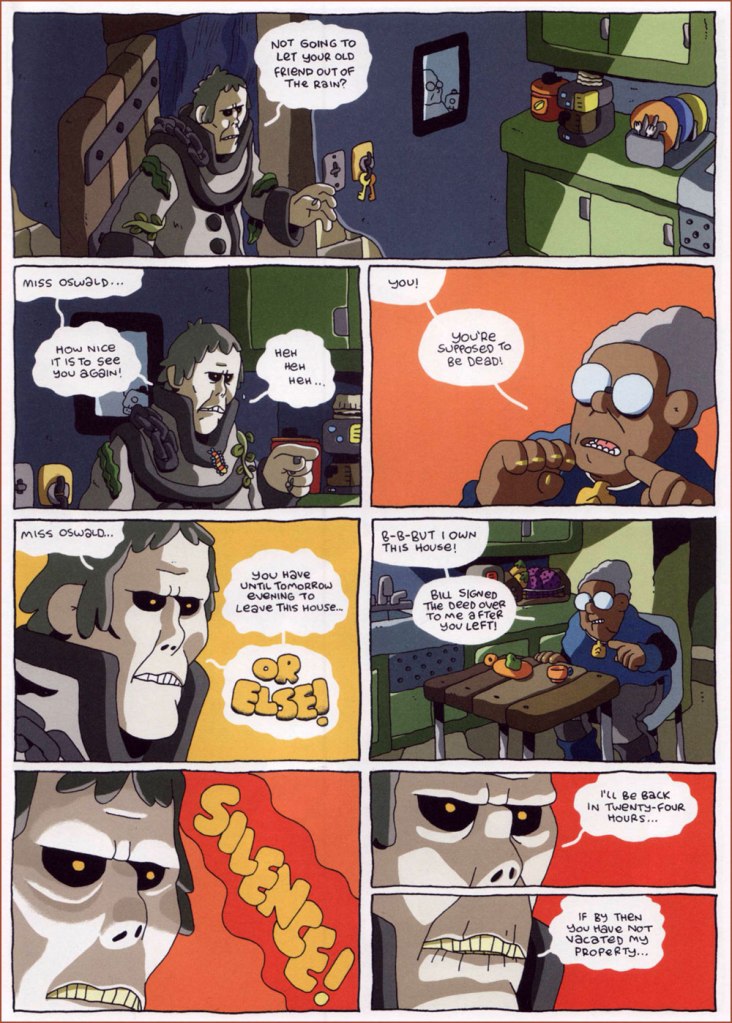
Finally, here are some excerpts (or extracts, as the Brits would say) from House of the Black Spot, the lushest, latest installment of Hank & Plus Man’s adventures:

You can read an (otherwise unpublished, as far as I know) Double+ Adventure here.

I keep reading reviews in which comparisons are made between Sears’ work and Hergé’s Tintin, which supposed resemblance I admit I don’t see at all. On the other hand, I’ve never read a full Tintin album, and to be perfectly honest have no intention of ever undertaking such a tedious task.

~ ds

* Toronto-based Koyama Press shut down its operations in 2021, so Ben Sears’ new book, Young Shadow, was published by Fantagraphics. I haven’t read it yet, but am looking forward to it, once I get my hands on a copy! You can read a review of it over at The Comics Journal.

** The question of why older men tend to wear their pants somewhere below their armpits still baffles me. Hypotheses have been made to the effect of beer-bellied folks having to decide whether the pant waistline lies above a bulging stomach or under it, and opting for the former option, but I have seen plenty of instances of pants being pulled up when the wearer had a relatively flat stomach…

Marc Hempel’s Male Id Funhouse

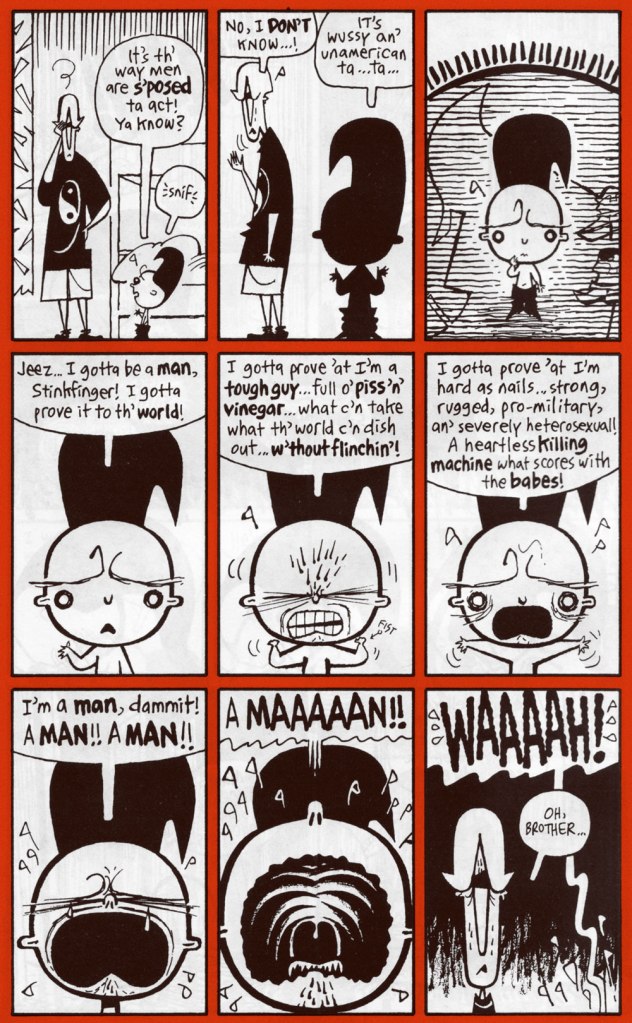
 « Marc Hempel (born May 25, 1957) is an American cartoonist/comics artist best known for his work on The Sandman with Neil Gaiman. » And with this sentence starts my diatribe.

In an ideal universe, any blurb about Marc Hempel would open with a mention of his solo work (Gregory, Tug & Buster), or, if one must discuss joint efforts off the bat, his excellent work with Mark Wheatley on Breathtaker and Mars would also rate highly on the list of comics worth alluding to. This universe, as you have surely noticed, is sorely lacking in perfection. However, this is a microcosm of ne plus ultra our blog, so please bear with me while I gush about Hempel’s lovely ink lines and his talent for humorous repartee while throwing a snide sidelong look at Gaiman, a sort of a persona non grata here at WOT. Oh, don’t boil over, kind reader – the latter has an army of fanboys to rush to his defense.

Once upon a time, in a kingdom far, far away (I kid, though 1995 simultaneously feels like ten years and half a century ago) there was a hilarious yet poignant series called TUG & buster, spanning seven issues published between 1995 and 1998.

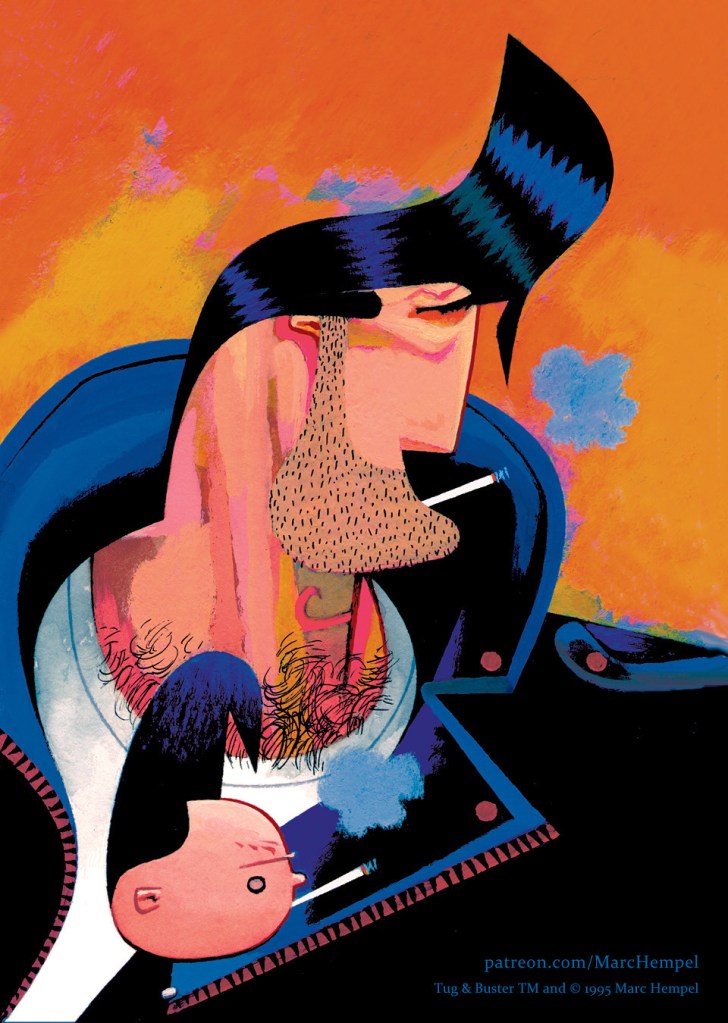
TUG: a brain-dead hunk (Hempel himself used ‘mildly retarded’ as a descriptor), lethally attractive to full-bosomed babes, despite dubious personal hygiene and a highly-flammable pompadour.

buster: a shrimp of a kid with an abysmal case of hero worship and no chest hair whatsoever to speak of.

The original art for Tug & Buster no. 1 (1995) borrowed from Hempel’s Tumblr. Leaving the watermark on, as removing it seems distinctly impolite!

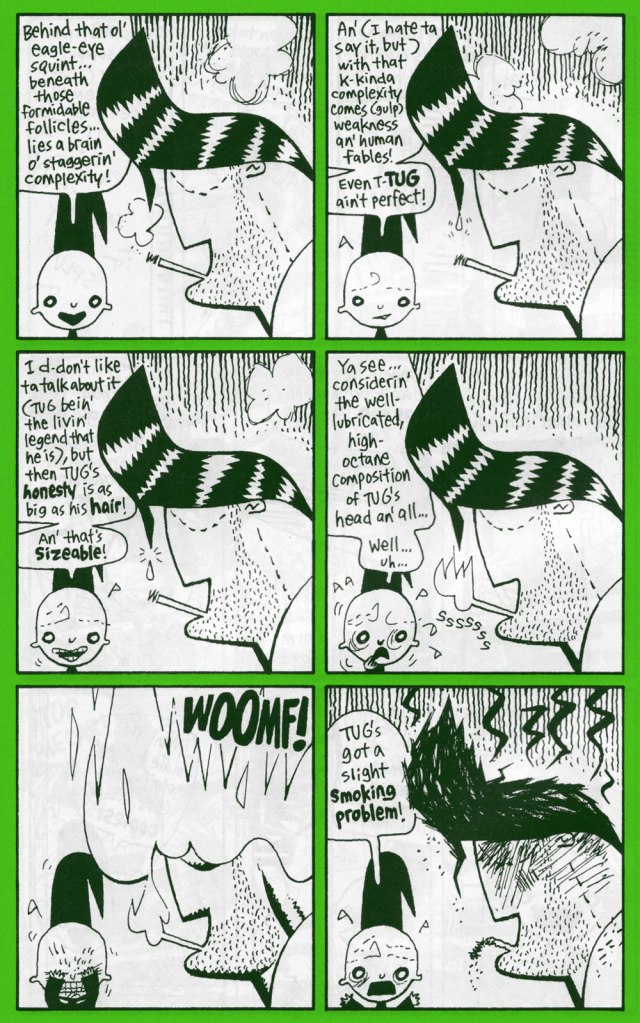
The capitalisation was presumably meant to emphasise Tug’s larger-than-life stature, while Buster’s lower case seems to poke fun at the kid’s weeness, both physical and emotional. Overcompensating for Tug’s laconic nature (he does not utter a single word), Buster prattles on like a broken record about manliness and nookie, simultaneously functioning as a sort of inner monologue narrator for Tug. That the latter most likely doesn’t have an inner monologue is irrelevant.

I dare you to read ‘my mizzen mast is hoisted’ without giving at least one snort:

If one were to disengage Buster from his general obsession with Tug – a truly painful process which would require more than one scalpel – and peek under the crackling veneer of his machismo, one would discover that he’s actually not nearly as dopey as he seems. He just has a very precise (and very wrong) idea of what constitutes a man.

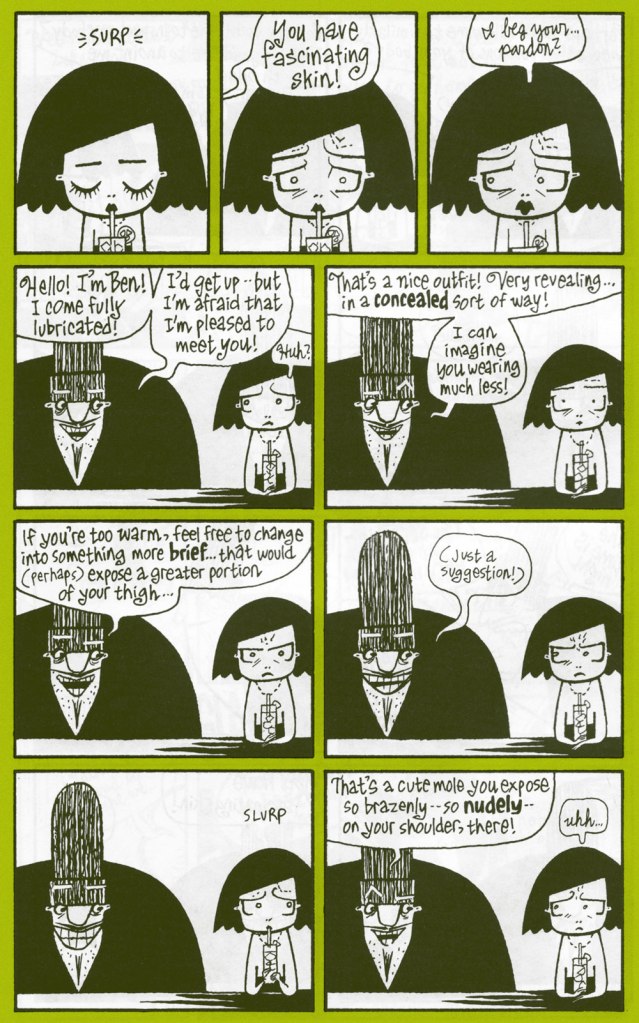
Not untypically, my favourite characters are not the protagonists, but two weirdos who complete the main cast: the hilariously, uncomfortably inappropriate Genital Ben and lost soul, over-analytical Stinkfinger (real name John).

Every time someone says ‘just a suggestion!’ I can’t help but think of this scene. I love the florid, delicate handwriting Hempel uses for Ben’s… stream of off-colour commentary.
A longer sequence of Stinkfinger stagnating in his apartment ends on a positive note, with him venturing outside after a claustrophobic hallucinatory episode.

If I’ve managed to sufficiently intrigue you, I recommend purchasing the lovingly printed, hard-cover collection, The 4-Fisted Misadventures of Tug & Buster (1998, Graphitti Designs; Image Comics for the softcover edition). However, that has been out of print for a while, so an interested party on a tight budget might consider acquiring single issues of T&G which are, for the most part, two bucks a pop at mycomicshop.

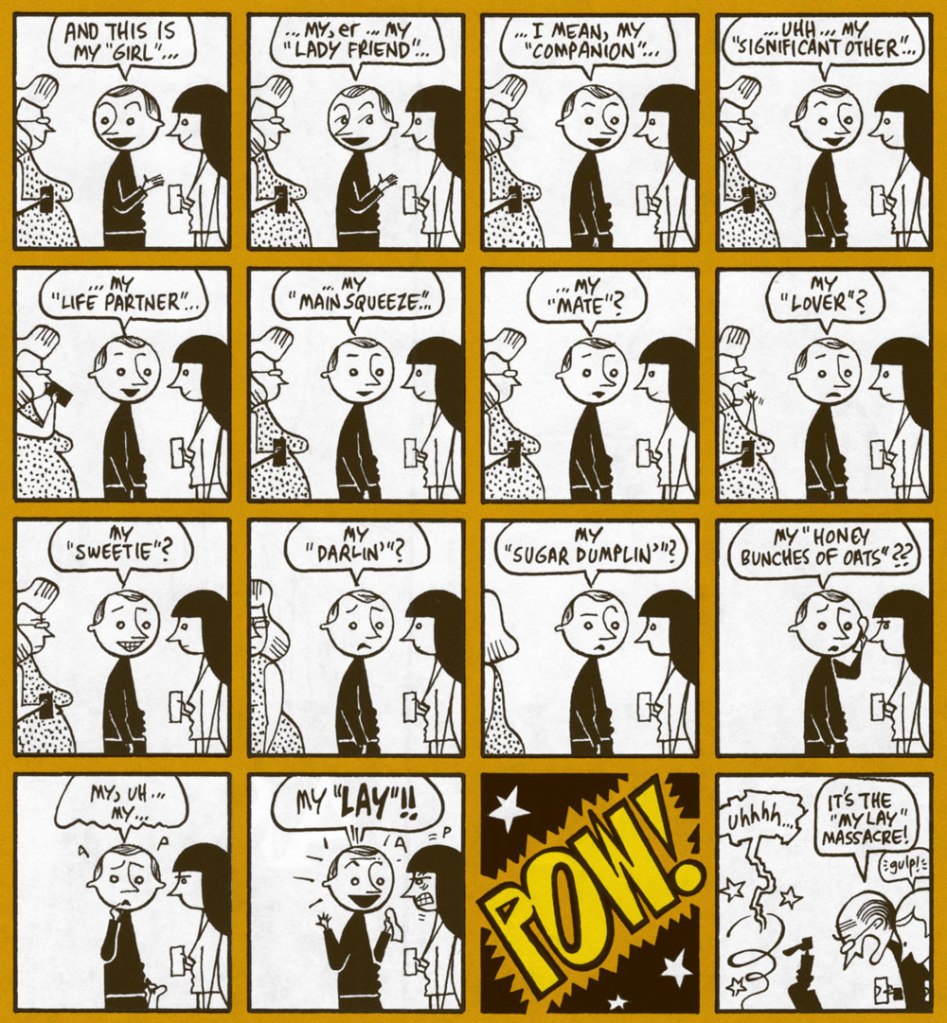
Some never-seen-before Tug & Buster vignettes leaked over to humour anthology Naked Brain, advertised as ‘subversive satire!’ and ‘sublime silliness!’ (I hesitate to slap the label of ‘sublime’ on anything, but otherwise, it is as advertised). Hempel stuffed these three issues (ushered into the world in 2002) full of odds and ends, both inedited or previously published on Sunny Fundays. I think we’ve covered enough T&B ground for now, so here’s a peek at a different type of material:

Page from Naked Brain no. 2 (2002).
Naked Brain no. 3 (2002). Hempel is very good with colour.
Page from Naked Brain no. 3 (2002).
Page from Naked Brain no. 3 (2002). This particular episode reminds me of Shel Silverstein‘s very brief play ‘Bus Stop’, which you can read here, starting from page 12.
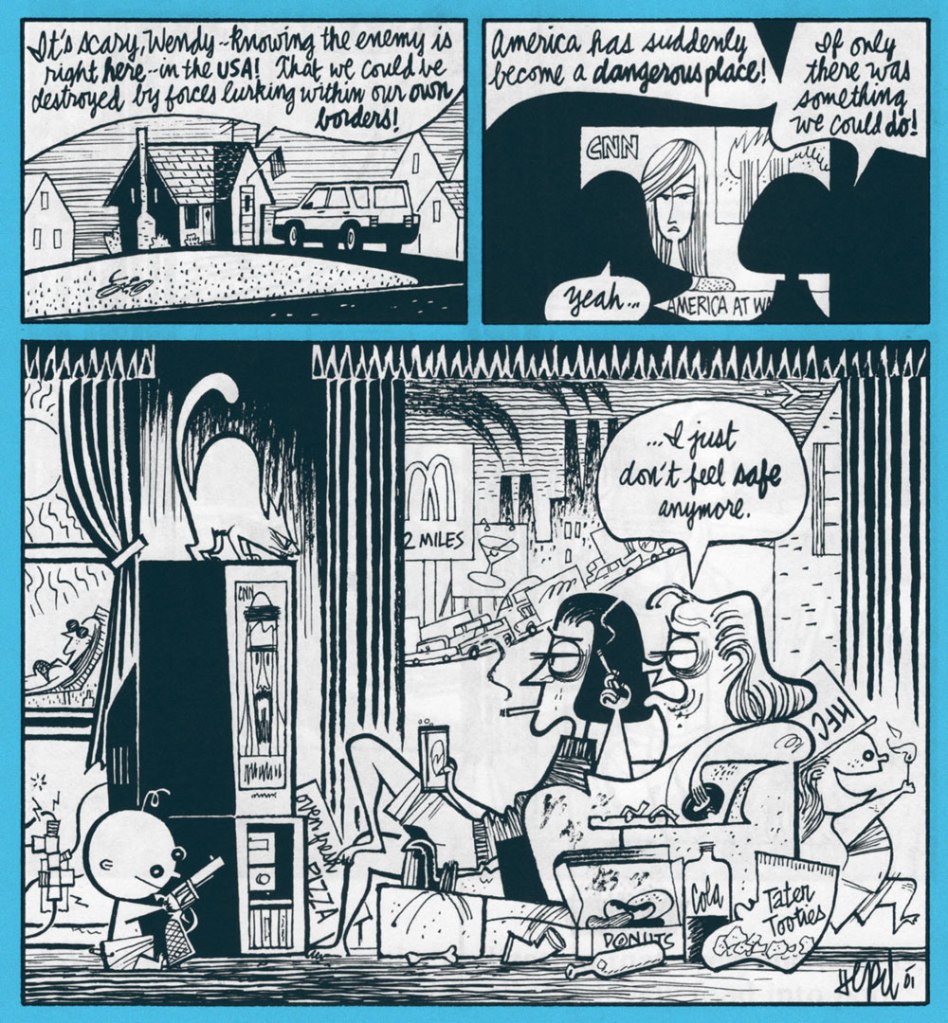
Page from Naked Brain no. 3 (2002). Not relevant in the slightest to today’s America.

! ds

Crude, Rough, and Ready: Norman Pettingill

« You’ve got to go pretty far back in the woods for good backwoods humor. » 

Contemplating Norman Pettingill‘s life brings to mind Henry David Thoreau in his secluded cabin – « I long for wildness, a nature which I cannot put my foot through, woods where the wood thrush forever sings, where the hours are early morning ones, and there is dew on the grass, and the day is forever unproved, where I might have a fertile unknown for a soil about me. »  Most of us living in high density urban centers have bittersweet moments of pining for the ‘natural’ lifestyle of the woods, perhaps fishing and hunting for modest yet satisfying sustenance, quietly sitting on the porch in the evenings and thinking philosophical thoughts with the backdrop of nocturnal animal sounds.

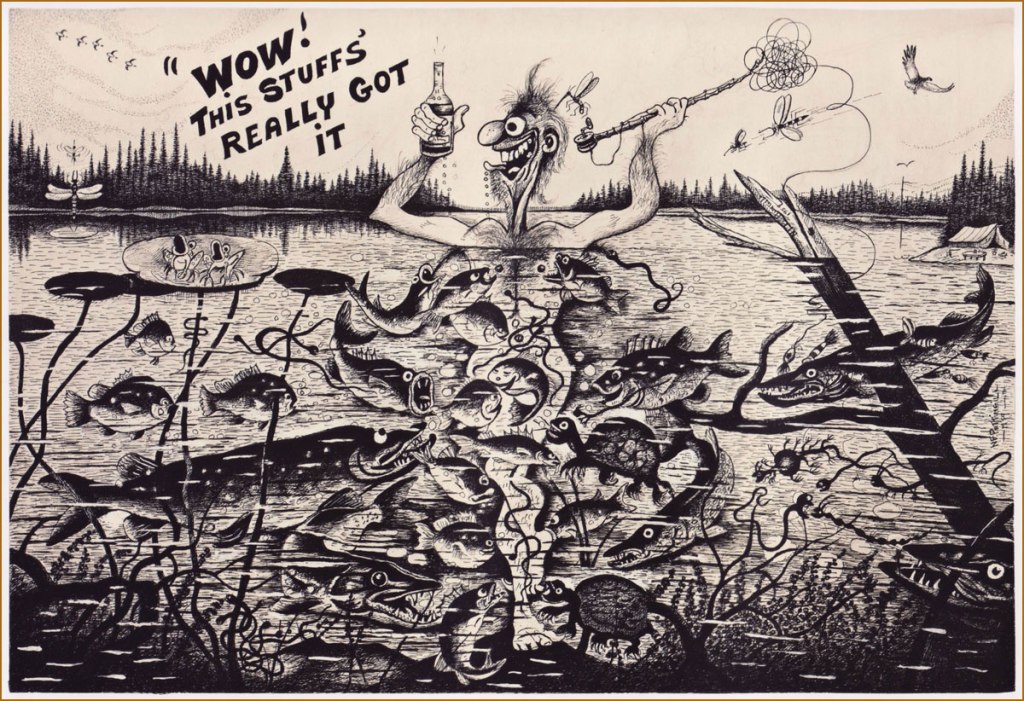
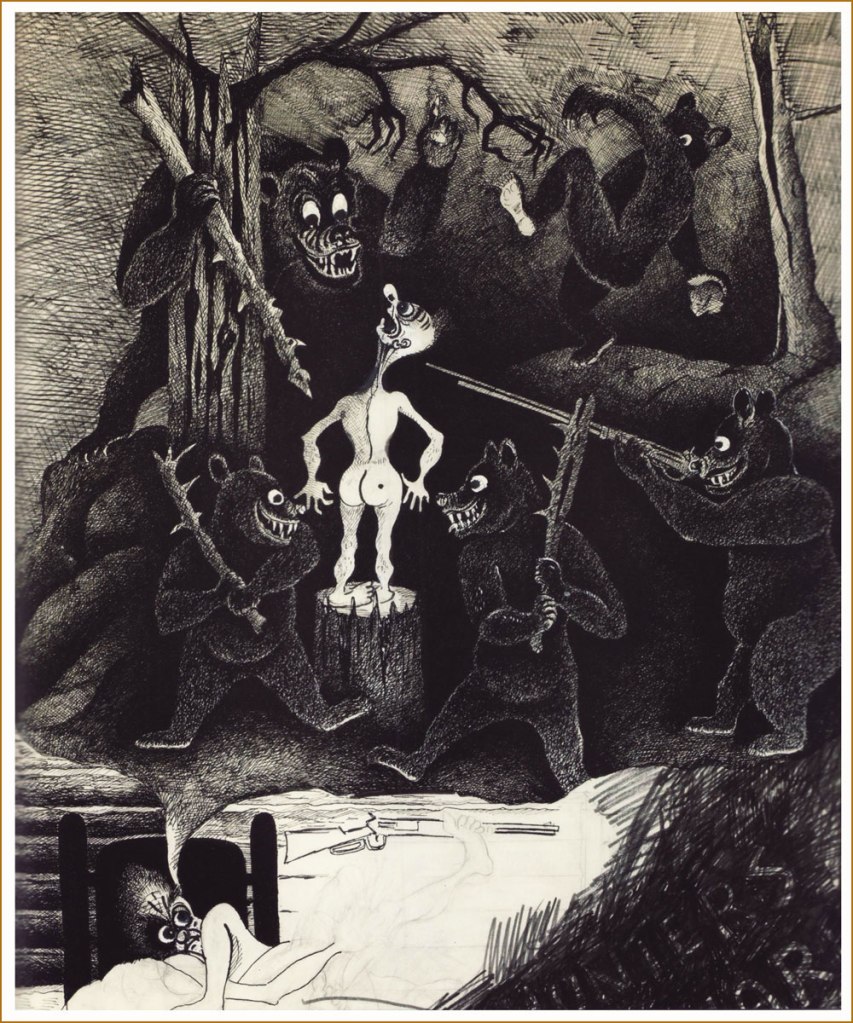
Judging from Pettingill’s cheeky illustrations of just such a natural life, quietude doesn’t actually come into much – instead, he presents us with a sort of vaudeville cast of bears bent on mayhem, drunk old-timers and pipe-smokin’ grannies, women emphatically pursued by wild fauna harbouring thoughts a holy man would blush at, crazy surgeons and gung-ho sturgeons (oh, there was no specific indication of the many fish nibbling on tender parts being sturgeons, but Wisconsin boasts two species).

Norman Pettingill (1896-1991) was born and raised in Wisconsin to be a hunter, fisher and trapper, just like all men around him, and although he took well to these activities (it seems he was a very good hunter/fisher/gatherer), his favoured interests lay elsewhere. I’m not sure how inviting this, err, virile environment would be to a boy who delights in drawing caricatures instead of chopping wood or shooting rabbits, but at any rate nobody seems to have dissuaded young Pettingill from his artistic pursuits.

His drawings with pen and ink can easily be divided into categories. The first consists of his quiet and beautifully detailed forest scenes, with varied animals poised as if about to dash away.

Then there are his bawdy, sometimes grotesque, and frequently unhinged caricatures of his fellow men (and women) and the stuff they get up to. To be fair, there is something sweet in his mockery – only an insider could observe the vernacular of language and behaviour with such bite and yet affection. I especially favour group scenes with more riotous action and ribald skirmishes than one could shake a hunter’s gun at.

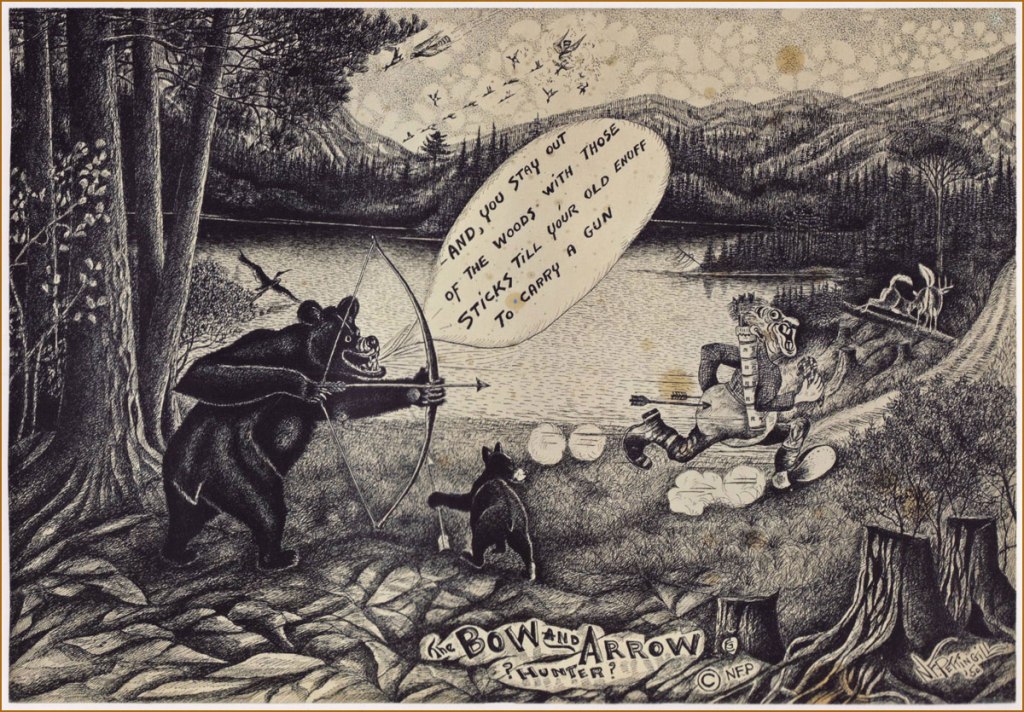
Other times, group shots give way to a more focused approach, whether it’s a woman approached by a bear who seems to be bent on inter-species action, or an inept hunter running at full speed from what was supposed to be his prey.

These pictures have been taken from Norman Pettingill: Backwoods Humorist (Fantagraphics, 2010). The images themselves were drawn between 1947 and 1959.

~ ds

Who Wants Yesterday’s Cornpone? Cathy Hill’s Mad Raccoons

What are you doing givin’ a raccoon a sugar cube? / What are you doing? What are you doing? How rude. / Cuz you can’t tell me you don’t know what he does with his food. ~ The Sugar Cube Blues

I learned a long time ago that there is little connection between the popularity of something and its quality. An author well remembered is not necessarily more talented than one whose work has been buried under the monolith of time (squish!), and what manages to claw its way into the public consciousness, much like a raccoon out of a trash can, is often more of a question of luck than some sort of intrinsic worthiness.

Mad Racoons no. 1 (July 1991, MU Press)

Occasionally, I feel like casting a spotlight on comics long forgotten… assuming that there was some memory to be forgotten in the first place, which is often not even the case. American comics artist and illustrator Cathy Hill set loose seven issues of her charming series Mad Raccoons between 1991 and 1997, but how many have made friends with these raccoons? Her absence on Wikipedia (surely today’s litmus test for fame?) underlines the obscurity of her work. I located a link to a Cathy Hill art exhibition… which seemed promising, as I know that Hill was predominantly a painter who has also drawn covers for SF novels as well as posters for a wide variety of events. Well, it was the wrong Cathy Hill – this one was British. So the cookie crumbles.

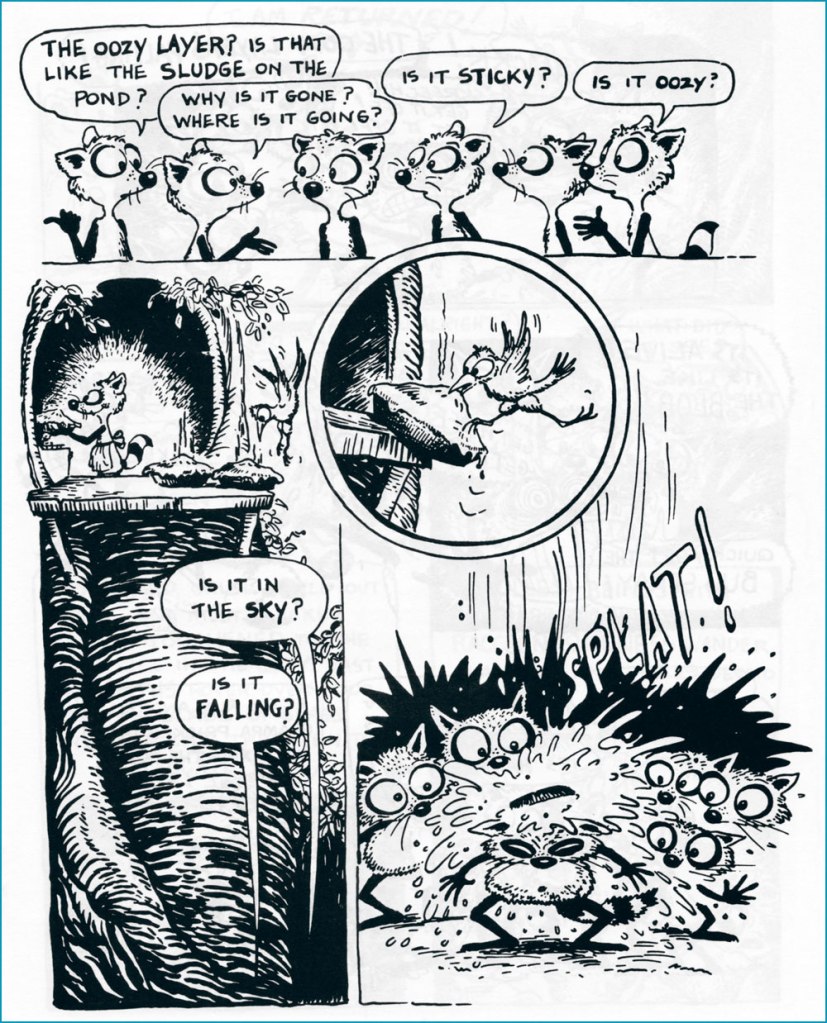
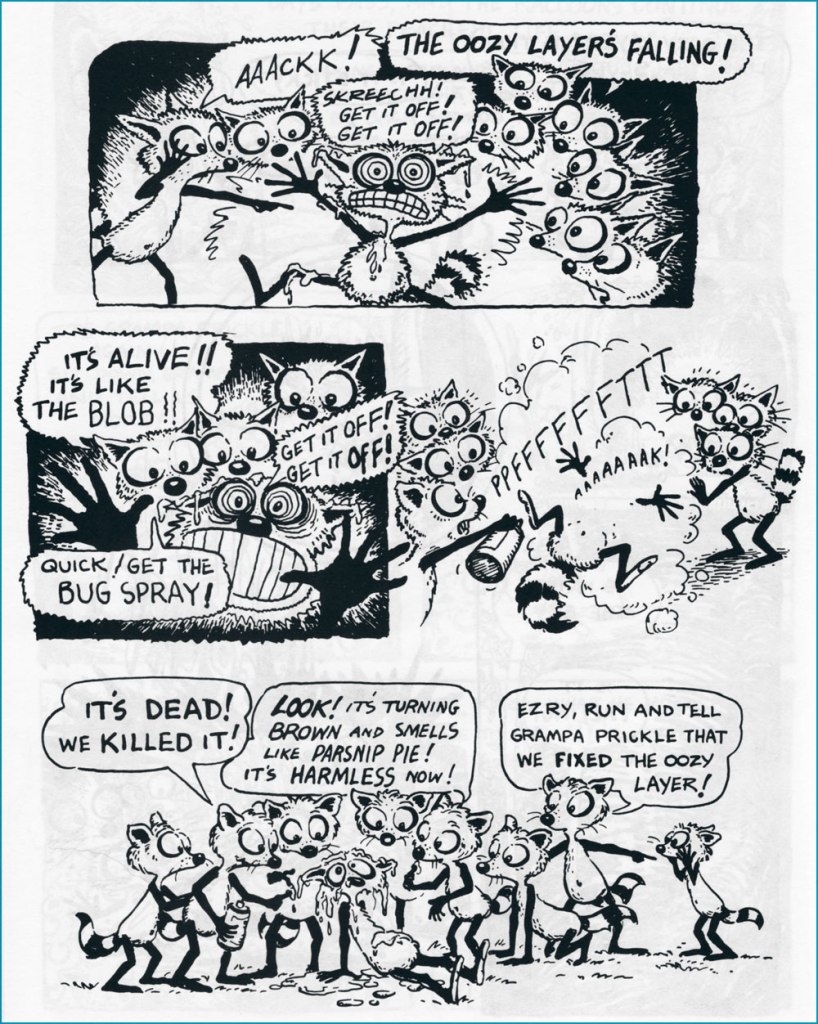
Mad Raccoons has a cast of highly entertaining characters. Virgil, for example, is a rambunctious racoon, liable to burst into poetic soliloquies as befits his name. He’s also subject to random temper tantrums (especially when somebody mentions cousin Oddfuzz, with whom he is perpetually at war), that typically end in a total melt-down accompanied by his trademark EEAAIIIEE!! scream.

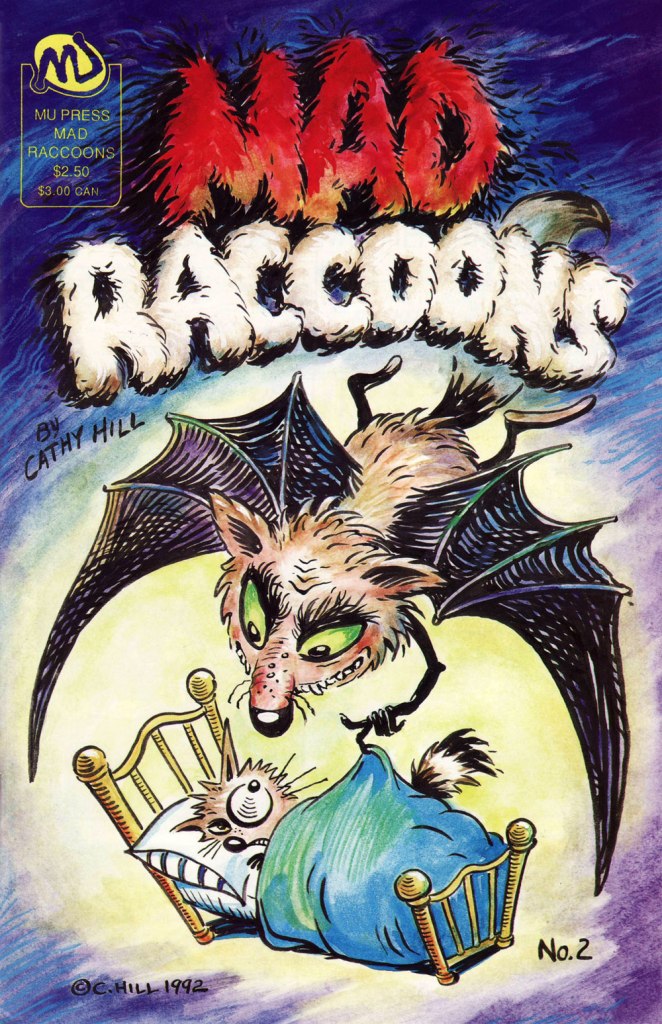
Mad Raccoons no. 2 (September 1992, Mu Press).

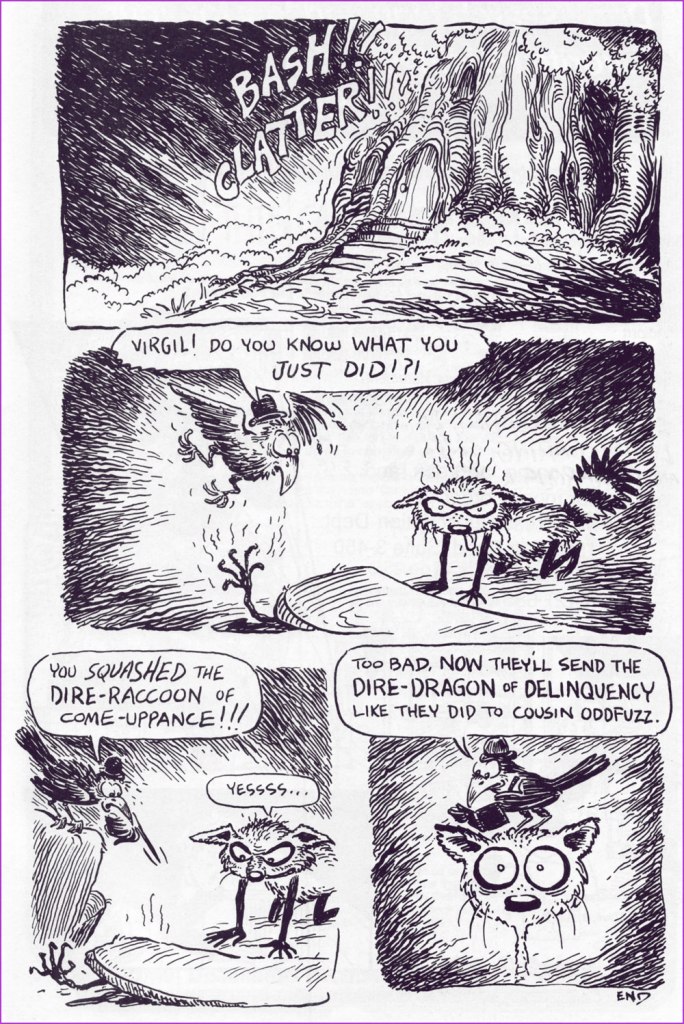
Speaking of tantrums – here are the concluding three pages of Virgil’s Visitor, in which Virgil is visited by the dire-raccoon of comeuppance (published in Mad Raccoons no. 2):

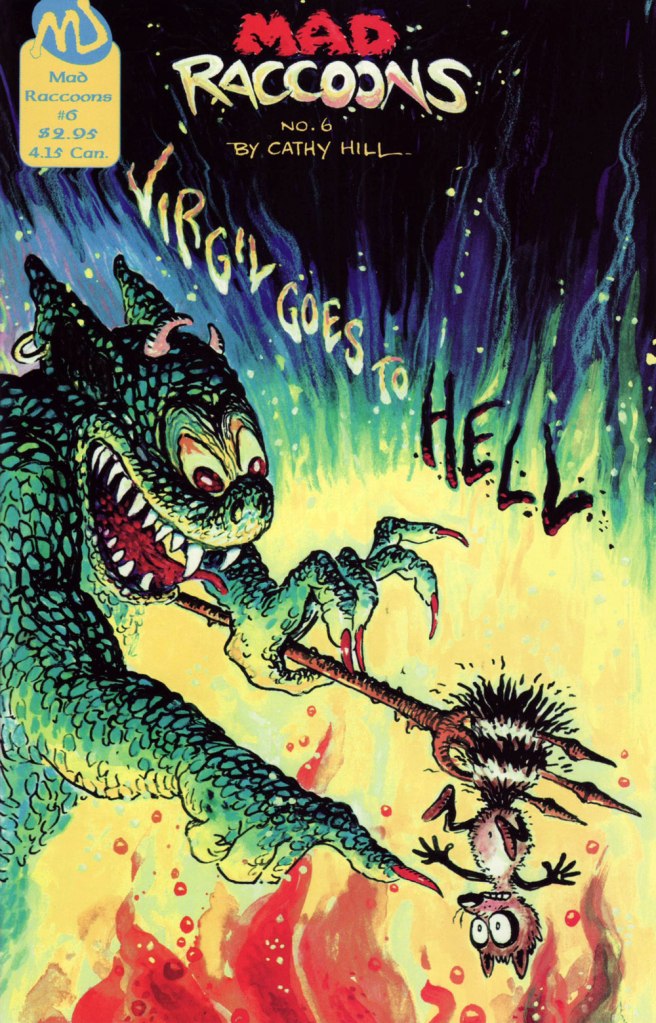
And he does indeed have to endure the cruel games of the dire-dragon of delinquency, three issues later:

Mad Raccoons no. 6 (July 1996Mu Press).

As entertaining as Virgil’s outbursts can be, I prefer to bask in glimpses of the world he inhabits, peopled (raccooned?) by characters young and old. The Natural Raccoon (published in no. 1), featuring Grandpa Prickle (which I tend to call Grandpa Pickle) and nursery of youngsters, makes for a choice example.

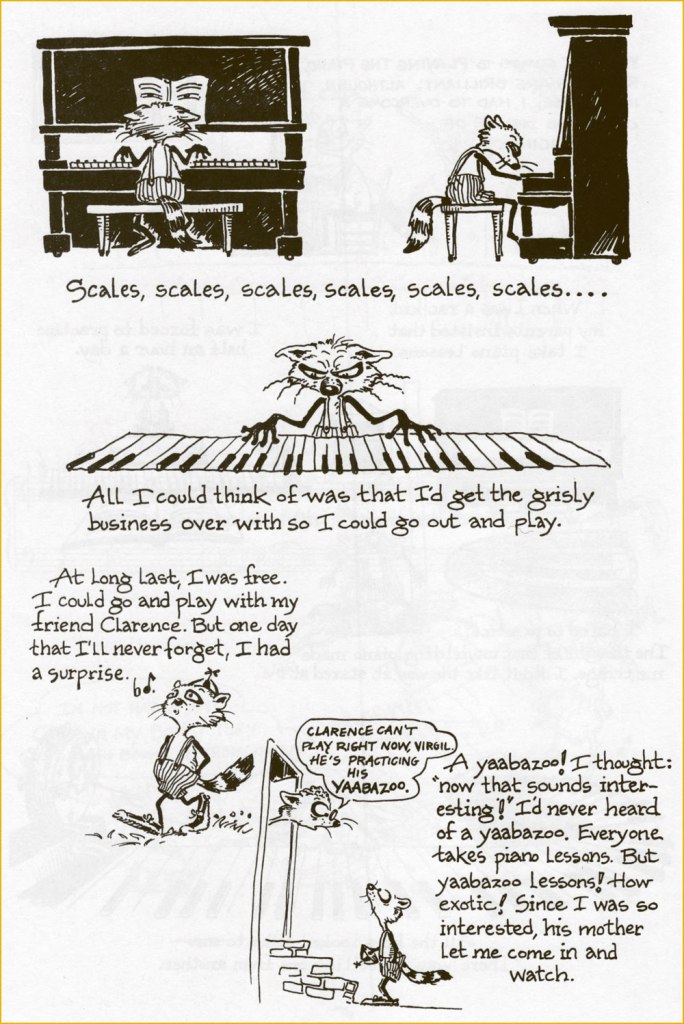
As someone who has very much a chicken scrawl of a handwriting, I reserve special admiration for folks with a steady hand and patience enough for calligraphy. Hill’s lettering is an important part of the dynamic art of her stories, and the following pages from Raccoons and Music (published in no. 2) allow one to really admire a fancier version of it:

A keen eye may note that 1988 appears at the bottom of the last page, whereas no. 2 was published in 1992. Indeed, Hill’s original idea was for a series of humorously informative stories about raccoons (such as Raccoons in Music, Raccoons in Art, Raccoons in Literature…), all of which were to be published in The Raccoon Booke. That never came to pass, but at least all (as far as I know) of these stories landed between the pages of Mad Raccoons. This earlier material has a different (although still recognizably Hill’s) art style; I would be hard-pressed indeed to decide which I like better.

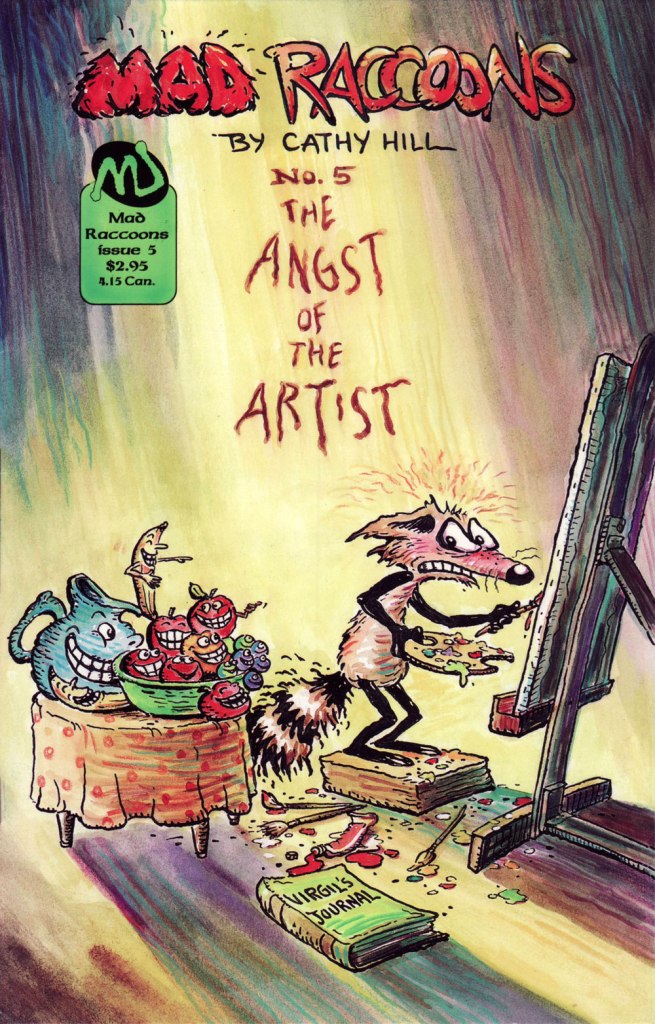
Mad Raccoons no. 5 (August 1995, Mu Press). Virgil lives in perpetual fear of being mocked (or at least not taken seriously). He’s clearly one of Hill’s favourite characters, and so frequently rates the cover feature.

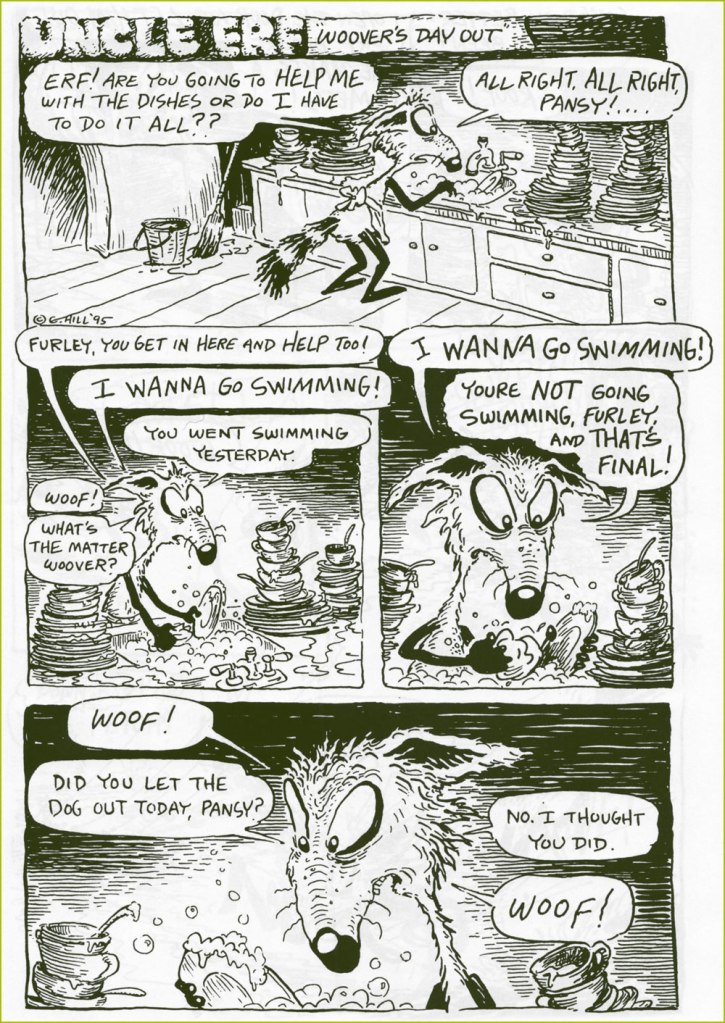
There’s also my favourite, Uncle Erf, who’s also his own wife Pansy and his son Furley, depending on which personality has control at any given moment – and things can shift pretty damn fast. This poor tormented beast is more than just the butt of jokes – Erf/Pansy/Furley is a walking repository of all human foibles, but with something really vulnerable and innocent peeking through the endless ‘family’ conflicts. In Woover’s Day Out (published in no. 5), a new member of the family, a dog named Woover, joins the team. Poor raccoon!

Thanks to the intercession of a friend, aside from having the individual seven issues, I am the proud guardian of The Mad Racoons Collection (signed, yet!), which gathers issues 1 to 4, the preface to which is probably the only place one can glean some information about the series and its author. I’d like to think that Cathy Hill is still out there somewhere, with friendly raccoons continuing their adventures inside her mind.

~ ds

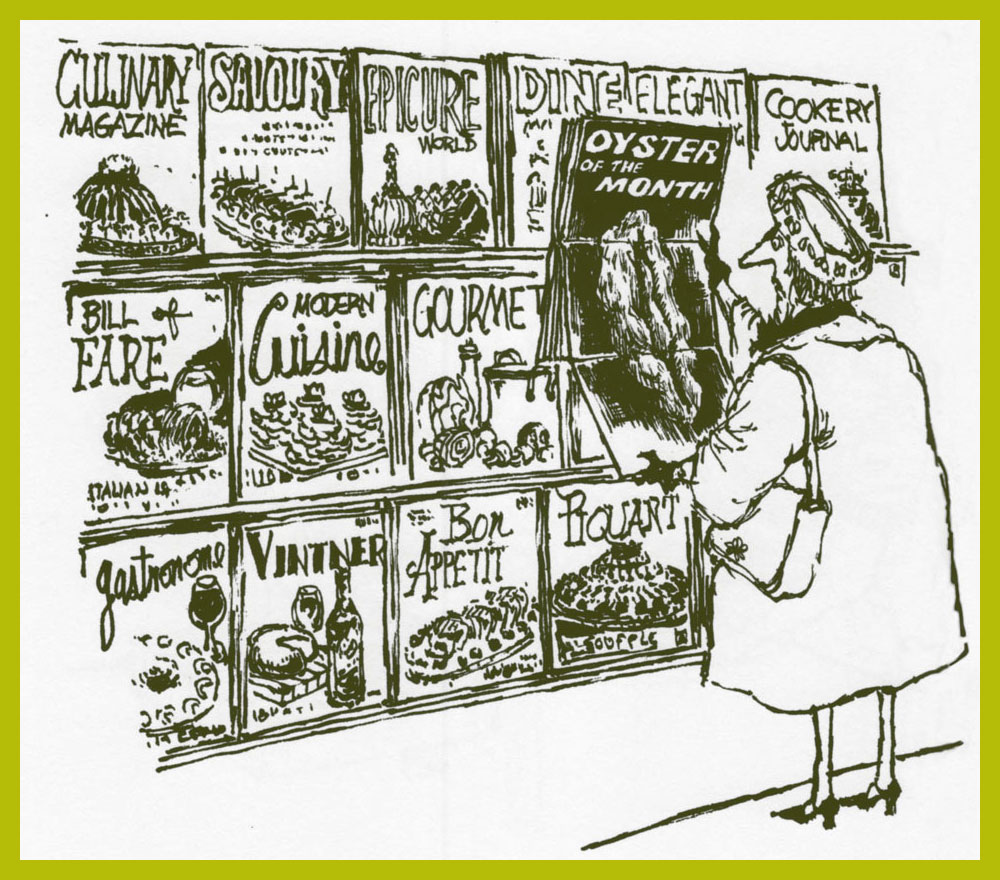
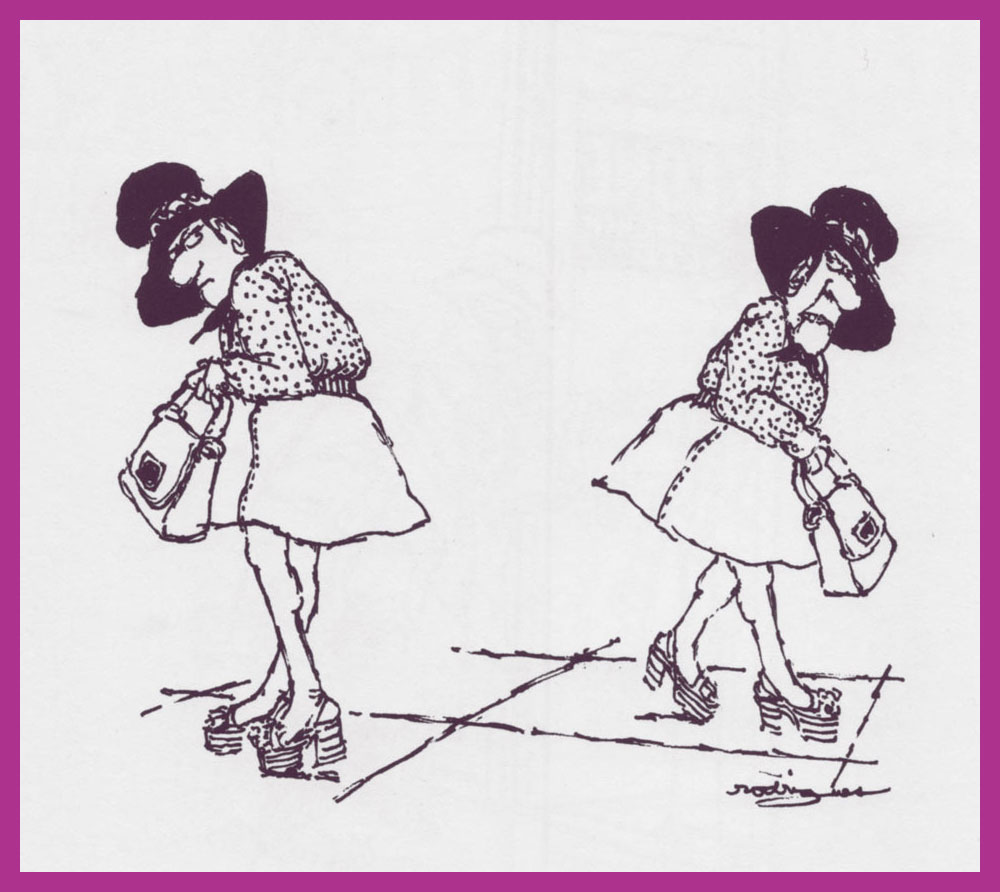
Charles Rodrigues’ Pantheon of Scabrous Humour

« He works at night, which is fitting, since some of his best cartoons deal with the dark side of the psyche. A classic black humorist, he rummages around in violence, insanity, perversion, bigotry and scatology, looking for what he needs to create the typical Rodrigues effect: wild laughter with a cringe of repulsion. » [source]

Charles Rodrigues (1926-2014) is an American cartoonist of Portuguese descent. Fantagraphics published two collections of this work, and their blurb describes him as « the sick mind behind some of the most outrageous, inventive, and offensive cartoons ever to appear in mass circulation magazines, including Stereo Review, Playboy and (from its very first issue) the National Lampoon. » One of these books collects his one-panel cartoons, and is titled Gag On This: The Scrofulous Cartoons of Charles Rodrigues. Scrofulous, in case you didn’t know, means something like ‘morally contaminated’.

So it will come as no surprise that this post might provoke a few pouts of distaste. On the other hand, I am hoping that it will also elicit some chuckles.

I remember my reaction at first reading Chuck Palahniuk’s 2005 short story ‘Guts‘ (if unfamiliar but curious, read it here, at your own peril) and feeling a sort of amazed astonishment about how far the author was willing to go. ‘He’s not really going to go there, is he? Oh wow, he actually went that far.’

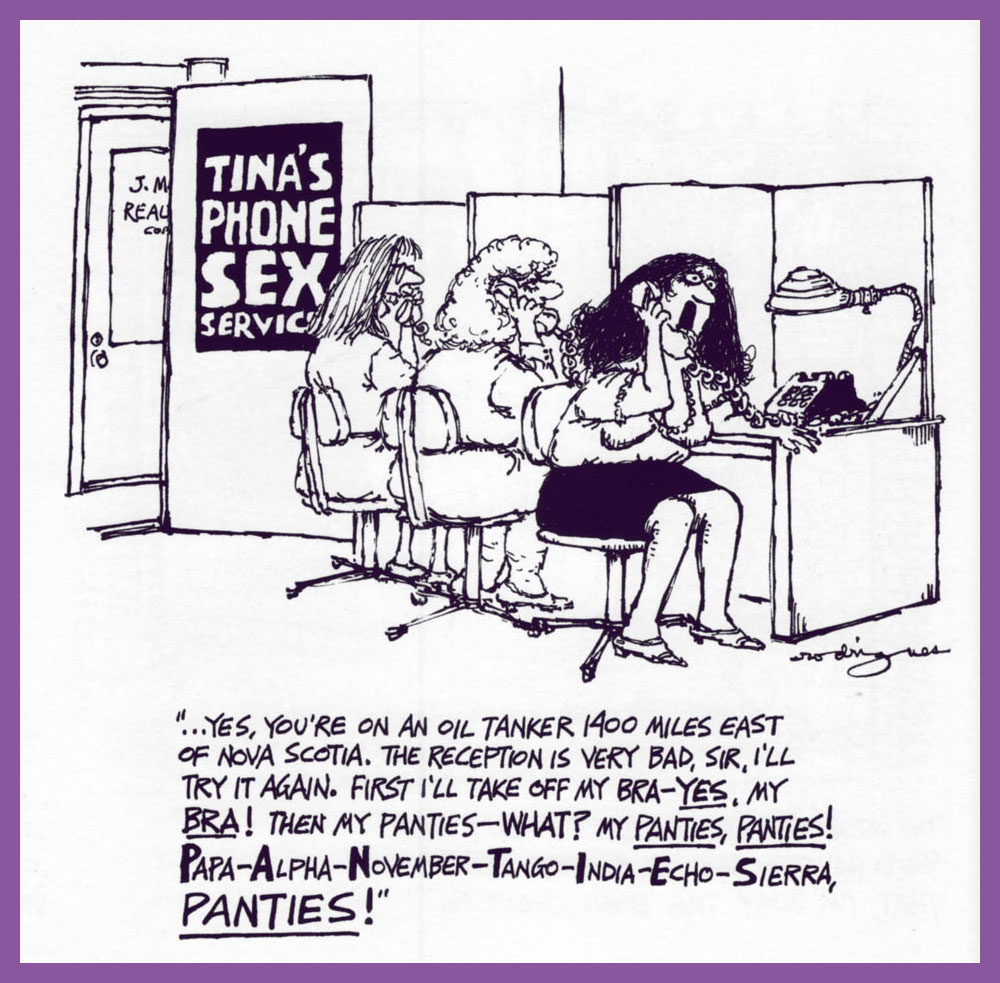
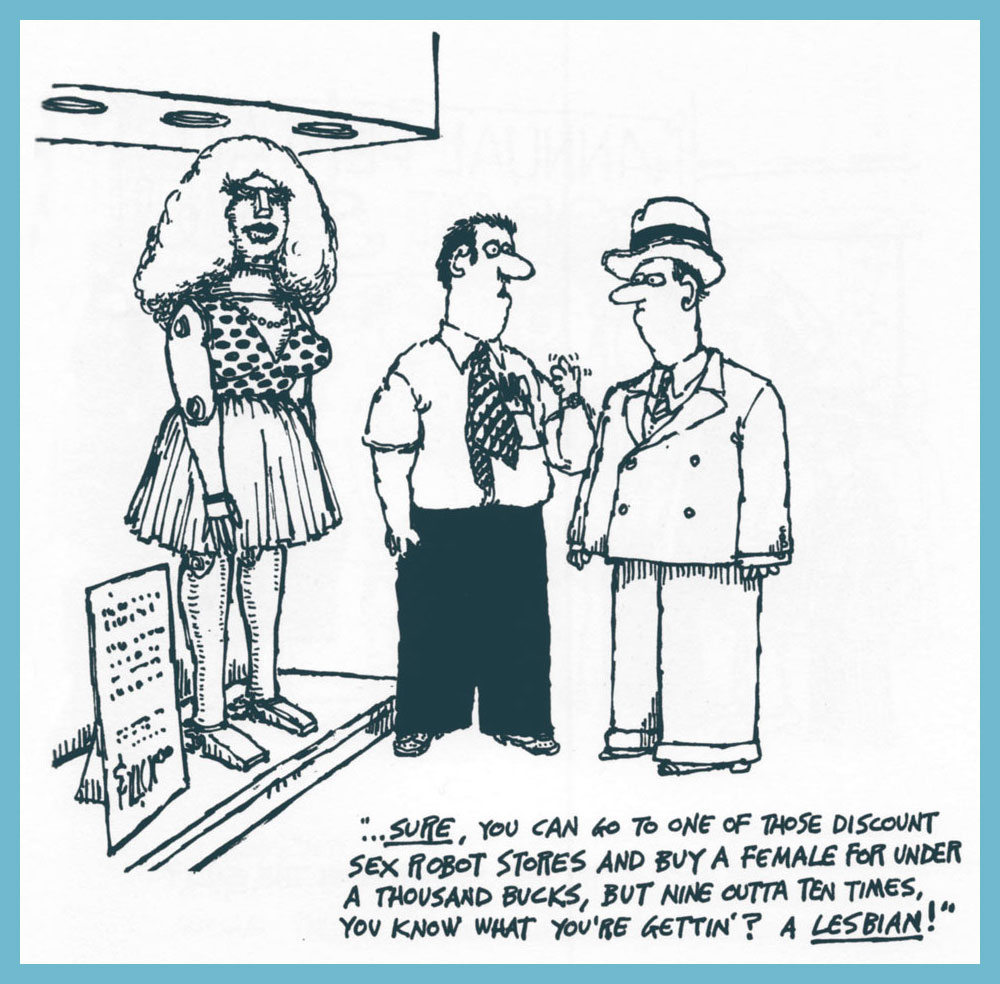
Well, reading Charles Rodrigues can be compared to that – at least in the slightly surreal surprise one feels when the gag winks at the reader, and trots happily across the invisible line nobody talks much about (but that we all know is there). If there’s a joke to be made, it doesn’t matter that it lies in the territory of the distinctly distasteful, Rodrigues will go for it with all arms blazing and nail it. Reading Guts is arguably an uncomfortable experience; reading a Rodrigues comic is wickedly entertaining… or incredibly offensive, depending on what floats (or sinks) your boat. He stuns the reader with a hilarious and crass barrage of absurdities reliant on scatology, taboos, and general indecency and sleaze. No one is safe – not the handicapped, nor the elderly; he flings dirt with equal aplomb at the women’s liberation front, gays and blacks, the terminally ill, rock stars, lepers, single mothers and ugly children, conjoined twins and cannibals — and this parade is only starting, chum.

Now I didn’t head into this with a desire to showcase the most stomach-churning of Rodrigues cartoons. This selection is based on a simple premise: some of my favourite instances of his sacrilegious* sense of humour. Gross-out gags and crudeness are actually really easy to come by, and often incredibly stupid — I worry about people who think a guy getting hit in the balls is hilarious. But I hope that this post demonstrates that in this case, there is a keen intelligence and a writer’s talent at work.

The following single-panel cartoons have been collected in Gag On This: The Scrofulous Cartoons of Charles Rodrigues.

« Cartoonists can look upon his work with a kind of awe. His staggering is perfection, his actors expressive, his architecture and perspective masterful. But I’ve heard more than one layperson comment that his work looked rough and unpolished. I beg to differ. His line was thick, lumpy and bled right into the very fiber of the paper, but it is controlled and deliberate. This was a craftsman in charge of his medium. » Bob Fingerman, from the introduction to Ray and Joe: The Story of a Man and His Dead Friend and Other Classic Comics.

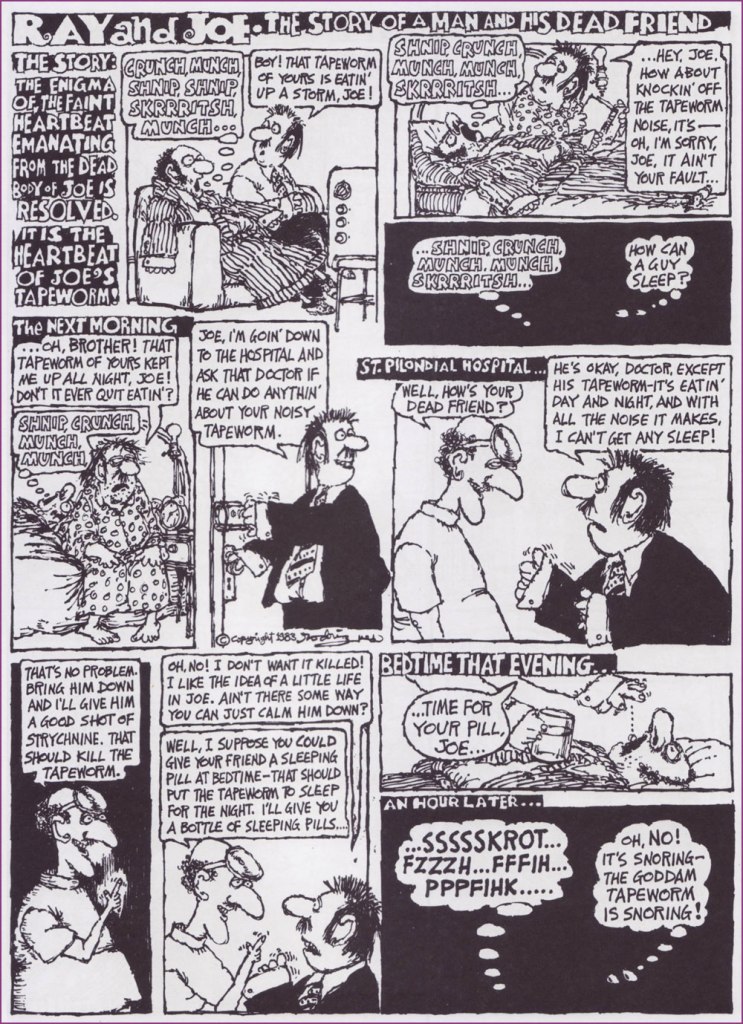
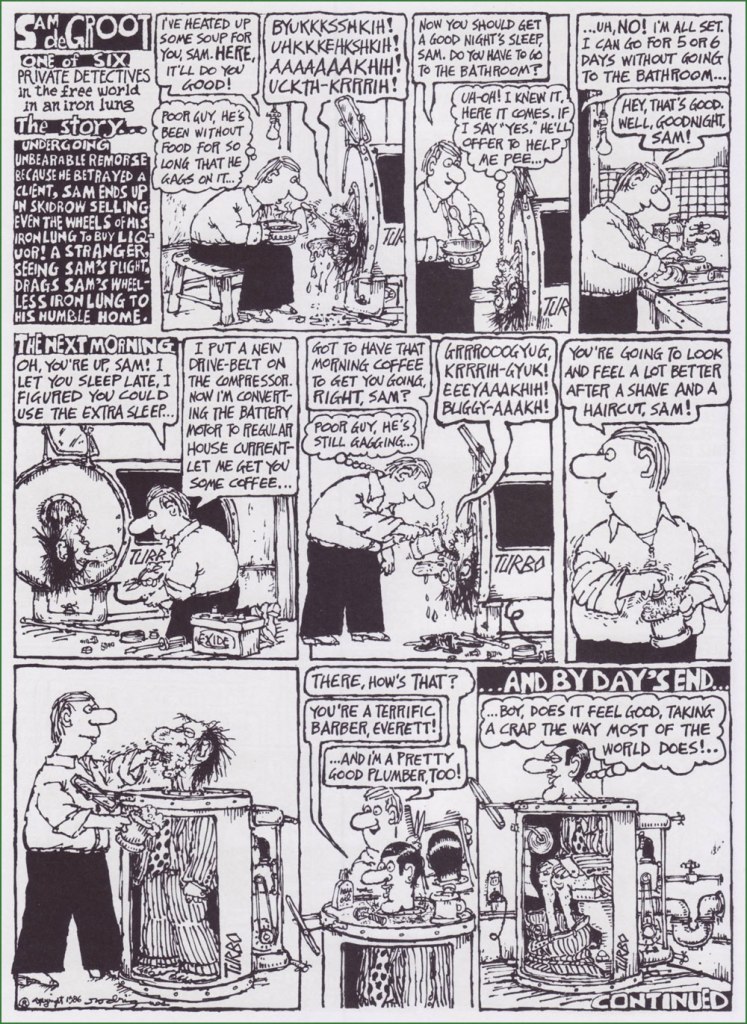
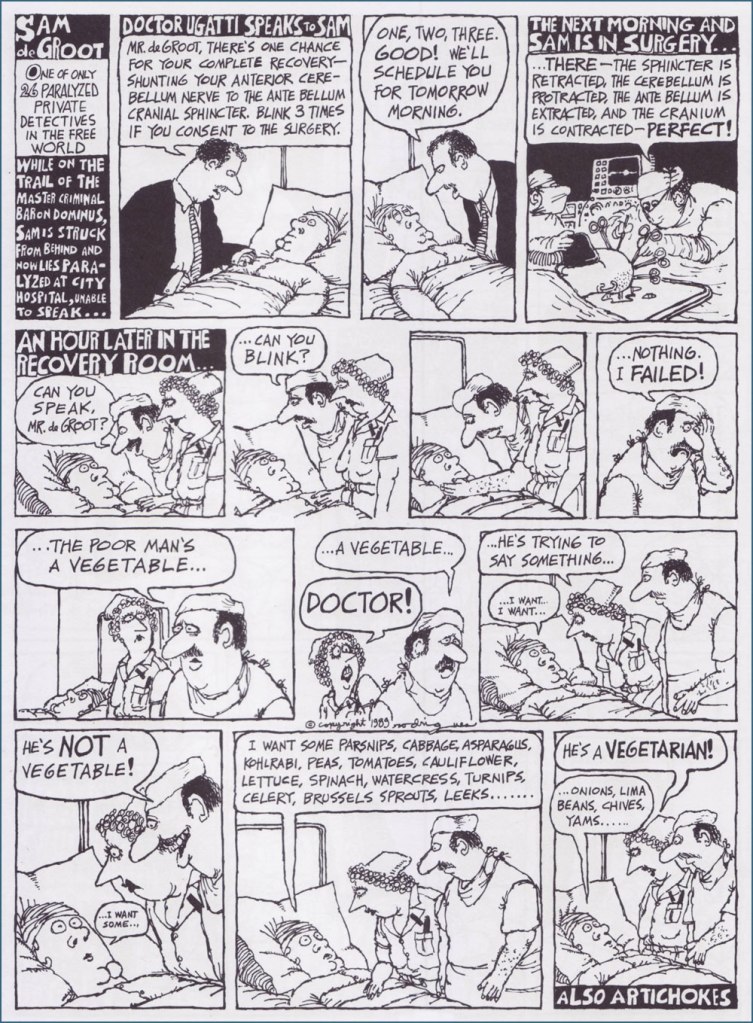
While his panel cartoons hit hard and fast, when given the space to develop a longer story, Rodrigues takes the time to set up things up for maximum… nastiness, with every gag flowing the most naturally in the world into an even more over-the-top one. The following pages are excerpted from Ray and Joe: The Story of a Man and His Dead Friend and Other Classic Comics, which had been my first exposure to Rodrigues’ work, which « boggled the mind and challenged all sense of decency and propriety ». What can I say? I found it in a now-defunct comic bookstore, looked through a few pages and immediately purchased it.

Page from The Story of a Man and his Dead Friend, in which Ray’s friend Joe dies, and Ray decides to keep his corpse around because he’s lonely without him (Joe is embalmed to avoid unpleasant odours and whatnot, which leads to its own set of scatological issues).
Page from Sam DeGroot: The Free World’s Only Private Detective in an Iron Lung Machine. Sam is on skid row after a series of misfortunes, but is picked up by a kind-hearted civilian (who turns out to be fattening him up to be eaten later on).
Sam is being successfully fattened up (Everett the cannibal is a very talented cook!), although in this panel Everett rescinds his evil man-eating ways, set on the right path by one of those door-to-door priests seeking to convert more sheep for his flock.
From the iron lung and into the hospital bed! Sam starts a new phase in his life (and ends up being literally able to talk out of his ass through an enema tube, but that comes later).

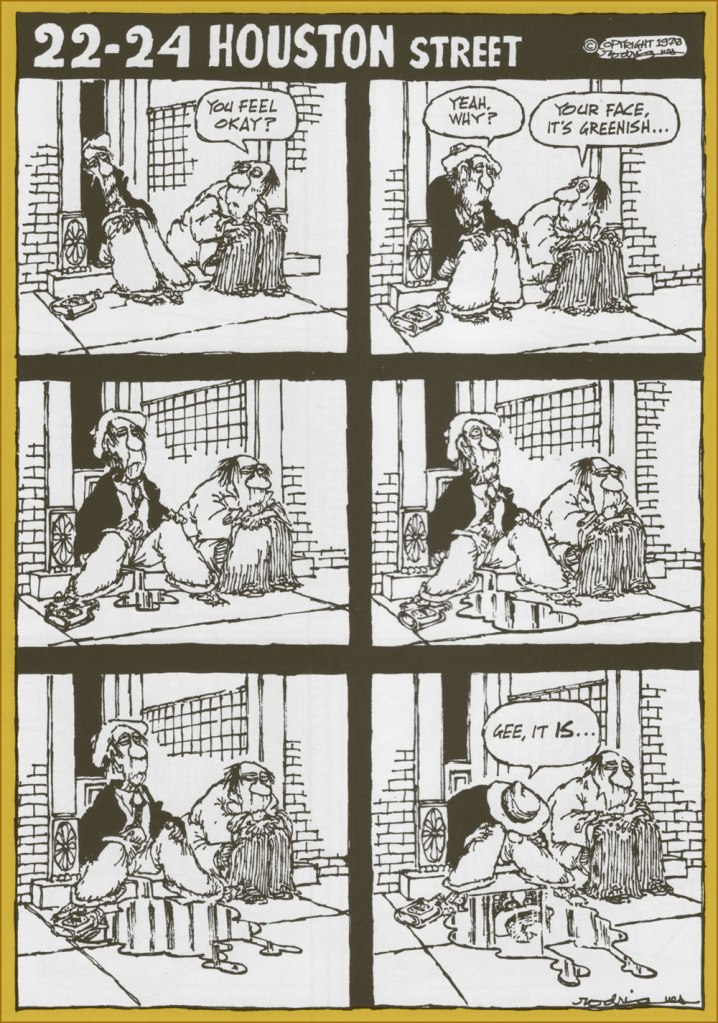
I’ll wrap this with an unrelated one-pager which somehow seems appropriate in this pandemic new year –

~ ds

*Interestingly, Rodrigues was actually a fairly religious, politically conservative man.

Massimo Mattioli Mania: M le magicien

Greetings to all! In this New Year, like an alcoholic in remission, I will abstain myself from tentacles (for at least a few months) while I catch up on other things I want to talk about. The first installment of this non-Tentacle Tuesday starts with an M, so it seemed appropriate to run it on Monday.

Massimo Mattioli (1943-2019) may be the second best-known Italian cartoonist abroad, at least according to Lambiek Comiclopedia (the first being Benito Jacovitti, another post in the making). However, an anglophone audience is likely to associate him with uncomfortable levels of violence, as only his 80s-and-onward strips have been translated to English. Case in point: his most notorious creation was Squeak the Mouse, serialized in underground Italian comics magazine Frigidaire in the early 80s. When this strip was imported into the United States, the customs agents seized the lot, as the work was deemed to be obscene and pornographic.

« Laying full-on slasher horror onto wacky cartoon violence, Mattioli’s characters embark on a sadistic bloodthirsty rampage, leaving a trail of mangled corpses and pools of blood in their wake. And the comic’s gratuitous bloodshed is not to be overshadowed by its crude humor and over-the-top sexcapades. In sum, a tour de force of unrelenting transgression, rendered in clean line art and dazzling pastel colors. » [source]

But this isn’t today’s topic. For this post I’d like to go back further in time, to a gentler and arguably more inventive Mattioli, since I don’t believe that over-the-top violence necessarily requires that much imagination. We go back to 1968 and the magical (and I try not to throw this word around lightly) M le magicien. Co-admin RG and I have our separate libraries, but since our tastes overlap by a large margin, we try to keep the number of duplicates to a minimum. Suffice it to say we both have a copy of the collected M le magicien strips (published by L’Association in 2003), and neither of us is parting with ours.

In 1968, 25-year-old Mattioli had moved from his native Rome to Paris, France, and there joined the illustrious ranks of artists revelling in absurdity and tongue-in-cheek humour (for example, Nikita Mandryka and his Le concombre masqué) working for communist magazine Vaillant, which was renamed Pif Gadget a year later. Mattioli’s first long-term project, M le magicien debuted in issue no. 1227 (December 1968), and continued its run until 1973.

It’s not really clear why the series ended – the introduction to L’Association collection just mentions that Mattioli decided to return to Rome. However, it seems likely that the strip was ousted by pressure exerted by Claude Compeyron, président-directeur général (CEO) of Vaillant – obsessed by commercial success and marketing schemes, he saw no point in publishing ‘lesser’ strips that were more difficult to absorb (Hugo Pratt‘s Corto Maltese, Les pionniers de l’espérance) or not immediately appealing to children. Compeyron’s approach to selling magazines (‘a magazine is like any product you sell or buy, like a pair of shoes‘) led to rédacteur en chef (editor-in-chief) Richard Medioni resigning in 1973. Medioni’s departure marked the end of what was arguably Pif Gadget’s golden, ‘red’, period; from that point onward, the editors had to learn to kowtow to the marketing department, and commercialism reigned supreme.*

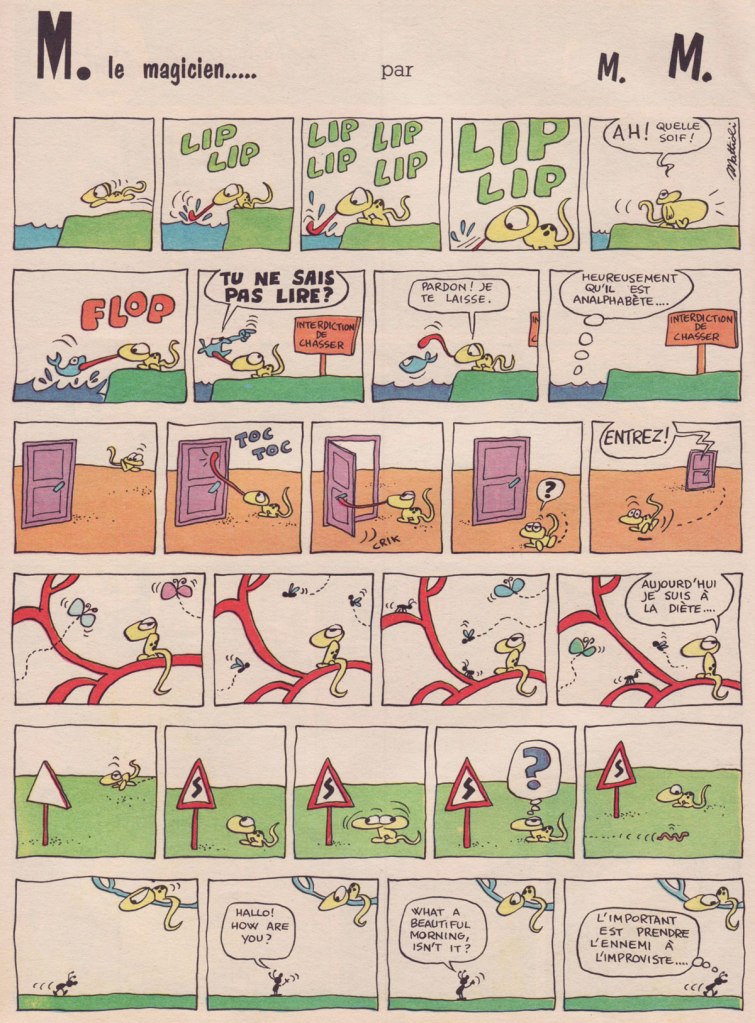
The cast of M le magicien is relatively succinct: the protagonist, your fairly standard magician, his talking magic wand, and a couple of chameleons (who periodically mlem the magician, mistaking him for an insect), two Martians bent on world destruction (or just magician’s castle destruction), a few insects of various shapes and genders, and some talking flowers and mushrooms. The characters are free to roam across pages, consume the backgrounds when they get hungry, and address the reader directly. Mattioli was not confident about his French, so he availed himself of visual humour with fairly simple (sometimes slightly unhinged) dialogues, which added to the charming atmosphere of absurdity.
While (as mentioned previously) we are the proud owners of two copies of the collected M le magicien, I had no wish to destroy either book by attempting to scan pages from it. Luckily, RG put quite a few Pif Gadget issues at my disposal, and I chose my favourites from this lot.
In the early days, Mattioli often stuck to one theme for his page, but tackled it from many angles in each self-contained strip of five panels. The following page vaguely concerns itself with the yellow chameleon’s insatiable appetite, a recurring joke:

From Pif Gadget no. 31 (September 1969). The first sequence of panels ends with ‘what a thirst!‘ In the second, the fish passes the ‘no hunting’ sign for a ‘no fishing‘ one, since the chameleon is fortunately illiterate. In the third, he’s dieting. Finally, in the fifth, the ant switching to English unexpectedly confuses the chameleon so that he forgets to eat it.
From Pif Gadget no. 53 (February 1970). The snow-averse flower wants somebody to lend it its fur, then complains to the heavens that nobody likes snow (to which the heavens answer, ‘but it’s free!’). Defeated by the snow, the flower concludes with ‘I surrender!’
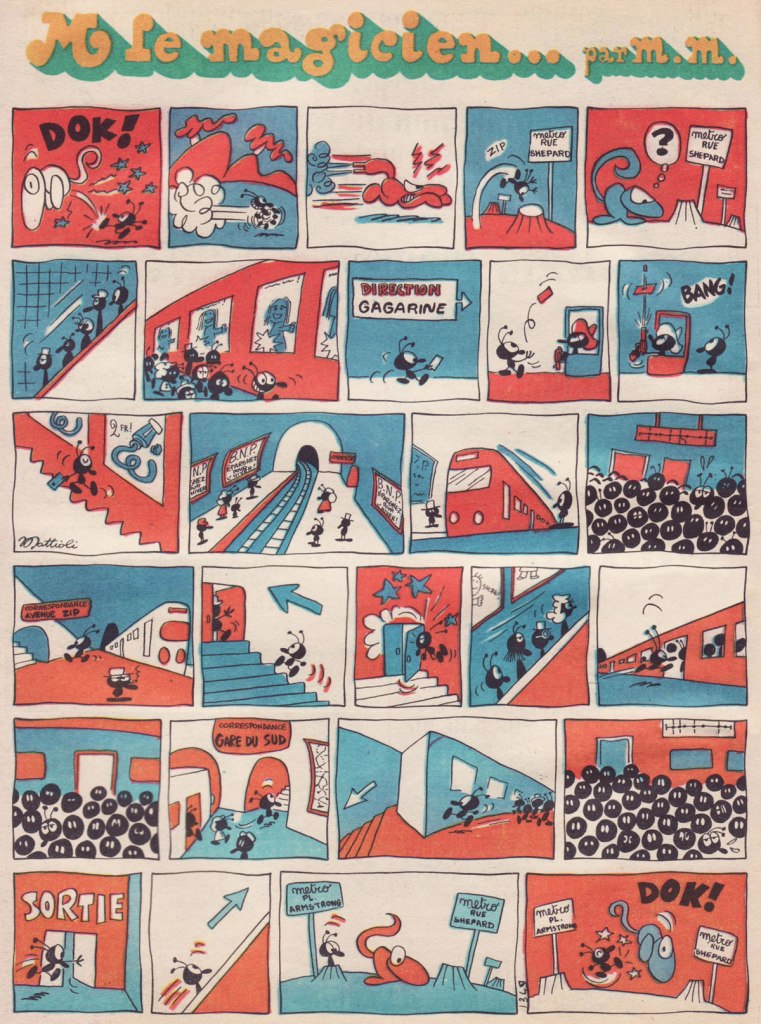
From Pif Gadget no. 111 (April 1971). I love that the ants have an elaborate underground city – and use it to their advantage. Note that by now M le magicien has an official (and lovely) logo!
From Pif Gadget no. 144 (November 1971). A self-explanatory sequence of head swaps!
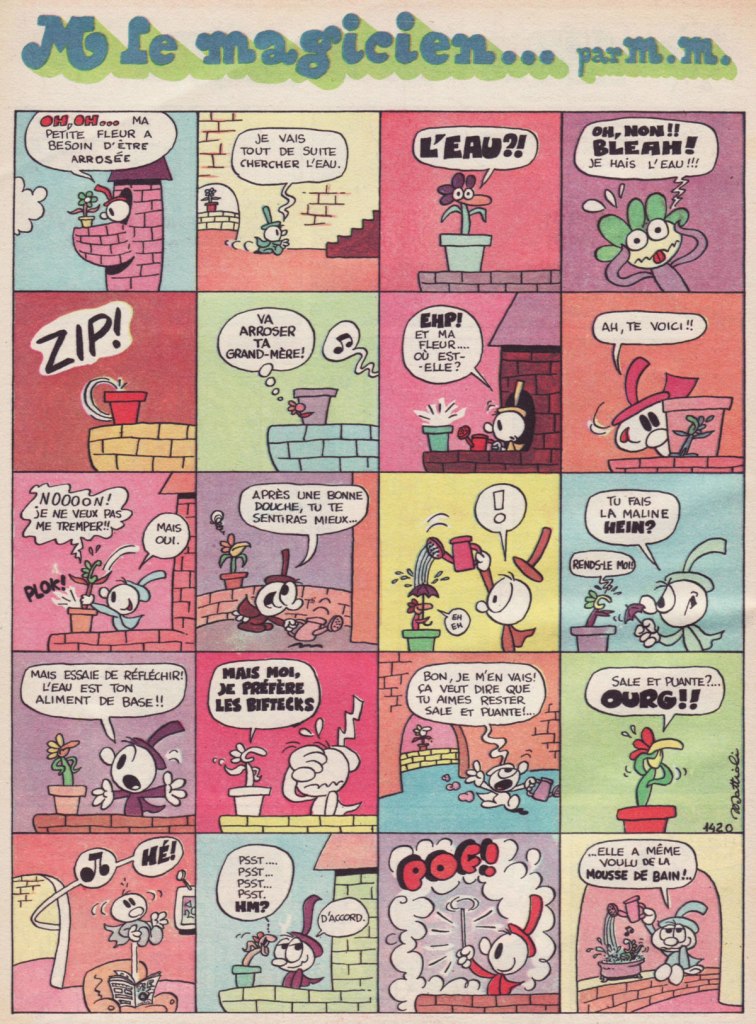
From Pif Gadget no. 182 (August 1972). The flower that hates water (and would rather eat steak) refuses to be watered until the magician mentions that it’s free to remain dirty and smelly if it wants to – then the flower opts for a bubble bath.

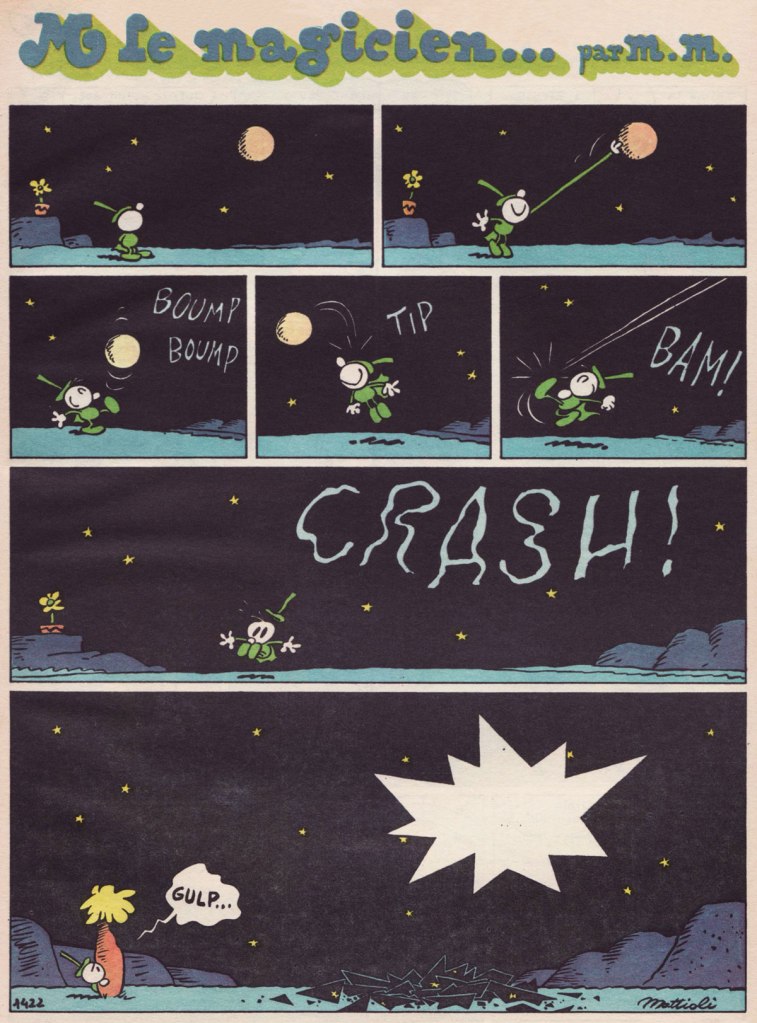
In later issues, Mattioli went for more ambitious, visually stunning but more spare one-page stories, often paying an obvious hommage to Krazy Kat.

From Pif Gadget no. 184 (September 1972).
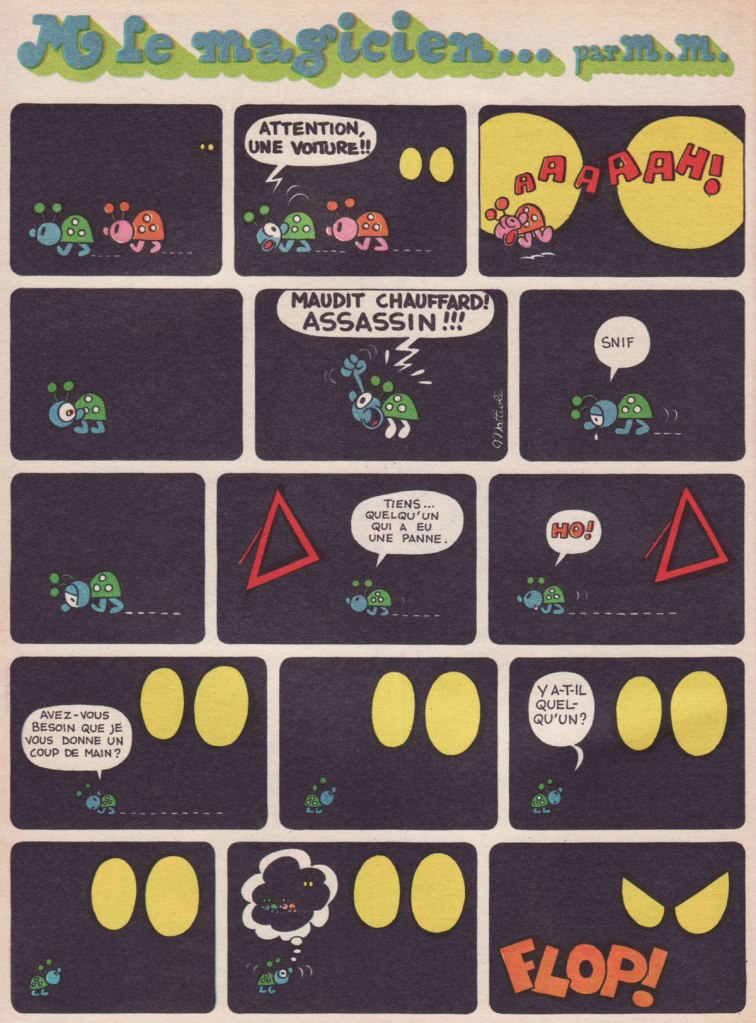
From Pif Gadget no. 185 (September 1972). Starting with a ‘look out, car!‘ warning, this page uses headlights as camouflage for the chameleon, betrayed by the characteristic FLOP sound he makes when gobbling up the remaining bug in the final panel.
From Pif Gadget no. 189 (October 1972). Another Herriman-esque page… with a classic banana gag, to boot (or to slide).
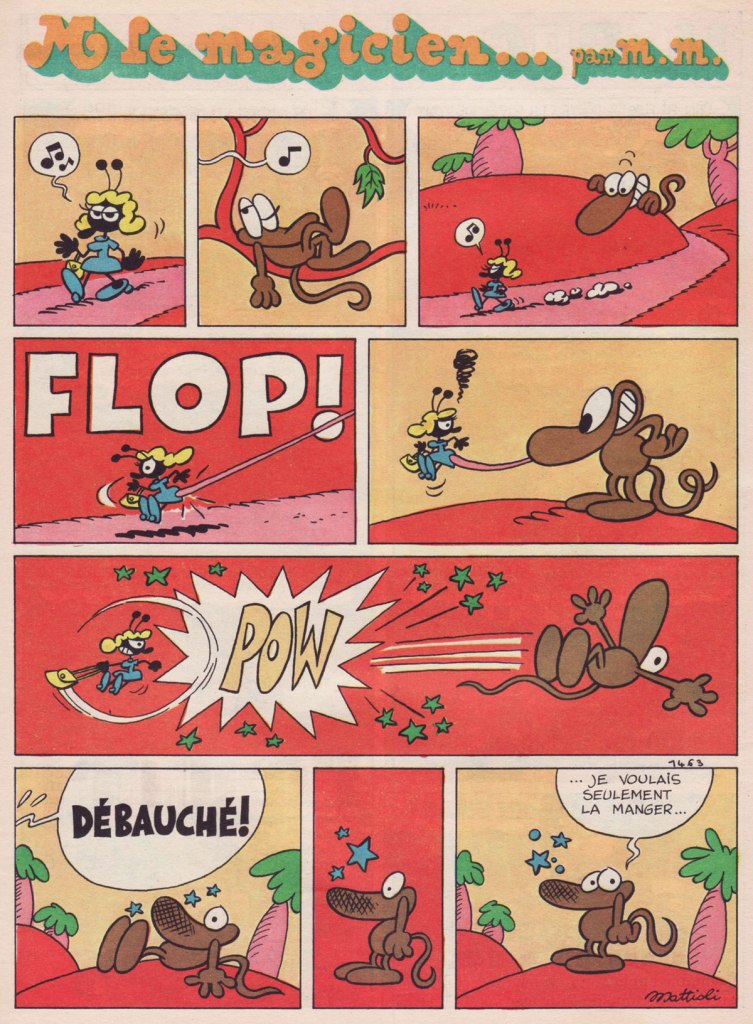
From Pif Gadget no. 225 (June 1973). ‘Pervert!‘, exclaims the indignant ant – to which the chameleon responds with ‘… but I only wanted to eat her…

And there we have it, a quick gallop through but a few strips of this masterpiece of humour and poetry. I highly recommend seeking out the omnibus if you speak at least un petit peu français.

Looking up meta-humour while I was writing this post, I came across a few choice jokes that made me crack up. While they’re not wholly related to M le magicien, their lovely absurdity fits right in with its spirit.

A dyslexic man walks into a bra.

A non sequitur walks into a bar. In a strong wind, even turkeys can fly.

A guy walks into a bar and says “ouch!”

What do you get when you cross a joke with a rhetorical question?

A dangling participle walks into a bar. Enjoying a cocktail and chatting with the bartender, the evening passes pleasantly.

~ ds

*Which is a (depressing) conversation for another day, but in the meantime, we highly recommend getting it from the horse’s mouth, so to speak, by reading Mon Camarade, Vaillant, Pif Gadget: l’histoire complète 1901-1994 by Richard Medioni.

Tentacle Tuesday: Spot the Octopus

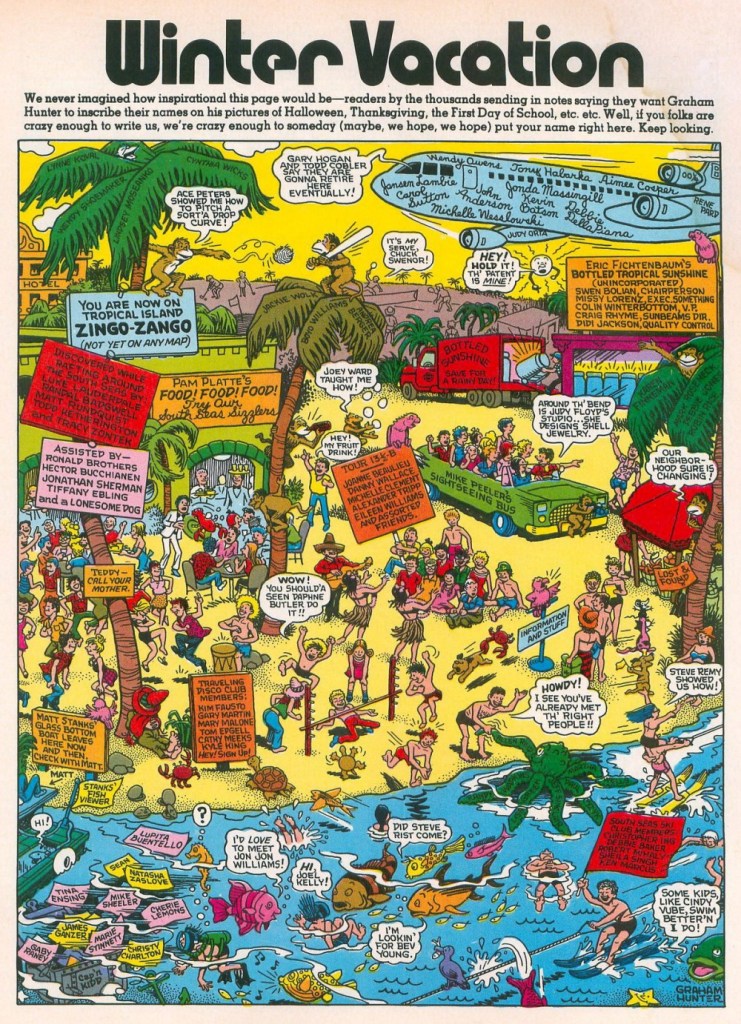
An octopus has crept into the following pages. Can you spot it before the year ends?*

*I realize this is an extremely easy assignment, but given the state of things these days, one should seek out a minor sense of accomplishment wherever one may find it!

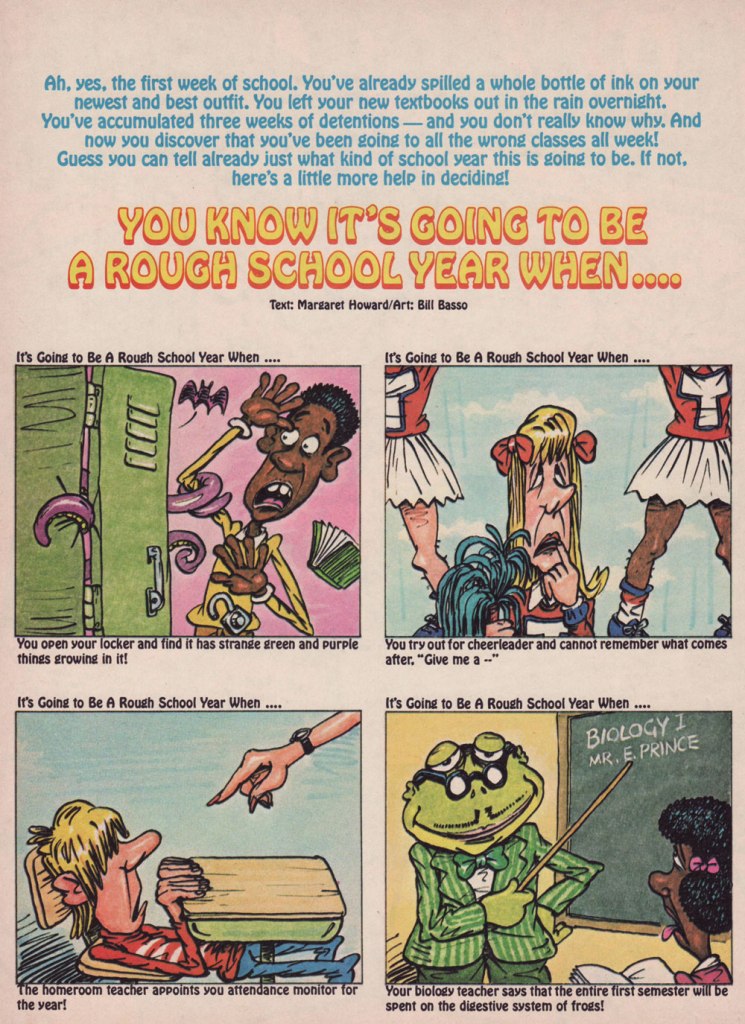
Page from Bananas no. 13 (1975, Scholastic), a kids’ magazine from the 70s. Somewhat similar to its older brother Dynamite, Bananas had (even) more of a focus on celebrities. Art by Bill Basso.
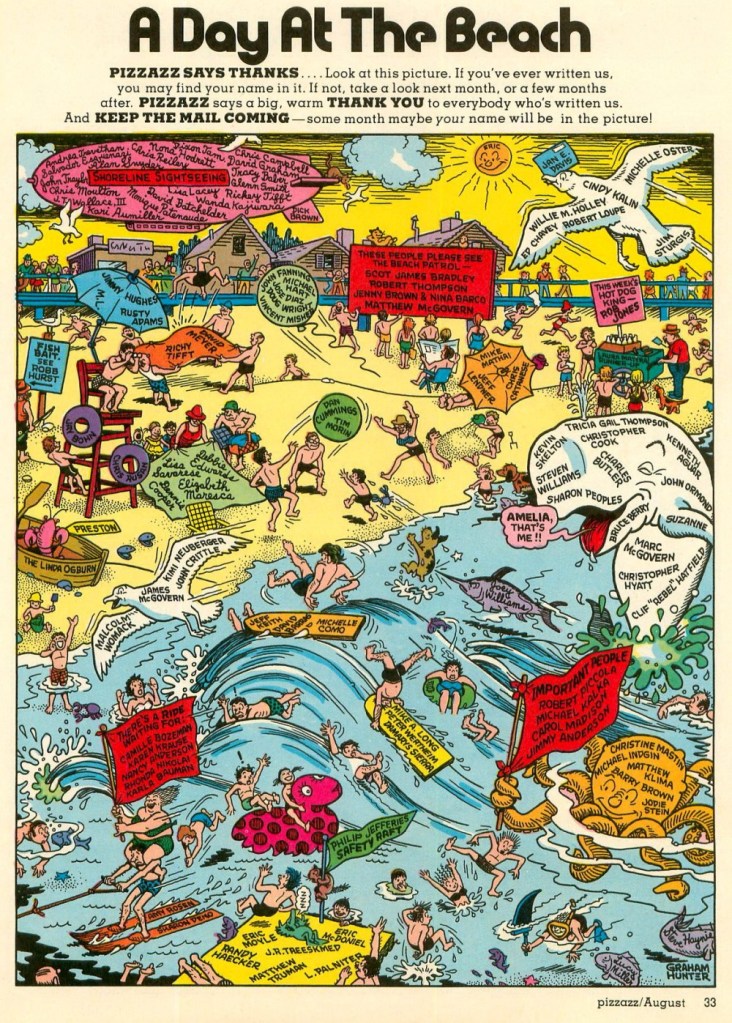
Pizzazz, published by Marvel Comics from 1977 to 1979, was pretty much a rip-off of Dynamite, and, as co-admin RG points out, rather tiresome to read with its constant insertions of Marvel plugs. From Pizzazz no. 11 (August, 1978, Marvel), this elaborate scene is by Graham Hunter – visit Hallowe’en Countdown, Day 27 for more from this great artist!
From the mag’s final issue, Pizzazz no. 16 (Jan. 1979, Marvel).

I have plenty more tentacles saved up, but after four years of weekly cephalopods, I am growing rather weary of this topic. While I endeavour to rekindle this old love of mine, I will move on to other interesting things, so this is not only the last Tentacle Tuesday of the year, but the last TT for a bit. See you on newer, fresher pastures!

~ ds

Santa Clauses Good, Bad, and in Between!

« Talk about cheap – on Christmas Eve, my neighbor shoots off three blanks and tells his kids Santa Claus just committed suicide. » — Milton Berle

We hope this Christmas day finds you healthy and happy, whether you’re spending it quietly with the nearest and dearest, or stranded far from your family. We all do the best we can.

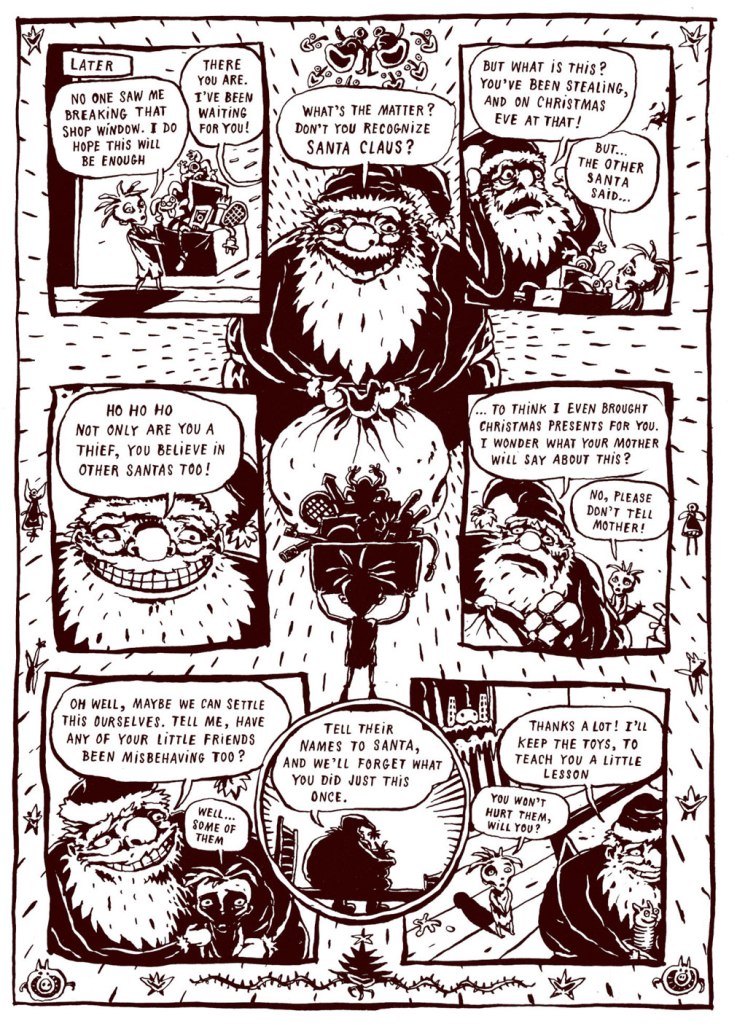
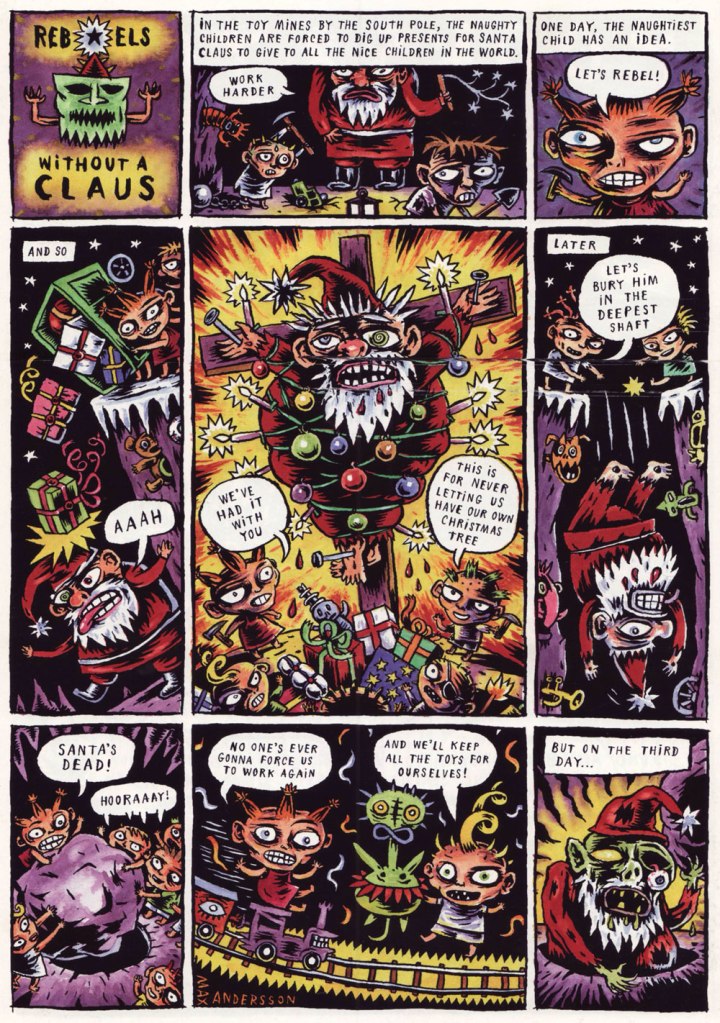
In a slightly different, yet somehow appropriate, vein… the following Christmas story by Max Andersson is a bracing antidote to the usual syrupy cheer of December 25th. As co-admin RG aptly put it*, in Andersson’s world, malevolence is the status quo, and this Jekyll-and-Hyde version of Santa Claus will fluff up the fur of the staunchest anti-Christmas reader.

*Read A Secret, Silken World: Max Andersson’s “Lolita’s Adventures”

Good Claus Bad Claus was published in Zero Zero no. 7 (Jan-Feb 1996, Fantagraphics).

As a bonus, we are including the no less cynical, but quite satisfying, back page of Death & Candy no. 1 (December 1999, Fantagraphics). Santa had it coming!

Ho-ho-ho (down the shaft), merry Christmas to all of our kind readers!

— Daria and Richard

Tentacle Tuesday: Tentacles, Illustrated

Today’s Tentacle Tuesday is going to be short and sweet, as the week before Christmas, complicated traveling plans, and pandemic scares do not incite one to write long posts.

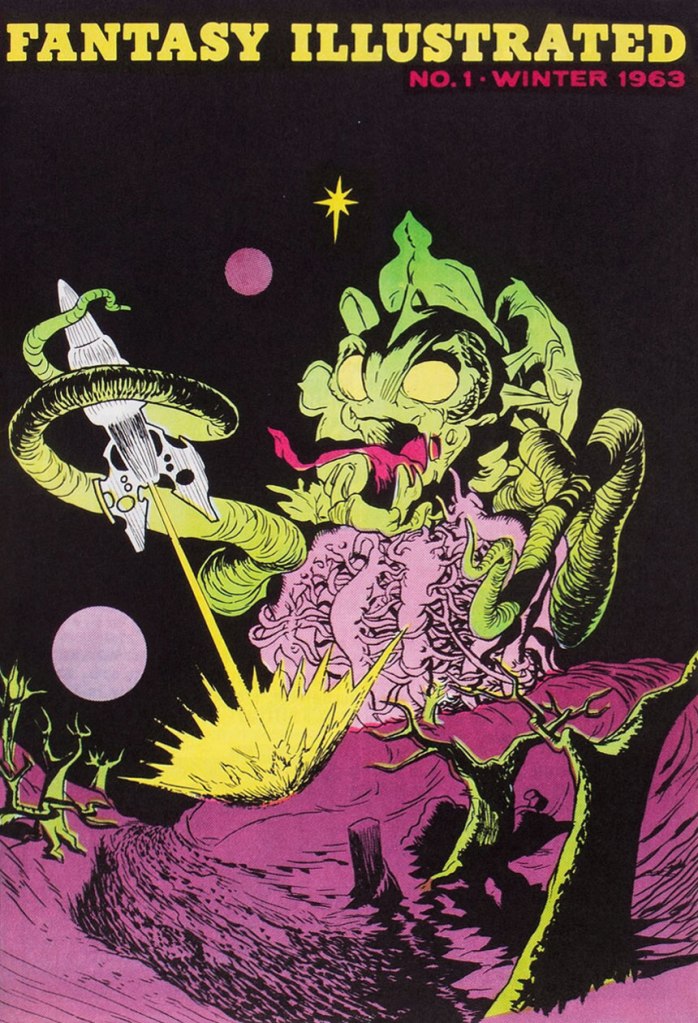
Bill Spicer, a then-letterer for Western Publishing, launched Fantasy Illustrated in 1964, after gathering some contributors through a want ad in a science-fiction fanzine. The introduction (with issue 4) of a Spicer-penned column titled ‘Graphic Story Review’ heralded a shift from the initial graphic adaptation of stories to a focus on articles and interviews, and what used to be Fantasy Illustrated continued as Graphic Story Magazine by issue 8 in 1967. GSM may have been somewhat short-lived (it lasted another 9 issues), but thanks to Spicer’s sensitive and literate editorial direction, it had a lasting impact on the minds of astute readers through pioneering in-depth interviews with comics creators (notably Basil Wolverton, Bernard Krigstein, Howard Nostrand…). GSM would later morph into the equally-excellent, but with a broader scope, Fanfare (5 issues, 1977-83).

Fantasy Illustrated no. 1 (Winter 1963). Cover by Landon Chesney.
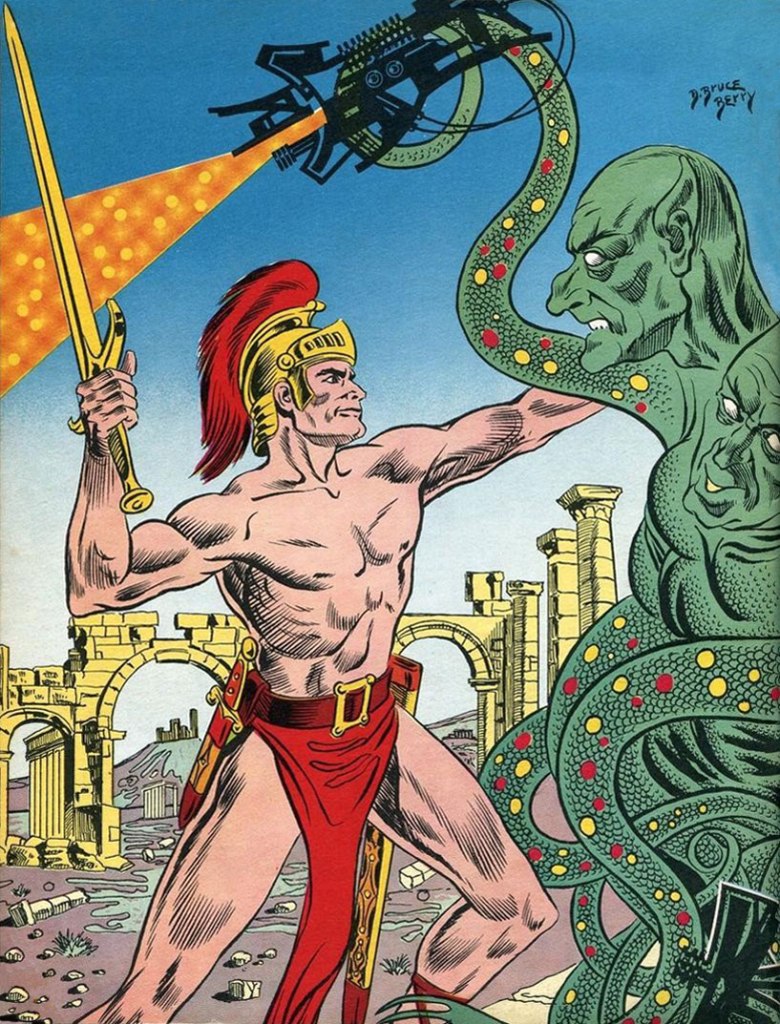
Fantasy Illustrated no. 6 (Summer/Fall 1966). Cover by future Jack Kirby inker D. Bruce Berry (Kamandi, OMAC, Manhunter).
The back of Fantasy Illustrated no. 6 (also by Douglas Bruce Berry).

~ ds