« You know, the dog food that Billy Jack loves! » — The Firesign Theatre
Ah, September the 18th. Today’s the birthday of the staggeringly accomplished William Stout (born in 1949), master of ancient reptiles, bootleg record covers, friend of The Firesign Theatre, former Russ Manning assistant (none but the best would do!), and I’ll spare you the illustrious details of his career in cinema. Still, let’s look around a bit, shall we?
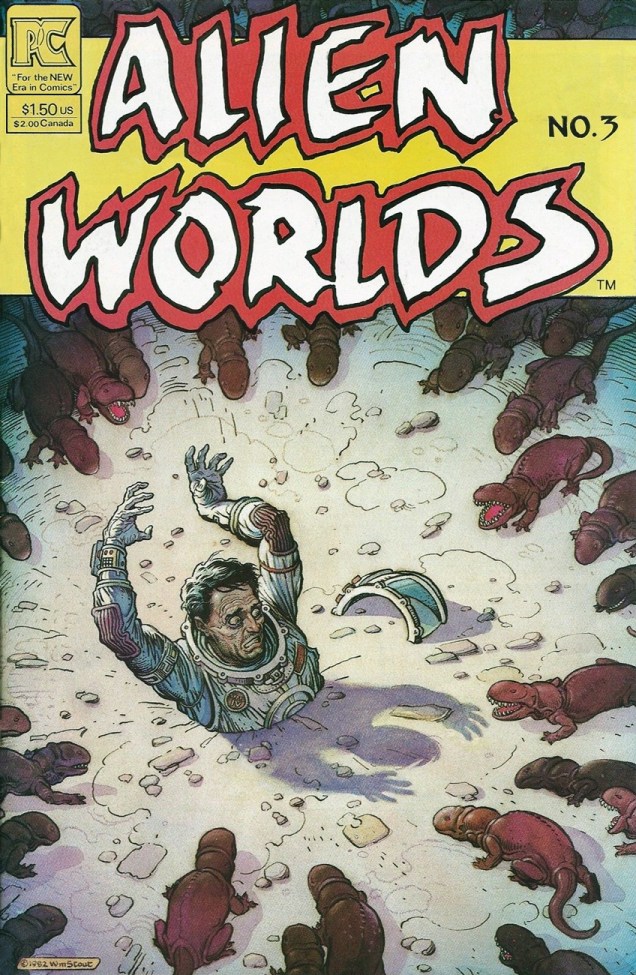
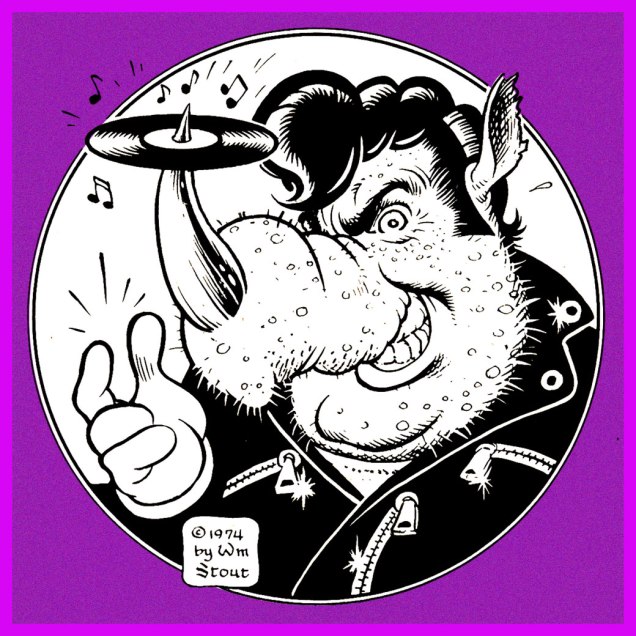
Here’s an unforgettable cover from Alien Worlds no. 3 (July, 1983, Pacific Comics). This scene gave me nightmares, and still raises a shudder. These critters look like a hybrid of a platypus and a piranha. Happy landings!Stout’s wonderful original logo for Rhino Records, circa 1974.
Speaking of ’74, isn’t that rhino a dead ringer for Swan’s oleaginous right-hand man, Philbin, from Phantom of the Paradise?
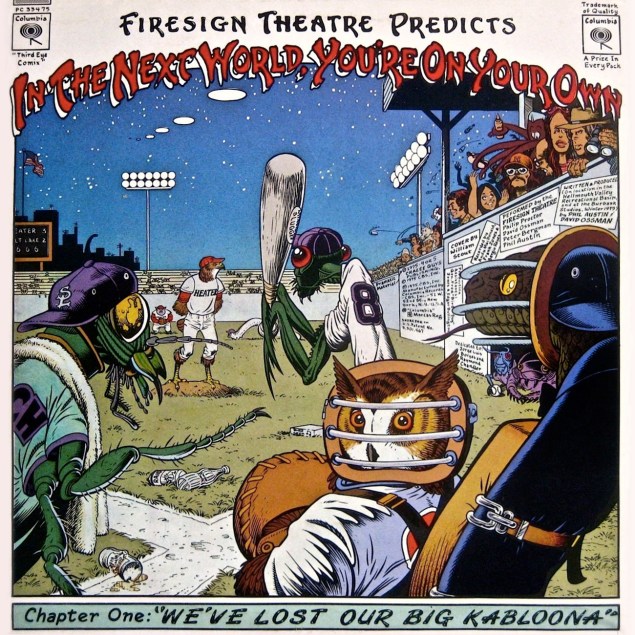
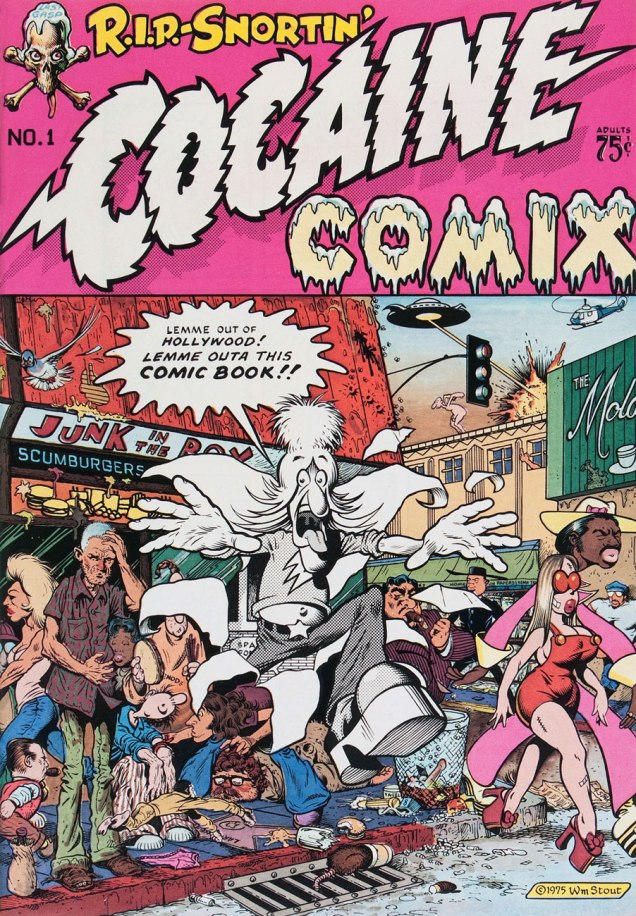
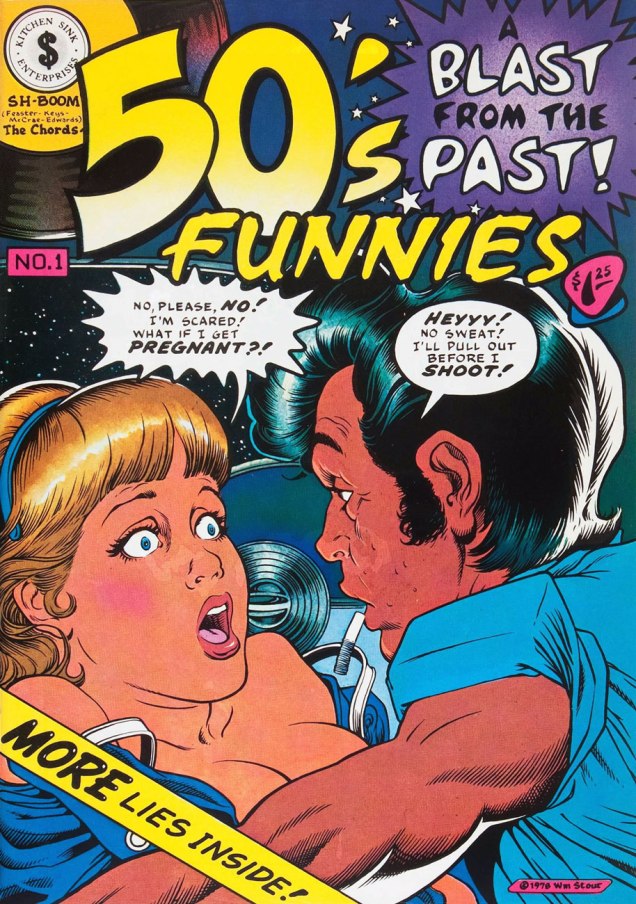
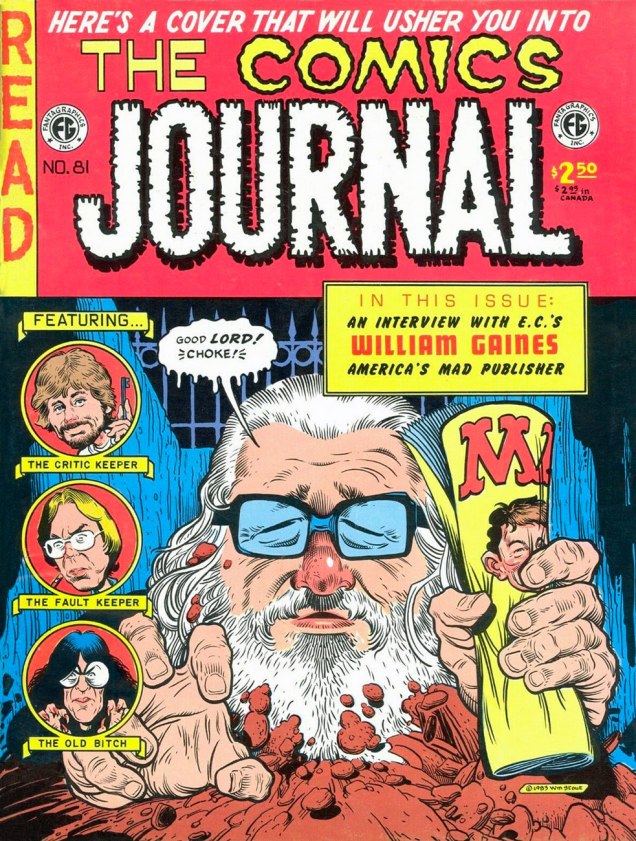
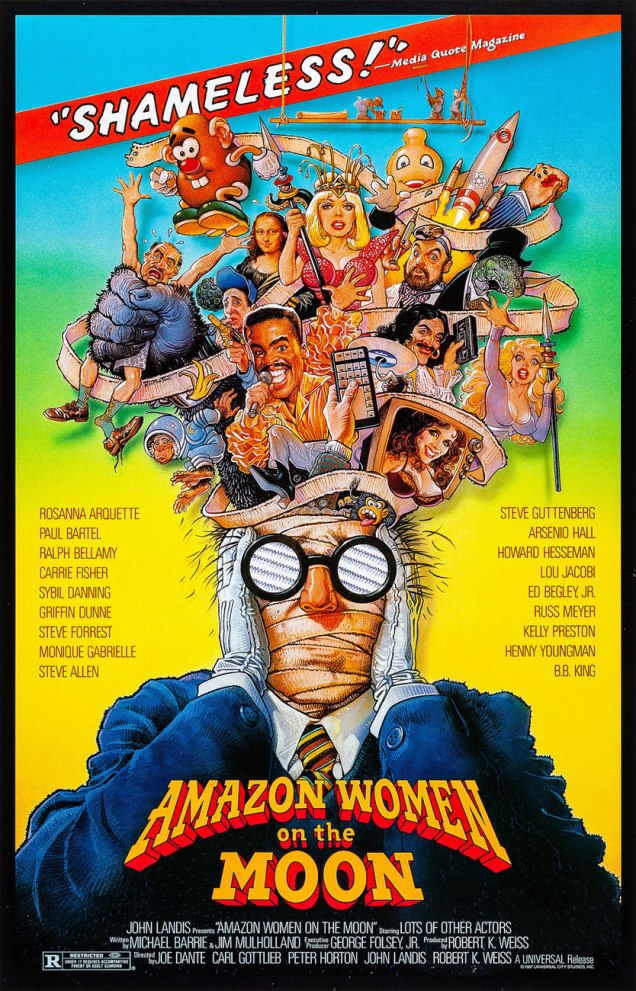
This is the back cover (the recto is equally sumptuous) for The Firesign Theatre‘s 1975 opus, In the Next World, You’re On Your Own, featuring a pair of classic sidelong suites, Police StreetandWe’ve Lost Our Big Kabloona.A clutch of underground classics? Sure. Here’s Cocaine Comix no. 1 (Feb. 1976, Last Gasp).Another number one (with a bullet, of course): 50’s Funnies no. 1 (1980, Kitchen Sink). More lies inside!A favourite page from Stout’s masterpiece (or certainly his great labour of love, at the very least): The Dinosaurs: A Fantastic New View of a Lost Era (1981, edited by Byron Preiss). This piece (the first he drew for the book) is entitled Hot Weather. « After lifting his head for air, he drank more and then wallowed his whole length and breadth into the ooze, vocalizing for the first time that day, and loudly. »Say hello to friendly Ed Gein. Weird Trips no. 2 (1978, Kitchen Sink). Please note the sinisterly customized Kitchen Sink Enterprises logo, Wrightson–brand coffee, and EC Comics narrator The Old Witch impishly peeking from a lower-right shelf. And yes, can’t go disemboweling your fellow man and woman without a copy of Gray’s Anatomy. Preparation is everything!Well, there never was any doubt that Mr. Stout was an EC Comics überfan. The Comics Journal no. 81 (May, 1983, Fantagraphics).I did bring up his Hollywood work, so here’s a sample. I wasn’t going to go with his the far-too-familiar Rock ‘n’ Roll High School poster… you all know it already, so where’s the fun in that? Of course, Joe Dante’s Amazon Women on the Moon again (1987) raises the eternal question: « Who made Steve Guttenberg a Star? »
And that’s Bill Stout for you: stunningly versatile, but always himself. Could any artist strive for more?
« The stranger’s face was entirely obscured by a broad-brimmed felt hat bent downward over his features; and the long, black coat looked almost like part of the thickening fog. » –Harry Vincent first encounters his future employer. (Shadow Magazine, April/June, 1931)
We note today the birth anniversary of Walter B. Gibson (September 12, 1897 – December 6, 1985), an extremely prolific writer and professional magician. Gibson is best known for developing the radio character of The Shadow, through nearly three hundred stories he wrote under the collective nom de plume of Maxwell Grant.
The Shadow’s had an interesting and varied career in comics, but Gibson’s novels (and the radio shows… Orson Welles!) are where it’s at. Still, let’s take a look around, shall we?
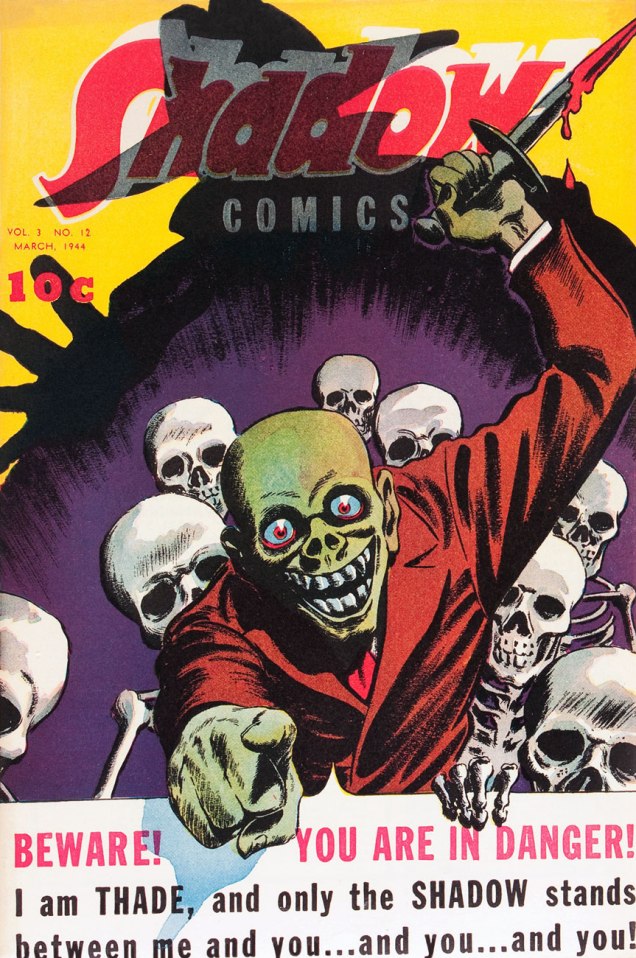
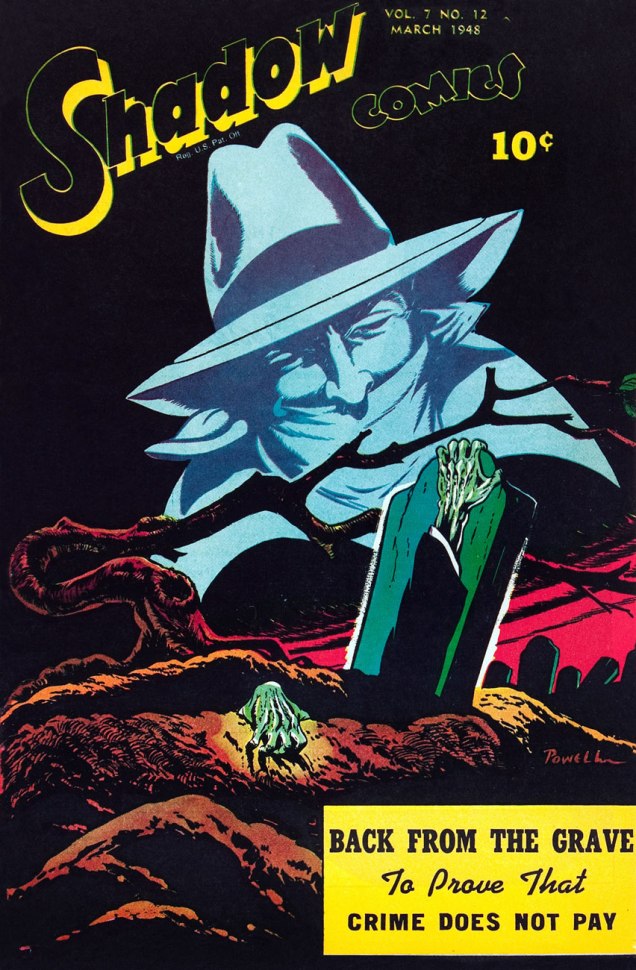
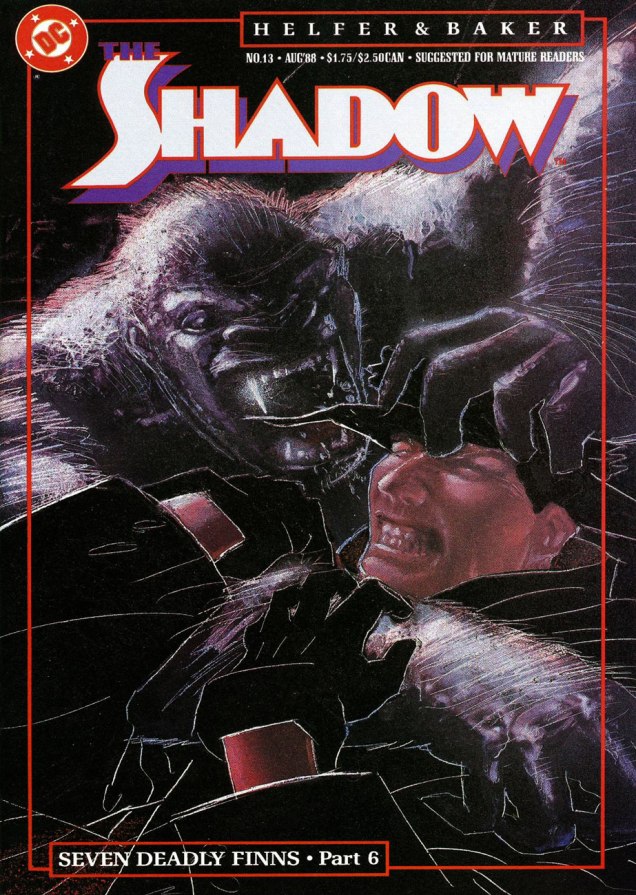
This is The Shadow Comics Vol. 3, no. 12 (March, 1944, Street and Smith); cover possibly by Vernon Greene. That Thade seems like a friendly sort, mayhap a tad overly so.This is The Shadow Comics Vol. 7, no. 12 (March, 1948, Street and Smith); cover by Bob Powell.Now why were Archie Comics allowed to take such ridiculous (though I’ll grant, perversely entertaining) liberties with The Shadow? Must have been a lull in the revival market, I suppose. This is The Shadow no. 1 (August, 1964, Archie), cover by Paul Reinman. You just wait until the subsequent issues…This, however, is not quite how Gibson envisioned and portrayed the mysterious Shadow. This off-model rendition hails from Archie Comics’ 8 issue, 1964-65 run, helmed by Superman co-creator Jerry Siegel and Golden Age journeyman Paul Reinman. This be The Shadow no.8 (September, 1965).A privileged peek at Frank Robbins‘ original cover art for The Shadow no.7 (Nov. 1974), second of his four (or so) covers for DC, featuring Night of the Beast!, scripted by Denny O’Neil. Yummy… but too short.Two great Street & Smith pulp heroes face off! Mr. Kaluta takes some artistic license here, however, since Ike (as The Avenger calls his throwing knife), is supposed to be small and almost needle-like, not a freakin’ butcher knife. Come to think of it, the Shadow’s trusty automatics look like something a Rob Liefeld character would wield. One doesn’t encounter often the final three issues of DC’s initial run of The Shadow. Post-Kaluta (save the covers) and post-Robbins, the art was handled by Filipino artist E.R. Cruz, who did a commendable job, while series regular Denny O’Neil (who wrote all issues except for number 9 and 11, Michael Uslan ably filling in) stayed until the curtain was drawn.Skipping the heinous Howard Chaykin revival, in which he delighted in sadistically dispatching The Shadow’s aged former operatives in gruesome ways (why do these people always call themselves fans of the original series?), we move on to the Andrew Helfer-Bill Sienkiewicz regular book. Better, but still not great. This is The Shadow no. 3 (Oct. 1987). Cover by Bill Sienkiewicz.Ah, now things perk up. A nasty but excellent tale, worthy of Michael Fleisher at his bugfuck best; the shade of Marshall Rogers and smart up-and-comer Kyle Baker were a good visual match. This is The Shadow no. 7 (Feb. 1988).This is Kyle Baker’s cover for the finale of his and scripter Andrew Helfer’s thrilling and hilarious Seven Deadly Finns saga (no. 13, March 1988) that made The Shadow such a must-read title. To quote Kate Bush, « What made it special made it dangerous », and the folks at Condé Nast, who hold the rights to the classic Street & Smith characters (also including Doc Savage and The Avenger) reportedly got twitchy* at the reckless liberties the Helfer-Baker team were taking and pulled the plug after issue 19, where a beheaded Shadow gets a big action robot body. The Shadow was rebooted the following year in more obedient hands, with quite pedestrian results.
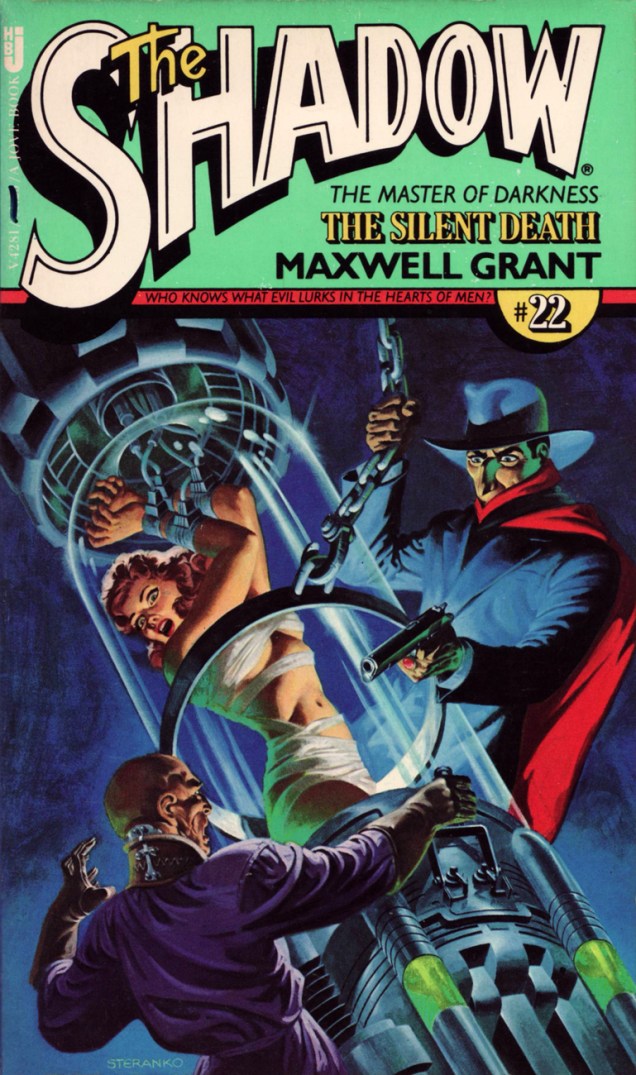
As a bonus, let’s slightly depart from comics proper and admire a couple of paperback reissues from the brush of noted fabulist James Steranko.
Steranko comes up with one of his subtlest, most unctuously moody covers for Pyramid’s 1974-78 series of Shadow paperbacks that introduced these classic pulp adventures to a new audience, picking up where its predecessors Belmont (1966-67) and Bantam (1869-70) had left off. Pyramid had one extra trick in its bag, though: Jim Steranko, who painted tantalizing covers for each of Pyramid/Jove’s twenty-three volumes. This particular case file, MOX, « from The Shadow’s annals as told to Maxwell Grant » originally appeared in The Shadow Magazine vol. 7, no. 6 (November, 1933).Natty dresser Jim Steranko has built up, over the years, quite a biography for himself. Of his numberless and prodigious accomplishments, my favourites are those that actually happened, such as a stunning series of cover paintings for Pyramid Books’ reprints of vintage Shadow pulps from the 30s and 40s. This one, twenty-second in a set of twenty-three, was published in March of 1978. The Silent Death initially saw print in The Shadow Magazine, Vol. 5, no. 3 (April 1, 1933.)
« J’fais dans la bande dessinée, qu’est bien plus pop que le ciné!* » — J.C. Forest (Une chanson, 1973)
On the eighty-ninth anniversary of his birth, let’s salute in passing one of the great pioneers of French comics, namely Jean-Claude Forest (Sept. 11, 1930 – Dec. 29, 1998), Barbarella’s creator, the man who, in the early 1960s, ushered strictly-for-kids bandes dessinées into decidedly more risqué and adult realms of eroticism, fantasy and fun.
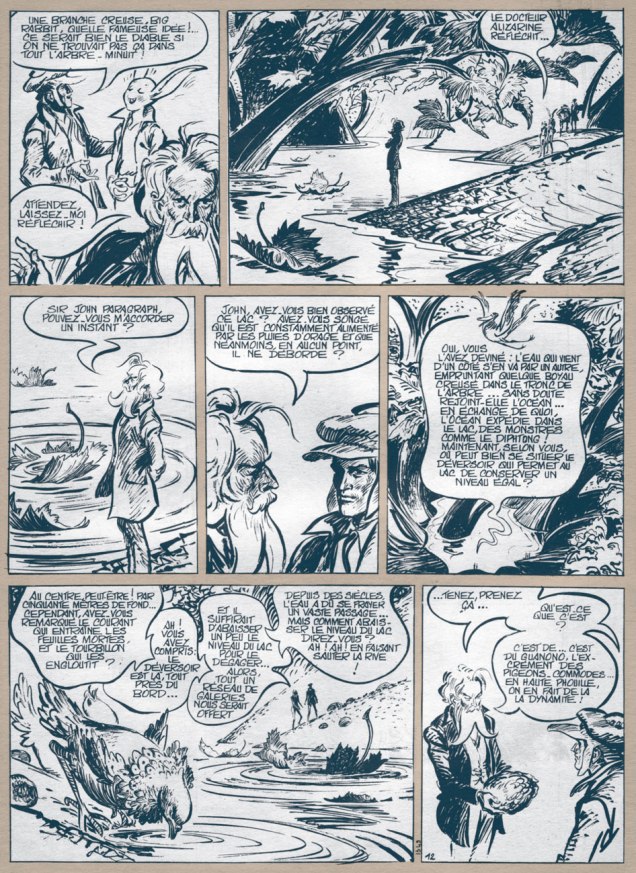
Born on September 11, 1930 in the Parisian suburb of Le Perreux-sur-Marne, he passed away in 1998 at the age of 68, but not before leaving behind a body of work of breathtaking depth and variety. Barbarella aside (sorry, miss): Le Copyright (the springboard for Nikita Mandryka‘s Le Concombre masqué), Hypocrite, Mystérieuse matin midi et soir (his wild riff on Jules Verne’s L’île mystérieuse), Bébé Cyanure, Les Naufragés du temps (illustrated by Paul Gillon), Enfants c’est l’Hydragon qui passe… « et j’en passe », as they say.
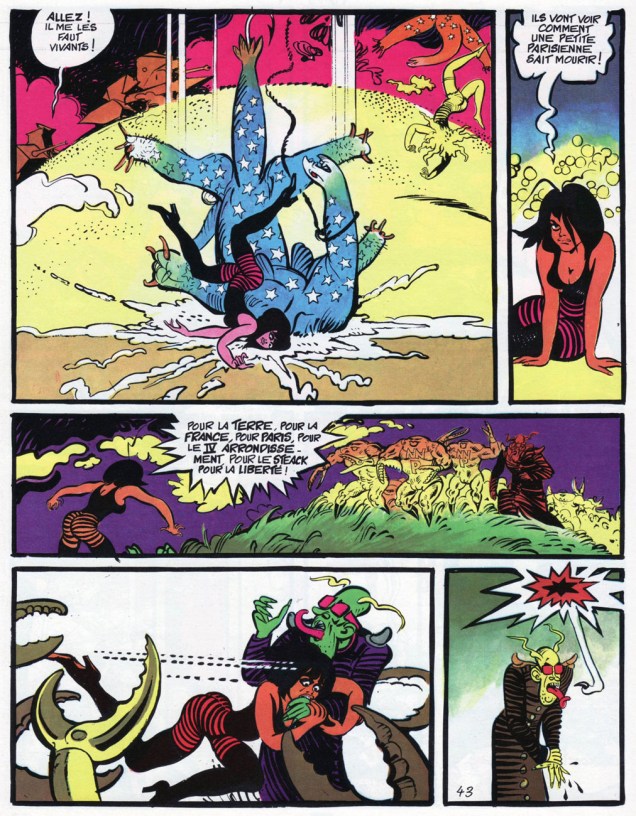
Here are a few highlights to give you a sense of the man’s imagination, versatility and tremendous draftsmanship, in chronological order.
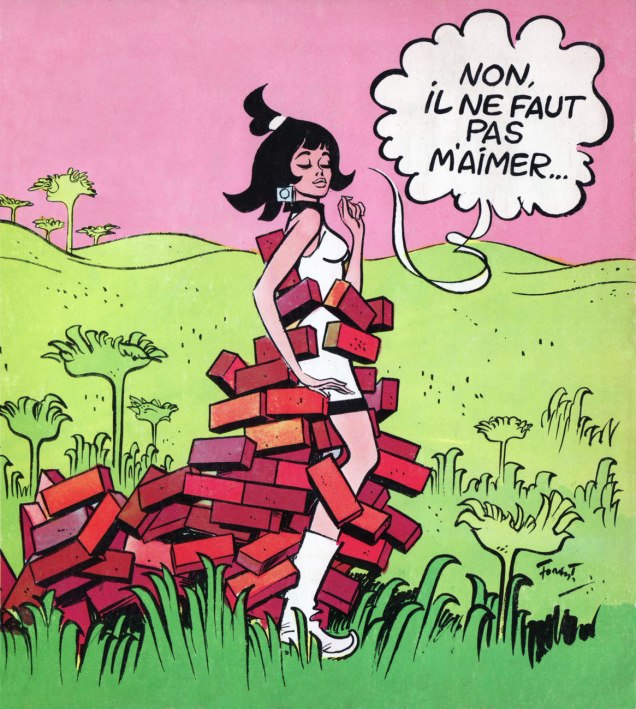
An excerpt is from Les colères du mange-minutes (1965-66), the second volume of Barbarella’s adventures. Yes, there was a film adaptation, but it’s, well, pretty vapid. Director Roger Vadim was kind of the Gallic John Derek; both were fair-to-middling directors whose chief talent was womanizing. Though one has to admit it *was* quite a talent.« No, you mustn’t love me… » Detail from the cover of giff wiff, revue de la bande dessinée no.22 (Dec. 1966), previewing its article on Forest’s 1965 experimental tv cartoon Marie Mathématique, which you can watch here. It features the dulcet tones of Le beau Serge, certainly one of the most overrated artistes of the 20th century. Too much competition to call the race to the bottom, though. 😉Born out of a misunderstanding between the editorial team of Pif Gadget and Forest, Mystérieuse matin midi et soir proved too labyrinthine for the magazine’s young readership, cost the publishers a bundle, and only two of its three parts appeared in Pif. Fear not, it was collected in album form the following year. This is a page from part 1, which saw print in Pif Gadget no. 111 (April, 1971).
A sequence from the rollicking N’importe quoi de cheval…, featuring Hypocrite, another of Forest’s spunky heroïnes. From Pilote Mensuel no. 6 (Dargaud, Nov. 1974).
A pair of pages from the melancholy, elegiac Enfants, c’est l’Hydragon qui passe « Children, there goes the Hydragon » (Casterman, 1984).
I’m sure it’s mere coincidence, but the boy, Jules, seems to be modelled after yet another Gainsbourg “muse”, pop nymphette Vanessa Paradis.
« If you don’t want to be idolized by the masses, you don’t become an author, you become a plumber-welder! » — Entretien avec Mandryka, Les cahiers de la bande dessinées no. 28 (1975), conducted by Numa Sadoul
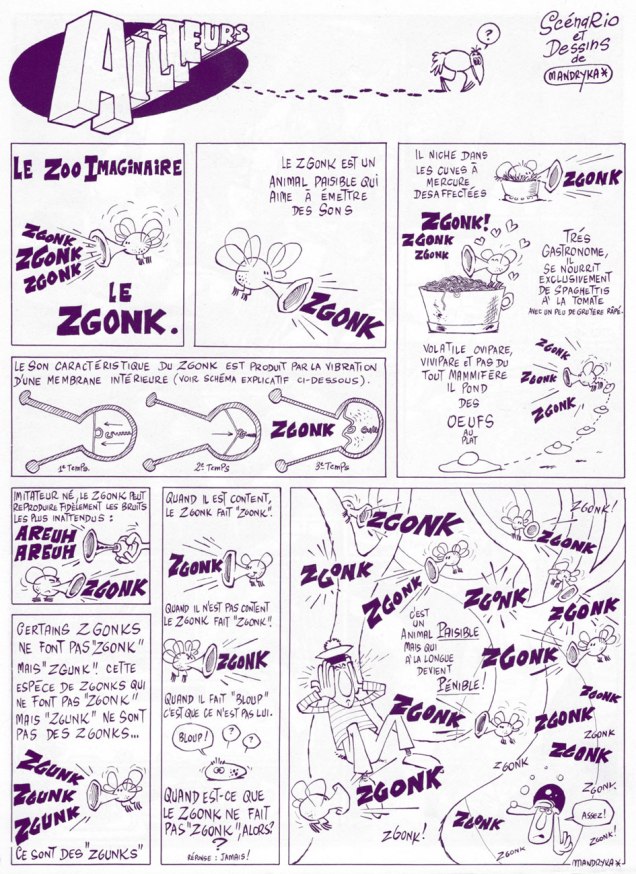
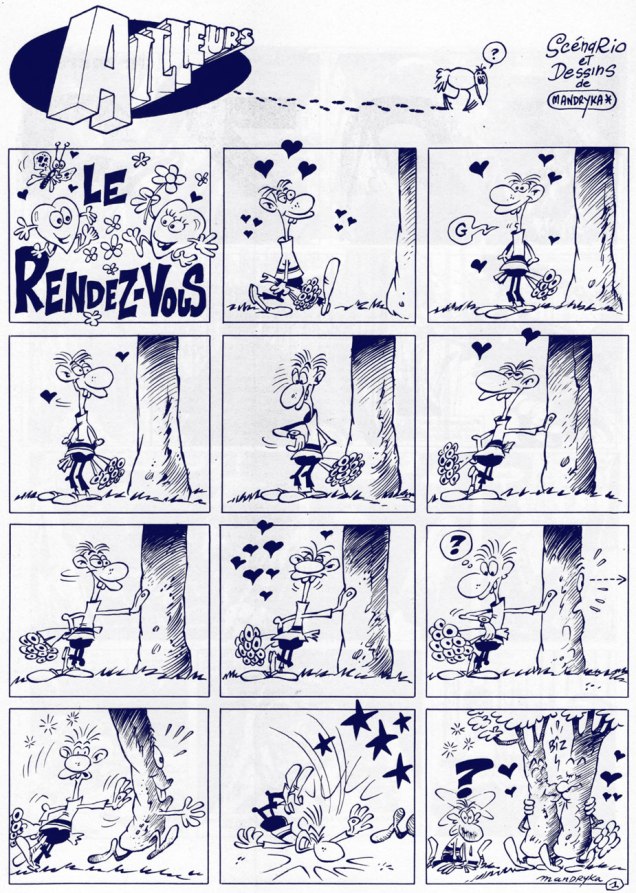
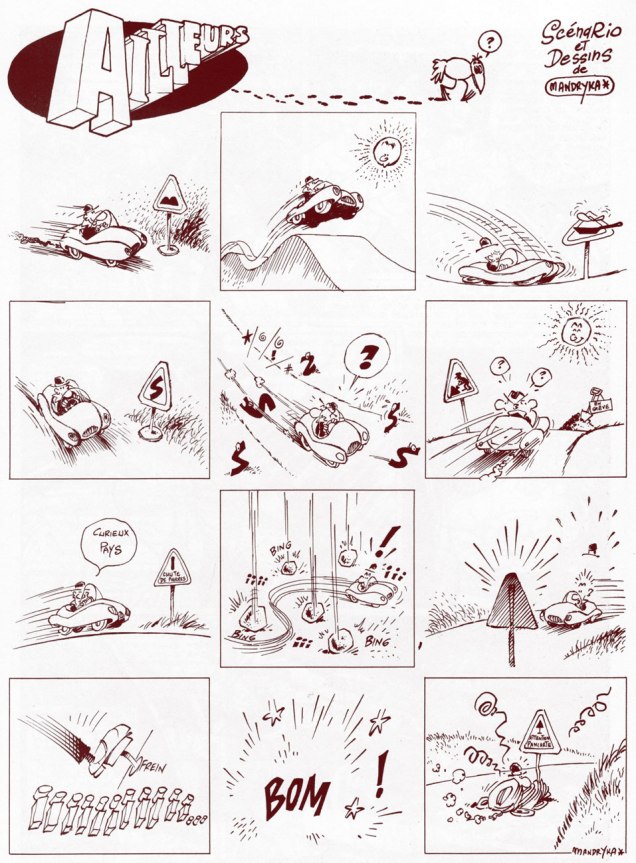
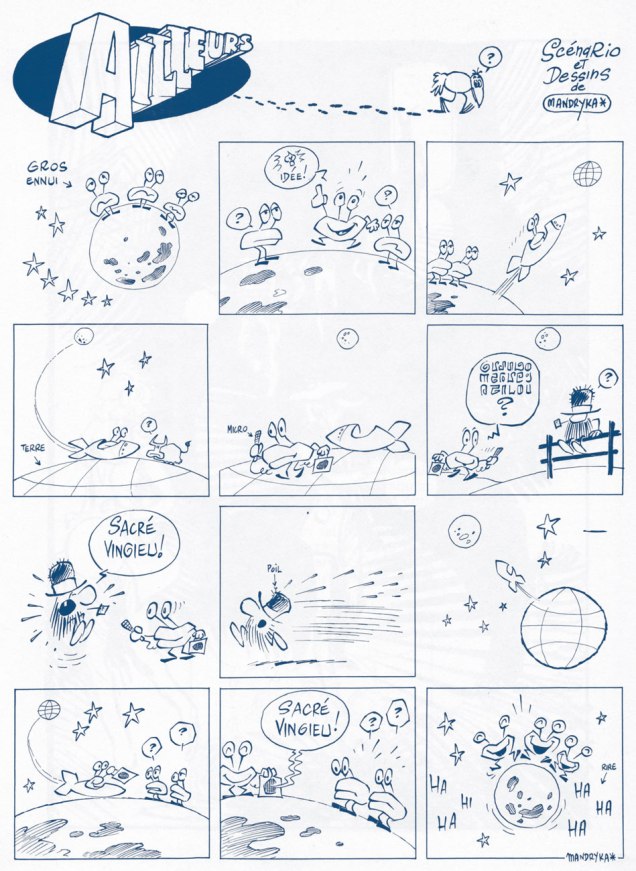
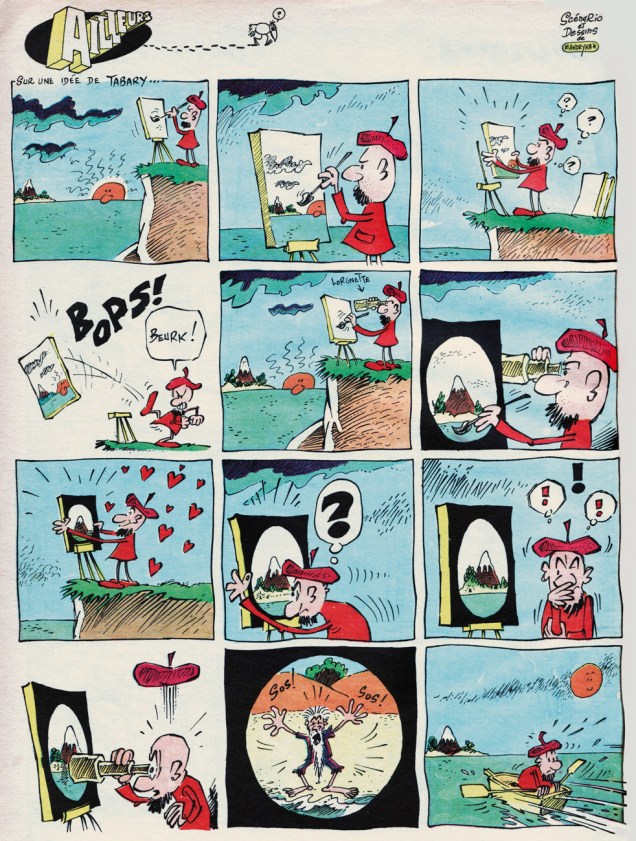
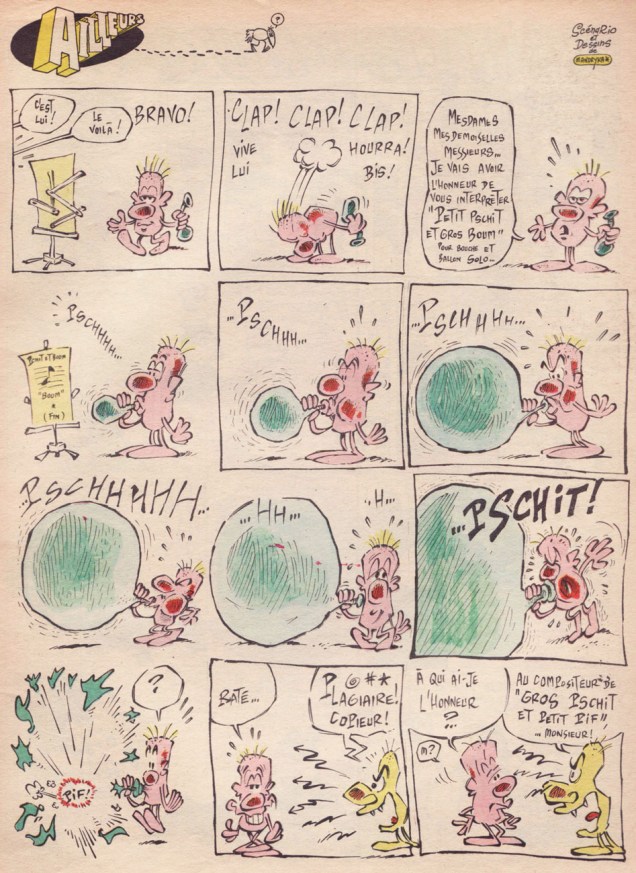
Nikita Mandryka was born October 1940 in Bizerte, Tunisia, to Russian émigré parents. His grandfather had fled the Russian Revolution in 1921 aboard a warship he was commanding. Nikita’s first professional strip appeared late in 1964 in Vaillant (Boff, in Vaillant no. 1024, Dec. 27, 1964), soon renamed Vaillant, le journal de Pif , then Pif Gadget in 1969. While he’s best known for his loquacious, dominoed cucurbit, Le Concombre Masqué, today we’re going to harvest the riches of his somewhat less familiar, but equally absurdist creation, the free-form strip Ailleurs (“Elsewhere”). The feature debuted with the inaugural issue of Pif Gadget and made its bow with issue 35, a few months down the line.
Mandryka left Pif Gadget on good terms (and returned over the years), and with a solid reason: while Pif’s editorial team rightly adored his work, its left-field humour left the majority of Pif’s young readership quite baffled, and sometimes infuriated. Mandryka’s place in the magazine may have been secure, but he yearned for an audience that actually understood him. This he would find at Pilote, with its teenage readership, and all the more so with L’Écho des Savanes (which he cofounded, in 1972, with Claire Bretécher and Marcel Gotlib).
Pif’s was an unusual case: its most singular, daring, arguably most valuable strips were those least appreciated by the kids. And that slice of the readership, you’ll have guessed it, tends to express its opinions more freely and vehemently than their elders, who did love (but more quietly) the somewhat abstract, second degré (offbeat, ironic) features, such as Marcel Gotlib and Henri Dufranne‘s Gai-Luron*, the recently-departed Massimo Mattioli‘s M. Le Magicien or Henri Crespi‘s Nestor. Still, the savvy editorial team, who after all had made the magazine a massive hit, keenly grasped the import of editorial balance and trusted its collective taste and instinct over the “wisdom” of the accountants and marketers… who, at the height of the magazine’s popularity, pulled a mutiny and… sank the ship. So, in hindsight, Mandryka was right to leave.
Ailleurs‘ début, from the inaugural issue of Pif gadget / Vaillant no. 1239 (March 1st, 1969); If it goes “zgunk”, it’s not a zgonk, it’s a zgunk.
As an english equivalent to « Sacré vingieu! », I propose « Dagnabit! »Ends with a sarcastic « Glory to the ten millionth discoverer of our planet! »« An original solution to the parking problem. »From Pif gadget no. 23 / Vaillant no. 1261 (July 1969); now you know what the legendarily stoic members of The Queen’s Guard do whilst at leisure.From Pif gadget no. 33 / Vaillant no. 1271 (Oct. 1969); idea provided by Tabary (Jean or his brother/ghost Jacques? We may never know).The final Ailleurs strip, from Pif gadget no. 35 / Vaillant no. 1273 (Oct. 1969). This would have made a great skit for Jacques Tati‘s peerless Mr. Hulot.Nikita’s just heard a really good one during this photoshoot for a L’Écho des Savanes advert.
« He’s back from the dead / the telegram read / If you get on a flight / You could catch him tonight / You’ll find Commissar / He’s at the Munich Hilton Bar » — B.A. Robertson
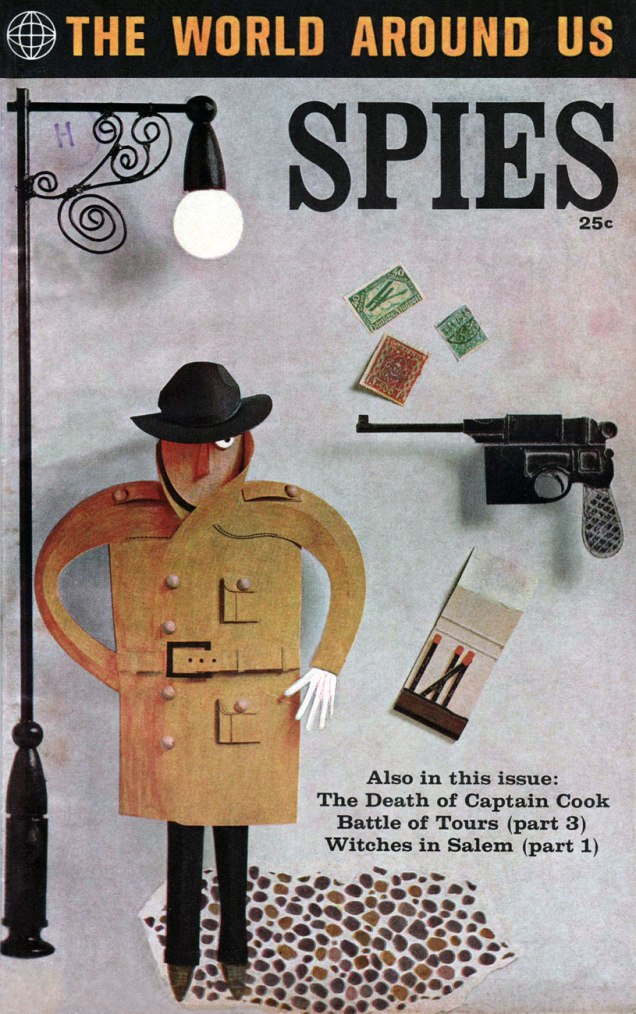
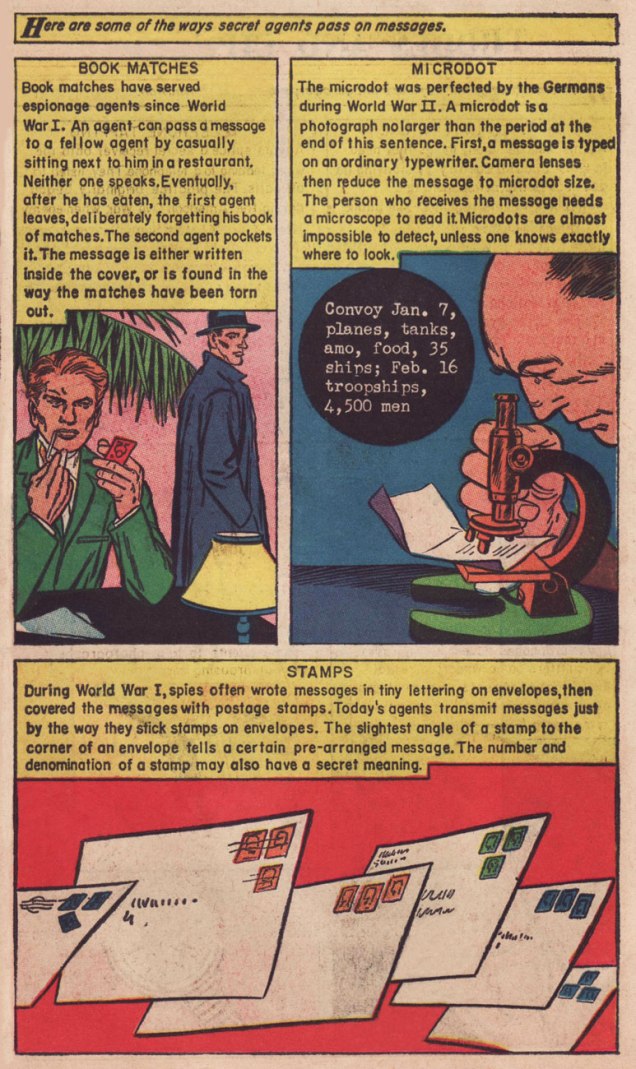
In 1958, Classics Illustrated publisher Gilberton tried something a bit different: a mostly non-fiction documentary title on various topics entitled The World Around Us, and featuring The Illustrated History of… Dogs, Space, Pirates, Great Explorers… depending on your area of interest, these could mean unrelenting tedium or sheer bliss. I haven’t encountered many issues, but the two I own, Ghosts and Spies, count among my prized paper possessions.
This is The World Around Us no. 35 (August, 1961), featuring this lovely mixed media piece by The Unknown Artist, whose cover remains defiantly unblown. On the inside, some fine company: George Evans, Norman Nodel, Edd Ashe, Jo Albistur… and Jack Kirby (inked by Dick Ayers)… the most beaten-down, anonymous, excitement-dialed-down-to-one Kirby you’re ever likely to see. Oh, he could do the job just fine, but the job, and the publisher, were not making anything of his regal strengths*. He would recall that this was « … the worst paying job of my entire life, including times I worked for free. »
Those early post-Code years were difficult ones for the diminished comics industry, and Kirby’s situation wasn’t exactly rosy: he’d been blacklisted at DC, thanks to the Jack Schiff / Sky Masters imbroglio, and his work at Harvey Comics had dried up. So what was a prolific artist to do, but pick up whatever bits of freelancing were available, here and there…
Quoting from Paul Gravett‘s review of Classics Illustrated: A Cultural History, we find this telling statement: « The most demanding editor was Roberta Strauss, a stickler for detail, who would count soldiers’ buttons or pleats in skirts and even called an editorial meeting in her hospital room only days after her son’s birth. » Give me Harvey Kurtzman‘s editorship** any old day!
**« Kurtzman’s editing approach to Two-Fisted Tales and Frontline Combat was a stark contrast to EC editor Al Feldstein‘s style. Whereas Feldstein allowed his artists to draw the story in any manner they desired, Kurtzman developed detailed layouts for each story and required his artists to follow them exactly. »
I’ve always been fond of this oddball little ad, which appeared in mid-70s comic books (in this case, a late 1974 DC 100-pager). It certainly demonstrates the considerable influence that pioneers such as Thimble Theatre creator Elzie Segar had on many an underground cartoonist.
If the advertised products had been iron-ons (à laRoach Studios*) instead of finished t-shirts, they’d be easier to find today. The Mickey Rat shirt is still being produced these days, though likely a grey market item… same as it ever was. On the other hand, I can find neither hide nor hair of the Hebrew Shazam shirt. Anyone? (2025 update: it’s available again here! A grateful tip of the hat to eagle-eyed reader Michael C. Rookard,)
A bountiful spread from The Natural Trading Company’s Mail-Order Catalog, which proposed T-Shirts – Posters – Art Prints – Buttons – Records – Comics… count me in!« Pinball Wizzard, you say? »
Here’s a bit of background on the Crazy World shirt, designed by (or swiped from) John Van Hamersveld, the genius behind the unforgettable The Endless Summermovie poster: « The face emblazoned across the chest of Mick Jagger in a 1972 New Musical Express feature on the Rolling Stones had a rich history according to its creator. The iconic image was the product of a mescaline and marijuana jag, after which Van Hamersveld was left with the enduring image of a man’s face with a big, toothy, wide smile. From a portrait of Jimi Hendrix he had made in 1968, Van Hamersveld came up with the Johnny Face logo the following year, which he used for promoting his own work. »
And there’s Mick, just like the man said.One of the current offerings. Oh, definitely a bootleg.
For me at least, it’s hard to look at Johnny Face without seeing in it echoes of The Face of Steeplechase, Coney Island’s widely-grinning mascot.
Trivia time: can you name the infamous individual behind the 1966 demolition of the beloved Steeplechase amusement park? Find the answer here.
As for the artist who crafted the Natural Trading Company ad, I was drawing a blank until a few years ago, when the wonderful Jay Lynch (1945-2017) kindly lifted the veil on that particular mystery: Jerry Kay was the stylish culprit. Much appreciated, Mr. Lynch!
– RG
*not to be confused with the originalRoach Studios, of course…
Death Race 2020 managed to be a pretty good series… for three issues (read ’em here!) The original creative combo was aces, three veterans from Brit SF institution 2000 AD, namely Pat Mills and Tony Skinner hatching the plots and Kevin O’Neill conveying them to visual glory. O’Neill scampered off after three issues (returning only to craft the series’ final cover), and things just weren’t the same without his sordid, madcap touch. It takes a special talent to depict compellingly *and* with a finely-tuned, subversive tone, this level of carnage and mayhem. Such talent, obviously, is ever in short, and possibly dwindling, supply.
But… we’re not here for the main feature. Buried in the back pages amidst the ads (mostly touting the alt-rock of the day) was a regular one-page hi-concept feature crafted by a succession of young (or young-ish) artistic iconoclasts. I suspect it was the fevered brainchild of former The Comics Journal managing editor Robert Boyd (1989-1990), also the editor of Death Race 2020. If this were Facebook, I’d show you my favourite example and move on to the next pretty shiny bauble. But through the pixie magic of blogging, I can afford to be utterly profligate and fling the whole delirious jumble your way. And so…
Story and art by Dave Cooper, from Death Race 2020 no. 1 (April, 1995).
Story and art by Pat Moriarty, from Death Race 2020 no. 2 (May, 1995).
Story and art by Bob Fingerman, from Death Race 2020 no. 3 (June, 1995).
Story and art by Jay Stephens, from Death Race 2020 no. 5 (August, 1995).
Story and art by Fábio Zimbres, from Death Race 2020 no. 6 (September, 1995). In these troubled days, I imagine many a Brazilian pines for the halcyon days of JK, faced with the reality of JB.
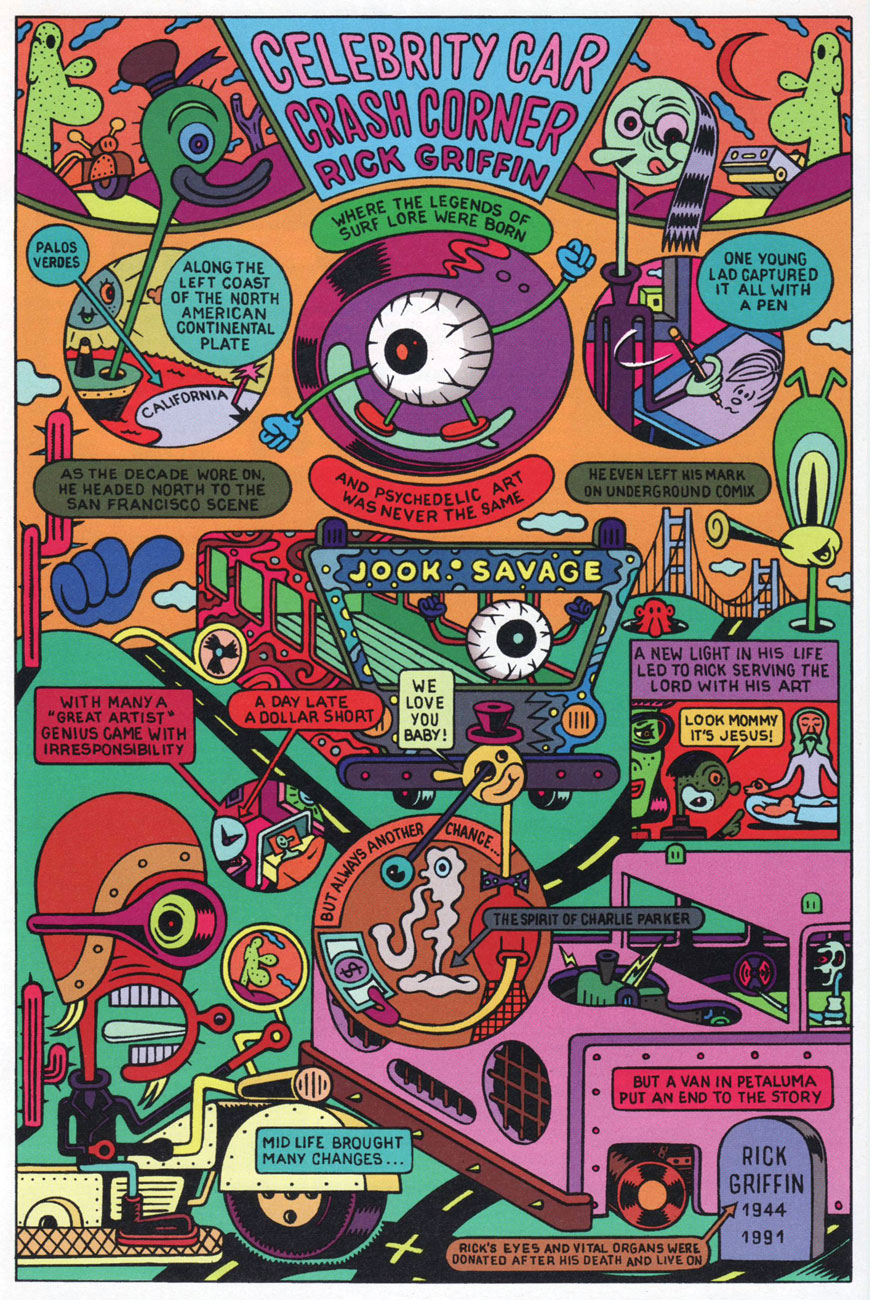
Story and art by Jaca Weiss and Robert Weiss, from Death Race 2020 no. 7 (October, 1995). For a look at some actual Rick Griffin art, look no further than here.
Story and art by Matthew Guest, from Death Race 2020 no. 8 (November, 1995).
To wit… a prime example of the aforementioned. By now, I’d like to think that most people have come to realize that the gendered driver question is a complex and fraught one. Here are some relevant statistics, if that’s your thing. You guessed it, things aren’t fair.
Drive safe, folks, and keep your eyes and mind on the road. The rest of us will appreciate it.
« Technology is constantly improving our lives. Look at the cellular telephone. Just ten years ago, virtually nobody was able to get into a car crash caused by trying to steer and dial at the same time; today, people do this all the time. » — Dave Barry
« I speak ten languages– all of them in Yiddish. » — Charles Rappaport
Like many a non-New-Yorker comics-loving goyim, my earliest encounters with Yiddish parlance came through Mad Magazine (furshlugginer, potzrebie, farshimmelt…), a practice initiated by its creator, Harvey Kurtzman, and carried on by his disciples and successors; unlike most of my ilk, however, my interest didn’t flag there, so I followed up Mad with Leo Rosten’s masterful The Joys of Yiddish.
As Art Spiegelman reminded us recently, in his controversial essay about the early American comic book industry, « the pioneers behind this embryonic medium based in New York were predominantly Jewish and from ethnic minority backgrounds. » Much like Mr. Spiegelman, I largely eschewed superheroes, unless nothing else was around. Of course, the trick to a varied diet is to stay alert to every possibility. Newspapers, naturally (it helps to live in or near a large metropolitan centre, though), random magazines, second-hand book stores, public and private libraries. Fluency in more than one language is a great asset, of course.
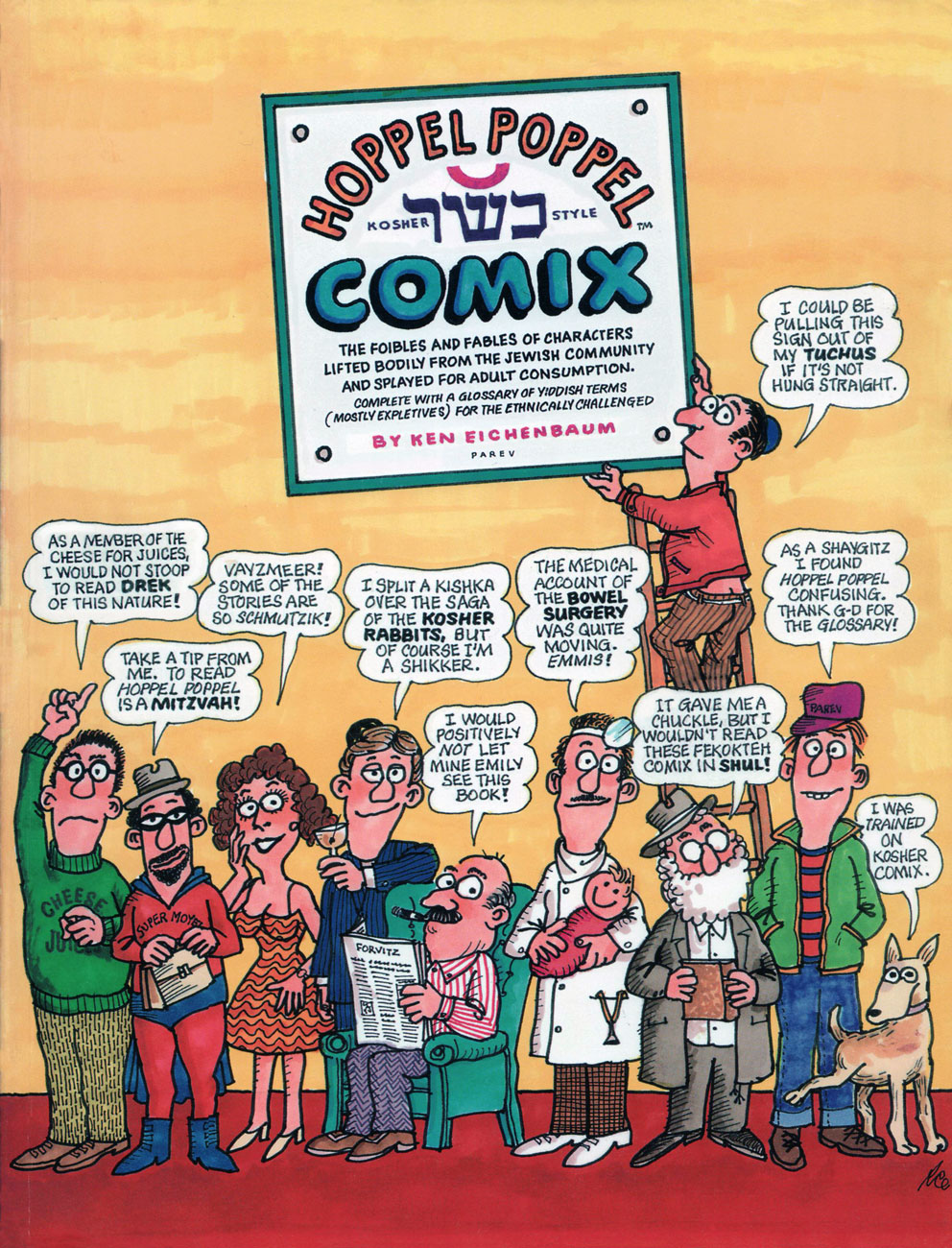
With the new possibilities opened up by the internet, I’ve grown quite fond of investigating obscure publications advertised or reviewed in old magazines. Case in point: a few years ago, I was flipping through The New Yorker‘s annual Cartoon Issue (another tip o’ the hat to Mr. Spieg) of 2001, and came upon this tiny, intriguing advertisement in its back pages.
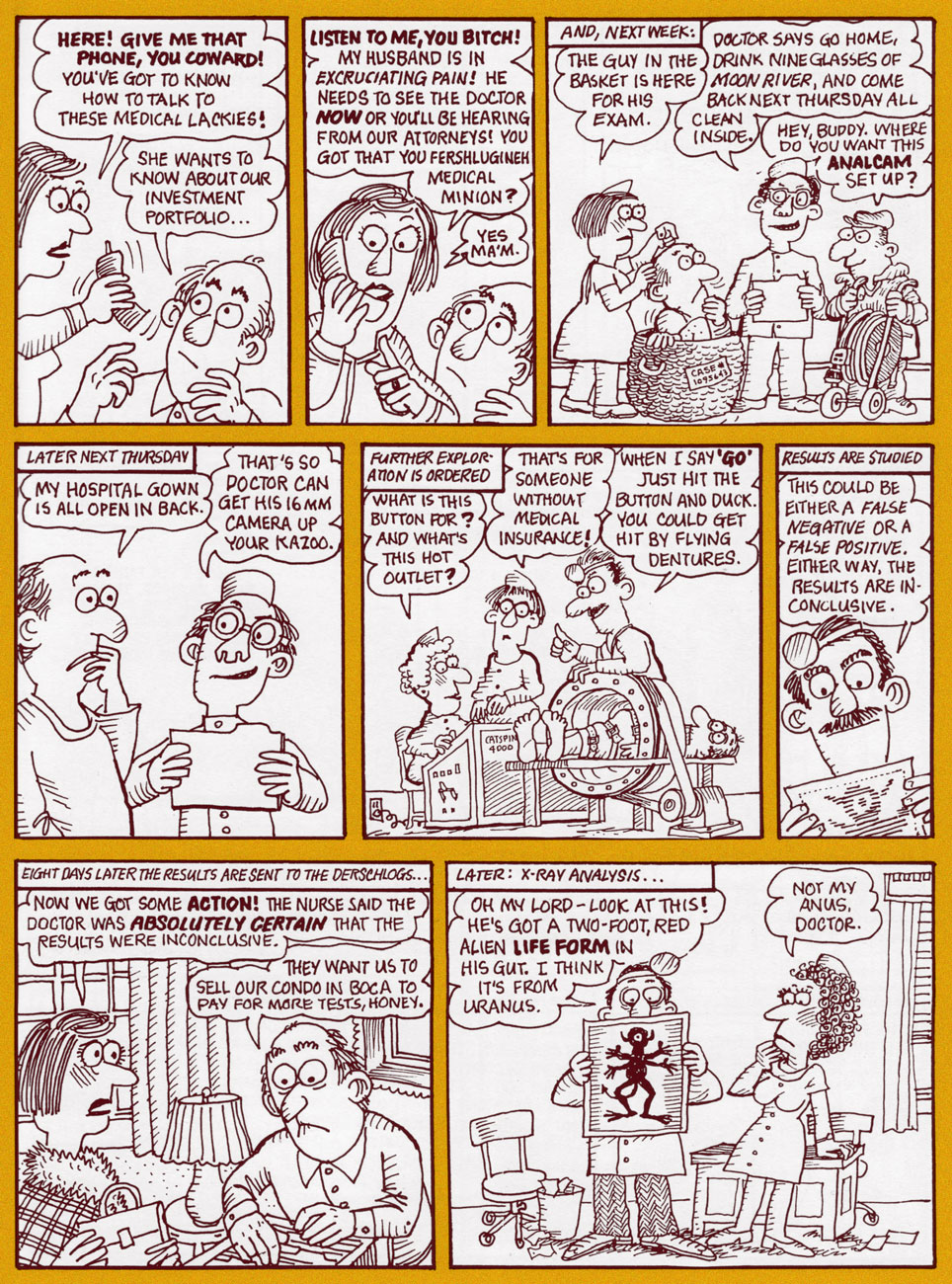
Drek(rhymes with wreck): Dirt, shit, or inferior merchandise; Ferbissoner (fur-biss’-n-er): Someone who clenches their teeth all the time; a hard-ass; Bissel (biss-l): a little bit; Schmutzik (shmoot’ [as in book] – tzik): dirty; Tokkeh (tock’-eh): actually, or really.Obviously, I looked up Hoppel Poppel Comix online, found a copy, ordered it, loved it… and here we are. My pick, The Medical Journal of B.M. Derschlog, turns out to have been the first story produced, and the impetus for the rest of the collection.
« Ken Eichenbaum’s comic book for adults began as cancer therapy. In 1999, Eichenbaum was diagnosed with colon cancer. While undergoing treatment, he began to come up with a 16-page thank-you card for those who had helped him through the ordeal. He was so encouraged by the response to that story, ‘The Medical Journal of B.M. Derschlog‘ — which lampoons his experience with the medical establishment — that he decided to write more illustrated tales. ‘I would lie in bed and there would be this shadow of illness. And I would come up with things that would make me chuckle to myself,’ says Eichenbaum, 70, who’s hesitant to talk about his cancer for fear of being seen as looking for sympathy. The result is a ‘graphic novel‘ — as these booklong comics are called — filled with sometimes funny, sometimes bawdy tales. Eichenbaum considers cartoonists Art Spiegelman and Ben Katchor to be two of his models, but ‘Hoppel Poppel‘ is less heart-wrenching than Spiegelman’s ‘Maus‘ and more slapstick than Katchor’s elliptical humor. » [source]
Mr. Eichenbaum was also clearly at ease with short-form gag strip (of these, the author coyly states: «… single-strip episodes, some of which may have previously appeared in Jewish community newspapers around the U.S. »). Some evidence:
Cheese for juices : Jews for Jesus. Mitzvah (mitz’-Vah): A good deed, a commandment; Vayzmeer (vayz’-meer): A little prayer, like ‘help me’; Kishka (kish’-keh): Stuffed intestine, regarded by many as a delicacy; Shikker (shik’-ker): an inebriated person; the state of being drunk; Emmis (em’-miss; rhymes with tennis): truth!; Fekokteh (feh-kok’-teh): shitty; Shul (shul): a temple, as school; Tuchus(tuch’-es; rhymes with ruckus): buttocks– offensive; Shaygitz (shay’-gitz): a non-Jewish male.
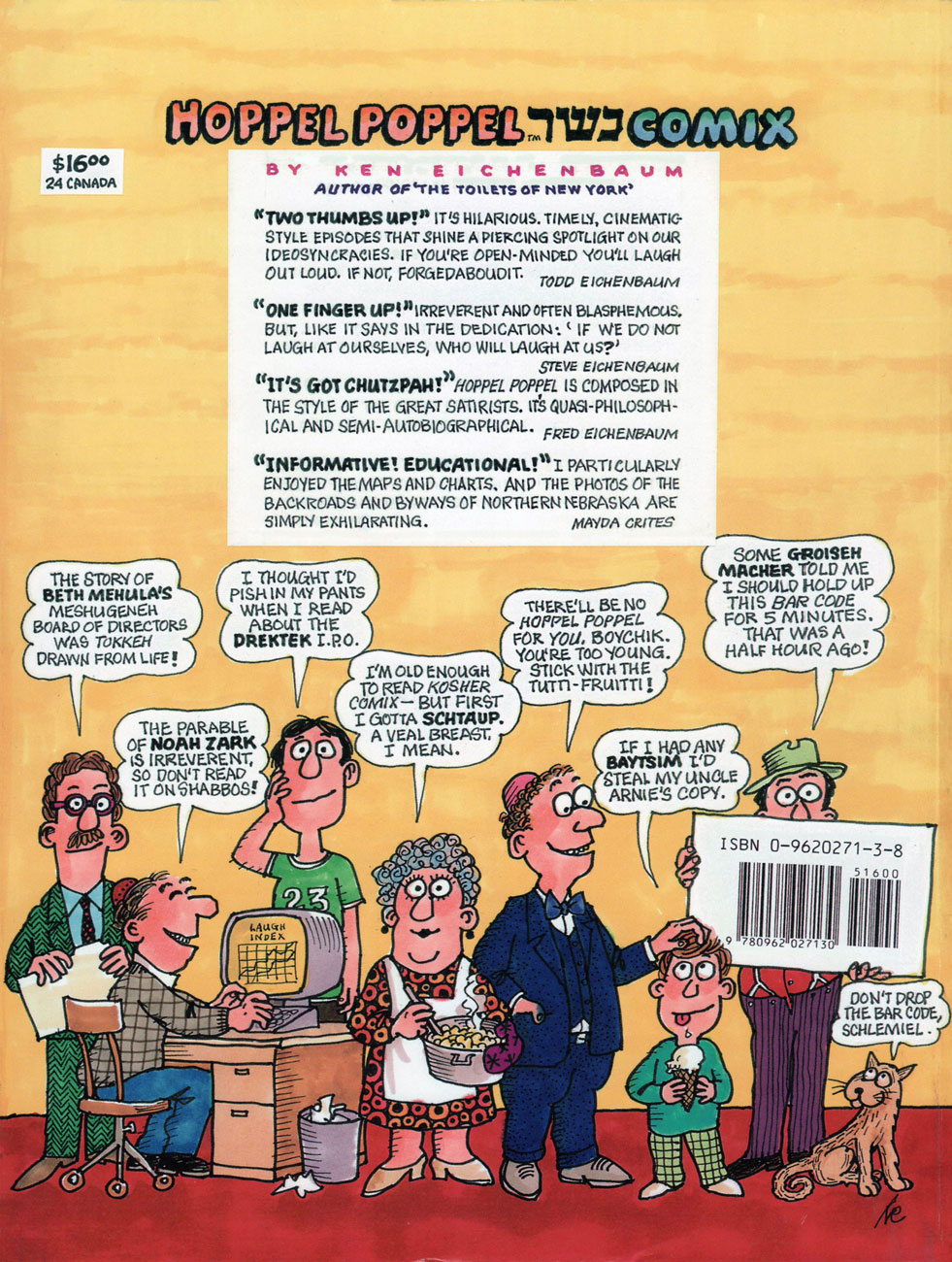
… and the back.
Well, it looks like a lovely day out there, so I’m off to pick up some potato knishes (like Mr. Kotter, I simply can’t kick that particular addiction)!
« The precious hours seemed to hurtle by, as if we were in some kind of vicious time machine! »
Today’s birthday number seventy-six for one of Charlton Comics’ most singular and hardest-working artistes, namely Enrique Nieto Nadal (born August 15, 1943, in Tangiers, Morocco, to Spanish parents), who injected some edgy excitement into the Charlton Comics line, handling with equal aplomb and virtuosity tales of romance, horror, war, adventure… and every combination thereof.
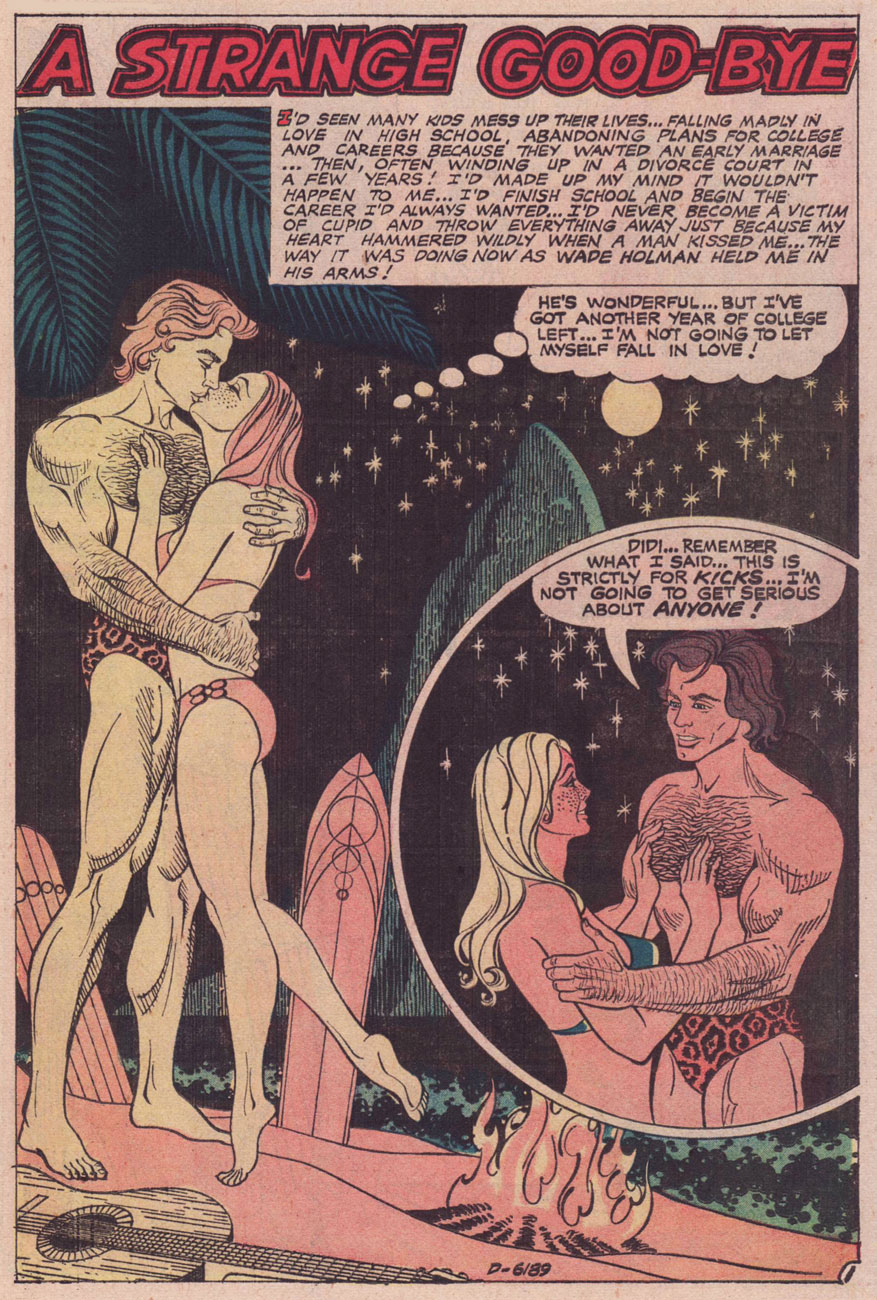
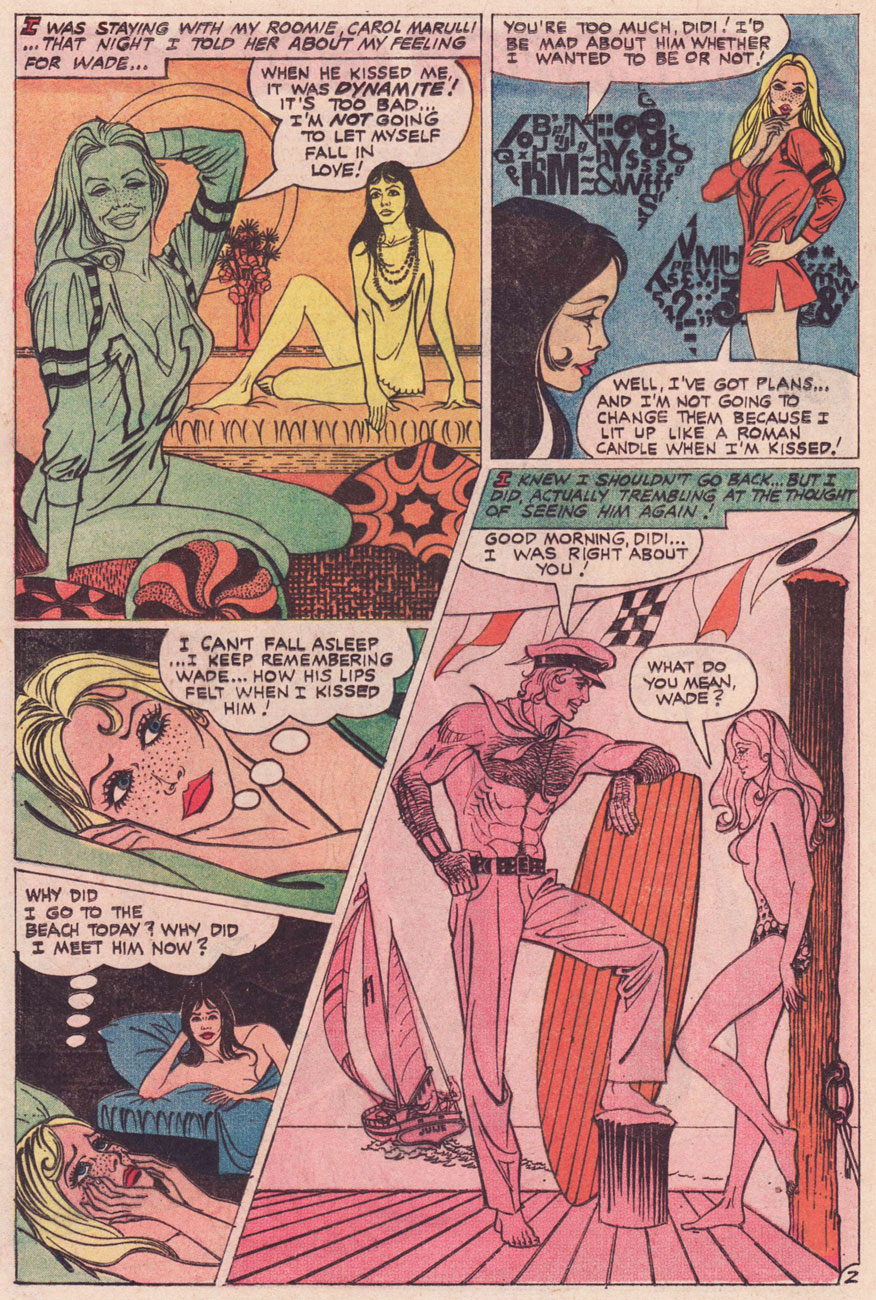
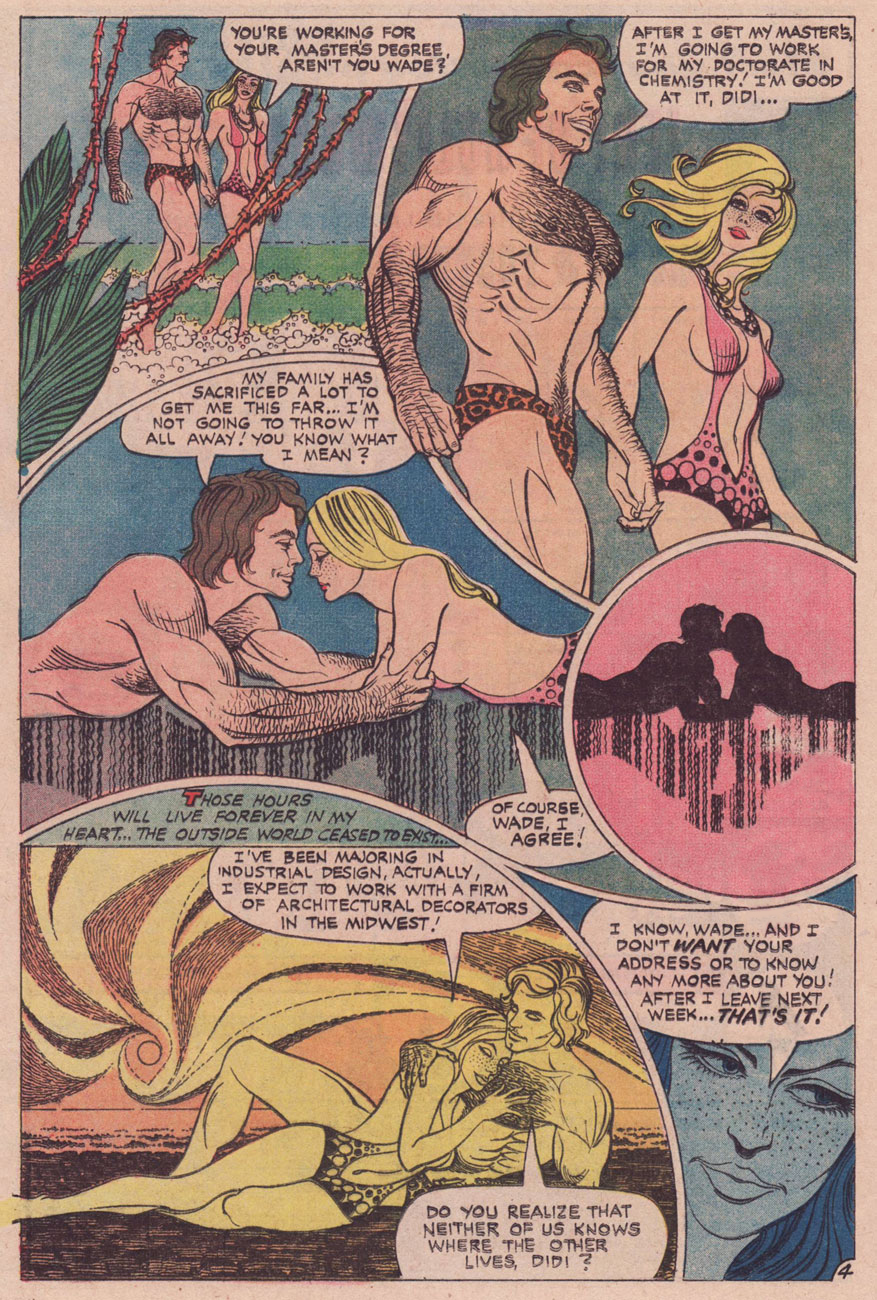
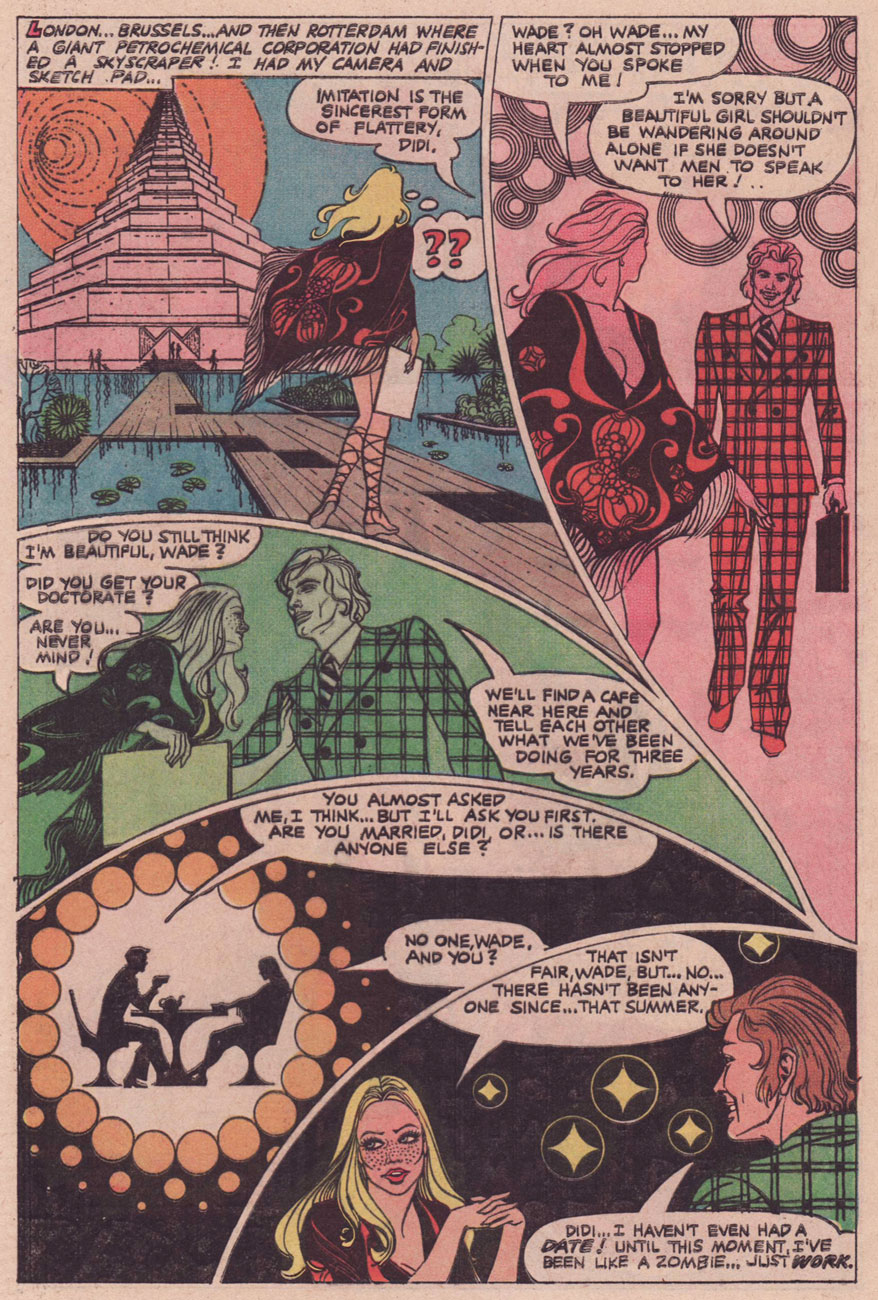
To mark this special occasion, I’ve picked out the lovely tale of A Strange Good-Bye from Love and Romance no. 20 (January, 1975); it provides a sterling showcase for his remarkable design chops and, as my dearest co-admin ds has earlier pointed out, Enrique’s tales provide, as a rule, beefcake and cheesecake in equally generous shares. Is anyone else that fair-minded?
I’m particularly fond of this yarn because of its unusual avoidance of most romance clichés: there are no scheming rivals, no duplicitous so-called friends, no disapproving parents, no melodrama… just two serious-minded, intelligent young people who are *really* into each other, but don’t lose their heads over it. And they may be yuppies, but success wasn’t just handed to them. Call me a sap, but I can’t help but sincerely root for Wade and Didi.
Oh, and let’s face it, can you think of any other US romance comics that pack such an erotic charge? It may be subjective, but I’ve rarely seen such convincing depictions of tenderness and affection, physical and otherwise, between two characters… and in mainstream, comics-code approved funnybooks yet. Full marks to Mr. Nieto and his masterful understanding and depiction of body language… male and female.
While he’s not credited, it’s still obvious to me that Joe Gill is the writer; my favourite facet of his romance tales is how he grounds what could be stock situations in the everyday, endowing his characters with actual, credible occupations, as opposed to soap opera ones. When a character describes a business deal or an industrial process, it makes perfect sense. I suspect this to be a by-product of Gill’s authorship of a 1973 series of promotional career-choice Popeye-branded comic books. The research clearly fed his subsequent work, which is just as it should be.
A Strange Good-bye was the cover feature of Love and Romance no. 20 (Jan. 1975). Blast that puzzle page!
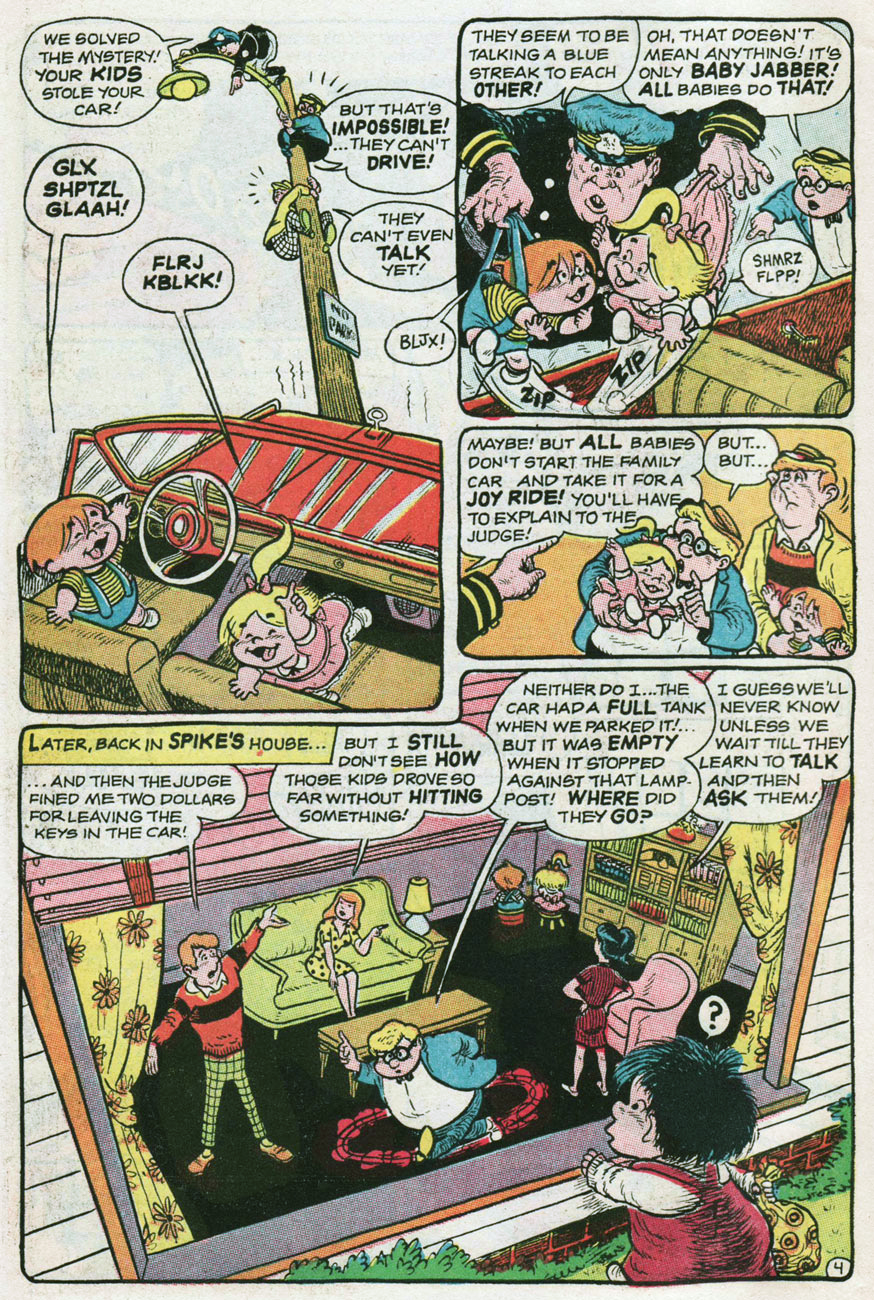
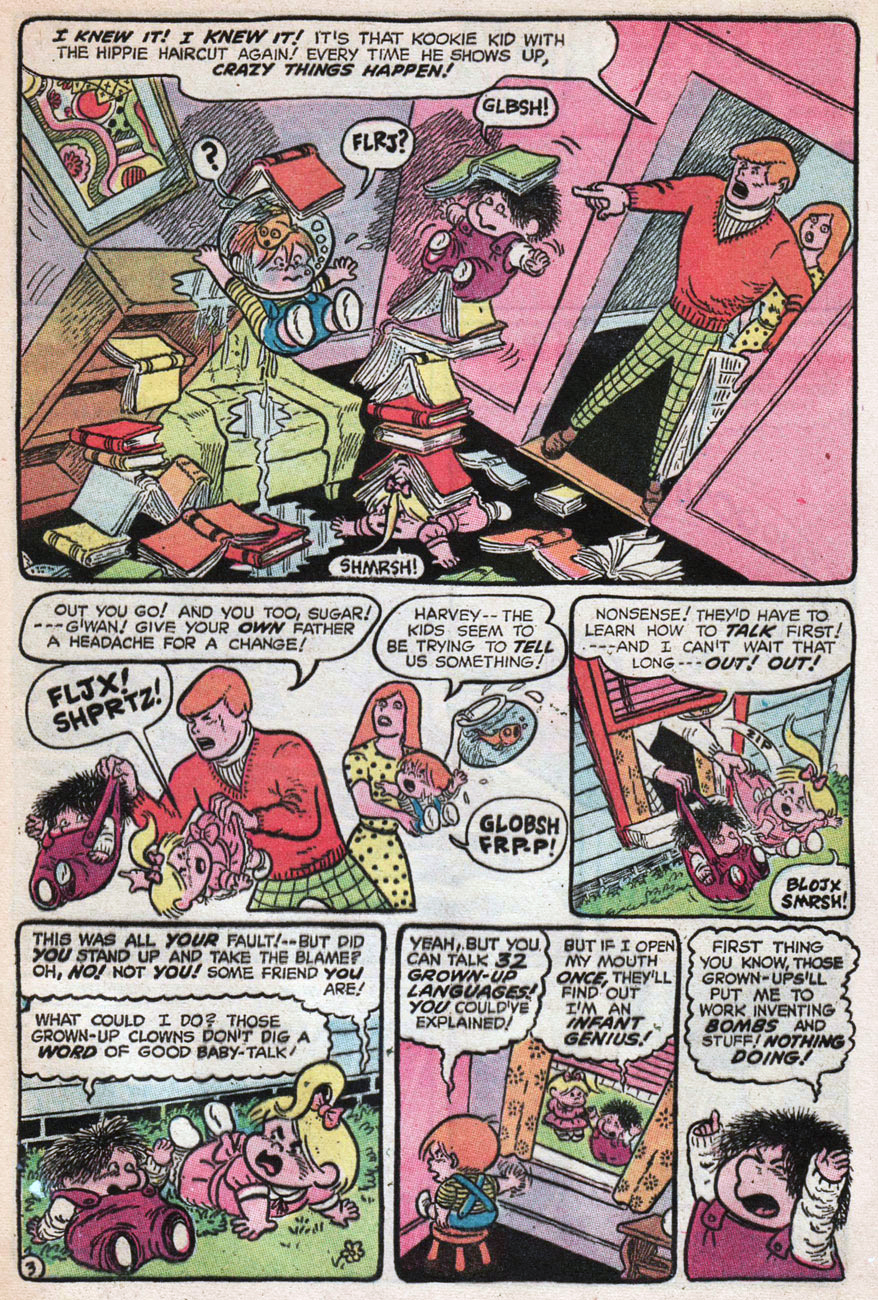
« And they sure seem to understand each other! Listen to them jabber away! » « Oh, come on — you know that’s only baby-talk! It doesn’t mean anything! »
If you were to ask me (make that *us*; we’re unanimous on that point) what was the most consistently excellent American comics series of the Silver Age, the response would be Sheldon Mayer’s Sugar and Spike. « Say what? », I expect most of you will say. Look at it this way: S&S ran for 98 issues from 1956 to 1971, the entire series crafted by a single creator-writer-artist, whose commitment and level of quality never flagged. Unlike, say, Fantastic Four (the most likely pick, I expect), it didn’t take several issues to find its legs, it didn’t suffer from mediocre to dreadful inkers for half of its run, nor, well, the glory-hogging participation of Stan Lee. At Marvel, I’d be more inclined to propose Steve Ditko‘s (and dialoguists Stan Lee, Don Rico, Roy Thomas and Dennis O’Neil’s) run on Doctor Strange (1963-66)… but we again run into the snag of the directionless twaddle that followed Ditko’s departure. In terms of superheroes, my vote would go to Arnold Drake, Bob Haney and Bruno Premiani‘s Doom Patrol (1963-68). Yet my overall number two would have to be Carl Barks‘ Uncle Scrooge* (1952-66). There as well, lesser hands took over once Barks stepped away. It’s an industry, after all.
Speaking of lesser hands, « The Sugar and Spike tales flowed exclusively from Mayer, who had a contract stating no other artist or writer could produce stories featuring his toddler characters. That’s a rare sort of deal to cut (then or now) for a property that the publisher owns outright, but Sheldon Mayer had more than earned his place at DC as a prolific writer, artist and editor for many years. » Of course, that covenant was pointlessly broken by DC after Mayer’s passing. Shame on you, Keith Giffen. Mayer had also asked that his wonderful 1970s creation, The Black Orchid, never be given an origin or have her mystery dispelled. But of course, in 1988, that trust was pointlessly broken by DC. Shame on you, Neil Gaiman (« Well, Alan made the Swamp Thing a vegetable, I’ll make the Black Orchid a plant… he’ll be so proud of me! »)
It’s no exaggeration to claim that Sheldon Mayer (1917-1991) was one of the essential architects of the US comics industry. Without him, DC would have passed on Superman, and without the Man of Steel, it’s a cinch our culture would be in a vastly different state, pour le meilleur et pour le pire. But that’s just one of his many contributions, direct and indirect. Much praise has been heaped on Mr. Mayer, justifiably so. His work is inspired, lively, absolutely hilarious, and life-affirming. He truly was a versatile giant. Check out Ron Goulart’s recollections of his friendship with Mr. Mayer, for instance.
This is Sugar and Spike no. 36 (Aug.-Sept. 1961). In case you’re wondering, the NCS after Sheldon’s signature indicates his membership (in good standing!) in the National Cartoonists’ Society.
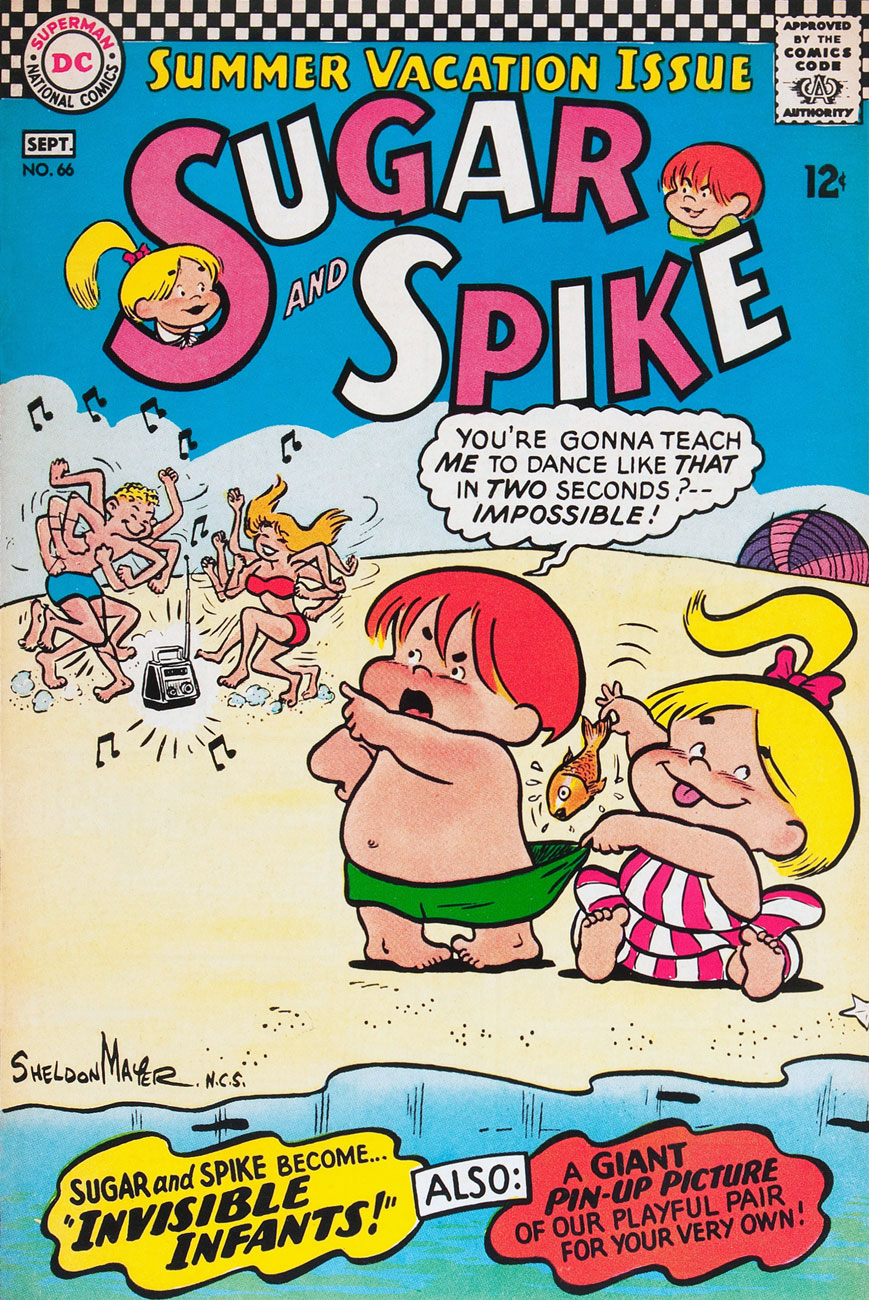
This is Sugar and Spike no. 66 (Aug.-Sept. 1966).
This is Sugar and Spike no. 79 (Oct.-Nov. 1968).
This is Sugar and Spike no. 80 (Dec. 1968-Jan. 1969).
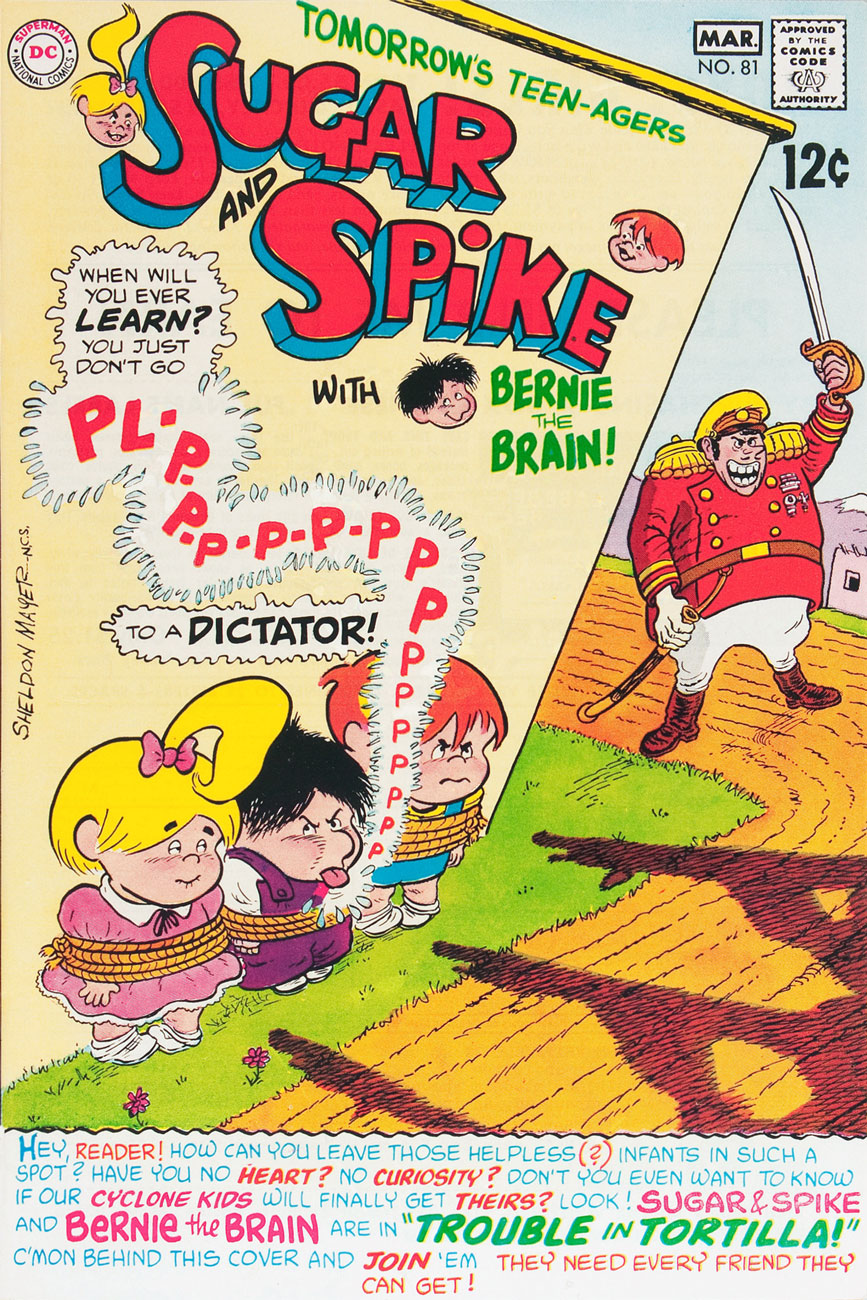
This is Sugar and Spike no. 81 (Feb.-Mar. 1969).
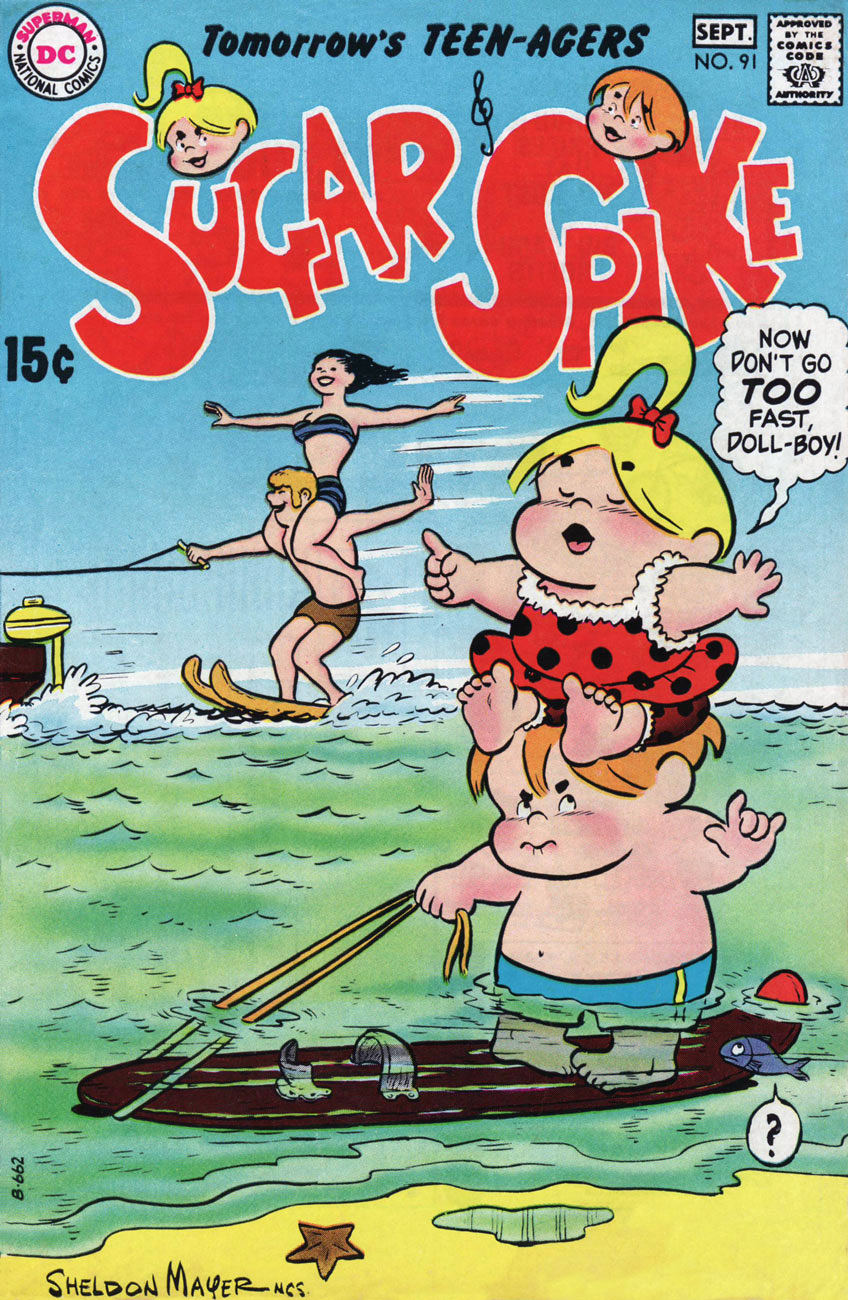
This is Sugar and Spike no. 91 (Aug.-Sept. 1970).
This is Sugar and Spike no. 96 (June-Jul. 1971).
This is Sugar and Spike no. 97 (Aug.-Sept. 1971). You’ll notice we’re featuring a lot of beach scenes… well, it’s seasonal!
In what I imagine to be another benefit of Carmine Infantino‘s editorial ascent, Mayer’s work took a wild turn with issue 72 of S&S. A fine new character, Bernie the Brain, was introduced, Mayer’s layouts suddenly adopted extreme and distorted perspectives and his inking grew more florid and detailed. Honestly, Mayer’s work at that point was the closest DC ever came in style to that of Underground Comix. These changes gradually ebbed, and by issue 90, things were more-or-less back to the old standard. The cause? failing eyesight (cataracts, to be exact), which led to the book’s cancellation, rather than the more banal dropping sales. Don’t worry, Mayer underwent successful eye surgery and intermittently returned to the drawing board. But he mostly wrote… beautifully. We’ll return to that soon.
Here are a few examples (show, don’t tell!) of the wild ‘n’ wooly Sugar & Spike:
Page 15 from Sugar & Spike no. 79‘s The Mystery of the Swiped Sea-Turtle (Oct.-Nov. 1968)
Page 4 from Sugar & Spike no. 80‘s Adventure Inside a Monster! (Dec. 1968-Jan. 1969)
Page 3 from Sugar & Spike no. 84‘s Bernie the Brain’s Biggest Blunder! (Aug.-Sept. 1969)
Unfortunately, Sugar and Spike falls in that select category of comics series that aren’t popular enough to be fully reprinted (DC issued one volume in its Archive Editions series, usefully reprinting S&S nos. 1 to 10) and too popular to be truly affordable (Angel and the Ape is another). In addition, since the series sold well, but to a broader audience than the traditional fanboy collector set, the books are mighty hard to come by in decent condition, not to mention *complete*. The reason? Paper dolls. They enjoyed, for quite some time, great popularity. Sugar and Spike’s regular Pint-Size Pin-Ups frequently ran on the back of story pages (often the conclusion!), so their absence is a real collector’s bugaboo. Besides, they were quite charming, so why do without them?
Pint-Size Pin-Ups from Sugar and Spike no. 78 (Aug.-Sept. 1968). I should also point out that Mr. Mayer kept a sincere, attentive, unpatronizing relationship with his readers.































 Who's Out There?