« Superstition, the mother of those hideous twins, fear and faith, from her throne of skulls, still rules the world. » — Robert G. Ingersoll
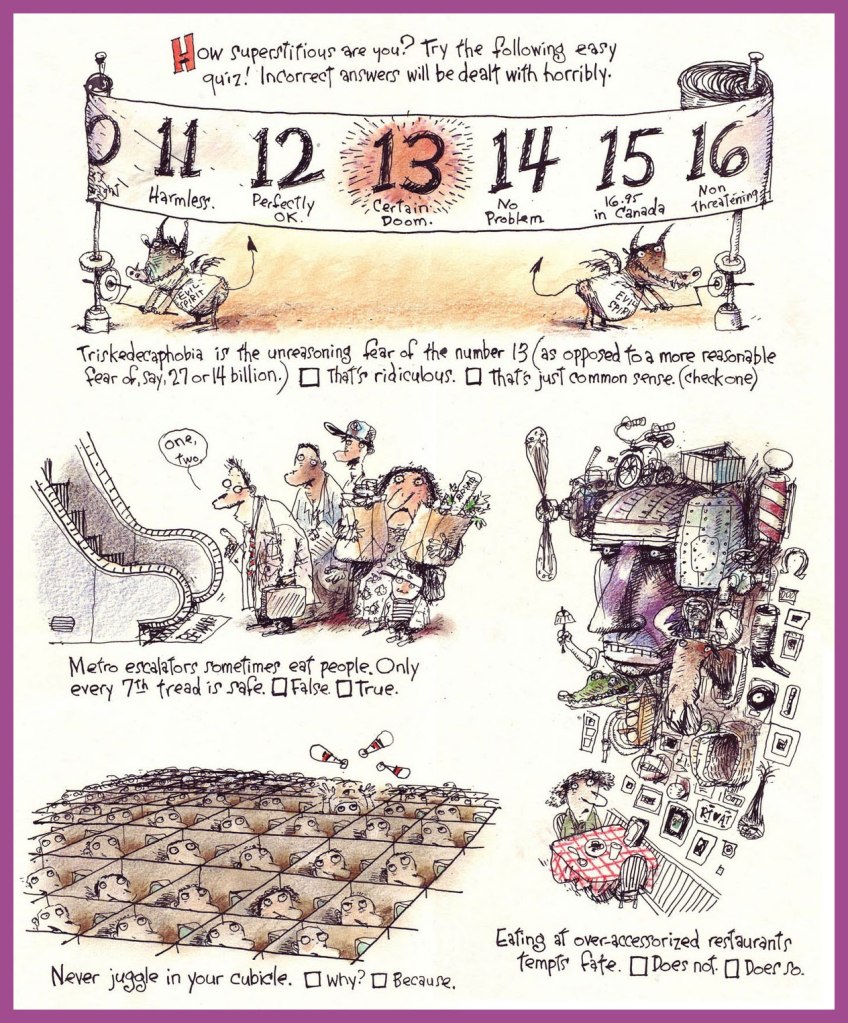
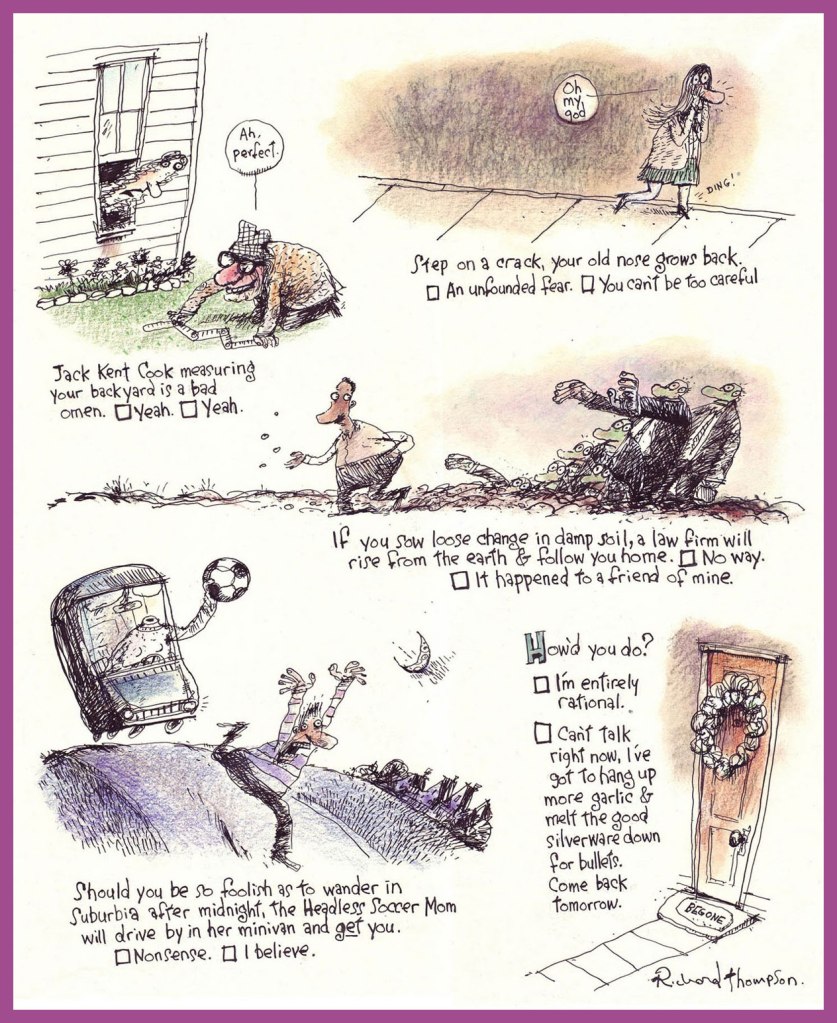
Feeling a tad superstitious? Today, as it also happens to be Richard Thompson’s birthday (coïncidence? hardly!), we combine two fabulous flavours into this confection of sheer frightful delight. Careful you don’t bite your tongue or deal yourself a case of whiplash.
Thompson « drew it for the Washington Post Weekend section back in September of 1996 and it appeared on Friday the 13th. » I believe!
Take the quiz and quell, at least for a time, those vicious neighbourhood rumours concerning you. For further such priceless resources, do take a gander at our prior Thompson posts, including this Hallowe’en-themed goodie and this fair sampling from Richard’s Poor Almanac.
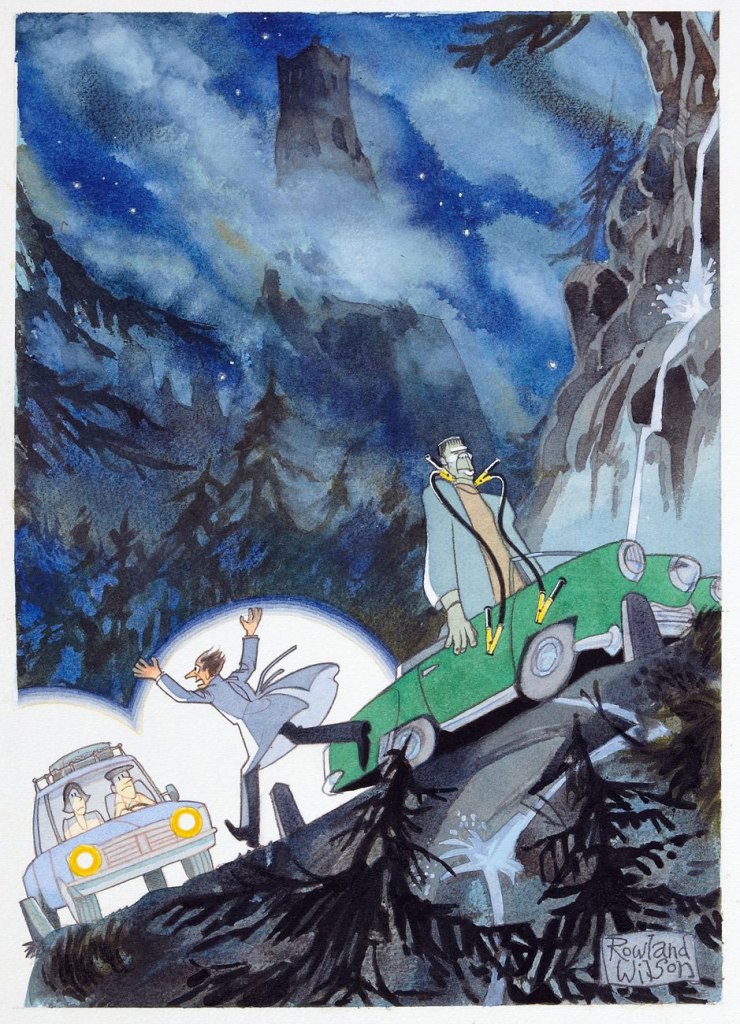
« Stop! Please, I need a jump start! » — the good doctor F.
From the pages of Playboy (Oct. 1990), a seasonal (well, soon to be!) cartoon by Texan Rowland Bragg Wilson (1930-2005).
You have to expect these things whilst motoring through the Carpathians.
In addition to his magazine work (the cream: Playboy, Esquire, The Saturday Evening Post, Collier’s, The New Yorker), Wilson made his mark in the animation field with Schoolhouse Rock! (with Phil Kimmelman & Associates) then as a concept designer with Disney Studios (The Little Mermaid, The Hunchback of Notre Dame, Hercules, Tarzan…). Quite the impressive waybill.
One more, on the same classic theme? Sure.
This one goes: « If I can bring this lovely creature to life, she will bring me lasting immorality! », and it appeared, of course, in Playboy (Nov. 1981). Ah, the difference one letter makes!
« And with that awakening, an insane sovereign once again asserts his rightful dominion over a night of madness — as the Halloween God! »
For years after Bernie Wrightson’s career path took him away from DC Comics, cover illustrations purchased by the publisher but left unused gradually trickled into print. Some were too specific and puzzling to be published tel quel, so new stories were written to order. Such a case was Batman no. 320 (February, 1980). This is another, which yielded The Halloween God, written by Gary Cohn and Dan Mishkin, illustrated by Ading “Adrian” Gonzales, and edited by Dave Manak.
This is Secrets of Haunted House no. 44 (Jan. 1982, DC). Cover created by Mr. Wrightson way back in… 1972!
And here’s an interesting twist: Wrightson’s original drawing didn’t quite look that way. As co-writer Gary Cohn told me, a few years ago, « When [editor] Dave Manak showed me this cover, the figure being thrown had a head much like the other goblins. I said, “Can someone change that to a Jack o’lantern head? Then we can write a story called, ‘The Halloween God.’ And so… »
I then asked Mr. Cohn whether he had any recollection as to who might have drawn said Jack o’lantern, as Wrightson was unlikely to be available. He responded: « My recollection might be wrong, but I think it was Dave Manak himself, who is no slouch as an artist. » That light effect on the ground really integrates the change, sells it, so to speak. Kudos to all involved.
« Merchant and pirate were for a long period one and the same person. Even today mercantile morality is really nothing but a refinement of piratical morality.» — Friedrich Nietzsche
This charming rogue doesn’t look like he’s going to share his pretties with just anyone, so be sure to ask nicely.
Stanley P. Morse ran a rather fly-by-night operation, even by funnybook industry standards, but someone in there had some taste, as evidenced by the classic material produced under its various dodgy banners (Aragon, Gilmor, Key Publications, Media, S.P.M., Stanmor, Timor…) by such notables as the aforementioned Mr. Baily, Basil Wolverton (including his enduring The Brain Bats of Venus) and a fledgling Steve Ditko.
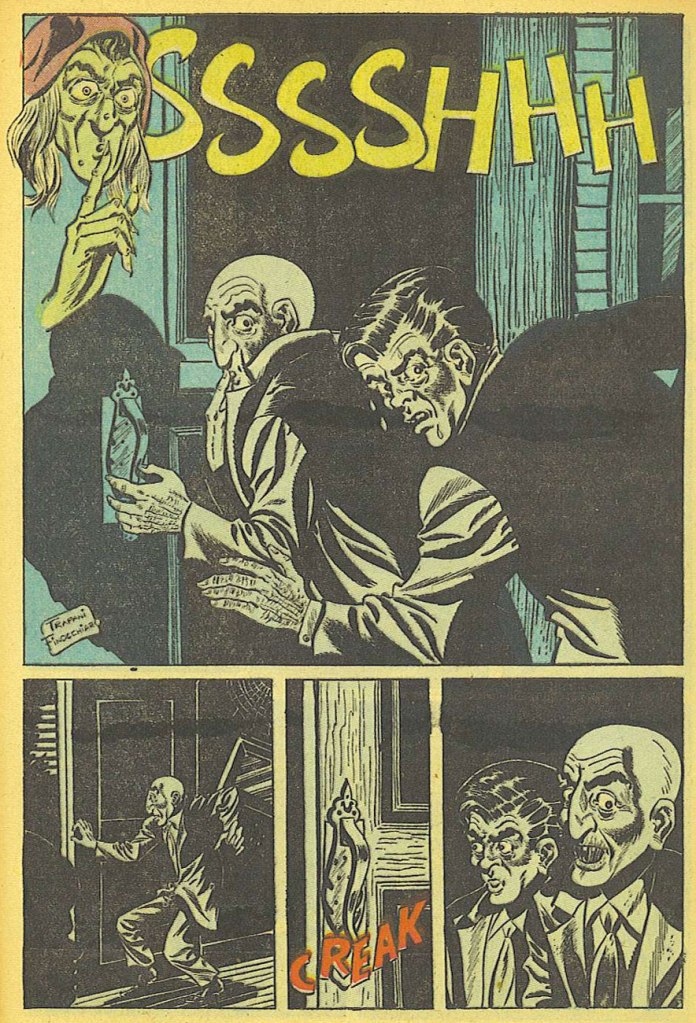
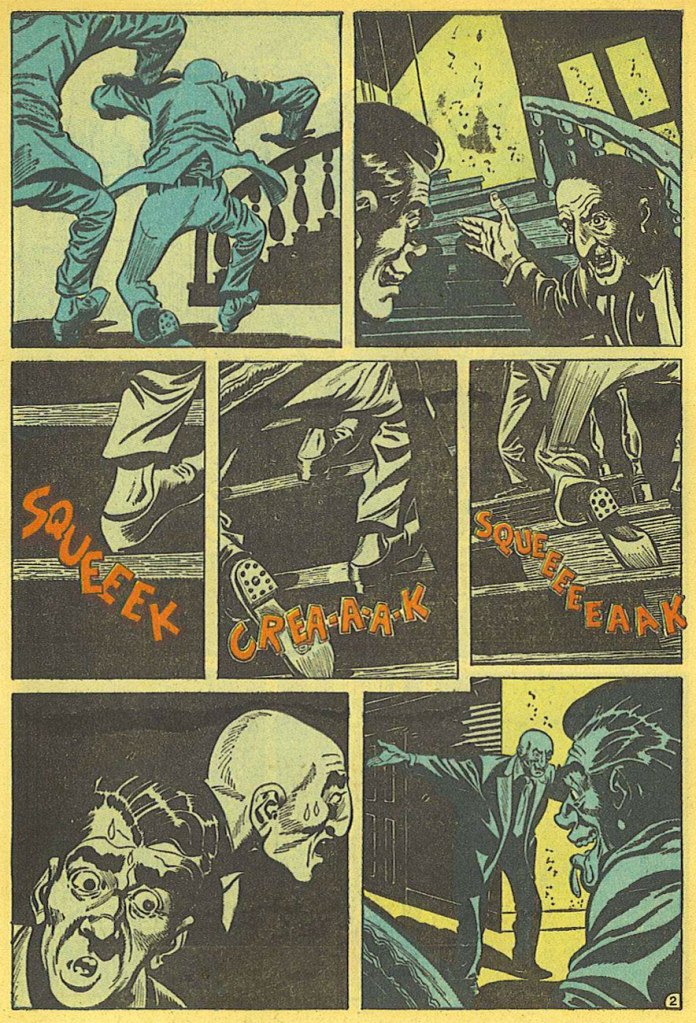
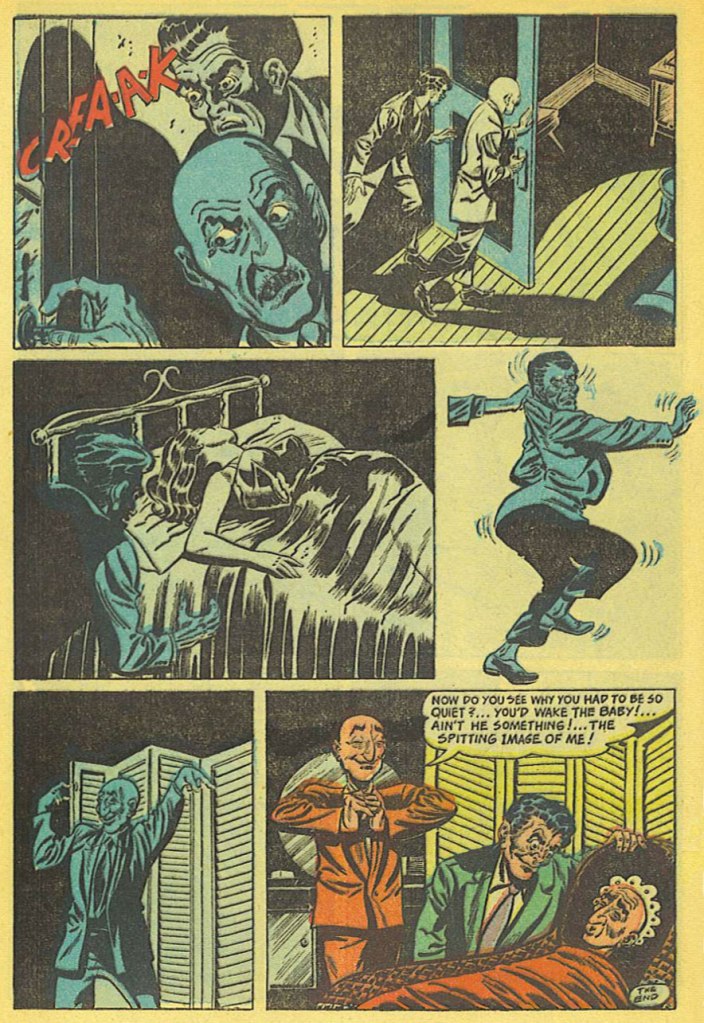
Still, the highlight of the issue has to be a brilliantly idiotic short tale intriguingly entitled… Sssshhh. Here it is:
Scripter unknown, with pencils by Sal Trapani, with inks by S. Finocchiaro. I have to say that this is my favourite-ever work by Trapani, a hack if there ever was one, whose inking jobs (his specialty in later years) generally did no favours to anyone’s pencils. And he had quite a prolific career, which was surely not hindered in the least by his being Dick Giordano‘s brother-in-law. For the defence, one of my close pals and colleagues holds that Trapani’s inks over Herb Trimpe‘s pencils on The Incredible Hulk (issues 156-166) were the finest of Trimpe’s lengthy run on the title. As far as that goes, I’ll stick with John Severin, but I do concede that Trimpe and Trapani did mesh well.
« Things are never quite as scary when you’ve got a best friend. » — Bill Watterson
Hey, it’s our 500th post!
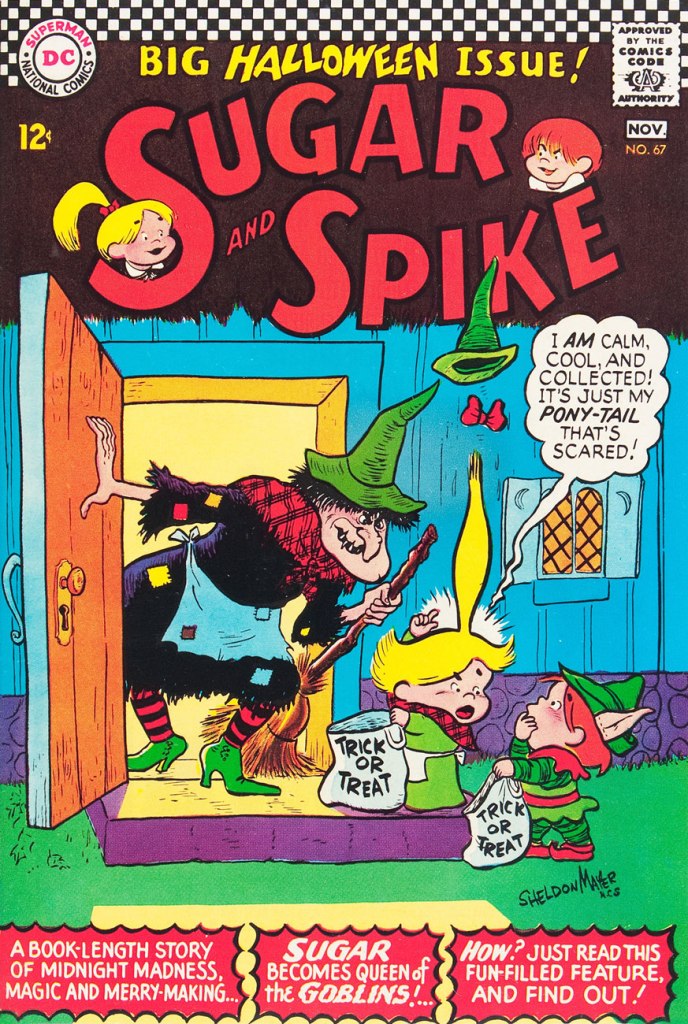
Who’d have the heart to resist Sheldon Mayer’s adorable toddlers (profiled here last year) if they came around trick or treating at your door? Even if you did resist, they’d be sure to get their grabby little mitts on the goods… some other way.
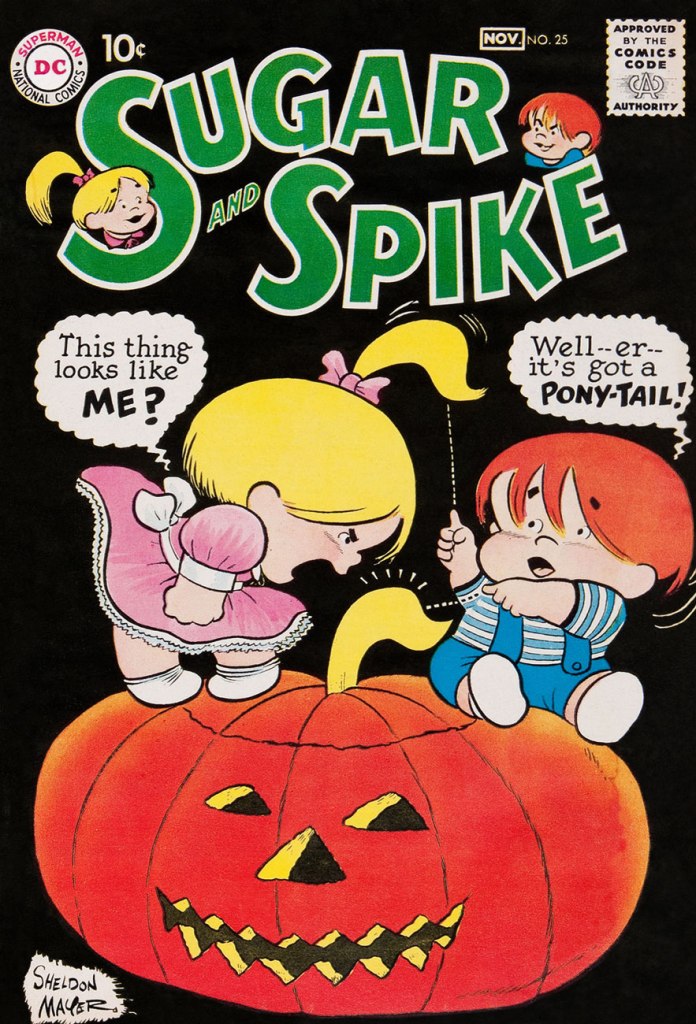
This is Sugar and Spike no. 25 (Oct.-Nov. 1959, DC).
This is Sugar and Spike no. 31 (Oct.-Nov. 1960, DC). Definitely my favourite of this splendid lot, largely thanks to that meticulous, understated colouring job. Jack Adler‘s doing, I’ll wager.
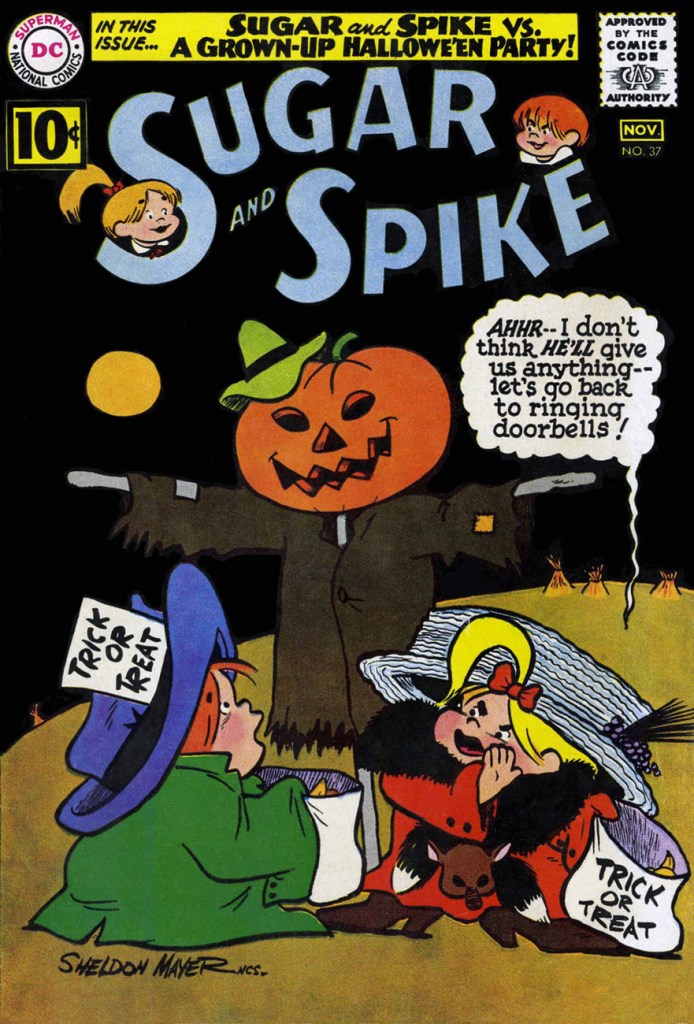
This is Sugar and Spike no. 37 (Oct.-Nov. 1961, DC).
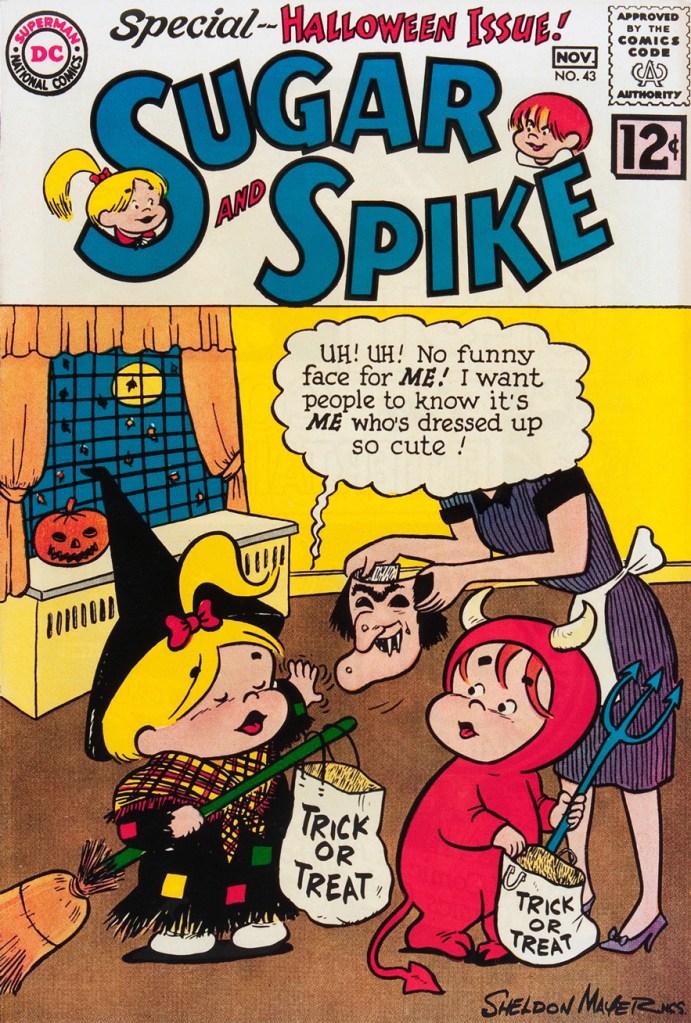
This is Sugar and Spike no. 43 (Oct.-Nov. 1962, DC).
This is Sugar and Spike no. 49 (Oct.-Nov. 1963, DC).
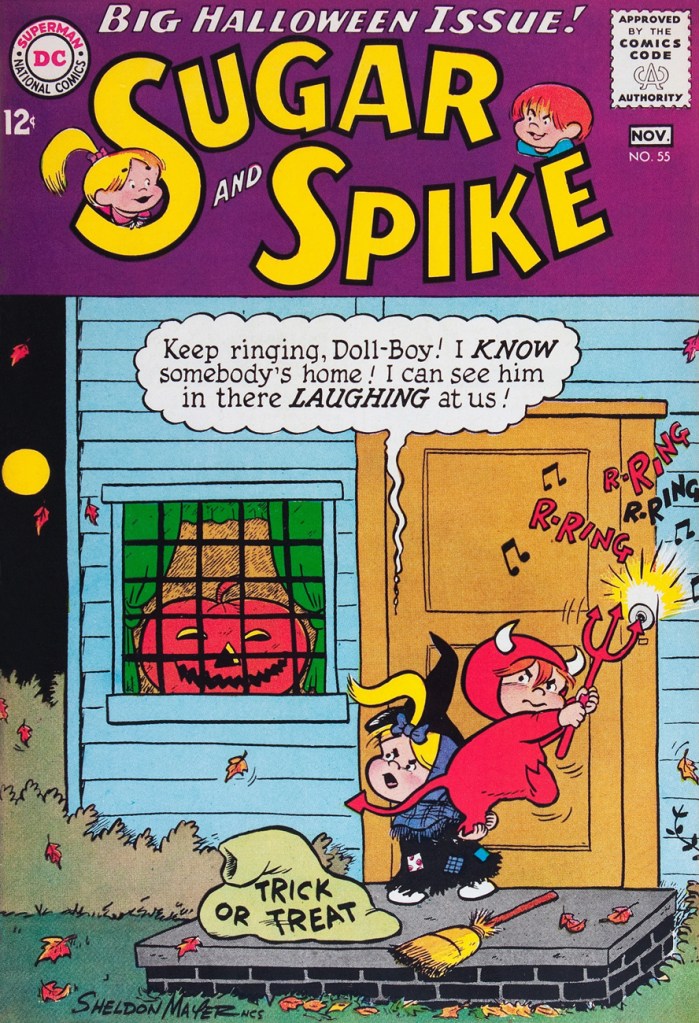
This is Sugar and Spike no. 55 (Oct.-Nov. 1964, DC).
This is Sugar and Spike no. 61 (Oct.-Nov. 1965, DC).
This is Sugar and Spike no. 36 (Oct.-Nov. 1966, DC).
A reprint? Not quite. This cover scene, which originally appeared back in issue 55, was reprised (redrawn, not reprinted) for the series finale, Sugar and Spike no. 98 (Oct.-Nov. 1971). I’d hate to take part in a contest announced in the last issue of a series. There *was* a no. 99, but it was a one-shot that only followed… 21 years later.
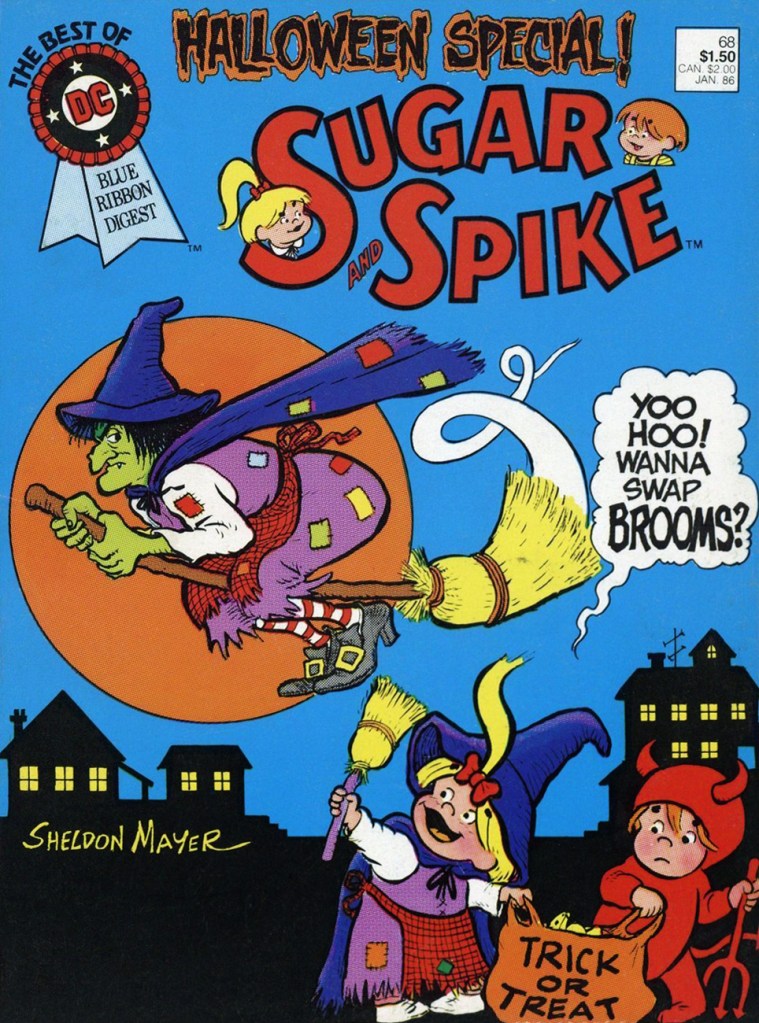
This is The Best of DC no. 68: Sugar and Spike (Jan. 1986). Edited by Nicola Cuti, and with a new cover by Mr. Mayer. Mostly reprints, but with material of this calibre, who’s to quibble?
I was initially set to feature just a couple of Sugar and Spike Hallowe’en covers, but in the end, it seemed unfair to play favourites.
Clearly, some cravings die awfully hard. This is Strange Tales no. 28 (May, 1954, Atlas), featuring a most claustrophobic… cuddle. The rest of this scarce issue contains artwork by Pete Tumlinson, Jack Katz (who recently — just last week! — turned 93), Bob Forgione, Don Perlin (who recently turned 90) and Tony DiPreta.
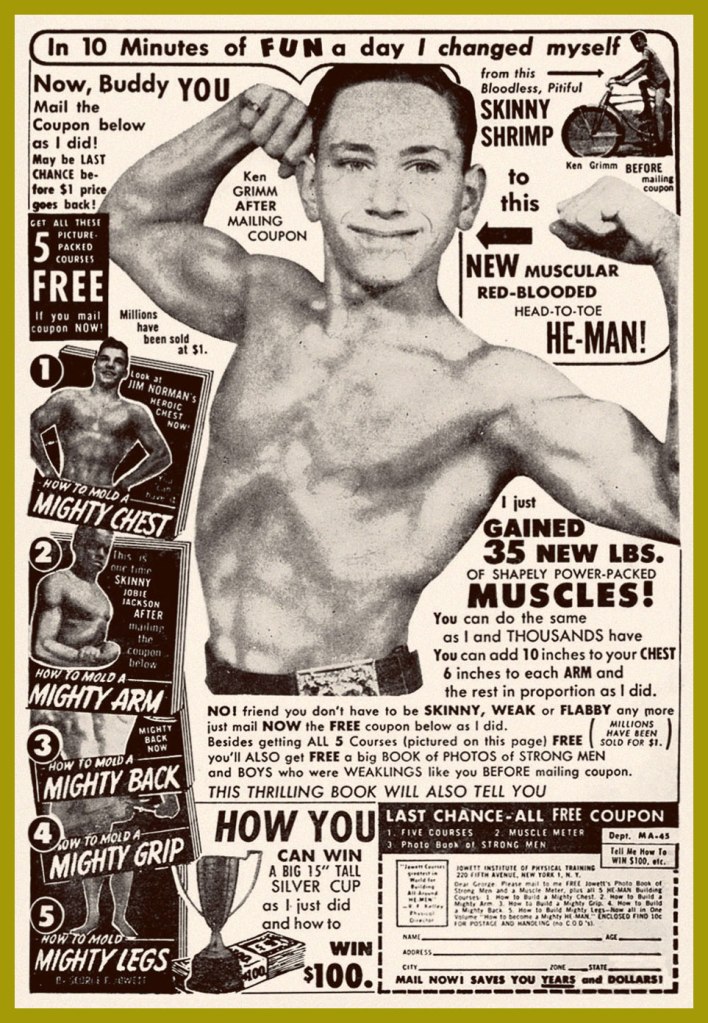
*Ken* Grimm, eh? Speaking of horror, they sure didn’t mince words to reel in the rubes, did they? This gentle, understated pitch appeared on the inside back cover of this issue of Strange Tales. « Mail the damn coupon with your shekels already, you bloodless, pitiful, skinny shrimp! », bellowed the bellicose drill sergeant.
« What is this ‘witch’s brew‘? Oh, that’s a special! It’s a squirt of everything! » — Pop Tate divulges one of his culinary secrets
A little while back (okay, quite a while back!), upon reading an article written by cartoonist Seth (John Stanley’s Teen Trilogy, The Comics Journal no. 238, Oct. 2001), this passage especially piqued my interest: « I have to admit right now that I like Archie comics quite a bit and I have hundreds of issues of Archie and its various spin-off titles. I can even tell you which years are the good years (1959 to ’65, incidentally) ».
As it happens, I’m in full agreement with the gallant Mister Gallant : this was when Archie’s Mad House and Tales Calculated to Drive You Bats came along, when Bob White (and Samm Schwartz, and Orlando Busino) were producing scads of wild and wooly covers featuring ghouls and bug-eyed critters, mole men and mad (though I’m told they prefer ‘eccentric’) scientists and sundry extraterrestrials and witches. The line’s cover layout was also nicely open, affording the artists plenty of latitude to indulge themselves. Here are some samples from the aforementioned creators at the peak of their formidable powers, before the end-of-recess bell rang and stifling homogeneity was henceforth imposed.
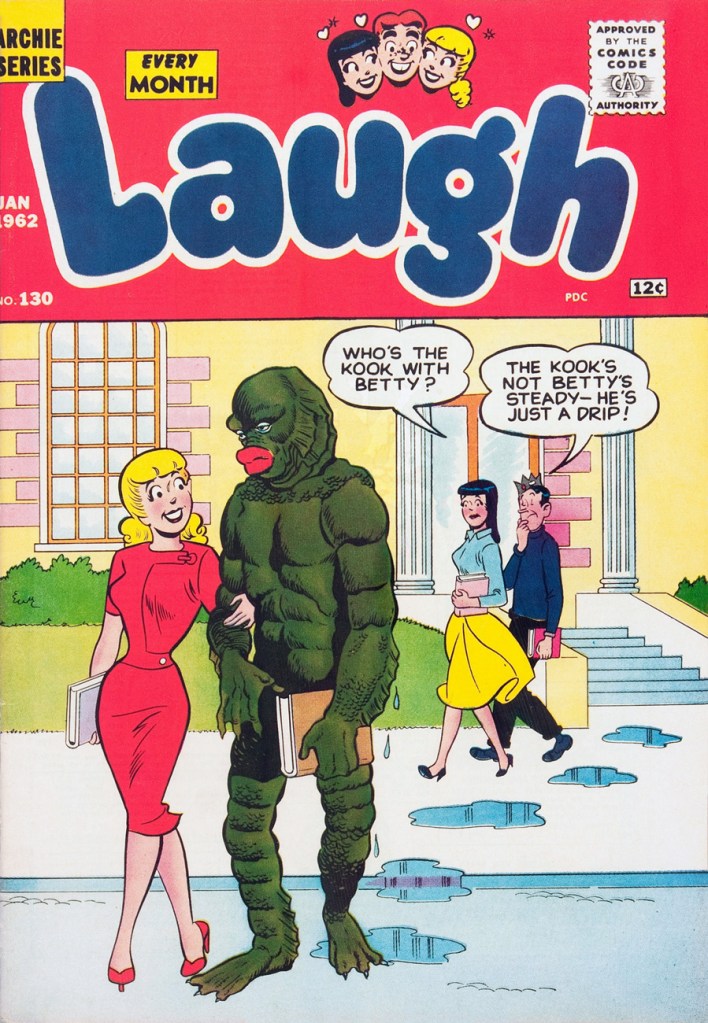
This is Laugh no. 130 (Jan. 1962, Archie); cover by Samm Schwartz. Looks like our friend Ricou Browning is slumming it in Riverdale, with Betty happily showing him the sights. Honestly, he’s more of a gentleman that Archie ever was.
This is Tales Calculated to Drive You Bats no. 2 (Jan. 1962, Archie); cover by the incomparable Orlando Busino, still with us and nearly 94 years young! I strongly suspect that these witchy younglings mean mystical business!
This is Archie no. 125 (Feb. 1962, Archie); cover by Harry Lucey, one of the crucial classic Archie artists. Regardless of what you’ve heard, look at the actual sales figures for 1969, with Lucey drawing every issue of Archie. Readers voted with their wallet.
Here’s a swell example: Pep Comics no. 158 (Oct. 1962). Spooky cover art by local favourite Bob White. I wouldn’t have pegged Archie as a skeptic, to be honest.
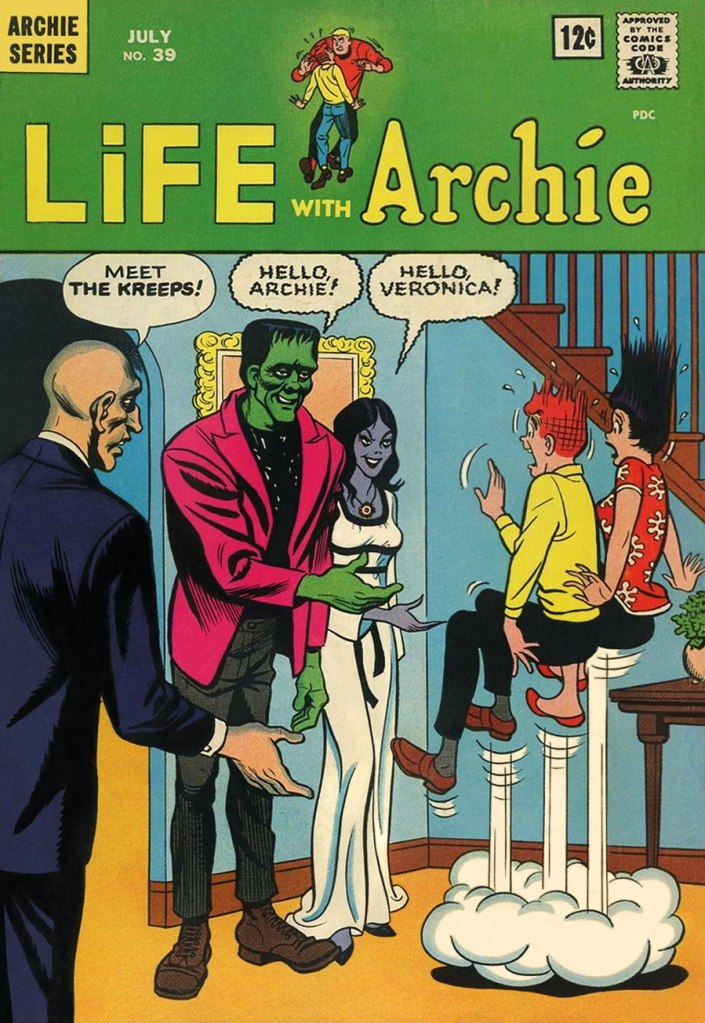
This is Life With Archie no. 39 (July 1965, Archie); cover, again, by Mr. White. The previous year had seen the TV arrival of The Addams Family and its imitators, The Munsters. So what’s one carbon copy more or less?
« People, chained by monotony, afraid to think, clinging to certainties… they live like ants. » — Béla Lugosi
It’s October first, and you know what that entails, don’t you? Among other ominous occurrences, it happens to be the onset of Who’s Out There’s annual Hallowe’en Countdown!
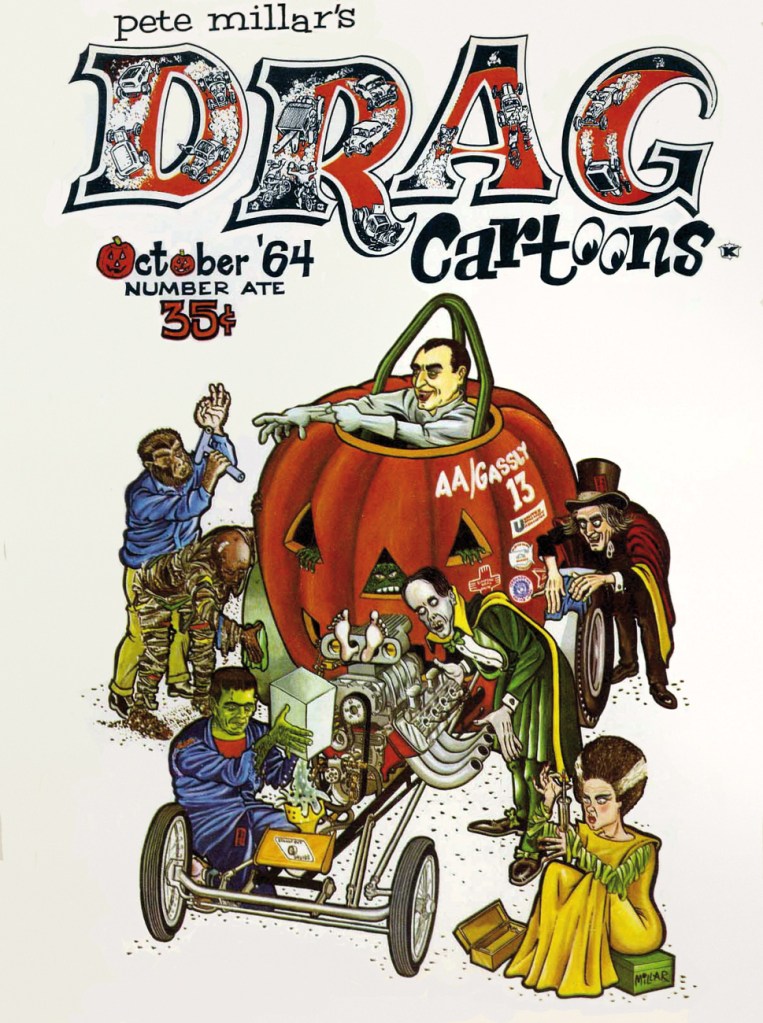
This year, we open hostilities with this fine monster mash by Pete Millar (1929 – 2003), drag-racing cartoonist nonpareil. I suspect we’ll be seeing more of certain members of this ghoulish cast of fiends.
This is Drag Cartoons no. 8 (October, 1964, Millar Publishing Company). Cover by Mr. Millar. What does this… vehicle run on, exactly?
Any goodies to be found beyond the dandy cover? Well, there *is* this little number (of several, actually) by one Alexander Toth…
Just another wrinkle on a familiar story, I realize, but such glorious artwork! Feel free to compare and contrast with Harvey Kurtzman’s interpretation, in a rather more sombre timbre, of the same basic scenario.
Another seasonal bonus from the same issue… that certainly seems like an advantageous deal… yessiree buckaroos!
« Charlton was just a place where you felt you could let off a little steam, even if you were never going to get rich. » – Roy Thomas
For over a decade, Pat Masulli (1930-1998) was executive editor of Charlton Publications’ comics line… and of its more lucrative song lyrics (Hit Parader, Song Hits) and crossword puzzle magazine line. Though much has been made of artist Carmine Infantino rising through the editorial ranks at DC Comics (positions traditionally held by writers or just plain bossy types; Sheldon Mayer was a most notable exception at DC), Charlton always did employ artists to manage the comics wing: Al Fago (1951-55), Masulli (1955-66), Dick Giordano (1965-68), Sal Gentile (1968-71) and finally George Wildman (1971-85). There are overlaps in time as well as the porous distinctions betwixt the titles of Managing Editor and Executive Editor.
Now, all of the aforementioned are serviceable artists, but I’m most interested in Masulli. Over the years, it’s gradually dawned on me that, for a few months in 1965-66, Masulli, as if he weren’t busy enough already, decided to lay out and pencil most of the comics line’s covers. And, astoundingly, they represented some of the finest (though often obscure) comics artwork of the decade. Cover artist is a plum job in comics, but few are born that can smoothly fill these tight, squeaky shoes.
What was Masulli like? It depends on whom you ask. His one-time assistant, artist (and later DC inker) Frank McLaughlin, responded with a diplomatic, amused « You don’t want to know. » Charlton’s main writer, Joe Gill, queried about Masulli as editor, sums it up: « Terrible. Pat’s dead now, but he was a martinet, not a friendly guy that enjoyed amiable relations with the artists. He ruled it, and he and I co-existed. » On the other hand, writer-editor Roy Thomas (who was granted his entrée into the industry from Masulli), understandably speaks well of him although, to his regret, they never met. Before they could, Masulli was promoted at Charlton, leaving him to devote his time and effort to the music division, handing the reins of the comic book line to his now-and-again assistant, Mr. Giordano.
Masulli’s go-to guy within his stable of artists appears to have been the versatile, underrated Rocco ‘Rocke’ Mastroserio, who died far too young (at the age of 40!), still steadily improving and shortly after landing some promising jobs at Warren and DC. Mastroserio’s early work can be a tad gawky and lopsided, but shows much promise. By the mid-60s, his covers (his forte) could at times attain a level of craft and inspiration rivalling (and akin to) the work of John Severin and Joe Maneely, fine models to emulate.
This time, however, let’s focus on highlights from the Masulli-Mastroserio flash flood of ’65.
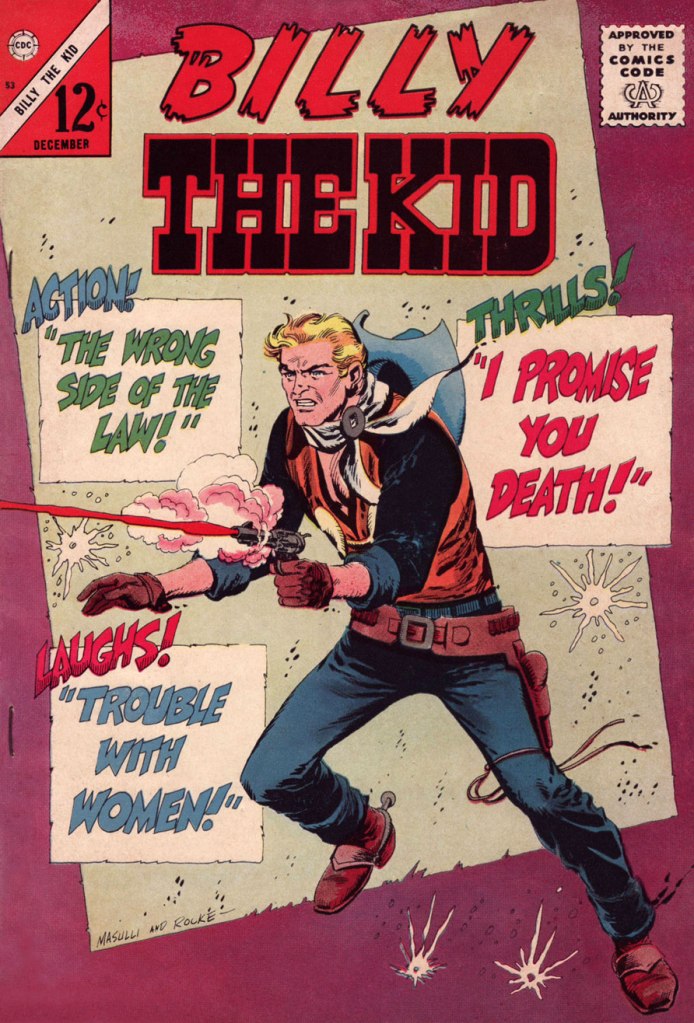
This is Billy the Kid no. 53 (Dec. 1965, Charlton).
This is Special War Series no. 1 (Aug. 1965, Charlton).
This is Fightin’ Navy no. 124 (Jan. 1966, Charlton).
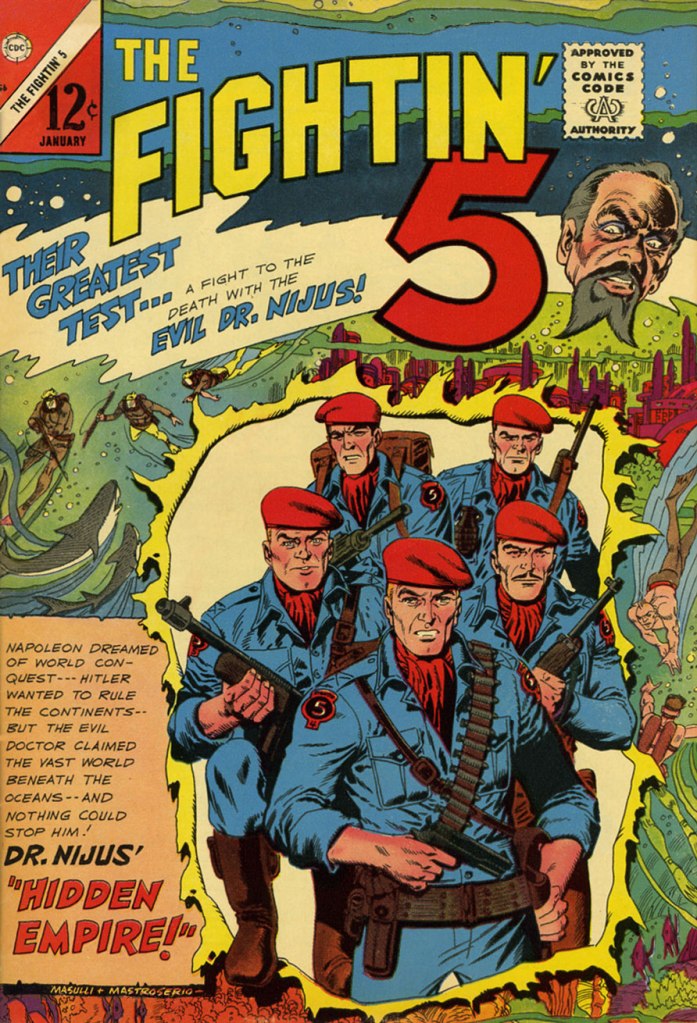
Intricate yet easy to parse, this is TheFightin’ 5 no. 36 (Jan. 1966, Charlton). Comic Book Artist editor Jon B. Cooke once or twice opined that The Fightin’ 5 were ‘a Sgt. Fury and His Howling Commandos swipe‘… but he was wrong: they were a Blackhawk swipe (if anything), and, let’s be honest, Sgt. Fury is, for his part, a Sgt. Rock and Easy Company swipe. All clear now?
This is Hot Rod Racers no. 9 (Jan. 1966, Charlton).
This is Hot Rod and Racing Cars no. 78 (Mar. 1966, Charlton). Masulli began his career as a colourist, and it certainly shows in his cover work.
This is Konga no. 23 (Nov. 1965, Charlton), the series’ final issue. The mighty Steve Ditko had begun the series, but later art chores were capably handled by the solid team of Bill Montes and Ernie Bache.
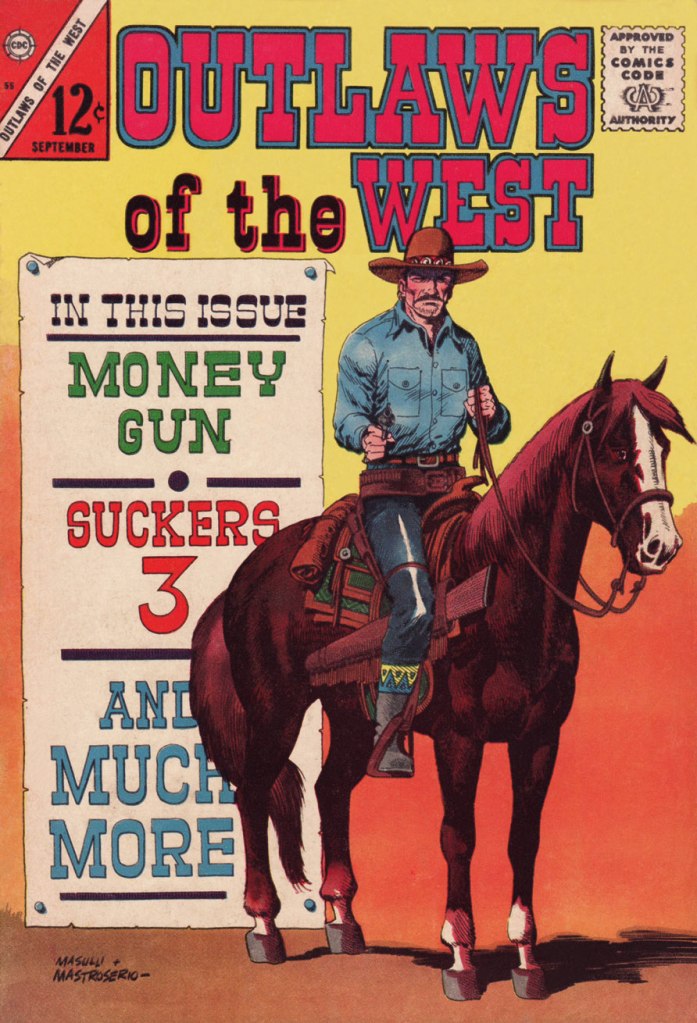
This is Outlaws of the West no. 55 (Sept. 1965, Charlton). Masulli could do busy and action-packed, and he could also do spare, clean and serene. Unlike many a cover artist, he didn’t seem to rely on one particular formula, or even two.
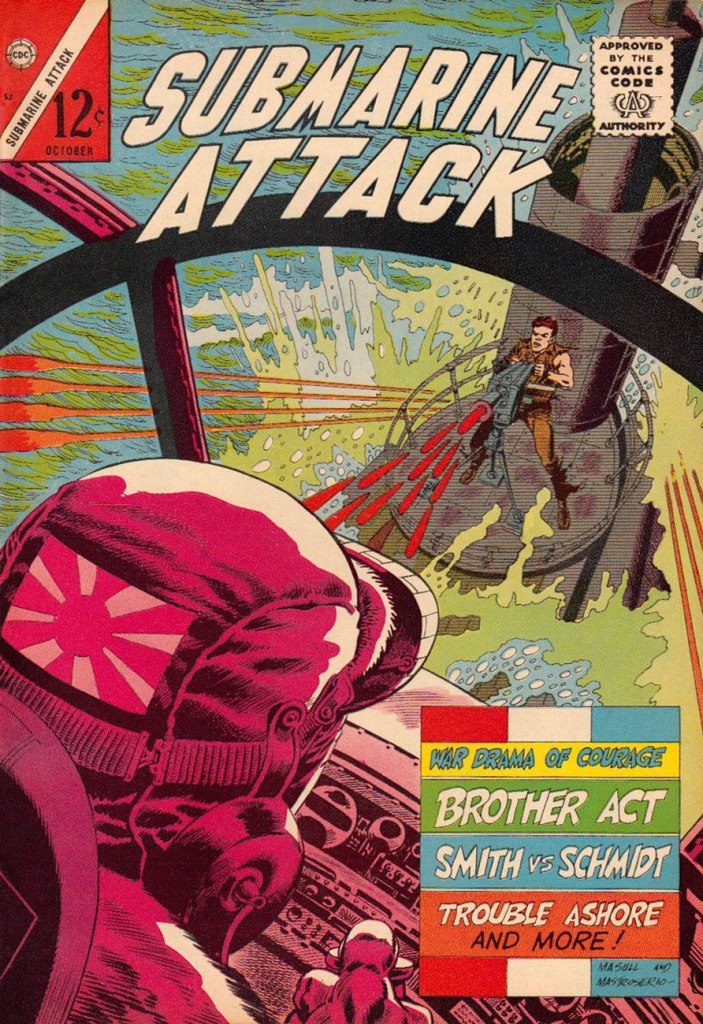
This is Submarine Attack no. 52 (Oct. 1965, Charlton). Both composition (that foregrounding!) and colouring are top-notch.
This is Texas Rangers in Action no. 53 (Dec. 1965, Charlton). Nearly all of Charlton’s covers of this period were distinctively lettered by Jon D’Agostino (1929-2010).
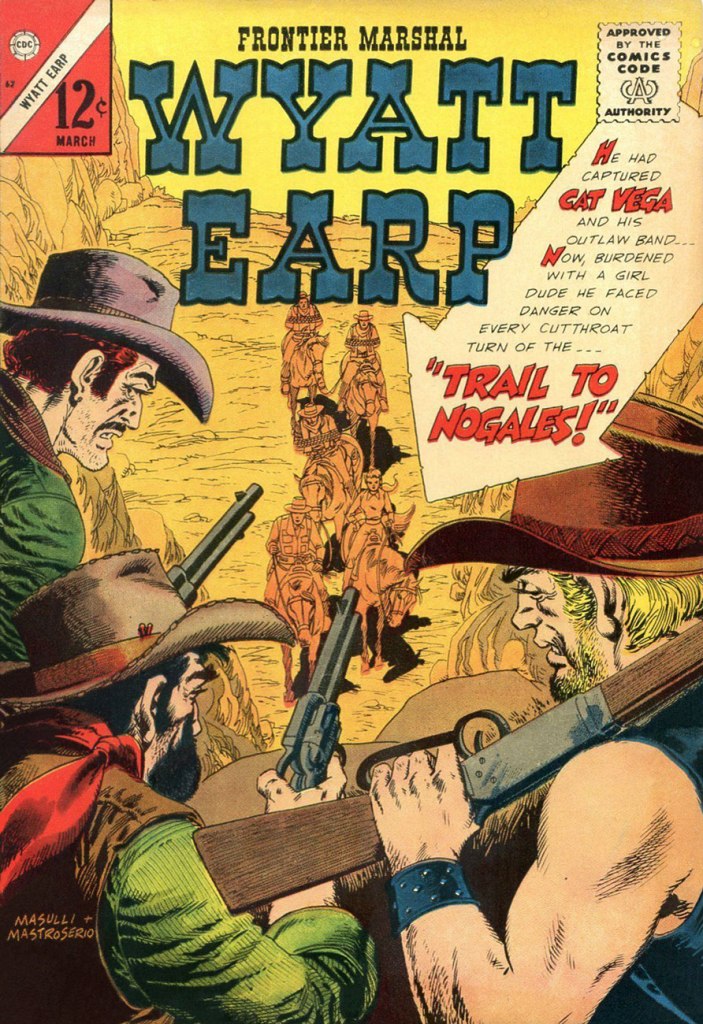
This is Frontier Marshal Wyatt Earp no. 62 (Mar. 1966, Charlton). Mastroserio’s savvy variation of line thickness to convey perspective and emphasize depth is what most reminds me of Joe Maneely‘s work for Atlas and DC (speaking of artists snatched away in their prime).
I’ll return at some point to spotlight solo Mastroserio. Next on the agenda for me, however, is this year’s Hallowe’en Countdown!
« It did not occur to me that I might be a writer until I flunked out of my first year as a chemistry major, and found work as an apprentice writer of Volkswagen ads. » — Peter Carey
Until the Beetle hit the market, automotive marketing copy was full of bluster, and the images (often illustrated) were flights of fancy, emphasizing low, long lines and a fantasy lifestyle.
The clean, simple photography on a white background that emphasized the Beetle’s compact, practical form may seem commonplace these days, but it was a revolution in a world where Americans grew up obsessed with muscle cars, horsepower, and tire smoke. Making the car small, when the convention was to make it fill the page, was also novel. The simplistic approach to design and layout was totally contrary to the advertising conventions of the time. [ source ]
While I object to the misuse of the rather pejorative “simplistic” to denote what is instead commendably strippeddown, uncluttered, or if one must, ‘simple‘… that’s the gist of it. After all, these folks are gearheads, not graphic designers.
One of the lesser-known components of the long-running campaign was a nifty 1967 promotional book that was graciously given away by one’s friendly Volkswagen dealer.
They gathered all the big guns and asked them to think small. Illustration by Charles Addams.
Let’s take a look inside.
One by perennial bon vivantEldon Dedini, working one of his pet motifs, but with his customary panache. Under Eldon’s pen, the car’s lines acquire a lusty fluidity.
A beauty by local favourite Virgil Partch (1916-1984). Such a graceful line the man had. Simple… not simplistic!
Don’t be confused: like the Porsche and the Corvair, the VW Beetle’s trunk is located in the front of the vehicle. Cute details: the booted husband’s still-smoking pipe and his glasses remain in the garage. VIP delivers, as usual. Read how he met his demise.
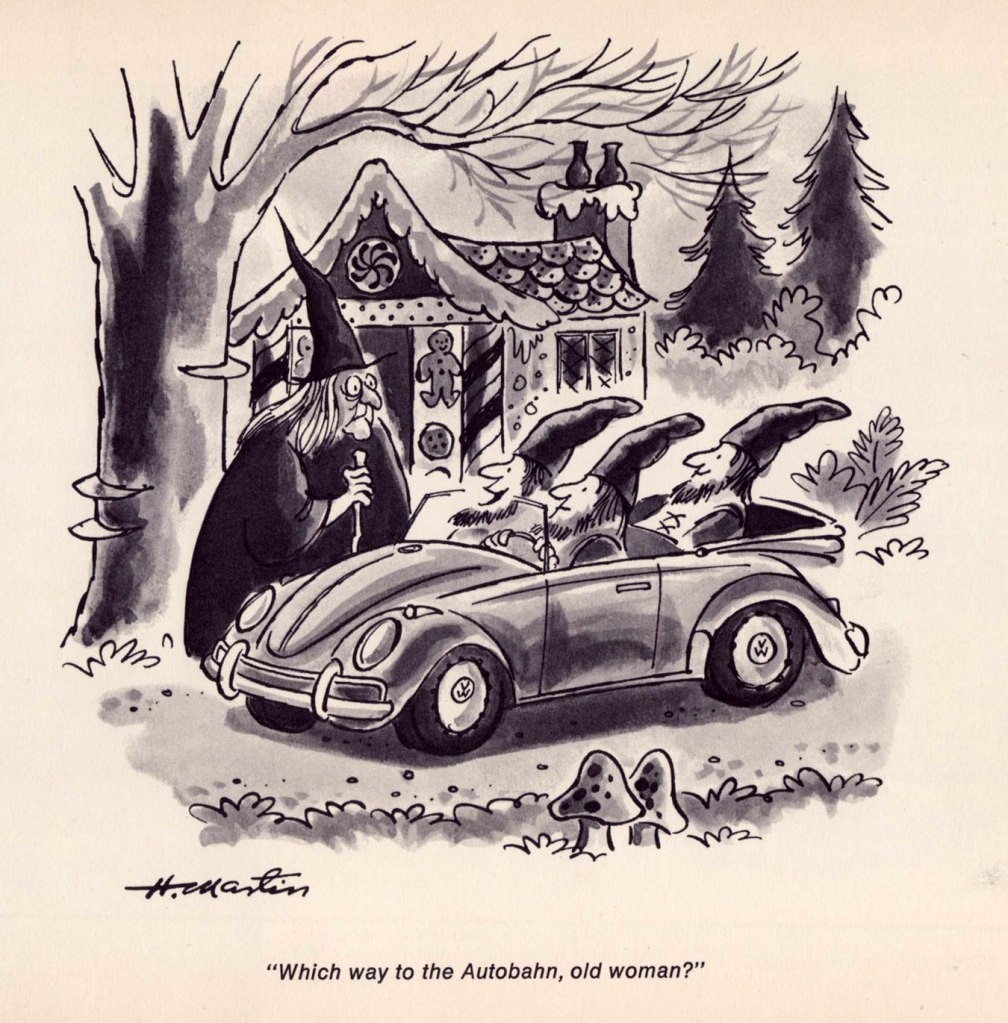
An adorable entry from long-time The New Yorker cartoonist Henry Martin, who passed away last June at the age of 94. I can just hear the German accent.
Another Playboy regular, Phil Interlandi (1924-2002) stretches out a bit, and very successfully at that.
One from the book’s royal guest, Charles Addams (1912-1988). It’s a fine joke, but I find that many people don’t get it; it would have benefitted from a more vertical composition. Still, trust Uncle Fester to know what’s going down.
A second dose of Mr. Addams. I wasn’t going to say no to a giant mutated toad and toadstool. Here’s our earlier sampler of his macabre wit, from (un)naturally, our first Hallowe’en Countdown.
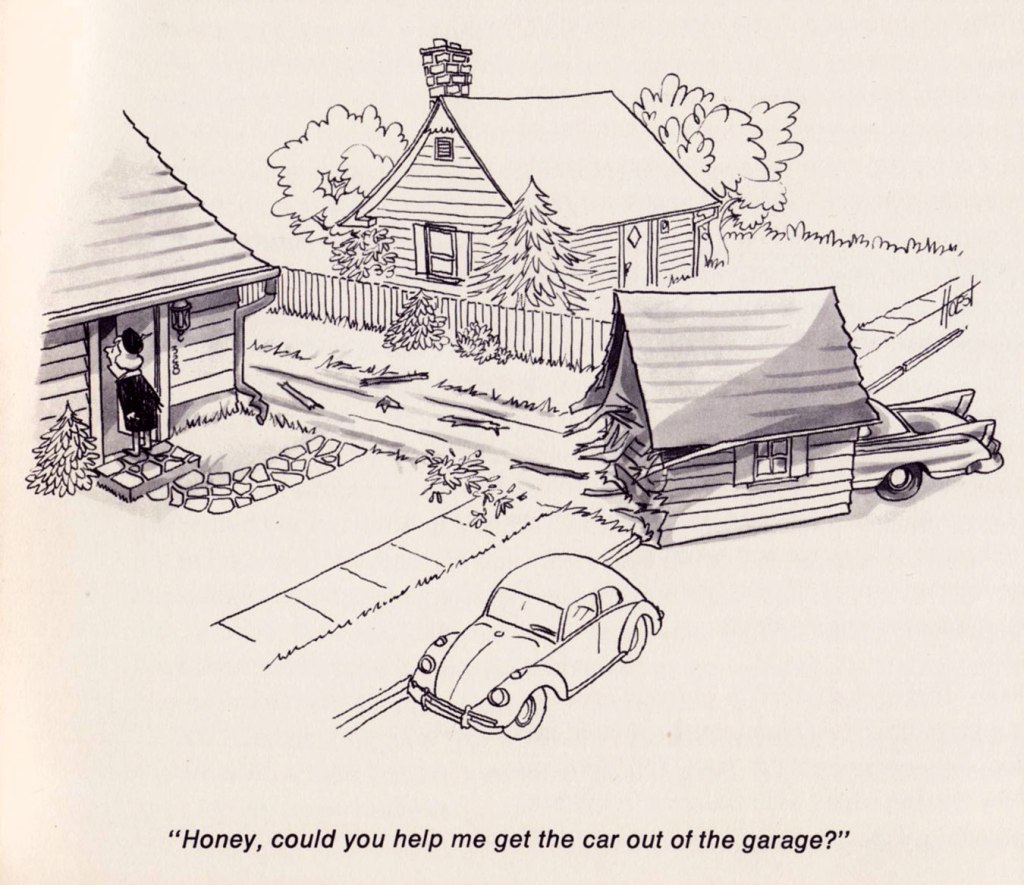
The couple of decades he spent drawing his successful syndicated strip about unceasing marital strife, The Lockhorns (whose début came the following year!) have perhaps dimmed the critical reputation of William ‘Bill’ Hoest (1926-1988). But he was quite good, when given a chance to stretch out a bit. It’s been since proven that women are the better drivers, incidentally.
And finally, a bat-entry from John Gallagher (1926-2005), a then-ubiquitous panel gag cartoonist in many of the biggest names in magazines: Collier’s, The Saturday Evening Post, Look, True… I love the absurd size ratio between the members of The Dynamic Duo. That’s one sidekick you could accidentally kick aside!

























 Who's Out There?