While I’m painfully aware that such things are inevitable, the past couple of weeks have been pretty brutal to the ranks of my musical heroes. First went Sylvester ‘Sly Stone’ Stewart; then Brian Douglas Wilson; then Lugee Alfredo Giovanni Sacco, aka Lou Christie, and then Bobby Sherman*… all born in 1943!
It would require quite a stretch to write more about Sly and Lou, but I’ve already devoted a piece to Mr. Sherman (Let’s Hear It for Bobby Sherman!), who enjoyed his own comics series in the early 1970s.
Which leaves us Brian. I’ve been a diehard fan long enough to remember that his name and accomplishments didn’t get separated from his band’s — especially given the embarrassment that the Mike Love-led Beach Boys touring cavalcade had become — until the early 90s. And I also recall that Pet Sounds was, for decades, just an expensive but critically acclaimed commercial failure that didn’t get certified ‘Platinum’ until the year 2000, a third of a century after its release. For similar tales of vindication through gradual changes in fortunes, see The Kinks are The Village Green Preservation Society and The Zombies’ Odessey and Oracle.
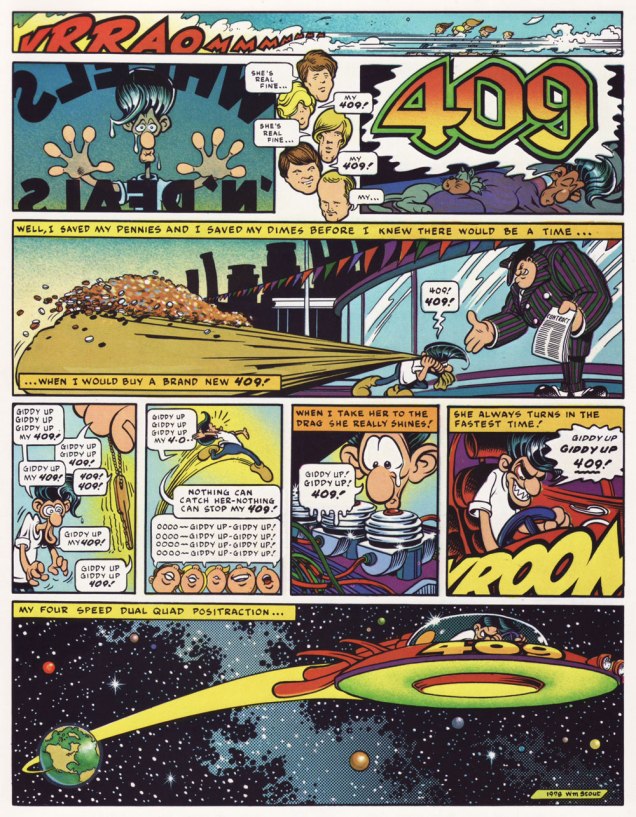
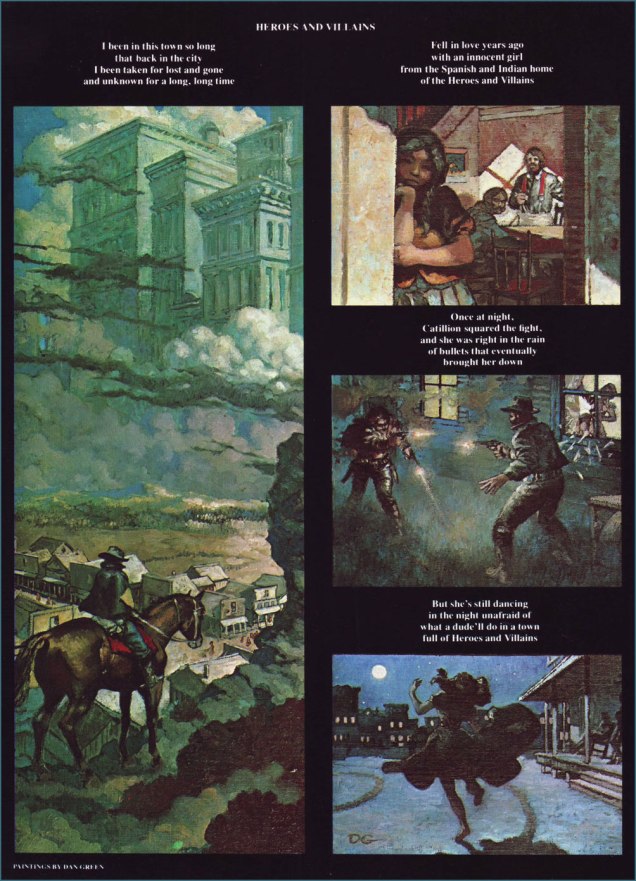
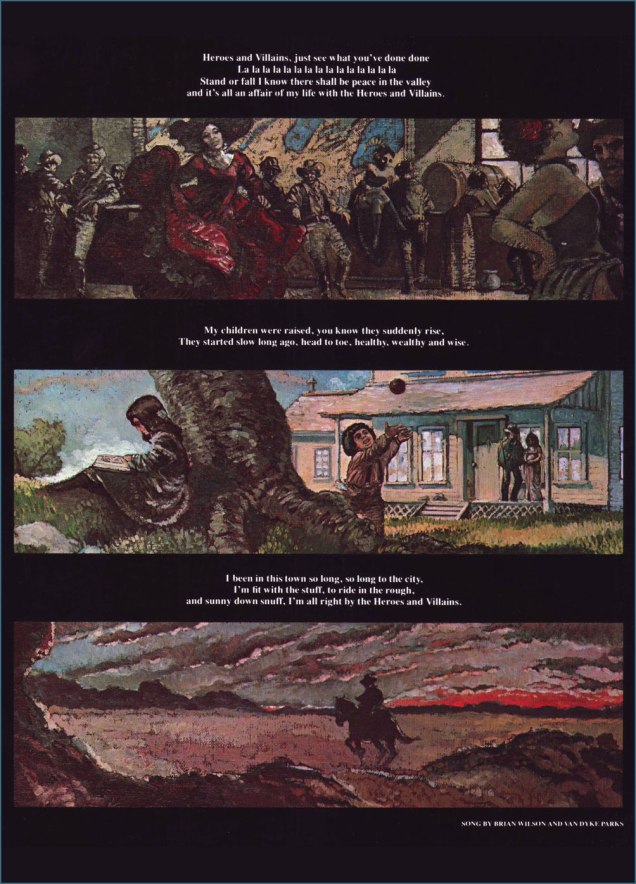
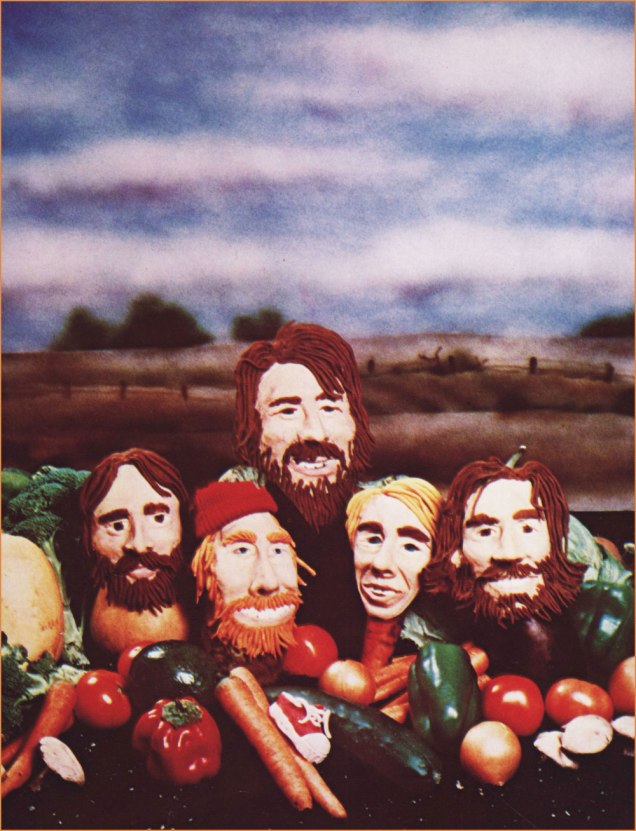
So I turn (for the second time!) to Byron Preiss‘ marvellously illustrated authorized biography of the Beach Boys, from 1978. In addition to a highly entertaining and well-documented text, Preiss, a man with an astonishingly well-filled Rolodex, had the bright idea of tapping various illustrators to contribute their visual cover version of a favourite BB song.
I’ve written about Mr. Stout already, in The Prodigious William Stout, which ought to give you an idea of how I feel about his work. Lyrics by BW collaborator and future record (including a young Bobby Sherman!) producer Gary Usher.Cheeky Harvey Kurtzman spells out just what sort of ‘Fun, Fun, Fun‘ could be had « ’til her daddy takes the T-bird away ».Nice drawing, although the only detail Ralph Reese truly gets right is poor Dennis Wilson‘s ill-starred appetite for the ladies. Also… Mike Love with a guitar, really?Those only familiar with Dan Green (1951-2023; another awkward lacuna from Lambiek’s comiclopedia) as a journeyman inker at Marvel and DC will likely be surprised at his adroitness with a brush. Here he tackles Wilson and Van Dyke Parks‘ (a true gentleman… and also from the class of ’43) arguably most ambitious œuvre, Heroes and Villains.A surprising clay-based entry from Joey Epstein and her husband, our beloved Tom Hachtman, photographed by Ben Asen. The likenesses are pretty solid… save for Brian, who’s too skinny. The song in question is, of course, Vegetables. « I know that you’ll feel better when you send us in your letter an’ tell us the name of your… your favorite vege-table. »This is former Air Pirate and Dirty Duck and Popeye cartoonist Bobby London‘s joyous celebration of Cool, Cool, Water, a tune intended for inclusion on the Beach Boys’ fabled Smile album (though it initially surfaced on their excellent Sunflower LP). To this day, however, London’s got mixed feelings about the whole thing. To begin with, he had no particular fondness for the Beach Boys, and getting dragged by Preiss to a late-70s BB live show, sans Brian (who was in no shape to perform anyhow) and with Dennis likely off promoting his Pacific Ocean Blue album, didn’t move the needle one iota. As London told me: « I had something more interesting and less Crumb-y in mind. » Now *that* is caricature. Despite depicting the Boys as animals, illustrator — and Official Horror Host Hall of Fame inductee — George Chastain unerringly nails the essence of each, not to mention the group dynamics: of course Brian’s off to do his own thing. Not linked to any specific song, this is nonetheless my favourite piece in the book. Take a bow, sir!
-RG
p.s. I should also mention that another one of my favourite musicians died this week, namely Argentine composer Boris Claudio ‘Lalo’ Schifrin, but as he was born in 1932 (he was ninety-three!), his inclusion would have spoiled the pattern. Hope you understand, Lalo. Here’s a mesmerising favourite from his jazz sideman days: 1963’s The Fakir, recorded by Cal Tjader (« the Swedish Nerd king of Latin Jazz », as my friend Rupert dubbed him), and composed, arranged and conducted by Señor Schifrin.
This is *nearly* a tale of two Rolands, both named Sabatier, both born in France and in the year 1942. One deservedly became a darling of the avant-garde as a standard bearer of the ‘Lettrisme’ art movement. He was evidently a genius, he passed away in 2022, and well, that’s not the one I’ll be writing about, at least this time.
So we’re left with the otherRoland Sabatier (1942 –), who’s a bit of a cypher: the Lambiek comiclopedia somehow failed to include him, despite his considerable achievements. Roland also — bafflingly — fails to even rate a passing mention in Richard Medioni‘s otherwise exhaustive Mon camarade, Vaillant, Pif Gadget, L’Histoire complète 1901-1994. To be perfectly honest, I hadn’t heard of him until this year, when I ordered a batch of cheap issues of Vaillant from a friendly French dealer. While I already knew the vast majority of the fabled bédé weekly’s stars, one unknown entity stood out, by virtue of both obscurity and evident talent.
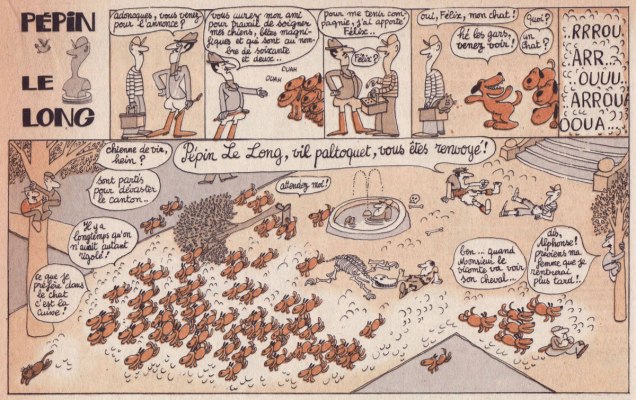
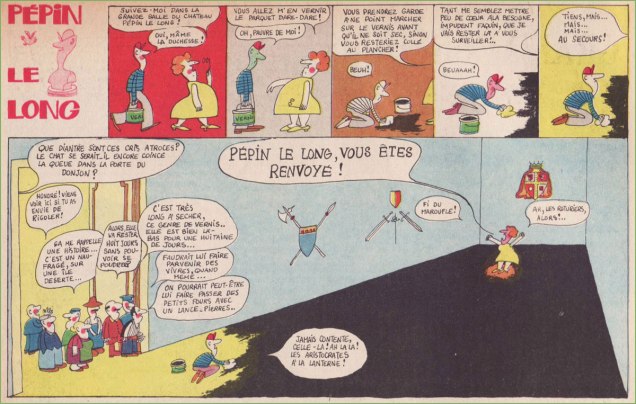
Pépin le long is a high concept strip about a poor schmuck who keeps getting fired, generally through some innocent mistake. His moniker is a play on Pépin le bref (714-768), one of the early kings of France, and a sterling example of the absolute necessity of keeping church and state separate. *That* Pépin is perhaps most famous for being papa to Charlemagne (748–814), King of the Franks and first Holy Roman Emperor.
Originally published in Vaillant, le journal de Pif no. 1131 (Jan. 15 1967, Les Éditions Vaillant).Originally published in Vaillant, le journal de Pif no. 1132 (Jan. 22 1967, Les Éditions Vaillant).Originally published in Vaillant, le journal de Pif no. 1133 (Jan. 29 1967, Les Éditions Vaillant).Originally published in Vaillant, le journal de Pif no. 1135 (Feb. 12 1967, Les Éditions Vaillant). I love those enthusiastic doggies, even if they do strip a horse to the bone like they’re piranhas.Originally published in Vaillant, le journal de Pif no. 1141 (Mar. 26 1967, Les Éditions Vaillant).Originally published in Vaillant, le journal de Pif no. 1144 (Apr. 16 1967, Les Éditions Vaillant).… and the swan song, second of two strips appearing in issue 1144. Excellent use of the vertical format for the finale!« No, young man: I’m the other, avant-garde Roland Sabatier. »
There were only ten Pépé le long strips, and I’ve managed to gather seven. Not bad, given their rarity.
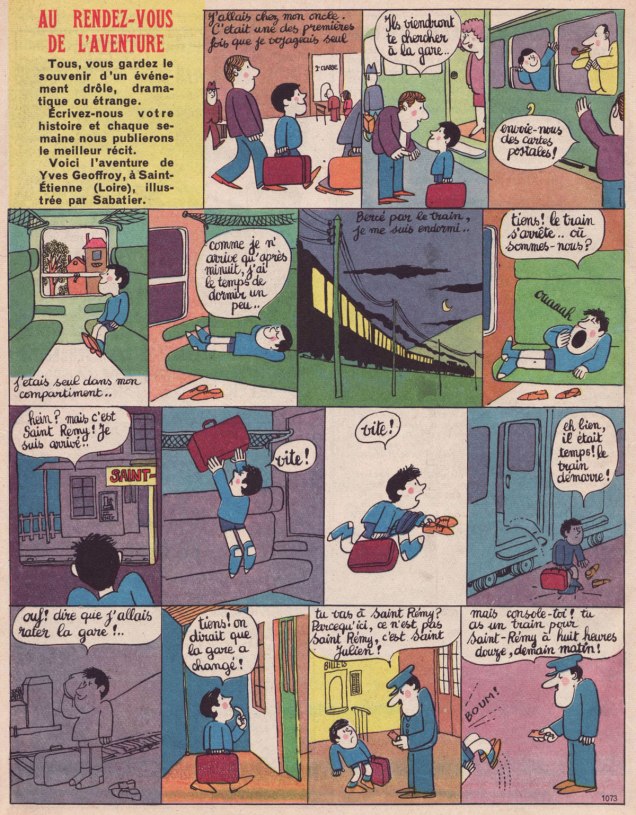
Before Pépin, in 1965-66, Sabatier had illustrated several — some forty — instalments of Vaillant’s established « Au rendez-vous de l’aventure » (1956-66), wherein readers sent in their personal stories of everyday adventure. Here’s a pair of examples.
Originally published in Vaillant, le journal de Pif no. 1068 (Oct. 31 1965, Les Éditions Vaillant).Remember cursive? Originally published in Vaillant, le journal de Pif no. 1073 (Dec. 5 1965, Les Éditions Vaillant).
« Losing my mind, but I don’t care I see Donna everywhere Down by the lakeside, in a lawn chair Donna, Donna everywhere » — Too Much Joy
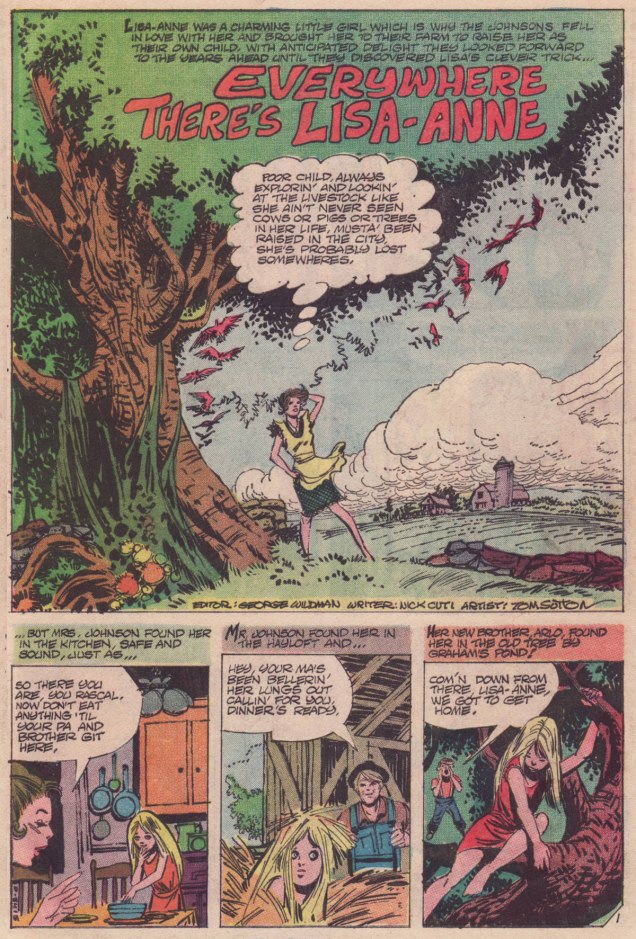
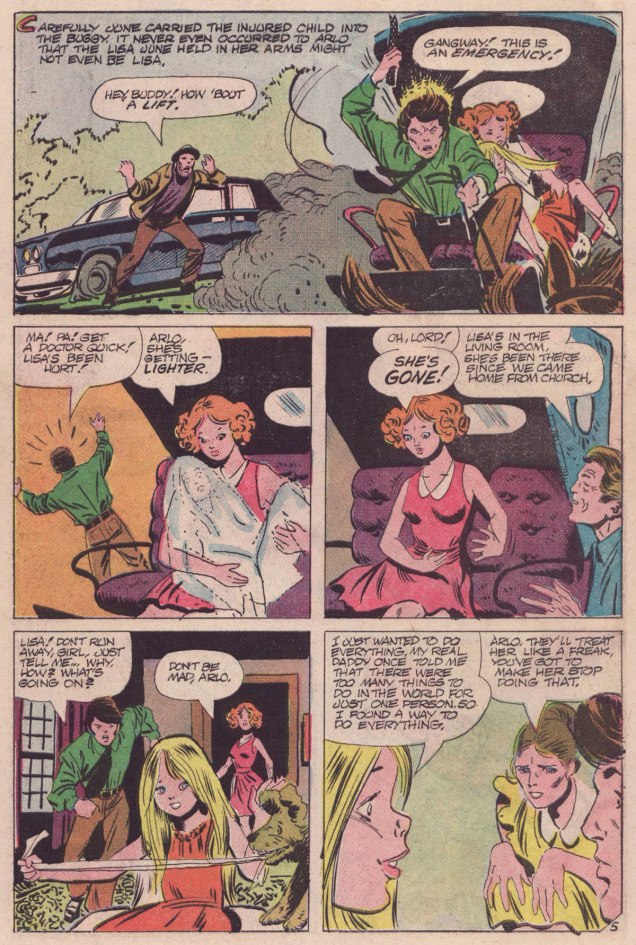
Today’s featured tale hails from Charlton’s groundbreaking anthology title Midnight Tales (1972-1976). It differs from the rest of the publisher’s mystery line in that it largely served as a vehicle and spotlight for Wayne Howard (1949-2007), who even received a ‘created by’ mention on the covers. My partner ds delved deeper into Midnight Tales minutiae in her Tentacle Tuesday entry « Plants Sometimes Have Tentacles, Too ».
« Everywhere There’s Lisa-Anne » saw print in Midnight Tales no. 6 (Nov. 1973, Charlton). It was written by Nicola Cuti, Howard’s co-conspirator (they had both apprenticed with Wally Wood), who provided the lion’s share of Midnight Tales scripts. It was illustrated by Tom Sutton and coloured by Mr. Howard.
What I enjoy about this snappy little tale is its graceful economy: it packs a lot of context and characters into its mere six pages, but flows so efficiently that it never feels rushed. It doesn’t attempt to explain what doesn’t need explaining, nothing is overstated, and none of the characters is a convenient idiot. No patronising hand-holding, just straight-ahead storytelling.
Let’s hope, for the Johnsons’ sake, that Lisa-Anne’s very convincing and the sheriff no laggard!
Lisa-Ann’s ubiquity reminds me of a favourite Cul de Sac Sunday strip… and any excuse to trot out the Richard Thompson is to be seized eagerly!
« You mean the secret password is Llanfairpwllgwyngyllgogerychwyrndrobwllllantysiliogogogoch? » — Barbarella
Unlike French rock ‘n’ roll, French science-fiction isn’t an oxymoron.
A couple of months back, I happened to order a handful of issues of Fiction (1953-1990), nominally the French-language edition of The Magazine of Fantasy & Science Fiction… yet superior in the sense that Fiction’s focus was broader, encompassing as it did more elusive genres like fantastique, while devoting ample space to excellent critical essays… in the French manner.
I was buying specific issues for their reprints of tales by my favourite writer, Jean Ray, and a couple of the issues happened to bear covers by future superstar Jean-Claude Forest (1930-1998), fabled creator of Barbarella, Hypocrite and Bébé Cyanure, as well as scripting early episodes of Paul Gillon‘s Les naufragés du temps.
As it turned out, Forest had lent his talents to quite a bevy of covers for Fiction — which speaks well of their editorial discernment — and as the kind seller had priced other issues at a most modest price — these are nearly seventy years old, let’s not forget — I opted to spring for more Forest rarities… and so here we are.
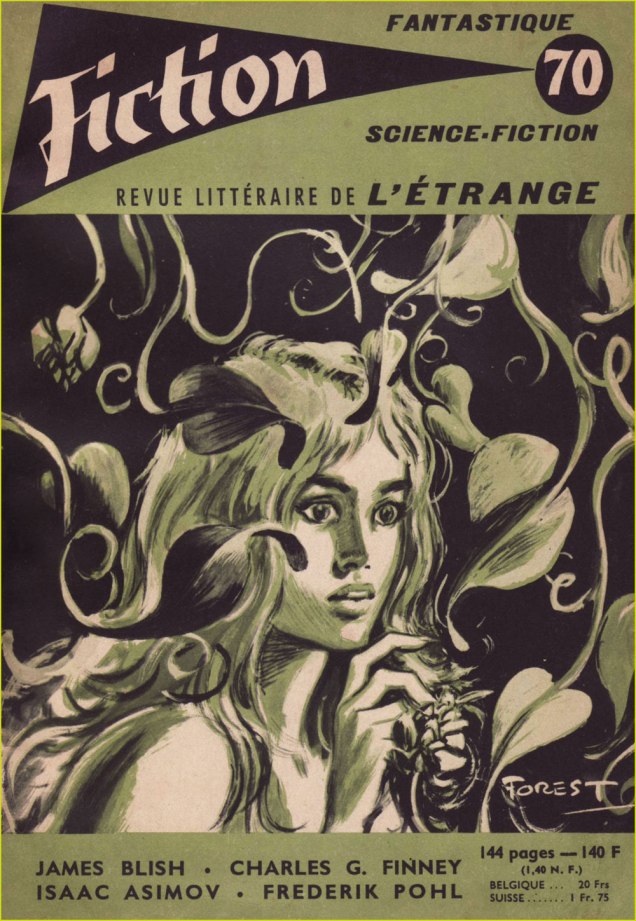
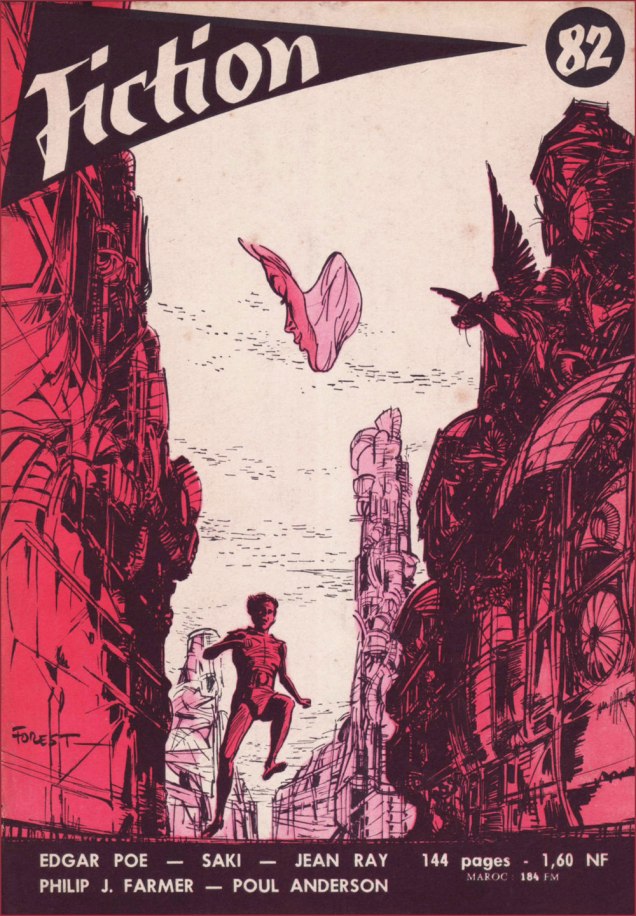
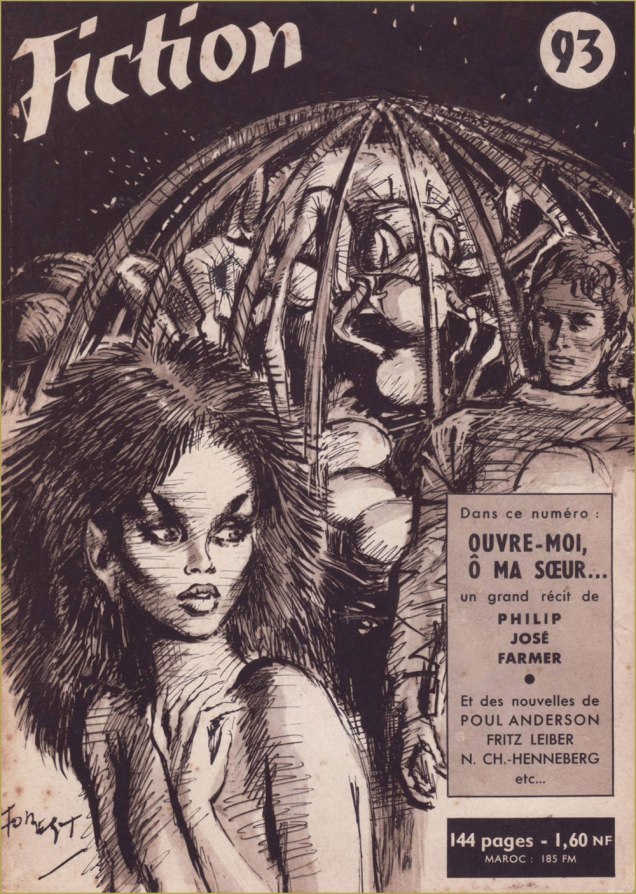
This is Fiction no. 61 (Dec. 1958, Éditions Opta), with Forest’s cover illustrating Julia Verlanger‘s “La fenêtre“.This is Fiction no. 64 (Mar. 1959, Éditions Opta), with Forest’s cover illustrating Robert F. Young‘s “La déesse de granit” (« Goddess in Granite »).This is Fiction no. 68 (July 1959, Éditions Opta), with Forest’s collage cover illustrating Charles Henneberg‘s “Au pilote aveugle“.Is that you, Barbarella? This is Fiction no. 70 (Sept. 1959, Éditions Opta), with Forest’s halftone cover illustrating Ilka Legrand‘s “Le rire dans la maison“.This is Fiction no. 75 (Feb. 1960, Éditions Opta), with Forest’s cover illustrating Thomas Owen‘s “Le manteau bleu“. Owen (né Gérald Bertot, 1910-2002) was among the great Belgian writers of the fantastique genre.This is Fiction no. 76 (Mar. 1960, Éditions Opta), with Forest’s cover depicting — you guessed it — Theodore Sturgeon‘s “The Silken-Swift“, translated here as « Douce-agile ou La licorne ».This is Fiction no. 81 (Aug. 1960, Éditions Opta), with Forest’s cover illustrating André Pieyre de Mandiargues‘ “Clorinde“.This is Fiction no. 82 (Sept. 1960, Éditions Opta), with Forest’s cover illustrating Philip José Farmer‘s “The Night of Light“, translated here as « La nuit de la lumière ». I love what Forest does with the composition, its focal point that elusive butterfly with a woman’s face.Forest goes gothic! This is Fiction no. 90 (May 1961, Éditions Opta), featuring a well-timed reprint of Henry James‘ 1898 novella “The Turn of the Screw” (read it here!), several months ahead of Jack Clayton and Freddie Francis‘ fine cinematic version, « The Innocents ».This is Fiction no. 93 (Aug. 1961, Éditions Opta), with Forest’s cover illustrating Philip José Farmer‘s “Open to me, my Sister“, translated here as « Ouvre-moi, ô ma sœur… ».This is Fiction no. 97 (Dec. 1961, Éditions Opta), with Forest’s cover illustrating Michel Demuth‘s “La route de Driegho“.This is Fiction no. 105 (Aug. 1962, Éditions Opta); exceptionally, Forest’s cover doesn’t refer to any of the inside stories; instead, he offers a scene featuring Pygar the blind angel, last of the ornithanthropes, a character from the bédéiste’s signature series Barbarella, which had just begun serialisation in V Magazine that spring. Finally — at least in my collection — this is Fiction no. 117 (Aug. 1963, Éditions Opta); Forest’s intriguing cover doesn’t appear to correspond to any of the stories within.
A word of warning: I plan to further elaborate on the superiority of French science-fiction in comics, but it’s daunting work, and might take a while yet, so bear with me. I’m pretty busy these days.
« Whoever digs Stine is out of his mind! Just how disturbed can Stine be? And who the heck understands his stuff? Not me. » — H.C., Hollywood (not an understanding sort)
I must open this post with a thank-you note to my past self, for picking up, decades ago and who knows where and on a whim, a somewhat pricey book by a cartoonist I’d never heard of, Richard Stine. Obviously, just because he was unknown to me doesn’t mean he’s not a known quantity. Let’s just say he has his devoted fans, and I quite understand their passion.
This is the book in question, Sparks by Stine (1982). It seems to have been intended for self-promotion (in the sense of seeking assignments, that is), given the inscription it bears: « THIS PORTFOLIO IS NUMBER ___ OF A SPECIAL FIRST EDITION PUBLISHED BY THE ARTIST ». Mine’s number 433, and the date of November 15, 1982 appears below Mr. Stine’s signature. I believe a paperback edition of Sparks — with a different, full-colour cover — was published a few years later. That one’s easier to get.Excerpts from letters to the Los Angeles Herald Examiner, where most of the drawings in this book first appeared: « … just wonder in what kindergarten “Stine” studied drawing? And how much marijuana he smokes before dreaming up his alleged “cartoons”? » — R.K., ArkadiaA zinger of a riposte: « Even my children, aged five and three, understand Stine. Their reactions aren’t vehement, they enjoy the simple drawings. And they don’t even smoke marijuana! » — M.H., San Diego« … it is stupid, insipid, has no rhyme nor reason, and so very disgusting. His humor is indicative of a thoughtless mind. By the way — what DOES he use for brains? » — Ms. R., Los Angeles « … Stine’s drawings do mean something — he shouldn’t have dropped out of art school in his first year. » — P.H., Hollywood« I demand you review Stine’s employment, comparing his productivity with the detrimental effects of his abusive creations. » — R.W., staff writer, UCLA Daily Bruin« … while you have one of the best, if not THE best cartoonist in the country, namely Karl Hubenthal, you also have one of the lousiest, if not THE lousiest cartoonist in the country, namely Stine. » — C.H., Glendale« … will you PLEASE provide us with ” A key to the understanding of Stine” in the same way that the Rosetta Stone enabled us to “read” the Egyptian hieroglyphics. » — Mr. and Mrs. L.C., Los Angeles « You’re wonderful! Only those living in ignorance fear your “message.” It’s like getting nasty for the first time: once you go through the one-way door, you’ll never be “nasty” again! I adore you. » — K.I., Venice
I won’t try to dig too deep into Stine’s oeuvre, as others — fellow blogger Ann Canright, for one — have already done a splendid job of it. What I have learned by now is that he was, circa « … a former cartoonist for the now-defunct Los Angeles Herald Examiner*, publisher of cards and author of two books… [ then ] became a full-time painter. »
And thereby hangs a tale, as the saying goes:
« Five years ago I decided to go back to painting. I started really small because I was used to working that way for publishing », Stine said. « I was working with magnifying glasses on my head and thought, ‘I need to get up and breathe and walk.‘ »
He pushed away the 3-inch-by-3-inch canvases and liberated himself size-wise, design-wise and attitude-wise. He stretched a canvas that « was bigger and taller than me », he said, and immediately felt free. [ source ]
He had by then moved from California to Bainbridge Island, in Washington state. And then… on to New Zealand, homeland of his wife Margaret. « Richard, now in his 80’s is still experimenting, exploring and creating and boy does it show in his playful spirit. » [ source ]
-RG
*Do read the history of the LA Herald Examiner if you get the chance… gripping stuff, imho.
« The poet is a madman lost in adventure. » — Paul Verlaine
Today, we’ll examine the early history of Italian fumetti maestro Ugo Eugenio Prat’s (aka Hugo Pratt, 1927-1995) most famous personage, Corto Maltese.
Maltese (named, indeed, after Dashiell Hammett’s famous novel… or rather its John Huston-helmed cinematic adaptation) created in 1967 for the Italian magazine Sgt. Kirk… saddled with a modest print run of 3000… and rather soon cancelled owing to low sales! There, Corto turned up — as a minor player — in a tale entitled Una Ballata del Mare Salato (“A Ballad of the Salt Sea”). Corto’s peregrinations then followed their tortuous course in French bédé weekly Pif Gadget from 1970-73, where the strip mostly baffled — or even enraged — readers but was tirelessly championed by the enlightened editorial team. In his Prix Goncourt-winning biography*, Hugo Pratt, trait pour trait, Thierry Thomas states: « With each new episode, the magazine received letters from readers who couldn’t make head nor tail of it, and demanded Rahan, nothing but Rahan. » Clearly, the world wasn’t ready for Corto… but that acceptance would gradually arrive, at least in the non English-speaking world**.
While the Corto saga has been made available over the years in several fine editions in most of the European languages, it took a long time for English to be added to the roster. In the USA, IDW has managed the fairly monumental but inarguably laudable task; I only wish the covers weren’t so ill-conceived, sadly a feature, rather than a bug, of editor-designer (and translator!) well-meaning Dean Mullaney‘s reprint collections at IDW**.
This presentation by Pif Gadget’s editor-in-chief, Georges Rieu, ran on the inside front cover of the magazine’s 59th issue, between Corto’s first and second appearances:
« You’ve met him while leafing through your PIF, last week… you may have deemed him, at first glance, cynical and cold… but you quickly realised that this nonchalance was but an appearance: Corto Maltese is a kind-hearted adventurer and his attitude serves only to mask a generosity that pulls him into adventures he’d rather avoid… adventures that drag him to the four corners of Central America, from Chile to the Caribbean, in savage lands where magic and ancient superstitions yet reign… in a search for lost civilisations and treasures.
Our friend, artist Hugo Pratt, has spent nearly ten years in patiently piecing together the history of Corto Maltese… in gathering all the documents that speak of these vanished worlds, in questioning the old sailors of the ports along the coasts of the Atlantic and of the Caribbean Sea…
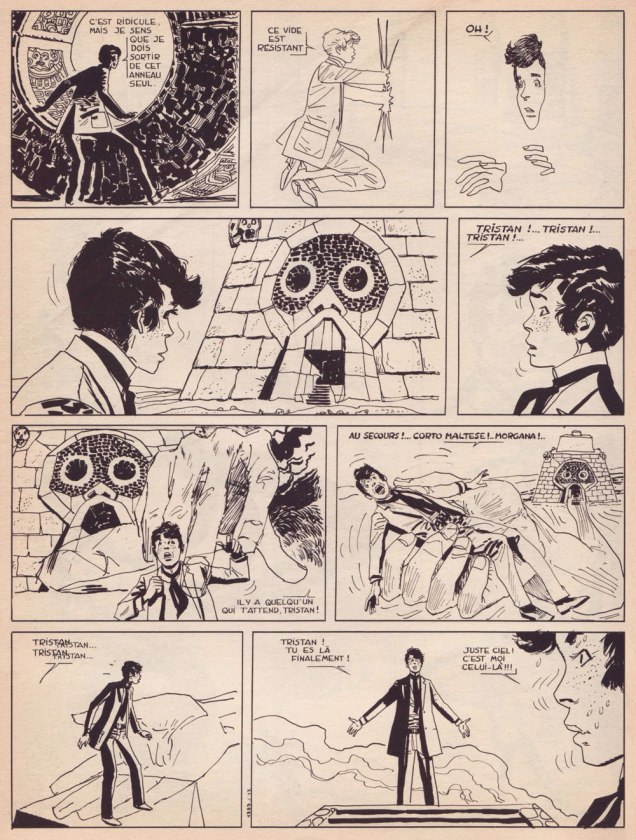
Today, he reveals to us the fruit of his research… adventures that, we are sure, will enthral you. Hurry over to page 11 and join Corto Maltese and his friends aboard their boat. »Corto’s young friend, Tristan Bantam, has some interesting visions in a sequence from Rendez-vous à Bahia (“Rendezvous in Bahia”… of course), Corto’s second solo tale, first published in Pif Gadget no. 59.
Rieu’s successor as Pif’s editor-in-chief, Richard Médioni, wrote: « In brief, in the Fall of 1969, Hugo Pratt found himself out of work. » After Pratt is crowned, that year, Best Italian Cartoonist at the Salone Internazionale dei Comics in Lucca (Europe’s oldest comics festival)… « It was expected that all publishers (French, Italian, and others, all present at the Salon) would push and shove their way to Hugo Pratt to propose a collaboration… but no such thing happened. Only Pif Gadget showed interest. »
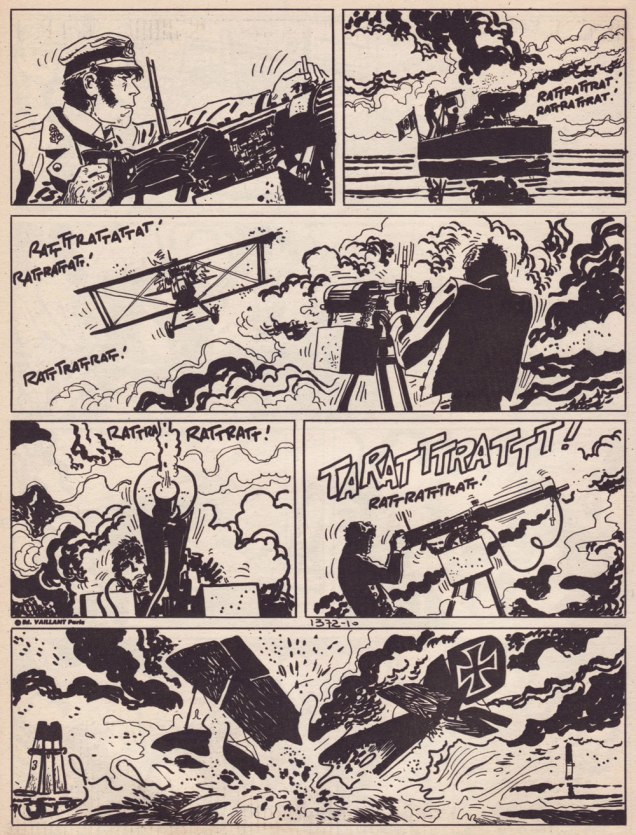
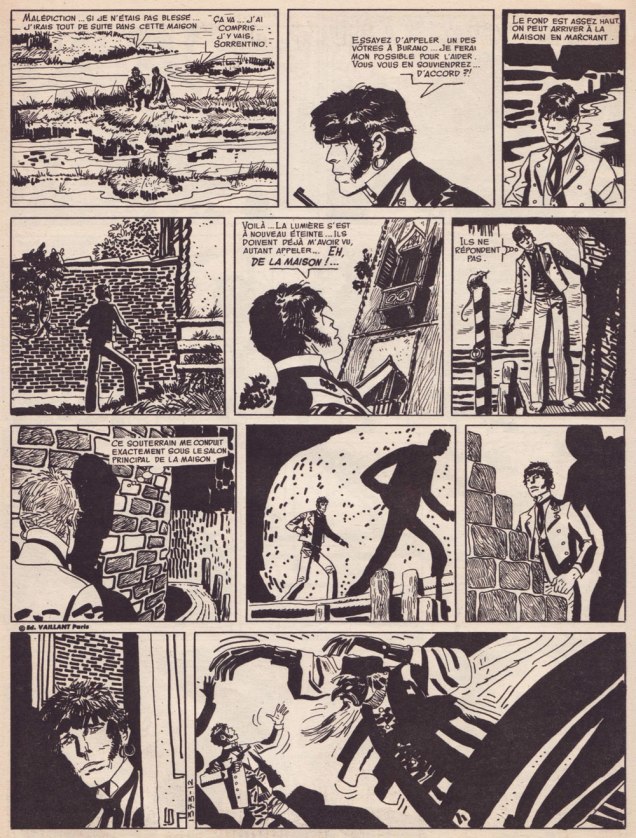
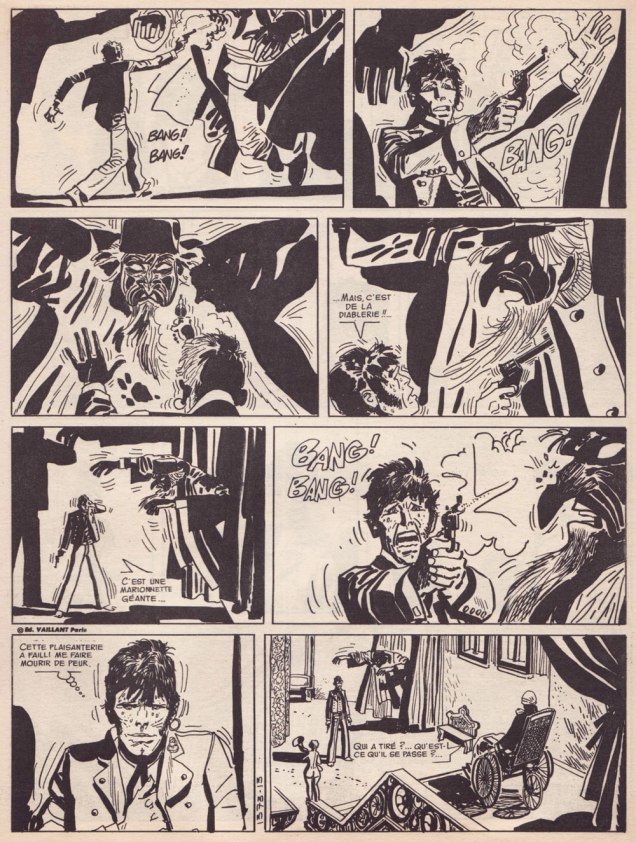
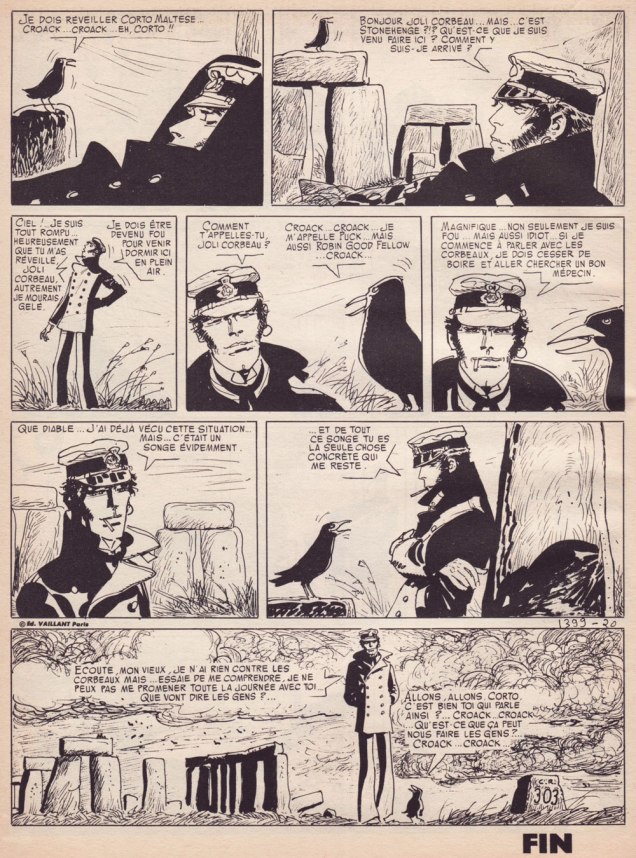
High drama and ace storytelling from À cause d’une mouette (“Because of a Seagull”), from Pif Gadget no. 89 (Nov. 1970, Vaillant).Corto is forced to take a hand in a skirmish in L’ange à la fenêtre d’Orient (“The Angel at the East Window”), first published in Pif Gadget no. 135 (Sept. 1971, Vaillant).The usually unflappable Corto gets the fright of his life in this bravura sequence, also from L’ange à la fenêtre d’Orient.Two pages from Sous le drapeau de l’argent (“Under the Banner of Money”), my initial encounter with Signor Pratt’s world. Published in Pif Gadget no. 143 (Nov. 1971, Vaillant).The quiet coda of Le songe d’un matin d’hiver (“A Winter Morning’s Dream“), set in Britain and plunging the reader into a dazzling brew of magical realism and English mythology from Pif Gadget no. 161 (March 1972, Vaillant). The featured crow is of course Puck, aka Robin Goodfellow, which you may recall from Will Shakespeare’s A Midsummer Night’s Dream. One might say it’s a bit like The Sandman, but without all the preciousness, not to mention having to deal with Neil Gaiman.
Bonus factoid: Hugo Pratt was related to another artistic giant, William Henry Pratt, aka Boris Karloff!
**According to his biographer, one of Pratt’s eternal regrets is that his work never broke through in America, land of his childhood cartooning heroes George Herriman, Milton Caniff, Alex Raymond and Burne Hogarth.
***One need only look at Mullaney’s Rip Kirby, where a blobby, lazy Photoshop shadow directly contradicts the light source indicated by Alex Raymond, a guy you’d assume it would be unwise to second-guess.
« All realities, all dimensions are open to me! » — Prince
Growing up, Lee Elias (1920-1998) never was a particular favourite of mine. A handful of stories in DC’s mystery titles aside — and I’ve grown to love those — I probably came across his work for Marvel’s Human Fly series, and I was always disappointed when Elias, not my beloved Frank Robbins, turned up in the credits. For the record, Elias drew ten of the nineteen HF issues, and Robbins drew six, plus five covers.
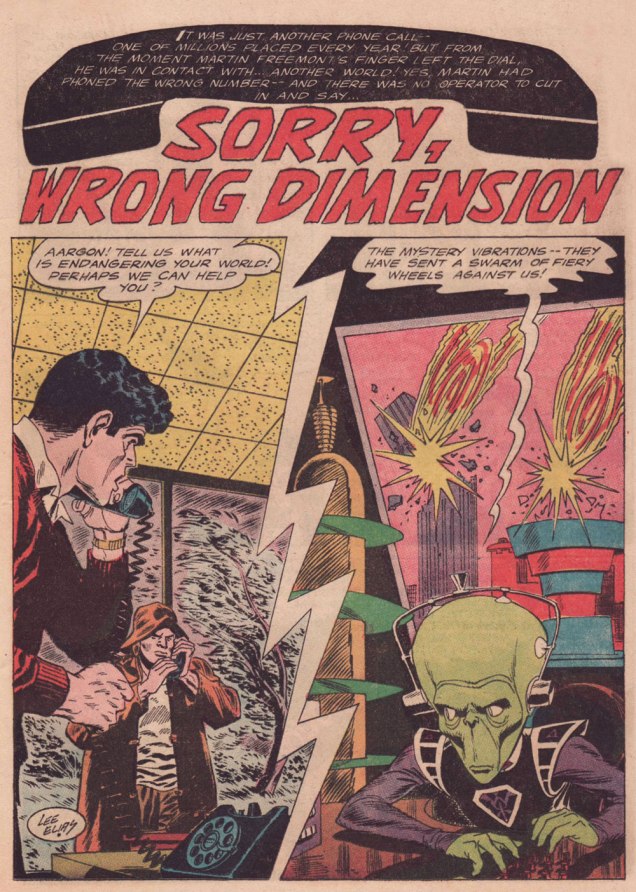
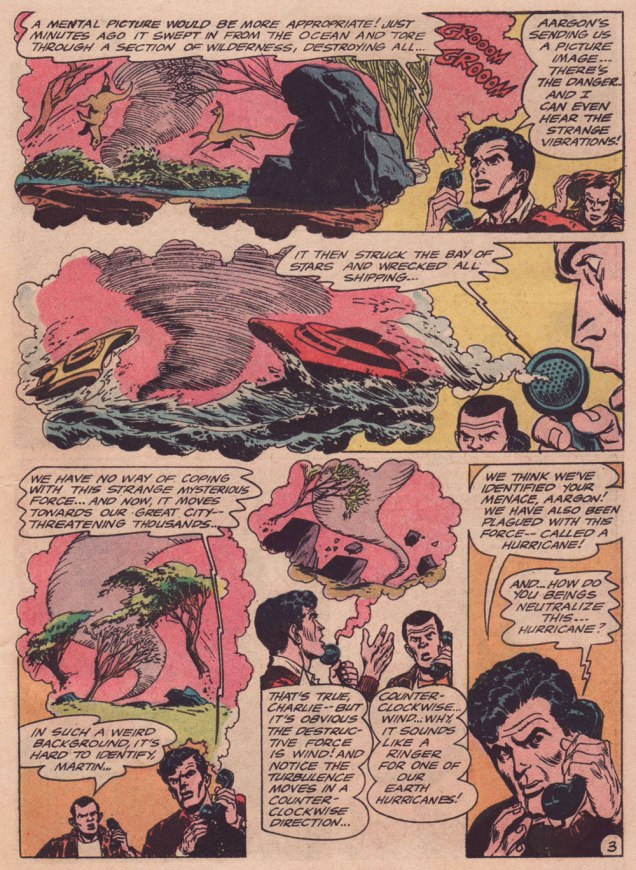
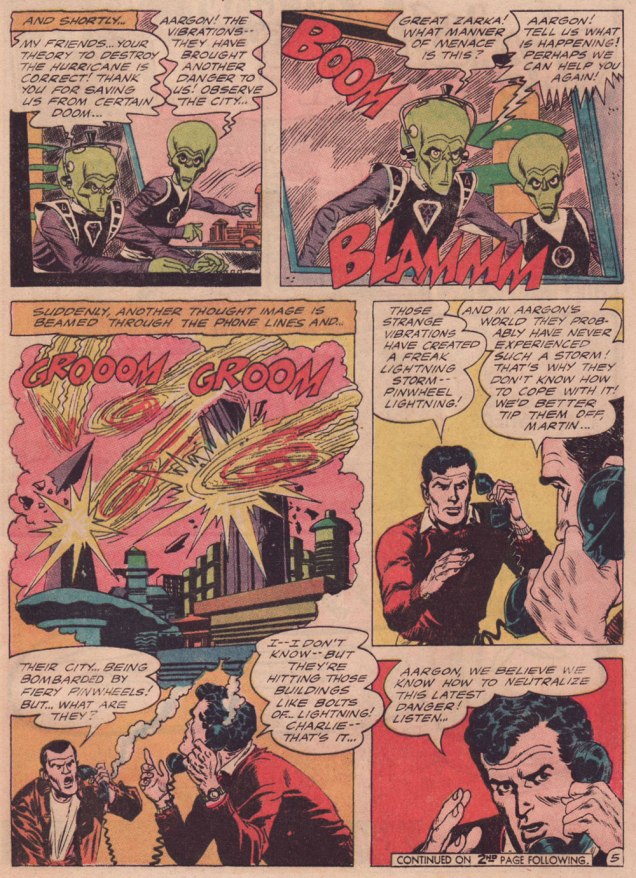
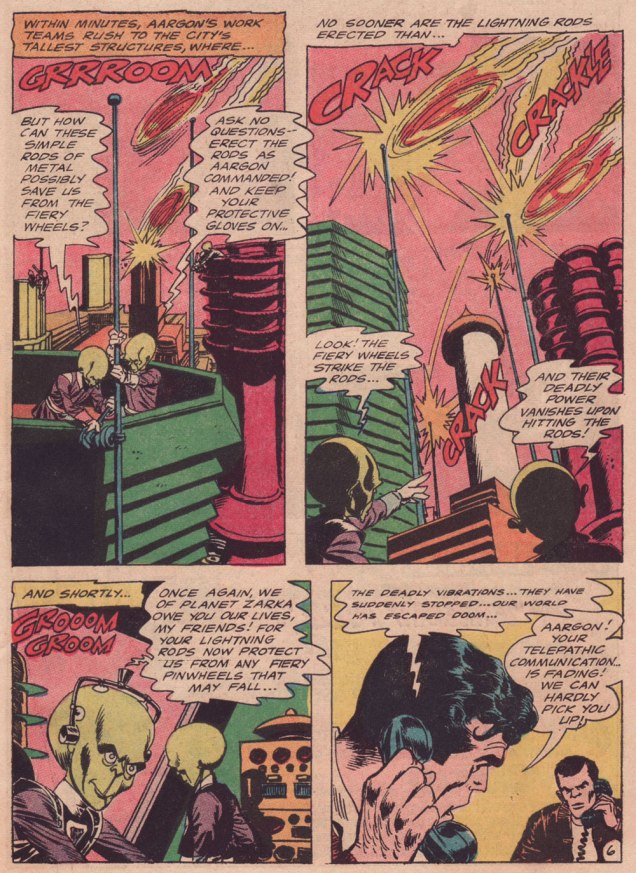
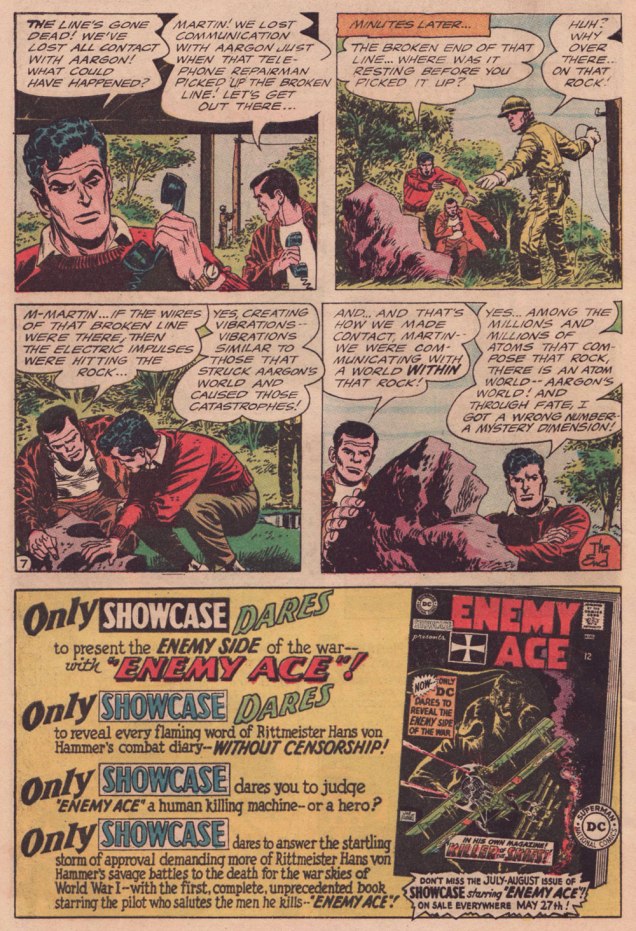
Over time, I noticed his gloriously gruesome cover work with art director-designer Warren Kremer for Harvey’s Pre-Code Horror titles of the early 1950s. His work on DC’s Adam Strange in the mid-1960s is best forgotten — there is only one Adam Strange, and it’s Carmine Infantino‘s (with trusty inker Murphy Anderson along for the Zeta Beam ride, of course). However, I adore Elias’ brief run (with writer Dave Wood) on Ultra the Multi-Alien, the splendidly wacky feature that replaced Adam Strange in Mystery in Space (issues 103 to 110, 1965-66).
Why am I so fond of this particular story? It’s the little things: for once, a story in a Jack Schiff-edited title makes some semblance of adhering to scientific — or at least science-fictional — principles; here, Elias designed an alien race that, given their grumpy, unprepossessing mugs, would typically have been cast as villains, but instead turn out perfectly honourable; the story’s human protagonists give aid to strangers in need, never asking for a thing in return: no Zarkan mineral rights, no salacious dirt on J’onn J’onzz, just selfless dedication to doing the right thing and the satisfaction of averting a crisis. How refreshingly old-fashioned, a cooling balm for these harrowing times.
-RG
p.s. my partner ds should return to our blog soon… she’s at present battling a mild case of writer’s block, so I’m filling in.
« Well, that was the silliest tea party I ever went to! I am never going back there again! » — Lewis Carroll
One more item unearthed while rummaging through my unsorted boxes: a couple of back issues of The Funny Times, one from 2010, the other 2013. The former held a fascinating exercice by Herblock prize winning cartoonist Ward Sutton, skewering and subverting the conservative ‘mindset’ from within. Not an easy trick to pull off convincingly, I would think; yet it’s one of Sutton’s specialties, having honed it to perfection — of a sort — as The Onion‘s longtime political cartoonist (since 2006), fictive curmudgeon “Stan Kelly”. Here’s a trove of Kelly pieces, which The New Yorker deemed “brilliantly terrible”.
Remember the Tea Party? Of course, B.P. barely feels like parody, given B.C. creator’s Johnny Hart mesolithic views. A couple of samples from a 1999 interview: « Jews and Muslims who don’t accept Jesus will burn in hell », « Homosexuality is the handiwork of Satan ». [ source ]Ah, yes — that nonsense about Obama’s birth certificate, another MacGuffin in a seemingly endless parade of conservative bugaboos.By most accounts, Herbert Hoover was a pretty lousy president, though everything’s relative. Another fine myth, that of a liberally-biased media. Teanuts goes right back to the first Peanuts strip (Oct. 2, 1950) for its inspiration (though not its aspect ratio, for some reason).Here’s a pearl: « simply, homosexuality can be healed. That is, a homosexual can become a heterosexual; the homosexual orientation can be changed through prayer for inner healing and the power of the Holy Spirit. ». [ source ]Again, Diligent-Bert hews so close to its model that it might easily pass for an actual Dilbert strip.
The feature was accompanied by this deadpan caveat: « EDITOR’S NOTE: Ward Sutton, an elitist who lives in the elitist New York area, is a cartoonist, illustrator, animator and painter who has recently been lurking about the back of Tea Party gatherings, stuffing his pockets with American flag cookies, and brochures for camouflage underwear and mail-order ammo. Superpatriot and regular guy cartoonist Joe Smith disavows any knowledge of Mr. Sutton and his ilk. Need I say more? »
Given the context of pointless and (self-) destructive trade wars currently raging, I thought I’d focus on a topic closer to home, and befitting the season: we’ve received some 85 cm (33 inches) of snow in the past week or so, which makes it ideal snowmobile weather, as these things go.
While there’s been a vibrant comics scene in Québec for just about as long as there have been comics, financial viability has always been a problem. Magazines would pop up like mushrooms after a rain, only to vanish just as suddenly after a few issues. It probably didn’t help that Québécois bédéistes were generally far less interested in producing the next Blondie than they were longing to be the next Crumb.
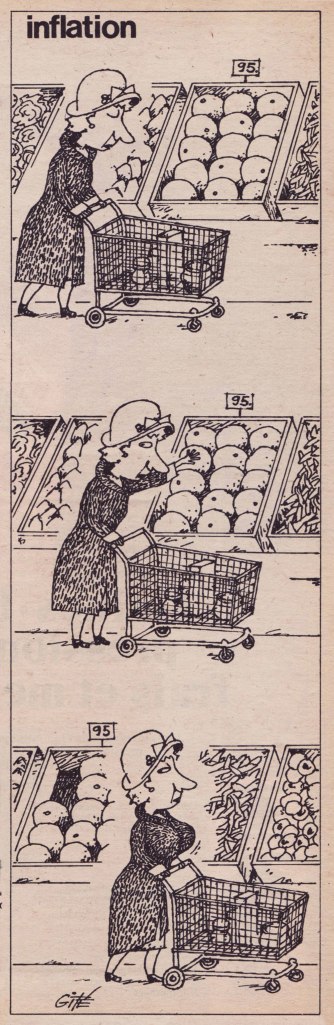
And so, the best gig around turned out to be Perspectives, a general interest magazine (1959-1982) bundled into weekend editions of several of Québec’s major newspapers (La Presse, Le Soleil, Dimanche-Matin…) in largely distinct versions, which makes collecting them a most daunting task. It’s worth noting that the editorial content, not merely the cartoons and comic strips, were of a very high calibre. After profiling his colleague and predecessor André Montpetit a while back, it’s now time to turn the spotlight upon Gité, born Jean Turgeon (1952-2014).
Do you Snowmobile? « I snowmobile! »; If this traditional wintery scene evokes for you peace and serenity, then you’ve never seen… a snowmobile! This simple machine possesses the gift of turning the quietest of areas into a noisy corner of hell. Unless you can’t bear the silence of our countryside…; In that case, become a snowmobiler… you only need a little snow… not *too* much, though!
You have chosen your snowmobile… and your outfit… think of the essentials.; Stop, listen, look.; Don’t neglect the comfort of your passagers: « Darling, I’m falling! Hiiiik! »; Have you properly read the repair manual?
Beware of the frost. « Say, daddy! How come it’s frozen solid in mid-air… it defies the law of gravity! » « The law of gravity? That must also be frozen! »; … and of the thaw. « Where am I? »; Especially if you’re an inveterate daredevil!; while the more sedentary type…; And if it breaks your heart to put away your snowmobile for the summer…; « And so long live the snowmobile! As for me, I’m off to Miami... »
It seems to me that making a lot of noise and hitting absurdly excessive speeds are the prime draws of their ‘sport’ to a significant portion of fervent snowmobilers. Back in the 1970s, these vehicles were rather comically wheezy, but now can reach speeds far in excess of what a regular automobile can legally — or otherwise — hit on the highway, never mind the Autobahn. I remember one holiday season, not so long ago, when one of my clients topped himself on his snowmobile, leaving behind a tearful wife, three young children, and a couple of rudderless businesses. While someone *did* think of electric — and therefore quieter — snowmobiles (and Jet-skis), they pulled the now-usual arrogant move (think OceanGate and SpaceX) of paying plenty of attention to investors and waving off due process, the scientific method and their engineers, leading to a predictable fiasco.
A note on Gité’s technique, as he recounts it in an interview conducted — in the nick of time! — for Jean-Dominic Leduc and Michel Viau‘s Les années Croc (2013):
« I had developed a technique, during the Perspectives era, that I was probably the only illustrator to use. I first created an illustration in pencil, which I then photographed on a giant machine, as a photostat. I then applied colours in markers with my fingertips, which created a sort of stained glass effect in terms of luminosity. Sometimes you can even see my fingerprints… That technique was not only arduous, but also dangerous. It was really toxic, I was literally ripping off the skin of my fingers. No wonder I got sick a few years later! That method left no room for error. »
Here are a couple more Gité strips from the pages of Perspectives:
« Not so Dumb », from Perspectives vol. 16 no. 37 (Sept. 14, 1974); the sign reads “Mean Dog”.
« Inflation », a forever relevant strip that appeared in Perspectives vol. 17 no. 7 (Feb. 15, 1975).
A sample Perspectives cover, this one featuring national treasure Robert Charlebois, at the time but a single decade into his spirited musical career.
Then came Croc, handily Québec’s most accomplished and successful humour mag (1979-1995, 189 issues), more National Lampoon than Mad, at least in the beginning. Gité produced quite a score of tremendous Croc covers — possibly the epitome of his œuvre — and I was planning on devoting a post to that lovely lot… but discovered that Gité’s colleague and close friend Guy Badeaux, aka Bado, had beaten me to the idea by over a decade. Feast your peepers on his savvy selections!
Ah, but he missed this one, Gité’s first! This is Croc no. 4 (Jan. 1980); despair not, doomsayer: the end may *yet* be nigh!
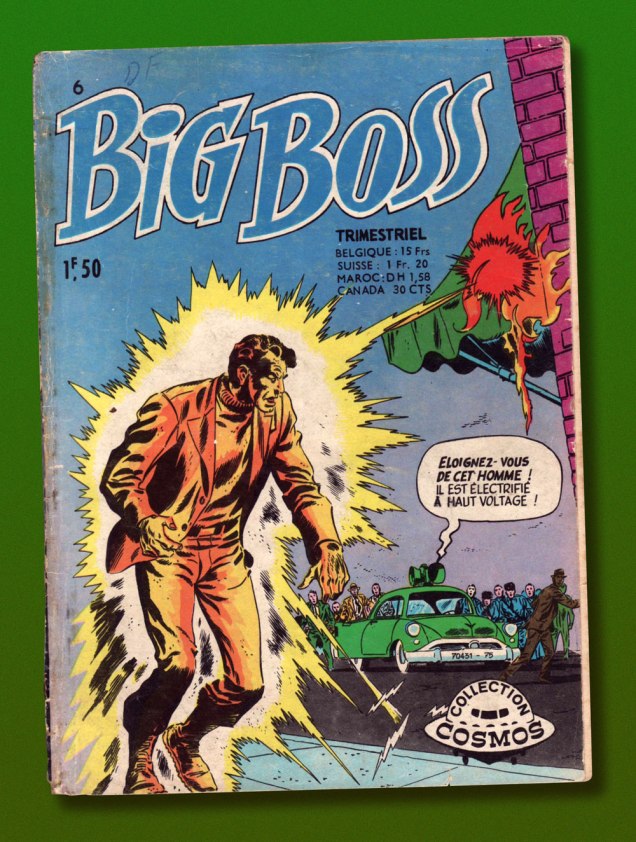
This is Big Boss no. 6 (Oct. 1971, Arédit-Artima); cover by Ruben Moreira.
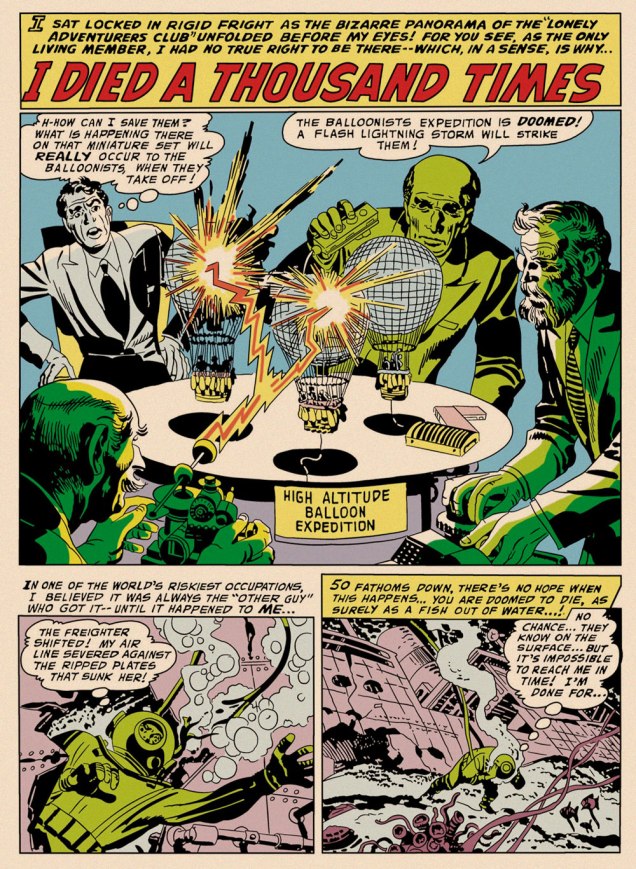
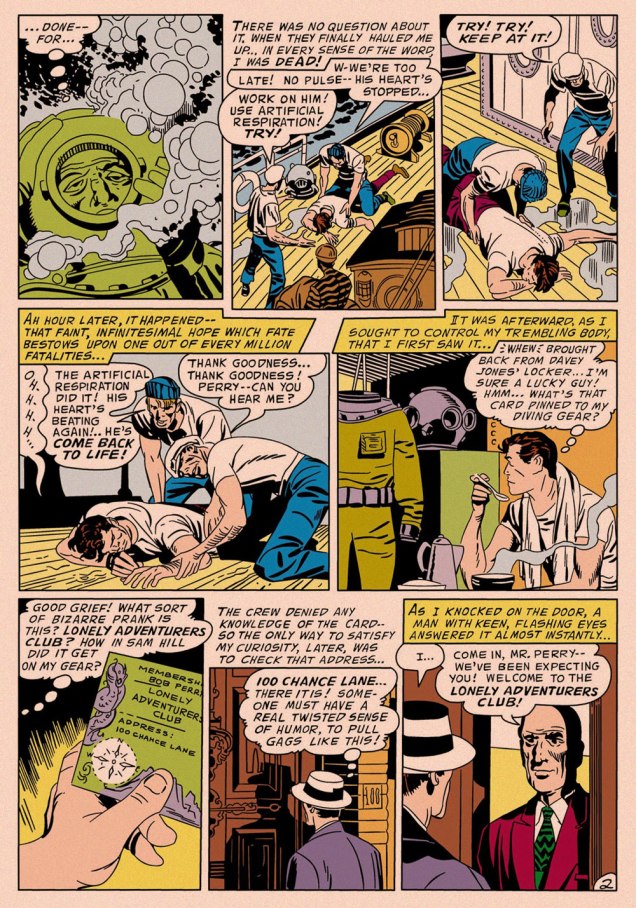
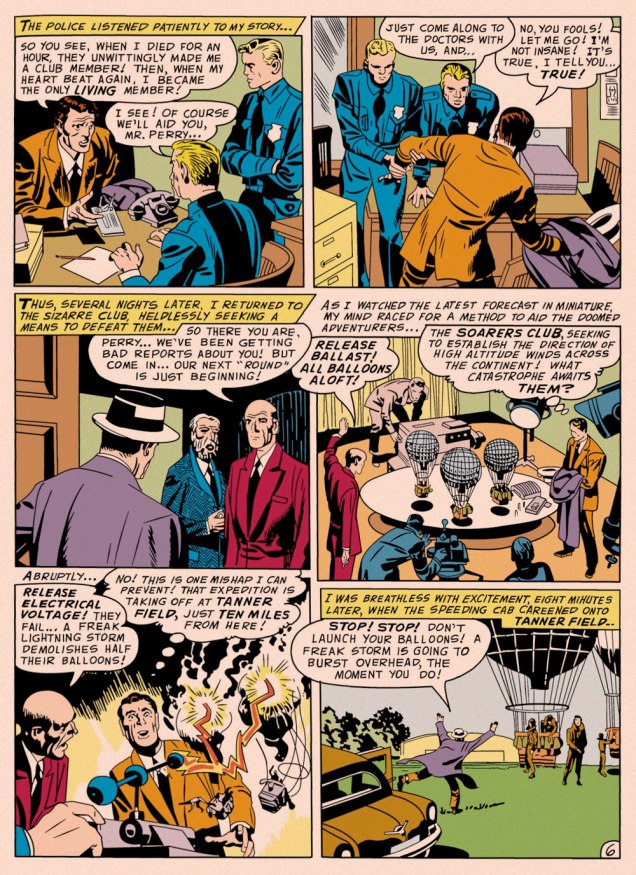
One might be inclined to say that, with its themes of adventurers cheating death or living on borrowed time, I Died a Thousand Times inspired Kirby’s Challengers of the Unknown, except that Ace, Rocky, Prof and Red had burst into print a few months earlier. Suffice it to say that they sprang from the same fertile well. It’s always intriguing to observe how the particular seed of an idea can be grown in a myriad of directions.
If you’ll forgive me the intrusion, this is how the opening panel appeared in the Big Boss reprint. In order to make things more readable in the digest format — and in black and white — Arédit‘s in-house art department routinely reframed and even augmented the artwork, with varying degrees of competence and success. This is one of the more accomplished efforts. The story’s writer is unknown (though it features a most Kirbyesque plot); it was pencilled and likely inked by King Kirby, and originally appeared in My Greatest Adventure no. 16 (July-Aug. 1957, DC); edited by Whitney Ellsworth; Jack Schiff; Murray Boltinoff and George Kashdan… let’s just say DC *was* a tad heavy on the management side in those days.
Though Kirby’s standalone short stories of this period are as charming and inventive as you’d expect, this modest trove of material has by and large been neglected. While a handful of these tales (The Thief of Thoughts; The Creatures from Nowhere!; The Cats Who Knew Too Much!; The Man Who Betrayed Earth; The Negative Man; and The Stone Sentinels of Giant Island) were semi-randomly reprinted in the early 1970s when DC had lots of pages to fill, this one didn’t resurface in North America until 2011’s pricey-then-and-pricier-now hardcover Jack Kirby Omnibus no. 1.

































 Who's Out There?