A Smutty Little Holiday

Holiday,
Oh what a lovely day today,
I’m so glad they sent me away,
To have a little holiday
.*

Today we embark on a V̶i̶c̶t̶o̶r̶i̶a̶n̶ r̶o̶m̶a̶n̶c̶e̶** romance set in 1889, seasoned with more than a dash of steampunk, all in the name of sweet (and currently very much needed) escapism. Expect NSFW, in case it matters.

Chester 5000 (Top Shelf, 2011) is a typical love story: boy meets girl, boy loses interest in girl sexually and so builds her a sex robot, girl falls in love with robot, boy gets jealous. The mechanical turn of the plot does in no way impede the emotional progression and, as a matter of fact, one finds oneself distinctly rooting for the very sweet Chester. Really, the fact that he’s a robot only comes into play to show off his many pleasure-centred tool attachments, not to mention his ability to hold a lover in mid-air for extended periods of time.

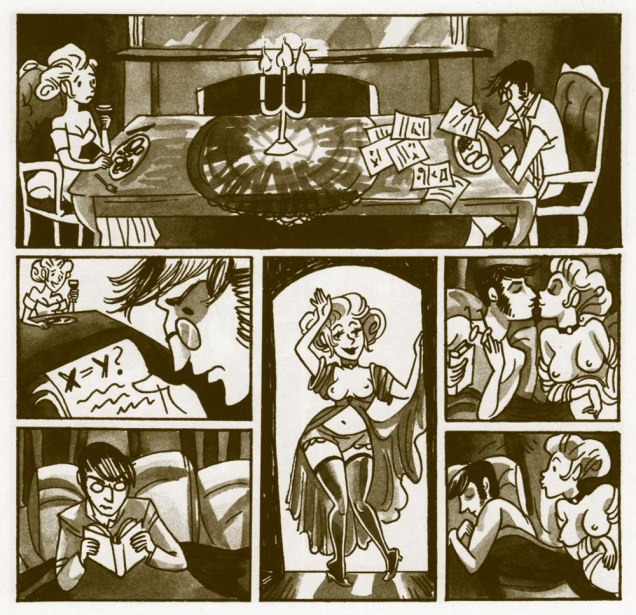
This comic is entirely mute, told in little vignettes which make it quite clear how the characters are feeling. American cartoonist Jess Fink has been singled out for her titillating talent of depicting luscious breasts, and I quite agree (and extend that compliment to the rest of female anatomy). Here are a few of the tamer scenes —
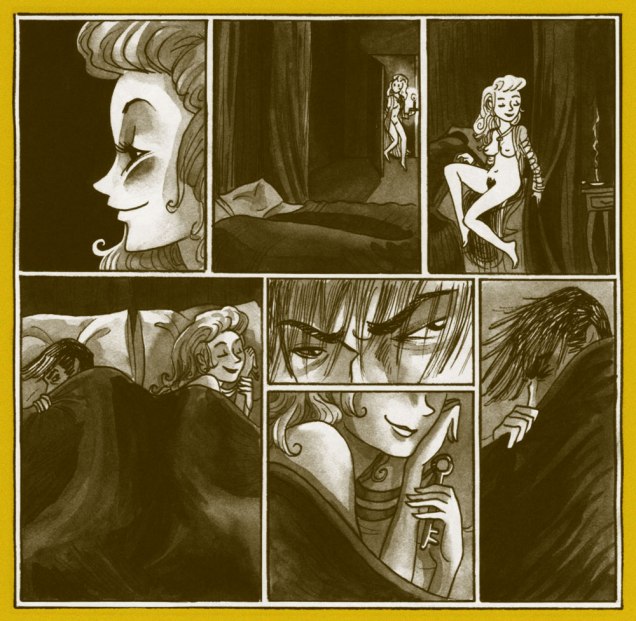
« Jess Fink’s “erotic, robotic Victorian romance” Chester 5000 XYV, an ongoing Web comic that’s recently been collected into a graphic novel by Top Shelf, is utterly of the zeitgeist. It has enough gadgets to entice the steampunk crowd, enough heat (tempered by romance) to seduce the yaoi*** crowd, enough sex-positivity for the feminist crowd, and enough craft for any “but girls can’t draw” naysayers. » (source: TCJ)

One might say this graphic novel is part of a wave of woman-penned, sex-positive, body-diverse comics — and indeed, Fink has several contributions to the anthology Smut Peddler. As for the anthology, I respect it as an admirable initiative, but is not something I collect because sadly most art within rubs me (ha, ha) the wrong way. I had purchased the 2014 edition because of Fink’s How You Gonna Keep ‘Em Down on the Farm story, but I gave it away to a rather stunned older man who came to pick up a box of random books I no longer wanted. Well, he said he wanted to read something new for a change (while his eyes goggled) — I hope he enjoyed it.

~ ds

*Holiday

** Co-admin RG would like to point out that this isn’t really Victorian other than in costume, and so objects to that categorisation. I’ll leave the reader to decide whether works of fiction set in a specific period (well before the author’s lifetime) deserve that era’s label or not. The Professor’s Daughter (discussed in Félicitations, Emmanuel Guibert!) was described in a review as ‘a love letter to Victorian London’ despite having been brought to life by two men from the late 20th century, but it was better researched than Chester 5000 — though the latter still has historical details, especially in the second volume, and Fink clearly knows a lot about Victorian costumes, as evidenced by this fun interview. If you want smut from the actual Victorian era, I’d like to point you in the direction of Victerotica – A Carnal Collection, volumes 1 and 2. RG also points out a certain plot similarity to La poupée sanglante, a 1923 novel by Gaston Leroux (author of Le fantôme de l’opéra).

***Speaking of yaoi, volume 2 of the series, Chester 5000 book 2: Isabelle & George (also published by Top Shelf), has some nice mann-gegen-mann action.

Hot Streak: Creig Flessel’s Detective Comics

« The criminal is a creative artist; detectives are just critics. » — Hannu Rajaniemi

This time, we’re going way back to the dawn of DC Comics, when the company name stood for its flagship title… Detective Comics.

This is when the company’s visionary but hapless founder, Major Malcolm Wheeler-Nicholson, was still around, before Harry Donenfeld and his crony Yakov (Jack) Liebowitz had the locks changed.

While that chain of events is a fascinating bit of history, what I’m here to celebrate is a sequence of classic covers by recent — 2024 recent — Will Eisner Comic Awards Hall of Fame inductee Creig Valentine Flessel (1912-2008). Flessel produced eighteen of the first nineteen Detective Comics covers (the premiere issue bore a striking, but rather primitive drawing by associate editor Vin Sullivan), visibly gaining assurance and verve as he sped along. By my reckoning, however, it’s only with the eleventh issue that he solidly hit his stride, which he never let up until the assignment passed into other hands… and then came Batman.

Anyway, here they are: no hand-holding, no patronising, superfluous captions… just graphic purity — and sweat-soaked, pulpy thrills galore.

This is Detective Comics no. 11 (Jan. 1938, DC).
This is Detective Comics no. 12 (Feb. 1938, DC).
This is Detective Comics no. 13 (Mar. 1938, DC).
This is Detective Comics no. 14 (Apr. 1938, DC).
This is Detective Comics no. 15 (May 1938, DC).
This is Detective Comics no. 16 (June 1938, DC).
This is Detective Comics no. 17 (July 1938, DC).
This is Detective Comics no. 18 (Aug. 1938, DC). Even as a relatively sheltered white teenager, I could easily tell that Sax Rohmer‘s Fu Manchu stories were racist (and sexist as well) « Yellow Peril » tripe… even in the context of their era, they went the extra mile.
This is Detective Comics no. 19 (Sept. 1938, DC), Flessel’s final cover for the title.

Flessel would turn up all over the place. Gary Groth writes, introducing his definitive, career-spanning Flessel interview:

« Flessel never became an auteur with a truly recognizable narrative voice or characters that he could call entirely his own. He was so skilled and versatile that he became an artistic chameleon, a commercial propensity that served him well throughout his career. He wrote and drew stories for the earliest published comic books: More Fun, Detective Comics and Adventure; worked for the advertising firm of Johnstone and Cushing; assisted Al Capp on Li’l Abner and worked with Charlie Biro on Crime Does Not Pay in the ’50s; spent the ’60s and early ’70s drawing David Crane, a comic strip about a minister in a small town and segued seamlessly into an eight-year gig doing The Tales of Baron Von Furstinbed for Playboy. »

Detail (the whole spread would have been impossible to scan properly) from one of Flessel’s long-running series of Eveready Batteries adverts, done in the employ of the celebrated Johnstone and Cushing ad agency (this one’s from 1951). On his The Fabulous Fifties blog, Ger Apeldoorn showcases a number of these lovelies — check ’em out!
Flessel turned up as Jerry Grandenetti‘s inker on my favourite issue of Joe Simon and Grandenetti’s much-maligned, short-lived but quite charming Prez (no. 4, Feb.-Mar. 1974, DC). Notwithstanding the — intentionally — fanciful elements of the Wild in the Streets-inspired social satire, old hand Simon had a much firmer grasp on how politics actually work than did any of the earnest, self-consciously ‘relevant’ comics writers of the day. And one can only sigh nostalgically at days when the worst thing that might slither into the White House was a mere vampire…

Flessel’s ability to depict ladies of the buxom and comely variety had certainly played a role in his landing a gig assisting Al Capp on Lil’ Abner for a couple of years in the late 1950s. At the time, Capp spent much of his time touring college campuses and berating the younger set, as was his wont.

Said virtuosity in the light-hearted and erotic stood him in good stead for an eight-year gig on The Tales of Baron Von Furstinbed for The Playboy Funnies; this one’s from the January, 1983 issue of Playboy Magazine. And here’s another, for good measure.

In closing, a brief exchange from The Comics Journal interview — please do go and read the whole thing, it’s a gem!

GROTH: I have a note that you had something to do with Superboy from 1958 to ’59.

FLESSEL: I did one. You know, it’s frightening; it’s like going out and drinking a lot of martinis and doing a job and not remembering.

-RG

Riddles & Bears: Meet Victor Chizhikov

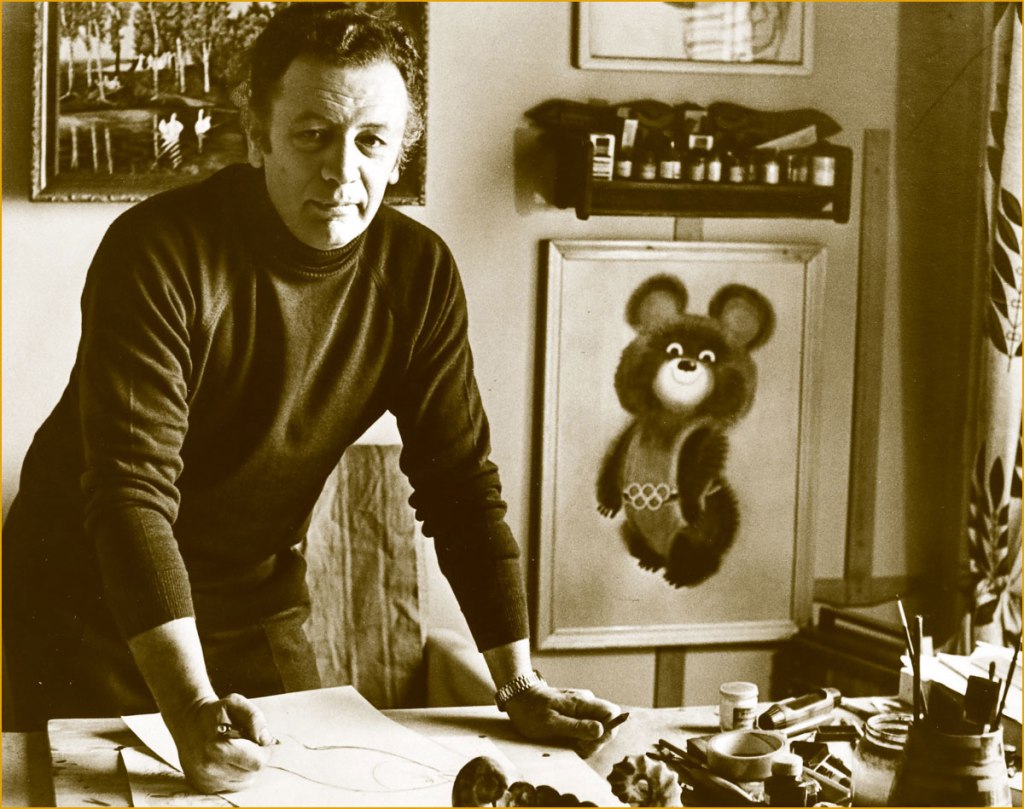
I grew up on the illustrations of Soviet illustrator/cartoonist Victor Chizhikov (1935-2020). I’m not sure whether I’m from the last generation that remembers his work this well — on a similar topic of ‘boy, we’re old’, older non-Slavic readers might be familiar with Misha, the mascot that Chizhikov designed for the 1980 Moscow Olympic Games.

Chizhikov with his creation Misha (both a nickname for Mikhail, and a contraction of ‘bear’).

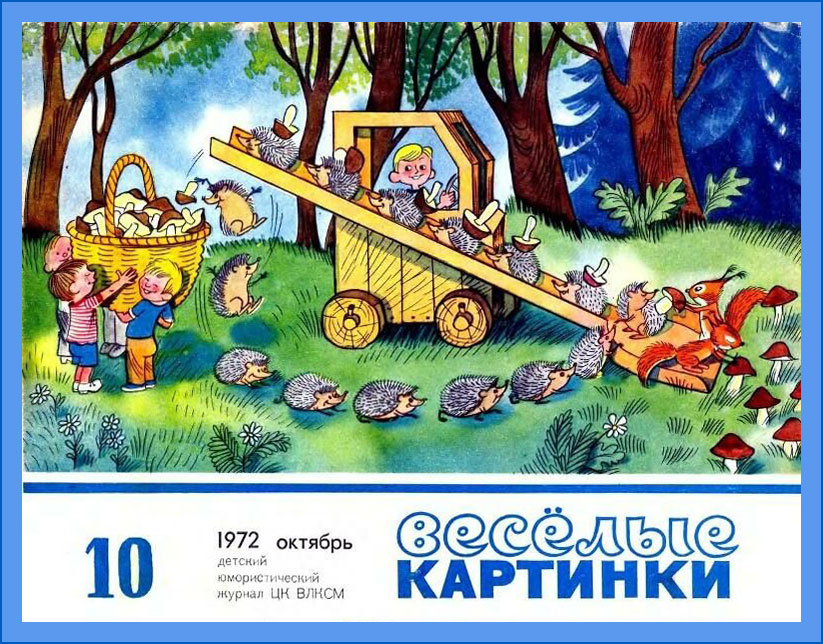
In 1955, Chizhikov started contributing illustrations and caricatures to Krokodil, a publication I was born too late to be personally familiar with (though I did write a post about it). While he has definitely drawn a number of ‘adult’ cartoons in his life, it’s his cheerful anthropomorphic animals, mushroom-studded landscapes and gently roguish children that linger in people’s minds, and those appeared from 1956 and onwards, frolicking through the pages of Весёлые картинки (Merry pictures), a publication aimed at children between 4 and 11. In 1958, Chizhikov also joined the staff of Мурзилка* (Murzilka), a magazine for the 7 to 13 year old crowd. I had subscriptions to both as a child. My grandfather was especially keen on giving me a well-rounded education, though he needn’t have worried, as I come from a family where nearly everybody was a voracious reader, albeit occasionally disagreeing on genre. I used to have a stack of Весёлые картинки somewhere, but I got rid of it at some point with the impetuousness of a young adult, alas.

An issue of «Мурзилка» from 1968.
A page from a 1965 issue of «Мурзилка» depicting scenes made up of palindromes.
Original art for an illustration created for a 1975 issue of «Мурзилка».
Page from a 1966 issue of «Весёлые картинки» — ‘Petrushka in the land of fairytales‘ was a recurring feature. Chizhikov had a most fluid line when needed.
The October page from a 1972 calendar published in «Весёлые картинки».
An issue of «Весёлые картинки» from 1982.

Interestingly, Chizhikov was daltonic, something one would never be able to guess from his illustrations. It is said that his wife would label pots of paint and pencils to help him out, but I don’t know what variant of colour blindness he was stricken with. A critic once described his characters as having a ‘mischievous squint, as if they live in an eternal summer in the bright sun‘ — maybe they were just squinting trying to discern the nuances between colours?

‘The Lamplighter Ant’
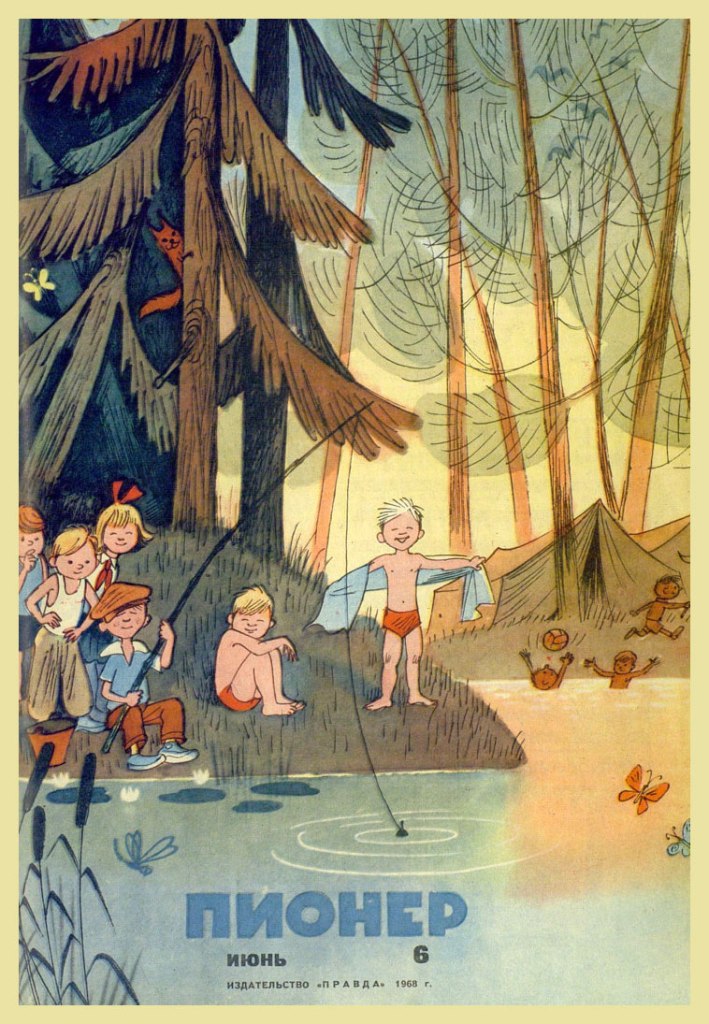
Issue of «Пионер» from 1958 — this was a magazine for 10 to 14 year-olds, but I don’t remember ever encountering any issues in the wild (possibly because my family objected to buying something called ‘Pioneer‘).

I owe this trip down memory lane to a friend who gave me a 1971 edition of 25 загадок — 25 отгадок (25 riddles — 25 answers) written by the immensely energetic and thus ubiquitous Korney Chukovsky** and illustrated by Chizhikov. Many thanks, Drew!

« Two stallions I have, they carry me on water. The water is tough, as if it were a stone. »
« If pine trees knew how to run and jump, they would flee from me to never cross my path again, because I am very steely, mean and toothy. »
« Small houses are running down the street, carrying little girls and boys. »
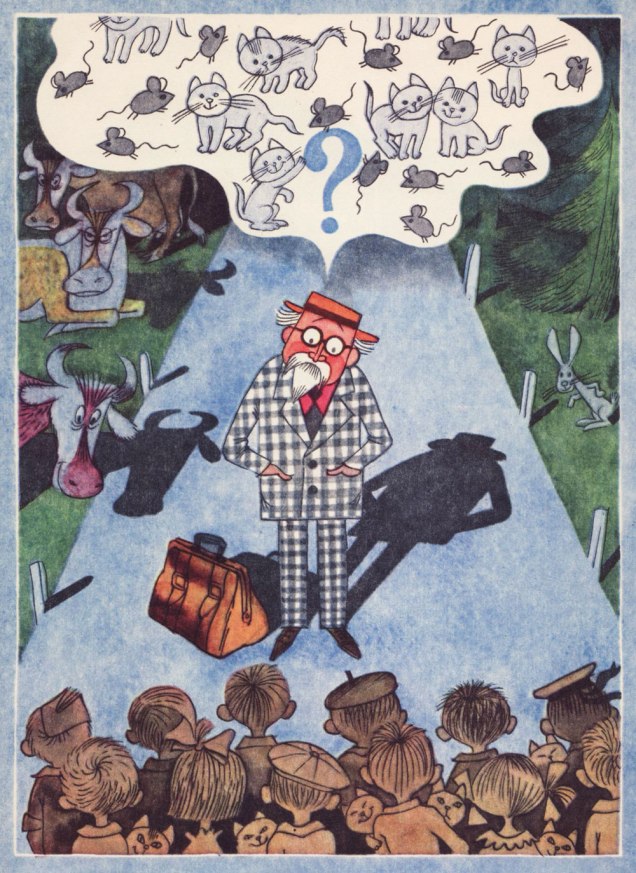
« Kondrat was walking to Leningrad, and coming towards him were twelve kids, each with three baskets, with a cat in each basket, and each cat having 12 kittens, each kitten holding four little mice. How many kittens and mice are the kids carrying to Leningrad? »
Cover of another book by Chukovsky, the ever-popular Doctor Aybolit, whose name translates literally to something like ‘Doctor Ouchithurts’. This character was loosely based on Hugh Lofting’s Doctor Dolittle, as well as Chukovsky’s friend Zemach Shabad, known for treating not only sick children, but also the equally ailing animals the children would bring along to their appointments.

~ ds

* Мурзилка is still around today, and given that it began publication in 1924, it is now listed in Guinness Worlds Records as the longest running children’s magazine in the world.

** 1882-1969, author of innumerable absurd ditties, rhymes and poems so well remembered and loved that many got incorporated into Russian as idioms; brilliant translator of English novels, stories and poems, making them accessible to a Russian-speaking audience for the first time; dissenter of governments, be it Soviet or Russian.