New Words for a New Year!

« I find vocabulary to be a great drawback. » — Elizabeth Taylor

I think most of us will concur — sorry, Liz — that a rich vocabulary is a useful asset on multiple levels. And in riding with that particular train of thought, if a new year brings new goals and resolutions to achieve them, what could be more judicious and feasible than picking up a handful of new words… and their proper meaning?

Cartoonist Mickey Bach (1909-1994) made it his mission to help the newspaper-reading masses bone up on unusual vocables. While he’s never ranked among the cartooning greats, the premise of his feature, Word-a-Day, was a rock-solid one, granting the panel a healthy run from 1946 to 1979, first with the Publishers Syndicate until 1967, when it merged with the Hall Syndicate*.

It’s also worth noting that, for a feature that’s been officially defunct for some forty-five years, it’s a pretty lively one: an admirably devoted and industrious fan has kept the Word-a-Day flame alive with the Word A Day Revisited Index. Kudos!
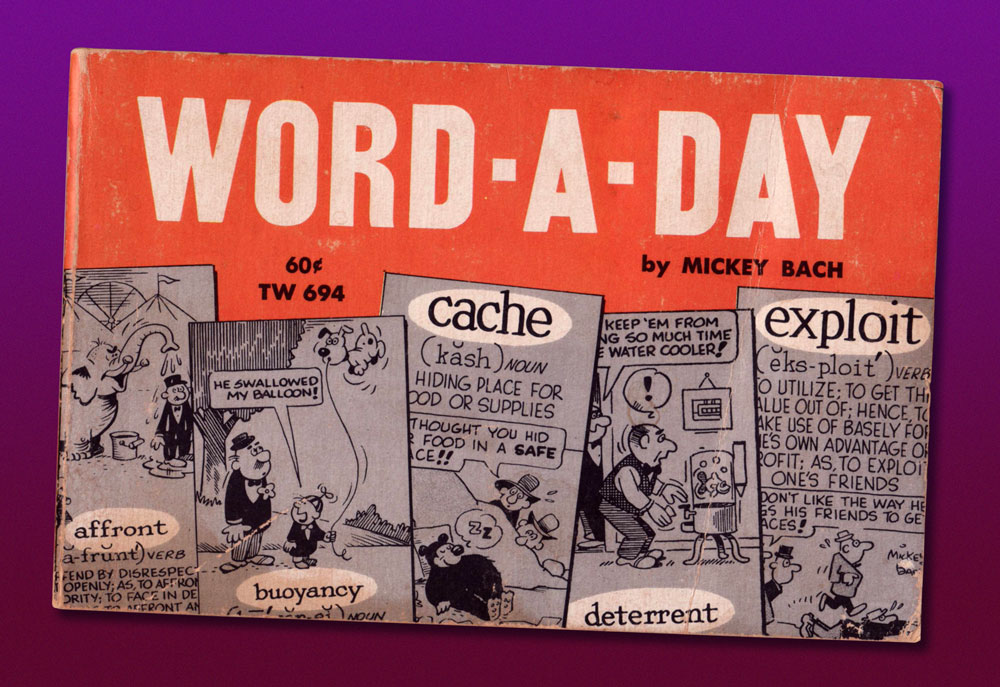
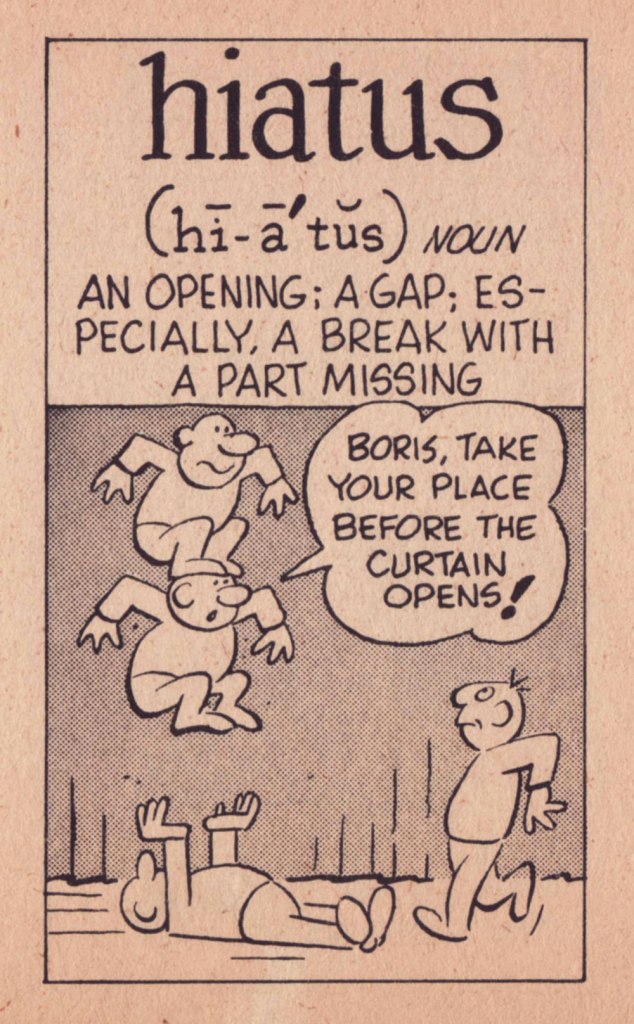
As far as I can tell, there was only one Word-a-Day collection published, but it was a successful one. First published by Scholastic Book Services in 1965 and comprising selections from 1960 to 1963, it received at least four printings through 1972, this being the fourth, from April of that year.

Let’s see what lies within, shall we?

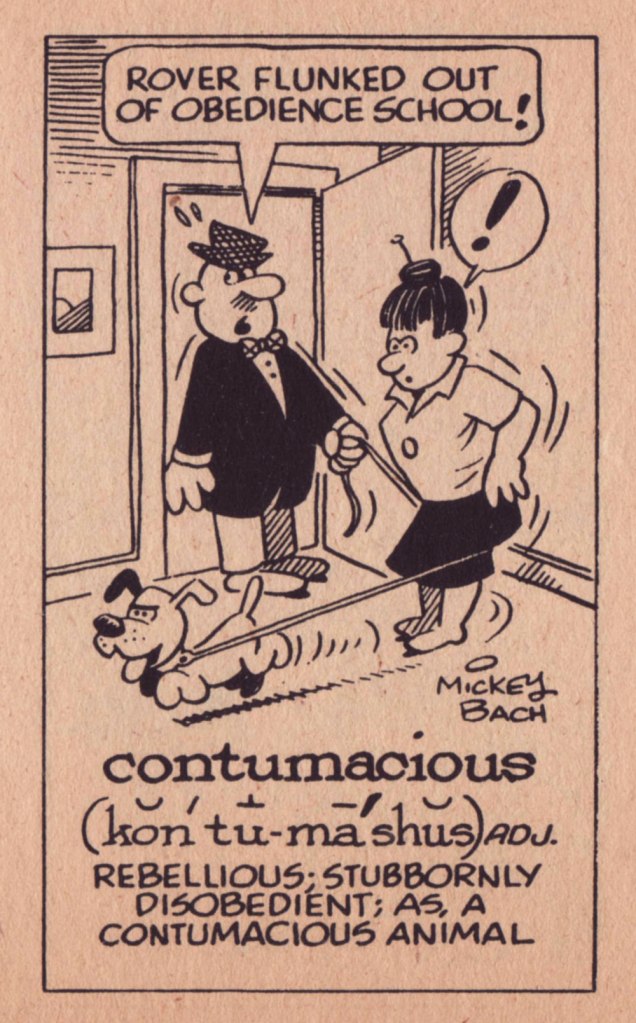
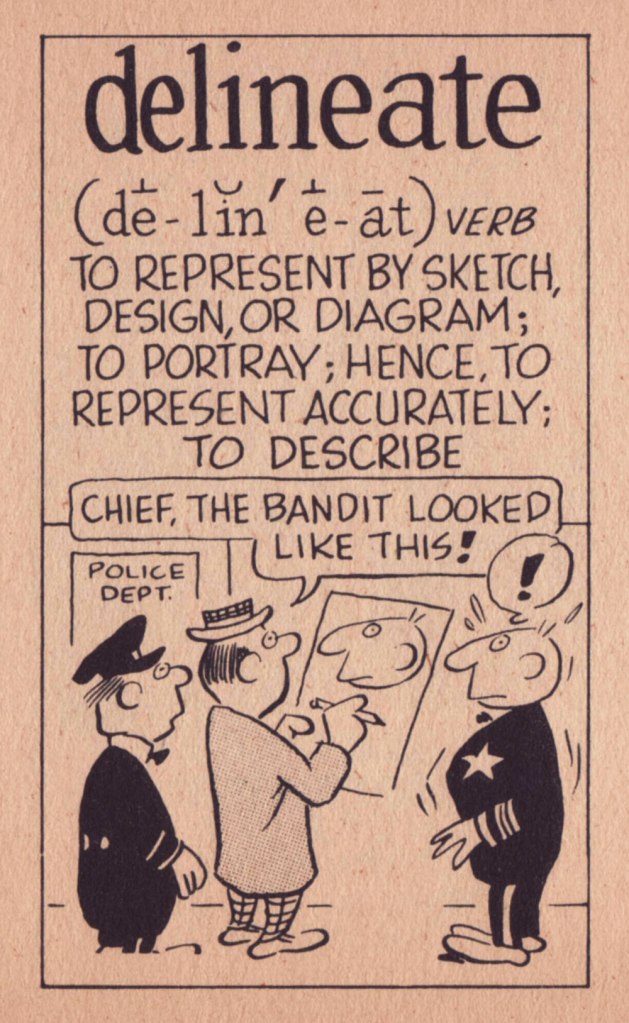
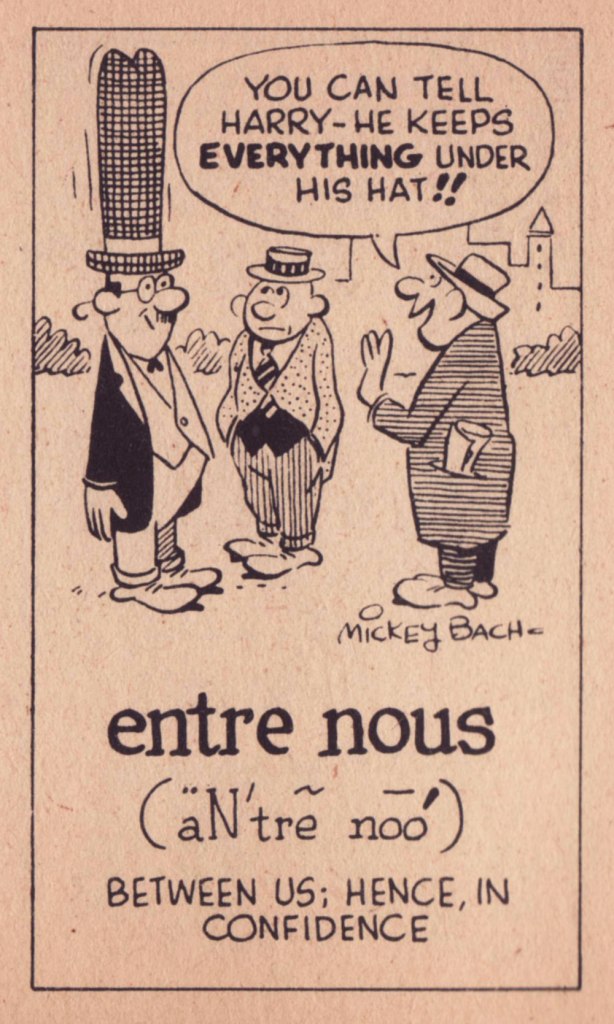
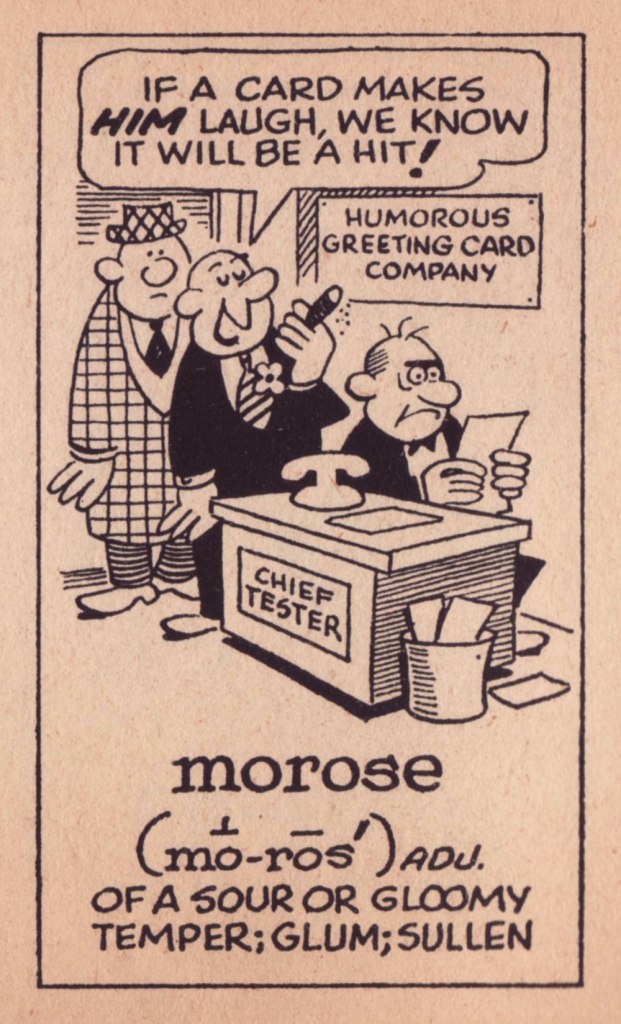
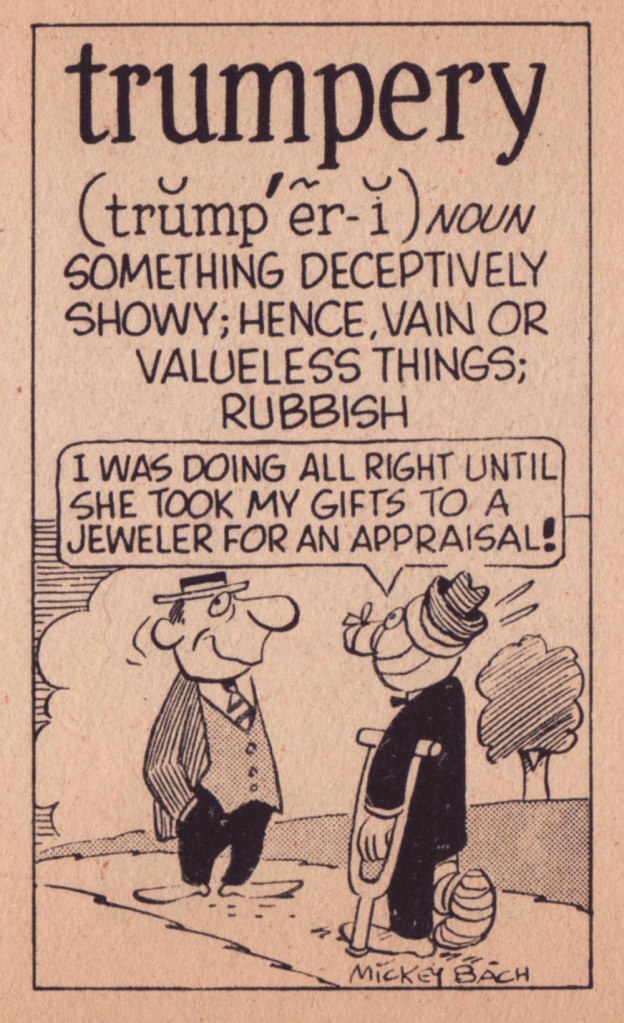
Part of the nostalgic fun in these images is their reliable repertory company of cartooning archetypes such as sandwich men, hobos, boxers, cranky bosses, talent agents, bearskin rugs, door-to-door salesmen, masked burglars, beret-sporting artistes…
Ah, yes: that nagging feeling that we, as a society, are somehow regressing rather than progressing.
Bach had a somewhat generic, but pleasant and competent cartoon style, wherein I detect the great Bill Holman as a principal influence. Bach clearly was a man of discernment.

Don’t be that boorish chump: here’s a handy guide to tipping étiquette from no less an authority than Emily Post (not to be confused with Emily Ghost).
This one’s a particular favourite of mine, having had to correct its misuse time and again; apparently, some people have surmised (without checking, naturally) that ‘fulsome’ means, ‘full’, only more so and in a fancier way. No, guys, ‘a fulsome investigation will be conducted‘ does not signify what you think it does.
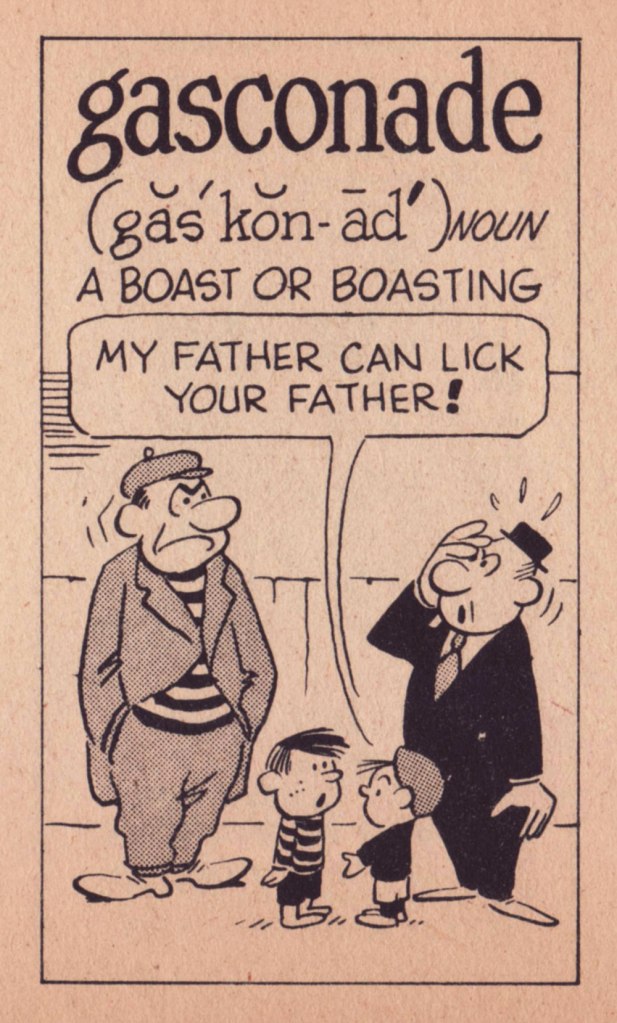
Derived from the French ‘Gasconnade’, which refers pejoratively to the speech of denizens of the Gascony region. « Speaking with the Gascon accent, which is to say accentuating silent ‘e’s, and letting ring out several final consonants that the French leave silent. »
I find this one particularly clever.
This one’s considered archaic nowadays — when it is considered at all — though its close relative, insipid, endures. Not to be confused with its homophone, incipience, which refers to the beginning of something.

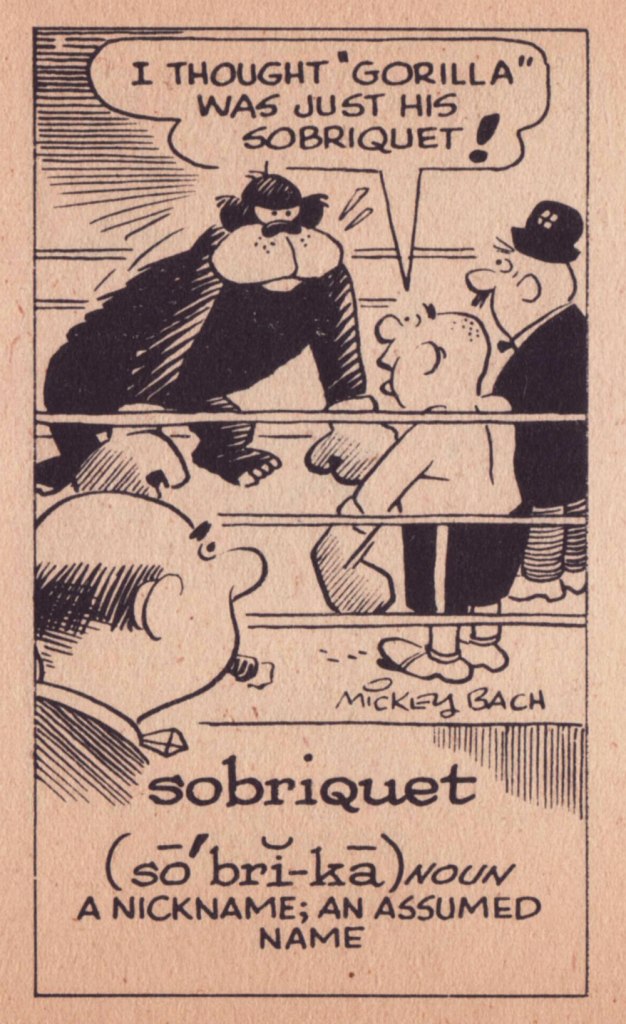
Sadly, Gorilla will likely pound the erudition out of that unfortunate pugilist.
Here’s a sentiment most reasonable the world over are currently experiencing, to their chagrin.

« There could be no jealousy/over my poetry/it’s my weakest quality/no vocabulary » — Todd Rundgren, Chapter and Verse

From both of us at WOT?, thanks for your continued support and interest, and may the coming year bring you as little as possible of what you’re dreading.

-RG

* It’s actually considerably more complex: « In 1963 Chicago-based Field Enterprises and New York Herald Tribune publisher John Hay Whitney acquired Publishers Syndicate, merging syndication operations with Field’s Chicago Sun-Times Syndicate, the New York Herald Tribune Syndicate, and the syndicate of the Chicago Daily News (a newspaper that had been acquired by Field Enterprises in 1959). When the New York Herald Tribune folded in 1966, Publishers inherited their strips, including Johnny Hart‘s B.C.Mell Lazarus‘ Miss Peach, and Harry Haenigsen‘s Penny.

In 1967, Field Enterprises acquired Robert M. Hall‘s New York-based Hall Syndicate, merging it with Publishers to form the Publishers-Hall Syndicate. » Phew.
A Very Langridge Christmas

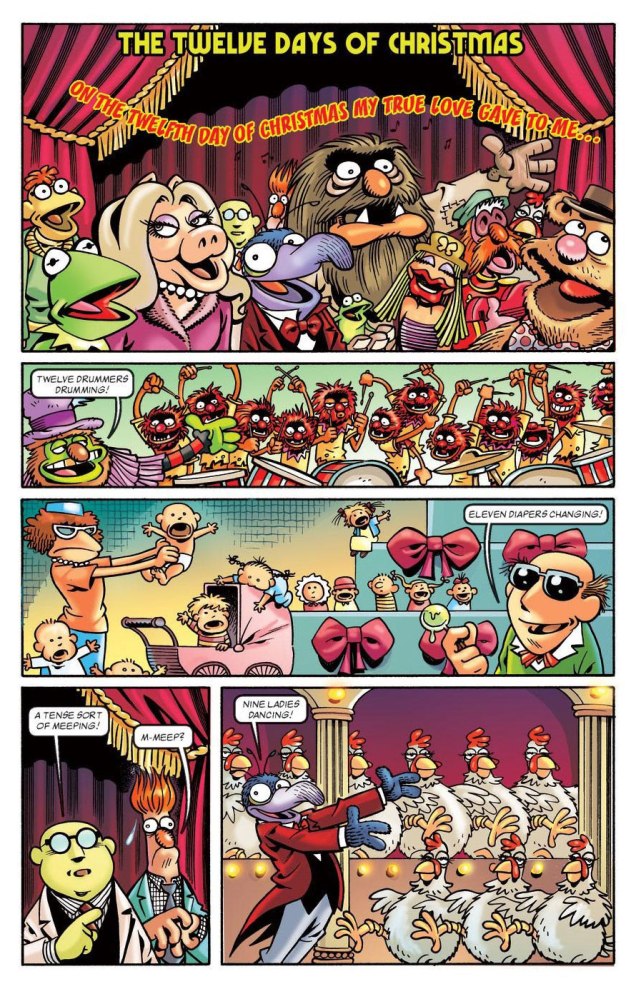
Speaking of festive mayhem, there is none better than penned (imagined, executed!) by Roger Langridge. Over the scope of his long (and ongoing!) career, the whole ‘rocking around the Christmas tree’ thing has shown up at least a couple of times — you may not have snow where you live, but take a gander at these and watch your holiday spirits soar (especially if bolstered by a bit o’ tipple).

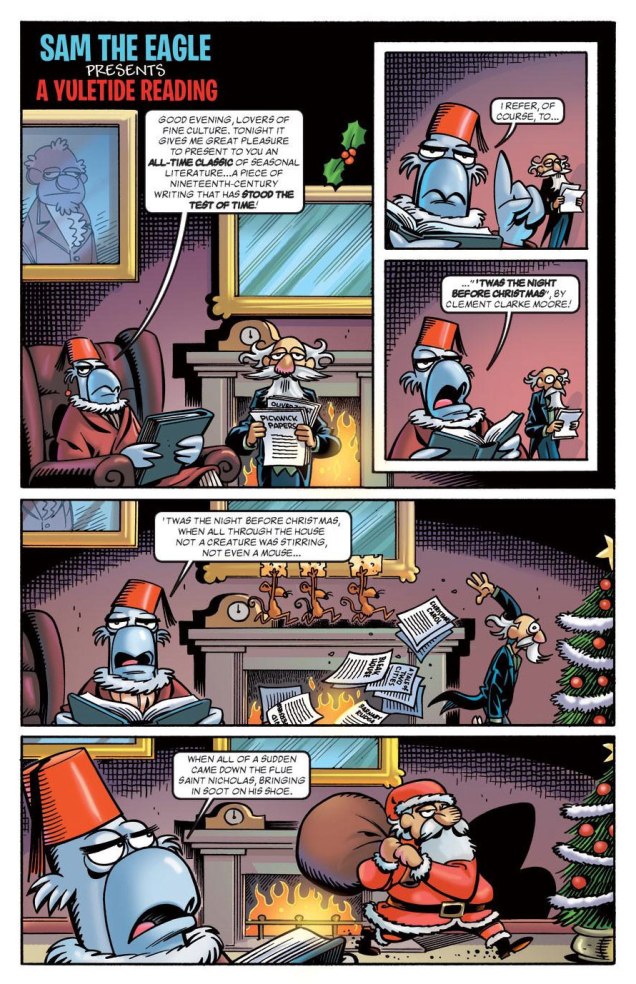
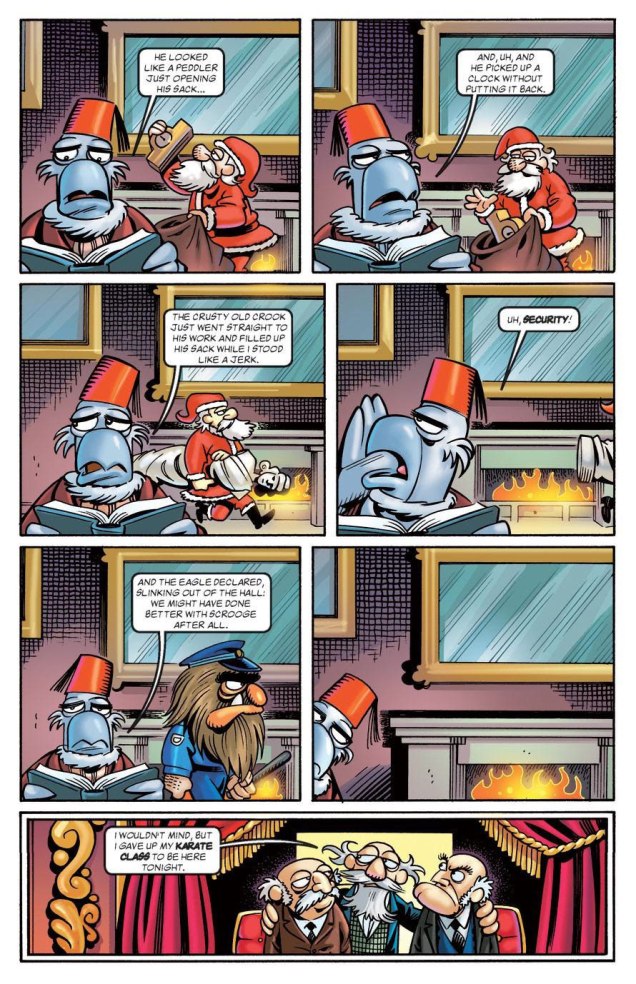
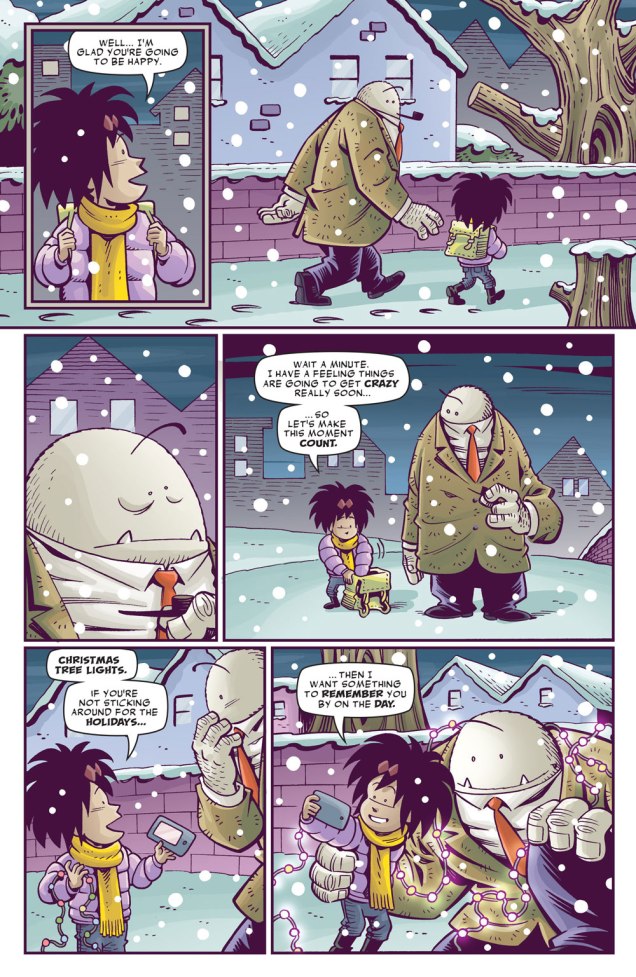
Here’s are some merry excerpts taken from The Four Seasons: Winter storyline printed in Muppets: The Four Seasons (2012, Marvel) for your enjoyment:

From the same issue, in this two-page digression (though what is The Muppets if not a series of glorious digressions), Sam narrates Dickens’ magnum opus… oh, nevermind.

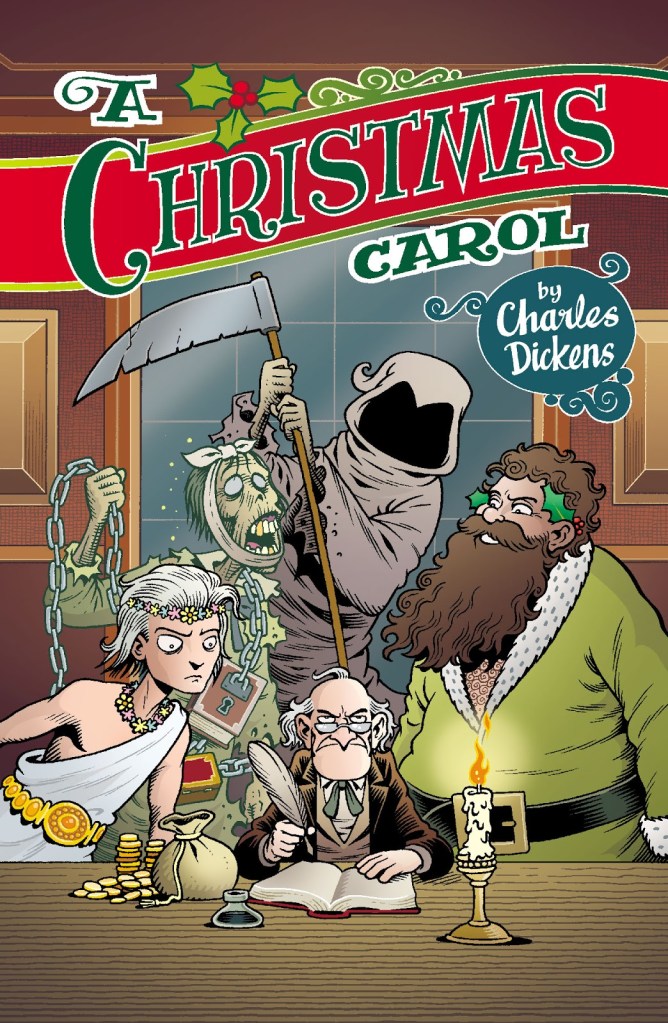
Speaking of Dickens, though, he did not go un-Langridged, happily:

A Christmas Carol (2013, St Mark’s Press)

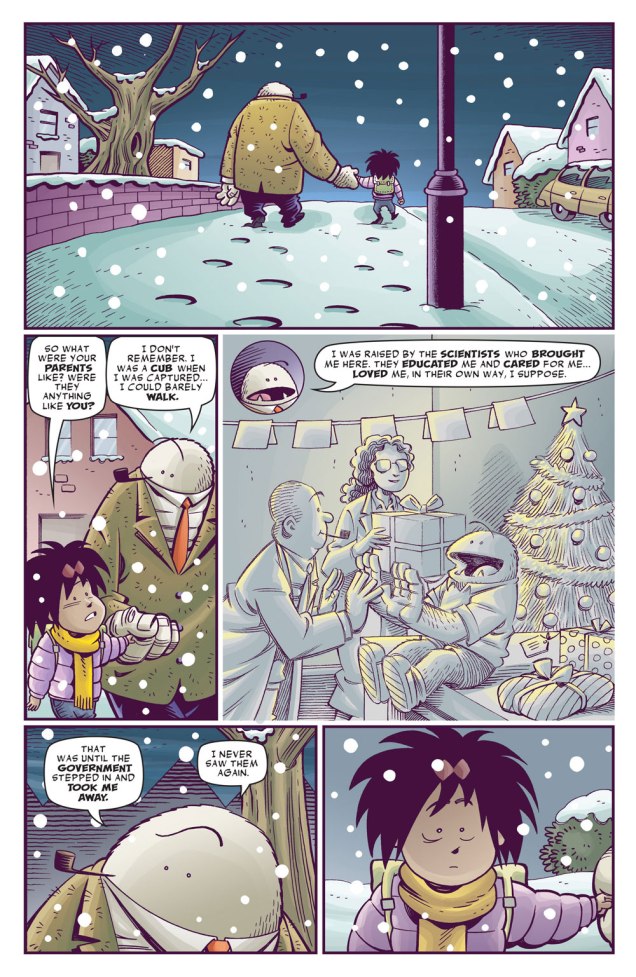
To further your cheer, a few more pages from Langridge’s Abigail & The Snowman (2016, KaBOOM!). This decade sure is a depressing one for all artistic professions — current active cartoonists seem to be mostly doomed to juggling thankless jobs for corporate giants such as Disney-slash-Marvel while defending their right to be (and to own their work) from AI pilfering (although ‘pilfering’ is too cute a word for it). Even such pundits as RL can rarely afford to work on what’s actually dear to their hearts. In that context, the sweet (and thoughtful) story of Abigail and her snowman friend was a very welcome addition to Langridge’s career, lodged as it was between two extremely underwhelming Dynamite-published affairs where he acted as the writer, namely King: Mandrake the Magician (2015) and Betty Boop (2017). I’m now convinced that Langridge’s art can save a poor script (thanks to jokes and beautifully non-sequitur asides inserted into the art), whereas a flat artist can ruin a plot faster than you can shout ‘Gisele Lagacé‘.

Langridge has been drawing daily cartoons based on his life for around 5 years now. This is the strip’s final week, as he has decided that it’s time to move on to something else, so I wanted to mention it before it’s too late — especially since it’s perfectly relevant to the season.

Strip from December 21, 2023

And a merry Christmas to all! We’ll see you again before the New Year.

~ ds

Everybody Knows Leadfoot Larry!

« In World War One, they called it shell shock. Second time around, they called it battle fatigue. After ‘nam, it was post-traumatic stress disorder. » — Jan Karon

Jerry Grandenetti‘s whirlwind passage through the halls of Charlton (circa early 1966) was barely noticed, let alone commented upon. Ah, but it nonetheless was interesting. Grandenetti, frustrated with his limited prospects in illustrating war scripts for Bob Kanigher at DC, was in the middle of trying to expand his client base and break away from the obvious constraints of dealing with a petty tyrant. He was also eager to let his style evolve naturally, which certainly wasn’t going to happen in the pages of Star-Spangled War Stories.

And so, in 1966, Grandenetti, while keeping active at DC, passed through Tower (Fight the Enemy), Gold Key (The Twilight Zone), Marvel (Tales to Astonish: both The Hulk and Namor), Warren (Creepy and Eerie), though much of that work was ghosted for Joe Orlando and only revealed to be Jerry’s own… well after the fact.

For my money — and it won’t surprise anyone — the most unhampered and noteworthy art he created over that year was at Charlton. Here’s a sample!

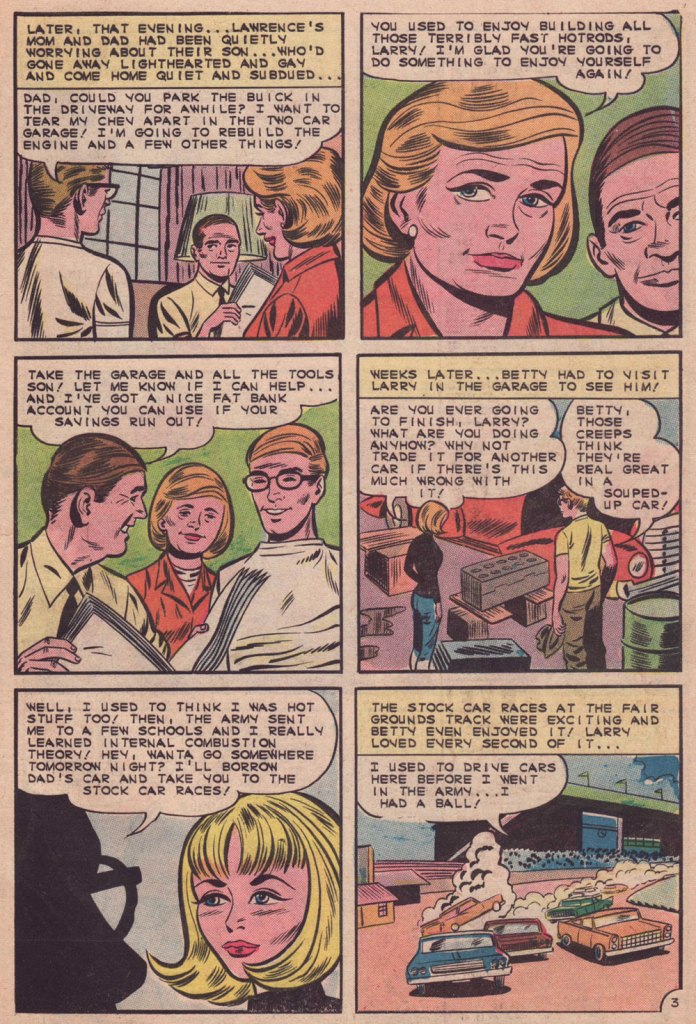
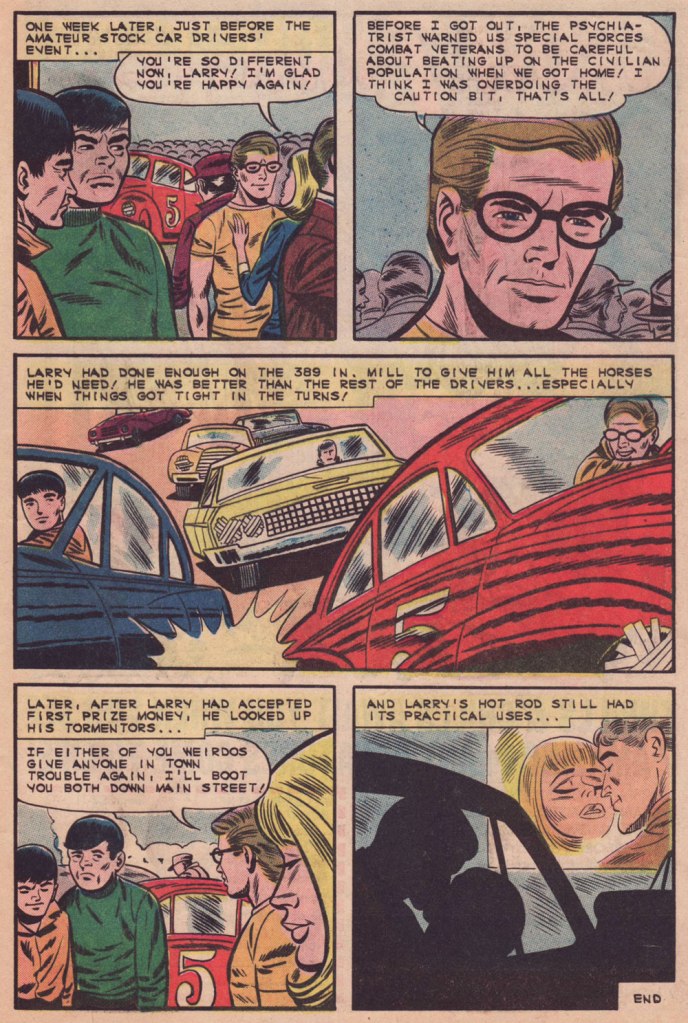
« Leadfoot Larry » was written by Joe Gill and inked by Jon D’Agostino.

While I prefer Grandenetti’s own inks (unless Wally Wood or Murphy Anderson are on the table!) over his pencils, future Archie stalwart Jon D’Agostino (1929-2010) performs a slick job that doesn’t smother Jerry’s pencils. A pair of romance stories saw him unfortunately saddled with indifferent Vince Alascia, but a teaming with Rocco Mastroserio proved attractive. The crown jewel of the ’60s Grandenetti Charltons was a sixteen-pager purporting to tell « The True Story of Jesse James! », wherein JG got to ink himself.

For me, what sets « Leadfoot Larry » apart is that it’s a character piece, the hot rodding taking a back seat to the — often underlying — themes of PTSD, sound reason pitted against blind rage, trust, maturity and responsibility facing callowness and cowardly chaos… with the sobering conclusion that you just can’t reason with some people. In typical Joe Gill fashion, most of the issues are circumstantial… they don’t explode into melodramatics. It’s not a perfect world, nor should it be, but one I’d rather inhabit, given the choice.

Here’s the issue it’s from, Hot Rod Racers no. 8 (Apr.-May 1966, Charlton). Despite being cobbled together from interior art, the cover manages to be pretty striking. Pat Masulli, editor.

-RG