Hallowe’en Countdown II, Day 5

« Got to get into my pajamas… quickly! Got to… oh, Lord… NO! »

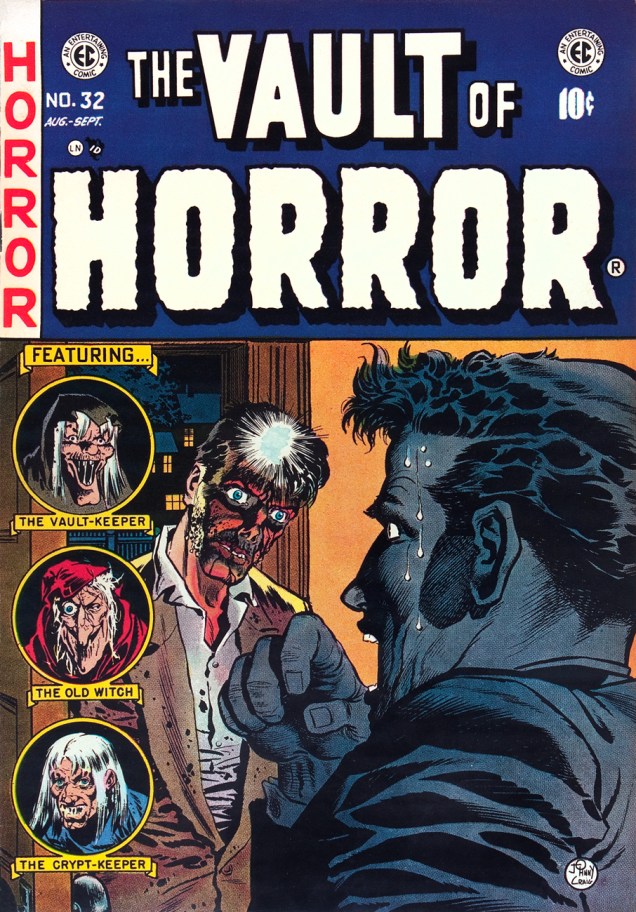
High time for some grue! I couldn’t reasonably be expected to shy away from EC’s 50s horror line, now could I? Of Entertaining (formerly “Educational”) Comics’ infamous/legendary trio of “New Trend” horror anthologies, The Vault of Horror surely was the finest. The deciding factor? The meticulous editorship, writing and artwork of Johnny Craig. While Tales From the Crypt and the The Haunt of Fear fed us a steady diet of Jack Davis, ‘Ghastly’ Graham Ingels and *choke* Jack Kamen (grandfather of the Segway, incidentally), with the fourth tale generally handled by Reed Crandall, Joe Orlando or George Evans, or if you got *really* lucky with your dime, Bernie Krigstein, things got stale. It didn’t help that the writing of the Bill Gaines / Al Feldstein duo, despite sporadic excellence, was quite formulaic and oh-so-verbose. Things got kind of claustrophobic for the artists. The Vault of Horror was different enough: Johnny Craig took care of the opening story, and wrote it himself, sparely and with great intelligence. A true breath of fresh air, though I’ll admit it’s an odd thing to say about EC’s gory tales.
VaultHorror32A

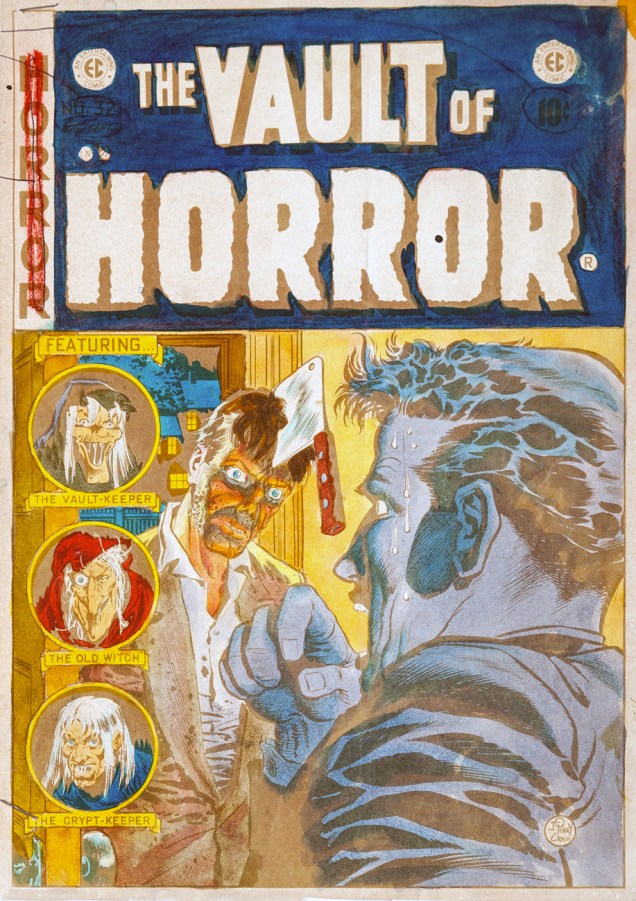
This particular cover (depicting a scene from Al Feldstein and Jack Davis’ « Out of His Head ») wasn’t originally slated for publication this way: EC’s attorney wisely insisted that it be toned down. The original version had appeared in house ads, so astute readers knew what they were missing.

To give you a sense of how far along things went before the punch was pulled, here’s the original, circa 1953, Silverprint cover proof in its original version, before being altered for publication. The proof was shot from the original negatives, with the image area reduced to printed size. Marie Severin used watercolours to specify the ink colours to be used.
VOH32SilverprintA

Finally, the version below was recoloured (from cool to warm!) for Russ Cochran‘s deluxe hardcover reprint set of the 1980s and retained for subsequent Gladstone and Gemstone reprints.

VOH32UncensoredA-RG

Hallowe’en Countdown II, Day 4

« Ape is real spooked, guys! He’s always imaginin’ he sees someone in there! »

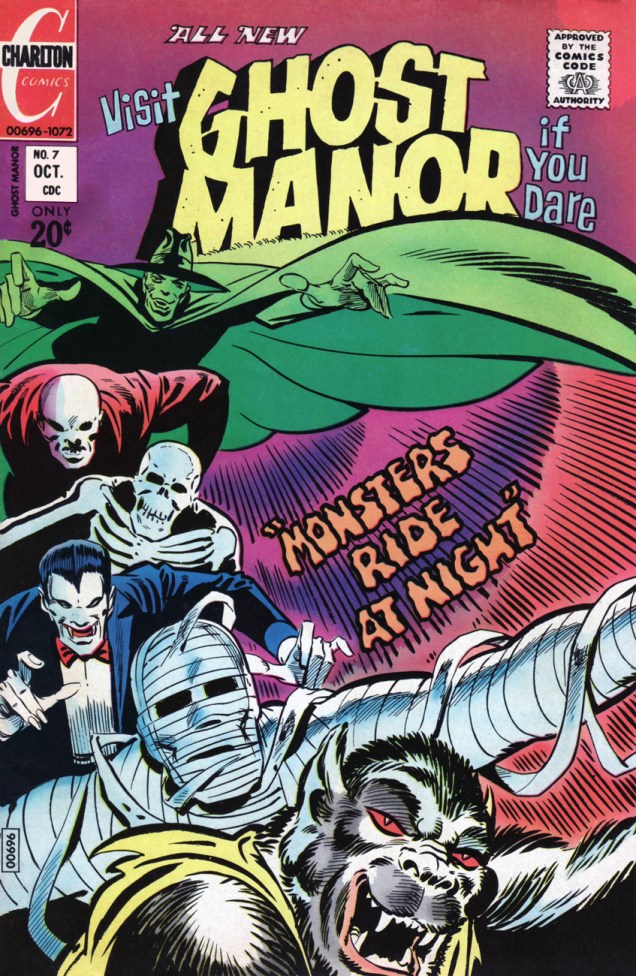
Here we have an evocative Steve Ditko cover, solid evidence of his tremendous design chops, from Charlton’s Ghost Manor (no. 7, second series, October 1972). A collaboration between Joe Gill and Ditko, « The Monsters Ride at Night » is an elegant bit of storytelling legerdemain, a fairly basic yarn that retains its mystery past the conclusion and whose deliciously dusty mood lingers in the mind. Well, in mine, at any rate. Back in the late ’70s, I traded a copy of Amazing Spider-Man 121 (acquired at a garage sale in a two-for-five-cents deal) for this one. I know I came out ahead in the deal*.

Ghost-Manor7A

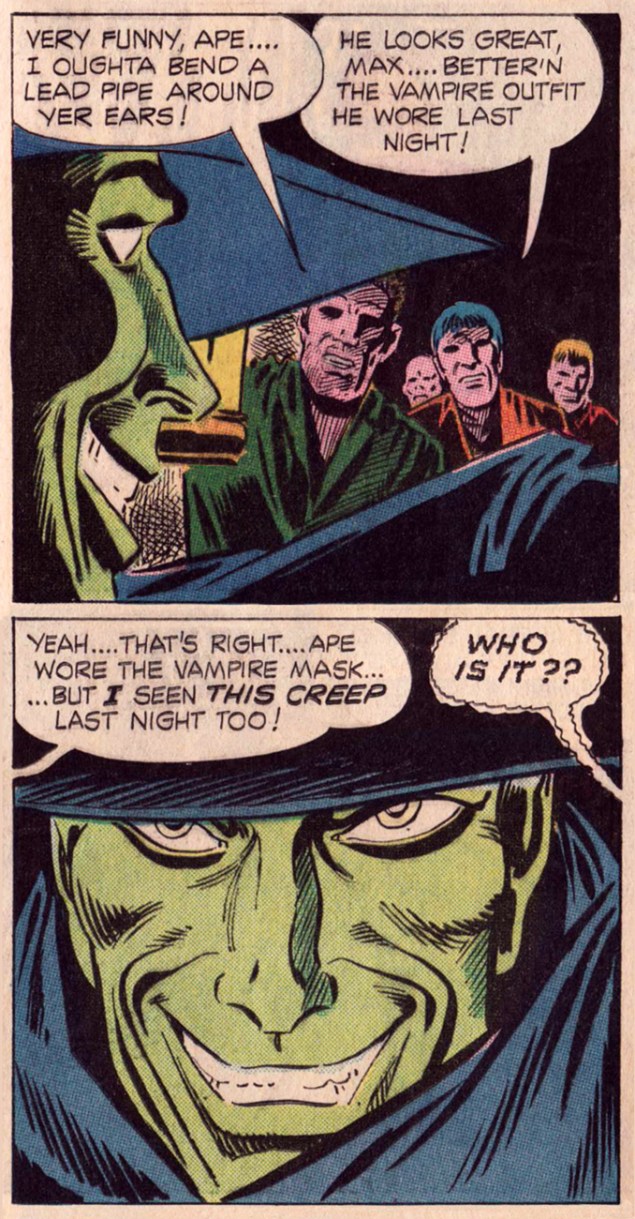
Again, I had every intention of providing the whole spooky shebang right here, but seeing as how I was preceded in this particular enthusiasm by a sinister confrère, it seems unnecessary. Just dim the light, settle in, point your browser to Destination Nightmare, pour yourself a noggin of your preferred poison, and savour this fine vintage.

Ghost-Manor7WhoIsA

I’m particularly fond of the mid-tale interlude, where our esteemed host, Mr. Bones, seizes the occasion to poke around the cobwebs a bit, a narrative game that the Gill-Ditko duo excelled at. DC and Warren’s hosts (with the obvious exception of Vampirella) never got to play such an active rôle in their respective recitals.

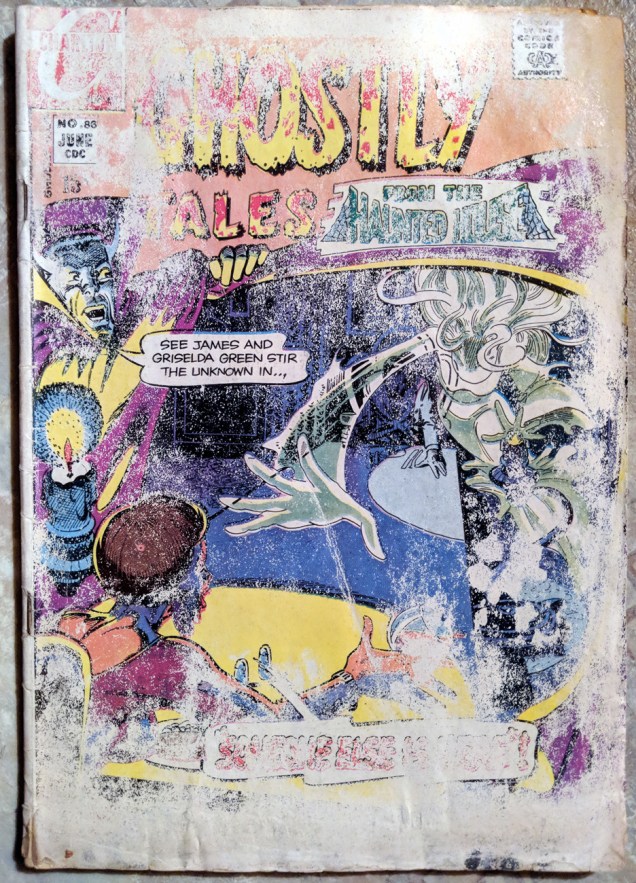
Oh, and since we’re on the topic of early 70s Charlton ghost books, here’s one I picked up just this afternoon, in the 50 cents box of the local comic book shop in Wolfsville, NS. It clearly had been through such hardships, I couldn’t resist giving it a home.

GhostlyTales86Beater.jpg
This is (or used to be) Ghostly Tales no. 86 (June, 1971), featuring three Joe Gill tales: « Return to Die » (illustrated by Pete Morisi), « Ghost Town » (illustrated by Pat Boyette), and « Someone Else Is Here! » (illustrated by Steve Ditko.) If books could speak…

-RG

*I had an extra copy, what do I care?

Hallowe’en Countdown II, Day 3

« It was like plunging deeper and deeper into a growing nightmare! »

A powerful (what else?) Jack Kirby piece, one of his last before decamping to DC. He actually gets a full writer/artist credit (a telling tail end turning point of that Marvel residence) on this tale, … and Fear Shall Follow!. The lush cover inks are provided by fellow Golden Age titan Bill Everett (1917-1973), a far cry from the miserable Vince Colletta « finishes » he would be saddled with at DC for the next couple of years (at their insistence!)

KirbyCOD5A

I was planning on featuring the entire story, but others have long ago preceded me down that primrose path. Why fight it? Just pay Diversions of the Groovy Kind a visit, where you’ll receive, as a bonus, Kirby’s other solo outing for the House of (mostly his) Ideas, The Monster!, from the previous issue of Chamber of Darkness (no.4, April, 1970). Both are sympathetically inked by Marvel’s production manager at the time, the underrated and gone-too-soon John Verpoorten (1940–1977). Again, several notches above “Valiant” Vince Colletta’s casual sabotage.

Plot-wise, … and Fear Shall Follow!, while another variant in the Carnival of Souls tradition, is enriched by its unusual setting and whiff of incense and philosophy. Reminds me of a possibly apocryphal exchange between Watchmen editor Len Wein and its writer Alan Moore: « Alan, that ending’s already been done on The Outer Limits! »; (in thick Northampton accent, dripping with sarcasm) « Yes, Len, but it’s never been done by me! ». With all due respect, it’s not as if Mr. Wein had any moral lessons to dispense regarding originality.

– RG

Tentacle Tuesday: Scuttle Over to British Shores

Finally, Tentacle Tuesday is here, and the tentacles are back with a vengeance! I’ve been waiting all week to spring ’em on you.

This cutie, the Triclopus, kindly agreed to let us use his, err, face to kick off the Tentacle Tuesday festivities.

Triclopus-KenReid

The Triclopus is a Ken Reid creation from August 31st, 1974. There’s a full list of Creepy Creations (published in the British Shiver and Shake) – with pictures! – over at Kazoop!, a great blog about British humour comics of the 60s and 70s. Go check it out. As for Ken Reid, we’ve previously talked about him here.

TentacleTuesdayIcon

ChrisRidell-alienography
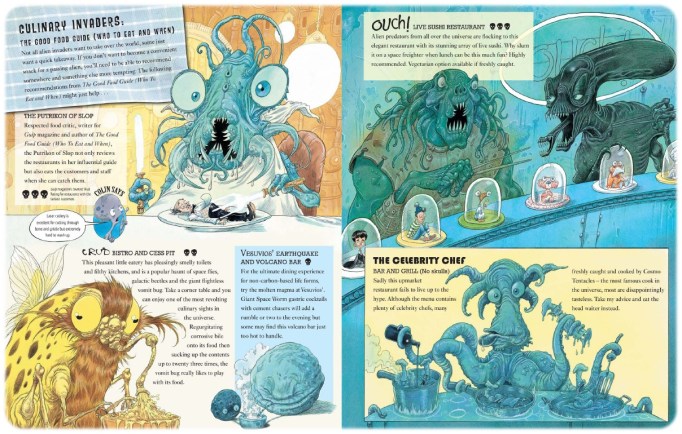
Excerpt (or, as the Brits would say, extract) from Alienography by Chris Riddell (2010).

Chris Riddell is a British illustrator, writer of children’s books, acclaimed political cartoonist, talented doodler, etc. His hand-lettering (not at all on display in Alienography, I admit) is sort of Richard Sala, Edward Gorey-ish, as is his somewhat macabre sense of humour. Visit Riddell’s blog here.

TentacleTuesdayIcon

This splendid illustration by Roger Langridge (tentacle artist par excellence) was published in Doctor Who Magazine no. 300 (February, 2001) to accompany some-article-or-other about “Spearhead from Space” (a Doctor Who episode, the seventh season opener, if you really must know).

RogerLangridge-DrWho

A bit more information about the cool Dr. Langridge-and-Dr. Who pairing:

“Within Doctor Who comics, he can be regarded as effectively the current Doctor Who Magazine “house letterer”, having lettered the overwhelming majority of comics since his debut on DWM 272’s Happy Deathday in late 1998. Almost every issue of DWM published in the 21st century was lettered by Langridge.

He has also occasionally pencilled, inked and even coloured some stories along the way. Deathday, for example, was also his Doctor Who pencil and ink debut, and was followed by artistic duties on TV Action!, the back half of The Glorious Dead (where he was co-credited as penciller with Martin Geraghty), The Autonomy Bug, Where Nobody Knows Your Name, The Green-Eyed Monster, Death to the Doctor!, and Planet Bollywood. He is thus perhaps the only artist to professionally draw all eleven incarnations of the Doctor, even though many of his renderings were obvious parodic in Death. Finally, he coloured Me and My Shadow and Where Nobody Knows Your Name.” [source]

TentacleTuesdayIconThe Wizard, a weekly British publication put out by D.C. Thomson (without a P, though it’s tempting), was created in 1922 and lasted all the way until the late seventies (with periodic interruptions for a merger and several title changes, from “Wizard” to “Rover and Wizard” to “Rover” and then again back to “Wizard” in 1970 until its final demise in 1978).

TheWizard-Oct26-1974
This edition of The Wizard is from October 26th, 1974, but I unfortunately have no idea who the artist is.

Between WWI and WWII (and sometimes beyond), D.C. Thomson published a number of weekly magazines/papers aimed at boys between 8 and 16. They cost 2 pence, and were thus known as “Tuppenny Bloods”, or the Big Five: Adventure, Rover, Skipper, Hotspur and the aforementioned Wizard. What could one hope to find in a Tuppenny? Short stories with illustrations, some comics, some non-fiction articles…. pretty much everything a growing boy (and girl!) with a lively mind would want.

TentacleTuesdayIcon

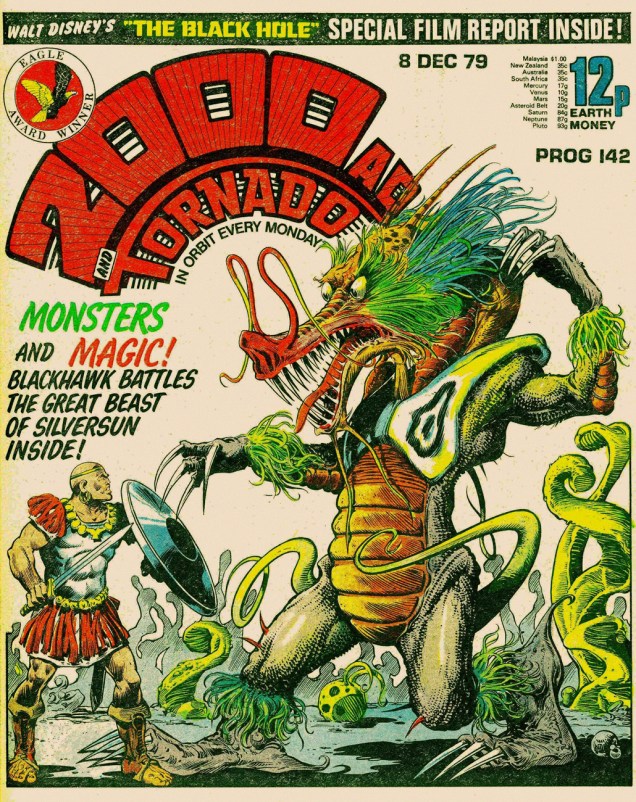
2000AD-1979A
2000 AD no. 142 (1979). I call this the “dragons’n’tentacles” ploy. Other than tentacles on the cover, this issue contains part 3 of Judge Dredd: The Black Plague, which I highly recommend, and some Stainless Steel Rat adventures.

~ ds

Hallowe’en Countdown II, Day 2

« … it was a balled-up thing… like an empty wrapper thrown carelessly aside… but somehow still recognizable as having once been human… »

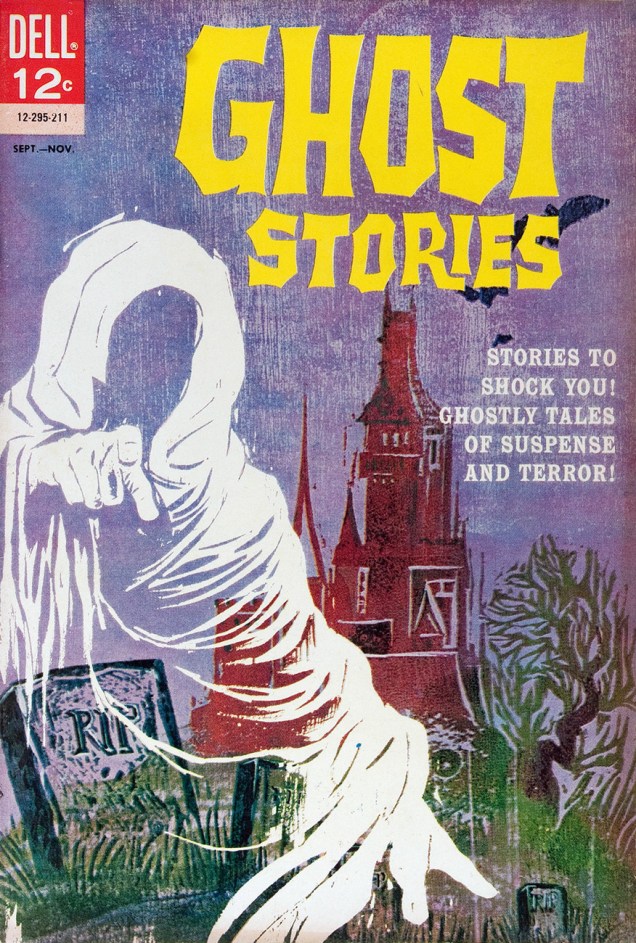
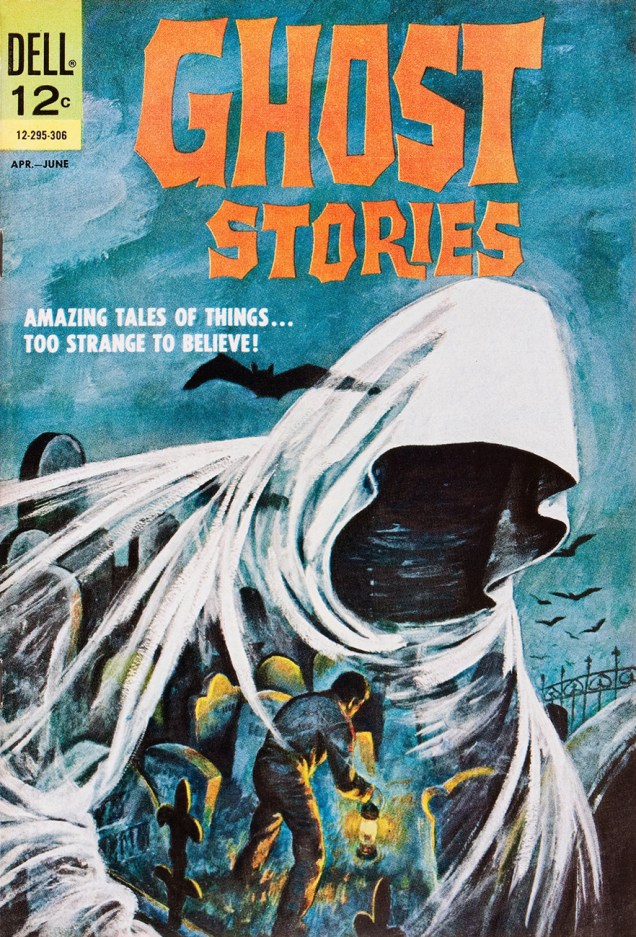
Dell’s Ghost Stories (1962-1973, with issues 21 to 37 lazily and straight-up reprinting numbers 1 to 16… with a single, perplexing exception, the all-new, surprisingly decent issue 35, late in 1972) were quite tame, trifling stuff, with one notorious bright spot: the première issue, entirely written by John Stanley (1914-1993) and comprising, amidst other excellent short pieces, what’s possibly the most nightmarish tale to see print up ’til then in American comics (particularly all-ages comics!), « The Monster of Dread End ». It represented the kind of material few comics publishers could have gotten away with at the time, save, ironically, one of the squeaky-clean stalwarts (Dell, Gilberton, Gold Key…) that opted out of the industry’s recently-instituted governing censorship board, the Comics Code Authority. Their reasoning was that, having never published anything objectionable to begin with, they were unlikely to head down that sordid path in the future.

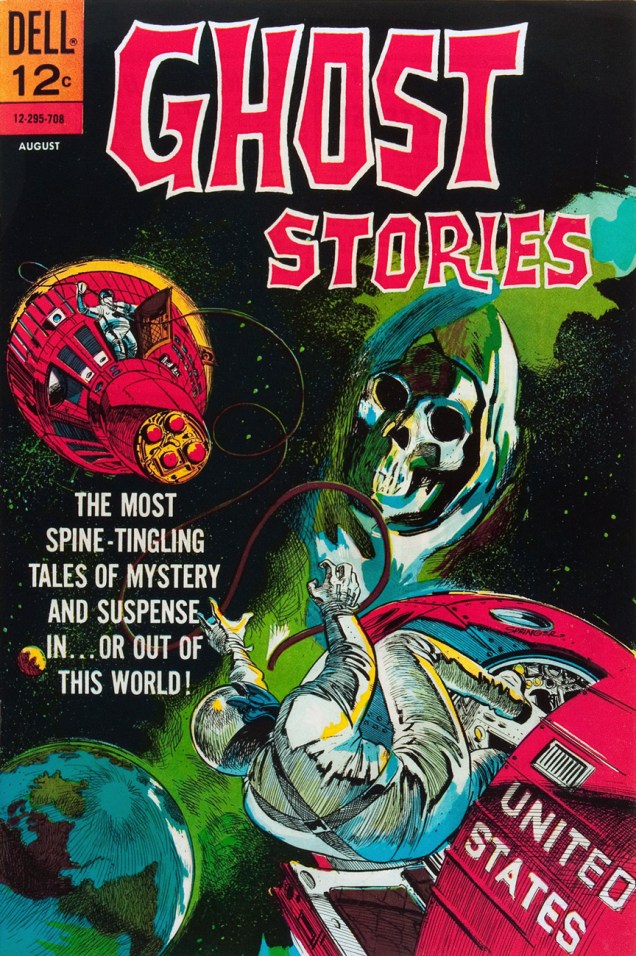
Journeyman cartoonist Frank Springer (1929-2009) provided some decent artwork through most of the book’s run, but as he didn’t have much to work with, script-wise (Carl Memling was no substitute for Mr. Stanley), the end result remains underwhelming. Looking at the bright side, he did provide a couple of quite alluring covers, the final, non-painted entries in our select little gallery.

GhostStories1A
If you haven’t already made its acquaintance, treat yourself to the nerve-tingling Number One, available gratis under the auspices of the fine folks at comicbookplus.com. Love the semi-woodcut technique used on the cover by the Unknown Artiste.
GhostStories2A
Ghost Stories no. 3 (April-June 1963). Cover artist unknown.
GhostStories10A
Ghost Stories no. 10 (April-June 1965). Cover artist unknown.
GhostStories19A
Ghost Stories no. 19 (August 1967). Cover and interiors by Frank Springer.
GhostStories31A
Ghost Stories no. 31 (January 1972). Cover and interiors by Frank Springer, price and indicia aside, a facsimile of issue 11 (July-September 1965). My own tepid introduction to the series.

-RG