Will Eisner’s The Spirit at Fiction House

« Our story opens on a rainy night on Central City’s waterfront… »

Continuing our chronicle of The Spirit’s wanderings from harbour to harbour over the decades, we make land today at pulp and comic book producer Fiction House, whose “Big Six” were the blandly-named but action-packed Fight Comics (86 issues, 1940–1954), Jumbo Comics (167 issues, 1938–1953), Jungle Comics (163 issues, 1940–1954), Planet Comics (73 issues, 1940–1953), Rangers Comics* (69 issues, 1941–1953) and Wings Comics (124 issues, 1940–1954). Compared to these, The Spirit’s five-issue stay was but a blip. Still, since FH’s art director was none other than Eisner’s old partner Samuel Maxwell “Jerry” Iger (1903-1990), this particular match is unsurprising.

Of course, it wasn’t common knowledge at the time, but these issues comprise little else but what came to be known as “the post-Eisner Spirit”, inarguably inferior work with the occasional highlight, generally a Jules Feiffer script let down by the visuals.

According to Eisner, interviewed in 1990 by Tom Heintjes: « Looking back, I have to say that it’s a blemish on my career that I allowed The Spirit to continue through this period, because I compromised the character just because I was busy with other things. That’s not to say that these are all bad stories, but they just don’t have the consistent outlook they had when I was directly involved. » « I look at these stories and I want to cringe – again, not because they’re bad, but because only the merest essence of the character is retained. »

If such is the case,  then it’s no small mercy that Will didn’t live to witness Frank Miller‘s masterwork of desecration.

SpiritFH1A
This is The Spirit no. 1 (Spring, 1952), featuring The Case of the Counterfeit Killer (Sept. 16, 1951), cover-featured The Curse of Claymore Castle (Nov. 4, 1951), The Plot of the Perfect Crime (Oct. 28, 1951), and Panic on Pier 8 (Aug. 19, 1951), each scripted by Feiffer. Cover artist unknown, but it’s a considerable improvement over the actual story.
SpiritFH2A
This is The Spirit no. 2 (Summer, 1952), reprinting The Amazing Affair of the First Man on Mars (Jan. 27, 1952), Contraband Queen (May 20, 1951), The Case of the Baleful Buddha (Nov. 18, 1951), and The $50,000 Flim-Flam (Apr. 15, 1951), the final three benefiting from some Eisner involvement. Again, cover artist unknown., but isn’t that gorgeously coloured?
SpiritFH3A
Ah, we’re getting more Eisner-ish, though not quite all the way. This is The Spirit no. 3 (1952), featuring The Walking Corpse (Mar. 9, 1952), It Kills by Dark (Feb. 24, 1952), The League of Liars (Nov. 25, 1951), and A Man Named Nero (Feb. 3, 1952). The first three are scripted by Feiffer, and the fourth is undermined; I wouldn’t brag about that one either.
SpiritFH4A
This is The Spirit no. 4 (1953), featuring The Last Prowl of Mephisto (Apr. 1, 1951), scripted and illustrated by a heavily-assisted and pressed for time Eisner; Design For Doomsday (Jan. 13, 1952), The Sword and the Savage (Sept. 2, 1951), and The Great Galactic Mystery (Apr. 20, 1952), these last three scripted by Feiffer. And another nearly-Eisner cover… he never would have made it this busy, I think.
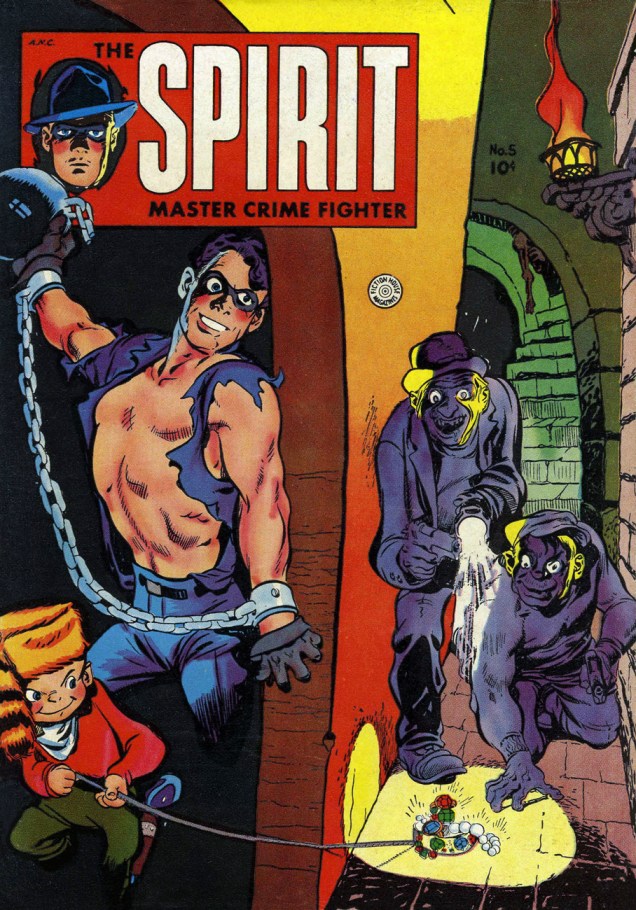
SpiritFH5A
This is The Spirit no. 5 (1954), cover-featuring Dragnet for Johnny Buffalo (Apr. 8, 1951), and also The Target-Man in 16-A (July 22, 1951), Damsels in Distress (a relative oldie from August 3, 1947), and The Loot of Robinson Crusoe (July 8, 1951), scripts a toss-up or a collaboration between Feiffer and Eisner. Now this cover I can buy as the genuine Eisner article: it’s a characteristic composition for him, and it’s sloppy in all the right places. The Spirit’s sidekick in this instance is Walkalong Haggerty, who saves his hide in “Dragnet..

So concludes our masked crimefighter’s passage at Fiction House. Fortunately, the publisher’s art department and production values were top-notch, so accommodations were quite cozy. Next time out, we’ll see how The Spirit would fare at the hands of Harvey Comics and (separately) at those of that nefarious rascal, Israel Waldman, in the swinging Sixties.

-RG

*Fiction House’s Rangers Comics featured the excellent “The Secret Files of Dr. Drew“, which ran in issues 47 to 60 (1949-51); the feature was the combined work of several of Eisner’s top Spirit alumni, namely writer Marilyn Mercer, penciller-inker Jerry Grandenetti, and letterer Abe Kanegson. The first ten (of fourteen) episodes just about out-Eisnered Eisner, until he protested and put an end to that gorgeous nonsense. This lot was lovingly restored and collected by Michael “Mr. Monster” Terry Gilbert (2014, Dark Horse). If you ask me, it’s the sole reprint of vintage colour material bearing the Dark Horse brand worth a damn… because Gilbert handled the work himself.
Warren Sattler’s Travels With El Chivito

« They’re drinkin’ red-eye, playin’ stud poker, and havin’ a high old time! I’ll just hang around awhile… »

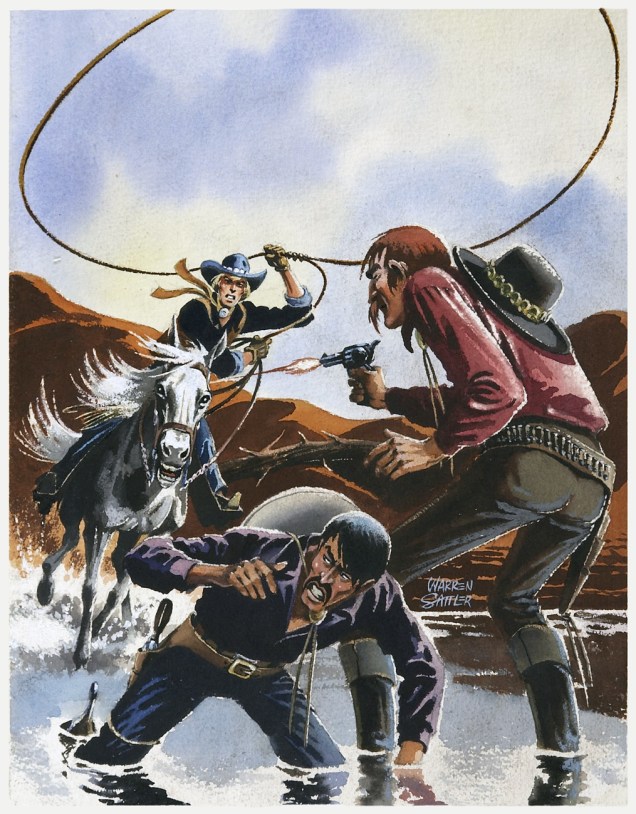
In the mid-1970s, thanks to Pat Boyette’s connections in Texas, Charlton Publications found themselves able to affordably produce painted covers, a development that several members of their iconoclastic stable of artists took full and glorious advantage of. Tom Sutton, Don Newton and Boyette were naturals, but Warren Sattler often gets unfairly sidelined from that esteemed lot… perhaps because he rarely worked for Charlton’s ghost books. Each of his cover paintings was produced for the publisher’s western / martial art adventure series, Yang, House of Yang, and Billy the Kid. And he alone worked in that most unforgiving of media, watercolours, wherein, unlike oils or acrylics, one requires unerring confidence and dexterity if you’re aiming to come up with anything above a muddy mess.

Today, Mr. Sattler (born September 7, 1934, in Meriden, Connecticut, where he resides to this day) celebrates his eighty-fourth birthday. Let’s wish him all the best!

Over the years, I’ve become quite enthused with Charlton’s long-running Billy the Kid series (1957-1983!), which featured over the years the artwork of such luminaries as John Severin, Maurice WhitmanRocco “Rocke” MastroserioJosé Delbo and of course Mr. Sattler. As far as I know, Joe Gill just about wrote the entire series, which is one of its chief pleasures: over a hundred issues of consistent characterization of young Bill Bonney as a peace-loving, unprejudiced champion of the underdog whom his amigos in Old México fondly nicknamed « El Chivito ». I know, hardly the real-life Bill Bonney, but what could one expect under the Comics Code Authority‘s heavy thumb?

Several of Mr. Sattler’s cover paintings have, thank goodness, survived destruction. They have to be viewed in person to be fully appreciated. For the nonce, we’ll make do with mere digital reproductions.

BTK112ORIG_A
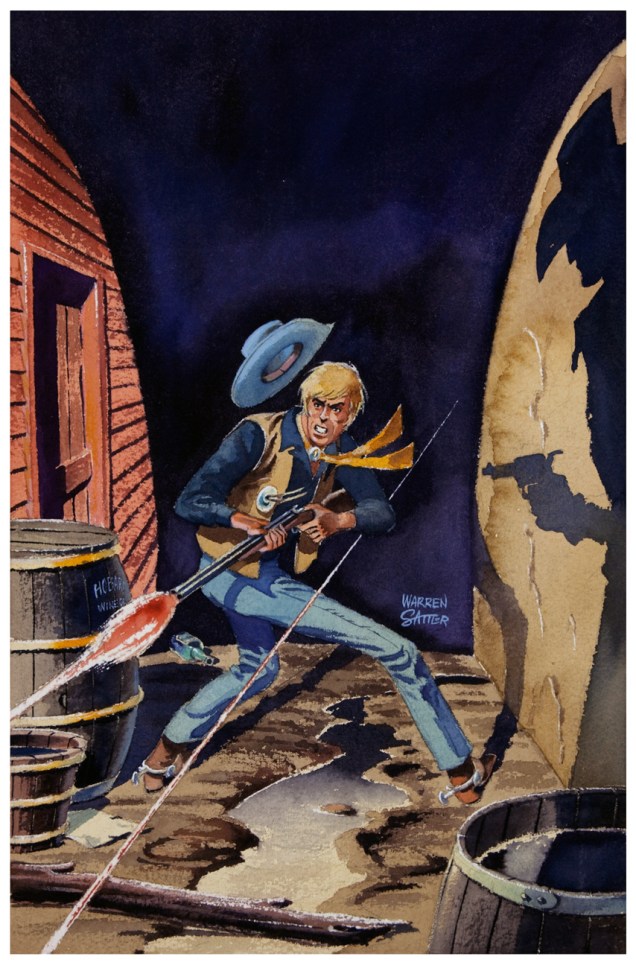
For his first painted comic book cover (or second, Yang no. 7 appeared that same month), I believe Mr. Sattler got the proportions slightly wrong, so the cover art was cropped fairly tight horizontally, which still made for a striking, action-packed cover, but since we’ve got the original…
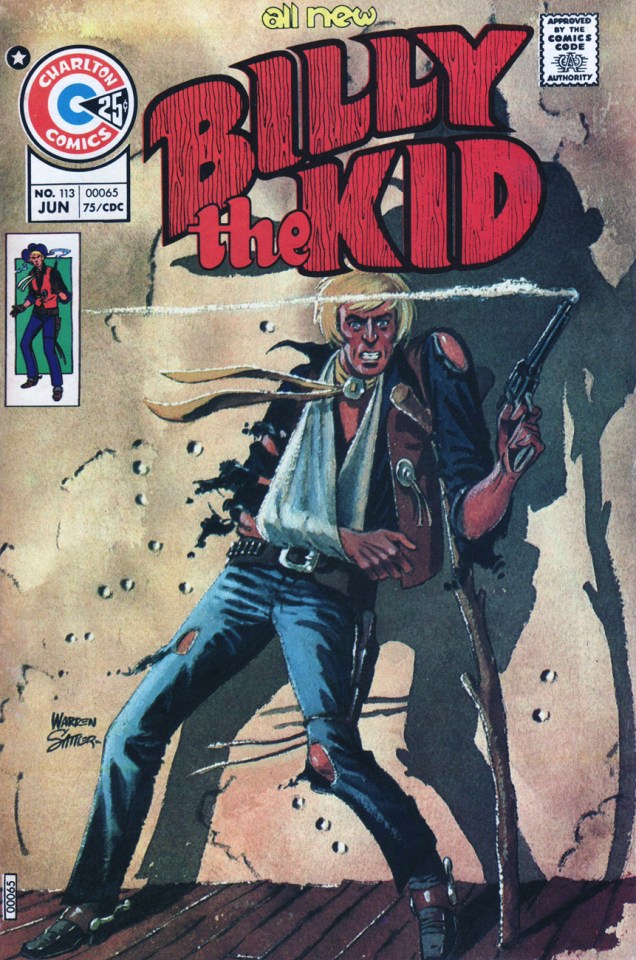
BTK113A
Two Billy adventures appear in this one: the cover-featured “The Good Life” and “The Spoilers!”
BTK114ORIG_A
This one was featured as the cover of Billy the Kid no. 114 (Oct. 1975), illustrating Gill and Sattler’s “Killers in the Shadows!”
BTK115A
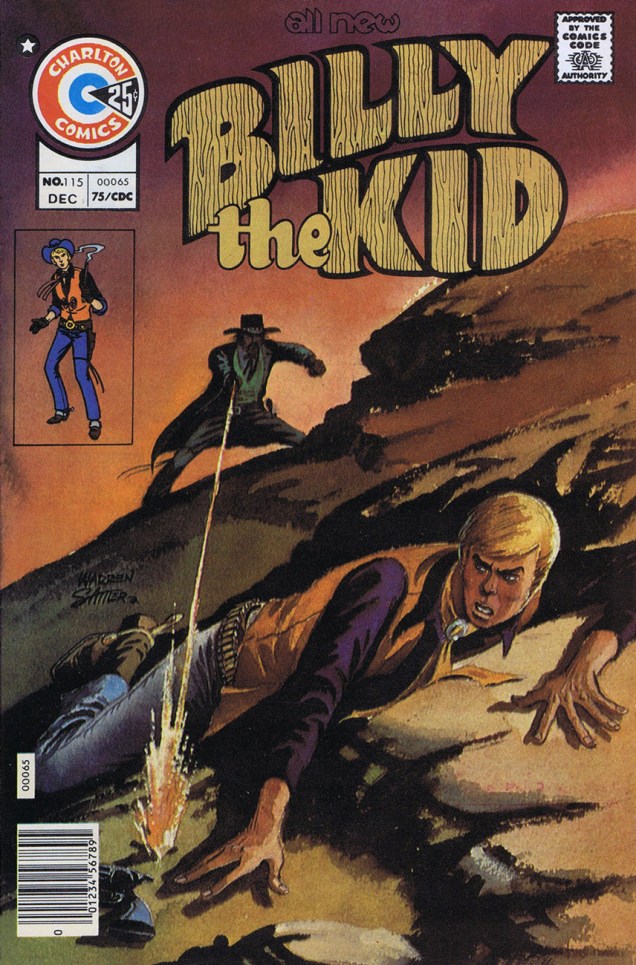
I’m sure Billy would be admiring the lovely light of dusk if he wasn’t being ambushed. Such a splendid and unusual (for comics) palette!
BTK116ORIG_A
The printed version of this painting, which appeared on the cover of Billy the Kid no. 116 (Feb. 1976), lost quite a bit of its subtlety in translation, so I’m happy to show you the original. I love that bit of yellow in the clouds, echoed in the bushwhacker’s shirt. For the first time, a solo Sattler Billy the Kid tale, “The Treasure”.

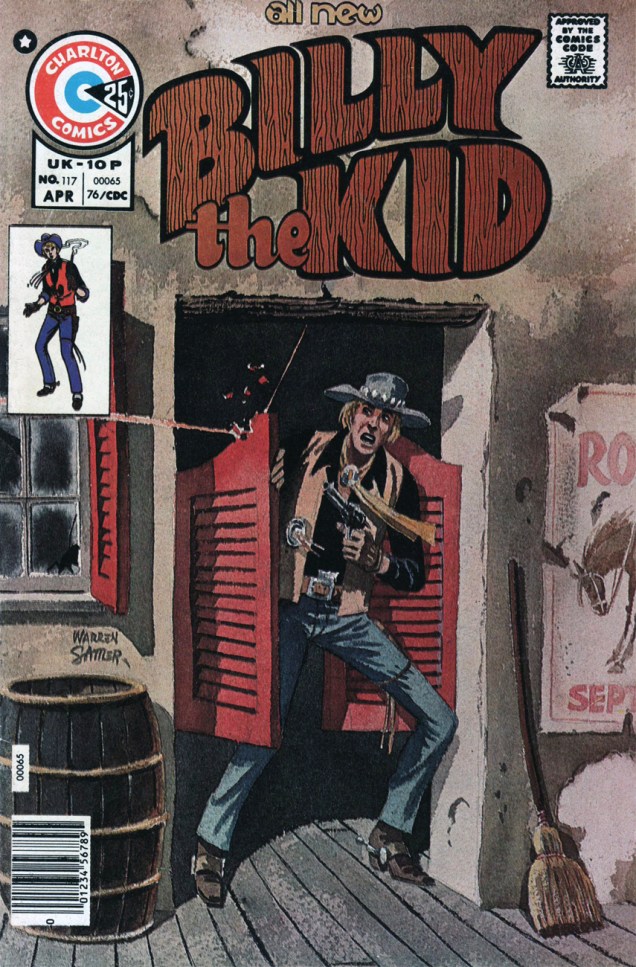
BTK117A

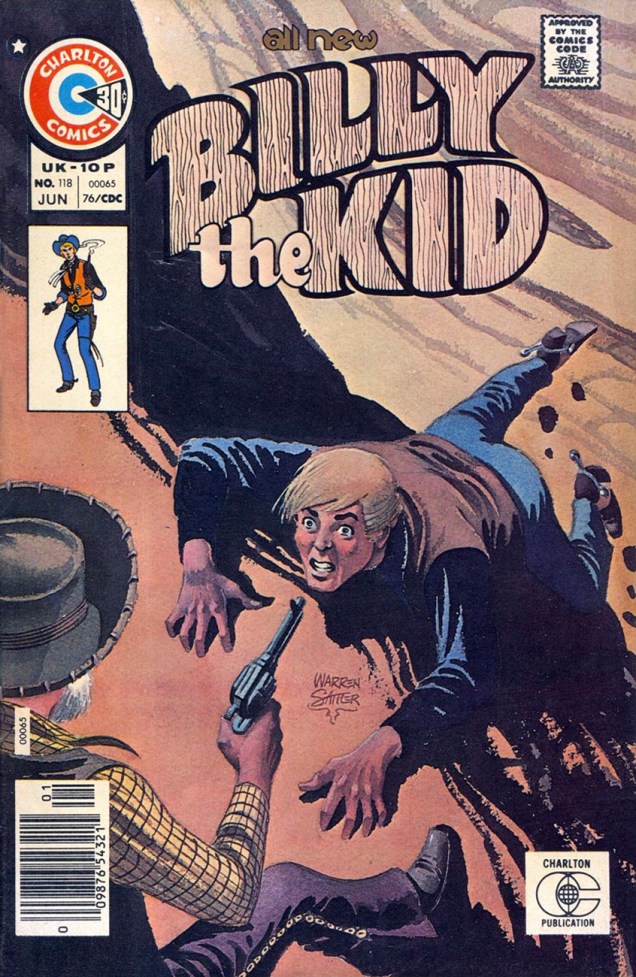
BTK118A
Beautiful composition, and an effective and economical way to convey height and distance. Note the cattle horns in the artist’s signature.
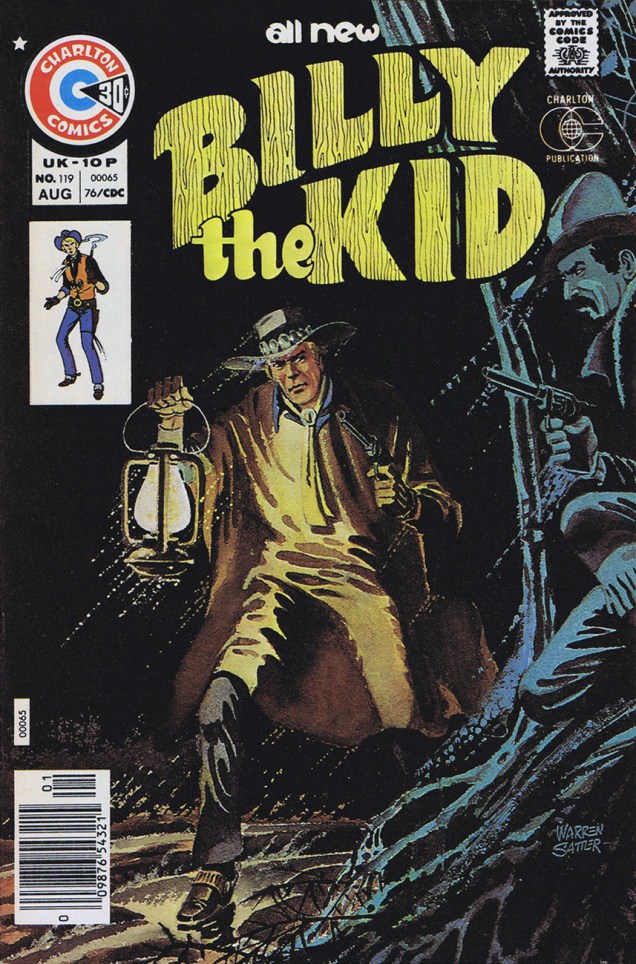
BTK119A
This one’s mood and palette bring to mind the work of Doug Wildey. A good thing, you understand. Excellent use of the « dry brush » technique for texture.
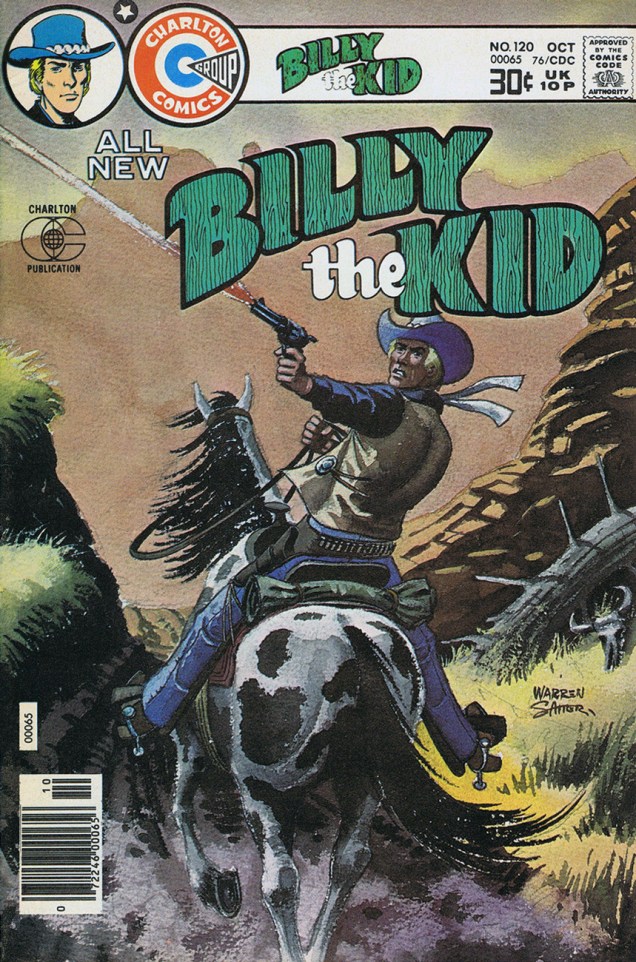
BTK120A
After several issues’ absence from the insides, Mr. Sattler reunites with Joe Gill on “Three for the Money!”
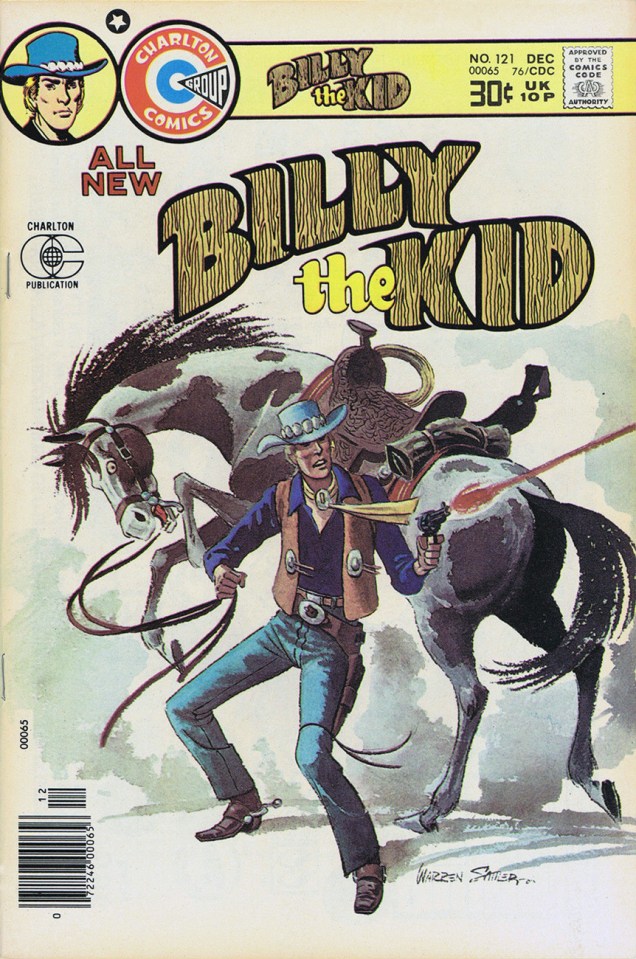
BTK121A
One final painted cover before Charlton rode off into the sunset…. for the first time.


SattlerBillyA
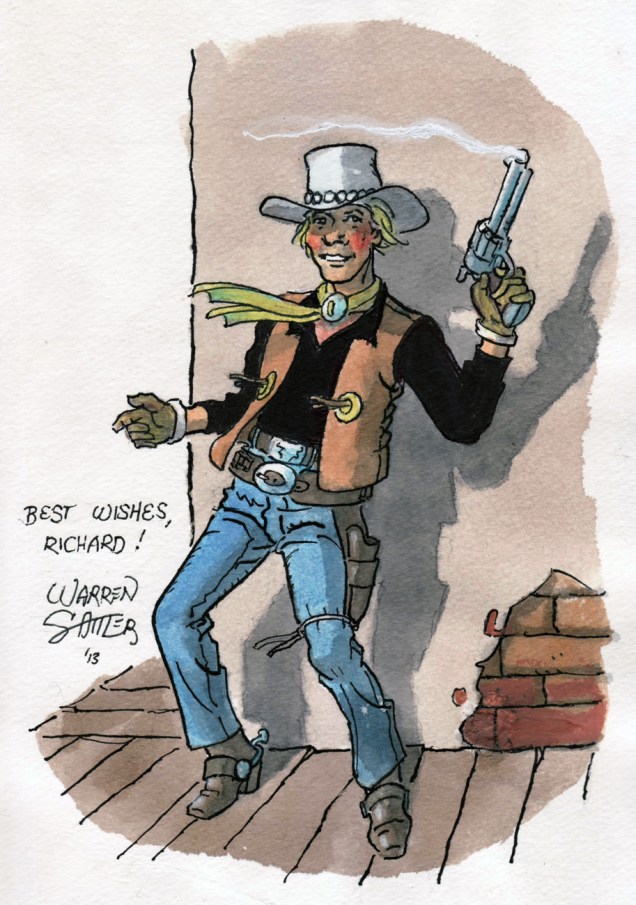
Mr. Sattler, a true prince of a man, created this piece especially for me a few years ago… without any request on my part! But you can bet I’ll always be grateful for this touching act of generosity and kindness.

As El Chivito’s many friends across the border would surely say, « ¡Que cumplas muchos más! », and thanks for everything!

-RG

Let’s All Go Down to the Catfights!

Catfight (noun): A vicious fight between two women that features biting & scratching and often involves clothes being ripped off.

To which I’ll add that if you put two women with different hair colours in one room, it’s like there’s a chemical reaction that makes them instantly aggressive. In comics, at least – and we all know that comics reflect real life accurately, right? The resulting combativeness is especially obvious when the encounter is between a blonde and a brunette. The women involved must also be beauties – presumably, plainer girls resort to verbal assaults when provoked, eschewing physical violence, unlike their flashier counterparts.

Or it could have something to do with the mostly-male audience who actively likes watching belles brawl. (Perhaps “ogle” would be a better description.) Let’s move on to the ogling bit, then!

Undercovergirl-catfight
Err, agreed on the “talking too much” bit. Manhunt no. 9 (Magazine Enterprises, June 1948). That art’s by Ogden Whitney.

“Jeepers! Baldy’s been skewered through the ticker! He’s defunct!” This charming scene with boob grabbery and skirt rippery (I know, don’t I have a way with words?) is from “Off Stage Kill”, a Dan Turner Hollywood Detective story from Crime Smashers no. 7 (Trojan Magazines, 1951).

CrimeSmashers7-DanTurnerHollywoodDetective
Script by Robert Leslie Bellem, pencils and inks by Adolphe Barreaux (who was also the editor). Read the issue here. In case you were wondering, Fifi and Brenda are just acting out a fight scene for a movie, although they do get a little carried away (and accidentally skewer Baldy in the process). How many women have a knife tucked away in their garter belt?

Skipping ahead ten years or so…

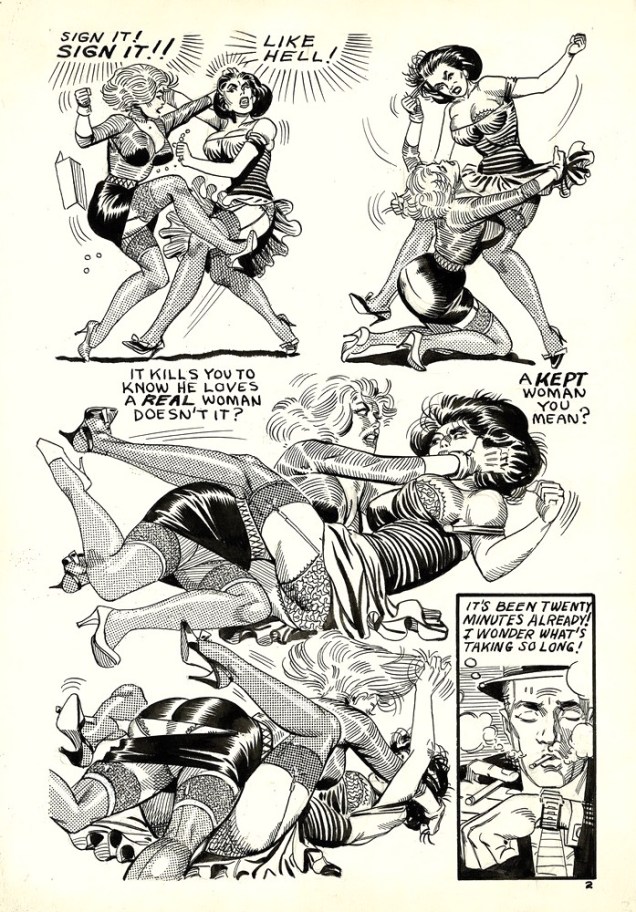
EricStanton-Steve Ditko-DivorceAgreement
Ditko shared a studio in NYC with artist Eric Stanton between 1958 and 1968, and they collaborated on some bondage comics (or at least it’s commonly assumed that they have – for more information on that, dive into a discussion on the Four Realities blog, or read this excerpt from Fantagraphics’ Dripping with Fear: the Steve Ditko Archives Vol. 5.) This page is from a story published in 1966 and entitled “Divorce Agreement”.

The clothes-shredding and breast-mauling (ouch) continues…

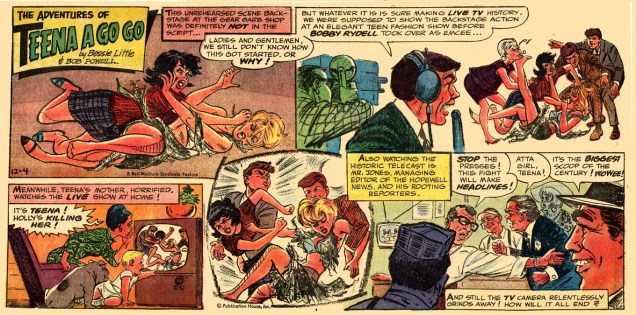
Teena-dailystrip-Dec4th-1966
Newspaper comics do it, too! This is Teena A Go Go from December 4th, 1966, written by Bessie Little and illustrated by Bob Powell.

Sometimes Betty and Veronica associations are hard to avoid. These girls also made sure to wear contrasting costumes while fighting, for maximum visual appeal, proving it’s possible to be fashion-conscious even in prehistoric times.

Anthro6A
Anthro (the happy teenager watching this scene, and normally a redhead) will marry the victorious maiden… but the fight is a draw, and so he has to marry both in this “The Marriage of Anthro” story. This is Anthro no. 6 (July-Aug. 1969). Pencils by Howard (Howie) Post (who created Anthro, the “first boy”, a Cro-Magnon born to Neanderthal parents) and inks by Wally Wood. Let it be mentioned that Anthro is an immensely fun series, and that I love Howie Post’s art with or without Wood’s beautifying influence.

Women of other cultures aren’t immune from this phenomenon, by the way. Witness Italian chicks fighting:

Maghella13-Averardo Ciriello.
Maghella no. 13 (Elvifrance, 1975), cover by Averardo Ciriello. ” The title is something like “a scalded pussy doesn’t fear cold water”, a play on “chat échaudé craint l’eau froide“, an idiom that means roughly “twice bitten, once shy” or “a burnt child dreads the fire” and translates literally to “a scalded cat fears cold water”.

Italian erotica can be so entertaining! Maghella means a “young witch” in Italian. “The girl is identified by two braids of black hair and giant breasts with unspecified powers“, reads Wikipedia… Odd, I would have thought that her breasts have very specified powers, indeed. 😉

Moving on to French damsels…

LeTreizièmeApôtre-NatachaHôtessedel_Air
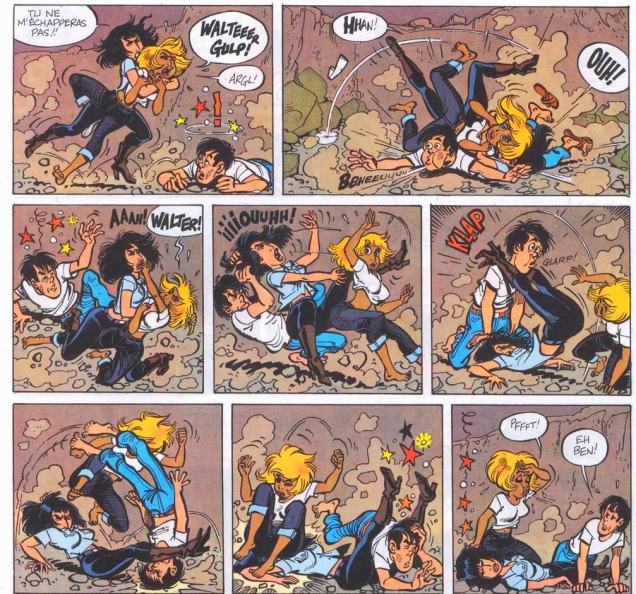
Natacha (hôtesse de l’air) is a Franco-Belgian comics series, created by François Walthéry and Gos.  This page is from an adventure (one of the final stories scripted by the great Maurice Tillieux) called Le treizième apôtre (The Thirteenth Apostle), published in 1978. The blonde is Natacha, our heroïne.

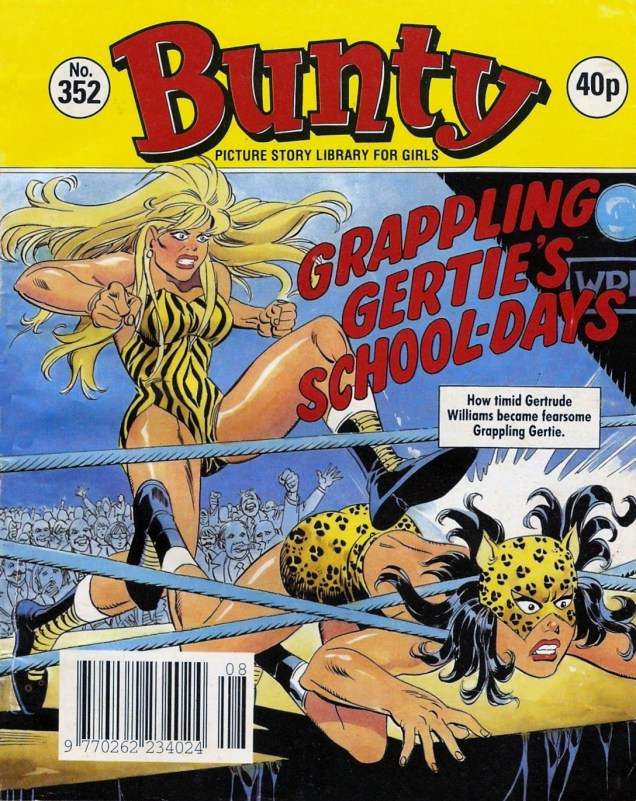
If you want to emphasize the catfight aspect, dress your girls in feline-motif outfits. Oh, I’m sorry – this is no quotidian quarrel, it’s professional wrestling!

Bunty352-WomenWrestlingComic
Bunty no. 352 (1992) – unfortunately, I don’t know who did the cover. British Picture Story Library was a 62 page a comic digest, published weekly. If you’d like to know how Leopard Lily overcame Tiger Tina, visit Assorted Thoughts from an Unsorted Mind.

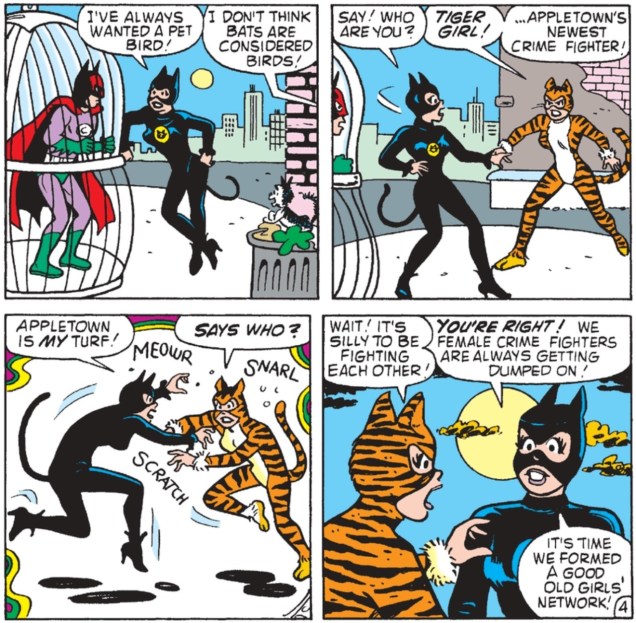
I think we need one even more literal interpretation of “cat fight”:

BettyandVeronica-TigerGirl-DandeCarlo
A snippet from “Meow Row”, published in Betty and Veronica no. 59 (January 1993). Script by George Gladir, pencils by Dan DeCarlo, inks by Alison Ford. Now guess who is who. (It’s obvious: Tiger Girl is Betty, and Veronica gets Meow Girl’s sexier costume.)

This is a fairly inexhaustible topic, but one must quit sometime. Cold shower, anyone?

~ ds

Update from January 2023 – now we also have Let’s All Go Down to the Catfights — Again!

Tentacle Tuesday: Warren and Its Many Tentacles, Part II

Greetings, tentacle lovers! I’m here with a new batch of Warren-published tentacles – this time, some he-men macho types get tangled up in them, though damsels predominate as usual. Don’t forget to visit part I: Tentacle Tuesday: Warren and Its Many Tentacles.

One thing that can easily be generalized from tentacular covers is that women frequently have a lot more fun on them than their male counterparts. To wit:

Vampirella39
Vampirella no. 39 (January 1975). Cover by Ken Kelly. The gal may not be Vampirella, but damn, she’s enjoying herself. I admit that having tentacle-shaped fingers would be… practical.
TentacleTuesdayIcon

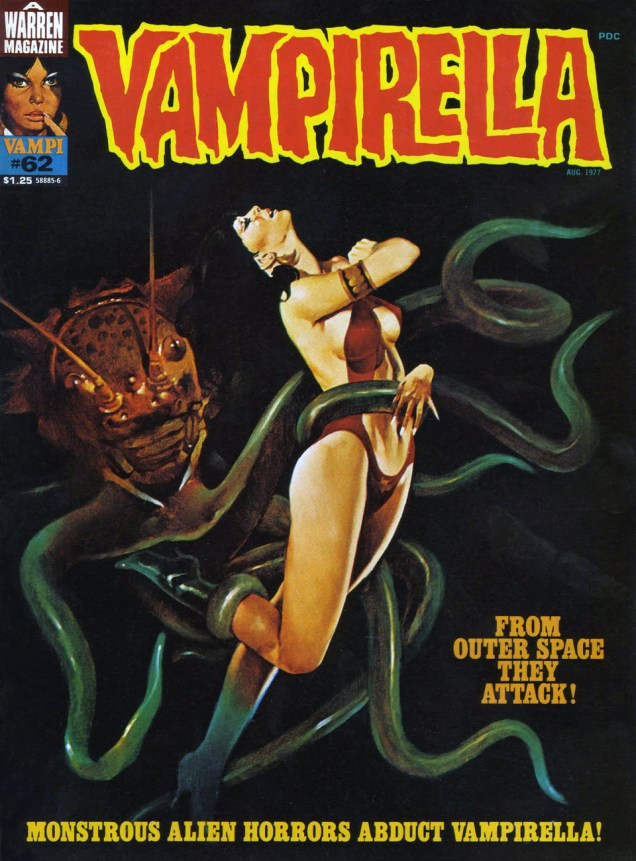
As for poor Vampi, she seems to encounter tentacles wherever she goes.

Vampirella62
Vampirella no. 62 (August 1977), cover by Spanish artistEnrich, whose real name was Enrique Torres-Prat.

The cover story, Starpatch Quark & Mother Blitz (scripted by Bill DuBay and illustrated by Jose Gonzalez), contains some spectacular, spiky, nasty tentacles.

Vampirella62-TentacleDetail
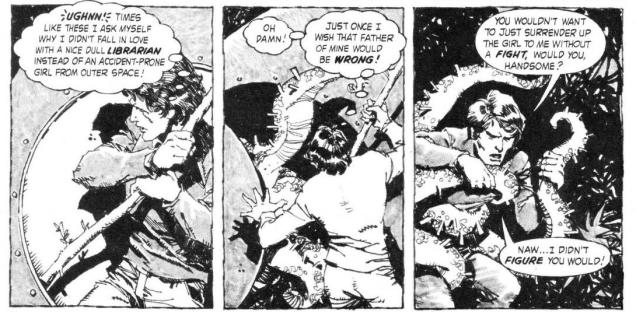
I tried saying « prasptam… hoodjum… billigam… POOT! », but no tentacled creature materialized. How very disappointing. I’d also like to know what kind of slap makes a « SPAKKT! » noise.
Vampirella62-TentacleDetail-2
The non-librarian girl in question is Vampi. Her eyeballs get ripped out by some vengeful queen and get accidentally conjured onto the desk of some random girl with an abusive husband, during which time blind, suffering Vampi is kidnapped by aliens while a handsome youth uses his father’s psychic connection with Vampi’s eyes to watch through them as they are retrieved by a tentacled monster, and… oh, never mind. Go read the story yourself.

TentacleTuesdayIcon

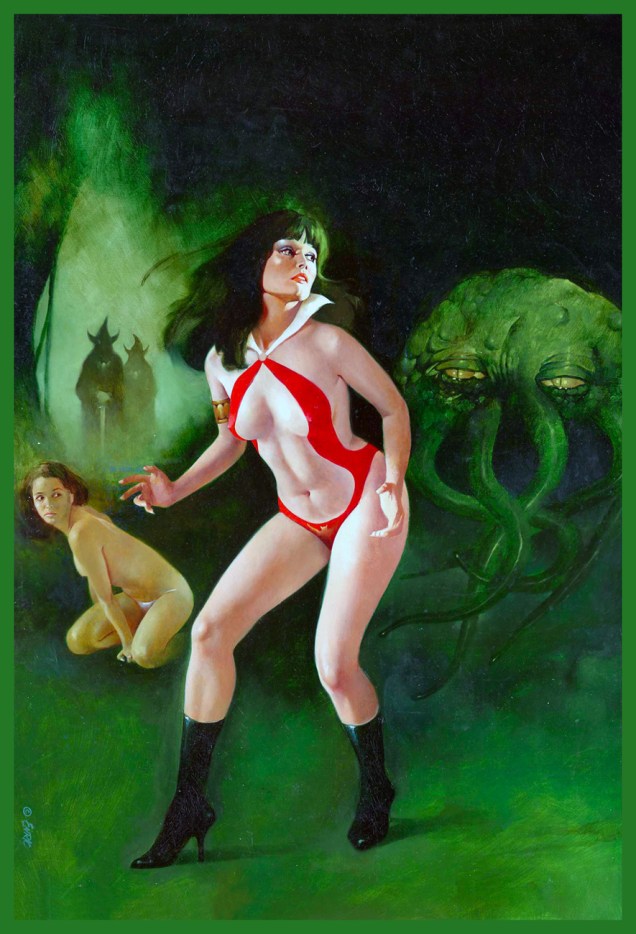
Vampirella105-originalart
The original cover art of Vampirella no. 105 (May 1982), painted by Enrich. It was printed much darker, so one can barely see tentacles. Fuck that, I say! Let us admire the green creature in its full glory! (And its unfortunate slight family resemblance to Jabba the Hutt…) His gaze seems to be appraising Vampirella – “hm, I wonder if she would be as tasty a snack as she looks?”
Vampi105A
The printed version of said issue.

The cover story sounds like fun… let’s take a peek.

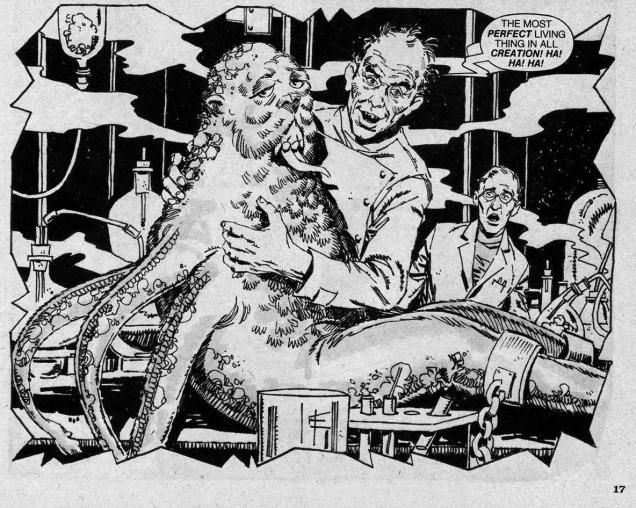
Vampirella105-perfecttentacles
I’m sorry, but that is not what “Blobs and Behemoths” made me think of. I was expecting something in the class of Cthulhu, not an overweight human walrus with tentacles! Panel from “Horrors of Heartache City”, scripted by Bill DuBay and illustrated by Jose Gonzales (apparently this team specializes in tentacles).
« You’re worried that little Orphee is thinking of making a meal of that luscious girl…? He’s turned down everything from the choicest prime rib to the slimiest of insects, which leads me to believe that he filters nourishment from the very air! »

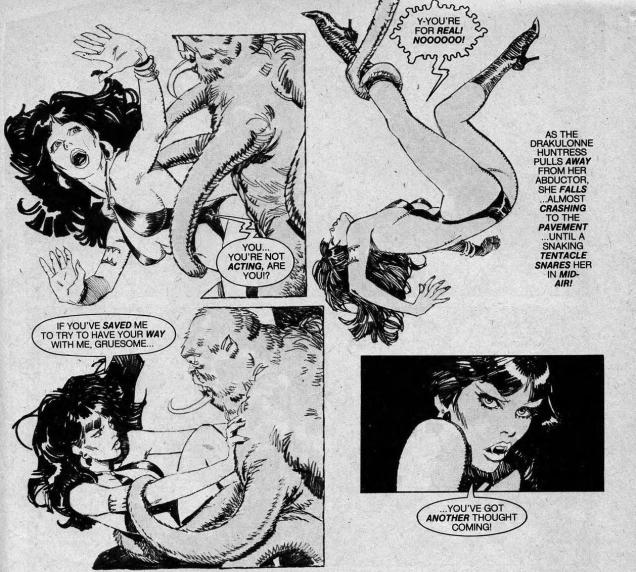
Vampirella105-wartything-tentacles

So much for scientific theories.

TentacleTuesdayIcon

I think I promised you some men fighting tentacles. Sigh, so be it.

Eerie66
Eerie no. 66 (June 1975), cover by Manuel Sanjulian.
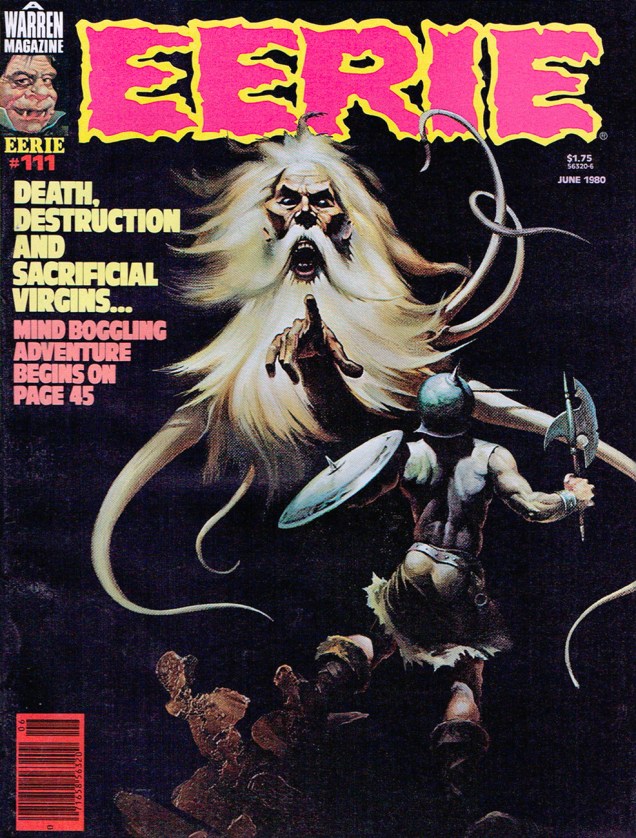
Eerie111A
Eerie no. 111 (June 1980), cover by Ken Kelly. What’s scarier than an old wizard with a majestic beard whipping in the wind? An old wizard whose head is attached to tentacles, obviously.
1994-number19
1994 no. 19 (June 1981), cover by Jordi Penalva. I am totally fascinated by the girl’s expression. Whatever the tentacles behind her are doing, they’re doing it right. As for the guy, he looks like a sanctimonious asshole, from his scowl to his hairy legs.

I had to know what the hell is “The Holy Warrior” about. “Godless commie heathens”? Oh, very subtle, 1994. Given the mention of kicking the living crud out of ’em, it’s tempting to assume that this is satire… unless the author has an amputated sense of humour. I couldn’t find any scans of the story online, but someone on a Very Creepy Blog kindly summarized it as:

“Third is “The Holy Warrior!” by Delando Niño (art) and John Ellis Sech & Bill DuBay (story). This story takes place in a future where there are Jesus clones. Our hero, the Holy Warrior, is seeking to rescue one, which is just a child, from communist enemies. He is able to do so, but the two of them are so hungry that he ends up killing the clone and eating him! Quite a bizarre and heretical ending for this story.”

And I thought that Vampi story was written by someone on drugs. Same author, mind you (Bill DuBay) – there’s definitely a pattern… of nonsense, balderdash and malarkey.

By the way, you can read a bunch of Warren publications online – for free! – here.

~ ds

Harvey Kurtzman, selon Marcel Gotlib

« Tous les merdeux ricanaient en se disant qu’une revue sans merdeux à la tête, ça ne marcherait jamais.* »

In issue 63 (April, 1974) of the recently rechristened « Charlie Mensuel » (to avoid confusion with its sister publication, Charlie Hebdo, yes, *that* Charlie Hebdo), insightful bandes dessinées critic and French national treasure Yves Frémion-Danet (b. 1947, Lyon), writing under his « Théophraste Épistolier » nom de plume, provided a classic essay accompanying a reprint of Harvey Kurtzman and Will Elder‘s « Goodman Gets a Gun », originally published in Help no. 16 (Nov. 1962, Warren). In his piece, Frémion posits that, with his 28 issues of Mad / Mad Magazine, Kurtzman’s brand of satire completely changed the rules of the game, and that despite an utter lack of commercial success and name recognition for himself and his work (reportedly, a French edition of Mad was published in 1965-66, for six or seven issues) on the continent, his influence on a significant swathe of the subsequent generation of French and Belgian cartoonists easily validates his vital importance.

PetitsMiquetsA
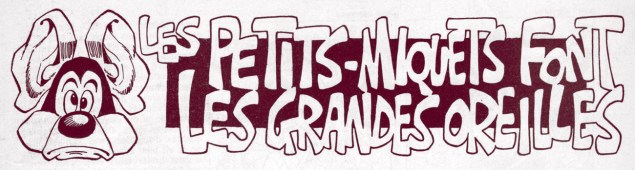
Théophraste Épistolier’s column’s logo, which translates as “Little Mickeys give you big ears”. A “Petit Miquet” is, in french, a generic name for cartoon characters from a dismissive and/or ignorant perspective. Someone to whom Mickey Mouse is the sole precursor of all Little Mickeys. Artwork by Gotlib.

Frémion spares no praise for Kurtzman’s acolytes Elder, Jack Davis, Basil Wolverton, Wally Wood and John Severin, and publisher Bill Gaines, but has nothing but contempt for editorial successor Al Feldstein (“vile copier”, “lumbering”, “regular”…). Frémion charts Kurtzman’s subsequent projects and associations, and his rôle in the rise of Underground Comix. Recommended reading… if you can read french.

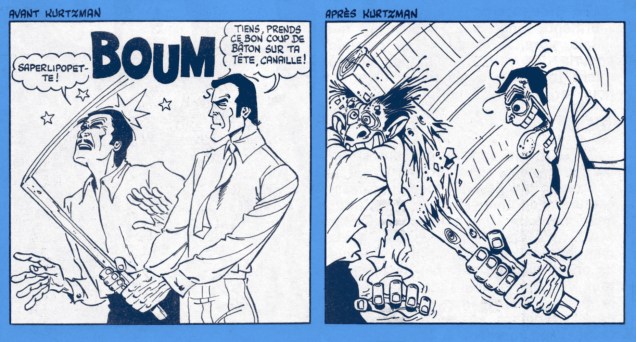
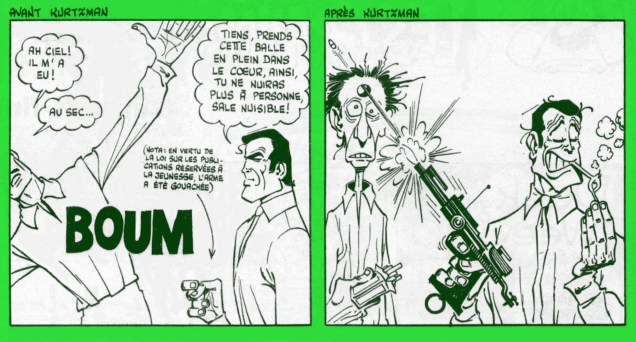
Ah, but that brings us to an apt illustration of that creaky adage, « A picture is worth a thousand words »: as it happens, the legendary Marcel Gotlib (b. 1934, d. 2016), speaking of influential, provided a quartet of original illustrations to put across what comics were like Before and After Kurtzman, commenting at once on American comics and on Franco-Belgian bande dessinée, with a snappy Gallic twist. Like Goofus and Gallant, but with far more tongue.

It took me a long time to come to terms with Gotlib. In my formative years, in Québec, his was such an outsize, smothering influence that one got quite sick of him. To be fair, not of him so much as his multitudinous, third-and-fourth-rate would-be clones. His style was easy to imitate, yet difficult to master. You see how that could easily careen off the rails?

GotlibKurtzman01AGotlibKurtzman02A

GotlibKurtzman03A
In the left panel, the pistol is missing, having been whited-out « in accordance with the law on publications intended for young people », a quite repressive set of regulations adopted in 1949.
GotlibKurtzman04A
More of the same: « Certain body parts have been whited-out. » Gotlib’s point is well made: when something relatively innocuous gets erased, the mind often fills the blanks with more perverse possibilities. Serves you right, censors.
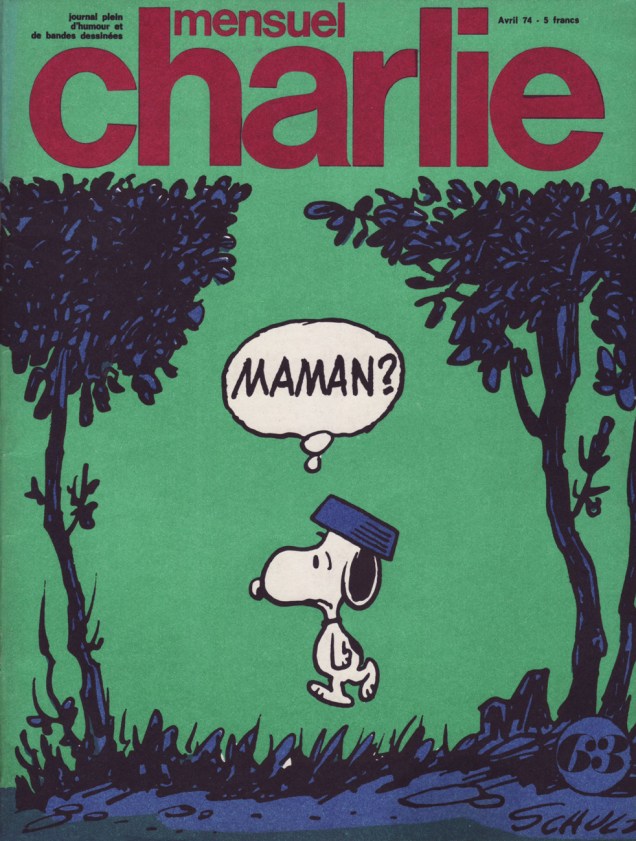
Charlie63A
The issue in question. Charlie / Charlie Hebdo was published from Feb. 1969 to Feb. 1986, lasting, in fits and starts, 198 issues. It then merged with Pilote… and disappeared. Cover, of course, by Charles Schulz.

-RG

All the shitheads giggled, telling themselves that a magazine without an shithead in charge never would stand a chance. » – Théophraste Épistolier