« We are all susceptible to the pull of viral ideas. Like mass hysteria. Or a tune that gets into your head that you keep humming all day until you spread it to someone else. Jokes. Urban legends. Crackpot religions. Marxism. No matter how smart we get, there is always this deep irrational part that makes us potential hosts for self-replicating information. » — Neil Stephenson
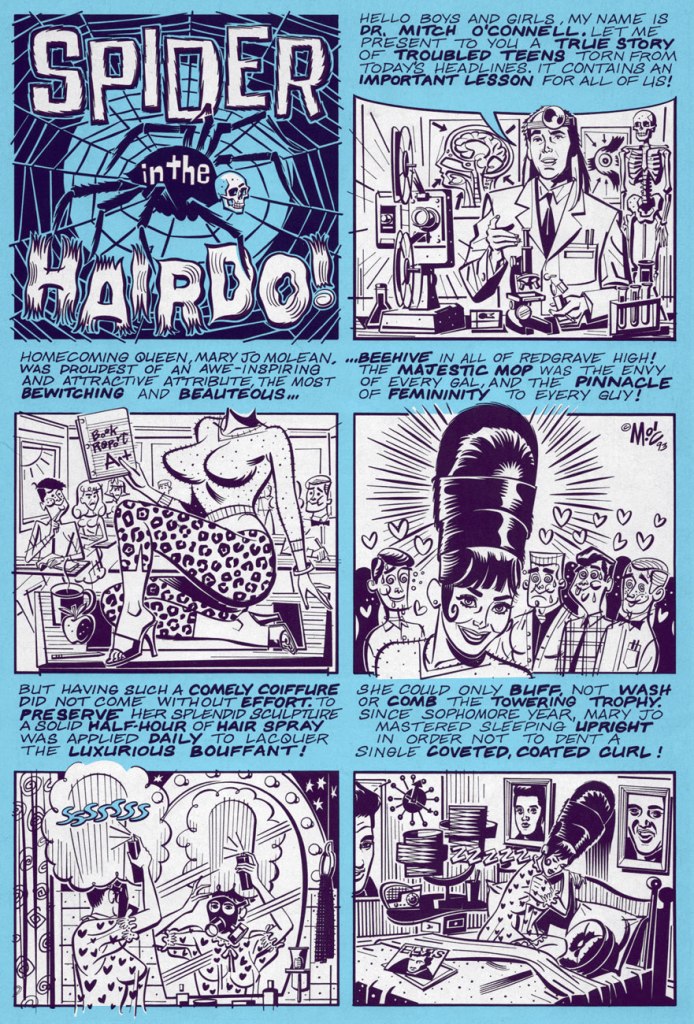

True story! It happened to a friend of a friend of a relative of an acquaintance of the hairdresser of the nephew of the uncle of the garage mechanic of the girdle maker of a cousin of a U.F.O. abductee ex-classmate of my brother’s. Or so he obliquely claimed under hypnotic regression.
Apparently, this tale gave rise (I know, I know) to a variant called The Cucumber in the Disco Pants.
And remember, always check with Snopes.com before propagating dubious claims.
Spider in the Hairdo! is a juicy excerpt from Dark Horse’s one-shot Urban Legends no. 1 (June, 1993). Adaptation by the self-proclaimed « World’s Best Artist », Mitch O’Connell. I can think of far less worthy candidates for the position.
Should you be craving more from Dr. Mitch, here’s where to go for your fix: www.mitchoconnell.com.
And if, like me, you can’t get enough of such urban folklore, check out any of Jan Harold Brunvand’s score of splendidly compelling books on the subject. When it comes to urban myths, Dr. Brunvand is the authority.
As a bonus, here’s Arthur Adams‘ slightly subsequent take on the same myth, published in DC/Paradox Press’ inaugural entry in its ‘Big Book of…’ series, The Big Book of Urban Legends (1994).
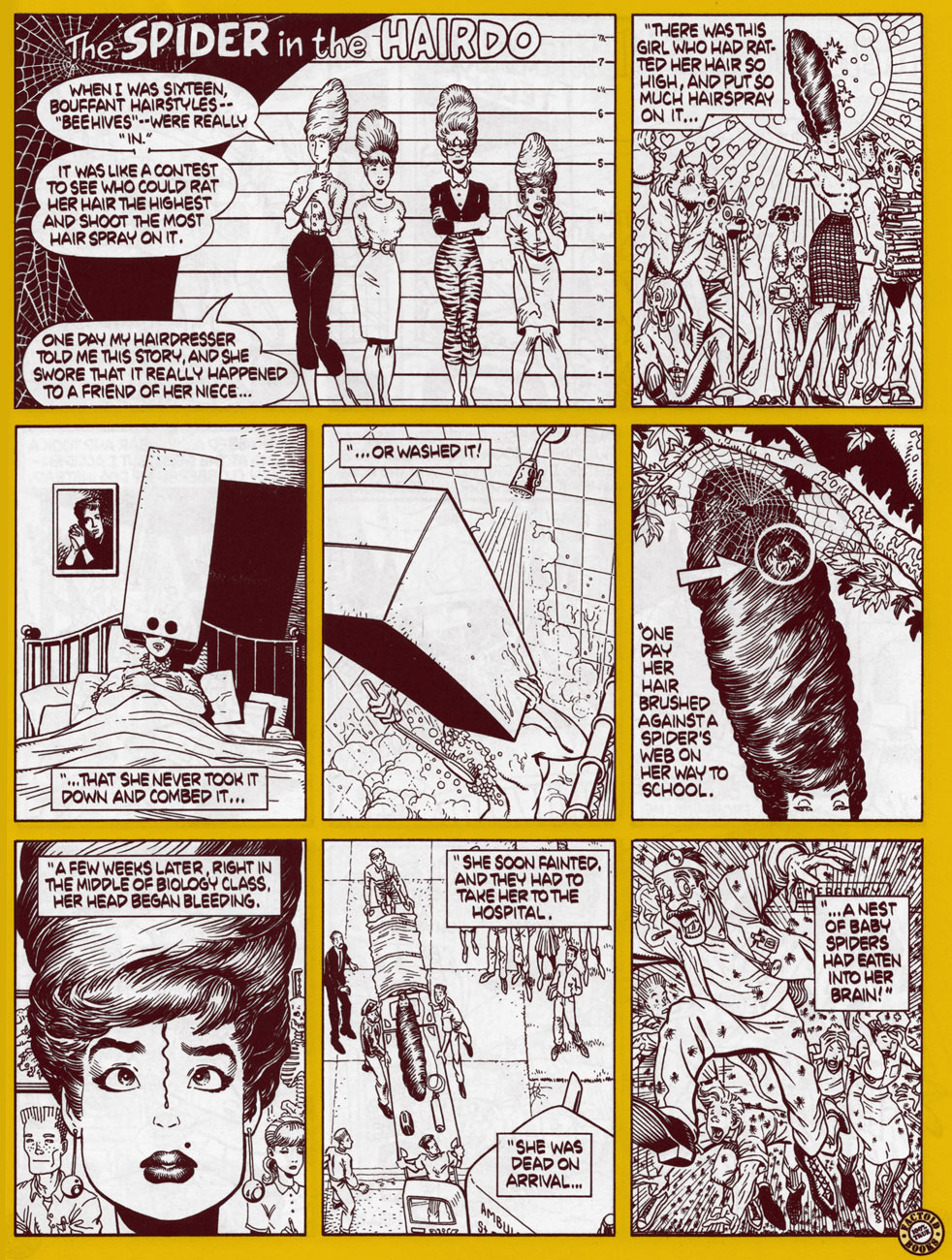
By their very nature, the Big books (seventeen in all) tended to be pretty hit or miss, not, for once, because of the writing, but chiefly due to the evident paucity, in the current comics industry, of artists versatile enough to credibly depict low-key, quotidian, humorous or historical situations. Is it counterintuitive, or fitting, that artists on the cartoonier end of the scale (Rick Geary, Roger Langridge, Gahan Wilson, Hilary Barta, Ty Templeton, Danny Hellman, Sergio Aragonés…) tended to fare best in producing this type of « documentary » work? I haven’t quite made up my mind. All I know is that the superhero specialists and photo tracers just brought embarrassment upon themselves *and* the unfortunate reader.
– RG





 Who's Out There?