C’est un fou qui repeint son plafond et un autre fou arrive et lui dit: « Accroche-toi au pinceau, j’enlève l’échelle!*»
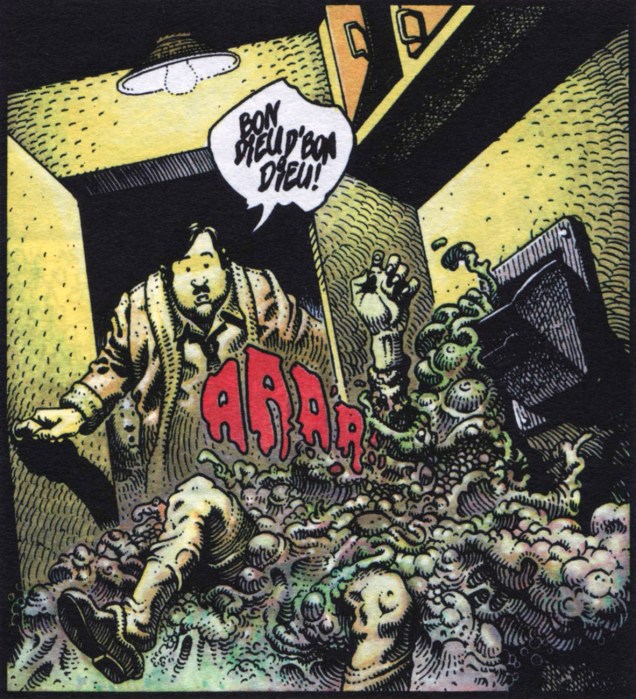
Marcel (and the hapless Yvonne) meet the Homo-Detritus. From Pilote no. 47-bis (April, 1978)
Poor Marcel Miquelon: a simple suburban nobody, he merely wants to get a good night’s sleep, but it’s never in the cards. When he and his Yvonne go to bed, each night at 10, some din from above invariably keeps him awake and frustrated. So what can he do but seize his faithful broom by the handle and bang on the ceiling to manifest his discontent? And dreadful things happen, in increasingly byzantine shades of dreadfulness.
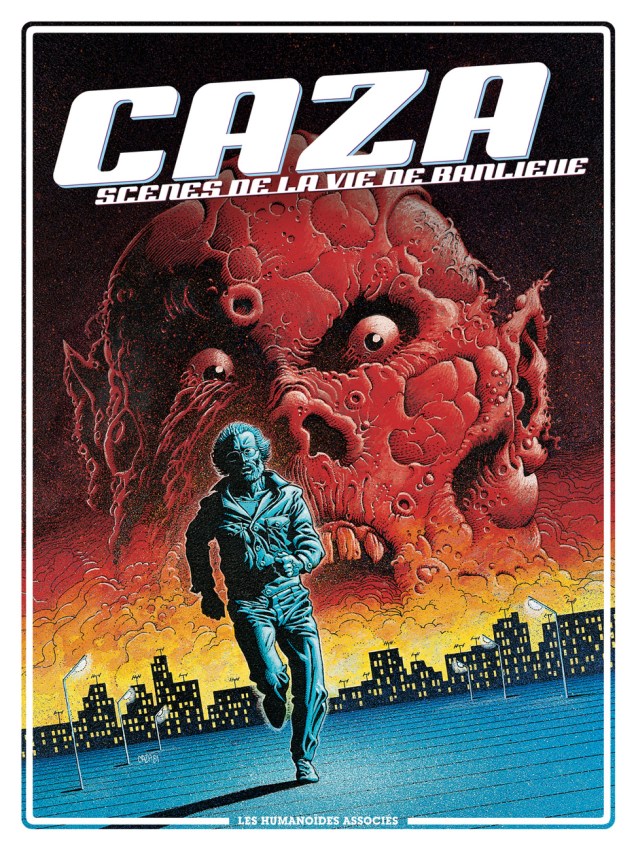
These loosely-connected vignettes appeared sporadically from 1975 to 1979, under the portmanteau heading of Scènes de la vie de banlieue in the French monthly Pilote (1974-1989). They were the brainchild of Philippe Cazaumayou, alias Caza (b. November 14, 1941, Paris), also a renowned science-fiction illustrator, which should certainly surprise no-one.
This episode is titled Toujours du bruit au plafond (« Still some noise on the ceiling »); it originally saw print in Pilote Mensuel no. 34 (March, 1977). It’s the rare (possibly the only) one that ends peacefully for Marcel, perhaps because he didn’t bother with the broom. Better St. Peter than… well, everything else.
*One of the hoariest French jokes, everyone’s heard it, and its appeal has whirled countless times around the bend, deep into irony and meta-subtext. Thankfully, though, it’s actually translatable, at least verbally: A lunatic is painting the ceiling. Another madman comes along and says: « Hold on to the brush, I’m borrowing the ladder! »
A ‘Scènes de la vie de banlieue’ collection (Dargaud, 1982). I agree: for all he’s gone through, Marcel Miquelon does deserve his own statue.The collected works (Les Humanoïdes associés, 2017)
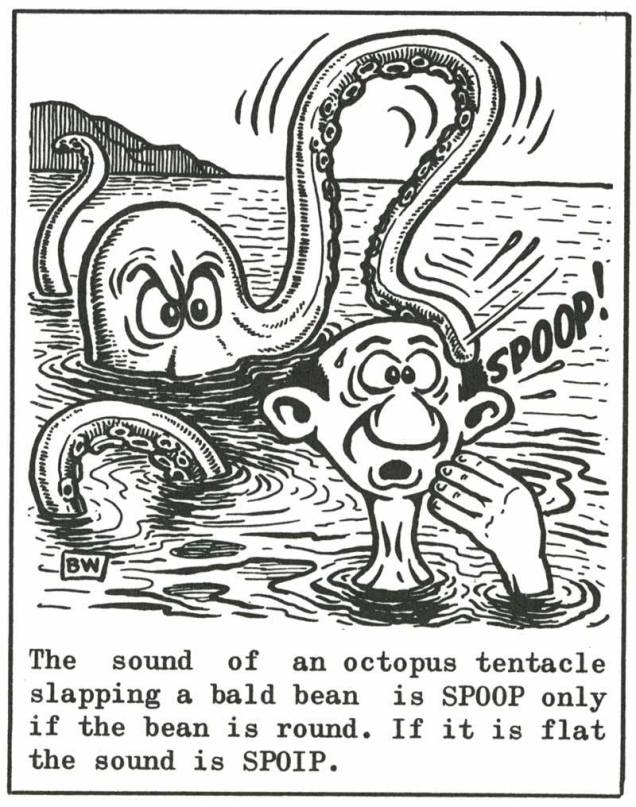
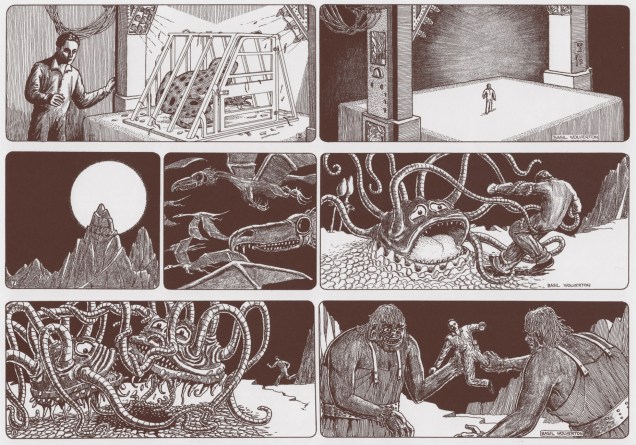
SPOOP! And a happy Tentacle Tuesday to you, too. Today’s feature is devoted to Basil Wolverton. A lot could be said about his sense of semi-slapstick, semi-surreal comedy and his unhinged-yet-meticulous drawing style, his delightful work in the realm of humour comics or his genuinely scary contribution to horror-in-pictures… but as I have a one-track mind, I’ll focus on his love of tentacles. No matter what sort of thing he was drawing, tentacles somehow managed to slip into it… and that’s understandable, for tentacles are both hilarious and fearsome. Without further ado, here’s your master of ceremonies and cephalopods… Basil Wolverton!
Here’s some more sounds you might like to know about, to be used indiscriminately to spice up humdrum conversations around the water cooler:
Hungry cannibal filing eyetooth: FWATCH! Man with calloused feet crossing rough linoleum: SKIRP! SKIRP! Thumb gouging eye: SPOP! Hot lava speweing on WCTU convention: FOOSK! Hot lava spewing on Elks’ convention: SSSCRISH! Person skidding on hot stove in bare feet: SCREESH! Beaver biting into wooden leg: CRASP! Car crashing into large vat of frogs’ eggs: SKWORP! False teeth falling through skylight: TWUNK! Sock in the face with Sears Roebuck catalog: PWOSH! Sock in the face with Montgomery Ward catalog: PWASH!
This mirth-inducing stuff is from an article that Basil Wolverton wrote for the Daily Oregon in 1948 called “Acoustics in Comics”. Here’s another excerpt of that article (which is definitely worth reading in its entirety, and is fortunately easily found online… here, for instance):
« ‘I want realism!’ he (my publisher) had bellowed. ‘No more of this wild imaginative stuff that’s causing some people to want to ban our comic books! From now on, get that realism in there, and your strips will be horribly funny! Then the readers will go into hysterics and laugh like crazy, and our books will be acclaimed the most laugh provoking on the stands!’ That meant that an imaginative word like CRANCH was taboo. It was up to me to get the real sound word. »
And, hoppin’ horse hocks, he did.
Enough of the rib-splitting stuff: this is a serious blog that discusses serious horror. *ahem*
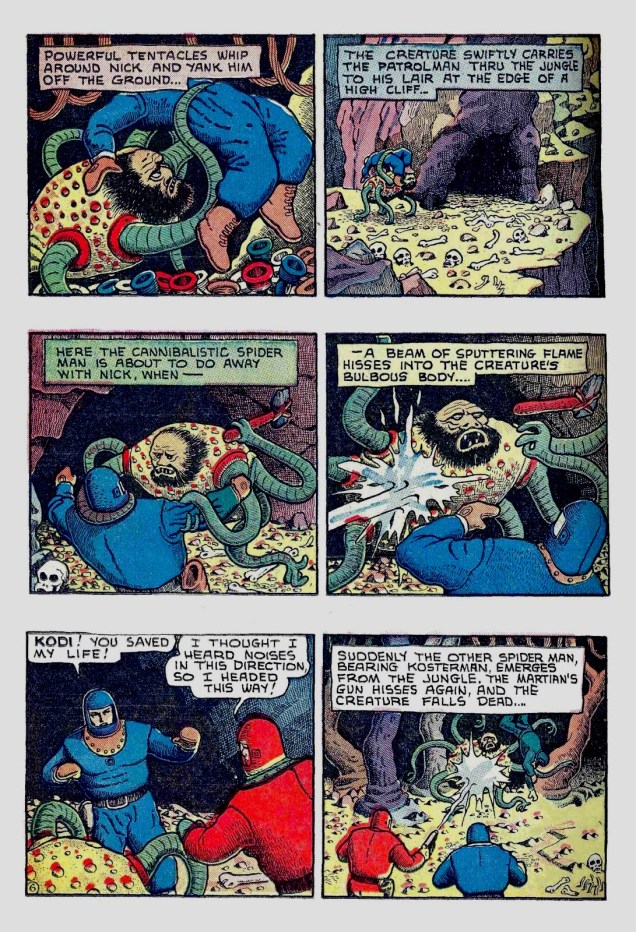
Page from Ethan Downing (1935), an early endeavour by Wolverton – unpublished.Amazing Mystery Funnies vol. 2 no. 12, December 1939. You may with to point out that this bandit is a cannibalistic spider, *not* a tentacled creature, but look at how he’s using his appendages, look me straight in the eye, and tell me that those aren’t tentacles. Besides, spiders have 8 legs, not 6, and this guy is definitely a 6-leg wonder… and they get called « tentacles », right from panel one.
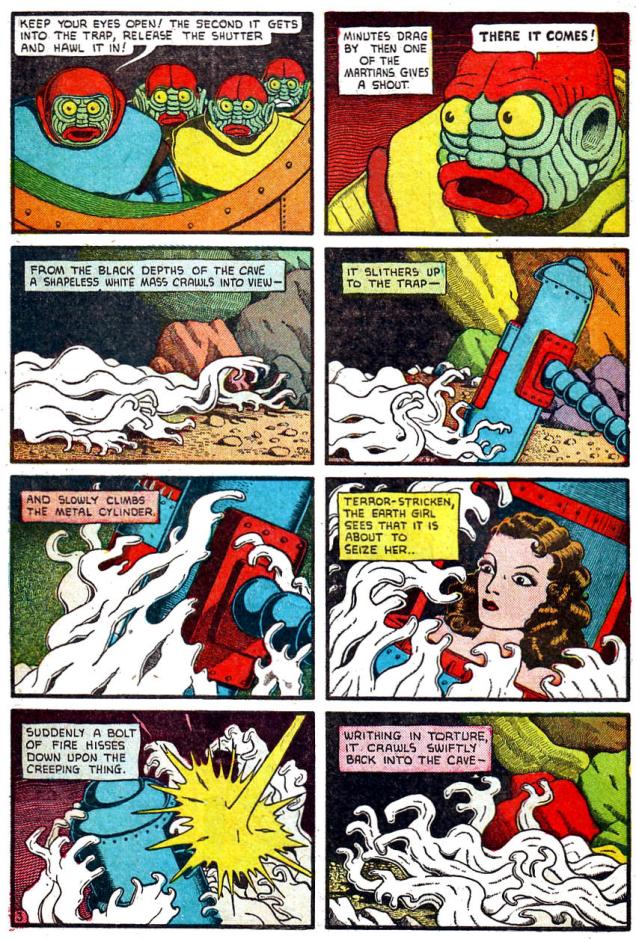
No inventory of Wolverton tentacles would be complete without the classic « Creeping Death from Neptune », first published in Target Comics vol. 1 no. 5 (June 1940), and reprinted many a time since, nearly as often the amazing Brain Bats of Venus (also quite heavy in quasi-tentacles. If aren’t familiar with it already, do yourself a favour and read it in full here.)
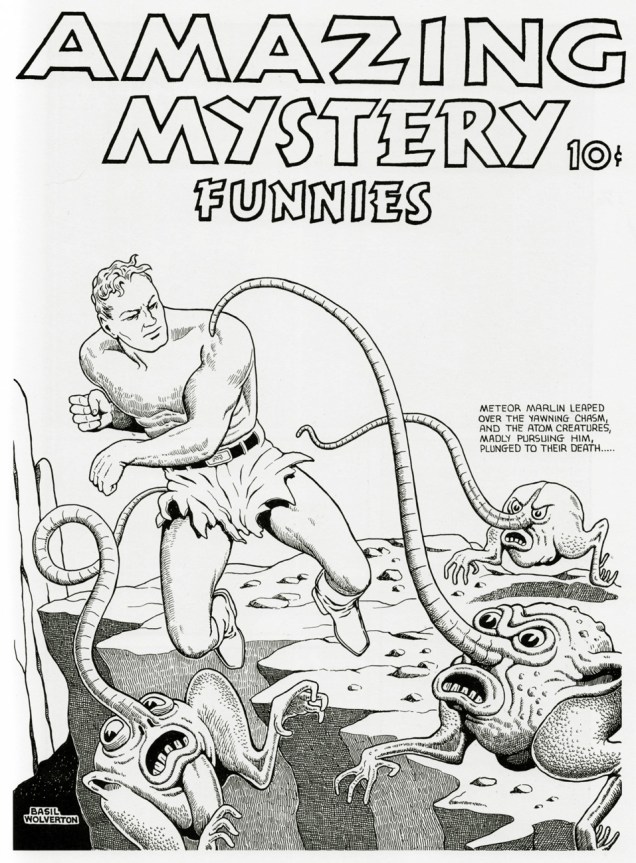
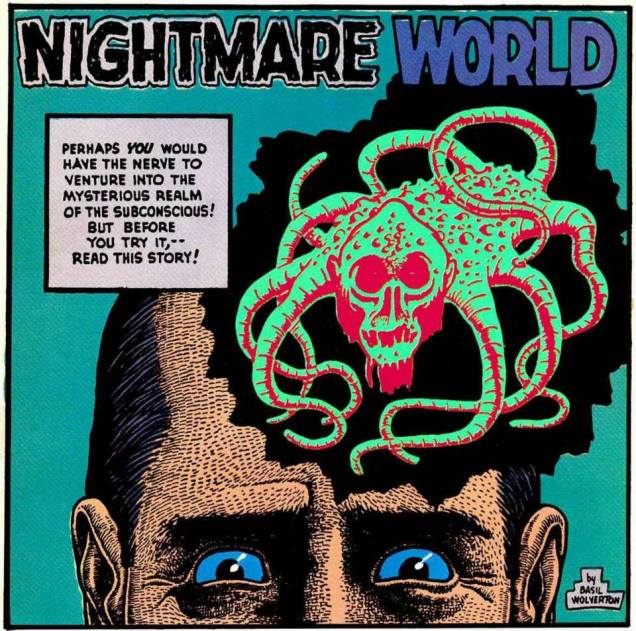
A page from Creeping Death from Neptune, first published in Target Comics vol. 1 no. 5 (June 1940). The earth-girl is interestingly deadpan about being consumed alive by some sort of slithering weirdness.This story also has « tentacle-like » metal arms. I’m telling you, pretty much everything’s a tentacle where Wolverton is concerned.Meteor Marlin, cover illustration for episode one, April 4th, 1940… never published. In this one, noses are tentacles!A panel from Nightmare World by Basil Wolverton that originally appeared in Weird Tales of the Future no. 3, 1952. This is a reprint from Mr. Monster’s Super Duper Special no. 8, 1987, re-coloured by Jeff Bonivert.
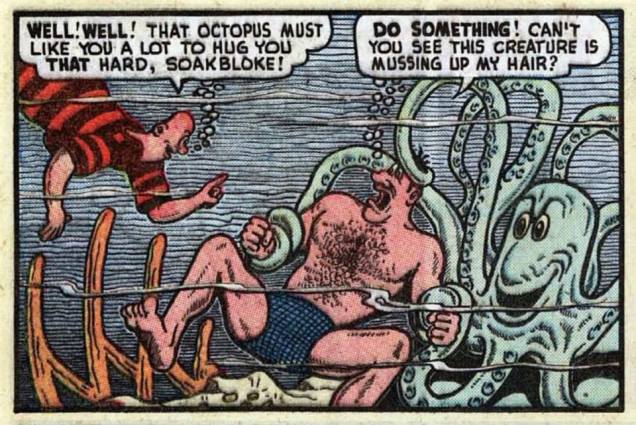
Phew! I’ll end this on a humorous note: octopuses evidently make fabulous hairdressers.
This is a panel from a Powerhouse Pepper story that doesn’t really have a title, being referred to as “Haw! Haw! Grab a good gander…” instead. Originally published in Tessie the Typist Comics no. 9, April 1947.
Sadly, Wolverton’s weirdly frightening villains did not always find favour with the powers-that-be. Back in 1940, Jim Fitzsimmons, assistant editor at Centaur, publisher of Amazing Mystery Funnies, wrote:
« Though the fantastic and weird are the essential selling point of this feature, we would advise that you keep away from the use of revolting characters such as Brain-Men. Some of these characters you have developed have actually sent shudders down my otherwise unconcerned vertebrae. »
Reading The Life and Comics of Basil Wolverton, Volume 1: 1909-1941 written by Greg Sadowski (2014, Fantagraphics), one gets the impression this brilliant master of spaghetti-and-meatballs* comics spent his artistic life trying to fit his imagination into the narrow guidelines imposed by editors, heads-of-companies and other pundits. He died in 1978, aged 69, but was active in the comics field until 1973 («Plop!») I’ll leave it for people more erudite than I to debate his success (or lack thereof) in the comics field…. I’m just happy to witness a resurgence of interest in this great artist, and enjoying the treasure-trove of material that’s available.

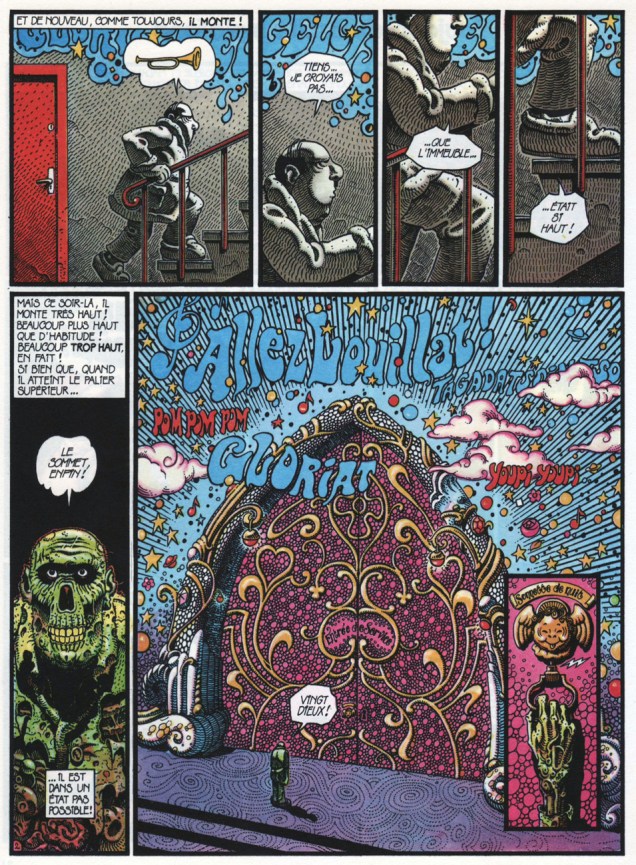

 This episode is titled Toujours du bruit au plafond (« Still some noise on the ceiling »); it originally saw print in Pilote Mensuel no. 34 (March, 1977). It’s the rare (possibly the only) one that ends peacefully for Marcel, perhaps because he didn’t bother with the broom. Better St. Peter than… well, everything else.



 Who's Out There?