Although it’s tempting (but lazy) to assume so, men didn’t *altogether* corner the risqué cartoon niche.
It would be quite an injustice to count out the magnificent Barbara Shermund (1899-1978), prolific contributor to The New Yorker (including eight covers) and Esquire magazines, and so much more.
Far too little is known about this pioneering artist, but here’s an insightful piece aiming to rectify the situation, at least a little, written by Caitlin McGurk:
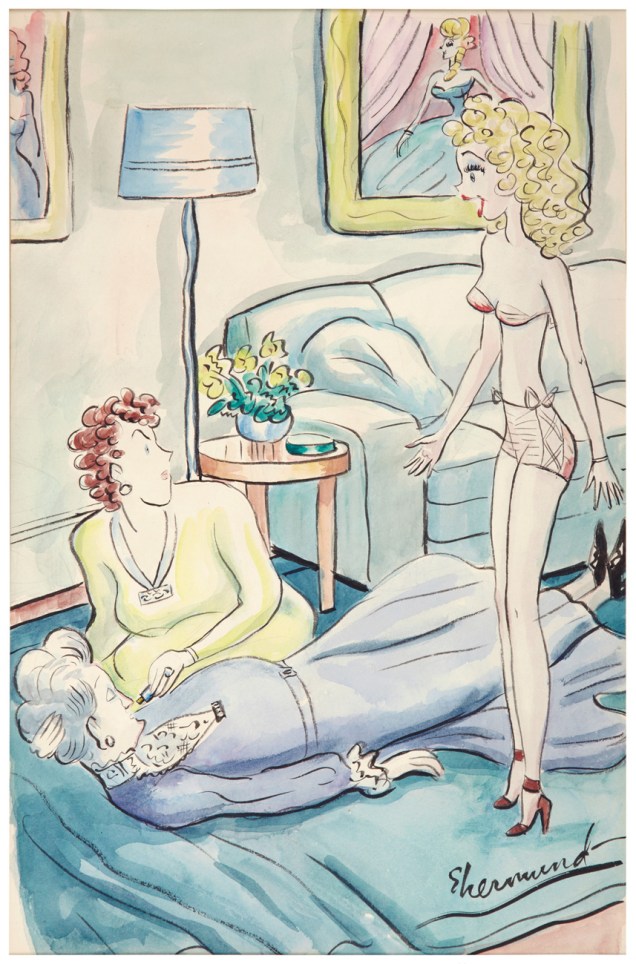
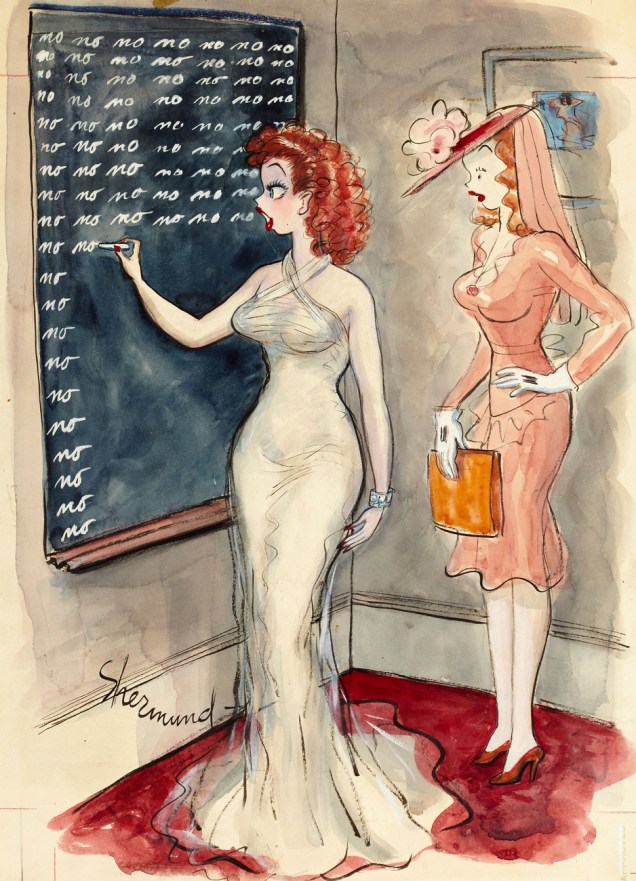
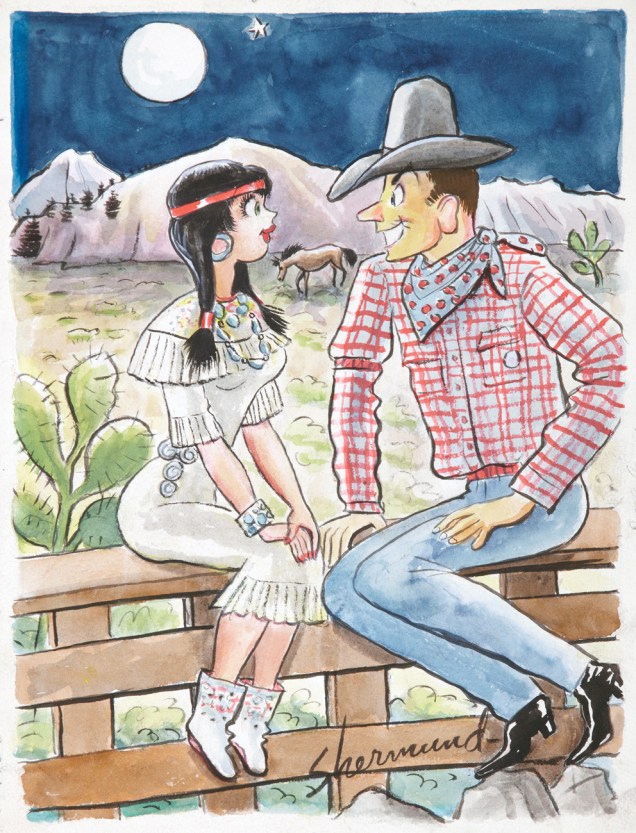
Nothing new under the sun! Frankly, that situation hasn’t gained a wrinkle since this cartoon’s appearance in The New Yorker‘s July 21, 1928 edition.One of Ms. Shermund’s aforementioned New Yorker covers, from the June 29, 1935 edition.« All I said was, ‘Granny, how do you like my new bathing suit?’ » Undated piece in ink and watercolour.« She’s lost! » Esquire, 1944. Ink and watercolour.« Mr. Dillon, I’d like to ask your daughter’s hand in marriage. » (1953, ink and watercolour.)« Who was that fellow I saw you with at Ciro’s last nite? » (Cheering Section, 1955. Ink and watercolour.)«Mother always makes me write it five hundred times before I go out with Mr. Parker » Esquire, publication date unknown, ink and watercolour.« Let’s play cowboy and indian! » (Cheering Section, 1959. Ink and watercolour.)
I can’t help but be reminded, by that final piece, of Jack Cole‘s rather more trenchant take on a similar power imbalance, published a year earlier.
« Well, there’s history repeating itself. » (Jack Cole, from Playboy, January, 1958.)
A postscript: in March, 2022, Ms. Shermund was the subject of an article in the New York Times’ ‘Overlooked No More’ series, comprising belated obituaries for notable folks whose departure flew under the radar, so to speak. In this case, we learned that:
« Shermund lived out her last years drawing at her home in Sea Bright, N.J., and swimming at a beach nearby. She died on Sept. 9, 1978, at a nursing home in Middletown, N.J.
In 2011, a niece, Amanda Gormley, decided to research her family’s history and was surprised to find that Shermund’s ashes had been left unclaimed in a New Jersey funeral home since 1978.
In May 2019, Gormley raised money through a GoFundMe campaign and, with the contributions of many artists and cartoonists, saw to it that Shermund’s ashes were buried alongside her mother’s grave in San Francisco. »
Tentacles gleefully probing various orifices, that’s what my mind is on this Tentacle Tuesday. We well know that octopuses not only tend to strangle their victims, but also get close up and personal with their anatomy.
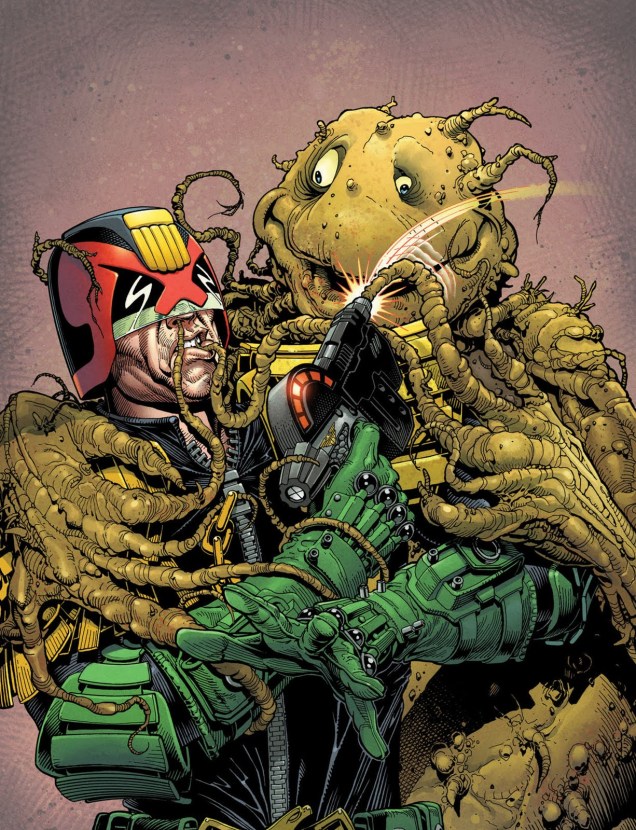
Just look at this adorable (did I say “adorable”? Maybe I meant “horrifyingly ugly”? I always get these two mixed up) cutie wrap Judge Dredd in his affectionate embrace.
I’ll let Pete Wells, owner of the « 200 A.D. Covers Uncovered » blog, explain the Couch Potatoes: « Behold, the god-like Cliff Robinson’s fantastic cover for Prog 1726, which features the welcome return of the Couch Potatoes. Another crazy Mega-City fad, the couch potatoes were lovable humanoid/vegetable lifeforms that sat in front of the Tri-D, repeating common phrases to its owner – think of a Little Britain fan and you’ll get the idea. The creatures were outlawed by the Justice Department when it transpired that they were super-evolving and feeding on their owners! »
Head over to Wells’ blog to watch this cover evolve from a preliminary sketch into a full-blown vision of tentacular glory.
A page from « Children of the Future », drawn by Paolo Eleuteri Serpieri, published in a special edition of Heavy Metal called « Son of Heavy Metal », May 1984. Looks like the children of the future shall be some unholy octopus-human breed. Amusingly, the lecherous multi-tentacled sleazeball is still named Octo despite having many, many more appendages than just 8.
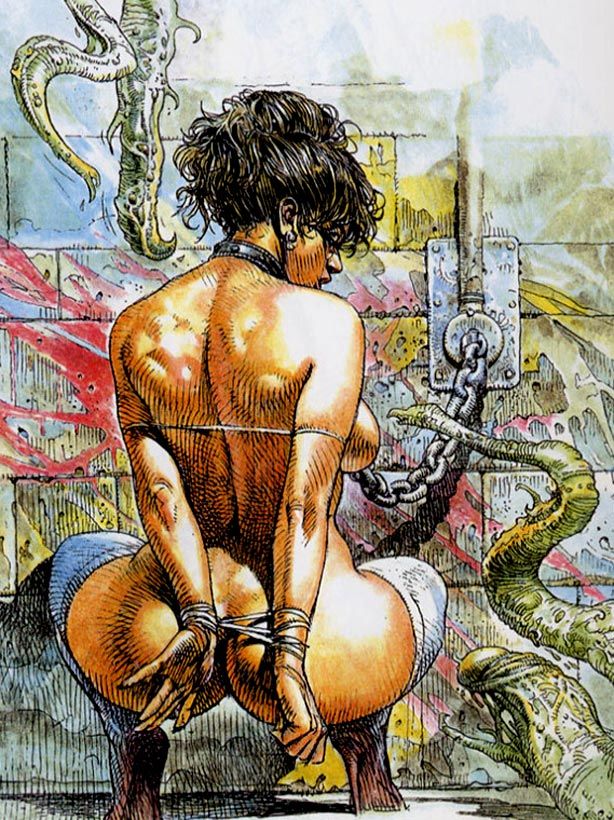
Serpieri is an Italian comic book writer and artist whose main interest is erotica. (His style is not really my thing, but hey, tentacles unite all.) He’s quite well-known for Druuna, a sci-fi/fantasy comic, which is more like an excuse to draw as many accouplements as possible.
Bonus image: Druuna and tentacles! Art by Paolo Eleuteri Serpieri. At least this ass-and-boob shot makes *some* anatomical sense – Druuna’s spine is still in place.
Lambiek Encyclopedia laconically notes that “Serpieri’s highly detailed portrayals of well-endowed heroines have earned him the undisputed title of “Master of the Ass”. Now Serpieri clearly has a huge interest in women’s asses, and he draws them lovingly, but so do a lot of other artists. Undisputed by whom? History is silent on this topic.
You can see more of his stuff here, which is definitely NSFW, unless you work in a brothel.
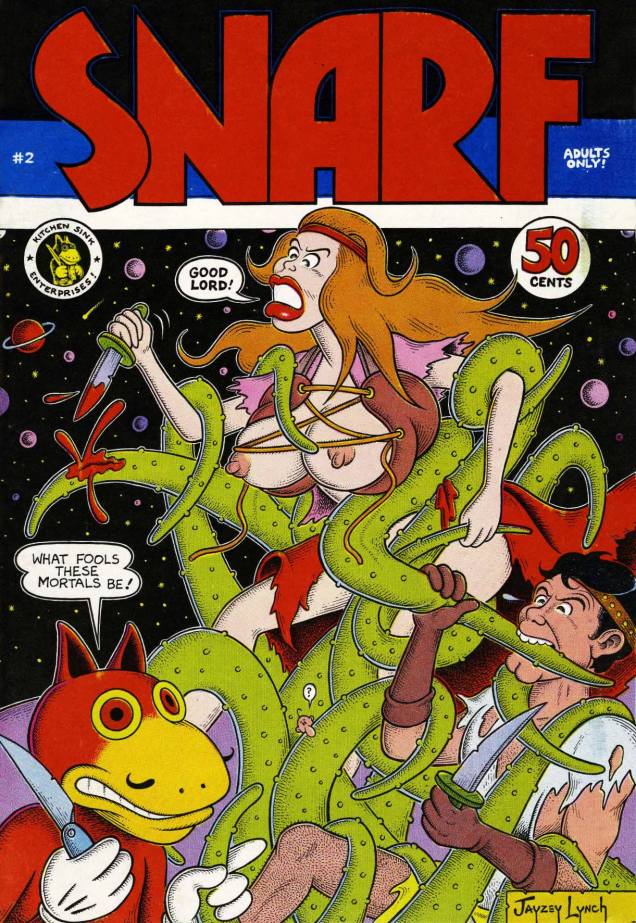
Sometimes you’re just minding your own business, and suddenly something green and scabrous sticks itself into your mouth. Jayzey Lynch is of course Jay Lynch, the artist of this cover (Snarf no. 2, August 1972). “Good lord!”, indeed.
M. Steven Fox of Comix Joint wrote a riveting (as usual) review of Snarf no. 2. Read it here.
« What kind of people are these? Where do they come from, what do they do? What’s in a name? »
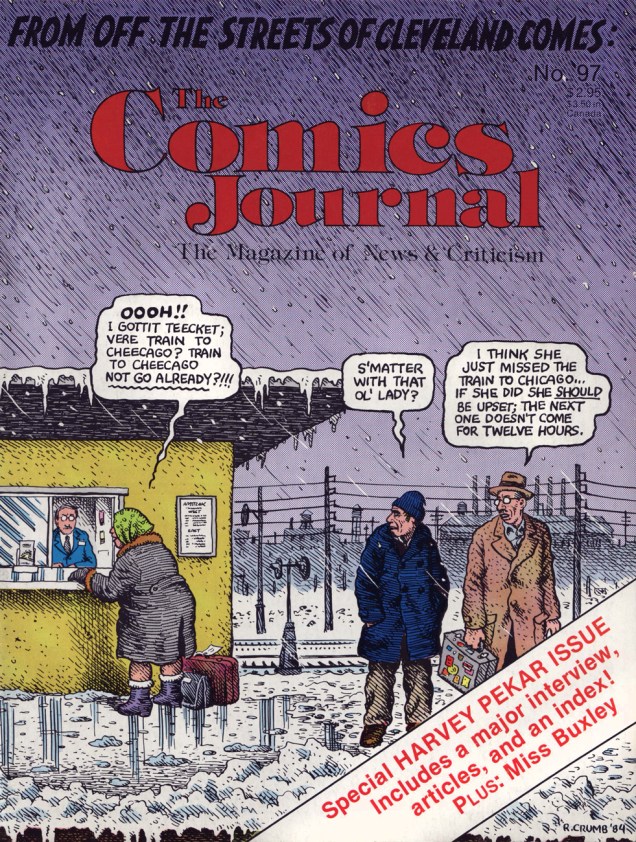
Coming out of nowhere (well, “From off the streets of Cleveland“, as it happens) in 1976, Harvey Pekar’s American Splendor was one of comics’ truest and most bracing alternatives. It wasn’t part of the Underground Comix movement, despite the participation of Pekar’s old friend and fellow record collector Robert Crumb, and it wasn’t like anything pushed out by the mainstream comics industry.
This is The Comics Journal no. 97 (April, 1985). Cover by Crumb and Pekar.
Crumb’s introduction to Doubleday/Dolphin’s 1986 anthology of early AS strips describes Pekar’s appeal better than anyone else is likely to:
« Yeah, Harvey is an ego-maniac; a classic case… a driven, compulsive, mad Jew… it’s something to see. But how else could he have gotten all those comics published, with almost no money; in total isolation from any comic-publishing ‘scene’ such as exists here in California, or in New York; constantly brow-beating artists to illustrate his stories; handling the distribution himself… only an ego-maniac would persist in the face of such odds. »
« The subject matter of these stories is so staggeringly mundane, it verges on the exotic! It is very disorienting at first, but after awhile you get with it. Myself, I love it… Pekar has proven once and for all that even the most seemingly dreary and monotonous of lives is filled with poignancy and heroic struggle. All it takes is someone with an eye to see, an ear to hear, and a demented, desperate Jewish mind to get it down on paper… there is drama in the most ordinary and routine of days, but it’s a subtle thing that gets lost in the shuffle… our personal struggles seem dull and drab compared with the thrilling, suspense-filled, action-packed lives of the characters who are pushed on us all the time in movies, tv shows, adventure novels and… those *other* comicbooks.
What Pekar does is certainly new to the comicbook medium. There’s never been anything even approaching this kind of stark realism. It’s hard enough to find it in literature, impossible in the movies and tv. It takes chutspah to tell it exactly the way it happened, with no adornment, no great wrap-up, no bizarre twist, nothing. Pekar’s genius is that he pulls this off, and does it with humor, pathos, all the drama you could ever want… and in a comic book yet! »
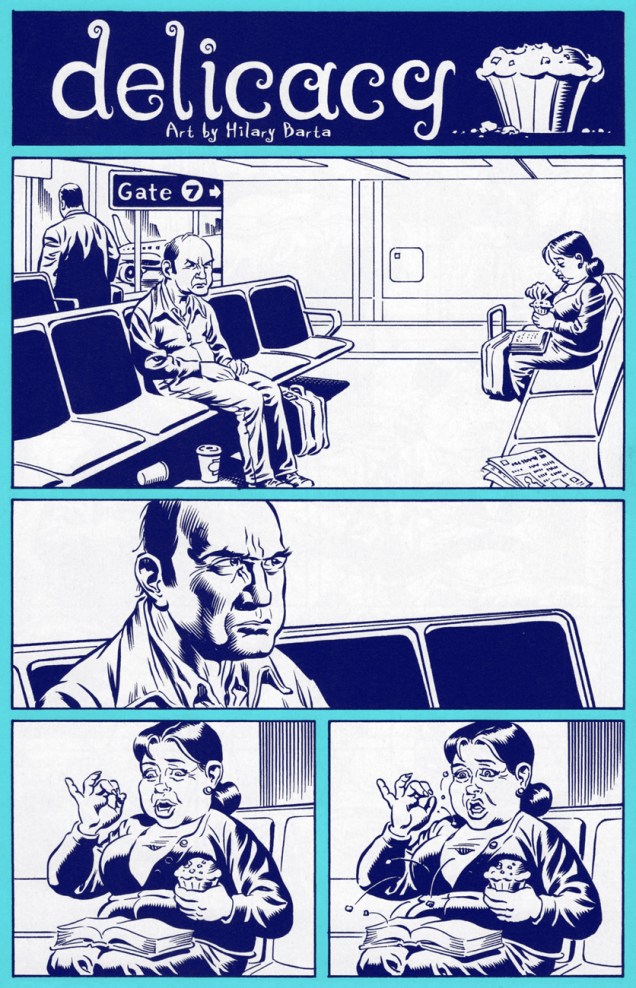
And here’s an atypical example of Mr. Pekar’s storytelling art, a rare but eloquent pantomime vignette. It originally saw print in DC Comics’ run of American Splendor comic books (no. 1, Nov. 2006, published under the Vertigo imprint and edited by Jonathan Vankin.) The symbiosis at play here between writer and artist makes ‘Delicacy’ my very favourite story by Hilary Barta, who somehow never gets matched with a script worthy of his tremendous talent, even when he’s working with Alan Moore (Moore can be very funny, but superhero parodies, even his, seldom are… and Splash Brannigan wasn’t exactly side-splitting). This is a wonderful oddity, one of two times that Barta and Pekar collaborated. Bon appétit!
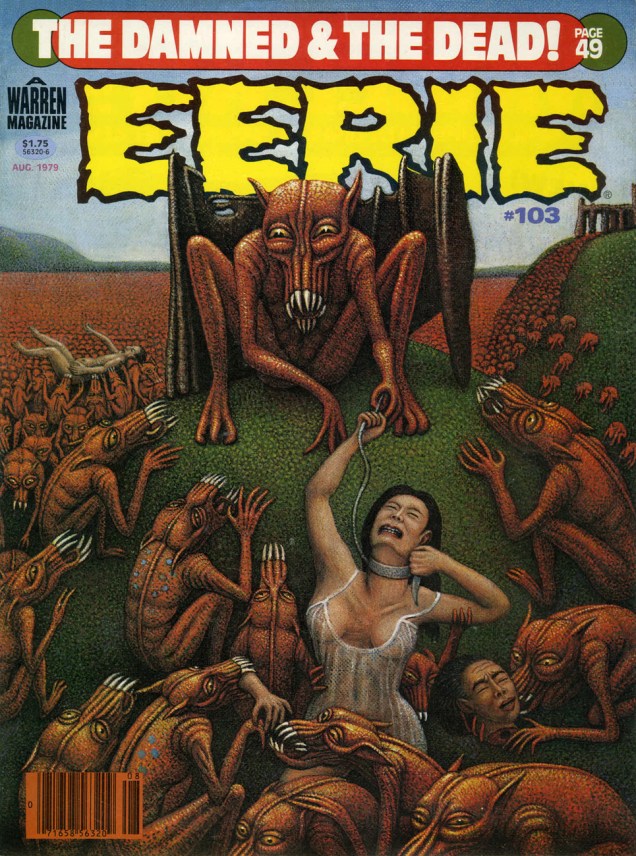
As the close of the 1970s neared, James Warren‘s magazine empire was inexorably crumbling. I like to imagine that it was decided, in desperation, that a little fiddling was in order… just a smidgen. Some enlightened soul (my pick is new editor Chris Adames) got the notion to bring on board Terrance Lindall (1944-) to produce some covers for the magazines. He painted a mere five, but made each one memorable, to say the least, evoking justified comparisons to Matt Fox, Lee Brown Coye, sans oublier the venerable Hiëronymus Bosch.
Well, then, let us bask in the comforting, bucolic visions of Terry Lindall at Warren, in their order of publication. Makes you want to pack a picnic lunch and go for a leisurely ramble through the countryside with your faithful Hound of Tindalos.
Creepy no. 108 (June, 1979.)Eerie no. 103 (August, 1979.)Creepy no. 116 (March, 1980.)What do you know? Terrance Lindall actually manages to make perennial fanboy wankbait Vampi look downright classy. This is Vampirella no. 86 (April, 1980.)And all too soon, it’s over, with Creepy no. 127 (May, 1981.)
Oh, how Creepy’s long-time readers must have wailed and moaned at these singular, quease-inducing mise-en-scènes! “Bring back Boris Vallejo!”
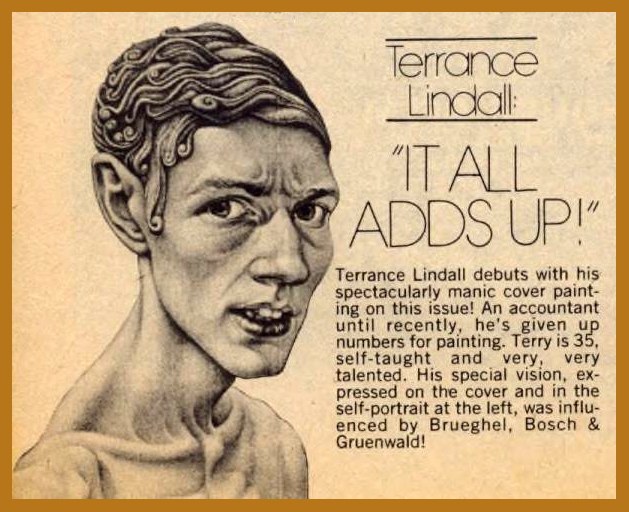
Nowadays, Lindall earns his keep as co-director and chief administrator of the Williamsburg Art and Historical Center in Brooklyn, New York. Doesn’t he just perfectly look the part?
The new kid’s mini-bio, as it appeared in Creepy 108 (June, 1979).








 -RG
-RG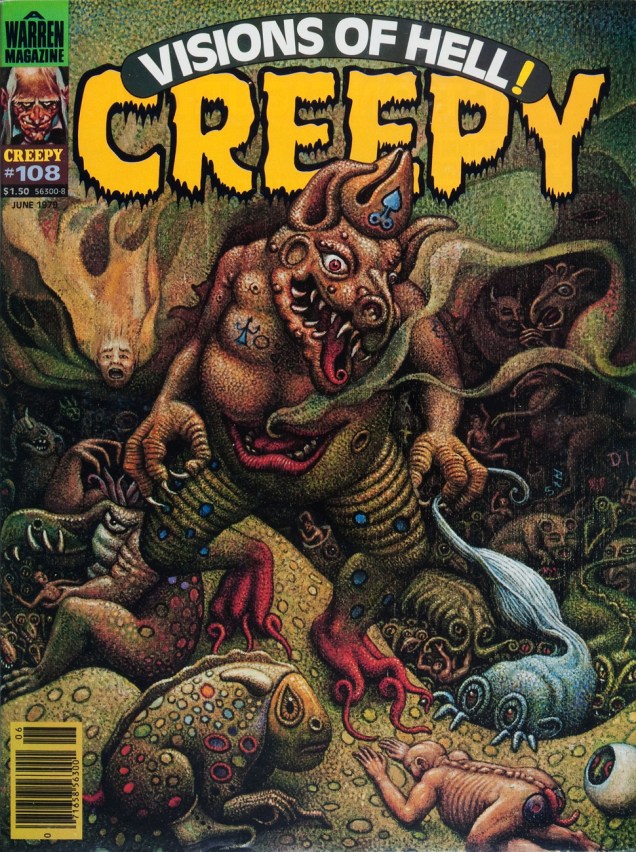


 Who's Out There?