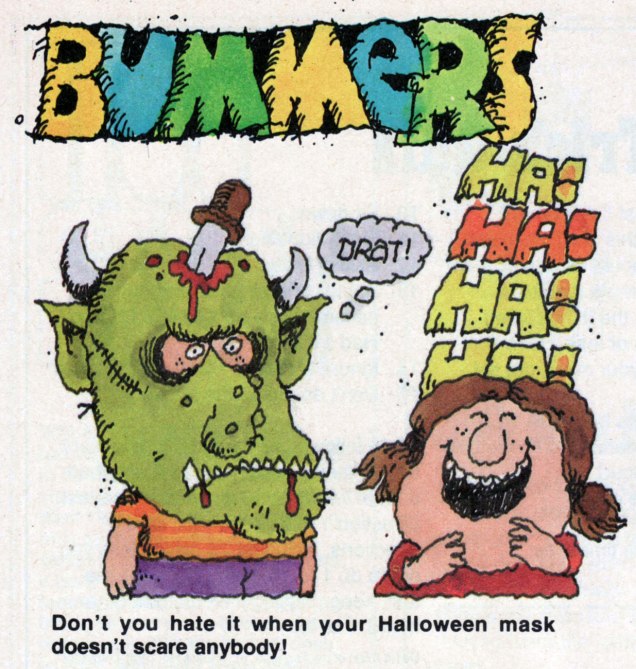
« Join the Group Gripe by sending in your own Bummer, and our Dynamite artist might pick your idea to illustrate. »
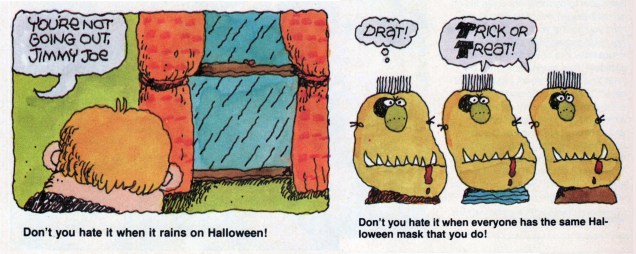
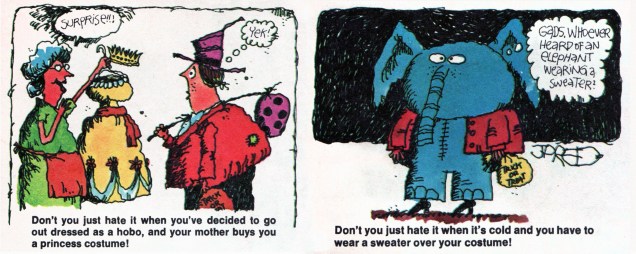
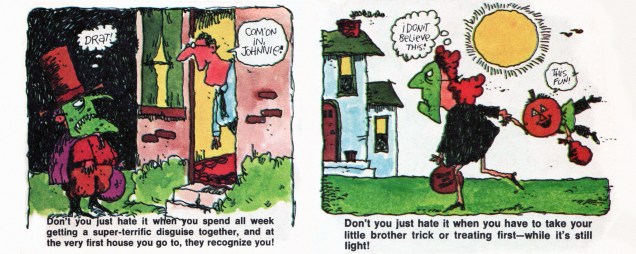
Bummers was a long-running feature (from the first to the final issue, in fact) in the pages of Scholastic’s Dynamite Magazine (165 issues, 1974-92), whose success was due, in no small part, to the winningly wobbly style of its illustrator, Jared Lee (b. 1943).
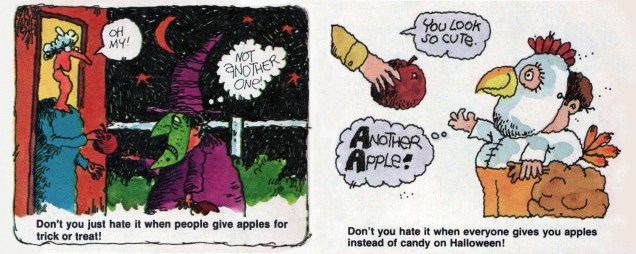
Here’s a selection of the finest Halloween-themed bummers from issues 4 (Oct. 1974) and 65 (Oct. 1979). Was any one of these yours?
It was bound to happen: two kids groused about the very same thing, and someone lost track. Well, kids, just be thankful the apples weren’t spiked with needles or razor blades. Left: the 1974 version. Right: the 1979 reprise. Note that Mr. Lee wasn’t about to repeat himself visually.
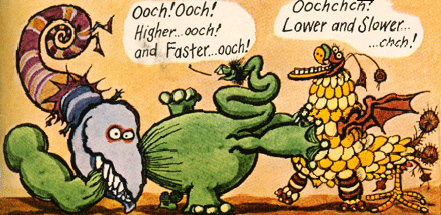
Borborygmi [bawr-buh-rig-mahy] a rumbling or gurgling sound caused by the movement of gas in the intestines. Did you know you could have a whole conversation in borborygmese? But don’t take my word for it:
This page, entitled “Les pois chiches” (Chickpeas), comes from a comics collection called “Tourista”, published in 1984, about, what else? Tourists and their behaviour in foreign climes.
Claire Bretécher is a socio-satirical cartoonist from France, best known for her comics dealing with women and gender-related issues (Les frustrés, Aggripine…) Lots of them have been translated into English. A quick rundown of her career: her work has been published in Spirou and Pilote in 1972, and she co-founded the Franco-Belgian comics magazine “L’écho des savanes” (Echoes of the Savannah) together with Marcel Gotlib and Nikita Mandryka. She also has a pretty good handle on Weird Body Things and how people react to them.
And speaking of odd stomach noises, this pertinent little gem comes to mind:
From Cul de Sac, an awesome comic strip (February 3, 2009) by the tragically deceased and much-missed Richard Thompson (1957-2016).
« Newly dead, the gases of decomposition moving in the stomach… moving the body like a rag doll whose lips flutter and belch… »
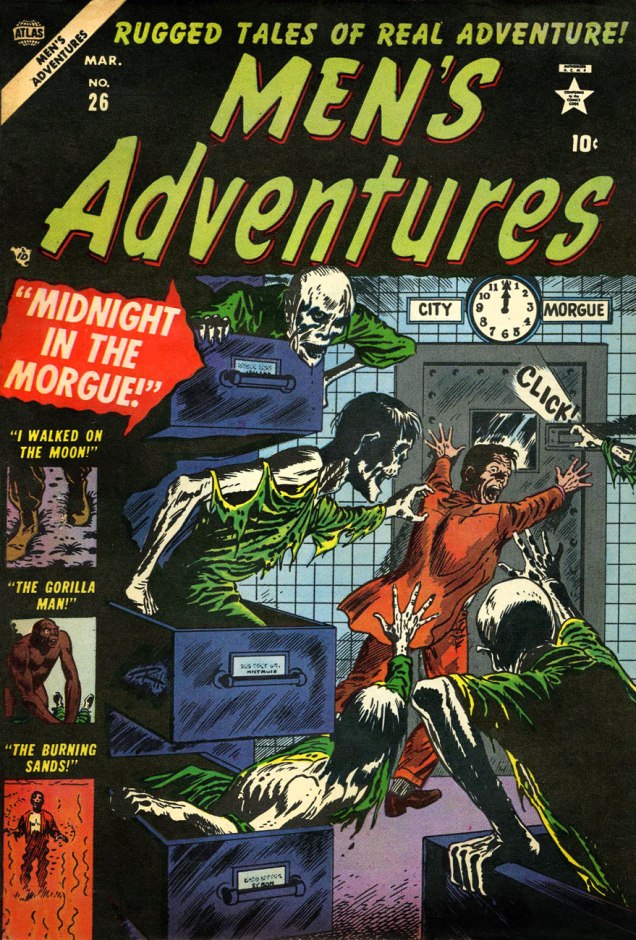
Atlas anthology Men’s Adventures (25 issues, 1950-54) was a pretty schizoid entity, with an editorial emphasis waffling from your typical would-be rugged he-man stuff (issues 4* to 8) to battle action (9 to 20) to mild horror (21-26) to, as a last resort, superheroes (27-28).
Russ Heath delivers his usual fine job for Men’s Adventure no. 26 (March 1954, Atlas). I like the matching green outfits on the cadavers. Yay, team!
In the mid-1970s you could tell that Marvel was running low on reprintable pre-Code material when items from Men’s Adventure began to pop up in its mystery anthologies.
Our cover story turned up then in Chamber of Chills no. 20 (Jan. 1976) announced by this ridiculous Ron Wilson/Dan Atkins cover. There’s a Broadway musical in there, I swear.
Since this was 1970s Marvel, the corpse is not only well-preserved, he’s buff as it gets. For comparison, read “Midnight in the Morgue” (writer unknown, art by Dick Ayers), with our thanks and a fond tip of the hat to The Horrors of It All blog.
A more haunting variation on the “trapped in the morgue with the not-quite-dead” theme is Nostalgia Press’ historically significant Horror Comics of the 1950’s (1971, edited by Bhob Stewart, Ron Barlow and original publisher Bill Gaines), which gathered, in full colour, 23 EC classics, including one previously unpublished story, An Eye for an Eye. The cover revives (ha!) Al Feldstein’s Tales From the Crypt no. 23 art from 1951.
Like many fellow modern-day EC Fan-Addicts, this book first came to my attention through the Captain Company catalogue that occupied the back pages of Warren Magazines. So many elusive, haunting grails… many of them turning out to be great beyond all reasonable expectations.
*the actual first issue… typical 1950s comics numbering scheme.
Alphonso Wong (also known as Wong Chak) is fondly remembered as the creator of Old Master Q, a truly long-running series that first appeared in newspapers/magazines in Hong Kong in 1962, was serialised in 1964, and is still in publication today. When Mr. Wong retired from his strip in the 90s, his son, Joseph Wong, took over the company, and he’s been managing the licensing ever since, as well as directing the team of artists writing and drawing the strip. Wong Chak passed away in 2017, at 93.
I’m no expert (the language barrier doesn’t help!), but people’s love for Old Master Q and Wong Chak is evident. To quote from Lambiek Comiclopedia,
[The strip] inspired its own magazine (“Old Master Q’s Crazy Comics”, 1965), toys, stationary, electronic scales, LED lamps, insulated cups, umbrellas and lunch boxes, as well as seven live-action film adaptations, four animated ones and two TV series. Copies of ‘Old Master Q’ can still be found in many Chinese hairdresser shops or doctor’s waiting rooms. Its success spread to the rest of Asia and translations in Europe, Latin America and Japan. Along with other well-known comic book characters, Old Master Q has his own statue in the “Hong Kong Avenue of Comic Book Stars” in Kowloon Park, Hong Kong. In August 2016 an Old Master-themed café opened on Nathan Road in Prince Edward, Hong Kong.
I prefer the art from the earlier days of OMQ, although I am glad that the strip is still around. (It’s a national institution!) To illustrate:
Please don’t forget to follow the numbers and read these top to bottom, right to left, as appropriate for a Chinese strip:
“Space Monster”, 1970. In panel number 4 , Old Master Q is saying “I am the first person to land on Mars! Hee, hee!”. In panel 5, he says “Friend!” to the aliens; despite his attempts at friendliness, they flee in panel 6, alarmed by “the strange beast that comes from space”.
Judging how often jokes about mermaids crop up, Wong Chak had a thing for them.
“Reminder of love”, 1970.
Wong Chak was impressively ambidextrous and could (and would) draw with either hand!
Here’s a strip from more recent days. As you can see, the reading order of the panels has been adapted to the Western palate, and there are English captions translating the Chinese text.
There’s as many collections of these strips as one would expect from a series so popular, including special-theme collections released for various holidays.
I eagerly await the day I’ll be able to read Old Master Q strips without having to painfully pore over a dictionary over every third character. (Especially given that I’m learning simplified characters, and Old Master Q uses traditional characters. Oof…) If that day ever comes, there’ll be a lot of material to dig into!
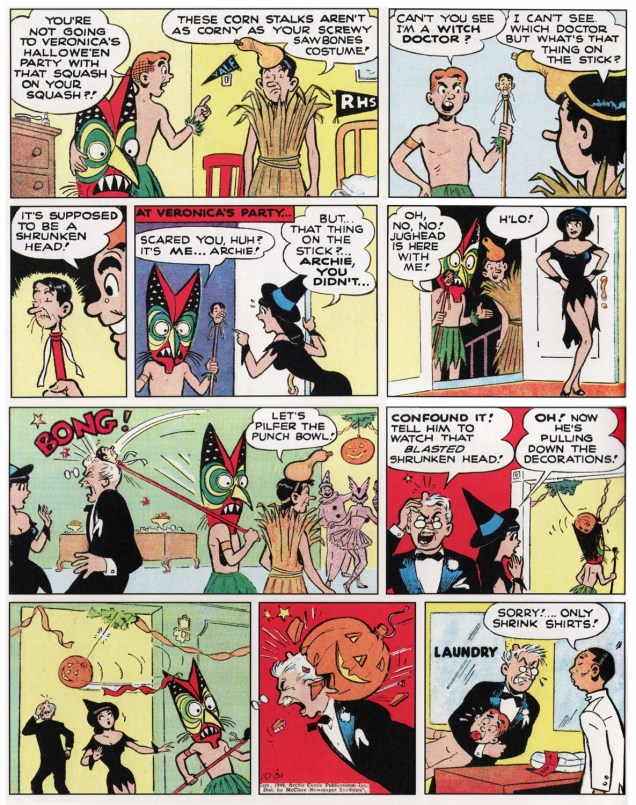
Here’s a seasonal Sunday strip from Archie creator* Bob Montana (October 23, 1920 – January 4, 1975), from October 31, 1948. Do note (or try not to) how sultrily Veronica is portrayed in comparison to her more restrained depictions in subsequent, supposedly less prudish decades.
*You can safely ignore the outlandish claims of the Goldwater family on that. They may run the company, but they ain’t created squat, despite their long tradition of shoe-horning themselves into the credits. And of screwing over the actual creators of their flock of golden geese.
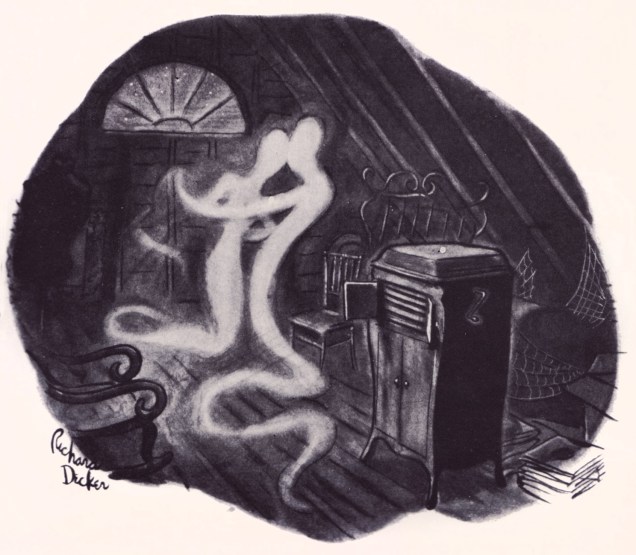
On a damp and chilly night, is there a finer way to keep warm than huddling with your beloved?
From The New Yorker 1955-1965 Album, published by Harper & Row.
Richard Decker, (b. Philadelphia, PA, May 6, 1907, d. November 1, 1988) fruitfully spent four decades as a contract cartoonist for the New Yorker. His association with the magazine began in 1929.
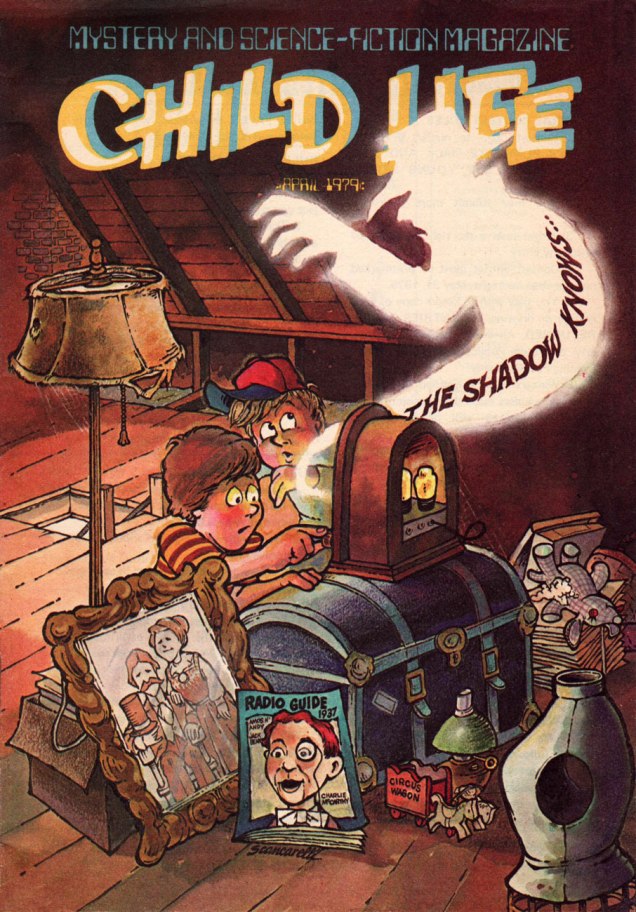
Along the same ordre d’idées, here’s a bonus piece about the evocative magic of old time radio, by long-time Gasoline Alley cartoonist (and bluegrass fiddler) Jim Scancarelli (b. 1941), from the April, 1979 issue of Child Life Magazine.
Care to fully capture and bask in this delicious melancholy? Go ahead, pour yourself a snifter of your favourite poison, hunker down in your coziest chair, and enjoy an episode or three of the classic The Shadow radio show, starring Orson Welles.
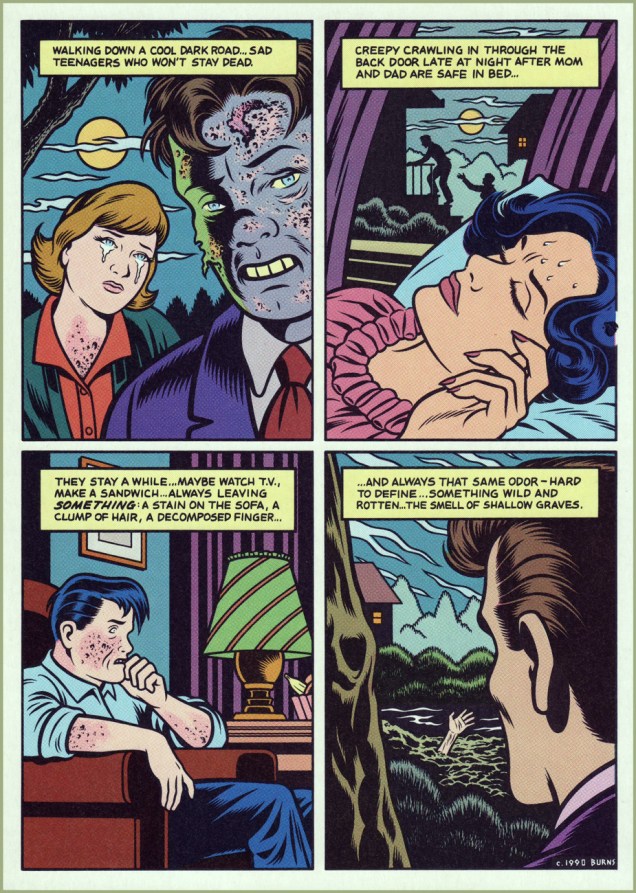
He wasn’t the first to seize upon the connection, but Charles Burns does evoke powerfully, and with tenebrous poetic grace, certain salient parallels between teenagers and the living dead, between decomposition and acne… I can’t help but be reminded of the undead masses shambling at the mall in George A. Romero‘s Dawn of the Dead (1978), trapped in the empty cycle of their old, ingrained habits.
Originally published in Raw Volume 2 no. 2 – Required Reading for the Post-Literate (May 1990, Penguin Books.) Edited by Art Spiegelman and Françoise Mouly.
The talented pen of Arnold Roth (born 1929, and still alive, hey!) has graced the pages of what will seem like a slightly exaggerated, but in no way exhaustive, list (but no, he’s indeed appeared in all of these): The New Yorker, Sports Illustrated, Esquire and Playboy; Harvey Kurtzman‘s publications Trump, Humbug and Help!; The National Lampoon and Punch (Roth lived in England for a while), and The Progressive.
The topic of Roth’s contributions to Kurtzman’s satirical publications will no doubt crop up at some later juncture, but in the meantime, let’s have a look at some of Roth’s solo lampoonery and comic-form persiflage (not to mention the beauty of his inking line and the dynamism of his compositions).
Roth created a Sunday strip called Poor Arnold’s Almanac for the New York Herald Tribune Syndicate, published from 1959 to 1961. In 1989, it was revived as a Sunday *and* a daily for Creators Syndicate, and lasted until 1990. This strip is from April 24th, 1959.
Speaking of solo work, I also adore his Comick Books of Pets (published in October 1976).
« Found, Raised, Washed, Curried, Combed, Fed, and Cared for in Every Other Way. »
Roth’s art is also rather striking in black-and-white. To wit:
1978. Note the actual Vitruvian Man, L’Uomo Vitruviano, standing in line on the right.
In the early 1970s, despite the western genre’s waning prospects in comics, DC found itself with a surprise hit in John Albano and artist Tony DeZuniga‘s antihero Jonah Hex, thanks to a healthy infusion of grit and spaghetti sauce. The battle-scarred Civil War veteran first reared his memorably homely puss in All-Star Western no. 10 (Feb.–Mar. 1972), which soon changed its title to Weird Western Tales with issue 12 to better accommodate its new star.
WWT’s reliably great covers probably didn’t hurt sales. Most of them were the work of Argentine Luis Dominguez, in tandem with the all-star design team of publisher Carmine Infantino, art director Nick Cardy and production manager / colourist Jack Adler. These covers all possess that elusive allure of « Mysterioso », as Infantino termed it.
This is Weird Western no. 25 (Nov.-Dec. 1974), featuring Showdown with the Dangling Man. Script by Michael Fleisher, art by Noly Panaligan.
Before midnight strikes and this Tentacle Tuesday waves us a teary goodbye, I shall endeavour to demonstrate that octopuses are vicious, grabby little miscreants who, in their quest for food and fun, don’t discriminate between species!
Oh, what the hell, I’ll just give three examples.
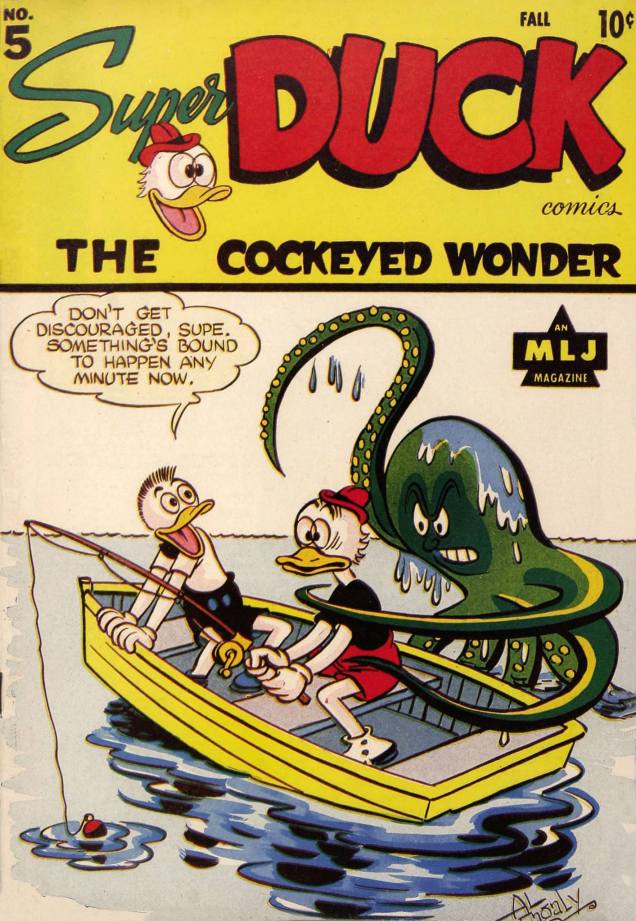
Here’s an octopus attacking a duck (to be more precise, a super duck, which is nevertheless gastronomically similar to its plainer cousin):
Super Duck Comics no. 5, Fall 1945, published by Archie Comics back when they were MLJ. Cover by Al Fagaly.
And here’s one attacking a gorilla… err, sorry, ape.
This is Planet of the Apes no. 15 (December 1975). Art by Bob Larkin.
It’s perhaps worth mentioning that French auteur Pierre Boulle wrote “La planète des singes” in 1963; the latter was translated as “Monkey Planet” in the UK and as “Planet of the Apes” in the US. (For once I’m with the Americans; “ape” sounds considerably more threatening than the childish “monkey”.) Marvel put out both a magazine (29 issues) and a comic book (12 issues) in the 70s – though frankly, there are so many comic tie-ins for this franchise, that I have nor the knowledge nor the desire to figure out what’s what or when or by who it was published. I’ll stick with the “tentacles, girl in bikini, pretty art” bit, though.
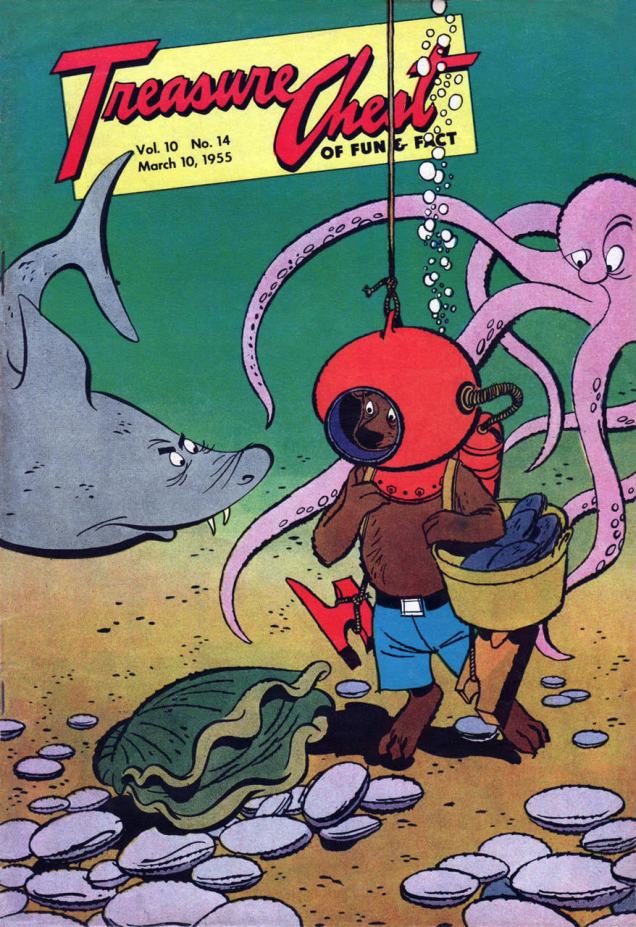
And here’s our last scene for today, an octopus attacking a bear. Actually, on the cover it’s unclear whether it’s attacking or protecting the bear, but having read the story, I can assure you that the pink cephalopod has bear meat on its mind.
Treasure Chest of Fun & Fact, vol. 10, no. 14 (March 19, 1955). The cover story, Pearl Divers, is scripted by Eric St. Clair and illustrated by Paul Eismann.
Treasure Chest of Fun & Fact was a Catholic comic book series distributed in parochial schools from 1946 to 1972… surprisingly, it’s often lots of fun, and occasionally within its pages one stumbles onto the work of a well-known artist like Murphy Anderson.
So whatever anthropomorphic species you may be, remember, don’t get your tuchus too close to the grabby tentacle of a hungry cephalopod!
 – RG
– RG







 Who's Out There?