The Moomins* never had a ‘proper’ Hallowe’en, as this celebration didn’t exist in Finland in Tove Jansson’s lifetime. The closest thing was Pyhäinpäivä , a sort of ‘Saints’ Day’ dedicated to lamented loved ones, whose memory is honoured with lit candles on their graves.
That being said, Moomins’ myriad adventures include many costumes and surreal moments that would qualify in a skipped heartbeat as good fodder for the end of October — who needs a specific holiday for sinister goings-on? Tove Jansson knew how to temper the spine-chilling with good humour. Her cast of characters is rich in spooky creatures rejected and misunderstood just because they live by different rules, some of which are, most appropriately to this post, ghosts.
The Hattifatteners (first appearing in The Moomins and the Great Flood, 1945), described as ‘…the little white creatures who are forever wandering restlessly from place to place, in their aimless quest for nobody knows what’ (Comet in Moominland, 1946) certainly qualify as a kind of ghost, with their whitish colour and the soft flexibility of mushrooms on thin stalks.
Hemulen (looking a bit Slavic there) and the Hattifatteners, whose appendages (appropriately) make them look like a bunch of crosses at a graveyard.
The Moomin lore includes actual ghosts, too. One example is the Island Ghost, featured in The Exploits of Moominpappa (written in 1950, and that can be read in its 1968 revised version here). In typical Jansson fashion, he can’t actually haunt very well, and is prone to random bouts of sneezing. He also likes knitting. That description fits me well, actually, so perhaps I’m a ghost, too.
« The room had suddenly grown cold with an icy draught, and the ghost sneezed. I don’t know how you’d have felt, but for my part I immediately lost much of my respect. So I crawled out from under the bed and said: ‘Cold night, sir!’ ‘Yes,’ replied the ghost in an annoyed tone. ‘A bleak night of fate resounding with the horrible wails of the phantoms of the gorge!’ ‘What can I do for you?’ I asked politely. ‘On a night of fate like this,’ the ghost continued stubbornly, ‘the forgotten bones are rattling on the silent beach!’ ‘Whose bones?’ I asked (still very politely). ‘The forgotten bones,’ said the ghost, ‘Pale horror grins over the damned island! Mortal, beware!’ The ghost uncurled, gave me a terrible look and floated back towards the half-open door. The back of his head met the door-jamb with a resounding bang. ‘Oops!’ said the ghost… »
The Moomins (1983) S01E45 – Island Ghost
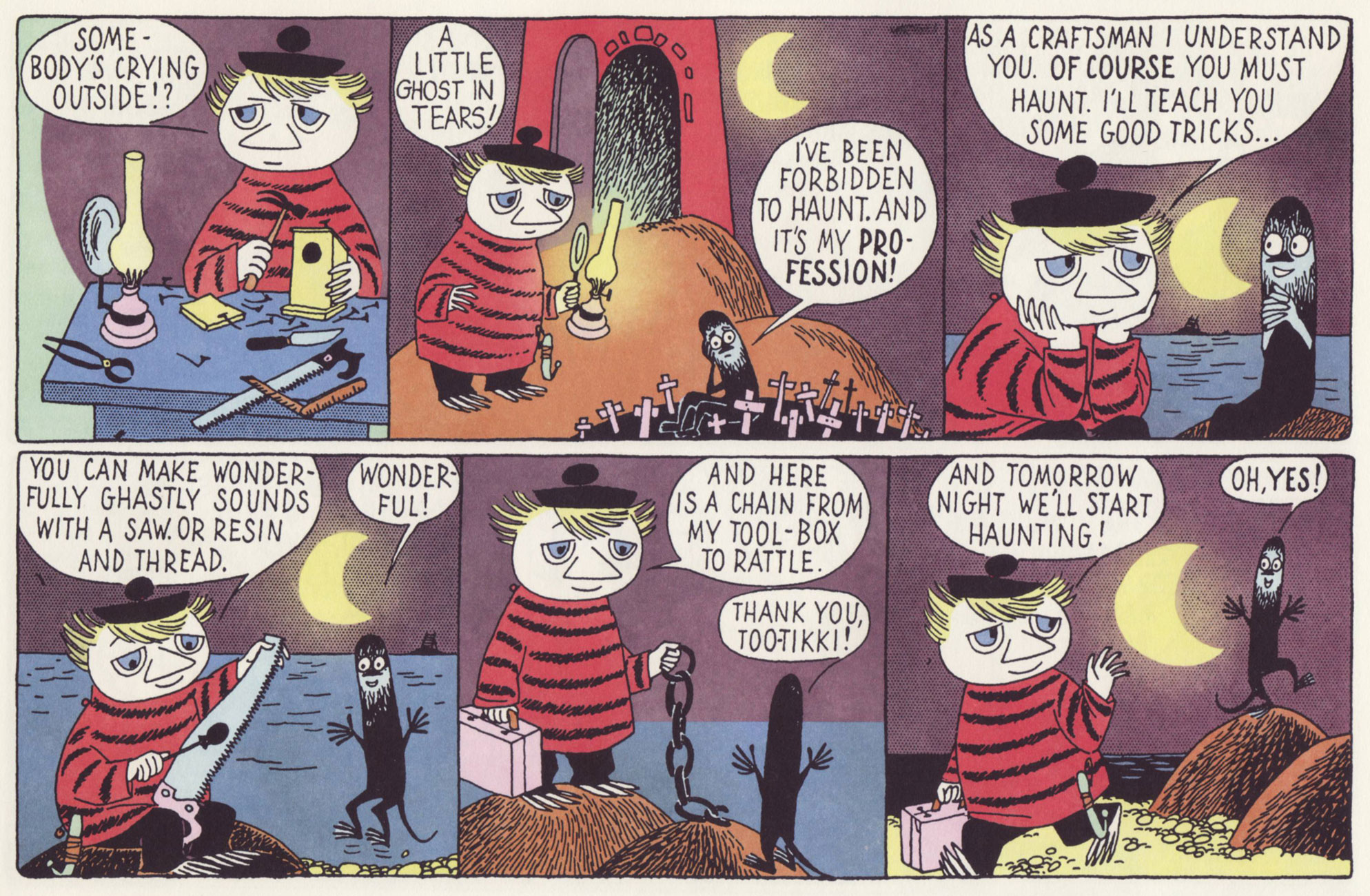
This is not the only time the Moomins tried living on an island or encountered a ghost. Moominpappa at Sea (a story published in the daily strip in 1957, and similar to, but not entirely the same, as the novel from 1965), in which the Moominpappa becomes a lighthouse keeper, features another timid spook who does such a rattle-up job terrifying Moomintroll that he gets banned from haunting by the stern Moominmomma. Given this story’s mostly nocturnal setting, lonesome lighthouse and clanging chains galore, it’s highly appropriate to this October. The following version has been ‘reworked’ in colour by Drawn&Quarterly:
Tove’s brother Lars Jansson, who took over the writing (and eventually the illustration as well) of the Moomin comic strip in 1958, also has something to contribute to this Hallowe’en post. As an honourable mention, I offer you his Moomin and the Vampire (1964). One can argue that his stories lacked the soul (and artistic ability) of his sister — I’m not here to discuss that, just to take a peek at the little vampire bat escaped from a zoo.
I think it safe to surmise that pretty much everyone is familiar with the light-coloured, pleasantly plump creatures collectively referred to as the Moomins. Even if you’ve never heard of Tove Marika Jansson, their creator, you’ve surely glimpsed a Moomintroll mug, a Snork Maiden tote, or a Little My t-shirt.
Tove Jansson (1914-2001) was a multi-faceted soul: comic strip artist, of course, but also novelist, painter and illustrator (one might argue that these all are related: point taken). She published her first Moomin book in 1945 (The Moomins and the Great Flood) to (eventual) great success; the eight books that followed were equally popular. All have been translated into forty-four languages. The Moomin comic strip, first designed for publication in the children’s section of Swedish newspaper Ny Tid, ran from 1947 to 1975, and was syndicated in 120 countries. (Here’s a detailed timeline of Moomins’ creation and development.) To Anglophone audiences, the strip is known thanks to The London Evening News, which picked it up in 1954.
The commercialization of the Moomin family, the ubiquity of Moomin merchandise overshadow the rest of Jansson’s career – but also cheapen the darling Moomins. (I should talk; I have two favourite Moomin mugs from which I drink kefir.) As with the best writing for children, Moomin stories are fun and easy to follow on the surface – but beneath that cheerful and cute exterior, complex themes are tackled, moral dilemmas remain unresolved, and the world is a confusing, unfair place.
Montréal’s Drawn and Quarterly is currently « reworking classic Moomin stories in full colour, with a kid-proof but kid-friendly size, price, and format » (to quote from their website) for their Enfant collection. « Enfant » means « child », but I think any adult with a sense of humour and just a pinch of childlike innocence will enjoy these stories. Drawn and Quarterly have heretofore published collections of London Evening News strips in black and white; and though the art is beautiful, I really like the way the strips came out in colour.
As little of this stuff is findable online, I’ve selected a few (well, quite a few) favourite pages to whet your appetite – a selection of goofy characters, hard life lessons and good old madcap fun.
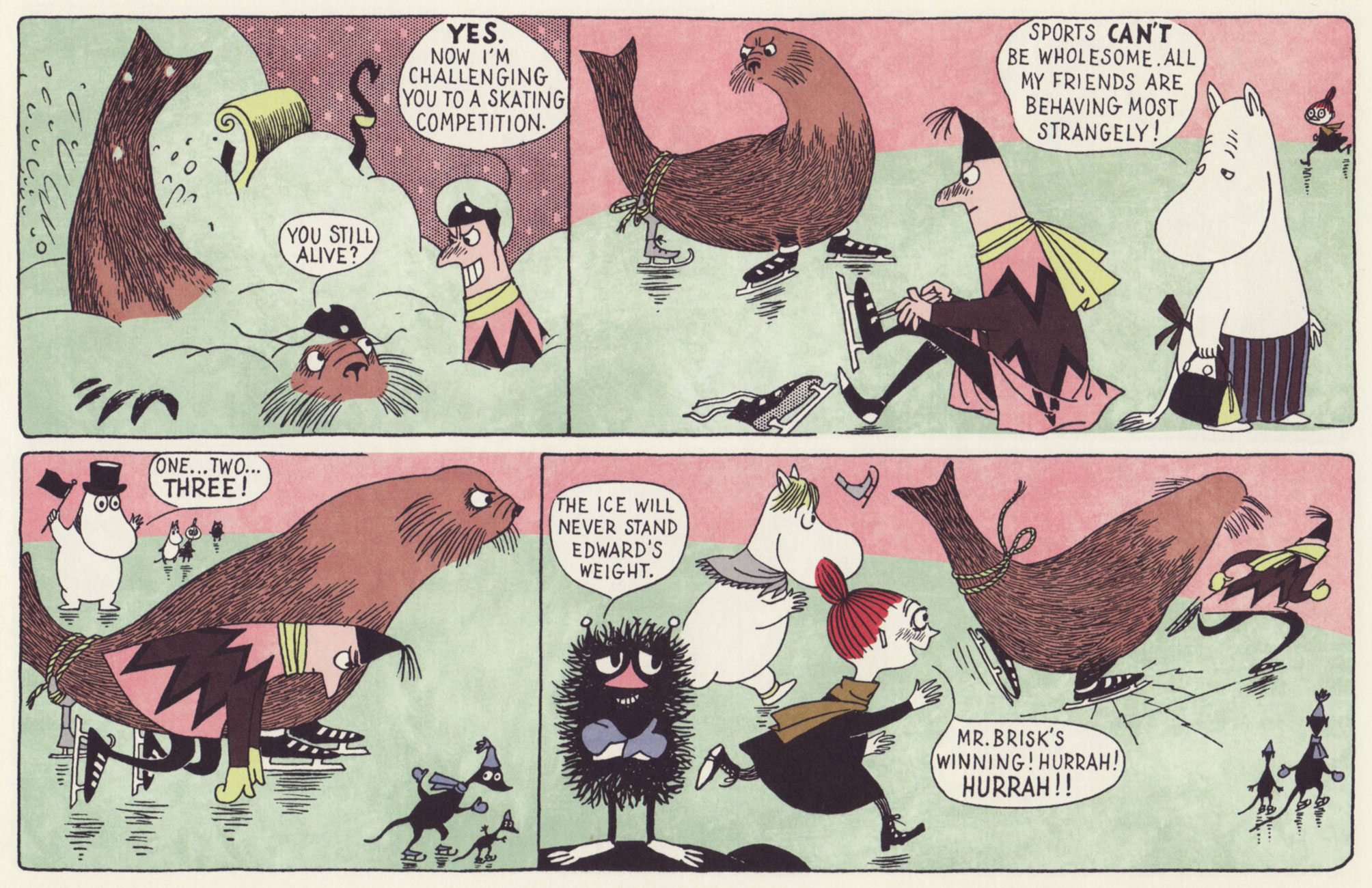
Pages from Moomin’s Winter Follies
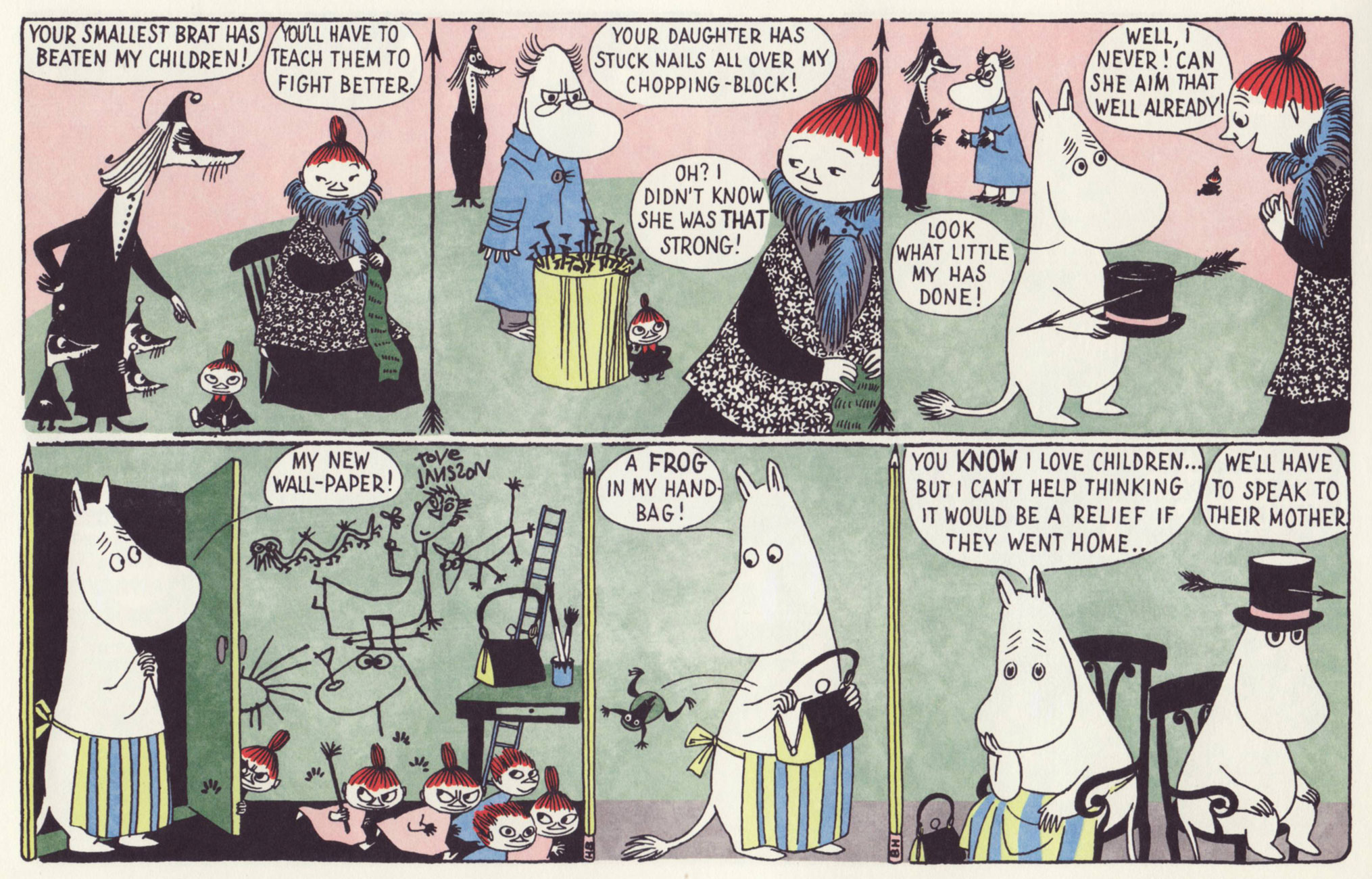
Moomin Builds a House. Little My makes her first appearance in this story. Some parenting advice from Elder Mymble, the mother of this red-haired hoarde: « I don’t like to keep scolding them. I just… pour some water over them. …Or lemonade. »
« Born in 1914, at the onset of World War I, Tove’s childhood and early adulthood took place in a time of intense political upheaval. Artists themselves, her parents were a part of the Swedish-speaking minority in Finland and in those first few years, when the world was at war, Tove and her mother stayed in Stockholm while her father remained in Finland, going on to fight in the Finnish civil war in 1918. That experience, some literary analysts say, is reflected in the missing Moominpappa, who appears only as an allusion in the first chapters of the first book. » (How Tove Jansson’s Moomins conquered readers’ hearts)
« As springtime dawns in Moominvalley and the first northern crocus opens, Moominpappa and Snorkmaiden, glamorized by the prospects of movie stars and gambling, insist the whole family take a trip down to the Riviera. Reluctantly Moomin and Moominmamma agree to go along, and the Moomins set off on a grand adventure, complete with butlers, luxury shops, indoor swimming pools, and duels at dawn. » Pages from Moomin on the Riviera.
« Following art school and travels abroad, Jansson drew cartoons for different outlets, including, for fifteen years, the satirical political paper Garm. (“Do as you like,” the editor told her. “Just make sure you hit them in the mouth.”) This is where the Moomins first surfaced publicly. Originally meaner-looking and troll-like creatures called Snorks, they began mostly as marginalia, a kind of signature, and might even be found loitering in a cartoon about the German Army’s evacuation of Lapland. » (The Hands That Made the Moomins)
Page from Moomin and the Sea.
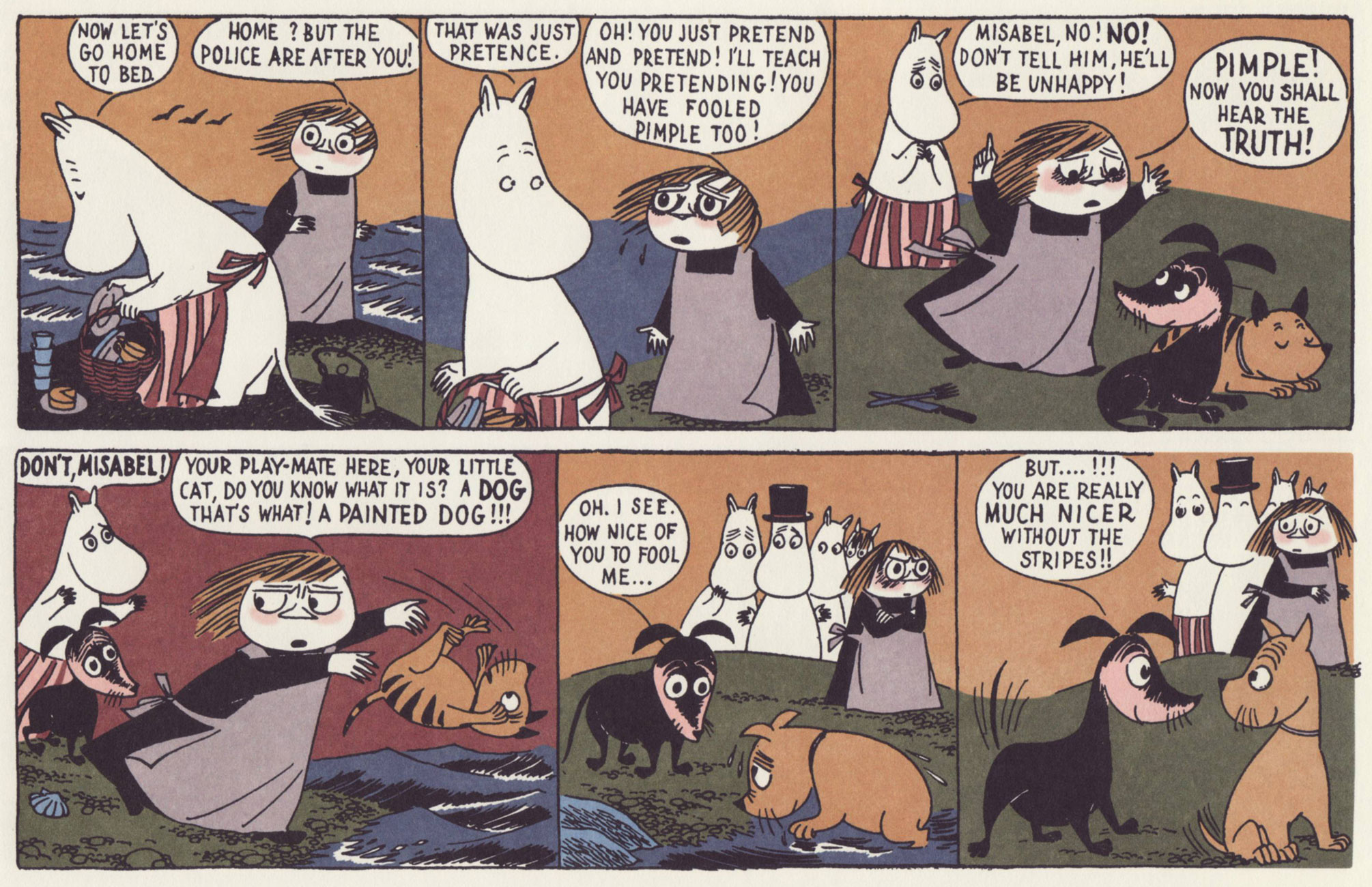
Misabel the maid is, as her name suggests, miserable. Afraid of any kind of non-conformist behaviour, scared of enjoying anything, she is anathema to Moomins’ approach to life. Pages from Moominmamma’s Maid.
« Tove’s entire life was filled with bold decisions: selling satirical cartoons mocking Hitler; opposing war; choosing not to marry or have children; and turning down Walt Disney’s offer to buy the Moomin brand. She was the writer, illustrator, designer and controlled the business side of her creation, not trusting anyone else to do it justice. » (Tove Jansson’s Feminist Legacy)
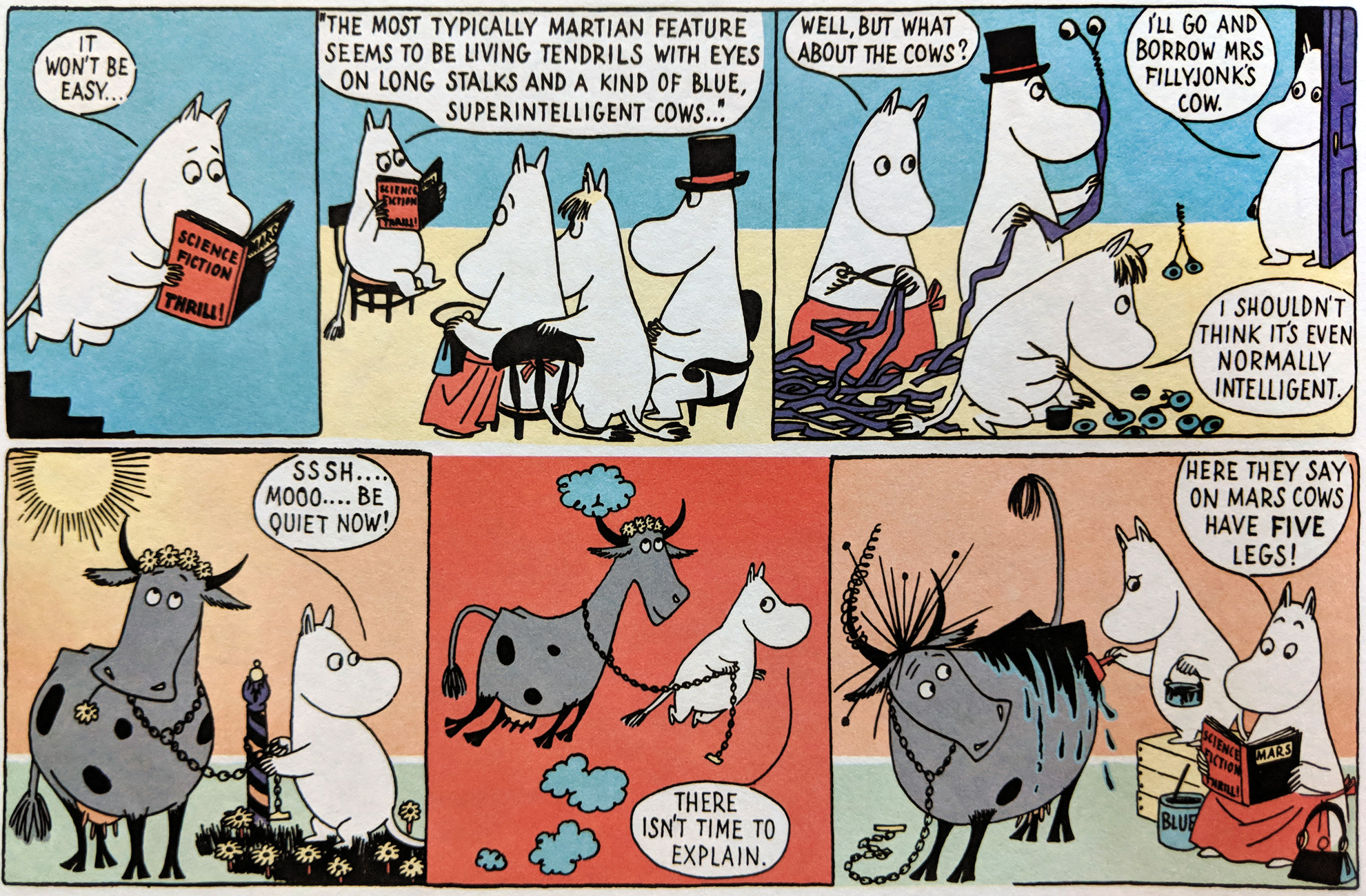
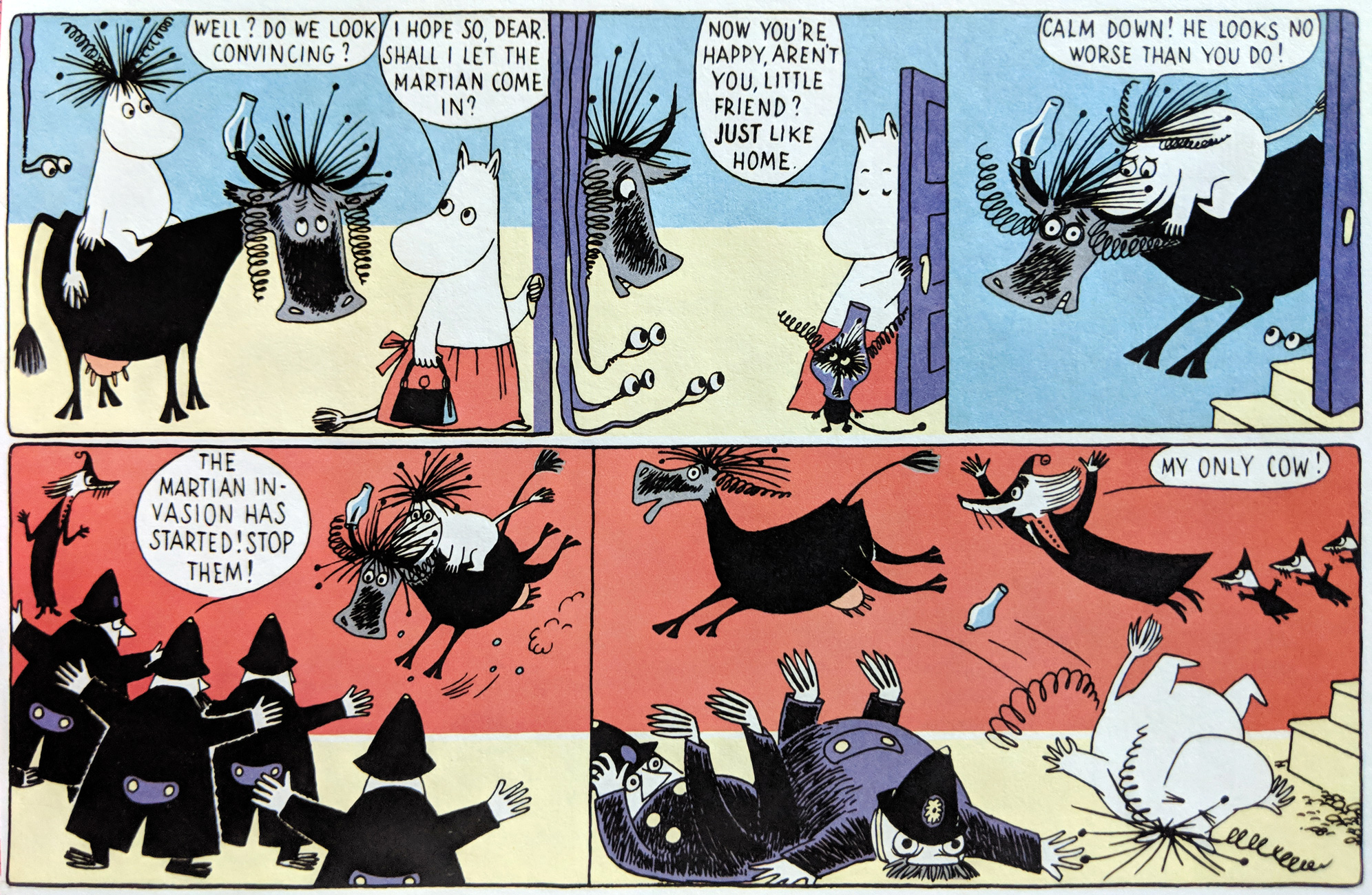
This sequence with a somewhat indignant cow is one of my favourite moments. Pages from Moomin and the Martians.
« In like spirit, Moomin hospitality excludes no one—except those prone to electrify the furniture or freeze Moominmamma’s roses. Guests include shrewish Fillyjonks addicted to cleaning; large graceless Hemulens obsessed with classifying and organising; and a philosophical Muskrat who believes only in the pointlessness of everything. » (Tove Jansson, Queen of the Moomins)
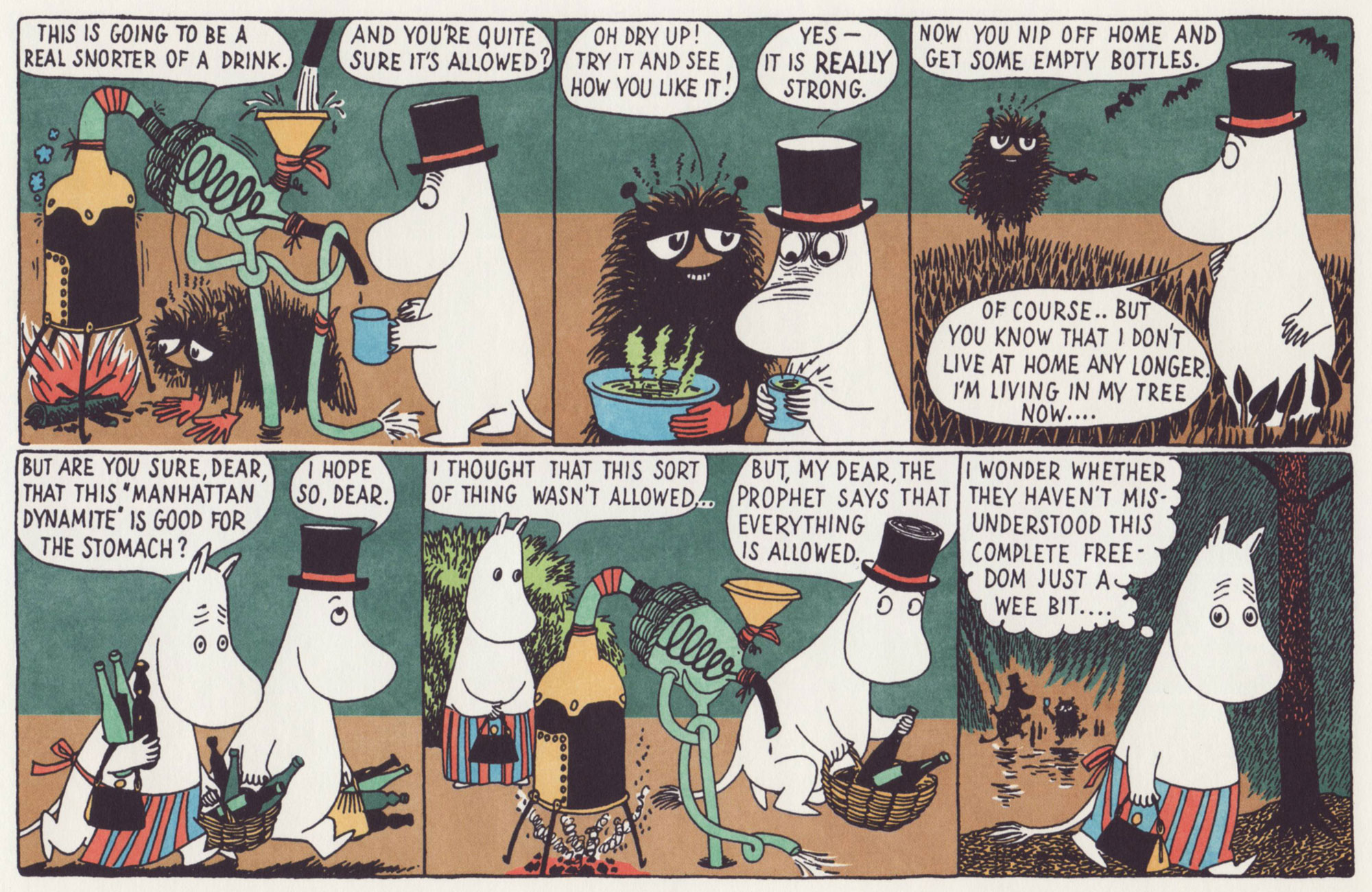
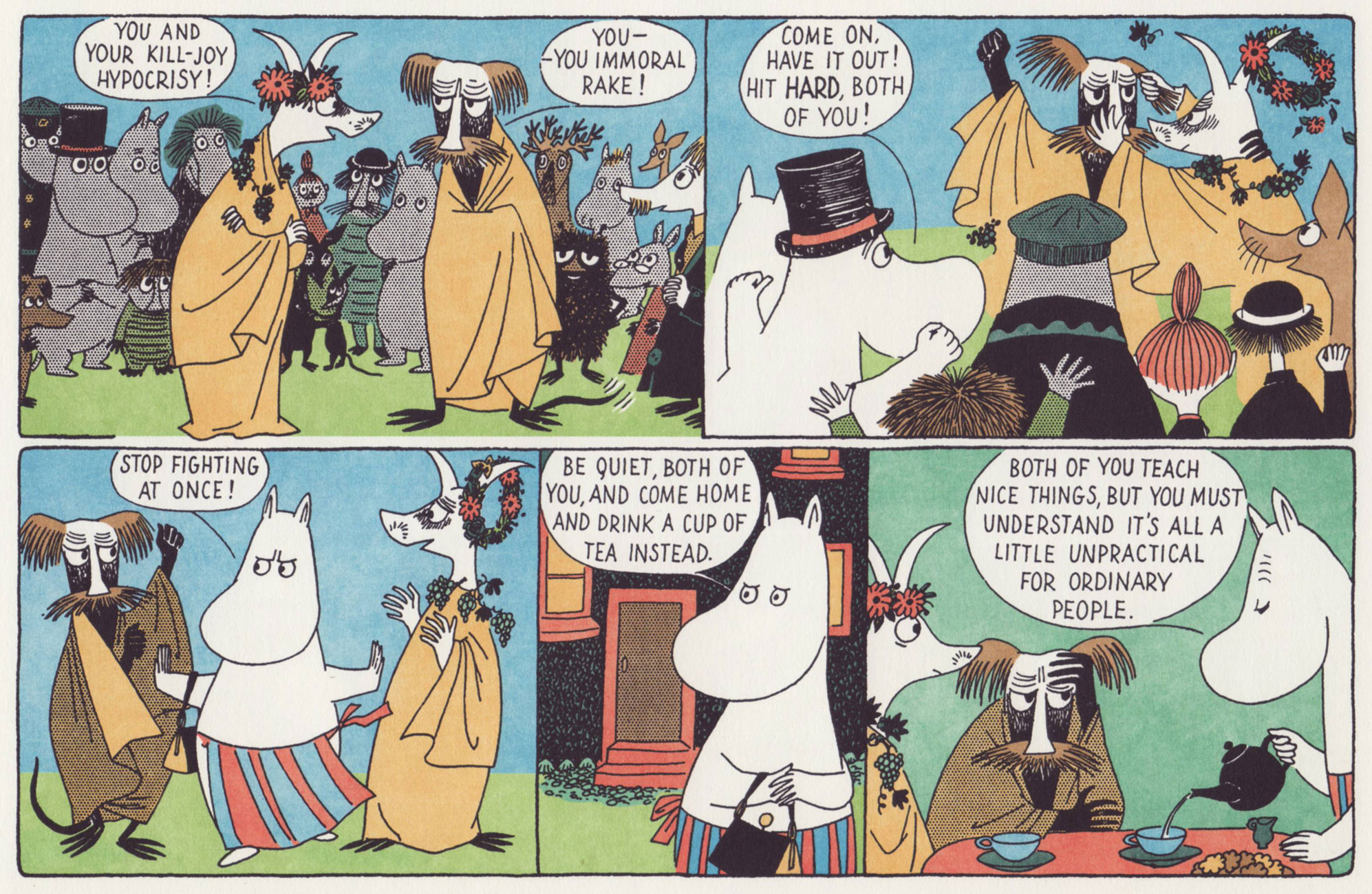
« When a charismatic prophet comes to town, the residents of Moominvalley are easily convinced to follow his doctrine for true happiness. Intrigued by their friends and neighbors’ lifestyle changes, the impressionable Moomins find themselves attempting to adopt the teachings of their new spiritual leader. But the freer they get, the more miserable they feel. Moominvalley’s state of divine chaos is further complicated by the prophet’s well-intentioned decree to free all of the jail’s inmates. » Moomin Begins a New Life.
« Over time, Jansson came to feel exhausted by the Moomins and that their success had obscured her other ambitions as an artist. In 1978, she satirized her situation in a short story titled “The Cartoonist” about a man called Stein contracted to produce a daily strip, Blubby, which has generated a Moomin-like universe of commercial paraphernalia—“Blubby curtains, Blubby jelly, Blubby clocks and Blubby socks, Blubby shirts and Blubby shorts.” “Tell me something,” another cartoonist asks Stein. “Are you one of those people who are prevented from doing Great Art because they draw comic strips?” Stein denies it, but that was precisely Jansson’s fear. » (Tove Jansson: Beyond the Moomins)
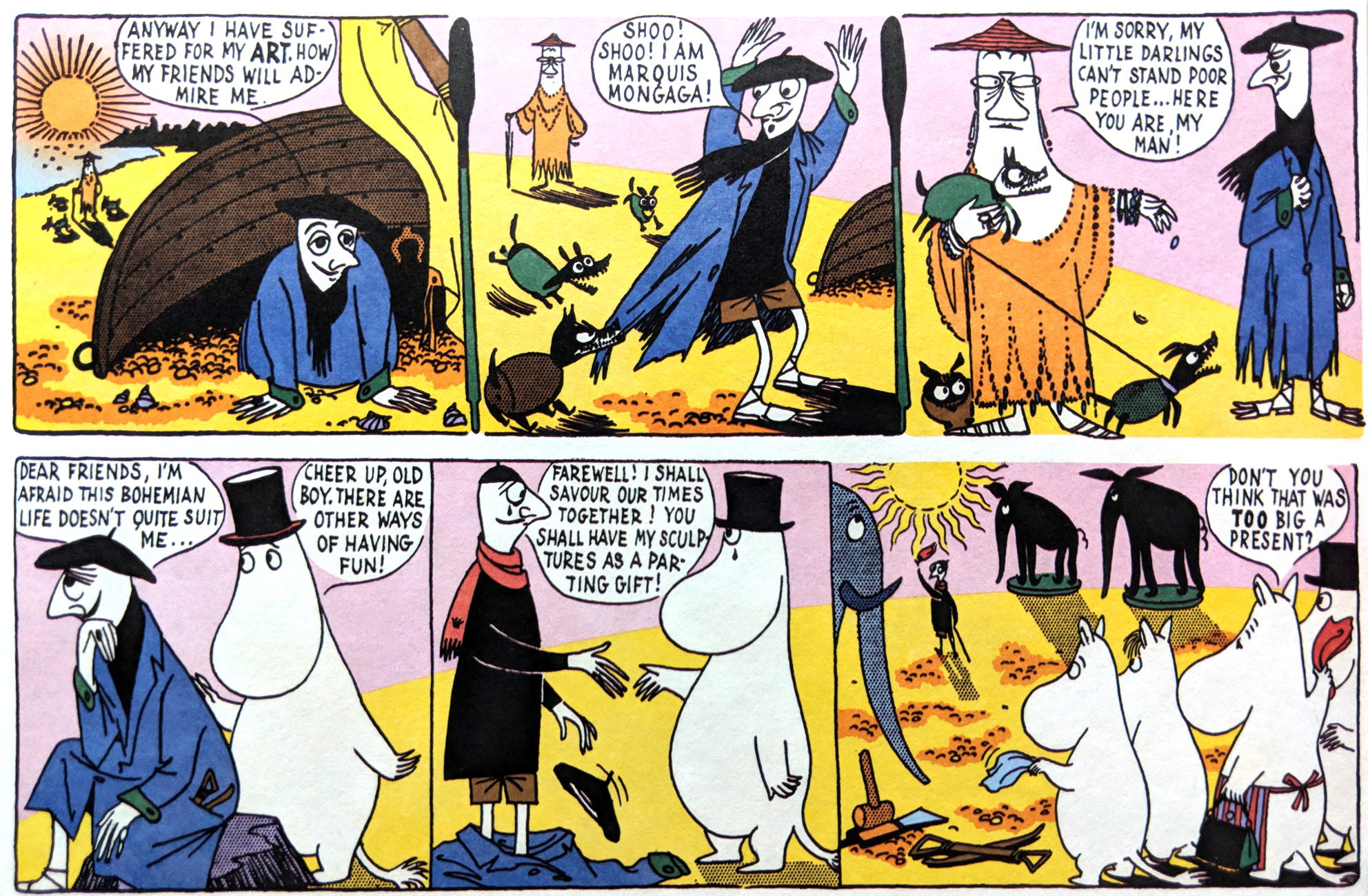
« Moomin’s pushy relations have come to stay, and in the process of getting them out, he unwittingly embarks on a quest for fame and fortune with his sly friend Sniff. But it’s much harder to get rich than either of them expects, whether it’s through selling rare creatures to the zoo, using a fortune-teller to find treasures, or making modern art. » Moomin and the Brigands.
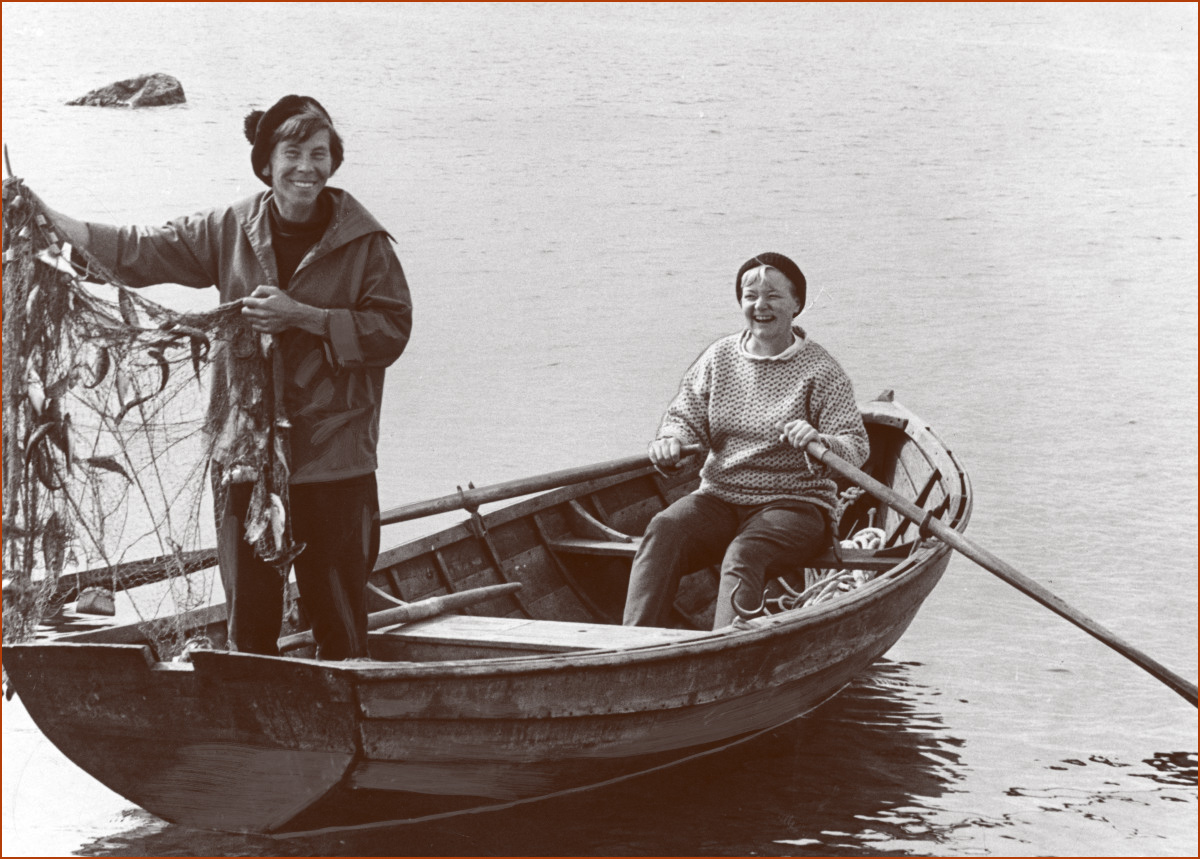
The only (other) thing I’ll add is that Tove Jansson was a lesbian, which tends to get glossed over by (bad) biographies of her. You can read an excellent essay about Jansson and her lifelong partner Tuulikki Pietilä here.
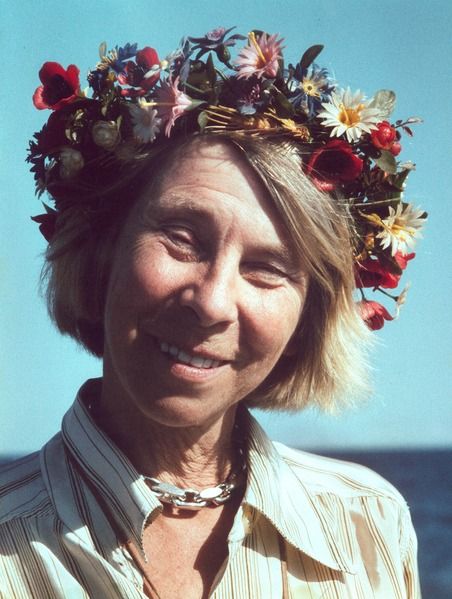
Tove Jansson photographed by her brother Per Olov.
There’s only two Tentacle Tuesdays left in the year after today. Well, let’s not bashfully bury our tentacles in snow and get on with it.
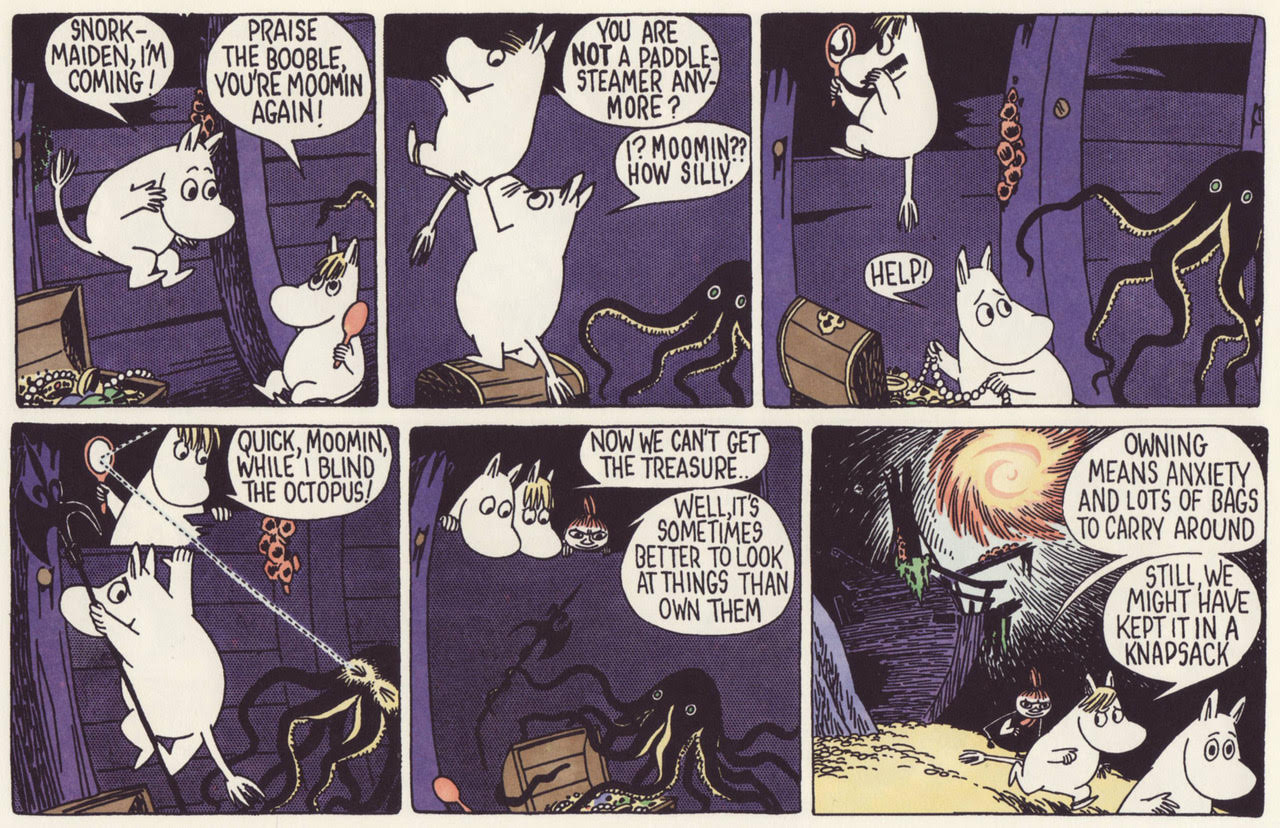
I don’t think Tove Marika Jansson, Swedish novelist, painter, illustrator and of course comic strip artist, needs much in the way of introduction. Merely one word is necessary, and that word (more of an exclamation, really) is “Moomin!” But did you know Snork-Maiden and Moomin-Troll once had to grapple with an octopus?
Montréal’s Drawn and Quarterly is currently « reworking classic Moomin stories in full colour, with a kid-proof but kid-friendly size, price, and format » (to quote their website) for their Enfant collection. « Enfant » means « child », but I think any adult with a sense of humour and just a pinch of childlike innocence will enjoy these stories.
This page is from « Moomin and the Comet » (although I prefer to call it « Muumipeikko ja pyrstötähti »… if I could only pronounce it!) by Tove Jansson and and Lars Jansson, her brother and writer and occasional illustrator of the Moomin comic strip. Published in July 2013 by Drawn & Quarterly, originally published on April 9th, 1958 in London’s The Evening News.
Incidentally, isn’t this photograph of Tove Jansson lovely?
So far, there’s something like 12 books published, and D&Q are releasing one or two additions to the collection every year. It’s the only thing I consistently buy from them (well, pretty much the only thing they publish that interests me). Highly recommended if you have any children in your life… and even more if you don’t!
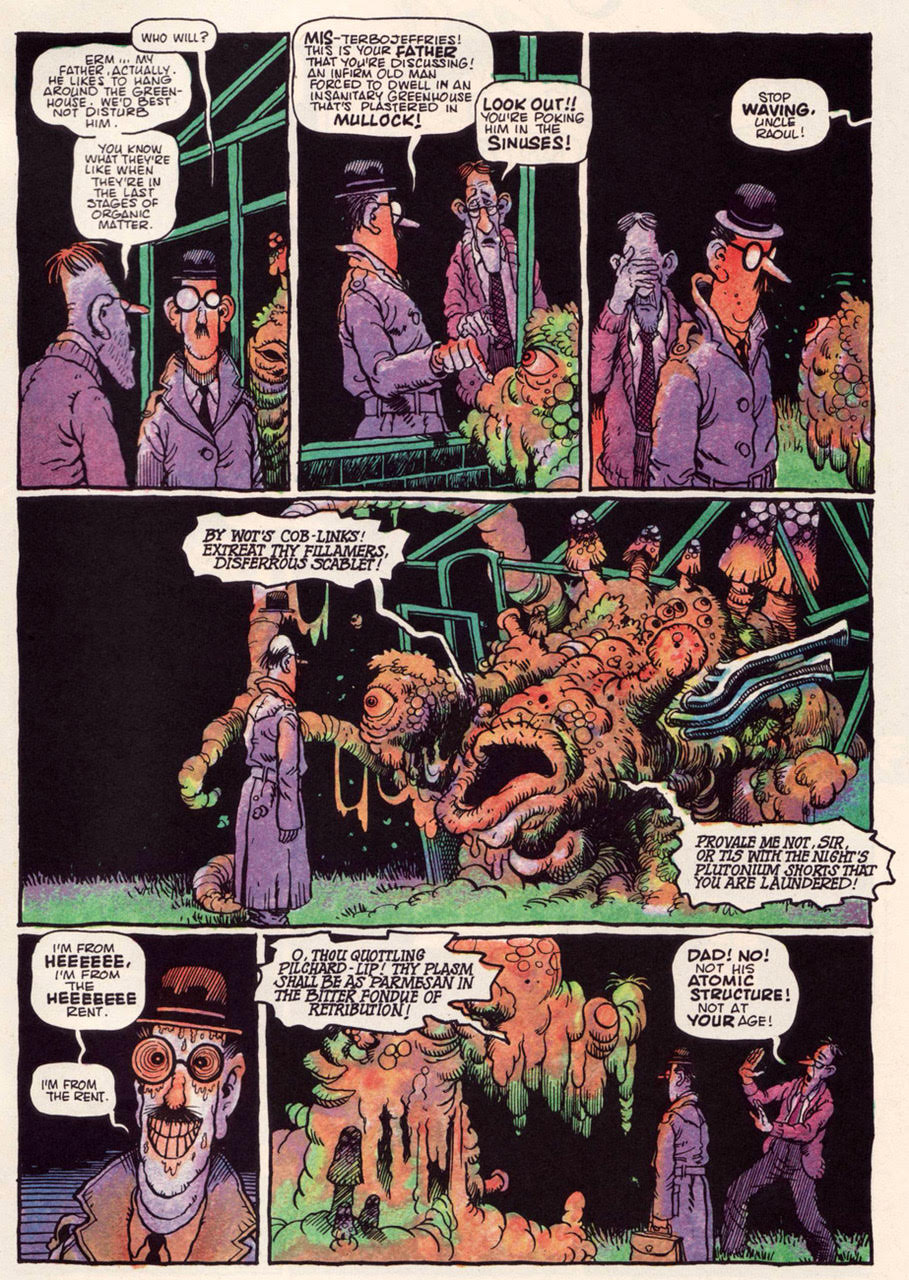
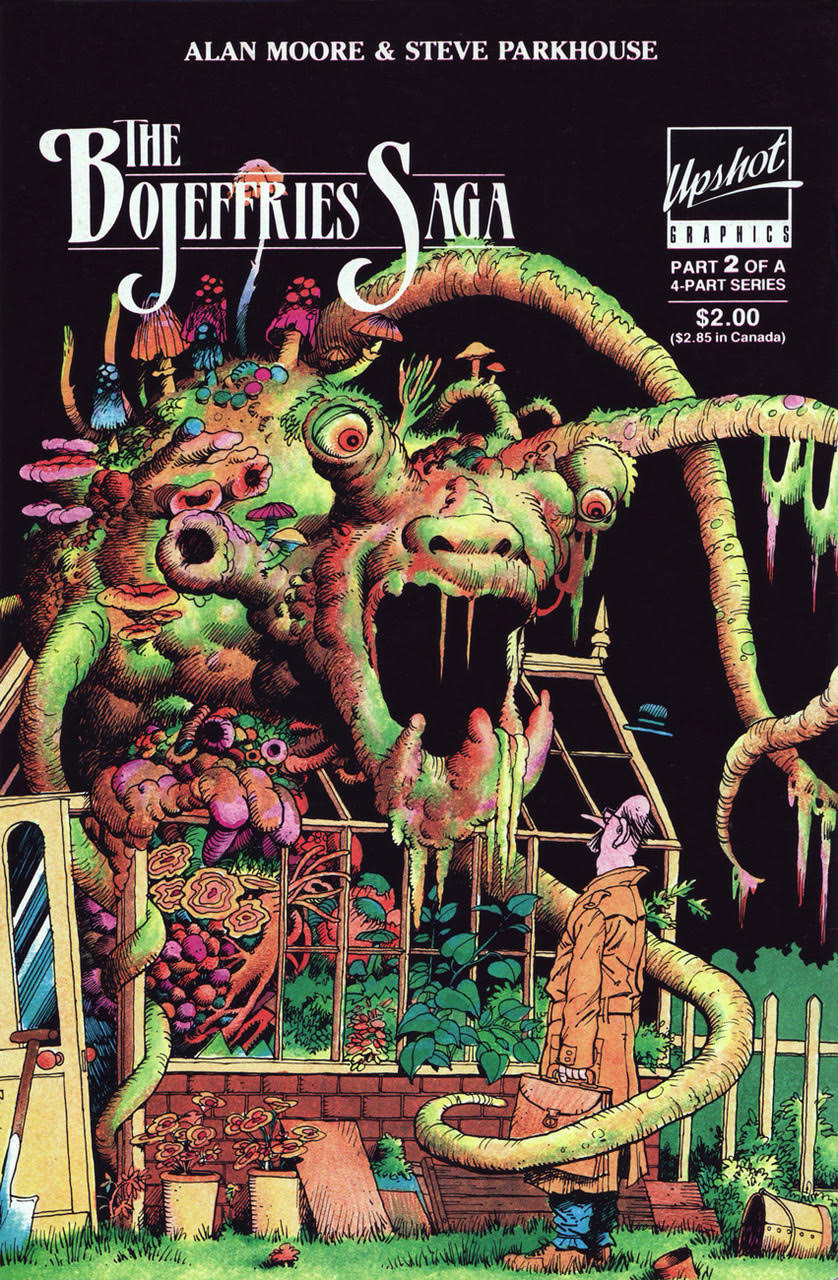
The Bojeffries Saga (written by Alan Moore and drawn by Steve Parkhouse) concerns itself with a loosely-tied group of relatives all of whom are supernatural and/or insane and some of whom have vaguely Slavic names, for added hilarity. The family consists of the two uncles Zlüdotny (a werewolf and a vampire); a nuclear baby (whatever that means); the close-knit trio of father, daughter and son, respectively Jobremus, Ginda, and Reth Bojeffries; and last but not least, grandpa Podlasp, whose tentacles you can admire below. Not, it’s not “Podslap”, although he does slap people on occasion.
The first Bojeffries tale, « The Rentman Cometh », appeared in black and white in British Quality Communications anthology Warrior, to be more precise Warrior no. 12, August 1983. Here you have it in glorious (and appropriately stomach-churning) colour thanks to a reformatted & coloured (by Kenneth Smith) reprint in Flesh & Bones no. 2, 1986 (Fantagraphics).
The main… err, hero… of this tale is Trevor Inchmale, a fastidious pain-in-the-ass bureaucrat, who, whilst day-dreaming of glory, accidentally discovers the existence of a tenant who owes the council £32,000 in rent arrears. Guess who the tenant is? And guess what happens to Inchmale? (Hint: a flower pot is involved.)
The back cover of Flesh & Bones no. 2, 1986 (Fantagraphics). Getting to spend a little time with Dalgoda (Jan Strnad and Dennis Fujitake) and then visiting with the Bojeffries? Yes, please!
I have The Bojeffries Saga collection issued in 2014 by Topshelf Productions in collaboration with Knockabout Comics. Mr. Parkhouse calls it « the complete and final edition », so who am I to argue with that? He also says, in his introduction, that « throughout its entire run the Bojeffries has been sheer, unmitigated fun. It’s been tough, it’s been demanding – but the end result has always made me laugh. »
Let’s end on a properly horrible (or at least horripilating) note.
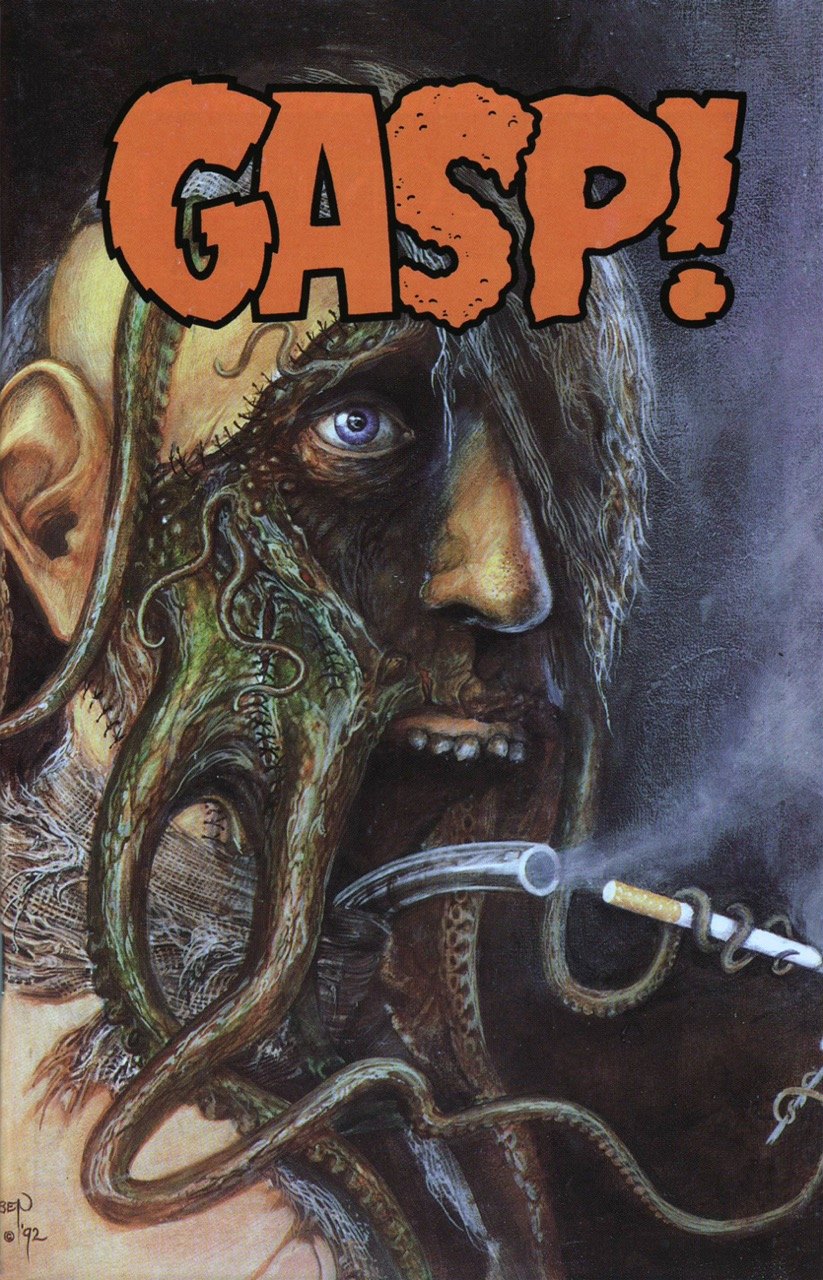
This could be part of a pretty convincing anti-smoking campaign. Gasp!, 1994; cover by John Totleben (a recycled painting of his from 1992, actually).
In 1994, Quebecor Printing sponsored Gasp!, a sampler of some independent titles (and not necessarily anything to do with horror, despite what the cover suggests). Its contents are a bit of a hodge-podge, with some highlights and some clunkers. You can get more information about the authors and stories within here.
A group of octopuses, by the way, is called “consortium”, although “octoposse” would perhaps make more sense.





 « Over time, Jansson came to feel exhausted by the Moomins and that their success had obscured her other ambitions as an artist. In 1978, she satirized her situation in a short story titled “The Cartoonist” about a man called Stein contracted to produce a daily strip, Blubby, which has generated a Moomin-like universe of commercial paraphernalia—“Blubby curtains, Blubby jelly, Blubby clocks and Blubby socks, Blubby shirts and Blubby shorts.” “Tell me something,” another cartoonist asks Stein. “Are you one of those people who are prevented from doing Great Art because they draw comic strips?” Stein denies it, but that was precisely Jansson’s fear. » (

 Who's Out There?