« Things are never quite as scary when you’ve got a best friend. » — Bill Watterson
Hey, it’s our 500th post!
Who’d have the heart to resist Sheldon Mayer’s adorable toddlers (profiled here last year) if they came around trick or treating at your door? Even if you did resist, they’d be sure to get their grabby little mitts on the goods… some other way.
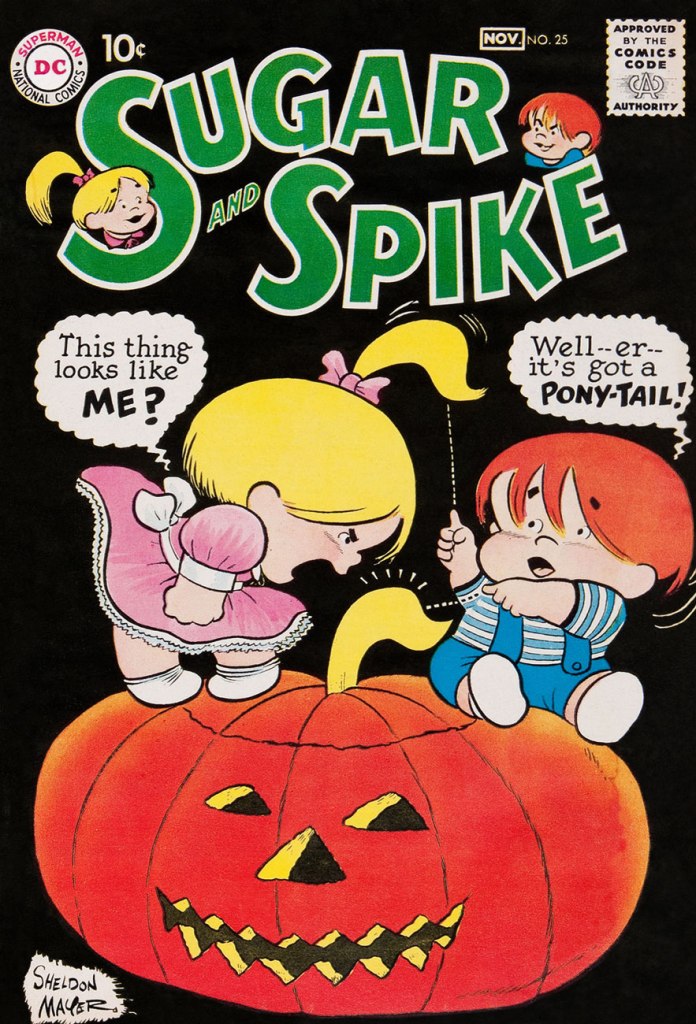
This is Sugar and Spike no. 25 (Oct.-Nov. 1959, DC).
This is Sugar and Spike no. 31 (Oct.-Nov. 1960, DC). Definitely my favourite of this splendid lot, largely thanks to that meticulous, understated colouring job. Jack Adler‘s doing, I’ll wager.
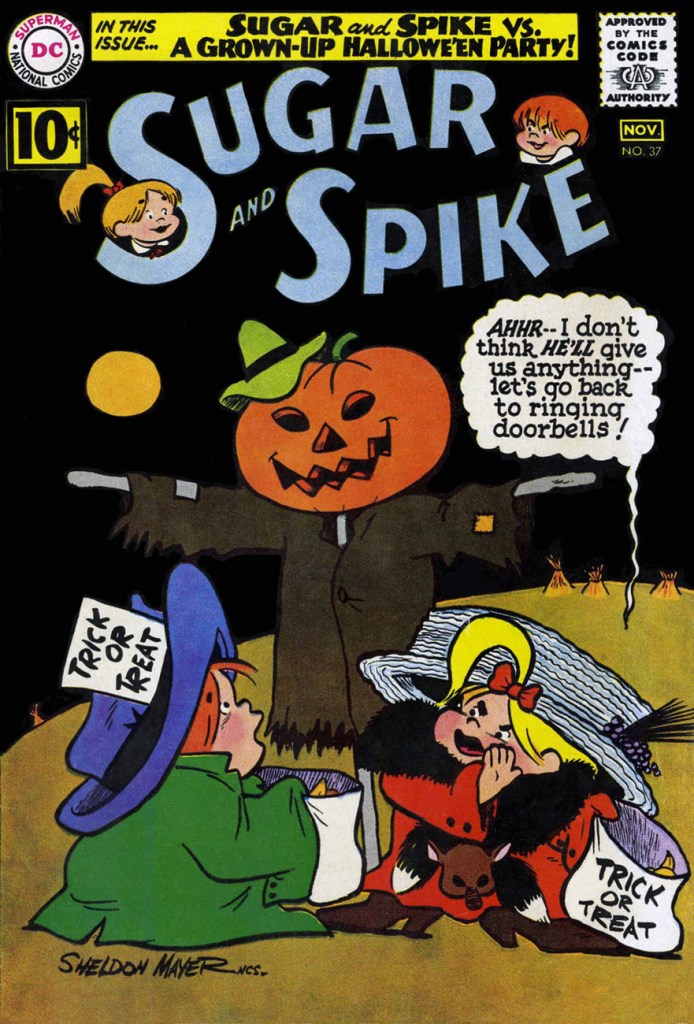
This is Sugar and Spike no. 37 (Oct.-Nov. 1961, DC).
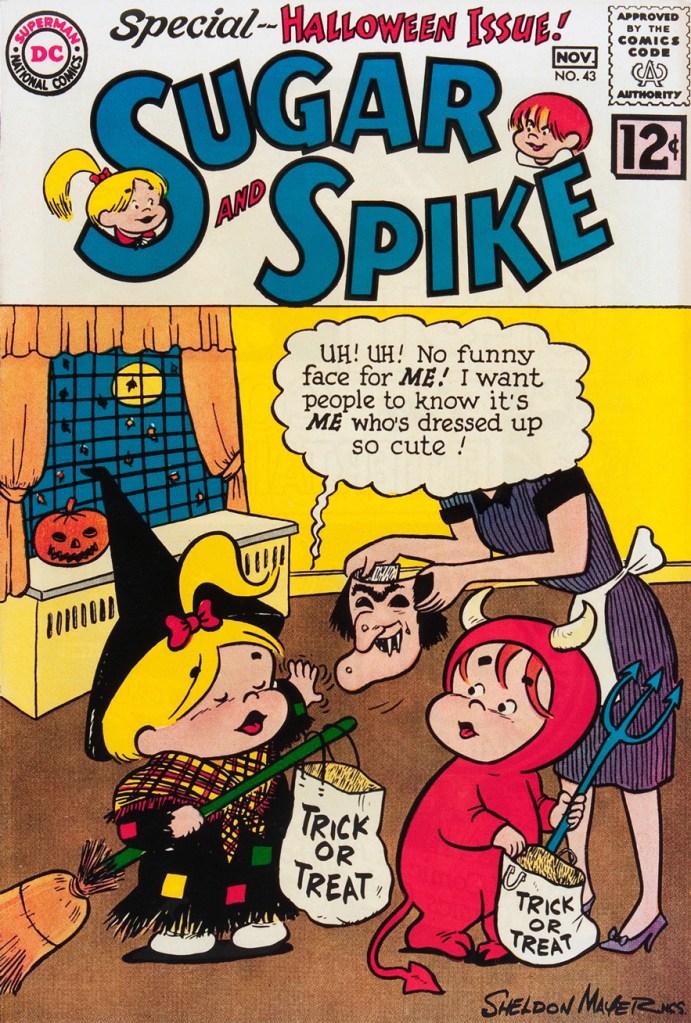
This is Sugar and Spike no. 43 (Oct.-Nov. 1962, DC).
This is Sugar and Spike no. 49 (Oct.-Nov. 1963, DC).
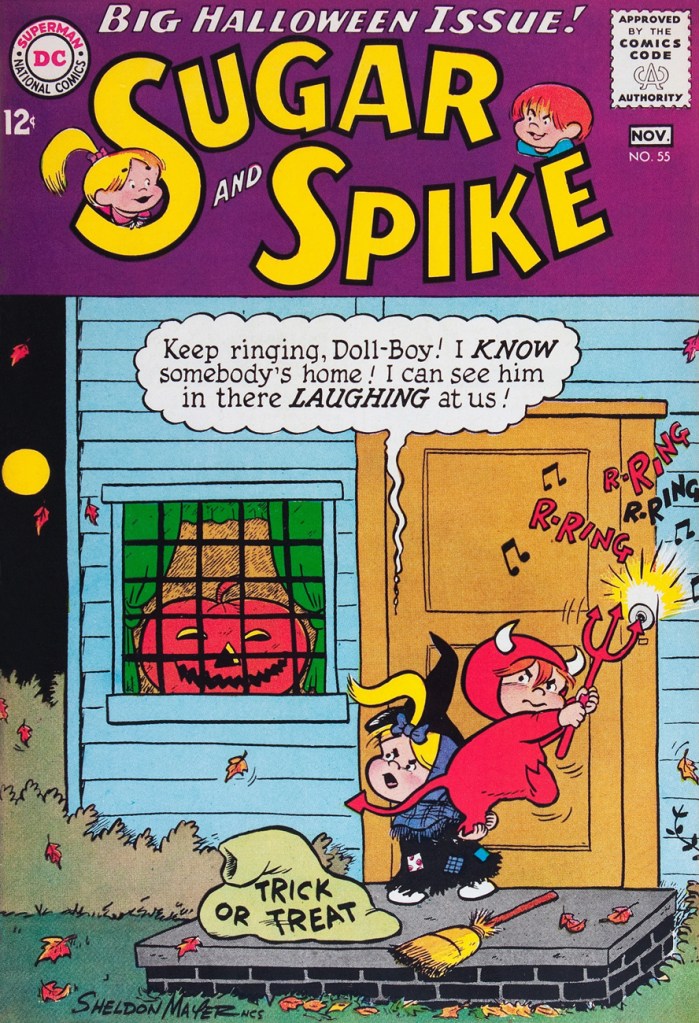
This is Sugar and Spike no. 55 (Oct.-Nov. 1964, DC).
This is Sugar and Spike no. 61 (Oct.-Nov. 1965, DC).
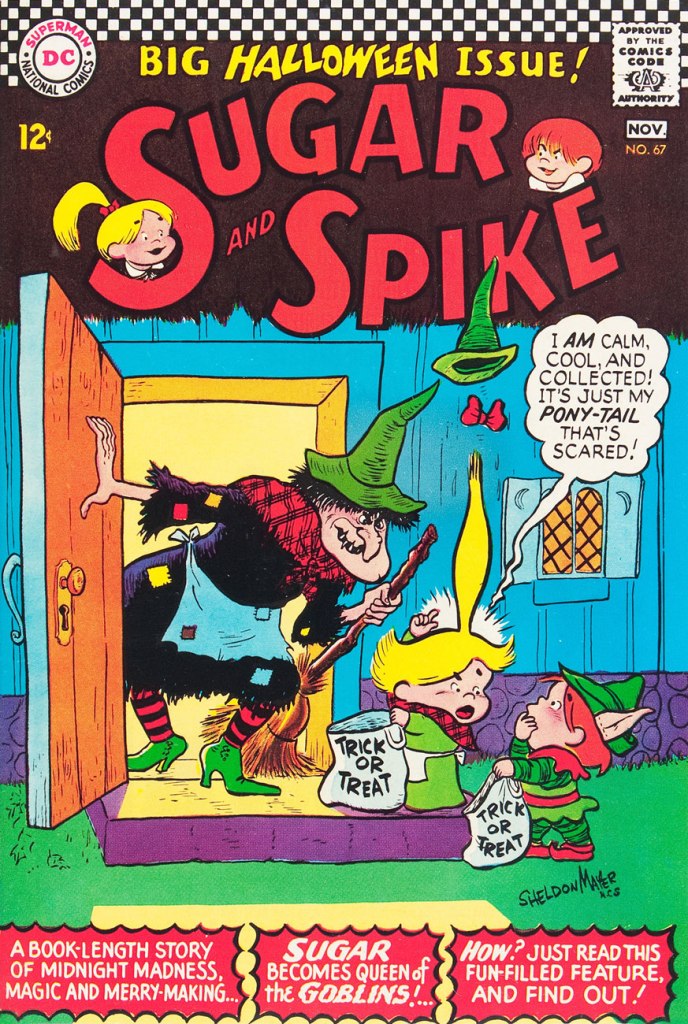
This is Sugar and Spike no. 36 (Oct.-Nov. 1966, DC).
A reprint? Not quite. This cover scene, which originally appeared back in issue 55, was reprised (redrawn, not reprinted) for the series finale, Sugar and Spike no. 98 (Oct.-Nov. 1971). I’d hate to take part in a contest announced in the last issue of a series. There *was* a no. 99, but it was a one-shot that only followed… 21 years later.
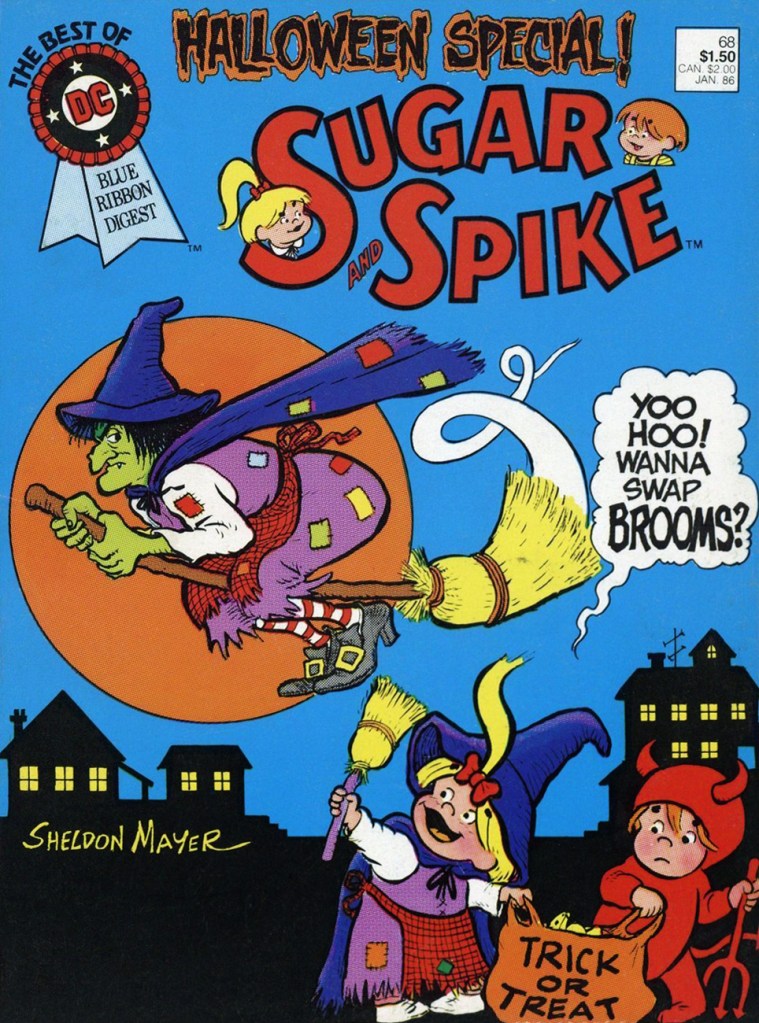
This is The Best of DC no. 68: Sugar and Spike (Jan. 1986). Edited by Nicola Cuti, and with a new cover by Mr. Mayer. Mostly reprints, but with material of this calibre, who’s to quibble?
I was initially set to feature just a couple of Sugar and Spike Hallowe’en covers, but in the end, it seemed unfair to play favourites.
« And they sure seem to understand each other! Listen to them jabber away! » « Oh, come on — you know that’s only baby-talk! It doesn’t mean anything! »
If you were to ask me (make that *us*; we’re unanimous on that point) what was the most consistently excellent American comics series of the Silver Age, the response would be Sheldon Mayer’s Sugar and Spike. « Say what? », I expect most of you will say. Look at it this way: S&S ran for 98 issues from 1956 to 1971, the entire series crafted by a single creator-writer-artist, whose commitment and level of quality never flagged. Unlike, say, Fantastic Four (the most likely pick, I expect), it didn’t take several issues to find its legs, it didn’t suffer from mediocre to dreadful inkers for half of its run, nor, well, the glory-hogging participation of Stan Lee. At Marvel, I’d be more inclined to propose Steve Ditko‘s (and dialoguists Stan Lee, Don Rico, Roy Thomas and Dennis O’Neil’s) run on Doctor Strange (1963-66)… but we again run into the snag of the directionless twaddle that followed Ditko’s departure. In terms of superheroes, my vote would go to Arnold Drake, Bob Haney and Bruno Premiani‘s Doom Patrol (1963-68). Yet my overall number two would have to be Carl Barks‘ Uncle Scrooge* (1952-66). There as well, lesser hands took over once Barks stepped away. It’s an industry, after all.
Speaking of lesser hands, « The Sugar and Spike tales flowed exclusively from Mayer, who had a contract stating no other artist or writer could produce stories featuring his toddler characters. That’s a rare sort of deal to cut (then or now) for a property that the publisher owns outright, but Sheldon Mayer had more than earned his place at DC as a prolific writer, artist and editor for many years. » Of course, that covenant was pointlessly broken by DC after Mayer’s passing. Shame on you, Keith Giffen. Mayer had also asked that his wonderful 1970s creation, The Black Orchid, never be given an origin or have her mystery dispelled. But of course, in 1988, that trust was pointlessly broken by DC. Shame on you, Neil Gaiman (« Well, Alan made the Swamp Thing a vegetable, I’ll make the Black Orchid a plant… he’ll be so proud of me! »)
It’s no exaggeration to claim that Sheldon Mayer (1917-1991) was one of the essential architects of the US comics industry. Without him, DC would have passed on Superman, and without the Man of Steel, it’s a cinch our culture would be in a vastly different state, pour le meilleur et pour le pire. But that’s just one of his many contributions, direct and indirect. Much praise has been heaped on Mr. Mayer, justifiably so. His work is inspired, lively, absolutely hilarious, and life-affirming. He truly was a versatile giant. Check out Ron Goulart’s recollections of his friendship with Mr. Mayer, for instance.
This is Sugar and Spike no. 36 (Aug.-Sept. 1961). In case you’re wondering, the NCS after Sheldon’s signature indicates his membership (in good standing!) in the National Cartoonists’ Society.
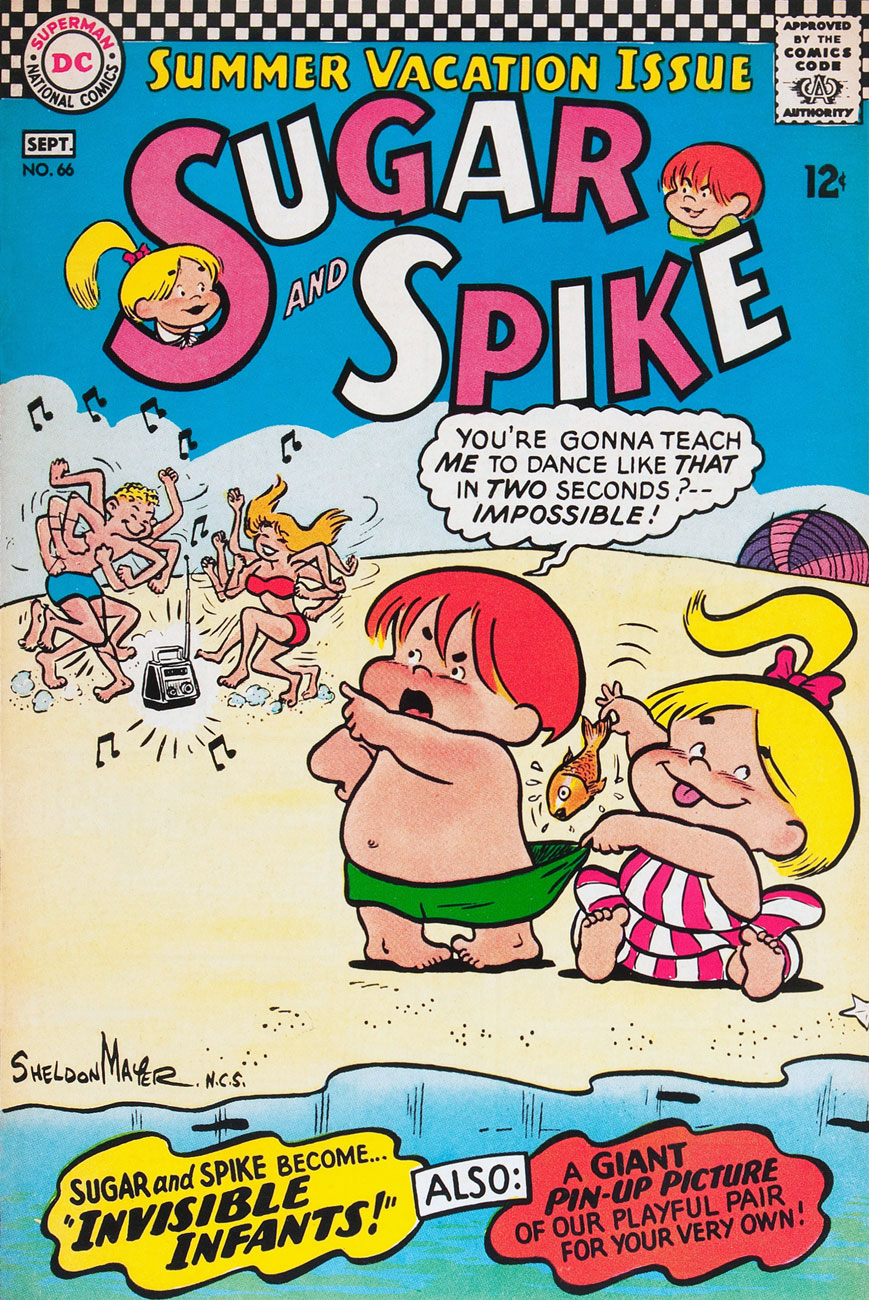
This is Sugar and Spike no. 66 (Aug.-Sept. 1966).
This is Sugar and Spike no. 79 (Oct.-Nov. 1968).
This is Sugar and Spike no. 80 (Dec. 1968-Jan. 1969).
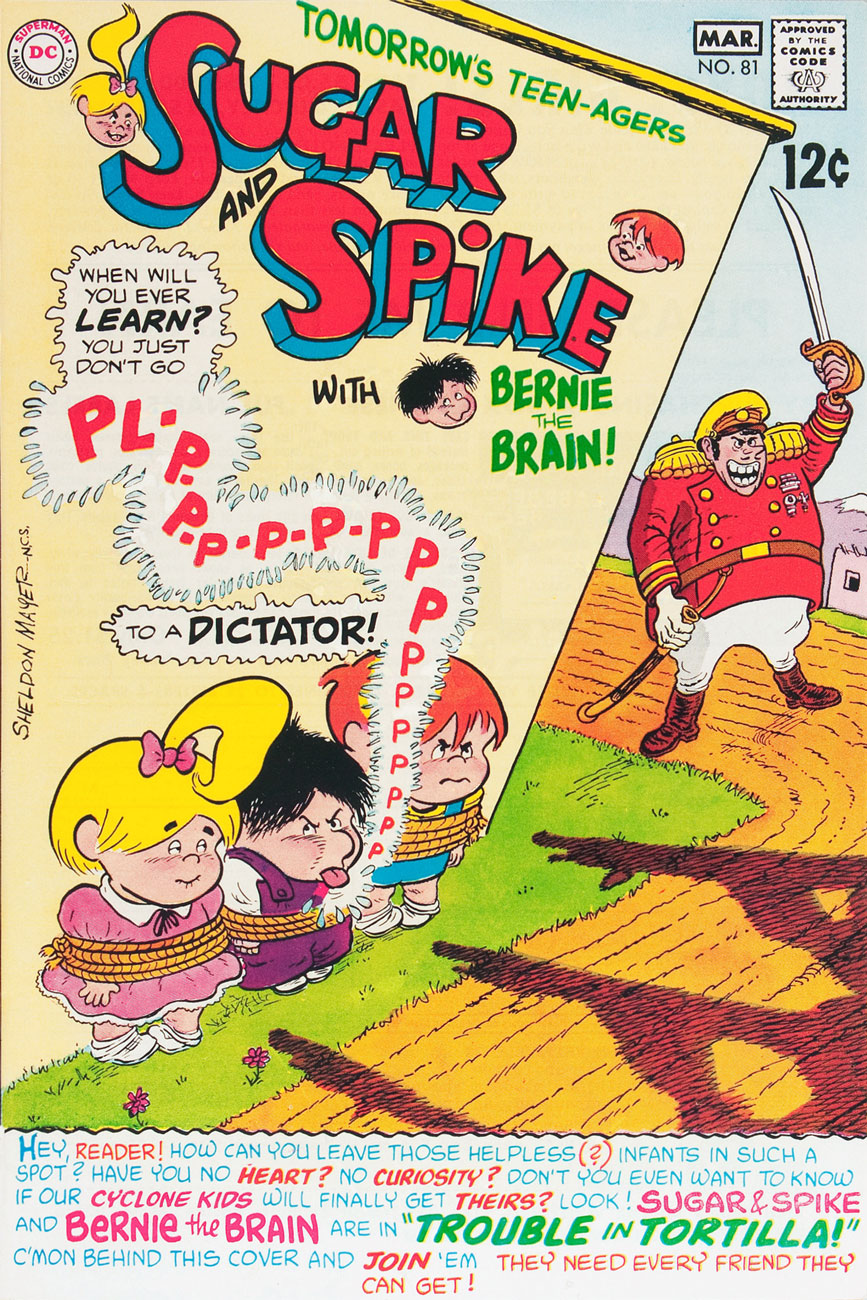
This is Sugar and Spike no. 81 (Feb.-Mar. 1969).
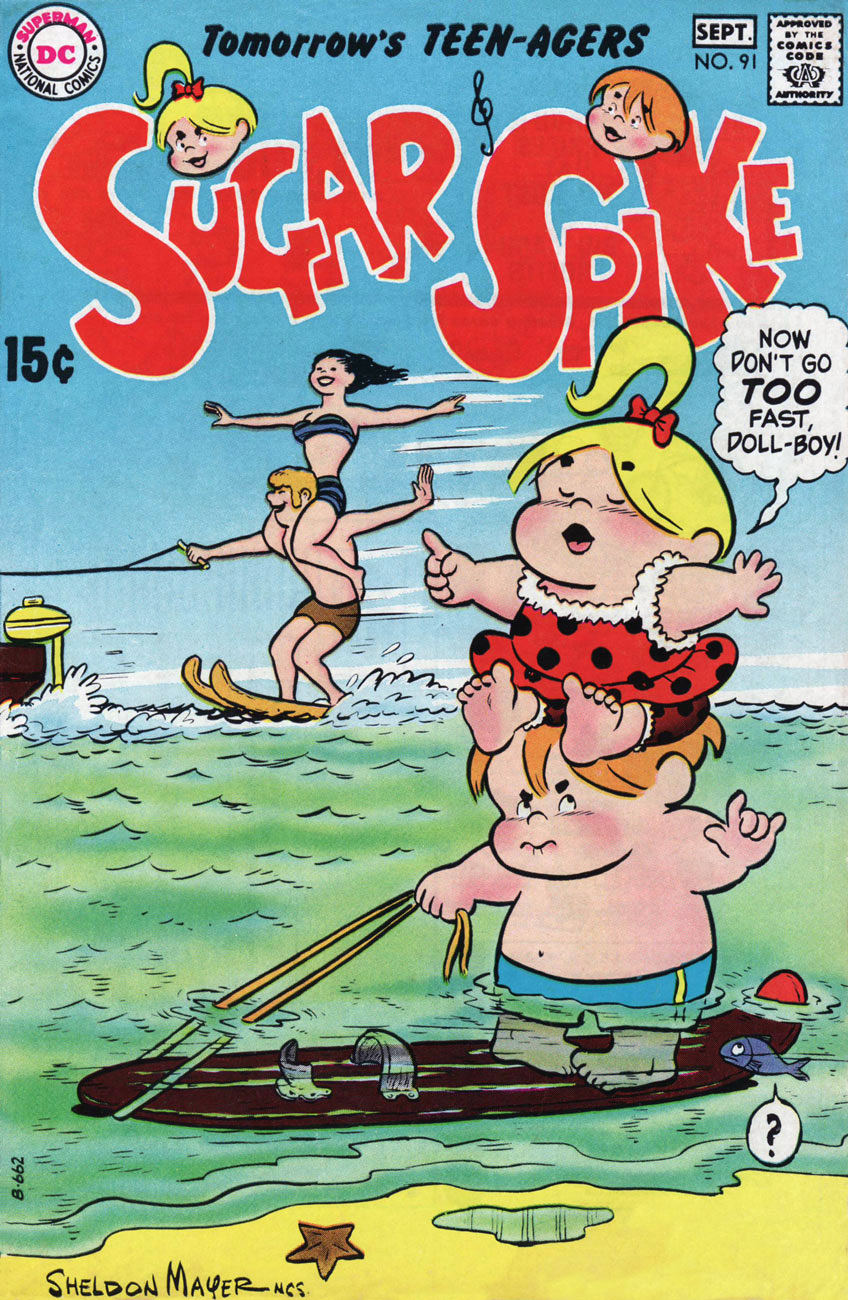
This is Sugar and Spike no. 91 (Aug.-Sept. 1970).
This is Sugar and Spike no. 96 (June-Jul. 1971).
This is Sugar and Spike no. 97 (Aug.-Sept. 1971). You’ll notice we’re featuring a lot of beach scenes… well, it’s seasonal!
In what I imagine to be another benefit of Carmine Infantino‘s editorial ascent, Mayer’s work took a wild turn with issue 72 of S&S. A fine new character, Bernie the Brain, was introduced, Mayer’s layouts suddenly adopted extreme and distorted perspectives and his inking grew more florid and detailed. Honestly, Mayer’s work at that point was the closest DC ever came in style to that of Underground Comix. These changes gradually ebbed, and by issue 90, things were more-or-less back to the old standard. The cause? failing eyesight (cataracts, to be exact), which led to the book’s cancellation, rather than the more banal dropping sales. Don’t worry, Mayer underwent successful eye surgery and intermittently returned to the drawing board. But he mostly wrote… beautifully. We’ll return to that soon.
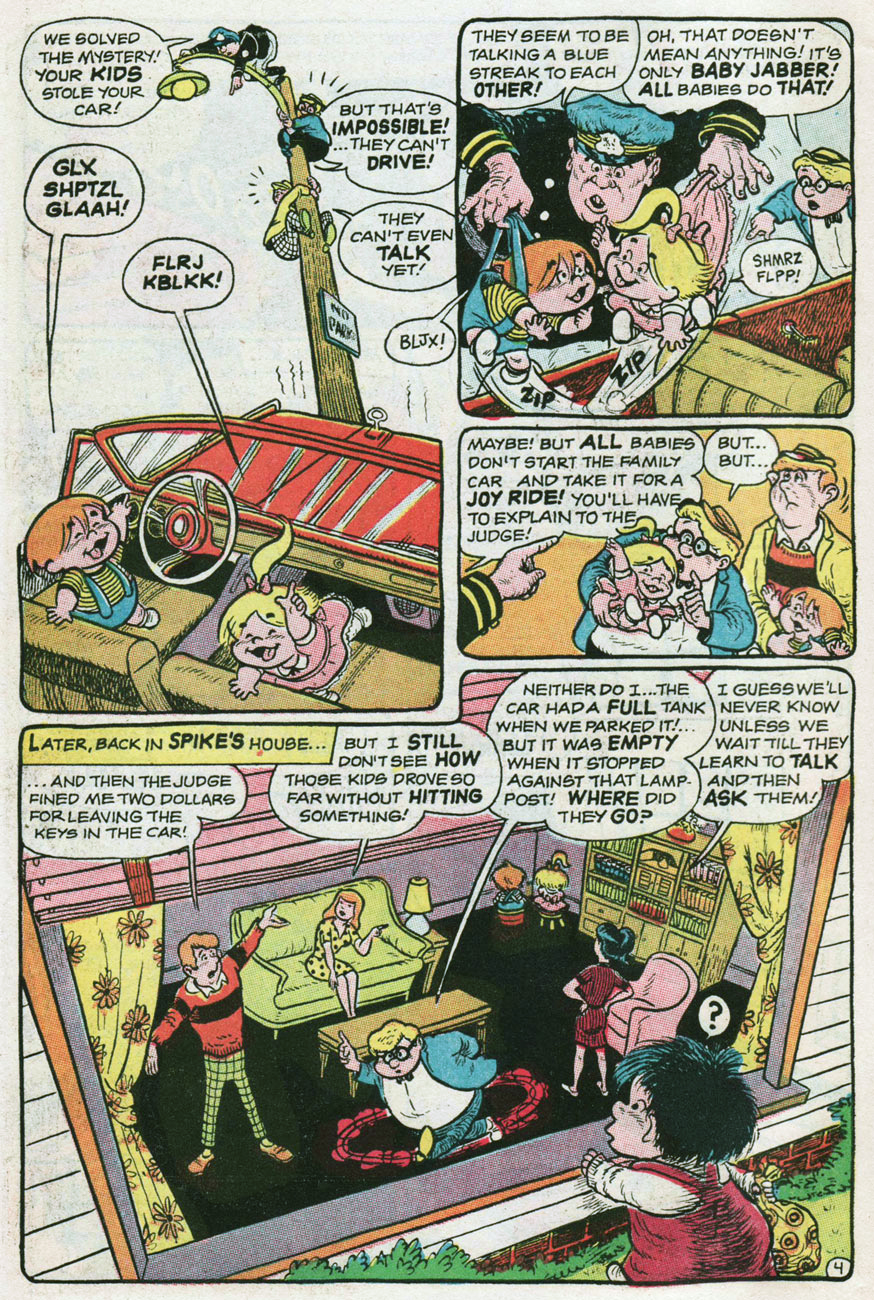
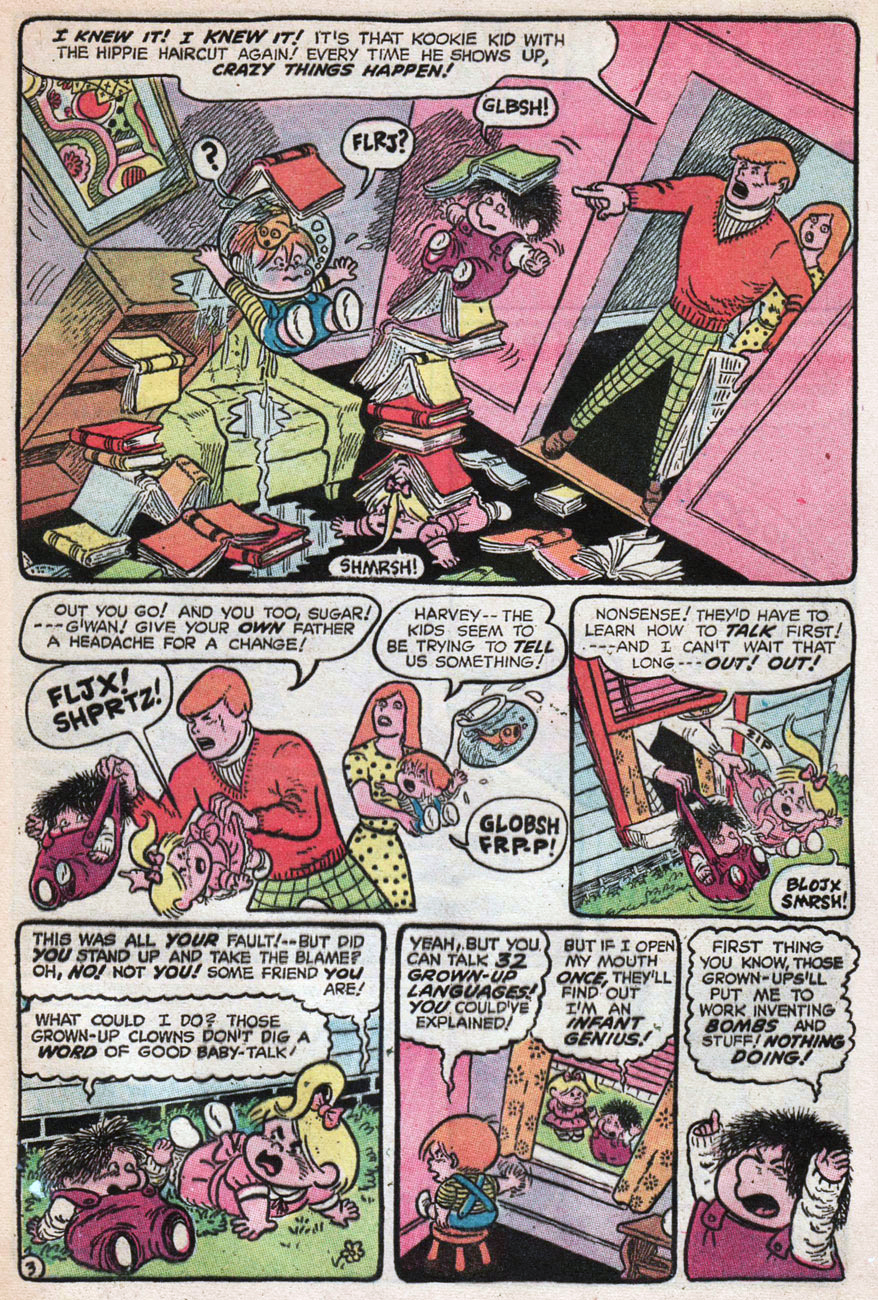
Here are a few examples (show, don’t tell!) of the wild ‘n’ wooly Sugar & Spike:
Page 15 from Sugar & Spike no. 79‘s The Mystery of the Swiped Sea-Turtle (Oct.-Nov. 1968)
Page 4 from Sugar & Spike no. 80‘s Adventure Inside a Monster! (Dec. 1968-Jan. 1969)
Page 3 from Sugar & Spike no. 84‘s Bernie the Brain’s Biggest Blunder! (Aug.-Sept. 1969)
Unfortunately, Sugar and Spike falls in that select category of comics series that aren’t popular enough to be fully reprinted (DC issued one volume in its Archive Editions series, usefully reprinting S&S nos. 1 to 10) and too popular to be truly affordable (Angel and the Ape is another). In addition, since the series sold well, but to a broader audience than the traditional fanboy collector set, the books are mighty hard to come by in decent condition, not to mention *complete*. The reason? Paper dolls. They enjoyed, for quite some time, great popularity. Sugar and Spike’s regular Pint-Size Pin-Ups frequently ran on the back of story pages (often the conclusion!), so their absence is a real collector’s bugaboo. Besides, they were quite charming, so why do without them?
Pint-Size Pin-Ups from Sugar and Spike no. 78 (Aug.-Sept. 1968). I should also point out that Mr. Mayer kept a sincere, attentive, unpatronizing relationship with his readers.










 Who's Out There?