Take Ten With Shel Silverstein

« Join the army and see the next world. » — Dylan Thomas

A couple of eternities ago, in Shel Silverstein: Without Borders, we profiled you-know-who and showcased the travel cartoons he produced for Hugh Hefner and Playboy Magazine. Now, we reach back even earlier, to his first stirrings as a professional cartoonist… and a lifelong rover. As it would turn out, Shel truly was a free spirit.

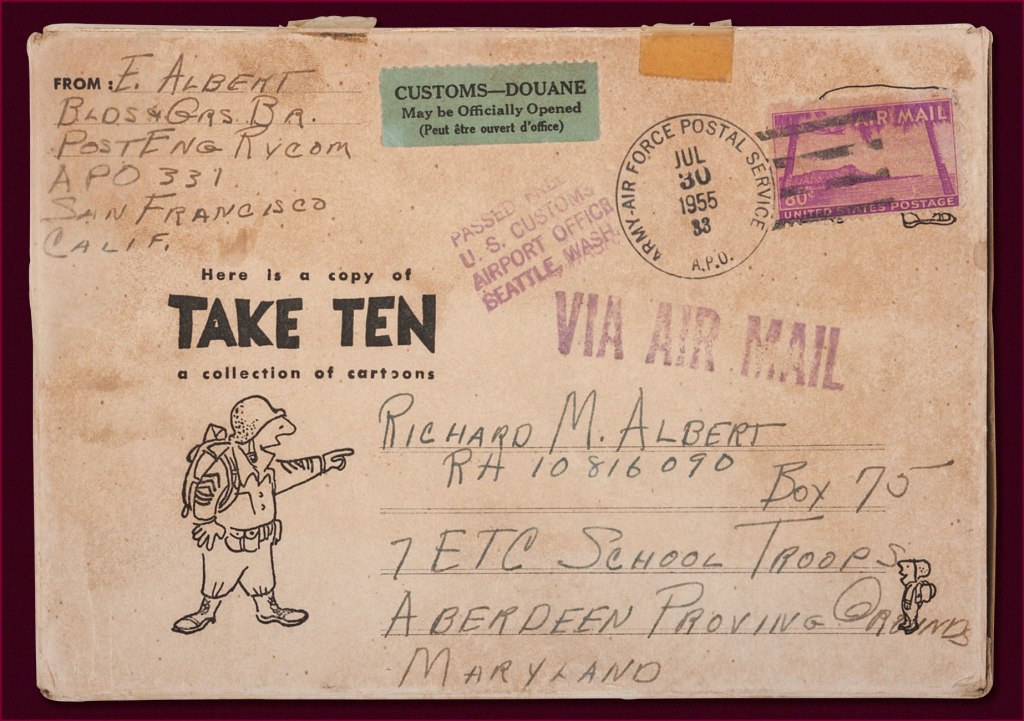
A little bit of biography to set the stage… circa 1955. I can just about hear him, in that distinctive voice of his, hawking hot dogs at Comiskey Park!
« In 1955, Stars and Stripes published Take Ten, a book collection of his cartoons that was sold through military PXs et commissaries. » And also by mail!
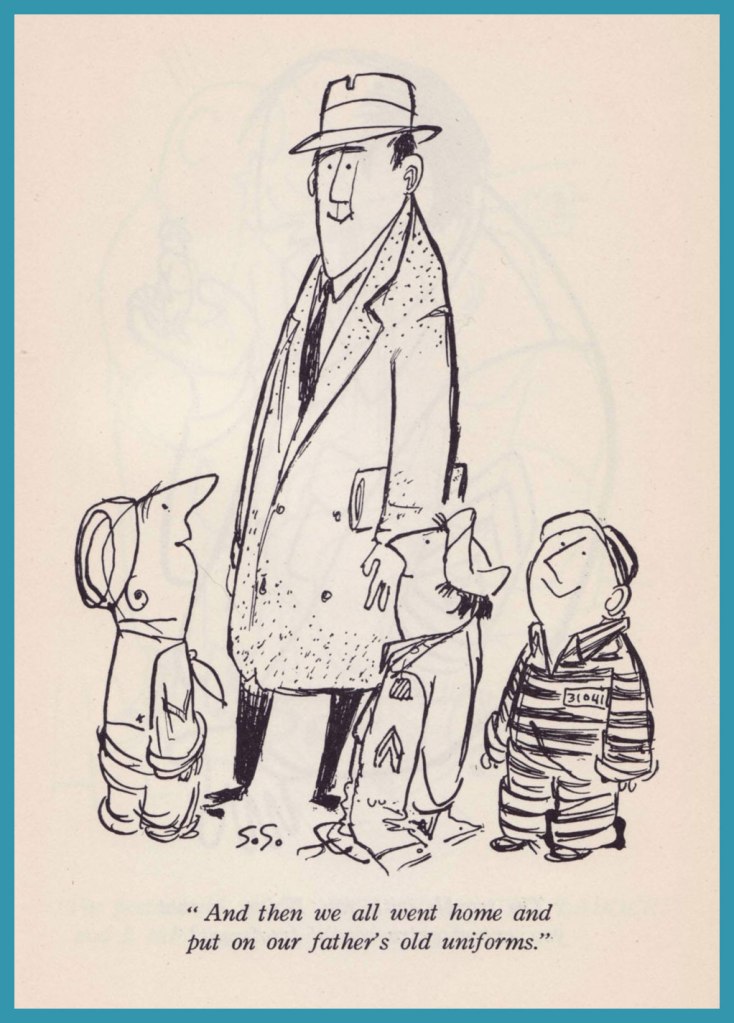
« Here they are… the Centaurs and Bird men… the Geniis and Cobras… the fifteen-foot PFC’s and two-inch E-1’s. Here is TAKE TEN, the first collection of Shel Silverstein’s cartoons, taken from Pacific Stars and Stripes, Army Times and his untapped top drawer. Here is a pocket-full of cartoons that will make you smile and chuckle and laugh out loud. »

Lisa Rogak writes, in her A Boy Named Shel (2007, St. Martin’s Press):

Once he arrived in Tokyo, Shel was assigned to the Pacific Stars and Stripes to past up stories and photo features for the paper. When his work was done — which he performed as quickly as possible — he turned his attention to drawing cartoons using the material that was right in front of him: the military. Shel roamed the streets of Shinbashi, a neighborhood that GIs frequented that once served as the end of the line of Japan’s first railroad. He spent hours each day wandering the streets taking note of the activities of his fellow soldiers, which would invariably end up in one of his cartoons.

He initially did it for his own amusement, through within a few weeks, the paper began to print his work. After spending six months juggling newspaper paste-up with cartooning, he convinced his editors to take him off layout duties and allow him to wander the Far East and send back reports in the form of one-panel cartoons. They agreed.

Evidently, Mrs. Silverstein’s boy was a most charming and persuasive fellow. He would soon pull the same stunt on Hugh Hefner… but none can claim, in either case, that he failed to deliver on his lofty promises!

Here’s a little bit of background on that famous old General, should you need it.
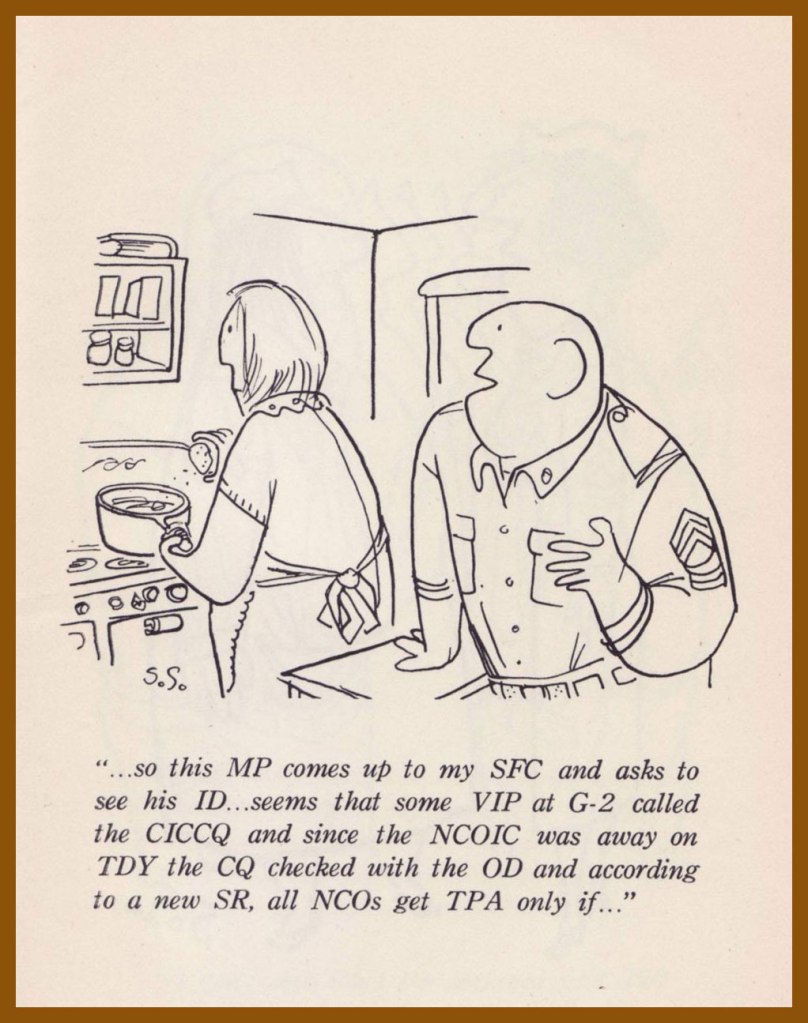
Here’s a helpful guide to US Military acronyms. Who knows, it might spare you some confusion one day.

Even with his freedom, Shel had a hard time dealing with the restraints of army protocol. Corky Alexander, the late editor of the English language Tokyo Weekender, first met Shel at Stars and Stripes. “He was an army corporal and was perhaps the worst soldier in the history of armed might, down through the ages,” he said.

His technique followed a simple pattern. First he thought of an object — say, his first sergeant. He’d concentrate until he would come up with 20 or 30 gags on the one subject. Out of it came situations peopled by his long-nosed characters, his little men, his giants, the animals and the strange creatures for which he has a special affection.

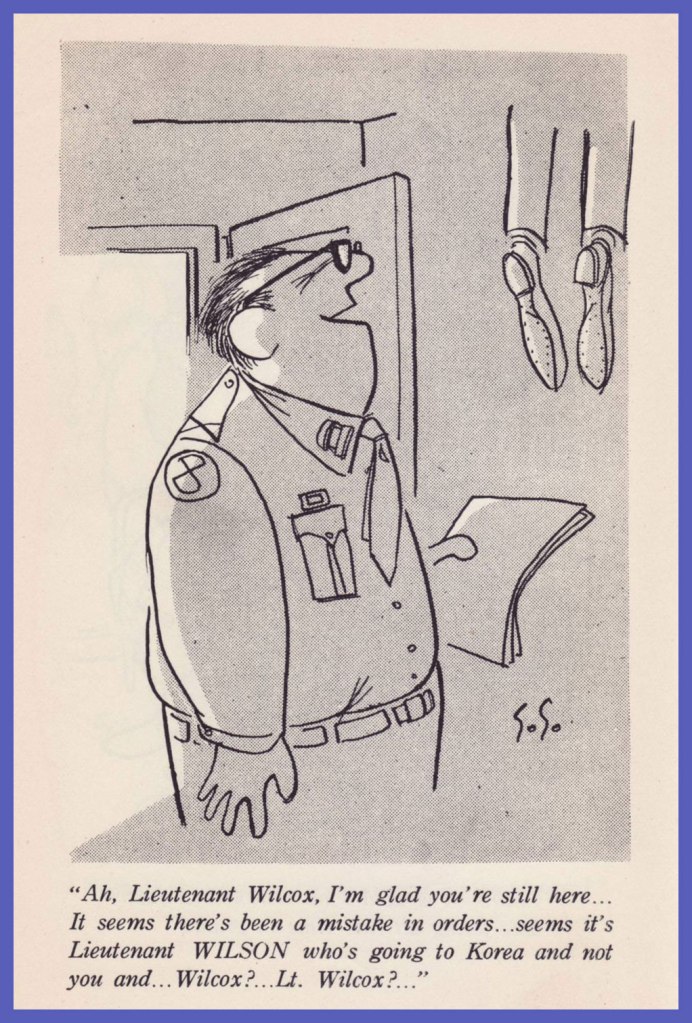
His favorite overall targets were the officers. “They even made zebras off-limits to me because they had stripes,” Shel said.

Old habits die hard. An occupational hazard, you might say.
This, er.. pet might be an early prototype of Shel’s mythic Floobie Doobie Doo.
Now what is that?
It ain’t no dog and it ain’t no cat.
It’s nine feet tall with eyes of blue.
I never seen such a thing
As a thing called a Floobie Doobie Doo.
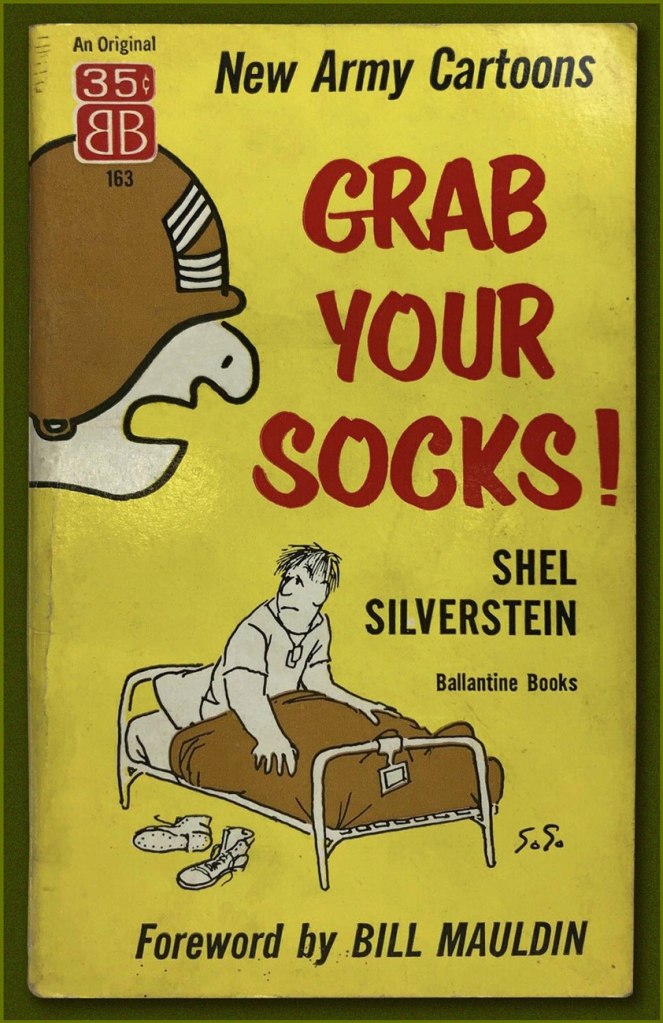
« Shel’s humor had struck such a nerve, and soldiers based in the Pacific shared his cartoons with their families and other civilians to show them what life in the military was really like, that a larger audience for his work was a natural consequence. In 1956, Ballantine Books published a thirty-five-cent mass market paperback edition of Take Ten called Grab Your Socks! »

In his foreword to Take Ten, Shel’s good buddy and PS&S colleague Bob Sweeney recounts:

In a letter to the home office, Bob Brown of the S&S Seoul Bureau wrote:
He stays up all night chewing pencils, drawing cartoons and writing ideas on little scraps of paper he never finds again. In the first twenty minutes he was here he had our little office more cluttered than the convention hall in his native Chicago.”

But,” added Brown, “he knows the people he draws. He’s lived through the same experiences and heard the same lines.

Here then are the simplicities as well as the subtleties — the obvious and the obtuse — the wonderful conglomerate of a man who loves to write, to draw, to create — and best of all — who loves to laugh.

-RG

Philosophy From the Foxholes: Bill Mauldin

« Wherever despotism abounds, the sources of public information are the first to be brought under its control. Where ever the cause of liberty is making its way, one of its highest accomplishments is the guarantee of the freedom of the press. » — Calvin Coolidge

Ah, the pitfalls of anchoring yourself to the news cycle: given the shocking news, last week, of the impending, unjustified closure of one of the greatest American journalistic institutions, the independent military daily newspaper The Stars and Stripes (founded in 1861!). I was all set to cobble together a series of posts showcasing the work of S&S’s greatest cartoonists, but then the massively unpopular decision was just as abruptly reversed. For now.

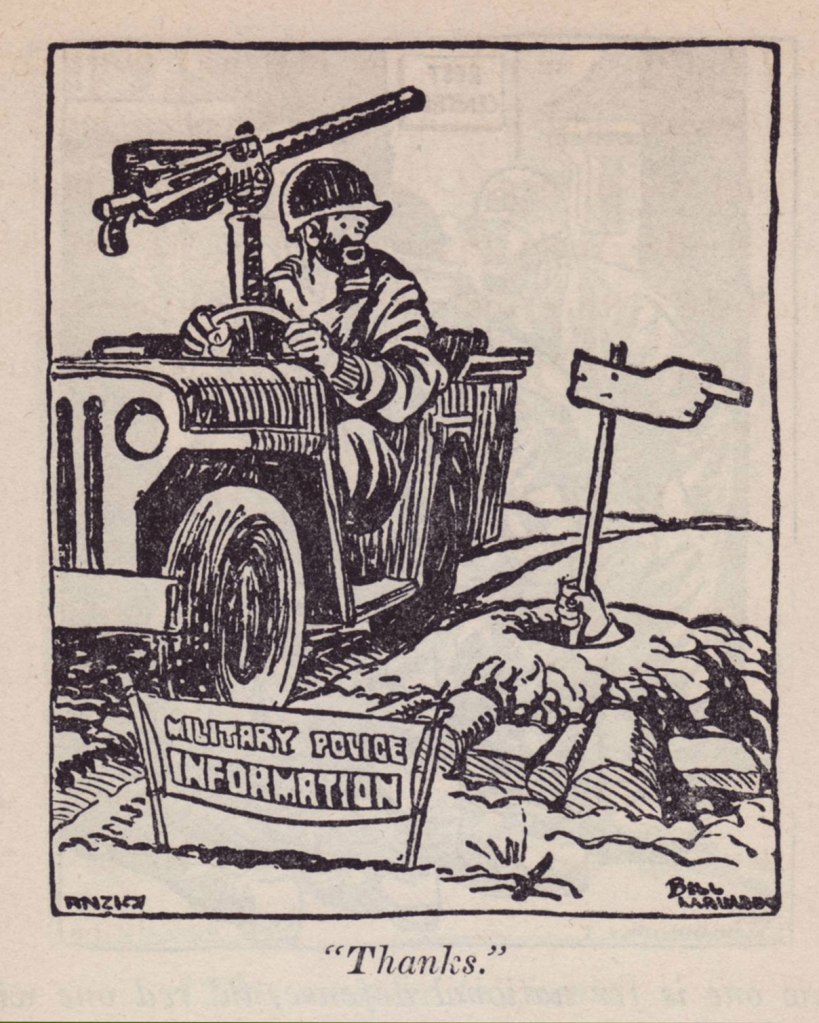
So I’ll stick to one post for the nonce (Shel and Tom will have to wait) and feature one of history’s greatest soldier cartoonists, William Henry “Bill” Mauldin (1921-2003), twice recipient of the Pulitzer Prize (1945, 1958), the Legion of Merit… and a host of other distinctions, both military and civilian.

Our baby-faced artist photographed during WWII.

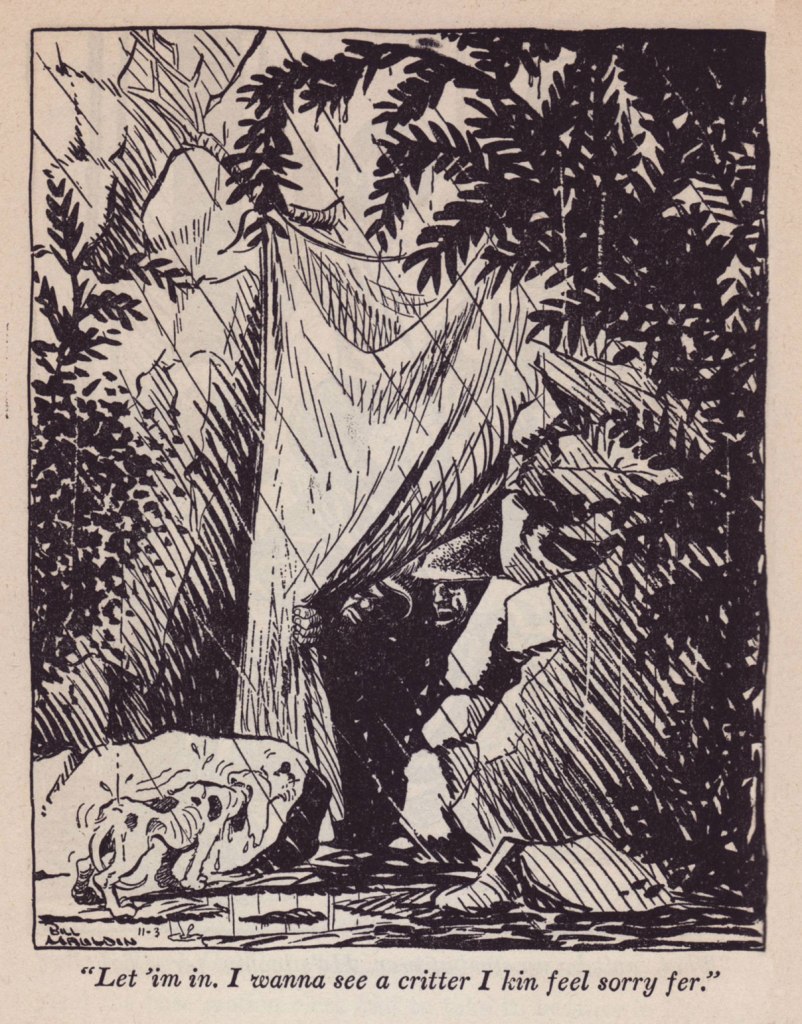
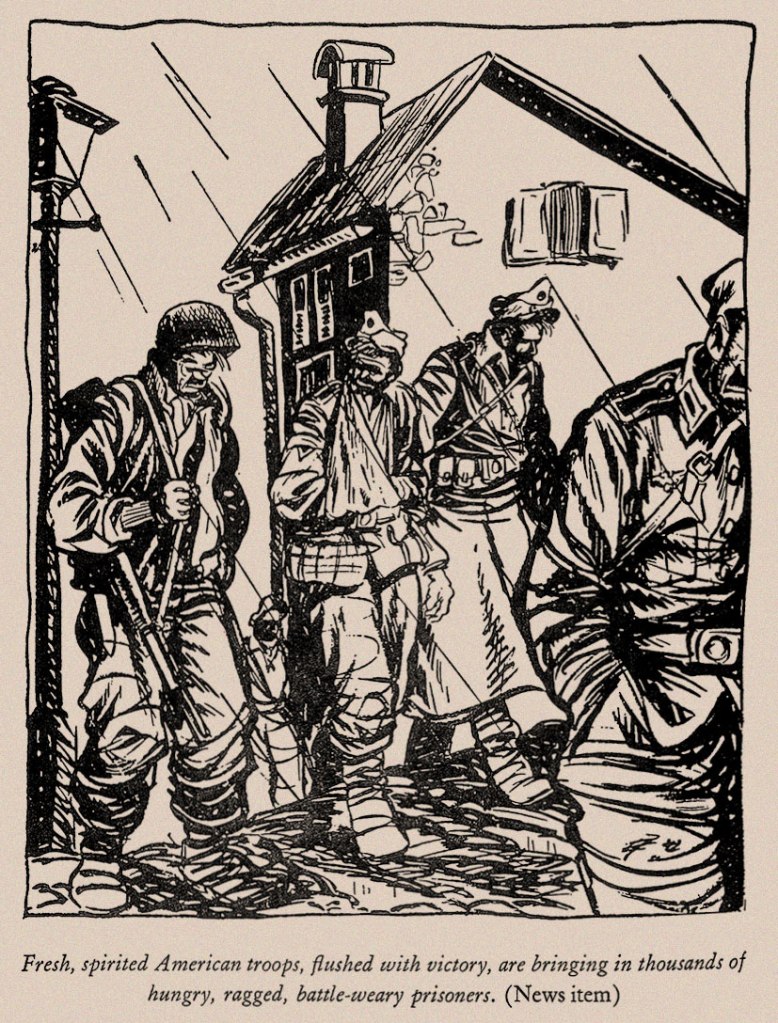
With but a single exception, the following are samples from his essential Up Front collection (1945), which Mauldin humbly opens with: « My business is drawing, not writing, an this text is pretty much background for the drawings. »

But such a background! Mauldin is, naturally, funny and insightful, but there’s much to learn therein, not merely about men in war, but just about everything under the sun. While so many nowadays mix up freedom and privilege, it’s good to be gently reminded of the high price of both.

« Until some intelligent brass hat repaired a big brewery in Naples and started to send beer to Anzio, the boys at the beach-head were fixing up their own distilleries with barrels of dug-up vino, gasoline cans, and copper tubing from wrecked airplanes. The result was a fiery stuff which the Italians called grappa. The doggies called it ‘Kickapoo Joy Juice’, and took the name from the popular ‘Li’l Abner’ comic strip which Stars and Stripes printed daily. It wasn’t bad stuff when you cut it with canned grapefruit juice. »
Mauldin’s biographer, Todd DePastino, wrote, in his Bill Mauldin: A Life Up Front: « First published on October 13, 1944, this cartoon made the 23-year-old Bill Mauldin the youngest Pulitzer Prize winner in history. Both he and his editors at Stars and Stripes were astonished by the selection, which did not seem to them particularly noteworthy. »

For a deeper dive into Mauldin’s war through the eyes of his ragged infantrymen, scrounge yourself a copy of Fantagraphics’ glorious Willie & Joe: The WWII Years (2008).

In closing, shall we hear from another president?

« I have great respect for the news and great respect for freedom of the press and all of that. » — Donald J. Trump

-RG