And Now a Word From Our Sponsor

« Advertising – A judicious mixture of flattery and threats. » — Stephen Leacock

It’s long been established that one can scarcely be too skeptical in the face of advertising, and the sooner one starts questioning its wooly claims, the better. In the early 1950s, Harvey Kurtzman‘s Mad shone the giddily harsh light of truth on, well, just about everything, but Madison Avenue‘s tactics were a favourite and frequent target, and for good reason. In 1956, Kurtzman heatedly left his creation after a mere 28 issues; while it retained much of its cultural influence as its reach increased, it degenerated into rigid formula in the hands of his too-cautious successor at the helm, Al Feldstein.

Fast-forward to 1974, and Dynamite Magazine‘s sixth issue. Readers presumably too young for Mad could now receive their monthly inoculation against the advertising industry’s tainted baloney.

From 1974 to 1981, the feature was illustrated by Calvin Sanford “Sandy” Huffaker, Sr. (1943 – 2020); then the reins were passed into the able paws of future Mad art director (small world!) Sam Viviano. But that’s a tale for another day.

Since Huffaker was only credited for illustrating the feature, it stands to reason that it was written in-house, and that narrows it down to two main candidates: editor Jane Stine or Linda Williams Aber (aka “Magic Wanda”); my money’s on Aber, who also wrote Count Morbida’s Puzzle Monthly Puzzle Pages.

As Dynamite’s ‘Inside Stuff’ table of contents always billed it, here’s « A Dynamite look at BADvertising »!

The feature’s inaugural entry, from Dynamite no. 6 (Dec. 1974, Scholastic). The voracious oldster lampooned here is Euell Gibbons, who shilled for Post Grape-Nuts (which contain neither grapes nor nuts!) in this vintage commercial.
From Dynamite no. 7 (Jan. 1975, Scholastic). You might recognize Nancy Walker, aka Rhoda’s mom Ida, and future director of Can’t Stop the Music! (trigger warning: Steve Guttenberg); here she is, pre-orange hair, in a Bounty Paper Towel spot from the Me Decade.
From Dynamite no. 9 (Mar. 1975, Scholastic). Here’s a 1971 Bufferin vs. Aspirin ad. Place your bets!
From Dynamite no. 19 (Jan. 1976, Scholastic). You just may be familiar with the object of this parody.
From Dynamite no. 25 (July 1976, Scholastic). Here’s another ‘wonderful, quickJell-o recipe from those gelatin-happy days.
From Dynamite no. 26 (Aug. 1976, Scholastic). Remember Morris? Here’s the famously fussy feline in a 1974 Nine Lives ad.
From Dynamite no. 27 (Sept. 1976, Scholastic). Here’s a Hamburger Helper commercial of the corresponding vintage.
From Dynamite no. 28 (Oct. 1976, Scholastic). Here’s our pal Poppin’ Fresh in a 1972 commercial.
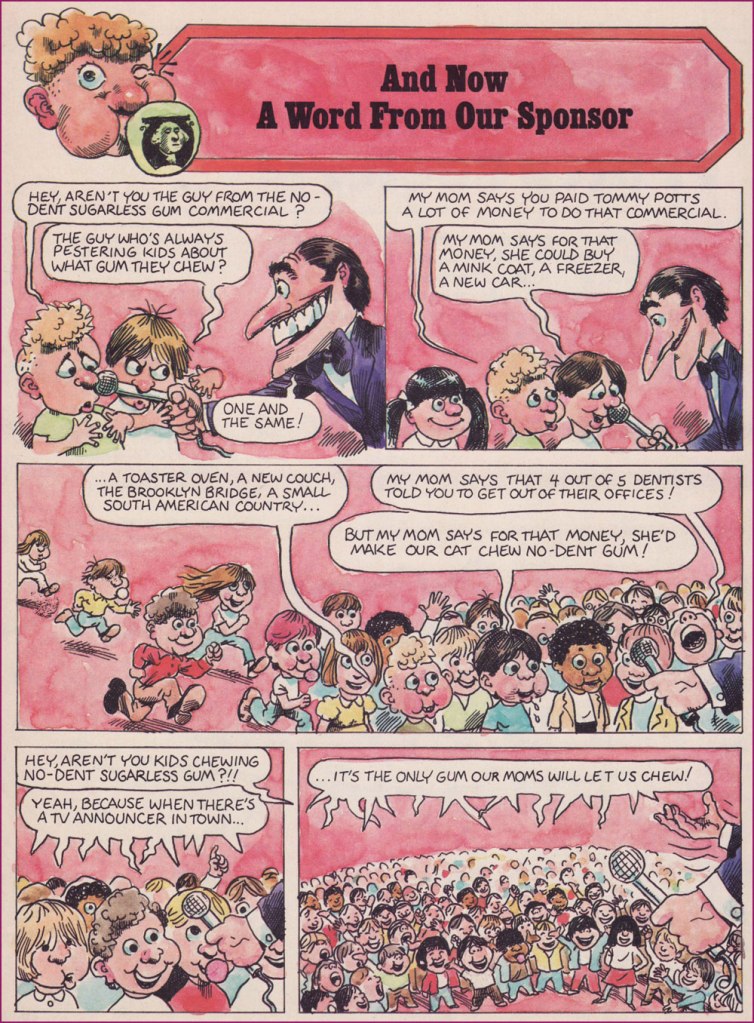
From Dynamite no. 37 (July 1977, Scholastic). On that topic, here’s our look at the 1970s bubble gum explosion!
This subscription ad appeared in Dynamite no. 26. I suspect it was a draft for issue 28’s more focused Laverne and Shirley cover, which had been previewed in ads as a photo cover.
From 1971, young Sandy wears his Ed Sorel influence a little heavily, but he was learning fast and from the best! For those who may not know — or who’ve forgotten — David Frye was possibly the nation’s premier Tricky Dick Nixon imitator. Was he? Listen here and judge for yourself!

Thanks to his versatility and ability to nail a likeness, Huffacker was among the most sought-after illustrators of the 1970s. Quoting from the Chattanoogan.com’s obituary:

« Huffaker was a highly acclaimed political cartoonist who started his career with The Birmingham News and the Raleigh News and Observer. He later moved to New York City and illustrated covers and articles for such publications such as Time Magazine, The New York Times, Sports Illustrated, Businessweek, People and Fortune Magazine. Some of the accolades awarded for his artwork include two Page-One Awards from the New York Newspaper Guild, three nominations for Cartoonist-of-the-Year by the National Cartoonists Society, A Desi Award of Excellence (Graphic Design Magazine), 20 Award of Merit citations from the Society of Illustrators, and was twice nominated for a Pulitzer Prize for illustration. »
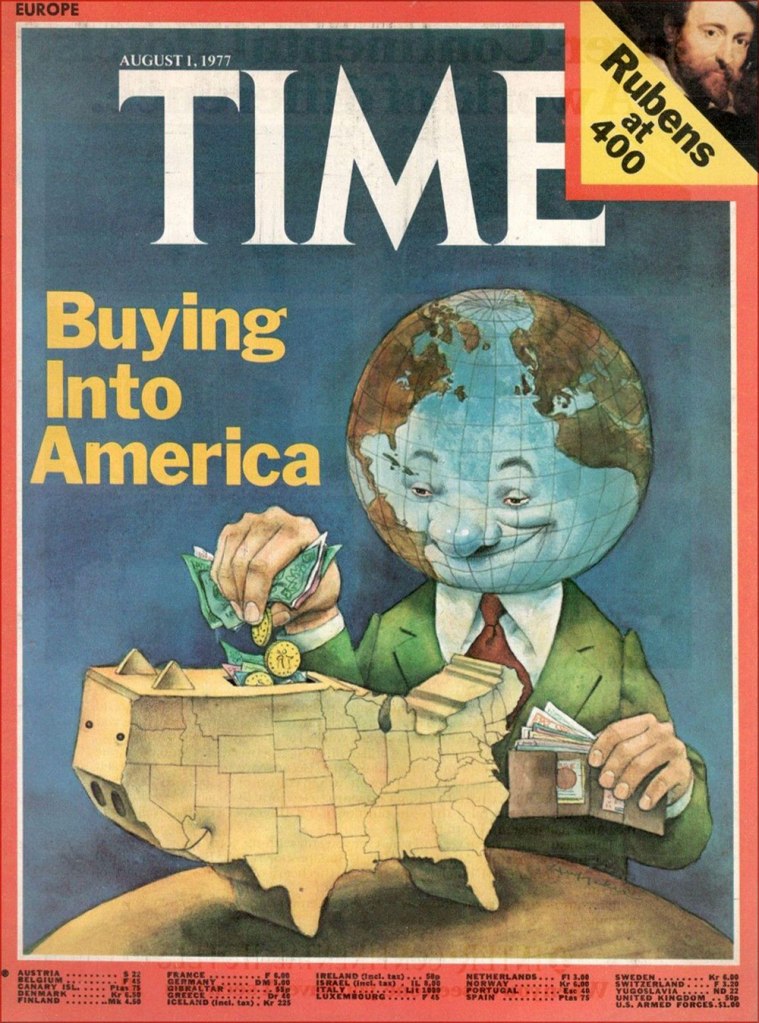
Here’s one of his aforementioned Time covers.

In a 2012 interview, he recalled those halcyon days: « During one week at the peak of his career as an illustrator, Sandy Huffaker had assignments from Time, Sports Illustrated and Businessweek. He had to turn down a fourth assignment that week from Newsweek. “I just didn’t have time. »

-RG

Roland Topor’s Unvarnished Truth

« Topor is probably the greatest graphic mind of the twentieth century. » — Seymour Chwast

Well, that’s quite a lofty claim… but considering the source, one that must be seriously considered.

Are you familiar with Roland Topor‘s work? Perhaps you’ve seen Roman Polanski’s 1976 adaptation of Topor’s novel Le locataire chimérique (1964). Or seen the singular animated film La planète sauvage / The Fantastic Planet (1973). Maybe you’ve seen some of his arresting film poster art (The Tin Drum, Realm of the Senses… and more). Were you perhaps an early reader of France’s legendarily transgressive magazine, Hara-Kiri, journal bête et méchant? Or, at the other end of the scale, did you grow up with Groucha, Lola and the Gluons on his charmingly bizarre 1980’s kids’ show, Téléchat?

All the same, Topor (Jan. 7, 1938 – Apr. 16, 1997) — eighty-four years ago today — is one of those rare fellows (like, say, Shel Silverstein) who achieved great success at whatever they undertook… and without compromising their vision. Painter, actor, scenarist, playwright, director, affichiste, cartoonist, illustrator… he did it all, and he did it all well. I’m happy to say that his legacy seems safe, if his posthumous presence online and in galleries and minds is any indication. And I’ve rarely had so much trouble paring down my selections, so prolific and versatile and hard-hitting was he. Dig in!

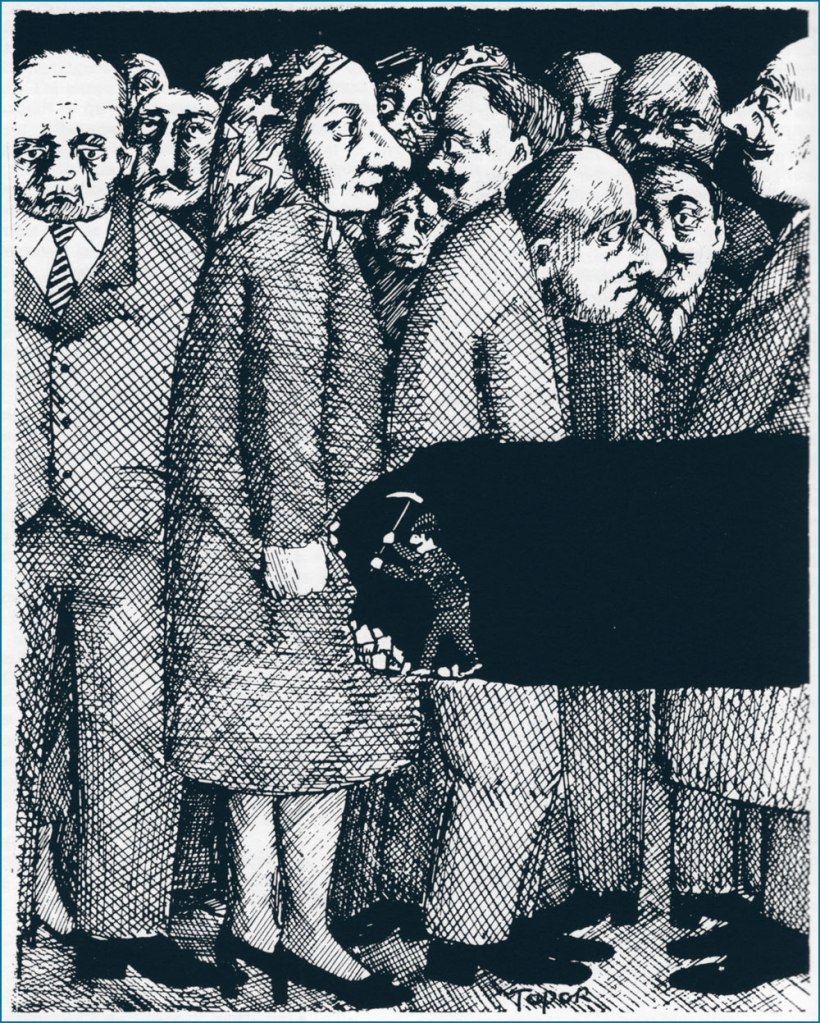
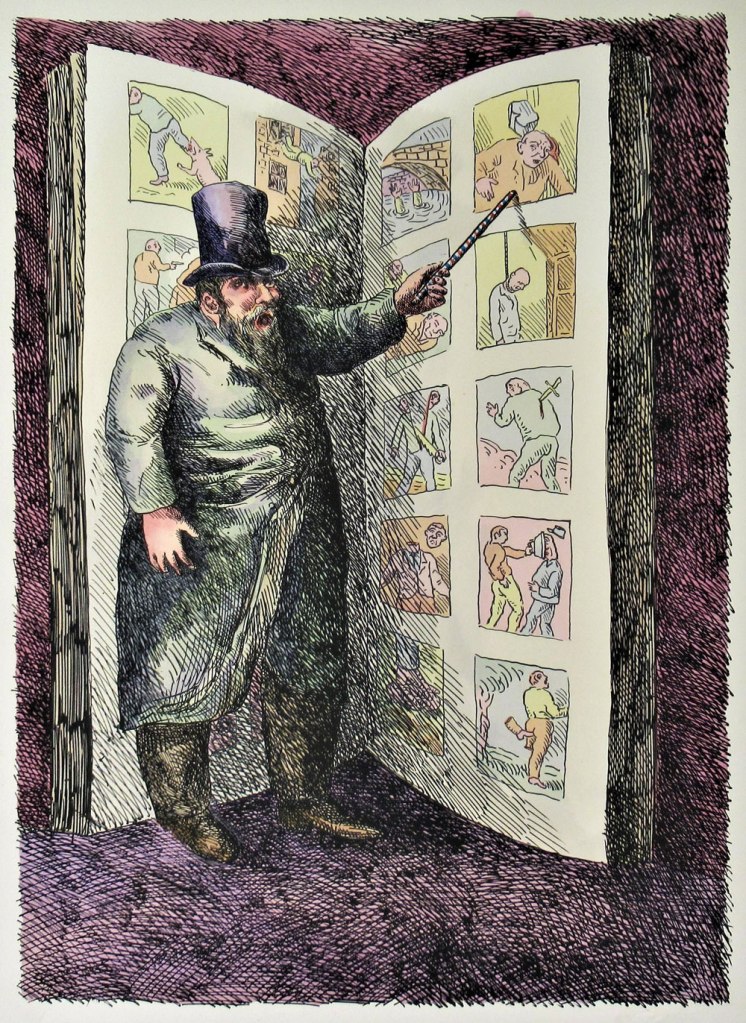
This is a typical, if striking example of the sort of work Topor was producing in the early 1960s (largely for Hara-Kiri — some three hundred drawings in a five-year span), and one wasn’t sure if his draughtsmanship could keep pace with his ideas.
I like to call this one ‘La ruelle armée’.
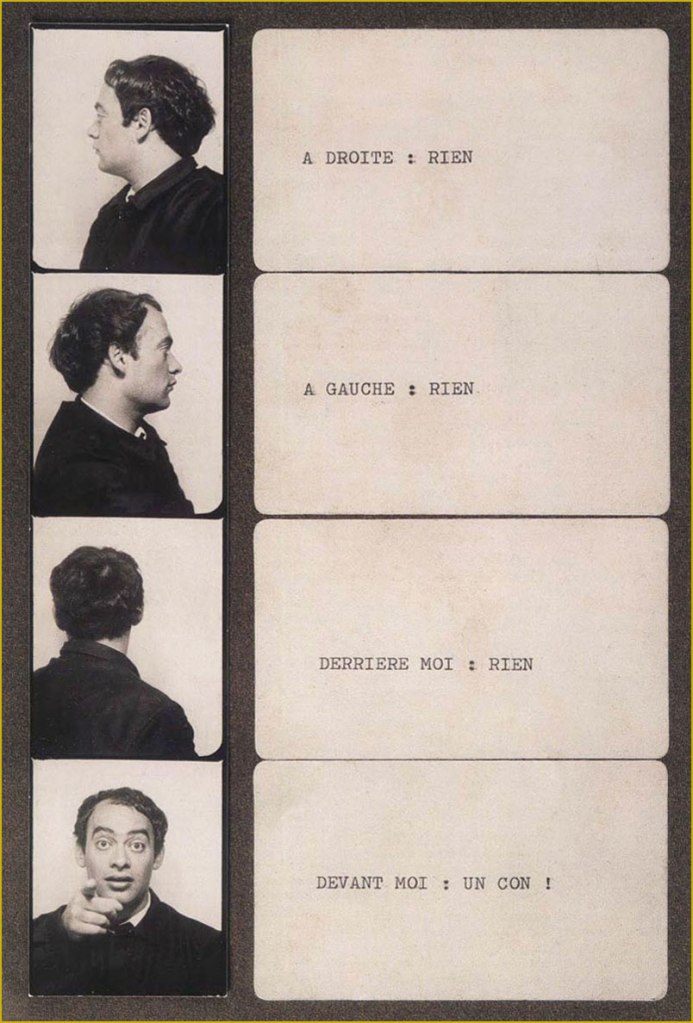
A bit of Photomatonfumetti from Mr. Topor, circa the 1960s. To the right: nothing. To the left: nothing. Behind me: nothing. Before me: a moron!
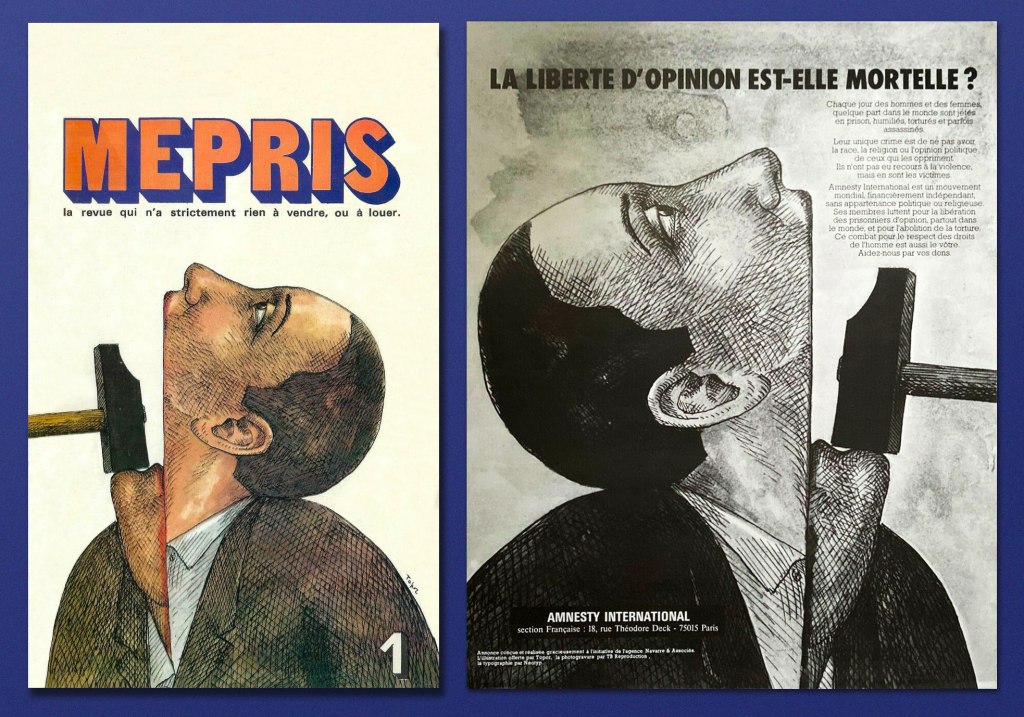
Topor recycled the punch-in-the-kisser motif several times; it was first used for a Hara-Kiri promo poster in 1961.
A pair of excerpts from 1974’s L’Épikon. I love the concept: Topor graphically (and fancifully) elaborated upon some antique pornographic photos. « In Warsaw, a housekeeper, by piety sucked the church candles. By dint of polishing the tallow, she skinned her lips and blushed like a virgin. »
« A Las Vegas whore, who resided in a palace, resorted to a trick to tame phalluses: she illuminated her snatch. » Here’s more from L’Épikon.
La roue (the Wheel) — 1973.
Another bit of recycling: first created (I think!) for Revue Mépris n° 1 (1973, Éditions Kesselring), Topor donated this powerful piece to Amnesty International for its worthy promotional work, such as this 1977 print ad. « Is Freedom of Speech Lethal? ».
This sardonic piece appeared in the collection L’amour à voix haute (“Love Out Loud”); the English version was entitled Je t’aime: A Pillow Talk, and used it as its cover.
Les nouvelles en trois lignes I (The News in Three Lines) – 1975. Comics!
Le saut périlleux (the somersault) – 1980.
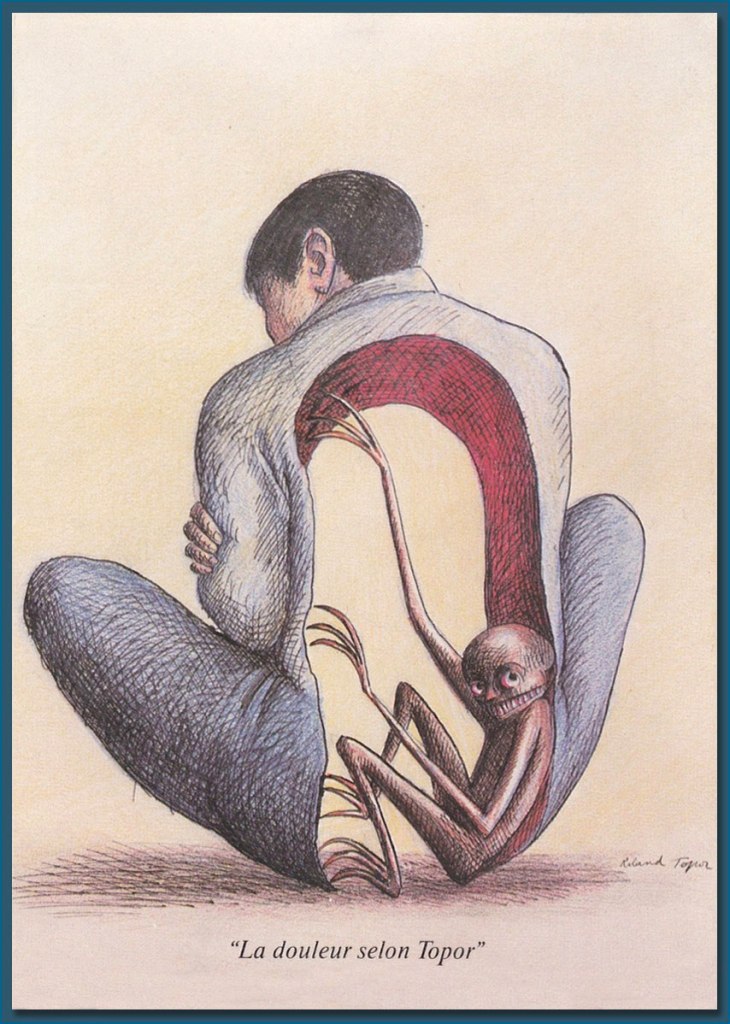
« Pain, according to Topor. »
« Leaving pain behind, according to Topor. » (1982)
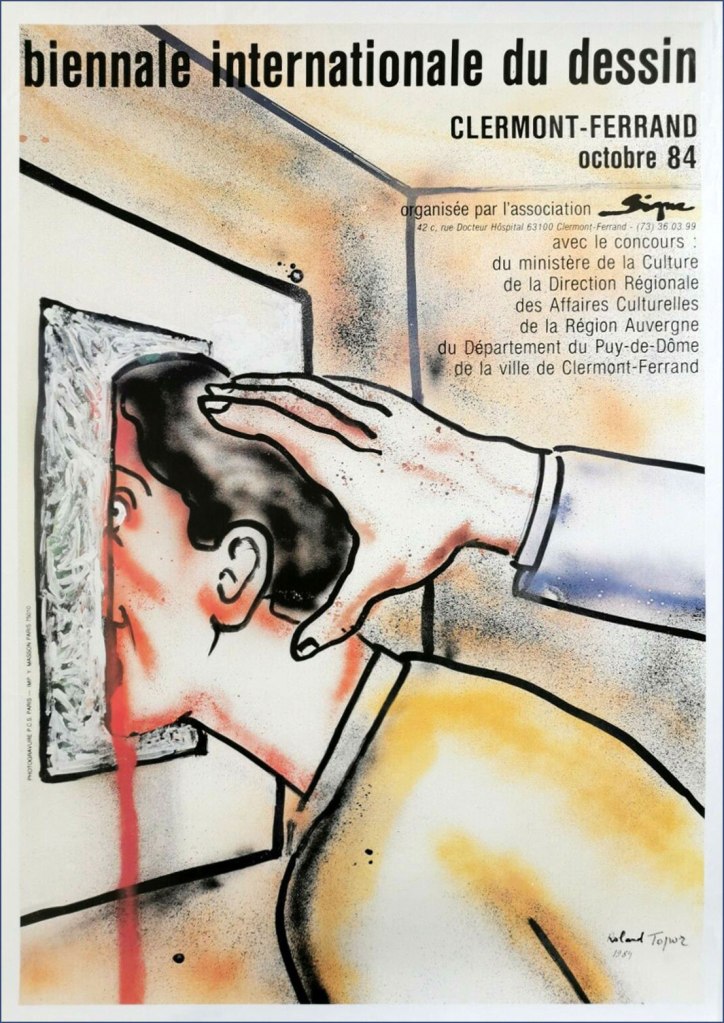
I’m happy to say that, with the years, his work just kept evolving and, in some ways, improving. This poster was created to promote the 1984 edition of a drawing festival held every other year.

Well, even if you weren’t familiar with Mr. Topor’s œuvre per se, you must have seen its echoes across all media in the work of (just off the top of my head!) Bill Plympton, Brad Holland, Peter Kuper, Bernard Kliban, Jean-Claude Suares… and countless others.

-RG