Tentacle Tuesday: The Kitchen Sink Touch

Kitchen Sink Press, a trailblazing publisher of underground comix that grew out of Denis Kitchen’s successful attempts at self-publishing, has seen its share of tentacles. (For a detailed story of how Kitchen Sink grew from a modest artists’ cooperative into a force to be reckoned with, as well as a discussion of its 30-year legacy, pay Comixjoint a visit.)

First we have a pair of entries from the Death Rattle catalogue. There were 3 “volumes” (series, if you will) published, and my favourite is volume 2, consisting of 18 issues coming out between October 1985 and October 1988, starting out in glorious colour but reverting to black-and-white with issue 6 (which was fine, actually). It’s a remarkably consistent anthology nearly devoid of clunkers, and featuring awesome stories and art by Rand Holmes, Jaxon, Tom Veitch, Al Williamson, Wally Wood, Steve Stiles, etc.  It’s also where Mark Schultz’ Xenozoic Tales series was introduced (Death Rattle no. 8, December 1986)!

KitchenSink-DeathRattle#4-RandHolmes
Death Rattle no. 4 (April 1986), cover by Rand Holmes, who’s already ascended to the rank of Tentacle Tuesday Master.
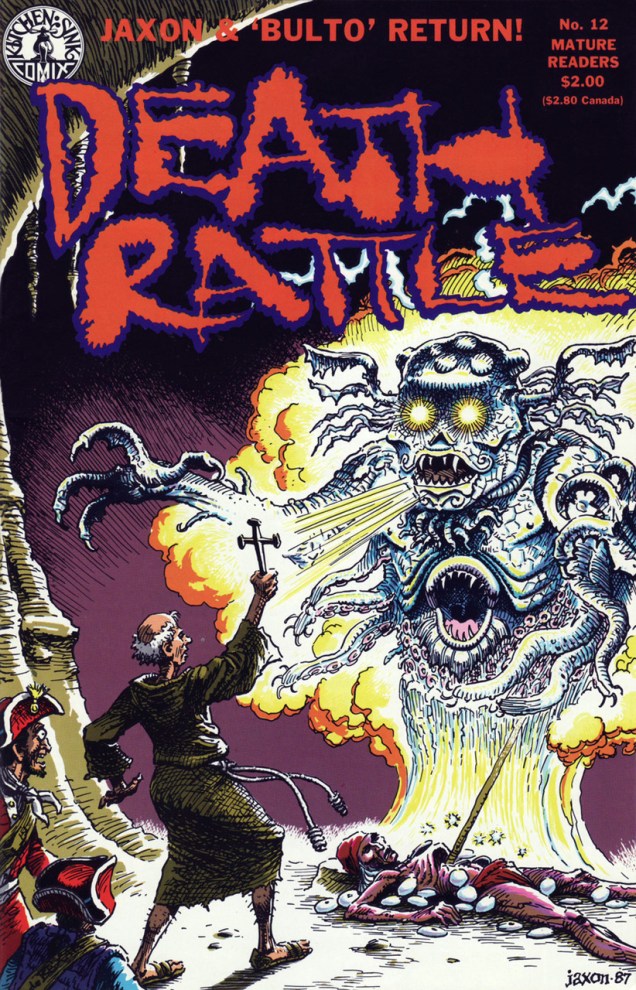
KitchenSink-DeathRattle12-Jaxon
Death Rattle no. 12 (September 1987), cover by Jaxon (Jack Jackson). The cover belongs to Jaxon’s “Bulto… The Cosmic Slug“, an epic eleven-parter that I really enjoyed reading (and not only because of its manifold tentacles). We’ll talk about that again.

Speaking of Jaxon, I’d like to quote from General Jackson, a tribute written by Margaret Moser (who dated him on-and-off through the years).

« The last time I saw Jack was a humid, late summer night in 2005 at the South Austin Museum of Popular Culture. His hair was nearly white and had lost its red-brown burnish, but his mustache was bushy as ever, and he resembled God Nose himself. He was a little grumpy, probably feeling bad, and I was with my boyfriend, so I didn’t sit on his lap. I did kiss his leathery cheek and fetch him a beer. He smelled like cigarette smoke and maybe of Old Spice.

On Wednesday, June 7, just three weeks after his birthday, Jack Jackson took his life at the graves of his parents outside Stockdale. His diabetes and arthritis were getting worse, affecting his ability to draw, and he’d been diagnosed with prostate cancer. Unwilling to face a debilitating course of chemo treatment, he put down his pen forever and made his own kind of peace with the unforgiving future. »

On to something more cheerful! Next, we have a bit of a non sequitur in this otherwise horror-centric post, although one might argue that being grabbed by an octopus is a traumatic experience. What’s The Spirit doing in here, you might ask?

« Kitchen Sink continued publishing multiple undergrounds and alternative comics through the ’80s and ’90s, but also expanded into publishing non-underground comics, graphic novels and extensive anthologies, most notably by Will Eisner, Al Capp, Milton Caniff and Harvey Kurtzman. » |source|

KitchenKink-Spirit34
The Spirit no. 34 (August 1987), cover by Will Eisner.
KitchenSink-SpiritattheBeach
Page from “A Day at the Beach“, drawn and scripted by Will Eisner and inked by André Leblanc, printed in The Spirit no. 34 (August 1987). Somehow I’m not surprised that Eisner draws a mean-yet-elegant octopus.

All rested now? Okay, back to horror.
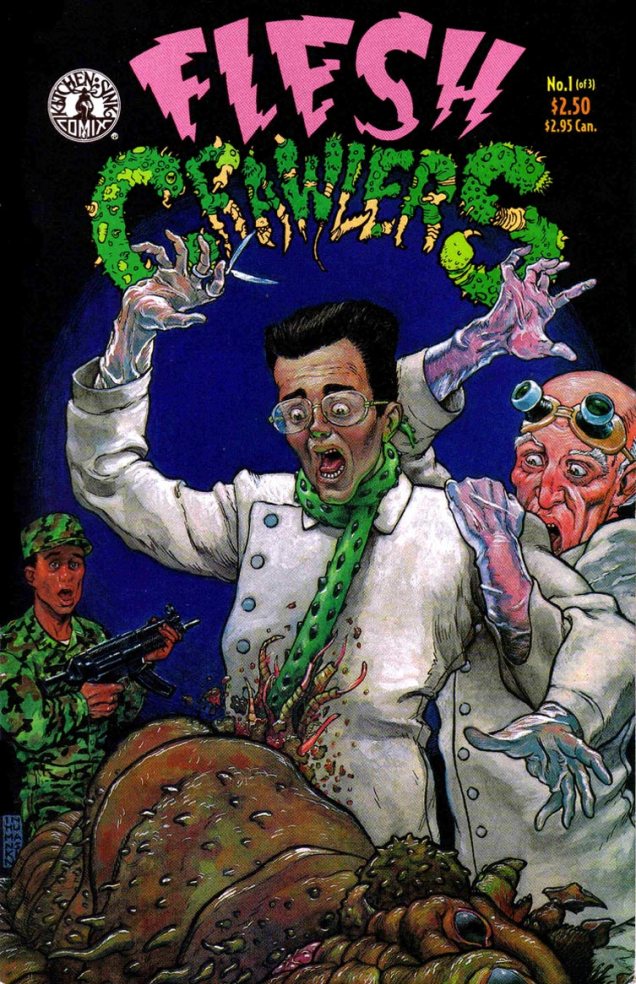
KitchenSink-FleshCrawlers#1
Flesh Crawlers no. 1 (1993), written by Richard Rainey and illustrated by Michael Dubisch. A quick look at the latter’s catalogue shows that Dubisch happily adds tentacles to whatever he’s drawing.

The scientist seems to have been preparing to dissect the specimen – turnabout is fair play! This cover reminds me of this, actually:

BarneyandClyde-Weingartens-Clark
Barney & Clyde is a syndicated newspaper strip with jokes that are actually funny and characters that you can get attached to, a rarity these days. You can read it online.

Back on topic, another attack of the Flesh Crawlers:

KitchenSink-FleshCrawlers#2
Flesh Crawlers no. 3 (1993), written by Richard Rainey and illustrated by Michael Dubisch.

My final submission for today involves a cozy family scene where Frank is peacefully having breakfast with, err… Potted turnip babies and an almost-nude greek serial killer. I think.
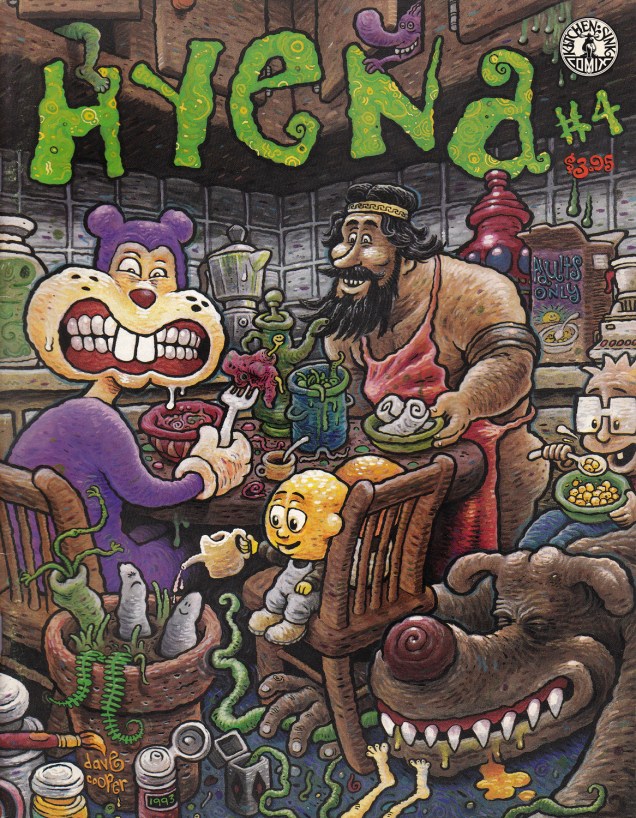
KitchenSink-Hyena4-KitchenSink
Hyena no. 4 (1993, Tundra), cover by Dave Cooper. If Jim Woodring’s work frequently creeps me out, Cooper’s comics are viscerally repulsive to me (I think he goes for “nauseating” on purpose, but I’m not in the camp of people who like to experience strong emotions by watching disgusting, repulsive things happen). This cover, though, is all right.

~ ds

Tentacle Tuesday Masters: Rand Holmes

We have just come back from a lovely vacation in Nova Scotia, one of Canada’s maritime provinces. In the honour of this all-too-short getaway, this Tentacle Tuesday is about Canadian artist Randolph Holton Holmes, who was born in Nova Scotia in 1942 and passed away in British Columbia in 2002, completely at the other end of this big country.

« Rand Holmes was Canada’’s most revolutionary artist in his heyday, the star cartoonist at the Georgia Straight newspaper in British Columbia during the 1970s. His hippie hero, Harold Hedd, became the spokesman of the emerging counterculture as he avoided work, explored free love, and flouted drug laws. The Adventures of Harold Hedd spread across the globe in the wave of underground comix and newspapers of the era and Holmes became famous — or at least notorious. While his comic character was bold and blatant, the artist was shy and quiet, well on his way to becoming a complete hermit. » (excerpt from Fantagraphics’ The Artist Himself: A Rand Holmes Retrospective)

Glimpsing through Holmes’  body of work, one quickly becomes aware that he displays a special affinity for drawing busty women… and (of more interest to this current post) that he loves to insert tentacles at the drop of a hat, especially if ETs of some kind are involved. A lot of artists use tentacles as a short-hand for aliens, and he’s not alone in that… much to my personal satisfaction.

RandHolmes-SlowDeath-1974
Slow Death no. 6 (Last Gasp, January 1974). Colonel “Saunders”?
FogCityComics-RandHolmes
Fog City Comics no. 2 (Stampart, October 1978).  “Science fantasy at its finest” may be an unfulfilled promise; by all accounts, Rand Holmes’ Killer Planet is the best story of the issue. Fog City Comics was an all-Canadian underground comix anthology and lasted a mere 3 issues.

As I mentioned Holmes’ story Killer Planet, here’s a peek at its manifold tentacles:

DeathRattle1-RandHolmes
A panel from Killer Planet, both written and illustrated by Rand Holmes, originally published in the aforementioned Fog City Comics no. 2, coloured by Bill Poplaski and reprinted in Death Rattle no. 1 (2nd series, Kitchen Sink Press, Oct. 1985).
DeathRattleScarfA
What kind of idiot eats fruit growing on an obviously life-threatening planet? Panels from Killer Planet, both written and illustrated by Rand Holmes, published in Death Rattle no. 1 (Kitchen Sink Press, October 1985).
DeathRattle1-RandHolmes-KillerPlanet
Panels from Killer Planet, both written and illustrated by Rand Holmes, published in Death Rattle no. 1 (Kitchen Sink Press, October 1985). Note the cute mushrooms in the bottom left corner.

And lastly, for contrast with the cover of Slow Death and its throes-of-ecstasy coupling scene, there’s this:

DeathRattle5-RandHolmes-JunkyardDog
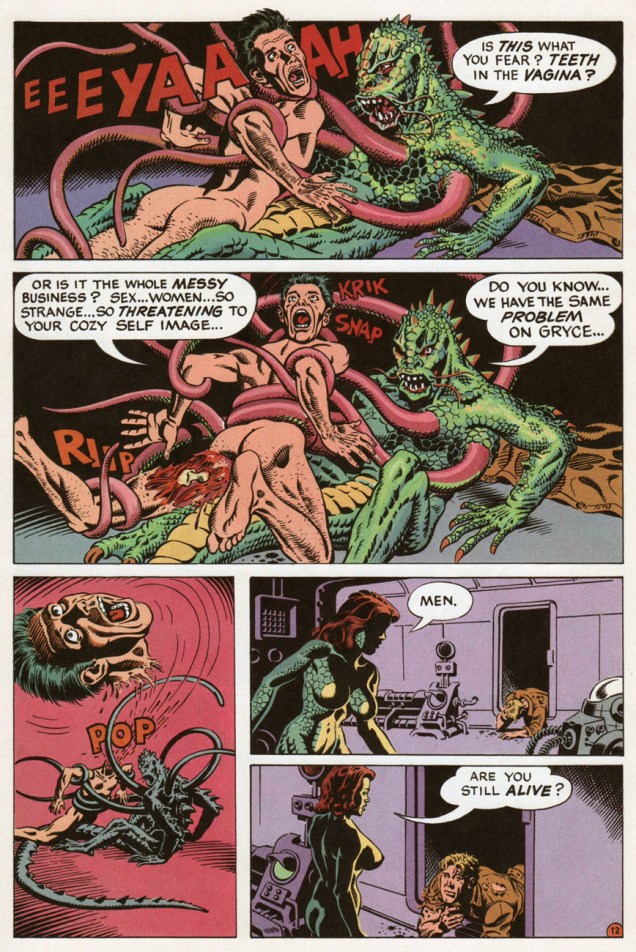
Vagina Dentata! A page from “Junkyard Dog“, written by Mike Baron. It was published in Death Rattle no. 5 (Kitchen Sink Press, June 1986). The (telepathic) alien female wasn’t unjustified in, erm, chewing up her rapist (the intercourse wasn’t consensual) – he was an unapologetic asshole.

~ ds

Smug Saddle Sniffer

Today’s linguistic lesson: what’s a snarf? I’ll let Kurt Vonnegut answer that one:

« Do you know what a twerp is? When I was in Shortridge High School in Indianapolis 65 years ago, a twerp was a guy who stuck a set of false teeth up his butt and bit the buttons off the back seats of taxicabs. (And a snarf was a guy who sniffed the seats of girls’ bicycles.) »

Here’s a typical illustration of a snarf, albeit a shockingly rich one, with a fittingly well-developed proboscis, in his not-so-natural habitat: golden-hour hues, a cozy armchair, and selection of vintage selles de vélo. Next time you see a bicycle with its seat stolen (let’s face it, these saddles *must* be acquired in illicit fashion), you’ll thank me for this mental image.

Snarf11RandHolmes
This is Snarf no. 11, 1989. Dennis Kitchen gave his comic book series an apt title!

The cover by Rand Holmes (1942-2002), a Canadian underground comix artist probably best known for his Harold Hedd comic strip. (Look for the compendium of his exploits published by Last Gasp, Anus Clenching Adventures With Harold Hedd!)

~ ds