« Doubt is not a pleasant condition, but certainty is absurd. » — François-Marie Arouet
Going back to 1975: for a few years, I’d been buying Vaillant’s Pif poche (and sometimes its companion titles, Pifou, Arthur, Placid et Muzo, Totoche, and Gai-Luron… poche) as well. However, since the 1973 putsch by the raging primitives* and sundry bean counters, the publisher’s output had largely gone to seed.
I was still picking up, when faced with a dismal crop at the newsstand, the occasional ‘poche’, mostly for the games and puzzles, which comprised half of the editorial content. I was intrigued by an oddly-named stylist, one ‘Rik Cursat’ (unusual name for a Frenchman, I thought… still, nice of him to sign his work!), whose assured line and friendly absurdity had caught my eye.
A game page from Placid et Muzo Poche no. 80 (Aug. 1975, Éditions de Vaillant). Sometimes he used his initials, sometimes he signed in full. « Using all letters above the drawing, find the names of two fruits. » The answers: PÊCHE and CITRON. This one appeared in Pifou Poche no. 63 (Sept. 1975, Éditions de Vaillant). « Using all the letters above the drawing, put together the names of two animals. » The answers: CANE and CHIEN.
It was only decades later that I thought to dig a little deeper. To my delight, it turns out that Cursat had a long and prolific, award-festooned career. Given his international success, it’s a bit of a mystery why he would have slummed it in the (presumably) low-paying back pages of frankly disposable kids’ publications. My guess is that his output was continuous and downright profligate, but he was reluctant to let a good drawing go to waste.
Henri ‘Rik’ Cursat** (1928-2006) was born and died in France’s third-largest city, Lyon. Deeply attached to his hometown, he reportedly produced over the course of his career some 20,000 drawings for its various daily newspapers, especially Le Progrès de Lyon, in whose employ he remained for some thirty-two years.
And since his body of work was so gargantuan and diverse, I’ll keep my focus narrow, borrowing from Absurdement vôtre, a 1977 selection of his cartoons published in Éclats de rire, a gags ‘n’ gals rag not unlike the American ‘Humorama‘ digests. He was, in fact, Éclats’ editor-in-chief for nearly a decade. Yet somehow his own cartoons are anything but crass or lowbrow.
Cursat had some pet recurring themes. One was literal gallows humour.
.
« He’s a repeat offender! »« It’s the downstairs neighbour; he claims that our fish is bothering him! »« Garçon, I don’t have a knife! »« Watch out for his left hook! ». Hooks were another of Cursat’s pet motifs.
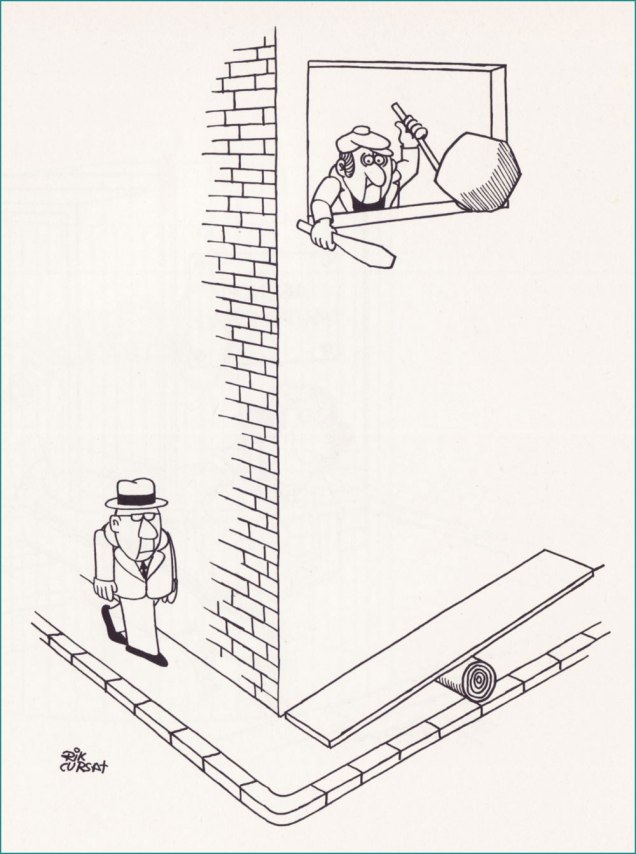
Another frequent theme was the mugger lying in wait just around the corner. Here’s a trio of variations:
.
.
.
.
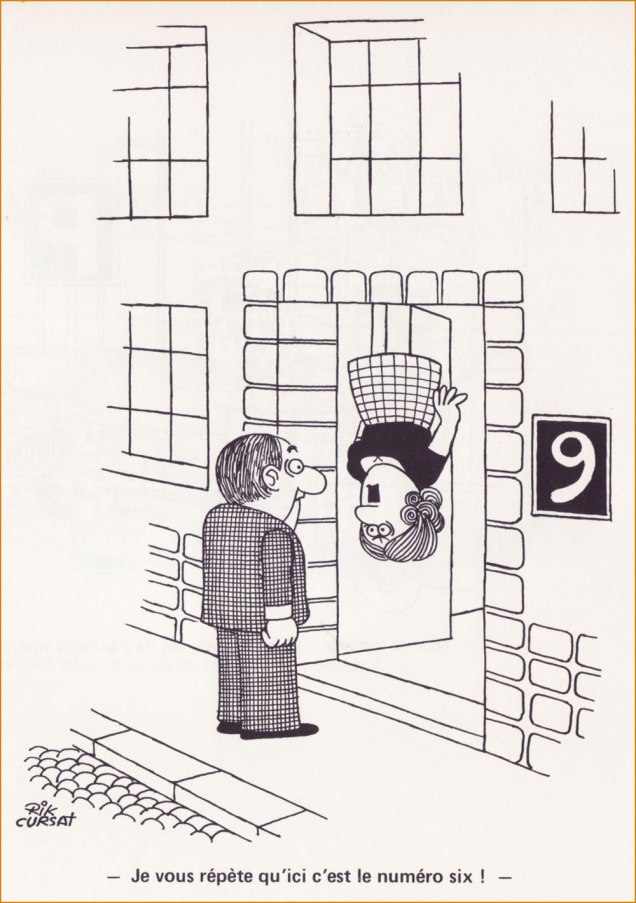
« Are you the architect? »« I keep telling you: this is number six! ». Another inspired riff on the same basic idea.
.
« Garçon, there isn’t a single fly in my soup! »Impishly looking at you, plotting a gag. The artist in the late 1970s.
« The working class is revolutionary or it is nothing. » — Karl Marx
Pif le chien was introduced to the world on March 26, 1948, in the French Communist daily L’Humanité. His strip was intended to replace that of Felix the Cat, who was deemed too bourgeois, what with his magic bag and invisible means of financial support. On the other paw, Pif, early on, was even a stray, homeless and starving. In time, he was taken in by a humble working-class family (as late as 1957, it was the outhouse and public baths), and that’s when the elements clicked into place.
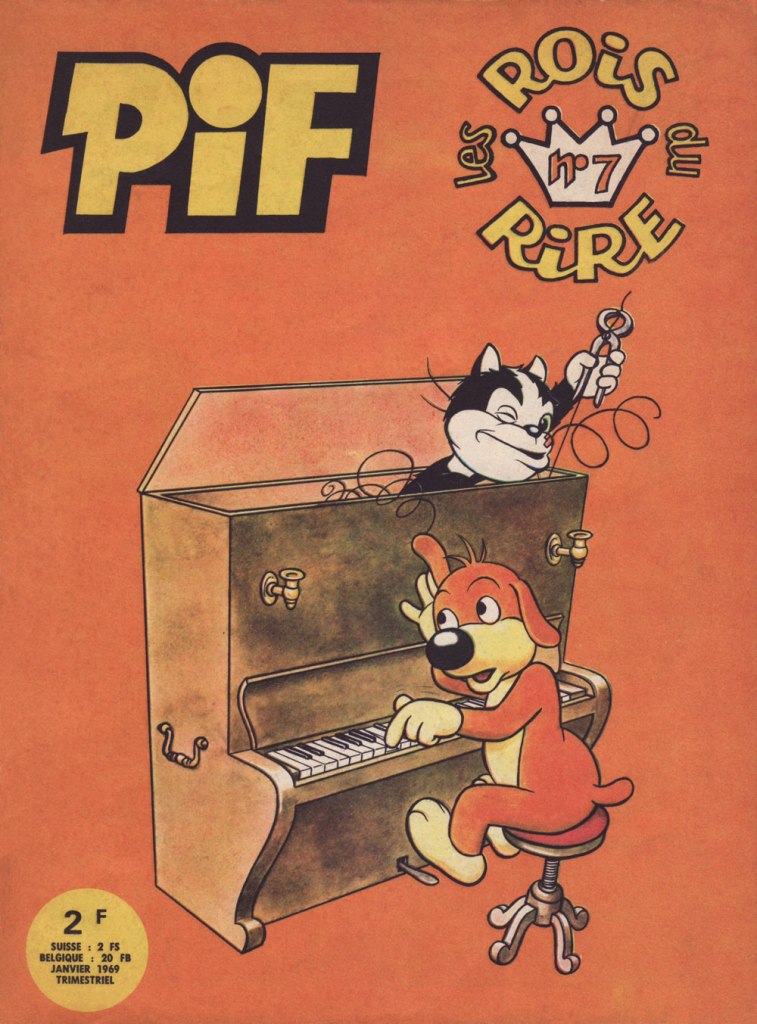
This is Les rois du rire no. 7 (Jan. 1969, Vaillant), a rotating anthology title gathering, in this case, two-pager Pif strips from the pages of Vaillant. Cover art by Pif’s creator, José Cabrero Arnal (1909-1982).
While I greatly admire and enjoy the work of Pif pater José Cabrero Arnal — and trust me, his is a story worth the telling: fought the Fascists in Spain, spent four years in a Nazi Stalag in Austria before being liberated by the Soviets, never quite recovered from the ordeal of his captivity, and remained fragile for the rest of his days. Consequently, in 1953, he handed Pif’s leash over to the truly indefatigable Roger Masmonteil (1924-2010).
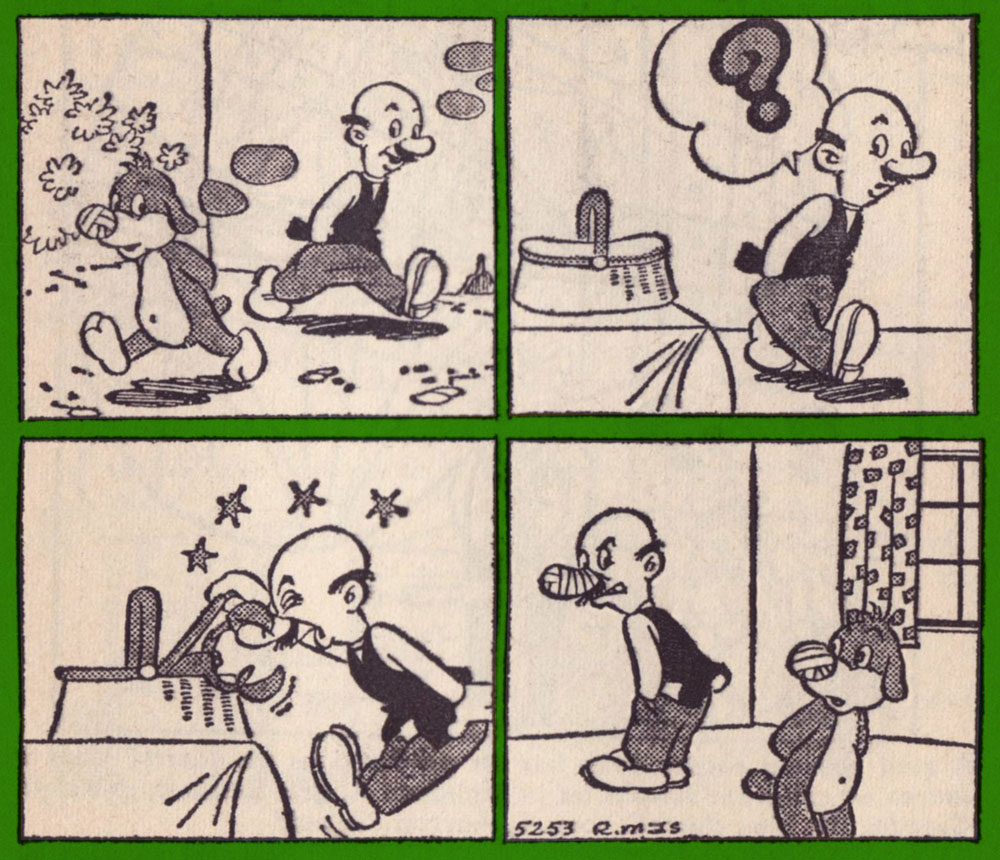
Of Masmonteil (who signed R. Mas.), historian Hervé Cultru writes, in his Vaillant, 1942-1969 : La Véritable histoire d’un journal mythique (2006, Vaillant Collector):
« The problem is that, once he got his finger caught in the gears of the freelancing engine, he couldn’t just yank it out! Because giving life to the Césarin family is practically a vocation: one must provide the daily strip, six a week. Over thirty years, Masmonteil, aka Mas, crafted over eleven thousand of them. There are also the Sunday strips, the pages for Vaillant, solo Pifou stories, Léo, created for Pif Gadget. It never ceased. By his career’s end, he had racked up some 45,000 gags or so. »
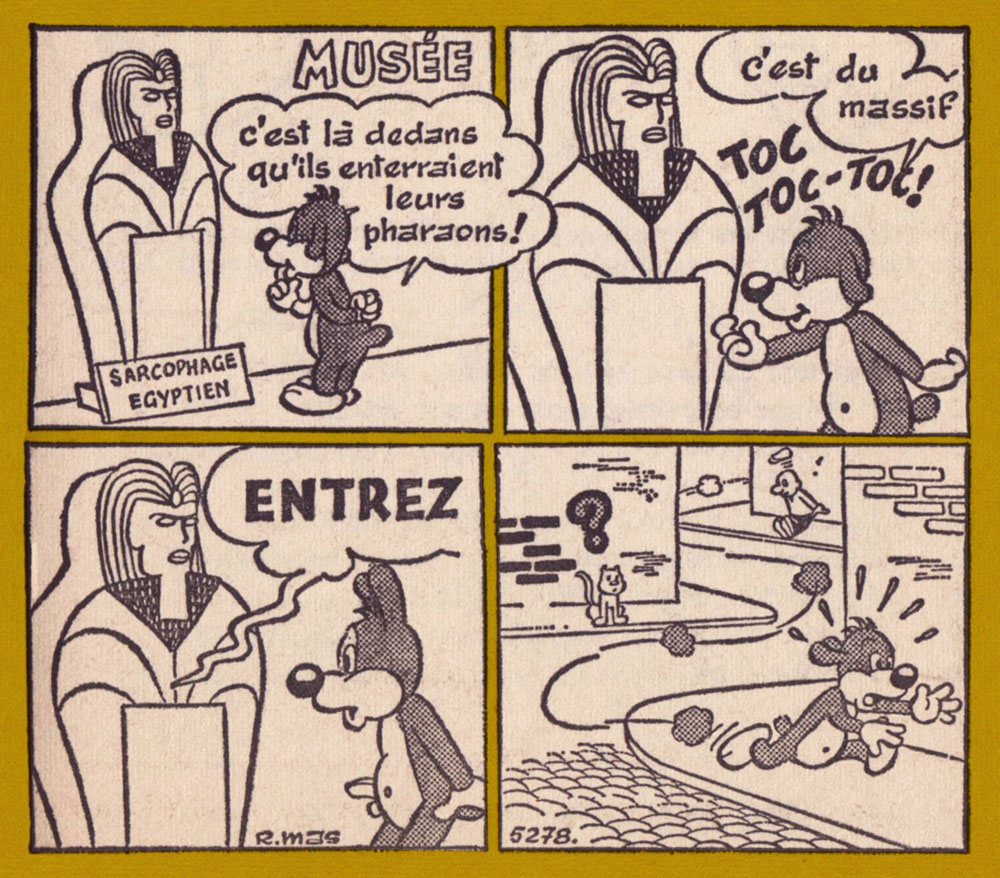
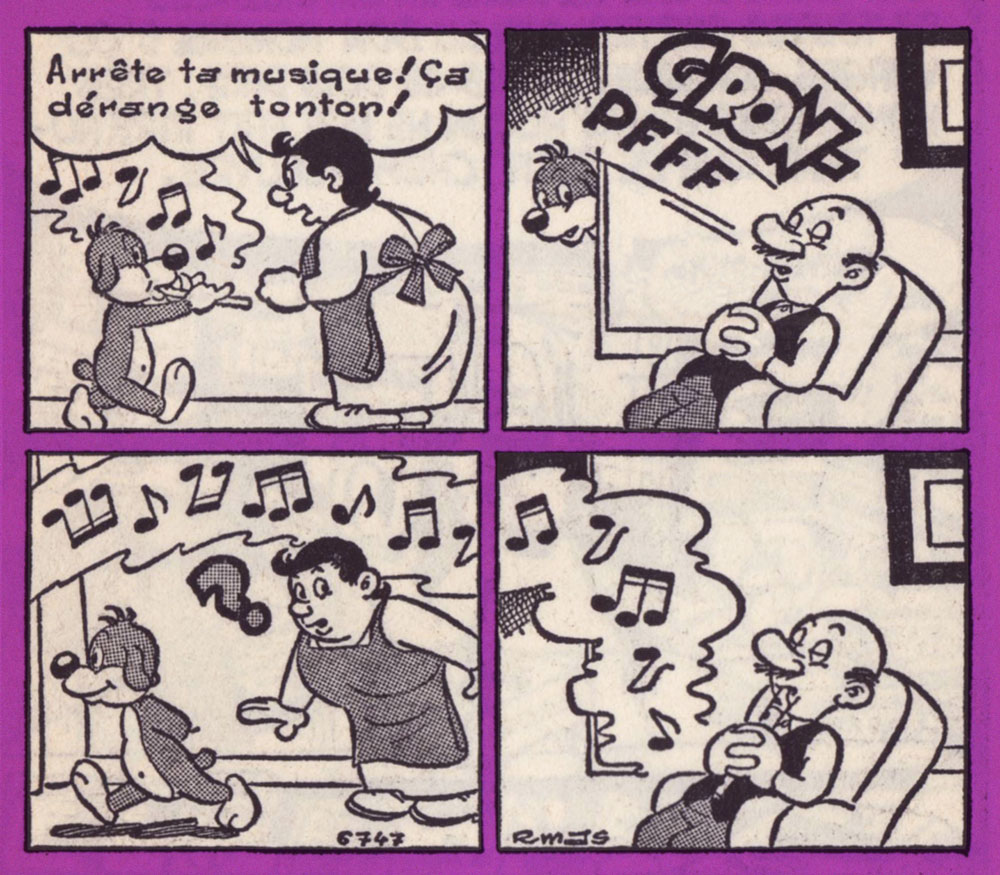
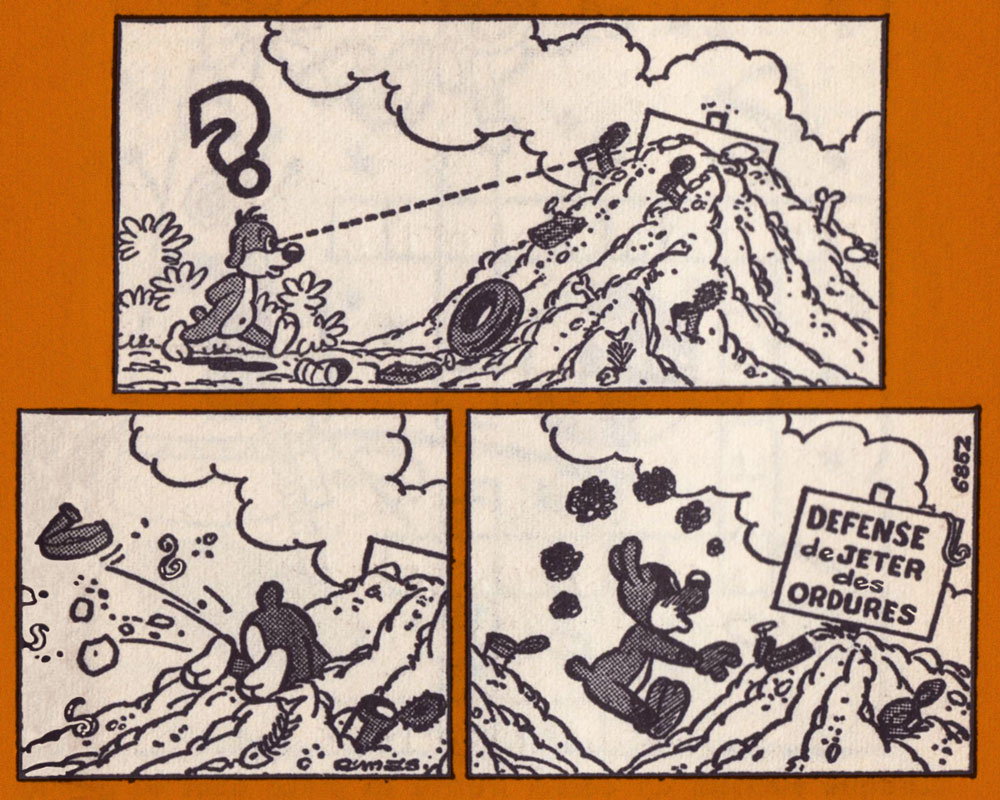
« Unlucky me, I’ve smashed the vase! » « Out of sight, out of mind! » « Bleh! What a revolting aroma! » « I’m found out! »« When the sea is too far, one makes do with a little corner of the Seine! » « I’m the back-float king ! » “Sur mer” (“On-Sea” would be the English equivalent) is a popular suffix to denote a town or resort’s coastal location. The Seine’s toxicity borders on the legendary, but things have actually improved in recent decades.I love a good pantomime gag. And every look is a sideway glance, which makes it even more special.« It’s in these things that they buried their pharaohs! » « That’s solid stuff! » « COME IN ». What most impresses me here is the final panel, with its expert use of a tiny space to convey depth, distance and setting. That’s the cartoonist’s art!« Quit your music! It bothers tonton! ».« And a-one! » « Brr! Doesn’t it cause him pain when you remove the hook? » « Not at all… it’s designed not to hurt… » « Next! » « Quiet! It’s designed not to! » Up yours, René Descartes!A slice (ouch!) of politico-historical guillotine humour.A dollop of social criticism. The sign says, naturally, « No Littering ».Pif’s archenemy, Hercule, at work. « Who’s going to get a good soaking? The Pif, that’s who! » « Failed! »
I’m inclined to admire Mas for the same reasons I hold Nancy’s Ernie Bushmiller in the highest regard: the uncanny ability to find humour in any and every place or situation, to distill and express it in a pared-down visual language made all the more potent by its universal simplicity. But it’s hard work, even if geniuses make it look easy. As Hervé Cultru explains, in Mas’ case:
« … Pif gets the last word in: at night, he haunts Mas’ dreams. The point at which he’s about to doze off is actually one of intense creativity. He constantly keeps a notepad and pencil at his bedside, to jot down ideas straight away, because if he neglects this precaution, all is forgotten by morning. »
An ad from L’Humanité, circa the late 1950s.Our cast: Tante ‘Tata’ Agathe and Oncle César ‘Tonton’ Césarin, Doudou, Pif, Hercule, and Pif’s son, Pifou. This is my copy of Album Vaillant no. 8— 4th series (comprising issues 952 to 960, August to October 1963), its rather fragile spine helpfully reinforced by a previous proprietor. I long wondered why on earth the French call wrestling ‘catch’. Turns out it’s their shorthand version of the forgotten 19th century appellation of the sport as ‘catch-as-catch-can‘.
In April 1967, Mas walks away from the Pif feature in Vaillant (four pages a week!), maintaining the daily in l’Humanité and Pifou’s solo strip. Pif returns briefly to Arnal, who still can’t handle the workload; Pif then passes into other, and decidedly far lesser hands.
Mr. Cultru, again:
« In 1968, the team takes umbrage with the repetitive and by far too ‘domestic’ character of the adventures.It feels that the working class household, typical of certain post-war values, that serves as a setting, has become obsolete, if not grotesque, and that it no longer fits the social context of the times. »
So they methodically excised everything that made Mas’ Pif special, and turned him into another Mickey Mouse, which is to say the familiar mascot or standard-bearer of a company, but one whose adventures nobody reads or truly gives a hoot about. Oh well — you still had a good run, Pif!
« A good puzzle, it’s a fair thing. Nobody is lying. It’s very clear, and the problem depends just on you. » — Erno Rubik
Jean Mad… now who’s he? A once-popular and prolific French cartoonist and illustrator, largely forgotten today, in part because his body of work appeared, frequently unsigned, in ephemeral periodicals… and hardly any of it was ever collected or reprinted. So he isn’t a household name, if he ever was, but his distinctive style will ring a bell among francophone readers of a certain age.
Now for a little context: in 1959, Belgian publisher Marabout launched a wildly popular series (nearly 500 titles between 1959 and 1984!) of pocket books called Marabout Flash, and the little tomes’ handy format (11,5 x 11,5 cm) and low cost “inspired” French publisher Vaillant, in 1962, to borrow the idea (at a size of 11,5 x 12 cm… to sidestep legal repercussions) for cheap reprint collections of José Cabrero Arnal‘s Pif le chien strips, which had been running in communist newspaper L’humanité since 1948. The format decided upon was 100 gags – 100 jeux (« 100 gags – 100 games »). It was an instant hit (quickly reaching 150 000 copies sold per issue), and soon generated numerous spinoffs. But the games half of the equation was, for a long time, rather shoddily-illustrated. By the turn of the decade, though, thanks to several judicious additions (Jean-Claude Poirier, Jean Marcellin and Henri Crespi, to name but a few) to the production staff, the product looked pretty spiffy. Which brings us to Mr. Mad, who first turned up in 1969… and came and went throughout the 1970s.
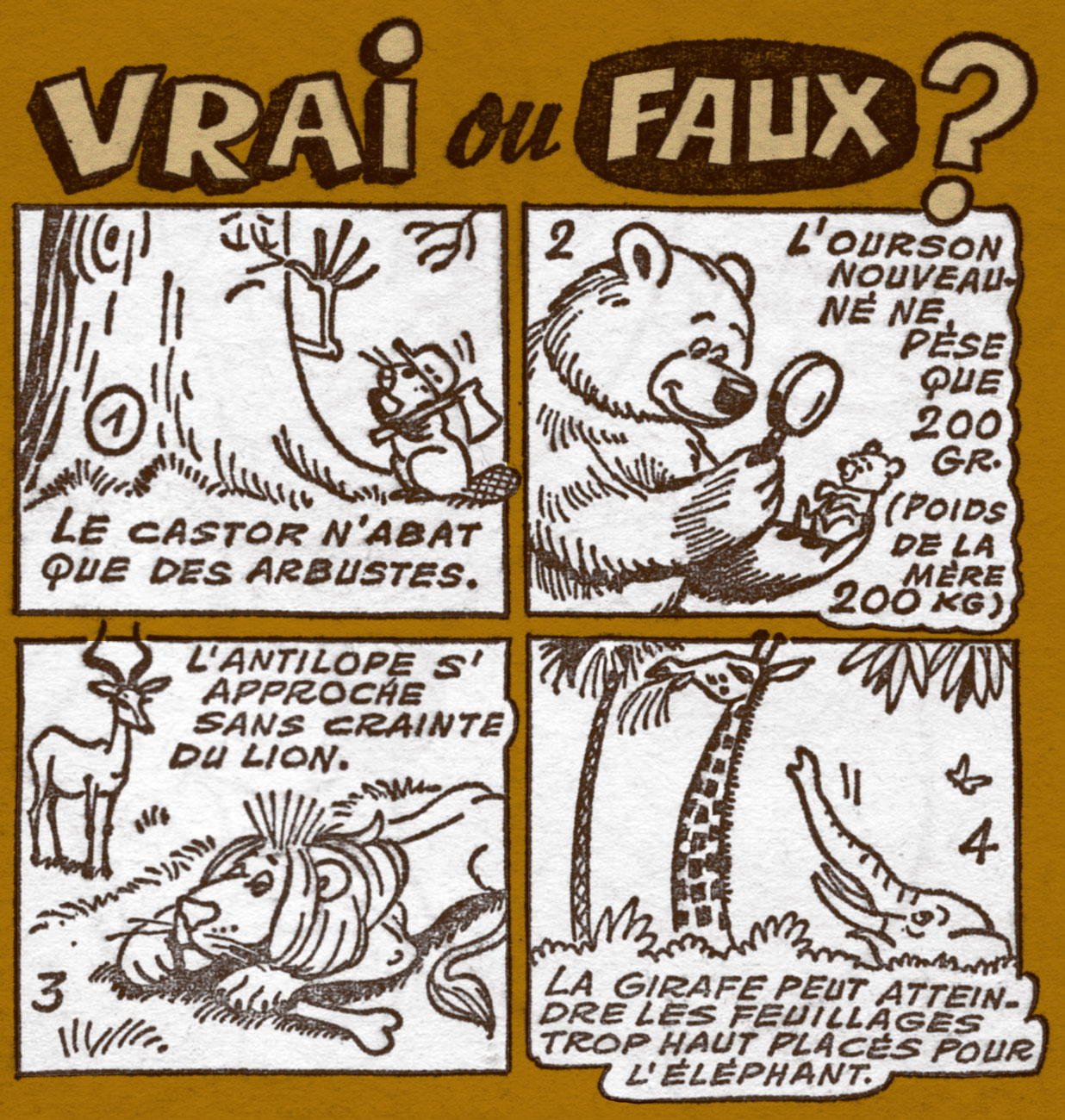
True or False? 1) The beaver only fells small trees 2) A newborn bear cup weighs a mere 200 g; its mother weighs 200 kg; An antelope can approach a lion without fear; A giraffe can reach foliage beyond the reach of an elephant. (1)-False: beavers have to known to drop trees up to 30 m high and 2 m in diameter; (2)-True; (3) True, when he’s full; (4) False: an elephant can just lean against a tree, bending it to reach the foliage it seeks.) From Pif Poche no. 71 (July, 1971, Vaillant).
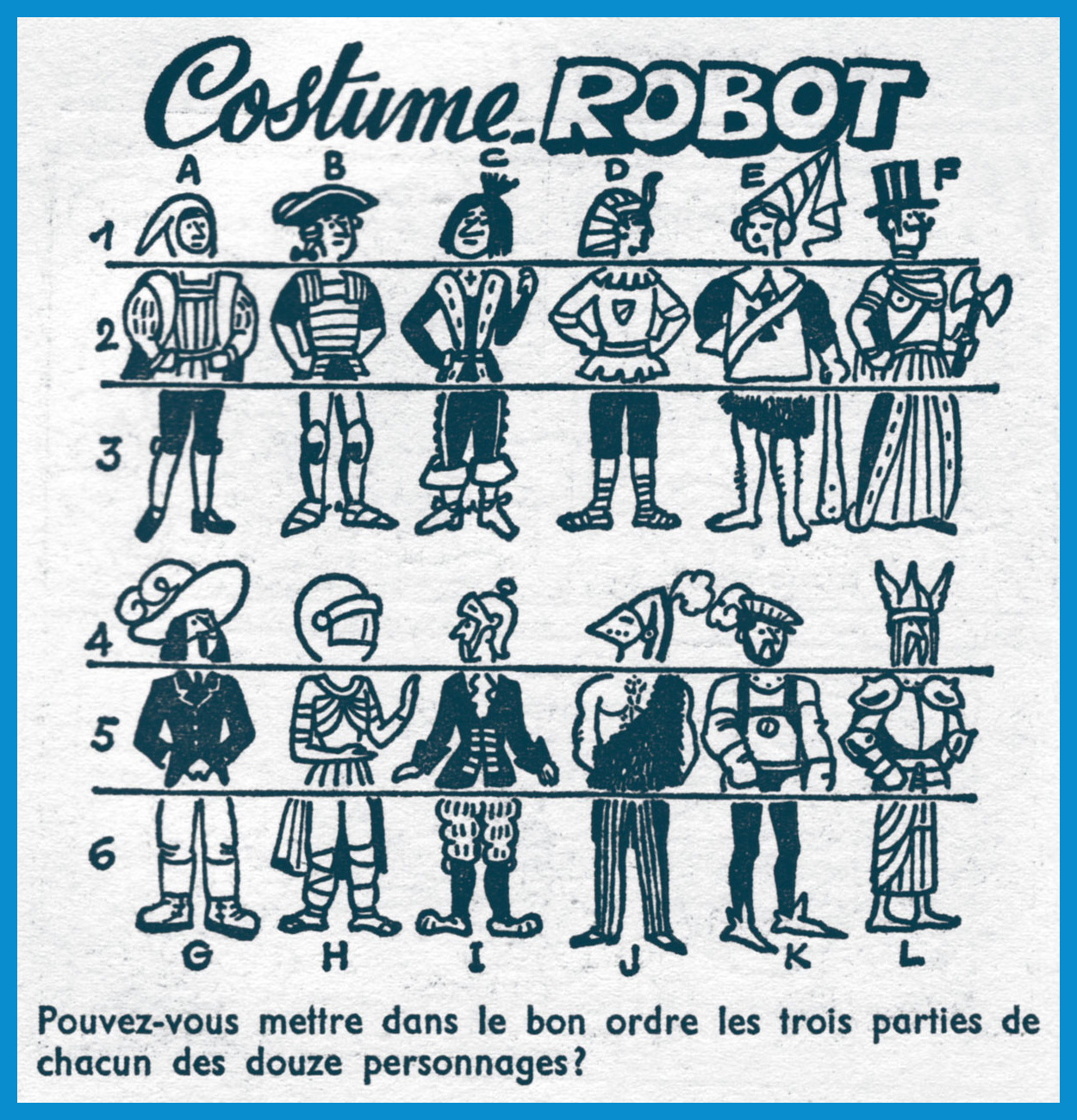
Mad was a master of historical detail. A1-D2-R6 (Middle Ages); B1-I5-A3 (Louis XV); C1-J5-E3 (Prehistory); D1-H5-L6 (Ancient Egypt); E1-C2-F3 (Lady of the manor); F1-G5-J6 (1900); G4-E2-C3 (Musketeer); H4-R5-G6 (Cosmonaut); I4-B2-D3 (Roman); J4-L5-B3 (Knight); S4-A2-I6 (Renaissance); L4-F2-H6 (Gaul). From Pif Poche no. 71 (July, 1971, Vaillant).
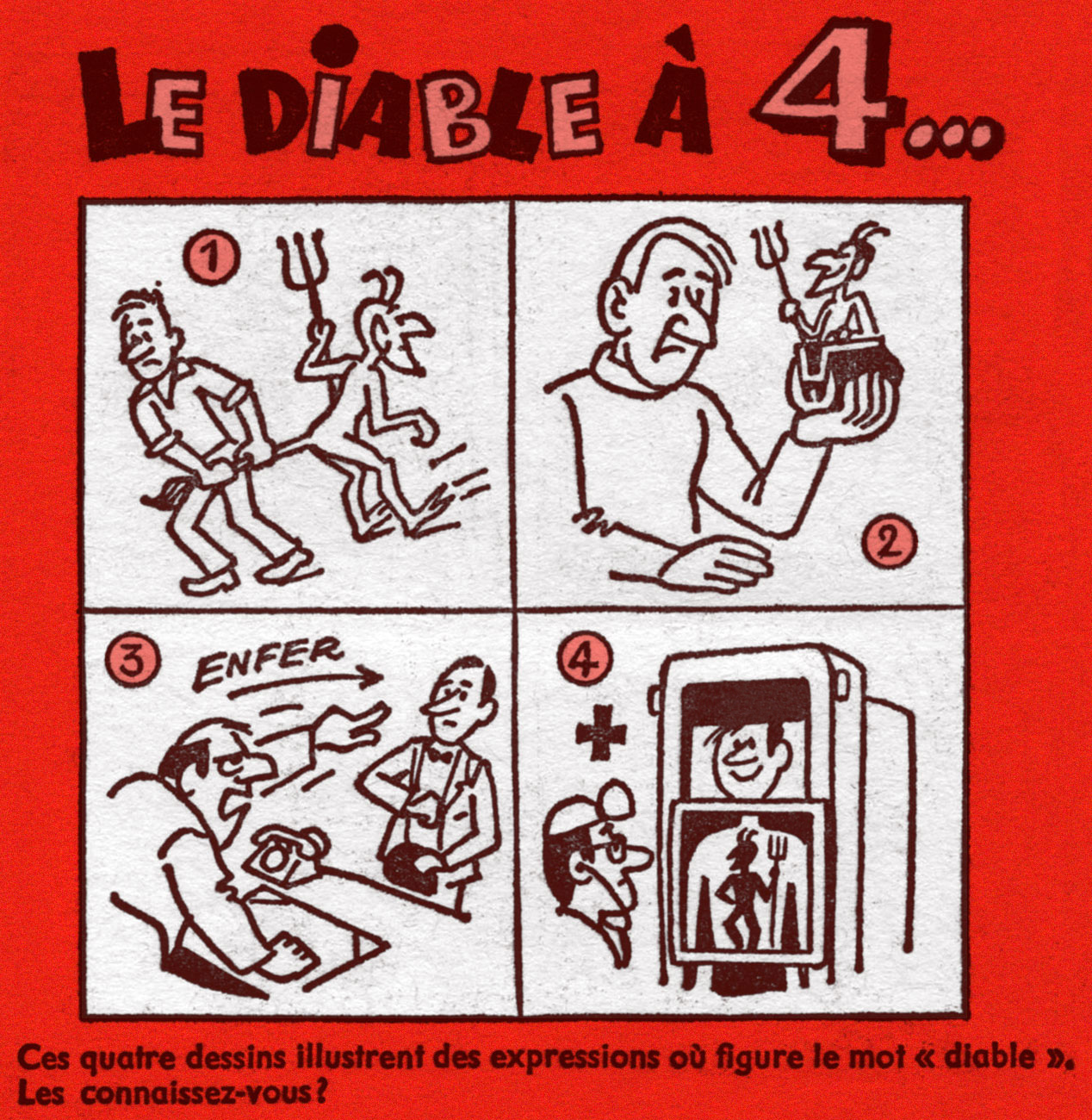
A cute demonstration of Mr. Mad’s versatility, from Ludo, le journal des amateurs d’énigmes no. 3 (Oct. 1973, Vaillant). « These four drawings are excerpted from different strips, but all have one detail in common. Which one? » The solution was to be provided in the following issue, which I only acquired decades later… but I’m sure you can suss out the answer to this one.
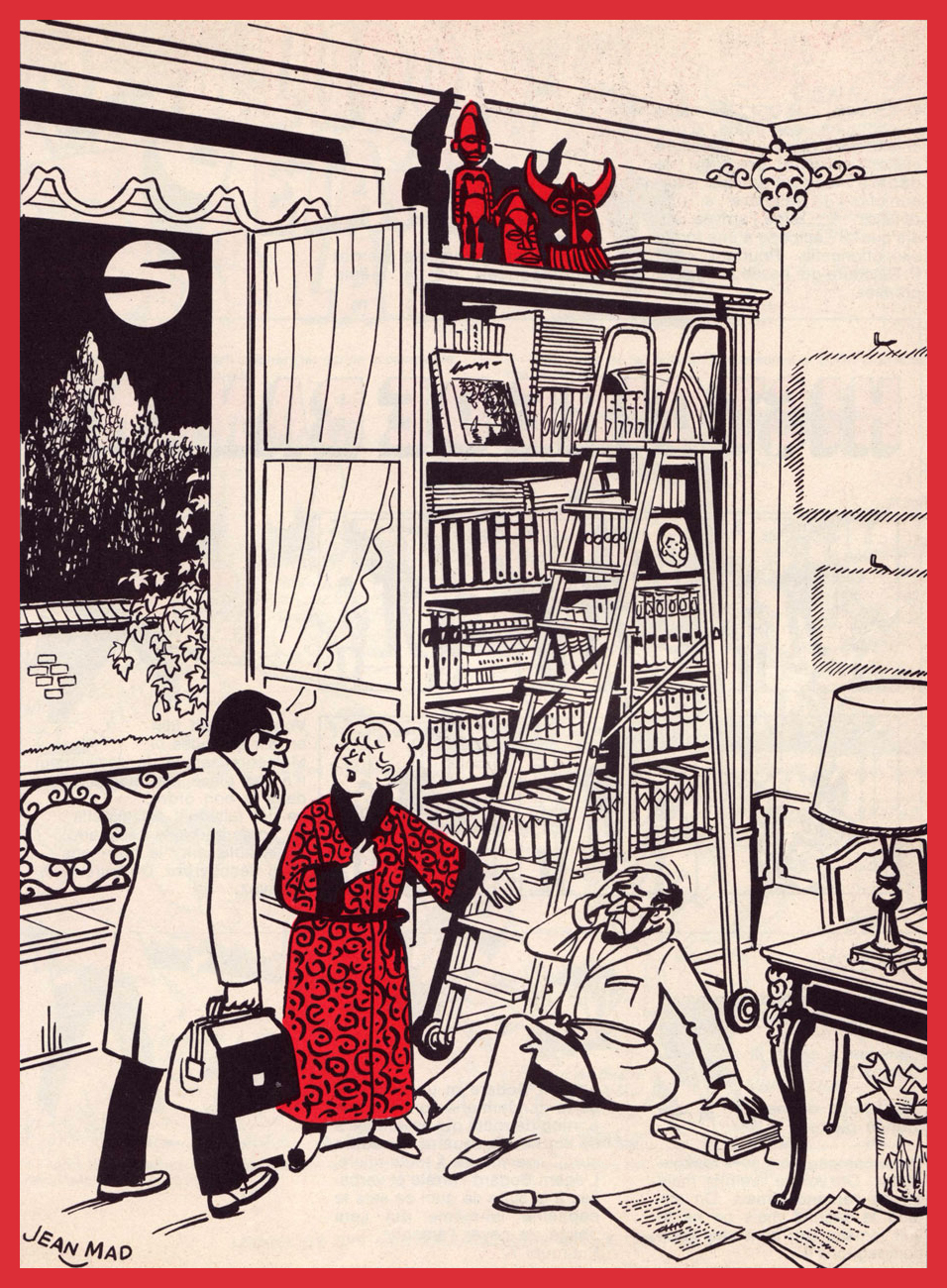
Prior to encountering this piece in Ludo, le journal des amateurs d’énigmes no. 1 (Feb. 1973, Vaillant), I had no clue as to the identity of the mystery artiste. I guess this piece was large and elaborate enough to warrant a signature.
«A car at last! » « Where? » A bit of a cheat, that one. How was I to know, at age six, that a “DS” was a French car, even one as lovely and classic as the Citroën DS? We didn’t have those around where I grew up, and that’s a shame. From Pif Poche no. 70 (June, 1971, Vaillant).
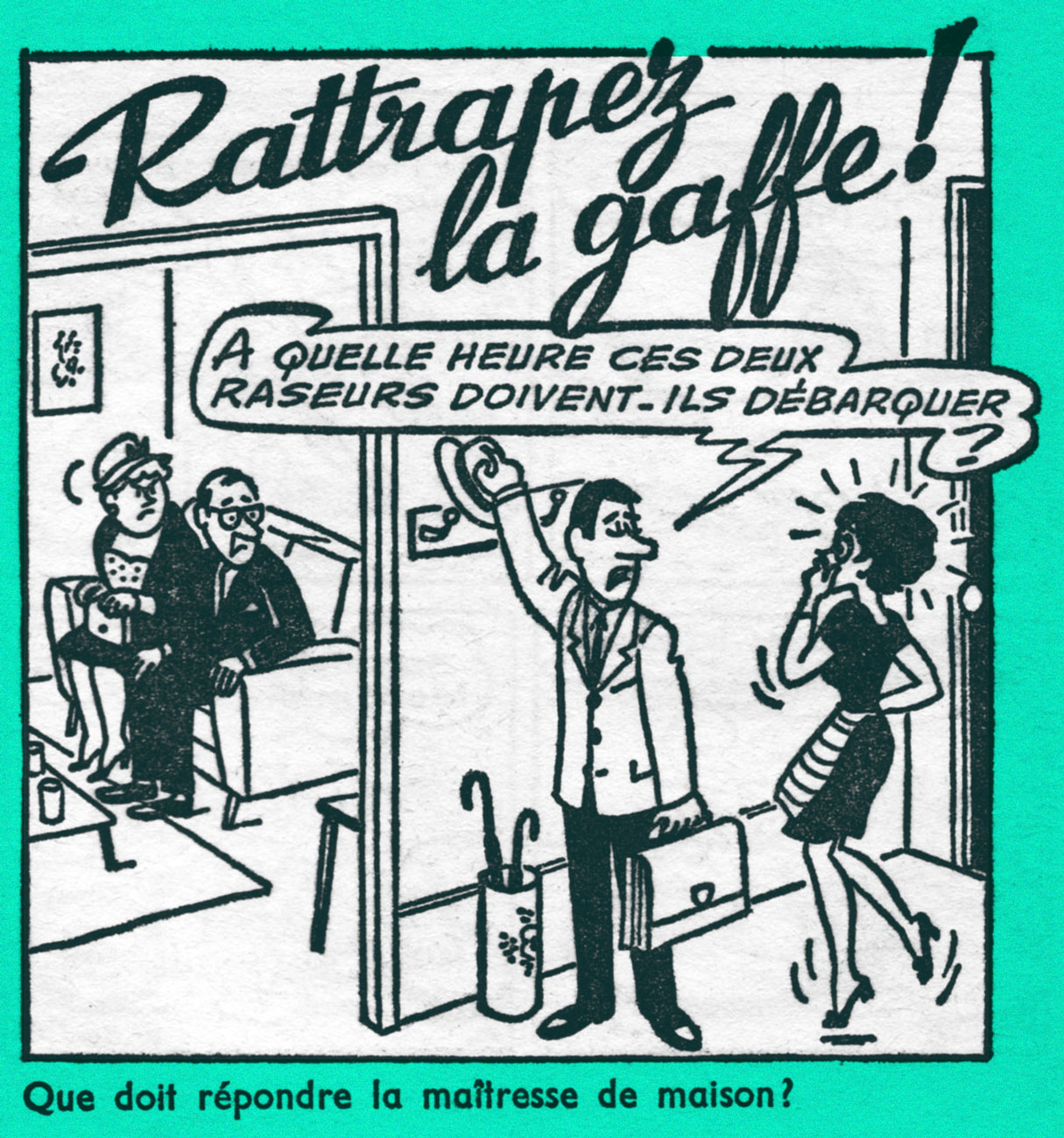
A surprisingly adult situation, given the audience. Catch the gaffe!: The man of the house, having queried his spouse: « At what time are those two drips due to drop in? », what should be her reply, to salvage the situation? « They had to cancel. But our friends, X… have just arrived. » From Pif Poche no. 71 (July, 1971, Vaillant).
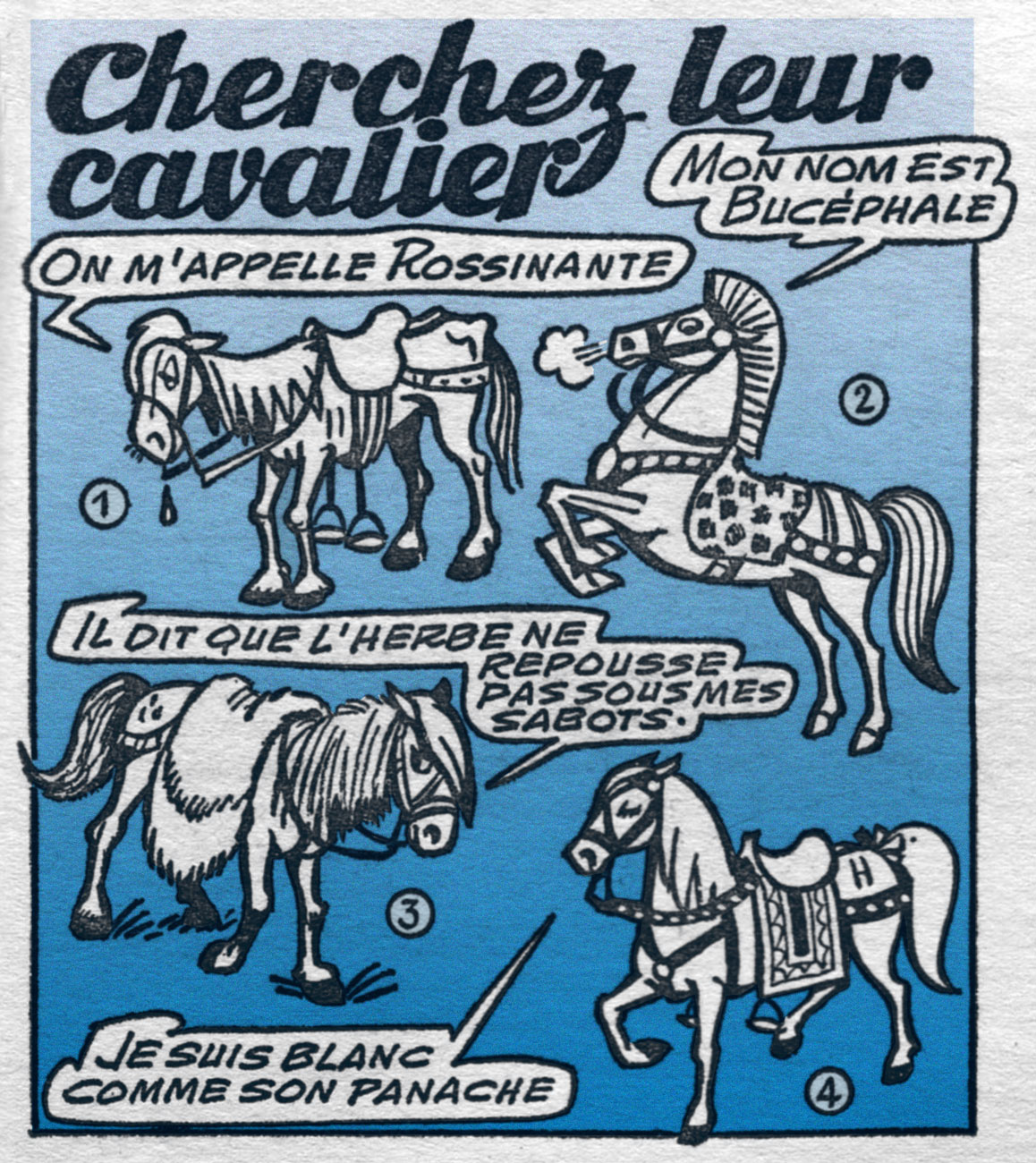
An artist who can not only draw steeds, but depict various equine types and personalities… now, that’s skill. From Totoche Poche no. 20 (March, 1971, Vaillant). Name Their Cavalier: (1) Don Quixote; « I am called Rossinante » (2) Alexander the Great; « Bucephalus is my name » (3) Attila the Hun; « The grass never grew back where I trod » (4) Henri IV (Henri de Navarre); « I am white, as is his panache ».
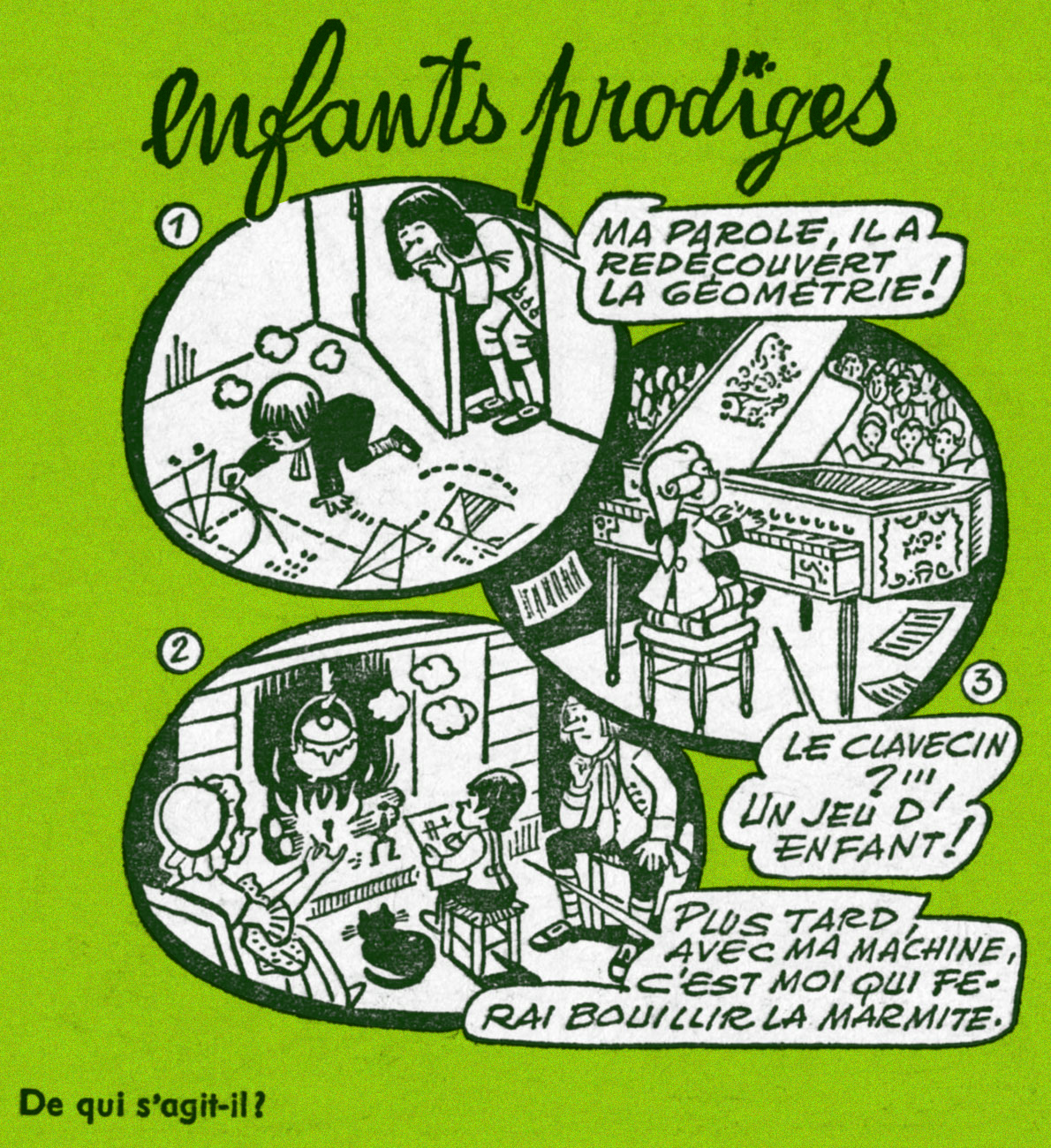
Child Prodigies: (1) « My word, he’s rediscovered geometry! » (Little Blaise Pascal) (2) « Later on, with my machine, I’ll be making the pot boil. » (Little Denis Papin) (3) « The harpsichord? Child’s play! » (Little Wolfgang Amadeus Mozart). From Pif Poche no. 68 (April, 1971, Vaillant).
I suppose I didn’t think twice about it when I was a kid, but it seems to me, in hindsight, that kids in those days were expected to possess quite a baggage of eclectic knowledge pertaining to history, geography, language, architecture, logic, observation… As an omnivorous, voracious reader, that state of affairs suited me to a T, and so these dense little volumes nourished me considerably at a time when I was most receptive to such gleanings. Inevitably, both the comics and the puzzles were soon dumbed down, but I had moved on by then.
















 Who's Out There?