« You mean the secret password is Llanfairpwllgwyngyllgogerychwyrndrobwllllantysiliogogogoch? » — Barbarella
Unlike French rock ‘n’ roll, French science-fiction isn’t an oxymoron.
A couple of months back, I happened to order a handful of issues of Fiction (1953-1990), nominally the French-language edition of The Magazine of Fantasy & Science Fiction… yet superior in the sense that Fiction’s focus was broader, encompassing as it did more elusive genres like fantastique, while devoting ample space to excellent critical essays… in the French manner.
I was buying specific issues for their reprints of tales by my favourite writer, Jean Ray, and a couple of the issues happened to bear covers by future superstar Jean-Claude Forest (1930-1998), fabled creator of Barbarella, Hypocrite and Bébé Cyanure, as well as scripting early episodes of Paul Gillon‘s Les naufragés du temps.
As it turned out, Forest had lent his talents to quite a bevy of covers for Fiction — which speaks well of their editorial discernment — and as the kind seller had priced other issues at a most modest price — these are nearly seventy years old, let’s not forget — I opted to spring for more Forest rarities… and so here we are.
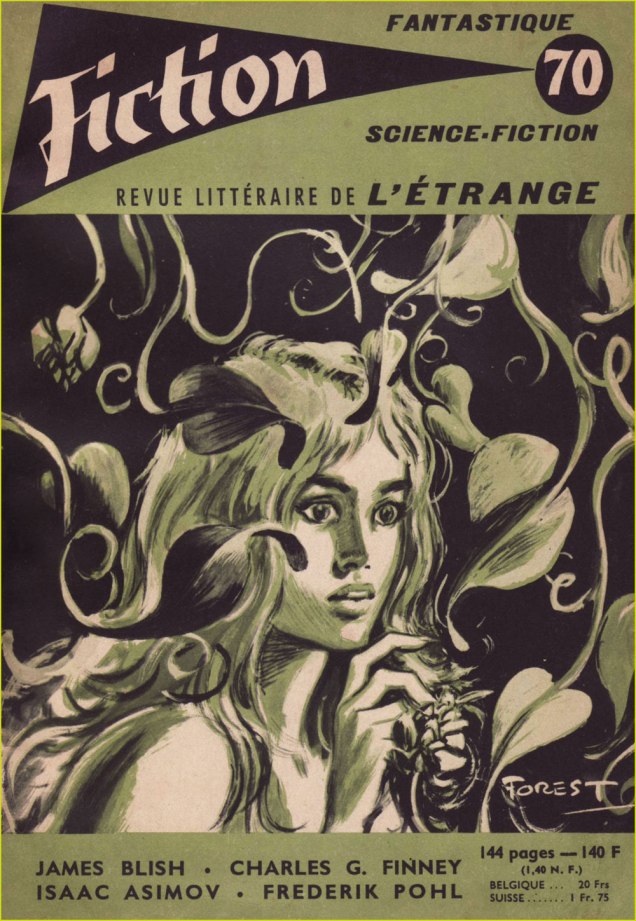
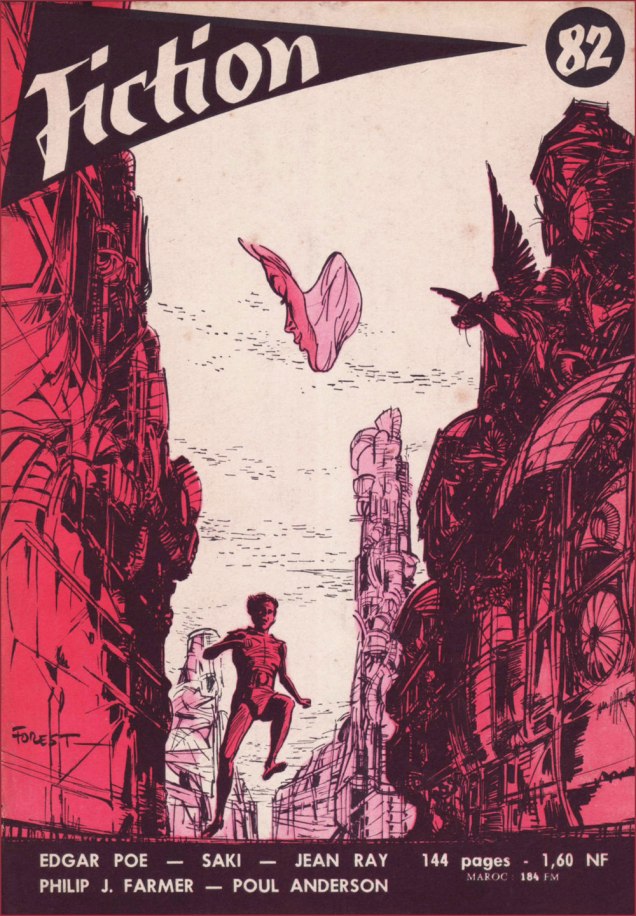
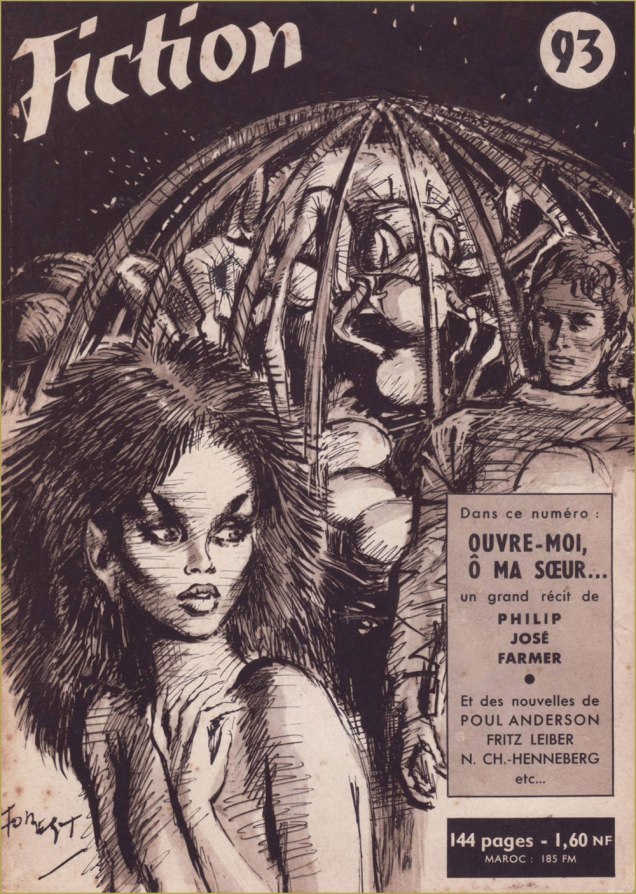
This is Fiction no. 61 (Dec. 1958, Éditions Opta), with Forest’s cover illustrating Julia Verlanger‘s “La fenêtre“.This is Fiction no. 64 (Mar. 1959, Éditions Opta), with Forest’s cover illustrating Robert F. Young‘s “La déesse de granit” (« Goddess in Granite »).This is Fiction no. 68 (July 1959, Éditions Opta), with Forest’s collage cover illustrating Charles Henneberg‘s “Au pilote aveugle“.Is that you, Barbarella? This is Fiction no. 70 (Sept. 1959, Éditions Opta), with Forest’s halftone cover illustrating Ilka Legrand‘s “Le rire dans la maison“.This is Fiction no. 75 (Feb. 1960, Éditions Opta), with Forest’s cover illustrating Thomas Owen‘s “Le manteau bleu“. Owen (né Gérald Bertot, 1910-2002) was among the great Belgian writers of the fantastique genre.This is Fiction no. 76 (Mar. 1960, Éditions Opta), with Forest’s cover depicting — you guessed it — Theodore Sturgeon‘s “The Silken-Swift“, translated here as « Douce-agile ou La licorne ».This is Fiction no. 81 (Aug. 1960, Éditions Opta), with Forest’s cover illustrating André Pieyre de Mandiargues‘ “Clorinde“.This is Fiction no. 82 (Sept. 1960, Éditions Opta), with Forest’s cover illustrating Philip José Farmer‘s “The Night of Light“, translated here as « La nuit de la lumière ». I love what Forest does with the composition, its focal point that elusive butterfly with a woman’s face.Forest goes gothic! This is Fiction no. 90 (May 1961, Éditions Opta), featuring a well-timed reprint of Henry James‘ 1898 novella “The Turn of the Screw” (read it here!), several months ahead of Jack Clayton and Freddie Francis‘ fine cinematic version, « The Innocents ».This is Fiction no. 93 (Aug. 1961, Éditions Opta), with Forest’s cover illustrating Philip José Farmer‘s “Open to me, my Sister“, translated here as « Ouvre-moi, ô ma sœur… ».This is Fiction no. 97 (Dec. 1961, Éditions Opta), with Forest’s cover illustrating Michel Demuth‘s “La route de Driegho“.This is Fiction no. 105 (Aug. 1962, Éditions Opta); exceptionally, Forest’s cover doesn’t refer to any of the inside stories; instead, he offers a scene featuring Pygar the blind angel, last of the ornithanthropes, a character from the bédéiste’s signature series Barbarella, which had just begun serialisation in V Magazine that spring. Finally — at least in my collection — this is Fiction no. 117 (Aug. 1963, Éditions Opta); Forest’s intriguing cover doesn’t appear to correspond to any of the stories within.
A word of warning: I plan to further elaborate on the superiority of French science-fiction in comics, but it’s daunting work, and might take a while yet, so bear with me. I’m pretty busy these days.
« We all have our time machines. Some take us back, they’re called memories. Some take us forward, they’re called dreams. » — Jeremy Irons
Today, we note the birth anniversary of the powerful French bédéistePaul Gillon (May 11, 1926- May 21, 2011). Working in a classical, realistic style, he began his career in comics with the weekly Vaillant. For daily newspaper France-Soir, he co-created the daily soap opera strip 13, rue de l’Espoir (1959-1962, scripted by Jacques Gall and François Gall), strongly inspired by Elliot Caplin and Stan Drake’s The Heart of Juliet Jones, but set in Paris.
Then, in 1964, for the short-lived bédé newspaper Chouchou (an eight-pager published for a mere 14 issues, a tragedy!), Gillon co-created, with scripter J.C. Valherbe (alias Jean-Claude Forest, of Barbarella fame), one of the great classics of French science-fiction comics, Les naufragés du temps (“Castaways of Time”). Several wonderful features (for instance, Georges Pichard‘s Ténébrax) were left stranded by Chouchou’s demise, including (literally) Les naufragés.
Fortunately, its authors deemed its premise too worthy to let the matter drop forever. Nearly a decade on, Gillon tweaked the saga’s opening pages and resumed the narrative, which France-Soir published. Forest scripted the first four collections (1974-76), then Gillon took full command of the strip, which found a warm new home in Métal hurlant from 1977 right to the end of the series with Le cryptomère (The Cryptomeria), collected in 1989.
Les naufragés’ premise is this: In 1990, a man (Chris) and a woman (Valérie) are placed into suspended animation. A thousand years hence, the man is picked up and woken. Where’s the woman?, he wants to know. A futuristic bout of cherchez la femme ensues, to make a long story short.
Forest, wrote, in 1967, of his original plans for the saga: « Chris was searching for an image. After many adventures, he manages to find Valérie only to realize that this image no longer fitted that of his dream. »
The sequence presented here comprise the second, third and fourth pages of the first tale, as they appeared in Chouchou in 1964. Say, that cool metal creature reminds me of one of the most ridiculous Marvel super-baddies of the 1960s, disgruntled government employee Alexander Gentry, aka… (see below for the answer).
The first album in the series, L’étoile endormie (The Sleeping Star) – 1974The fourth album in the series, L’univers cannibale (The Cannibal Universe) – 1976The fifth album in the series, Tendre chimère (Sweet Illusion) – 1977
A peek at a page of original art from album 3, Labyrinthes (1976):
Stan Lee and Don Heck‘s The ‘Dreaded’ (ha!) Porcupine, or what happens when neither Steve Ditko nor Jack Kirby are on hand to design your costume (and ghost-write your story). Incidentally, Stan, porcupines don’t project their quills. Here he is depicted by Kirby, from the cover of his inaugural appearance, in Tales to Astonish no. 48 (October, 1963).







 Who's Out There?