« All realities, all dimensions are open to me! » — Prince
Growing up, Lee Elias (1920-1998) never was a particular favourite of mine. A handful of stories in DC’s mystery titles aside — and I’ve grown to love those — I probably came across his work for Marvel’s Human Fly series, and I was always disappointed when Elias, not my beloved Frank Robbins, turned up in the credits. For the record, Elias drew ten of the nineteen HF issues, and Robbins drew six, plus five covers.
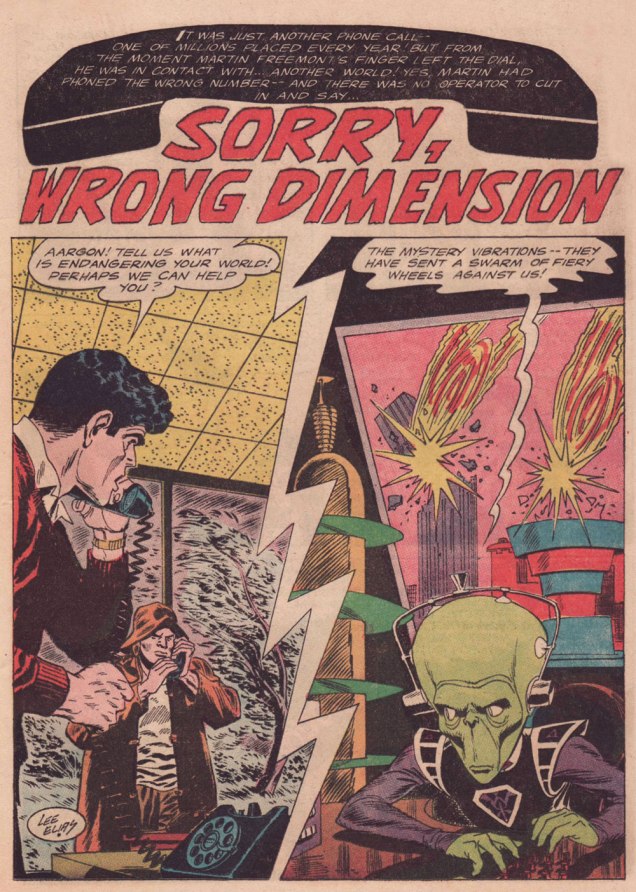
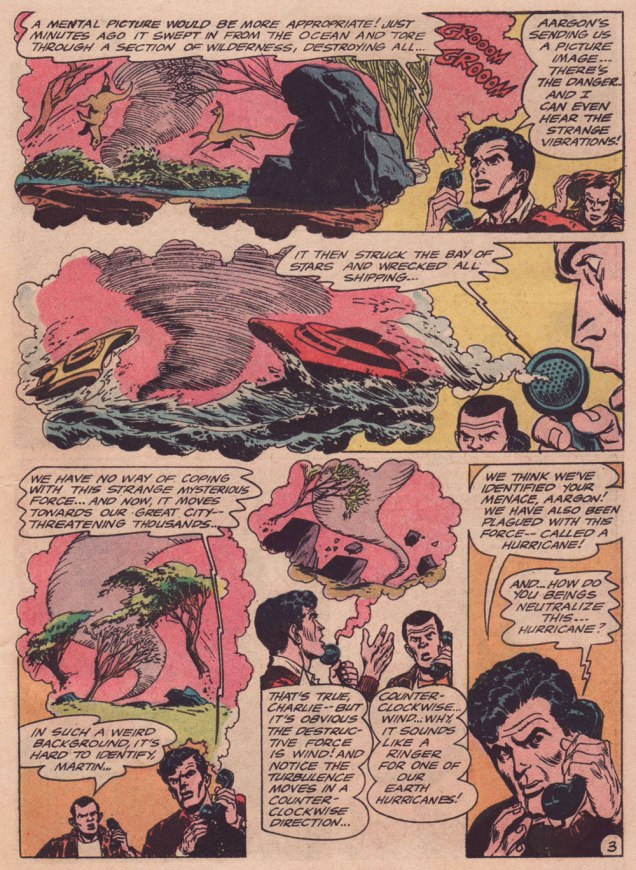
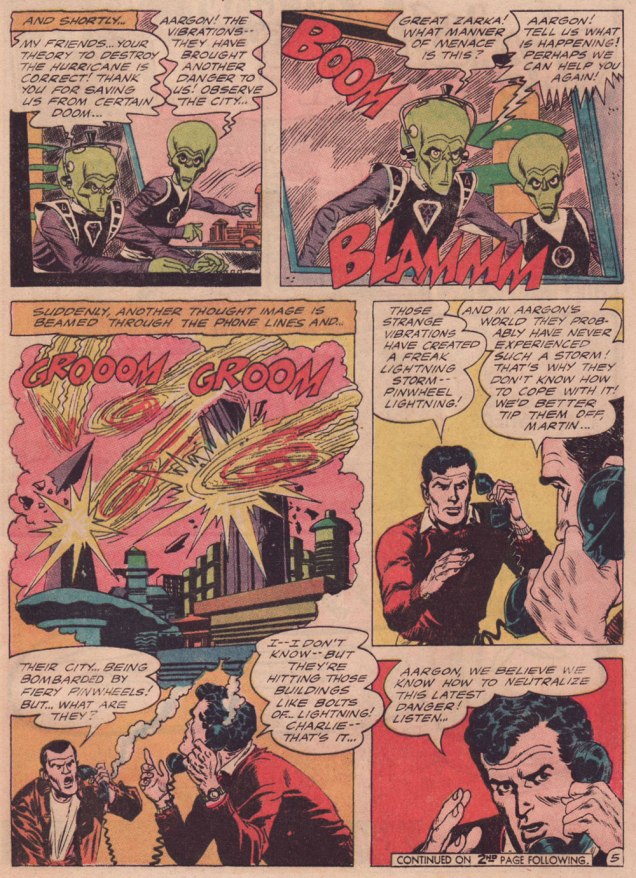
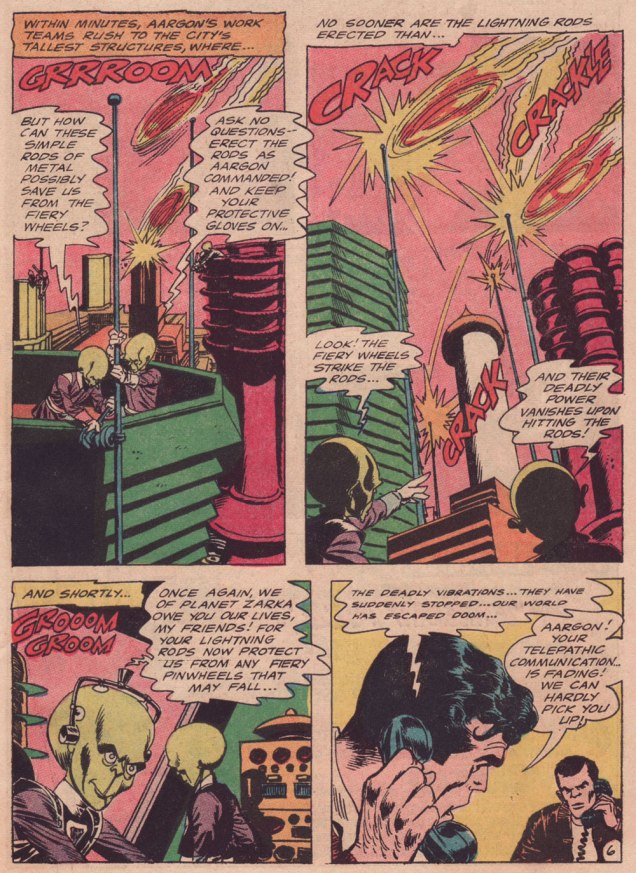
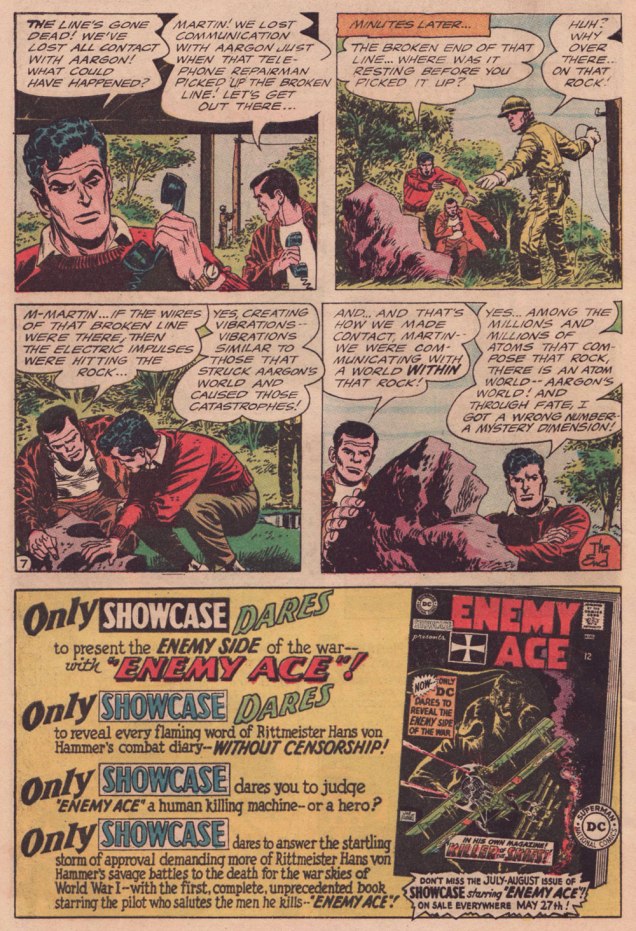
Over time, I noticed his gloriously gruesome cover work with art director-designer Warren Kremer for Harvey’s Pre-Code Horror titles of the early 1950s. His work on DC’s Adam Strange in the mid-1960s is best forgotten — there is only one Adam Strange, and it’s Carmine Infantino‘s (with trusty inker Murphy Anderson along for the Zeta Beam ride, of course). However, I adore Elias’ brief run (with writer Dave Wood) on Ultra the Multi-Alien, the splendidly wacky feature that replaced Adam Strange in Mystery in Space (issues 103 to 110, 1965-66).
Why am I so fond of this particular story? It’s the little things: for once, a story in a Jack Schiff-edited title makes some semblance of adhering to scientific — or at least science-fictional — principles; here, Elias designed an alien race that, given their grumpy, unprepossessing mugs, would typically have been cast as villains, but instead turn out perfectly honourable; the story’s human protagonists give aid to strangers in need, never asking for a thing in return: no Zarkan mineral rights, no salacious dirt on J’onn J’onzz, just selfless dedication to doing the right thing and the satisfaction of averting a crisis. How refreshingly old-fashioned, a cooling balm for these harrowing times.
-RG
p.s. my partner ds should return to our blog soon… she’s at present battling a mild case of writer’s block, so I’m filling in.
« Competition brings out the best in products and the worst in people. » — David Sarnoff
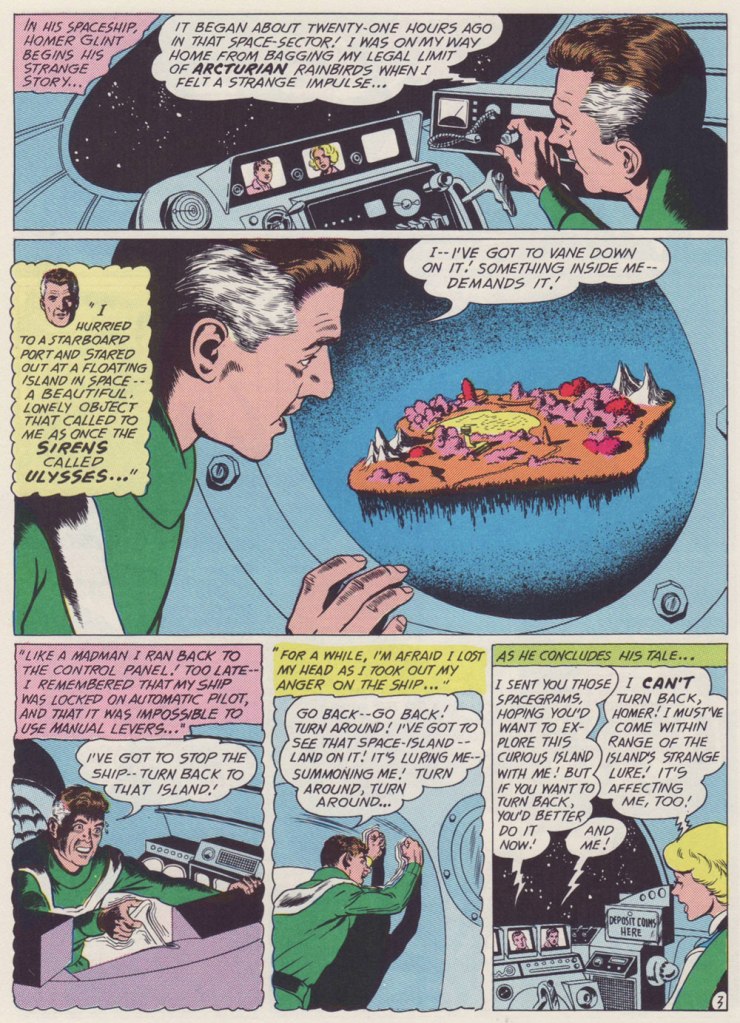
The other day, my partner was trying out a video game whose soundscape seemed exceptionally judicious and well-integrated to the action. At one point, she noticed that the optimal way to play was by matching one’s pace and movements to the musical rhythm. I said, “Oh, it’s just like that Star Rovers story!”
And now for a bit of context: The Star Rovers was a short-lived series that sporadically appeared in the back of DC’s Julius Schwartz-edited titles, mainly Mystery in Space, backing main feature Adam Strange.
As Michael Uslan beautifully puts it, in his introduction to Mysteries in Space: The Best of DC Science-fiction Comics (Fireside/Simon and Schuster, 1980):
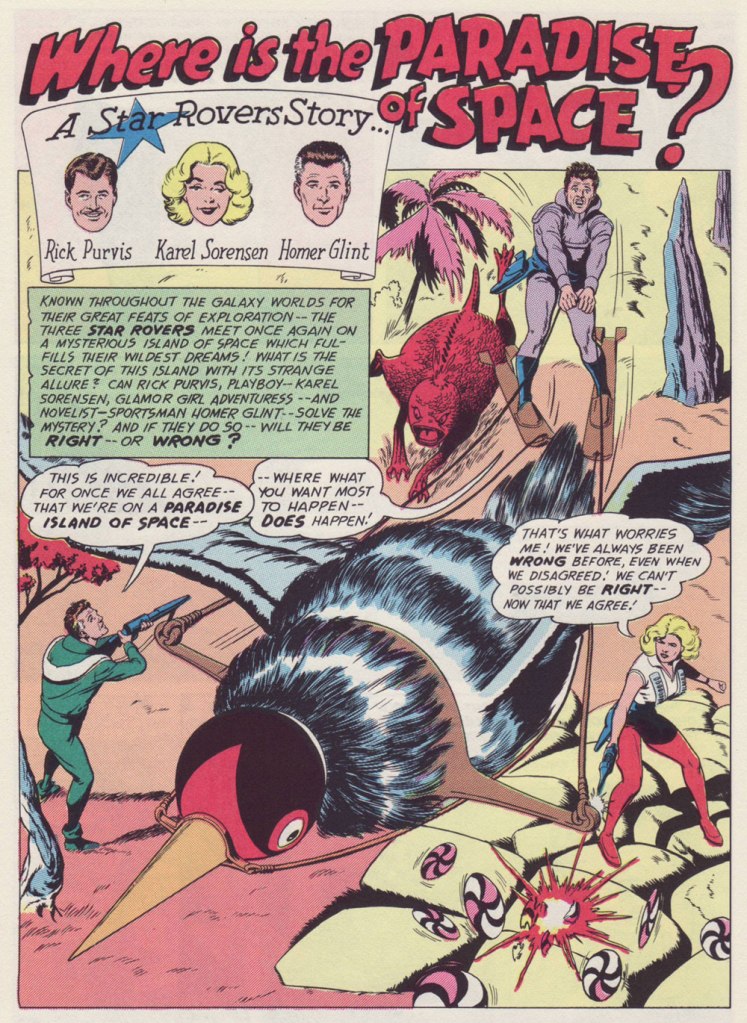
« The Star Rovers were a whole other category of space heroes, typical of the kind of originality demanded by Julius Schwartz. A transgalactic trio of playboy, glamor-girl and novelist-thrill-seeker, they rarely agreed about anything and were rarely right about anything even when they did agree. »
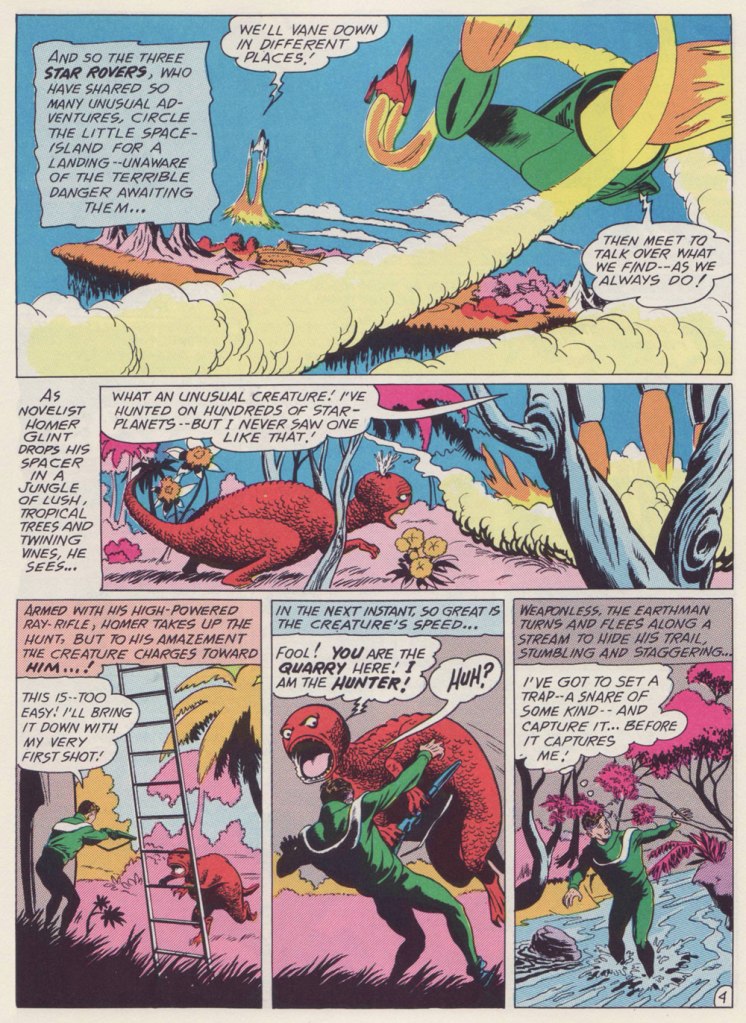
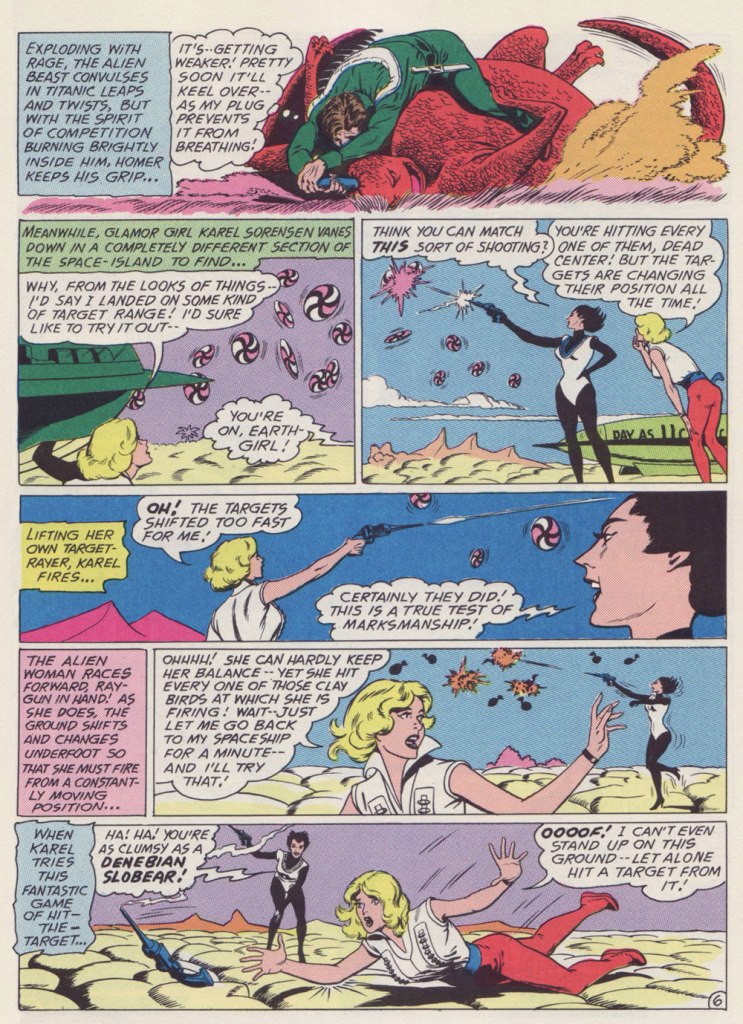
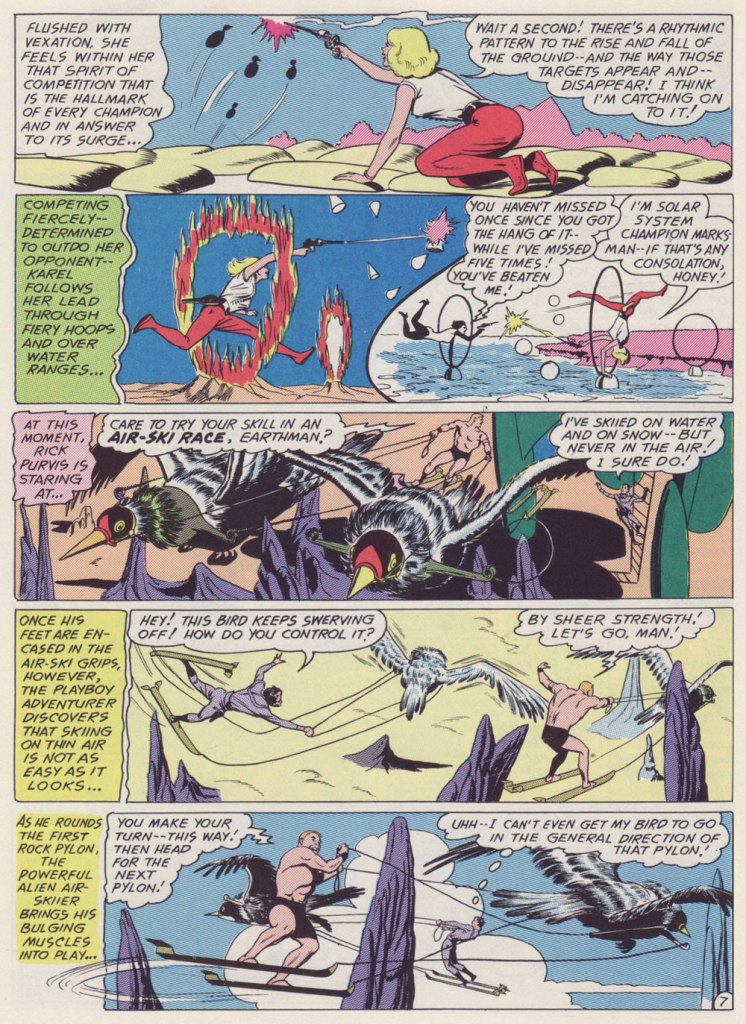
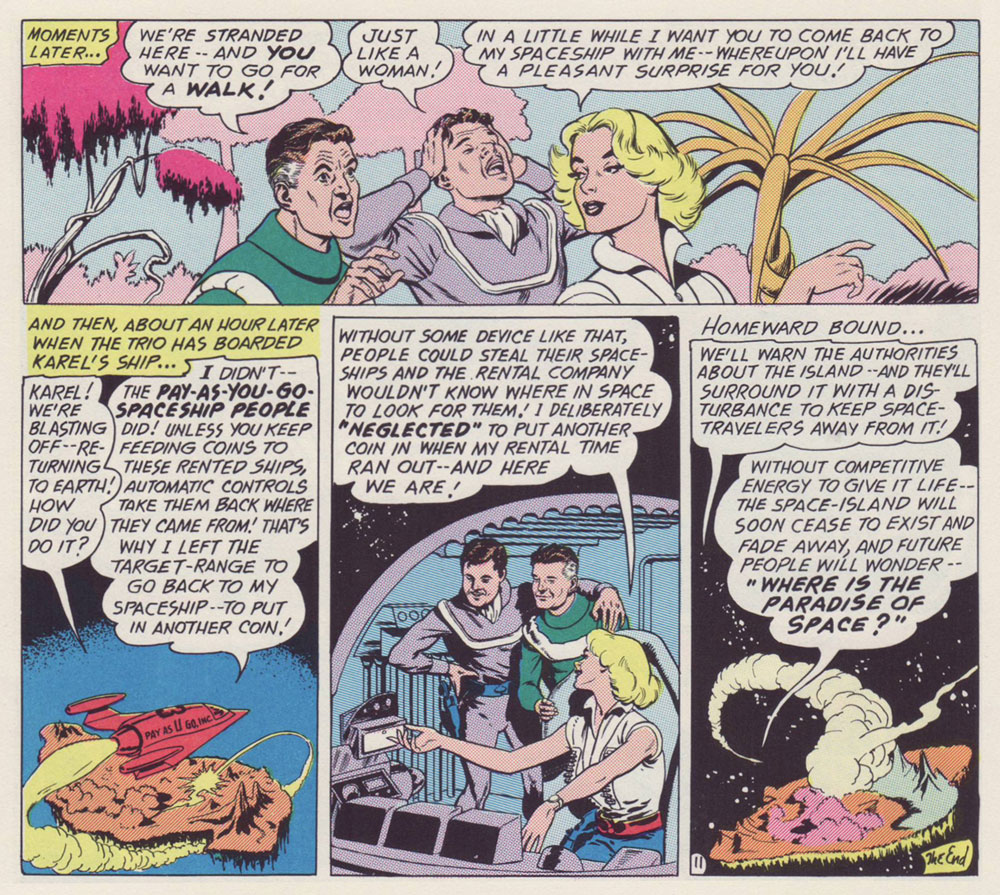
This is the third Star Rovers episode, Where Is the Paradise of Space?, from Mystery in Space no. 74,Mar. 1962, DC).
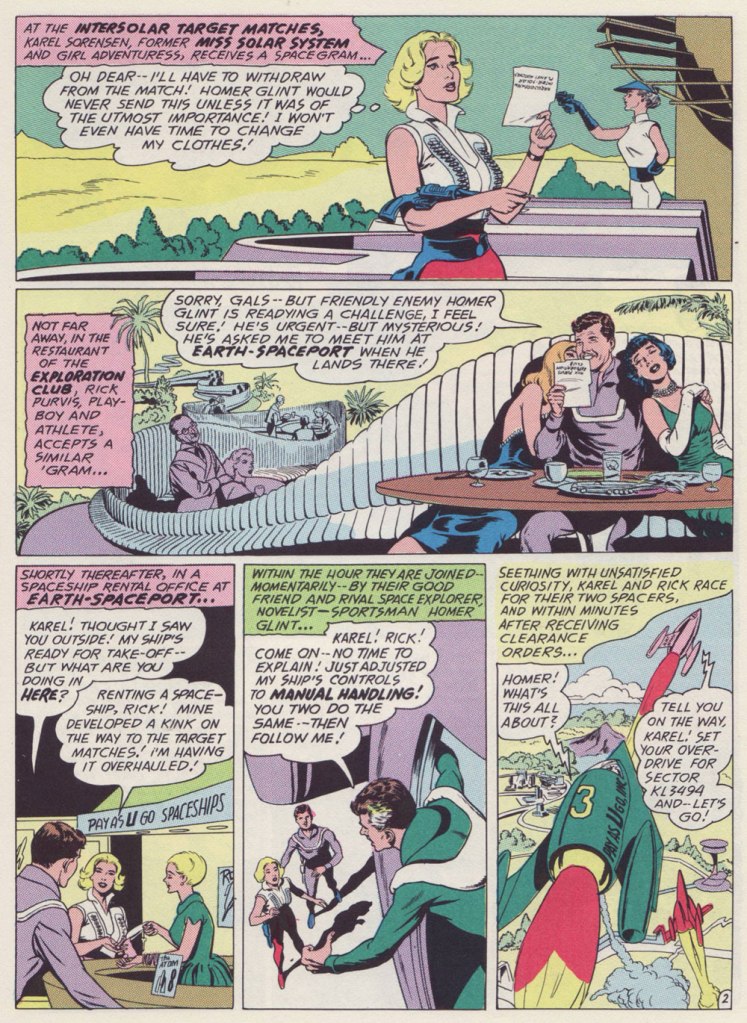
This is the sequence that brought this story to my mind.
One of the most charming aspects of the Star Rovers is the protagonists’ equal footing. In this case, Karel is a bit more than the fellows’ equal, but the series is mostly exempt of the sexism you’d expect from the period of its creation.
Much of the appeal of the Star Rovers is that they’re not a team: they’re friendly rivals, ‘frienemies’, as we’d call them these days. Aside from matching wits and theories, they never directly compete, as differences in their fields of endeavour would make the exercice pointless. There’s a light, jovial tone to these mysteries, yet they can still be taken seriously as intriguing puzzles.
All nine episodes were edited by Schwartz, scripted by Gardner Fox, and illustrated by Sid Greene (1906-72). The latter, a veteran of the comics industry with published work going back to 1940, arguably turned in the finest work of his busy career, and likely would have kept on doing so had it not been for… Batman’s troubles.
To make a long story short, as the Batman titles were shedding readers like there was no tomorrow (making it possible that there would, indeed, be no tomorrow), DC bigwigs opted to switch things around a bit, pulling editor (and Jack Kirby blackballer) Jack Schiff off Batman and Detective Comics and handing him the reins of Schwartz’s SF titles Strange Adventures and Mystery in Space. He ran those into the ground, but in goofily entertaining fashion, at least. Unlike the bat-books, there were expendable to DC.
As the ultimate Star Rovers tale appeared in the final issue of the Schwartz-edited Strange Adventures before the changeover, it seems likely that the series would have carried on under a Schwartz régime. But the Rovers weren’t at all in Schiff’s wheelhouse: the delicate premise called for deft, intricate plotting and wit, qualities not to be found within Schiff’s stable of writers. Gardner Fox and Greene were among Schwartz’s trusted confederates, and talent poaching was rarely allowed within DC’s editorial enclaves.
After this editorial switch, Greene was, with few exceptions, put to work inking the pencils of Schwartz’s big three: Carmine Infantino on Batman and The Elongated Man, Gil Kane on Green Lantern and The Atom, and Mike Sekowsky on Justice League of America. The problem, at least as I see it: Greene’s inks didn’t mesh well with any of these pencillers’ styles. Oh well — it’s a living. At least Greene was able to return to full pencil and ink duties on a handful of short stories for editor Murray Boltinoff, mostly in the pages of The Unexpected. Better late than never.
Finally, for your edification and amusement, here’s a Star Rovers checklist:
Who Caught the Loborilla? (Mystery in Space no. 66, Mar. 1961) What Happened on Sirius-4? (Mystery in Space no. 69, Aug. 1961) Where Is the Paradise of Space? (Mystery in Space no. 74, Mar. 1962) Where Was I Born– Venus? Mars? Jupiter? (Mystery in Space no. 77, Aug. 1962) Who Saved the Earth? (Mystery in Space no. 80, Dec. 1962) Who Went Where– and Why? (Mystery in Space no. 83, May 1963) When Did Earth Vanish? (Mystery in Space no. 86, Sept. 1963) Will the Star Rovers Abandon Earth? (Strange Adventures no. 159, Dec. 1963) How Can Time Be Stopped? (Strange Adventures no. 163, Apr. 1964).







 Who's Out There?