« I opened my magazine (What did you see?) / I saw Mr. France (What did he have?) / A girl on each shoulder (What else?) / And one in his pants » — 10cc, Sand in My Face (1973)
You may think of this post as a companion piece, a spinoff of its predecessor. I’d had for some time, in the back of my mind, the notion to showcase some obscure French ‘human sculpture’ ads, but it needed more. Comments on the previous post provided the spark.
Is there a more classic “humble immigrant makes good in the USA” yarn than that of Angelo Siciliano, born in 1892 in the tiny Italian town of Acri? The Smithsonian has told the full, colourful story, so I’ll spare you a rehashing of it.
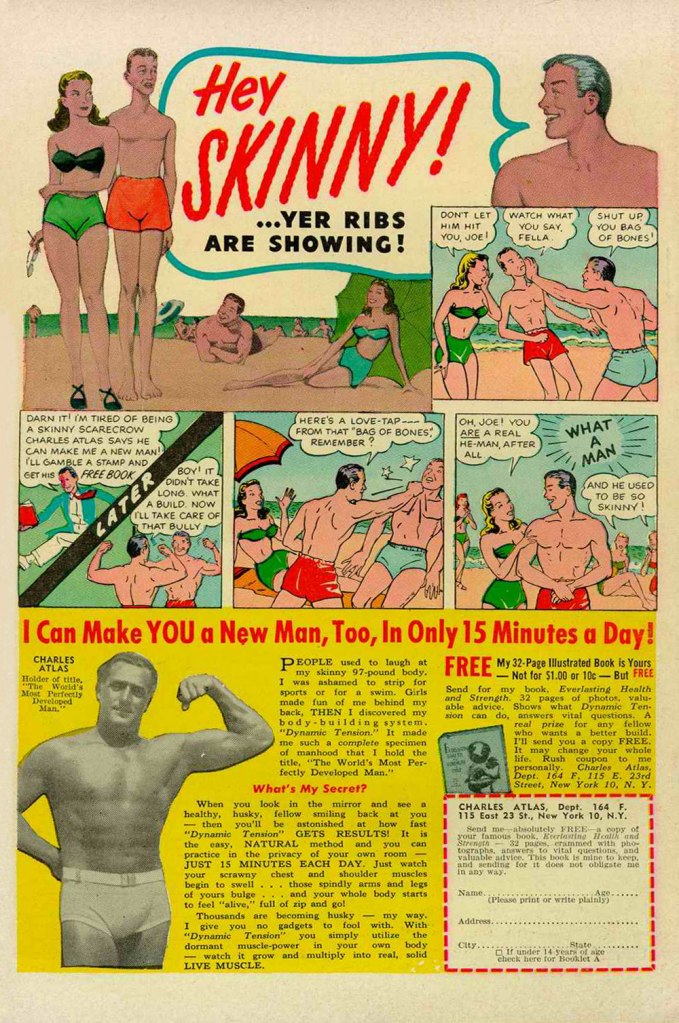
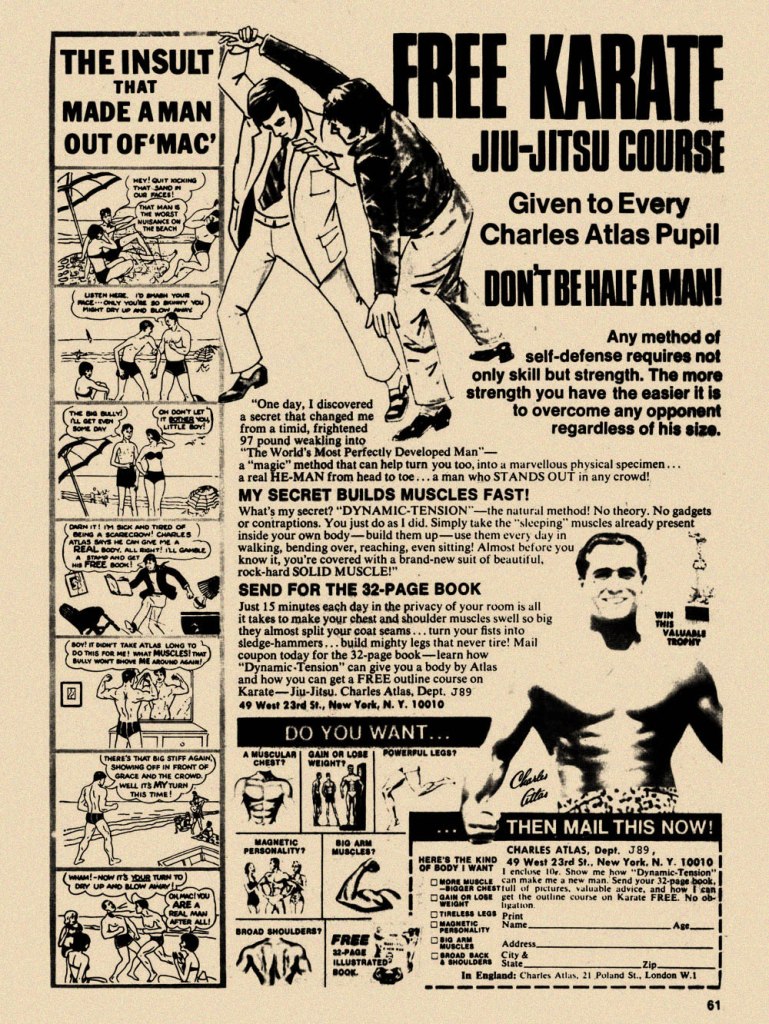
Let’s just say that young Siciliano worked hard to overcome adversity and redeem his puny physique, and the rest is the stuff of legend. The principles of ‘dynamic tension‘ and his immortal moniker aside, Angelo’s finest brainstorm was to employ the lowly but then-ubiquitous medium of comic books to introduce his product and its natural audience to each other. Let’s take the tour!
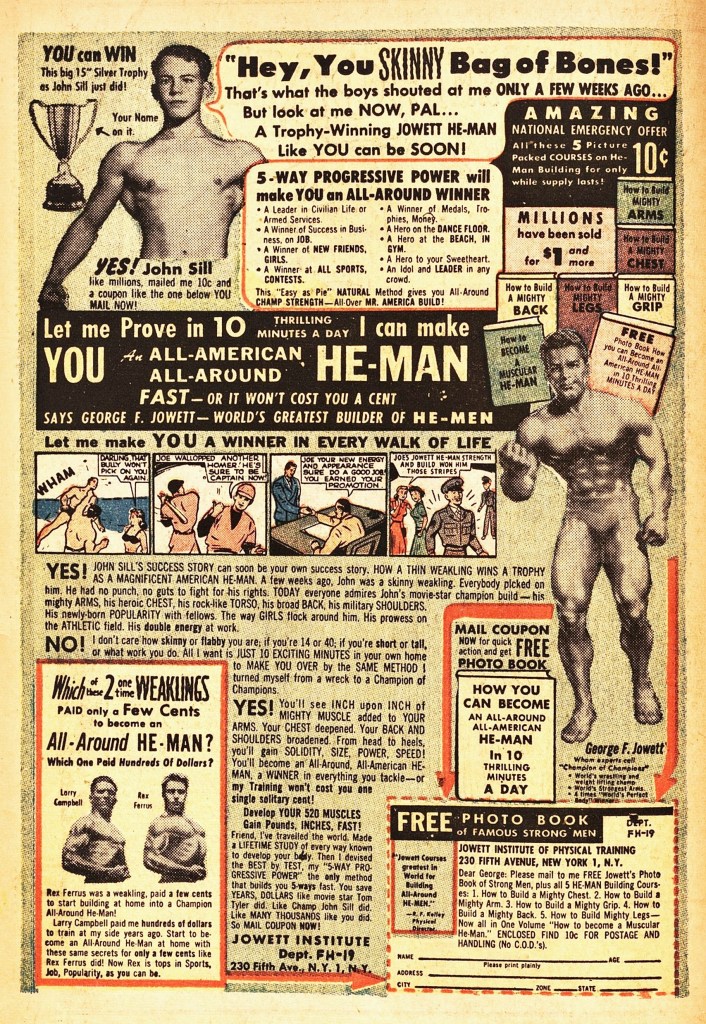
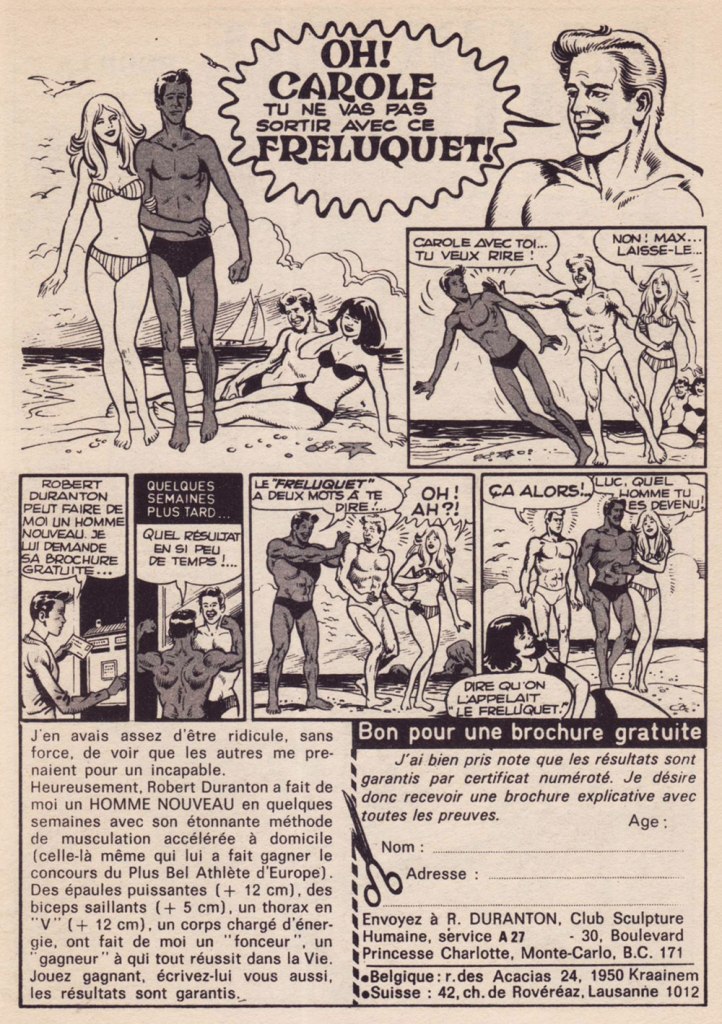
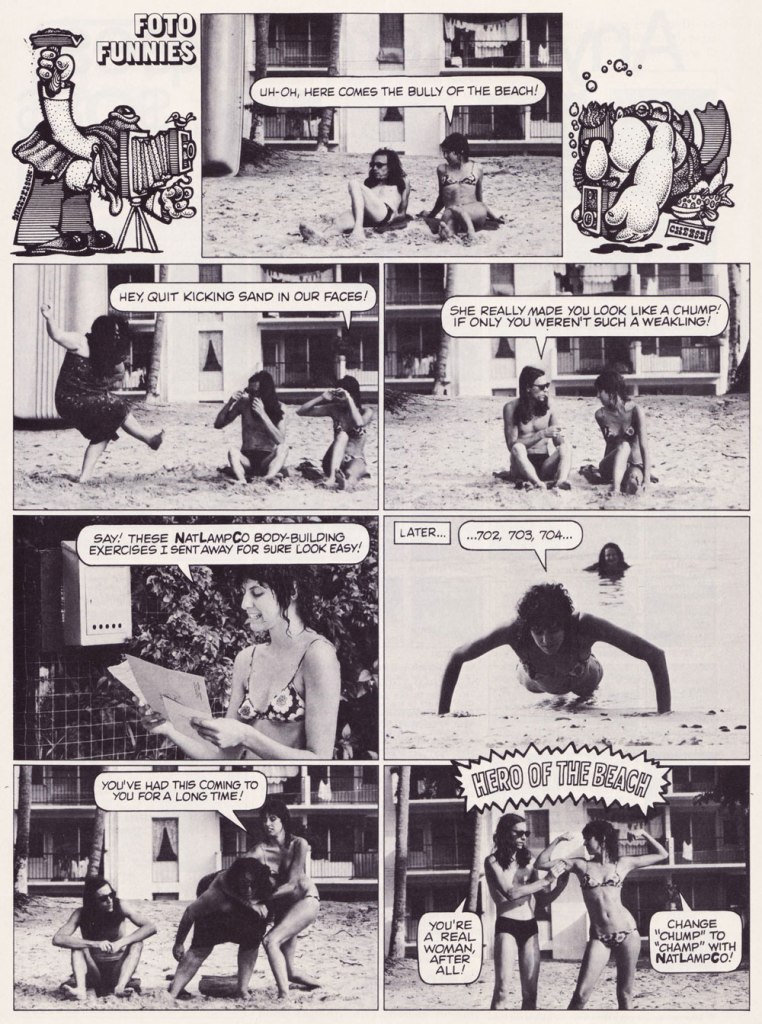
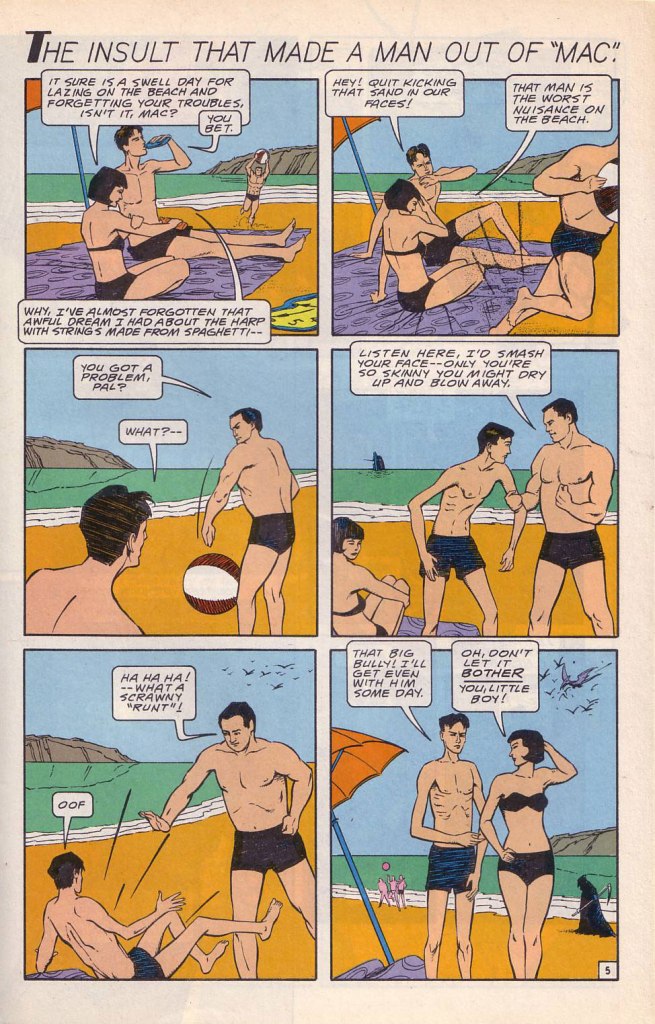
While the Charles Atlas ads began running in the 1930s, this is probably their classical expression. This one saw print as the back cover of Mad no. 14 (Aug. 1954, EC). Its opening insult even inspired Miles Heller’s 1995 salute to the great old comic book ads, Hey Skinny!There was inevitably fierce competition in the self-improvement field. This entry, from the U.S. Nature Products Corp., appeared in Stan Lee’s oh-so-macho Man Comics no. 10 (Oct. 1951, Atlas).Lots and lots of copy — but the all-important cartoon hook is present and accounted for. From the pages of Firehair no. 9 (Fall 1951, Fiction House). The Jowett Institute of Physical Training wants you to get buff! To be fair, George F. Jowett got there first.This is surely the definitive version, with the unforgettable tag line and ‘hero of the beach’ conclusion. I pulled this one from The Witching Hour no. 25 (Nov. 1972, DC), which hit newsstands just a few months before Mr. Atlas passed away, aged 80, on Christmas Eve. I can’t help being amused: French publisher Arédit, whose digest-sized collections of (mostly) reprints of US comics proudly bore the tag « Comics for adults », featured very few outside ads… and those were almost exclusively for self-defense and body-building systems. Here’s a sample trio. This one appeared in Maniaks no 4 (Fall, 1971). This title featured reprints of DC Silver Age ‘humour’ comics… all but the only actually funny one (that would be Sugar and Spike, of course).Oh, I’m sure the ERB Estate got their cut. And who might that R. Duranton fellow be? Four times Mr. France, for one thing! Here he appears with Louis de Funès in a famous scene from Le Corniaud, a 1965 farce starring beloved stars André Bourvil / De Funès and directed by Gérard Oury. This one’s from Kamandi no. 4 (Summer 1976, Artima), which featured reprints of various 60s and 70s DC adventure comics. It was an affordable way to catch up on material one might have missed — or couldn’t afford!This refreshing gender-switched lampoon comes from the pages of National Lampoon no. 26 (May, 1972), the ‘Men!’ issue, guest-edited by Anne Bats, No other credits, dammit. The opening page (of four) of Steve Skeates and Sergio Aragonés‘ wacky satire, from the pages of Plop! no. 2 (Nov.-Dec. 1973, DC). There have been truly countless spoofs of the Atlas adverts… most of them quite dire. Once more, I’ll spare you.By the mid-1970s, with America in the kung-fu grip of martial arts fever, it’s understandable that many a young man was envisioning Bruce Lee‘s lithe, compact physique as an alternative to the hulking musclemen of yore. The Charles Atlas company tried to cover all bases with this ad; from — speaking of old-time musclemen — Doc Savage no. 2 (Oct. 1975, Marvel).
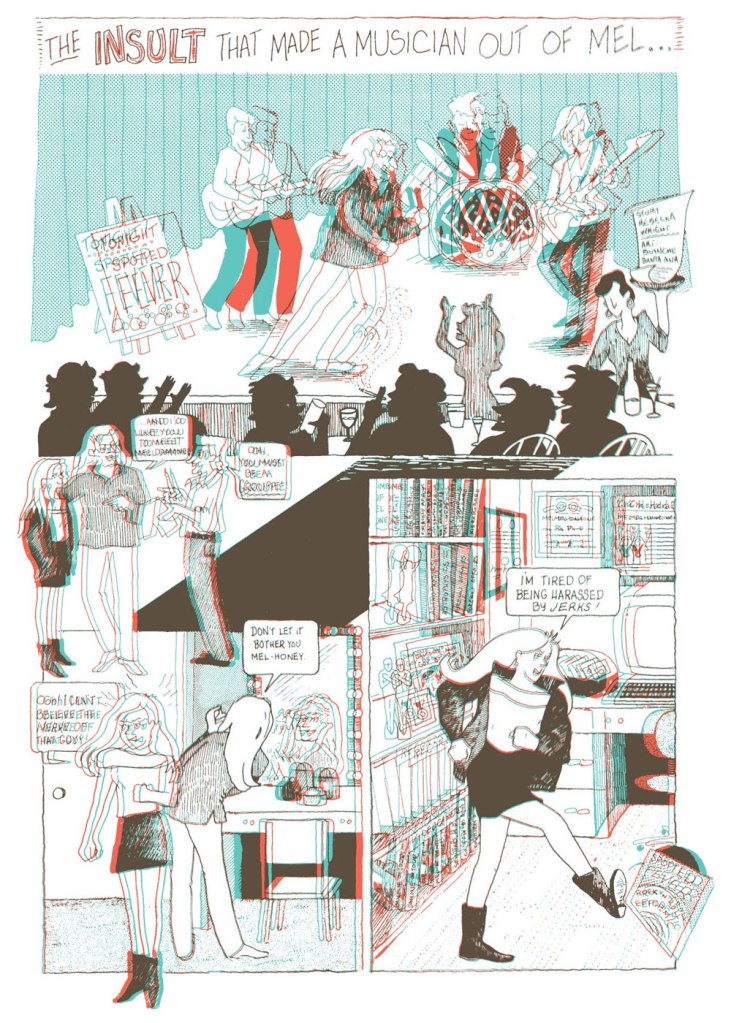
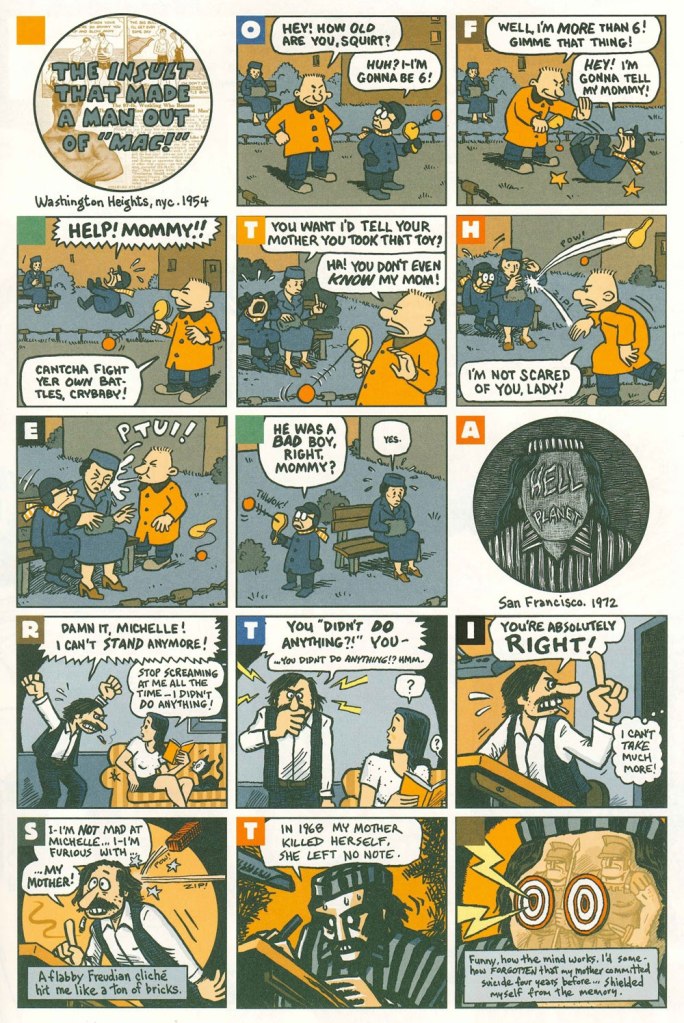
Ah, yes — those days when ‘Bruce‘ was the stereotypical gay name. From the ‘Playboy Funnies’ section of the magazine’s November, 1977 issue.And for something a bit off the beaten path: this is The Insult That Made a Musician Out of Mel, scripted by Rebecka Wright, illustrated by Blanche Santa Ana, with 3-D effects by Ray Zone, from Wimmen’s Comix no. 12 (Nov. 1987, Renegade Press), edited by Angela Bocage and Rebecka Wright.Does this look familiar? This is the first page of Flex Mentallo’s origin tale, as it appeared in Doom Patrol no. 42 (Mar. 1991, DC), written by Grant Morrison, with art by Mike Dringenberg and Doug Hazlewood. I have no idea whether Atlas had a sense of humour, but his successors sure didn’t, as evidenced by the lawsuit they filed against DC Comics over this clear — if brazen — case of satire. I much prefer the TV show version of Flex, I confess.Peter Kuper deftly used the cliché to take a jab at George Bush Sr.’s image and the first Gulf War. Dated and irrelevant? Trying to prove your ‘manhood’ remains distressingly au courant… just consider these two schmucks, to cite but one recent example. And hey, here’s “Stormin’ Norman lying on T.V.” From Bleeding Heart no. 1 (Winter 1991-92, Fantagraphics).Art Spiegelman digs deeper and makes more discerning use of the raw materials at hand with The Insult that Made a Man out of “Mac!”, first previewed in The Virginia Quarterly Review and then collected in Breakdowns Portrait of the Artist as a Young %@?*! (Oct. 2008, Pantheon).
« Pretty soon, they had me working at the stat machine and the PhotoTypositor, or touching up stripper photos for the Trocadero Burlesk ads. Mostly putting some underwear on them. I may as well have been Vincent Van Gogh, for all I knew. I was in heaven. » — Brooks recalls his formative years
At first blush, I’ve immensely admired cartoonist-illustrator-historian (and so on) Lou Brooks (1944-2021) and his assured line. An ever-eager autodidact, Brooks handily achieved a feat that sets the mind a-reeling: soaking up ‘low’ illustration styles and the essence of faceless pictorial ephemera (think comic book ads, matchbooks, bar coaster and napkin art…), Brooks miraculously derived, from this primeval soup, his unique style, paradoxically bland (by design!) yet instantly recognizable.
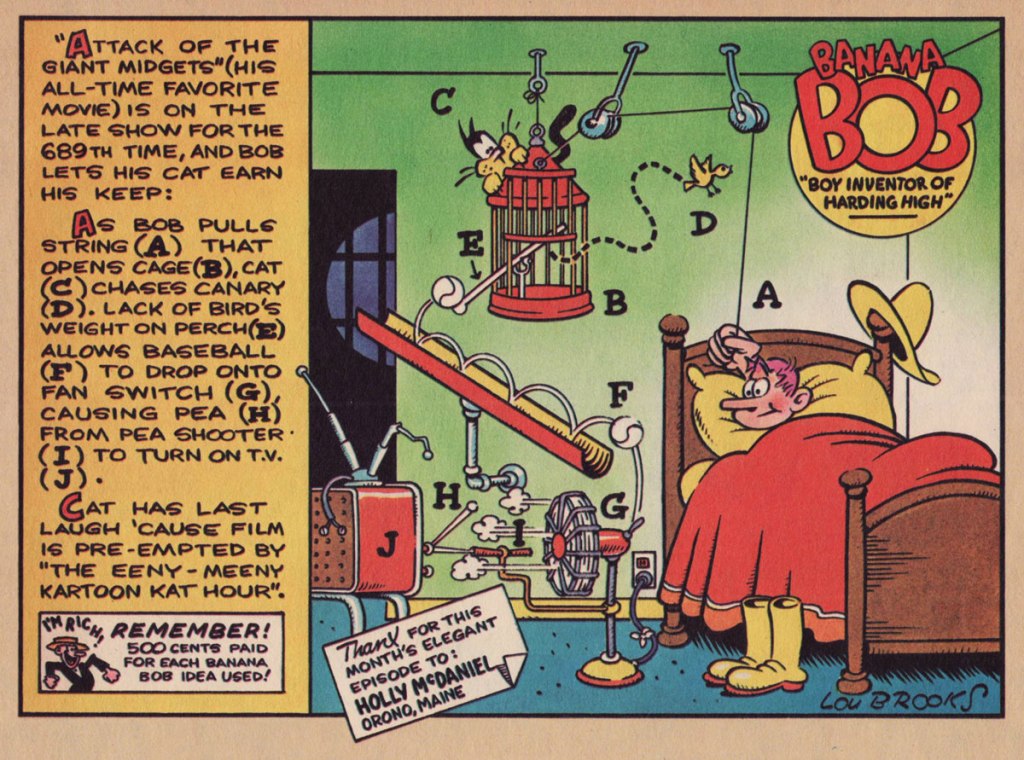
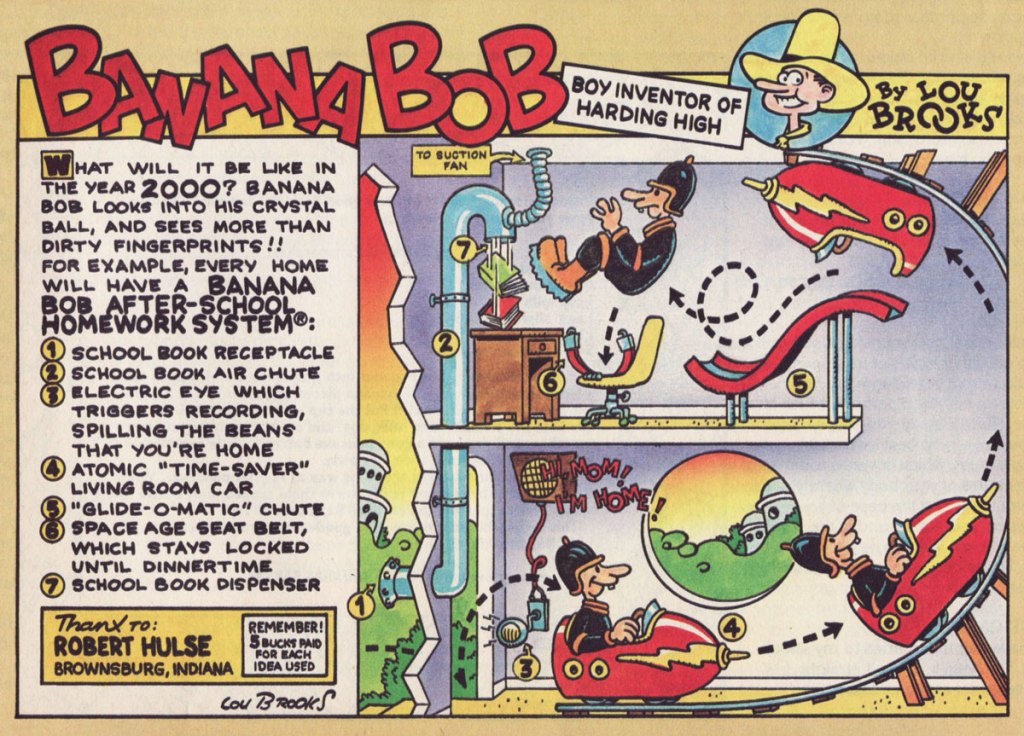
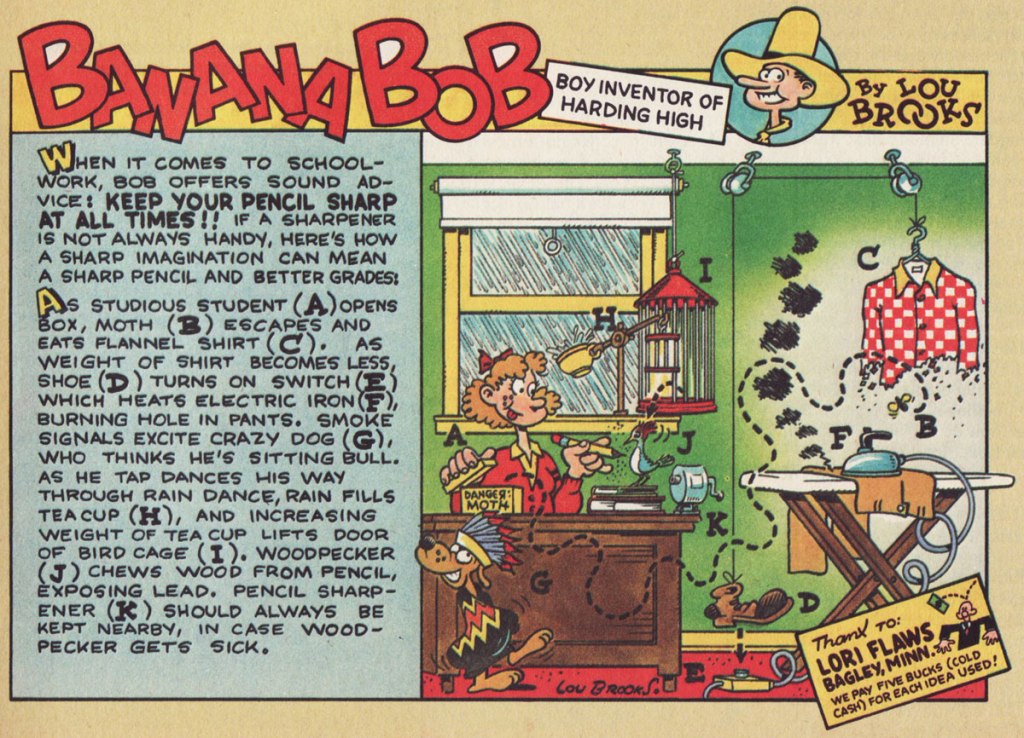
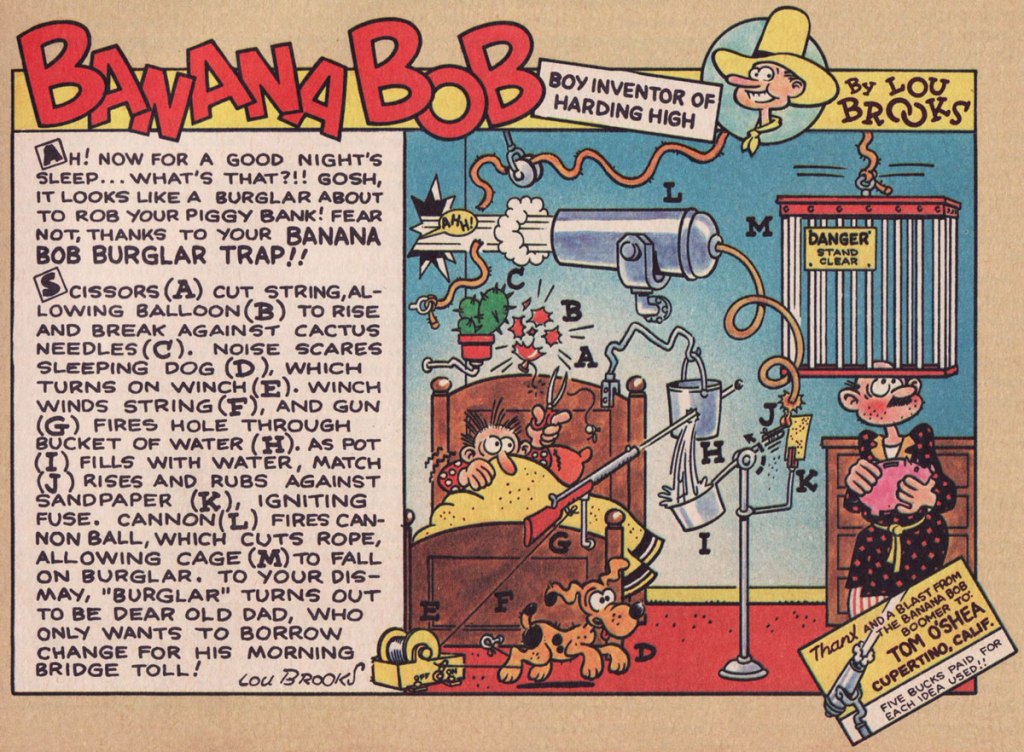
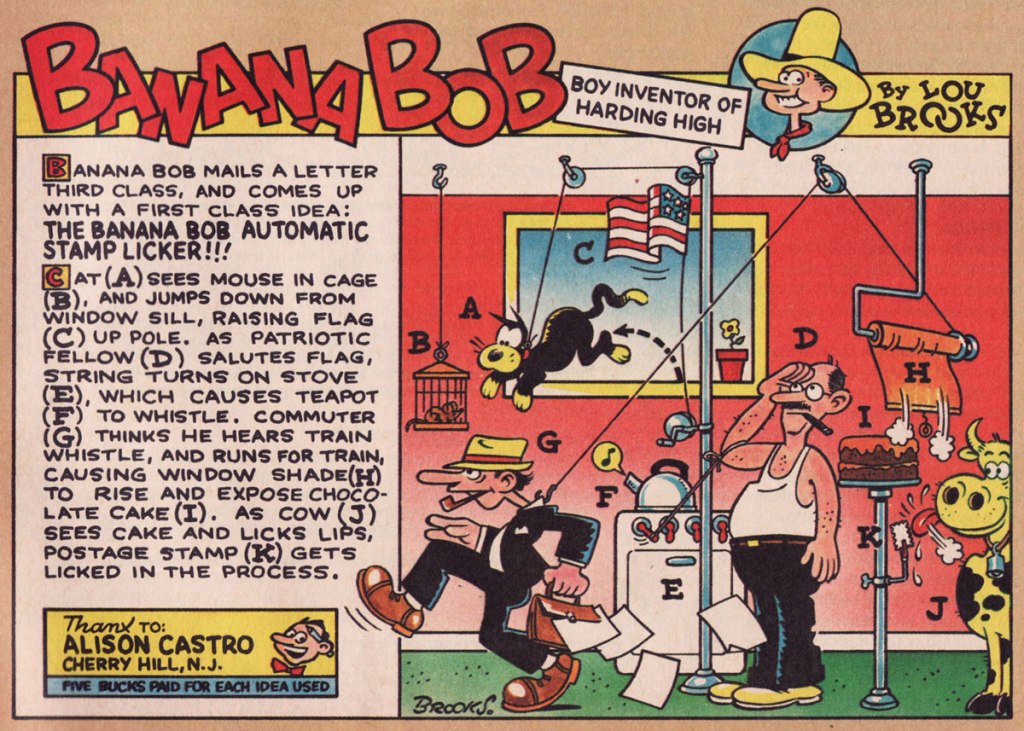
One of Brooks’ earliest jobs in the badlands of professional cartooning was a strip he produced for Scholastic‘s Bananas (1975-84), a skewing-slightly-older companion to the publisher’s big hit Dynamite (1974-92). Banana Bob, “Boy Inventor of Harding High” exploited the time-honoured gizmo formula hatched in 1912 by Rube Goldberg with the twist that here, the doodads were contrived by readers and given visual interpretation by Brooks. Banana Bob ran for the mag’s first twenty-nine issues.
With the early strips, Brooks was still fine-tuning the works. With a dozen or so under his belt, he hit his stride. This one’s from Bananas no. 12.From Bananas no. 13. Foo! There’s our pal, Bill Holman’s Spooky the cat (though he’s lost his bandage)!From Bananas no. 16.From Bananas no. 18.From Bananas no. 19. And add a dash or two of Bill Holman… Brooks knew his stuff, all right.From Bananas no. 20.From Bananas no. 21. I see shades of a Jay Lynch influence!From Bananas no. 24.From Bananas no. 25.From Bananas no. 26.From Bananas no. 27.From Bananas no. 28.… and the series’ full-page finale, from Bananas no. 29, aka the 1979 Bananas Yearbook.
Though Brooks had already developed his trademark style — as evidenced by other illustrations he did for Bananas — he didn’t fully employ it on the Banana Bob strip. If memory serves, here’s where I first encountered a full-fledged Lou Brooks wallop, and I suspect I’m not alone in this (our younger readers are likelier to have first come across his exemplary revamp of the old Monopoly game):
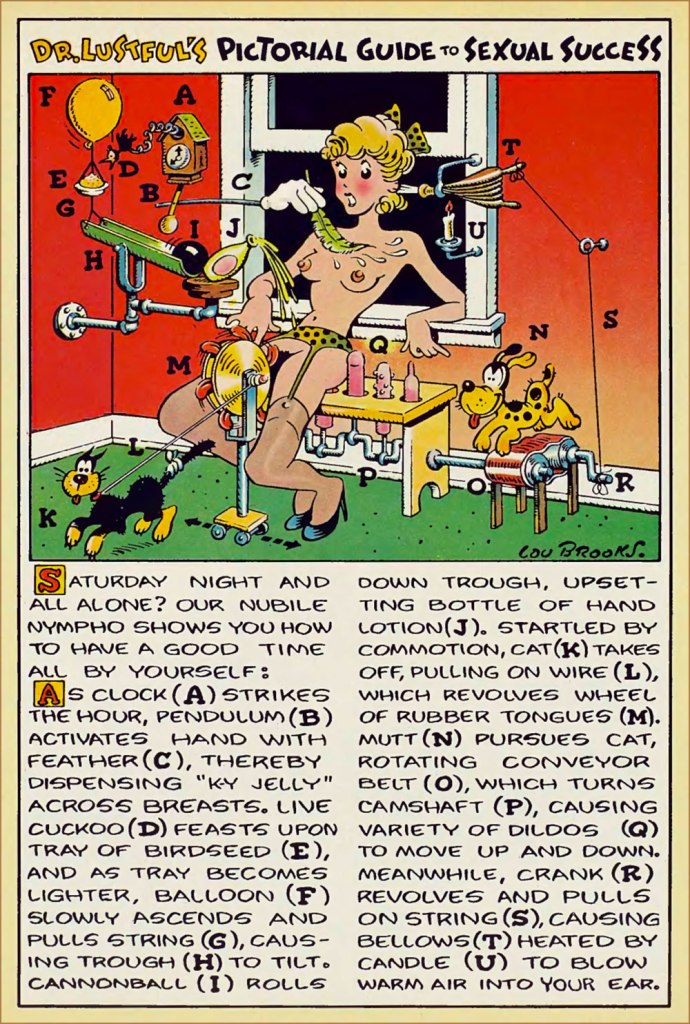
As Brooks evidently knew a good theme when he had one, here’s his Goldberg Variation for Playboy:
From Playboy’s December, 1977 issue, and featuring another fun guest appearance by Spooky the cat.
… and speaking of Mr. Spiegelman, here’s a collaboration between titans. It appeared in the January, 1980 issue of Playboy.
Of course, there’s so much more to Lou Brooks than one could conceivably cover within a mere blog post. To that end, we have a handy little biopic entitled A Guy Named Lou — filmed entirely in Illustr-O-Vision!
Brooks was an assiduous chronicler of the history of reprographics — don’t miss his jaw-dropping Museum of Forgotten Art Supplies. While he did a bit of everything to keep himself amused and occupied, he never lost sight of his vocation, of his one true love — I mean, he was in a band (with Bill Plympton!), but it was called Ben Day and the Zipatones!

















 Who's Out There?