« I don’t mind if my skull ends up on a shelf as long as it’s got my name on it. » —Debbie Harry
A couple of years back, I spotlighted a story by a neglected Golden Age favourite of mine, Anthony Lewis “Tony” DiPreta (July 9, 1921 – June 2, 2010), the wacky The Hidden Vampires! I advise reading it first for comparison (and a bit of background on the artist).
A whole hour! People were armed with unwavering patience back in the day.
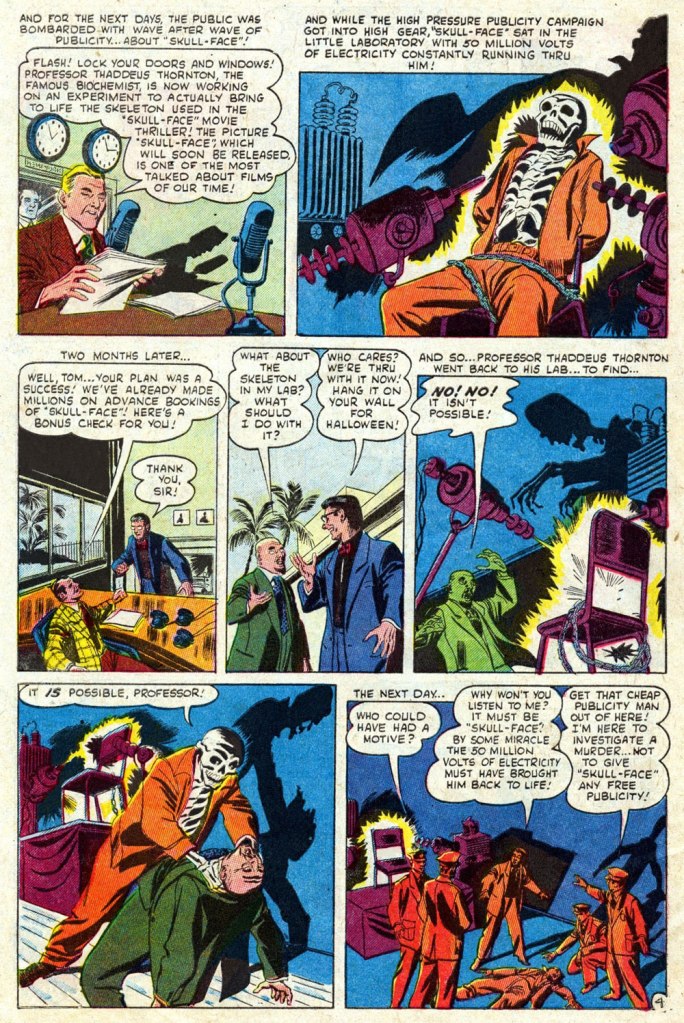
So the suits’ great flash of inspiration is not to update a fifteen-year old movie (from 1937!), nor remake it: they’ll just trot it out again. Picture doing this with 2006’s biggest horror hit, Saw III. How do you think it would fare today?
You’d think a seasoned publicist would be a savvier negotiator. I mean, all he needs is some random skeleton. Adjusted for inflation, a thousand 1952 dollars would today be worth 9,829 bucks. But that’s nothing compared to his liberal waste of electric current: the voltage used to execute a convict in the electric chair is around 2,000 volts for less than a minute… and that makes the lights dim all over the area*. Now multiply the voltage by 25,000, and the duration (let’s round it off to a minute, for simplicity’s sake) 80,640 times longer. Picture the resulting electric bill, not to mention the repercussions on the power grid, all for a stunt that could have simply been faked (i.e. just say there’s live current… no-one’s going to check). Oh, and what’s a “famous biochemist” doing on a film studio’s payroll? Come to think of it, it’s not that odd: Thornton was a cynical, opportunistic money-grubbing parasite, the Dr. Memhet Oz of his day…
Note these stellar examples of one of DiPreta’s trademark horror ambiance moves: lighting from below, projecting stark, expertly-delineated shadows.
One has to wonder why Fenton insists on addressing the resurrected ‘Demon’ (he was a demon on the sousaphone) incorrectly as “Skull-Face” (that’ll only aggravate him, you dolt!). Would it have helped if he’d added air quotes?
The ho-hum Sol Brodsky cover of Mystery Tales no. 6 (Dec. 1952, Atlas), but hey, our pal “Skull-Face” is the featured attraction!
The comics industry’s traditional garish colour and murky reproduction fail (spectacularly!) to do justice to DiPreta’s spare, confident and elegant inking line. To remedy the situation, here’s a look at a surviving piece of original art. It hails from “One Must Die” (scripted by Carl Wessler), from Crime Can’t Win no. 11 (June 1952, Atlas), the publisher’s knockoff of Lev Gleason‘s influential Crime Does Not Pay.
A slick Joe Palooka Sunday from July 24, 1966. DiPreta enjoyed quite a run on the strip, illustrating it from 1959 to its 1984 finale.




 Who's Out There?