« Less is more. » — Ludwig Mies van der Rohe
Once again, my initial instinct when I hit upon the notion of showcasing the work of Jean-Michel Folon was: « is he too obvious a subject? ». Then reason stepped in with: « to whom, exactly? »
Which brings me to my own tiny Folon anecdote: about twenty years ago, I was helping out a friend, who usually took off the month of January to travel. As it happened, it was usually the worst month for art freelancers, at least in my experience, so he was helping me out too.
Anyway, instead of working from home or some ad agency’s offices, I would work from his boutique, manning the four telephone lines while his regular employees handled the in-person traffic. One day, I took an order from a nice lady who, while I was filling out the relevant papers, gave her last name as Folon. « Like the illustrator? », I asked. « Yes indeed, he’s my cousin! », she replied, clearly delighted. « I’ve been living here in Canada for thirty years, and you’re the first person who’s ever asked! ». Which goes to show that one should think twice before extrapolating from one’s familiarity with a given subject. Or to put it simply, just because you’ve heard of someone, don’t assume everyone else does… whether they should have or not.
I can’t make mention of Folon without bringing up his strongest formative influences, Saul Steinberg (1914-1999) and André François (1915-2005); we’ll return to these gentlemen in due time.
To put it succinctly, Steinberg brought greater graphic and thematic purity to the gag cartoon… by dispensing with the gag, at least in the traditional sense. Not everyone dared to follow that perilous path, but Folon did, and similarly thrived.
Born in Brussels in 1934, Folon initially studied architecture, but soon detoured into drawing and never returned to his early vocation, though he certainly erected his share of edifices… on paper. He timidly began submitting drawings in 1957. A decade later, he had scaled and conquered the lofty North American market, landing cover assignments with The New Yorker, Esquire and Fortune, among others.
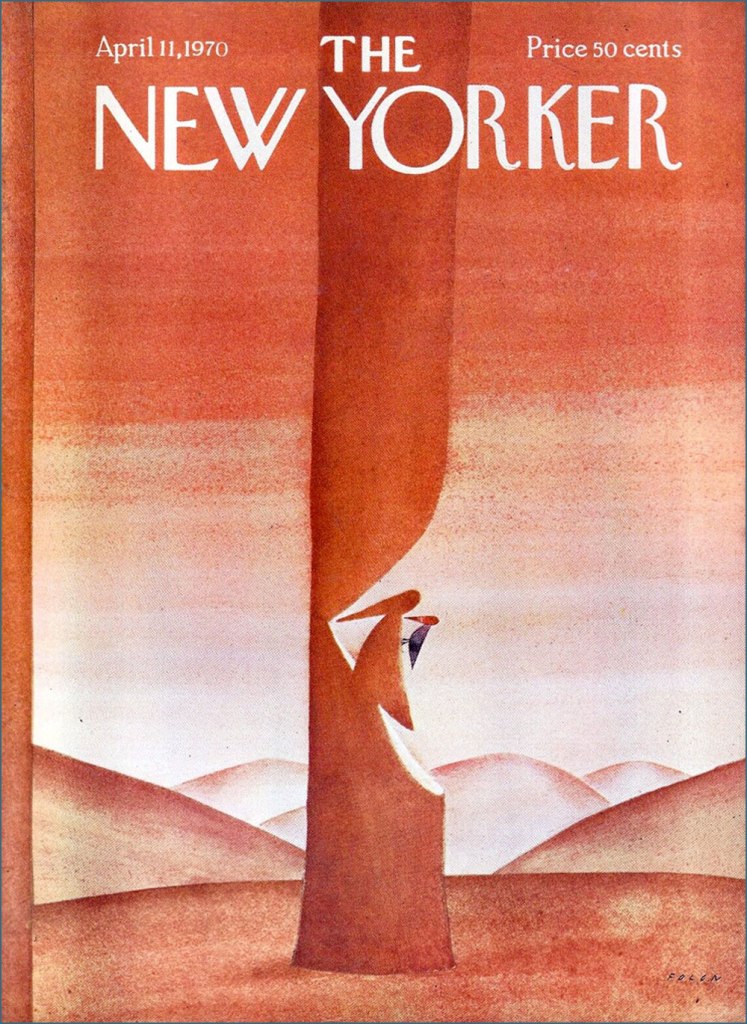
He turned his confident, limpid vision across all printed media, but also sculpture, tapestry, stained glass and animation. He passed away in 2005, but not before designing and establishing his own museum. Be sure to check this stunning place out!
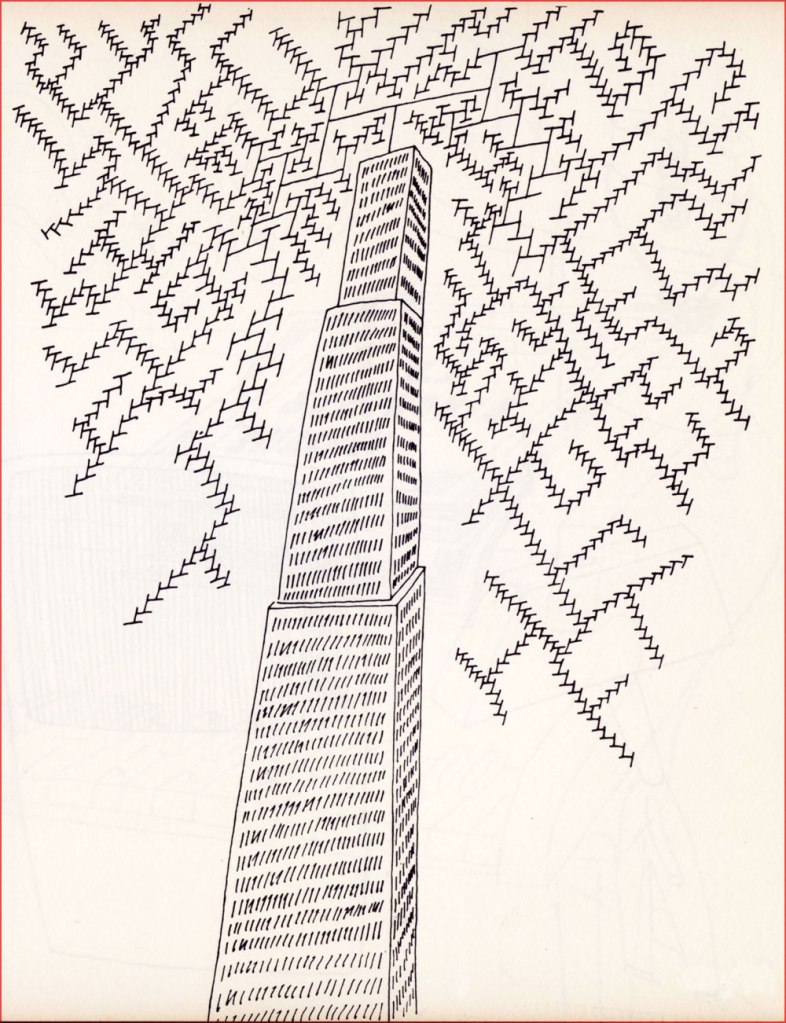
Such a multifaceted career and œuvre being too gargantuan in scope for a simple blog post, I’ll mostly stick to a sampling of some of Jean-Michel’s drawings, produced during his first decade as a professional artist.

*
*

*

*

*

*

*

And here’s some of his later work:

Colombier, incidentally, belonged to that coterie of poor souls who did all the heavy lifting while their ‘collaborator’, Serge Gainsbourg, received and happily hogged all the credit.
In 1975, Colombier recycled the recycled adagio as the opening and closing theme for French public national television channel Antenne 2’s daily programming, accompanied by an appropriately graceful animated sequence by Folon.


-RG
 Who's Out There?