« A painting requires a little mystery, some vagueness, and some fantasy. » ~ Edgar Degas
… and some tentacles, of course!
This painting of a chained barbarian confronted by an octopus (here to collect his liver, no doubt?) is the work of Bob Juanillo, an artist of which little is known, other than that he was active in the late 60s and early 70s, contributed to a lot of comics fanzines, and died at 30 (source). At least we know it from 1974!
To follow, the original art for a variant cover for Red Sonja vs. Thulsa Doom no. 1 (February 2006). The painting is by Gabriele Dell’Otto, an Italian artist who has done work for Marvel and DC. Tentacles or enormous snake-tail, you be the judge. As for powerful necromancer (and shape-shifter) Thulsa Doom, he is the brain-child of American author Robert E. Howard.
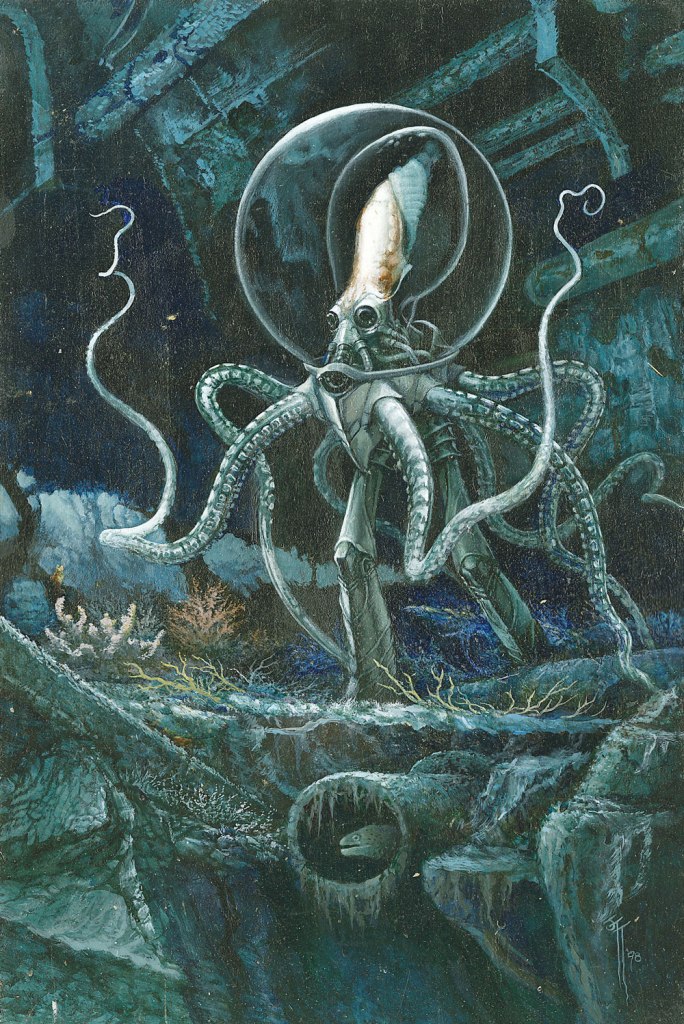
This painting by John Totleben appeared (as far as I can tell) somewhere in Timeslip Special Vol 1 no. 1 (August 26th, 1998). « The isotope itself was eventually dumped, as garbage, into the oceans, where it began mutating the ocean life. One of the mutates was an octopus who, developing high intelligence, and through unknown means, donned a mechanical suit. The isotope itself eventually went on to mutate all life on the planet. » (source) I giggled at the idea of an octopus donning a mechanical suit ‘through unknown means’. These cephalopods get into everything!
Finally, voici an unfinished painting by Frank Frazetta, entitled Death Dealer VII (the first Death Dealer was painted in 1973). Health issues (blurry vision, and a series of strokes) prevented Frazetta from finishing it, though his preliminary sketch was published in Rough Work (Spectrum Fantastic Art, 2007).
« Tentacles lashing wildly with pain… the squirming squid releases a sudden gush of inky-black liquid… »
Just look at that… yet another Tentacle Tuesday has come crawling (unless it prefers to travel by jet propulsion) out! Today our handy time machine brings us, once again, to the Golden Age of comics (1930s to 1956), when war was very much on people’s minds, and tentacles were very much part of every decent comic artist’s repertoire.
More Fun Comics no. 83 (September 1942). Cover by George Papp, co-creator of Green Arrow and Congo Bill (with, respectively, Mort Weisinger and Whitney Ellsworth), and one of the main artists on DC’s Superboy feature between 1958 and 1968.
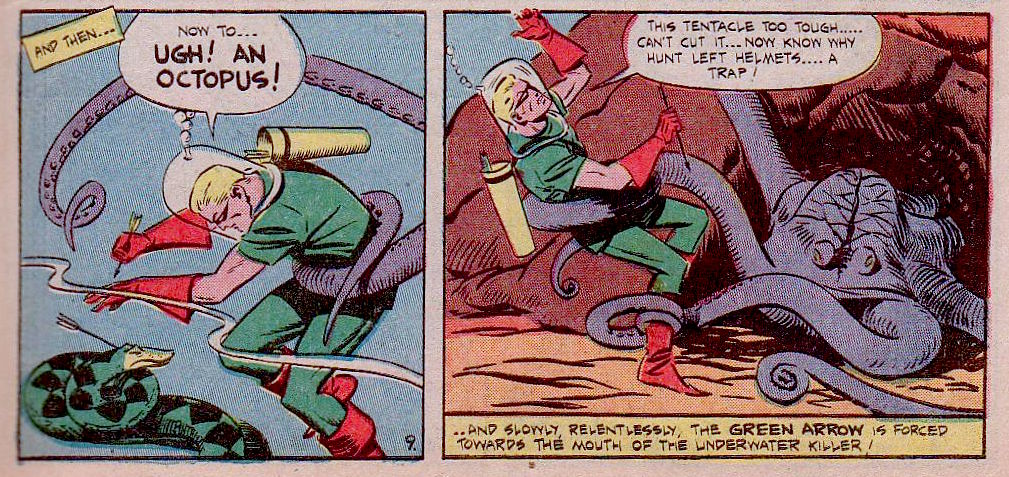
Panels from « The Five Arrows », scripted by Joseph Greene and drawn by George Papp.
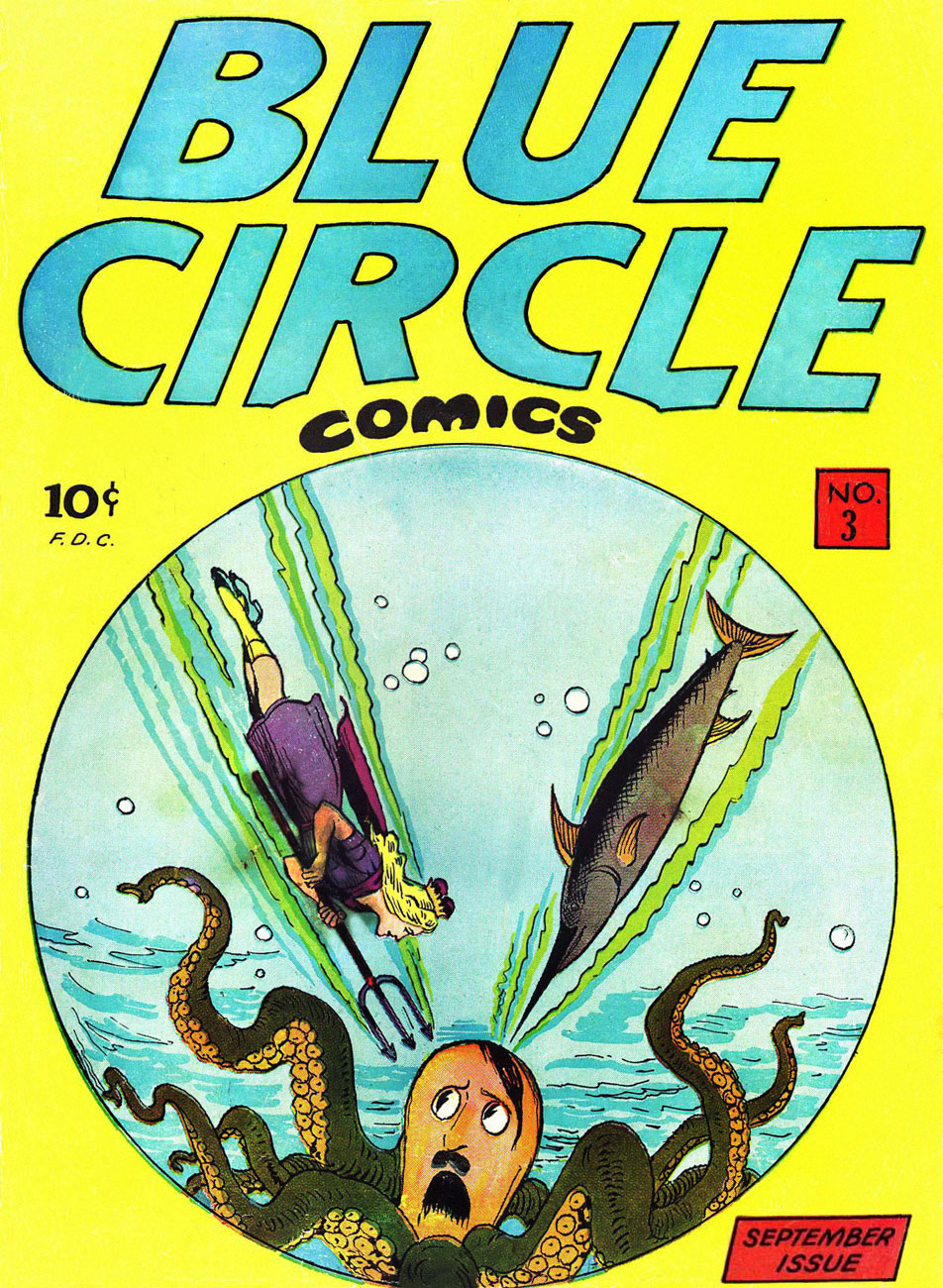
During WWII, it was not unusual to find the Axis powers represented by an octopus in caricatures and political cartoons. As a matter of fact, as The Octopus, a Motif of Evil in Historical Propaganda Maps argues, the octopus, scrawled onto all manners of maps by caricaturists, has represented the spread of evil since the 19th century. I highly recommend at least glancing through the aforementioned essay – aside from being fascinating from a historical perspective, it also has tentacles galore. Anyway, the following comic eschews any subtlety and depicts Hitler himself as the Octopus of Evil:
Blue Circle Comics no. 3 (September 1944), cover by Harold DeLay. That’s Maureen Marine bomb-diving into Hitler’s sorry ass. She has an interesting backstory, actually: a captain’s daughter who drowned when her dad’s ship was sunk by a Nazi U-boat, she was revived by Neptune (he must have liked her blonde hair) and became Queen of Atlantis, protector of the ocean, especially against despised Nazis.
There’s a great essay about Blue Circle Comics on Four Color Glasses. To quote, « Enwil’s “flagship” title was called Blue Circle Comics. It was a fairly common for publishers to use a color in conjunction with a shape or symbol for their comic book titles: Blue Circle, Red Circle, Red Band, Red Seal, Blue Ribbon, and Gold Medal were all titles from the Golden Age. In the case of Blue Circle Comics, though, the title did actually feature a character called the Blue Circle. » Read it here!
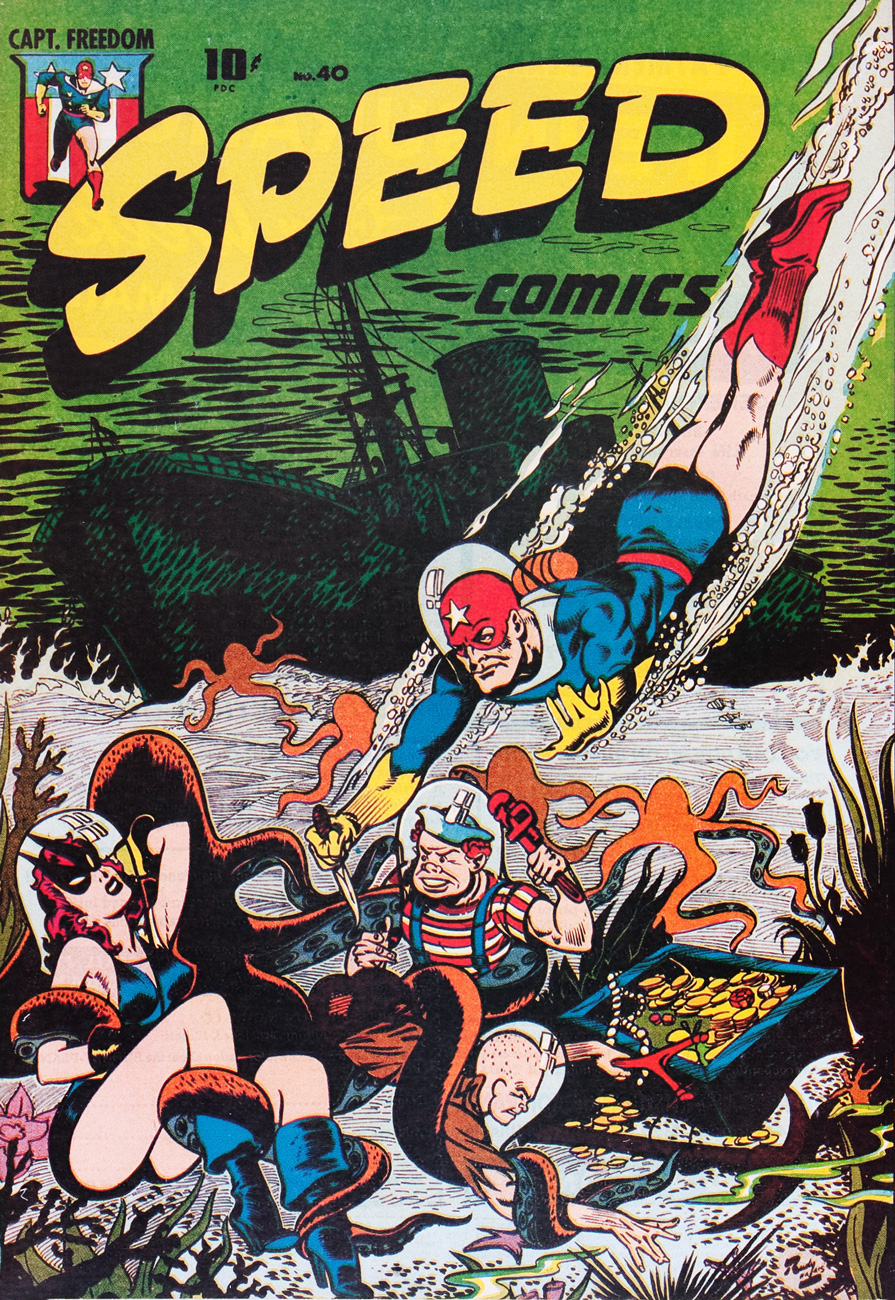
A recurring theme of octopus adventures is that there’s some treasure involved. I bet the lady would prefer to stay with the octopus troupe and their tender nuzzles than to be rescued by this odd assortment of cut-throats in sailor costumes… The chick en question is Harvey Comics’ Black Cat.
Speed Comics no. 40 (November 1945), cover by Rudy Palais.
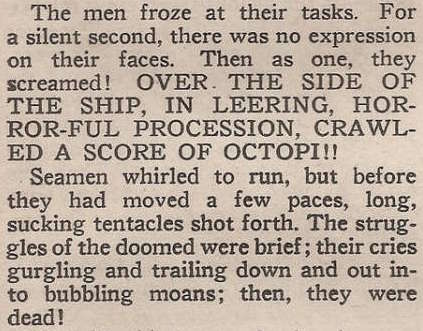
The title story turned out to be nothing but text… Though for readers with a decent imagination, a “score of octopi” and “bubbling moans” is definitely more than enough.
I bet you’re wondering how all this ends. Well, « Still, the octopi flopped forward!! CAPTAIN FREEDOM yanked the controls and the ship’s whirling airscrews roared into the octopi, sharp blades ripping tentacles from their bodies with murderous force! » Goodbye, trained octopi (which is not even the correct pluralization of an octopus).
Strange Worlds no. 2 (April 1951). Cover by Gene Fawcette.
« They were like octopuses — they scurred along on huge rubbery tentacles, and their bodies were nothing but huge heads in the midsts of these. Monstrous squawking beings coming at us from all directions! » Lovely writing, isn’t it? Nevermind that “scurred” is not an actual word. The title tale is actually an illustrated text story titled « Octopus-Kings of the Lost Planet », scripted by W. Malcolm White. Well, “scripted” is a bit strong.
« We decided that these descendants of a mighty but inhuman race had gone backwards in the course of the lost centuries. There were the Octopus-Kings of a Lost Planet — they had been rulers — but their own folly had lost them even the dignity of a solid body! »
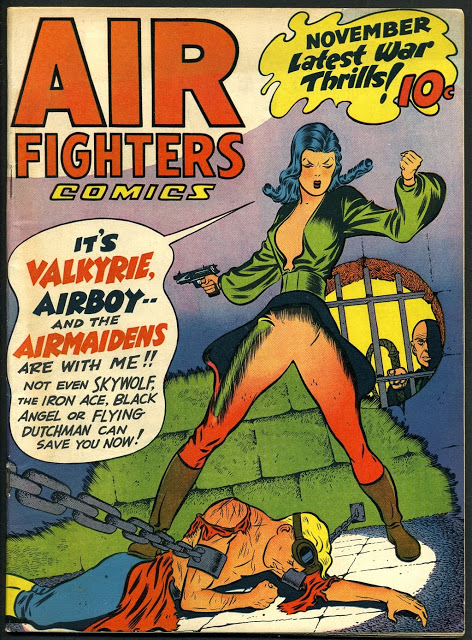
Airboy, a.k.a. David Nelson, has been in some truly bizarre scraps in his time, so a fight to the death with tentacled monsters who want (as usual) to take over Earth is strictly routine. Created by writer Charles Biro and artist Al Camy, Airboy not only used his expertise in aviation to fight off Nazis, but also all manner of fantastical monsters. A quick look through the covers of Airboy Comics will reveal crazy scientist machinery, rabid tigers, gladiator fights, giant amœbas, pterodactyls, minotaurs, insect-shaped aliens, an invasion of man-eating rats, and so on. Pure entertainment! Airboy’s most memorable (and prettiest, by far) foe (and love interest) is Teutonic aviatrix Valkyrie, who eventually defected to the Allies’ side. She barely seems like a Golden Age creation – with her blouse splitting until her navel and her skin-tights pants, her costume leaves little to the imagination.
She was sexualized further in later incarnations – Dave Stevens’ version of her for Eclipse Comics is probably the hottest – but the Golden Age Valkyrie is more charming and earnest (IMHO), devoid of the nymphomaniacal arrogance appended to her personality in later years. Anyway, back to the topic:
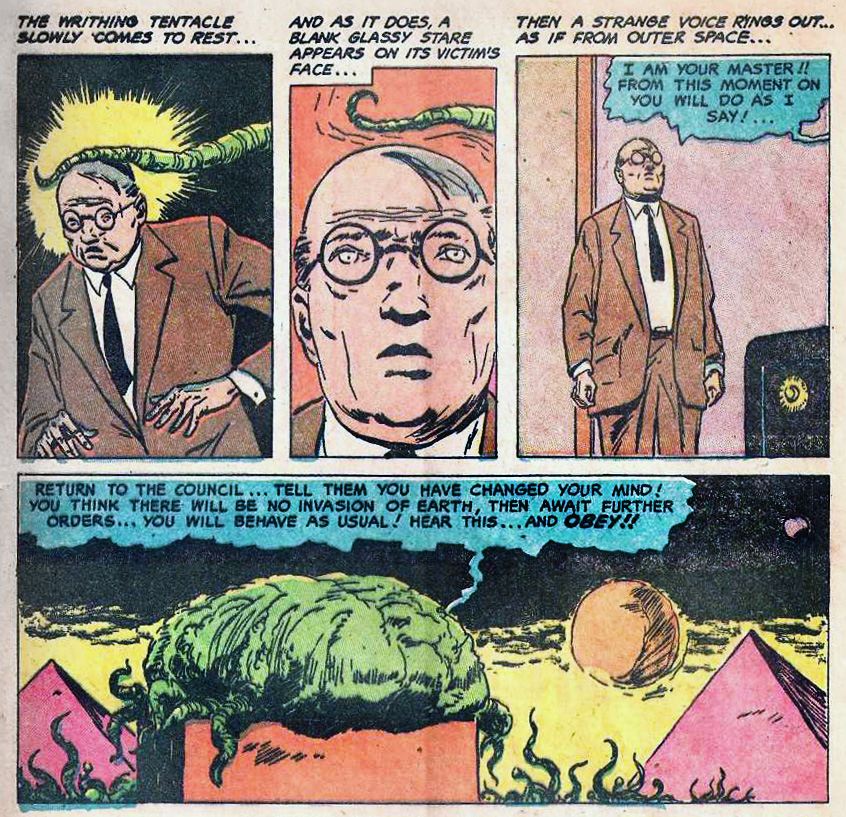
Airboy Comics no. 102 (August 1952). The octopus seems to be wearing glasses. « Excuse me, Sir, have you seen my book? »
The title story, modestly titled « Invasion of the Tentacles » (no beating around the bush!), is drawn by Ernest Schroeder.
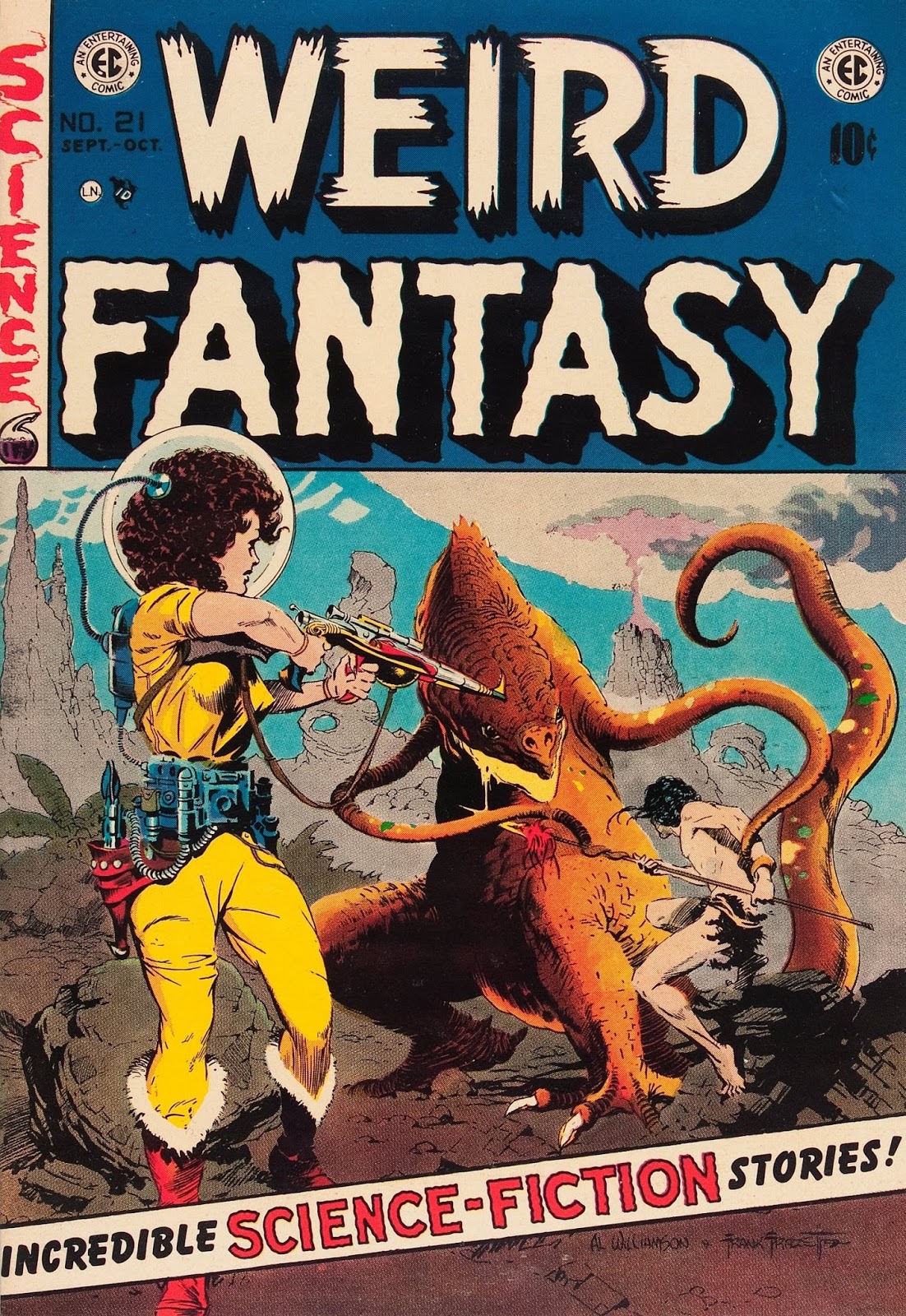
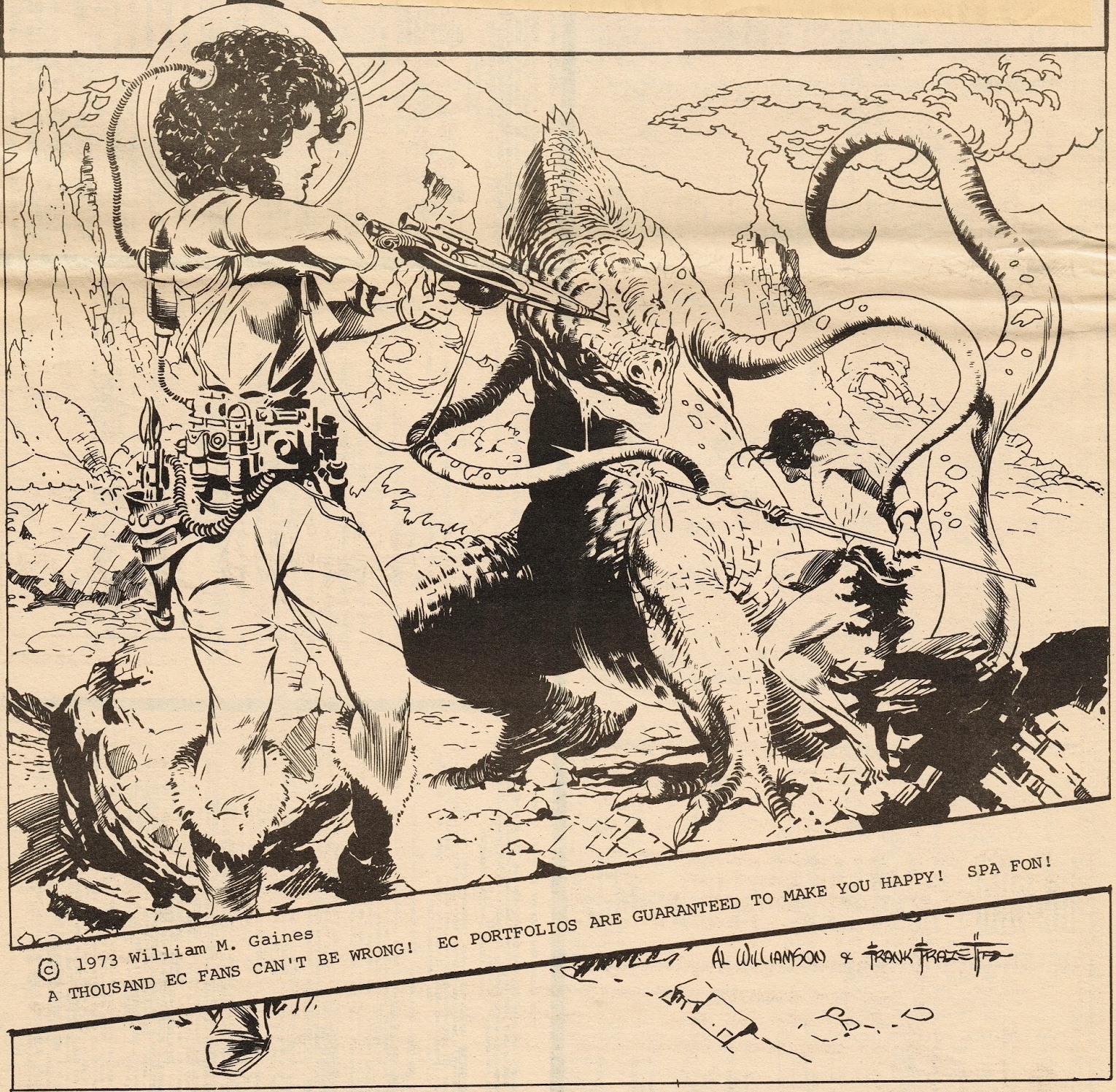
Weird Fantasy no. 21 (September-October 1953). Cover by Al Williamson and Frank Frazetta. The fur-trimmed boots are a nice touch!
The title story, « My Home… », scripted by Al Feldstein and drawn by Joe Orlando, is emotionally manipulative… and succeeds very well in breaking the readers’ hearts (or pissing them off, depending on your temperament). Read a synopsis of the plot, if you wish, or read the whole story here – who am I to give spoilers to those who don’t want ’em?
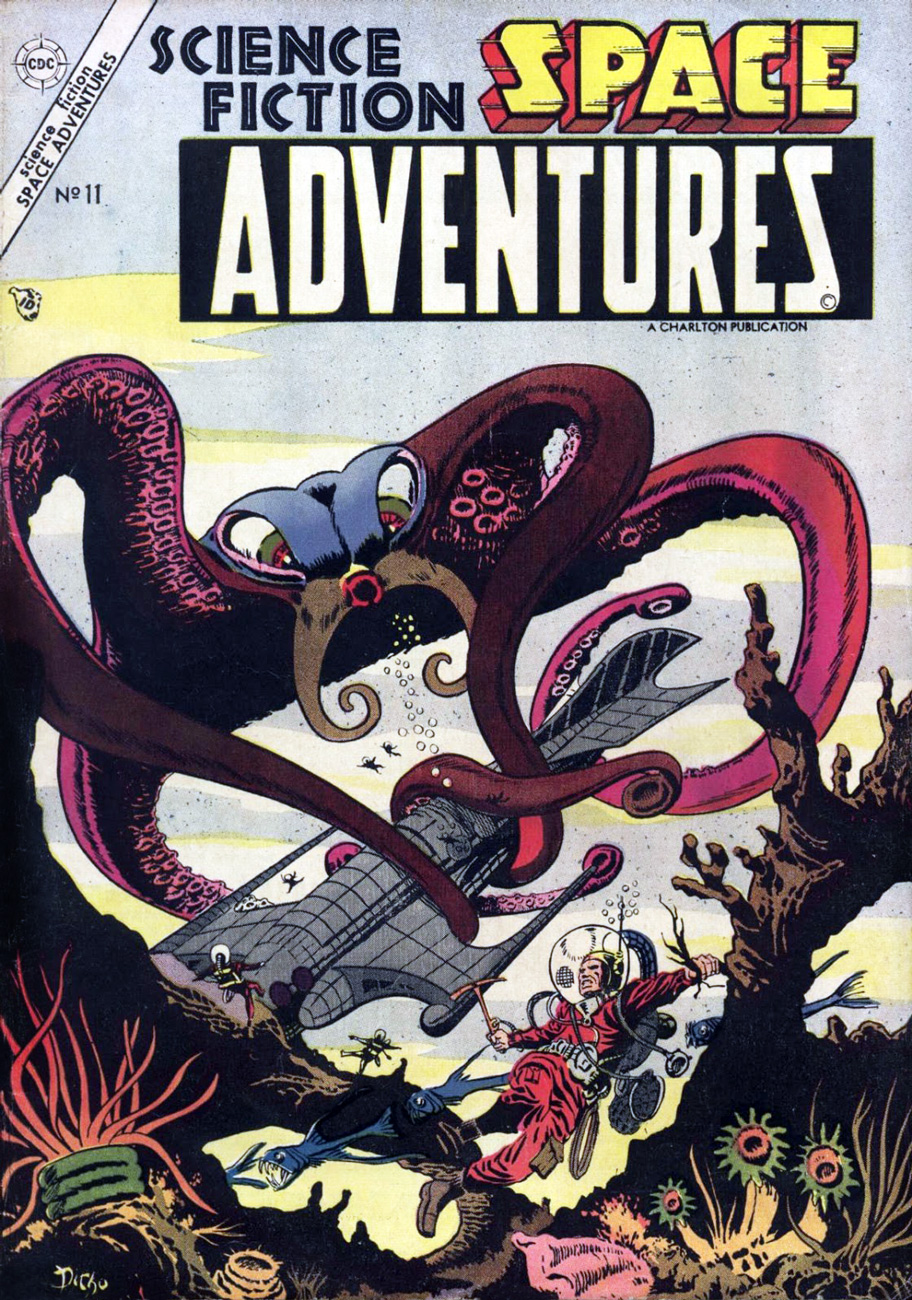
Space Adventures no. 11 (May-June 1954), cover by Steve Ditko.
Ron Adams, explorer extraordinaire and famous hunter, goes to planet Xarto to capture a giant carnivorous plant (but if you called it an octopus, nobody would bat an eye). Panels from « Interplanetary Safari! », penciled by Bill Molno and inked Dick Giordano.
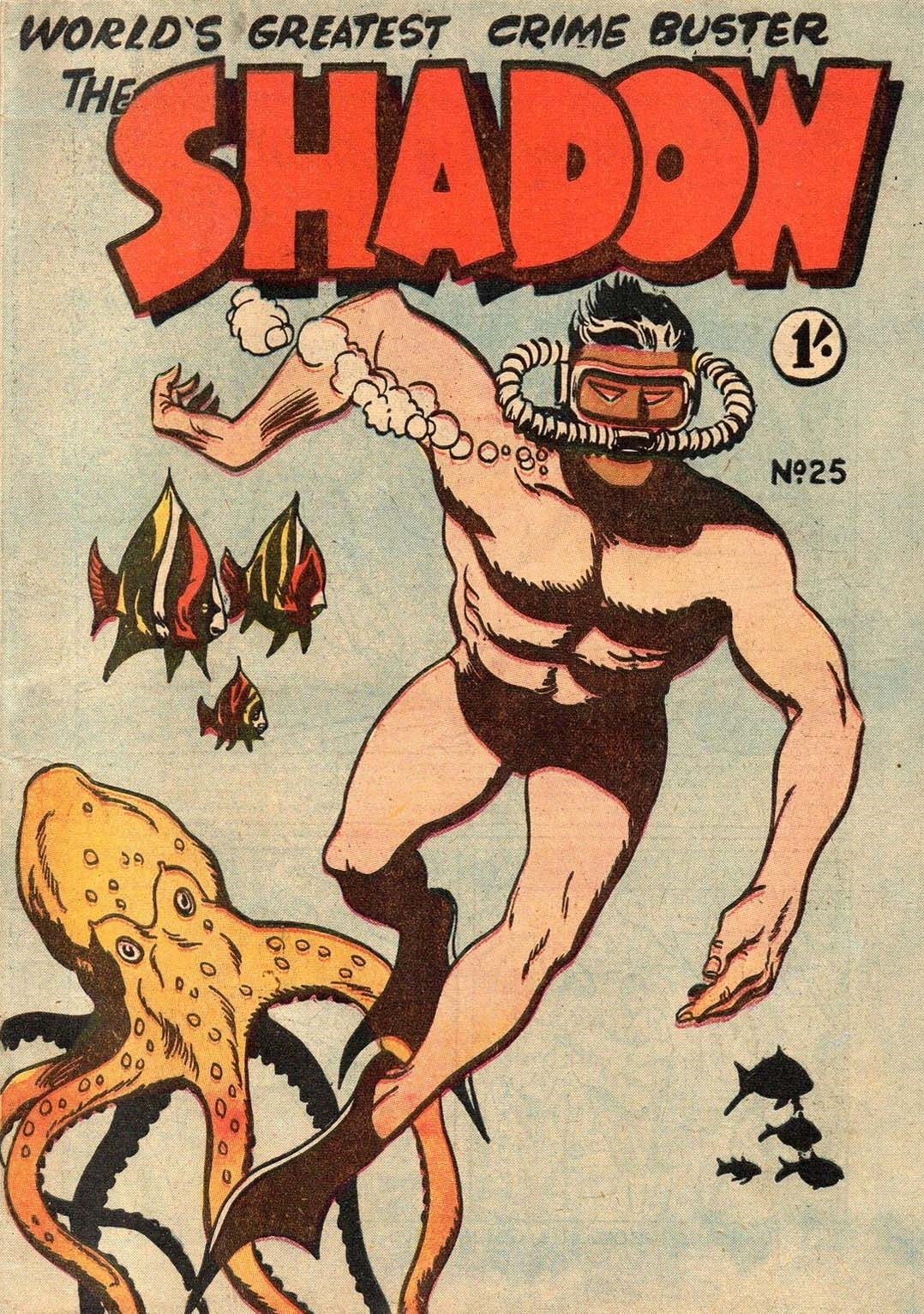
The Shadow no. 25 (September 1956), the child of Australian comic book publisher Frew Publications. The Australian Shadow has nothing to do with « Who knows what evil lurks in the hearts of men? »– this is just a guy who puts on a mask… and takes off his pants. The octopus seems astonished at the sight of bare man-flesh (if there are Speedos there, they’re well camouflaged).
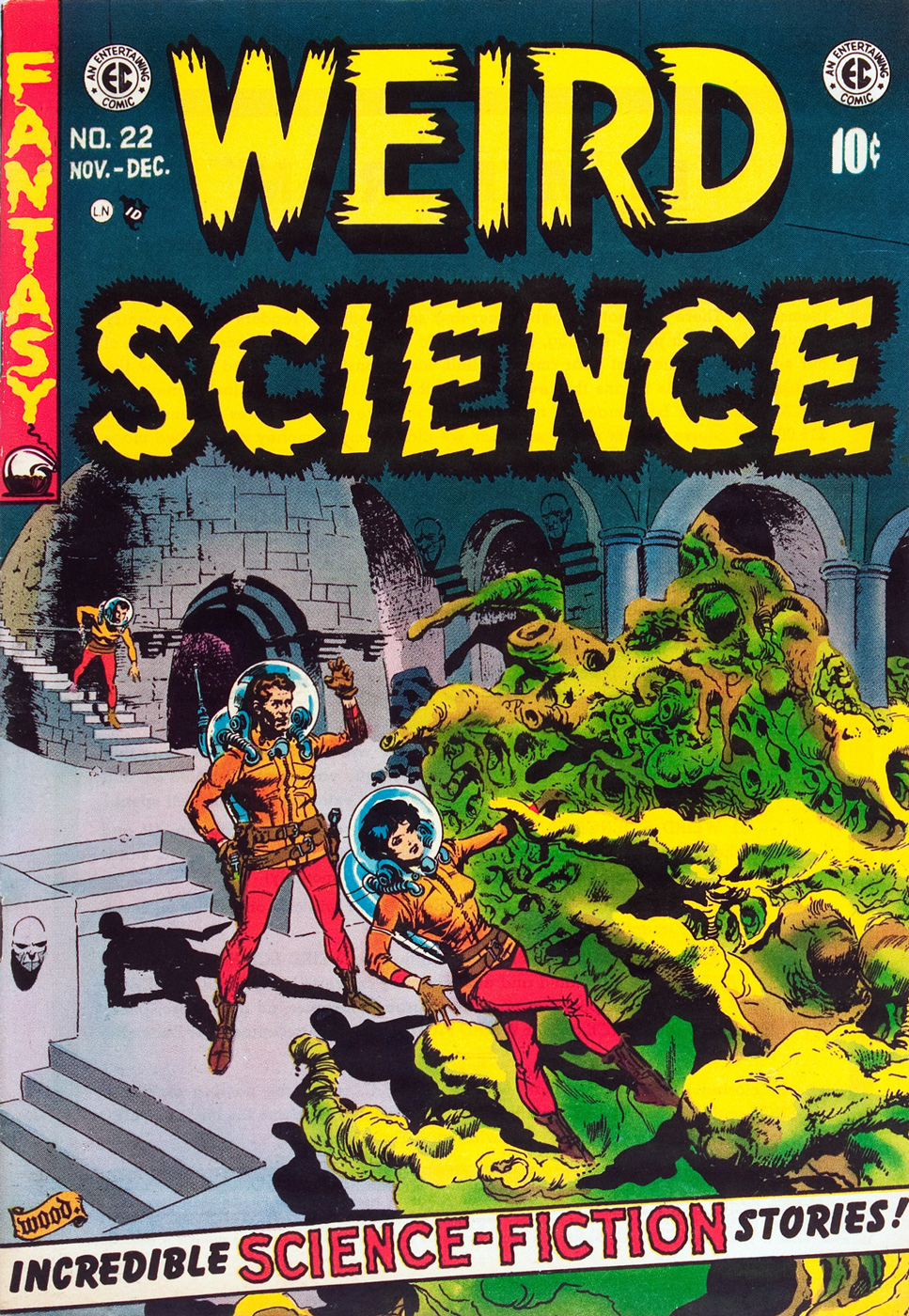
Today’s Tentacle Tuesday delves into William Gaines’ EC and the glorious 50s (well, glorious for *some* things, at any rate). “Weird”, you say? Why, weird simply must include tentacles!
It’s a mixed bag: those of you who dislike Al Feldstein (and I know my co-admin RG would raise his hand readily) may be terribly annoyed by this post, but patience, my friends! there’s a lot of Wally Wood (a Tentacle Tuesday master, by the way!) in here, too, and who in their right mind would admit to detesting Wally Wood?
(As for myself, in case somebody is wondering, I like Feldstein’s artwork just fine.)
Weird Science no. 6 (March-April 1951). Cover by Al Feldstein.
« EC’s flaws are pretty obvious: even when the artists were striving for greater seriousness than the ironic gore of the horror stories or the outrageous early sci-fi plots or even the clever but predictable crime and suspense stories, the writing was often overwrought, prolix, and ham-fisted, and the artists were straightjacketed by EC’s rigid visual grid. They were Entertaining Comics first and foremost, but they also seemed compelled to break out of their commercial formulas, however finely realized, and publish stories that were fiercely honest, politically adversarial, visually masterful, and occasionally formally innovative…» (source: Gary Groth’s Entertaining Comics)
Weird Science no. 10 (November-December 1951), art by Wally Wood.
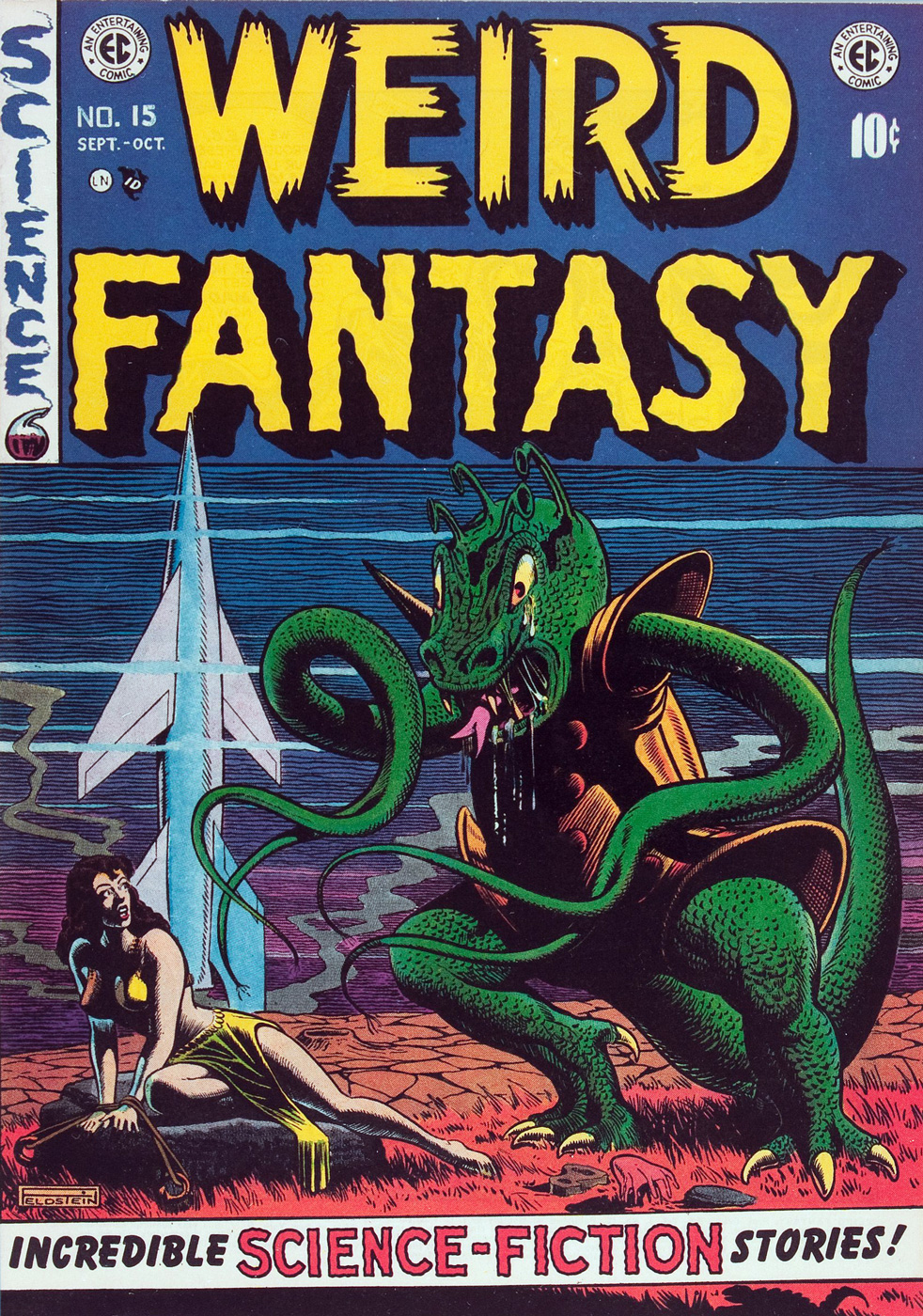
Weird Fantasy no. 15 (Sept-Oct 1952). Cover by Al Feldstein. The best cover that Feldstein has ever drawn? Quizás, quizás, quizás! The monster is doing a traditional Slavic dance, I think.
« While [Feldstein was] freer than most writers of his era to indulge his fantasies, he was also more punitive toward the characters who acted them out. John Updike tormented adulterers with depression and guilt. Feldstein lopped off their heads or burnt them alive. If they received a scarlet letter, it was branded on their flesh. In real life, sexual misbehavior might have cost one alimony. Feldstein made Shahira law seem like Thomas Jefferson had drafted it. Feldstein reflected a society which, while fascinated by sex, was terrified or ashamed of this fascination. » (source: Bob Levin in Let Us Now Praise Al Feldstein)
Weird Science-Fantasy Annual no. 1 (1952), art by Al Feldstein.
















 Who's Out There?