I talked about Carol Lay all the way back in 2017 (see The Giant Licking Machine), but did her a disservice by only featuring a single one of her Story Minutes. I am here to remedy that inadequacy.
In 1990, Lay drew a 5-page story for LA Weekly titled The Thing Under the Futon (read it here – the thing under the futon even has tentacles). « The pay was several times what independent comics paid and the audience was larger and included women », Lay quips on her website, so a one-time story planted the seed for a weekly comic strip called Story Minute, so named because it would just take you a minute to read a story (I might also add that it’s very difficult to stop at reading just one). That eventually was rechristened Way Lay and ran until 2008.
My introduction to the subject at hand.
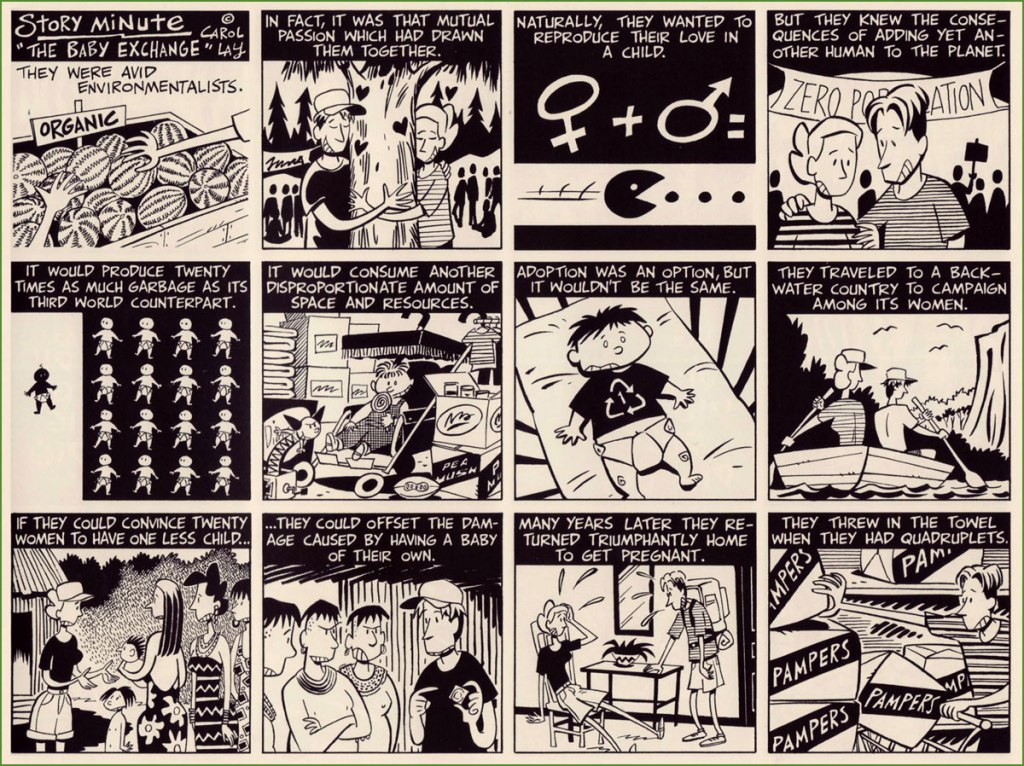
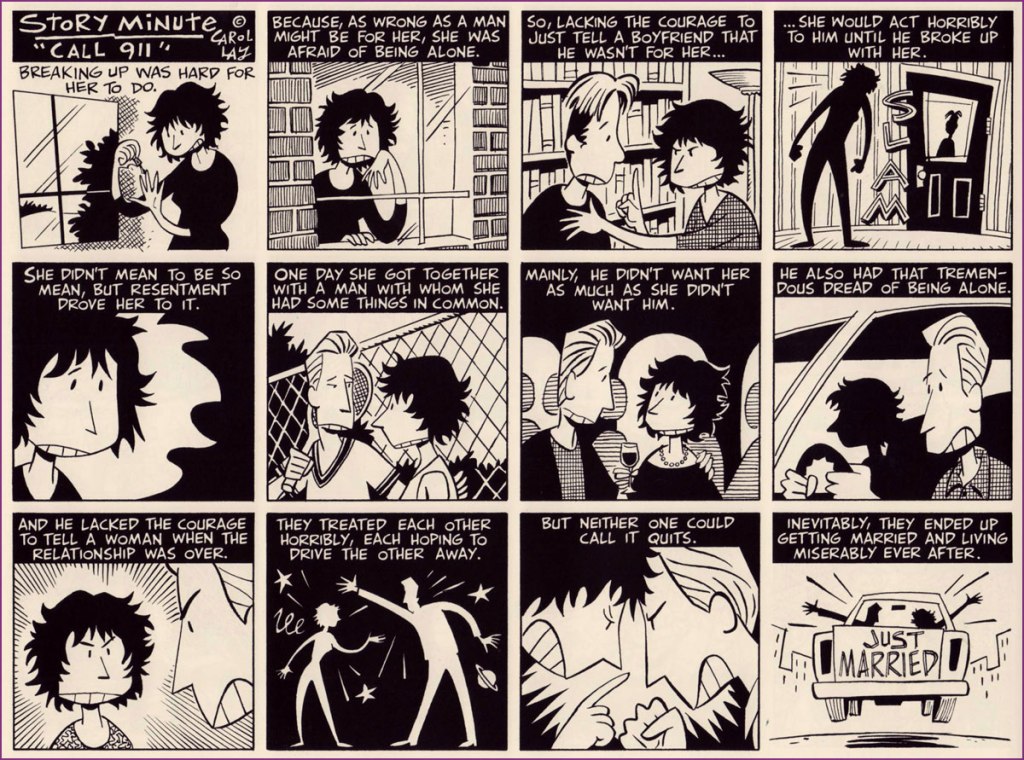
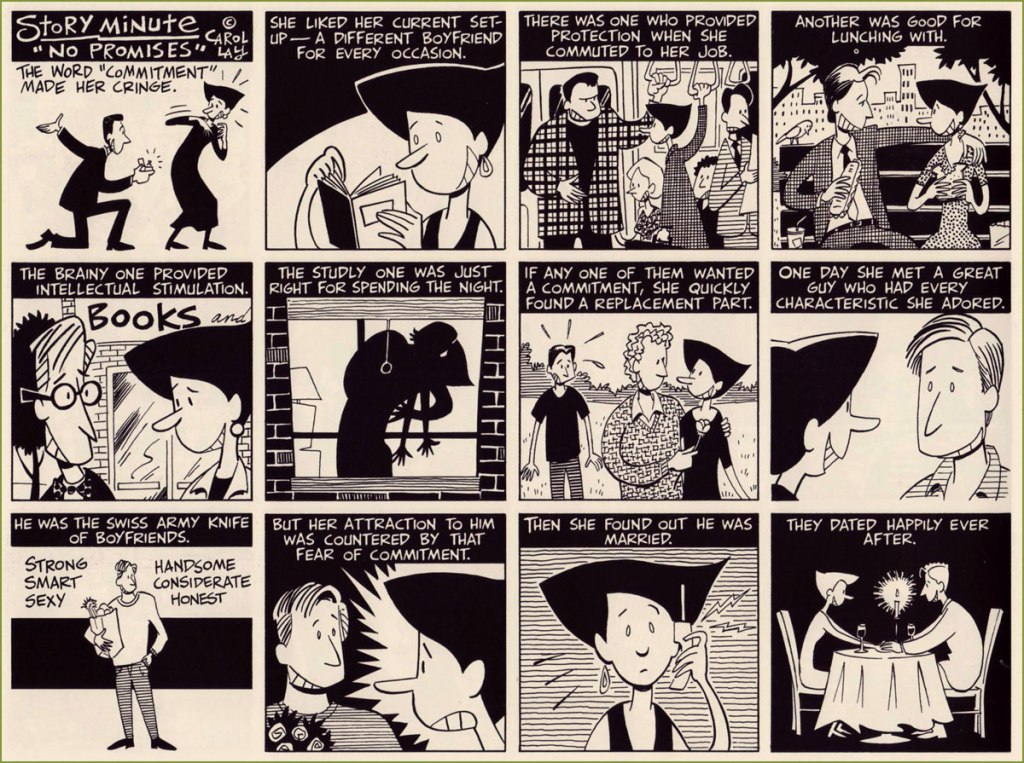
As I mentioned in the earlier post, the most recent collection of these is Illiterature, published in 2012, and it’s where the strips below have been selected from. Lay picks all kinds of topics as strip springboards, but since I am the one selecting the ones to feature, there’s a definite interpersonal tilt, as I think her forte is her ability to showcase the inner workings of a close relationship by plonking people into a slightly surreal or sci-fi context. The line between cynical and poignant is navigated with ease.
« I kept mostly to the order in which I produced the strips, but I took the liberty of tossing some clinkers or shuffling a few so that they flow better in book form… I also used my artistic license to improve on some of these older works – I’m a better writer and artist than I was when I created these strips… In a sense several of the strips in these volumes are ‘director’s cuts’ in that I’m a better director now than when I drew them. »
Given my appetite for recipes and the cookbooks they’re published in, it was just a matter of time before I stumbled across the hybrid genre of cooking memoir in comic book form. Needless to say, these two art forms have been friends for a long time: comics have been highlighting food in different ways for probably as long as comics have existed. As for cookbooks, it used to be common practice to include illustrations (maybe even cartoons in the margins!), not the lavishly printed photographs we are used to today, alongside the recipes. A treasured 1930s Soviet cookbook inherited from my grandparents, falling apart but no less charming for it, features little cartoons on every other page, similar to how the drawings of Robert Gring once adorned the pages of Assimil language guides (see co-admin RG’s Robert Gring’s Wits-Sharpening Fun).
But I believe that endeavours to specifically write a whole graphic novel/cooking memoir (replete with recipes!) is a fairly recent phenomenon. I’m not talking about stuff like Stan Lee Presents the Mighty Marvel Superheroes’ Cookbook (1977, complete with recipes for ‘He-Man Pancakes’ and ‘Thor’s Cabbage Rolls’), but a thoughtful examination of food functioning as connective tissue between generations and memories. It also helps when the recipes are actually appetizing.
Why is Captain America lasciviously fondling a meatball when absolutely no meatballs are involved in this recipe? Art by Joe Giella.
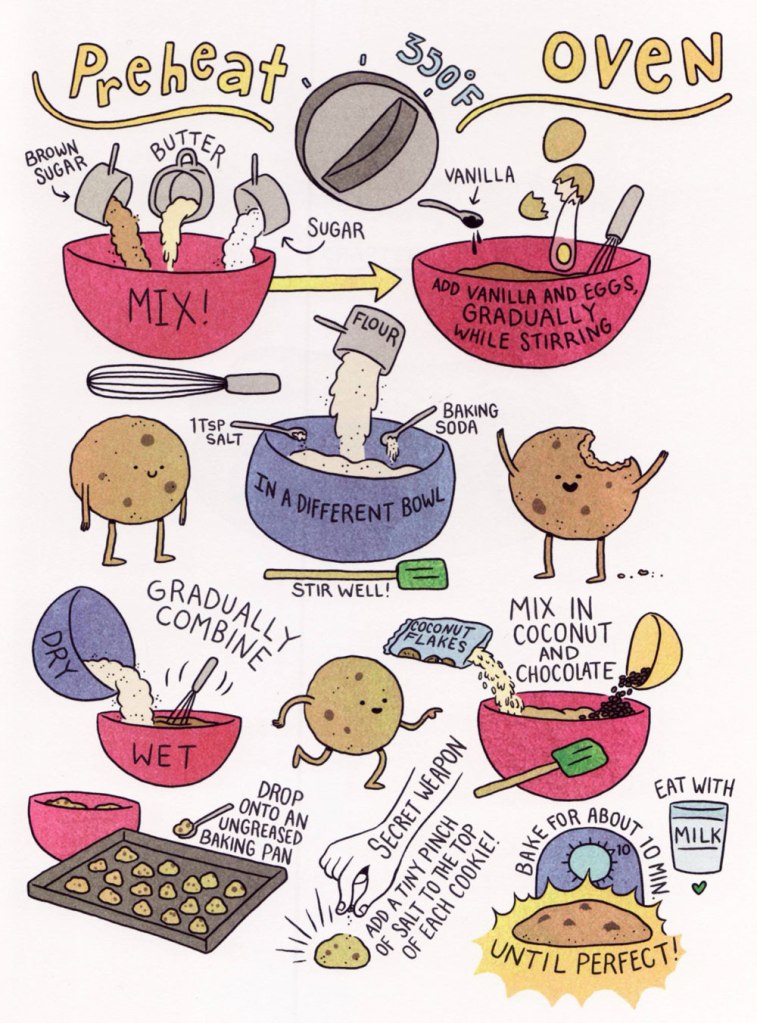
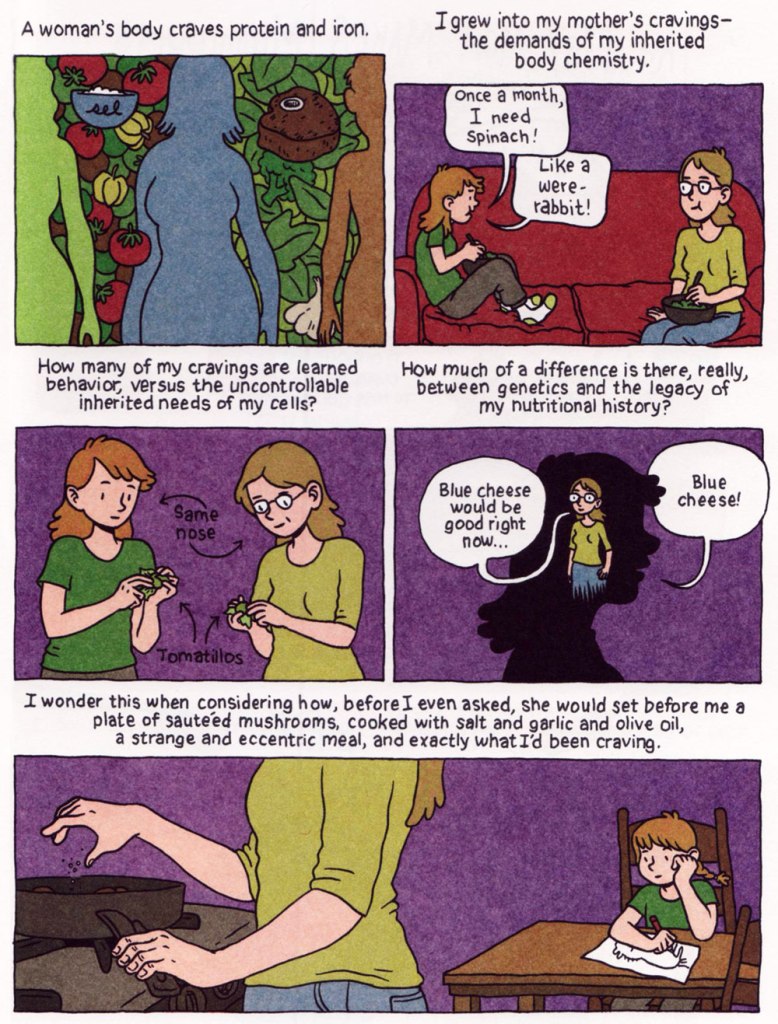
I’m actually not fond of cookbooks that delve into family anecdotes, as that type of narrative tends to get bogged down in saccharine sentiment that obscures the bigger picture, as the narrator collapses into dreamy sighs about how genuine cooking used to be (as compared to the sterile, hurried modern approach, presumably). The visually-oriented nature of comics seems much better suited to emphasise that telling-stories aspect, besides which drawing ingredients and techniques over and over again must get tiresome rather fast, which tilts the stories-to-recipes ratio firmly in favour of the former. Here are some excerpts from books in my library, each taking a slightly different focus on the subject.
An excellent example of memoir-cum-comic-cum-cookbook is Lucy Kingsley‘s joyous Relish: My Life in the Kitchen (2013), probably my favourite example of this subgenre. Its colourful, cartoony style is the perfect backdrop for Kingsley’s pilgrimage through memories – and as the daughter of a professional chef with a penchant towards nature and an aesthete dedicated to fancy gourmet food, she has a great variety of cuisine-related reminiscences to share.
Cook Korean! (2018) by Robin Ha draws strong connections between Ha’s Korean roots and her gradually evolving relationship with her mother. Mothers, as they tend to be the first source of a newborn’s food and the child’s main guide to new flavours, crop up a lot in these recollections, but here the emphasis is more on reconnecting with one’s ancestry through traditional food. I bought this book for the recipes, but I was touched by Ha’s obvious enthusiasm and desire to make this cookbook a fun, easy-going romp through not only a lot of Korean staples, but also people’s attitudes towards them.
Dirt Candy (2012) by Amanda Cohen and Ryan Dunlavey chronicles the hard life of the chef/owner of a NYC restaurant. While I am not quite on board with Cohen’s claim that vegetables are boring unless they’re treated in very specific and fancy ways, her clear frustration at the reputation of vegetarian (I’m sorry, ‘vegetable‘) cuisine is educational and entertaining, as she spends a chunk of the cookbook discussing the evolution the Americans’ tortuous relationship with vegetables and ‘healthy’ food.
I’m still on the fence about whether I think it’s pretentious or not, but vegetarian cooking with ‘gloopy brown sauce’ is definitely a thing.
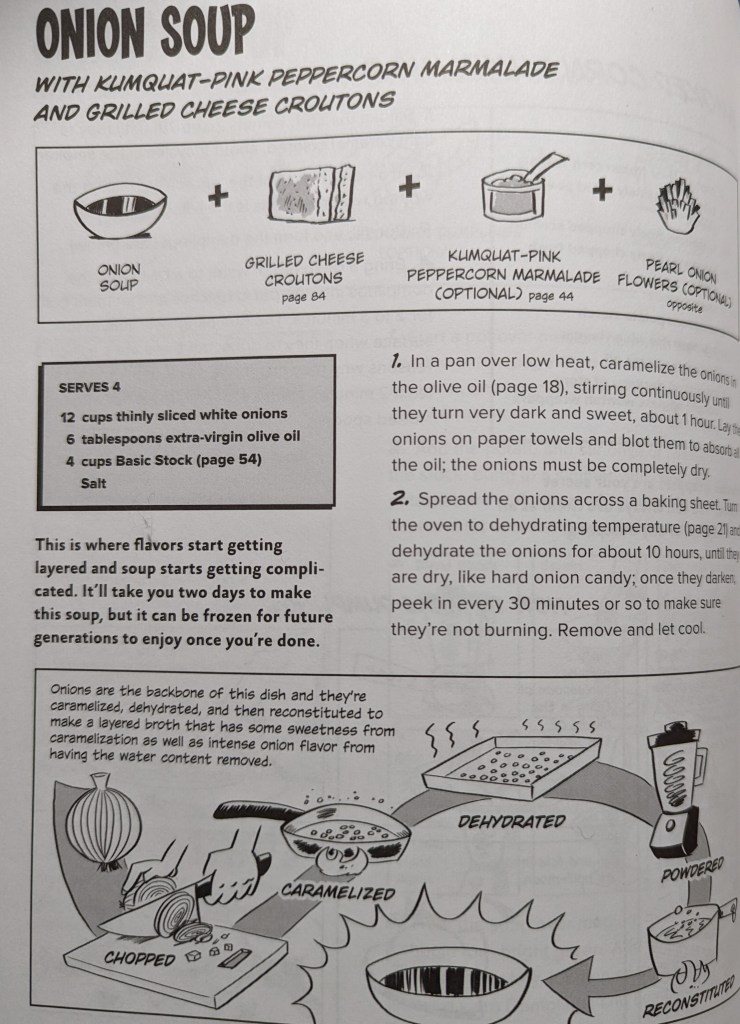
I have not tried any Dirt Candy recipes yet, as most of them require a multitude of bowls and techniques, not to mention the sort of time investment I currently reserve for other projects. The culmination of that approach is Cohen’s recipe for onion soup, which demands two days of preparation and would have also required the sacrifice of your first-born, if this hadn’t been a vegetarian (sorry, vegetable…) cookbook.
I applaud bold new ingredient combinations, but I think most of us are perfectly happy to keep our kumquats away from our onion soup.
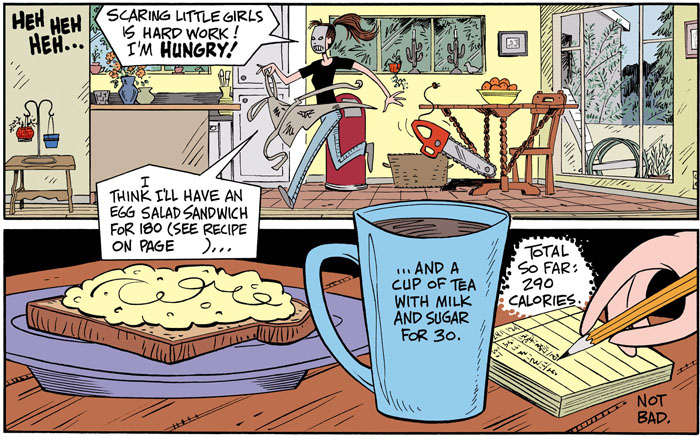
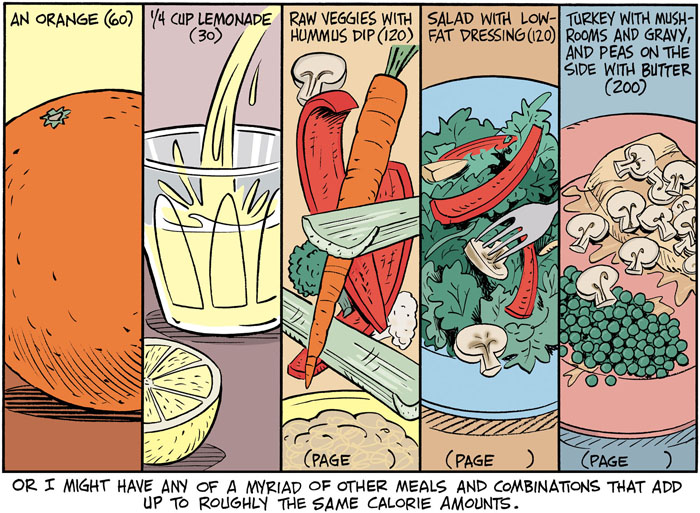
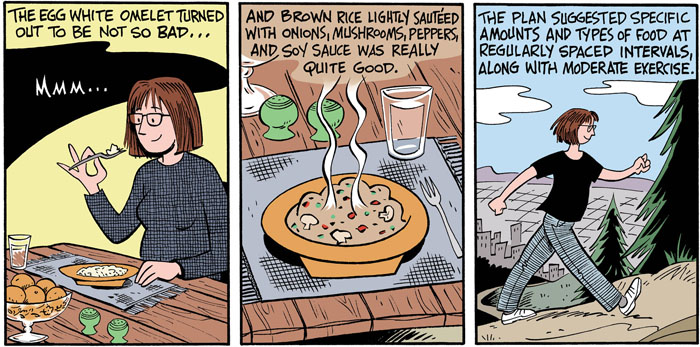
Carol Lay‘s The Big Skinny: How I Changed My Fattitude (2013) recounts her tortured relationship with food and how she finally was able to come to grips with her weight. It’s not that easy to laugh at yourself, and Lay successfully pulls it off, which makes this memoir instantly endearing whether one swears by counting calories or is convinced that it’s the sort of madness psychiatrists make a living on.
~ ds
P.S. I couldn’t write a post about comics and food without mentioning Ben Katchor, a WOT favourite. He has many beautiful perambulations into the territory of food, but one might mention The Dairy Restaurant for starters.
Carol Lay (born 1952) is an illustrator and cartoonist who has done a variety of work – some comic books published, collections of Story Minute (probably the strip she’s best known for), as well as illustrations for The New Yorker and such.
Her drawing style is easily recognizable (and not necessarily up at everyone’s street – some people can’t get past her highly stylized way of drawing mouths, for instance), but what makes her work most appealing to me is Lay’s sense of humour. I’m not even sure that “humour” is the right word for it – her stories have set-ups that are imaginative but often completely surreal, if not far-fetched; yet her characterizations of people ring absolutely true.
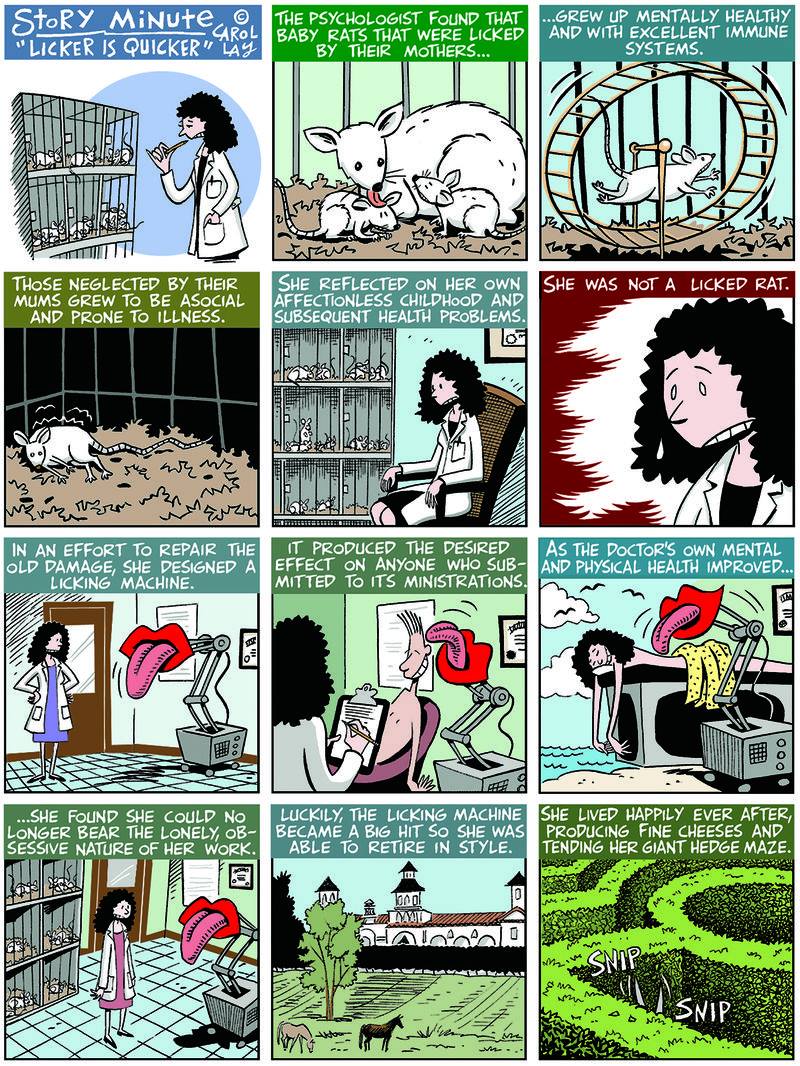
She excels at one-pagers, but longer stories are great, too. Here’s an example of the former, a typical Story Minute:
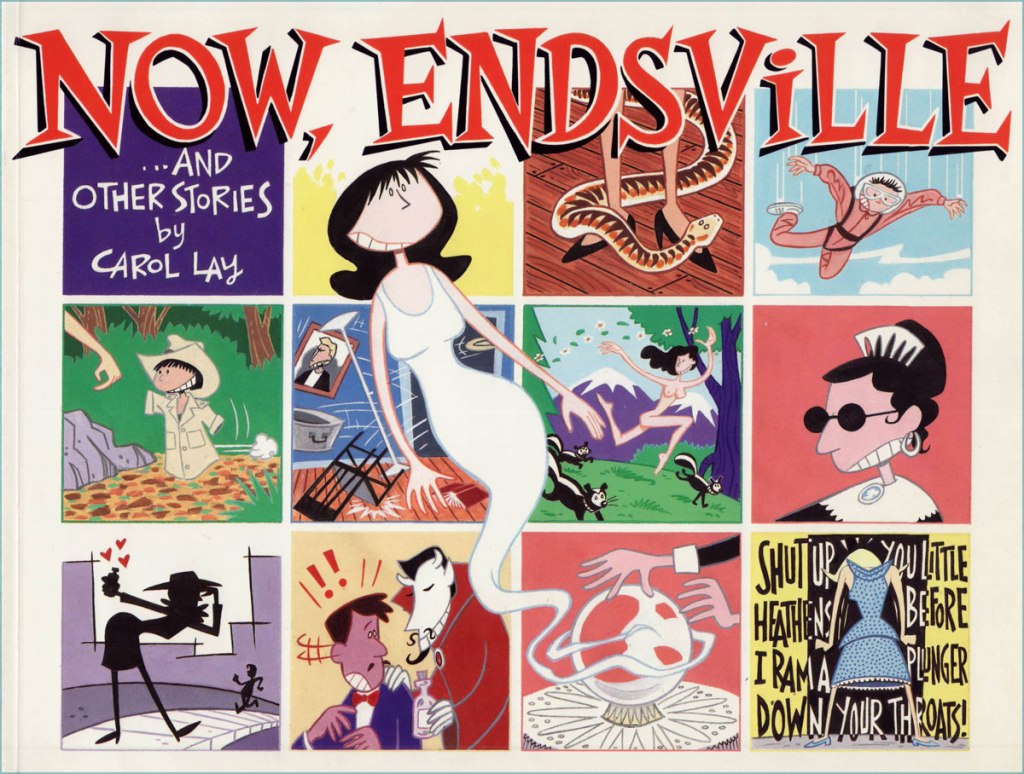
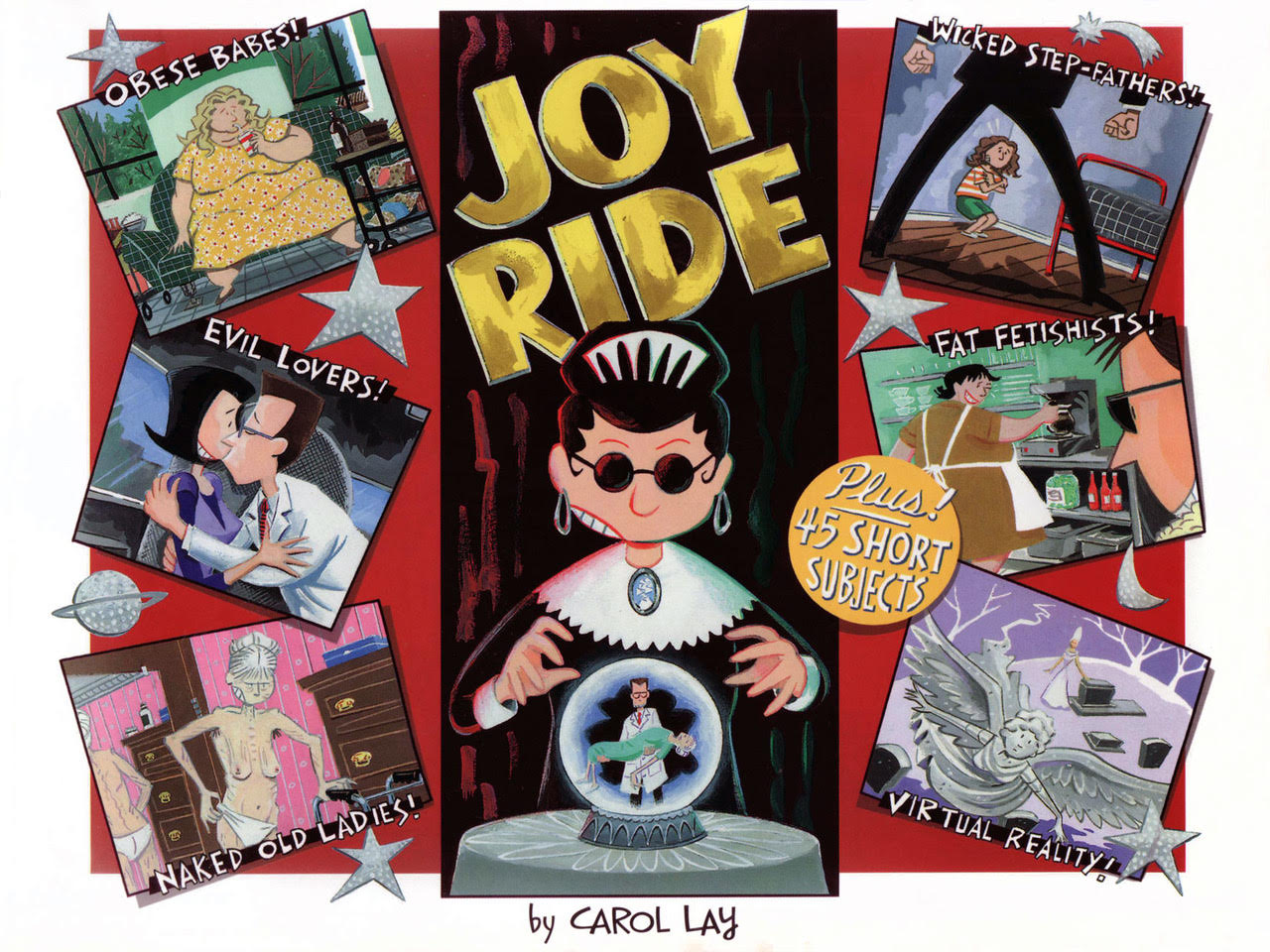
There are four collections of Lay’s weekly strips out there: three paperbacks, published by Kitchen Sink (Joy Ride, Strip Joint and Now, Endsville), are quite out of print, so keep an eye out for used copies in second-hand bookstores. The latest one, Illiterature, was published in 2012 by Boom!Town in hardcover (and I believe there was supposed to be a volume 2… still waiting for that one.)
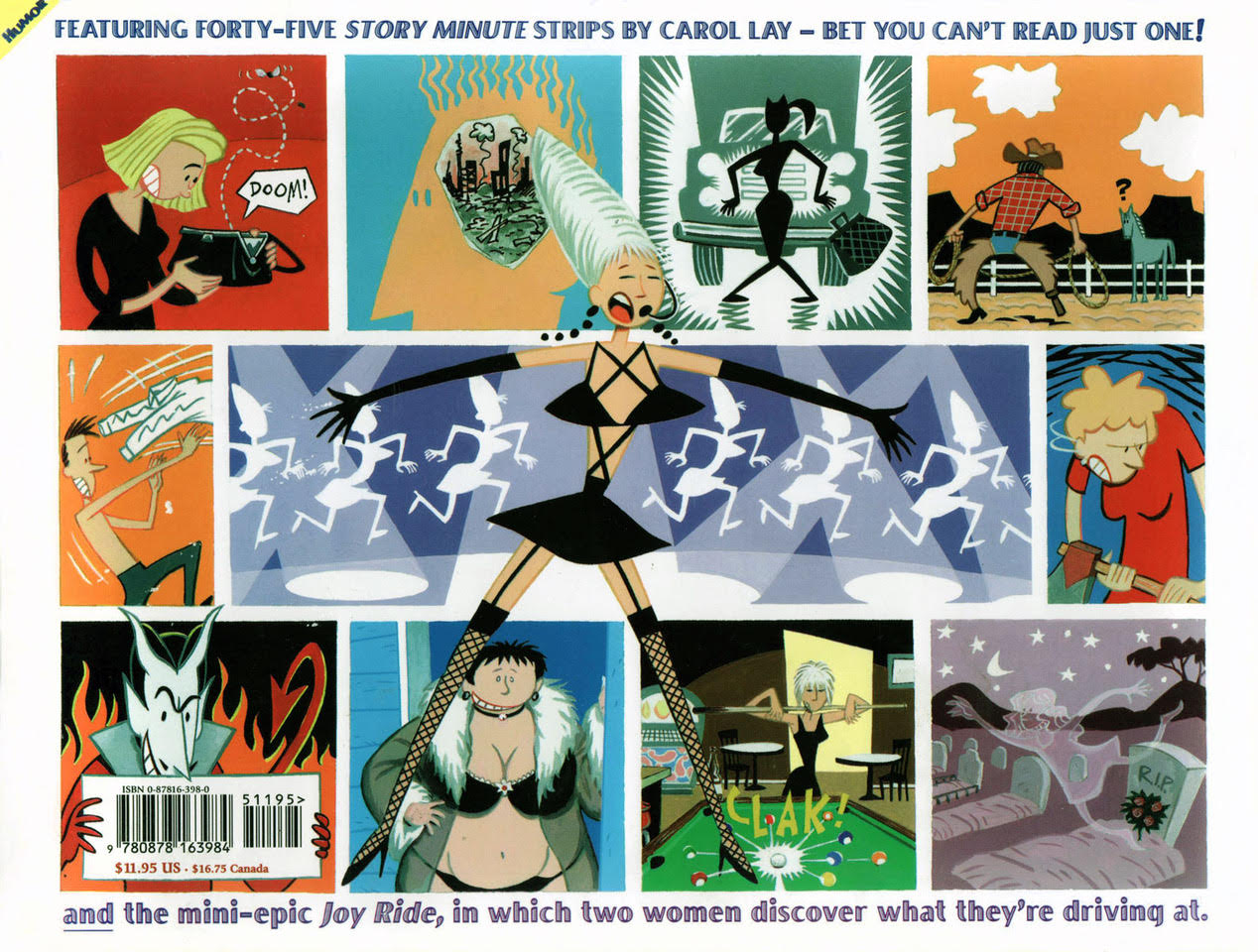
The Kitchen Sink collections have beautiful painted covers, another reason for seeking them out. They also contain some longer (say, around 20 or 30 pages) stories, for instance one of my favourites, Joy Ride (that gave its name to the whole collection), set in a world where minds can be transferred between bodies, being fat is outlawed, and “drivers” are people whose job involves forcing fat people to get into shape by temporarily taking over their personality.
And this is the back:
You can read Lay’s webcomic (some of it includes coloured Story Minute strips – originally, they were black-and-white – and most of it is longer, new stories) at http://www.gocomics.com/lay-lines








 Who's Out There?