Jean-Claude Forest in ‘Fiction’

« You mean the secret password is Llanfairpwllgwyngyllgogerychwyrndrobwllllantysiliogogogoch? » — Barbarella

Unlike French rock ‘n’ roll, French science-fiction isn’t an oxymoron.

A couple of months back, I happened to order a handful of issues of Fiction (1953-1990), nominally the French-language edition of The Magazine of Fantasy & Science Fiction… yet superior in the sense that Fiction’s focus was broader, encompassing as it did more elusive genres like fantastique, while devoting ample space to excellent critical essays… in the French manner.

I was buying specific issues for their reprints of tales by my favourite writer, Jean Ray, and a couple of the issues happened to bear covers by future superstar Jean-Claude Forest (1930-1998), fabled creator of Barbarella, Hypocrite and Bébé Cyanure, as well as scripting early episodes of Paul Gillon‘s Les naufragés du temps.

For more background on Forest, check out my earlier, career-spanning post, the ambitiously titled Jean-Claude Forest, ‘Father of Adult Comics’. I still stand by it!

As it turned out, Forest had lent his talents to quite a bevy of covers for Fiction — which speaks well of their editorial discernment — and as the kind seller had priced other issues at a most modest price — these are nearly seventy years old, let’s not forget — I opted to spring for more Forest rarities… and so here we are.

This is Fiction no. 61 (Dec. 1958, Éditions Opta), with Forest’s cover illustrating Julia Verlanger‘s “La fenêtre“.
This is Fiction no. 64 (Mar. 1959, Éditions Opta), with Forest’s cover illustrating Robert F. Young‘s “La déesse de granit” (« Goddess in Granite »).
This is Fiction no. 68 (July 1959, Éditions Opta), with Forest’s collage cover illustrating Charles Henneberg‘s “Au pilote aveugle“.
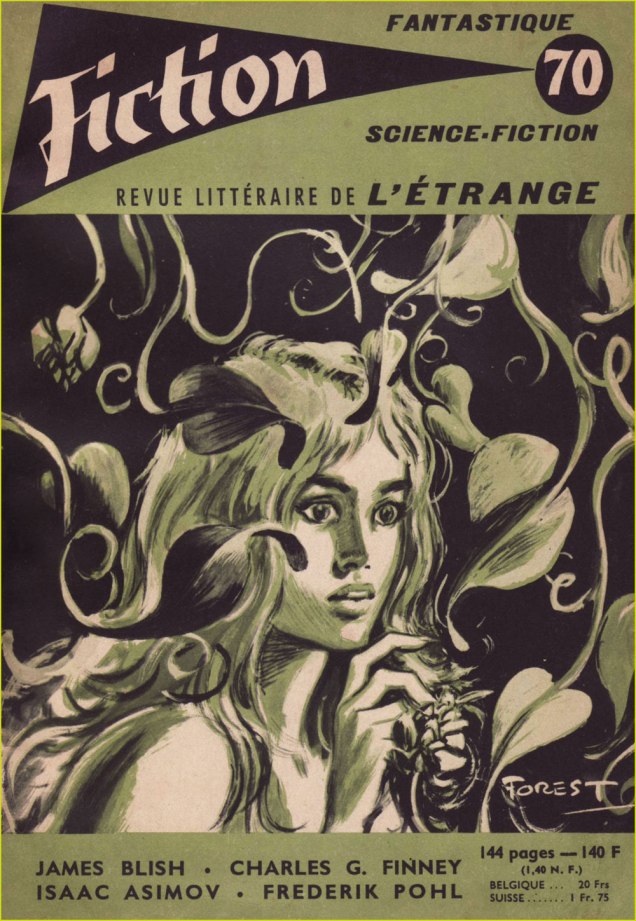
Is that you, Barbarella? This is Fiction no. 70 (Sept. 1959, Éditions Opta), with Forest’s halftone cover illustrating Ilka Legrand‘s “Le rire dans la maison“.
This is Fiction no. 75 (Feb. 1960, Éditions Opta), with Forest’s cover illustrating Thomas Owen‘s “Le manteau bleu“. Owen ( Gérald Bertot, 1910-2002) was among the great Belgian writers of the fantastique genre.
This is Fiction no. 76 (Mar. 1960, Éditions Opta), with Forest’s cover depicting — you guessed it — Theodore Sturgeon‘s “The Silken-Swift“, translated here as « Douce-agile ou La licorne ».
This is Fiction no. 81 (Aug. 1960, Éditions Opta), with Forest’s cover illustrating André Pieyre de Mandiargues‘ “Clorinde“.
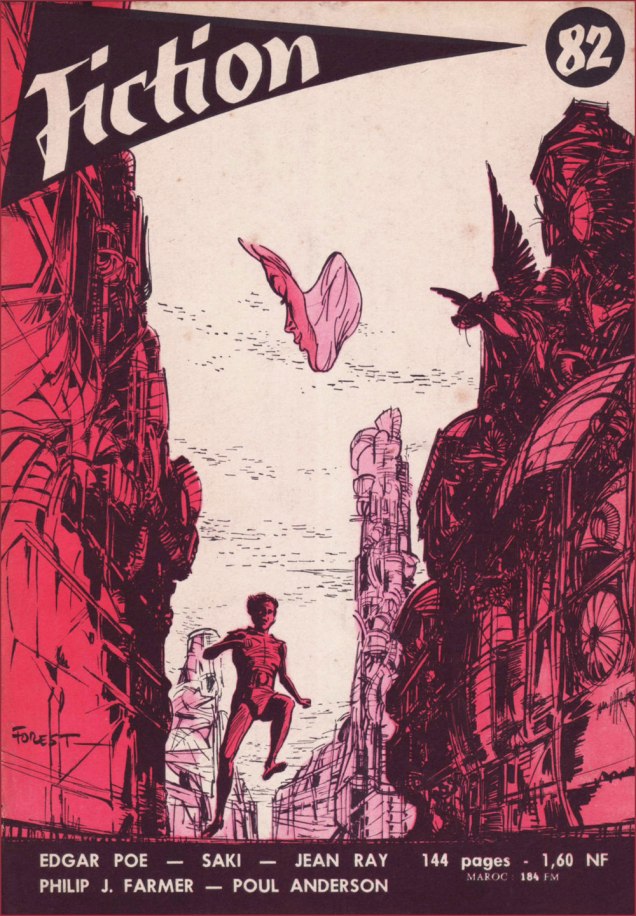
This is Fiction no. 82 (Sept. 1960, Éditions Opta), with Forest’s cover illustrating Philip José Farmer‘s “The Night of Light“, translated here as « La nuit de la lumière ». I love what Forest does with the composition, its focal point that elusive butterfly with a woman’s face.
Forest goes gothic! This is Fiction no. 90 (May 1961, Éditions Opta), featuring a well-timed reprint of Henry James‘ 1898 novella “The Turn of the Screw” (read it here!), several months ahead of Jack Clayton and Freddie Francis‘ fine cinematic version, « The Innocents ».
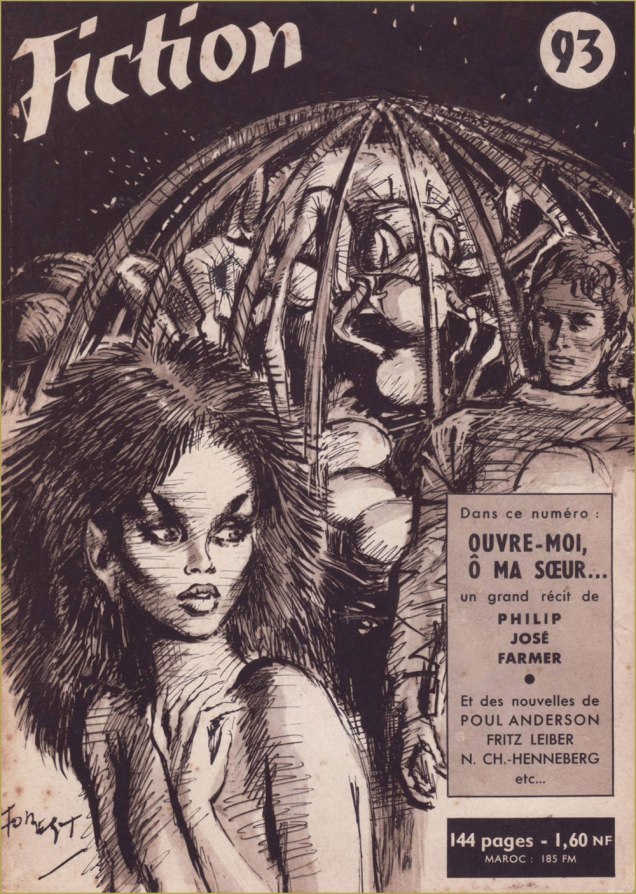
This is Fiction no. 93 (Aug. 1961, Éditions Opta), with Forest’s cover illustrating Philip José Farmer‘s “Open to me, my Sister“, translated here as « Ouvre-moi, ô ma sœur… ».
This is Fiction no. 97 (Dec. 1961, Éditions Opta), with Forest’s cover illustrating Michel Demuth‘s “La route de Driegho“.
This is Fiction no. 105 (Aug. 1962, Éditions Opta); exceptionally, Forest’s cover doesn’t refer to any of the inside stories; instead, he offers a scene featuring Pygar the blind angel, last of the ornithanthropes, a character from the bédéiste’s signature series Barbarella, which had just begun serialisation in V Magazine that spring.
Finally — at least in my collection — this is Fiction no. 117 (Aug. 1963, Éditions Opta); Forest’s intriguing cover doesn’t appear to correspond to any of the stories within.

A word of warning: I plan to further elaborate on the superiority of French science-fiction in comics, but it’s daunting work, and might take a while yet, so bear with me. I’m pretty busy these days.

-RG

Jean-Claude Forest, ‘Father of Adult Comics’

« J’fais dans la bande dessinée, qu’est bien plus pop que le ciné!* » — J.C. Forest (Une chanson, 1973)

On the eighty-ninth anniversary of his birth, let’s salute in passing one of the great pioneers of French comics, namely Jean-Claude Forest (Sept. 11, 1930 – Dec. 29, 1998), Barbarella’s creator, the man who, in the early 1960s, ushered strictly-for-kids bandes dessinées into decidedly more risqué and adult realms of eroticism, fantasy and fun.

Born on September 11, 1930 in the Parisian suburb of Le Perreux-sur-Marne, he passed away in 1998 at the age of 68, but not before leaving behind a body of work of breathtaking depth and variety. Barbarella aside (sorry, miss): Le Copyright (the springboard for Nikita Mandryka‘s Le Concombre masqué), Hypocrite, Mystérieuse matin midi et soir (his wild riff on Jules Verne’s L’île mystérieuse), Bébé Cyanure, Les Naufragés du temps (illustrated by Paul Gillon), Enfants c’est l’Hydragon qui passe… « et j’en passe », as they say.

Here are a few highlights to give you a sense of the man’s imagination, versatility and tremendous draftsmanship, in chronological order.

BarbarellaA
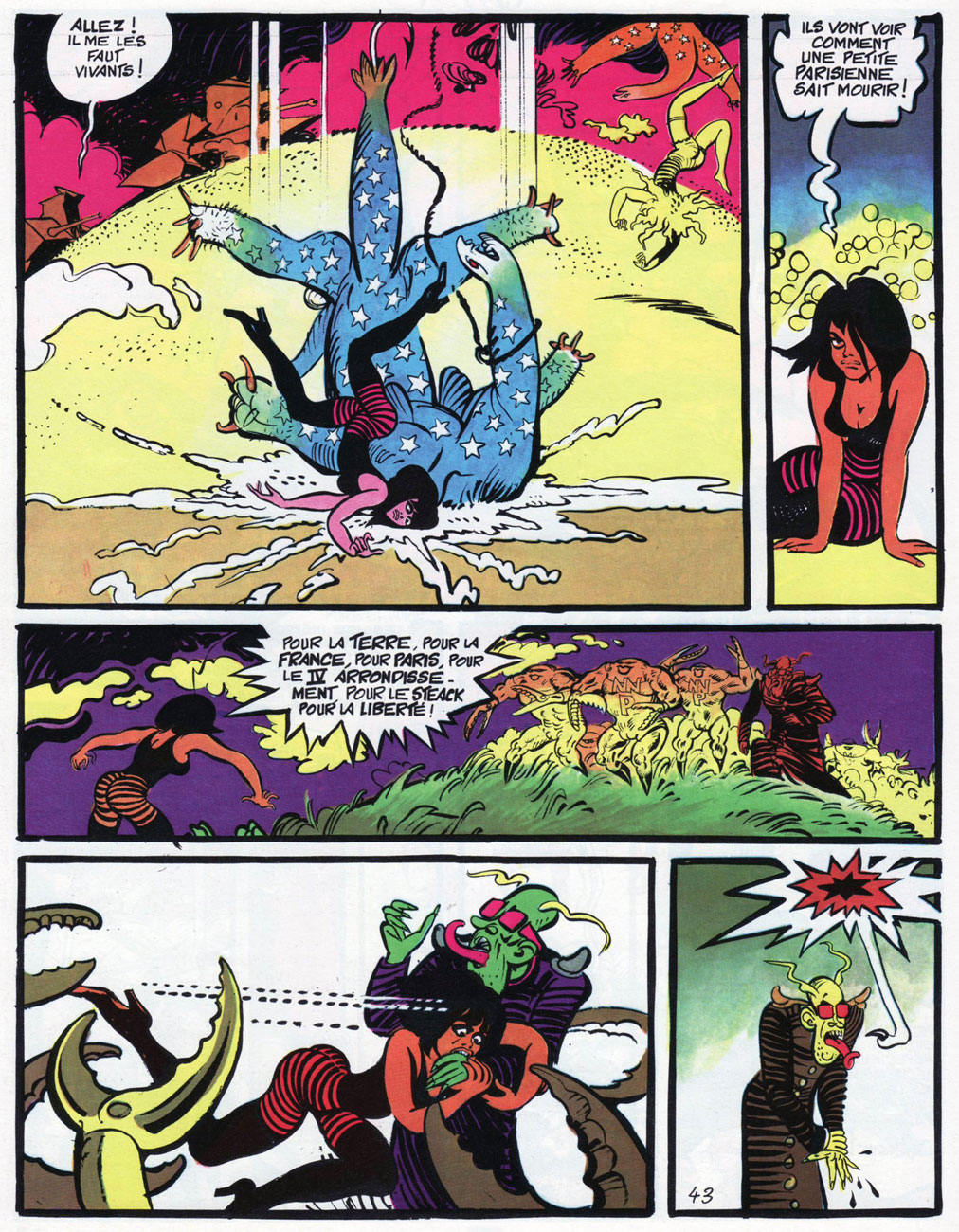
An excerpt is from Les colères du mange-minutes (1965-66), the second volume of Barbarella’s adventures. Yes, there was a film adaptation, but it’s, well, pretty vapid. Director Roger Vadim was kind of the Gallic John Derek; both were fair-to-middling directors whose chief talent was womanizing. Though one has to admit it *was* quite a talent.

GiffWiffMarieMathA
« No, you mustn’t love me… » Detail from the cover of giff wiff, revue de la bande dessinée no.22 (Dec. 1966), previewing its article on Forest’s 1965 experimental tv cartoon Marie Mathématique, which you can watch here. It features the dulcet tones of Le beau Serge, certainly one of the most overrated artistes of the 20th century. Too much competition to call the race to the bottom, though. 😉

ForestMystérieuseA
Born out of a misunderstanding between the editorial team of Pif Gadget and Forest, Mystérieuse matin midi et soir proved too labyrinthine for the magazine’s young readership, cost the publishers a bundle, and only two of its three parts appeared in Pif. Fear not, it was collected in album form the following year. This is a page from part 1, which saw print in Pif Gadget no. 111 (April, 1971).

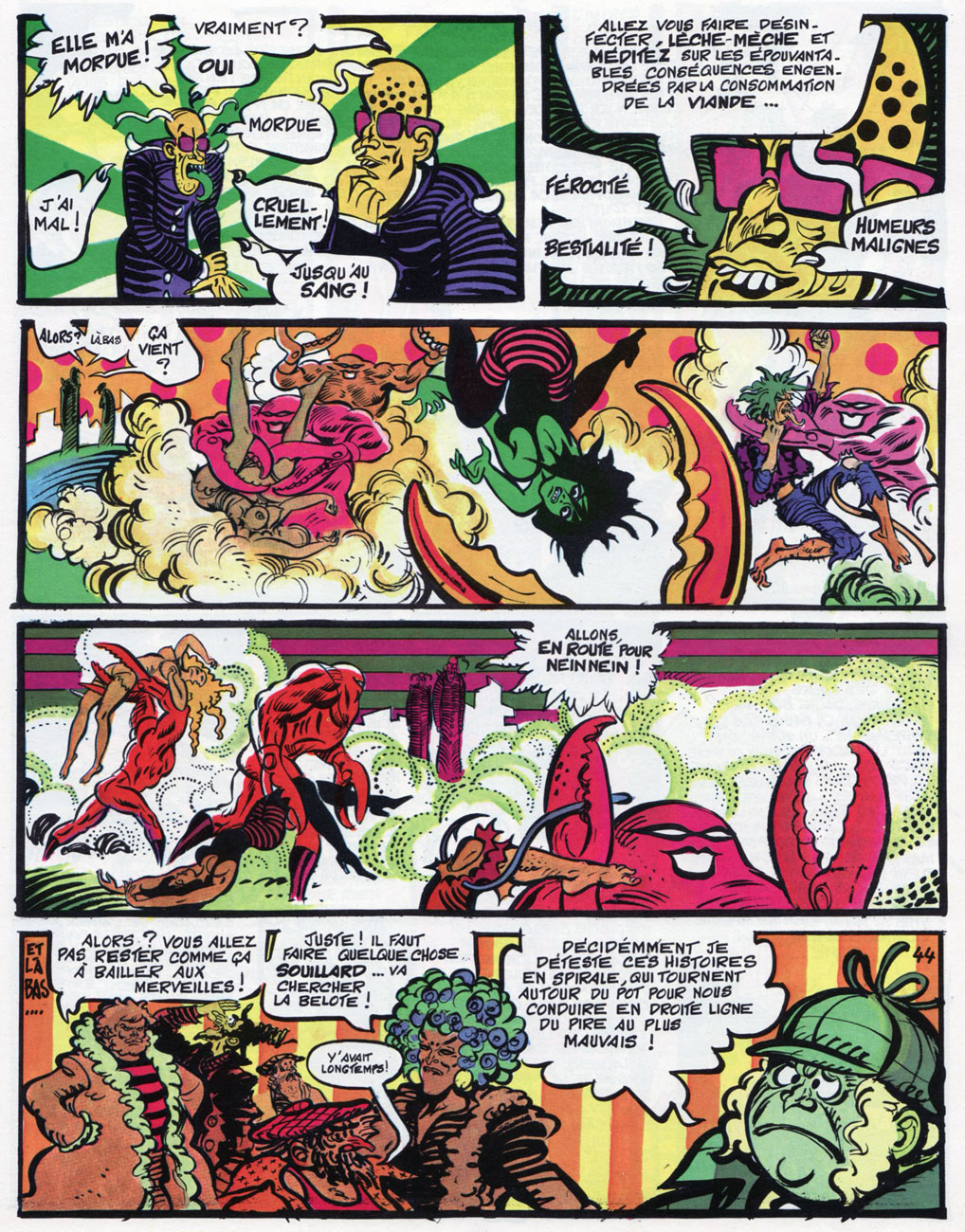
ForestHypoCheval01A

ForestHypoCheval02A
A sequence from the rollicking N’importe quoi de cheval…, featuring Hypocrite, another of Forest’s spunky heroïnes. From Pilote Mensuel no. 6 (Dargaud, Nov. 1974).

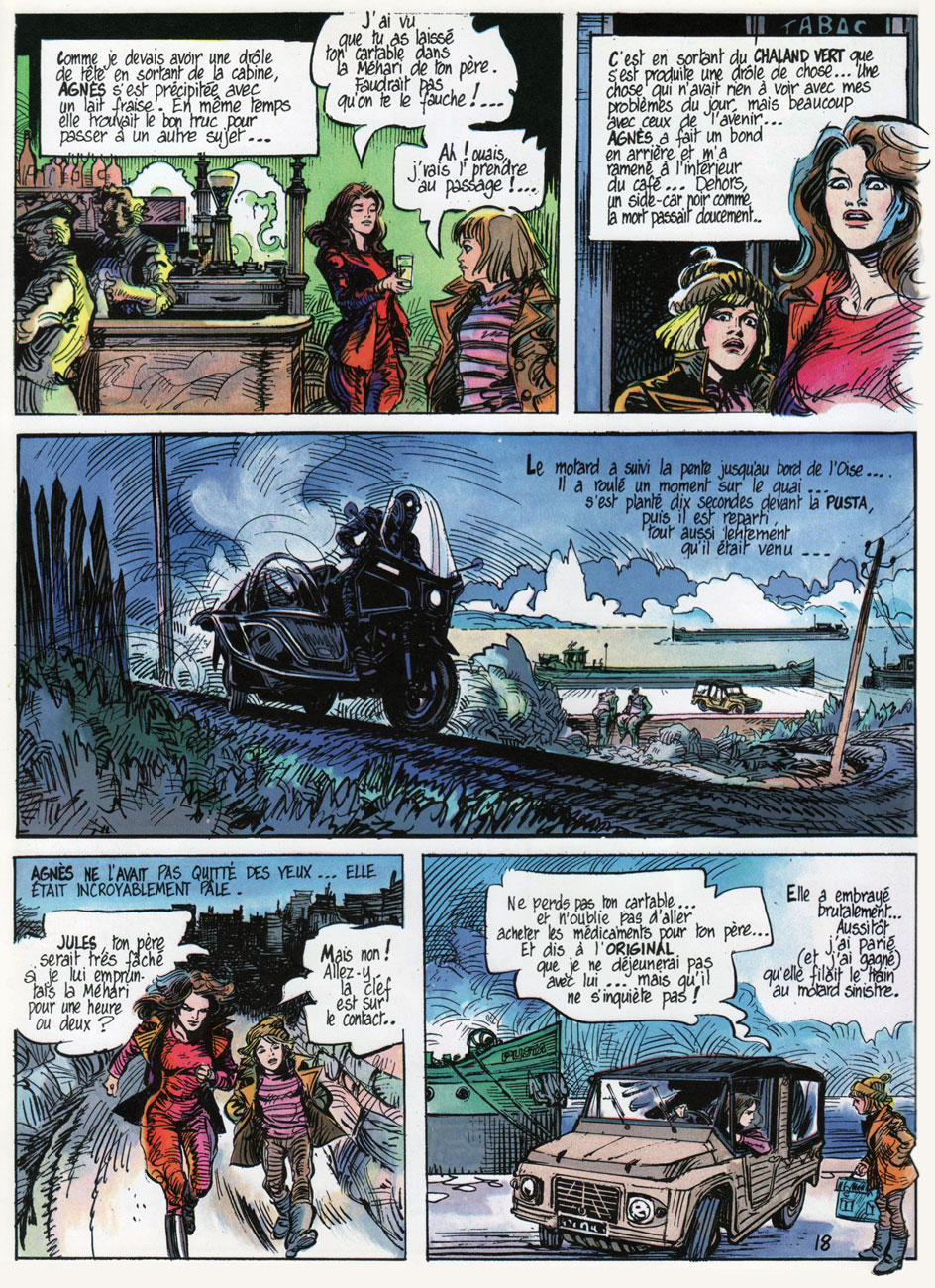
A pair of pages from the melancholy, elegiac Enfants, c’est l’Hydragon qui passe « Children, there goes the Hydragon » (Casterman, 1984).

ForestHydragon18A

ForestHydragon02A
I’m sure it’s mere coincidence, but the boy, Jules, seems to be modelled after yet another Gainsbourg “muse”, pop nymphette Vanessa Paradis.

– RG

*I make comics, they’re far poppier than movies!