« Sooner or later we all sit down to the banquet of consequences. » — Robert W. Frank, paraphrasing Robert Louis Stevenson
Today, we ask: who was Peter Randa? I’m asking because I read one of his books at random — actually, the comics adaptation, and was deeply impressed with its quality. Randa, né André Duquesne (1911-1979) in Marcinelle, Belgium, wrote some 300 hundred novels in various genres over a mind bogglingly productive quarter-century under a myriad of pseudonyms, namely Jean-Jacques Alain, Urbain Farrel, Herbert Ghilen, Jules Hardouin, Jim Hendrix (!), Henri Lern, André Ollivier, H.T. Perkins, F.M. Roucayrol, Diego Suarez, Jehan Van Rhyn and Percy Williams. There may be others. He dealt in the genres of science-fiction, horror, espionage, crime, and erotica (with over fifty novels written in the early 1970s).
Two more covers (respectively 1955 and 1973) painted by the also miraculously prolific French illustrator Michel Gourdon. Here’s a segment from a French TV show touching upon the scope of his career, on the occasion of the auctioning of his vast trove of original art. Hope it all found good homes.
Well, here’s the basic plot, taken from the current e-book edition (which I’m grateful exists at all, as even outstanding work often languishes in utter obscurity or downright oblivion): « Archie Leggatt is a madman, a real one. He believes himself the Devil, had kidnapped three young women and terrorised a fourth. A run-of-the-mill serial killer? Perhaps… but when such an un assassin boasts supernatural powers and leaves more than the scent of brimstone behind, physicians and investigators begin to wonder and ask themselves questions with terrifying implications. Can one truly hope to put Satan behind bars? »
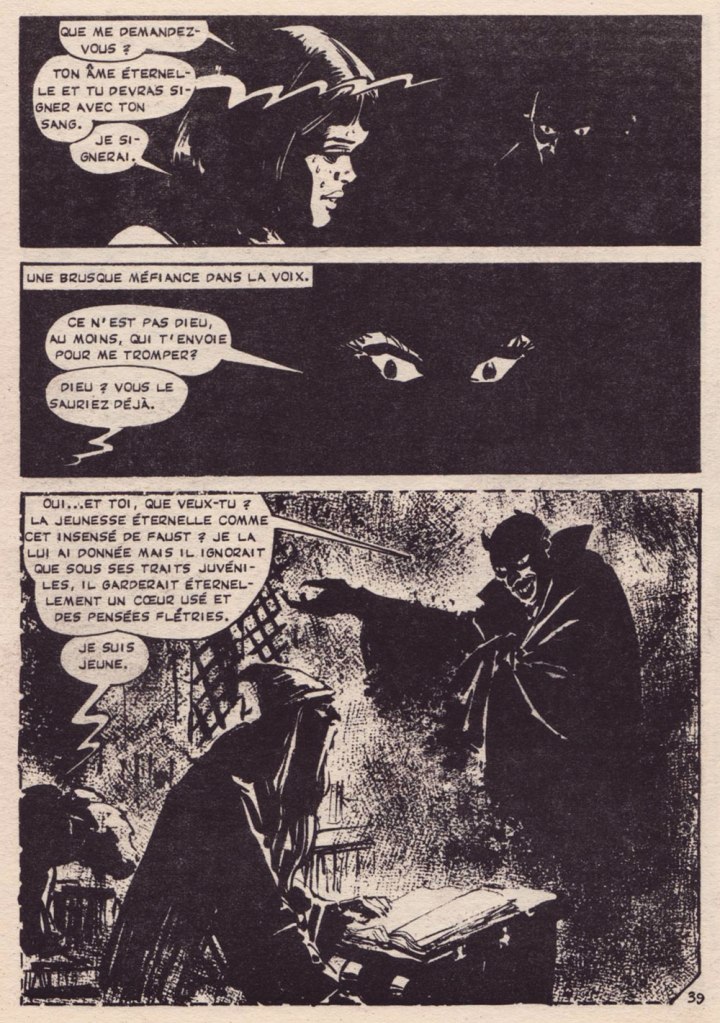
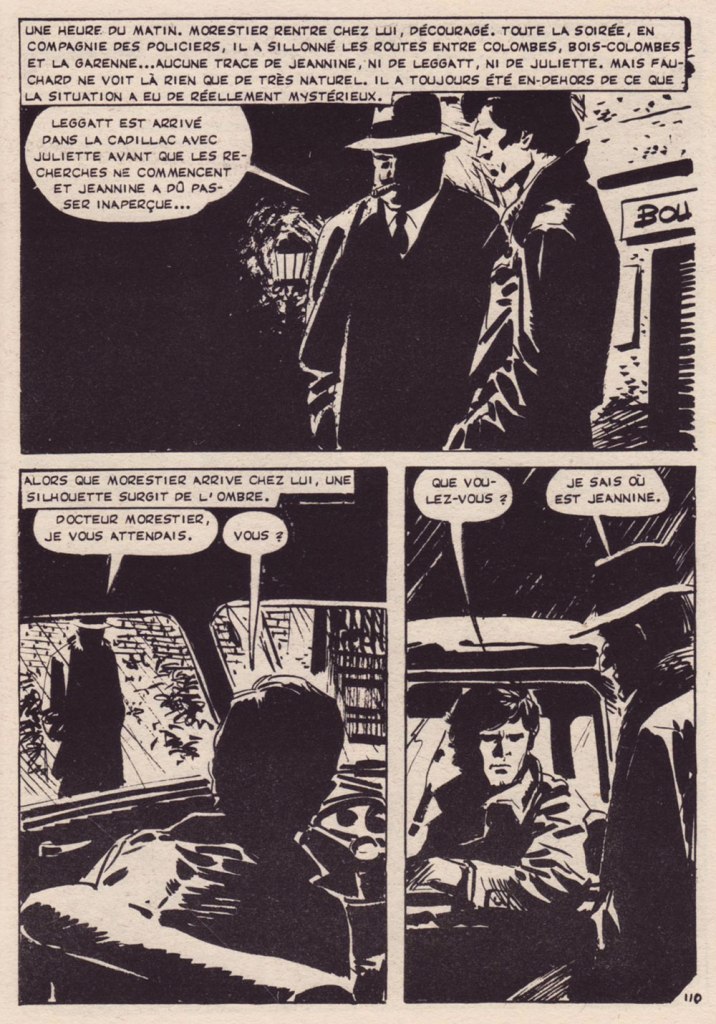
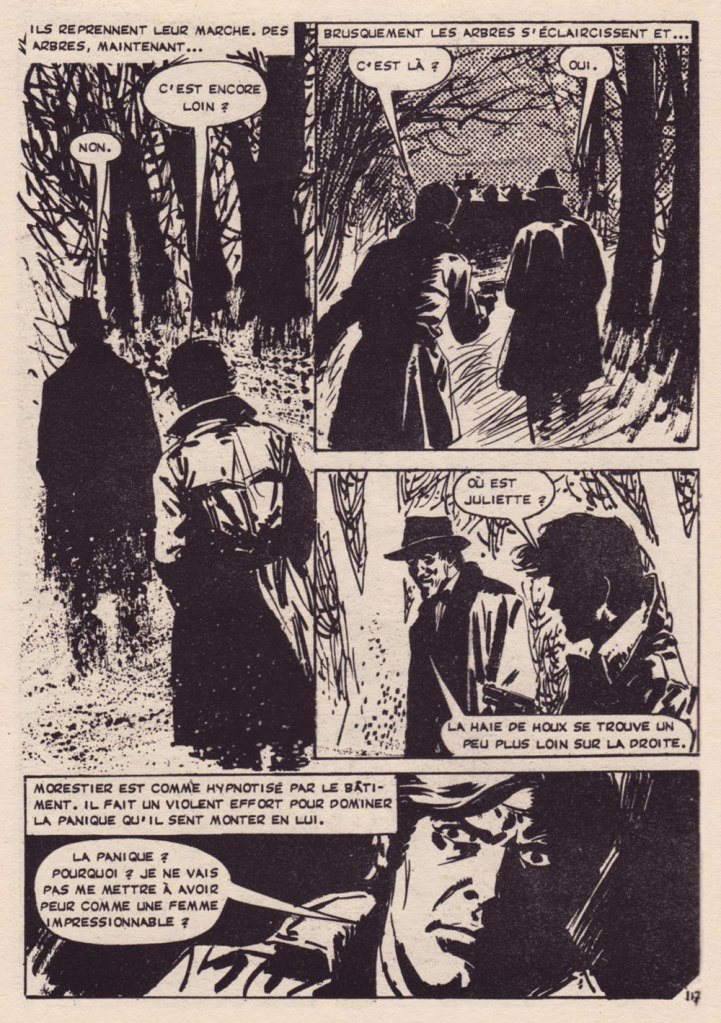
Illustrator unknown, wouldn’t you know it? Given his skill, style and stamina, I’m guessing he’s Spanish, but beyond that, I’m drawing a blank. Still, kudos to this anonymous artistic practitioner.I know, I know: it’s Warren’s Uncle Creepy with a pencil moustache. Jeannine agrees to the Faustian deal Leggatt proposes.A handsome doctor thinks he can save the woman he loves. Randa sets up the usual scenario, all the better to kick the reader’s legs out from under him. Le banquet des ténèbres — the bédé adaptation — saw print in Eclipso no. 30 (June 1973, Arédit). Amusingly, mycomicshop.com’s archivist describes Eclipso as ‘French publication reprinting comics from various Marvel properties.’ Well, not exactly. The title should clue you in: the anthology started out reprinting DC series such as Eclipso, Deadman, Mark Merlin, Challengers of the Unknown, Hawkman, Doom Patrol… while also dipping into Tower’s T.H.U.N.D.E.R. Agents, for instance. Marvel got stirred into the mix in the early 1970s, then came a period of French novel adaptations, then back to US comics, mostly from Marvel. The ride ended in 1983.
What fascinated me about Le banquet is its steady ambiguity between possible mental aberration, hypnotic suggestion, and the outright supernatural. This precarious balance — and slow-burning tension — is maintained right to the end, which is no mean feat. Is Leggatt just a regular madman, a consummate mesmerist, or a temporary, occasional shell for Old Nick? I’m reminded of a similar exploit accomplished by Arturo Pérez-Reverte in his 1993 novel El Club Dumas (The Club Dumas), wherein one didn’t know for certain whether there was anything actually uncanny going on… until the conclusion. Sadly, Roman Polanski fumbled his cinematic adaptation (as The Ninth Gate), starting with the absurd casting of Johnny Depp as the presumably intelligent book detective protagonist. When Polanski’s wife starts flying, the jig is up, I’m afraid.
« I prefer hallucinations ’cause they tend to make more sense than experience. » — Todd Rundgren
Today, I’m mixing things up a bit and heading over to Europe. We’ll be looking at various versions of « Le seuil du vide » (Threshold of the Void) a story by André Ruellan (1922-2016), aka Kurt Steiner.
At left, the original novel, published in 1956; at right, the comics adaptation, published in 1973. Believe it or not , both covers are the work of the same man, the prolific Michel Gourdon (1925-2011). He had a predilection for a palette of green and blue hues.
The plot, in a few broad strokes: Young painter Wanda Leibovitz comes to Paris, hoping to forget a romance gone wrong. At the train station, upon her arrival in town, Wanda encounters a mysterious old lady offering to rent her a room, but under certain conditions…
Basically, it’s the ‘New Bodies for Old’ plot, and it ends as bleakly as you might imagine. Ruellan/Steiner wasn’t the least bit afraid to probe the darkness. The victim’s innocence was no protection against the forces besieging her, to put it mildly.
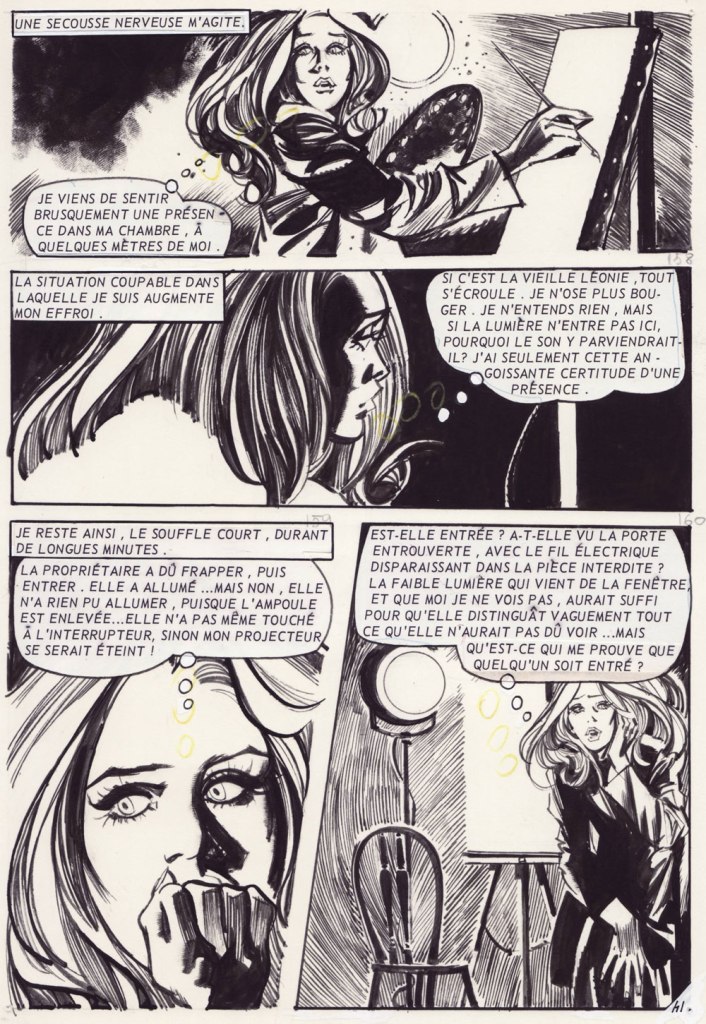
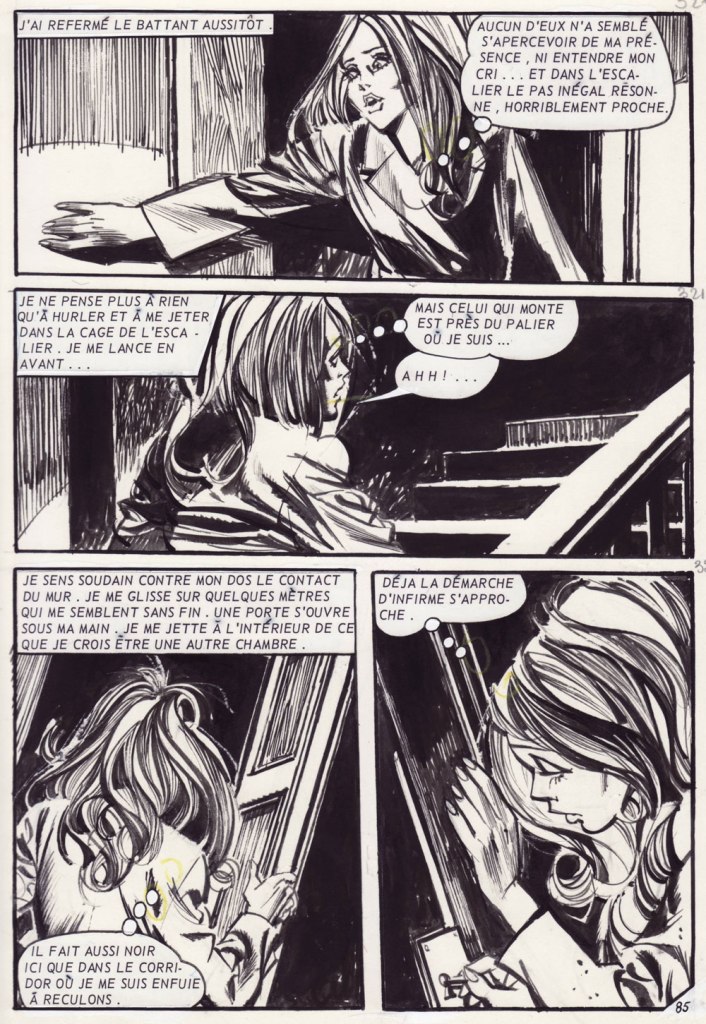
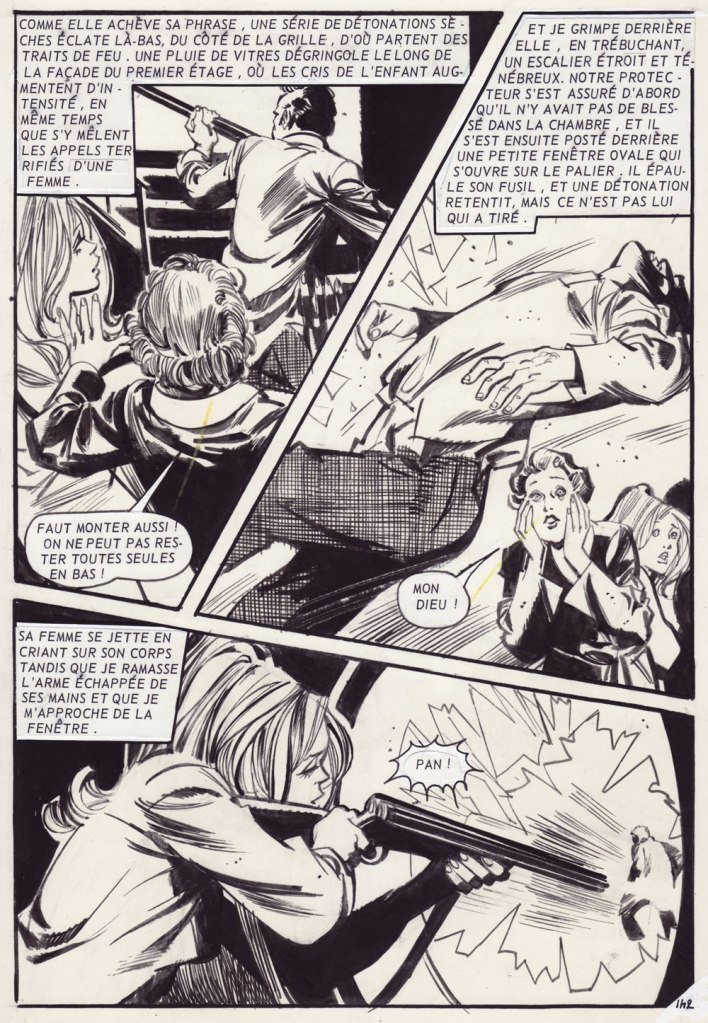
Here are a few interior pages from the Arédit adaptation, featuring art by Cándido Ruiz Pueyo.
There was also a movie adaptation by an ambitious young filmmaker by the name of Jean-François Davy. This was his third try at getting a project off the ground and into cinemas, and his only horror film. They just weren’t making such films in France in those days — the iconoclastic Jean Rollin being the notable exception — in Belgium, sure, but not in France. It took some doing to get the project (barely) financed, lensed and distributed, and its director wound up turning to porn for the rest of his career — hilariously titled porn, to be fair.
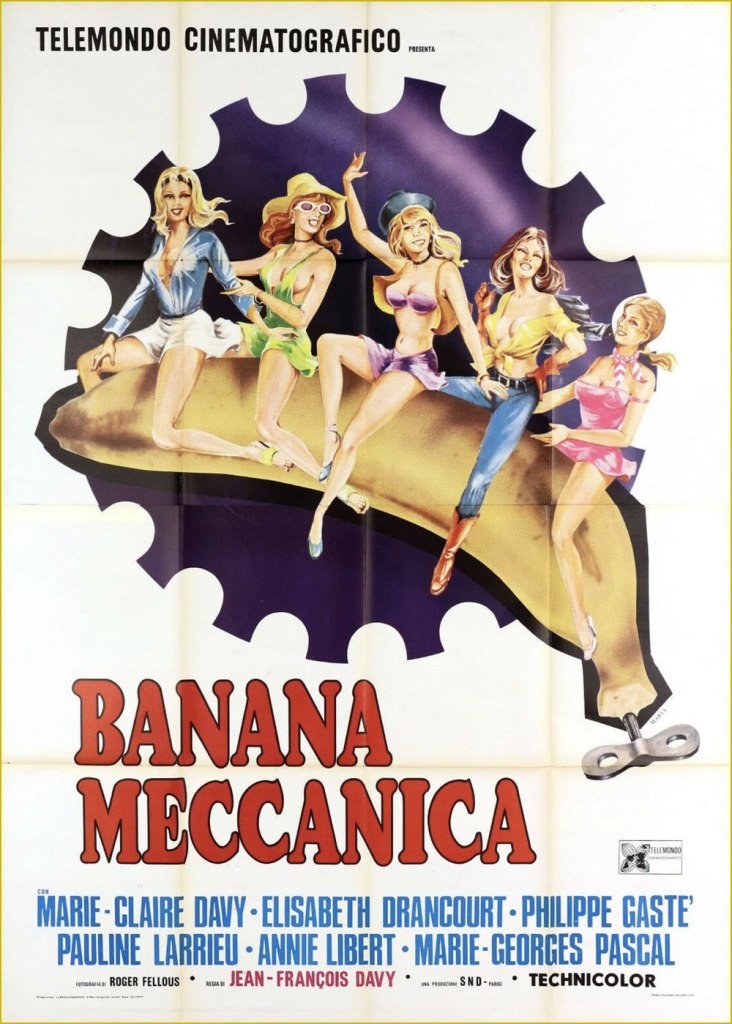
The film features such luminaries as Rififi‘s unforgettable Jean Servais, along with a non-coincidental cameo by (yet to be filmed) The Tenant author Roland Topor. Davy soon attained greater commercial success with his Bananes mécaniques, nominally a Clockwork Orange parody.
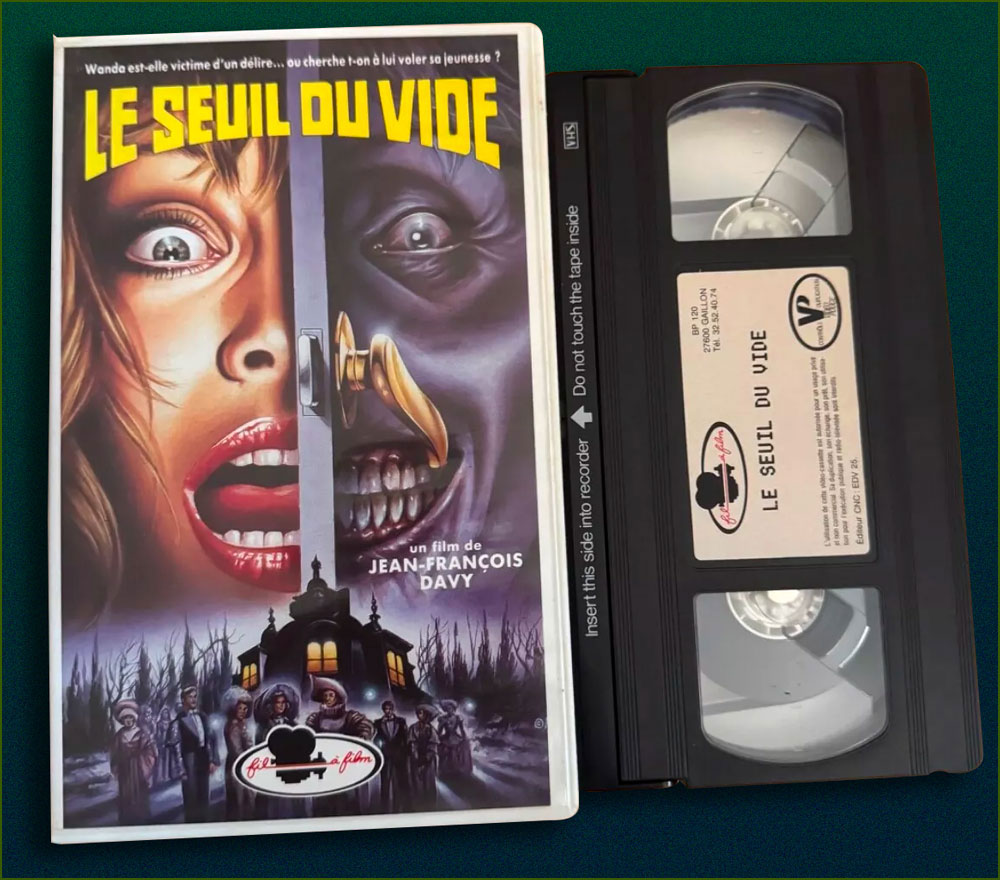
And here’s the VHS release, featuring the film’s original poster. Airbrush!
« Insanity is believing your hallucinations are real. Religion is believing that other peoples’ hallucinations are real. » — Dan Barker
When they talk about ‘adult comics’, they mean this — as opposed to ‘comics for randy teenage boys’. By ‘this’, I refer to adaptations of slow-burning psychological horror (or ‘anguish’, really) novels. These weren’t often about literal demons and ghouls, they were about people slowly but surely losing their grip on reality, through natural circumstances or, in a yet more sinister vein, the process of being gaslit by malevolent parties.
These comics are often extremely understated, and I stayed well away from them as a kid, not that I would have understood what they were about. Returning to them, I’ve come to appreciate their low-key, droning power of fascination.
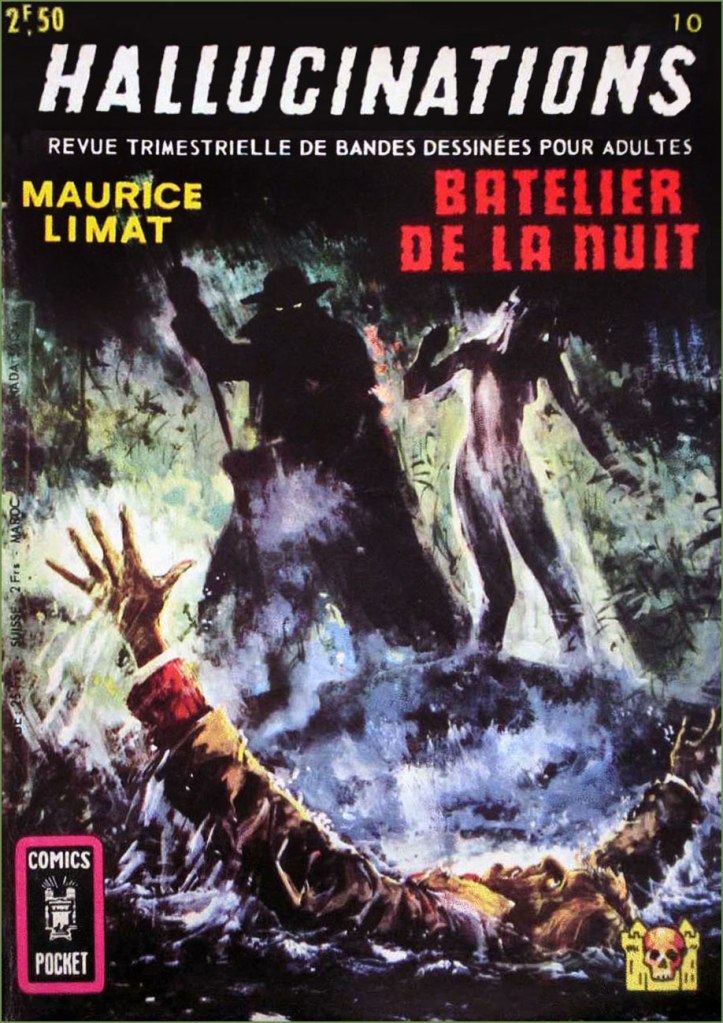
This is Hallucinations no. 2 (Sept. 1969, Arédit). Cover artist unknown. The prolific horror and SF writer André Caroff was a nom de plume of André Carpouzis.This is Hallucinations no. 6 (Sept. 1970, Arédit). The splendid cover painting is the work of Carlo Jacono (thanks for the ID, Caspar!) and the insides by prolific Spanish cartoonist Adolfo Buylla (1927-1998), who contributed to Gold Key’s spooky titles in the 1970s. Marc Agapit was one of the literary pseudonyms used by Adrien Sobra (1897-1985). This is Hallucinations no. 10 (July 1971, Arédit). Cover artist unknown. Maurice Limat (1914-2002) was another busy — but sometimes excellent — writer of SF, crime and horror.
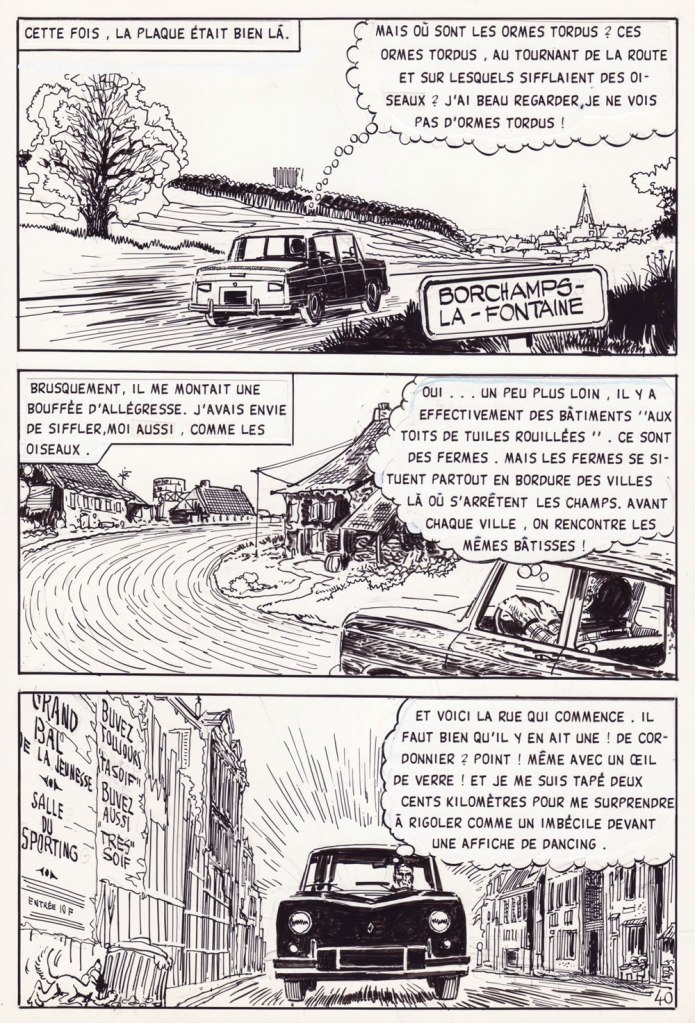
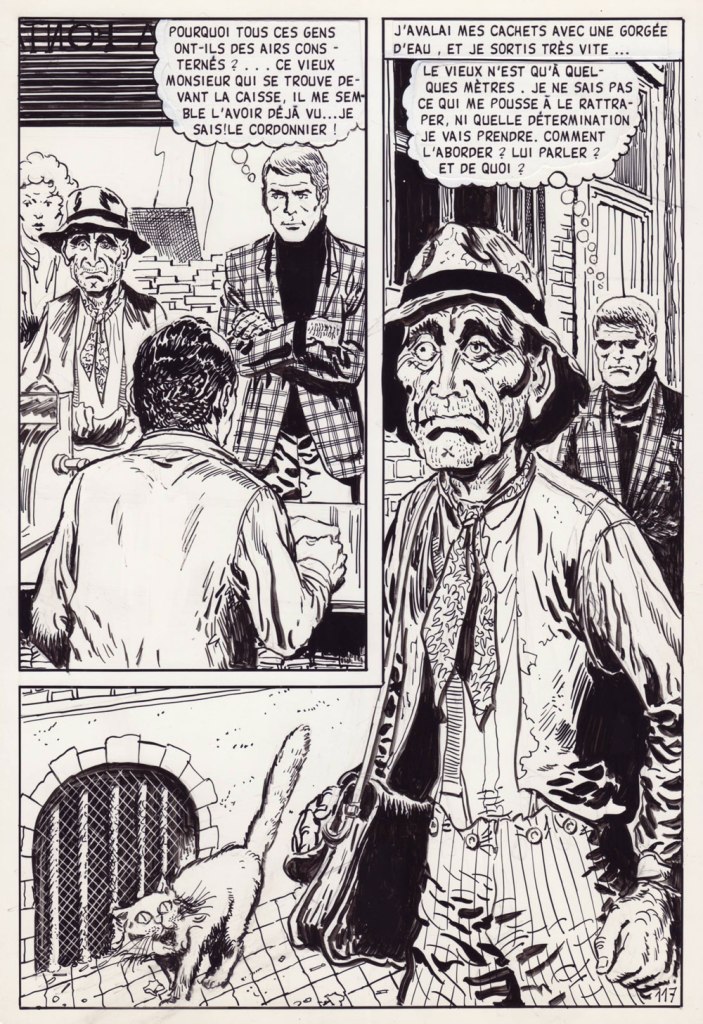
Batelier de la nuit (“Night Boatman”) was also illustrated by Mr. Buylla. Here’s a pair of moody pages involving — of course — hallucinations.
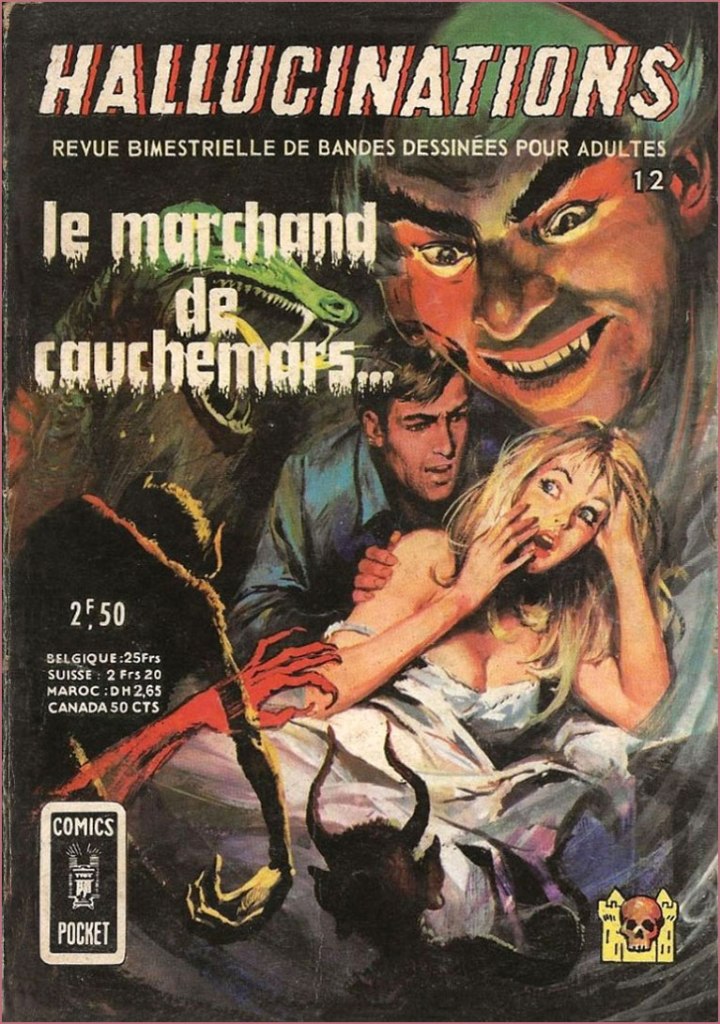
This is Hallucinations no. 12 (Nov. 1971, Arédit). Cover artist unknown. The series must have met with some success, as its publishing frequency increased from quarterly to bi-monthly. I swear I recognise that style; around 1980, I had a European sticker album of spooky scenes that this artist illustrated. I’ll dig it up yet…
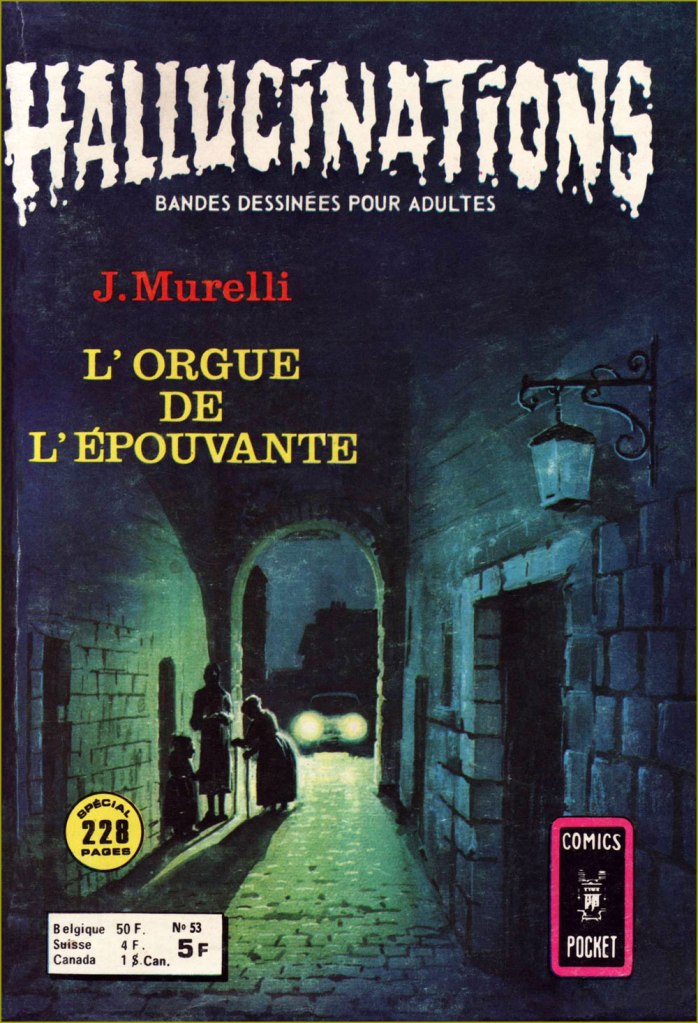
A decade ago, I got my hands on some original art from issue 53 of Hallucinations, “L’orgue de l’épouvante” (“Organ of Terror”, 1975), illustrated by Belgian cartoonist Jean Pleyers, and adapted from Jean Murelli’s novel.
Since I own only six pages of the 200+ tale, I have no solid idea what’s going on, but it’s intriguing. I’ve spotted a cheap copy and should soon be able to fill in the blanks. Here’s a plot blurb: « Reporter Luc Rohard is a hardcore skeptic who refuses to view his colleague Vérac’s disappearance in supernatural terms. His investigation leads him to a small village in which has retired sinister doctor Domitis. Is the latter a mad criminal who’s lost his mind in the course of obscure experiments on the human mind, or…? But who shall ever know the truth about the Vampire of the abbey and his troubling companion? » Cover painting by Michel Gourdon (1925-2011).
« Then hear this, and never forget it. Any fool with fast hands can take a tiger by the balls, but it takes a hero to keep on squeezing. » ― Stephen King, The Dark Half
A couple of years back, I was reading, through idle curiosity, a ranking of Stephen King’s books*. I came upon the article author’s précis for King’s 1993 novel The Dark Half:
« The premise is simple and ingenious: a literary author “kills” off the pseudonym whose popular fiction has been paying the bills, only for that alter ego to take murderous, corporeal form. Within the killing spree that ensues, King offers some profound observations about the schism between high art and popular culture, while also exposing his own worries about legacy. » I like King’s perhaps a bit too cute allusion to Donald Westlake’s troubles with his better-selling, pulpier pseudonym Richard Stark — The Dark Half’s antagonist is named George Stark.
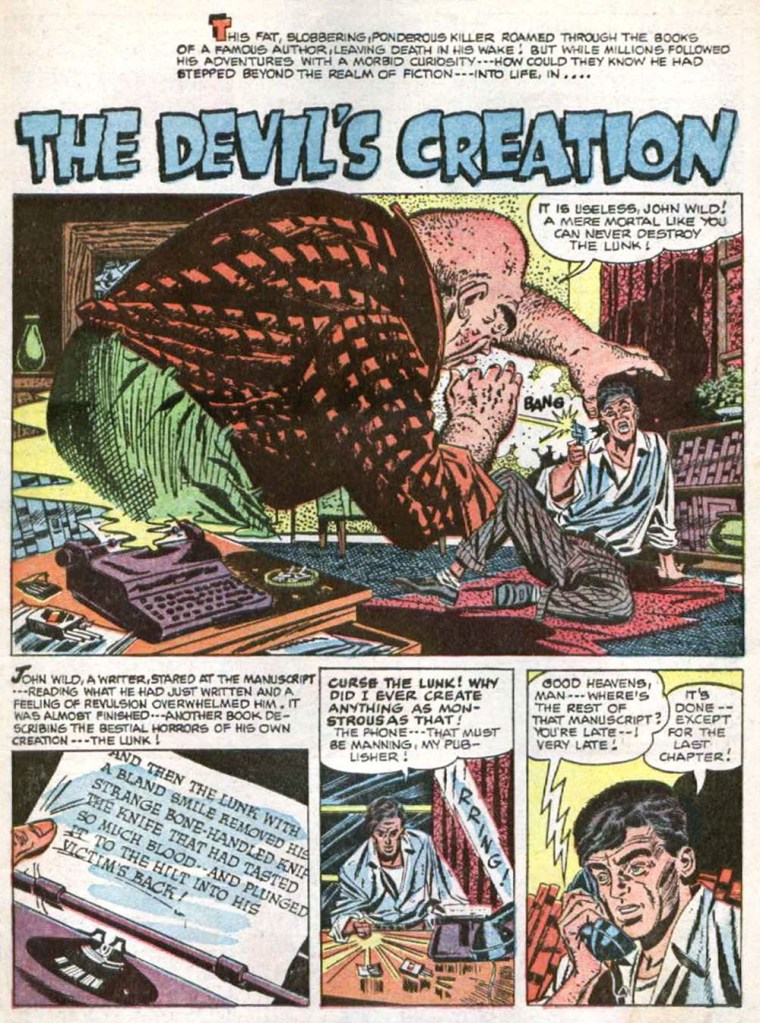
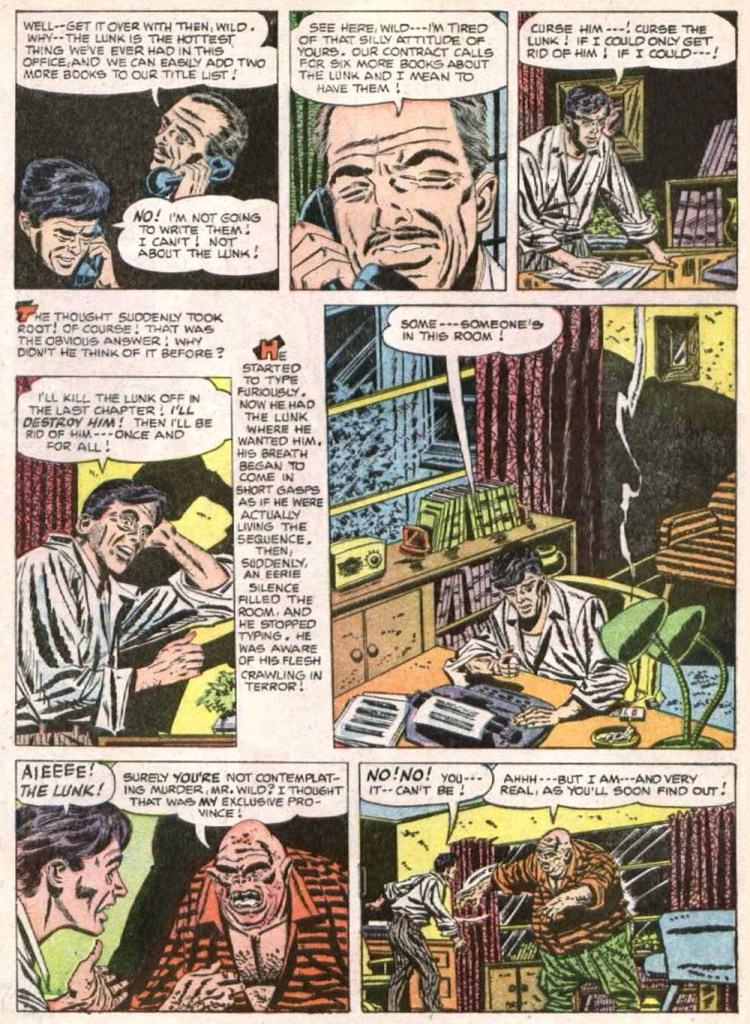
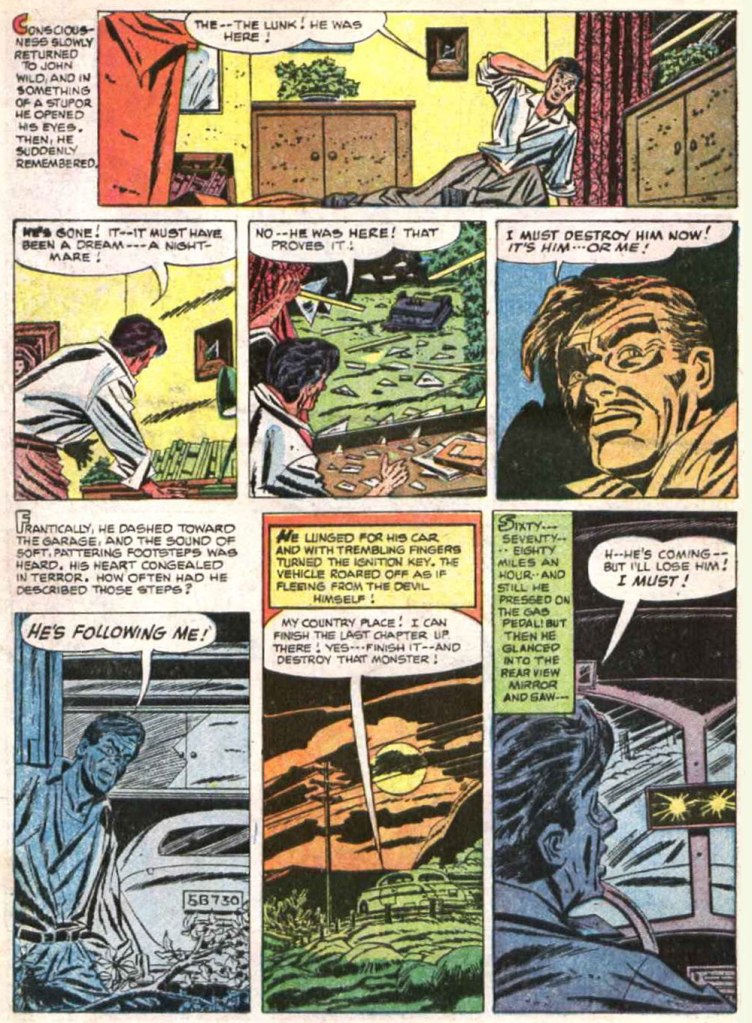
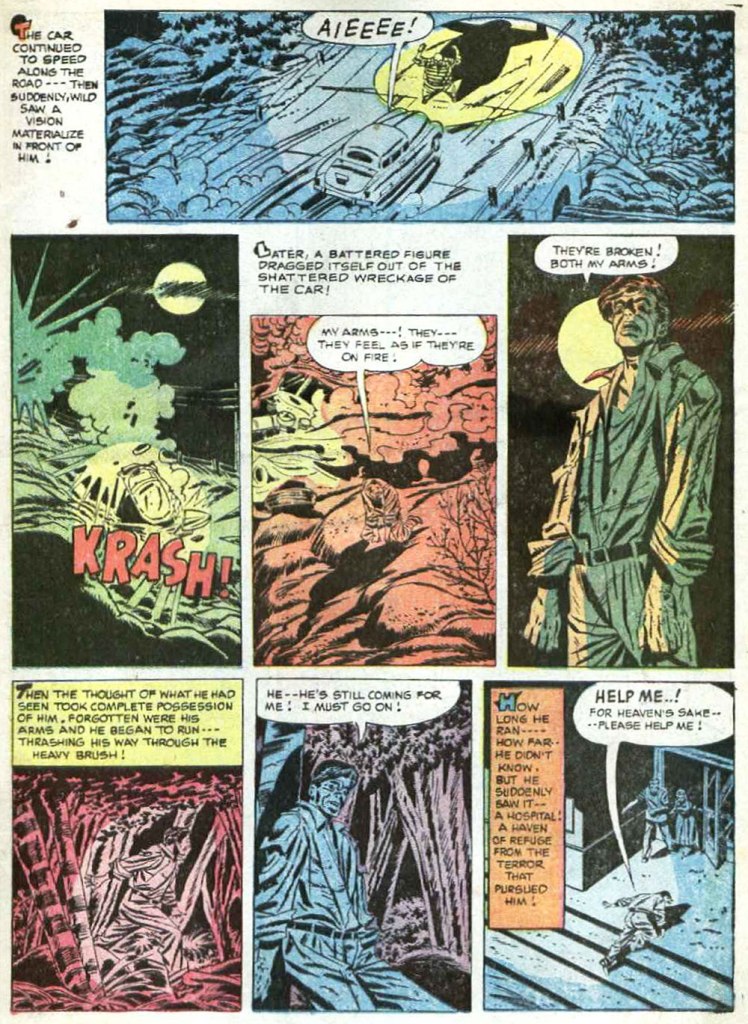
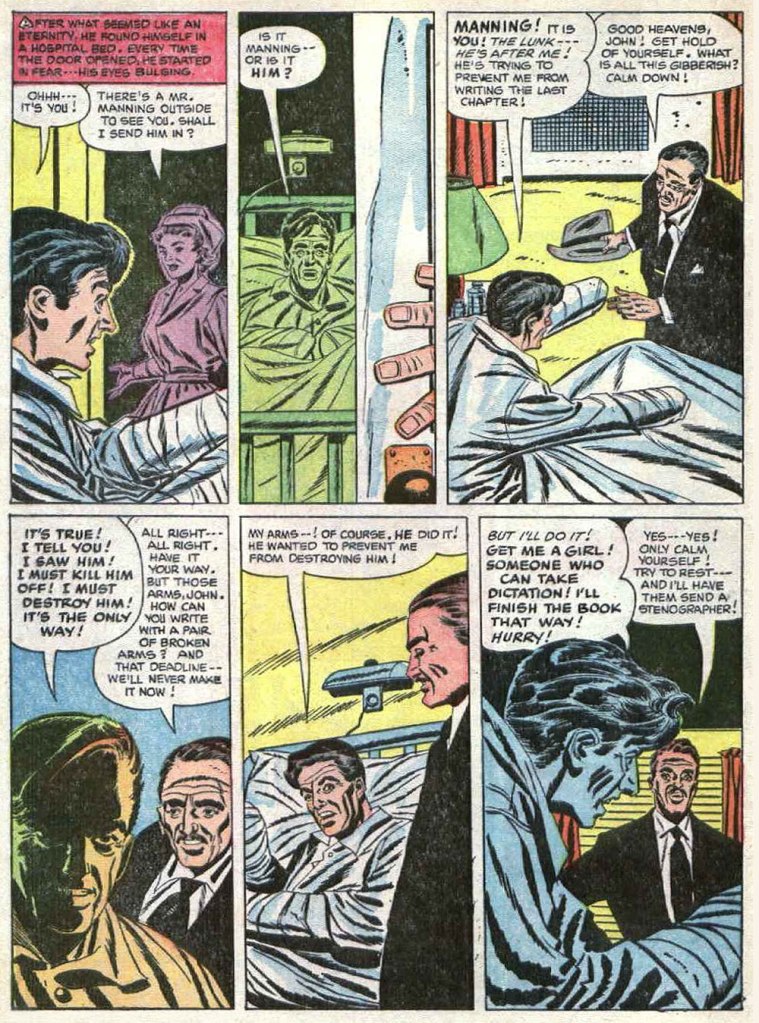
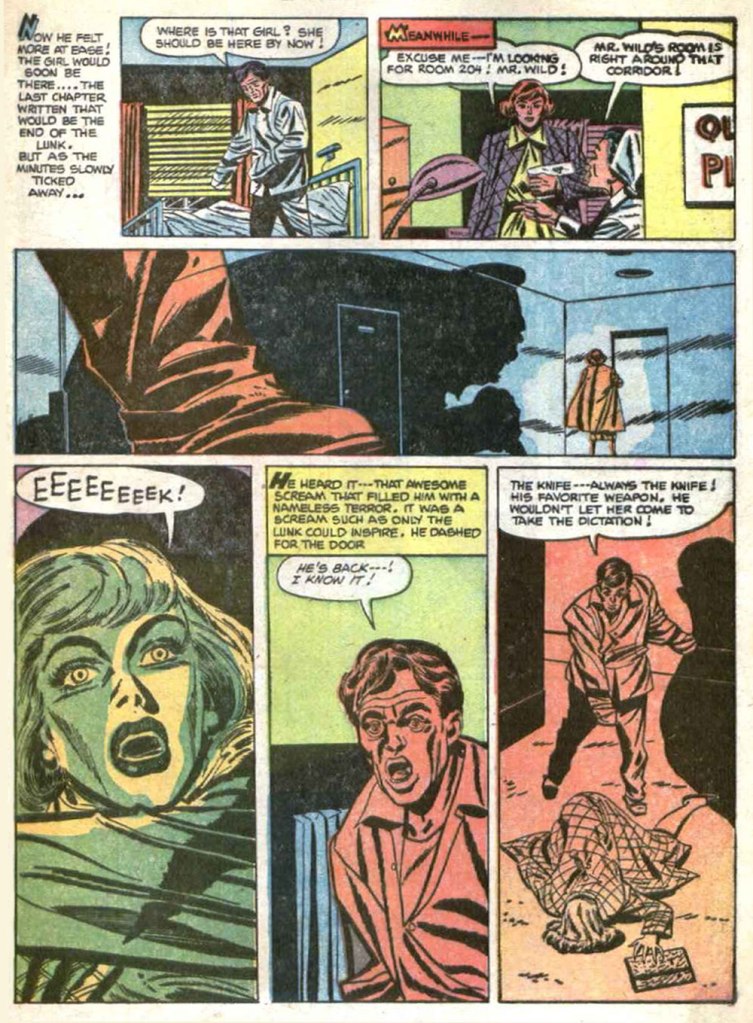
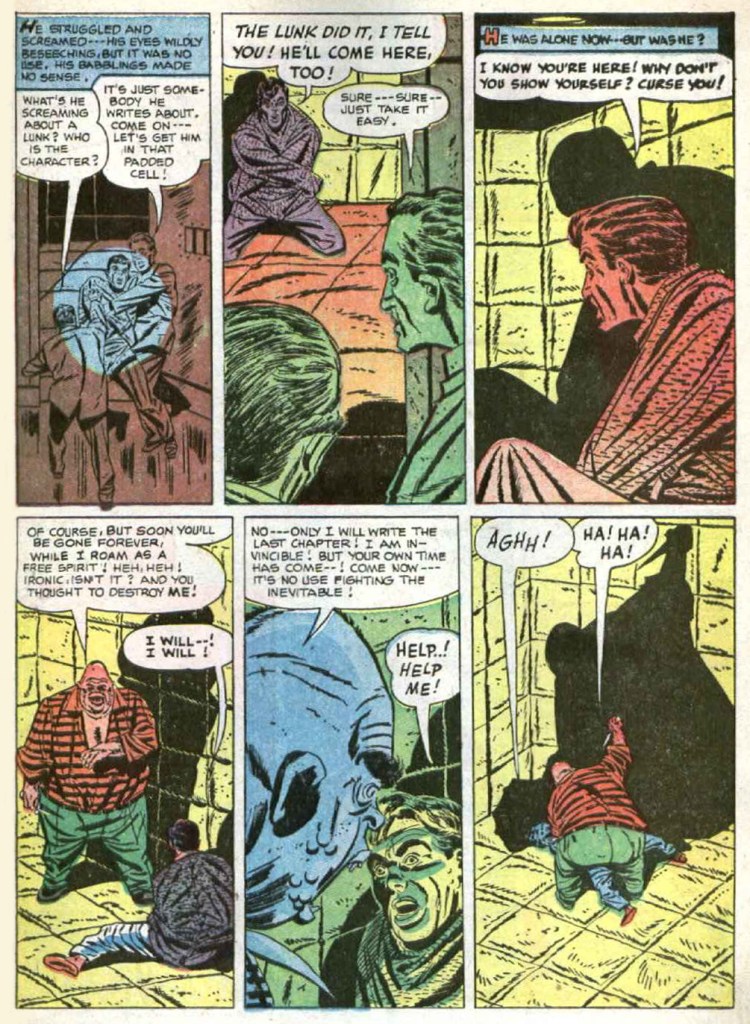
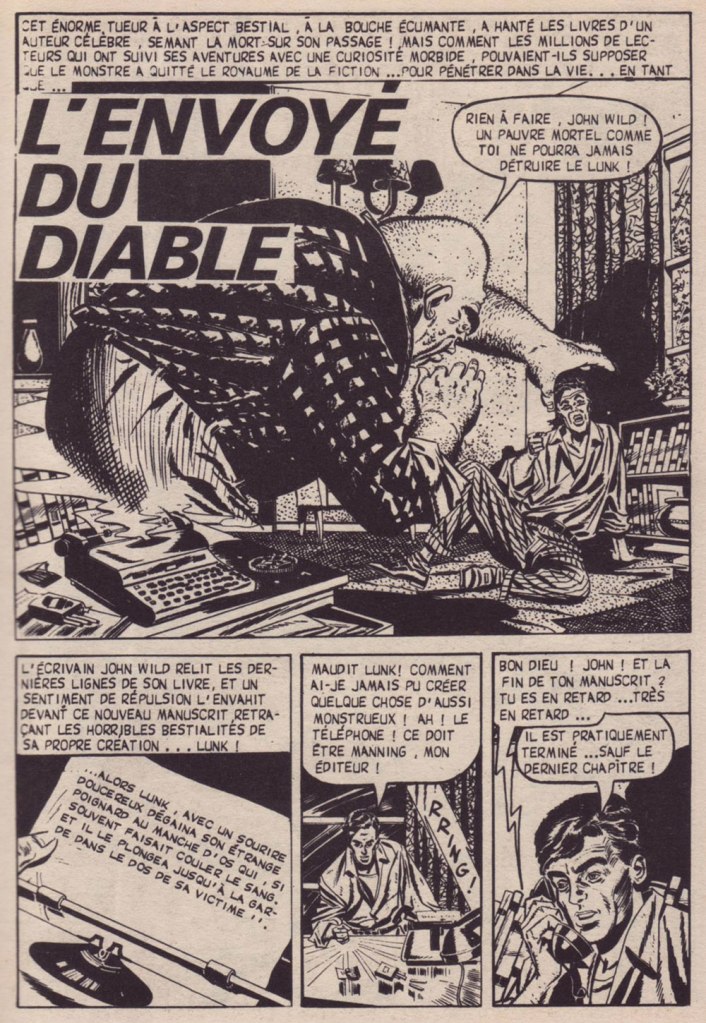
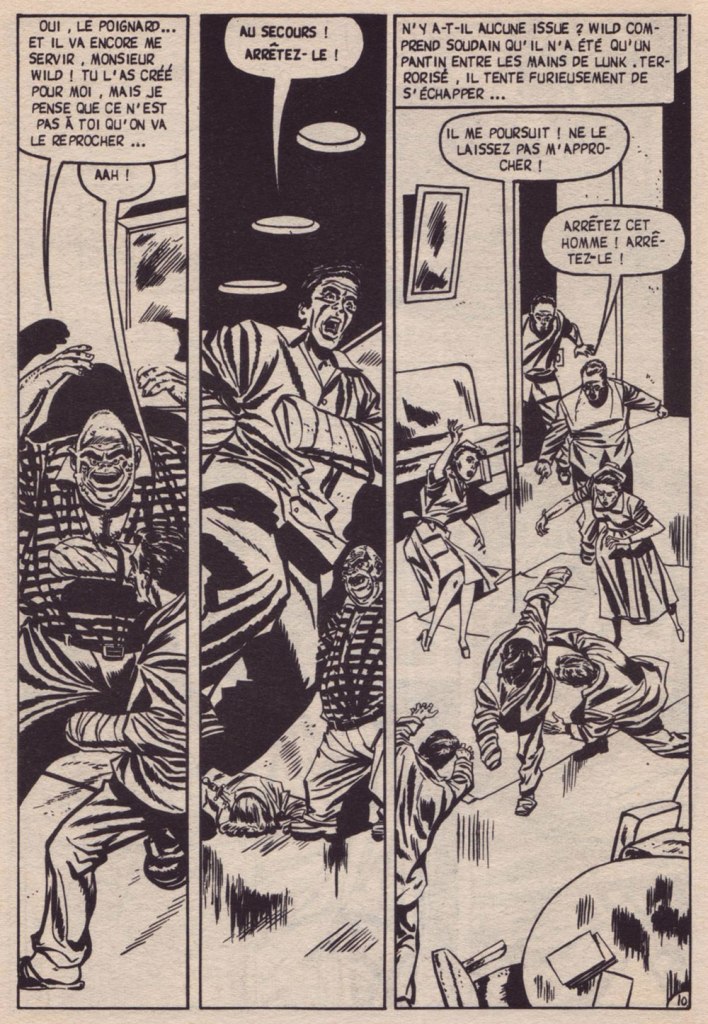
Anyway, that essential premise reminded me vividly of a harrowing comic book story I’d encountered as a child. Here it is — poorly reproduced, I’m afraid — and I’ll provide a bit of context afterwards.
The Devil’s Creation originally saw print in Beware! Terror Tales no. 2 (July 1952, Fawcett). Scripter unknown, art by Mike Sekowsky (1923-1989).On a small town kid’s budget, some US comic books were highly unlikely to turn up on my local spinner rack. Besides, I didn’t even know English yet. But these French digests (162 pages for 35 cents!) could be a godsend. This one came out slightly before my time, but I somehow landed a second-hand copy. This is my dog-eared Eclipso no. 9 (Oct.-Dec. 1970, Arédit); I was, within its pages, introduced to — besides Eclipso — Deadman, The Spectre, The Doom Patrol, The T.H.U.N.D.E.R. Agents and Mark Merlin.
Amid all this fine, but sanitised Silver Age fare, here was one short story that sharply stood out by its merciless brutality. I’m still mystified at how this seemingly random story, which hasn’t even been reprinted once in North America, so incongruously landed in this collection. Amusingly, Sekowsky appears elsewhere in the issue, pencilling the light-hearted A Day in the Life of Dynamo (from Dynamo no. 1, Aug. 1966, Tower). Say what you will, the man was versatile.
Notice how they took away his gun? Censorship was pretty strict in France when it came to publications for youth. In reformatting stories for a different size and ratio, this publisher’s efforts were often pretty dismal; this, however, was an exception. I daresay the pacing was even improved. You simply never know!
-RG
*Not having made it through much of his oeuvre, my favourite King is the non-fiction Danse Macabre (ranked his 51st best book). Fun fact: ill-advisely, the French have retitled King’s famous short story collection Night Shift (ranked no. 13)… Danse macabre. The real DM was retitled Anatomie de l’horreur (‘Anatomy of Horror’). Now I’m sure that didn’t confuse anyone.
« Generally speaking, espionage offers each spy an opportunity to go crazy in a way he finds irresistible. » — Kurt Vonnegut
I love a good tale of espionage, but not in the Bond mould. While the adventures of Fleming’s 007 have their charm, it’s not exactly plausible spycraft, nor is it expected to be, I reckon. The world-weary, less flashy and more cerebral approach pioneered by Eric Ambler (Passport to Danger, A Coffin for Dimitrios) and Graham Greene (The Confidential Agent, The Quiet American) is more in keeping with my interests.
« Before Ambler, international thrillers tended to be dominated by such writers as John Buchan, Herman Cyril McNeile (known as “Sapper”), and their many imitators. These books were often rousing adventures, but filled with improbabilities, both of plot and character, plus a hearty jingoism and a well of right-wing, Old World prejudice that would curl your hair today. » [ source ]
As far as I’m concerned, I’m afraid that describes Fleming’s writing to a T. By contrast, I was right chuffed when I learned, a couple of days ago, of this striking bit of news about worthy Ambler disciple John le Carré (The Spy Who Came in From the Cold, Tinker Tailor Soldier Spy), who passed away last year.
Now, given his prodigious and lasting popularity, most people likely presume that James Bond was the first “super spy”. While espionage chronicles have been around nearly as long as there’s been storytelling, the spy, if he survived his adventure, rarely embarked on a sequel.
That state of affairs was scrambled somewhat by the arrival on the scene of Hubert Bonisseur de la Bath, alias OSS 117. Created by Jean Bruce, he’s starred in 265 novels, which have sold in excess of 75 million copies. The series was initially published by the legendary Fleuve Noir press, which lent the English language the now-ubiquitous (and often misused) term of ‘Noir‘.
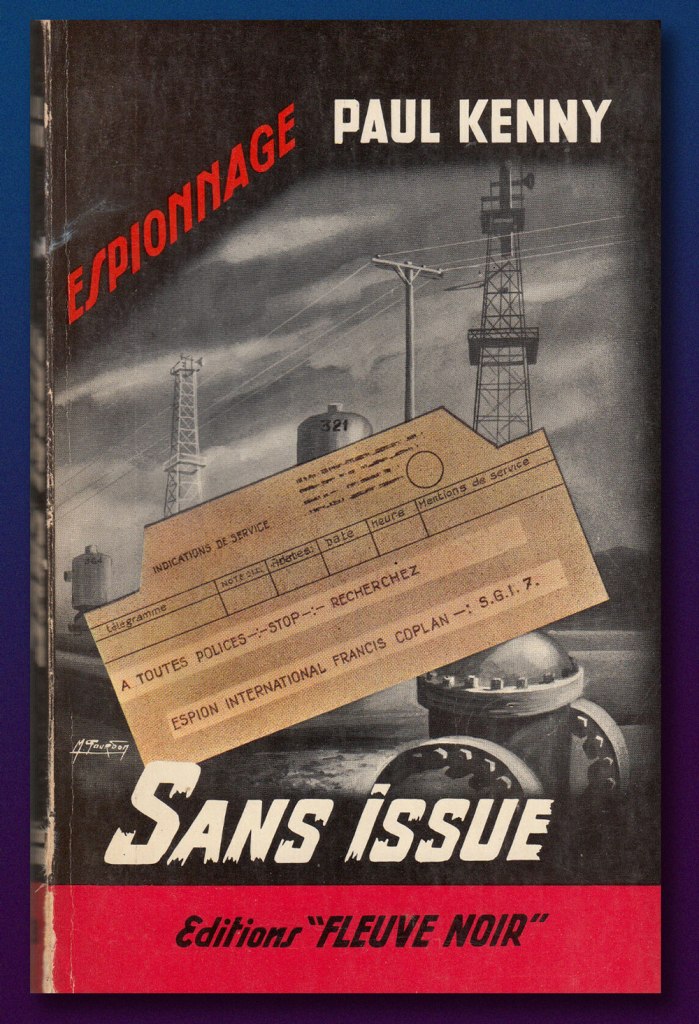
As it happens, Mr. Bruce decided, after 25 novels in three years, to shift his series over to a rival publisher (Presses de la Cité*). Fleuve noir, understandably scrambling to avoid a massive shortfall, commissioned a pair of Belgian writers, Gaston Van den Panhuyse and Jean Libert (under the joint nom de plume of Paul Kenny) to concoct a replacement agent secret. The new fellow was Francis Coplan, alias FX-18. He was featured in 237 novels between 1953 (beating James Bond to the stands by a couple of months) and 1996.
Coplan’s début, 1953’s Sans issue (“No Exit”)
In 1966, les Presses de la Cité began issuing, through their Arédit/Comics Pocket line, graphic adaptations of OSS 117 novels; Coplan followed in 1969. As a kid (and later!), I assiduously steered clear of these: stiff and generic-looking artwork, overly-verbose scripts. At nearly 200 pages, the comics were barely shorter than the novels (generally less than 250 pages long), so the adaptors clearly didn’t make full use of the visual medium’s condensing potential.
So why am I even discussing these?
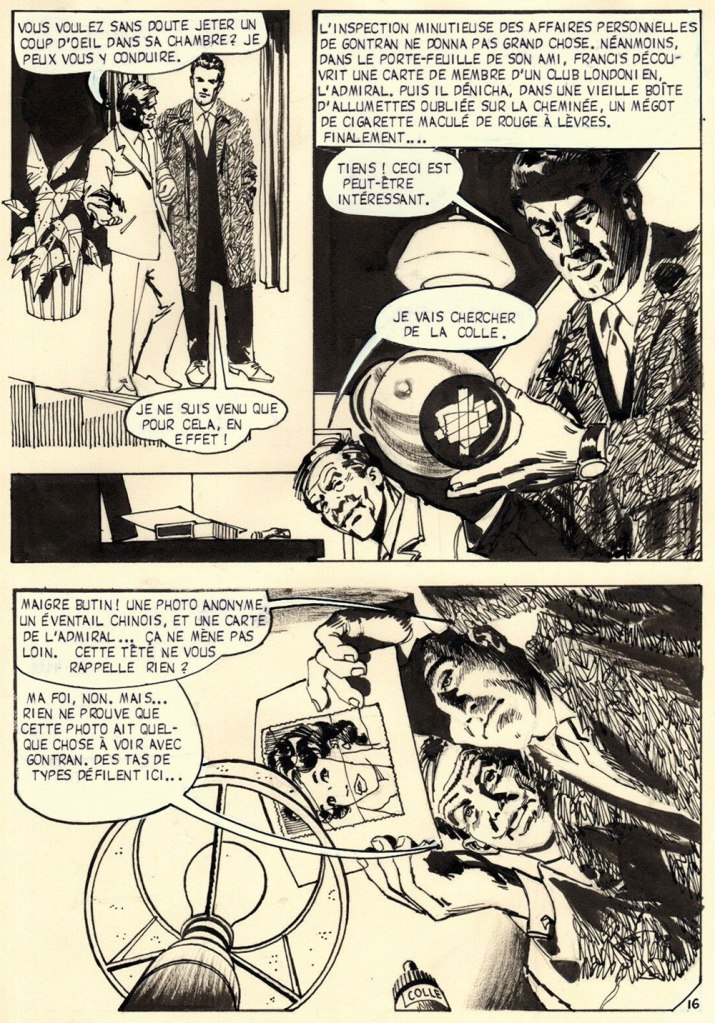
Because I discovered recently that an artist whose work I do rate highly, José de Huéscar (1938-2007), drew, as it happens, a handful of Coplan issues, and demonstrably well at that. Here are some samples, pulled from the original art.
Position clé, page 33 (1971). Note Huéscar’s confident use of a dry brush technique and his bold use of negative space (panel one in particular).
Sabotages sanglants, page 16 (1971). Ingenious, low-tech Coplan is far more John Drake than James Bond, and that’s how I prefer my spies!
Sabotages sanglants, page 24 (1971). Inventive, but not gratuitous or confusing, ‘camera’ work.
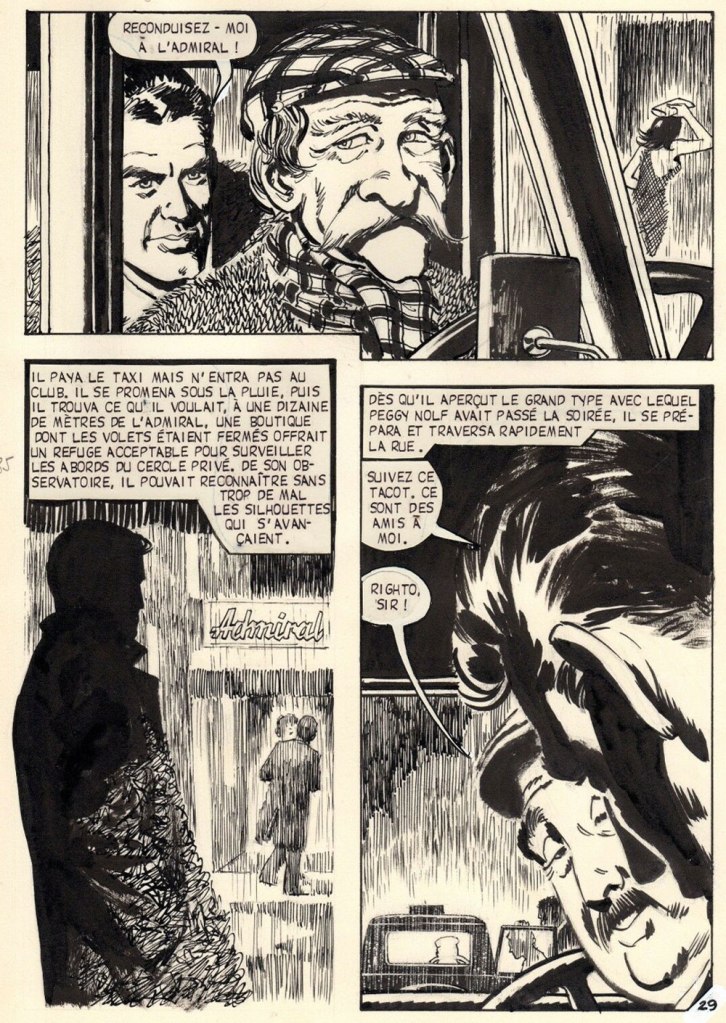
Sabotages sanglants, page 29 (1971). Fun with textures, great depth of field work, again with clear storytelling despite the invasive captions.
Sabotages sanglants, page 43 (1971). Another page that would have resulted in static talking heads. The meal the characters share is virtually relegated to the captions, and Huéscar wisely moves the action (so to speak) outside.
Sabotages sanglants, page 85 (1971). Having left London for Cairo, Coplan recruits some local help. In lesser hands, this would have just been graphically tedious talking heads.
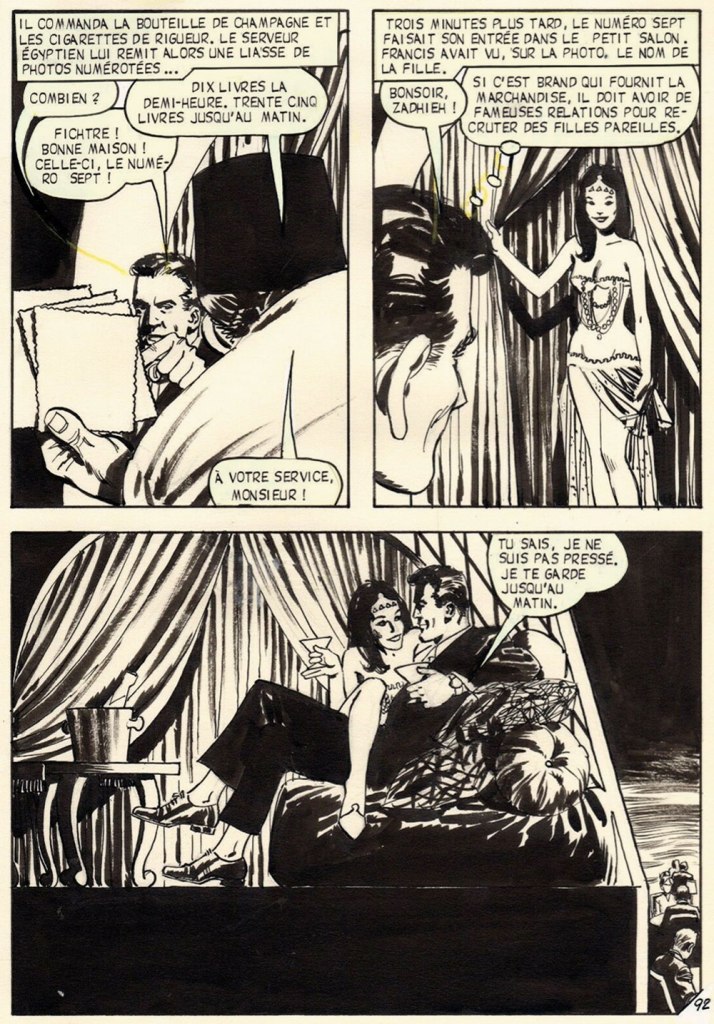
Sabotages sanglants, page 92 (1971). Yes, this will get Francis into trouble.
Front and back covers of Coplan no. 7: Position clé (Jan. 1971, Arédit), and Coplan no. 10: Sabotages sanglants (Oct. 1971, Arédit). Seems like the cover artist (likely prolific Italian painter Carlo Jacono) had a favourite model!
-RG
*the competitors would merge in 1962, when Presses de la Cité bought Fleuve Noir. While les Presses always did a steady business in translations of American novels, their output comprised a healthy contingent of French-language originals (including excellent series by San-Antonio and Georges Simenon); nowadays, after the usual jumble of soul-killing mergers and acquisitions, they mostly traffic in translated novelisations of American TV shows and pop franchises, a dismal parallel path to globalisation and the steady decline of French culture from the second half of the 20th century.
« Each time I enter this fog, it feels as though icy fingers were clutching at me! »
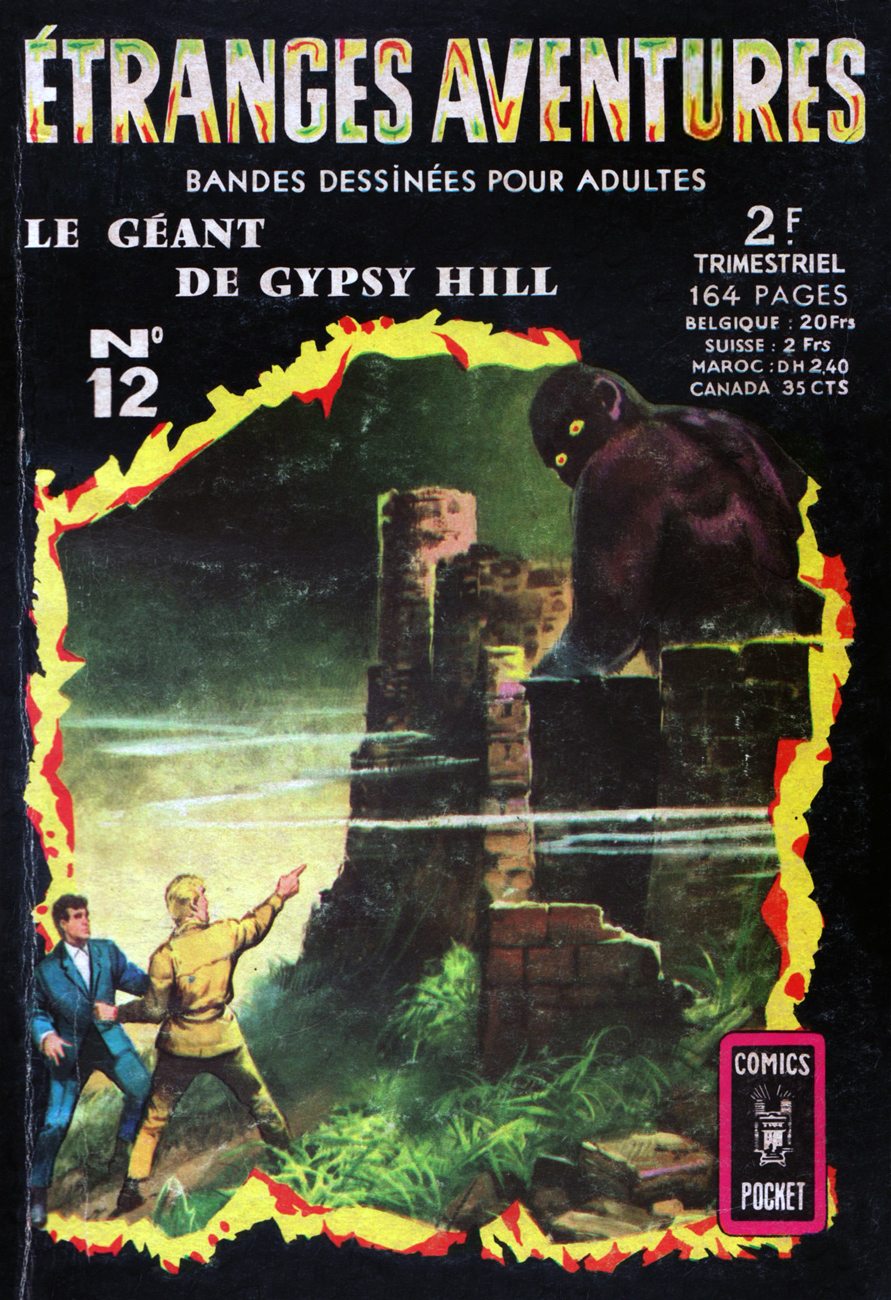
Étrange aventures, a squarebound quarterly digest (roughly 5 x 7 inches, 164 pages), was one of many titles published in France by Arédit / Artima between 1966 and 1984 through its Comics Pocket imprint. Étranges aventures was one of the collection’s flagship titles, with a healthy run of 79 issues from July, 1966 to March, 1984. Its contents were mostly repackaged and reformatted translations of various DC and Marvel (and the odd Charlton) comics in black and white, but with fun painted recreations of the original covers for the twenty-or-so issues. At under fifty cents a pop, they presented a bargain to the cash-strapped aficionado, thrifty access to scarce and/or pricey items.
This issue was a relative exception, cover-featuring an original work (or at least not an American one), the sort of material the publisher usually reserved for its more “serious” titles. These were often comics adaptations of horror or suspense novels issued earlier by mother company Les Presses de la Cité under its Fleuve Noir imprint. Graphic novels? Exactly.
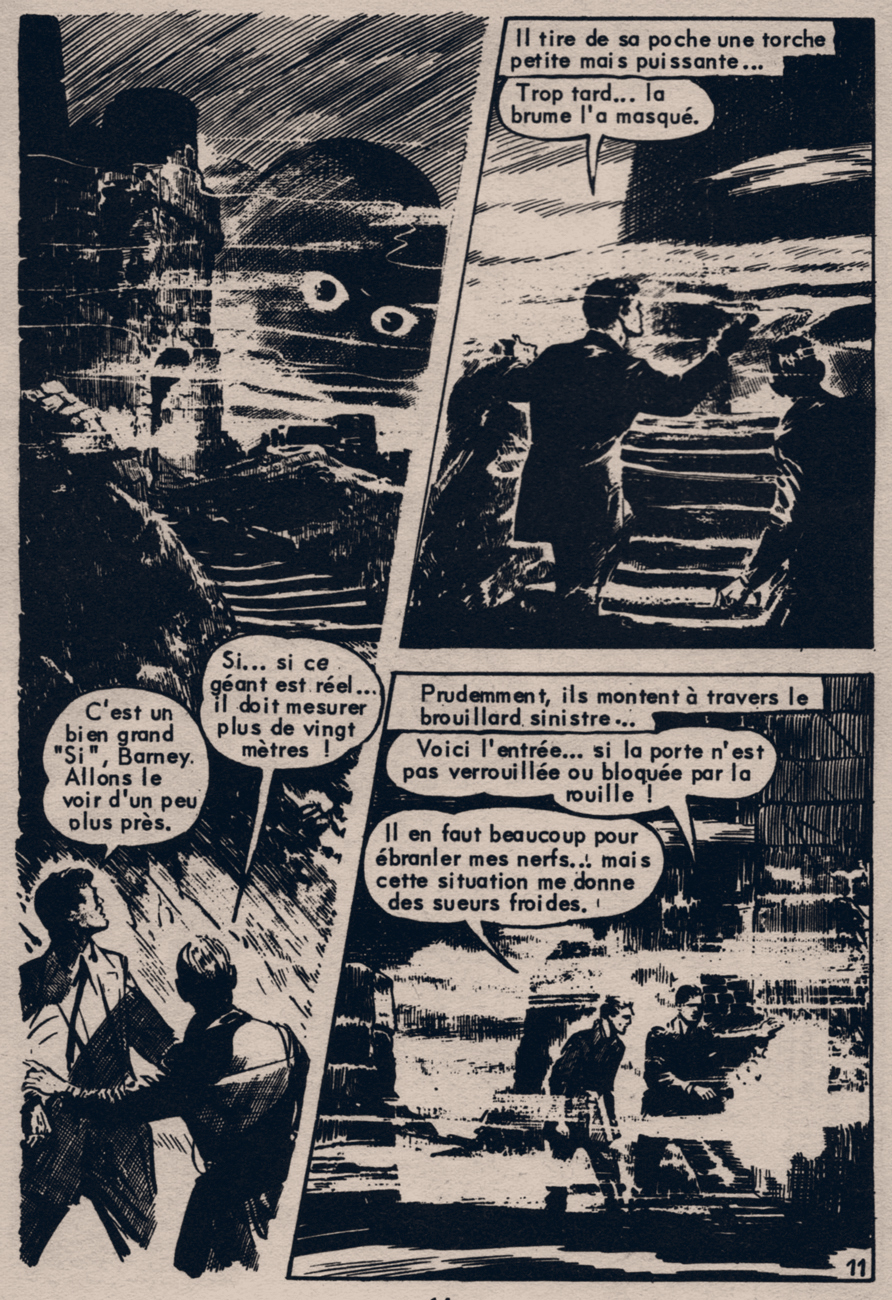
« If… if this giant is real…it must stand over twenty meters high! » « That’s a mighty big ‘If’, Barney. Let’s take a closer look at him. » He pulls from his pocket a small but powerful flashlight… « Too late… the mist has hidden him. » Cautiously, they climb through the sinister fog… « Here’s the entrance… if the door isn’t locked or blocked by rust! » « It takes quite a bit to frazzle my nerves… but this situation has given me cold sweats! »
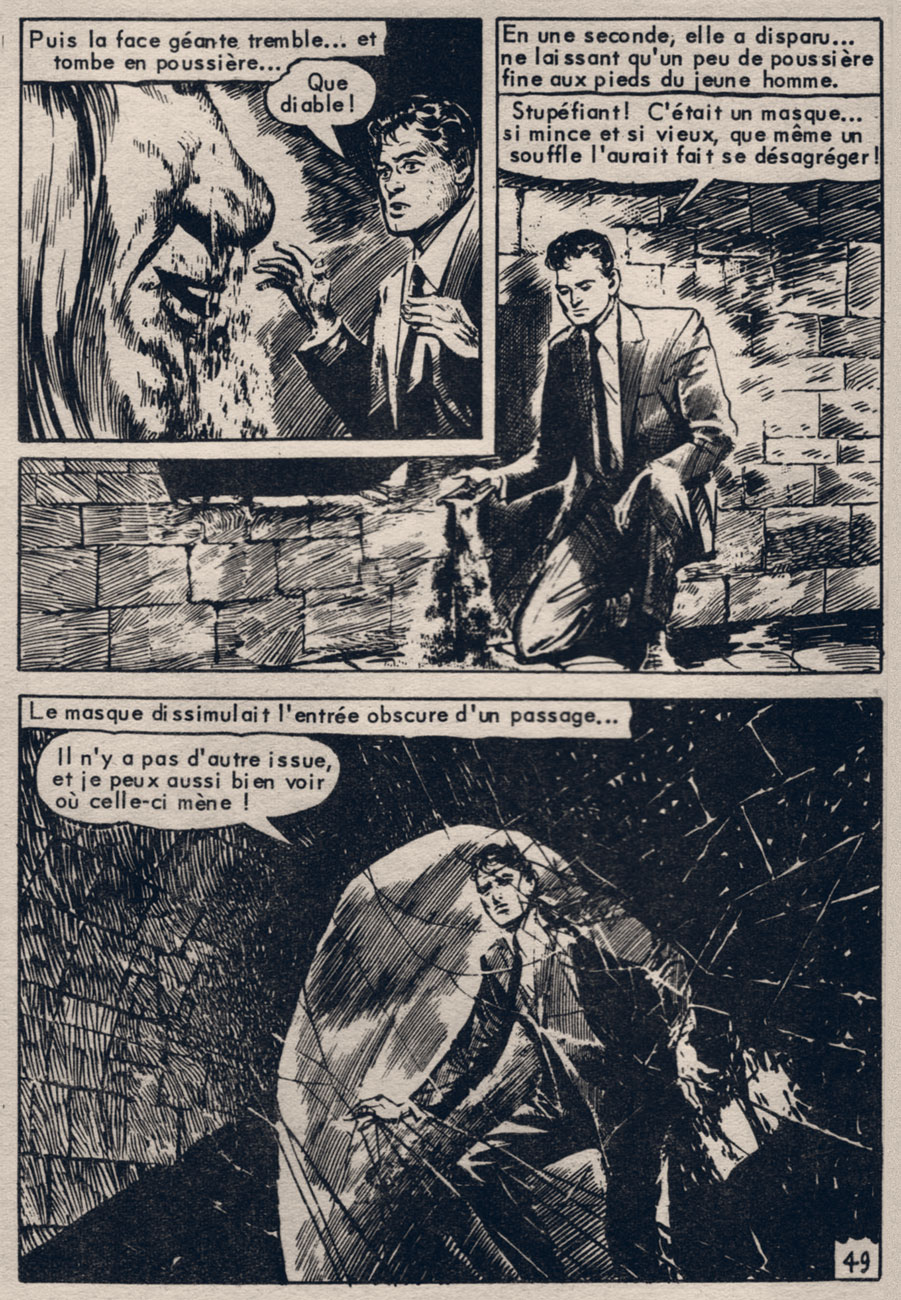
« Welcome to the giant’s lair. He who has had the courage to venture this far will regret not having been cowardly, for he will find death. »
Prosaically, the whole affair turns out to be the work of unscrupulous special effects experts, vulgarly after some jewels. All this imaginative and diabolically elaborate work and expense for some shiny baubles! Still, it’s all about mood.
Writer and artist unknown. And nationality, for that matter. In places, the artwork has clearly been resized and adjusted, and switches back and forth between halftone and line art reproduction. So the lasting mystery lies not in the story, but in its provenance.





















 Who's Out There?