Charles Bronson’s Paper Doppelgängers

« I guess I look like a rock quarry that someone has dynamited. » — Charles Bronson

Welcome to our 400th post! I suppose a Steve Ditko birthday post would have been more momentous, but I did that already a couple of years ago, while he still drew breath.

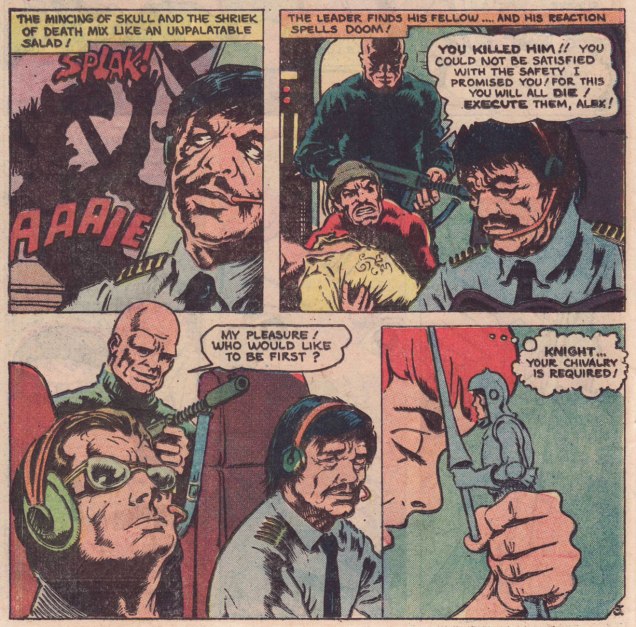
Today, our man Charles Dennis Buchinsky, aka Charles Bronson (1921 – 2003… he would have turned 98 today — picture that!) squeezes in a rather routine bit part (merely credited as « The Pilot ») in Joe Molloy and Mike Zeck’s nonsensical hijacking melodrama Only a Toy. Heck, read it here if you don’t believe me.

Oddly enough, this expanded cameo came about just a year after Bronson’s megahit Death Wish, as Bronson reached the pinnacle of his earning power (in inverse proportion to the quality of his output, thanks to his long association with the shady Cannon Group). Presumably, he was just doing a favour for his old pal Zeck.
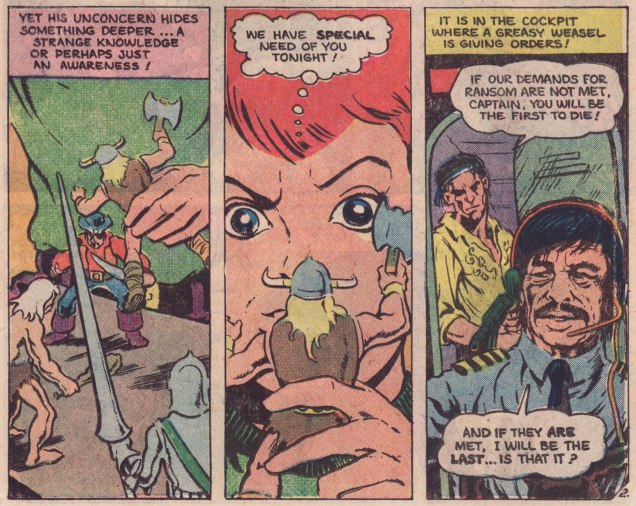
ZeckBronson01A

ScaryTales2Bronson02A
« Like an unpalatable salad » indeed; a word salad. Published in Charlton’s Scary Tales no. 2 (October, 1975). Edited by George Wildman.

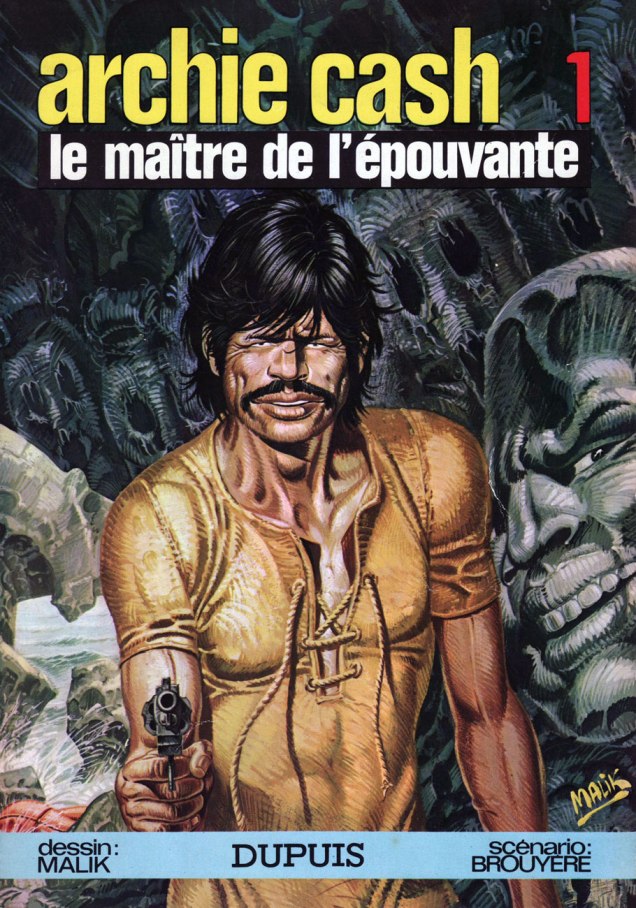
Ah, but this wasn’t the first time cartoonists had paid such tribute to Bronson: in 1971, writer Jean-Marie Brouyère and artist William Tai (aka Malik) created the South-America set Archie Cash series for Belgian bédé weekly Spirou. The series had a healthy run of 15 albums (what one would call a graphic novel over in North America) between 1973 and 1988.
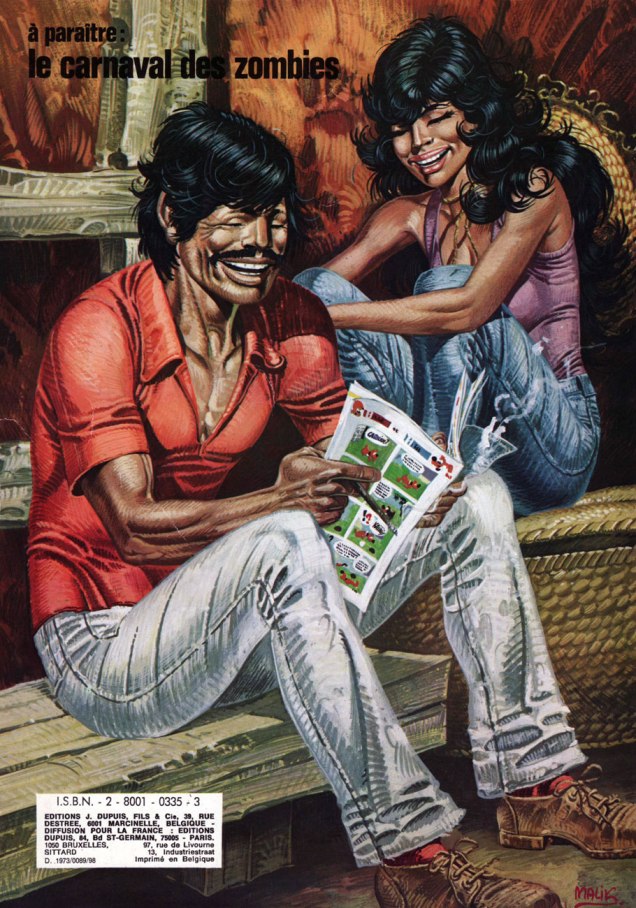
ArchieCashRectoA

ArchieCashVersoA
Front and back covers of Archie’s début, Le maître de l’épouvante (1973).
ArchieCashMaître05A
And to give you a sense of the series’ narrative texture, page five from Le maître de l’épouvante; when it debuted in the fall of 1971, the series brought a welcome griminess and ethno-social realism to the squeaky-pristine pages of Spirou.

The Italians would then follow suit, “borrowing” Jean-Paul Belmondo‘s likeness for their Goldrake series around 1972, followed by Alain Delon‘s looks for Playcolt, and more exploitively, Ornella Muti‘s charms for Sukia. Mind you, all these liberties with celebrity likenesses don’t make Brian Hitch‘s laziness and lack of imagination any less reprehensible.

Anyway, back to our birthday boy: if you want to see Bronson at his finest, I recommend his early, pre-moustache TV showcase Man With a Camera (1958)… the 29-episode boxed set’ll cost you peanuts and it’s great value. Then, from his European period, you can’t go wrong with 1968’s Adieu l’ami (Farewell, Friend), co-starring the aforementioned Mr. Delon; 1970’s gloriously weird Le passager de la pluie (Rider on the Rain), 1971 winner of the Golden Globe for Best Foreign Film, and co-starring creepy Eva Green‘s mom (or should that be “mum”?), Marlène Jobert. And of course 1971’s Soleil rouge (Red Sun), co-starring, this time not only Delon, but none other than Toshirô Mifune!

Happy birthday, Mr. Buchinsky!

– RG
Hallowe’en Countdown III, Day 31

« Our dried voices, when we whisper together are quiet and meaningless as wind in dry grass or rats’ feet over broken glass in our dry cellar. » — T.S. Eliot, The Hollow Men (1925)

It’s with a bittersweet little shiver that I wrap up this year’s WOT Hallowe’en countdown. In light of my fond feelings for the holiday, I didn’t want to go out with a massive fireworks display of a post, but opted instead for a quiet, succinct coda.

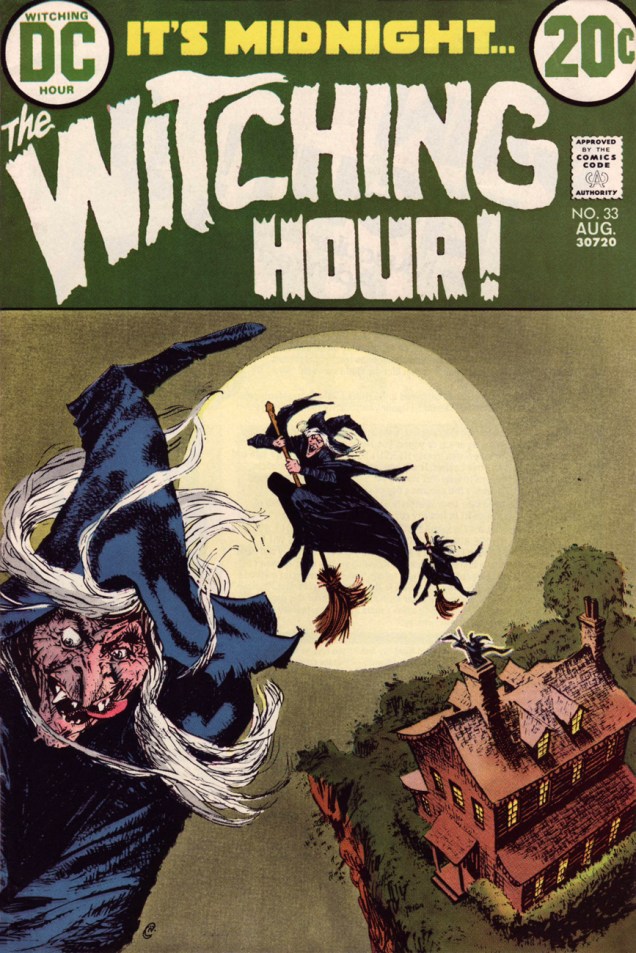
Nick Cardy‘s illustration impeccably epitomizes the spirit of Hallowe’en. No, it’s not about the candy collection ritual nor about the motley, garish masquerade… truly, it’s much as Ray Bradbury summed it up in his preface to his The October Country, « … that country where it is always turning late in the year. That country where the hills are fog and the rivers are mist; where noons go quickly, dusks and twilights linger, and midnights stay. That country composed in the main of cellars, sub-cellars, coal bins, closets, attics, and pantries faced away from the sun. That country whose people are autumn people, thinking only autumn thoughts. Whose people passing at night on the empty walks sound like rain… »

You can practically hear the echoes of sinister cackling drifting on the chill October breeze.

WitchingHour33A
How’s this for perfectly-composed, uncluttered graphic majesty? A wisely understated palette, from top-to-bottom, holds it all together. One has to understand that this sort of soft-sell, muted grace could not make it to market without a tremendous amount of trust, cooperation and… no second-guessing. This is It’s Midnight… The Witching Hour! no. 33 (Aug. 1973, DC), edited by Murray Boltinoff. That lead witch looks quite… lusty. Where’s she off to, and why is the Comics Code Authority not stepping in?

This seldom-seen Nick Cardy cover graces quite an issue, by my reckoning: the blackly ironic Four Funerals, drawn by Ruben Yandoc and probably written by editor Boltinoff; George Kashdan‘s cynical Cold Ashes — Hot Rage, drawn by Alfredo Alcala (what, him again?); and Carl Wessler‘s convoluted A Choice Seat for… Doomsday!, illustrated by the mighty Jerry Grandenetti. Read it right here!

… and Happy Hallowe’en, one and all!

-RG

p.s. before I forget: how cool is it that the witches exit through the chimney?

Hallowe’en Countdown III, Day 30

« If it wasn’t for baseball, I’d be in either the penitentiary or the cemetery. » — Babe Ruth

Since the (so-called) World Series is still going on, this seems all the more appropriate.

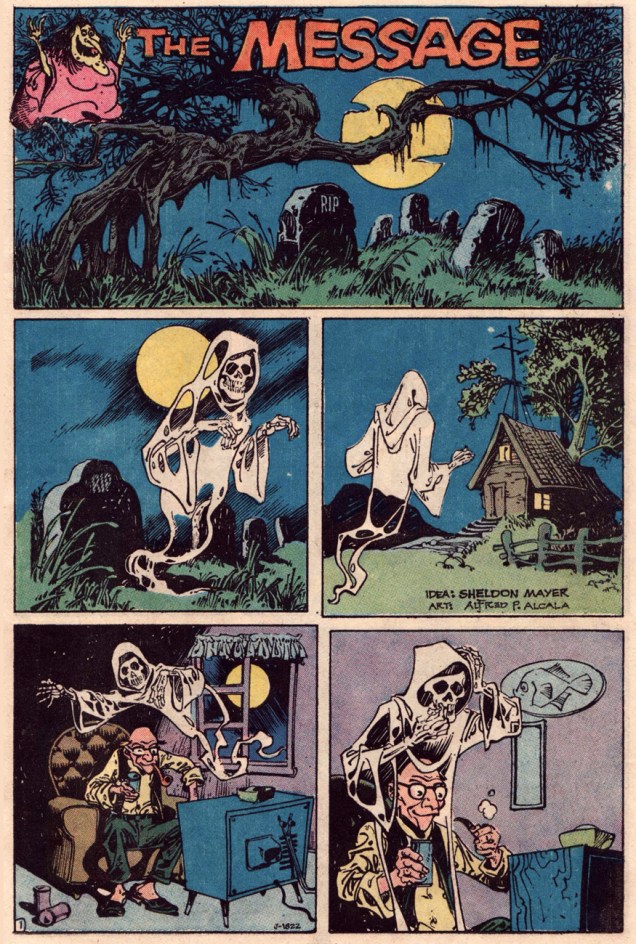
AlcalaMessage01AAlcalaMessage02A

It was with this piece that I first began to grasp just how gifted and versatile Filipino giant Alfredo P. Alcala (1925-2000) was. He’s inarguably a grandmaster of eerie moods, but hardly bereft of a fun side. This brief piece, a dream collaboration between Sheldon Mayer and Alcala, was published in Plop! no. 1 (Sept.-Oct. 1973, DC). And what an issue that was, gathering such talents as Basil Wolverton, Sergio Aragonés, Mayer and Alcala, Frank Robbins, George Evans, John Albano, Stephen Skeates and Berni Wrightson… yikes! (read it here!)

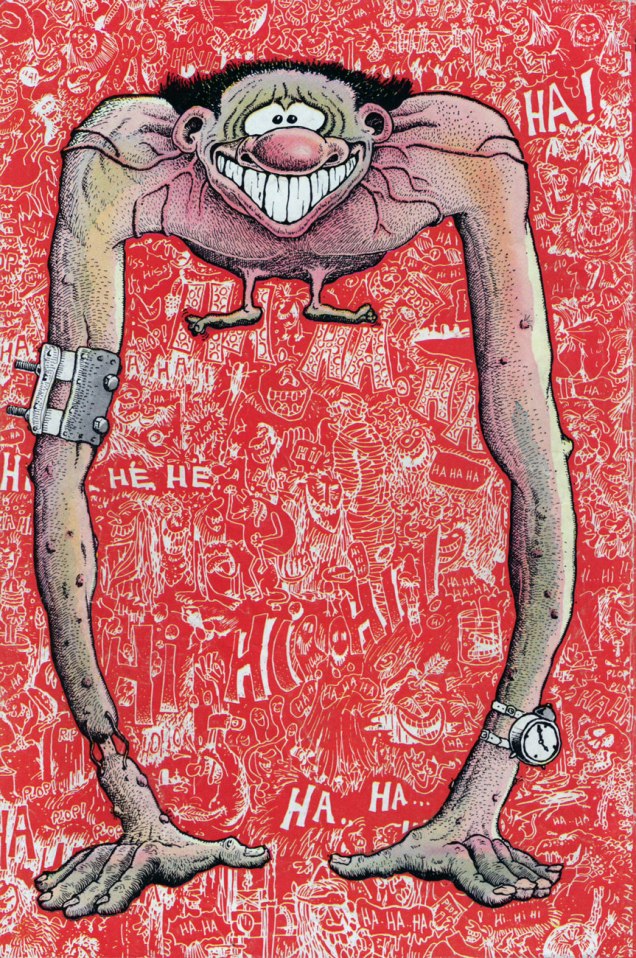
WolvertonPlop01BackA
As a bonus, here’s the *back* cover of Plop! no. 1, featuring Wolverton’s cover boy “Arms” Armstrong. Which provides me with the opportunity to inform you that this very week has seen the long-delayed publication of Greg Sadowsky’s Brain Bats of Venus: The Life and Comics of Basil Wolverton Vol. 2 (1942–1952), his definitive biography of that singular and fascinating man. Read all about it here!

– RG

Hallowe’en Countdown III, Day 28

« As worthless a collection of crackpot notions and harebrained theories as I’ve ever seen in print! » — Graymatter McCogitator III, Chairman, National Academy of Very Smart Persons

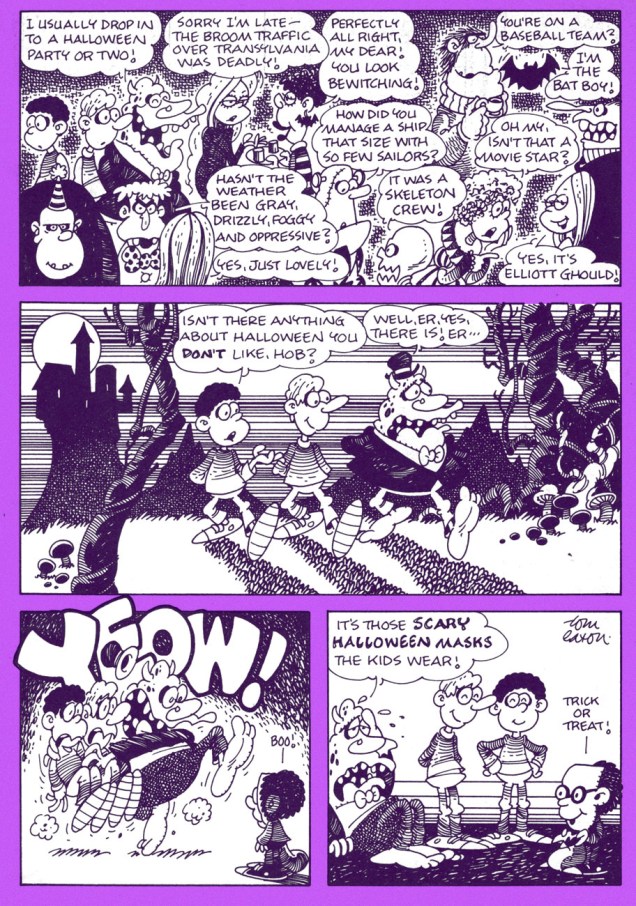
OliverCool01AOliverCool02A

This Oliver Cool strip (we featured another one a couple years back) saw print in the October 1976 issue of Young World. While both strip and publication are just about forgotten, they’re worth a look… but then I have a soft spot for comics produced outside the comics industry proper (if you can call it that); in many cases the ‘product’ reaches a wider audience, but the tradeoff is that it’s a far more casual public.

I’ll readily concede that I’m pretty forgiving when it comes to the scripting of strips aimed at young readers, as the authors are forced to navigate a myriad of oft-needless and downright asinine hurdles in their efforts to amuse, entertain and, yes… even enlighten.

Oliver Cool’s creator and delineator, cartoonist Tom Eaton (1940-2016), as he was born in Wichita, Kansas, inevitably passed through greeting card maven Hallmark‘s art department (as did Brad Holland, Robert Crumb and Russell Myers), going on to work as an art editor for Scholastic Book Services, who issued several of his books in the 70s.

Apparently, though, if he’s to be remembered for anything, it may be for his extended stint as resident cartoonist of scouting magazine Boys’ Life (1984-2015), most significantly on The Wacky Adventures of Pedro, featuring the mag’s ‘mail burro‘, introduced in the 1950s. Take a gander at this (naturally) eye-opening article by R.C. Harvey on the subject.

YoungWorldOct76A
This is Young World Vol. 13, no. 8 (Oct. 1976). Speaking of the Winchester Mystery House, you owe it to yourself to read Alan Moore‘s tour-de-force Ghost Dance (Swamp Thing no. 45, Feb. 1986, DC), illustrated by Stan Woch and Alfredo Alcala, the definitive WMH spooky tale. In the context of Moore’s American Gothic cycle, it felt a bit incidental, practically a non sequitur, but it’s damn powerful stuff. Psst: check it out here.

Bonus-wise, here’s a pair of recent-ish Pedro strips. At this point, Eaton’s crisp line and meticulous layout bring to my mind the qualities of another Midwestern cartooning wunderkind, Rick Geary.

EatonPedroAEatonPedroGravityA

Here’s a moving obituary for this fine man.

-RG

Hallowe’en Countdown III, Day 25

« You’re sure you want to spend the night out there? »

As an avid backyard camper, this effectively chilling cover by the versatile Argentine Luis Dominguez never failed to bring a pleasant tingle of dread. It has that quality of a silent, slow-motion nightmare. Barely-glimpsed but eerily tangible horrors shambling your way… and you can hardly move, helpless but with all senses on edge. Eek.

DominguezUnexpected166A
Though it came late in Carmine Infantino‘s tenure, one can safely assume that DC’s publisher and his adjutant, art director Nick Cardy, had a hand in the cover’s layout. It certainly does tick Carmine’s boxes of « Leave Room for the Kids » and « Make It More Mysterioso. »

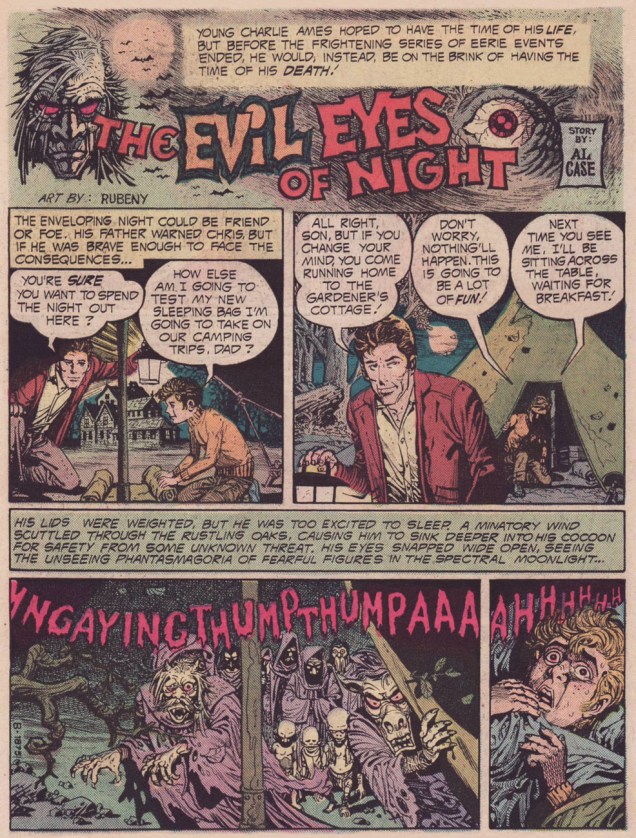
DC’s The Unexpected no. 166, (July 1975). The moody featured story, The Evil Eyes of Night, scripted by Al Case (one of editor Murray Boltinoff‘s several noms de plume) and illustrated by an inspired Ruben Yandoc, doesn’t betray or squander the promise proffered by the cover, though it hardly proceeds as one might presume. This isn’t The Expected, after all…

YandocEvilEyes01A
I do believe that Yandoc did his own lettering, as it’s a consistent element across his American output. That’s always a plus, an added touch of personality. Love those sinister onomatopoeia!

YandocEvilEyes02A

– RG

Hallowe’en Countdown III, Day 12

« Egad! This looks like it’s straight out of a horror movie! »

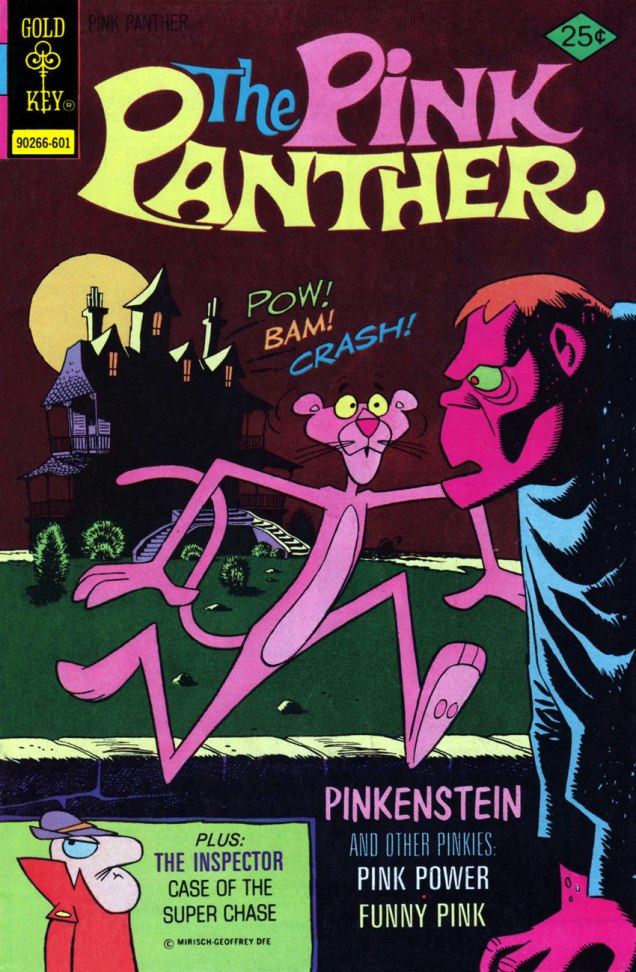
How deep and searing a trace the Universal Monsters cycle has left on popular culture: you see its mark on everything from literature to breakfast cereal. It’s nothing new in the cartoons, of course: Warner Bros, with the Looney Tunes, had their lugubrious fun with, for instance, Boris Karloff and Peter Lorre archetypes. So it’s no great shock to eventually witness DePatie-Freleng‘s The Pink Panther getting in on the monstrous act.

PinkensteinA
Nice bit of mood setting, isn’t it? This hails from The Pink Panther no. 31 (January, 1976). This being Gold Key, writer and artist uncredited and unknown. Any ideas?
PinkPanther31A
The issue in question… interesting colouring touch, most likely accidental: the only white space on the entire cover is the “PINK POWER” title.

Incidentally, we’ve checked out The Inspector in an earlier post.

– RG 


Hallowe’en Countdown III, Day 11

« Is it true your first concert is going to be at a cemetery? »

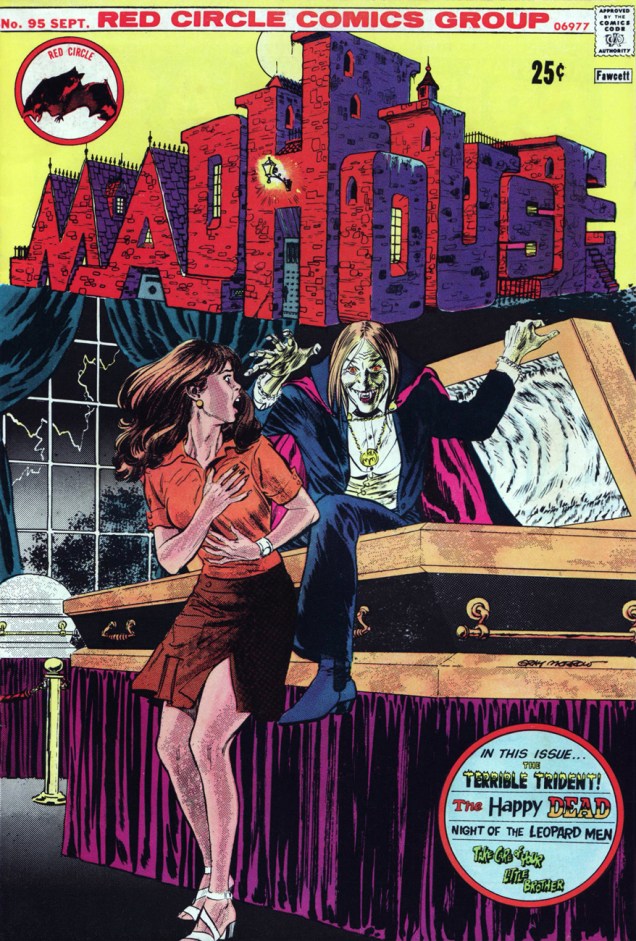
By the summer of ’74, the Archie brass was getting sick of those no-account Didit Brothers (You know, Dan, Dippy, Dick and Clyde) and their groupie Fran the Fan, so the Madhouse Glads were tossed out on their collective ear in favour of… a horror anthology. It made sense: in the 1970s, there was considerable overlap (largely female, but not exclusively) among readers of, say, The Witching Hour, Betty and Me, and Romantic Story.

Madhouse95A
The final fate of Fran the Fan? This is Mad House no. 95 (Sept. 1974, Archie); cover art by Gray Morrow. Read the issue here.

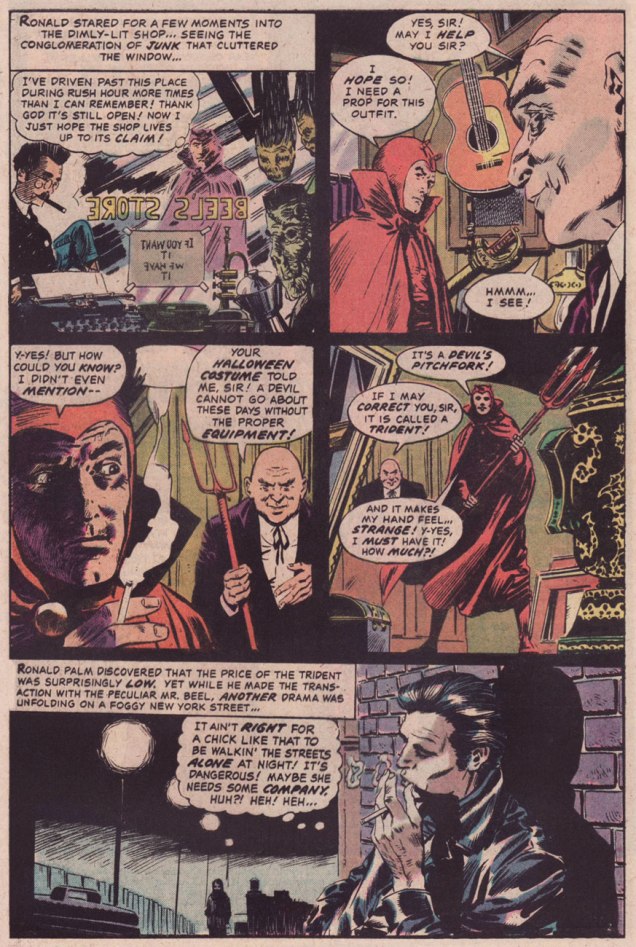
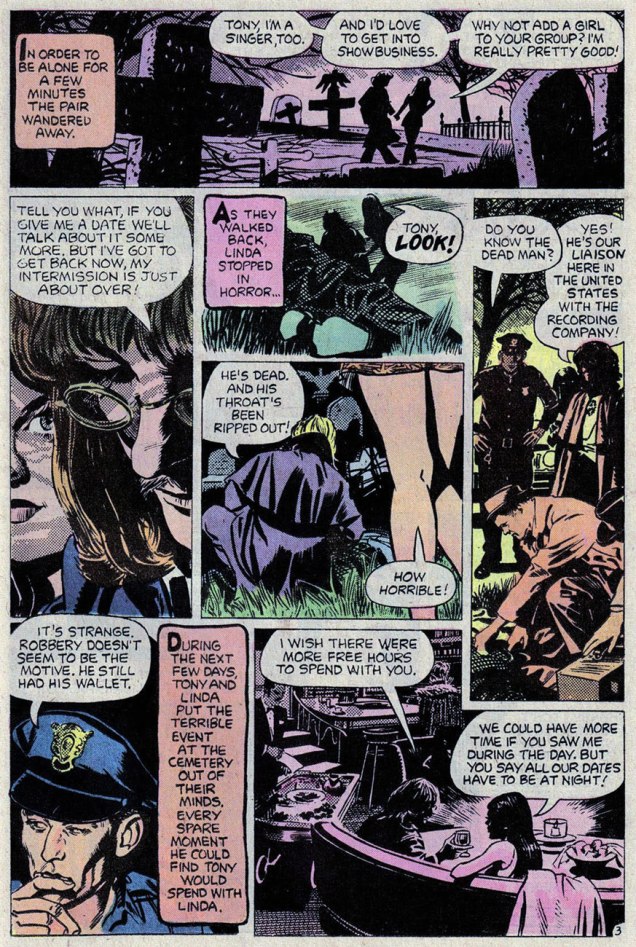
It’s fair to assume they were envisioning a companion title for their Chilling Adventures in Sorcery / Red Circle Sorcery. This was something different for Archie, all right: they sought out top talent, but in a fairly consistently sober visual style. Gray Morrow‘s photo-based approach was the baseline, and small wonder: he was the editor. The bulk of the stories was penned by Marvin Channing, and while the ‘twist’ endings weren’t exactly fresh, some of these tales were surprisingly nasty and nihilistic.

AlcazarTrident02A
Page two from The Terrible Trident!, written by Don Glut and illustrated by Vicente Alcazar.
WildeyHappyDead03A
Page three from the cover story, The Happy Dead. Written by Marvin Channing and illustrated by Doug Wildey. Whoever handled the colouring here was smart and discerning.

However, this version of Madhouse lasted but three issues before the book was returned to its original, pre-Glads format. Sorcery endured for nine issues, the first three done in the Archie house style, with narration by Sabrina, the Teenage Witch. By the end of 1974 (with a book cover-dated February, 1975), the experiment was over. But these things come in cycles, don’t they? Witness the recent Afterlife With Archie… which incidentally reprinted much of this material.

SabrinaA
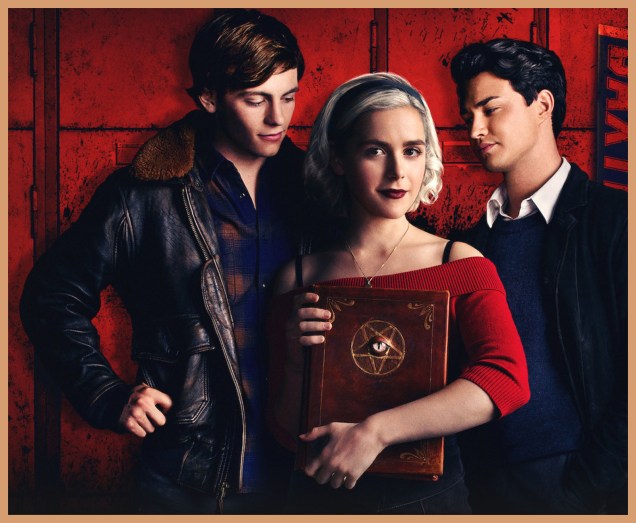
And in other media, amidst the current glut of Archie product, one finds a direct scion of a timid, decades-ago exploration, Netflix’s Chilling Adventures of Sabrina.

– RG

Hallowe’en Countdown III, Day 9

« I hear they’ve hired a skeleton crew to take over the night shift. »

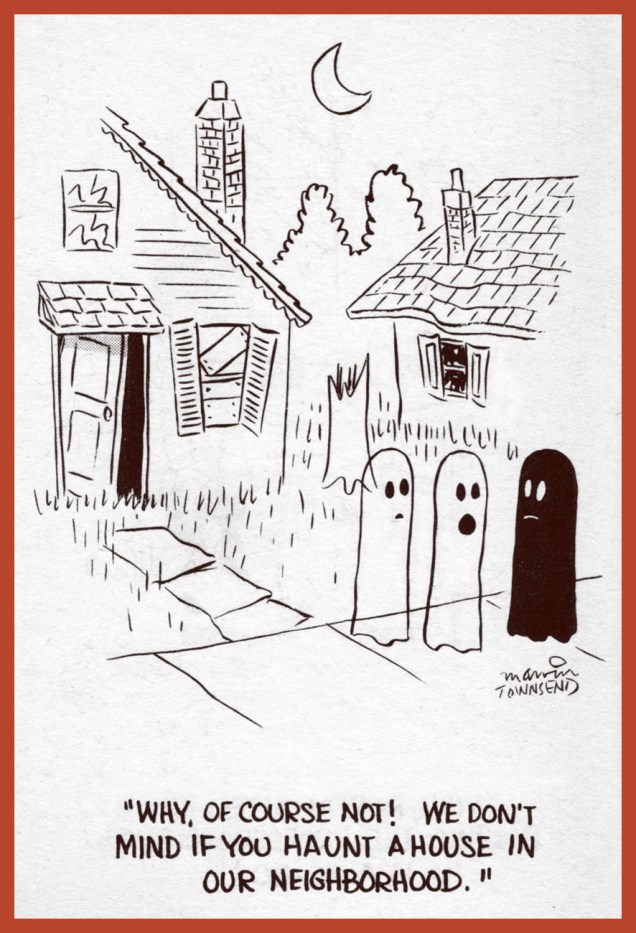
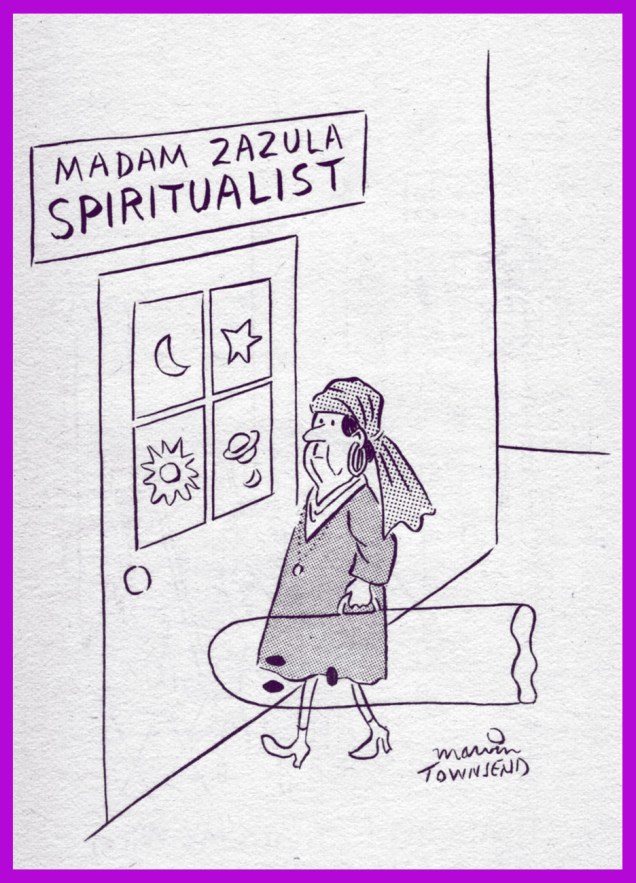
Published in 1971 by, of all entities, the Xerox Corporation, under its Xerox Education Publications banner, this oddball little volume is pretty high on charm. Its author, Kansas City cartoonist Marvin Townsend (1915-1999), placed his gags all over the place, high and low, from slicks to religious publications to pulps (including Amazing Stories and Argosy), to girlie digests such as Charlton’s Cartoon Spice, created several running strips, including the Ali feature for the long-running (1946-72) Catholic comic book Treasure Chest (of Fun & Fact). Let’s not forget that Townsend was in fine company there: contributors to TC over the years include Murphy Anderson, Reed Crandall, Graham Ingels, Fran Matera, Jim Mooney, Joe Orlando and Joe Sinnott. In the lean years of the Silver Age, it was ‘any port in a storm’, and any reliable source of income and exposure was the freelancer’s boon. Same as it ever was.

GhostlyGhastlyA

TownsendGuestSpeakerA
It’s hard to imagine today’s church being this open to airing and considering the opposing view.
TownsendArkA
All aboard for Noah’s Same-sex Ark cruise!

TownsendBlackATownsendDeadLetterA

TownsendScooterA
I love that kid’s steadfast nerve and adaptability. 

TownsendZazulaA

For a further sampling of these Ghostly Ghastly Cartoons, glide on over to this blog entry: http://neatocoolville.blogspot.com/2007/10/ghostly-ghastly-cartoons.html. Fret not, I kept the overlap to a strict minimum.

– RG

Hallowe’en Countdown III, Day 2

« In June, 1913, the family moved out in terror! … they simply abandoned the house in the Midlands. There is no record of successors. If you are looking to rent a house, cheap… it may still be there! »

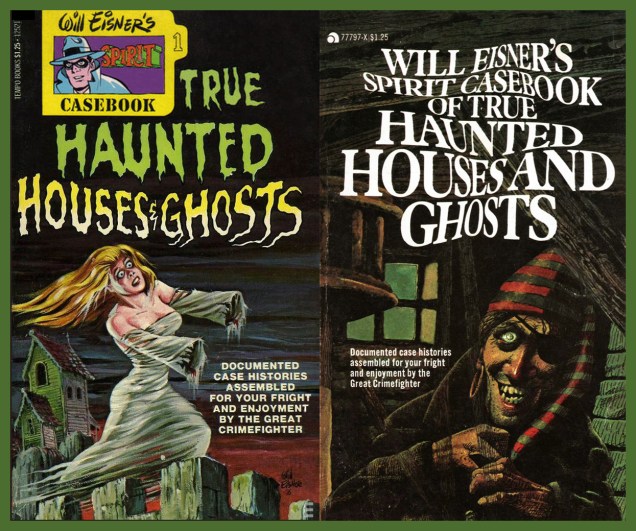
On this second day of our Hallowe’en countdown, let’s peer through the mists of time at 1976, when Will Eisner was still experimenting with marketing formats for comics-type material. This was still a couple of years before his A Contract With God and Other Tenement Stories (1978) appeared. During that period and beyond, Eisner was throwing a lot of material at the wall, in the finest exploitation tradition, hard on the heels of every bankable trend: Will Eisner’s Gleeful Guide to the Quality of Life, 101 Outerspace Jokes, Will Eisner’s Gleeful Guide to Communicating With Plants, Will Eisner’s Gleeful Guide to Living With Astrology, 300 Horrible Monster Jokes… and it wasn’t all good, as you can imagine.

This 160-page paperback from 1976 is arguably the cream of that crop; an easy choice for those of us who value Eisner’s expert hand at setting a shadowy mood.

SpiritCasebook2A

EisnerSpiritGhostsVersoA
Mr. Eisner’s original back cover.

Publisher Tempo Books seems to have had limited faith in the sales appeal (too gruesome?) of the original cover, as a variant edition was issued in short order, bearing a fine, but non-Eisner cover. Can anyone identify the artist?

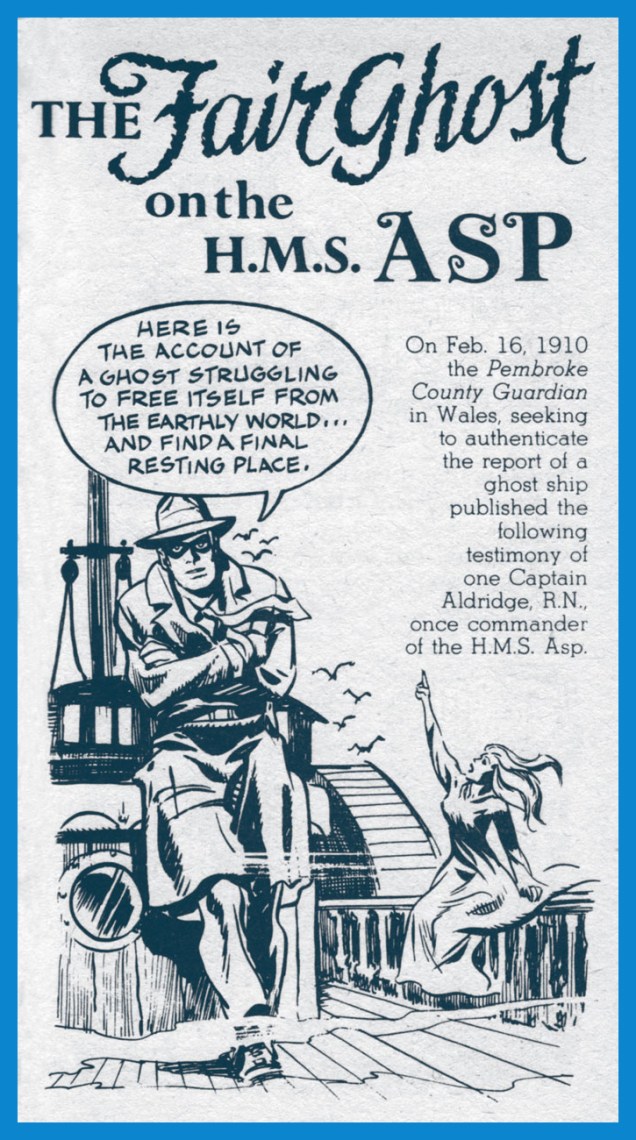
EisnerHouseGhostAEisnerHMS_AEisnerInmate23AEisner5thAvenueA

-RG

Walter Gibson and His Shadow

« The stranger’s face was entirely obscured by a broad-brimmed felt hat bent downward over his features; and the long, black coat looked almost like part of the thickening fog. » –Harry Vincent first encounters his future employer. (Shadow Magazine, April/June, 1931)

We note today the birth anniversary of Walter B. Gibson (September 12, 1897 – December 6, 1985), an extremely prolific writer and professional magician. Gibson is best known for developing the radio character of The Shadow, through nearly three hundred stories he wrote under the collective nom de plume of Maxwell Grant.

The Shadow’s had an interesting and varied career in comics, but Gibson’s novels (and the radio shows… Orson Welles!) are where it’s at. Still, let’s take a look around, shall we?

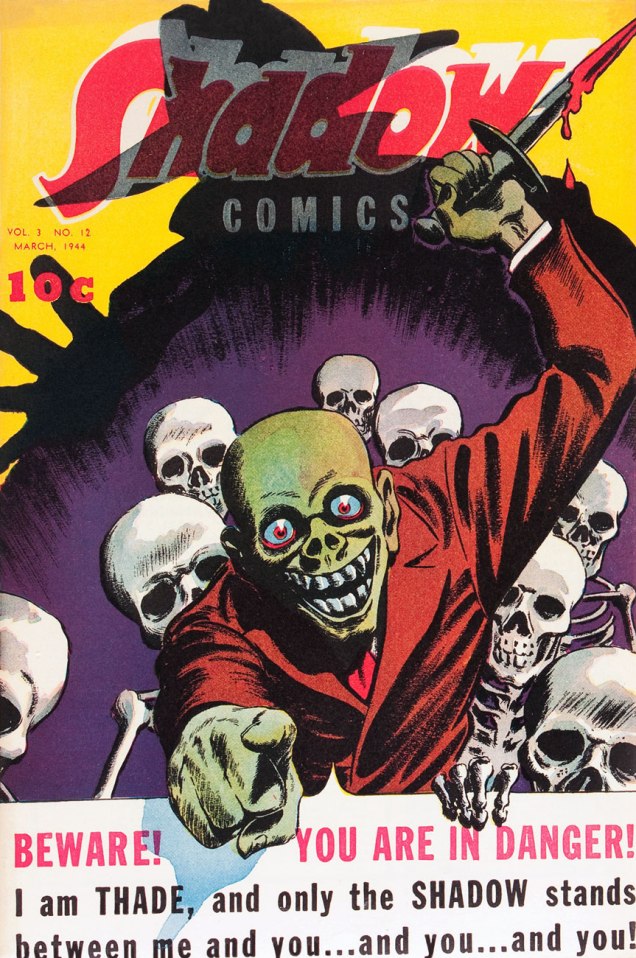
ShadowV3No12A
This is The Shadow Comics Vol. 3, no. 12 (March, 1944, Street and Smith); cover possibly by Vernon Greene. That Thade seems like a friendly sort, mayhap a tad overly so.
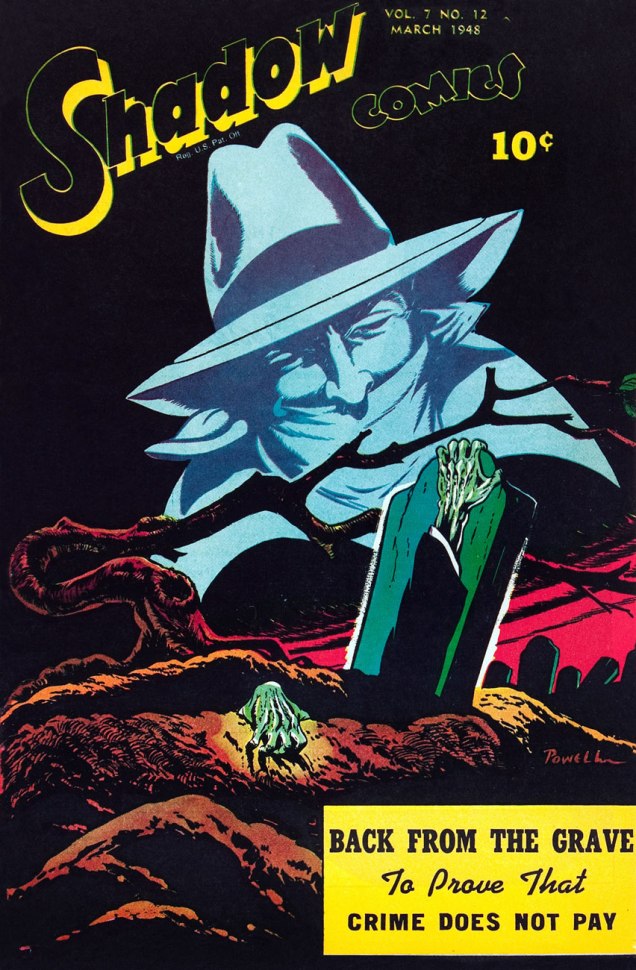
ShadowV7No12A
This is The Shadow Comics Vol. 7, no. 12 (March, 1948, Street and Smith); cover by Bob Powell.
ArchieShadow1A
Now why were Archie Comics allowed to take such ridiculous (though I’ll grant, perversely entertaining) liberties with The Shadow? Must have been a lull in the revival market, I suppose. This is The Shadow no. 1 (August, 1964, Archie), cover by Paul Reinman. You just wait until the subsequent issues…
ArchieShadow8A
This, however, is not quite how Gibson envisioned and portrayed the mysterious Shadow. This off-model rendition hails from Archie Comics’ 8 issue, 1964-65 run, helmed by Superman co-creator Jerry Siegel and Golden Age journeyman Paul Reinman. This be The Shadow no.8  (September, 1965).
Shadow7CoverOriginalA
A privileged peek at Frank Robbinsoriginal cover art for The Shadow no.7 (Nov. 1974), second of his four (or so) covers for DC, featuring Night of the Beast!, scripted by Denny O’Neil. Yummy… but too short.
ShadowKaluta11A
Two great Street & Smith pulp heroes face off! Mr. Kaluta takes some artistic license here, however, since Ike (as The Avenger calls his throwing knife), is supposed to be small and almost needle-like, not a freakin’ butcher knife. Come to think of it, the Shadow’s trusty automatics look like something a Rob Liefeld character would wield. One doesn’t encounter often the final three issues of DC’s initial run of The Shadow. Post-Kaluta (save the covers) and post-Robbins, the art was handled by Filipino artist E.R. Cruz, who did a commendable job, while series regular Denny O’Neil (who wrote all issues except for number 9 and 11, Michael Uslan ably filling in) stayed until the curtain was drawn.
SienkewiczShadow3A
Skipping the heinous Howard Chaykin revival, in which he delighted in sadistically dispatching The Shadow’s aged former operatives in gruesome ways (why do these people always call themselves fans of the original series?), we move on to the Andrew Helfer-Bill Sienkiewicz regular book. Better, but still not great. This is The Shadow no. 3 (Oct. 1987). Cover by Bill Sienkiewicz.
ShadowRogers7A
Ah, now things perk up. A nasty but excellent tale, worthy of Michael Fleisher at his bugfuck best; the shade of Marshall Rogers and smart up-and-comer Kyle Baker were a good visual match. This is The Shadow no. 7 (Feb. 1988).
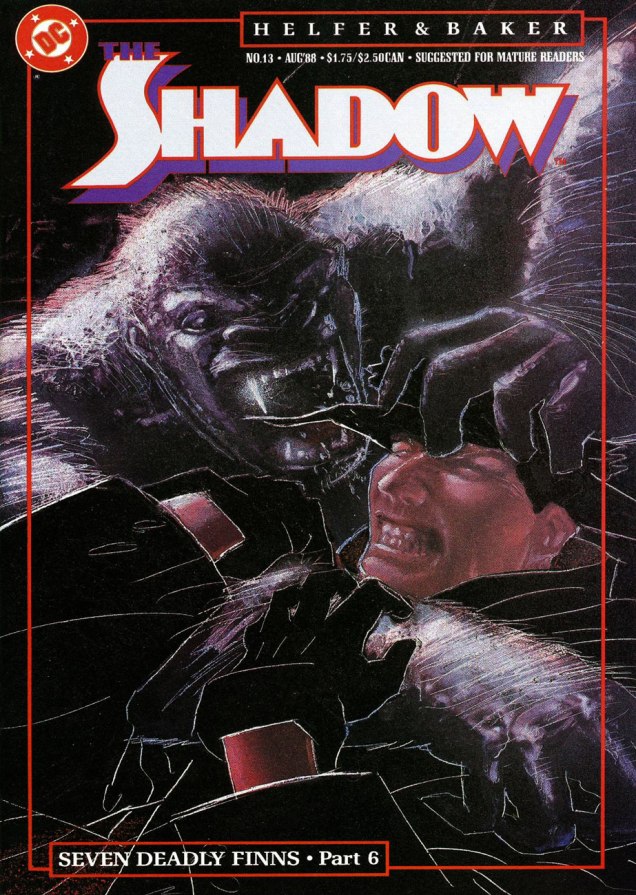
ShadowBaker13A
This is Kyle Baker’s cover for the finale of his and scripter Andrew Helfer’s thrilling and hilarious Seven Deadly Finns saga (no. 13, March 1988) that made The Shadow such a must-read title. To quote Kate Bush, « What made it special made it dangerous », and the folks at Condé Nast, who hold the rights to the classic Street & Smith characters (also including Doc Savage and The Avenger) reportedly got twitchy* at the reckless liberties the Helfer-Baker team were taking and pulled the plug after issue 19, where a beheaded Shadow gets a big action robot body. The Shadow was rebooted the following year in more obedient hands, with quite pedestrian results.

As a bonus, let’s slightly depart from comics proper and admire a couple of paperback reissues from the brush of noted fabulist James Steranko.

Shadow8A
Steranko comes up with one of his subtlest, most unctuously moody covers for Pyramid’s 1974-78 series of Shadow paperbacks that introduced these classic pulp adventures to a new audience, picking up where its predecessors Belmont (1966-67) and Bantam (1869-70) had left off. Pyramid had one extra trick in its bag, though: Jim Steranko, who painted tantalizing covers for each of Pyramid/Jove’s twenty-three volumes. This particular case file, MOX, « from The Shadow’s annals as told to Maxwell Grant » originally appeared in The Shadow Magazine vol. 7, no. 6 (November, 1933).
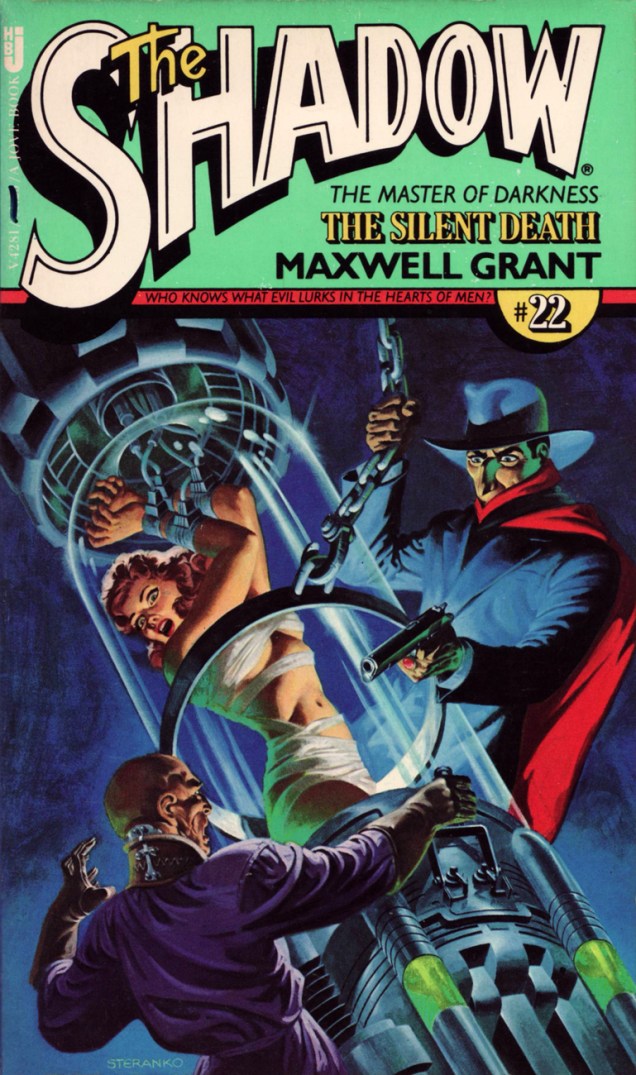
Shadow22A
Natty dresser Jim Steranko has built up, over the years, quite a biography for himself. Of his numberless and prodigious accomplishments, my favourites are those that actually happened, such as a stunning series of cover paintings for Pyramid Books’ reprints of vintage Shadow pulps from the 30s and 40s. This one, twenty-second in a set of twenty-three, was published in March of 1978. The Silent Death initially saw print in The Shadow Magazine, Vol. 5, no. 3 (April 1, 1933.)

-RG

*which everyone apparently’s been denying since.