Tentacles have always been omnipresent in comics, but there’s been a true explosion of tentacular material in recent years. Sadly, the quantity is inversely proportional to the quality, and the comics market seems to be flooded with covers so aesthetically unappealing that I can’t bring myself to feature them. Still, I’ve been accumulating covers from 21st century – here are a few that I can get behind, albeit half-heartedly.
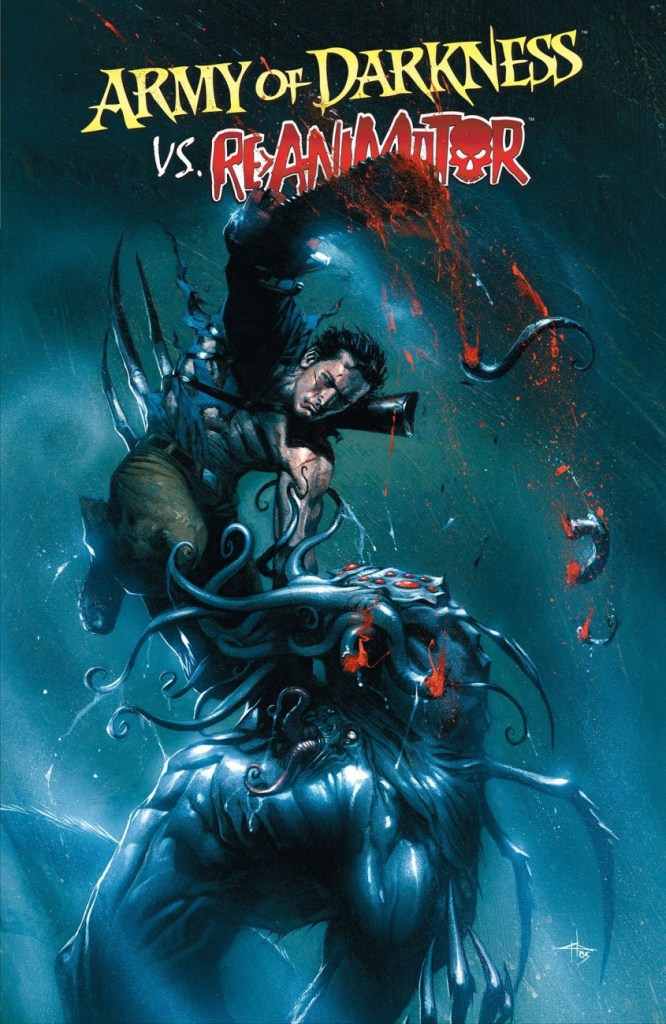
Army of Darkness vs. Re-Animator! (October 2006, Dynamite Entertainment). Cover by Canadian comics artist Nick Bradshaw.
As any story loosely based on an H. P. Lovecraft character (in this case Herbert West) and featuring a crossover as the main point of interest (in this case, West is fighting Ash Williams from the Evil Dead series), this is, not to put too fine a point to it, crap.
Great Pacific no. 16 (July 2014) – variant cover by Charles Paul Wilson III.
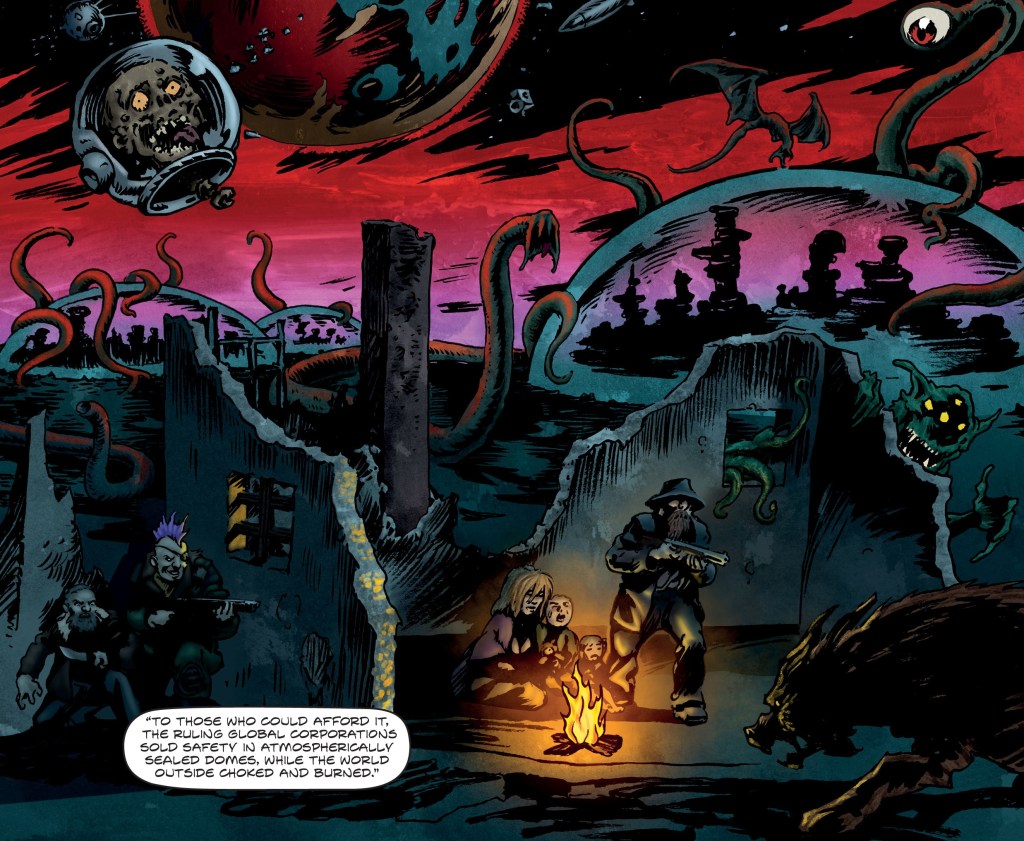
Great Pacific has been lauded as an interesting comic with a powerful message of environmental preservation, but this is the only cover I kind of like, the others being distinctly on the ugly side (albeit abounding with tentacles). I see comics as a great merging of words and images, so when the pictorial side leaves so much to be desired, my interest in reading the story is nil — I’ll go read a book instead.
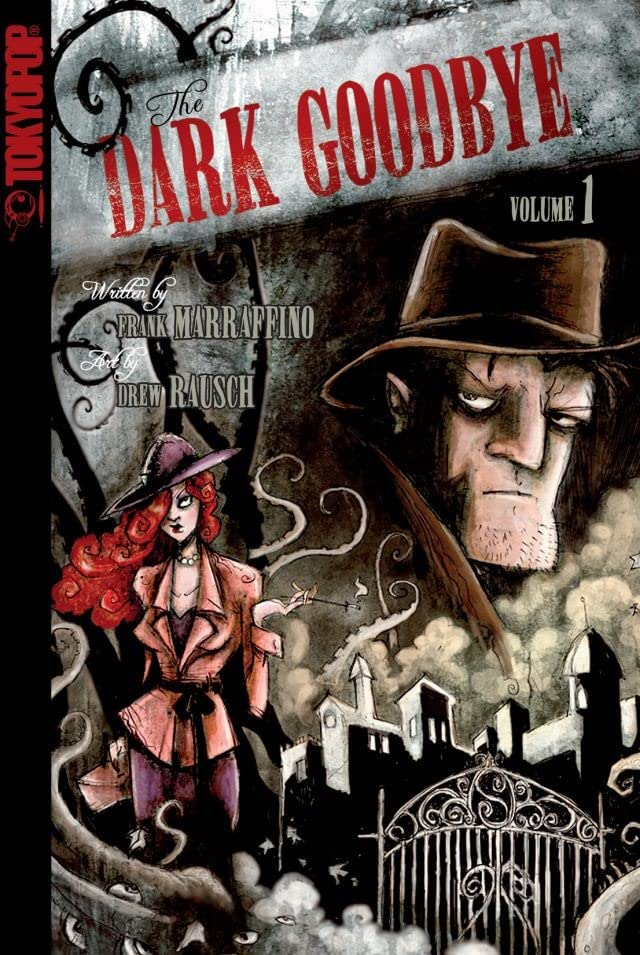
I had low expectations for Professor DarioBava, but this was surprisingly a rather fun read, despite its extremely derivative nature, abounding, as publicity promised, naked women, monsters, exorcisms and lesbian scenes involving a nun in lingerie.
The art is not great but quite serviceable, involving a murky but non-offensive palette with some colour pops.
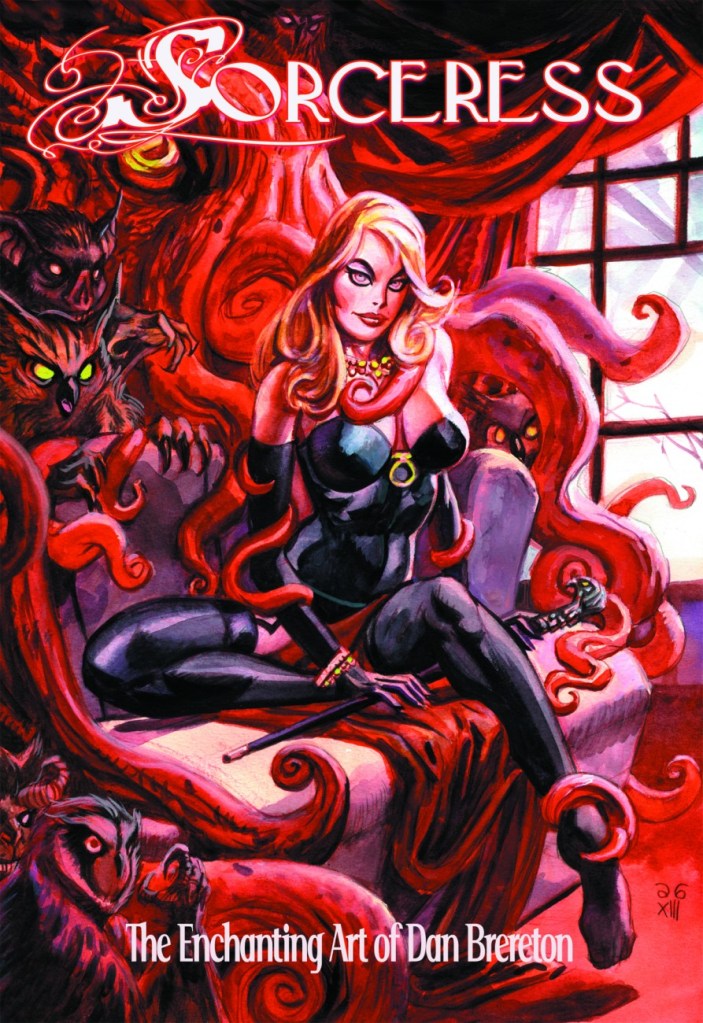
A collection ofDan Brereton art, published in November 2013 (Little Eva Ink).
I can actually say that I like Brereton’s painted and colourful style (co-admin RG demurs on that point), and as he seems to quite enjoy painting tentacles, his art will surely crop up again in one of my posts.
« Mer-Boy! You’re making me angry! »« You’re beautiful when you’re angry! »
Today’s batch of tentacles all come from the heads and hands of one team: scripts by Robert Kanigher, pencils by Ross Andru and inks by Mike Esposito. I make no secret of my dislike for Kanigher scripts when there are women involved*, but the Andru & Esposito team deliver some very nice art to go with the dubious plotting. Besides, we are concentrating on tentacles… though I can’t promise an occasional plot-jab. 🙄
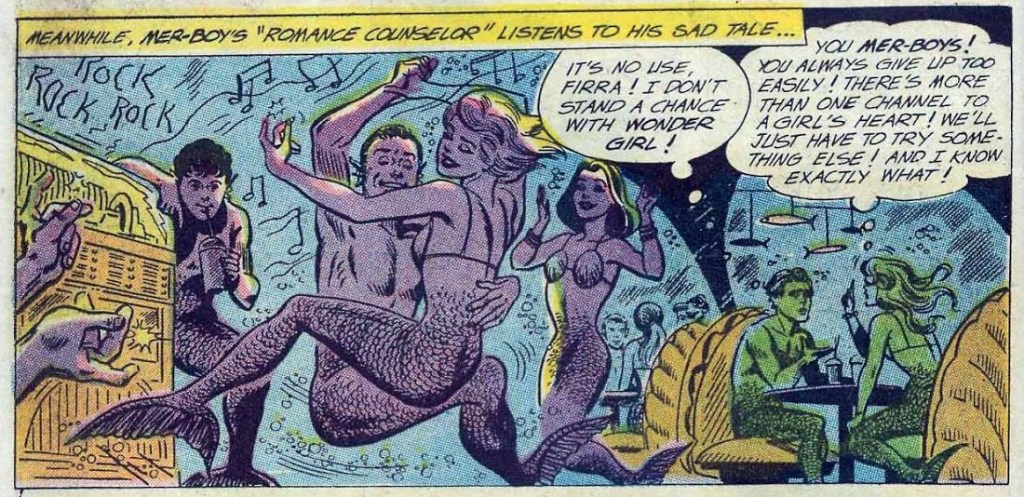
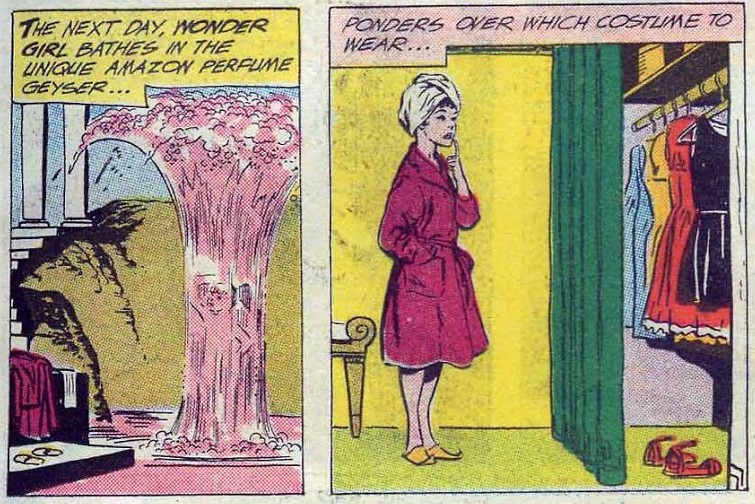
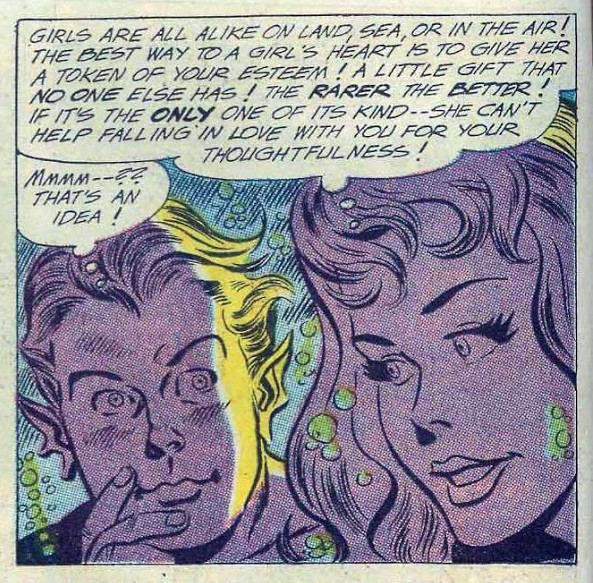
*My complaints about his scripts are two-fold: that his plots make precious little sense is one, but that sort of nonsense is often fun to read, as long as one doesn’t take it seriously. However, the barrage of misogyny, not so much. I go on about it in some length in Don’t Let a Mysogynist Plan Your Wedding: Robert Kanigher and Wonder Woman’s Utterly Unsuitable Suitors, but if you need an immediate example, here are some example of great art and scripting claptrap. I just chose a random, non-tentacle issue from that era… the following panels are from The Cave of Secret Creatures, published in Wonder Woman no. 116 (August 1960).
The pretty mermaid’s suggestion is to make Wonder Girl jealous by inviting her to a party and then proceeding to ignoring her altogether. Monumentally stupid? Yes. Is Firra being obtuse on purpose? It’s very possible. Remove the fantastical monsters and the whole superpowers thing, and these stories will read like a hackneyed romance comic.
What’s the point of bathing in perfume (yikes, by the way) before going to an underwater party?
More bad advice from the mermaid. Have you ever heard ANY girl say that “girls are all alike”?
It’s too bad, because it’s really fun to spend some time with this underwater society of mer-teenagers hanging out, drinking seaweed sundaes, and gossiping.
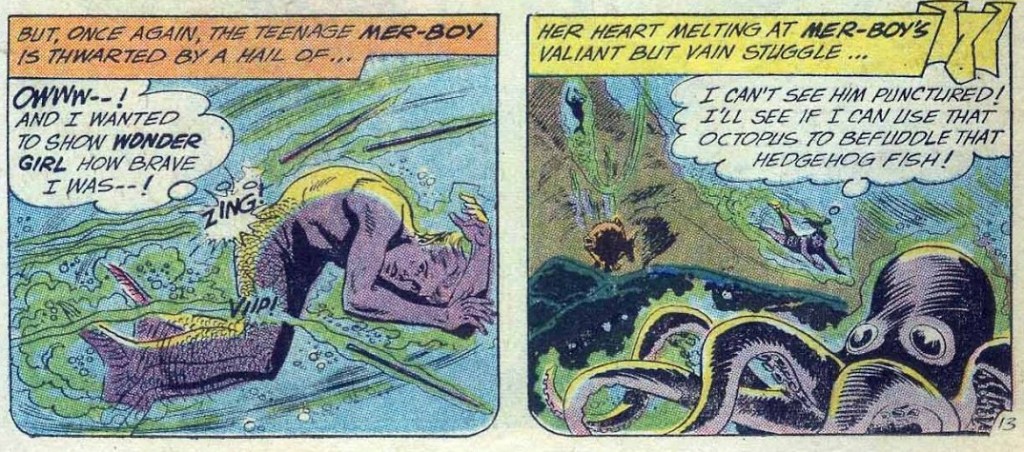
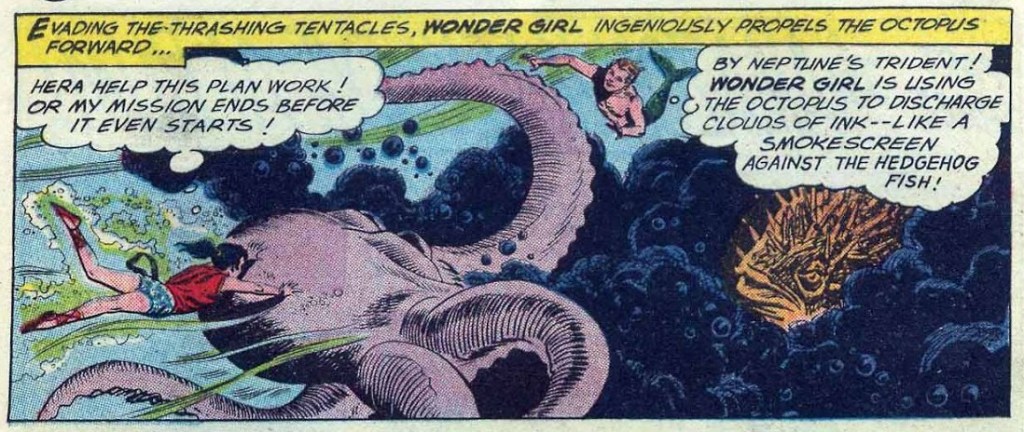
A page from Mer-Boy’s Secret Prize!, published in Wonder Woman no. 119 (January 1961).
Anyway, I promised you some tentacles, and by Jove (or by Hera!) I shall deliver. Between issue no. 112 and issue 126, Wonder Girl (occasionally her grown-up counterpart, Wonder Woman) has fought more octopuses than one can shake a stick at.
Restraining order, anyone?
The reason for that is simple – the daft Mer-Boy (and the adult Mer-Man) is a frequent plot hinge of these stories, either harassing Wonder Girl for a kiss, quarrelling with her other (equally daft) suitors, or being in desperate need of rescuing when his imbecilic antics land him (yet again) in hot water. I guess that’s one thing I can say about the plotting – at least WG is not a damsel in distress… And I by far prefer him to Steve Trevor (the other suitor who often comes up in these things), whose behaviour is exemplified in, for instance, Wonder Woman no. 127 (January 1962) – he tricks Wonder Woman into agreeing to marry him by faking a serious wound, complains about the food she cooks for him, and then flies into a murderous rage when she takes off from their honeymoon to stop a nuclear missile. (Oh, and it was all a dream, by the way!)
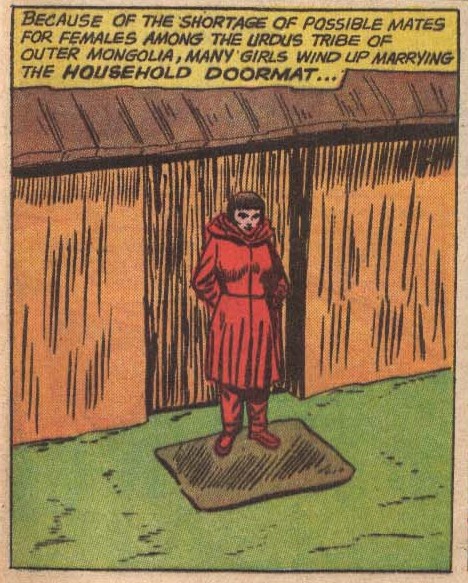
As if to emphasize the retrograde nature of these comics, each issue we are treated to a “marriage around the world” page detailing strange customs. For example, from Wonder Woman no. 128 (February 1962):
Artist unknown. I tried finding out if this was true and could find nothing at all, so the author of this was either talking out of his ass, or has special connections with Urdu tribes… Better to marry a doormat than to become one, I guess?
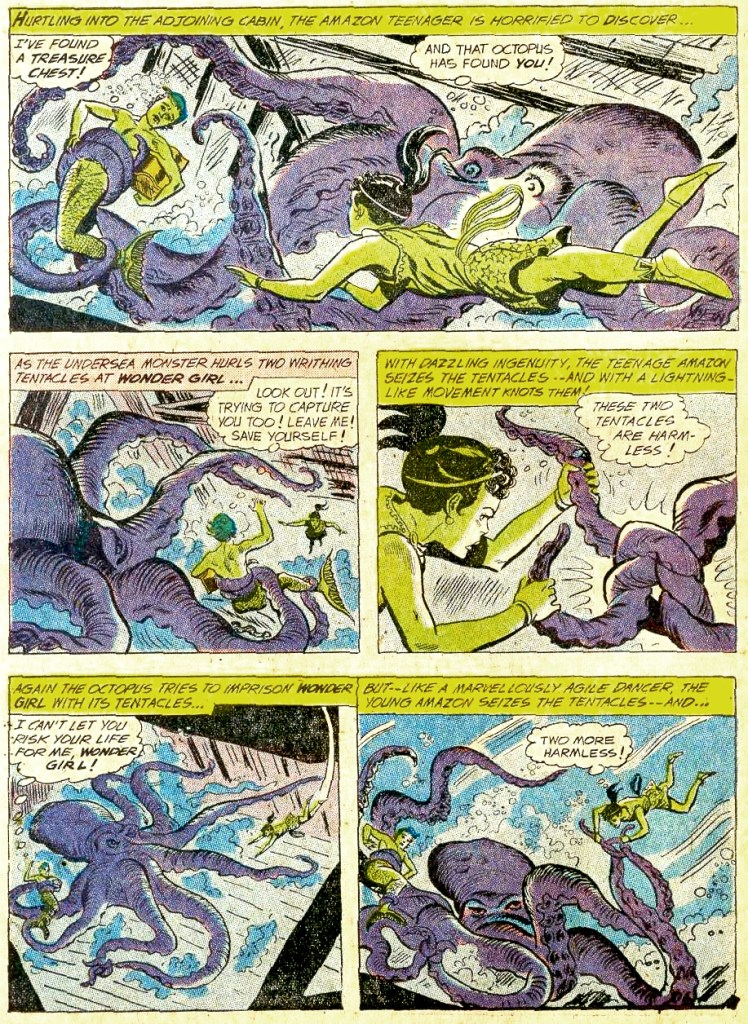
Page from The Chest of Monsters!, published in Wonder Woman no. 112 (February 1960). “Having to rescue Mer-Boy yet again”, part 300.
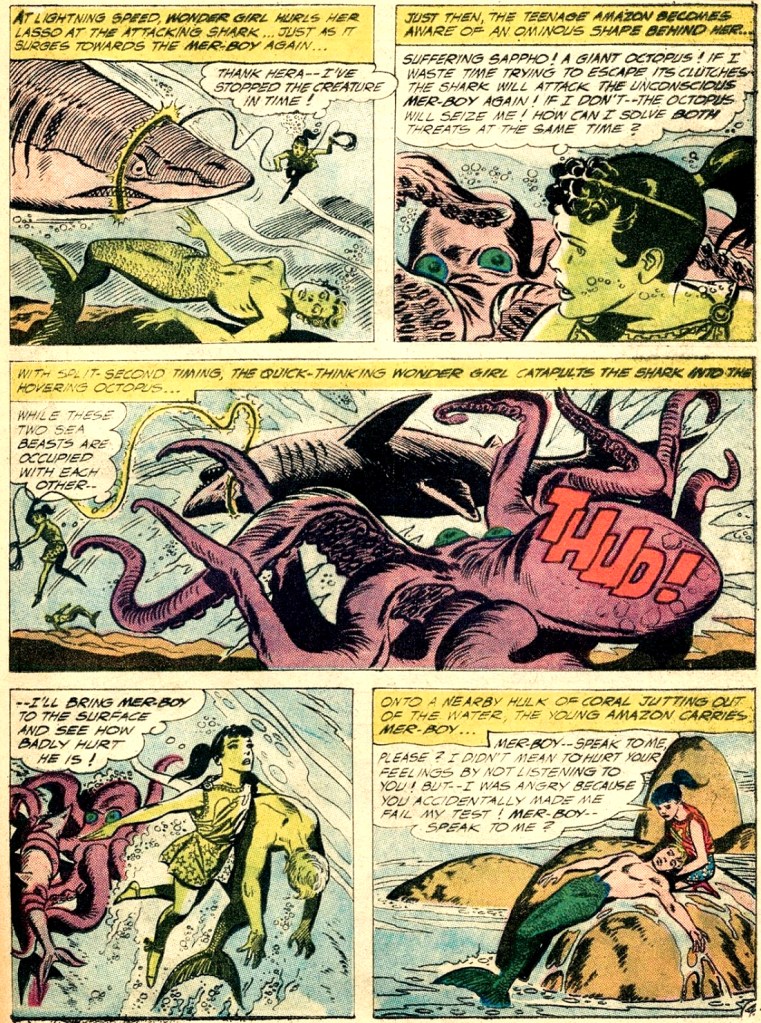
Page from Mer-Boy’s Undersea Party, published in Wonder Woman no. 115 (July 1960). Um, yes, rescuing Mer-Boy again.
Pages from Wonder Woman’s Impossible Decision, published in Wonder Woman no. 118 (November 1960). Oh, now it’s Steve who’s having problems, for a little variety!
In case you’re wondering what the Impossible Decision is, Wonder-Woman has to choose which of her suitors to save. Personally, I would let both of them plummet.
In a previous story, Wonder Woman has to choose between saving Steve or saving a whole world, so I think she’s no stranger to fucked-up situations, thanks to Mr. Kanigher.
Two excerpts from Amazon Magic-Eye Album! published in Wonder Woman no. 123 (July 1961)Admiring the action from a polite distance, Mer-Boy is useless as usual.
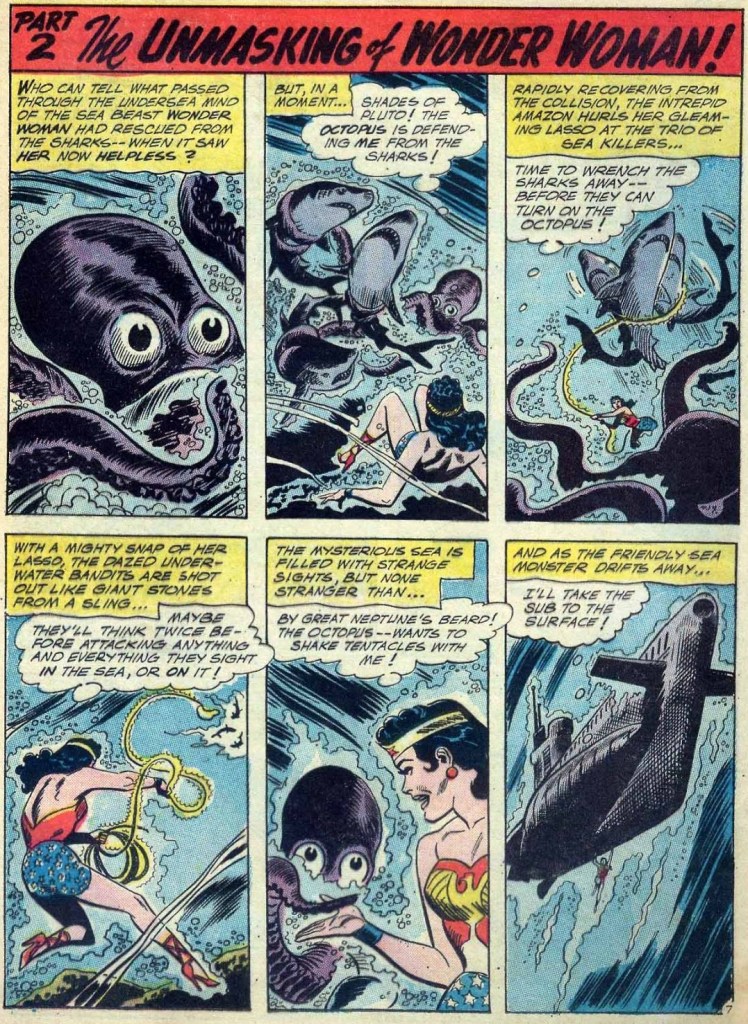
A page from The Unmasking of Wonder Woman! This story was published in Wonder Woman no. 126 (November 1961).
After Wonder Woman rescues the octopus from some bloodthirsty sharks, they become friends! Perhaps because for once, no suitor is involved.
May the gentleman octopus grant you a Happy New Year!
Greetings, pretty cephalopods and cephalopodettes! This is the last Tentacle Tuesday of the year, and as is my custom, I return to a sub-topic close to my heart: women entangled in tentacles. Nothing crass, mind you – we have our standards!
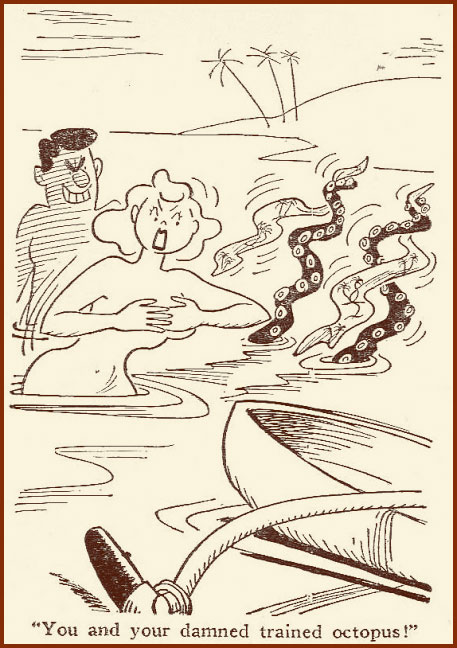
Original art for a cartoon published in Wham! (December 1954, Wolf Books). Art by George Wolfe. I imagine the three guys whose arms are grabbing her colliding with one another in the door frame…
As the signature attests, the artist is George Wolfe (1911 – 1993), who has had an illustrious, though mostly forgotten, career as a magazine cartoonist with published work in Esquire, Saturday Evening Post, New York Herald Tribune, etc. He also had a few syndicated comic strips under his belt, as well as winning several prestigious awards (namely, the Reuben, the highest award of the cartooning profession). Touring Tessie, created by Wolfe for Wolf Books (has a nice ring to it, doesn’t it?), was the so-called hostess of this magazine, and its main attraction. Do yourself a favour and head over to The Wolves of Broadway VII: The Alpha Female to peruse more Tessie cartoons and learn more about just what kind of gal she was.
Tessie is one again getting entangled in the clutches of an octopus… this time a more literal interpretation.
The image used for the cover of Wham! (April 1954, Wolf Books). Another trained octopus – working for his own account and calling the shots!
From the cartoony to a more realistic approach –
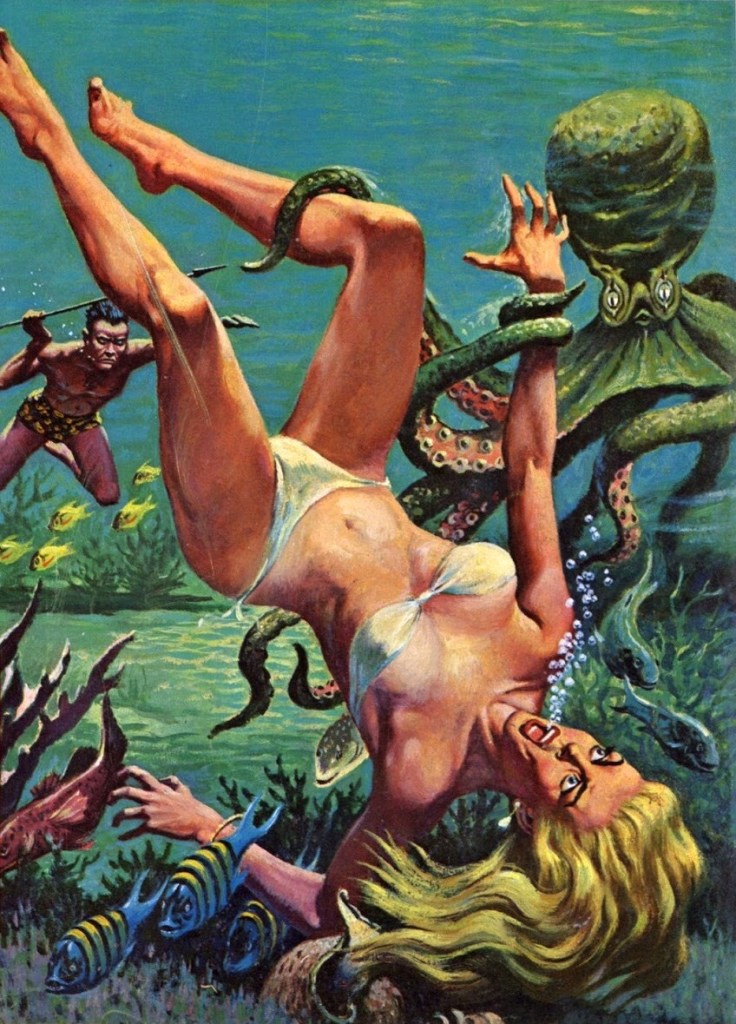
Detail from the original cover art of Bold Men vol. 5, no 2 (March 1961, Cape Magazine Management). Bold Men is an “interest magazine focusing on pictorials and adventure stories”, explains mycomicshop.com, but with this issue featuring stories like How Nazi Bormann’s Cruel Lust will Betray Him! and The Deadly Blonde Witch of Waikiki! , I’m not sure that “bold” is the right word here.
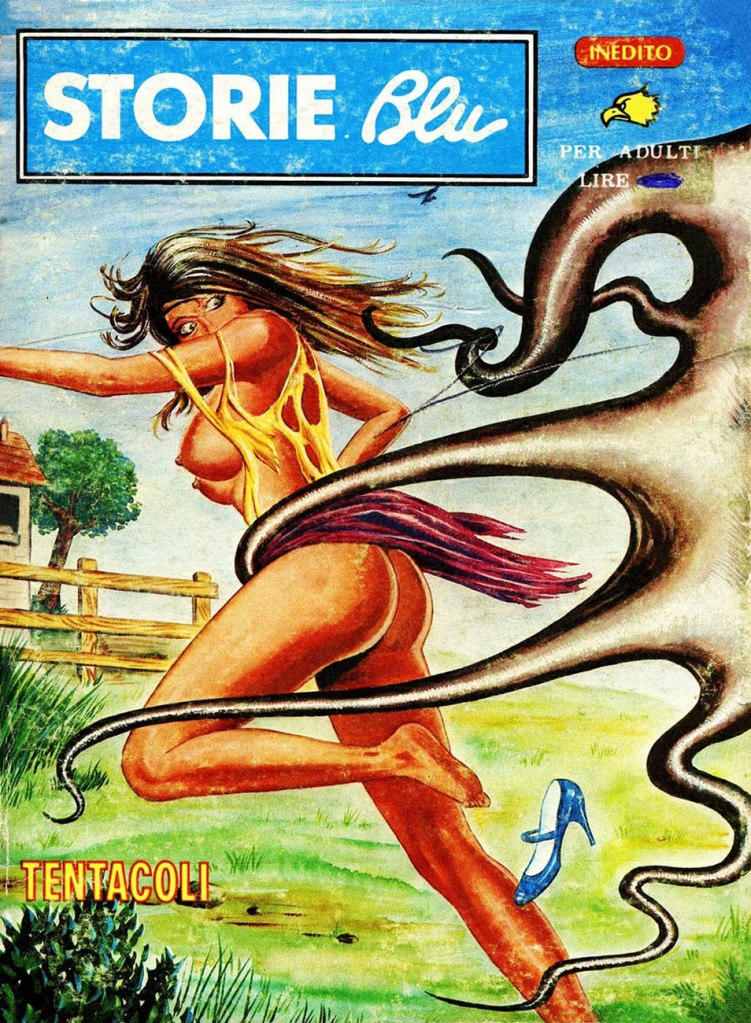
The following three covers are from Storie Blu, an Italian erotic, science-fiction comics series published by Ediperiodici (also known as ErreGI), Edifumetto’s main competitor in the adult comics sector. Ediperiodici disseminated a huge number of erotic series running the gamut from A all the way to B in terms of genre: erotic… horror, western, spy, jungle, military, fantasy, etc. If you want to get an idea of what the stuff looked like, take a peek at Lucifera, Maghella (in-house favourite) or Messalina.
Storie Blu ran between 1979 and 1990, for a respectable 122 issues and two supplements (click here for a full list in Italian).
Storie Blu no. 28 (1983, Ediperiodici). Psycho-monsters, announces the cover!
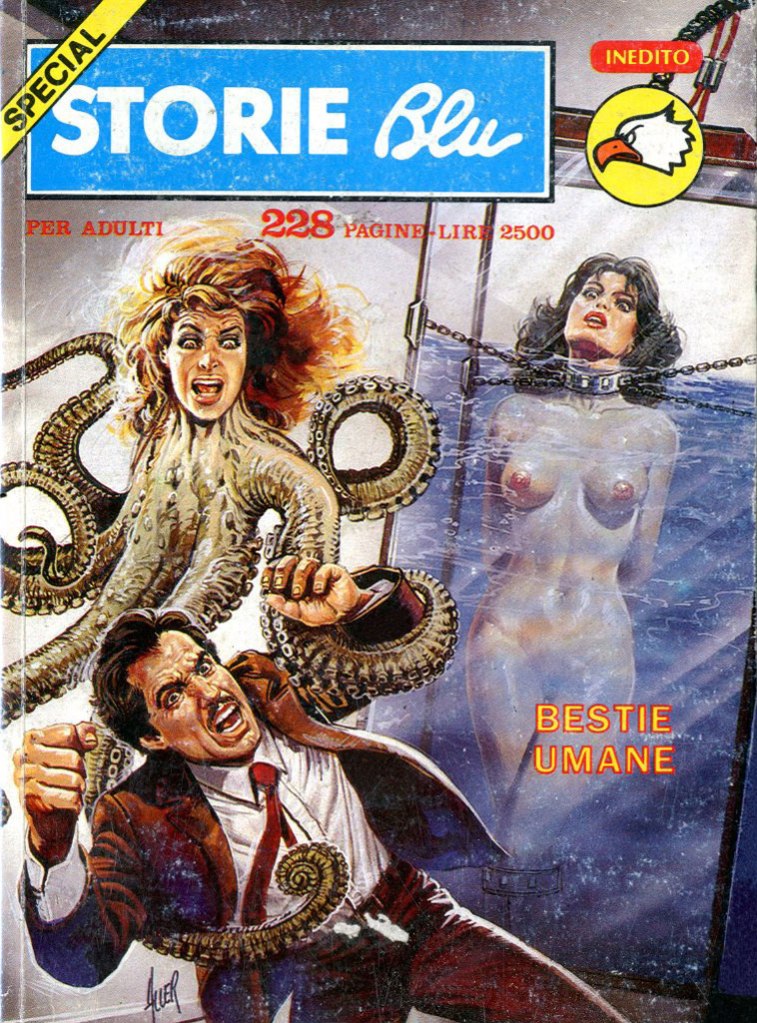
Storie Blu no. 39 (1983, Ediperiodici). This cover is a good example of the “what the hell is going on here” approach Italian erotica often prefers – RG commented that the tentacled female must be the guy’s ex-wife, and his current wife is in the fish-tank. Anything’s possible! Cover is by Giovanni Alessandri (not the grammarian from the 16th century, as you may have initially thought!), who went under Aller.
Storie Blu no. 81 (1986, Ediperiodici). The cover story was scripted by Carmelo Gozzo and illustrated by Alberto Giolitti (who, I believe, also drew this cover) – you can read a synopsis and take a look at some art here.
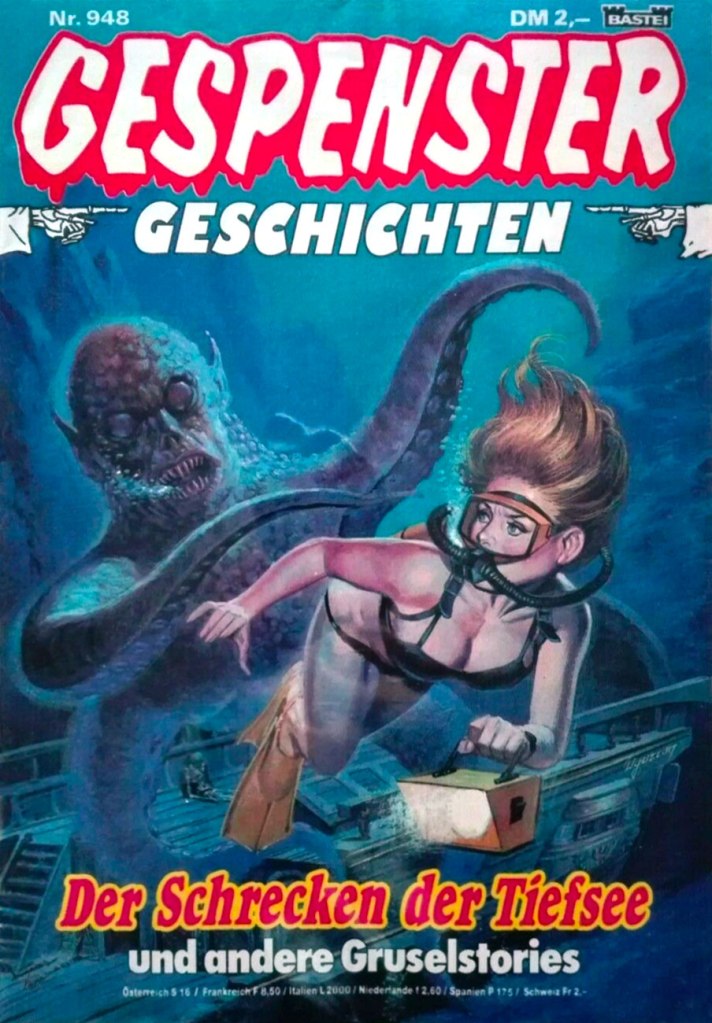
Moving on to another European country… Gespenster Geschichten‘s sister publication Spuk Geschichten already has a Tentacle Tuesday: A Torrent of Teutonic Tentacles.
Gespenster Geschichten no. 948 (1991, Bastei Verlag). Cover by Turkish painter/illustrator Ugurcan Yüce, who moved to Germany in his 30s and contributed quite a lot of covers to publishing house Bastei Verlag, which published (and continues to) many highly successful popular pulp and comic series.
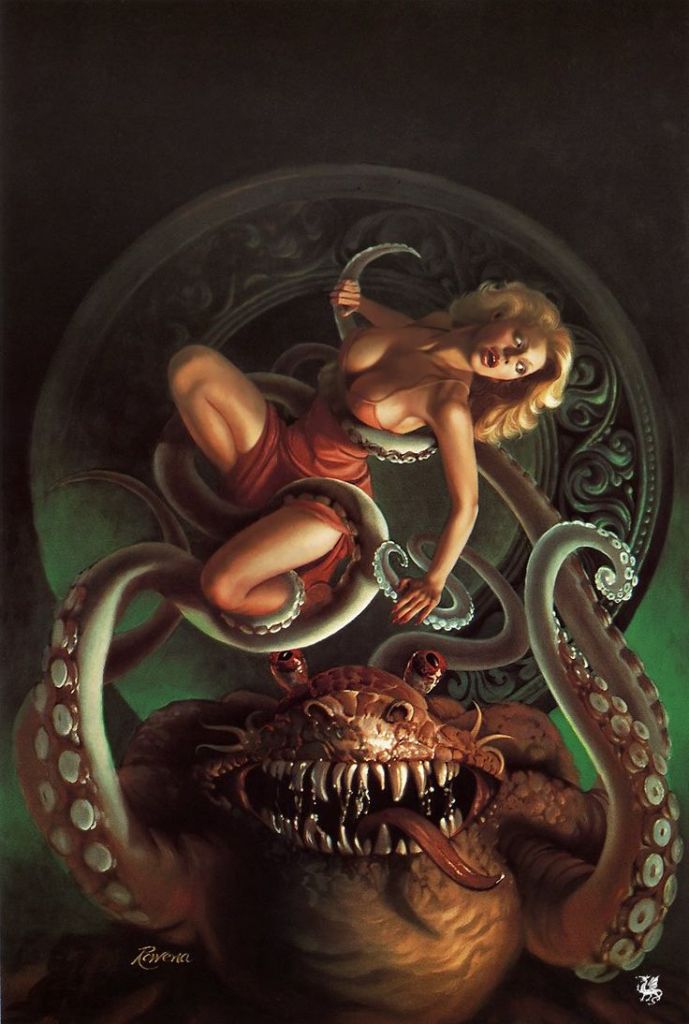
Just one more for the road, what do you say?
Painting by Rowena Morrill (whose name appropriately sounds like something out of some fantasy novel). This has been used as a cover for a German edition of Creepy… but I prefer to provide it sans captions or logos.
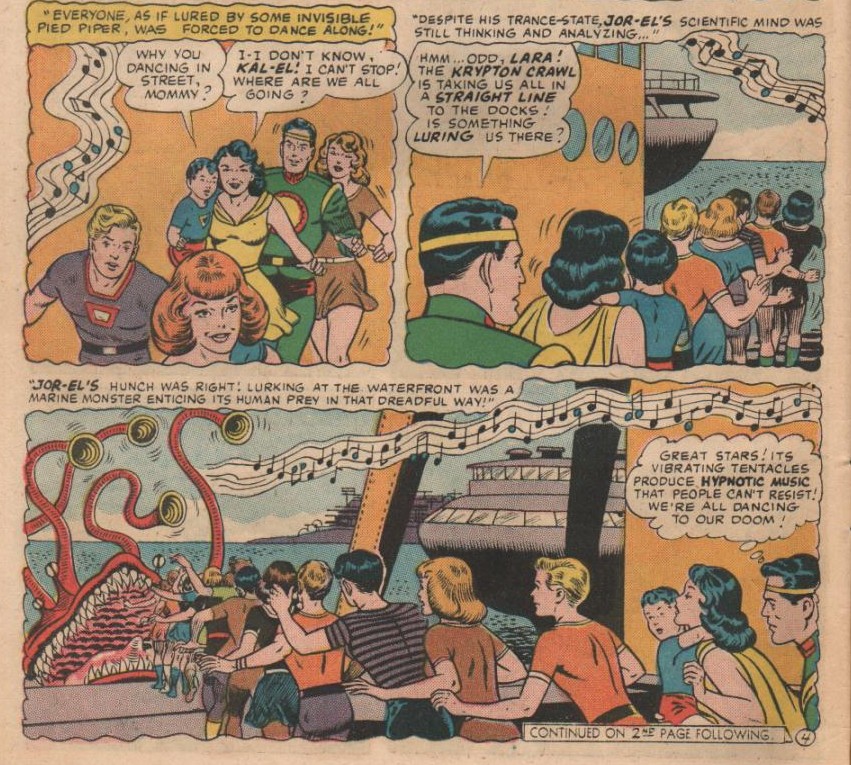
« The vibrating tentacles produce hypnotic music that people can’t resist! »
This is the last Tentacle Tuesday before Christmas, so wishing all of our lovely readers a splendid (and safe) evening, whether you celebrate Christmas specifically, something else altogether, or nothing at all.
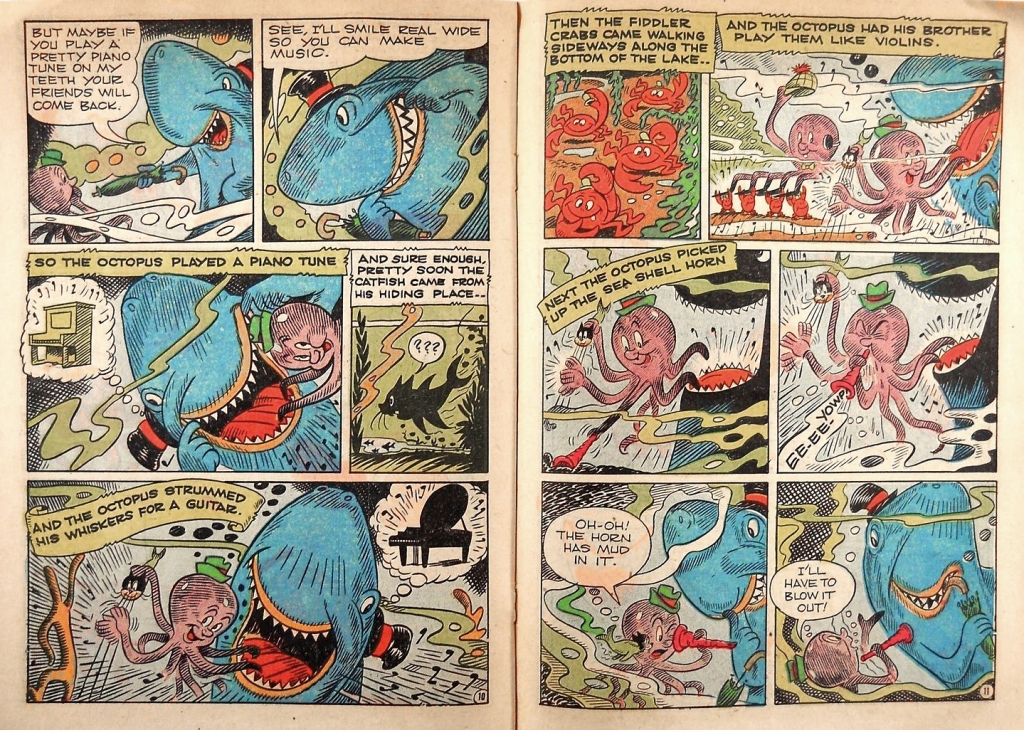
As far as I’m concerned, one of the most important components to creating a holiday mood (aside from being with my family, of course) is music. If it’s played by an octopus, so much the better – and one not? Having a lot of arms is surely handy for playing many instruments at the same time. One must say this is a musical edition of Tentacle Tuesday – so put on a record, preferably of the old-school vinyl variety, and swing your tentacles (or whatever appendage you do possess) along!
Grumpy Shark (1946, Belda Record & Publ. Co.) Written by Bob Bellemand illustrated by Mel Millar, this comic is part of the Talking Komics series issued by Belda Record & Publishing Co., in which a record was sold alongside the comic to delight both eyes and ears of its young audience. I didn’t know octopuses had whiskers – live and learn!
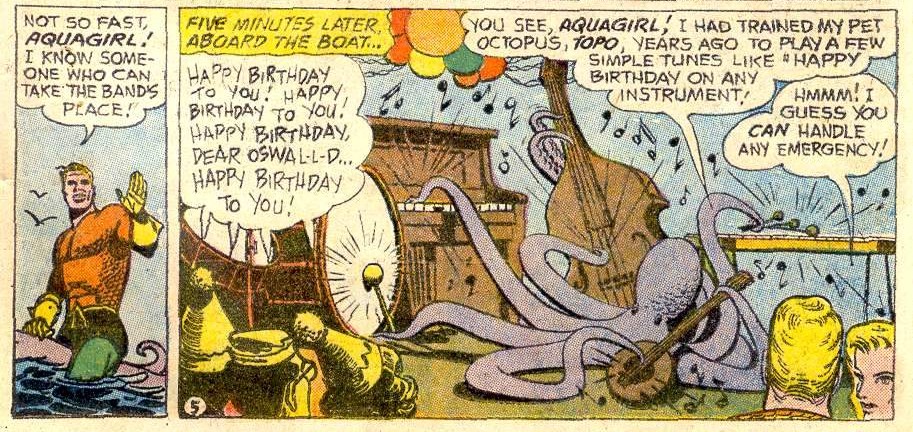
These panels, which I have been seeing all over the place with no attribution of artist or issue number (tssk, tssk) are taken from Aquaman Meets Aquagirl!, scripted by Robert Bernstein and illustrated by Ramona Fradon, and published in Adventure Comics no. 266 (November 1959, DC). Of course Topo, Aquaman’s pet octopus, is adorable as well as talented, and probably deserves his own post… but in the meantime, he has to share space with Aquaman’s other tentacled encounters.
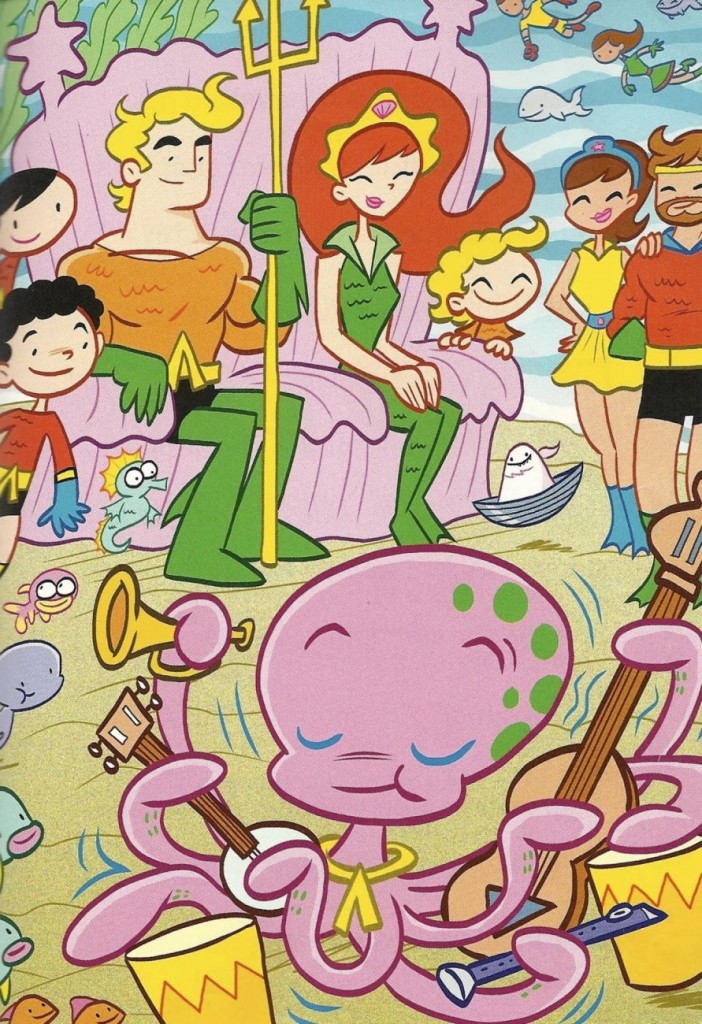
Speaking of Topo… he’s been getting some attention recently, and unsurprisingly his musical talent is involved:
Page from Heroes of the High Seas (January 2011, Picture Window Books), scripted by J.E. Bright and illustrated by Art Baltazar. « Capstone Publishers and DC Comics have joined forces to produce a new children’s books series, DC Super-Pets. The series will focus on the super-powered pets of heroes like Superman, Aquaman, Wonder Woman, Batman, and Green Lantern… »
Page from The Swinging Superman!, scripted by Otto Binder, pencilled by Curt Swan and inked by George Klein, and published in Superman’s Pal, Jimmy Olsen no. 88 (October 1965, DC).
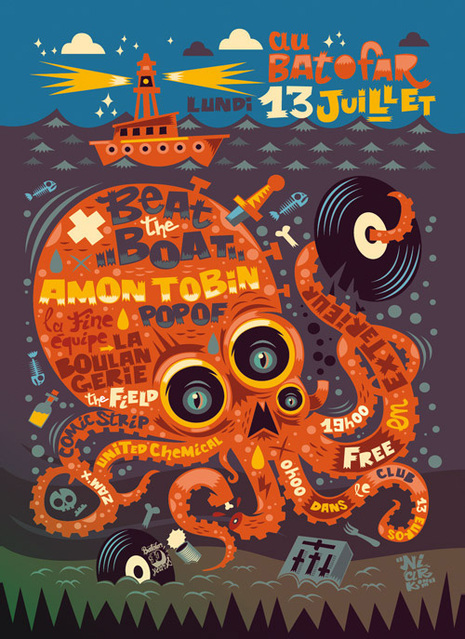
And to prove that octopuses dig LPs, too, I’ll include this nifty poster:
Poster by Sébastien Feraut (known as Niark1), a French illustrator. Visit his website!
On a connected subject, I heartily recommend this Soviet cartoon, which involves all manner of sea-creatures (yes, including several octopuses!) playing all sorts of instruments – don’t worry, it has subtitles in English.
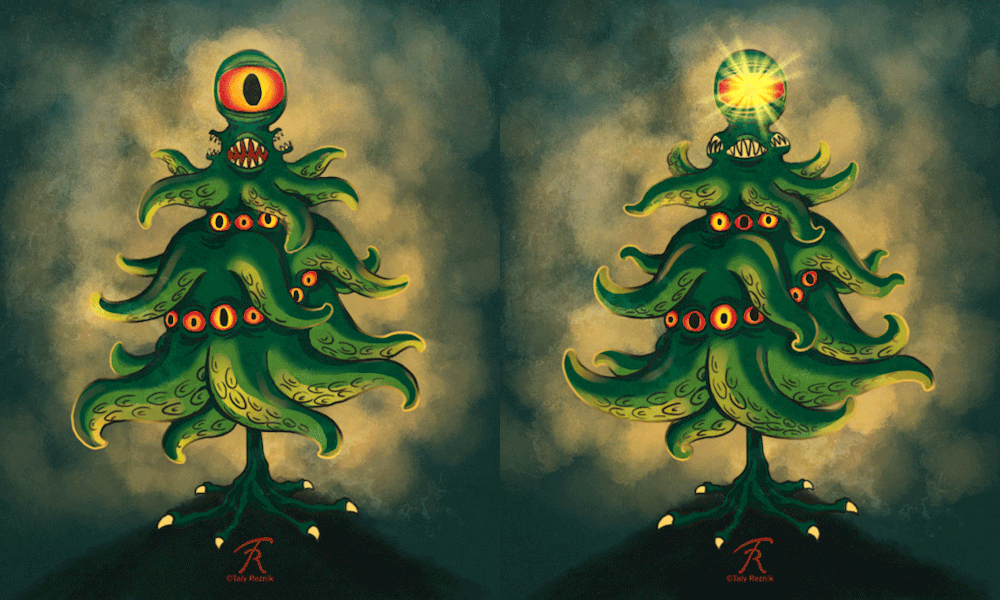
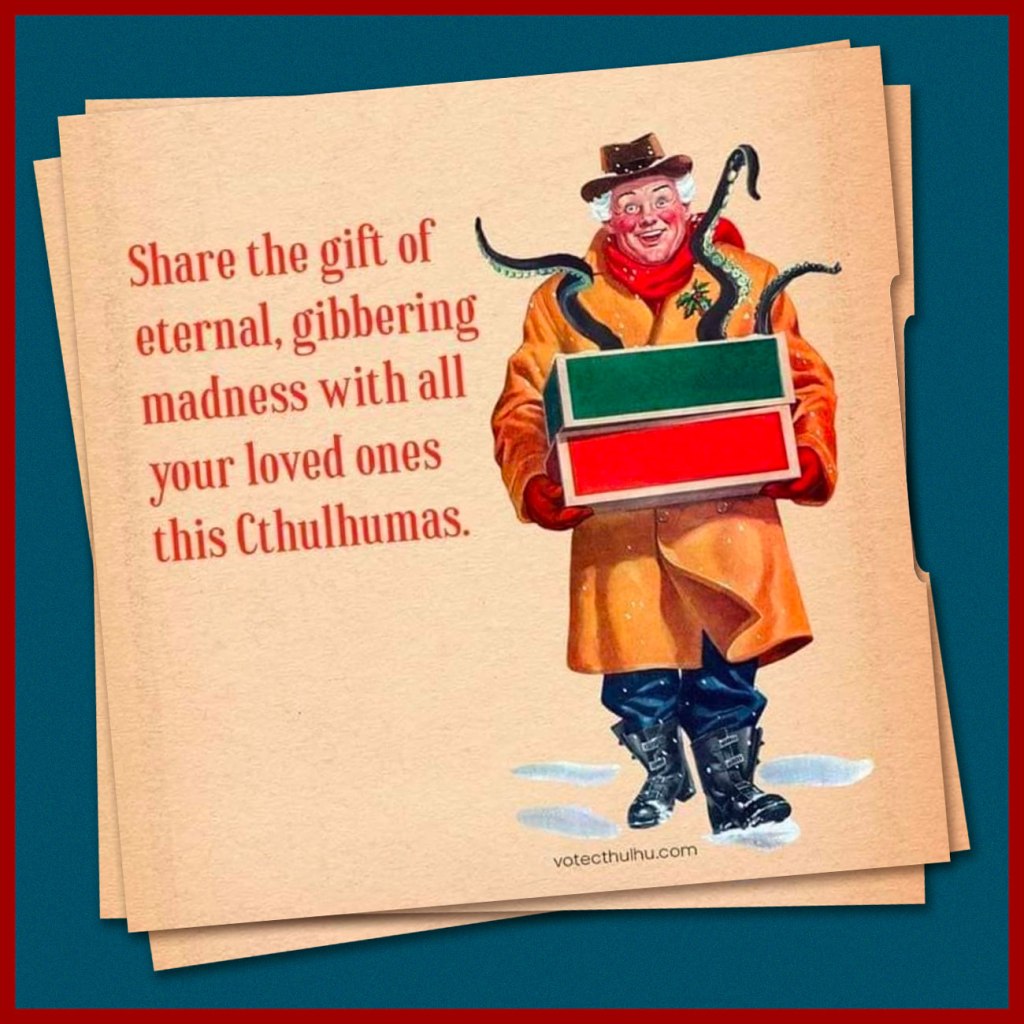
And finally — hope you’ve remembered to mail out all your Unholiday cards! Never forget that the ever-vigilant Cyäegha has its eye on you! [ artist unknown… so far ]
Today’s TT is like one of those 5$ grab bags: you don’t exactly know what you’re going to get, but there will at least one thing you’ll find amusing! Unless the store has cheapened out and stuffed it with nonsense nobody in their right mind would want. This offering, on the other had, is full of our favourite artists, and is not nearly as disparate as I first thought 😉
I don’t always have an over-arching idea for a post, inevitably ending up with plenty of odds and ends that don’t neatly fit into any one category. Actually, some of those “scraps” are the most enjoyable finds for me.
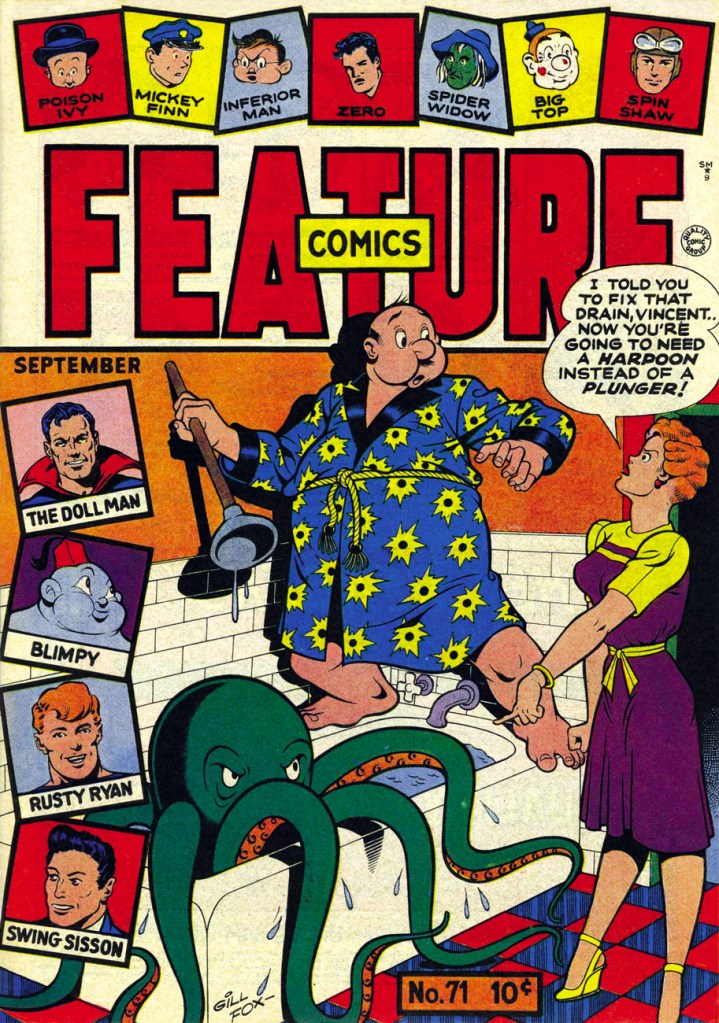
Feature Comics no. 71 (September 1943, Quality Comics). Cover by Gill Fox. The octopus-in-plumbing theme is an oldie-but-goodie; the undaunted housewife may yet regret her cavalier attitude towards the tentacled one, who probably wants to move in with his family.
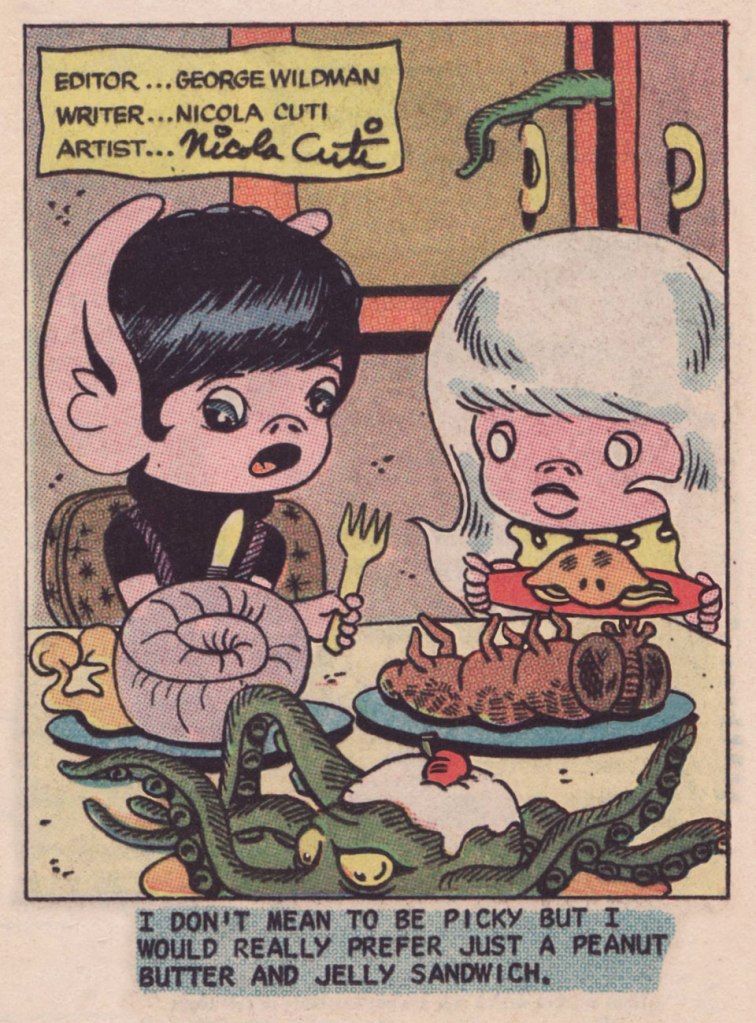
Nicola Cuti‘s Weirdlings was a charming little ‘filler’ gag page designed and drawn by him. This one was published in Haunted no. 14 (Sept. 1973, Charlton). I think the octopus, that appears to be still alive, would also prefer a good old PBJ sandwich.
Archie’s Pal Jughead no. 77 (October 1961). Cover by, dare I say legendary, Samm Schwartz; revisit (or discover!) some of the nicest covers he has drawn for Archie Comics in co-admin RG’s post.
Christmas is approaching fast, so naturally it occurred to me that I have never really done a proper H.P. Lovecraft Tentacle Tuesday. What, does the idea of a festive Cthulhu sound strange to you? But he’s the one who brings nameless horror… err, gifts to little children!
“For several years now, artist Amy L. Rawson has crafted a needle-felted Santa Cthulhu sculpture (often in collaboration with artist Brian East), changing the design each year.” Make sure to visit her website, all aglow with many more Santa Cthulhus and even a Mrs Santa Cthulhu!
I’d like to put us all in the proper chipper mindset, especially since cheer (festive or otherwise) is so hard to come by this horrendous year. For starters, I can make a few decorating suggestions. How about some Christmas ornaments with tentacles? Or perhaps a Cthulhumas wreath? You say your partner would most certainly object… Well, how about an ugly Cthulhu sweater to impress people at your next Zoom meeting? No, not your cup of tea, either? Some people are so hard to please! Well… in that case, let’s just check out some comics.
I actually think that there’s not much point in attempting to adapt Lovecraft stories into comics – it’s just too hard to do properly, and few (if any) people have managed it. How can you transform a description like « the words reaching the reader can never even suggest the awfulness of the sight itself* » into images on paper? Yet I can sympathize with artists who tried to do just that – the grandeur of Lovecraft’s visions is a compelling force. At the same time, he has become a bit of a ridiculous figure by now, his legacy awkwardly stuck between reports of his racism and misogyny and the current ubiquity of the characters he created. Oh yes, it’s tentacles all the way down for this father of our (nearly) collective tentacular obsession… down into memes and light-hearted pokes that abound online, spanning the range between ‘amusing’ and ‘blatantly stupid’. It is possible to buy a cuddly baby Cthulhu toy, for instance (and I would have purchased it, if it hadn’t gone out of stock).
First we’ll take a look at a few serious attempts to adapt HPL stories into comics… ones with tentacles, of course, as this is Tentacle Tuesday, after all. Let’s face it, there have been many, many comics series (and I do mean many) based on, vaguely or directly, on Lovecraft material… and the bulk of this has horrible (in my humble assessment) art, and stories to match. I’m really not interested in reading about how Lovecraft teamed up with Houdini to save Arthur Conan Doyle’s life, but it may be the coolest thing somebody has ever heard. Your own mileage may vary – for every Lovecraft fan who shudders at bad adaptations of his oeuvre, there’s one (or two) who just want to “get to the good stuff, not be derailed by a rambling description of the bloody countryside” (actual quote).
For a detailed look at comics adapting Lovecraft, head over to this Cthulhu Mythos Comics list.
I’ll begin with Tom Sutton visuals – after all, he’s one of our esteemed Tentacle Masters.
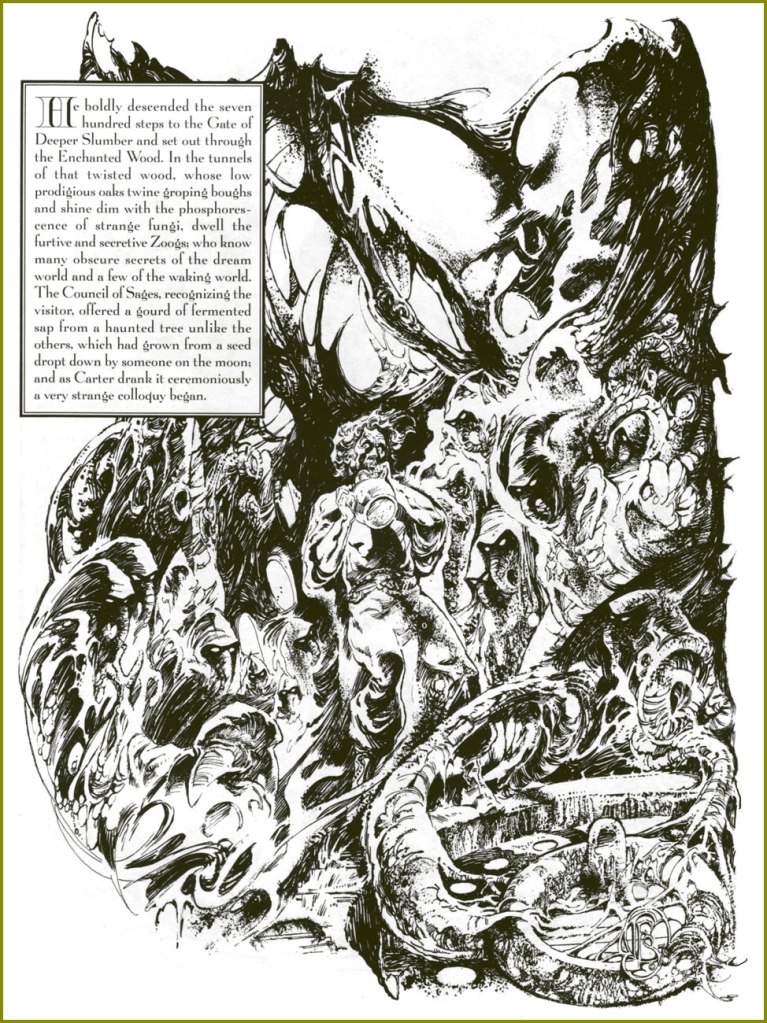
The Cover of H.P. Lovecraft’s The Dream-Quest of Unknown Kadath: a Portfolio (1978), with Tom Sutton illustrations of this classic Lovecraft tale.
One has to admit that the sheer horror on the face of the man stuck amidst all these suggested-but-not-quite-clear monsters is supremely convincing!
On the other hand, Richard Corben opted to for clearly defined monsters when he illustrated Dagon:
Page from Dagon, a Lovecraft story adapted and illustrated by Richard Corben, published in Haunt of Horror: Lovecraft no. 1 (August 2008, Max Comics). I like Corben’s art much, much better in colour, so this leaves me rather cold.
Art (once again by Corben) that was used as a cover illustration for Haunt of Horror: Lovecraft no. 1. Read the issue here.
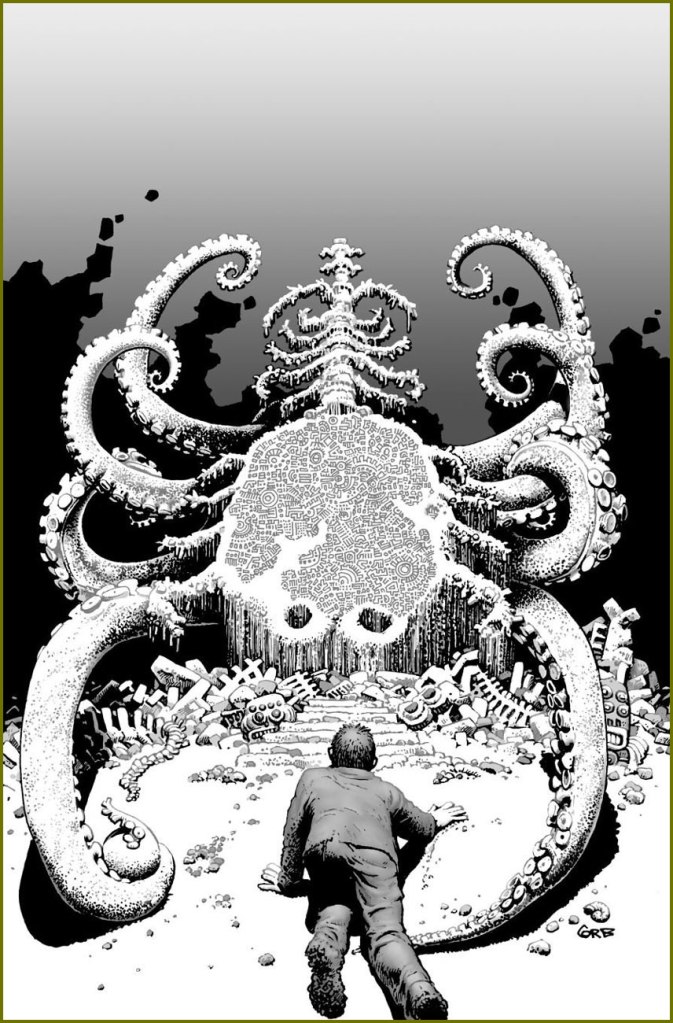
Lovecraft: The Myth of Cthulhu (2018, IDW). Cover by Esteban Maroto. Maroto did a very nice job of depicting out-worldly creatures in stark black and white, with just the right proportion between the well-defined and the merely suggested – have a look at the inside of this book over here.
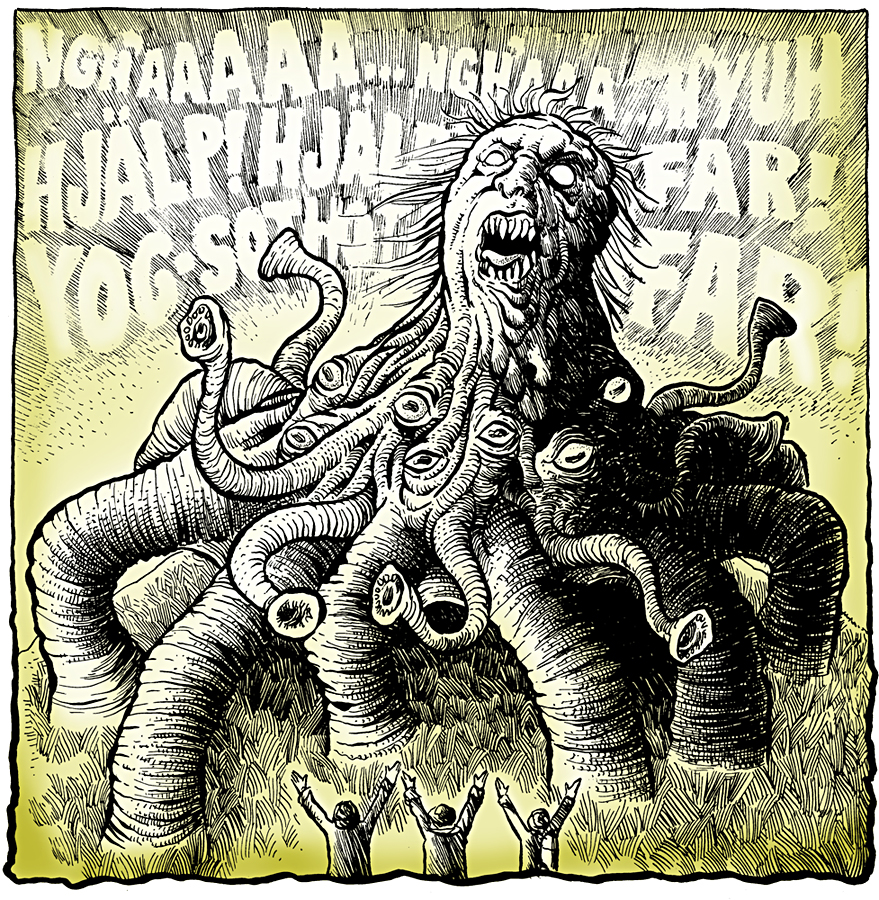
I’ll quote the artist, Richard Svensson: « This is actually a panel from my 10-page comic version of H. P. Lovecraft’s “The Dunwich Horror”. I did it for a small-press Swedish (mostly humorous) comic book Lovecraft anthology. Since there aren’t that many images around showing Wilbur Whateley’s mostly-invisible twin I thought I’d post my own attempt at portraying the unnamable.» A pretty good job, I think!
I don’t actually like Svensson’s art that much, with the exception of this comic, but I dig his animation work, for which he builds monsters out of clay! Watch Out of the Old Land, his latest from September, 2020.
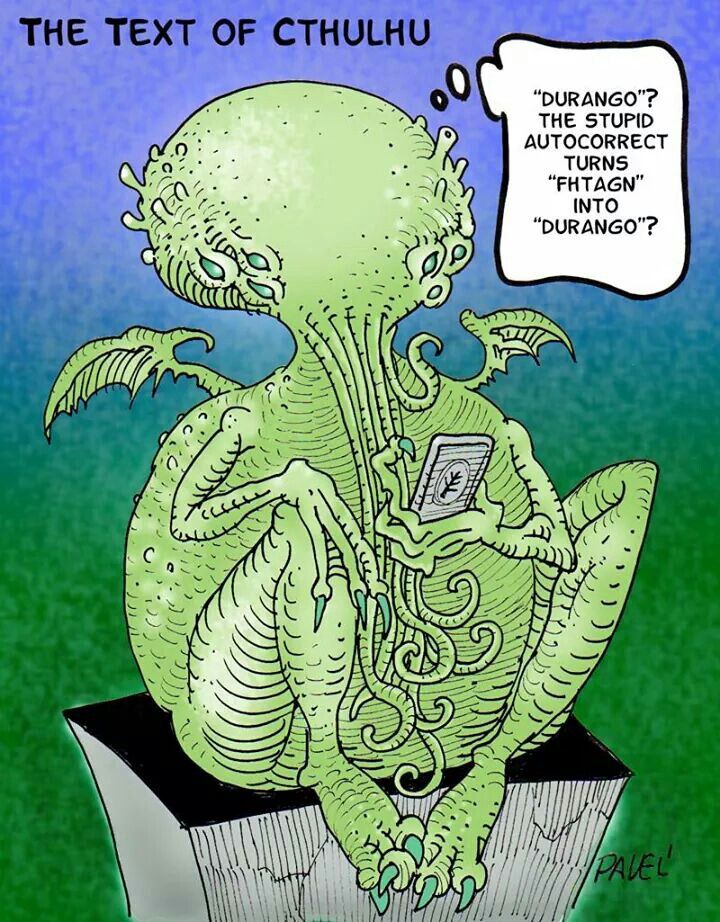
I mentioned earlier how the Great Old Ones have been repurposed as butts of jokes and tropes for memes. Well, I’m not here to share memes (other than very occasionally), but I do have a few nice illustrations-cum-cartoons to share.
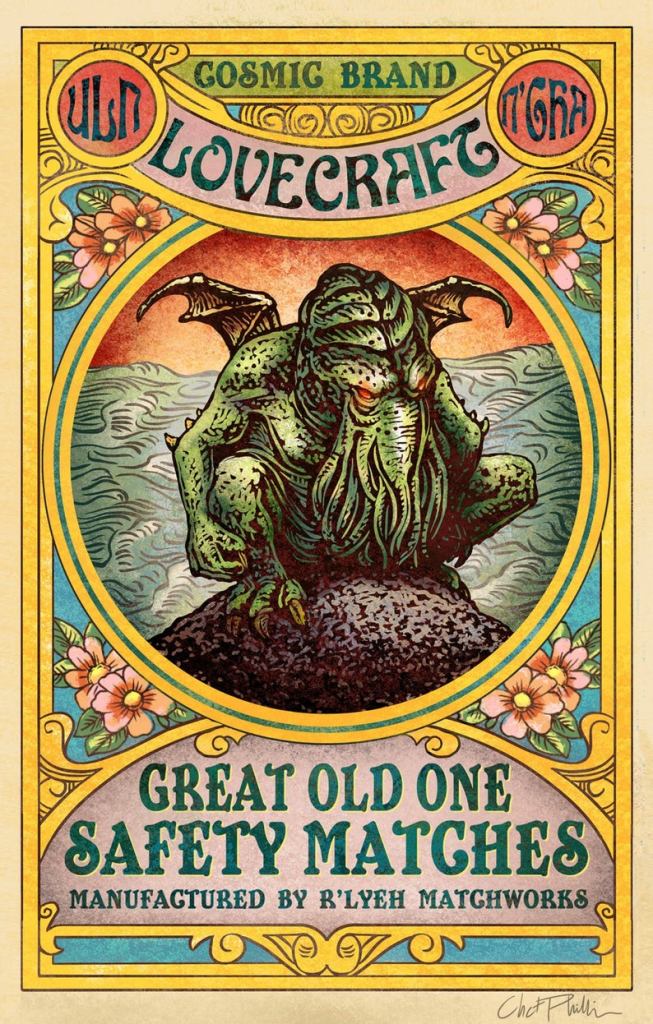
Matchbox design by Chet Phillips (2000); he has a done quite a few, and sells them as prints in his store. I haven’t really witnessed the age of colourful, stylish matchboxes, but I understand the people who collect them! It’s a very quaint and romantic topic.
One might call the illustrator and comics artist Kellie Strøm a bit of a cosmopolitan – born in Denmark, he grew up in Ireland and, in adulthood, made London his place of residence. He has accomplished much, but seemingly obtained little recognition for it – his graphic novel (The Acid Bath Case, 1992, published by Kitchen Sink), a collaboration with Stephen Walsh, seems to have been lost in the rivers of time, despite being a striking showcase of Strøm’s black-and-white, precise-yet-graceful style. He also has a great eye for colour, as becomes evident from a quick glance at Star Wars comics he’s illustrated (but does anybody read Star Wars comics?), or, in a much more pleasant and hopefully longer-lasting and farther-reaching vein, his paintings for children’s books.
A panel from The Acid Bath Case (1992, Kitchen Sink). These may not be tentacles per se, but as far as I’m concerned, they qualify!
Personally, I have a soft spot for his illustrations in glorious full colour – I believe that it’s a rare skill to be able to use a full rainbow palette and not end up with gaudy or downright ugly results. Let’s have a look!
That thing is soon growing up to be a tentacled monstrosity, but right now it’s all pretty colours!
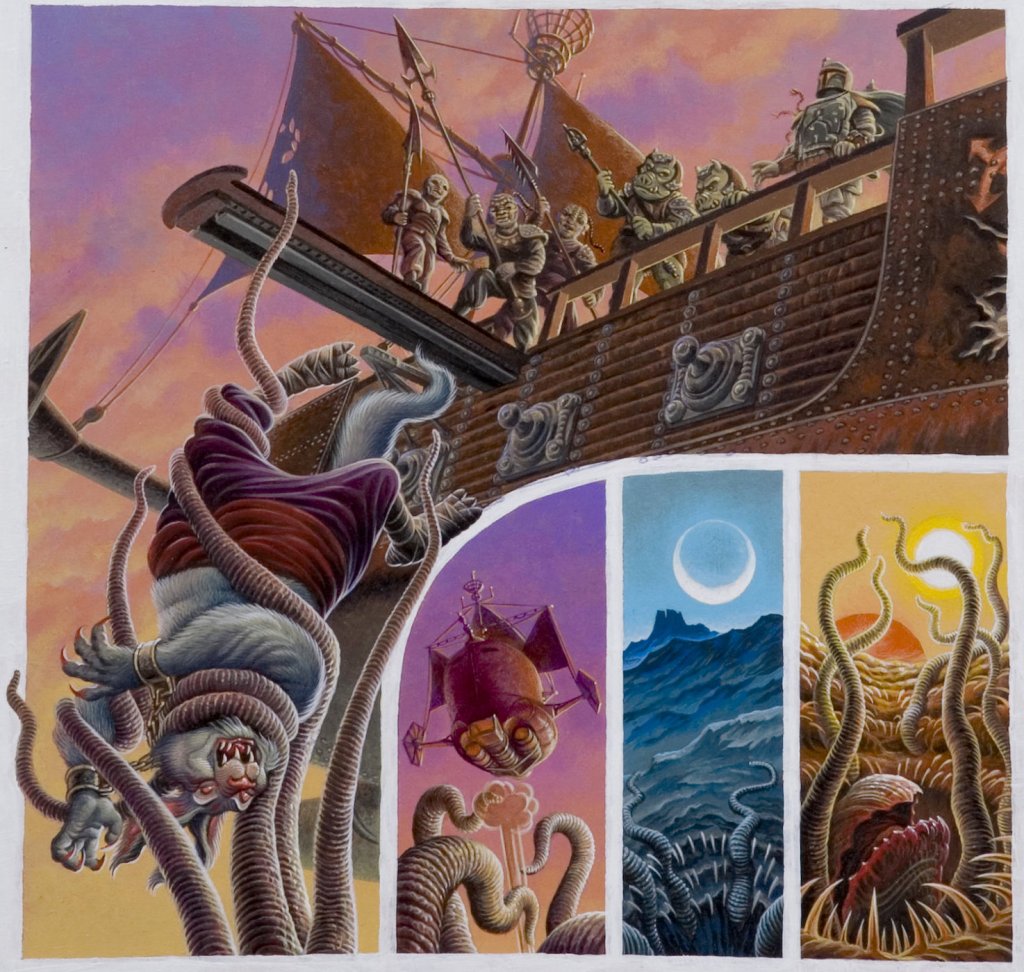
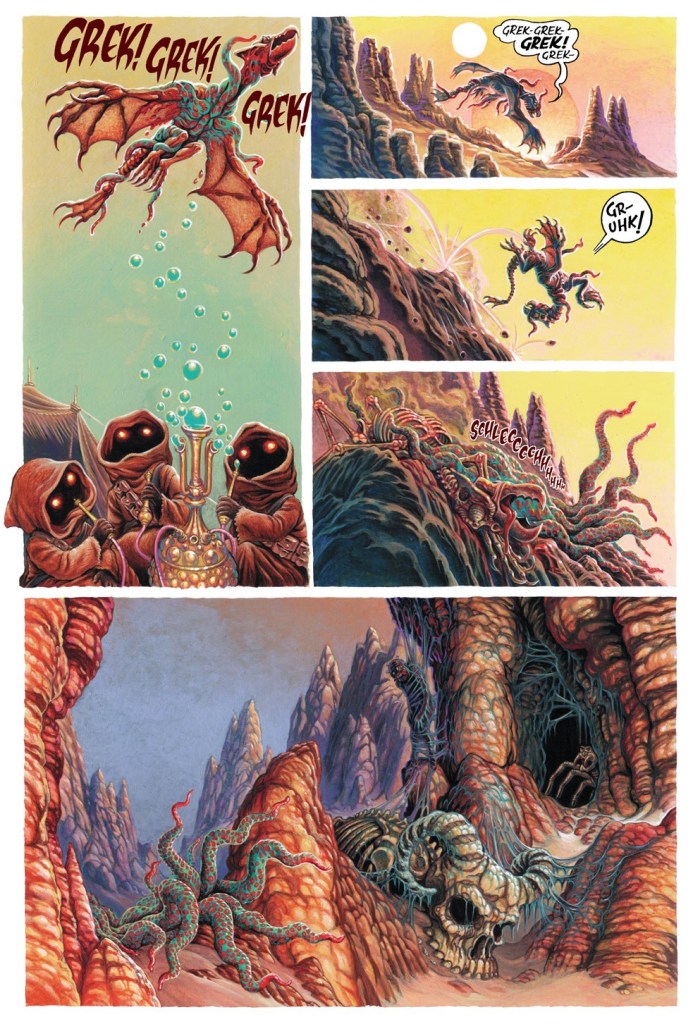
The following are pages from Fortune, Fate, and the Natural History of the Sarlacc, written by Mark Schultz and published in Star Wars Tales no. 6 (2000, Dark Horse). Watch an unfortunate victim plunge into the gullet of a merciless tentacled beast!
For comparison purposes: this is the original art…
And the following are pages from the printed comic:
I also mentioned Strøm’s career as an illustrator in children books. The results are beautiful, and, I sincerely hope, well-remunerated.
Panels from Het Zeemans – ABC (2008, Rubinstein Publishing) – or, in other words, Sailors’ ABC:
I didn’t have the heart to remove the copyright from this image! Visit Strøm’s website here. Look how many delightful tentacles one can squish into one panel!
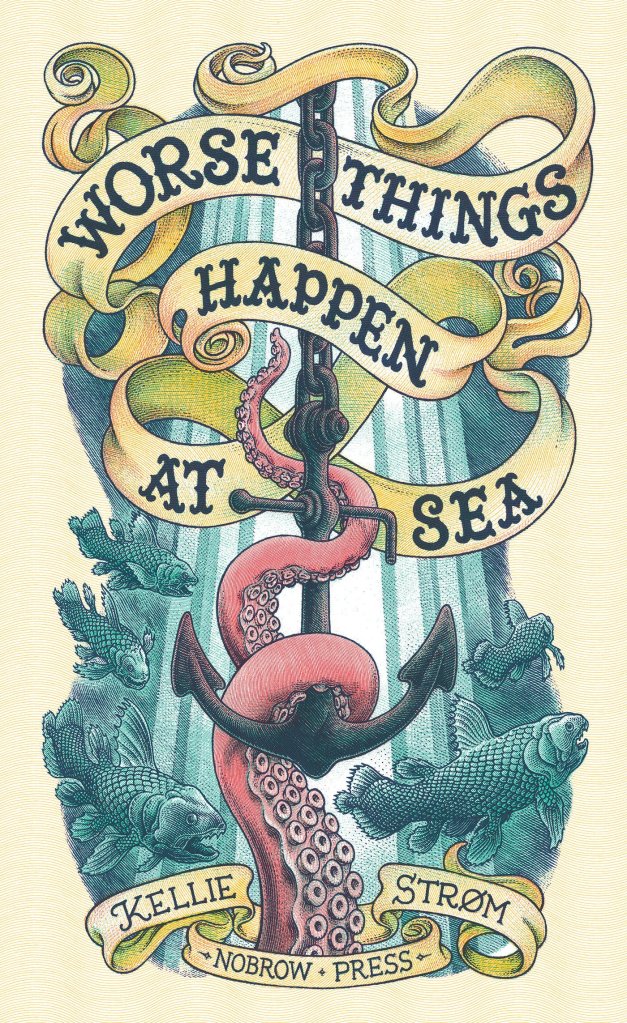
2014 saw the release of the tentacle-wealthy Worse Things Happen at Sea(Nobrow Press), in which « historical ships are attacked, enveloped and engorged by monstrous sea creatures surfacing from the deepest depths of the darkest oceans. » Must be Strøm’s Nordic roots re-surfacing, though apparently he cannot swim!
I’d like to thank my Italian collega for making sure this title was in impeccable Italian, and for not backing away slowly when I asked her, completely out of the blue and without context, how to say “pardon my tentacle”. Most people would have run.
Welcome to our Latin Tentacle Tuesday! Poor Italy is the brunt of quite a few jokes, and even most positive articles about it are nothing but shallow fluff designed to sell airplane tickets and inspirational posters about food and love. All I can say is that Italians love their tentacles as much as any other hot-blooded nation. 😉
Più was a comics magazine licensed from Pif Gadget in 1982. Just like its fountainhead, Più offered a gadget with every issue, which, as I understand from nostalgic posts about it on various blogs, was a prime selling point among its young and enthusiastic clientele. As for comics, reprints of some French comics straight from Pif’s pages were rounded out with fresh Italian material. Given that Pif was publishing quite a few Italian artists at that time, this only seems fair! And on the subject of the latter, co-admin RG, whom I may call a Pif historian with no fear of controversy, has written a number of posts about the writers and artists featured within Pif Gadget’s pages during its heyday… a good place to start digging in is my favourite of these posts, Jean Cézard and Arthur le fantôme.
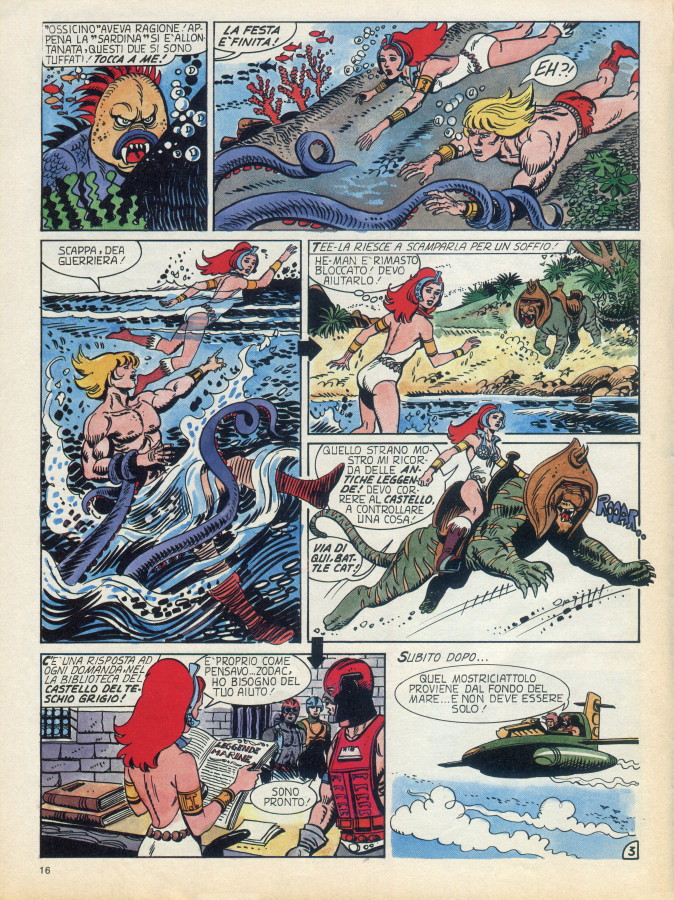
Moving on: the following Masters of the Universe pages are from Negli Oceani di Eternia, published in Più no. 76 (March 1984, Editoriale Domus).
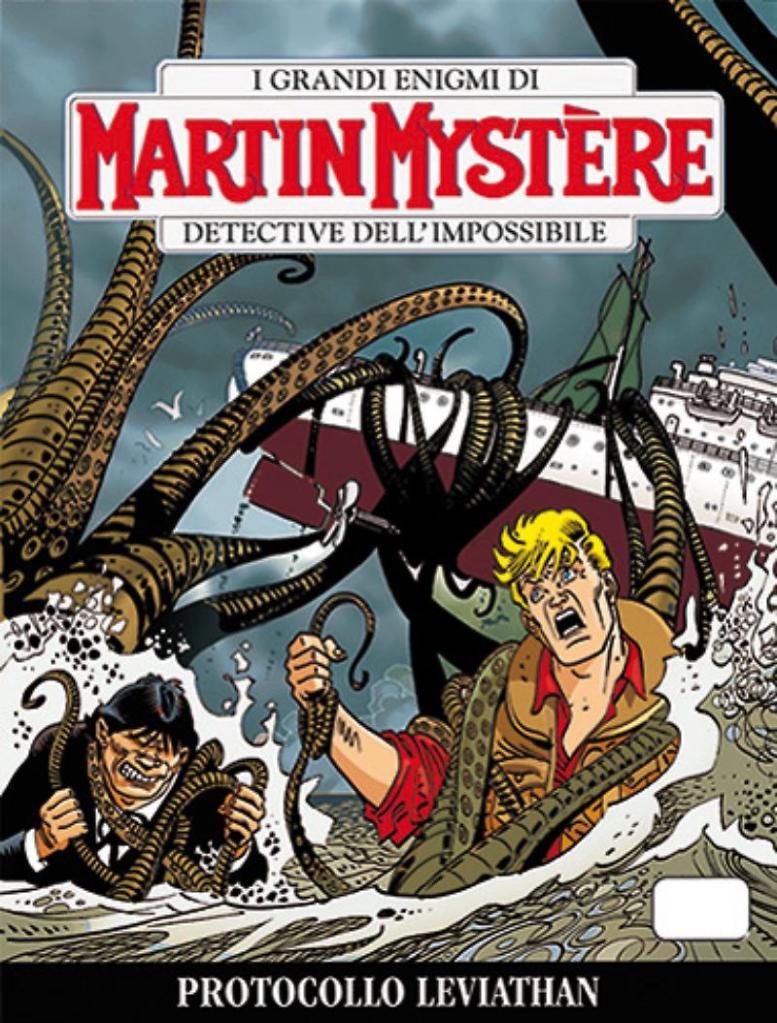
Created by writer Alfredo Castelli and artist Giancarlo Alessandrini, Martin Mystèreis an exceedingly popular comic book series (as a matter of fact, the best selling comic book in Italy – in case you’re wondering what that means, around 20 thousand copies a month)*. Its title comes from the eponymous main character, Martin Jacques Mystère, the usual walking collection of tropes: good looking art historian, archaeologist-anthropologist à la Indiana Jones, collector of rare objects, and so on. No self-respecting adventurer goes around without a sidekick, and Mystère’s assistant is Java, an amazingly strong, quite mute Neanderthal man (speaking of tropes, that one is a doozy). One might also say that he’s quite international: an Italian-created American character with a French name who lives in New York City and frequently helps its finest to elucidate crimes…
*I stand corrected by one of our readers, who pointed out that Italy’s most popular comics series is Tex, which sells around 200 thousand copies a month (compared to Martin Mystère’s 20 thousand). Thanks, Darko!
Martin Mystère no. 103 (October 1990). Cover by Giancarlo Alessandrini.
Martin Mystère no. 328 (August 2013). Cover by Giancarlo Allesandrini.
This series started in 1982, and is still around, so you can just imagine how many tentacles Martin has tangled with in some 378-odd issues. Yet high-res images are scarce online, so I asked co-admin RG to whip up this nifty collage of some of his tentacular exploits:
Issues no. 163, no. 181, no. 237 and no. 297, with covers by Giancarlo Allesandrini.
Our next (and last stop) is another very popular series, Zagor. Its beginnings go all the way to 1962 (ancient, no doubt), when editor/writer Sergio Bonelli and artist Gallieno Ferri banded together to concoct a comic book series.
Its protagonist Zagor, or Patrick Wilding, is another American. If Martin Mystère represented the suave, erudite adventurer-about-town, Zagor is a kind of avenger-slash-protector, of the “be peaceful or I’ll beat the crap out of you” school. His origin story makes for rather uncomfortable reading: after tracking down massacring a whole family branch of Abenaki Indians to avenge his parents’ death and realizing that he made a boo-boo (by finding evidence that his father was a murdering, power-abusing sadist who was killed purely in retribution for his criminal acts… which is another can of worms), he decides to redeem his sins by ensuring peace between different Indian tribes and trappers by whatever means necessary.
Zagor no. 42 (December 1968), illustrated by Gallieno Ferri and written by Guido Nolitta (Sergio Bonelli’s nom de plume).
Inside art from Zagor no. 42, illustrated by Gallieno Ferri and written by Guido Nolitta.
His sidekick? Chico, a walking stereotype down to his full name (Chico Felipe Cayetano Lopez Martinez y Gonzales) whose presence is played for some mean laughs. «He is short, fat, extremely clumsy and voracious, corrupt, boastful, but also likeable.» Um, yeah, that sounds likeable, all right. If you’re thinking that Chico is also obsessed by food (he’s Mexican and fat, right?) and that it gets him into all sorts of stupid peril, you are perfectly correct. Gordo, this is not.
Interestingly, Zagor is most popular outside of his native Italy. Specifically, he retains popularity in the former Yugoslavian republics (Bosnia, Herzegovina, Slovenia, Croatia, Serbia…) and Turkey. Stories continue to be published in Italian up until this day, but from what I’ve been able to gather, the books sell at a much brisker pace once they’re translated to languages spoken by inhabitants of the aforementioned countries.
Zagor no. 626 (September 2017). Cover by Alessandro Piccinelli. Okay, so those are not tentacles per se, but it says TENTACOLI! right on the cover, so I’m not arguing.
Zagor no. 662 (September 2020). Cover by Alessandro Piccinelli.
« My imagination grew wilder, the most unexpected associations flared up in my mind, and as I kept trying, the reception room kept filling with strange objects. Many of them were born, apparently, out of the subconscious, the brooding jungles of hereditary memory, out of primeval fears long suppressed by the higher levels of education. They had extremities and kept moving about, they emitted disgusting sounds, they were indecent, they were aggressive and fought constantly. I was casting about like a trapped animal. All this vividly reminded me of the old cuts with scenes of St. Anthony’s temptations. » [source]
Today’s topic does not involve a man becoming a cockroach: that has been discussed often enough. My current area of interest concerns the many strange and striking ways in which a living form becomes a completely different form under the influence of a supernatural power or its natural inclination, of witchcraft or the whimsy of a writer whose imagination flares up much like it did for poor A. I. Privalov, depicted above trying to create a a sandwich and a cup of coffee and ending up with a roomful of horrors…
This strange creature surely illustrates the perils of getting stuck mid-metamorphosis!
The Doom Patrol no. 95 (May 1965). Cover by Bob Brown. While transforming into god-knows-what, Dr. Sven Larsen is careful to preserved his impeccably coiffed chevelure. Perhaps he inspired Ted Baxter.
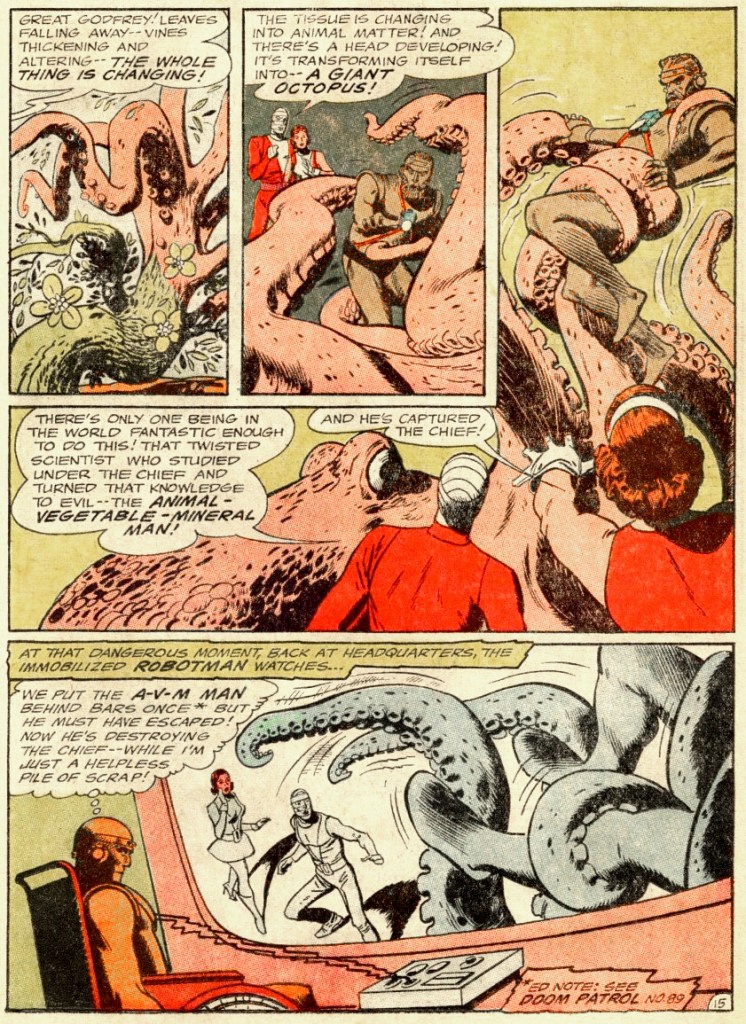
In Return of the Animal-Vegetable-Mineral Man, scripted by Arnold Drake and illustrated by Bruno Premiani, the Doom Patrol battle a scientist crazed with power-lust (while dealing with trouble of their own, like being unable to control their powers – it was apparently decided that a scientist who can become anything he likes is not interesting enough).
That this AVM (animal, vegetable, mineral) man decided to transform into an octopus will not surprise regular readers of Tentacle Tuesday: we know that the octopus is the most perfect form there is!
In the rest of the story, AVM also transforms himself into electric eels, tungsten birds, a building-tall neanderthal man, liquid mercury, a grizzly bear, etc., but it’s all a bit of a let-down after the giant octopus, if you ask me.
I’ll continue with this rather evocative cover by Bernie Wrightson, in which we get a preview peek at a gruesome scene just a few seconds before it actually happens.
House of Mystery no. 204 (July 1972). Cover by Bernie Wrightson.
It all starts with a nasty dream of cranberry jelly…
… and ends with an unwelcome transformation of future bride into hungry monster. In this case, a pretty girl is not so much like a melody, but yet another helping of aforementioned cranberry jelly… perhaps I should have kept this story until Christmas.
All in the Family was scripted by Mary Skrenes and Bernie Wrightson; illustrated by Bernie Wrightson.
If this story of transmogrification made your teeth itch, just have a gander at the following histoire d’amour…
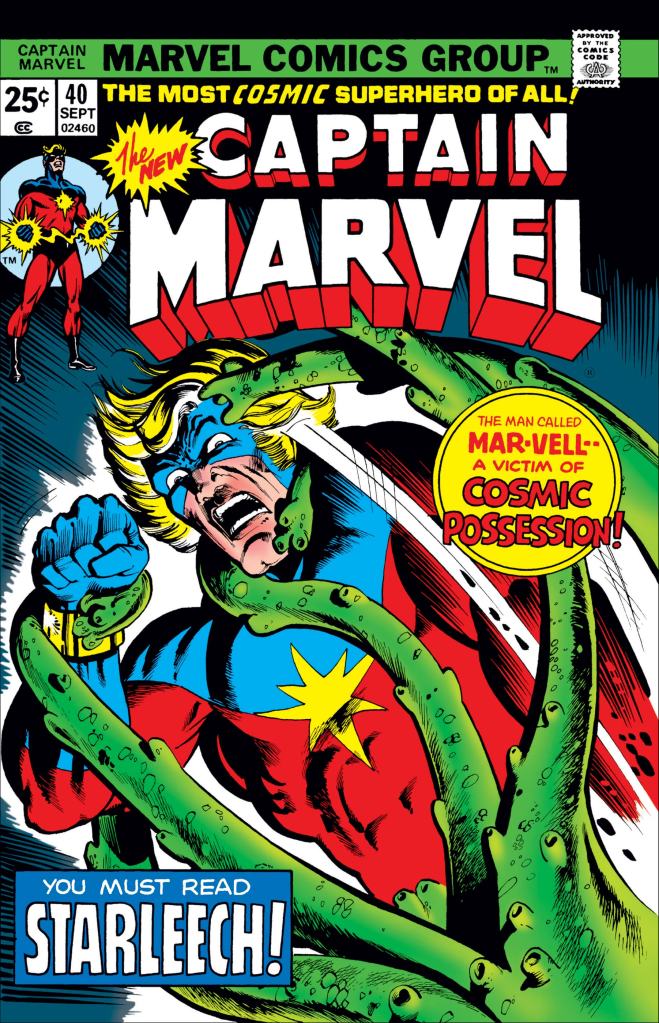
Captain Marvel no. 40 (September 1975). Cover pencilled by Al Milgromand inked by Klaus Janson.
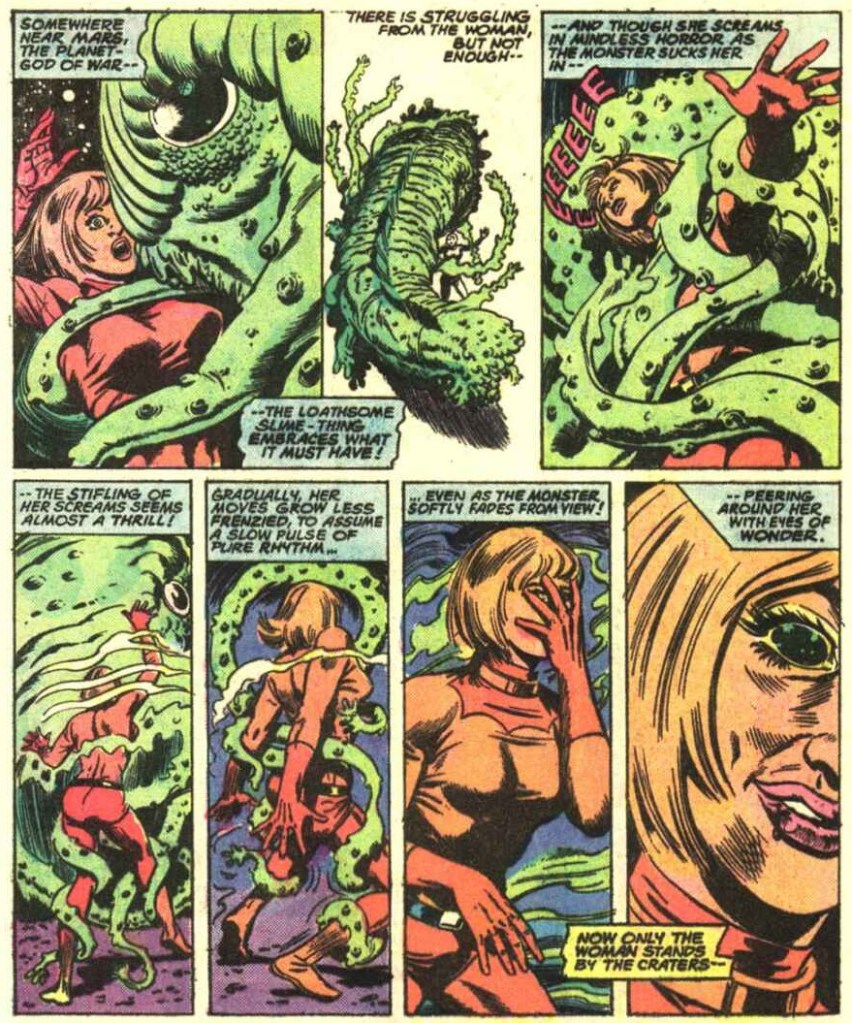
No, hold your horses, I’m not implying anything untoward about Captain Marvel. That thing he’s tangled up with is his lover (or should I say ex-lover) Una. Just a little case of demonic possession!
Um, those are not “eyes of wonder”, more like a demented gaze.
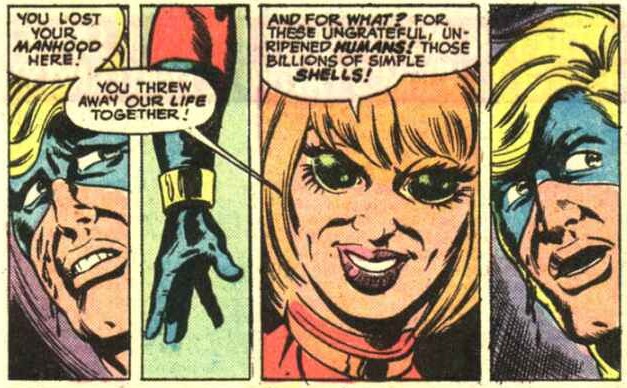
Will Captain Mar-vell be able to kill the woman he loves, even if she’s more of a shell inhabited by a tentacled psychic monstrosity, and despite having lost his manhood, whatever that was?
Stay put for the exciting finale of Rocky Mountain ‘Bye! was scripted by Steve Englehart and Al Milgrom, pencilled by Milgrom, and inked by Al McWilliams!
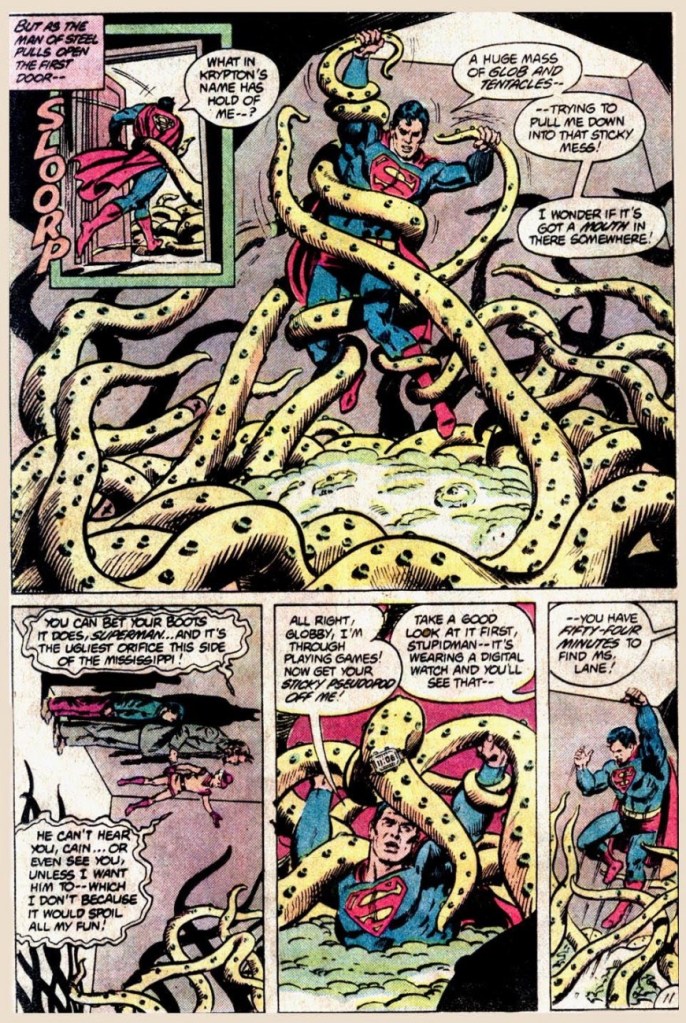
What do we have here? A harmless trick-or-treating kid transformed by Mr. Mxyzptlk into a malefic octopus? It’s business as usual for Superman in this goofy tale (who, incidentally, was the star of Tentacle Tuesday: It’s a Bird! It’s a Plane! It’s a Tentacle!) I’m sure most children would relish the opportunity to become an actual ghost or werewolf…
But I am not convinced that anybody would want to be transformed into, err, “Globby”.
Nothing as stylish as an octopus with a digital watch.
These pages were from The Haunting Dooms of Halloween!, scripted by Dan Mishkin, pencilled by Curt Swan and inked by Tony de Zuñiga, published in DC Comics Presents no. 53 (January 1983).
… in which we continue our exploration of tentacles slithering their way into Franco-Belgian comics!
In an orderly fashion, please.
The other day, a friend heartily recommended a certain movie to me, pointing out that it was ‘ancient’ and therefore probably available online for free. When I checked the year, it turned out to have been from 1995 which, excuse me, hardly qualifies as prehistoric. What can be considered ‘old’, then, people in their early thirties will ask? Why, this magazine cover, for instance.
Le Petit journal illustré (May 21st, 1922). The bottom says “a drama at the bottom of the sea”, with details of how a diver was attacked by an octopus and cannot get out his knife to fight against his repellent aggressor.
Skipping some thirty years ahead, I believe we’re still in “old” territory.
A page from « Zette reporter : Aventure en Pacifique », published in Lisette n° 38 (September 16th, 1956). Script by François Drall, illustration by Yvan Marié. The girls, after witnessing a fight between a giant shark and octopus, now seek to escape the clutches of the victor’s eight appendages.
Lisette was a comics magazine specifically aimed at female readership (to be more precise, it was marketed to girls between 7 and 15 years old). The interesting part is that it often featured articles about traditionally men-dominated careers, some of which had only been very recently accessible to women… for instance, an interview with Anne Chopinet (one of first women accepted in l’École polytechnique) and a reportage on women air pilots back when this was an almost exclusively man-only club.
Moving on to further, more energetic octopus-evading tactics… we have Bob Morane, originally a hero harking from adventure books written by prodigiously prolific Belgian novelist Henri Vernes, and published by Belgian éditeurMarabout. The number of adventures Morane has lived through is rather staggering: around 200 novels + about 80 comics albums. Now there’s a challenge for the serious collector!
Original art fromBob Morane et l’oiseau du feu(1960). Illustrated by Dino Attanasio.
Scripted by Antoine Raymond (a.k.a. Vicq), illustrated by Will, 1962.
Co-admin RG called André Franquin‘s œuvre “an embarrassment of riches” in his Faites gaffe, monsieur Franquin! post. I thoroughly agree, and am very pleased to report (though this is in no way surprising) that tentacles are part of his vast répertoire.
Pages from what’s collectively known as Idées noires (Franquin’s Last Laugh in English). These dark strips and cartoons were Franquin’s « l’humour du désespoir », the humour of despair, and appeared in Le trombone illustré (Spirou’s magazine supplement) in 1977 and, with the discontinuation of the latter, moved to Fluide Glacial until 1983.
I’d better stop here. After all, I wouldn’t want to go as far as ‘modern’ times… say, from the 90s and onward, although it’s scary to think that was still 30 years ago!

































 Who's Out There?