Hallowe’en Countdown VIII, Day 11

« … devolving into a downright National Socialist muck of murderous paranoïa, a Lord of the Flies for our new century… »

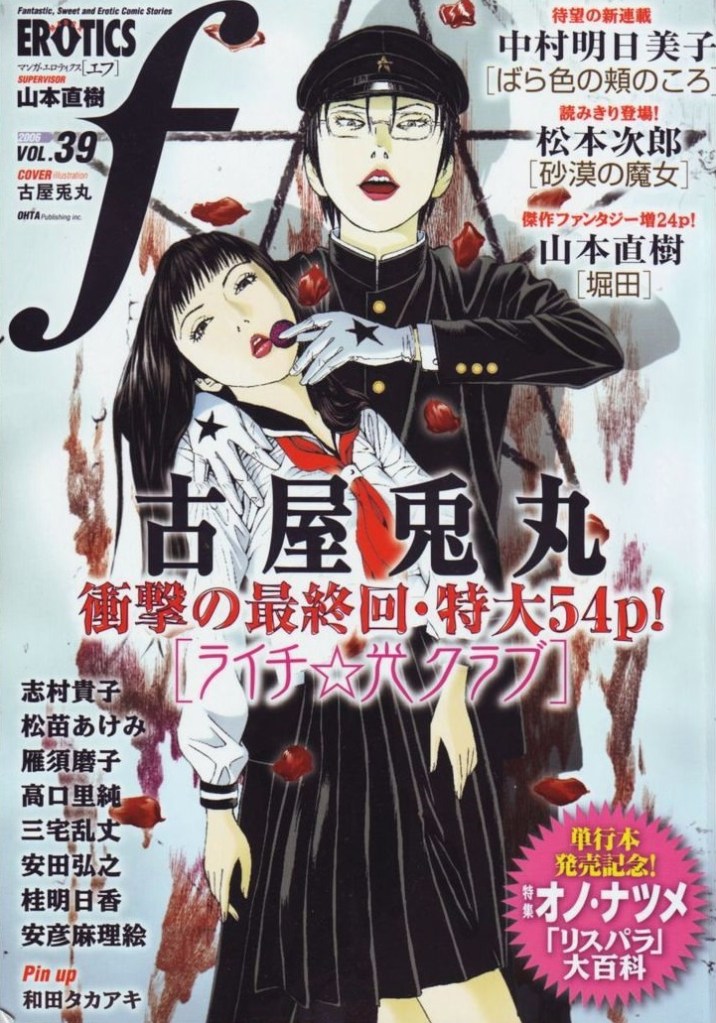
Lychee Light Club, aka Litchi Jirai Club (ライチ☆光クラブ), is a manga written and illustrated by Usamaru Furuya, who was smitten by a theatre play of the same name after watching it in 1985 as a high school student. Years later, he recreated it in manga form, albeit with a somewhat modified plot. It was serialized in Ohta Publishing’s Manga Erotics F* (May 7, 2005 – May 3, 2006). As for the play, it was directed by Norimizu Ameya** for the theatrical group Tokyo Grand Guignol (it’s funny to see the French ‘guignol‘ in this context).

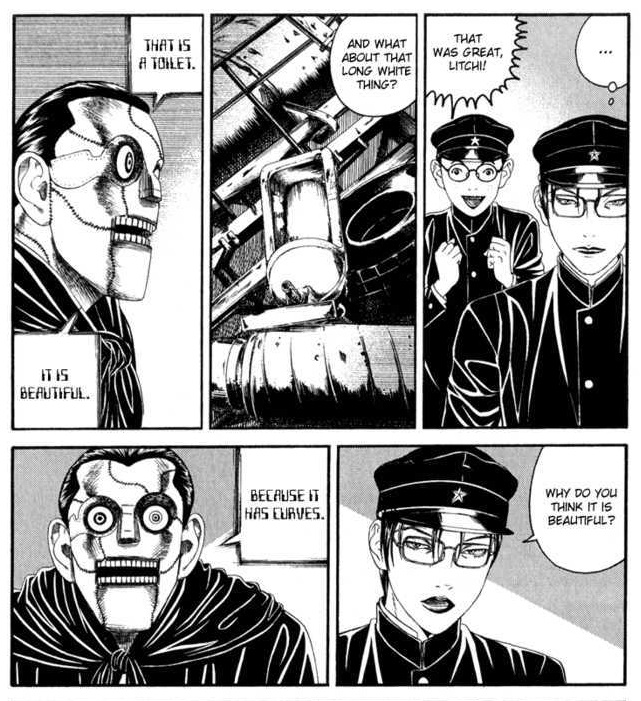
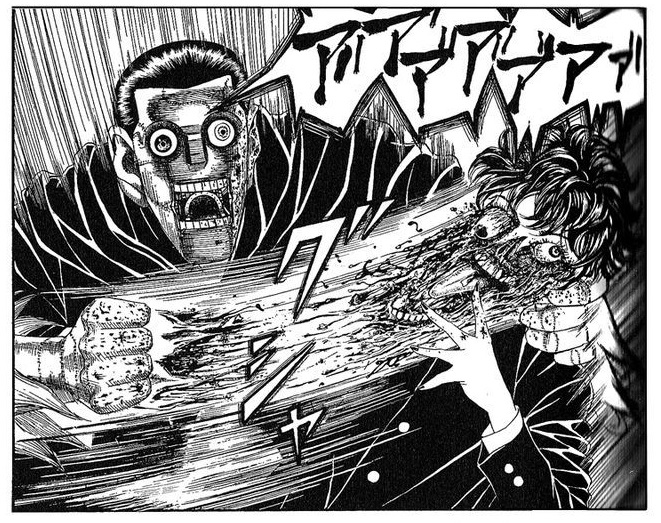
Lychee Light Club‘s over-the-top violence elicits the occasional chuckle (one of its characters dies from somebody pitching a toilet through his midsection), and more than one wince of discomfort, too, as its schoolkids maim, bash and burn their way through the story. The premise is simple – Lychee Light club (more of a cult, really) consists of eight barely-teenage boys who worship youth as the ultimate symbol of beauty (and, consequently, hate all things adult). They have nice digs where they spend all their time after school – an abandoned factory with plenty of dumped implements useful in their pursuit of the sadistic. They are led by the charismatic and cunning ‘Zera’ (actually, Tsunekawa from class 2), whose charm and fine features inspire blind devotion from his gang, not to mention occasional sexual favours.

To pursue their vision of eternal youth and a universal, if unfocused, lust for power, the posse builds a mostly robotic ‘thinking’ machine-cum-Frankenstein-monster, all metallic parts except for a human eye ‘borrowed’ from Zera’s number Eins, Niko. Zera informs his crew that he planted lychee seeds in a landfill three years ago… and now they have a forest of trees heavy with fruit at their disposal as fuel for Lychee, their mechanical prodigy. Apparently Zera is also a brilliant agriculturist, for lychee trees are notoriously slow to bear fruit, and three years later he’d have a forest of greenery at best. ***

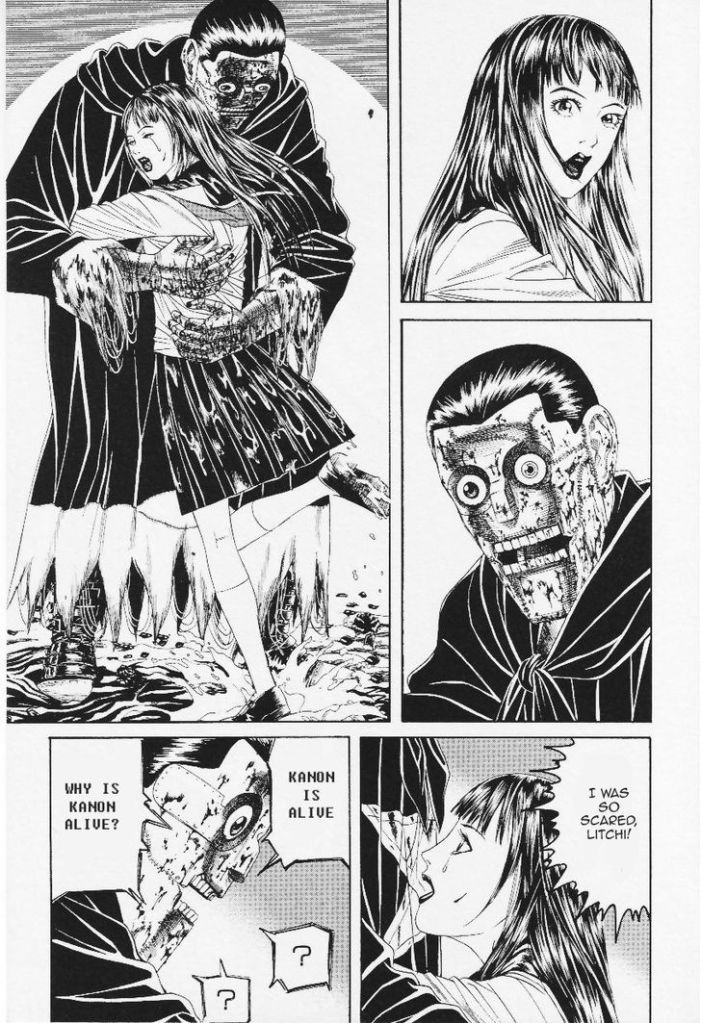
Lychee awakens! When questioned about why he is born, Lychee’s computer algorithm spits out that its mission is ‘to capture a girl’, so off he goes to kidnap many until he finds one beautiful enough to be their ray of light, eventually bringing Kanon, the female protagonist.

The story’s settings immediately plunge the reader into a kind of claustrophobia – filthy streets, a sooty factory, trashed cars — clearly an industrial town which doesn’t offer much hope for a better future. The boys’ lives outside the club are barely discussed, but the story hints that they all come from an uncomfortable family situation, though apparently they’re all ‘good kids’, as their maths professor incredulously notes before she is gleefully tortured and murdered.

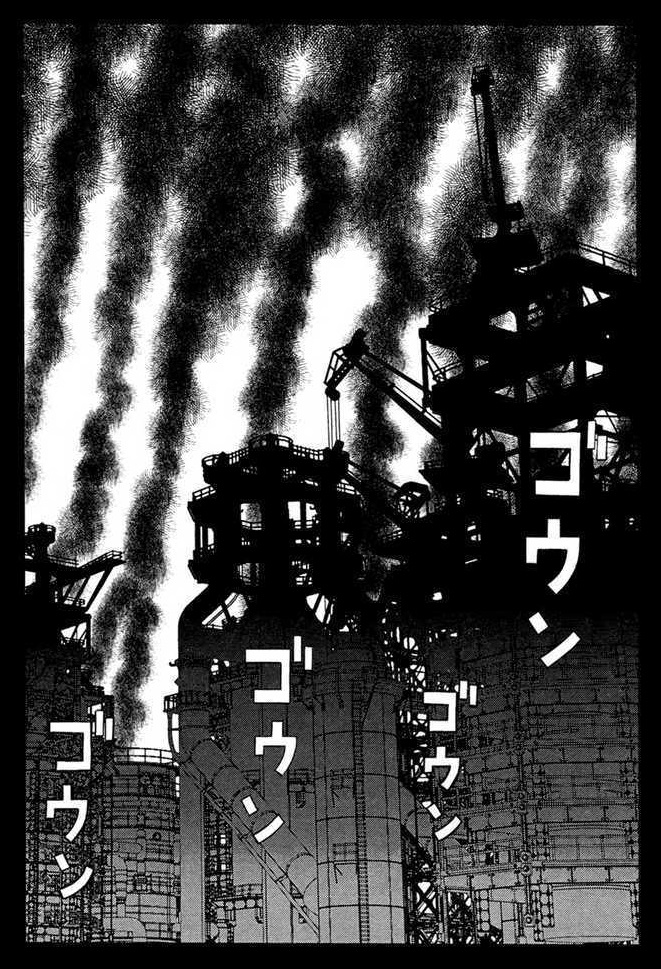
Don’t forget to read right to left! Much later, in a fit of poetic justice, Zera gets killed by a toilet with (doubtlessly) beautiful curves.

There is a strong current of body dysphoria running through Lychee Light Club, fitting for a set of characters so fixated by ‘beauty’. The megalomaniac Zera is obsessed with Elagabalus, a Roman teenage emperor known for his sexual decadence (apparently to the point of standing out for his outlandish vices among other Roman emperors centuries later, which is surely a feat of some kind, given what some of them got up to). 

In a sort of Peter Pan/Neverland situation, the boys are nauseated by the sight of an adult woman’s body (her breasts are qualified as ‘repulsive, swollen lumps of fat’), and horrified by her ‘ugly’ innards, wondering whether their own organs are ugly, too (plot spoiler: they are, indeed). They obsess over Kanon, the eventual heroine of the story, because she’s soft and beautiful (but hasn’t turned into a woman yet). Kanon herself doesn’t want to grow up because she’s worried Lychee (at that point ‘humanized’ by her love) will reject her adult self. 
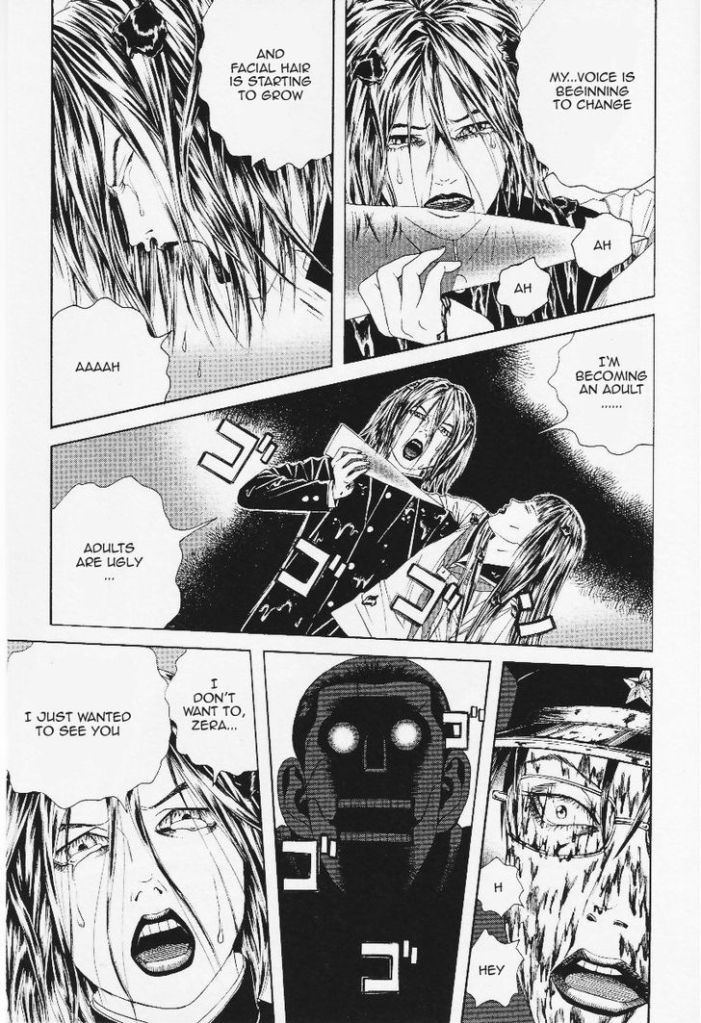
All of them need to urgently get to therapy, but instead of that eyeballs are ripped out, innards (not to mention semen) are spilled, and the whole thing ends in an utter bloodbath, leaving the only ‘innocent’, Kanon, mourning Lychee, who is now more ‘human’ than the members of the Lychee Light club because he understands that murder is wrong. Reading this manga is a bit like observing a train wreck. Nothing in this story is nearly as profound as it pretends to be, and plot holes bloom much like lychee flowers — and yet its mostly naïve characters stick in one’s mind. Poor, poor children.
« …a mere plaything, having feelings! »

~ ds

* Speaking of the erotic… a quick perusal of blurbs quickly yields ‘Shocking, sexy and innovative, the Lychee Light Club is at the pinnacle of modern day Japanese seinen manga (young adult comics)‘, with which advertisement I have several bones to pick. ‘Sexy’ is an uncomfortable description of a manga with sadistic violence and heavily underage protagonists, though eroguro fans probably lap the former up. As for the ‘young adult comics’ bit, I’d like to submit a petition to stop assuming that stories about teenagers are meant to be necessarily read by teenagers. Should ‘old’ people read exclusively about the elderly? One can argue that adults aren’t so interested in reading about to-be-adults (my case in point, Wheel of Time book one, which I recently read, and whose adolescent protagonists were intensely annoying), but that speaks more to a lack of storytelling ability.

** Who’s had a wild enough (perhaps ‘unhinged’ would be a better description) life that he would merit an entire article by himself (see a summary here).

*** As far-fetched as this plot is is, the anime by the same name (loosely based on the manga) is hilariously goofy where the manga was highfalutin. Take the plot of episode number 6, in which ‘Some members of the club wonder if Lychee really only runs at lychee fruit and then offer him a peach. As he accepts it, they give various other foods and eventually Lychee develops culinary skills.’

Folk-Artist: Hua Junwu and the National Style

Hua Junwu (華君武, 1915-2010) hailed from Hangzhou. He was born during a hectic epoch — life tossed him around quite a bit, but unlike a lot of his contemporaries, he was able to navigate through these changing times with dry feet. He had been drawing since his school days, but the seeds of his artistic career were sown around the time he moved to Shanghai to become a student at Utopia University, where he first began submitting his cartoons to magazines for publication, as well as meeting like-minded artists.

A year after the Second Sino-Japanese War started, in 1938, he left the Japanese-occupied Shanghai for Yan’an (the seat of the Communist government at that time) and worked at the Lu Xun Academy of Literature and Art, also contributing anti-Japanese propaganda cartoons to publications like Jiefang Daily. Japan formally surrendered in 1945, but the same year saw an escalation of the struggle for power between the Nationalists and the Communists, which signalled the start of the Third Chinese Revolutionary Civil War. Hua travelled through Northeast China, working as a reporter and cartoonist for Northeast Daily. 1949 saw the founding of the People’s Republic, and Hua joined People’s Daily as the head of its art department, and the China Artists Association as its Secretary-General in 1953.

In his introduction to Selected Cartoons of Hua Junwu (New World Press, 1984), Hua credits German artist E. O. Plauen (see Circus Acrobats of Life: E. O. Plauen’s Father and Son) as one of his main artistic influences. I was amused that the other artist who had Hua’s utmost admiration was Georgi Sapojnikov, a former officer of the Russian Imperial Army who occupied the spot of daily cartoonist in North China Daily News, working under the pseudonym Sapajou*.

There was considerable difference between rural Yan’an and sophisticated Shanghai, and this change of scenery is what shaped the artist’s style into its distinctive form. To quote Hua, « Shanghai in the 1930s was a cross between a colonial and feudal society, a special territory where Chinese and foreigners lived cheek by jowl. As I had learned so much from foreigners’ cartoons, my own cartoons were inevitably rather foreign in flavour. Fortunately, the only people who paid any attention to cartoons in the Shanghai of those days were, I suppose, a few intellectuals who were also foreign influenced, so I was able to get by. » After his move to Yan’an in the late 40s, Hua found his audience changing from the aforementioned ‘few intellectuals’ to a readership of mostly peasants, who found his foreign-based style alien and hard to understand. Feeling like ‘a round peg in a square hole’ and heavily influenced by the writings of Mao Zedong, Hua adopted a philosophy of ‘national style’, ‘the Chinese style and spirit which the common people of China love‘, for which he is now fondly remembered.

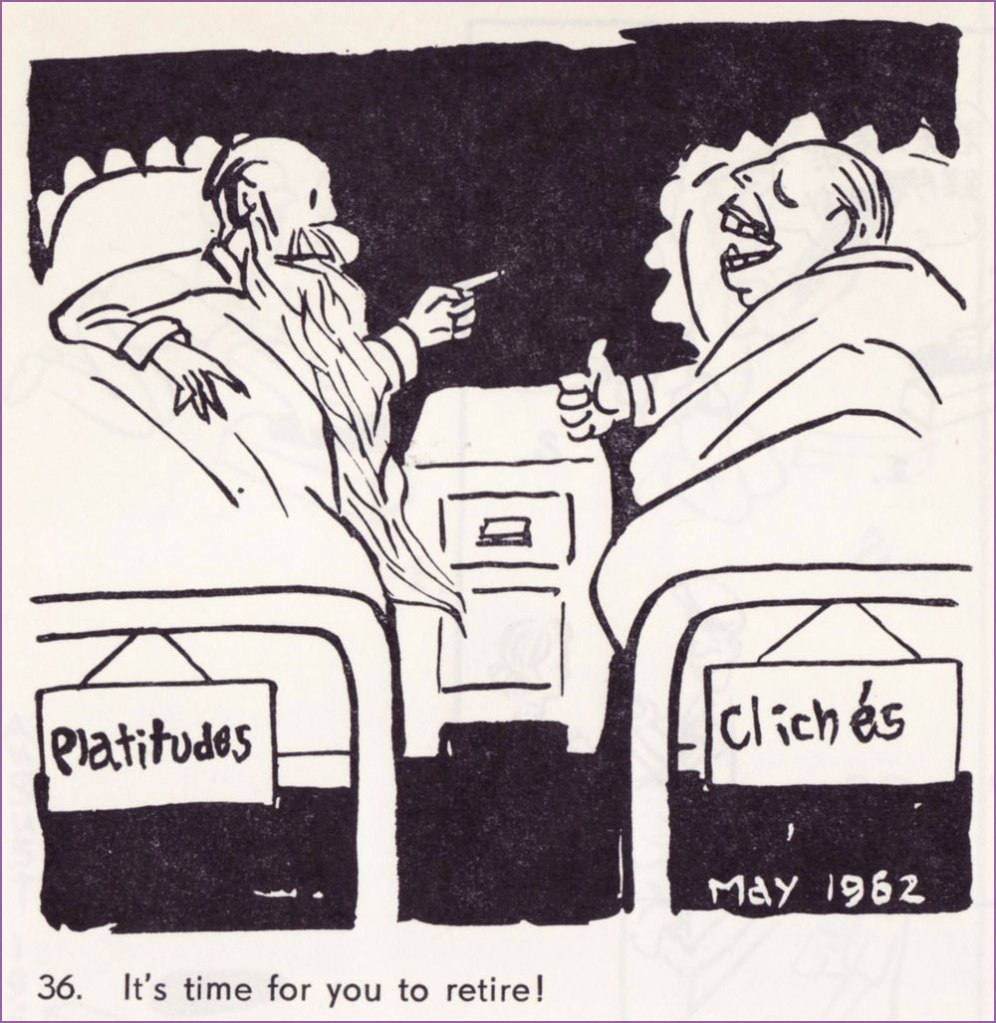
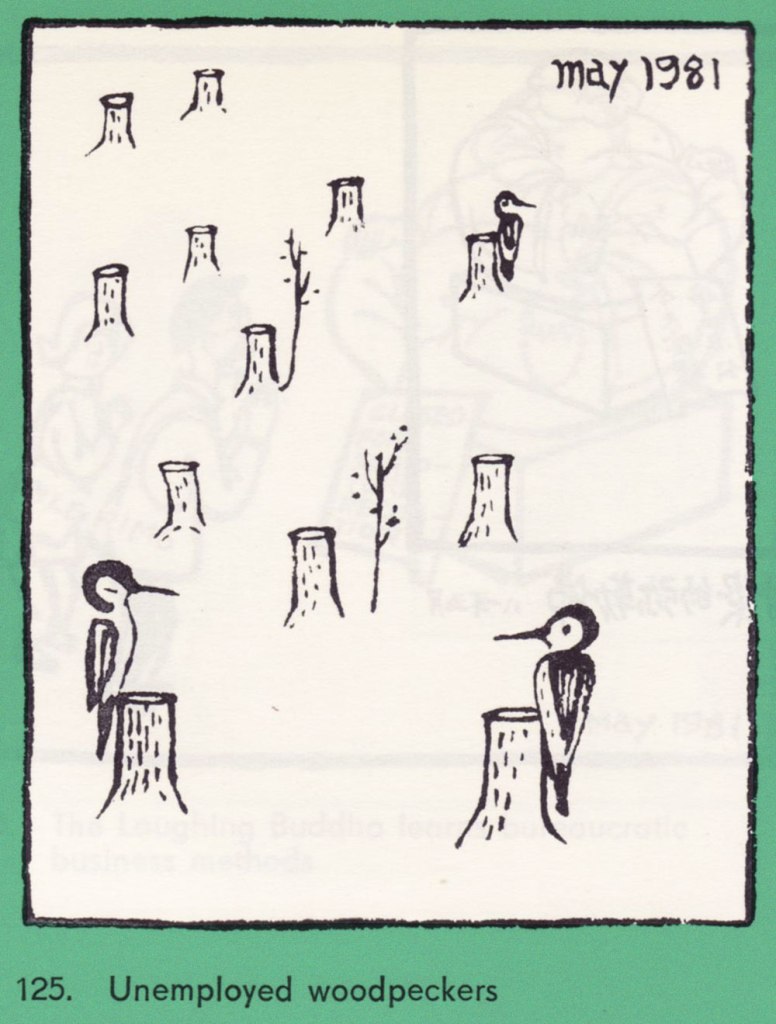
This collection, as noted on the cover, is bilingual – the cartoons in Chinese are included on the left, with their English translations on the right (Hua Junwu drew the English letters himself, to keep their Chinese flavour). However, in interests of intelligibility, we are just including the translated versions.

I just wanted to share some fun cartoons, but this post once again dragged me into the 20th century and its bloodshed, as well as the history of communism (this time from a Chinese perspective). Some topics are rich veins to mine, full of interesting filaments that lead to their own story.

~ ds

* The story of ‘White’ Russian refugees fleeing to Shanghai during the civil war between Bolsheviks and Tsarists is a fascinating topic in itself. Of more relevance to this post is this quote from Citizens of No State: Daily Life of Shanghai White Russians, 1920s-1930s: « A man endowed with the gift of reducing the complexities of Chinese politics to a single image and of capturing the ebullient, chaotic nature of Shanghai without sentimentality or cynicism, Sapojnikov worked for the newspaper for more than two decades. » I think a post about Sapajou is needed at some point in the future…

Tomie and Soichi’s Snowy Winter Vacation

There are some weather phenomena one quickly learns to associate with specific plots – fog denotes something creepy or mysterious, rain evokes haunting melancholy, wind howls like the souls of victims. Snow is a bit less obvious, though its connotations often run the gamut from coziness to isolation. Manga artist Junji Ito (see Tentacle Tuesday: Junji Ito’s Remina) often uses weather to mirror his characters’ emotions, so it is no surprise that he has a few snowstorm stories under his belt. I welcome snow — in this part of the world, we were lucky enough to finally get a white landscape just in time for New Year’s — but I definitely not want to be trapped in the wintry world depicted by Ito!

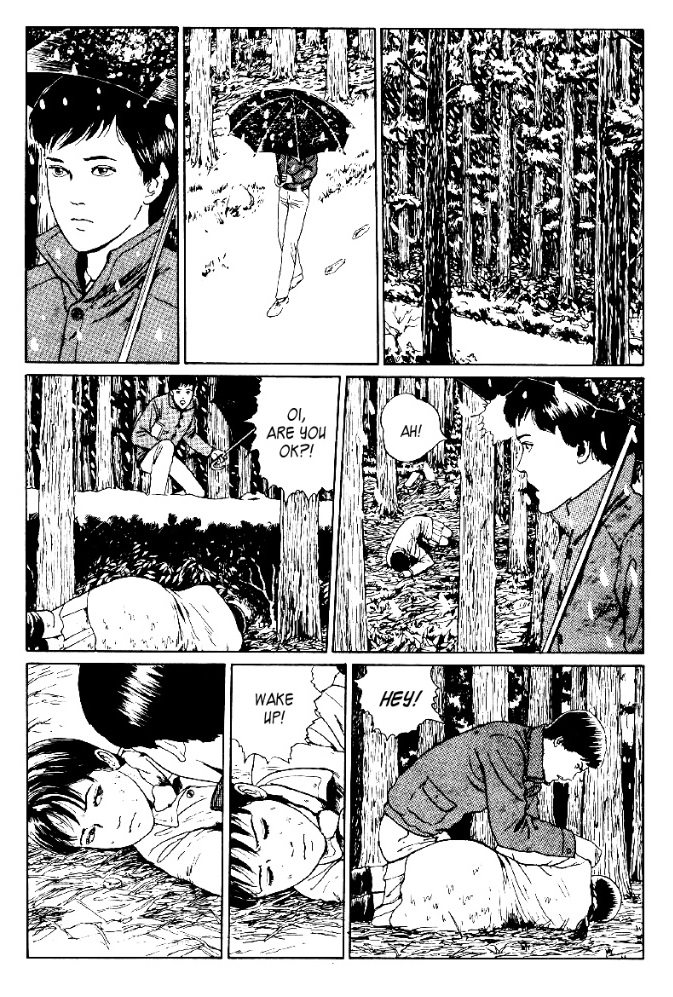
Here are a few pages from Fun Winter Vacation, a chapter/self-contained story from Souichi’s Diary of Delights (1997). Souichi is a little creep with more than a slight penchant for the occult, so weird shit happens whenever he is present. That’s him hiding behind the tree in the first panel – fetching lad, isn’t he? One might say he brings people’s darkest thoughts out into the open. You can read the full story here (remember to read right to left!) I’ve heard some readers complain that this narrative doesn’t quite make sense… welcome to Ito’s dreamlike logic. These episodes are meant to be absorbed like a nightmare one can’t quite wake up from, not dissected in the manner of an A leads to B equation.

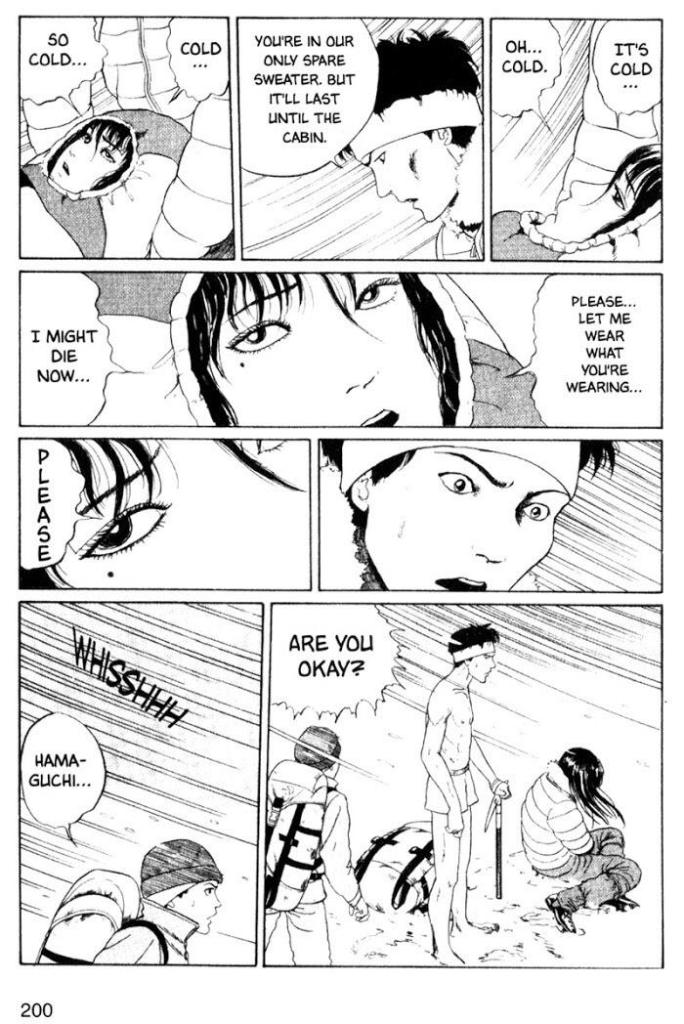
Revenge, originally published in the June 1993 issue of manga magazine Monthly Halloween, is standard Ito fare, and concerns itself with a woman so beautiful that she drives people to madness… in this case, the notorious Tomie, who dispatches a few new victims and nibbles on a wee bit of human flesh in this snowbound vignette.

Read Revenge in full here, and of course support Ito by purchasing his books. Publisher Viz Media is currently issuing plenty of them in a handsome hardcover format, including stories never previously translated to English.

~ ds

Tentacle Tuesday: Junji Ito’s Remina

Cover of the original Japanese edition.

Occasionally, I like going with the flow when selecting the topic for a Tentacle Tuesday. I recently traded for a Junji Ito book I’d never heard of, Remina, and as one of its highlights (um… possibly the only highlight, but more about this later) is the profusion of tentacles within, it seemed like a natural fit for a topic of discussion.

We have only mentioned Junji Ito once before (in Tentacle Tuesday: Octopods Dig Manga!), but I am a fan of his work – or at least of the best of his work. In my assessment, that would be the genuinely disturbing Gyo (with the catchy subtitle of ‘The Death-Strench Creeps‘) and the haunting Uzumaki, as well as a handful of excellent short stories.

I’m by no means a horror manga pundit, but I’ve sampled a certain number of works by mangakas whose work has been translated to English, and found most of these œuvres quite unappealing, be it because of incompetent art, more human cruelty than I can stomach, far too much soap-opera-style drama, or glaring plot loopholes. Ito is not without his flaws, but something sets him apart from other authors working in a similar vein: he can depict stomach-churning gore and moments of quiet dread with equal aplomb. Cartoonists who rely on carnage to horrify their readers are ten a penny, those with a more subtle approach are few; those who can effortlessly transition from one to the other are something special.

As in that old joke about the horse that always takes its rider to the nearest pub, Ito does have a favourite approach: he starts with a most mundane object or incident, elicits a delectably menacing atmosphere out of it, and then gives it all a good twirl until the spiralling events send the protagonists (and sometimes the whole country, if not the whole planet as well) into the welcoming arms of total, uncompromising Armageddon. One might argue that he does that because it’s easier to finish it all than to think of a ‘proper’ ending, but it gives his work a certain surreal quality I really appreciate – everybody is going to die, and now that this little matter is out of the way, we can concentrate on the creative ways this is going to happen.

Remina was serialized in Big Comics Spirits from September 2004 to July 2005. The English volume (released by Viz Media, who have published the bulk of Ito material in English, slowly making their way through his whole bibliography in excellently designed hardcover editions) was released in December 2020. The plot concerns itself with a scientist who discovers a new planet and names it Remina in honour of his beautiful daughter. Of course, the planet turns out to be hurtling towards Earth at physics-defying speeds, annihilating everything in its path (which the main scientist somehow is completely unaware of, until his many lab assistants inform him of the latest developments).

And here it is, eating one of the planets in our Solar System with as much grace as an aristocratic lady carefully nibbling on a sliver of tomato.

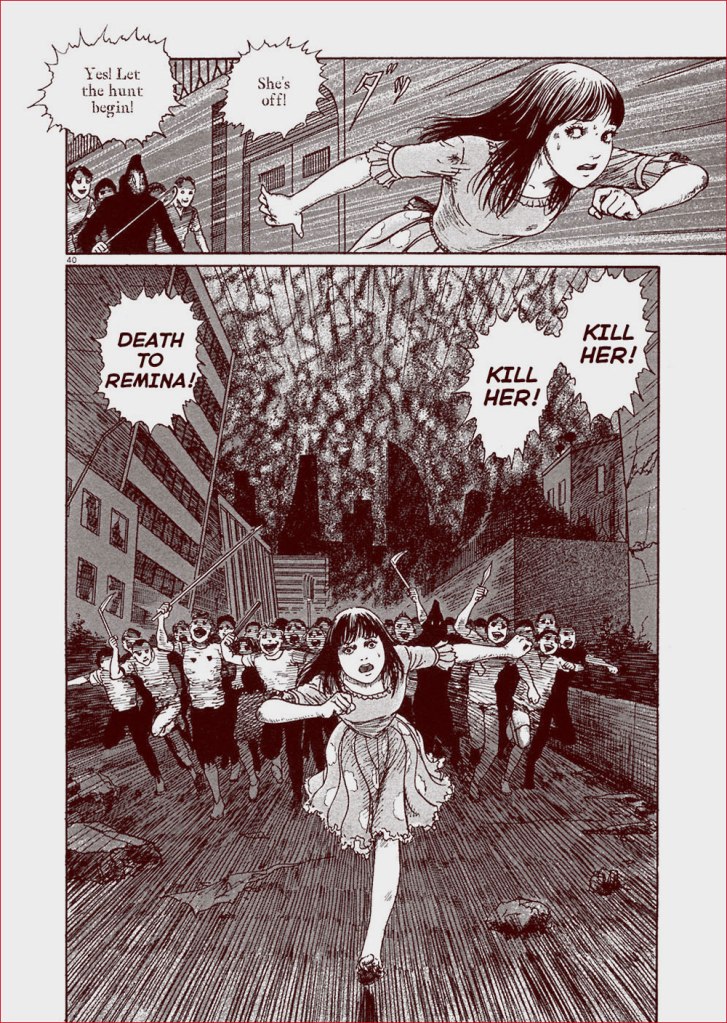
In (not entirely unbelievable) leap of logic, Japanese citizens decide that the impending destruction is caused by Remina, previously an immensely popular and celebrated girl, and that executing this ‘witch’ is going to solve the problem. What follows is a series of chase scenes, with a giant crowd pursuing Remina throughout the progressively more and more destroyed city. Remina’s three protectors (the president of her fan club, her manager, and some uber-rich fanboy who tries to rape her later in the book) drag her around, trying to keep her safe from the murderous crowd, but they don’t do such a great job – she gets crucified next to her dad but survives, set free, captured again, flogged, tortured, crucified again, and so on.

It doesn’t help that Remina, like a lot of Ito’s pretty creations, doesn’t really have a personality. She just sobs, screams for her daddy and her lost love (the manager, who apparently she was profoundly in love with), and implores people to just leave her alone. Scenes of crucifixion and the creepy robes worn by her pursuers indeed suggest religious fervour – as the earth’s gravity changes, cities are destroyed, volcanoes erupt etc., the only thing almost everybody is interested in is Remina’s mutilation and dismemberment.

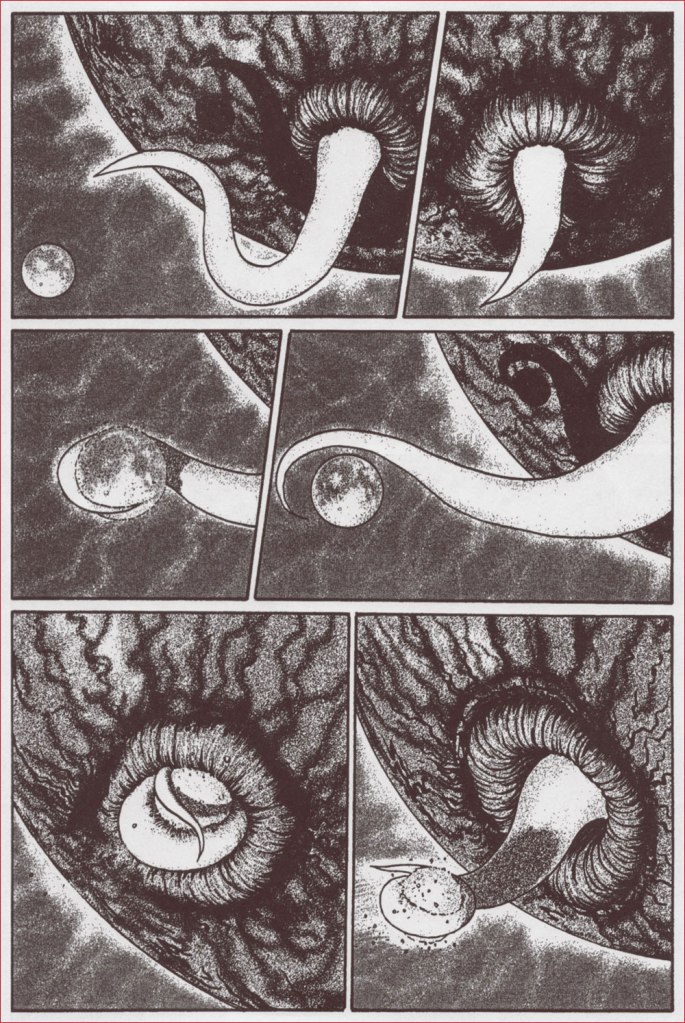
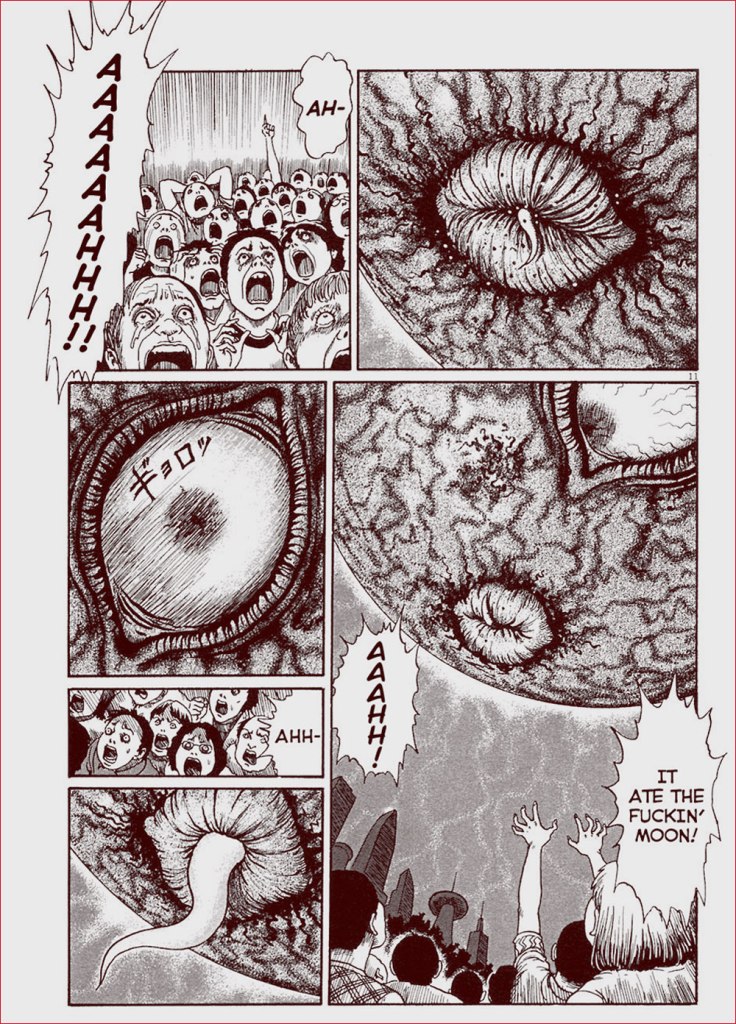
Still, there are some fun moments, most of these involving tentacles! Remina the planet has a giant eye and a coquettish, tentacular tongue that it flicks out to swallow the moon just as Remina the human is about to be killed.

One of more iconic images of Remina, the moment before the moon gets swallowed….
This is a scan from a previous edition of Remina, where the translators were a little looser with language. In the book I have, a laconic ‘it ate the moon‘ is substituted for ‘it ate the fuckin’ moon!‘.

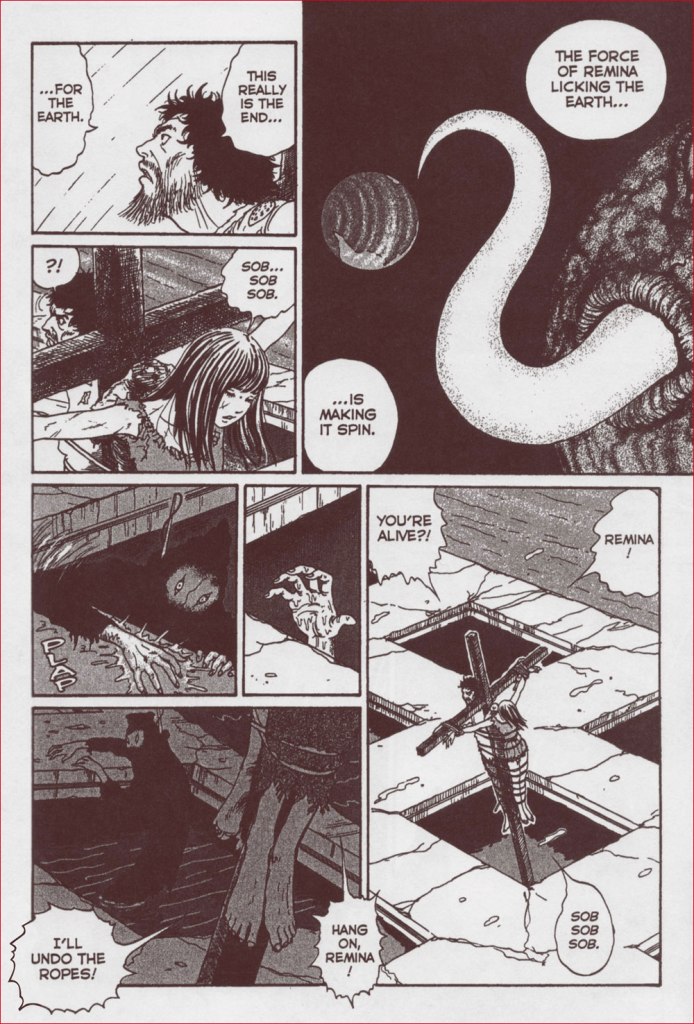
It uses the same ‘tongue’ to lick Earth and accelerate its spinning…

Typical Remina dialogue: “SOB SOB SOB.” Note that this is the second time Remina gets crucified. It is distinctly some sort of unhealthy obsession.

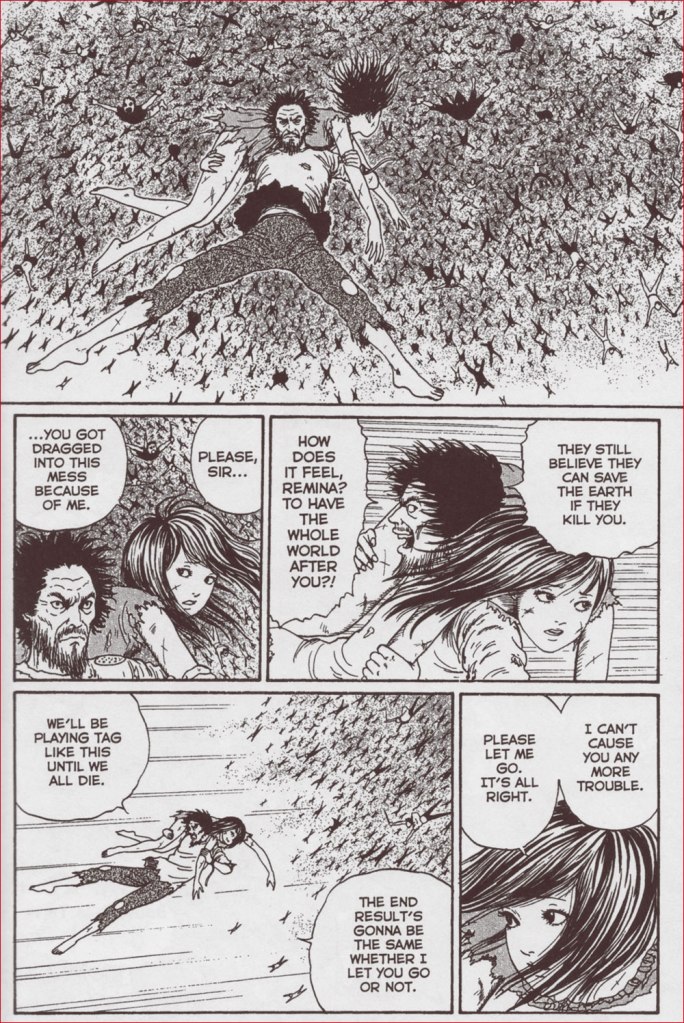
… which sends everyone airborne, and gives rise to funny kung-fu-in-the-air scenes as yet another protector kicks the collective asses of Remina’s would-be executioners.

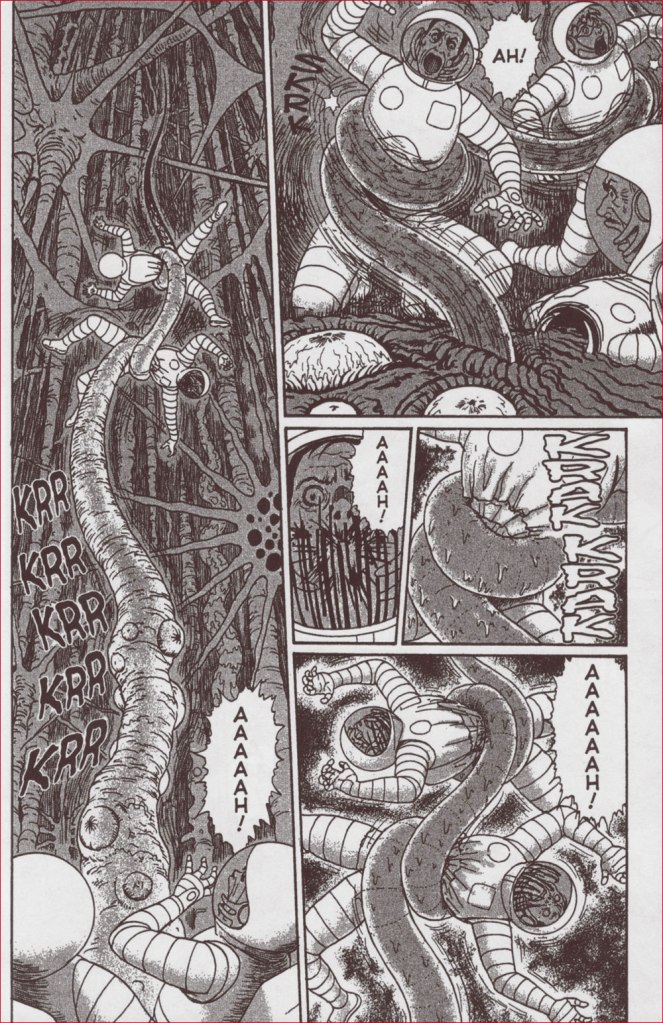
Then there’s planet Remina’s surface, all writhing tentacles, acid pools and noxious fumes. That’s where most of the tentacle enjoyment lies.

Somewhat atypically, there is even a happy ending, albeit one involving some of the main characters floating around in space in an atomic shelter bunker with a year’s worth of provisions (and hopefully oxygen?)

As you have probably surmised, this is not Ito’s most subtle work. However, some loved it – for instance, check out Manga Judgment: Hellstar Remina (地獄星レミナ) by Junji Ito (伊藤 潤二).

~ ds

Q: What’s Michael? A: Kobayashi’s Most Special Cat

« Michael is, simply put, Japan’s version of Garfield, Heathcliff and Krazy Kat all rolled into one. » — Wizard: The Guide to Comics*

* I actually disagree with all three comparisons, aside from the fact that the first two comics are also about orange cats, but this is the review Dark Horse used to promote the series.

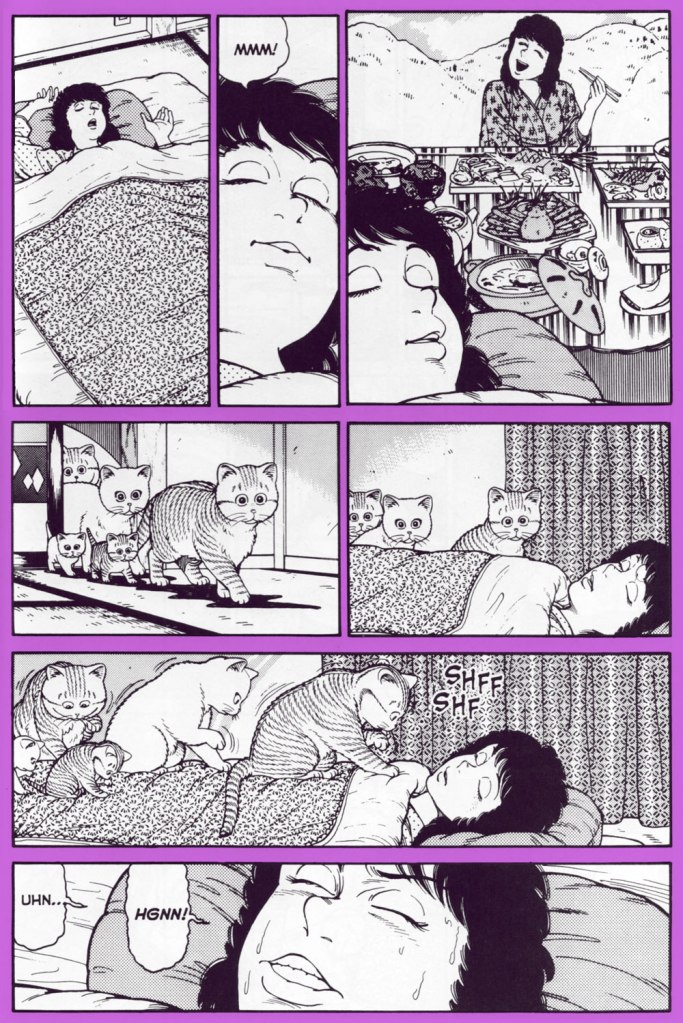
What’s Michael? (ホワッツマイケル? in Japanese) is a comic series by Makoto Kobayashi about a cat named Michael who goes about his cat life in a pretty standard way. He spends most of the day snoozing, has distinct food preferences, and likes to meow loudly at night while courting his favourite cat lady. One would not be entirely unjustified in thinking that cat lovers will read any old comic that prominently features felines (I have occasionally been guilty of that myself!), but I am convinced that there’s something special about this series.

One of the things that makes it so endearing is that Kobayashi has a very good grip on feline body language, making it fun to follow even the poorest excuse for a plot, like for instance Michael contemplating which cozy enough spot to select for a nap. That being said, he doesn’t limit himself to realistic cat situations, often featuring cats acting like (very goofy) people, parodying human and feline at the same time.

Natural cat body language… and different ways in which cats just can’t bend, cheerfully pointed out.

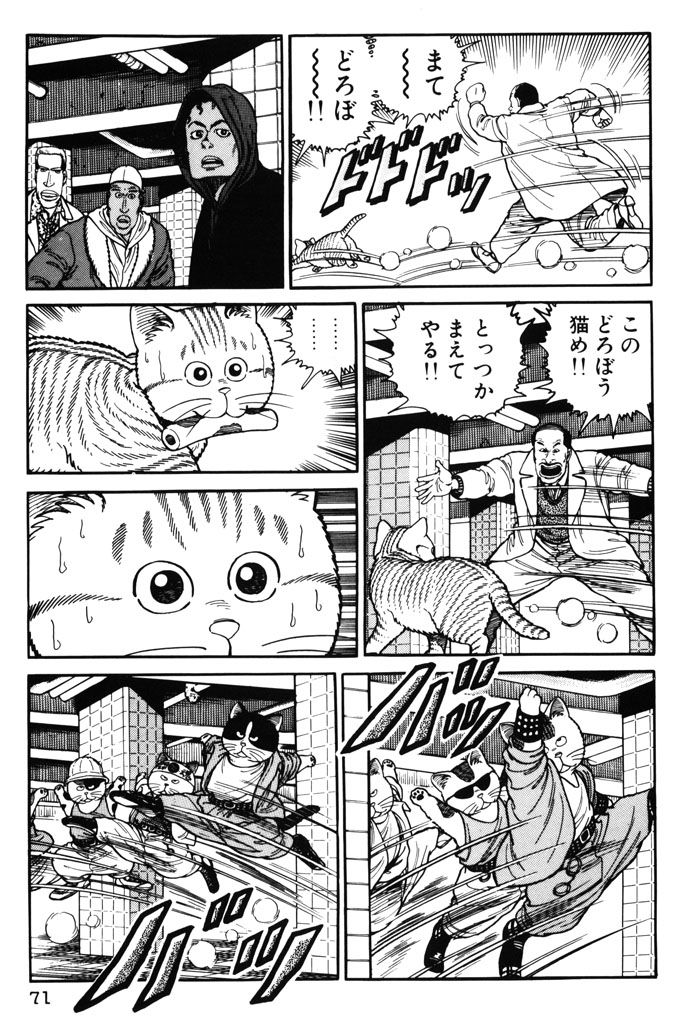
Some readers are more interested in the outlandish stories, of which there are many (ranging from cat parodies of various movies to plain weirdness), some develop a soft spot for the recurring human (or semi-human) characters. Michael himself switches owners like switching gloves, depending on the needs of the story, and there is not much continuity. Kobayashi’s ideas can be a little hiss or miss, but there’s something here for everyone… provided you like felines, of course… adventures of a vampire count who is scared of cats are side-by-side with wacky cat food commercials, depictions of everyday life of various cat-besieged country bumpkins alternate with cat street gang rumbles, and all of that is sprinkled with humans-as-pets interludes. And, naturally, our ordinary yet handsome tabby Michael drinks, sleeps and plays alongside Popo, his wife, their kittens, and a rotating cast of other cats (Catzilla comes to mind!) and the poor, often put-upon dog nicknamed Bear.

The Count’s quest for a pretty neck to bite is, as always, thwarted by Michael or one of his relatives.
Michael, Popo and their kittens on the prowl for a soft spot for a snooze.
One of the strip’s running jokes is that Michael passionately hates Morning Cat canned food, and will go to ridiculous lengths to avoid eating it.

The following sequence illustrates one of Kobayashi’s favourite tricks, namely to start off with more-or-less normal cat behaviour and veer off into an unexpected direction:

As you have probably noticed, Kobayashi often opts for exaggeration when it comes to people’s facial expressions, which sometimes leads to results that are more grotesque than funny. He also enjoys drawing pretty women, but that is more obvious elsewhere, for instance in his series Club 9 (Dark Horse has published 3 volumes of that and abandoned the project before the story’s end, much to my annoyance).

In Japan, What’s Michael? was published in the weekly magazine Morning starting in 1984, and it even won the Kodansha Manga Award in 1986. There seems to also have been quite a few collections released.

One of the Japanese editions of volume 1 and 2.
Cover of another collection from 1987; Bear likes to sit and watch cats playing.

In 1988, its popularity was also rewarded with a 45-episode anime which was also broadcast in Italy and Spain (at least according to a Russian article I found). The following is the cover of a collection of these episodes, as far as I could ascertain:

In the US, it was published by Dark Horse‘s manga imprint. I am not entirely sold on the translation (the aforementioned country bumpkins, for instance, talk as if they were in a cheesy would-be Western written by somebody who has no understanding of the genre), and it also bothers me that the comics were published in the standard American left-to-right reading direction. I think it is a relatively recent phenomenon to leave manga as it was drawn when translating it into European languages – audiences have become more refined.

An example of the story going interestingly off the rails, in the proper right-to-left format.

Apparently there are stories that have never been translated, as they were deemed unfit for Western audiences (those intrigue me, yet my knowledge of Japanese is nil!), but those that were selected by whomever is in charge of these decisions have been collected in 11 volumes, published between 1997 and 2006. Most of them are quite out of print by now; I managed to gather all eleven over the years, though while writing this post I discovered that Dark Horse has decided to rescue this series out of its out-of-print-darkness and re-publish the works in two 500-page volumes. Am I going to purchase those? Yes, of course, as there is bonus material involved! Though the wrong reading direction remains wrong, alas.

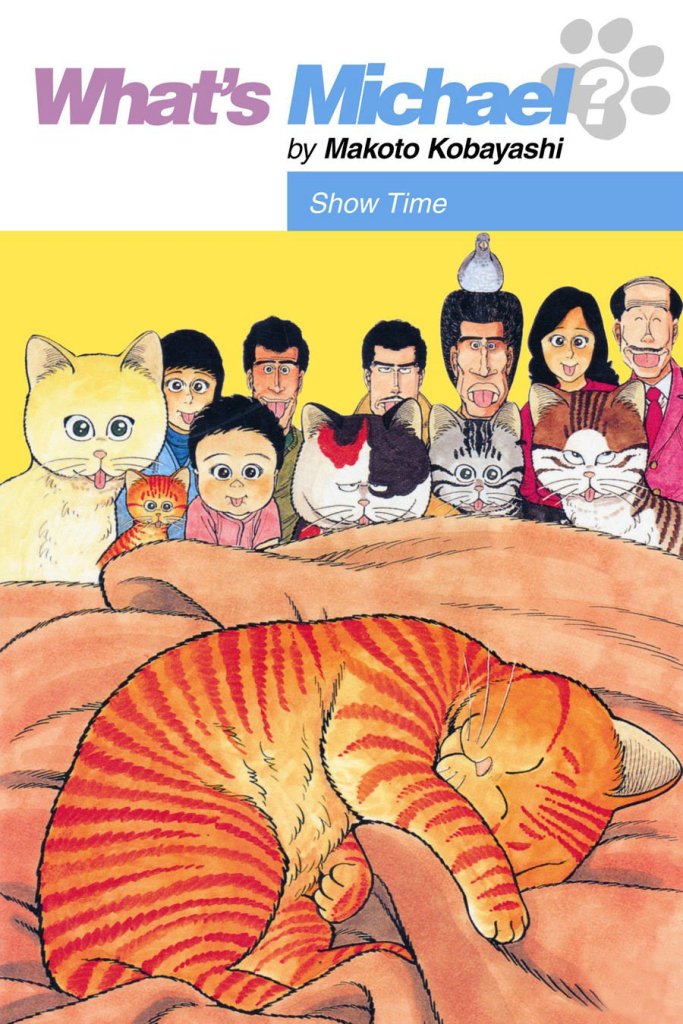
Volume 8 of Dark Horse’s initial What’s Michael? run.

I enjoyed reading a review of the first volume of the reissue on Al’s Manga Blog, and maybe you will, too: What’s Michael? Fatcat Collection Vol 1.

~ ds

Tentacle Tuesday: Octopods Dig Manga!

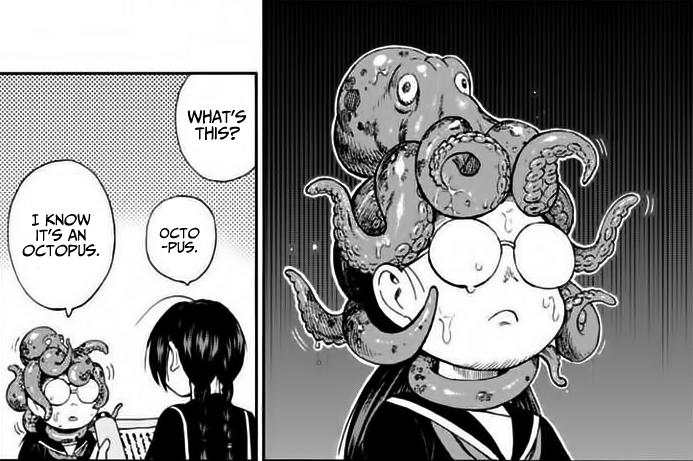
Last night, an octopus materialized into my office and reproached me for neglecting manga during my Tentacle Tuesday forays. I vowed to do better! As octopuses are impatient fellows, I decided not to tarry and complied immediately.

Shinobuna! Chiyo-chan
Panels from Shinobuna! Chiyo-chan, a comic by Kiyoto Shitara. Begun in 2017, it is still going and is being published by Tokyo-based Kadokawa Shoten. Read it here.

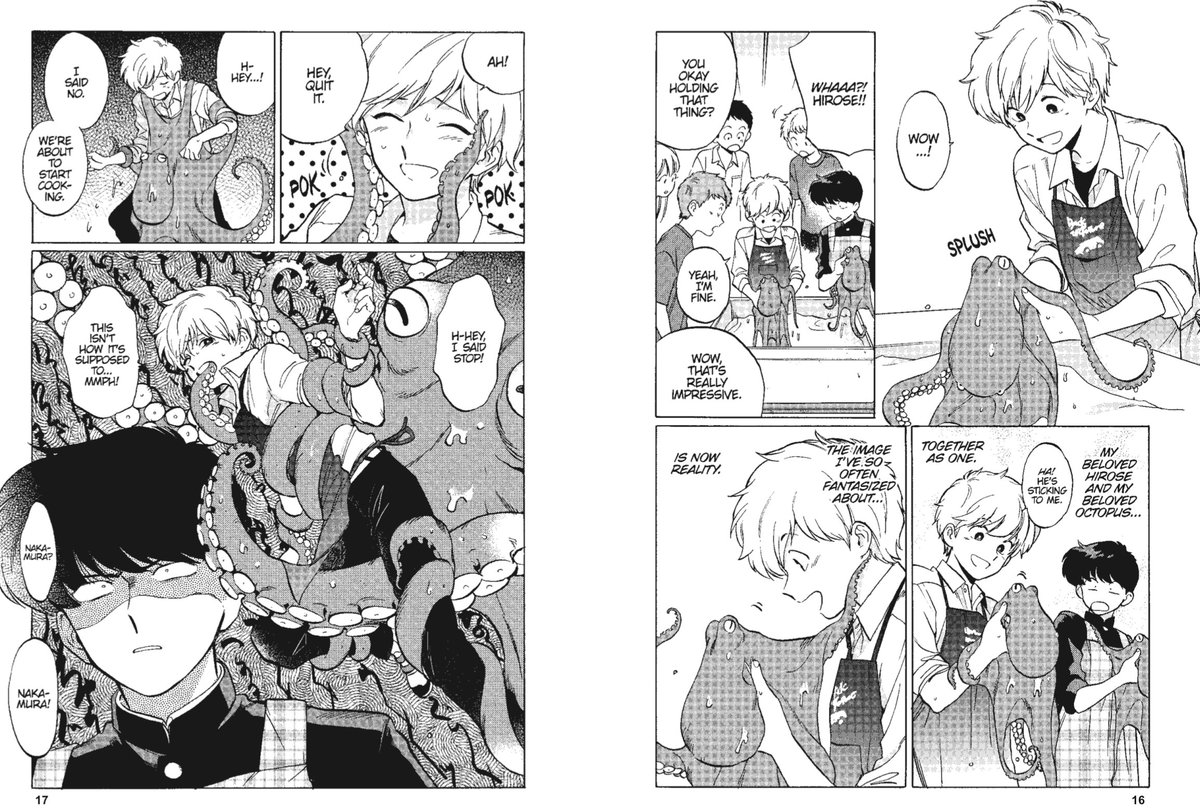
While the previous manga is about a schoolgirl trying to get her classmate’s attention (she’s also a ninja, not that it simplifies matters), the following concerns itself with a shy boy who falls instantly in love with a (male) student from his class and spends the rest of the story trying to get closer to him.

goforitNakamura-cover
Go For It, Nakamura!, started in 2014, is written and illustrated by Syundei and published by Akane Shinsha.

GoForItNakamura
That’s Nakamura’s pet octopus, Icchan. « Octopi like to go into crevices, don’t they?! Wow, look at how squishy it is! »

Adventures in Poor Taste’s Trevor Richardson wrote a slightly extravagant review of Go for It, Nakamura! that delves deep into this manga’s the cephalopod imagery. Just for the fun of all the octopus metaphors, I’ll quote:

« As a queer person, I couldn’t help but identify with that queer young man who doesn’t yet know how to use all the extra arms that queerness grants him. Who doesn’t yet know how to push his tentacles up against the metal lid of self-doubt and oppression and twist it off. Who isn’t yet able to expel all that confusion and rejection like a cloud of black ink and surge down to trenches where straight people never dare drift to join his fellow otherworldly, queer creatures in the dark. »

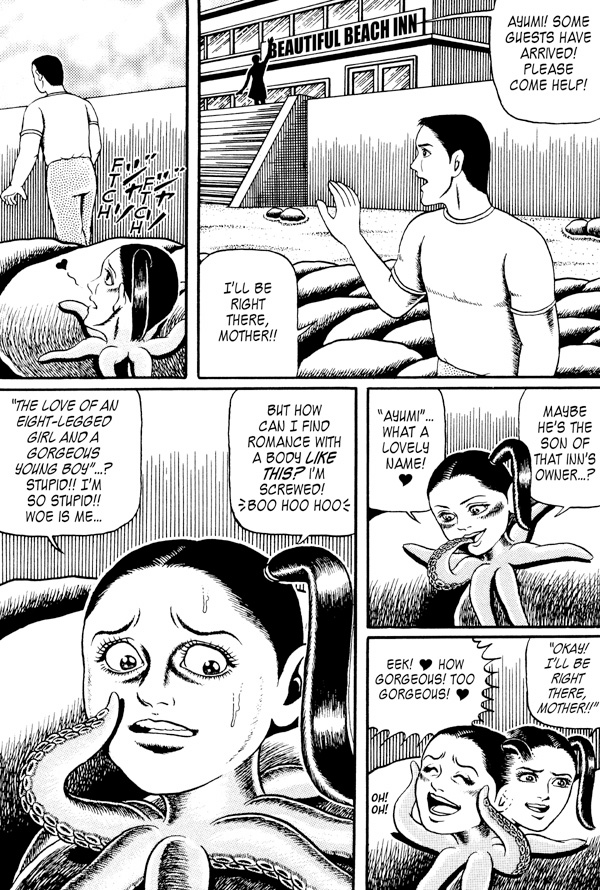
To those who aren’t into high school romance but prefer their manga on the side of the macabre and the bizarre, I propose Octopus Girl by Toru Yamazaki (1990), though the events still mostly take place at a school. Takoko, our main character, is bullied by her classmates and nearly killed by them when they decide to semi-drown her and then force her to eat a live octopus (to which, the story specifies, she is allergic, because eating a live octopus isn’t horrifying enough as it is). As a response to this ordeal, she turns into an octopus (with a girl’s head) and exacts terrible revenge on her bullies!

OctopusGirl
The English publisher describes it as “delightfully disturbing” – at any rate, I certainly agree with the “disturbing” part. Here, Takoko eats her own appendages for sustenance (don’t forget to read from right to left.)

OctopusGirl2
« Teenage monsters lose their hearts and heads in a relentlessly gory collection of dark humor and horror! Carving a comical niche in modern horror manga, Toru Yamazaki’s Octopus Girl serves up the most disgusting dishes of heartbreak and revenge found on land or at sea. Have a side order of nervous laughter with your main course of bloodcurdling fear, some gore with your teen angst, and some killer instincts with your kawaii! These shocking vignettes will hypnotize fans of the macabre and the absurd, as intestines, eyeballs, and fluids of all sorts shoot enthusiastically across Yamazaki’s pages! »

One-Piece-935-manga
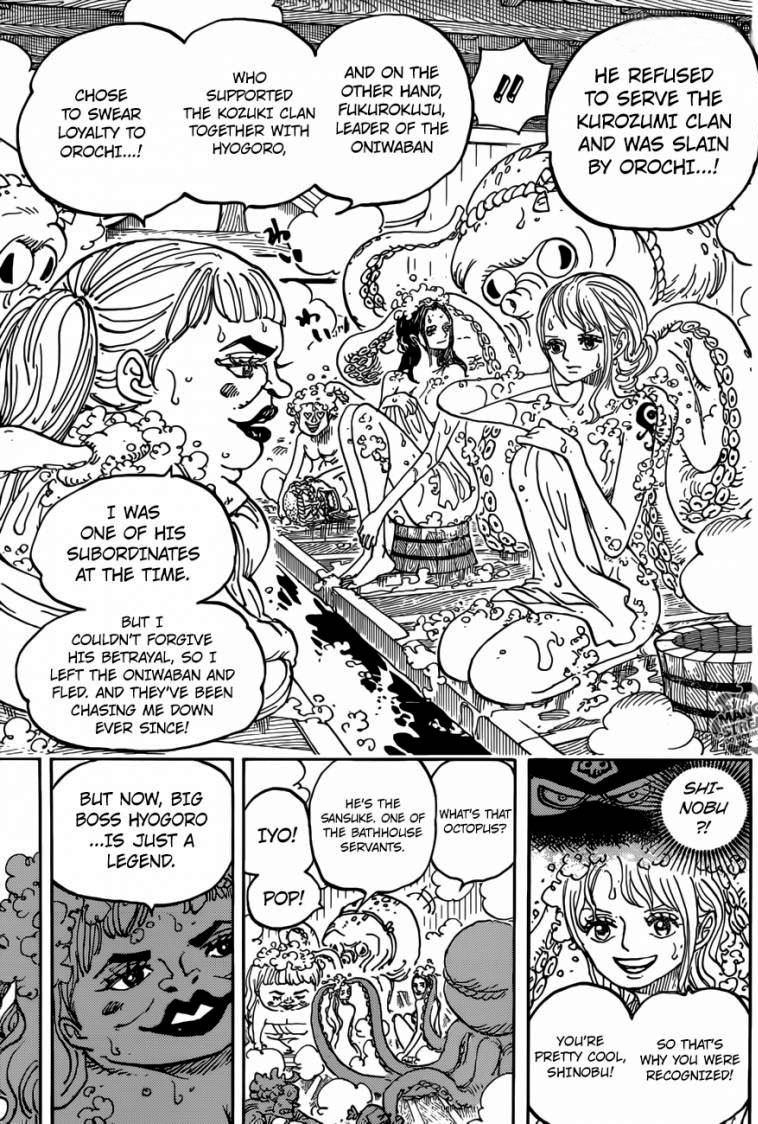
Page from One Piece, a humorous manga series by Eiichiro Oda, serialized in Shueisha‘s Weekly Shōnen Jump magazine since 1997. Read it here if you’re so inclined – in terms of posting copyrighted content, otakus seem every bit as bad as Russians. « The story follows the adventures of Monkey D. Luffy, a boy whose body gained the properties of rubber after unintentionally eating a Devil Fruit. With his crew of pirates, named the Straw Hat Pirates, Luffy explores the Grand Line in search of the world’s ultimate treasure known as “One Piece” in order to become the next Pirate King. »

Moving on to proper horror – in the sense of it being devoid of comedy -, two pages from Junji Ito’s Gyo Ugomeku Bukimi (Fish: Ghastly Squirming), published as a series between 2001 and 2002 in the Japanese weekly manga magazine Big Comic Spirits. I’m enough of an aficiona-Ito to own most of his work that’s been translated into English, and though a lot of his stories are rather hit-and-miss, Gyo is one of the genuinely gruesome ones.

gyo-junjiito-1

gyo-junjiito-2

Ito is quite adept at conjuring up quite far-fetched yet terrifying plots, with events spinning faster and faster out of control until… until he doesn’t quite know how to tie up the story. Having gone so deep into the utter destruction of the world, there’s no elegant dénouement available but sheer Armageddon. That is definitely a weakness, so I tend to prefer his short stories, where the conclusions are fast and hard-hitting. That being said, I definitely recommend reading Gyo (read it here, but remember to support the artist by purchasing!) and Uzumaki (another terrifying read likely to leave you with a phobia of spirals). For an excellent discussion of Junji Ito’s appeal, please consider the excellently written The Horrifying Appeal of Junji Ito.

Okay, a couple more horror comics!

MAngaDevilman Manga vol.1 ch.0- Devil's Awakening
Page from Devilman, written and illustrated by Go Nagai, published from 1972 to 1973 in Shōnen Magazine.  This has very typical manga art, which is to say, art that doesn’t appeal to me. But a vicious female demon with tentacles *everywhere*? I wasn’t going to say no to that.

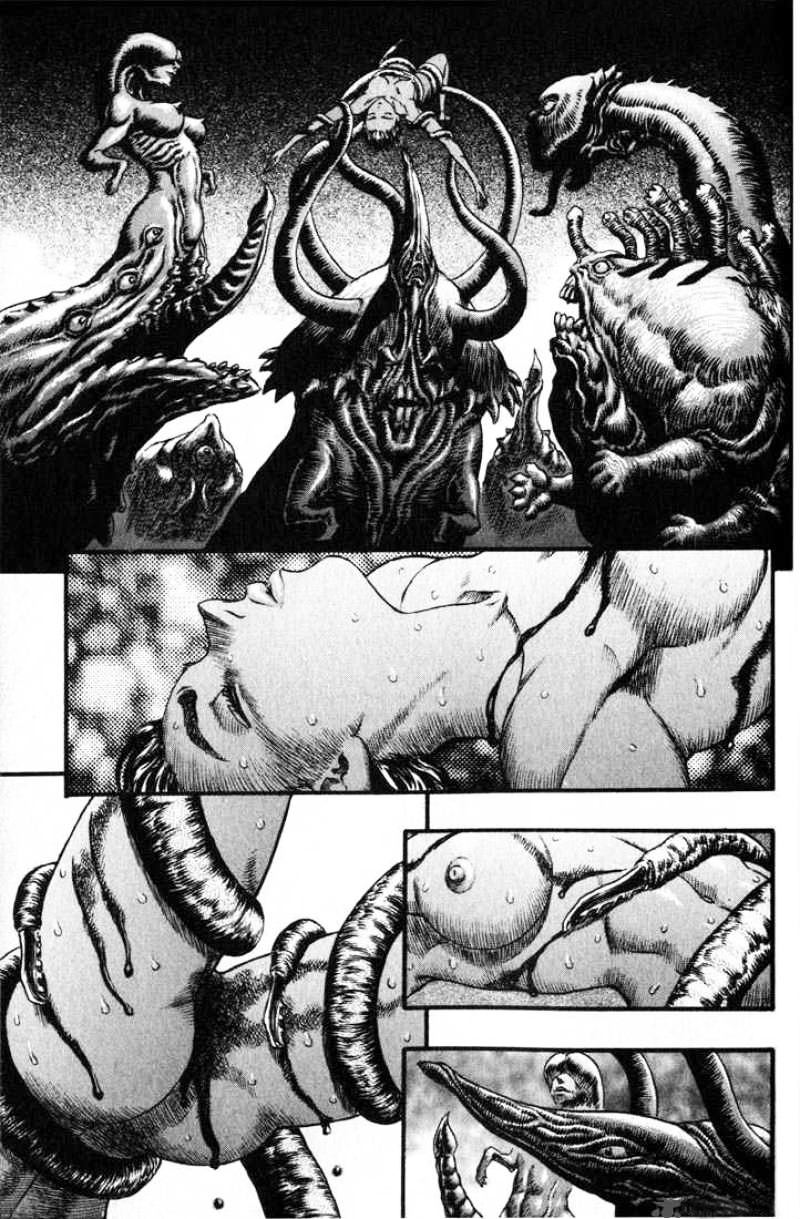
I’ll leave off on a somewhat… sexualized… note with two pages from the dark world of Berserk by Kentaro Miura, first published in 1988 and still going on. It’s been called one of the greatest literary works in all of manga… well, I can’t vouch for that, as I haven’t read much of it, but it does seem complex, at any rate.

Berserk-13

Berserk13-2
You may, if you so desire, read Berserk here.

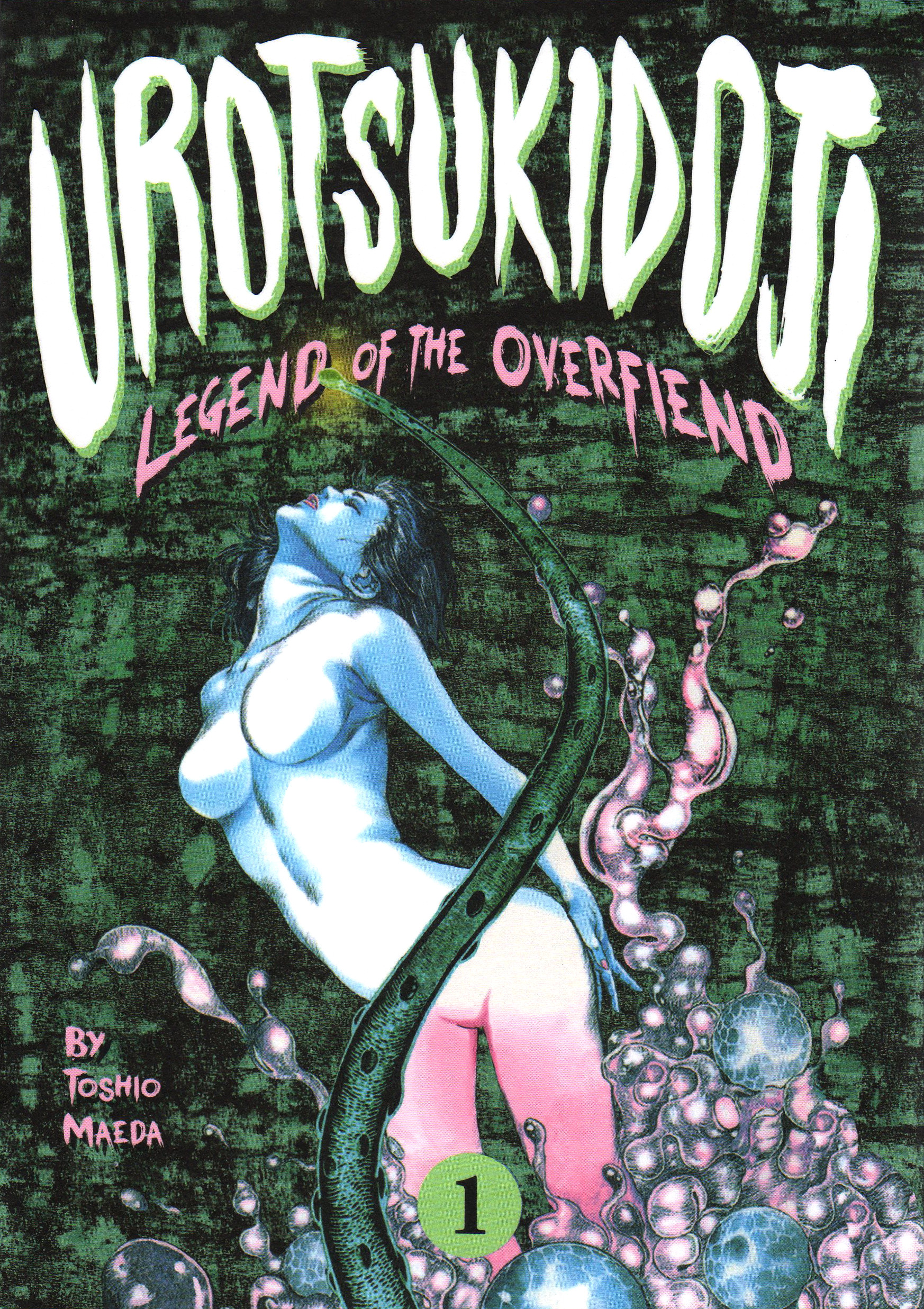
Oh, as long as we’re on the topic of probing tentacles, I’ll wrap up with some Toshio Maeda, an erotic manga artist and pioneer of hentai. His best known work is Urotsukidōji: Legend of the Overfiend which been credited with popularizing the trope of tentacle rape. Fellow tentacle lovers, are you for or against such a use of tentacles? Please let us know in the comments.

ToshioMaeda-legend-of-the-overfiend
Urotsukidōji: Legend of the Overfiend by Toshio Maeda, serialized in Manga Erotopia from 1986 to 1989. Were nipples verboten, one may wonder, or is this just a demon of some kind?

mangaToshio Maeda
Panel from Urotsukidōji: Legend of the Overfiend by Toshio Maeda. If you’re in the mood for further tentacles, visit The Tentacle Lounge, an aptly-named blog devoted to Maeda.

~ ds

Shigeru Mizuki and the World of Yōkai

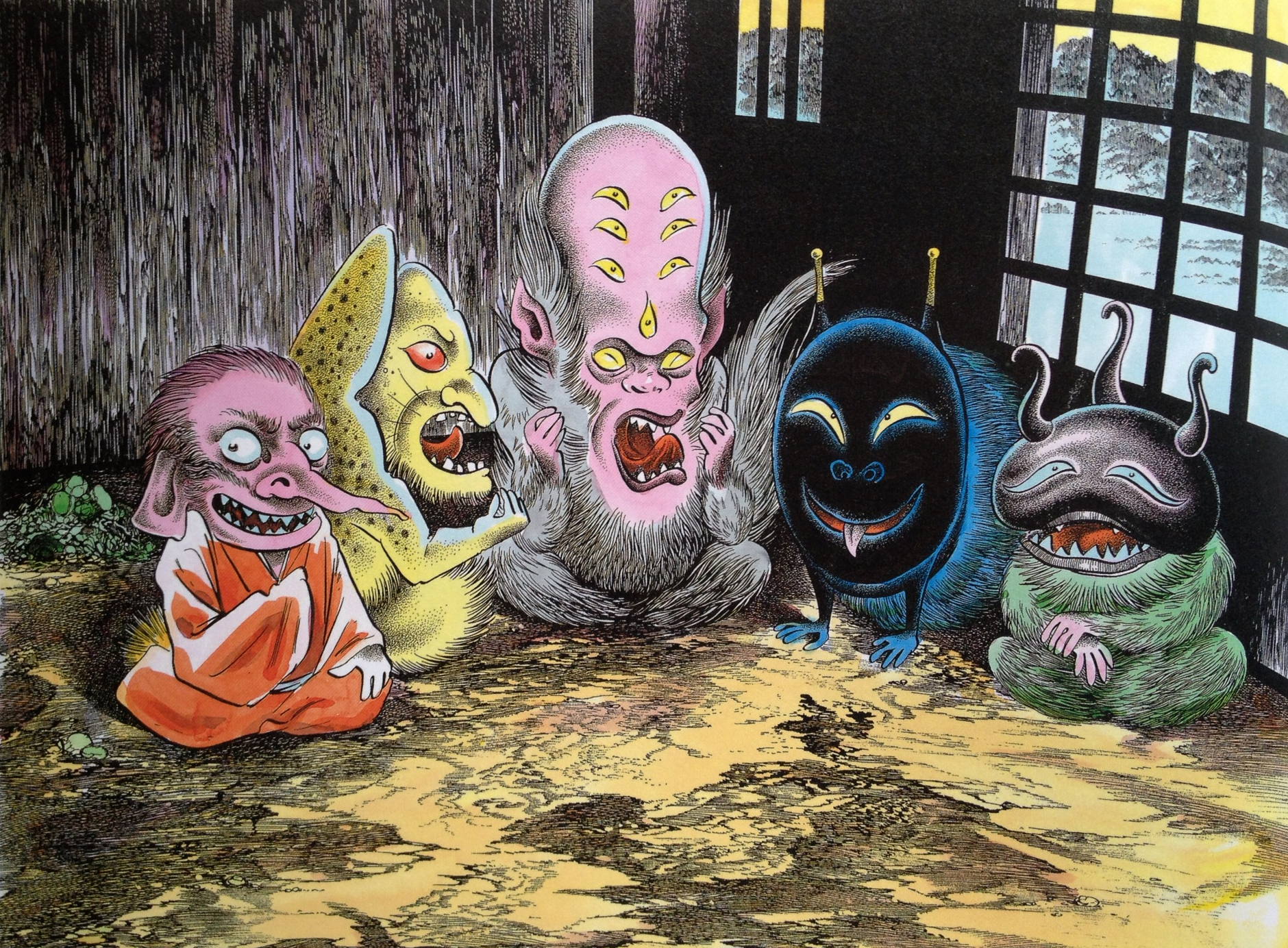
Shigeru Mizuki, Japanese comics artist and historian, is probably one of the best-known manga authors. A lot of his stuff has been translated into English, so when I started my timid forays into manga, his name instantly popped up. Mizuki’s area of interest (and expertise) was the Yōkai, or Japanese monsters, ghouls, goblins and other assorted bogeymen – right up my street, I thought!

Despite my interest in Japanese monsters, the first Mizuki book I picked up, NonNonBa,  failed to capture my interest. Since then, I’ve tried looking through a few others I’d spot in bookstores… and I’ve resigned myself to the fact that Mizuki is just not my thing, whatever other people may see in his work.

That being said, I still really enjoy some of his illustrations, especially if they’re in colour – and I love the way they give us a peek into the rich (and quite scary) world of Japanese folklore.

ShigeruMizuki-Godofpestilence
Gods of Pestilence or cute pets? Your choice.

ShigeruMizuki-Gashadokuro
Hiratsuka-juku is a post station in Tōkaidō. A famous painting by Andō Hiroshige depicts a part of the road that leads to it. Mizuki took the painting as a basis and added a « small » detail: a Gashadokuro, one of my favourite Yōkai (and man, there’s a lot of cool Japanese monsters to vie for that spot). The Gashadokuro, literally « starving skeleton », is a gigantic pile’o’bones held together by sheer malevolence, created from skeletons of people who died of starvation. It starts its rounds after midnight… and is invisible until it bites your head off. If you ever hear bells ringing in your ears, congratulations, you’ve about to be eaten by a Gashadokuro!

ShigeruMizuki-umibozu-YokaiJiten
« Umibozu », from Graphic World of Japanese Phantoms, 1985. These ‘sea monks’ seek to destroy ships and won’t rest until the crew is at the bottom of the ocean.

ShigeruMizuki-Yokai-Tongue
Is this a Akaname, the filth licker? Readers versed in Yōkai, please let us know!

Futaba Kikaku Co.,Ltd.

shigerumizuki-suiko-1981
A Suiko, or ‘water tiger’, although this one looks more like a balding dinosaur.

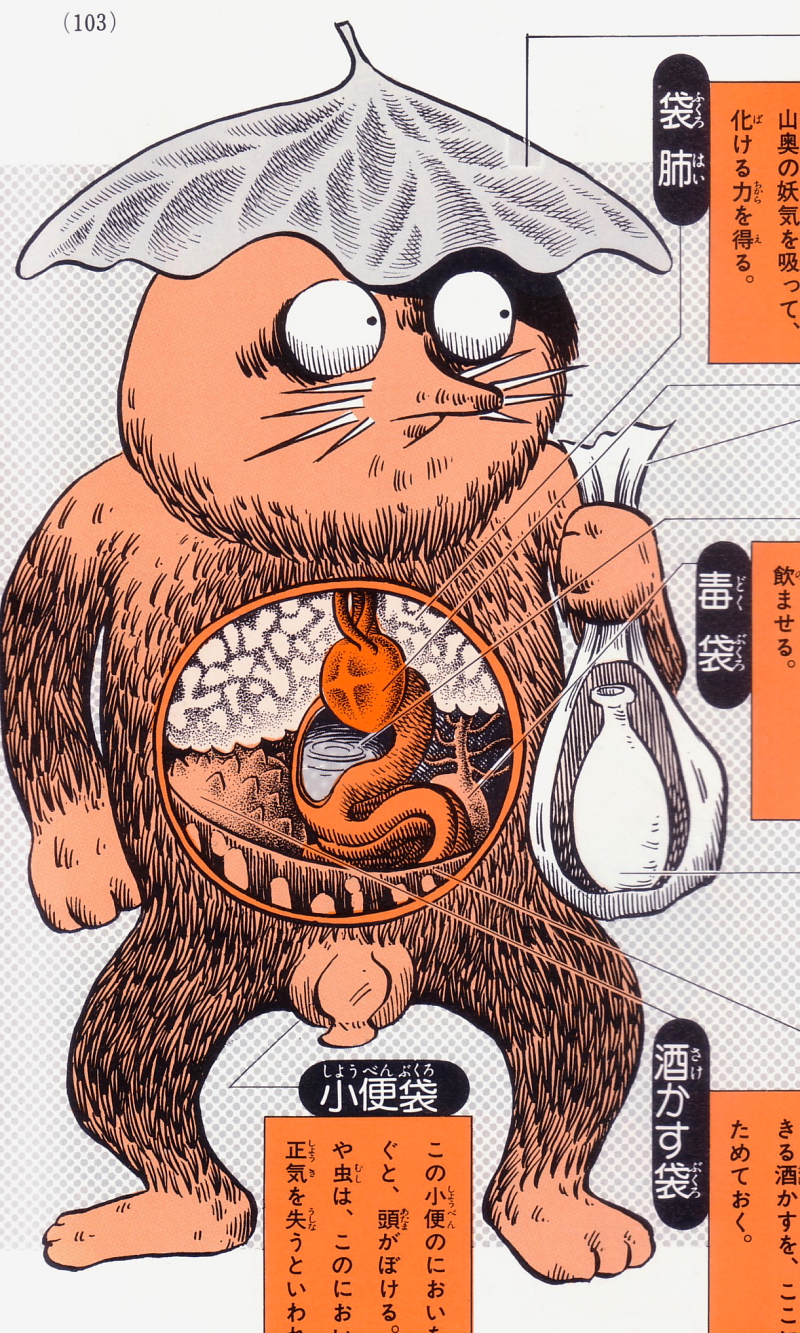
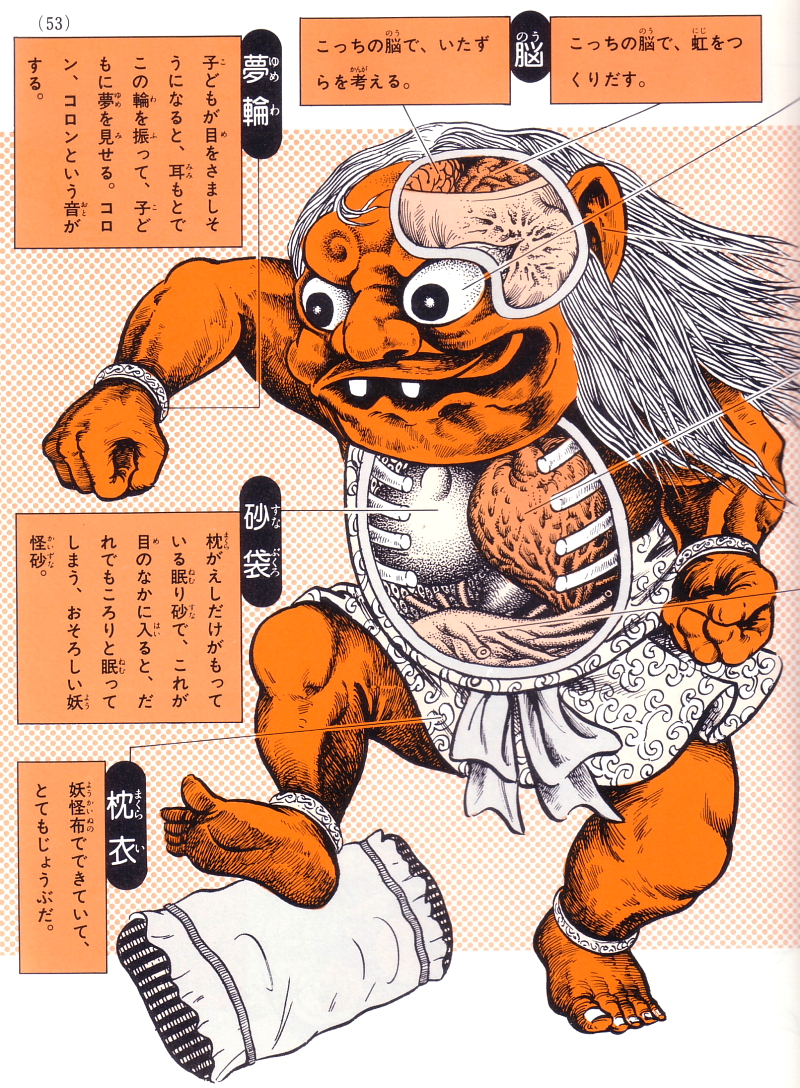
In the 1960s, Shigeru Mizuki released Yōkai Daizukai, an anatomically-oriented guide to traditional monsters from Japanese folklore. I don’t think it’s ever been released in English, but a French version came out in 2018 (and I fully intend to purchase it when I come across it).

Shigeru Mizuki-Yokai1
A Kuro-Kamikiri, or hair cutter, which doesn’t sound so terrifying… unless you live in a society where long hair is a status symbol and loss of it means disgrace.

Shigeru Mizuki-yokai2
A Fukuro-sage, a type of Tanuki (or
Japanese raccoon dog),  who has the ability to transform itself into a bottle of sake. «The Fukuro-sage usually wears a large potato leaf or fern leaf on its head and carries a bag made from human skin. The bag contains a bottle of poison sake. Anatomical features include a stomach that turns food into sake, a sac for storing poison that it mixes into drinks, and a pouch that holds sake lees. The Fukuro-sage’s urine has a powerful smell that can disorient humans and render insects and small animals unconscious.»

Shigeru Mizuki-Yokai3
The pillow-flipper or Makura-gaeshi move pillows about, occasionally suffocating people with them or even stealing their souls.

For a further assortment of monsters, click visit the Pink Tentacle blog.

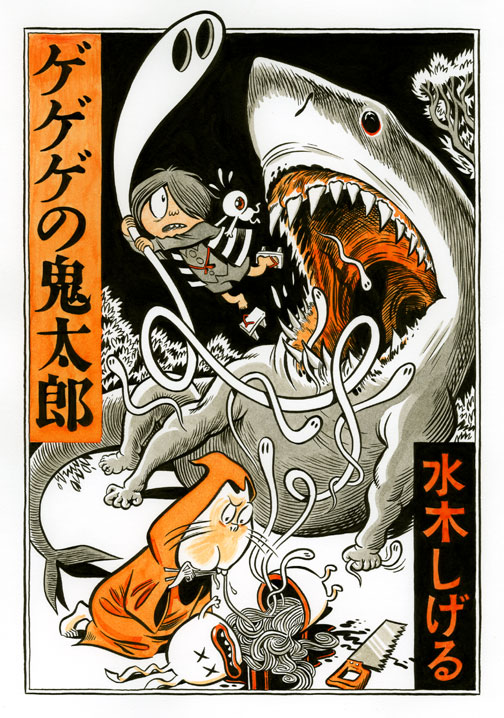
And a final morsel – Craig Thompson‘s hommage to Shigeru Mizuki. The little boy depicted is from GeGeGe no Kitarō, Mizuki’s 1960’s series.

CraigThompson-gegegenokitaro

~ ds

Tentacle Tuesday goes “blub, blub”

Today’s Tentacle Tuesday features octopuses in water where, after all, they generally belong.

We open the festivities with a scene from Japan, the undisputed motherland of all things tentacular. As a bit of an aside, for those wondering what’s up with up with Japanese tentacle porn, there’s an interesting theory that suggests that the latter was just a way to avoid censorship and obscenity charges when drawing erotic manga.

According to hentai artist Toshio Maeda talking about his experience in the mid-80s, “At that time pre-Urotsuki Doji, it was illegal to create a sensual scene in bed. I thought I should do something to avoid drawing such a sensual scene. So, I just created a creature. His tentacle is not a penis as a pretext. I could say, as an excuse, this is not a penis; this is just a part of the creature. You know, the creatures, they don’t have a gender. A creature is a creature. So it is not obscene – not illegal.”

For now we’ll stick with this G-rated page from Panorama Island.

PanoramaIslandTentacles
From The Strange Tale of Panorama Island, a graphic novel by Suehiro Maruo, based on the novella by Edogawa Rampo, the Japanese Edgar Allan Poe and godfather of Japanese detective fiction.

Don’t worry – the characters are in an underwater tunnel with transparent walls, so the girl is perfectly safe (for now). Read an interesting review of this manga here: http://goodokbad.com/index.php/reviews/strange_tale_of_panorama_island_review

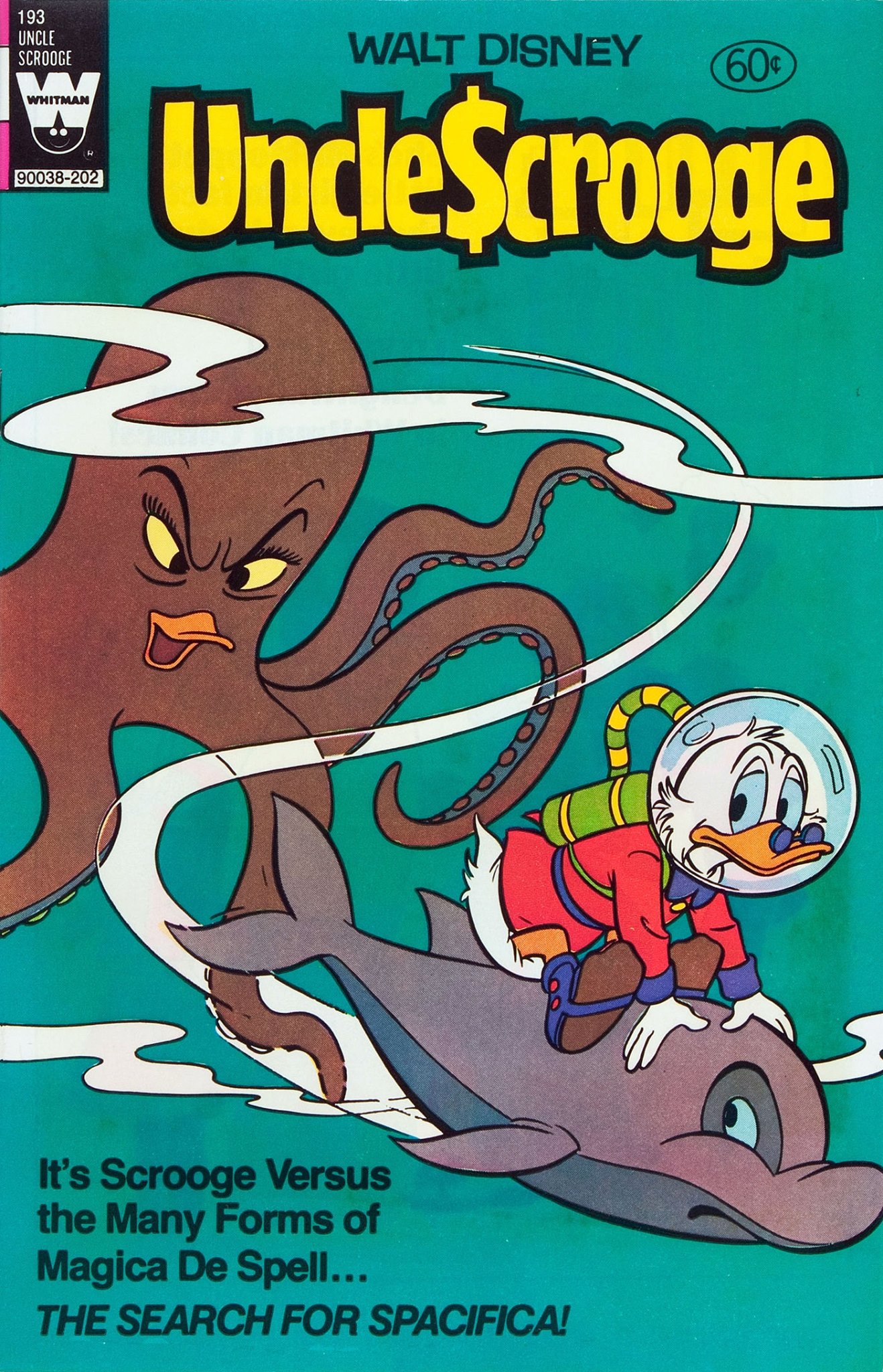
Next in line is this cantankerous beak-mouthed octopus, actually Magica De Spell transformed (which explains why the creature appears to be wearing mascara – waterproof mascara, of course).

UncleScrooge193
Uncle Scrooge no. 193, February 1982. Pencils by Pete Alvarado, inks by Larry Mayer. (This one’s a variant cover with a white Whitman logo.)

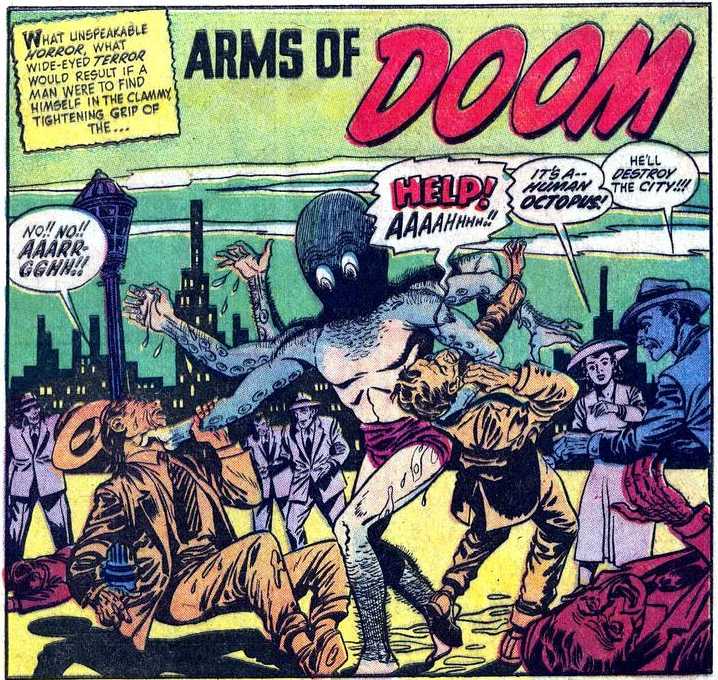
The last of Tentacle Tuesday for this week: a snippet of a rather gruesome story, in which a scientist transforms a poor, city aquarium-dwelling octopus who was minding his own business into a terrifying man-octopus creature who runs amok. In the end, the octopus reverts to his normal form and kills the scientist. (Justice, if not particularly poetic.)

1025-octoman
The first panel of “Arms of Doom” from Harvey‘s Black Cat Mystery no. 32, 1952, drawn by Rudy Palais. So… how exactly is he going to destroy an entire city? He has 6 arms, all right, but he’s only human-sized, if a bit stronger than a normal man.

You can read the whole riveting tale here: http://pappysgoldenage.blogspot.ca/2010/10/number-821-octoman-is-here-let-it-be.html

~ ds

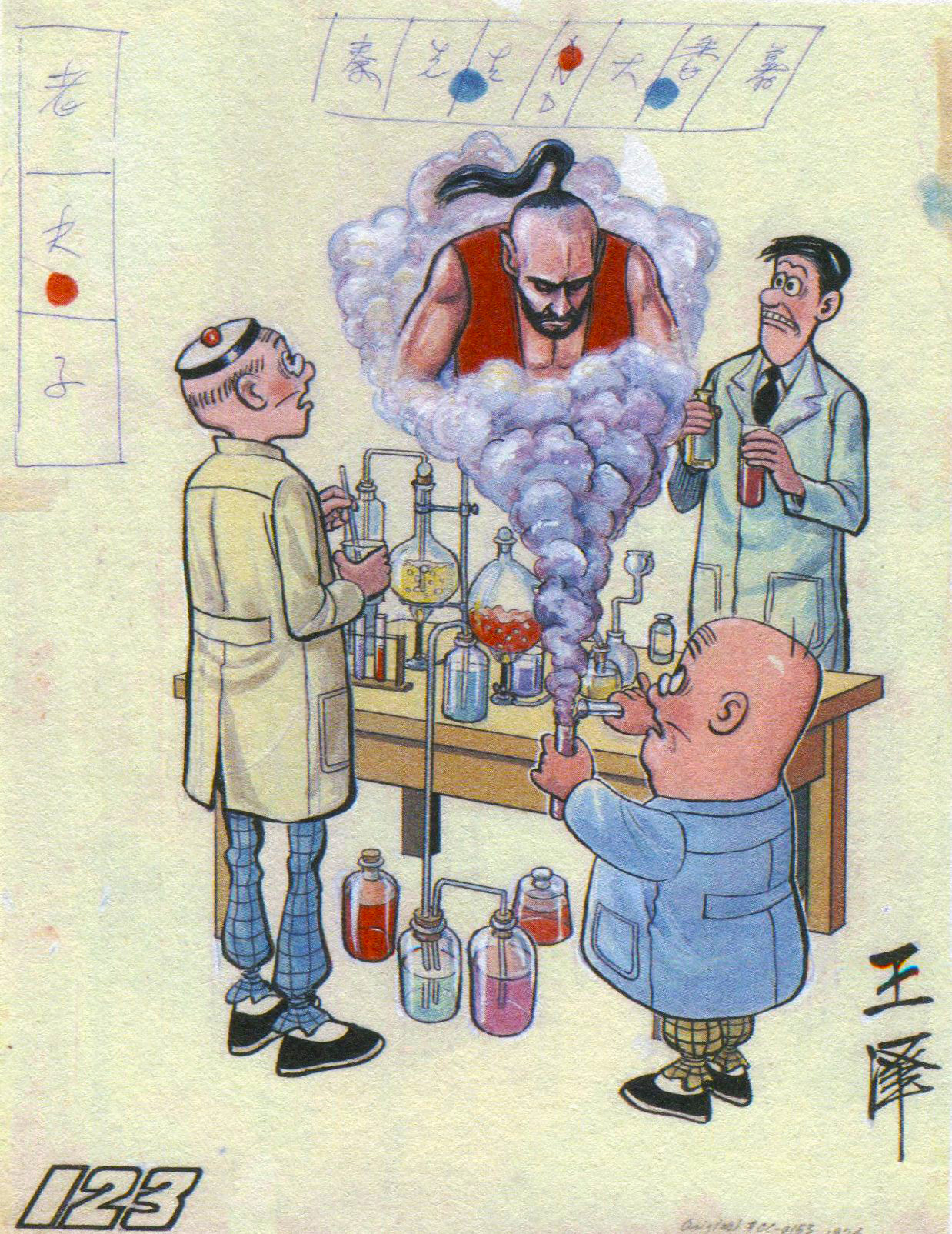
Satirical socio-cultural commentary from the Old Master

Alphonso Wong (also known as Wong Chak) is fondly remembered as the creator of Old Master Q, a truly long-running series that first appeared in newspapers/magazines in Hong Kong in 1962, was serialised in 1964, and is still in publication today. When Mr. Wong retired from his strip in the 90s, his son, Joseph Wong, took over the company, and he’s been managing the licensing ever since, as well as directing the team of artists writing and drawing the strip. Wong Chak passed away in 2017, at 93.

I’m no expert (the language barrier doesn’t help!), but people’s love for Old Master Q and Wong Chak is evident. To quote from Lambiek Comiclopedia,

[The strip] inspired its own magazine (“Old Master Q’s Crazy Comics”, 1965), toys, stationary, electronic scales, LED lamps, insulated cups, umbrellas and lunch boxes, as well as seven live-action film adaptations, four animated ones and two TV series. Copies of ‘Old Master Q’ can still be found in many Chinese hairdresser shops or doctor’s waiting rooms. Its success spread to the rest of Asia and translations in Europe, Latin America and Japan. Along with other well-known comic book characters, Old Master Q has his own statue in the “Hong Kong Avenue of Comic Book Stars” in Kowloon Park, Hong Kong. In August 2016 an Old Master-themed café opened on Nathan Road in Prince Edward, Hong Kong.

I prefer the art from the earlier days of OMQ, although I am glad that the strip is still around. (It’s a national institution!) To illustrate:

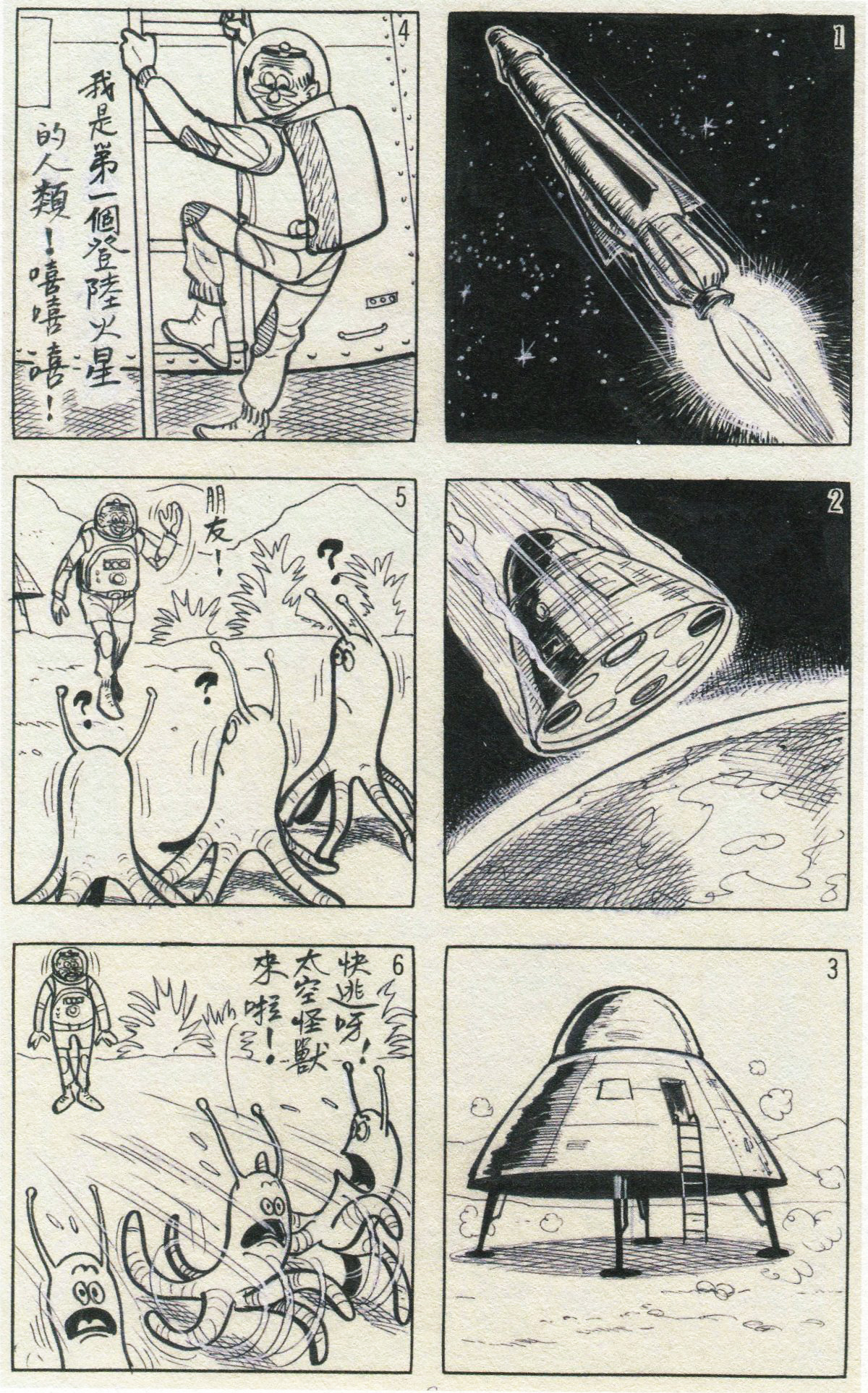
Please don’t forget to follow the numbers and read these top to bottom, right to left, as appropriate for a Chinese strip:

OldMasterQ1970aliens
“Space Monster”, 1970. In panel number 4 , Old Master Q is saying “I am the first person to land on Mars! Hee, hee!”. In panel 5, he says “Friend!” to the aliens; despite his attempts at friendliness, they flee in panel 6, alarmed by “the strange beast that comes from space”.

Judging how often jokes about mermaids crop up, Wong Chak had a thing for them.

Reminder-of-Love_1970
“Reminder of love”, 1970.

Wong Chak was impressively ambidextrous and could (and would) draw with either hand!

OldMasterQ1974

Here’s a strip from more recent days. As you can see, the reading order of the panels has been adapted to the Western palate, and there are English captions translating the Chinese text.

OldMAsterQSmallPersonBigGhost

There’s as many collections of these strips as one would expect from a series so popular, including special-theme collections released for various holidays.

OldMasterQCover

I eagerly await the day I’ll be able to read Old Master Q strips without having to painfully pore over a dictionary over every third character. (Especially given that I’m learning simplified characters, and Old Master Q uses traditional characters. Oof…) If that day ever comes, there’ll be a lot of material to dig into!

Old master Q

You can follow the modern-day strips by visiting the official website, https://www.oldmasterq.com/

~ ds