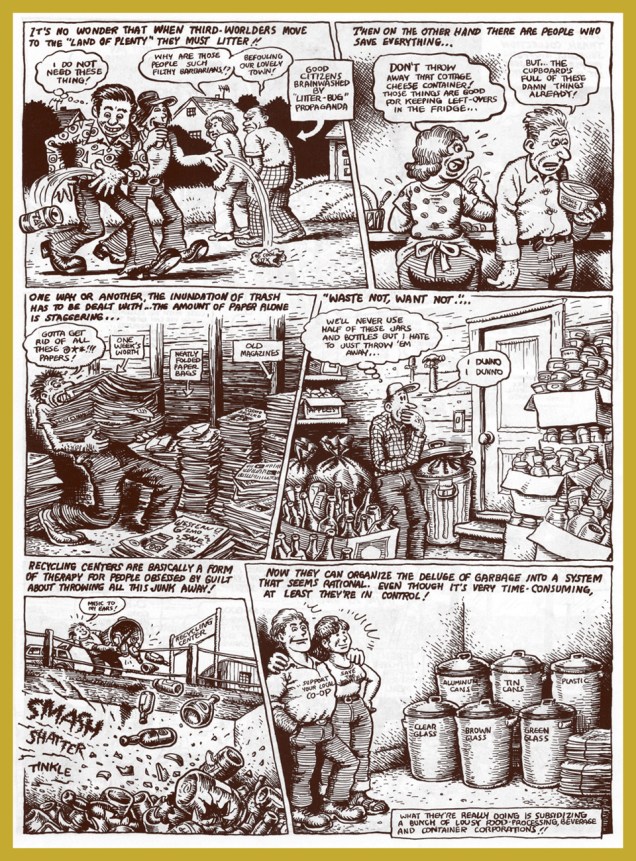
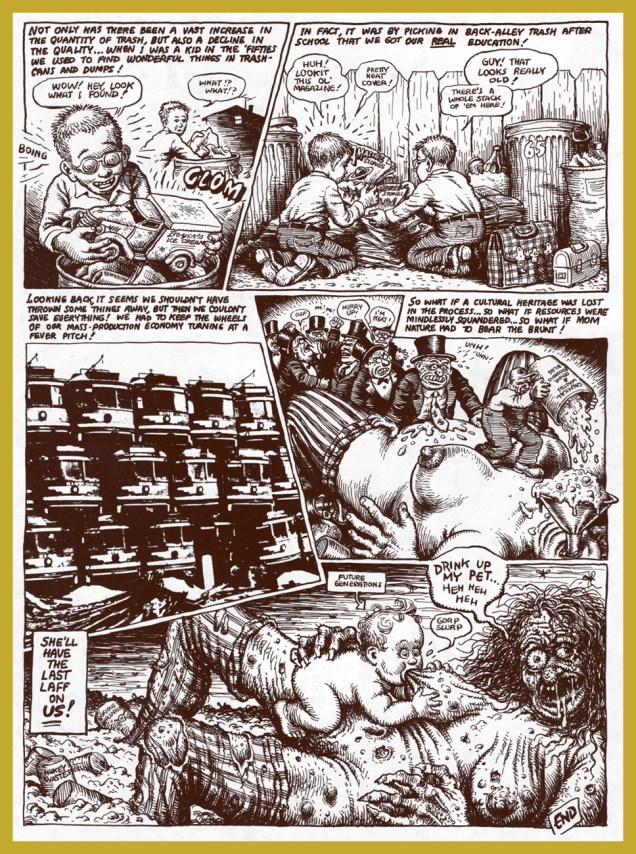
R. Crumb’s “Trash – What Do We Throw Away?” (1982)

« Maybe we could find some way to send barges of trash to the sun and incinerate it all. Hey, it’s an idea. It’s an idea! » — Adam West

Lately, I’ve noticed that crusty ol’ Bob Crumb is being pilloried… well, more than he usually is. It appears that some members of the, er, younger cartooning generation are taking offense, in the most tone-deaf,  irony-deprived and contextually-clueless way imaginable, to a half-a-century old, utterly static, wafer-thin and inaccurate idea of his work. « …old white cartoonists of the most explicitly homophobic, anti-feminist, racist, and controversial comics of 70s/80s ». Funny, I’d say that comment itself is more than slightly racist (not to mention ageist). Guess it’s open season on some targets.

Ah, but it’s a waste of time, saliva and ink trying to convince zealots of any stripe of anything. I don’t enjoy all of Crumb’s work myself, but when a particular piece doesn’t grab me, I just move along. But the medium would be much the poorer without his (in no particular order and just off the top of my head): A Short History of America, Introducing Kafka, Heroes of the Blues / Early Jazz Greats / Pioneers of Country Music card sets, his collaborations with Harvey Pekar in American Splendor, most of his Weirdo pieces, his album covers, « Ode to Harvey Kurtzman », Stoned Agin, his American Greetings cards, and… I’ll be here all night if I keep this up.

I was going  to feature what’s possibly my all-time favourite Crumb story, « The Religious Experience of Philip K. Dick » (Weirdo no. 17, Summer 1986), but lo and behold, it’s already available in full on the philipdick.com site… but as there’s no dearth of first-rate picks, here’s another comics essay from the pages of Weirdo (no. 6, Summer 1982). Please note how fair-minded and even-handed Crumb is here: I’m certainly guilty myself of a couple of the attitudes and behaviours depicted, but since the author’s challenge is so unflinchingly honest, his criticism becomes food for thought. He’s not interested in flattering the comfortable, including, most of the time, himself.

CrumbTrash01ACrumbTrash02ACrumbTrash03ACrumbTrash04A

I’ll leave you with some sage words from Alan Moore, who describes the circumstances of his love affair with Angelfood McSpade: « Firstly, and more obviously in the case of this particular image, there was the open sexuality. Not having led a terribly sheltered life, I was familiar with the images of sex to be found in the neighbourhood magazine racks, ranging from Playboy to the Fry-the-Krauts-on-Passion-Bridge ‘Men’s Sweat’ periodicals of the day, to the soft-core titillation of homegrown products like Parade. Judging from the drawings and photographs that graced these magazines’ covers, sex was something that was deadly serious, not to say faintly miserable, smothered as it was in commercial gloss and the self-conscious poutings of the ex-stenographers staked out across the centre spread.

Angelfood was different. She was wearing, in addition to the grass skirt, a big, pleased-with-herself smile rather than the slightly-concussed ‘Just Raped’ look that her cover girl contemporaries were starting to adopt. It was my first taste of the sexual openness of the psychedelic movement, and though it bears little relevance to my overall impression of Crumb’s work, it requires mention in these terms for the personal impact that it had upon me. This is not to say that its effect in other areas was not equally as marked. Sexuality aside, this drawing was subversive.

For one thing, it was subversive in the way it commented upon race. Many cartoonists since Crumb have referred back, ironically, to the stereotyped image of black people that dominated the cartoons of the past, but this was the first time I’d seen it done: the first time I’d seen a cartoon depiction of a Negro so exaggerated that it called attention to the racialism inherent in all such depictions. » (excerpted from “Comments on Crumb”, Blab no. 3, Fall 1988, Kitchen Sink.)

CrumbILoveYouKeepOn
Keep on Truckin’ and the copyright law rabbit hole

– RG

p.s. This was our 200th post… thanks for your interest and support!

Mother Earth’s Plantasia

« Unless you’re some kind of masochist, I would imagine that you’d like to begin your plant experience with the easy, almost impossible-to-kill group. »

A sunny reminder of some of the plant world’s myriad of virtues, from 1973’s Mother Earth’s Hassle-free Indoor Plant Book by Lynn and Joel Rapp, a terrific little tome that bears the probably unique distinction of having yielded its own soundtrack. Not only that, but its own *excellent* soundtrack, Mother Earth’s Plantasia by Canadian-born songwriter, producer and electronic music pioneer Mort Garson. The LP was distributed through one of the wackiest marketing schemes I’ve ever encountered: it was given away with the purchase of a Simmons mattress from Sears. Uh?

PlantasiaRubinA
« A green thumb is simply a positive state of mind about growing things. »

I see Plantasia’s even been reissued a few years back on fancy 180 gram vinyl (along with other formats and impressive ancillary products). But you can hear it in its entirety without making the considerable financial investment, thanks to this lovely tribute on the Music Is My Sanctuary blog.

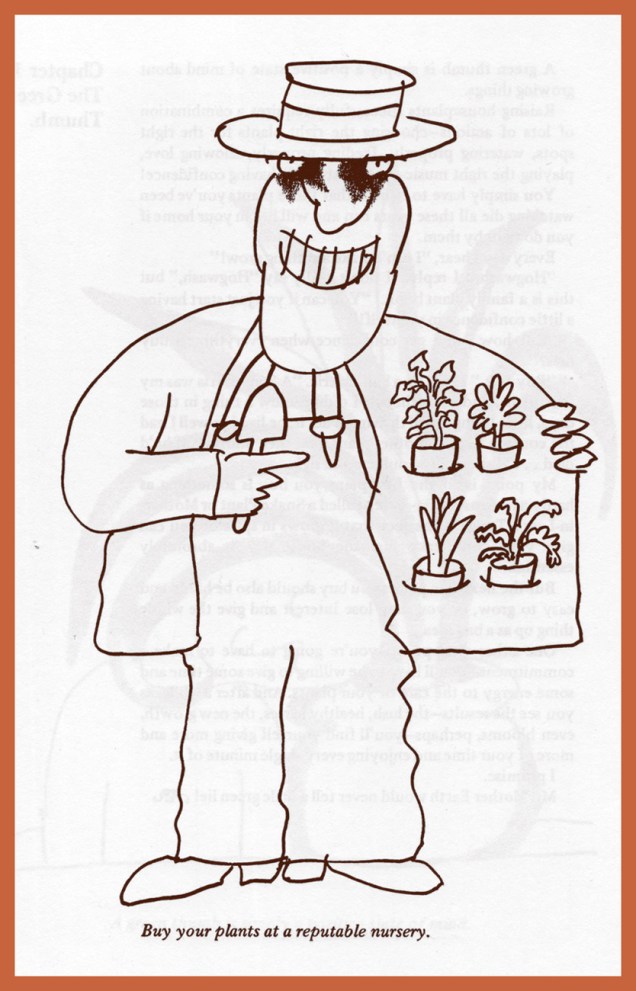
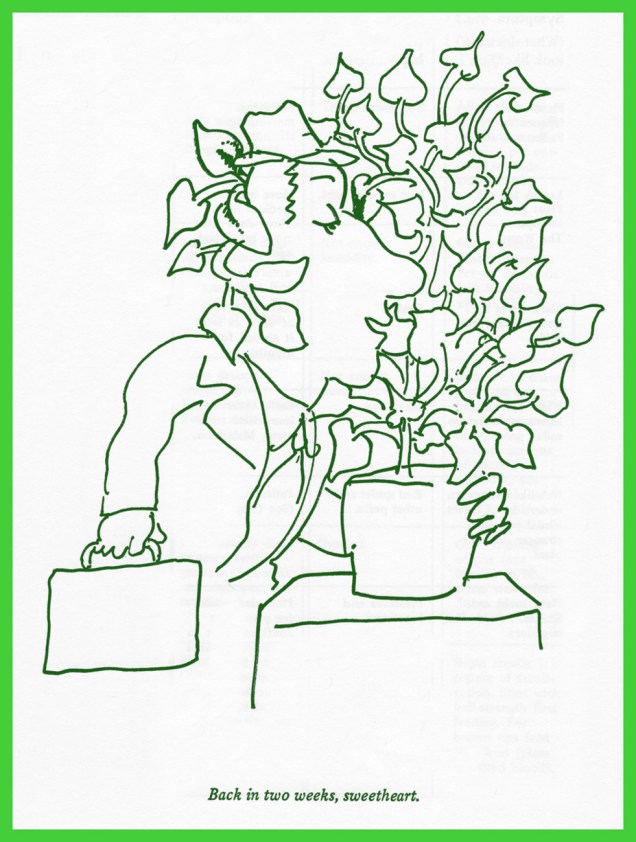
The book (and LP booklet) are illustrated by « Marvelous » Marvin Rubin… who quite deserves the sobriquet, if you ask me.

RubinPlantasia01A
« I was first introduced to Bromeliads by a 75-year-old semi-retired mechanic named Rafe ‘Frenchy’ DeLago. At least I thought I was. It turns out that I was actually first introduced to Bromeliads by my mother and the Dole Company, but neither my mother nor I knew it at the time. Truth is, my mother still doesn’t. You see, all pineapples are Bromeliads. In fact, all Bromeliads are pineapples! »

RubinPlantasia02A

RubinPlantasia03A
As confirmed by George Orwell’s sole comic novel, Keep the Aspidistra Flying.
RubinPlantasia04A
« Those plants will grow in your house, all right, but they’d grow better if you lived in a greenhouse. »
RubinPlantasia05A
« It is well known that plants grow best to classical music, but we have been told about a hip Dieffenbachia who loves The Rolling Stones. »
RubinPlantasia06A
« As people in the plant business, take it from us: the worst pest when it comes to killing plants is Homo sapiens. »

RubinPlantasia07A

– RG

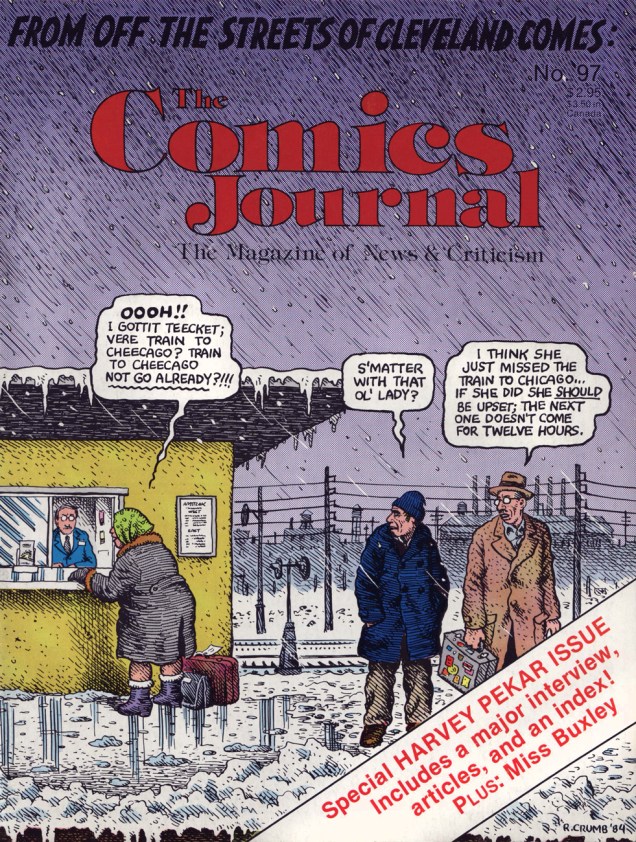
From off the streets of Cleveland comes…

« What kind of people are these?
Where do they come from,
what do they do? What’s in a name? »

Coming out of nowhere (well, “From off the streets of Cleveland“, as it happens) in 1976, Harvey Pekar’s American Splendor was one of comics’ truest and most bracing alternatives. It wasn’t part of the Underground Comix movement, despite the participation of Pekar’s old friend and fellow record collector Robert Crumb, and it wasn’t like anything pushed out by the mainstream comics industry.

JournalPekarA
This is The Comics Journal no. 97 (April, 1985). Cover by Crumb and Pekar.

Crumb’s introduction to Doubleday/Dolphin’s 1986 anthology of early AS strips describes Pekar’s appeal better than anyone else is likely to:

« Yeah, Harvey is an ego-maniac; a classic case… a driven, compulsive, mad Jew… it’s something to see. But how else could he have gotten all those comics published, with almost no money; in total isolation from any comic-publishing ‘scene’ such as exists here in California, or in New York; constantly brow-beating artists to illustrate his stories; handling the distribution himself… only an ego-maniac would persist in the face of such odds. »

« The subject matter of these stories is so staggeringly mundane, it verges on the exotic! It is very disorienting at first, but after awhile you get with it. Myself, I love it… Pekar has proven once and for all that even the most seemingly dreary and monotonous of lives is filled with poignancy and heroic struggle. All it takes is someone with an eye to see, an ear to hear, and a demented, desperate Jewish mind to get it down on paper… there is drama in the most ordinary and routine of days, but it’s a subtle thing that gets lost in the shuffle… our personal struggles seem dull and drab compared with the thrilling, suspense-filled, action-packed lives of the characters who are pushed on us all the time in movies, tv shows, adventure novels and… those *other* comicbooks.

What Pekar does is certainly new to the comicbook medium. There’s never been anything even approaching this kind of stark realism. It’s hard enough to find it in literature, impossible in the movies and tv. It takes chutspah to tell it exactly the way it happened, with no adornment, no great wrap-up, no bizarre twist, nothing. Pekar’s genius is that he pulls this off, and does it with humor, pathos, all the drama you could ever want… and in a comic book yet! »

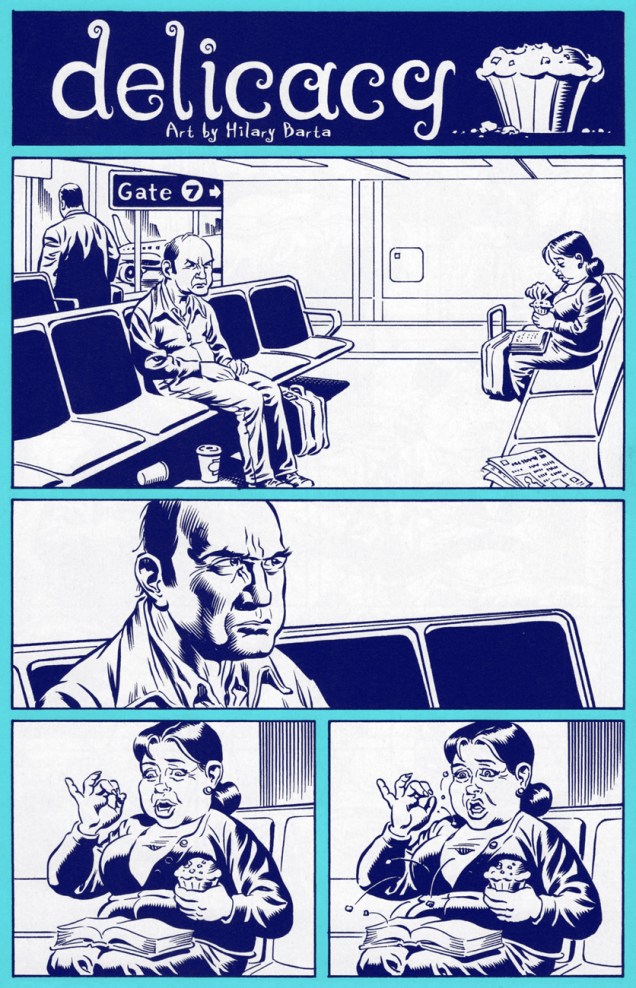
And here’s an atypical example of Mr. Pekar’s storytelling art, a rare but eloquent pantomime vignette. It originally saw print in DC Comics’ run of American Splendor comic books (no. 1, Nov. 2006, published under the Vertigo imprint and edited by Jonathan Vankin.) The symbiosis at play here between writer and artist makes ‘Delicacy’ my very favourite story by Hilary Barta, who somehow never gets matched with a script worthy of his tremendous talent, even when he’s working with Alan Moore (Moore can be very funny, but superhero parodies, even his, seldom are… and Splash Brannigan wasn’t exactly side-splitting). This is a wonderful oddity, one of two times that Barta and Pekar collaborated. Bon appétit!

PekarDaVinci1APekarDaVinci2A-RG

“How Much You Gettin’ Paid for This Gig?” Scott A. Gilbert’s True Artist Tales

« I have moss for brains, so I can keep my cool »

It’s kind of sobering to chance across some regional comics… sometimes they’re of such high quality that I tend to wonder at, and regret, the vast bounty cast aside and left in the dust. How much more similarly fine stuff is out there is anyone’s guess. It makes me long for the days of greater cultural variety on a smaller scale, of humble local stations, local stardom and the unpredictable crazy quilt of regional popularity.

Houston, Texas’ Scott A. Gilbert is a prime example. If not for his being awarded a Xeric Grant in 1995, which financed the publication of It’s All True!, a concise 52-page collection of his favourite True Artist Tales, even fewer of us would have been exposed to his freewheeling talent. Without further ado, here are some of my picks from the booklet.

GilbertStenchA
A Whiff of Hypocrisy (1992)
GilbertArtHistoryA
One Art History (1993)
GilbertTexasMonsterA
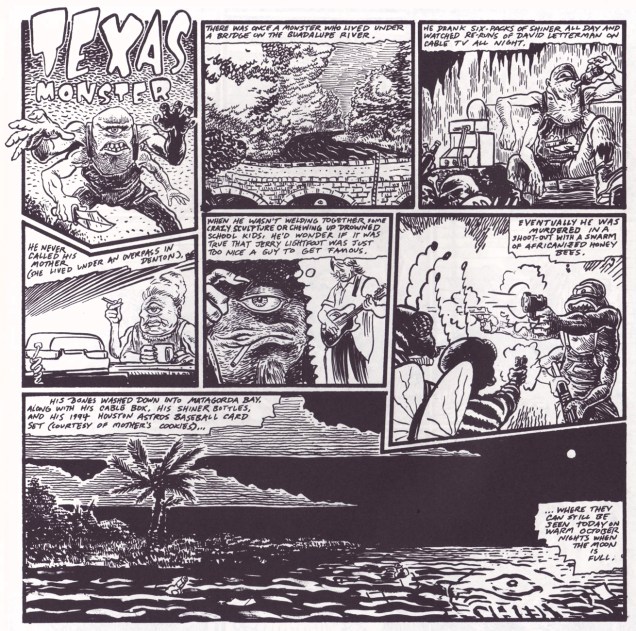
Texas Monster (1994)
GilbertRieverheadedA
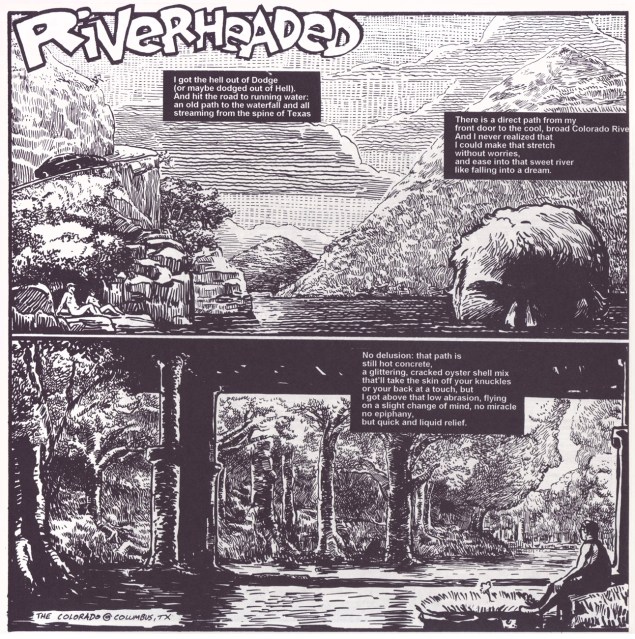
Riverheaded (1994)
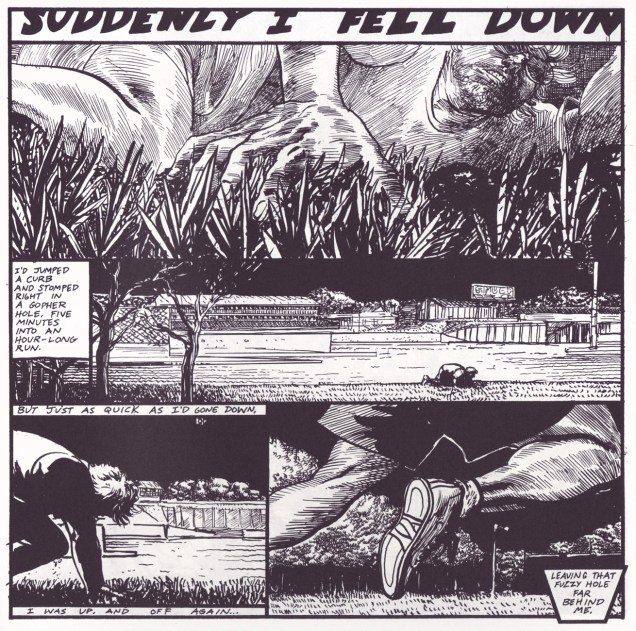
GilbertGopherA
I Fell (1994)

Gilbert’s True Artist Tales was published in rival alternative weeklies Public News (1988-97), and Houston Press (1997-2000). To answer our opening question, Gilbert got $25 a strip at Public News and $30 at Houston Press.

And for a bit more context, here’s an illuminating presentation that former Comics Journal managing editor Robert Boyd gave last year during a retrospective of Gilbert’s art Boyd was curating (now there’s something you don’t often see these days: the use of “curating” in its proper context!)

http://www.thegreatgodpanisdead.com/2016/11/true-artist-tales-talk.html

-RG