Hallowe’en Countdown III, Day 11

« Is it true your first concert is going to be at a cemetery? »

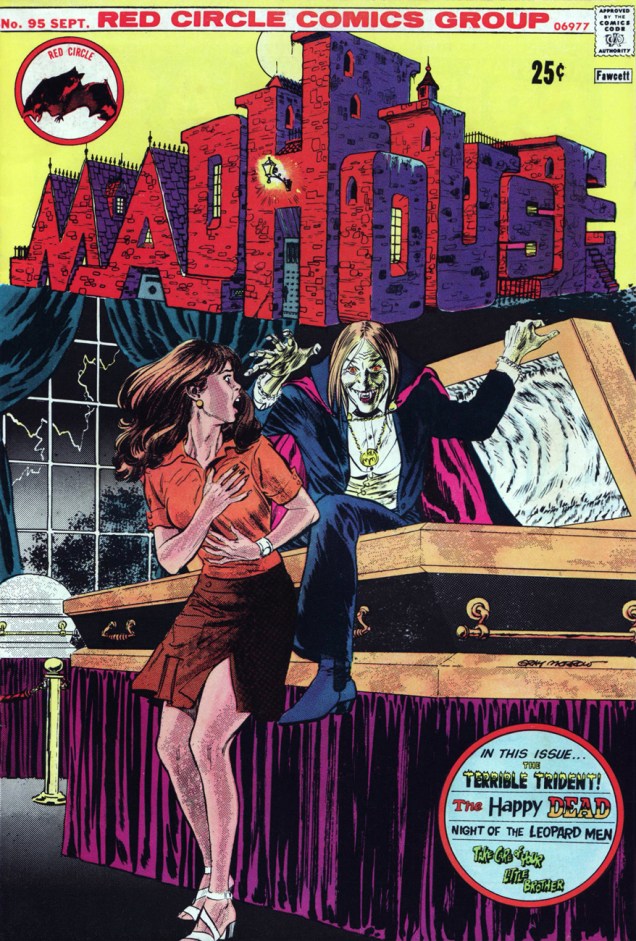
By the summer of ’74, the Archie brass was getting sick of those no-account Didit Brothers (You know, Dan, Dippy, Dick and Clyde) and their groupie Fran the Fan, so the Madhouse Glads were tossed out on their collective ear in favour of… a horror anthology. It made sense: in the 1970s, there was considerable overlap (largely female, but not exclusively) among readers of, say, The Witching Hour, Betty and Me, and Romantic Story.
Madhouse95A
The final fate of Fran the Fan? This is Mad House no. 95 (Sept. 1974, Archie); cover art by Gray Morrow. Read the issue here.

It’s fair to assume they were envisioning a companion title for their Chilling Adventures in Sorcery / Red Circle Sorcery. This was something different for Archie, all right: they sought out top talent, but in a fairly consistently sober visual style. Gray Morrow‘s photo-based approach was the baseline, and small wonder: he was the editor. The bulk of the stories was penned by Marvin Channing, and while the ‘twist’ endings weren’t exactly fresh, some of these tales were surprisingly nasty and nihilistic.
AlcazarTrident02A
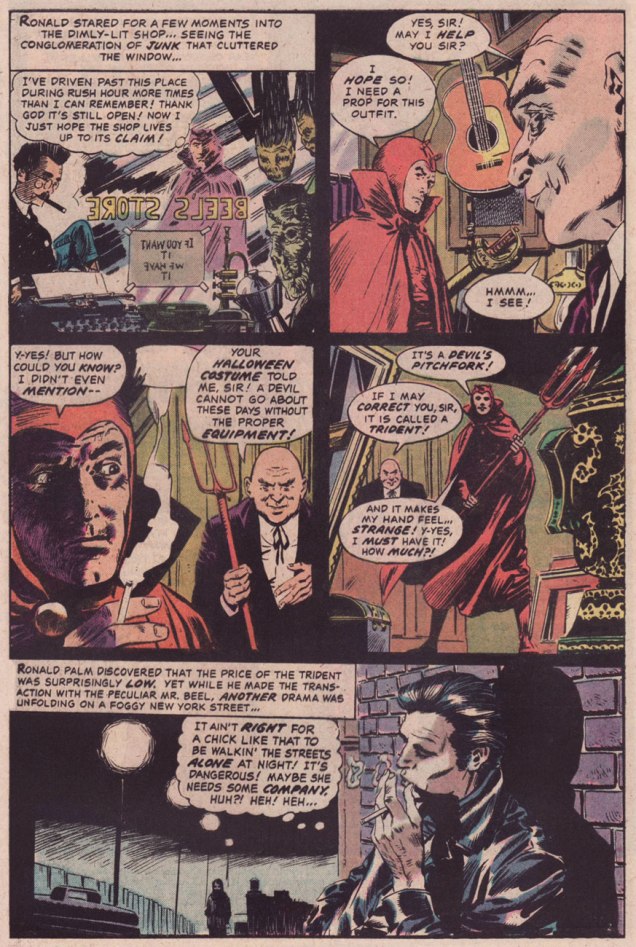
Page two from The Terrible Trident!, written by Don Glut and illustrated by Vicente Alcazar.
WildeyHappyDead03A
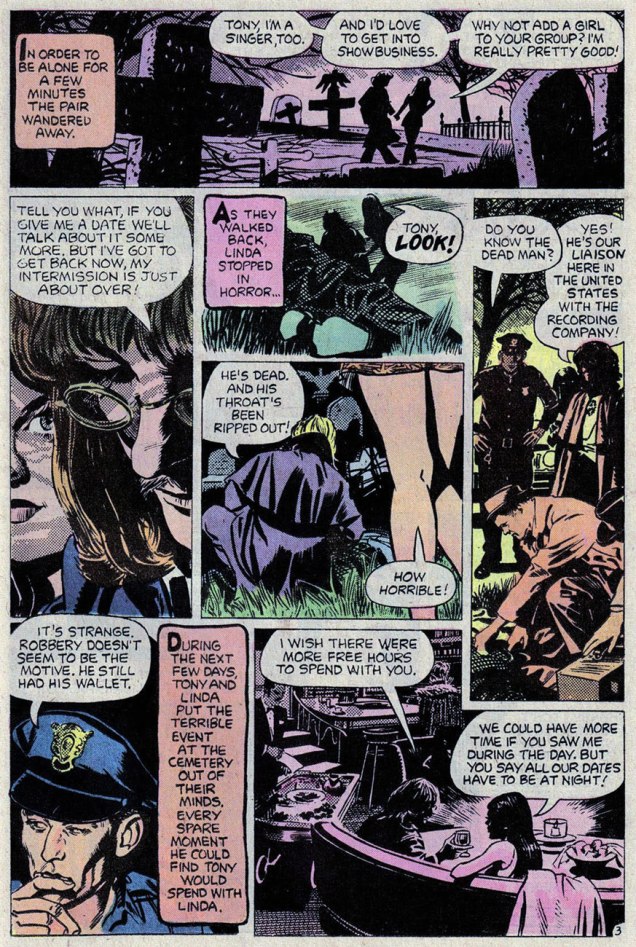
Page three from the cover story, The Happy Dead. Written by Marvin Channing and illustrated by Doug Wildey. Whoever handled the colouring here was smart and discerning.

However, this version of Madhouse lasted but three issues before the book was returned to its original, pre-Glads format. Sorcery endured for nine issues, the first three done in the Archie house style, with narration by Sabrina, the Teenage Witch. By the end of 1974 (with a book cover-dated February, 1975), the experiment was over. But these things come in cycles, don’t they? Witness the recent Afterlife With Archie… which incidentally reprinted much of this material.
SabrinaA
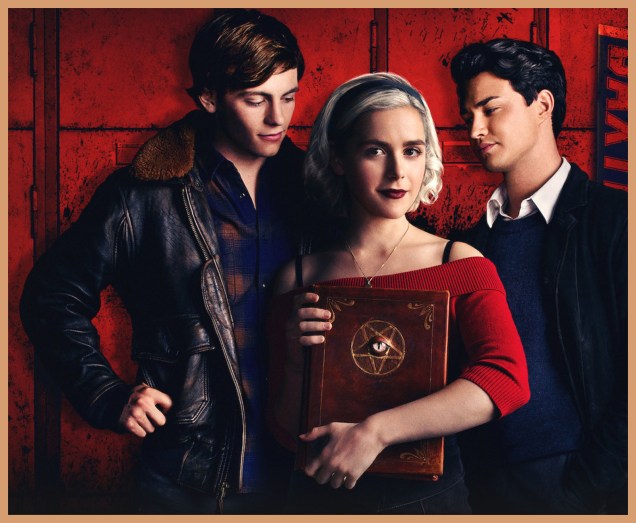
And in other media, amidst the current glut of Archie product, one finds a direct scion of a timid, decades-ago exploration, Netflix’s Chilling Adventures of Sabrina.

– RG

Hallowe’en Countdown III, Day 10

« Behind every tree there’s a new monster. » — Todd Rundgren

Now how can you go wrong with a genre-melding title like this? Did publisher Hillman Periodicals decide it was entirely too much of a good thing, and nip it in the bud? Who wrote and drew the darn thing? Nearly seventy years on, these are not easily-answered questions.

Monster-Crime1A

Anyway, the lone, unnumbered issue of Monster Crime Comics rolled off the presses in the fall of 1952, it’s a pretty scarce item, as they say in the trade, and it features the sordid tales of The Crutch to Paradise, Another Hallowe’en, The Boss of Ice Alley, Oregon Tiger, The Canvas Tomb, The Cold Doorstop, and The Two-Legged Newspaper.

« A low print run and high price for the time (15 cents!) combined to make this one-shot among the rarest of the era’s crime comics, with perhaps 20-100 copies surviving. The over-the-top cover contributes to the book’s fame, particularly because it has nothing to do with the contents. Pre-Code crime comics from Hillman, possibly printed to clear out a backlog before the publisher ended its comics lineup a few months later. » [ source ]

– RG

Hallowe’en Countdown III, Day 9

« I hear they’ve hired a skeleton crew to take over the night shift. »

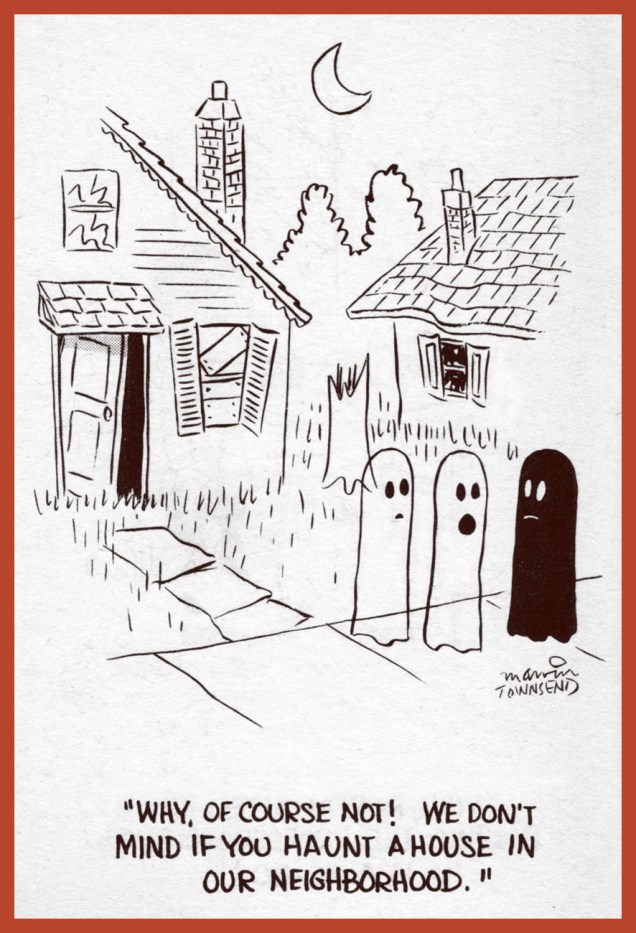
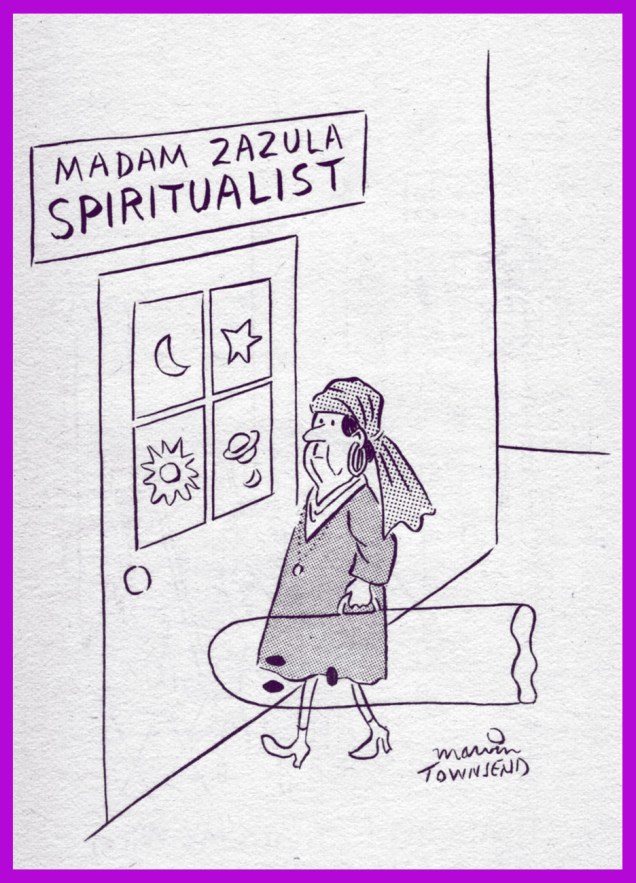
Published in 1971 by, of all entities, the Xerox Corporation, under its Xerox Education Publications banner, this oddball little volume is pretty high on charm. Its author, Kansas City cartoonist Marvin Townsend (1915-1999), placed his gags all over the place, high and low, from slicks to religious publications to pulps (including Amazing Stories and Argosy), to girlie digests such as Charlton’s Cartoon Spice, created several running strips, including the Ali feature for the long-running (1946-72) Catholic comic book Treasure Chest (of Fun & Fact). Let’s not forget that Townsend was in fine company there: contributors to TC over the years include Murphy Anderson, Reed Crandall, Graham Ingels, Fran Matera, Jim Mooney, Joe Orlando and Joe Sinnott. In the lean years of the Silver Age, it was ‘any port in a storm’, and any reliable source of income and exposure was the freelancer’s boon. Same as it ever was.

GhostlyGhastlyA

TownsendGuestSpeakerA
It’s hard to imagine today’s church being this open to airing and considering the opposing view.
TownsendArkA
All aboard for Noah’s Same-sex Ark cruise!

TownsendBlackATownsendDeadLetterA

TownsendScooterA
I love that kid’s steadfast nerve and adaptability. 

TownsendZazulaA

For a further sampling of these Ghostly Ghastly Cartoons, glide on over to this blog entry: http://neatocoolville.blogspot.com/2007/10/ghostly-ghastly-cartoons.html. Fret not, I kept the overlap to a strict minimum.

– RG

Hallowe’en Countdown III, Day 8

« You look a sorry sight, John! »

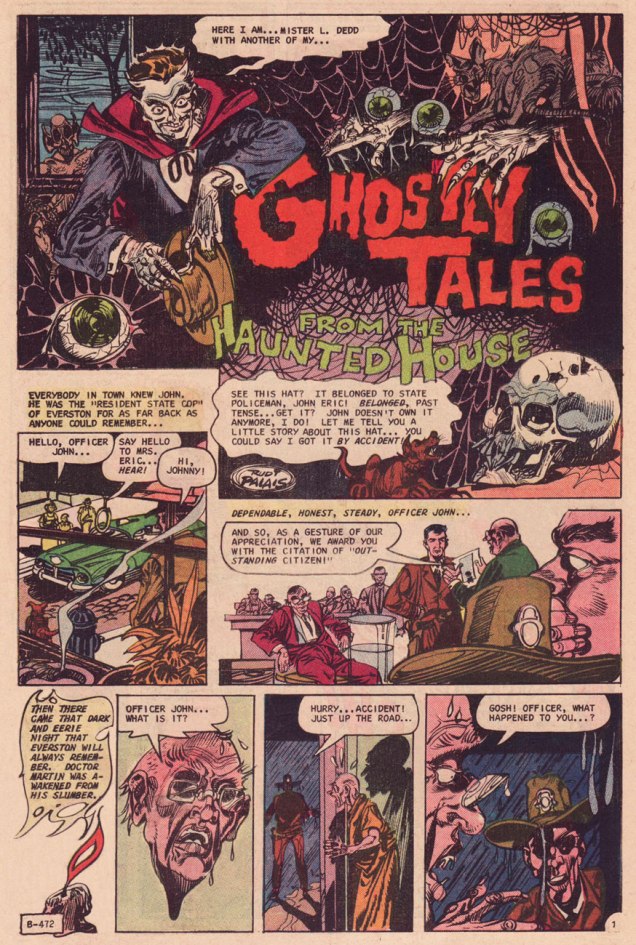
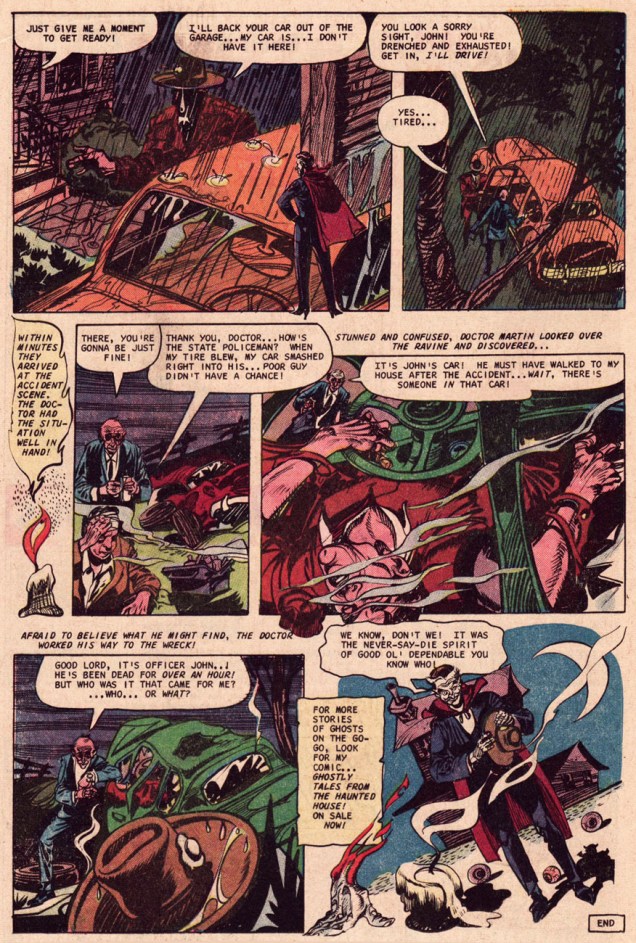
Golden Age pioneer Rudy Palais (1912-2004) wound down his career in comics with a smattering of terror tales for Charlton between the late 60s and the mid-70s. It’s a shame he didn’t do more, because his highly-stylized approach fit right into the Charlton non-mould. The inaugural issue of The Many Ghosts of Dr. Graves (May, 1967) features a pair of remarkable Palais two-pager sweatfests. Here’s one of them, a simple story effectively told, and wherein Ghostly Tales host Mr. L. Dedd plugs his own book.

PalaisGraves01A

PalaisGraves02A
Check out the sizzling stiletto heels Mr. Dedd’s sporting in the first panel!

– RG 

Hallowe’en Countdown III, Day 7

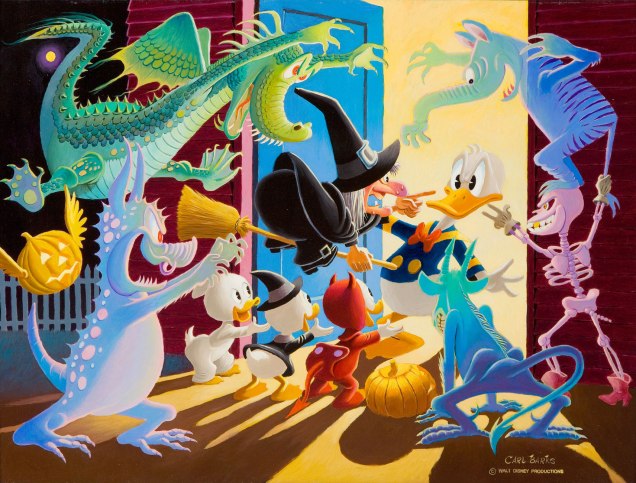
« Phooey on trick or treaters! This year I’M going to have all the fun — play the tricks and eat the candy myself! » — foolish words from Donald

Whoa, lots of action for poor Unca Donald this Hallowe’en, some of it possibly malevolent. Best hand out the treats and be generous, to be on the safe side.

BarksHalloweenDuckburgA

This lovely painting entitled Halloween in Duckburg was created in 1973 by the incomparable Carl Barks, aka The Good Duck Man. It’s based on his cover for Walt Disney’s Donald Duck no. 26 (Dell Comics, Nov. 1952), which in turn was based upon the Disney cartoon short Trick or Treat.

BarksDonaldDuck26A

Watch it here… while you still can.

As a bonus, here’s a nice Donald mask (not that Donald… right colour, but too scary) for your trick or treating purposes, from the same issue’s back cover.

DonaldDuckMaskA

– RG

Hallowe’en Countdown III, Day 6

« Spine-chilling tales of suspense, horror, and the supernatural—prepare yourself for Adventures into the Unknown! »

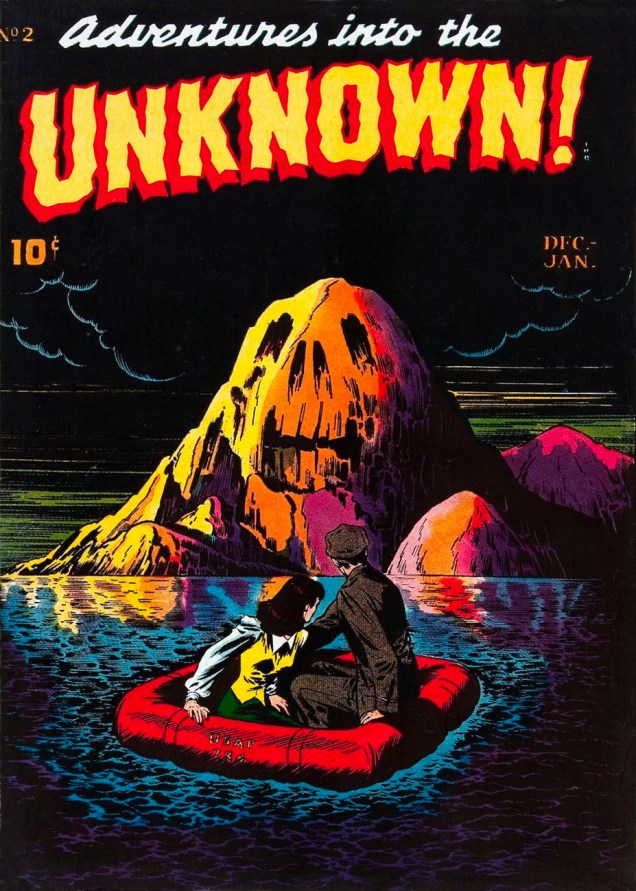
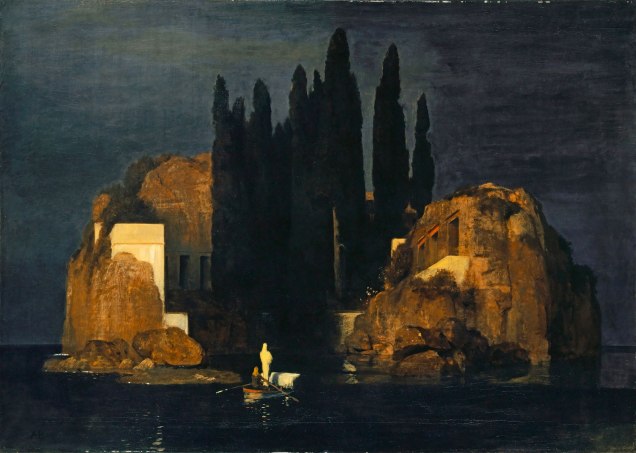
This American Comics Group (ACG) entry is generally considered the first title fully committed to the supernatural genre in the history of US comics. And this arresting, Isle of the Dead-styled tableau graces the cover of the title’s second issue (December, 1948). Art by Edvard Moritz. Most of the stories were scripted by horror legend and H.P. Lovecraft disciple Frank Belknap Long (read his The Hounds of Tindalos and forfeit your soul!) Speaking of which, the entire issue’s contingent of chills and thrills is available right here for your pleasure and leisure.

ACGAdvUnknown02A
This is Adventures Into the Unknown! no. 2 (Dec. 1948 – Jan. 1949, ACG).
BöcklinIsle1880A
As I was saying, Arnold Böcklin‘s Isle of the Dead painting, in its original version… of several.

This painting also inspired a quite fine Val Lewton / Mark Robson / Boris Karloff motion picture bearing the same name (1945). Watch the trailer, why don’t you.

« Kill, puppets, Kill! » — Turgot, the Puppet Master, never one to mince words.

– RG

Hallowe’en Countdown III, Day 5

« … his appreciation for city life was such that when I was a little girl and we would be going on walks, he would periodically draw my attention to the colorful and interesting patterns created by garbage strewn about on the streets, or by dilapidated storefronts with their torn-off signs. » — Gina Kovarsky on her father’s perspective

Funny how history works: for every world-famous New Yorker cartoonist, there’s another who’s just about been forgotten, yet is every bit the equal of his more celebrated colleague.

Anatol Kovarsky (born in Moscow in 1919, lived and thrived to the impressive age of 97) began working for the New Yorker in 1947, who published his cartoons and cover illustrations until 1969, when the man turned his full attention to painting.

KovarskyBunkA
This specific piece first saw print in The New Yorker in 1956, and was collected later that year as part of the classic Kovarsky’s World (Alfred A. Knopf).

For further reading, here’s a pair of excellent articles on the esteemed Mr. K:
http://michaelmaslin.com/inkspill/anatol-kovarsky-still-drawing-after-all-these-years/
and http://coyleart.typepad.com/coyleart/2007/08/anatol-kovarsky.html

-RG

Hallowe’en Countdown III, Day 4

« ... and suddenly, an ordinary business day becomes a day of horrible visions… »

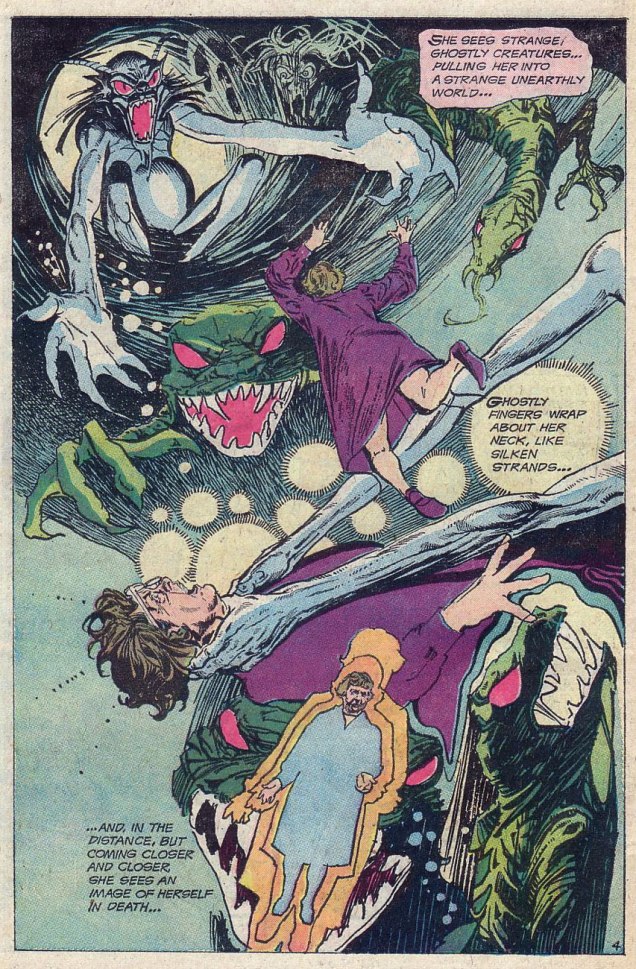
When he was introduced in 1951 (Star Spangled Comics no. 122), Dr. Terrance Thirteen was a perfect fit for the DC universe: a skeptic who, in the nominally-rational world he inhabited, got to elucidate and debunk all sorts of mock-supernatural shenanigans. When the ghost-breaker made his return in the late 60s (as a foil to his also-returning contemporary The Phantom Stranger), however, the world had changed. The editorial balance had shifted in favour of the mystical, and Dr. 13 wasn’t as fortunate as the kids from Scooby Doo: he now faced bonafide manifestations from the beyond, but he wouldn’t have any of it, becoming a blind, overbearing ideologue in the vein of filmic non-believers Dana Andrews in Night of the Demon (aka Curse of the Demon) or the fabulous Peter Wyngarde in Night of the Eagle (aka Burn, Witch, Burn… adapted from Fritz Leiber’s Conjure Wife).

And things got worse and worse over the years; by now Dr. 13 is treated as a joke and a punching bag (even Matt Howarth blew it, a rare misfire), but that’s the general climate in the modern mainstream: most long-running characters, even the heroes, with a scientific background (Henry Pym, Reed Richards, Tony Stark et al) are frequently depicted as arrogant, misguided and often downright insane.

For a brief time in the early 1970s, Dr. 13 was handled by a sympathetic and skillful writer who understood what the man stood for and what made him tick. For a full example, check out our earlier post on another Dr. 13 case, … and the Dog Howls Through the Night! (1974).

DeZuniga13Glasses05ADeZuniga13GlassesA
Scripter Skeates stated, a few years ago: « I quite like this story, especially the beautiful psychedelic scary artwork DeZuniga provided (an artist I very much enjoyed working with; he also illustrated a number of my Supergirl tales), plus the ending in which I somehow decided to treat this yarn as though it were a cautionary tale, the lesson learned being that one shouldn’t commit murder! For the longest time a copy of this comic wasn’t in my collection , but a couple of years ago I came upon a copy at a convention — the price-tag was a bit high due to the origin story that’s also in there! When I told my wife I had shelled out forty bucks for a comic with a story of mine in it that didn’t even have credits on it, she concluded that I was the one who was quite definitely insane!! »

-RG

Hallowe’en Countdown III, Day 3

« Apparently, no one could credit such a grotesque being with any sense of kindliness, and so the wounded monster limped along his way, his hatred of humanity grew in proportion to his size. »

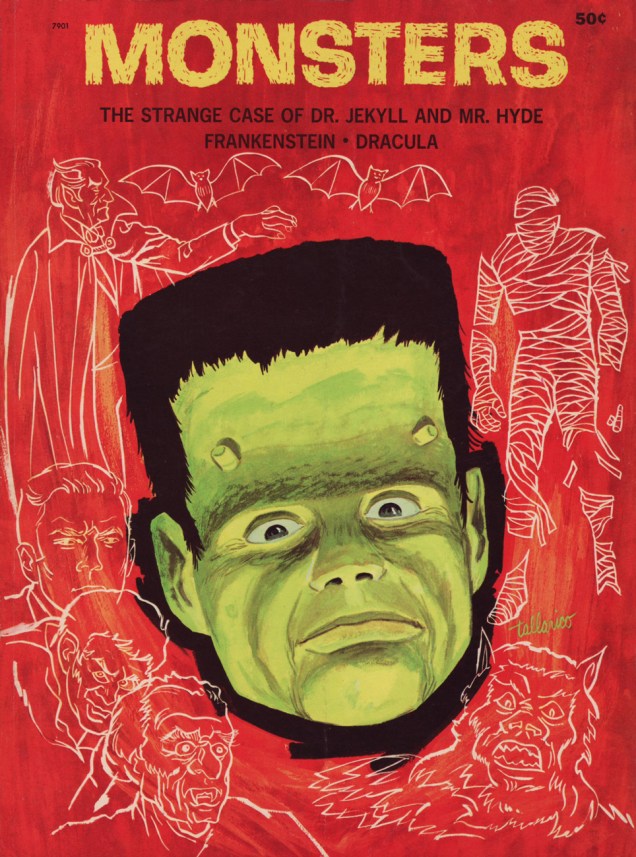
Unleashed upon the world in 1965 by Wonder Books, this generously-illustrated volume of classic adaptations is a collaboration between fellow prolifics Walter Brown Gibson (1897 – 1985), the writer most closely associated with Street & Smith’s The Shadow, and artist Tony Tallarico, a journeyman who produced a bounty of work, as artist and packager, for just about every publisher in the business… save DC and Marvel, and who, upon leaving the mainstream comics field in the mid-1970s carved out a lucrative little niche for himself putting together scads of illustrated books, mostly for children, on just about every subject under the sun.

MonstersTallaricoA

TallaricoDracA
« Dracula’s form had materialized now, His long-nailed fingers were gripping the window bars, and the mist had become a swirl of moths behind him. »
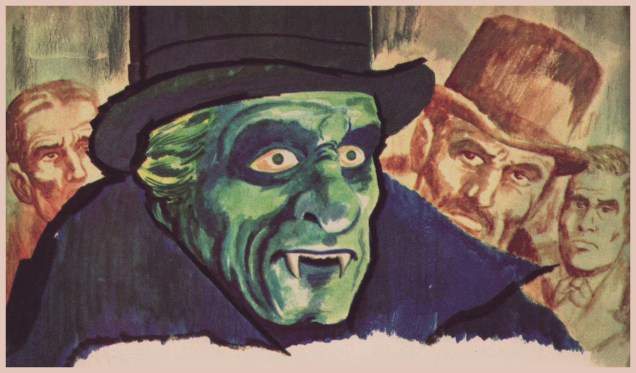
TallaricoHydeA
« The man’s  ugly, fiendish look chilled Enfield, but the crowd threatened the ruffian, who finally said that his name was Hyde… »

Tallarico would, the following year, revisit some of the fiends depicted here for a short-lived but infamous trio of series for Dell: Dracula, Frankenstein and Werewolf. Ah, but don’t be so dour: it’s just light, campy fun.

-RG

Hallowe’en Countdown III, Day 2

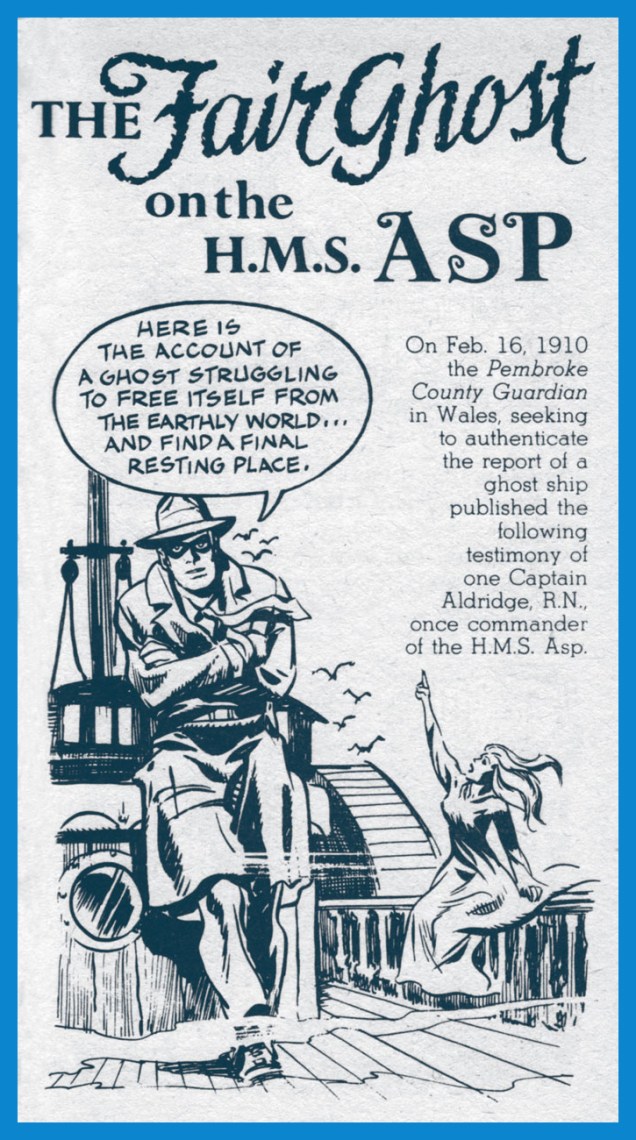
« In June, 1913, the family moved out in terror! … they simply abandoned the house in the Midlands. There is no record of successors. If you are looking to rent a house, cheap… it may still be there! »

On this second day of our Hallowe’en countdown, let’s peer through the mists of time at 1976, when Will Eisner was still experimenting with marketing formats for comics-type material. This was still a couple of years before his A Contract With God and Other Tenement Stories (1978) appeared. During that period and beyond, Eisner was throwing a lot of material at the wall, in the finest exploitation tradition, hard on the heels of every bankable trend: Will Eisner’s Gleeful Guide to the Quality of Life, 101 Outerspace Jokes, Will Eisner’s Gleeful Guide to Communicating With Plants, Will Eisner’s Gleeful Guide to Living With Astrology, 300 Horrible Monster Jokes… and it wasn’t all good, as you can imagine.

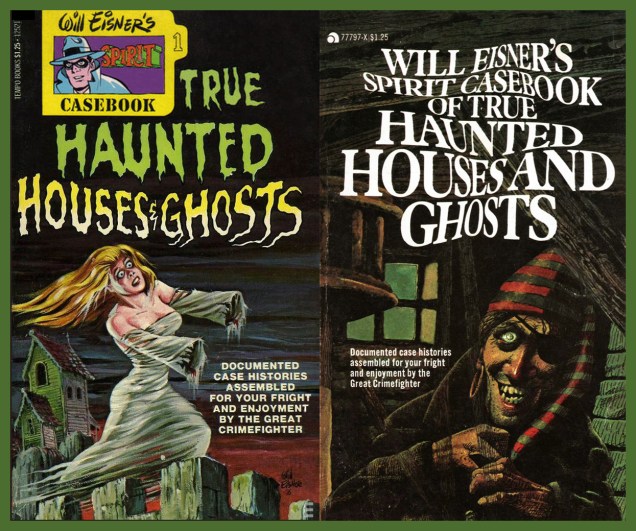
This 160-page paperback from 1976 is arguably the cream of that crop; an easy choice for those of us who value Eisner’s expert hand at setting a shadowy mood.

SpiritCasebook2A

EisnerSpiritGhostsVersoA
Mr. Eisner’s original back cover.

Publisher Tempo Books seems to have had limited faith in the sales appeal (too gruesome?) of the original cover, as a variant edition was issued in short order, bearing a fine, but non-Eisner cover. Can anyone identify the artist?

EisnerHouseGhostAEisnerHMS_AEisnerInmate23AEisner5thAvenueA

-RG