Fungus Friday: Amanita New Year (To Get Over This One)

It’s nearly New Year’s eve, and a Friday, which seems like some sort of omen for a gallery of vintage winter postcards featuring toadstools, seeing as Fungus Friday is every bit as tangible as Tentacle Tuesday (go here if you’re late to the tentacle train). The connection between hibernal celebrations and mushrooms might not be an immediately obvious one, but one has to keep in mind that the way we celebrate Christmas is distinctly pagan.

More in reference to mushrooms, it has been argued that Santa Claus actually started out his folkloric life as a shaman who gets high on Amanita* (either by direct consumption, or by drinking the urine of reindeer who have consumed them). When one looks for coincidences, one finds them, but nevertheless it’s worthwhile pointing out that the pine trees we adorn our households with for Christmas form a symbiotic relationship with Amanita muscaria (yes, that iconic red toadstool with white warts that so often stands in for a generic mushroom in many stories), and that Santa Claus’ red-and-white costume follows its colours. For more in-depth analysis, I highly recommend Santa Claus Was a Psychedelic Mushroom (written by Derek Beres, who also coined the great alliteration ‘psychedelic piss’ when discussing reindeer-processed Amanitas).

This claim has been disputed by people (some of whom were foaming at the mouth, and not necessarily from mushroom consumption) who point out that this is rather a case of retro-fitting facts into the storyline. You may accuse me of intellectual laziness, but I actually don’t give a fig about where Santa Claus came from. Of more relevance to me (and this post) is this bit: ‘Fly agaric does not appear in authentic Germanic Christmas cards, they’re New Years cards which use fly agaric as a good luck symbol, alongside horse shoes and four-leaf clovers.’ The Fliegenpilz is indeed a good luck charm in Germany, so that’s quite possible. New Year’s card are certainly germane to this time of year, now that the ecstatic joys of Christmas (ahem) are a week behind us.

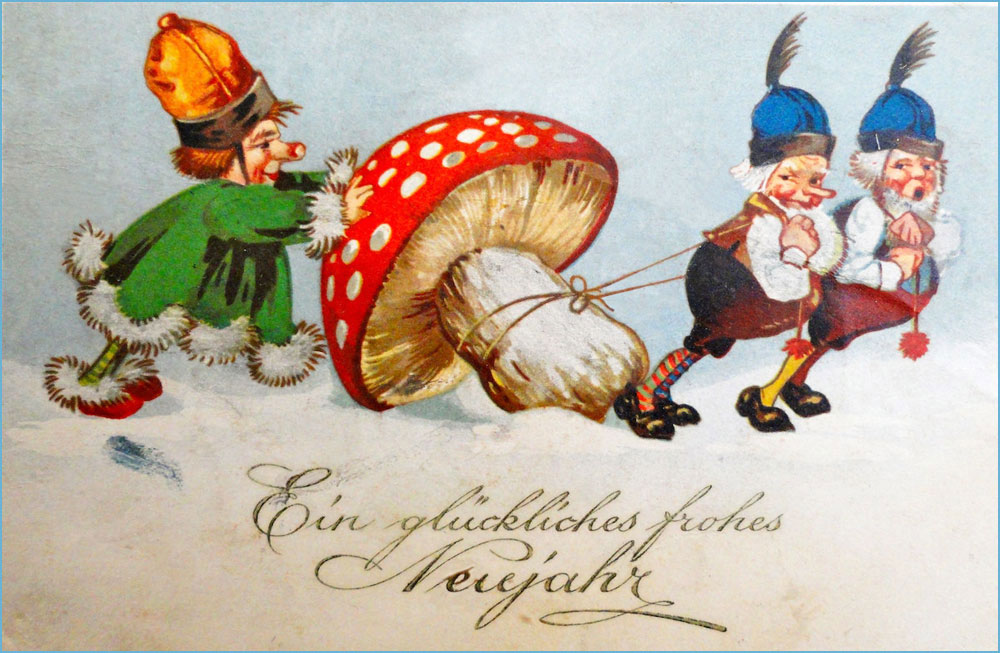
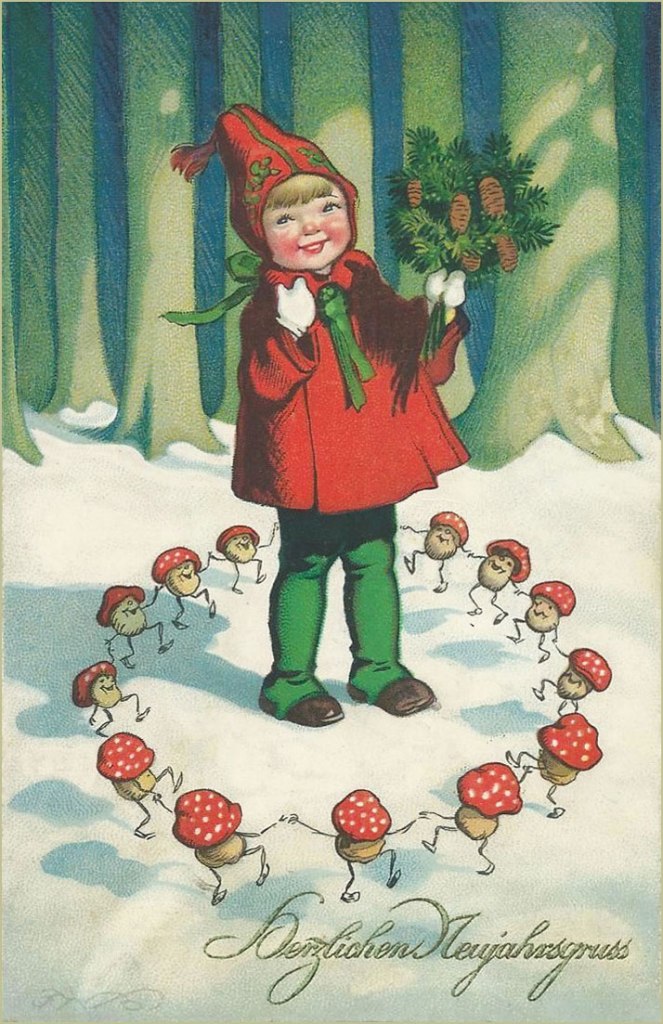
Either way, enjoy the array of vintage postcards from the late 1930s-1940s, most of them German. Whatever they’re supposed to symbolize (the ones with writing do mention New Year, not Christmas), to a modern reader’s eyes they’re delightfully weird, and I won’t blame anyone for thinking that some drugs were involved.

The Amanitas-as-good-luck-charm theory seems to be borne out in the following, given the presence of clover, horse hooves, etc.:

I wonder if the kid in white represents the Destroying Angel (Amanita virosa and similar) – its name gives more than a hint about its toxicity. Perhaps ‘Mushroom Grandpa’ should stay away. Pigs are also a good luck charm, so they make more than one appearance in these postcards (though much like the rabbit’s foot, they’re distinctly unlucky for the actual animal, since they get gobbled up…)
Boldog Új Évet is actually in Hungarian, not German, and means Happy New Year
… and Daudz laimes jauna gada is in Latvian.

Who knew so much revelry was taking place around a couple of mushrooms?

The closest I was able to find is Head uut aastat, which is Happy New Year in Estonian. This post is proving to be quite a language lesson.
Another Latvian postcard. The one on the left is totally sloshed.
Gelukkig Nieuwjaar is in Dutch.

The rest of these are in German:

There is something disquieting about a pink-cheeked child surrounded by dancing mushrooms.
‘Wow, this thing is big and it’s all for me!’
An Amanita drawn by somebody who wasn’t sure what they looked like (hint: it’s not a raspberry).
Weihnacht is sort of like Christmas eve in German-speaking countries. Note that this postcard differs from others in two ways – it features a bolete, not an Amanita, and wishes the viewer Merry Christmas, not Happy New Year (with a bag full of money, apparently).

Happy New Year to all our dear readers, and may your paths be littered with tasty mushrooms in the coming year!**

*Amanita muscaria is considered poisonous, as far as foraging mushrooms go, though it has a long history of being used as a psychedelic/intoxicant by many tribes (namely, by the indigenous people of Siberia). A strong dose causes delirium and a host of other side-effects, which fade after a few days. I might add that some Russians (and god knows Russians will eat whatever mushroom is even remotely edible – I say that with nothing but admiration) consider it a good edible, provided you boil it in water three times or so. I might try that one of these days! I have no interest in psychedelic properties, but plenty of interest in culinary ones.

**Assuming you like them, of course.

~ ds

Pudge, Girl Blimp, Goes Cavorting

« While so many other women underground cartoonists were reclaiming the right to their own bodies in the wake of Roe v. Wade with comics like Abortion Eve and Tits n’ Clits, Marrs was reclaiming hers by reveling in its grotesqueries—namely, burps, pimples, compleat dandruff, BO, flatulence, ‘and other bodily emissions’. »

My first exposure to underrated cartoonist Lee Marrs was the story A Feline Feast, which you can conveniently read in co-admin RG’s post Felines and Moonshine: Two by Lee Marrs. I liked the expressive sketchiness of her line straight away, but only got around to what’s arguably her magnum opus, The Further Fattening Adventures of Pudge, Girl Blimp, much later.

In a fairer world, Marrs would be a much better known name. Was is because her output was so wide-ranging, or because she was writing frankly about women as actual human beings, not some glorified version thereof? I think fame is largely down to luck, and I guess luck was not exactly au rendez-vous. Still, fame or no fame, it’s undeniable that her career has been long, varied, and, I imagine, satisfying. It has been summarized by Monica Johnson writing for The Rumpus, so if you want the nitty-gritty of it, head over here; I’ll just mention that she was one of the first female underground comics artists, as well as one of the ‘founding mommies’ of Wimmen’s Comix.

Wimmen’s Comix no. 3 (October 1973, Last Gasp). The ranks of Marrs’ fellow Wimmen’s Comix founders have been cruelly decimated of late: our respectful farewells to Diane Noomin (who died last Sept. 1st) and Aline Kominsky-Crumb (who died November 29th).

Comixjoint explains,

« Our squat, face-stuffing heroine Pudge is introduced with her hitchhiked arrival in San Francisco from Normal, Illinois as a fat 17-year-old runaway. She’s also a virgin and she really wants to get laid, but that won’t happen in the first issue (or the second). Pudge’s backstory is further complicated by the fact that she is, in reality, a Martian, and the government of Mars has sent two guardian Martians to Earth in order to keep an eye on her… »

The Further Fattening Adventures of Pudge, Girl Blimp no. 1 was published by Last Gasp in 1973 and then reprinted, with a new cover, by Star*Reach, which also released issues no. 2 and 3. This is no. 3 from October, 1977.

I wasn’t setting out to write yet another post about an ‘historically important’ series; these things are accidental. The following scans are from a 2016 collection, The Further Fattening Adventures of Pudge, Girl Blimp, which almost looks like a print-on-demand affair, the art reproduced a tad shoddily and fuzzily. Where is the lavish hard-cover edition with bonus material, I would like to know? Well, we’ll settle for this in the meantime.

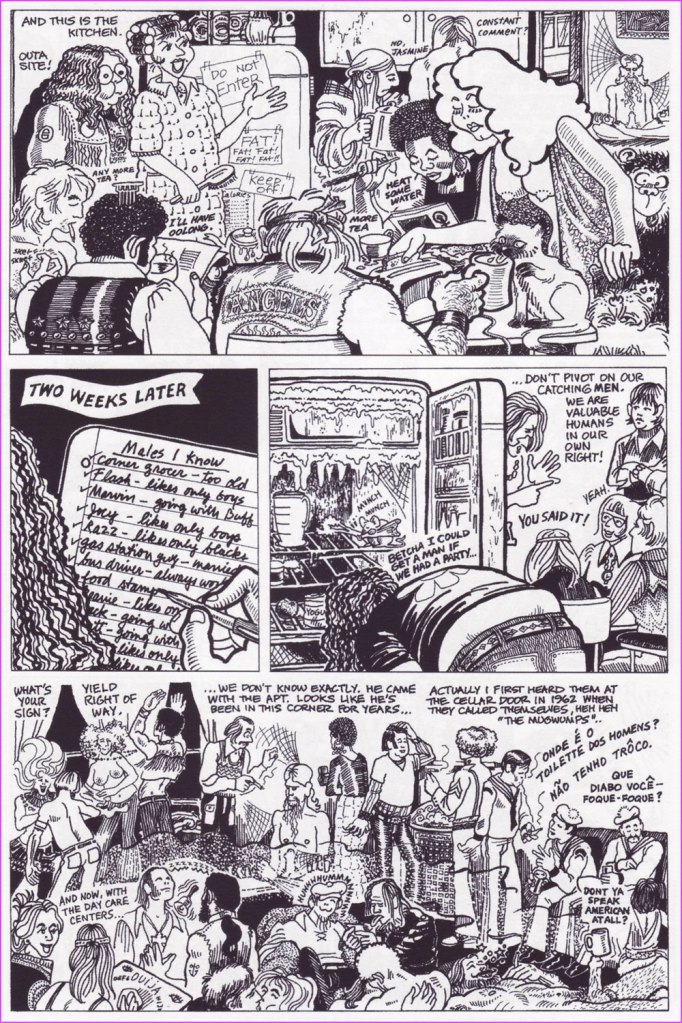
A little peek into the commune where Pudge lives, as well as a glimpse at one of the many parties (an occasion to find some guy to have sex with, hopefully).

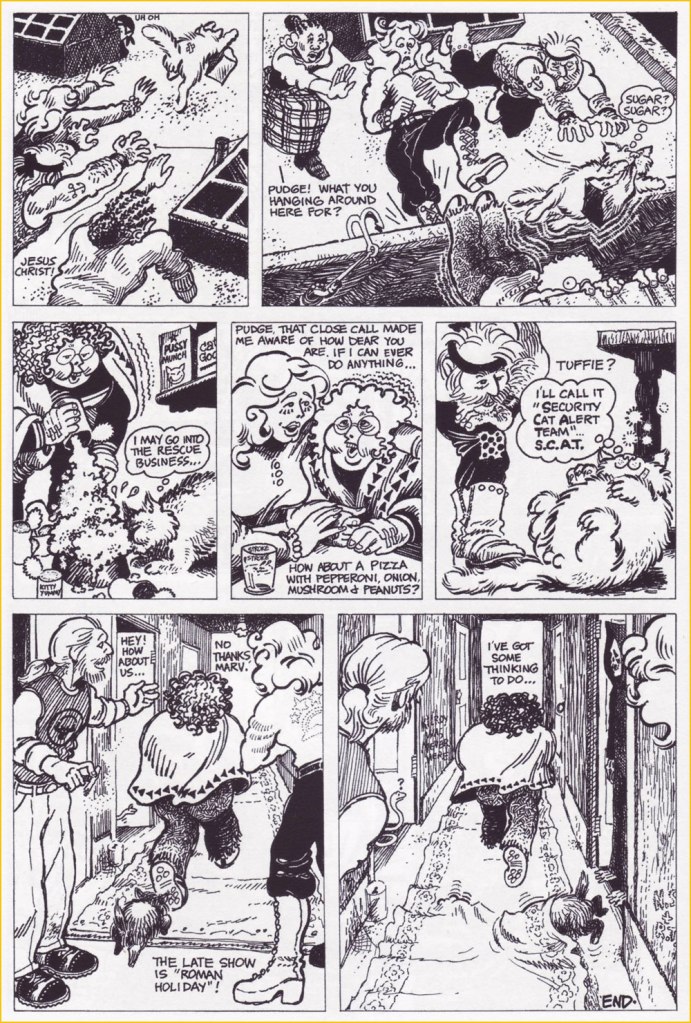
Here is a four-page sequence that I chose not only because it involves a cat (though I admit that influenced me), but mostly because it shows the nice dynamics of the close-knit group of ‘perverted hippies’ Pudge lives with:

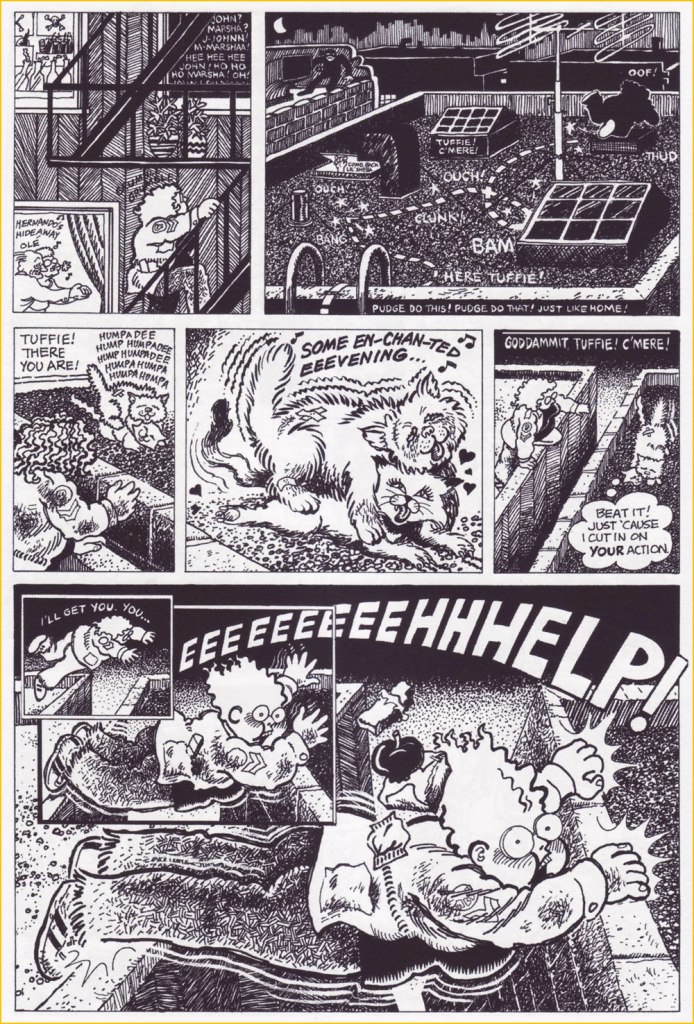
Finally, a look at one of Pudge’s many attempts to hold a job:

The lovely thing about this series is that it never comes off as cringy, despite all the plot traps this comic could have fallen into. Pudge is not some sort of idealized, sexy Voluptuous Woman, and neither is she a butt of fat jokes. Her girth is a facet of her, along with her personality, curls, and puppy enthusiasm for some things – some people love her, some people don’t, and that’s fine. When she loses weight, her beau bemoans ‘sigh… I’m gonna miss all those yards of bouncy flesh…’ but he is not fetishizing her. Besides adroitly handling what’s arguably a taboo topic (although a lot more today than it was in the 70s, I imagine), Marrs also lovingly depicts a totally believable camaraderie between a rather disparate group of people of all races and interests; addresses sex in a playful and positive yet realistic way; and even delivers a sort of a public service message, as we follow Pudge while she gets a crash course in contraception, is instructed on how to find her cervix, and compares breasts with friends. She may occasionally end up in jail or suffer disappointments as she discovers that life is more complicated than she thought… but in the end, this is a friendly and welcoming world to spend some time in.

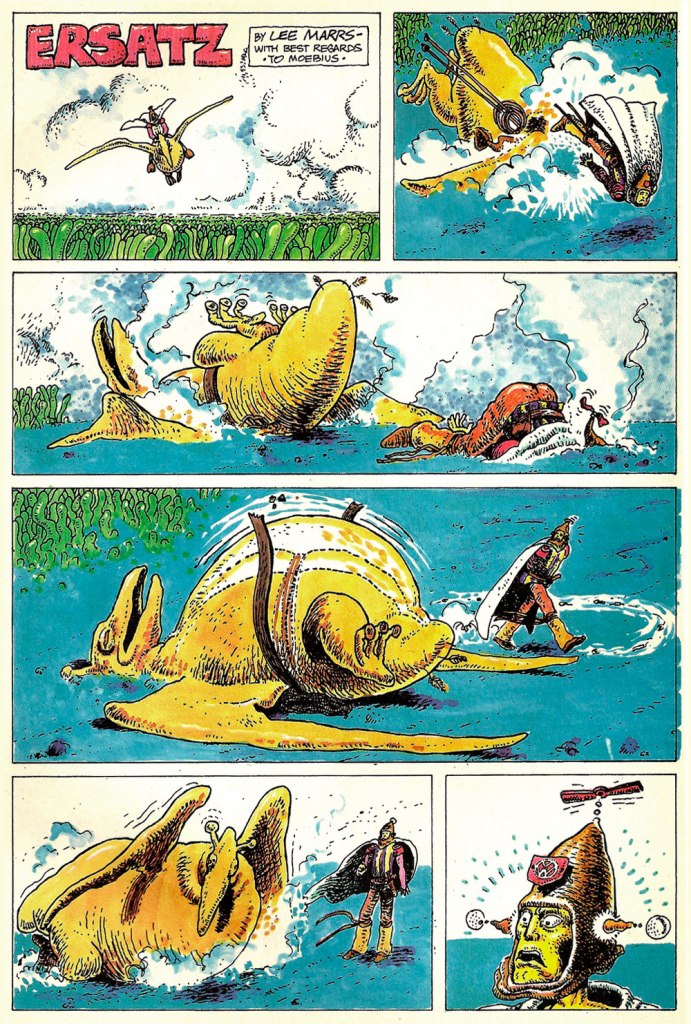
I’ll leave you with this Moebius parody, published in Imagine no. 3 (August 1978, Star*Reach):

~ ds

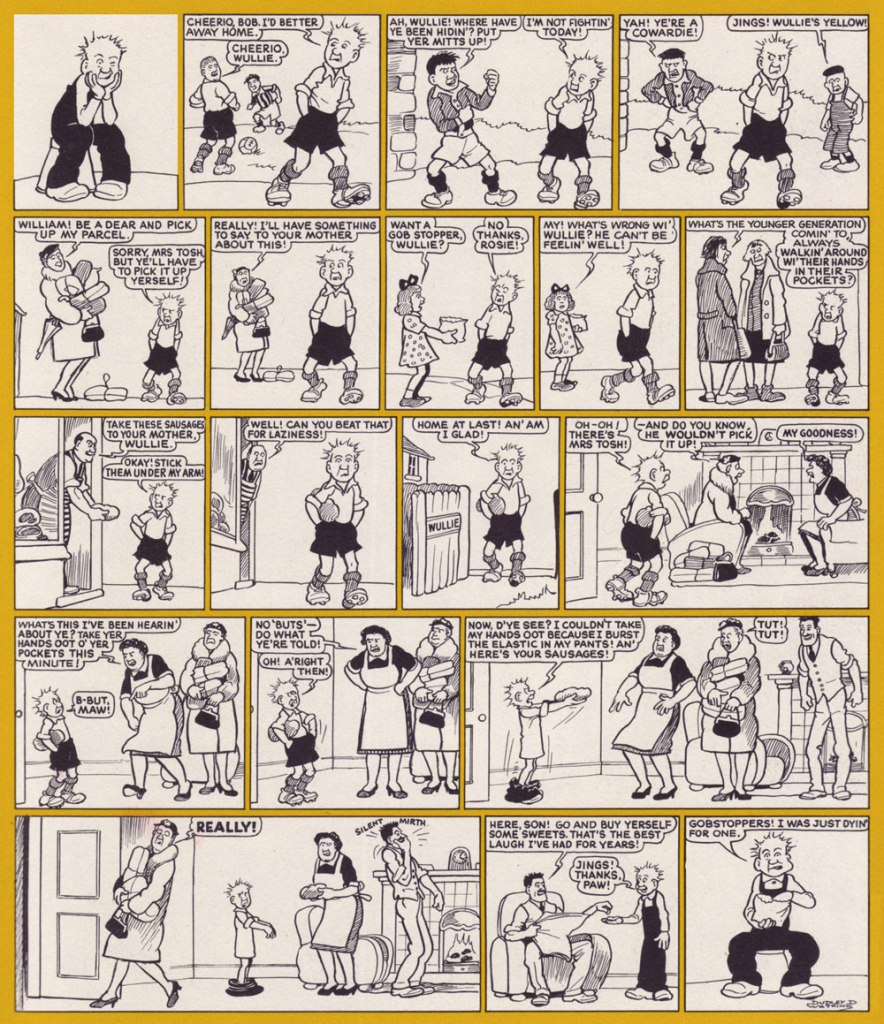
Oor Wullie and His Trusty, Rusty Auld Bucket

See the janny? See ma granny?
Ma granny hit um wi a sanny
then she timmed the bucket owerum
an he tummelt doon the sterr
an he landed in the dunny
wi the baikie in his herr.
*

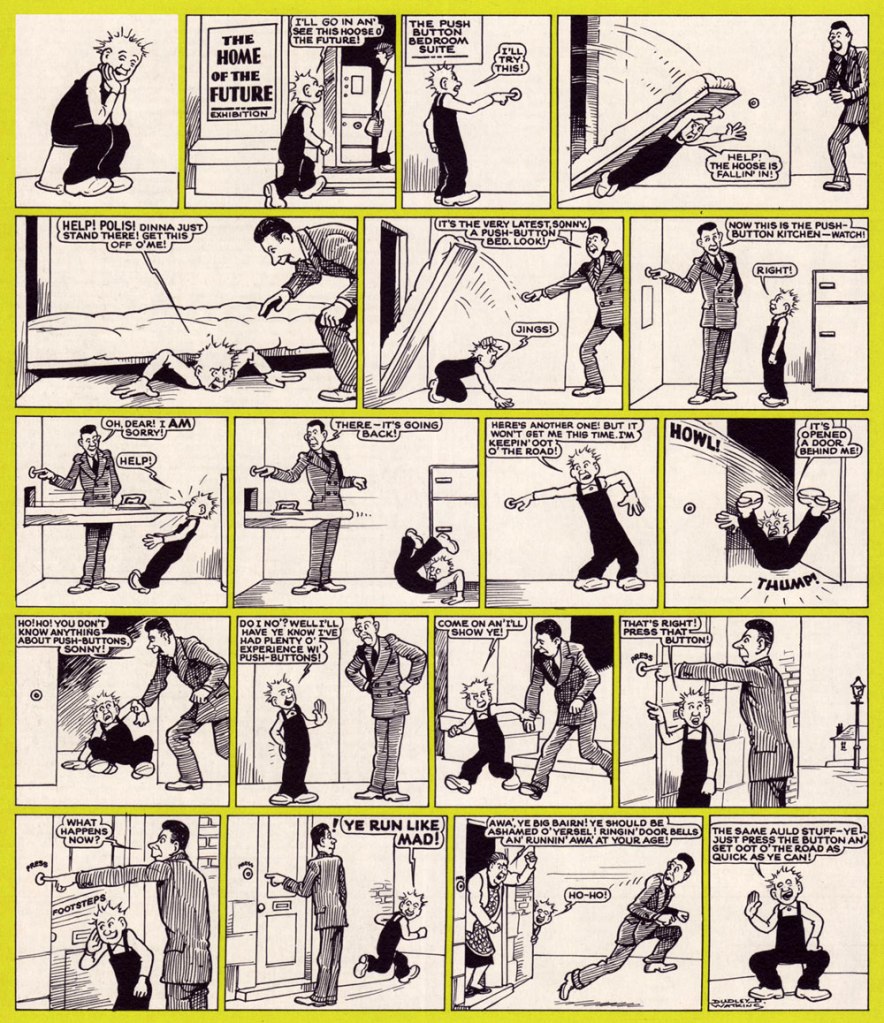
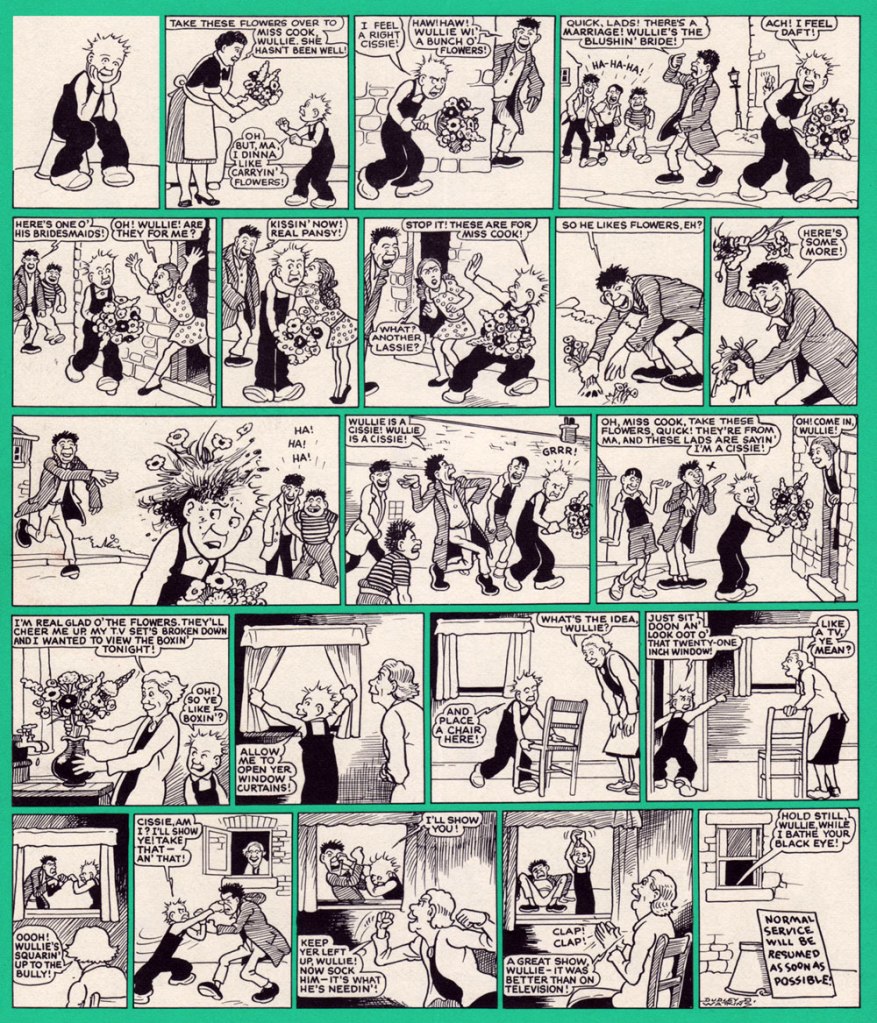
The home of Scottish strip Oor Wullie is The Sunday Post, distributed by D.C Thomson (publishers of, notably, The Beano and The Dandy). You may note that I used the present tense – this strip was brought into the world in 1936, but astonishingly it’s still going strong (it celebrated its 80th anniversary in 2016, to give a quick idea to those who prefer not to launch into mathematical cogitations). It has, through the years, gone through a number of different hands, but it was originally created by comics writer and editor Robert Duncan Low and drawn by cartoonist Dudley Dexter Watkins, who died very much in the cartooning saddle in 1969. His work was reprinted for a bit, until new blood could be found to take over, first in the shape of Tom Lavery (who was told to imitate Watkins’ style), then followed by a bevy of other cartoonists since then.

The Low & Watkins duo also came up with The Broons, which started the same year and ran in The Sunday Post as well, to the point where the strips were often collectively referred to as Broons & Oor Wullie. There’s a lovely documentary about The Broons here.

Reading Oor Wullie is loads of fun, and a big part of that is its use of Scottish slang – not so much of it that action is obscured, but enough for plenty of colour and also the opportunity to pick up some new vocabulary. Did you know that ‘oxter‘ means ‘armpit‘, for example?

To quote from perceptive article THE BROONS AND OOR WULLIE from Indira Neville‘s blog,

« […] the use of the dialect reflected the publisher D. C. Thomson’s ‘realist’ editorial policy and focus on authenticity. It was intended to attract a large Scottish urban audience and in this was really successful. Both strips were massive hits and at their peak had an estimated readership of three million (79% of the adult population of Scotland!) 

One of the most interesting aspects of Oor Wullie and The Broons is that for most Scots they were/are the only mainstream, regularly available written representation of their spoken language. In being this they have an increased relevance within the current Scottish language revival. The National Library of Scotland is even using Oor Wullie as a means to introduce and engage children in the richness of the lexicon. It has a website that’s ‘a guid fun wey tae lairn oor language‘. »

Wullie (or William) is a pretty standard boy prototype: prone to mischief and frequently embroiled in neighbourhood fights, embarrassed when his mam dresses him in nice clothing, but basically an honest lad with his heart in the right place. In that sense, he reminds me of Sluggo. You may note that every page starts and ends with Wullie sitting on his favourite bucket – every boy needs a good friend!

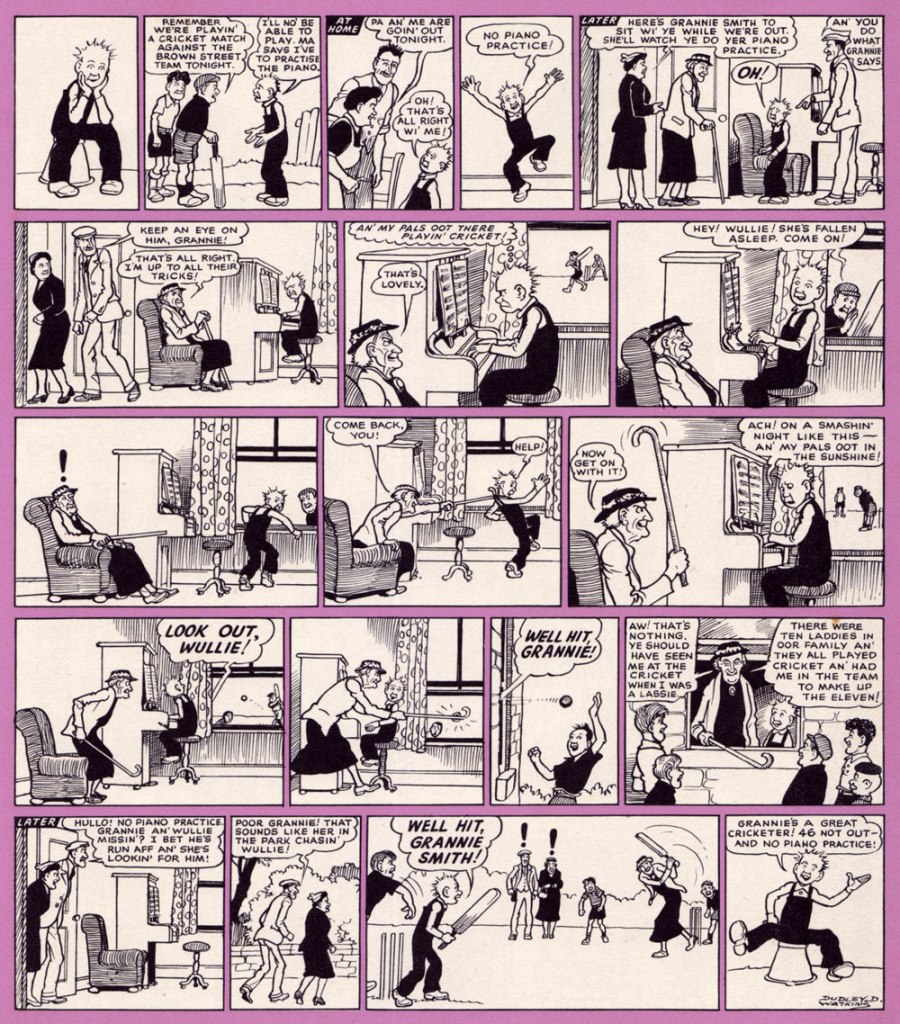
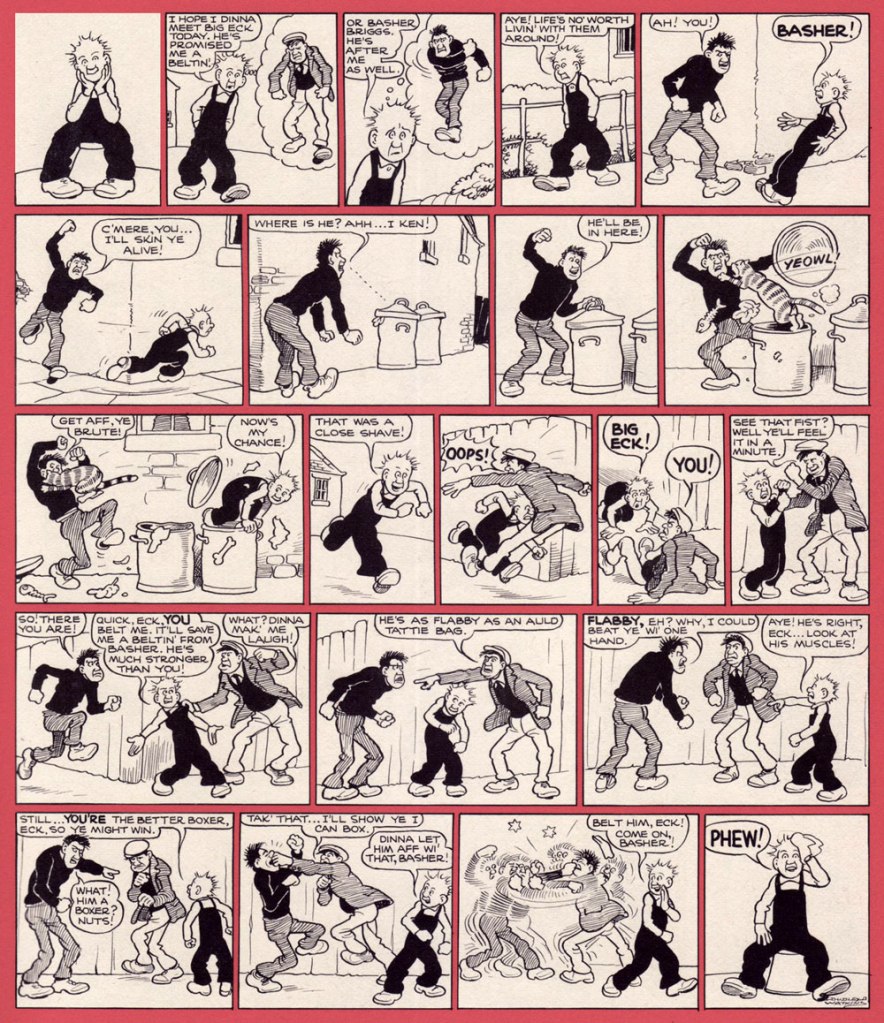
The following strips have been scanned from a 1976 collection, ‘selected from the Sunday Post and earlier Oor Wullie books‘. The artist is the aforementioned Dudley Watkins (which I can confidently claim, as each page is signed – I also compared the art to some original Dudley art being sold online, and this conclusion seems legit).

To celebrate Our Wullie‘s 80th birthday in 2016, 86 statues of Wullie in different costumes were placed around Dundee for the Bucket Trail event (including Oor Bowie, a David Jones tribute). This was a great hit, and Wullie’s BIG Bucket Trail was launched in 2019, with around 200 statues installed all around Scotland. View them here, they’re really fun.

When one thinks that a Moscow-born Russian (that would be me) would be greatly enjoying a classic Scottish comic some decades later… the world works out in funny ways.

~ ds

* From The Ballad of Janitor MacKay by Margaret Green

Of Ducks, Russian Folklore, and the Mysterious Gamayun

Today’s post started out as an introduction to Moscow-born Russian cartoonist and illustrator Alexander Utkin, whose family name translates to something duck-related (‘utka’ means ‘duck’)… a few other topics may have crept in on soft paws, but sticking to one thing was never my forte.

I came across Utkin’s work in a comic book store. The volume attracted me with its stylish cover and vivid colours, standing out among its shelf companions despite the fact that they were also quite vibrant, this being the children’s corner (thankfully a reliable refuge for colour that’s often shunned in modern comics – if you haven’t noticed the absence of colour in the modern aesthetic, see this documentary about Chromophobia, or Colors: Where did they go? An investigation for a discussion).

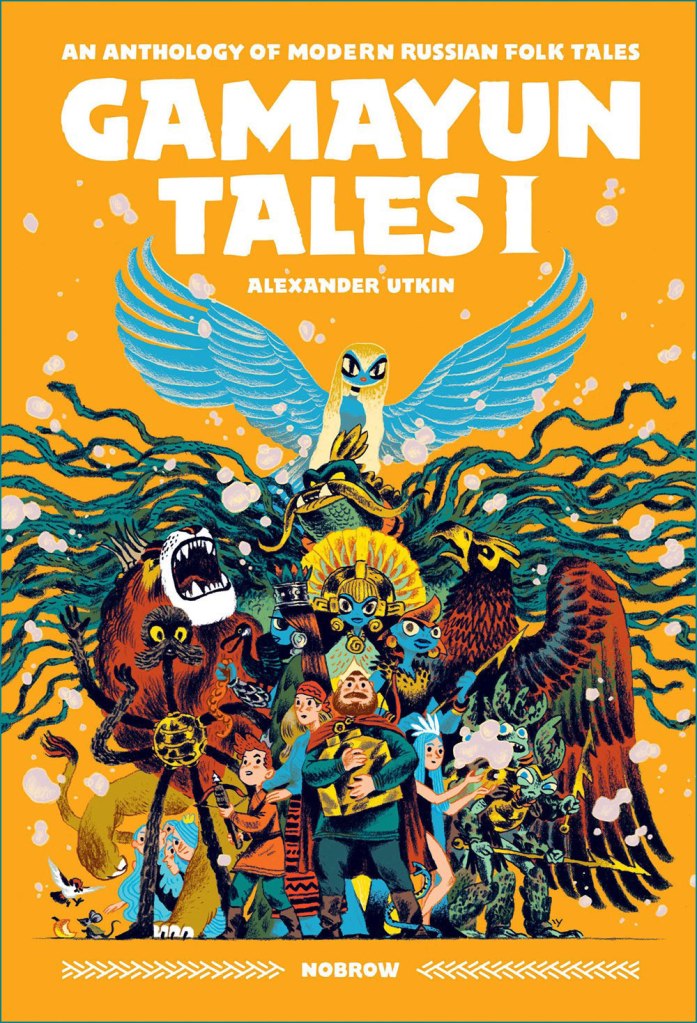
The book that introduced me to Utkin, although what I had first seen was the French edition (Le roi des oiseaux, 2020); this edition is from 2018 and published by Nobrow.

I like cases where one doesn’t have to choose between art and storytelling, when the former is lovely and the latter, substandard (or vice versa). Utkin’s illustrations are beautiful, and he coherently and engagingly tackles a topic that’s dear to my heart – namely Russian fairy tales. Remember I mentioned Baba Yaga (see Hallowe’en Countdown VI, Day 28) a few weeks ago? We will meet her again today (hide your children). We also encounter the legendary Gamayun, a prophet-bird (strangely, as a child I learned its name from the song Sirin, Alkonost, Gamayun* and not from reading folk tales) with no legs or wings, who propelled itself with its tail, and whose interrupted flight signalled death or misery. In a more modern interpretation, she morphed into a sort of bird of paradise with a woman’s face. Read about her and her ‘sisters’ Sirin and Alkonost here.

Published by Nobrow in 2020. Here’s a review of this collection.

Utkin’s Gamayun is a strange, vaguely female creature with huge eyes who narrates the stories (thus ‘Gamayun Tales’). There seems to be a resurgence of interest in all things folky** in many parts of the world, perhaps a desire to preserve some cultural heritage when faced with globalisation – in that sense, one can say that this series is part of that pattern. These revivals don’t often reach a Western audience, however, so it’s especially cool that Utkin’s forays into Slavic myths have been well received and enthusiastically lauded by French and English speakers as well.

Here are a few pages from Roi des oiseaux or The King of Birds, which are, respectively, the French and English versions of the same story… except that the French edition also contains La dispute (The Quarrel), which in English was plunked into Gamayun Tales I. It’s a bit confusing.

In case you were wondering, Utkin’s Gamayun series is technically intended for children. I’m in the habit of regularly raiding the children’s section for interesting stuff, but I can call it mother’s interest (never-you-mind that I am the mother of cats and plants, not little humans). Here are several pages from Gamayun Tales II – this story is called The Quarrel (and, as mentioned earlier, was part of the French edition of The King of Birds):

The following page are from Vasilisa and the Doll, which in English was published in Gamayun Tales II, and in French, as part of the La princesse guerrière (‘the warrior princess’) collection:

I promised you Baba Yaga, didn’t I? The way Utkin draws her predatory teeth reminded me of Canadian artist Emily Carroll, whose creepy stories often mention teeth (one might say it’s a leitmoteeth of hers – sorry for the terrible pun). Her work deserves a post of its own, but for now I restrain myself to mentioning that Carroll, clearly also a fan of traditional folklore, illustrated a graphic novel (written by Marika McCoola) about you-know-who, Baba Yaga’s Assistant (2015, Candlewick). Here is a tooth and style demonstration:

A few stylized pages tell the traditional story of Baba Yaga and the girl with the kind heart – you can read the tale (in English) here.
And here is what the slightly re-upholstered, modernized tale looks like.
Classic chicken legs!

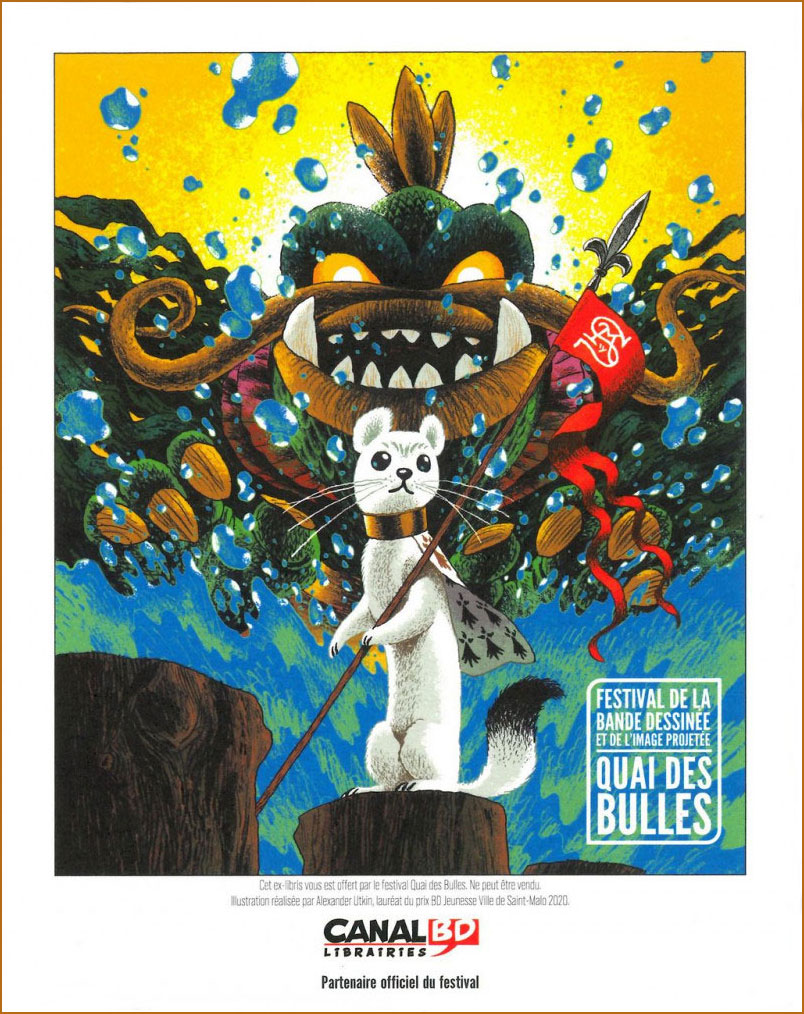
To get back to our main topic, I’ll leave you with this glorious poster Utkin illustrated for a French bédé (comics) festival in 2020:

Visit Utkin’s IG account.

~ ds

*I highly recommend the whole album for those who like folk rock – it’s by the Russian band Akvarium.

**This includes the bevy of young woman trios and quartets (from Ukraine, Georgia, Poland, Finland, Germany…) popping up seemingly all over the place, singing traditional folk songs whilst walking around. Here is a charming example from Russia.

Boop-Oop-a-Doop Like It’s the Thirties!

« Her surname, a familiar catchphrase of the time, was inspired by the inter-lyric expostulations of a nationally famous Paramount Pictures songbird, Helen Kane. ‘Boop Boo a Doop!’ was the chant she sang in her sweet, high-pitched voice, a flippant raspberry to the jazz age. Somehow these nonsense syllables seemed to embody the spirit of the waning days of the twenties… »

I think everybody knows Betty Boop, though probably not that many have seen the original cartoons from the 1930s. She was ‘created’ by Max Fleischer orchestrating a team of animators – as with any gestalt creation, one can argue about who was responsible for what until one is blue in the face, but it has been convincingly argued (by Bill Blackbeard, for example) that Grim Natwick was the actual creator, probably with a stable of other animators.

In 1930, Betty, then still nameless, made her first appearance in (the pleasantly weird) Dizzy Dishes as a supporting character, as a seductive canine anthropomorph with dog ears and human curves. She acquired more personality once she was matched up with Bimbo, another doggo, in Bimbo’s Initiation (1931) – which is an even stranger cartoon, a tale of hazing by a bunch of creatures with pulsating buttocks and candles on their heads pursuing Bimbo with chants of ‘wanna be a member? wanna be a member?’, to which Bimbo always responds ‘no!’ to get sent to yet another chamber of tortures. I would suggest not psychoanalysing that too closely. Watch for the grand WTF finale:

By 1932, Betty, who now had a stable position as Bimbo’s regular girlfriend and a name to call her own, had jettisoned her dog attributes, floppy dog ears quite seamlessly transformed into big hoop earrings. Though she was a’booping from the very beginning, she acquired her hallmark Boop surname with Betty Boop Limited (1932). The aforementioned Helen Kane* was not pleased, and there were, as Blackbeard explains in his introduction to Betty Boop’s Sunday Best: The Complete Color Comics, 1934-1936 (Kitchen Sink Press, 1995), ‘threats of lawsuits, various legal manœuvres, and demands for creator royalties, all without result‘.

In 1933, Hearst’ King Features Syndicate started negotiating terms for a Betty Boop comic strip, and in 1934 the strip, drawn by Bud Counihan, appeared. However, this was not exactly the same unhinged, hip-jiggling Betty of earlier years. King Features wanted to appeal to more conservative audiences, and Betty’s sexuality was toned down a notch. The animated Betty didn’t fare much better – as usual, guardians of Moral Purity™stuck their fingers in the pie, and from June 1934, the Motion Picture Production Code kicked into effect, forcing Betty to leave behind her carefree flapper days to become either a career girl, or some generic housewife.

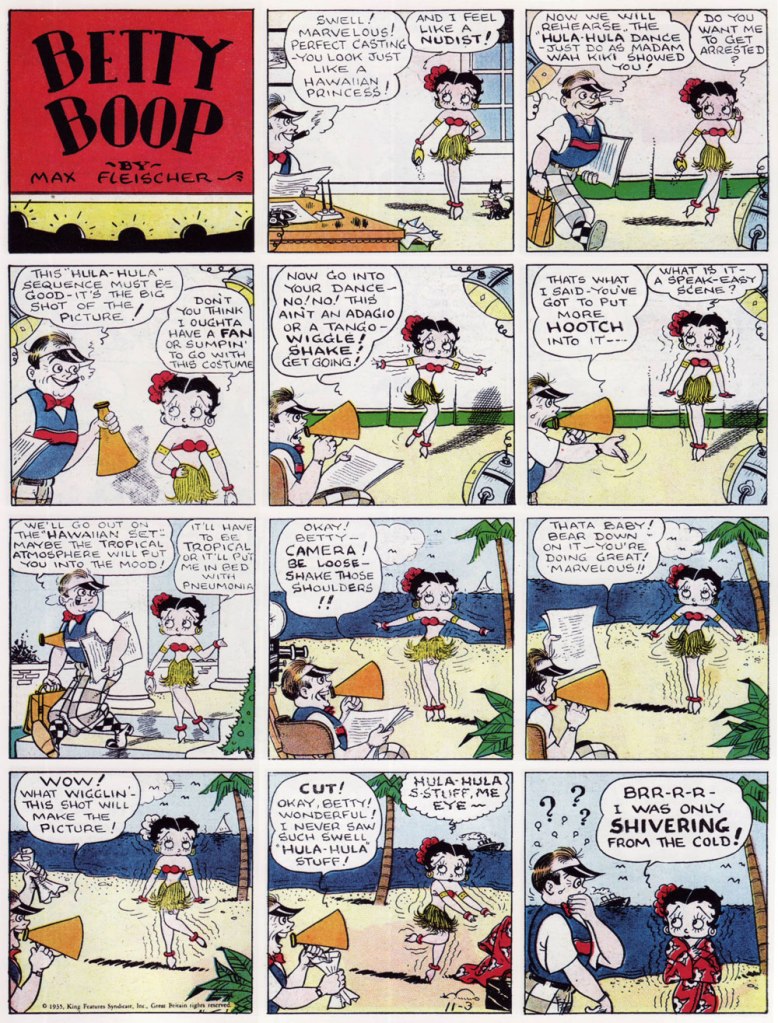
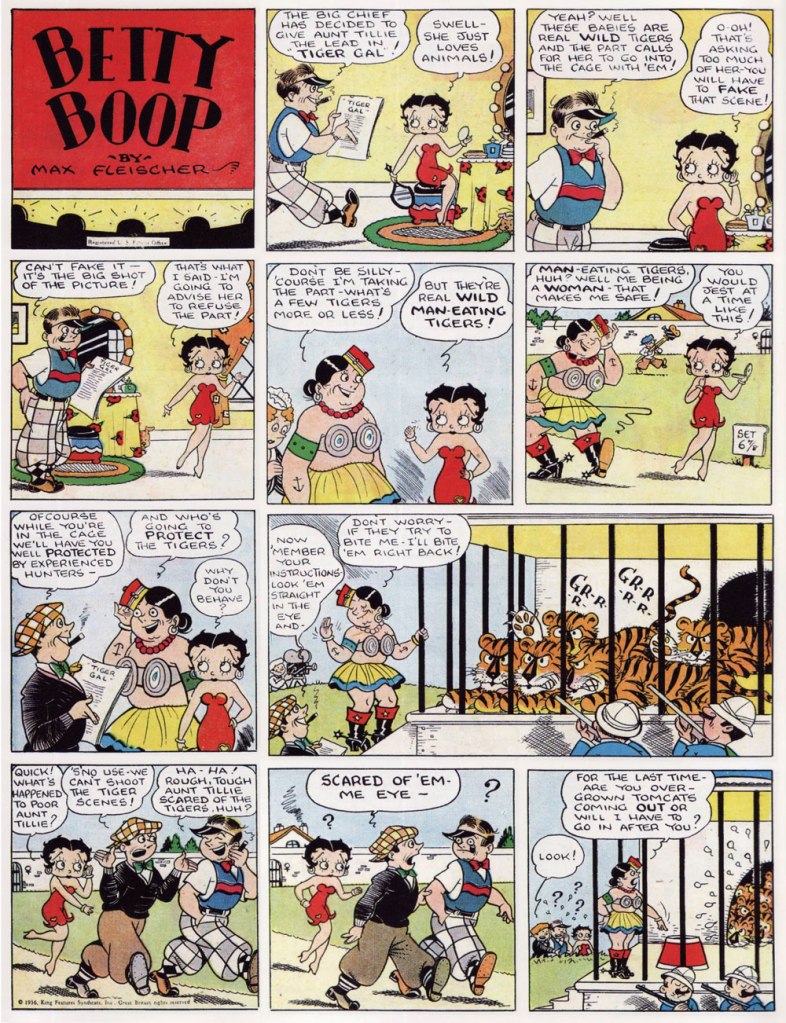
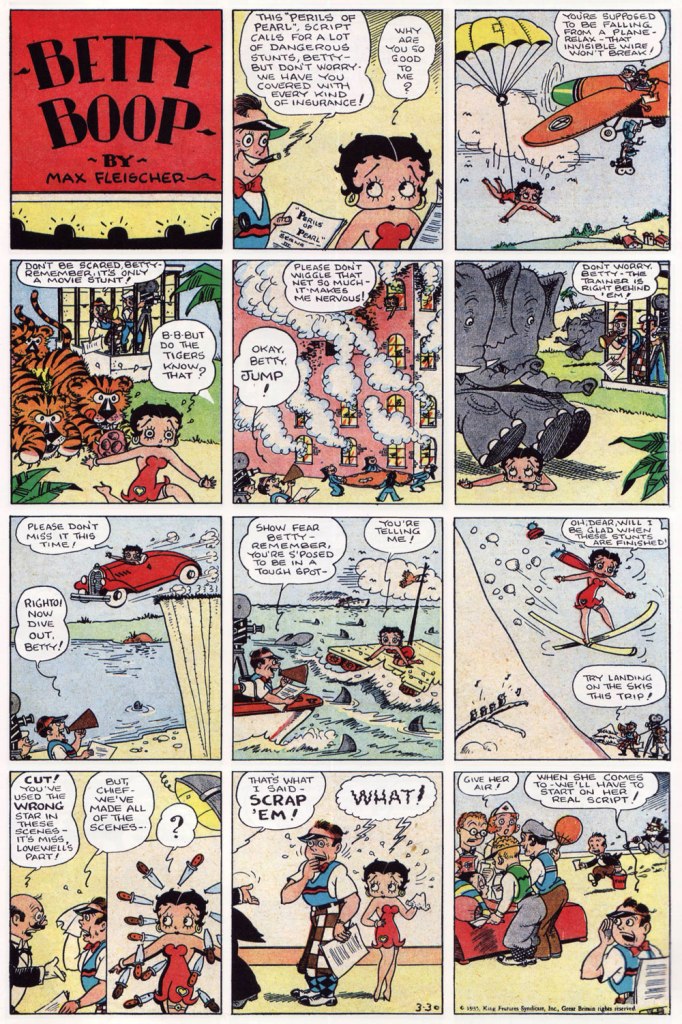
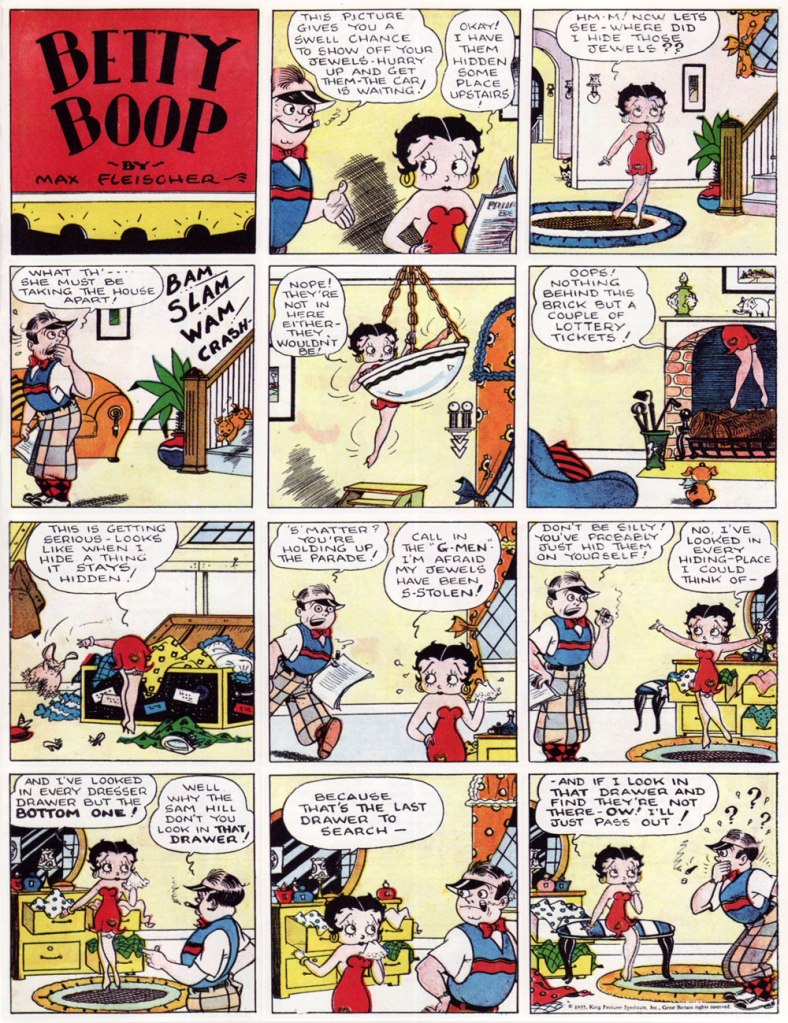
Oh, but there was still plenty fun to be had. Besides, the comic strip Betty was not quite as smothered – while the latter was nursing babies and whatnot in a long dress, the former was still running around in her risqué red number, occasionally even kissing men and living the life of a spoiled movie star. Here are a few Sunday strips – thanks for co-admin RG for scanning these unscannables.

Sunday strip from March 1935. Counihan’s tigers are consistently adorable.
Sunday strip from 1935, and a few different perspectives on Betty’s legs and derrière.
Sunday strip from 1935. That’s a more fun version of a police line-up…
Sunday strip from 1935. Mentions of nudism come up more often than one would expect (and yet Betty is never particularly undressed, at least not by modern standards).
Sunday strip from 1936. In the later years, Betty’s indomitable aunt Tillie monopolized much of the action. She may have not had Betty’s sex appeal, but she was kind of fun to watch – a generous woman (also generous with her fists in cases of disagreement). Have I mentioned the tigers?

Blackthorne Publishing, known for their reprints of classic titles, issued three 72-page collections of Betty Boop reprints, comprising a mix of dailies and Sundays.

Blackthorne Comic-Strip Preserves nos. 1 and 2 (both published in January 1986). Covers by Bud Counihan.

There are a lot of modern conversations about the meaning of Betty Boop**. Was she but a sex symbol, bent to the lascivious male gaze that created her? Or perhaps an early example of a feminist icon, in control of her own sexuality? Her combination of innocence and feminine wiles actually reminds me of Sally the Sleuth (see Here Comes Sally the Sleuth… and There Goes Her Dress!), as Betty effortlessly runs around half naked, thwarting rape attempts without losing an ounce of her cheerfulness. These questions mostly address a pre-1934 Betty, as her identity in the public eye seems to have been formed in those few years of unhinged actions and symbolism… as well as BB merchandise in the 1980s, as she was rediscovered by makers of all manner of goods (note that it was still her sexier form that was used on cups, lamps, t-shirts, keychains, and whatever else you can think of).

From recent attempts to revive the character, Gisele Lagacé and Roger Langridge‘s comic series comes to mind – more as a traumatic experience rather than a pleasure, despite being hyped as ‘insanely entertaining‘. Langridge is a WOT favourite, but in this case even his script cannot save Lagacé’s insipid art (‘Lagace’s art is amazing. Her characters emote in ways I didn’t think two-dimensional cartoons could.’ says The Court of Nerds) or the flat colours by Maria Victoria Robado (who normally opts for colourful images, so I’m thinking that the drabness was imposed upon her by the artist). At least some of the covers of this 4-issue series were nice…

Betty Boop no. 4 (January 2017), cover by Roger Langridge.

*In recent years, it has come out that Kane was probably aping the act of black vaudeville performer Esther ‘Baby’ Jones.

**See, for example, The Forgotten Black Woman Behind Betty Boop.

~ ds
Hallowe’en Countdown VI, Day 28

Most readers will be familiar with the East European witch Baba Yaga, she of the giant mortar, pestle, and chicken-legged-house. The Slavic tradition is rich in heroes and villains, but Baba Yaga is my definite favourite. Perhaps it’s because of her dichotomous nature – undeniably evil, kidnapping children to eat them and such, she also lends a very helpful hand to those she likes… depending on the vintage of the tale and who’s the narrator, and sometimes within the same story. Potato, pota-toh, right? She’s the kind of hag that cool women aspire to become when they’re old: a cantankerous, wise beldam who does whatever she pleases, lives alone in the middle of a forest with her cat, and tells anybody she doesn’t like to fuck off (or transforms them into something nasty to teach them a lesson).

Introduction to Vasilissa the Beautiful, illustrated by Ivan Bilibin, 1931. That’s Baba Yaga flying on top.

Interpretations of what she actually stands for abound, but to be honest I am not interested in her narrative origins, just the storytelling. She is a character who lives and breathes; it rather seems impolite to ask too many questions, lest one ends up in her oven, on the way to becoming dinner.

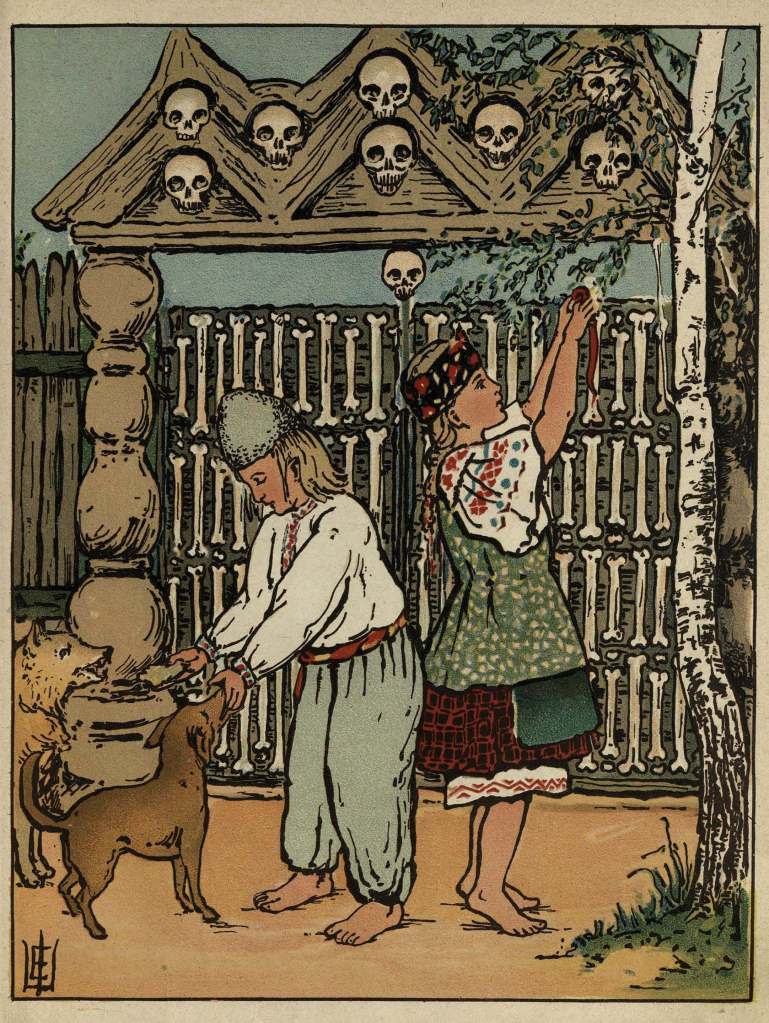
Folklorist Vladimir Propp‘s theory is probably the best regarded, and argues that she’s the guardian of the kingdom of the dead, with her house representing a grave (people of yore were buried in special houses built on top of tree trunks, with roots resembling chicken legs). She might have once been a deity of hills and forests, kind protector of villagers; or perhaps a goddess of harvest, punished by other gods who removed her beauty and left her a crone. Viy (yes, that Viy) is her father, and Koschei the Immortal (sometimes pictured as riding naked on his favourite horse) is either her son or her nephew. The fence around her house is built from human bones. I think she deserves her place in this year’s Halloween pantheon.

Anyway, here are a few of my favourite visual renditions of her…

Ivan Bilibin (1876-1942), co-founder of the Union of Russian Artists, is mostly remembered for his illustrations to Russian folk tales. His was the first version of Baba Yaga I was introduced to a a small child (as a matter of fact, I still have a collection of tales illustrated by him lying around somewhere). His style is easy to recognize, and full of details – while tsars and beautiful maidens get clothed in robes painstakingly adorned with golden filigree, forest scenes are crowded with branches, leaves, and mushrooms, giving the slightly claustrophobic impression of the trees closing in on the viewer. This is no civilised forest. This is a wild, slightly malicious entity that does not take kindly to strangers.

Baba Yaga in her natural habitat, the flying pestle. Ivan Bilibin, 1900.

The following book from 1915 does not credit its illustrator, and I’m not knowledgeable enough to interpret their memorable signature (seen in the inside illustrations, bottom left).

Baba Yaga (this book was originally published in 1908, using the same painting, but with fewer background details; this edition is from 1915, illustrator still unknown).

Two illustrations from the inside, showing off Baba Yaga’s frequently present black cat, and her fence of human bones and skulls. Admire the decorative ‘devils dancing’ panel inside her hut. The cat can be easily bribed, and in one of the classic tales helps out the would-be victim get the best of Baba Yaga, after the young girl gives him some ham out of the kindness of her heart.

In the Western world, illustrator Nicolai Kochergin (1897-1974) is famous for his Soviet propaganda posters, but he is beloved by Russians who grew up around the so-called ‘golden age’ (1950s-1960s) of children’s book illustrations in the USSR. See a selection of the latter over at Tom Cochien’s Monster Brains Blog. WOT habitué Barney might be interested in his first-ever illustrated book, a Soviet translation of Twain’s A Connecticut Yankee in King Arthur’s Court, published in instalments in a magazine in 1928.

Although I technically grew up much after these illustrations were published, I think I can count myself lucky that my parents mostly surrounded me with old books.

~ ds
Hallowe’en Countdown VI, Day 18

« Why does a silly bird go on saying “chiff-chaff” all day long? Is it happiness or hiccups? » — A. A. Milne

Greetings! I am very temporarily standing in for co-admin RG, who can probably use a break from his harrowing post-a-day schedule. Either that, or I muscled my way in after chaining him to the bathtub, your pick.

We have never talked about the adorable cartoonist Jack Kent (1920-1985) on WOT?. While he has illustrated some 40 children’s books, no humble achievement, his momentous oeuvre is surely the endearing King Aroo (from that intriguing class of literary creations ‘adored by the intelligentsia, but [that] bomb in popularity polls’*). Often our most cherished comics are considerably harder to discuss than something one holds less dear, and this is a prime example of that. Among worries of ‘would I able to do it justice? Would I be able to explain its charm?’, I have been postponing the conversation about King Aroo, Monarch of pocket-sized kingdom Myopia, to an indefinite, much later date.
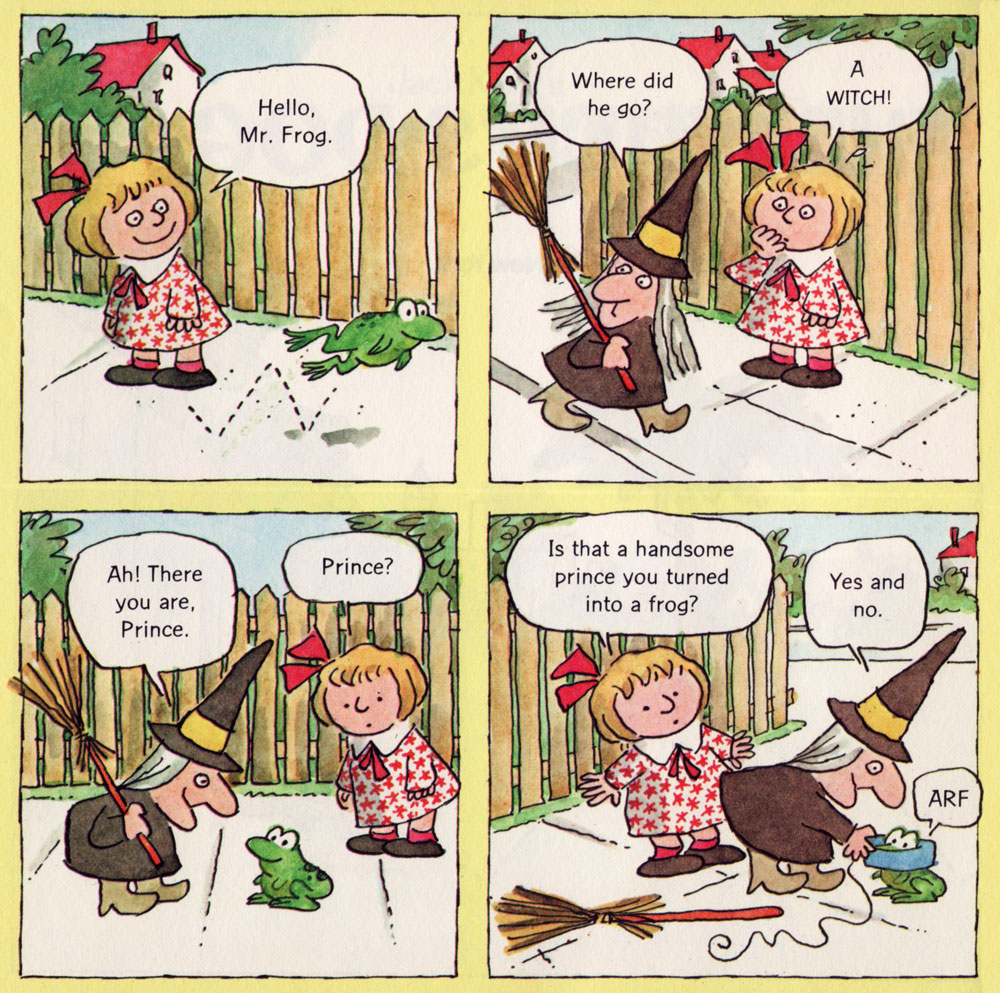
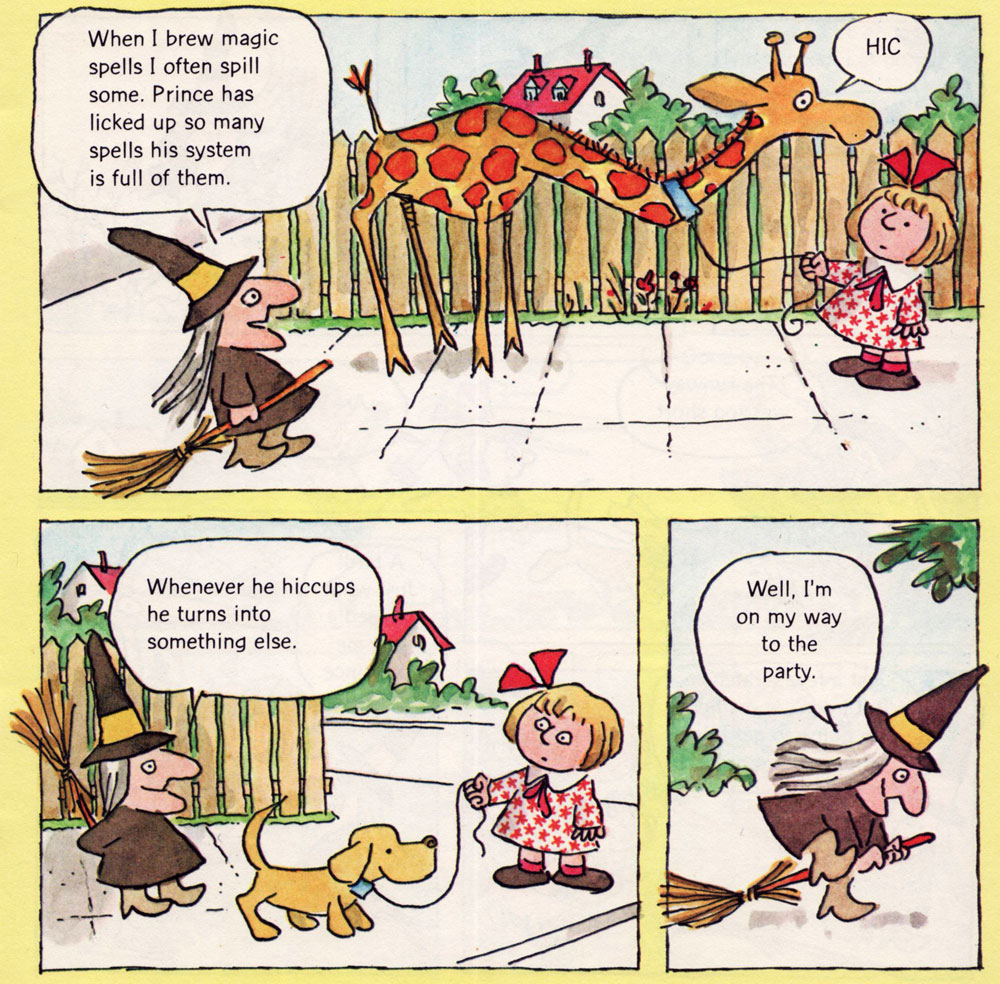
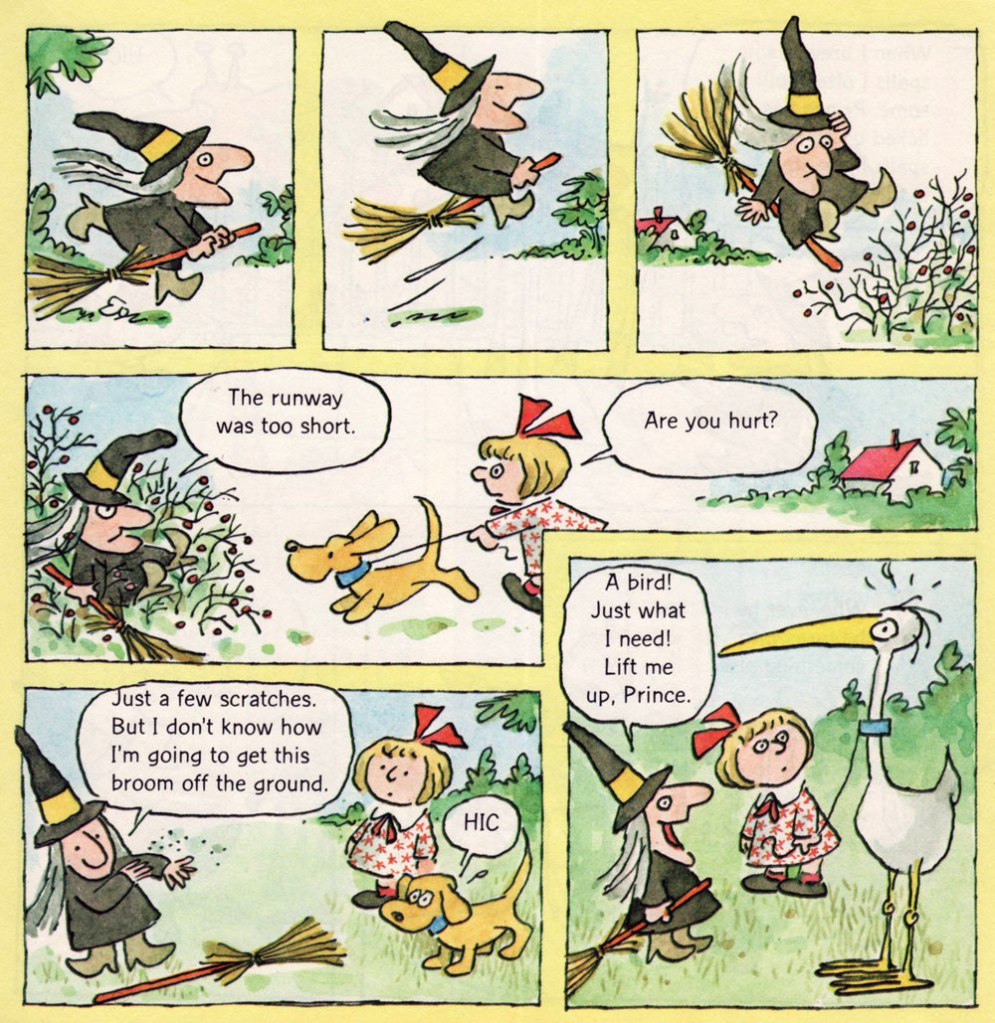
In the meantime, and since it is very much of the season, let us concentrate on the short, but no less lovable for its length, Cindy Lou and the Witch’s Dog, a children’s book (well, nearly more of a booklet) from 1978. Aside from the presence of a witch in the tale (as announced by the title), it also features hiccupping as a main plot point, a state of things close to my heart as I am quite prone to this affliction, though I fortunately do not undergo metamorphosis with each involuntary contraction of the diagram. Here’s a factoid of the day: the medical name for hiccup is singultus, from the Latin singult which means ‘to catch one’s breath while sobbing’. My grandmother always thought there was something profoundly wrong with me with all these hiccups… but then she was also convinced I’d grow up to be an alcoholic from sharing an occasional beer with my dad, so perhaps her forebodings can be dismissed.

Enjoy the following few pages (probably about a third of the story, so definitely more than just a sample).

Regretfully, we do not get to see what party the witch goes to.

Of course Prince’s collar magically adjusts to his neck, whether it’s the neck of a giraffe or that of a mouse.

Skipping a few pages to share this tree’o’cats, which neither RG nor myself could resist including:

~ ds

* Source

Purr for Paul Murry!

As co-admin RG recently pointed out, we are in the middle of a move, which is not terribly conducive to long, contemplative posts, so I suppose this one could be called a bit of filler. I (for one) am always happy to look at some pretty pin-ups, and no labyrinth of boxes is going to stand in my way.

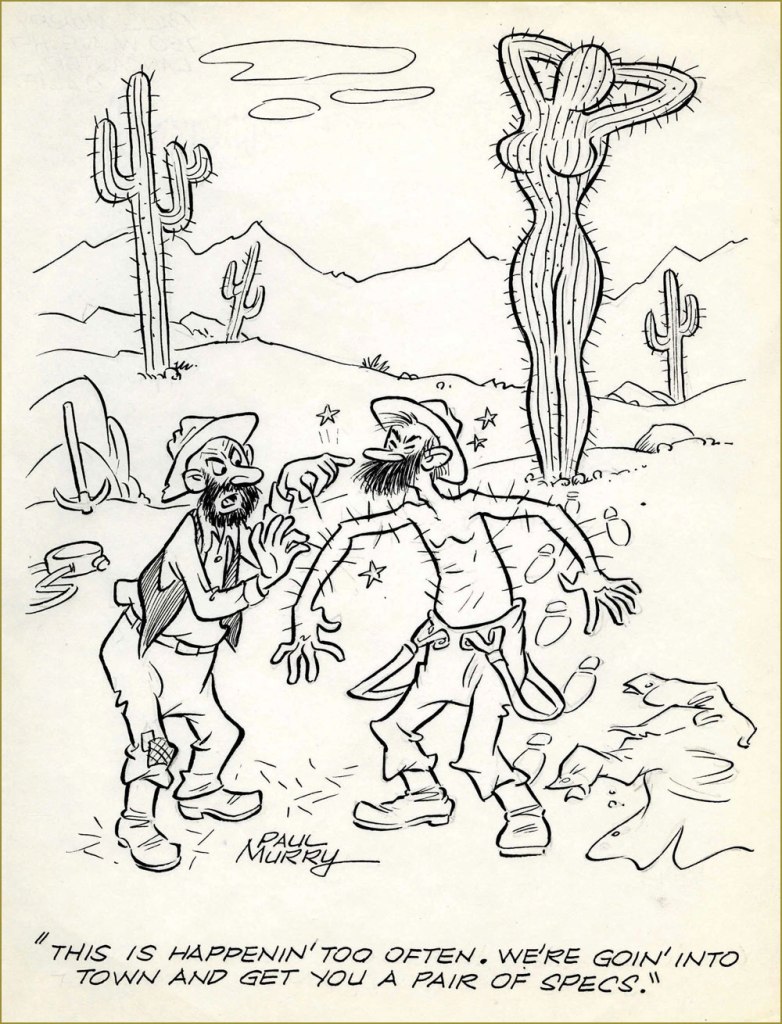
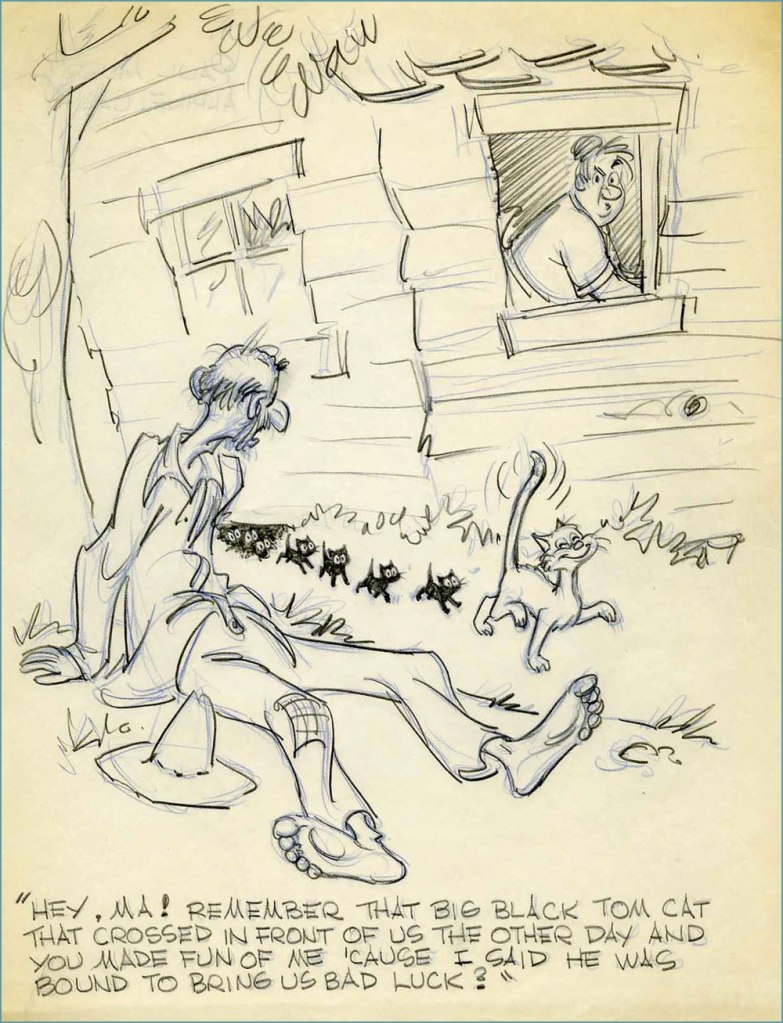
If you’re at all interested in Dell or Gold Key comics, you’re likely already familiar with the work of Paul Murry (1911-1989), whose Disney characters regularly appeared in their pages between 1946 and 1984. His life followed an interesting path – a farmer in his native Missouri, he started working for the animation department of Disney Studios in the late 1930s, then branched out into Disney’s comic department in 1943, working on newspaper strips (Uncle Remus and His Tales of Brer Rabbit in the mid-40s, the fun Buck O’Rue in the early 50s) and the aforementioned Dell/Gold Key Disney imprints.

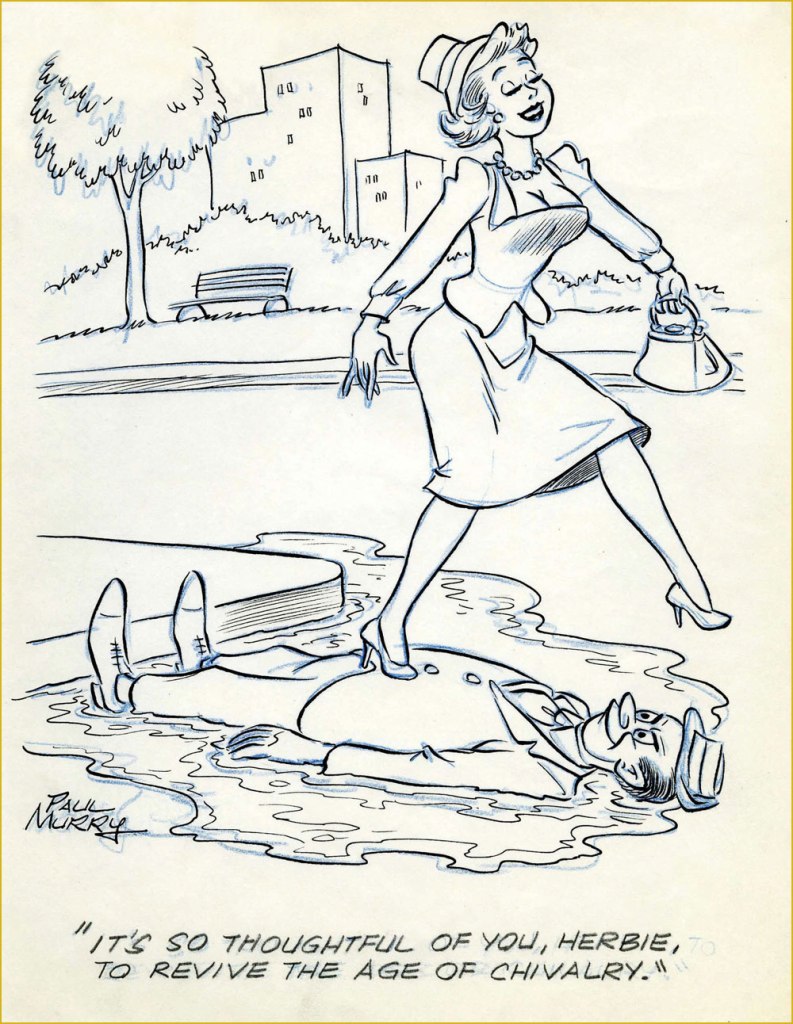
Murry also drew girlie cartoons, and quite good ones, too. Working in animation yields handsome artistic dividends, but one might also say that Murry, with his discerning eye for dynamic anatomy, was made for it. Here’s a batch of them from the 40s and 50s.

… with the exception of this one, which is from the 30s, and ‘attributed’ to Murry – good enough for me.
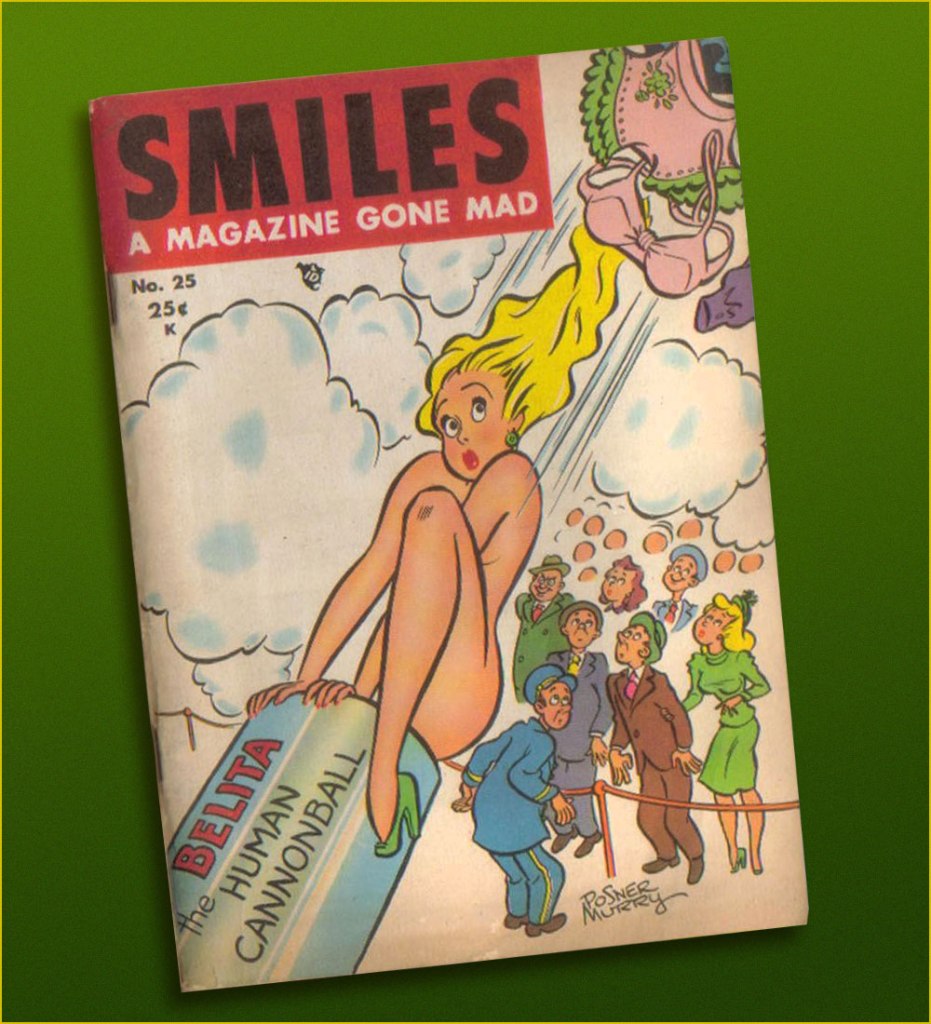
Smiles no. 25 (spring 1948) – ‘Posner Murry’ is one of his aliases.

You can peruse more images at the Sekvenskonst blog (including a sequence of Murry Monday posts!)

Random fact of the day: in Russian, cats make a ‘murr’ sound (pronounced like ‘moo-rrr’, with a rolled R at the end), and that explains the title of this post.

~ ds

Nothing Much Happens to Mr. Mamoulian

« Somebody said that drawing a page of comics ought to be as easy as writing a letter to a friend. So I did just that. I took a bit of paper and drew in ink whatever came into my head. I tried to surprise myself. If I made a mistake it would just have to stay there. » — Brian Bolland

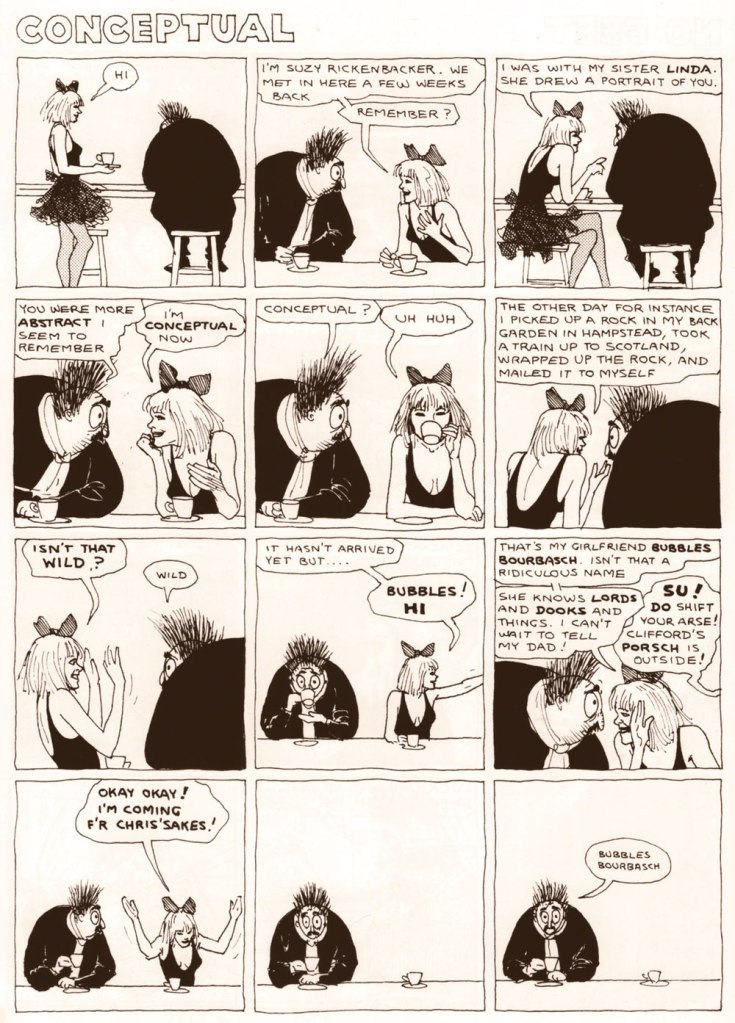
Brian Bolland‘s habitual style is easy to recognize, and co-admin RG and I are both fond of it. But there was a time when the normally meticulous Bolland decided to do something different, something much more sketchy and spontaneous. The result was the vaguely Armenian-sounding Mr. Mamoulian, who doesn’t look much like one of Brian Bolland’s ankle-biters (unless one is the proud owner of a perceptive eye)… until he encounters some pretty women, which are a dead giveaway.

Mr. Mamoulian, a pervy sort of ‘older’ (40-ish?) guy prone to bouts of nihilism and crippled by self-doubt, engages in the sort of things listless people do, when they are not quite sure how to occupy their time*: sit on park benches while others are at work, shuffle stuff around their apartment from point A to point B (and back again), enjoy a cuppa, and stare at the ceiling after waking up in the middle of the night. He is obsessed with feminine beauty, but uneasy with the ramifications of being obsessed with it. Rattled by the passage of time, irked by life’s idiosyncrasies, trapped in and by his body, he’s nevertheless a silly and rather comforting presence as we follow him on one of his aimless traipses around the rainy countryside, witness one of his exchanges with his imaginary naked lady friend (Bubbles Bourbasch), or coo at his surprisingly congenial friendship with punkette Evelin Shit-Face.

* These days, of course, one just stares into a cellphone/binge-watches a show on whatever streaming service, which is prompted by the same impulse, but it somewhat less romantic.

The proverbial beautiful English weather.
The early days of the fragile friendship between Mamoulian and Evie (who, for all her punky pretensions, is a rather well-mannered, thoughtful young woman).
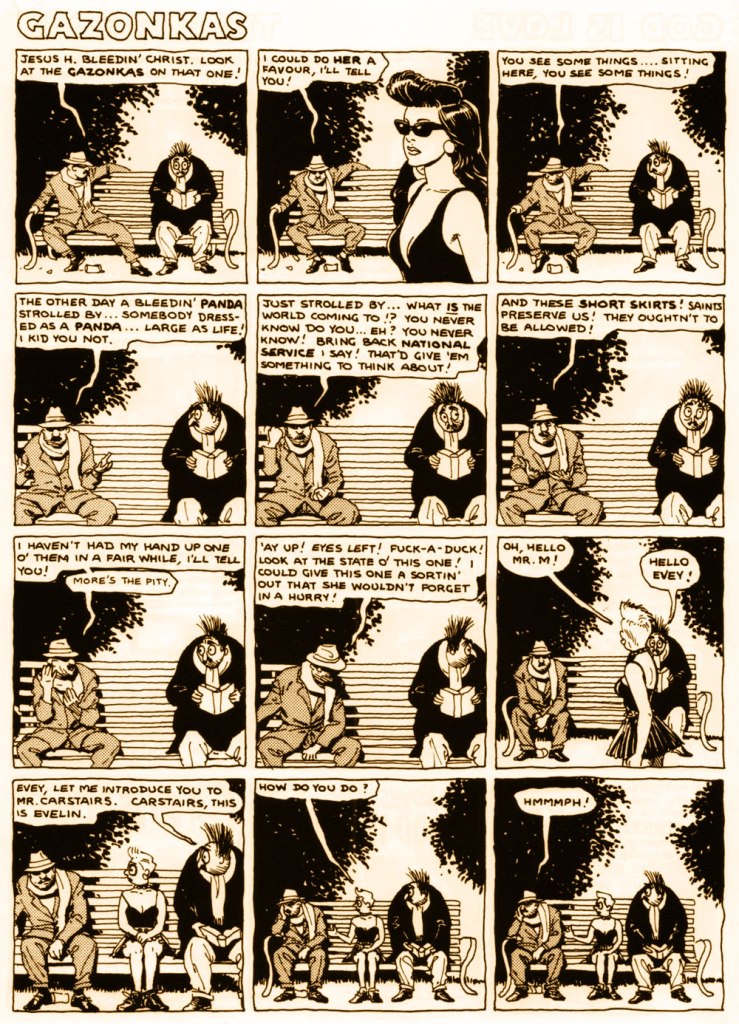
Mamoulian is silent – does he condone Mr. Carstairs’ patter? Disapprove of it? Probably a bit of both. In the end, it’s his behaviour that matters – Evie is a person to him. As for Mr. Carstairs, he’s a spot-on portrayal of a first-class hypocrite.
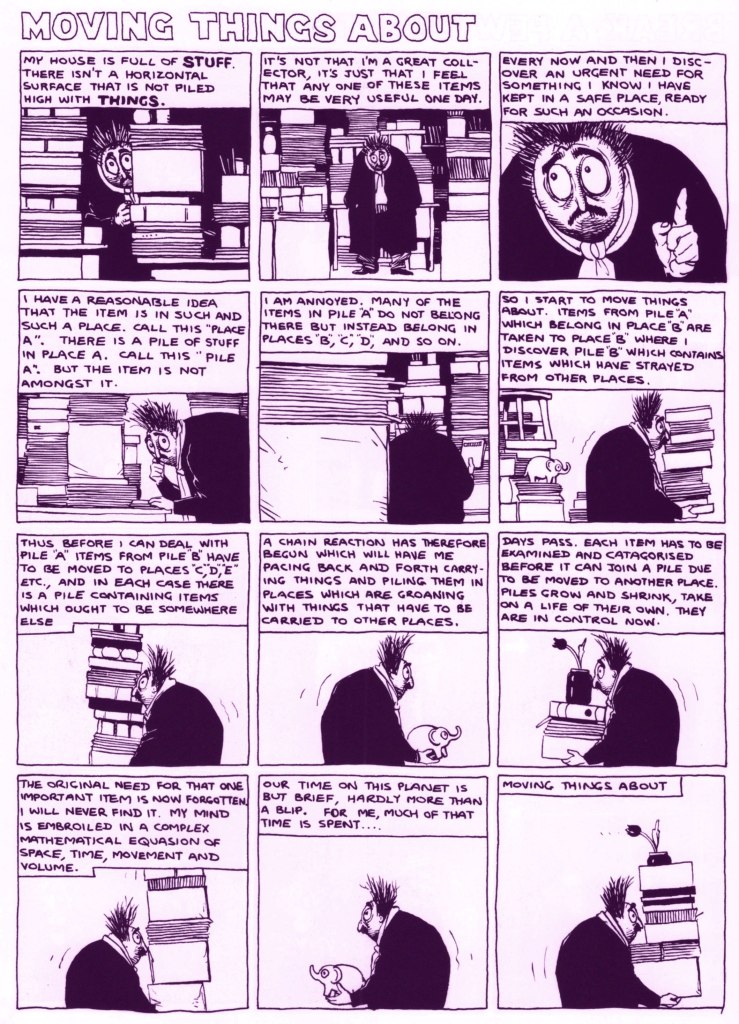
Here Mamoulian’s reflections are reminiscent of the philosophical musings of Marc Hempel’s Genital Ben.

Mr. Mamoulian is arguably a peephole right into Bolland’s id, but it’s not at all an uncomfortable experience (unlike, say, peeking into the mind of Chester Brown, who creeps me out in a big way), even when the strip goes creepily dreamlike, or addresses uncomfortable topics (for some, the couple of bondage-related pages – not included here to avoid ruffling feathers – would be it; apparently ‘Bolland is noted by some for his use of bondage imagery‘, though I honestly think that’s a bit of an overstatement). In the end, Mamoulian’s character is casually tapping into many sources of frustration and confusion that rattle around most human heads. He is relatable.

Bolland calls Mr. Mamoulian ‘not very good’, but I obviously disagree with this assessment, as you’ve probably noticed by now. I love the sketchiness of the art, its surreal energy. The strip is, by turns, hilarious, depressing and always very, very British (and not just because of the continuous tea-drinking). I believe we can all relate to Mamoulian’s struggles with being alive, and the notions of freedom and art. We also get tantalizing glimpses of punk and metal scene through Evie and Steve’s interludes.

Mr. Mamoulian’s first encounter with Bubbles (off screen), who is later to visit him at night as her imaginary nude self. Interestingly, it seems to be her name, not her looks, that stuns his imagination.
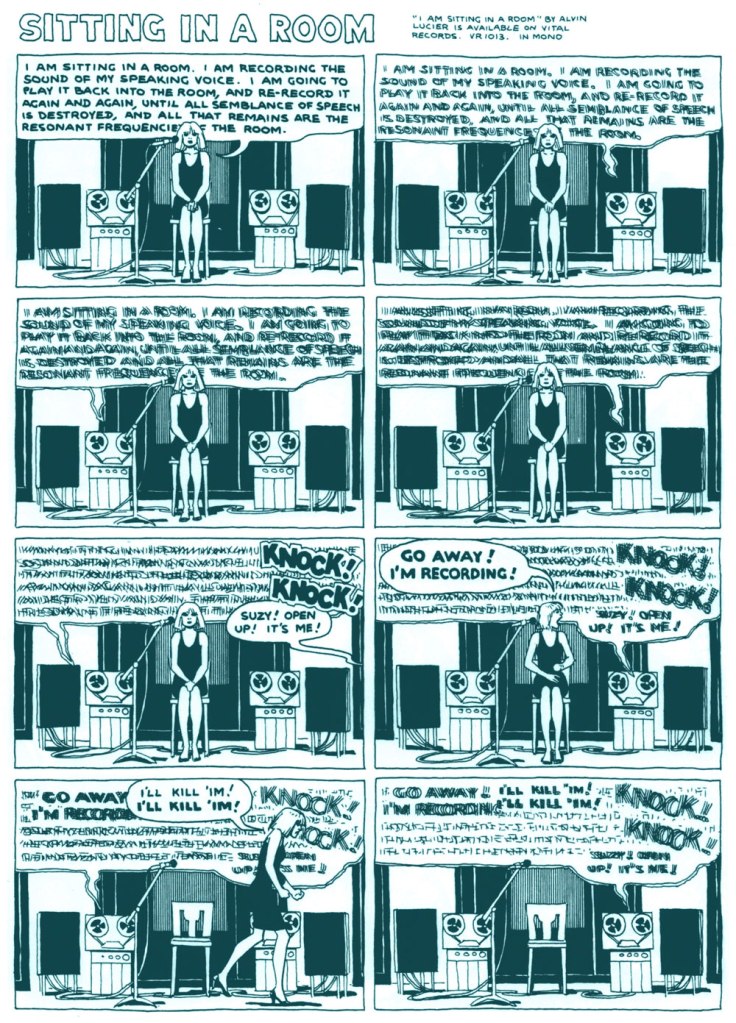
One of American Suzy’s many conceptual experiments.

In terms of style, both in terms of art and storytelling, I suppose this strip fits comfortably into a set of British semi-autobiographical strips from the mid to late 80s – Eddie Cambpell’s Alec and Glenn Dakin’s Abraham Rat, for example, both of them also gloriously funny and contemplative and excellent. As a matter of fact, Mr. Mamoulian was first published in Paul Gravett‘s Escape Magazine* (read a lovely article about it here**), home of Cambell and Dakin’s strips as well…

* Mr. Mamoulian first appeared in Escape no. 11 (1987).

** To quote from the aforementioned article, Glenn Dakin in The Comics Journal no. 238, October 2001, explained that Escape “provided a focal point for people. People would meet up and discuss their dreams and ideas and get together as friends or have arguments and fall out and sometimes even if somebody annoys you or if somebody didn’t seem to have respect for your work, that would be enough to fill you with enough anger to go out there and try to prove them wrong.” Recently, John Bagnall told me, “To some readers at the time, Escape Artists were sometimes generalized as the school of strips “where nothing happened”, but their approaches were actually much more disparate. As for the social scene, there was a loose sense of unity when we would meet up in London, though naturally not everyone got on well or were even huge fans of certain people’s work.

~ ds

Still Henpecked After All These Years: Harry Hanan’s Louie

I’ve talked about Harry Hanan‘s Louie before (see Louie Reads Some Ghastly Comics), but as this post dates from the early-ish days of WOT, it included only one image. My opinion of it has also changed. I called it an ‘endearing’ strip, but I’ve come to feel that the overall effect of watching this schlemiel fail at absolutely everything, day after day, is rather bleak. On the other hand, this daily drudgery makes his rare moments of joy stand out in stark contrast.

‘Hen-pecked’ husbands are a favourite topic of all manner of comedians, so in that regard Louie is not an interesting character; as a matter of fact, his insignificance and inability to stand up for himself reek of desperation, and he evokes a mixture of condescension and pity from the attentive reader. I like him best when he’s out alone, observing something weird happening à la Mr. Mum, getting the short end of the stick from inanimate objects – anything is better than being scolded and shoved around by his wife, really.

The series ran from 1947 until 1976. At the very beginning, Louie was an unlucky criminal; when the strip garnered some popularity and English-born Hanan moved to the United States, his character became an honest man, though he seemed to hold a number of different jobs, from the classic door-to-door salesman to soda jerk. He was considerably sprightlier and full of mischief, and instead of his ever-present wife towering over him, he had a shifting cast of females staring with incomprehension at his antics.

Daily from August 2, 1952, seventy years ago and change!
Three daily strips from 1954.
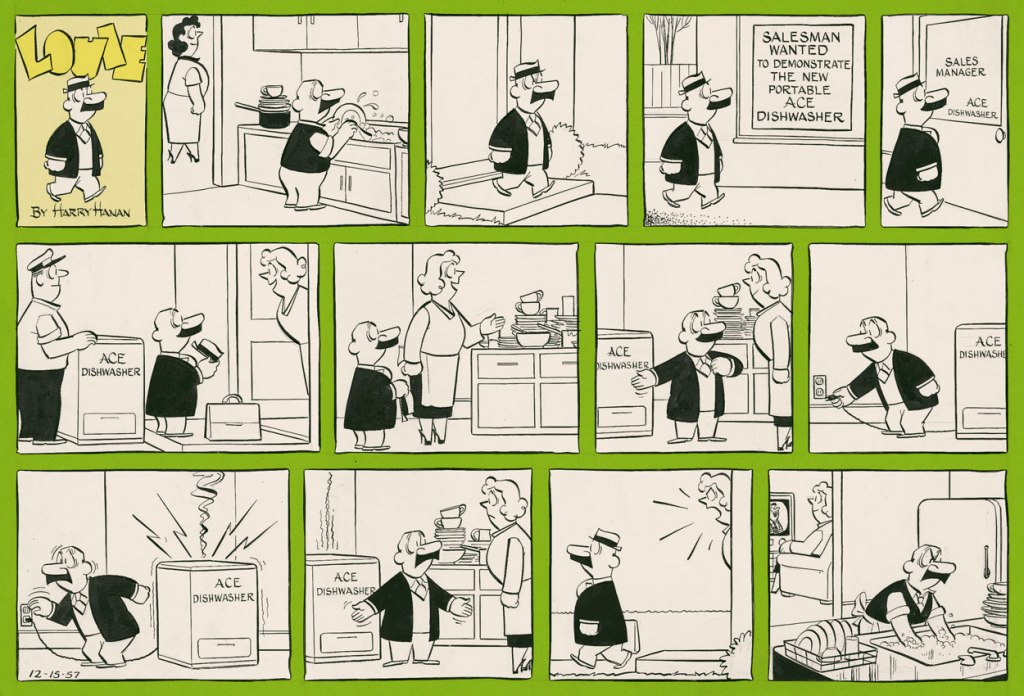
Sunday strip from December 15, 1957.

By the 70s, Louie is more of a tired shambling shell, constantly getting yelled at by his wife, his boss, or just about anybody, really. Still, some fun moments occur —

Strip from January 1, 1970. This is the one that made me think of its contemporary (and infinitely superior, sorry) strip Mr. Mum.
Strip from May 3, 1972. Attempts to discipline others as payback for the moments when you are the one being ordered around always backfire…
Strip from January 10, 1972. Once Louie abandoned his omnium gatherum of jobs, he settled down as a typical office worker with an equally typical tyrannical boss.
Strip from 1972 (exact date unknown). The wife looks downright vindictive, which is interesting since quilters I know tend to have the facial expressions of any person engaged in a beloved craft – enthusiastic, peaceful, or concentrated…
Strip from November 14, 1972. An office worker, and one of British origin at that, surely would have an umbrella in his possession?
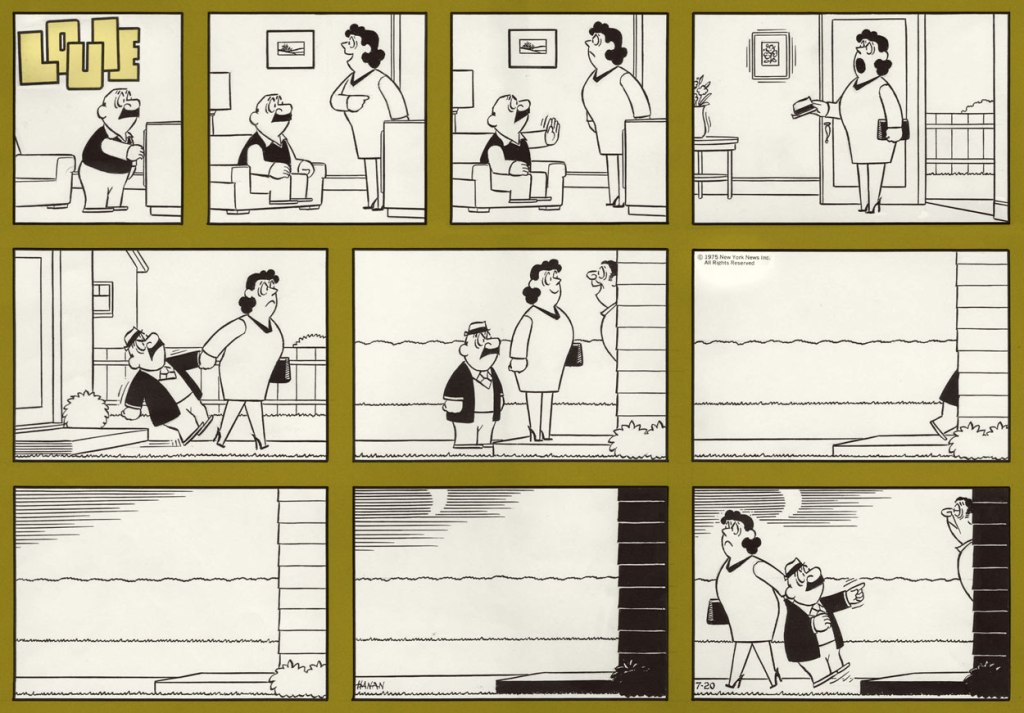
 Sunday strip from July 20, 1975, in which Louie gets (meekly) combative.

The line between domestic comedy and domestic tragedy is a thin one – one of my grandfathers, though not a loser, distinctly marched in the direction indicated by his wife (my grandmother), so I have developed an allergy to that kind of relationship early on. Your mileage with Louie may vary!

~ ds