Jules Feiffer’s Triumph

It’s Jules Feiffer’s birthday! Break out the bubbly (not the cheap stuff)!*

Born on January 26th, 1929, today he turns a respectable 89. He’s still releasing new books, so let’s wish him many more happy and productive years.

If a book with no pictures has no use (according to Lewis Carroll’s Alice), I figure a blog post with no pictures is equally devoid of purpose, so here’s a few fun Feiffer bagatelles.

FeifferABC

Explainers: The Complete Village Voice Strips” was supposed to collect everything in four handy volumes, but unfortunately so far there’s only been one (published in 2008) and no mention of others to come. Still, it’s well worth seeking out. Check out an excellent review of it here, tempting you to it with this pithy quote:

« Explainers is a ‘dipping book’. It’s not something to storm your way through but something to return to over and again. Feiffer’s thoughts and language, his observations and questions are fearsomely eternal. Best of all, Feiffer’s expressive drawing is a masterclass in style and economy all by itself. »

In his earlier years, Feiffer’s excitable, skittish pen was a little more subdued. Case in point: Clifford, Feiffer’s first published strip.

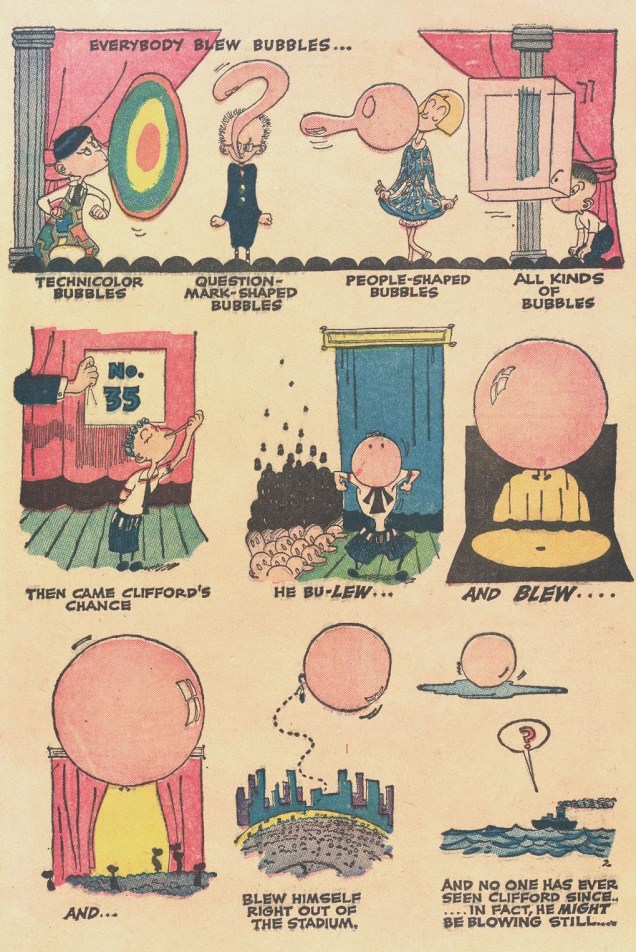
CliffordJulesFeiffer
Kewpies #1, spring 1949.

CliffordJulesFeiffer2

Clifford first appeared in Kewpies #1 (spring 1949), published by Will Eisner, when Feiffer was but 20. In « Out of Line : the Art of Jules Feiffer » (2015), Martha Fay explains that Feiffer had the style of Walt Kelly’s Pogo in mind when he created Clifford.

FeifferCliffordDarkA
Robert Boyd writes: « From 1949 to 1951, Jules Feiffer drew Clifford, which appeared in Will Eisner’s The Spirit Section, an eight-page comic book insert syndicated to newspapers. » This particular strip first saw print in the January 14, 1951 section.
FeifferBoyGirl
Feiffer’s lively cover to his 1961 strip collection Boy, Girl, Boy, Girl (Random House)

Nowadays, Feiffer is writing and illustrating children’s books. In an interview with Gary Groth, he explained that « They represent the gentler, sweeter world that, as we grow older, we go about corrupting first chance we get. No, that’s too cynical. Second and third chance we get. » They may be intended for children, but they are, for the most part, every bit as clever and multi-layered as the Feiffer-for-adults.

JulesFeifferBarrelofLaughs
1995, Harper Collins.

What kind of plot would a Feiffer-book-for-children have, you ask?

« Prince Roger sets out eagerly on a quest and finds a few adventures, a lot of friends, a damsel or two in distress (not!) and himself, in the end. A ‘carrier of joy’ whose mere presence causes everyone to laugh uncontrollably, Roger finds cruelty and kindness equally amusing, and expects his quest to be a lark. It’s anything but: As Roger passes through the Forever Forest, nearly starves at the Dastardly Divide, sees people at their worst in the Valley of Vengeance, and temporarily despairs in the Mountains of Malice, he sobers up, learns to care for others, becomes an expert peacemaker, does Good Deeds, and falls in love with Lady Sadie, who says what she thinks as she repeatedly saves his bacon. »

Read an excellent (though 10 year-old) article from New York Times about Feiffer here.

~ ds / RG

*A triumphant return to the home town
Treated with love and respect
A special school assembly
Before they would have broken my neck
My favourite colour
An E-type Jag
Roll out the red carpet
A glass of champagne – Not the cheap stuff!

(Black Box Recorder, « Being Number One »)

Tentacle Tuesday: Your Basic Contemporary Tentacle

Today’s Tentacle Tuesday veers away from more traditional tentacles and such, straying into more current territory where normal octopuses fear to tread. In a battle between a member of the Octopoda and a Lovecraftian horror, the latter would indubitably win…

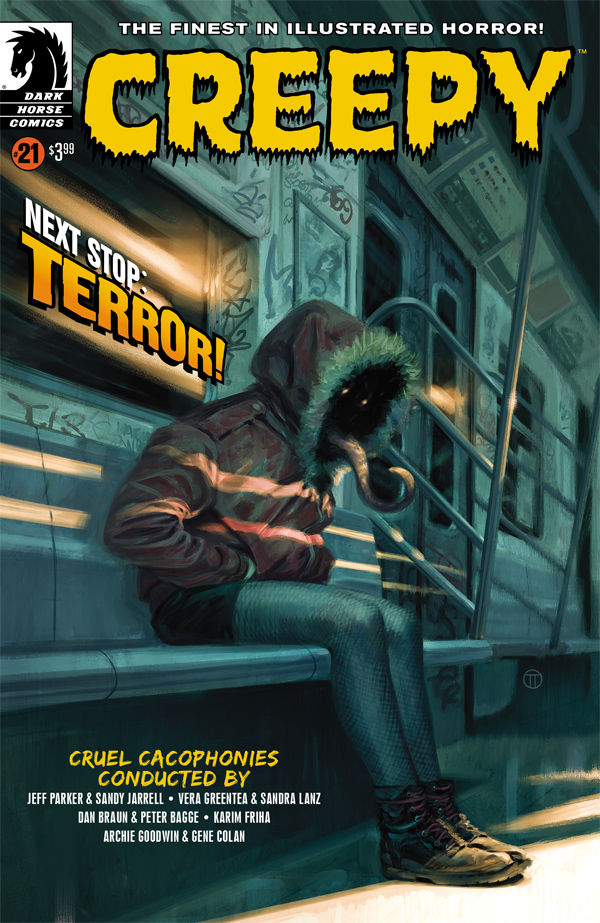
Exhibit no. 1: a painting by Julián Totino Tedesco that uses the classic combination of sexy and frightening. It was used as the cover of Creepy no. 21 (Dark Horse Comics, August, 2015)…

JulianTotinoTedescoCreepy21

And here’s the actual cover:

Creepy21
I think adding « NEXT STOP: TERROR » was a tad unnecessary, not to mention cheesy. Isn’t a girl with a tentacle coming out of her face terrifying enough? Dark Horse pompously describes this issue as « featuring spooky sequential storytelling from graphic greats », promising we’ll be « sweating with sickening satisfaction », proving that there *is* such a thing as too much alliteration.

TentacleTuesdayIcon

Next up is a charming bibliophile, who looks mournful rather than scary.

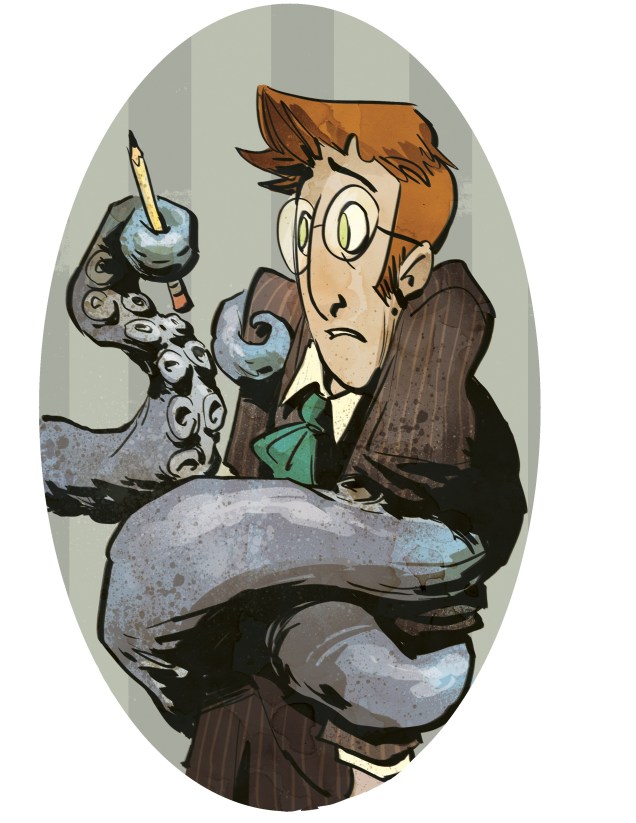
providence-raulo-cover-04-greatrace_copy
« Stop interrupting while I’m trying to write! » Providence no. 11 (December 2016). Century Variant art by Raulo Caceres, a Spanish comic artist.

No-one will be surprised to find out that Providence (12 issues published from 2015 to 2017), written by Alan Moore and illustrated by Jacen Burrows, is meant to be considered as belonging to Lovecraft’s Cthulhu Mythos. In his 2013 interview with Pádraig Ó Méalóid, Moore had pointed out that Providence required a staggering amount of research on his part, and that he had been « living and breathing » Lovecraft while writing it. The following exchange illustrates this research-focused approach:

AM: I’m even trying to check out what the weather was like, which is difficult to establish other than in broad generalities, but I can at least sort out what the sky looked like, and what the phases of the moon were – which is something that Lovecraft used to take pains to do, so I feel that I should as well.

PÓM: Find out if the moon was gibbous, or something like that?

AM: Yes, that was it, he used to – yeah, gibbous, the gibbous moon, which is nearly, what, three-quarters full, waxing or waning?

PÓM: Yeah, three-quarters full. It’s a wonderfully Lovecraftian word.

AM: In one of his stories he changed all the dates in it because he found out that a gibbous moon hadn’t happened on the day that he said it had. He said, ‘this is a lesson for all aspiring writers of fiction.’ And I’ve taken that to heart.

TentacleTuesdayIcon

Finally, we have another Dark Horse entry:

Hellboy2ActualCover
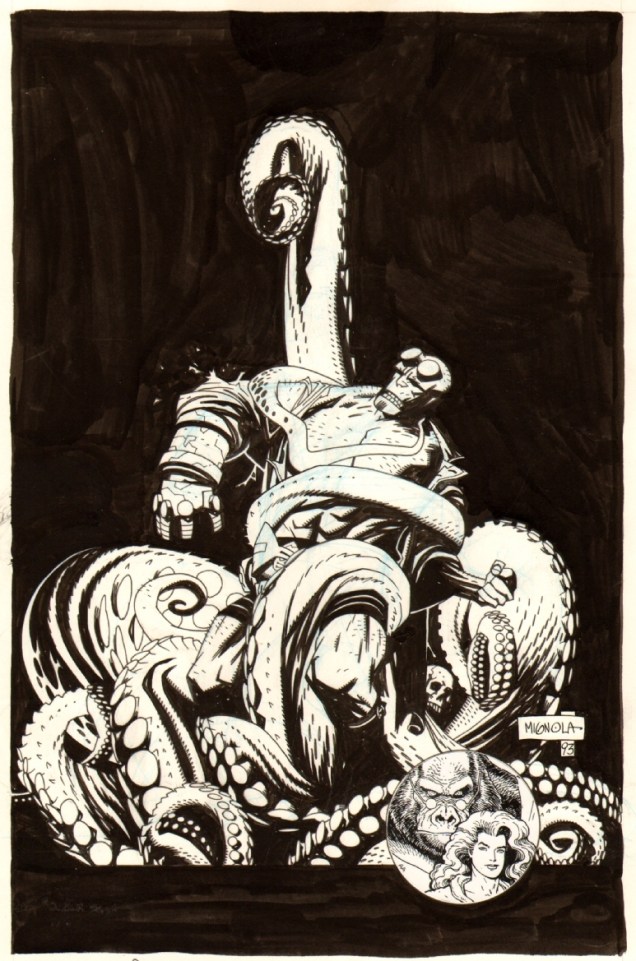
Hellboy: Seed of Destruction no. 2 (1994).

The sketch for the cover (1993):

MignolaHellboyTentaclesSketch
Now we know what’s behind the hand-and-sword symbol!

Hellboy: Seed of Destruction, the first Hellboy mini-series (4 issues, March-June 1994), was plotted/illustrated by Mike Mignola and scripted by John Byrne. (It was also the basis for 2004’s Hellboy movie, which you can safely ignore, IMHO.) You can read the whole thing here. The individual issues were collected in a paperback in 1994, which also contains a couple of bonus stories from various sources.

The insides have sufficient tentacles to please even the pickiest, most tentacle-crazed reader:

HellboySeedsofDestruction2

HellboyTentacles1

~ ds


Tentacle Tuesday: Swashbuckler vs Octopus

For as long as there have been tentacles, there have also existed brave men to combat them (preferably whilst garbed in tight costumes).

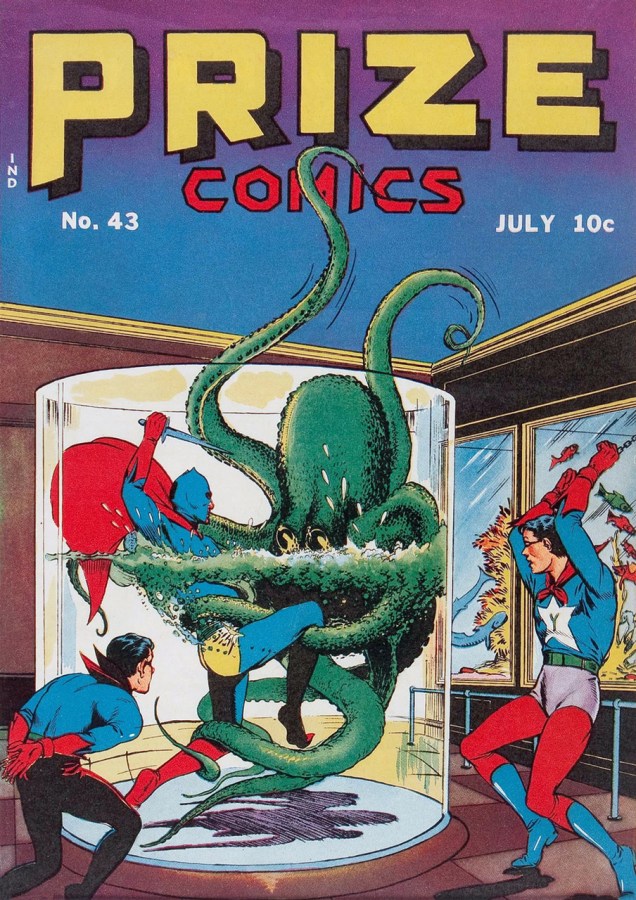
Heroes have battled poor, innocent octopuses in water…

Prize43A
« The mantled crime-battler makes a desperate lunge… a razor-keen blade knifes into rubbery flesh! » Prize Comics no. 43, July 1944. The cover is by Dan Zolnerowich, illustrating a scene from « Wanted – Dead Or Alive ». Dick Briefer’s Frankenstein also puts up an appearance in this issue, this time fighting – pardon, smashing – the Nazis.

The aforementioned scene doesn’t look anything like it does on the cover, involving a much bigger tank, an orange octopus, and a quite underwhelming fight scene (my main emotion was sympathy towards the octopus for getting stabbed by some idiot in a mask with ears).

PrizeComicsTentacles
Nobody was asking you to get into the tank, bubba. Observe the octopus knitting its tentacles together in distress (we knit our brows; octopuses knit their tentacles).

Octopuses have also been defeated by valiant warriors in space…

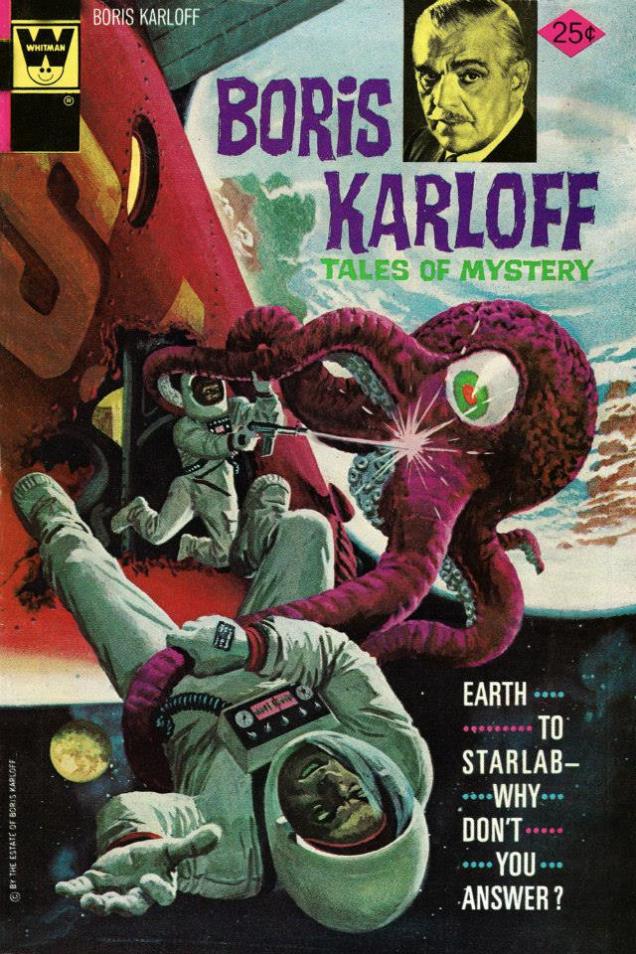
BorisKarloff56
« Earth to Starlab – why don’t you answer? » «Well, sir, we were grabbed by this giant space-octopus and he just won’t let go…» Boris Karloff Tales of Mystery no. 56, 1974 (This one is a Whitman variant.) This painted cover is most likely the work of the prolific George Wilson.

And intrepid daredevils have also gone tentacle a’manglin’ in… say, what is that gooey stuff, anyway?

HouseofMystery301
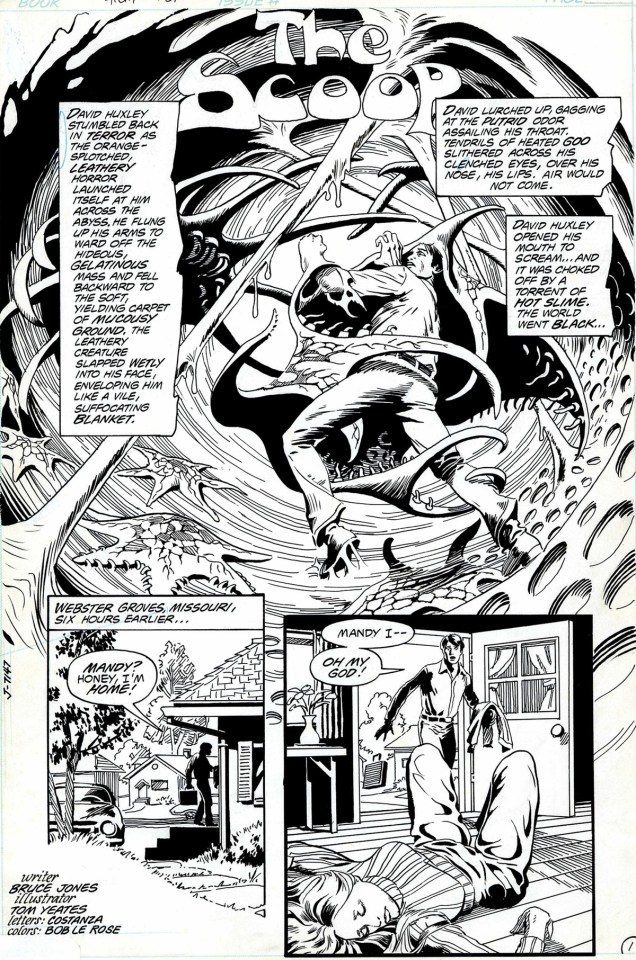
Is that green thing attacking our hapless hero a malevolent butterfly, a hostile starfish, a vindictive serpent? Only one thing is certain: it has tentacles! (Also, here’s the form-revealing, tight clothing I was pining for earlier.) House of Mystery no. 301 (February, 1982); cover by Joe Kubert illustrating The Scoop.

The Scoop (script by Bruce Jones, art by Tom Yeates) has an intriguing premise (I won’t spoil it – read it for yourself). Here’s the original art of its first page:

TheScoop

Well, that’s it for now. I’ve got some pretty cute tentacled creatures saved up for next week’s installment. À bientôt!

~ ds

TentacleTuesdayIcon


Tentacle Tuesday: Adopt an Octopus Today!

I’m in the mood for a light-hearted Tentacle Tuesday, an octopus-as-gentle-companion kind of mood.

Without further ado, I invite you to take a peek at the lives of those who opted for a slightly unorthodox pet!

Here’s our first friendly fellow. Ocho the octopus may be a minor player on this cover, but I’d like to think that he can still be part of our Tentacular Tuesday line-up (I couldn’t resist his puppy eyes).

10845760_788912494490179_7872800748136590150_o
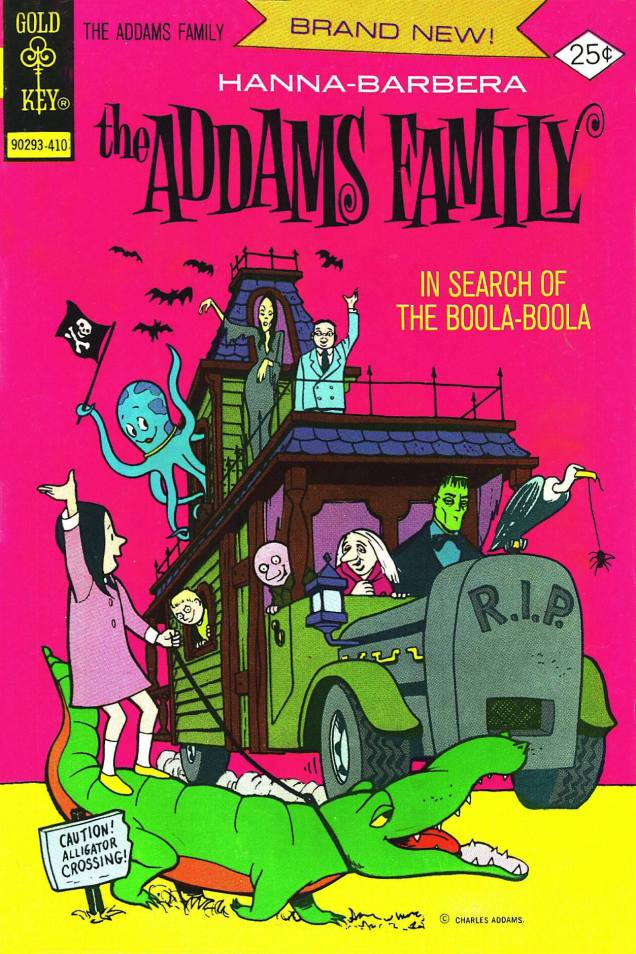
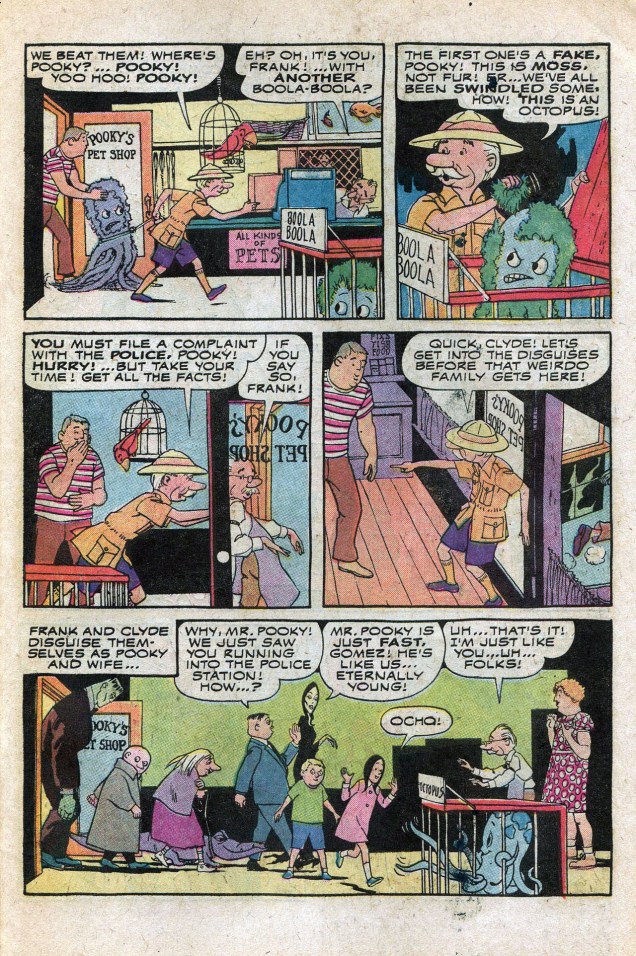
The Addams Family no. 1, October 1974. Cover by Bill Ziegler.

AF#1 not only features Ocho, but also a creature called Boola-Boola, basically a shaggy, colour-changing octopus – so you get double the tentacular pleasure in one issue!

AddamsFamily1GoldKey
Art also by Bill Ziegler.

You can read the whole story here. Interestingly enough, the website that has beautiful scans of all three Addams Family Gold Key issues seems to be dedicated to teaching young people’s English, or to quote from the horse’s mouth, “Improve your English through Reading Comic with Fun”.

TentacleTuesdayIcon

Next up are Victoria and Otto, a nattily-dressed Victorian girl and her pet (confidant, friend, butler…) octopus.

OttoVictoriaSkating

Given the style of these comico-illustrations, I don’t think it will astonish anyone to learn that Brian Kesinger is a Walt Disney Studios alumnus. Apparently, Otto and Victoria’s popularity has taken him by surprise, though it seems rather obvious that a curvy steampunkette and a friendly octopus would be a hit with a lot of people. This may be overly cute, but how can you resist the chronicles of two dear friends (though they may be of different species), especially when they regularly drop everything for a tea or reading break?

Read-To-Your-Octopus

ice_bucket_art_challenge_by_briankesinger-d7vyhhk
Ice bucket challenge!

Otto and Victoria (with some involvement from Kesinger, I imagine!) have three books to their name – Walking Your Octopus: A Guidebook to the Domesticated Cephalopod (2013), Coloring With Your Octopus: A Coloring Book For Domesticated Cephalopods (2014) and Traveling With Your Octopus (2015), all three published by Baby Tattoo Books.

Here’s a self-portrait of the artist as a tentacle man:

BrianKesington
I think he’s stuck drawing tentacles for the rest of his life, now that Otto & Victoria merchandise is selling well. Careful what you wish for!

You can peruse more octopus adventures here.

TentacleTuesdayIcon


For our last entry, a friendly game of cards.

Now you see this brand new razor
I had it sharpened just today
I’m comin’ in there with my own rules
That you must follow when you play
Hey kid, keep your hands up there
While you’re givin’ them out, please
Stop puttin’ them wildies
Down there ‘tween your knees***

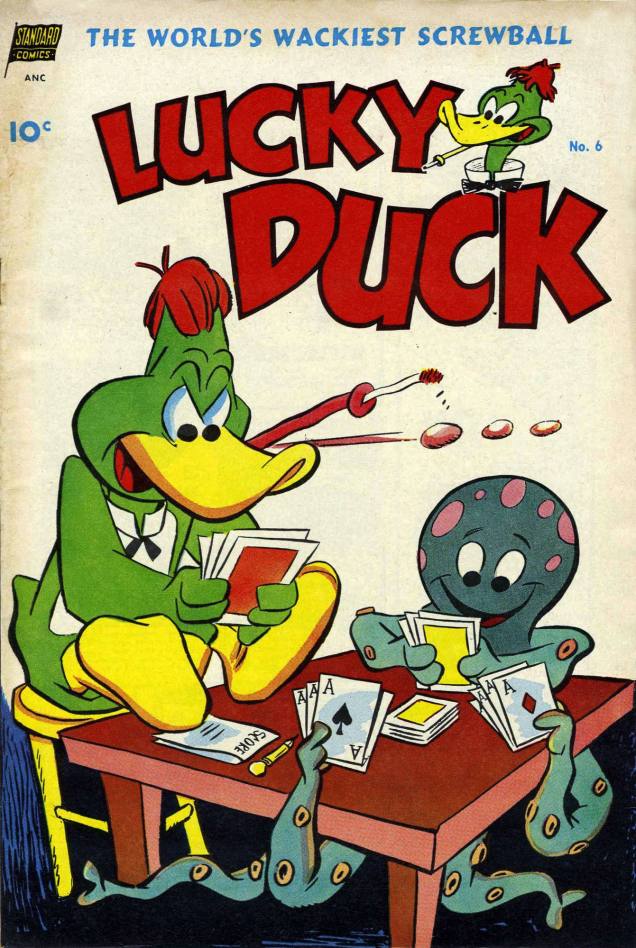
LUckyDuckn6
Lucky Duck #6 (May 1953), art by Irv Spector, (1914-1977), whose career was mostly in animation, though he left behind some lovely comic work as well. The madcap energy of his stories certainly makes it look like the characters are actually in motion!

The inside stories are also by Irv Spector.  His son, Paul Spector, hosts a wonderful blog about his father’s work, and you can find many Lucky Duck stories for your enjoyment on its online pages for a dose of the sort of ebullient zaniness one only finds in animal funnies of the 1950s.

As a little bonus, a peek at Gary Larson’s view of octopuses as pets.

GaryLarsonOctopusObedienceSchool

~ ds

Tentacle Tuesday: Out of the Snowbank and Into the Jungle!

Welcome to the first Tentacle Tuesday of 2018. Exciting, isn’t it?

Since it’s currently chillingly cold outside (or so the weather networks tell us), let’s bask in a bit of warmth and visit some exotic places where heat reigns supreme all year ‘round.

TentacleTuesdayIcon

What’s the first thing to do on a vacation? Take a leisurely walk, of course. However, I’d advise against venturing into a swampy forest. Some people never listen to sage advice, however…

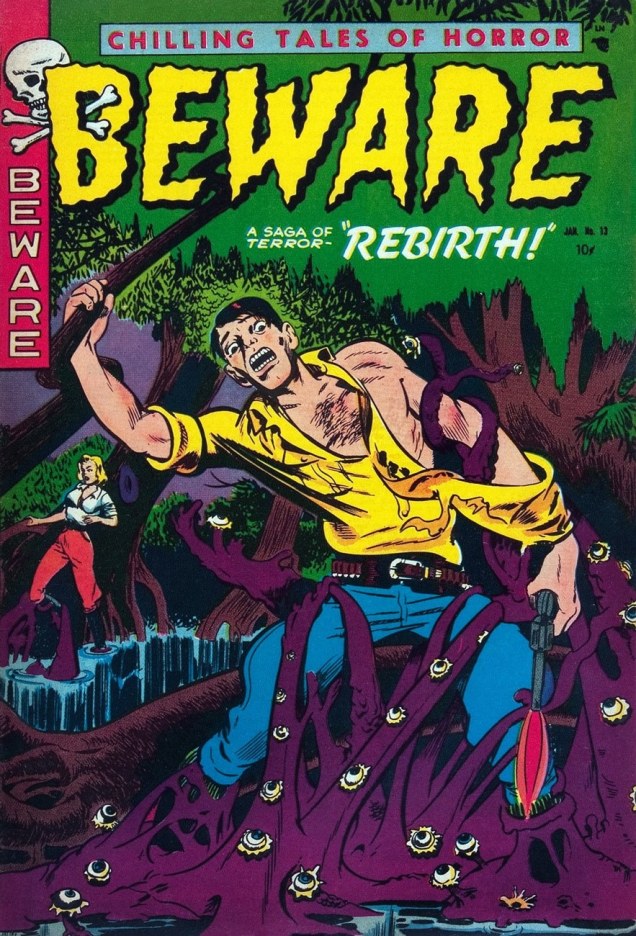
Beware13
This is Beware no. 13 (1953), with a cover by Harry Harrison. « Out of the filth and mud-spawned deep it came, this horrible slug-white creature that wanted only one thing — to be loved! » Wait, what? “Rebirth”, the cover story, also illustrated by Harrison, clearly has absolutely nothing to do with the cover.

I’m quite fond of Harry Harrison as a writer, but as an artist he seems to have been rather middling. Although advertised as a “saga of terror”, Rebirth is an intriguing story in which the “horrible slug-white creatures” are actually far more likeable than the regular humans, who are back-stabbing, greedy assholes. Not that the plot makes much sense.

Beware13HarryHarrisonPanel1
The “white slug” may be well-intentioned, but he tends to launch into pompous speeches at the drop of a hat.
Beware13HarryHarrisonPanel2
A heart-warming, romantic scene.

TentacleTuesdayIcon

Okay, so a walk through a forest didn’t pan out quite as hoped. Let’s take a soothing dive into welcoming, warm waters. Did I say “welcoming”? Perhaps a little *too* welcoming.

TerrorsoftheJungle20
Terrors of the Jungle no. 20 (December 1952), cover by L.B. Cole. Normally I like Cole’s use of bright colours, but on this cover he goes all the way into gaudiness. However, the octopus is quite handsome, and he’s got startlingly human, expressive eyes. I’m rooting for him! Once again, the cover has little to do with the cover story.

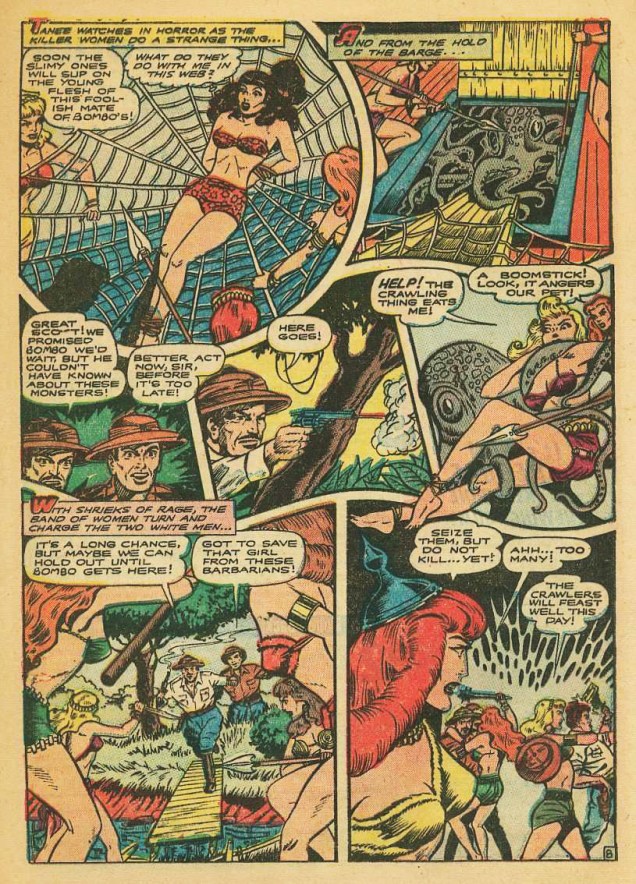
The Creeping Scourge, credited to the Iger Shop (that my spellchecker keeps correcting to “tiger shop”), a comics packager that was officially known as the Eisner and Iger Studio, is an entertaining romp with babes in bondage, wild natives, catfights, blood sacrifices, etc. For example:

TerrorsoftheJungle20Panel
A typical page from The Creeping Scourge, published in Terrors of the Jungle no. 20 (December 1952). « Help! The crawling thing eats me! » is a pretty snappy catchphrase.

TentacleTuesdayIcon

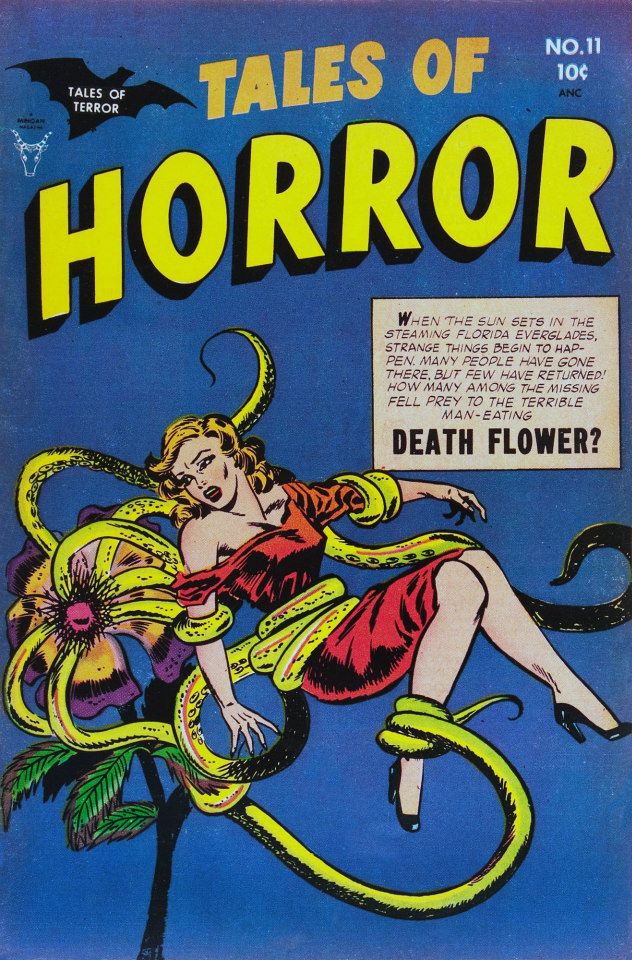
For the botanically-minded, a vacation is a fine opportunity to admire some heretofore unseen exotic plants. Take a look at this sweet little flower:

TalesofHorror11
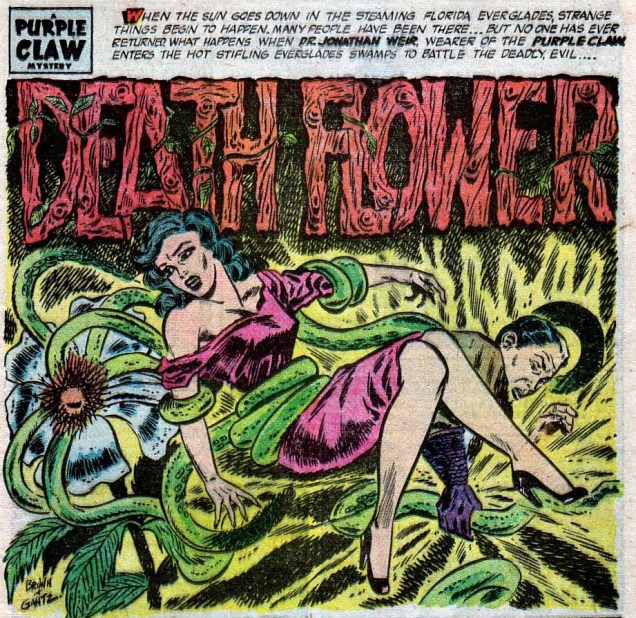
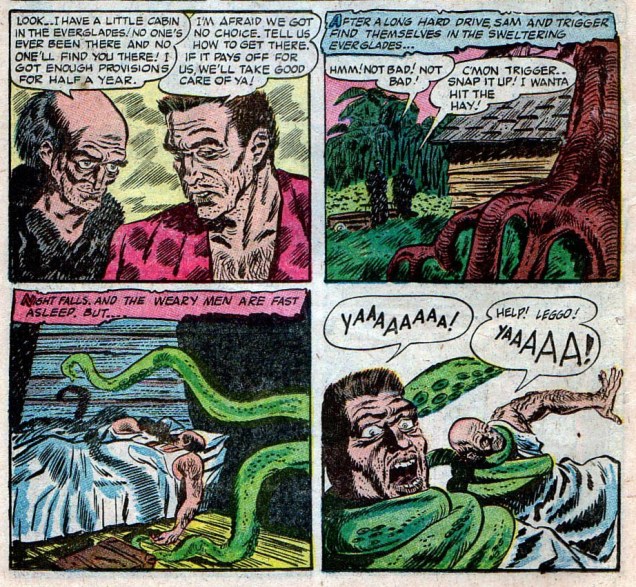
« In the middle of the everglades, there’s a flower that’s different from any you’ve seen… »  Tales of Horror no. 11 (June 1954). Pencils by Ben Brown, inks by David Gantz. Death Flower tells the blood-curdling tale of a creepy old man who lives in the Florida swamps and feasts on human flesh – after having turned into a flower, of course.
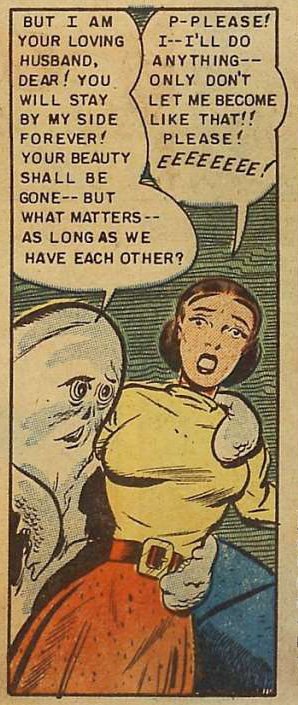
DeathFlower1
The opening panel of Death Flower, also drawn by the Ben Brown (pencils) and David Gantz (inks) team.
DeathFlower2
Wouldn’t *you* trust this old man? Just look at him – such honest eyes, such a confidence-inspiring face. Yes, of course we’ll go to your cabin, venerable oldster!

That’s it for our little holiday pleasure trip – come to think of it, I’ll remain where it’s cold and snowy, thanks.

~ ds

(27178) Quino*

Today we talk about an artist who had an asteroid dedicated to him! (27178) Quino was discovered in 1999.

Quino is the nom de plume of Joaquín Salvador Lavado, an Argentine cartoonist born in 1932 and still with us today (currently 85 years old, for those in the audience who aren’t too good at mathematics). He’s best known for his character Mafalda (heroine of a self-titled comic strip), a lively and precocious 6-year old girl who sought to change the world for the better (but hated soup – how can anyone improve the world without soup?) This comic strip, which ran from 1964 to 1973, is said to have been influenced by Schulz’s Peanuts – for instance, Umberto Eco made that comparison in 1968 – but it makes me think more of Bushmiller’s Nancy. Comparisons aside, I heartily recommend it.

You won’t be surprised to find out that Quino wrote in Spanish – being Argentine and all – but some of his strips, notably Mafalda, have been translated into a variety of languages… by which I mean mostly French. I was harbouring the hope that this great artist had been able to reach many countries with his art, but it seems that his non-Mafalda cartoons (and he’s done quite a few after he quit Mafalda in 1973) aren’t really available in languages other than Spanish or French. As consolation, it seems that at least Mafalda was a big hit in not only Latin America, France and Québec, but also Asia, even meriting a translation into Chinese.

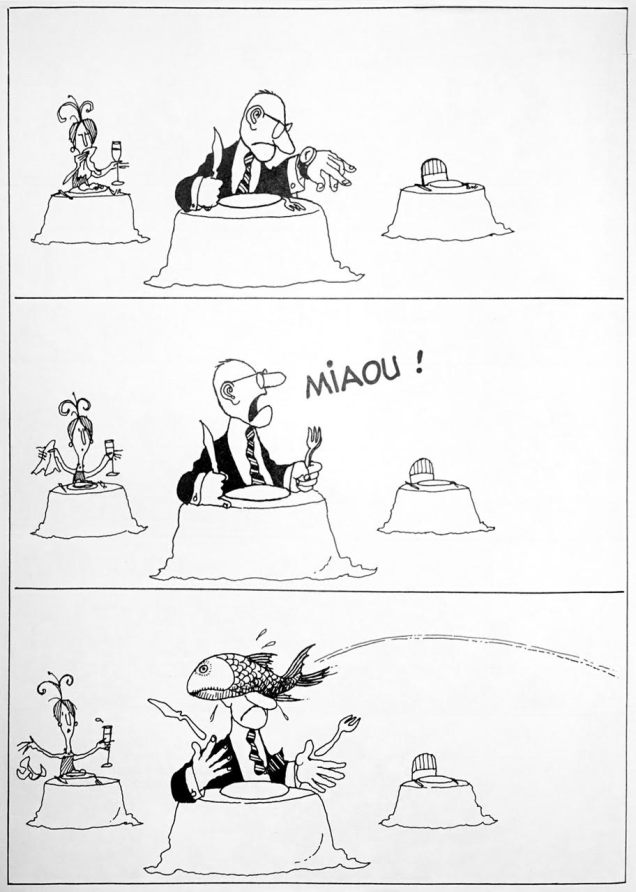
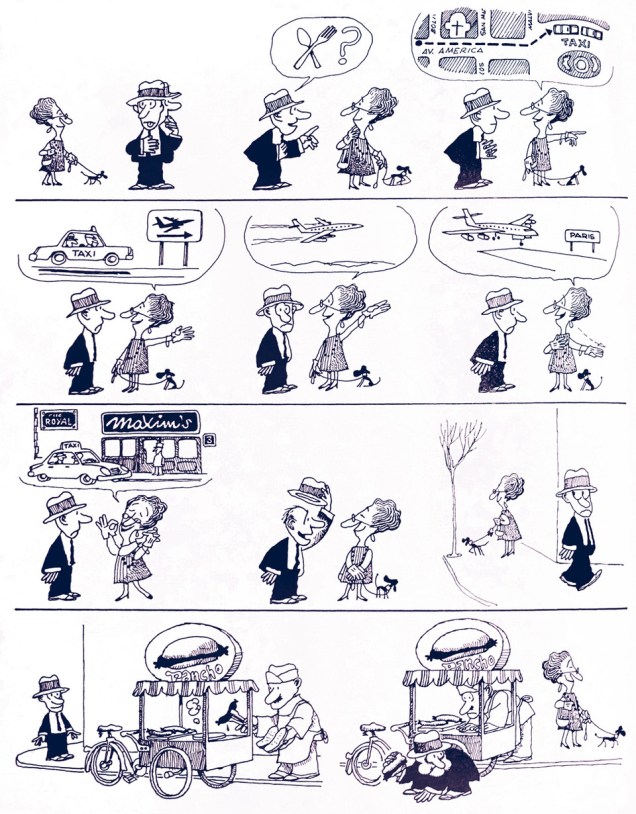
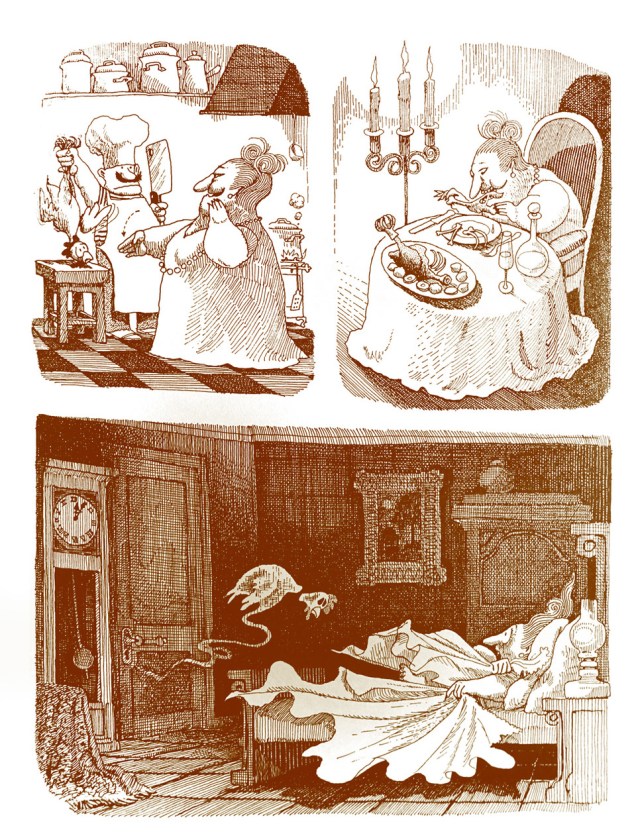
The following three comics were scanned from Manger, quelle aventure! (eating, what an adventure) published in 2016 by Glénat. I was looking for something mute but amusing to sidestep linguistic barriers, and I hope that these qualify. Check out Quino’s beautifully squiggly, decorative lines!

MiaouQuino

QuinoRestoA

ChickenGhostBR~ ds

*part of our galaxy’s main asteroid belt

Tentacle Tuesday: the PG-13 Edition

Most of us may be in a winter holidays kind of mood, but tentacles don’t take holidays, especially not on the last Tentacle Tuesday of the year. While you lounge around in front of a roaring fire (or, more likely, in front of a TV screen), the tentacles continue their arduous work… of grabbing (and possibly disrobing) women.

However good they may be at undressing their victims, did you know that octopuses take the utmost care to hide indecent lady-parts from the audience? Case in point (it would have been much more efficient to grab her by the neck or midsection):

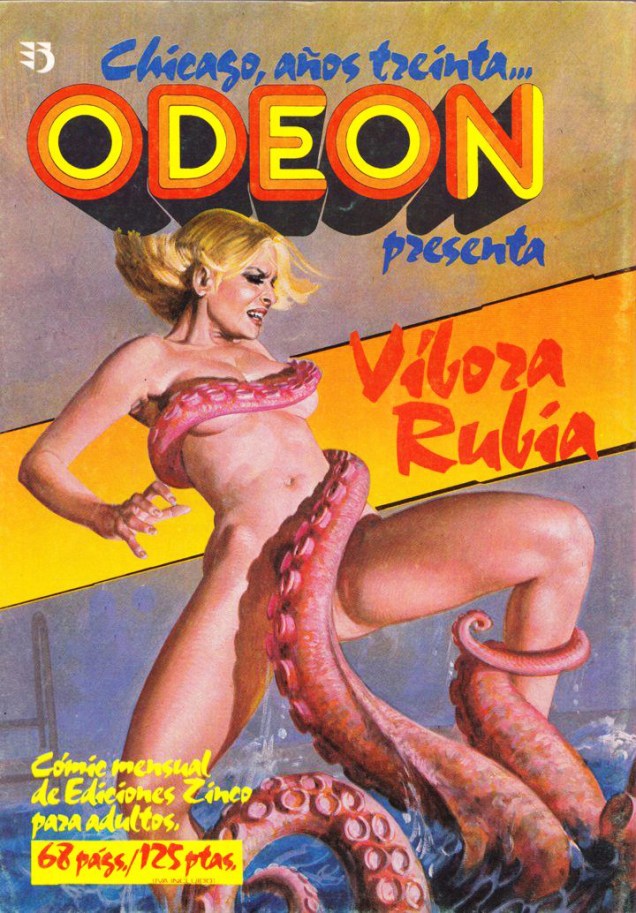
OdeonViboraRubia
« Víbora Rubia » means « blonde viper » in Spanish, and « Chicago, anos treinta » is pretty self-explanatory – Chicago in the thirties. Víbora Rubia (or Vipera Bionda in Italian), is the heroine of an Italian erotic comic series that was regularly printed in Italian comics magazine Odeon and occasionally translated into Spanish. This is one such Spanish edition, 1978, cover painted by Emanuele Taglietti. No, I have no idea what Chicago has to do with a quasi-nude chick in an octopus’ embrace.

As far as I can figure out (Italian not necessarily being my forte), « Odeon » was an Italian comics anthology for adults published from 1977 to 1988. While the earlier issues proudly displayed the enticing warning « for 18 years and older! », later issues modestly called themselves « relatos gráficos para adultos », which loosely translates to « graphical records for adults ». Ironically, the relatively staid covers of early issues became progressively smuttier and more risqué, with bare breasts galore and more rape and bondage scenes than you can shake a stick at, the whole thing veering more than just a little bit into over-the-top ridiculousness. Frankly, I don’t even know why the octopus is bothering to hide the blonde’s nipples.

You can see a gallery of Odean covers here. NSFW, obviously.

TentacleTuesdayIcon

Continuing the march into tentacular extravagance, here’s a couple of panels from a comic called « La mort amoureuse » (either “Death in love” or “romantic death”, depending on how one interprets it). It’s a rather violent story of Death (personified as a lusty though decrepit female), her equally prurient servant Destiny, her two semi-amphibian lovers (a torero and a rock singer kidnapped from the world of the living), and a beautiful woman in a capsule fished out of the sea.

OxoLaMortAmoureuse
A page from « La mort amoureuse » by OXO, a Spanish artist whose name is Eusebio Perdices… which is all I’ve been able to find out about him. Published by Les Humanoïdes Associés, 1987. The lads are polite enough to thank Miss Octopus for her help.

I found this comic to be charmingly over the top, proving that digging through stacks of haphazardly piled up comics in the back of a comic store sometimes pays off. It opens with the story of a lesbian mermaid who dies of a broken heart when her lover callously betrays her, and merrily makes its way through all sorts of sexy shenanigans, amputations and transplants (as well as one decapitation), with dangling eyeballs and dream sequences cheerfully peppering the plot. The sex scenes aren’t explicit (although they’re “suggestive as hell”, as one of my friends would put it, and everyone is quite sex-starved), but the dialogue is equal parts titillating and gross, which elicited quite a few disgusted nose-crinkles and chuckles from me.

Here are two quotes, picked from two randomly selected pages, with quick (and rather literal) translations into English so you can get a feel for OXO’s poetic style. Memorize these in French and you can impress your lover during your next tryst – don’t forget to thank me later.

« Laisse-moi sucer, pour tuer le temps, et pour trouver l’oubli, la moëlle amère de tes os! » (Let me suck, to kill time and find oblivion, the bitter marrow of your bones!)

« Je suis au parfum: la passion est biodégradable! Amour et chair se putréfient également! Laisse-moi plutôt rêver de ton puissant gourdin… ta queue, tendre et primesautière, qui me défonce et défroisse un peu plus les plis de mon vagin flétri. » (I’m well aware: passion is biodegradable! Love and flesh both putrefy! Rather let me dream of your powerful cudgel… your tail, tender and impulsive, which shatters and smooths the folds of my withered vagina!)

TentacleTuesdayIcon

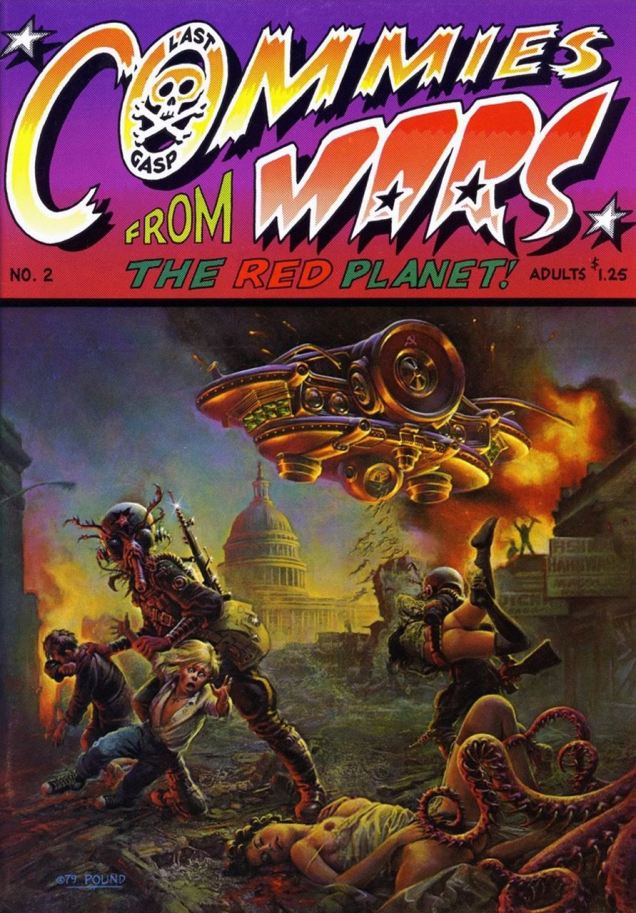
And for our last entry, here’s a cornucopia of fun: Communists! Tentacles! Aliens with good taste in girls! Uncensored nipples! (Actually, the nipples *were* censored on my scan of this cover, but co-admin RG restored them to their former glory with a bit of Photoshop. Thanks, partner.)

CommiesFromMarsTentacles
Commies From Mars no. 2 (Last Gasp, December 1979). The cover is by John Pound. The fallen gal seems to be enjoying herself more than her still-conscious friends… but those spikes, ouch. Once again, the tentacled beast makes sure to modestly cover its victim’s privates from prying eyes.

Actually, I’ll be a generous little communist sympathizer and give you a two-for-one: here’s another issue of the same series, also with tentacles. Why break a formula that works?

CommiesFromMars3
Commies From Mars no. 3 (Last Gasp, February 1981). Cover also by John Pound,  a man equally at ease drawing hot babes and mean tentacles.

~ ds

Tentacle Tuesday: Groping Vines and Other Shenanigans

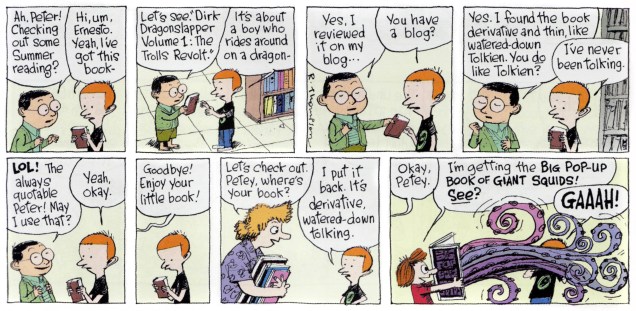
What better way to start Tentacle Tuesday than with the Big Pop-Up Book of Giant Squids? Sensitive people may want to skip this one.

PopUpTentaclesA« Dirk Dragonslapper », other than making me giggle every time, sounds like an actual character from some fantasy trilogy, which may be a comment on the state of fantasy these days (hint: it’s not fantastical). I’ll go with the cephalopods, thanks!

Incidentally, there’s a lot of dreadful fantasy covers out there (and that’s quite out of the scope of this blog, anyway), but I can’t resist sharing this one with you.

Swords-In-The-Mist-cover

Poor Fritz Leiber! An octopus holding a bunch of swords at completely ridiculous angles, a squat muscle-bound freak with a bare ass and some booby green-and-purple women floating a distance away. Thanks, Peter Elson.

TentacleTuesdayIcon

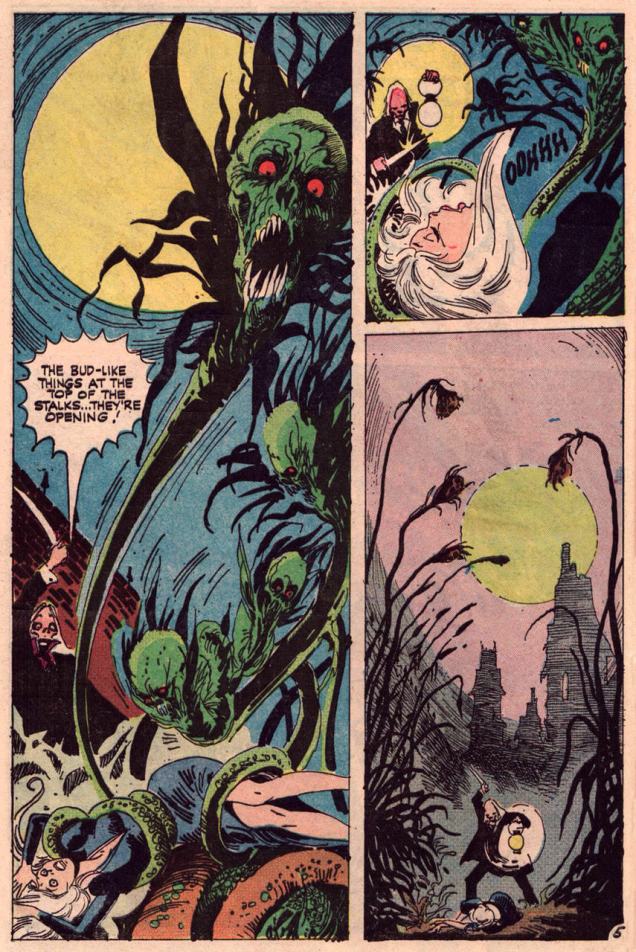
Let’s take a break from cuteness. Next up is some serious cause for alarm from Tom Sutton, who’s excellent at psychological horror. His weird art is full of details one can sink into; his sketchiness and sweeping lines leave one with the disquieting impression of being inextricably pulled into a distorted, nightmarish world.

ABuddingEvilTomSutton1
Damsel in distress from « Budding Evil », Haunted no. 17 (July 1974, Charlton), both scripted and drawn by Tom Sutton. Tell me you can look at the girl’s face as she’s getting strangled by tentacles and not get goosebumps.
ABuddingEvilTomSutton2
The meat-eating flowers have seriously disturbing “buds”… the best of us would have fainted!

There’s an inspired essay about Sutton here which I heartily recommend! I’ll take the liberty of borrowing a great Sutton quote from it (itself taken from a 2000 interview by Jon B. Cooke for Comic Book Artist no. 12). Voilà:

« They published weird stuff, and I have always been fascinated by weird stuff, and the weirder the better….  I do owe a certain amount to Charlton, because they allowed me to write a lot of ditties of my own, to paint a lot of horrible covers, and they never, ever, ever remarked on my technique. »

TentacleTuesdayIcon

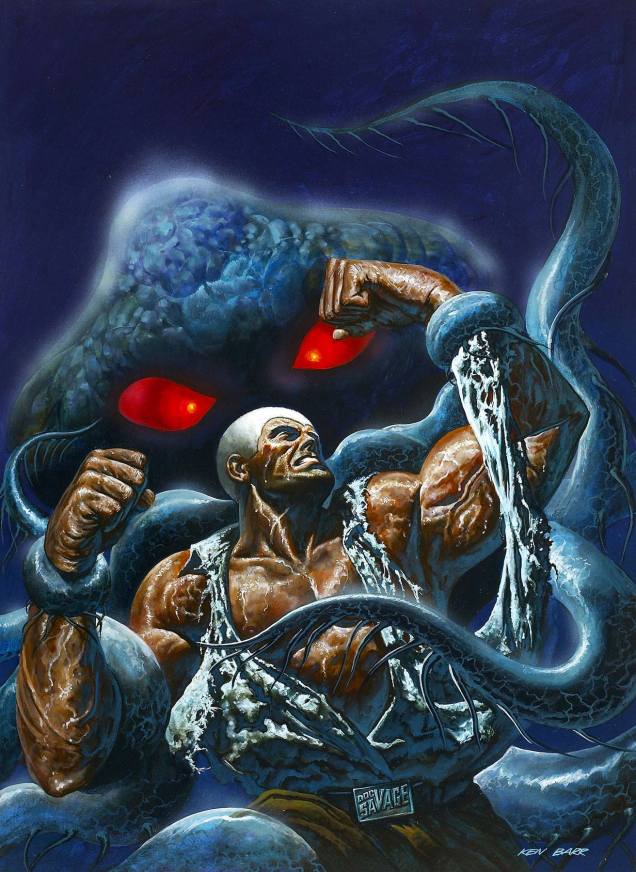
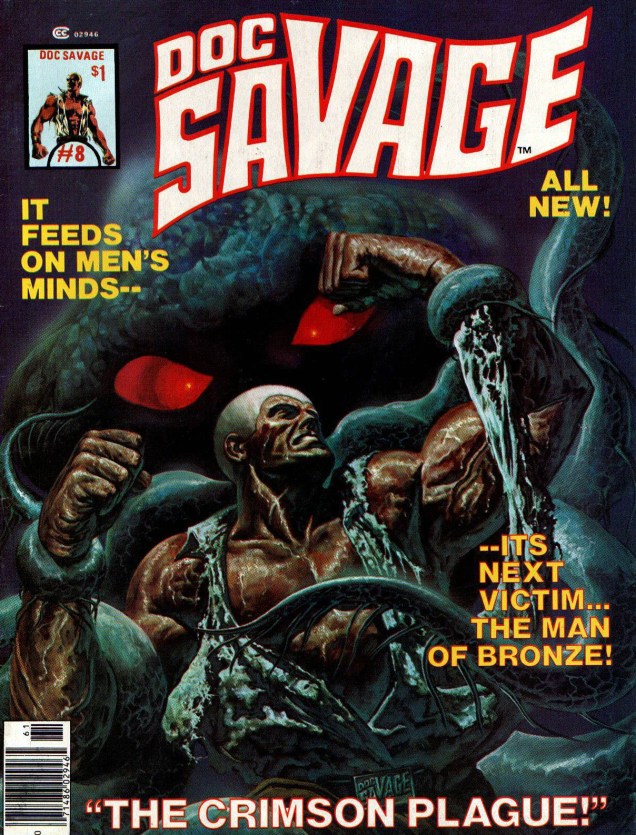
Brr. I think we need an example of straightforward macho heroism to counter-act the icky impression left by the creeping horror glimpsed above. Here’s Doc Savage to the rescue, as usual. Watch the epic struggle between muscled man and malevolent tentacled beast!

DocSavageKenBarr
Original cover art for Doc Savage no. 8 (Marvel, Spring 1977) by illustrator Ken Barr. And no, I don’t have the answer as to why Doc Savage’s normally bronze hair looks like a white bathing cap here. However, Barr seems to have enjoyed painting it – just look at that glistening musculature!

Let’s see the cover as it was published:

DocSavageCover8
A bit too much text, guys. C’mon, you have a tentacled monstrosity with indubitably evil eyes, a man with rippling muscles and bulging veins… We’ve figured out that Doc is its next victim (just as surely as we know that he will come to no real harm).

Interestingly, upon opening the magazine, the first thing one sees is a Tom Sutton illustration. Small world! The cover story, « The Crimson Plague », is an adaptation of a novella published in Doc Savage Magazine in September 1939, and most likely written by Lester Dent (as Kenneth Robeson), who’s responsible for most of the classic Doc Savage epics. It’s an « adventure in which Doc Savage and his team deal with kidnapped scientists, captured comrades, and the deadly secret of the Octo-Brain » (sounds exciting, doesn’t it?) and is illustrated by Ernie Chan.

~ ds

Tentacle Tuesday: Adventure and Levity

There’s only two Tentacle Tuesdays left in the year after today. Well, let’s not bashfully bury our tentacles in snow and get on with it.

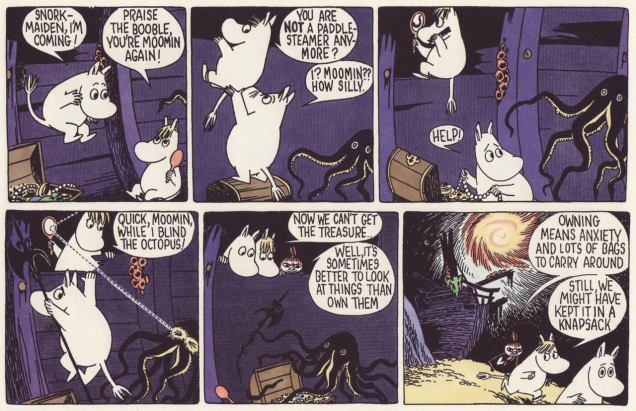
I don’t think Tove Marika Jansson, Swedish novelist, painter, illustrator and of course comic strip artist, needs much in the way of introduction. Merely one word is necessary, and that word (more of an exclamation, really) is “Moomin!” But did you know Snork-Maiden and Moomin-Troll once had to grapple with an octopus?

Montréal’s Drawn and Quarterly is currently « reworking classic Moomin stories in full colour, with a kid-proof but kid-friendly size, price, and format » (to quote their website) for their Enfant collection. « Enfant » means « child », but I think any adult with a sense of humour and just a pinch of childlike innocence will enjoy these stories.

MoomingandtheCometToveJansson
This page is from « Moomin and the Comet » (although I prefer to call it « Muumipeikko ja pyrstötähti »… if I could only pronounce it!) by Tove Jansson and and Lars Jansson, her brother and writer and occasional illustrator of the Moomin comic strip. Published in July 2013 by Drawn & Quarterly, originally published on April 9th, 1958 in London’s The Evening News.

Incidentally, isn’t this photograph of Tove Jansson lovely?

ToveJanssonSwim

So far, there’s something like 12 books published, and D&Q are releasing one or two additions to the collection every year. It’s the only thing I consistently buy from them (well, pretty much the only thing they publish that interests me). Highly recommended if you have any children in your life… and even more if you don’t!

TentacleTuesdayIcon

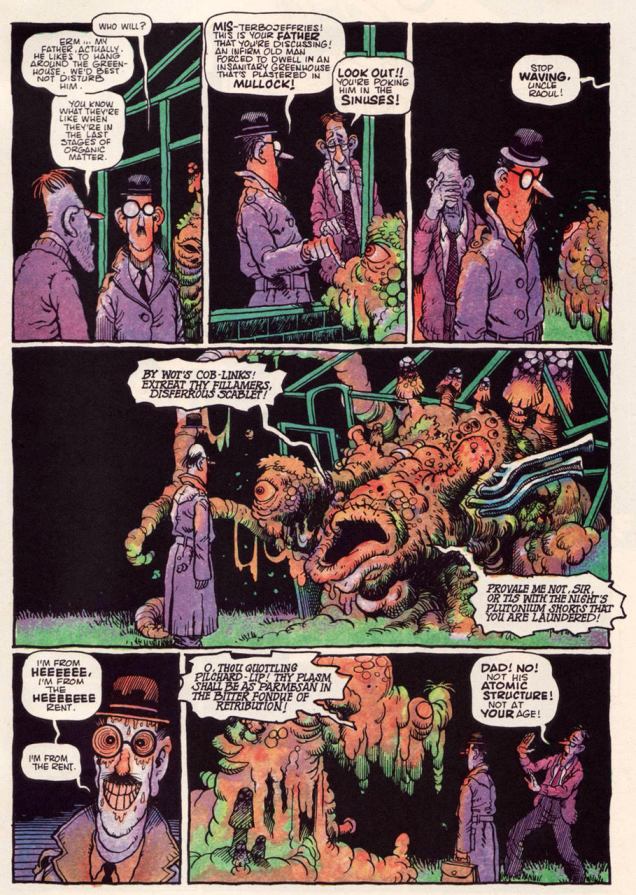
The Bojeffries Saga (written by Alan Moore and drawn by Steve Parkhouse) concerns itself with a loosely-tied group of relatives all of whom are supernatural and/or insane and some of whom have vaguely Slavic names, for added hilarity. The family consists of the two uncles Zlüdotny (a werewolf and a vampire); a nuclear baby (whatever that means); the close-knit trio of father, daughter and son, respectively Jobremus, Ginda, and Reth Bojeffries; and last but not least, grandpa Podlasp, whose tentacles you can admire below. Not, it’s not “Podslap”, although he does slap people on occasion.

BojeffriesSagaRentmanCometh
The first Bojeffries tale, « The Rentman Cometh », appeared in black and white in British Quality Communications anthology Warrior, to be more precise Warrior no. 12, August 1983. Here you have it in glorious (and appropriately stomach-churning) colour thanks to a reformatted & coloured (by Kenneth Smith) reprint in Flesh & Bones no. 2, 1986 (Fantagraphics).

The main… err, hero… of this tale is Trevor Inchmale, a fastidious pain-in-the-ass bureaucrat, who, whilst day-dreaming of glory, accidentally discovers the existence of a  tenant who owes the council £32,000 in rent arrears. Guess who the tenant is? And guess what happens to Inchmale? (Hint: a flower pot is involved.)

BojeffriesSafaFleshBones
The back cover of Flesh & Bones no. 2, 1986 (Fantagraphics). Getting to spend a little time with Dalgoda (Jan Strnad and Dennis Fujitake) and then visiting with the Bojeffries? Yes, please!

I have The Bojeffries Saga collection issued in 2014 by Topshelf Productions in collaboration with Knockabout Comics. Mr. Parkhouse calls it « the complete and final edition », so who am I to argue with that? He also says, in his introduction, that « throughout its entire run the Bojeffries has been sheer, unmitigated fun. It’s been tough, it’s been demanding – but the end result has always made me laugh. »

TentacleTuesdayIcon

Let’s end on a properly horrible (or at least horripilating) note.

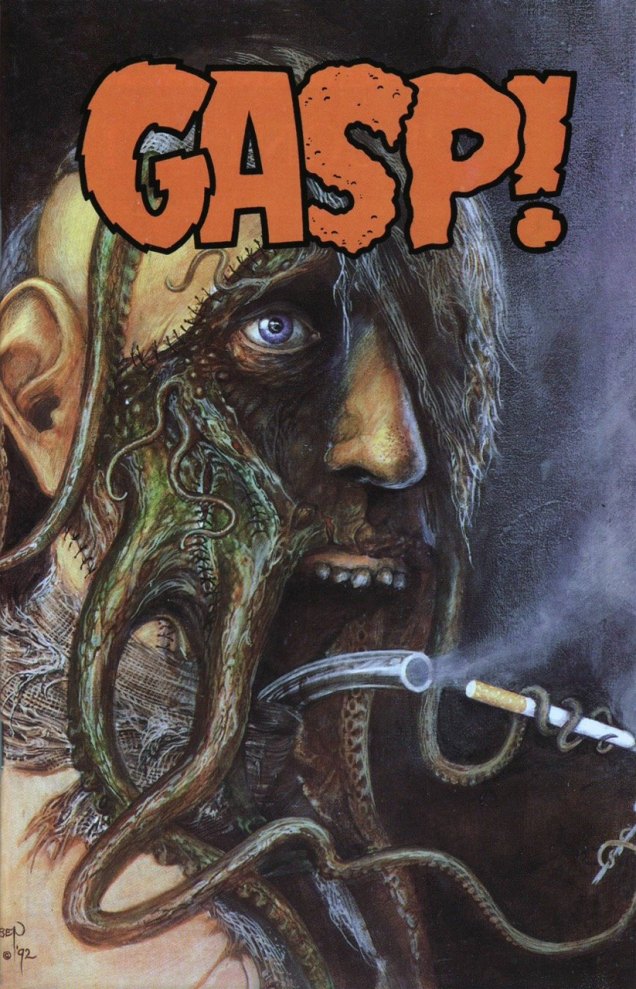
GaspJohnTotleben
This could be part of a pretty convincing anti-smoking campaign. Gasp!, 1994; cover by John Totleben (a recycled painting of his from 1992, actually).

In 1994, Quebecor Printing sponsored Gasp!, a sampler of some independent titles (and not necessarily anything to do with horror, despite what the cover suggests). Its contents are a bit of a hodge-podge, with some highlights and some clunkers. You can get more information about the authors and stories within here.

A group of octopuses, by the way, is called “consortium”, although “octoposse” would perhaps make more sense.

Signing off,

~ ds

Tentacle Tuesday, from goofily scary to scarily goofy

It’s that time of the week again!

Let’s start with something hair-raising. Well, not really – we’re a blasé audience, and it takes something special to truly scare us. Yet can you deny the foul-smelling, palpable sense of foreboding, the billowing and swirling nightmare that beckons from the elegant inks of this page?

TheGravesendGorgonAlcala
« She boiled up out of the sea that hellish night — a monstrous hideous creature, she was, with the craggy face of an evil eyed witch! » Giant-Size Chillers no. 1 (February 1975). The cover promises a « frightful, fearful first issue! » Does it deliver? Eh, not really. Here’s a page of the best story in it, The Gravesend Gorgon, scripted by Carl Wessler and pencilled + inked by Alfredo Alcala.

Gravesend is an ancient town in northwest Kent, England; as for the gorgon part, it’s not entirely accurate, but it’s clear that comic writers cannot resist an alliteration.

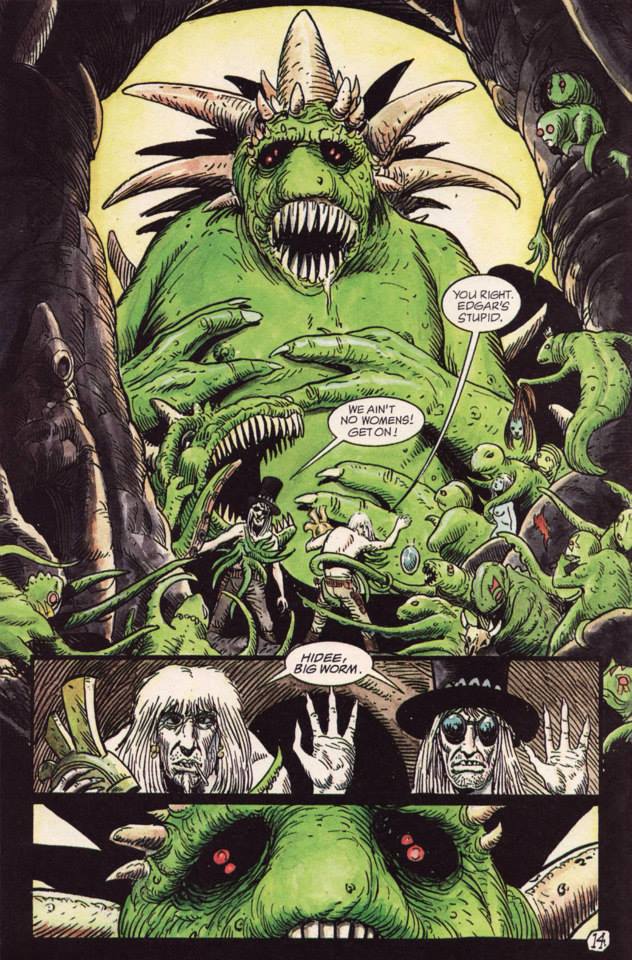
On a slightly more humorous front (unless one is directly involved with this green monstrosity, in which case the situation would quickly lose its humour), here’s a page that hails from Jonah Hex: Riders of the Worm and Such no. 4, (June 1995). The story features the half-worm, half-human albino Autumn Brothers, whom you can see here greeting the big worm-momma. Texas blues rockers Johnny and Edgar Winter attempted to sue, but the suit was dismissed after a judge begrudgingly ruled that « the First Amendment dictates that the right to parody, lampoon and make other expressive uses of the celebrity image must be given broad scope. » Thank you, Los Angeles court. Frankly, it seems that the brothers are more remembered for the lawsuit than their music.

JonahHexRidersoftheWorm4
« Sure like to make big worm happy, whatever she want. Not care much for tentacle down throat. » Jonah Hex: Riders of the Worm and Such no. 4, June 1995. Scripted by Joe R. Lansdale,  pencils by Timothy Truman, inks by Sam Glanzman.

Jonah Woodson Hex, created by writer John Albano and artist Tony DeZuniga in 1971, curmudgeonly and disfigured but bound by a personal code of honour, is a favourite character of mine, although I only like the way he is written for DC’s Weird Western Tales. Well, with one exception, this one! I most tentacularily recommend Jonah Hex: Shadows West, a collection of the three Vertigo-published mini-series scripted by Lansdale and illustrated by Tim Truman and Sam Glanzman, containing the stories Two-Gun Mojo, Shadows West and Riders of The Worm and Such.

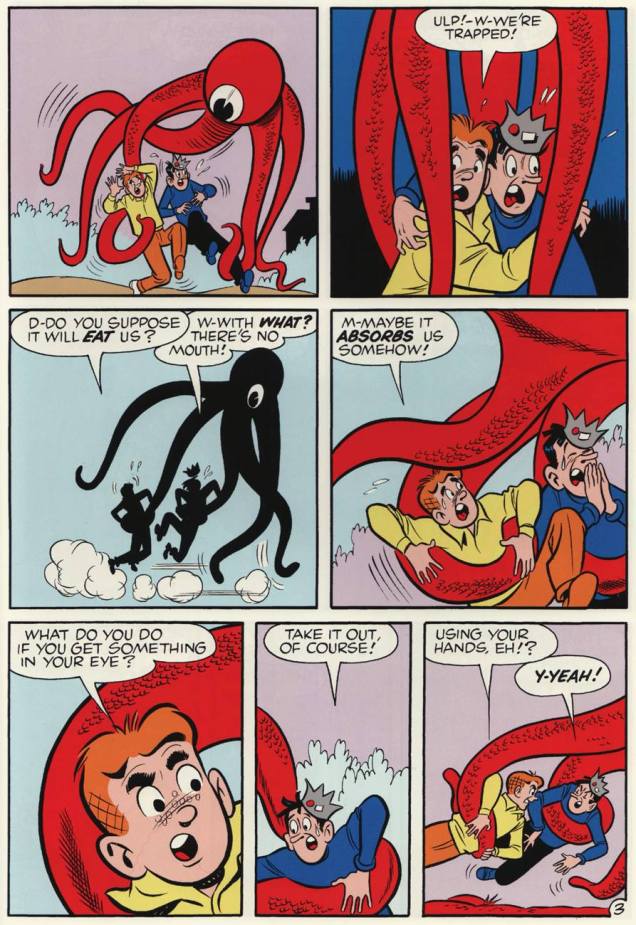
And to wrap this up, on an even goofier note, here’s Jughead getting into yet another weird situation, which is pretty standard for him.

JUghead77SammSchwartz
This page from The Eyes Have It comes from Jughead no. 77 (October 1961). Script by George Gladir, pencils by Samm Schwartz, inks by Marty Epp. Schwartz is absolutely the best Archie artist to draw tentacles; most everybody else would have made a mess of it.

Jughead77A

~ dsTentacleTuesdayIcon