Today’s Tentacle Tuesday is dedicated to Dark Horse Comics, one of the largest independent comic companies (the third largest, period, after Marvel and DC – at least according to their website). That being said, I’m not a huge dusky stallion fan – one of my gripes is that this publisher tends to reprint older comics (like the Harvey Comics Treasuries) on inappropriately glossy paper, as well as ramp up the contrast on the art until the background is so dazzlingly white you could probably blind yourself with it. On the other hand, a lot of mangas translated to English are published by their imprint, Dark Horse Manga – I am profoundly grateful for What’s Michael?, for instance (even though it’s not the first thing that comes to mind, manga-wise).
Throughout DH’s run (it was formed in 1986), it has housed the work of quite a few influential artists and writers, as well as published many long-running and award-winning series. Overall, this publishing house is a force to be reckoned with… and a lot of their pet series (like Hellboy) have tentacles galore. Shall we take a look-see?
Ragemoor no. 3 (May 2012), cover by Richard Corben.
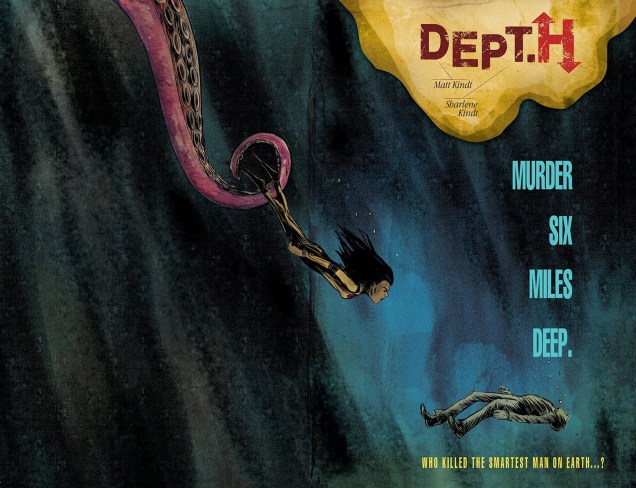
I’ll get around to reading Dept. H one of these days, but in the meantime, some tentacles from this suspenseful (or so say the reviews!) deep-sea who-dunnit:
Dept. H no.1 (April 2016), cover by Matt Kindt.Dept. H no. 7 (October 2016), cover by Matt Kindt, colours by Sharlene Kindt.Black Hammer / Justice League no. 1 (July 2019), a variant cover by Yuko Shimizu.
I mentioned Hellboy earlier – speaking of that, unsurprisingly, a large chunk of today’s post features covers from this ever popular series. But am I going to show you regular covers? Naah, too obvious.
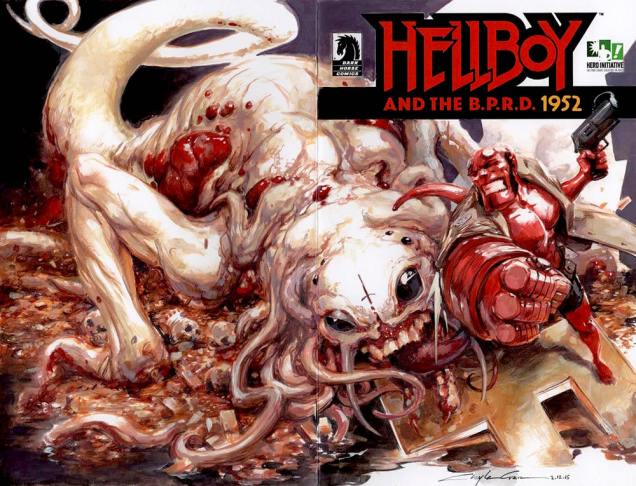
«Dark Horse Comics printed a precious few blank covers on the landmark Hellboy and the B.P.R.D. 1952 #1, and the Hero Initiative commissioned 100+ top artists to do an original drawing on each cover. Presented here is the gallery of ALL 109 original covers!» (See them here.)
I picked a few that I liked, but make sure you click on that link because about three quarters of those commissioned covers are awash in tentacles. Now that’s what I call good, nay, great commission art!
Cover by Chris Ivy. Chosen because despite the abundance of all manner of creatures, the eye is automatically drawn to the Cthulhian horror that’s politely waiting its turn for devouring and whatnot.Cover by Walter Flanagan. They’re somewhat, shall we say, timid tentacles, but that’s what I like about ’em.Cover by Ben Glendenning. Chosen because of the WTF factor of a creature with a dozen scaly, plant-like tentacle-arms.Cover by Clayton Crain. Probably the most gruesome cover of today’s post, included for the blood and entrails and disquieting albino-ness of it all.Cover by Allison Grace. I hope that cigarette isn’t implying anything… untoward has happened.
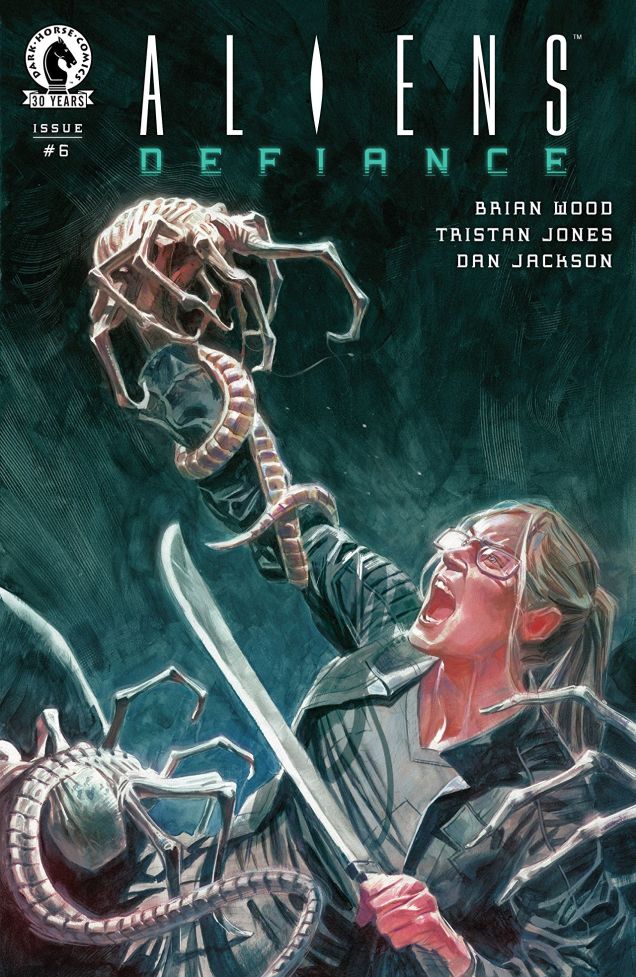
And a last cover, just to leave you on a quiet, peaceful note…
Aliens: Defiance no. 6 (October 2016).
This is, by no means, an exhaustive list – stay tuned for a Part 2, coming to your computer and cellphone screens sometime soon (when you least expect it!)
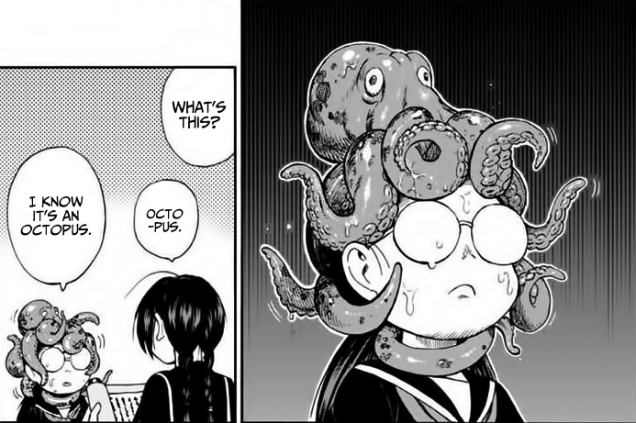
Last night, an octopus materialized into my office and reproached me for neglecting manga during my Tentacle Tuesday forays. I vowed to do better! As octopuses are impatient fellows, I decided not to tarry and complied immediately.
Panels from Shinobuna! Chiyo-chan, a comic by Kiyoto Shitara. Begun in 2017, it is still going and is being published by Tokyo-based Kadokawa Shoten. Read it here.
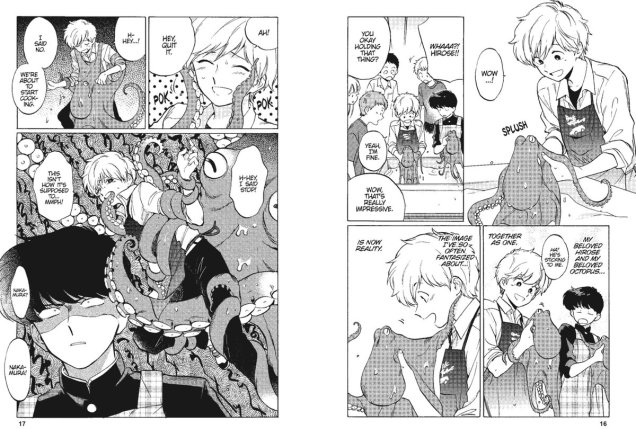
While the previous manga is about a schoolgirl trying to get her classmate’s attention (she’s also a ninja, not that it simplifies matters), the following concerns itself with a shy boy who falls instantly in love with a (male) student from his class and spends the rest of the story trying to get closer to him.
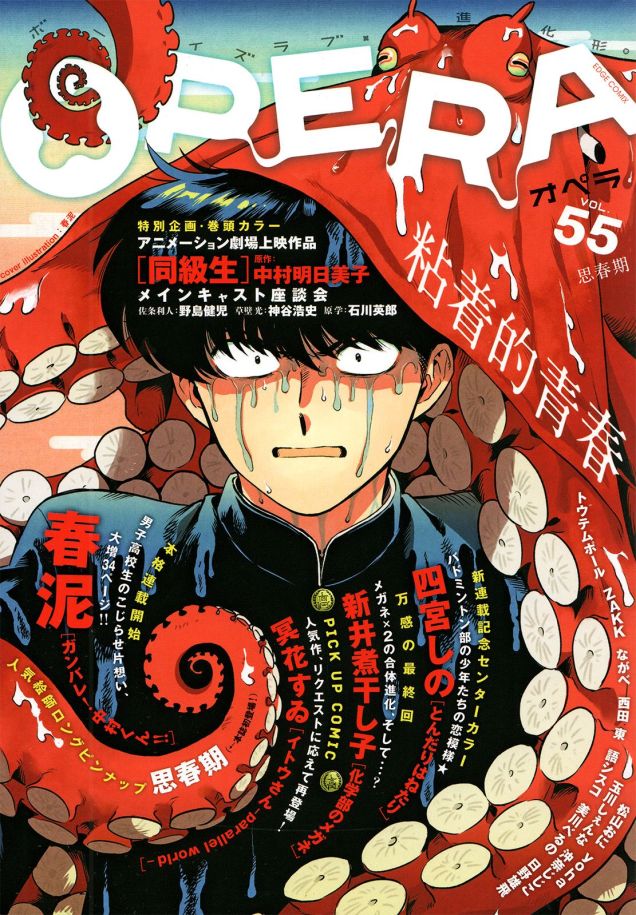
Go For It, Nakamura!, started in 2014, is written and illustrated by Syundei and published by Akane Shinsha.That’s Nakamura’s pet octopus, Icchan. « Octopi like to go into crevices, don’t they?! Wow, look at how squishy it is! »
Adventures in Poor Taste’s Trevor Richardson wrote a slightly extravagant review of Go for It, Nakamura! that delves deep into this manga’s the cephalopod imagery. Just for the fun of all the octopus metaphors, I’ll quote:
« As a queer person, I couldn’t help but identify with that queer young man who doesn’t yet know how to use all the extra arms that queerness grants him. Who doesn’t yet know how to push his tentacles up against the metal lid of self-doubt and oppression and twist it off. Who isn’t yet able to expel all that confusion and rejection like a cloud of black ink and surge down to trenches where straight people never dare drift to join his fellow otherworldly, queer creatures in the dark. »
To those who aren’t into high school romance but prefer their manga on the side of the macabre and the bizarre, I propose Octopus Girl by Toru Yamazaki (1990), though the events still mostly take place at a school. Takoko, our main character, is bullied by her classmates and nearly killed by them when they decide to semi-drown her and then force her to eat a live octopus (to which, the story specifies, she is allergic, because eating a live octopus isn’t horrifying enough as it is). As a response to this ordeal, she turns into an octopus (with a girl’s head) and exacts terrible revenge on her bullies!
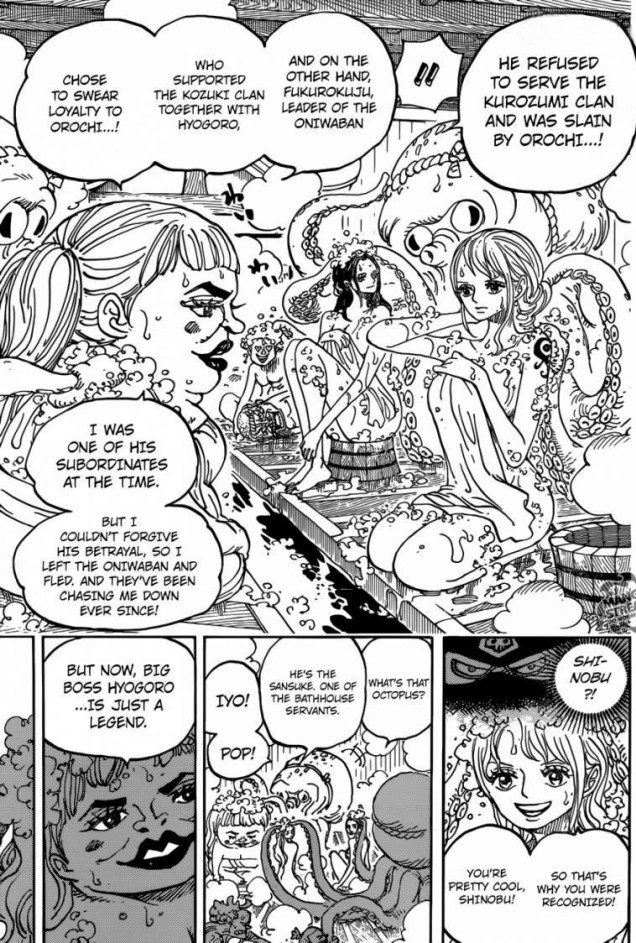
The English publisher describes it as “delightfully disturbing” – at any rate, I certainly agree with the “disturbing” part. Here, Takoko eats her own appendages for sustenance (don’t forget to read from right to left.)« Teenage monsters lose their hearts and heads in a relentlessly gory collection of dark humor and horror! Carving a comical niche in modern horror manga, Toru Yamazaki’s Octopus Girl serves up the most disgusting dishes of heartbreak and revenge found on land or at sea. Have a side order of nervous laughter with your main course of bloodcurdling fear, some gore with your teen angst, and some killer instincts with your kawaii! These shocking vignettes will hypnotize fans of the macabre and the absurd, as intestines, eyeballs, and fluids of all sorts shoot enthusiastically across Yamazaki’s pages! »Page from One Piece, a humorous manga series by Eiichiro Oda, serialized in Shueisha‘s Weekly Shōnen Jump magazine since 1997. Read it here if you’re so inclined – in terms of posting copyrighted content, otakus seem every bit as bad as Russians. « The story follows the adventures of Monkey D. Luffy, a boy whose body gained the properties of rubber after unintentionally eating a Devil Fruit. With his crew of pirates, named the Straw Hat Pirates, Luffy explores the Grand Line in search of the world’s ultimate treasure known as “One Piece” in order to become the next Pirate King. »
Moving on to proper horror – in the sense of it being devoid of comedy -, two pages from Junji Ito’s Gyo Ugomeku Bukimi (Fish: Ghastly Squirming), published as a series between 2001 and 2002 in the Japanese weekly manga magazine Big Comic Spirits. I’m enough of an aficiona-Ito to own most of his work that’s been translated into English, and though a lot of his stories are rather hit-and-miss, Gyo is one of the genuinely gruesome ones.
Ito is quite adept at conjuring up quite far-fetched yet terrifying plots, with events spinning faster and faster out of control until… until he doesn’t quite know how to tie up the story. Having gone so deep into the utter destruction of the world, there’s no elegant dénouement available but sheer Armageddon. That is definitely a weakness, so I tend to prefer his short stories, where the conclusions are fast and hard-hitting. That being said, I definitely recommend reading Gyo (read it here, but remember to support the artist by purchasing!) and Uzumaki (another terrifying read likely to leave you with a phobia of spirals). For an excellent discussion of Junji Ito’s appeal, please consider the excellently written The Horrifying Appeal of Junji Ito.
Okay, a couple more horror comics!
Page from Devilman, written and illustrated by Go Nagai, published from 1972 to 1973 in Shōnen Magazine. This has very typical manga art, which is to say, art that doesn’t appeal to me. But a vicious female demon with tentacles *everywhere*? I wasn’t going to say no to that.
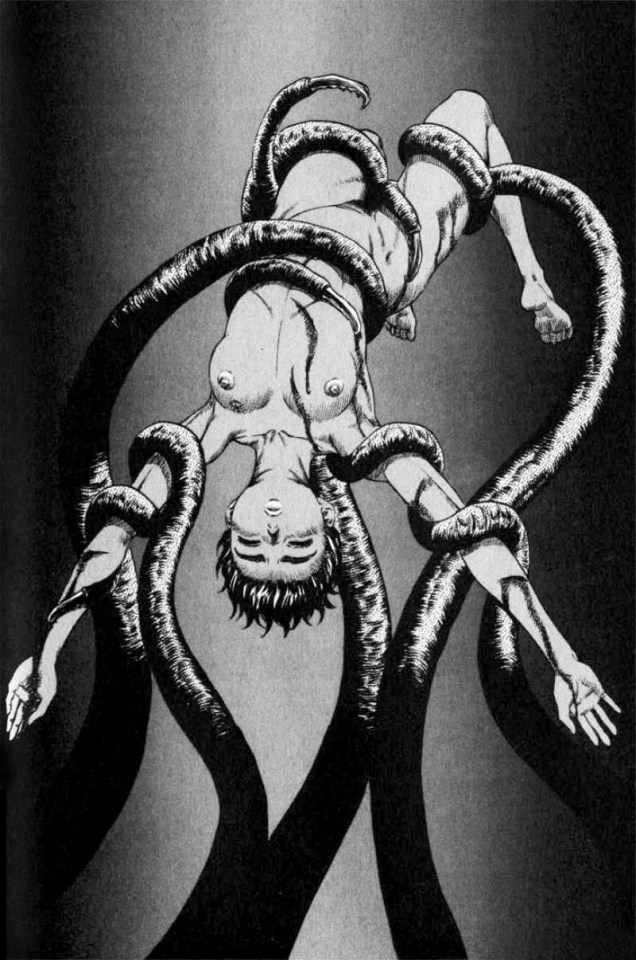
I’ll leave off on a somewhat… sexualized… note with two pages from the dark world of Berserk by Kentaro Miura, first published in 1988 and still going on. It’s been called one of the greatest literary works in all of manga… well, I can’t vouch for that, as I haven’t read much of it, but it does seem complex, at any rate.
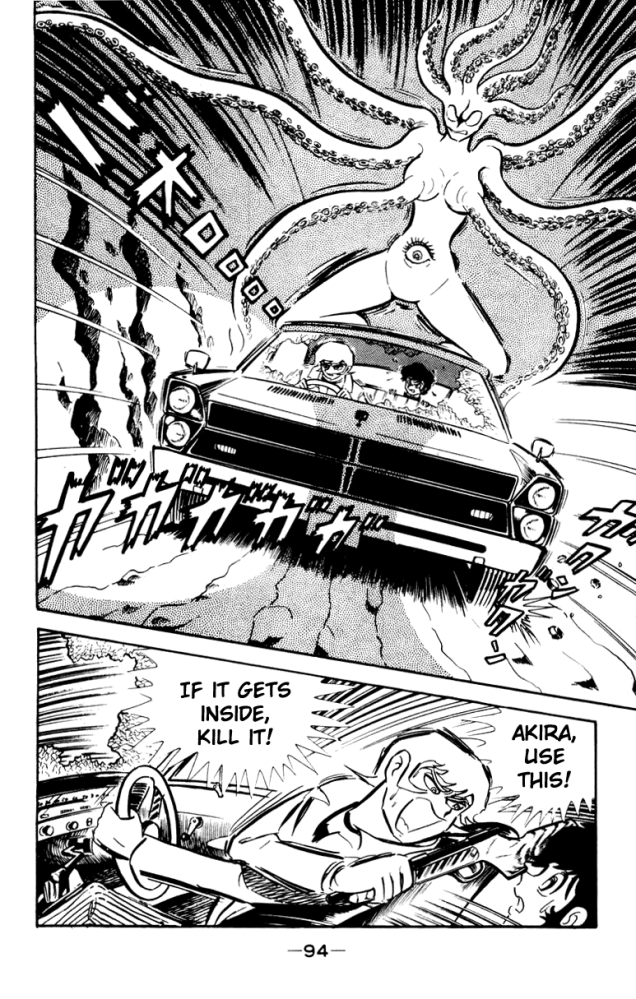
Oh, as long as we’re on the topic of probing tentacles, I’ll wrap up with some Toshio Maeda, an erotic manga artist and pioneer of hentai. His best known work is Urotsukidōji: Legend of the Overfiend which been credited with popularizing the trope of tentacle rape. Fellow tentacle lovers, are you for or against such a use of tentacles? Please let us know in the comments.
Urotsukidōji: Legend of the Overfiend by Toshio Maeda, serialized in Manga Erotopia from 1986 to 1989. Were nipples verboten, one may wonder, or is this just a demon of some kind?Panel from Urotsukidōji: Legend of the Overfiend by Toshio Maeda. If you’re in the mood for further tentacles, visit The Tentacle Lounge, an aptly-named blog devoted to Maeda.
As we’re currently in the blaze of summer (rocketing temperatures and crazy humidity, courtesy of global warming – this June was the hottest June ever, and we’re well on track for beating records for July), a Tentacle Tuesday post about plants seemed appropriate. Did I say “plants”? More like “plantacles”: these vines and tendrils snatch and grab, creep and reach, entwine and writhe just like their cephalopod counterparts.
Pages from Dark Side of the Moon, with art by Maurice Gutwirth, published in Hit Comics no. 2 (June 1941, Quality Comics).
So Blaze Barton encounters some vine tentacles, fine; but he also encounters ‘queer tiny plants‘ that swarm him and attack with what looks very much like octopus appendages. The delightful thing about Hit Comics and particularly Barton’s adventures is that the stories are goofy as hell.
The story continues in the same vein, merrily galloping into insanity… into an ‘evil-infested‘ lake that boasts man-eating weeds, once again complete with tentacles.
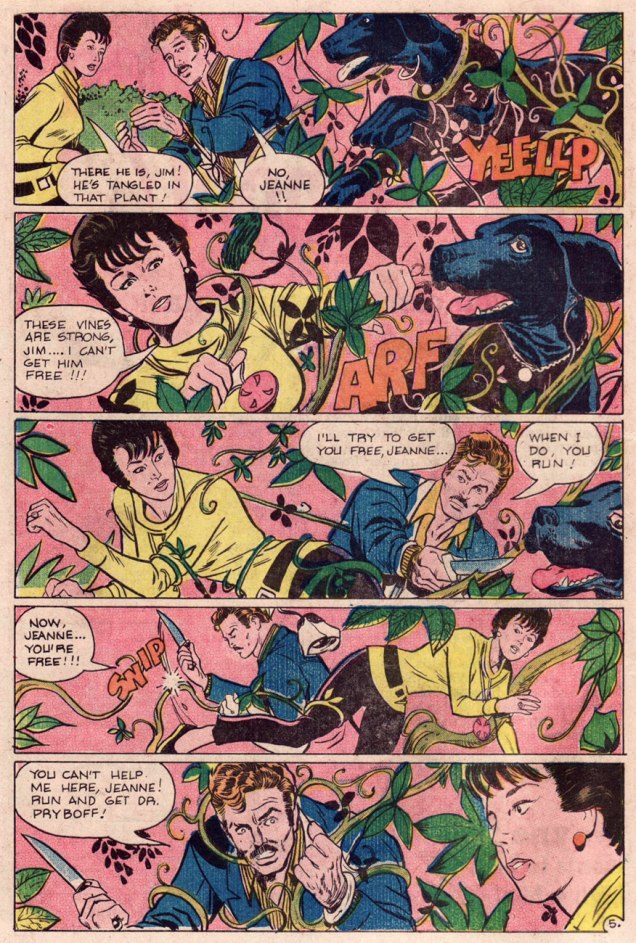
Continuing our grabby, carnivorous vines theme, a creepy little tale of a scientist who slightly oversteps his bounds:
Pages from The Hungry Garden (scripted by Joe Gill and drawn by Fred Himes), published in Ghostly Haunts no. 34 (August 1973). Trespassers will be stung, choked, and then gleefully consumed.Should you be curious or concerned, the pooch makes it out just fine, and in fact goes on to save the day!
Occasionally, an entire tree will decide that it’s more fun to strangle a human than to passively let itself be chopped down. Who could argue with that?
Psychotic Adventures no. 3 (June 1974, Last Gasp). Cover by Charles Dallas. The blog Mars Will Send No More has many Dallas stories (all from Psychotic Adventures) for your perusal; I recommend them heartily.
The cover story, Women of the Wood, is based on a short story by Abraham Merritt that you can read here if you’re so inclined. It’s an excellent creepy tale – though I can’t promise tentacles, I can definitely guarantee murderous trees.
« For all those hundred years there have been hatred and battle between us and the forest. My father, M’sieu, was crushed by a tree; my elder brother crippled by another. My father’s father, woodsman that he was, was lost in the forest — he came back to us with mind gone, raving of wood women who had bewitched and mocked him, luring him into swamp and fen and tangled thicket, tormenting him. In every generation the trees have taken their toll of us — women as well as men — maiming or killing us. »
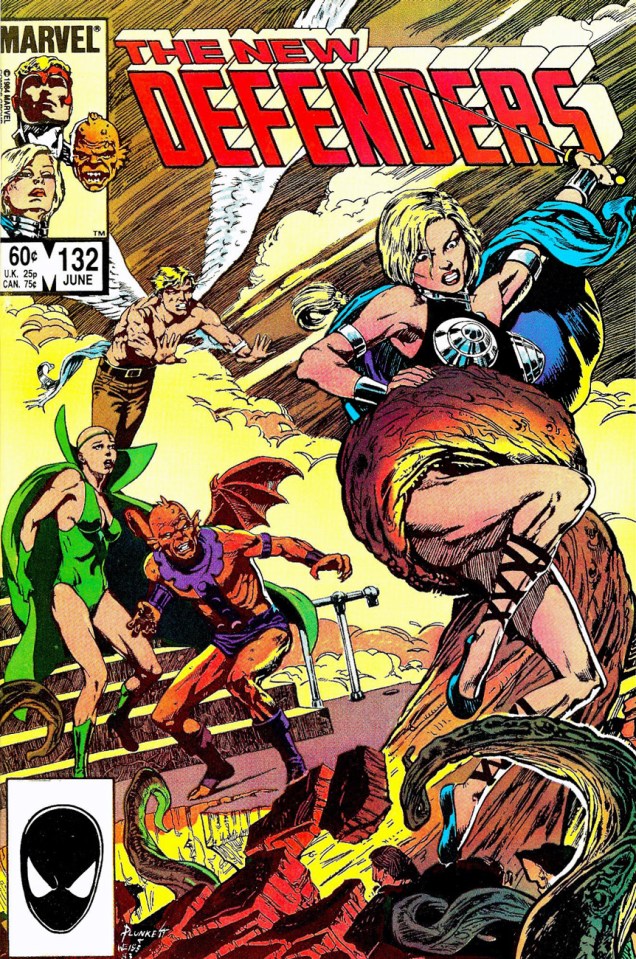
Speaking of attacking tree trunks, I do believe this qualifies:
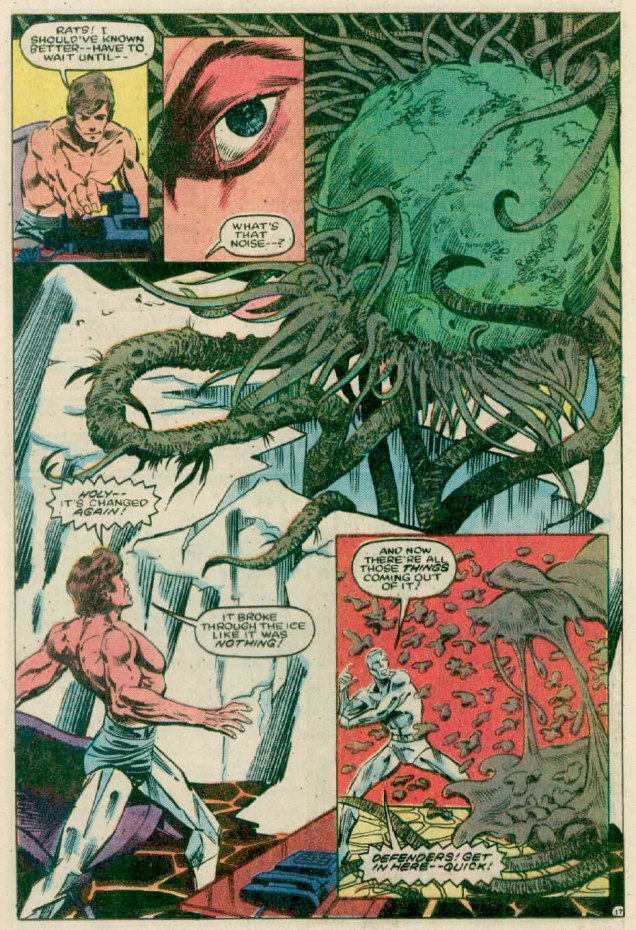
The Defenders no. 132 (June 1984). Penciled by Sandy Plunkett and inked by Alan Weiss.
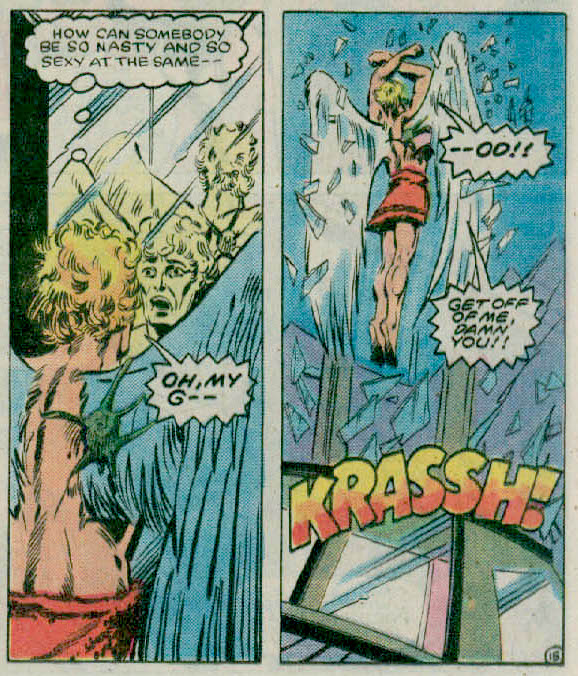
The cover story, The Phantom of Gamma-Ray Flats! (scripted by Peter B. Gillis, penciled by Don Perlin and inked by Kim DeMulder) is quite entertaining – and brimming to the gills with plant tentacles.
Not “rapey”, “ROPEY”.
The tiny remnant of the tentacle creature manages to find a hold on Warren’s back, perfectly à propos to this post… but I couldn’t resist including the other panel revealing his thoughts about his sexy colleague. Warren is Warren Worthington III, aka The Angel, a founding member of the X-Men.
The Savage Sword of Conan no. 42 (July 1979). Cover by Bob Larkin.The Devil-Tree of Gamburu is scripted by Roy Thomas, penciled by John Buscema and inked by Tony DeZuniga.
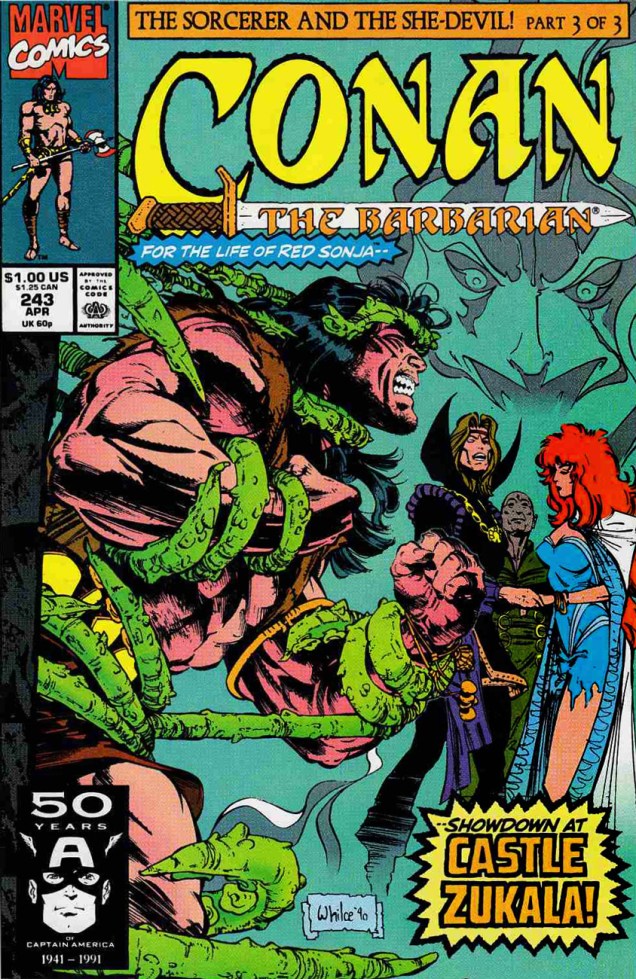
And another Conan cover for the flora hall of tentacles:
Conan the Barbarian no. 243 (April 1991). Cover by Filipino artist Whilce Portacio.
« I say let the world go to hell, but I should always have my tea. » — Fyodor Dostoyevsky
A colleague at work labelled me a “tea whore” the other day. I don’t think that’s an official expression (though apparently one can purchase tea mugs with this message), but I’ll take that as a badge of honour. And therein lies my similarity to my beloved octopods: they never say no to a nice cup of tea, either. Evidence, you may ask? I’ve a-plenty of it. Pour yourself a steaming cup of oolong and join me!
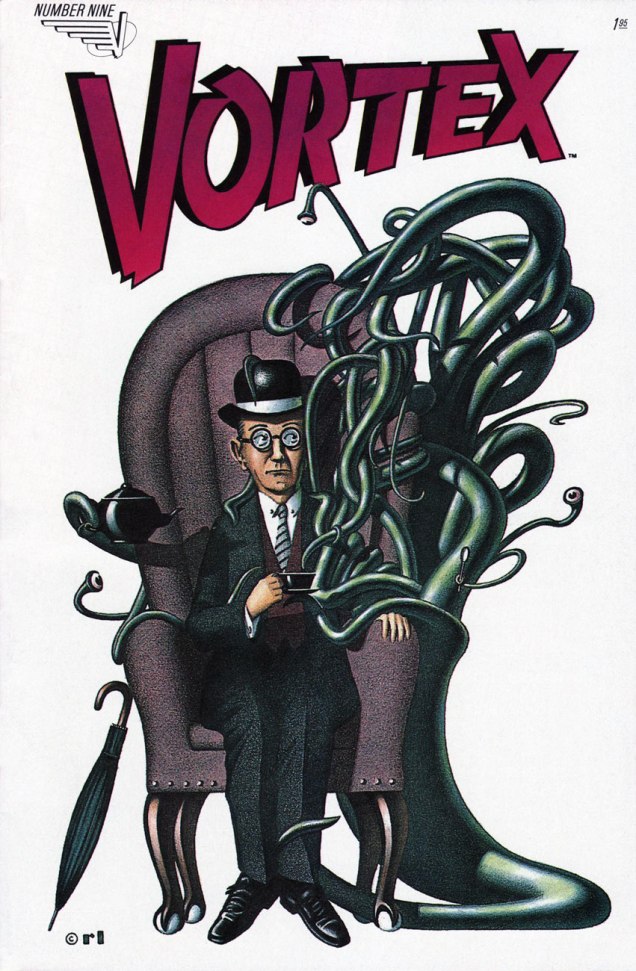
Donald Duck no. 200 (October 1978), cover by Larry Mayer. Incidentally, he has already been part of a Tentacle Tuesday.Surprise: this quintessentially British scene (an umbrella, a cup of tea and a suitably meek accountant) is brought to you by a Canadian comic! This is Vortex no. 9 (May 1984), cover by Ron Lightburn. Vortex was one Canadian Vortex Comics’ titles. Some interesting stuff was published by these guys: Matt Howarth’s Those Annoying Post Bros and Savage Henry, Los Bros Hernandez’s chunk of Mister X, Ted McKeever’s Transit, Chester Brown’s Yummy Fur…
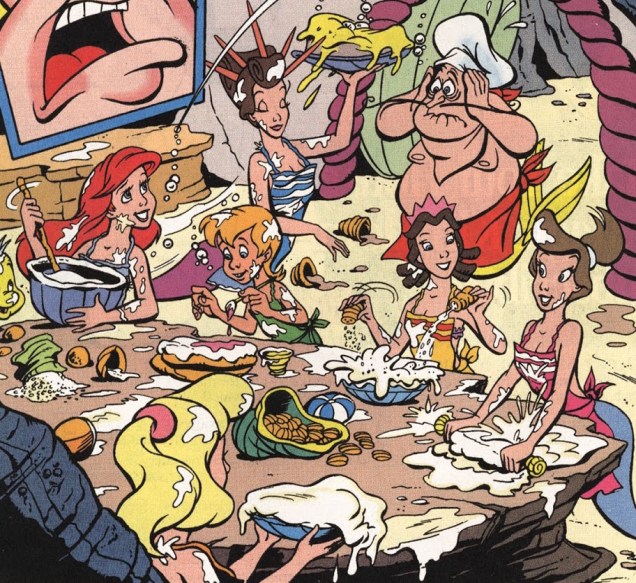
The following pages are from Disney’s The Little Mermaid no. 10 (June 1995). No, no, stick around, it’s worth it. You can read the full issue here.
So far so good, even though this begs some questions (such as “how do you pour a cup of tea underwater?”) But the following dialogue suggests that things other than tea-drinking were on the mind of *this* octopus:
You know how all this ends, don’t you? That’s right:
I tried to make this a purely innocent post, but things didn’t pan out.
Gahan Wilson is always, always good and ready for tentacles. (By the way, he is financially struggling and has dementia, which is both stupefying and depressing. I never cease to be amazed at how someone with such a wide-ranging and fruitful career can end up impoverished… His family raised enough money on GoFundMe – for now – to take care of him, but you should still visit that page for recent pictures and updates about his health.)
Cartoon by Gahan Wilson, published in Playboy’s August 2006 issue.
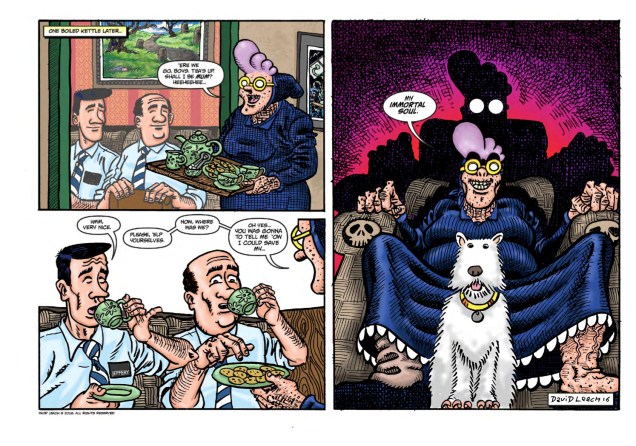
In 1986, British cartoonist David Leach unleashed Psycho Gran upon an unsuspecting world. The « five-foot high, mauve-haired, bespectacled psychotic granny with a pan-dimensional, sentient handbag called Percy, a flying dog called Archie and a pathological loathing of rudeness » first appeared in British children’s comic Oink!, where she lingered for 15 issues, pummeling purse snatchers, clobbering office workers and disciplining rampaging monsters until 1988. In 2011, she came back – her hair more purple than ever, her lust for authoritarianism unabashed – and is currently involved in a four-part mini-series.
And she’s drinking tea with Mr. Cthulhu. I’m jealous.
« We all have grannies. I think there’s something wonderfully exciting, mischievous and dangerous about them, or was that just mine? They’re old and they’re the mum of your mum, plus they spoil you rotten, but they can also tell you what to do, like your own mum does! That seemed so strange when I was a kid, the idea that they could boss not only you but also your mum or dad around. And I think we’re all a little scared of the elderly, no one likes to think that one day they’ll be old themselves, I think we resent them for showing us what we’re going to become. Psycho works because she looks frail and yet she’s super strong and batty. She’s the classic sheep in wolf’s clothing. And there’s something funny about an old granny being lethal and crazy to boot, especially since usually the elderly are portrayed as figures of fun to be mocked and laughed at. » (Look Out, Britain! Psycho Gran is Back!)
And by the way, I wasn’t exaggerating about Psycho Gran’s passion for control (and tea).
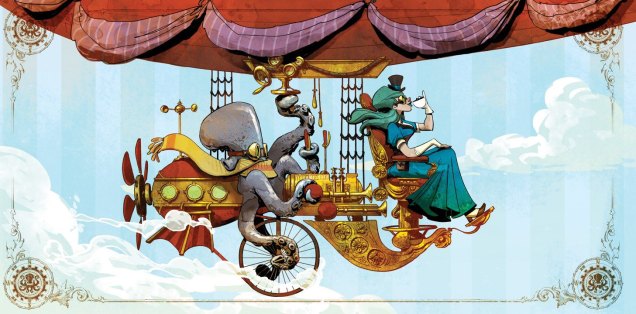
Drink tea with your octopus today… and if you don’t have an octopus, borrow one from a friend. I don’t have a dirigeable (that would be a zeppelin for younger people in the audience) , but I manage. Toodle-oo!
The cover for the 2016 calendar of Otto and Victoria, an adorable steampunk couple created by Brian Kesinger. These two were featured earlier in Tentacle Tuesday: Adopt an Octopus Today!
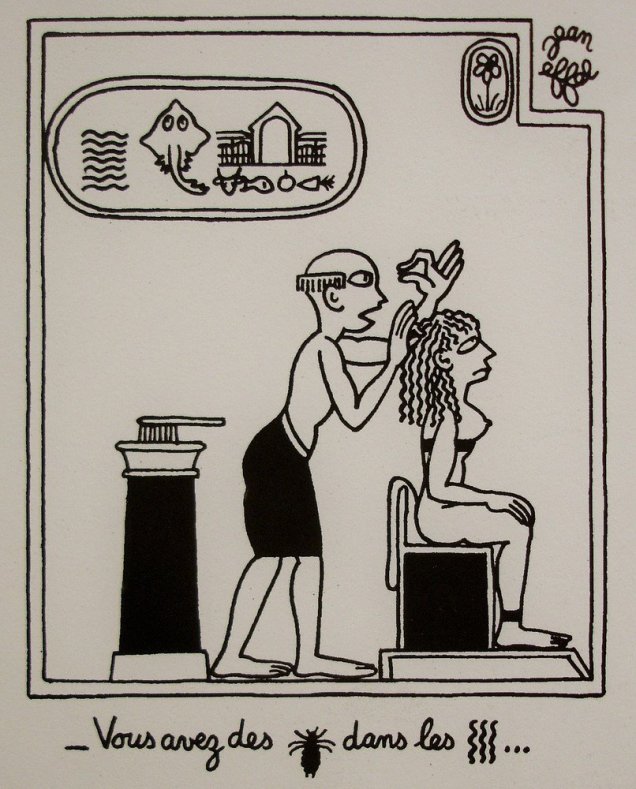
Despite his father’s insistence on a commercial career, French illustrator Jean Effel (1908-1982) pursued studies in music, art and philosophy. When his attempts to become a theatrical writer failed, he switched gears and started working as a caricaturist for newspapers in the 1930s. By the 1940s, his work was widely known and widely published, mostly in socialist/communist newspapers sponsored by the French Communist Party. After the second World War, he also branched out into book illustration (his work on Fables de la Fontaine is quite charming). Today, he’s mostly remembered (if barely) for his La création du monde (The Creation of the World).
I learned about Jean Effel (a nom de plume; François Lejeune was his true name) from a couple of books my parents had lying around when I was growing up. He was, I believe, my first exposure to cartoons, and the warm place his work holds in my heart is partly dictated by nostalgia. Only in part, however; few would deny that Effel’s animals and humans, his God, his Devil and his various angels are charming in that plump, childlike way that young animals are irresistibly cute. Some grouchy contrarians might get annoyed by that cuteness; the rest of us will enjoy his kind world. Oh, vexations and sarcasm are part of its tapestry, but nobody stays angry for long, pranks are witty but inoffensive, and problems are creatively resolved. Effel was an atheist, but his God was so kind and paternal that even priests didn’t object to their parishioners reading his work.
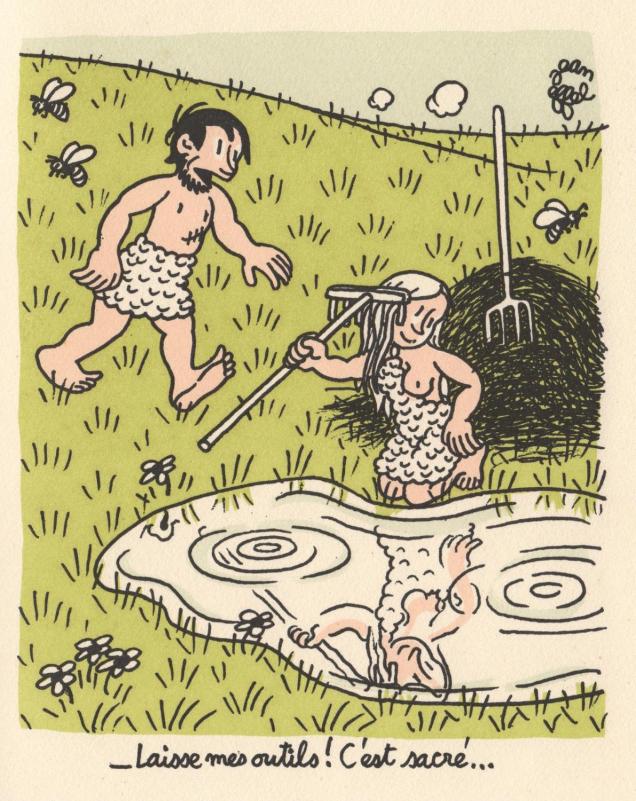
“How was it?” “Divine!” Even Effel’s handwriting/lettering is adorably rounded, childlike.“Leave my tools alone! It’s a sacred thing…” Note Adam’s scar, mute testimony to his missing rib.
To come back to my childhood, the twist in the story is that the books were in Russian: Soviet translations from French. The main collection of Jean Effel’s work was published in 1963 by the Hermitage Museum’s publishing press. The introduction calls him a « sincere friend of the Soviet Union », pointing out that Effel even learned to use Russian letters. In 1967, he was awarded the Lenin Peace Prize, which was mostly reserved for non-Soviets, foreign prominent Communists and supporters of the Soviet Union (Nelson Mandela also had one, as did Linus Pauling and Pablo Picasso).
Jean Effel’s present to the U.S.S.R.: a detailed map of France, with a hand-lettered dedication – “to my Soviet friends, with all my heart”.
It’s odd, but I can’t give you the exact date of the conception or publication of The Creation of the World: the Soviet book mentions that it was begun in 1950, English Wiki gives the date as 1945, French Wiki says 1953, Encyclopaedia Universalis (a French site) posits 1937, etc. Rather absurdly, there are a lot more detailed articles about Effel in Russian than in French, so for once I actually tend to trust the Russian side of things. It was clear that Effel genuinely liked Russians, and admired what he saw on his many visits to the U.S.S.R. I assume he only saw what he wanted to see (or what he was shown by his tour guides); still, he was clearly an idealist, a kind and gentle man by all accounts who believed in pacifism and loved animals.
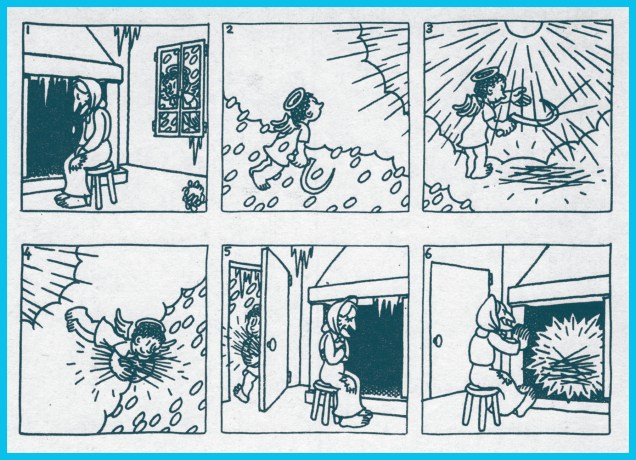
A few pages from my 1963 Soviet edition:
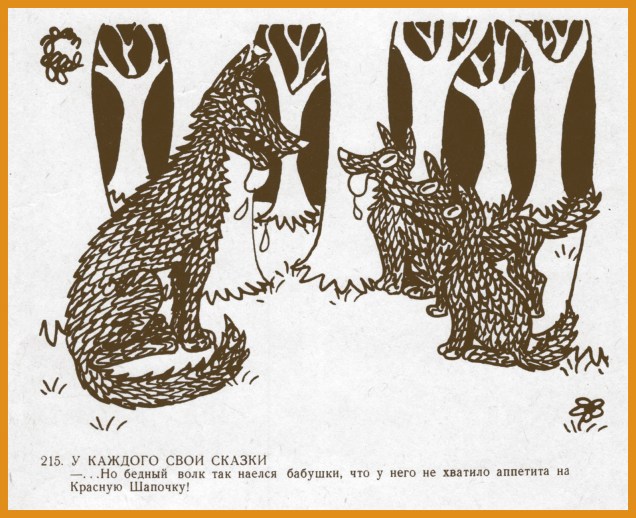
Dog meteorology: “He’s raising his paw: now water will pour down…”To each his own fairy tale: “But the poor wolf was so stuffed after eating grandmother that he had no appetite left for Red Riding Hood!”
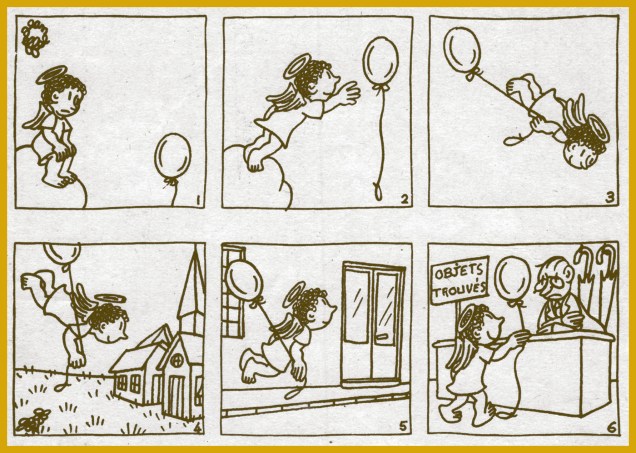
The desk caption says “found objects”.141: “He’s making projects for something…” 143: “How hilarious! If this keeps up, I’ll lose a rib from laughing too hard…” 144: “This is but a sketch. Just wait ’til you see the 3D version…”
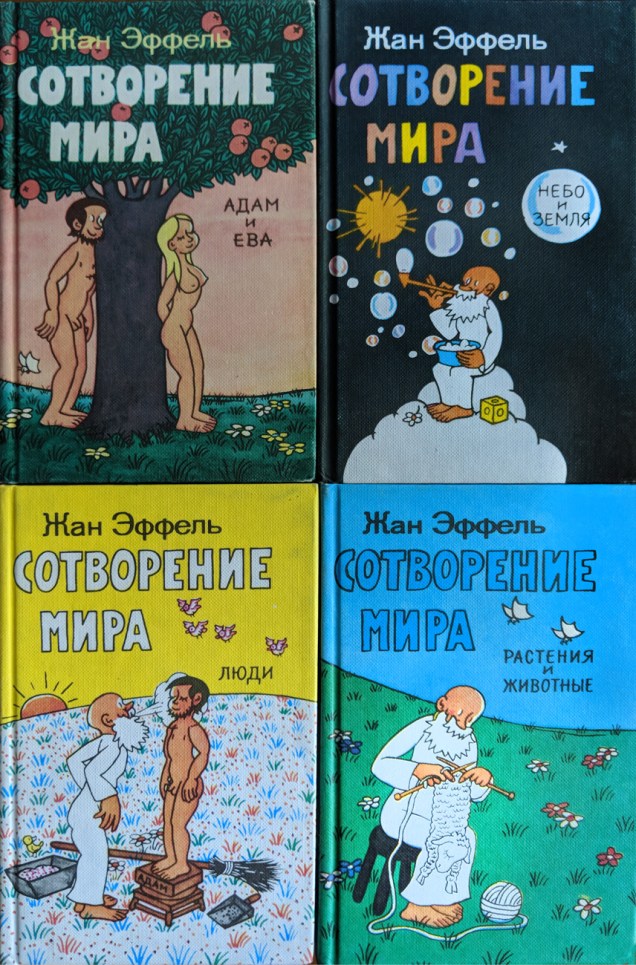
A few years ago, I found another Russian edition in some Canadian (how books travel..) second hand bookstore, a collection in four volumes:
Clockwise, left to right: Adam and Eve, Sky and Earth, Plants and Animals, and People.
The back covers are also worth a look:
Oddly, Animals and Plants is marked as costing 75 kopecks, and the other three are 80 kopecks each, though this was clearly sold as a set with a slipcase.
There can be no god without a devil! The charming Lucifer is probably my favourite character. This is a page from the Russian-Estonian edition. 173: “He likes us: he’s wagging his tail!” 174: “My name is Lucifer, but you can simply call me Lulu!” 175: “Oh, Mister Lucifer! You’re just the devil!” 176: “Perhaps I can tempt you with an apple?”The most recent edition of La création de l’homme, published in 1997.
A few other odds and ends from Effel’s multi-faceted career…
Sylvain is inviting you… to visit the PROTECTION OF NATURE exhibit at the Paris Fair.
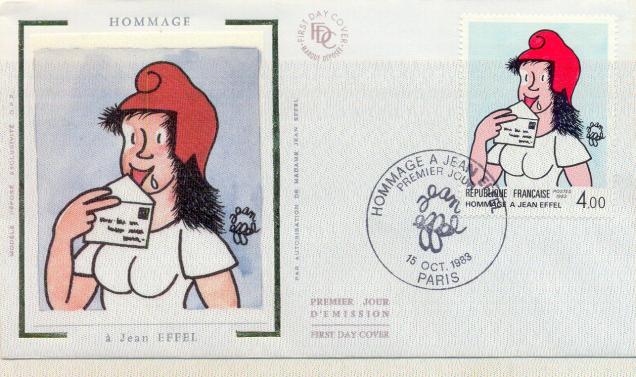
The French Postal Service issued a stamp in 1983 to celebrate Jean Effel and his sweet version of Marianne, a cheerful young woman with a red cap who symbolized the new French Republic.
« Though the refined eyes of the aesthete may consider Kirby’s work crude, ornery, and anti-intellectual, the fact remains that he combined the virtues and limitations of his class with a stubborn genius to produce a body of comics work that has remained consistently true to its source and is unparalleled both in quantity and quality. » (Gary Groth)
Strike while the iron is hot, it is said, and thus part II of our celebration of Jack Kirby‘s tentacle prowess comes hard on the heels of Tentacle Tuesday Masters: Jack Kirby, Part 1. I’d like to thank co-admin RG for his vast knowledge of Kirby comics, as well as his suggestions and scans – that’s what (among other things) partners are for. Whereas part 1 focused on Kirby’s 70’s work for DC, today’s post (also firmly entrenched in the 1970s) is a celebration of his brief but intense return to Marvel Comics.
All art is scripted and penciled by Jack Kirby and inked by Mike Royer, unless otherwise indicated.
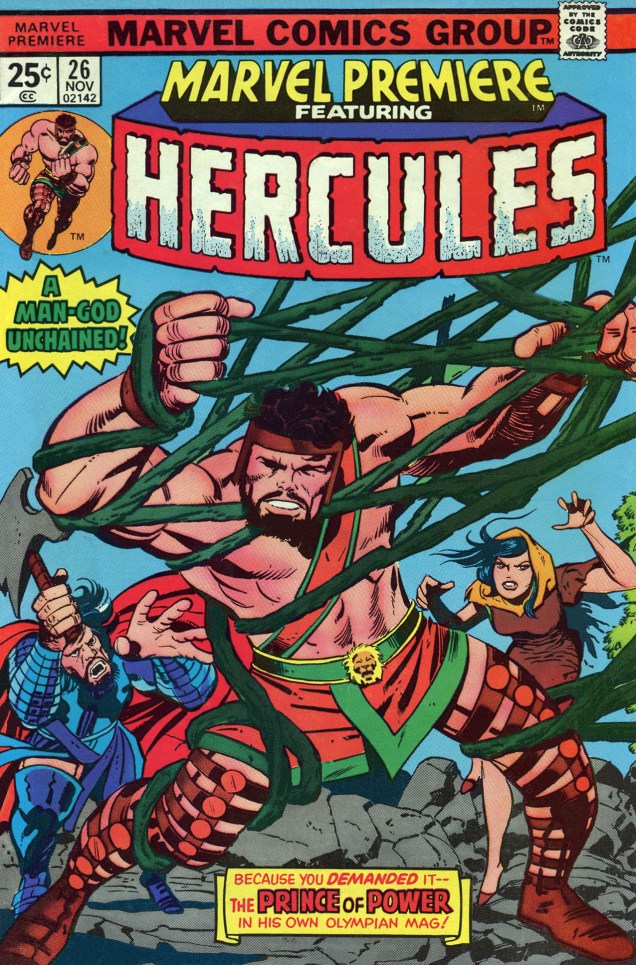
We start with the somewhat less interesting, but nevertheless tentacular, Hercules.
Marvel Premiere no. 26 (November 1975), penciled by Kirby and inked by Vince Colletta. Only the cover is by Kirby, the inside story being a collaboration between Bill Mantlo, George Tuska and Vince Colletta.
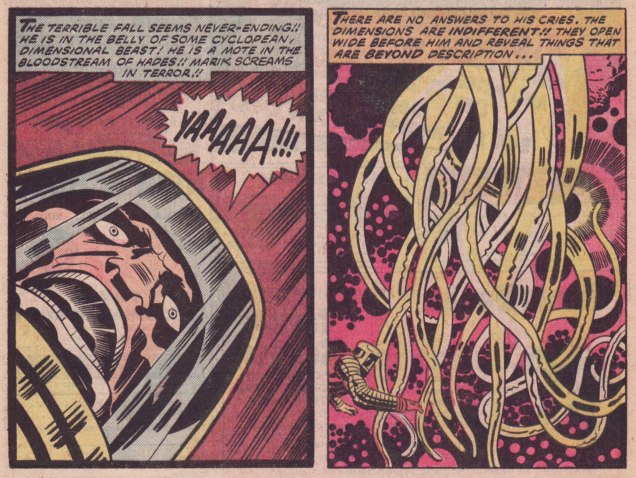
Now that we have the boring stuff over with, we move on to the spacey part of this post: epic voyages into the cosmos, mind-shattering encounters with Gods and fights to the death with unthinkable monsters of fearsome power! As usual, in chronological order: one must respect tradition.
« To make his comic, Kirby watched 2001 again, referenced a stack of stills, and pulled from the screenplay and Arthur C. Clarke’s novelization. The illustrations were instantly recognizable to anyone who’d seen the film, but the characters were uniquely his: beefy and emotive with a touch of uncanny. There are also moments of pure Kirby: a splash page of a spacesuit-clad astronaut gaping at an exploding cosmic sky, an acid-trip interpretation of the climatic Star Gate sequence. »
Pages from Beast-Killer! (read the full story on Diversions of a Groovy Kind) published in 2001, A Space Odyssey no. 1 (December 1976).Panel from Wheels of Death (again, read the story on Diversions of a Groovy Kind) published in 2001: A Space Odyssey no. 4 (March 1977). *My* question is, does anybody remember any tentacles in the film? I know, I really have a one-track mind.
« Kirby was the right choice for the assignment, but, Mark Evanier (a comic book writer, Kirby friend and colleague, and author of the biography Kirby: King of Comics) says, he was wary of taking on someone else’s story, especially one as iconic as Kubrick’s vision of 2001. “He didn’t feel he had a lot of wiggle room to expand or inject himself into it,” Evanier says. “He had to keep reminding himself, ‘That’s my viewpoint, that’s not Stanley Kubrick’s,’ and adjusting.”» (source: The Crazy Legacy of Jack Kirby’s Forgotten 2001: A Space Odyssey)
I wanted to find a good overview of The Eternals, and thought I had found it (plenty of pictures, an overall idea of the leitmotifs driving the series – and importantly, NO MENTION OF THE MOVIE)… until I came to the end of the article in question and saw that the author was next going to read Neil Gaiman‘s take on The Eternals* to see if the latter had fixed some of Kirby’s plot flaws, at which point I choked on the water I was sipping. But, but! the author repented, and so I give you Review: The Eternals by Jack Kirby from the blog Giant Size Marvel.
Panels from God and Men at City College published in The Eternals no. 6 (December 1976).Panel from Disaster Area, published in The Eternals no. 15 (September 1977).The Eternals no. 18 (December 1977), penciled by Jack Kirby and inked by Frank Giacoia.Panels from To Kill a Space God, published in The Eternals no. 18 (December 1977).Panels from To Kill a Space God, published in The Eternals no. 18 (December 1977).
Surely everyone knows Captain America already, but here are his 7 Most Awesome Moments (arguable, but a good starting point) by the good folks at Comic Alliance.
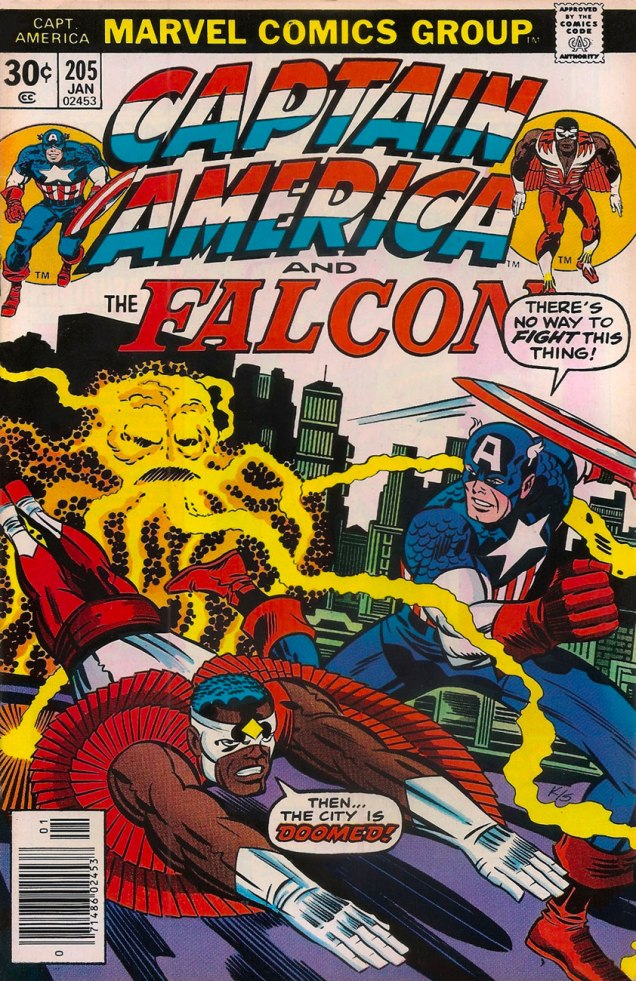
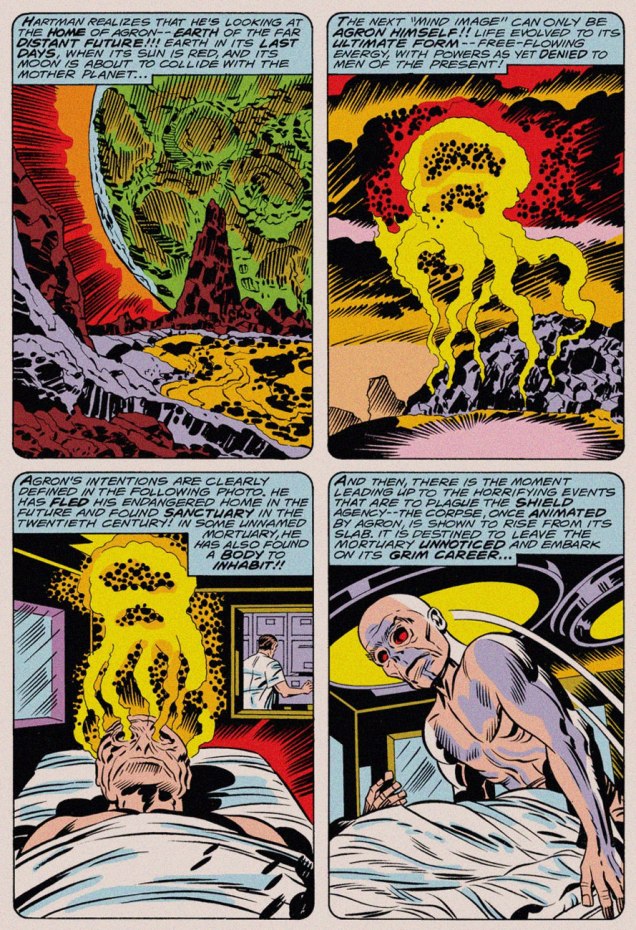
Here we have energetic tentacles, free-flowing-energy cephalopods…
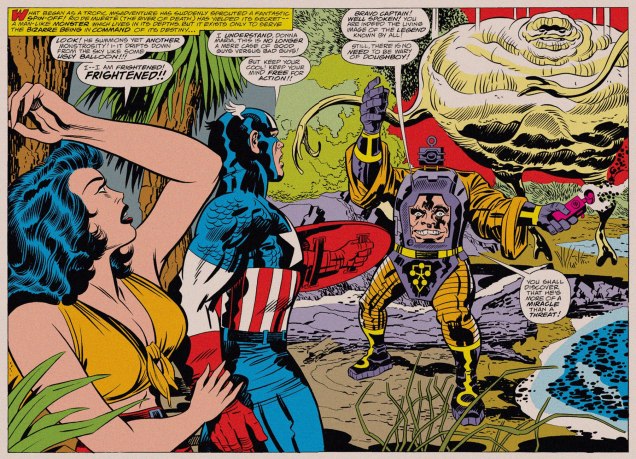
Captain America no. 205 (January 1977), penciled by Jack Kirby and inked by Joe Sinnott. The thing with the tentacles is Agron, who (which?) will eventually learn to animate a corpse, but for now he’s just in his energy form.Page from Agron Walks the Earth!, scripted and penciled by Jack Kirby and inked by John Verpoorten, published in Captain America no. 205 (January 1977). I *told* you Agron would animate a corpse, but did you listen?Double splash from Arnim Zola — The Bio-Fanatic!!, scripted and penciled by Kirby and inked by Frank Giacoia and John Verpoorten, published in Captain America no. 209 (May 1977).
You asked for it (right?): Doughboy in action! Technically, those are rubbery arms, not tentacles, but as someone who regularly makes sourdough bread, I assure you, dough *does* sprout tentacles and will latch onto your hands and arms with them.
Page from Arnim Zola — The Bio-Fanatic!!, scripted and penciled by Kirby and inked by Frank Giacoia and John Verpoorten, published in Captain America no. 209 (May 1977).Captain America no. 210 (June 1977), penciled by Kirby and inked by John Verpoorten. The Red Skull taking a leaf out of Medusa’s book? Seriously, those have *got* to be hair extensions.
I also recommend reading Learning to Love Jack Kirby, an earnest and personal story of how the author (Chris Sims) came to appreciate Kirby and, at the same time, a pretty good overview of some of his most memorable characters and comics.
« I’m tempted to say that you don’t really get Kirby until you develop the ability to look beyond the surface of a story and see how much craftsmanship it takes to look as simple as his comics, but that’s really just covering up my own initial revulsion. There were plenty of kids who encountered Kirby at the same age I did and wound up loving him from the start; I’m just a slow learner.But I do think there’s something to the idea that it just has to hit you right for everything to make sense, and once you’re there, you’re there forever. And the good news is that Kirby’s contributions to the medium are so vast, so unavoidable even a quarter-century after his death, that even just scratching the surface of superhero comics means you’re encountering them all the time. »
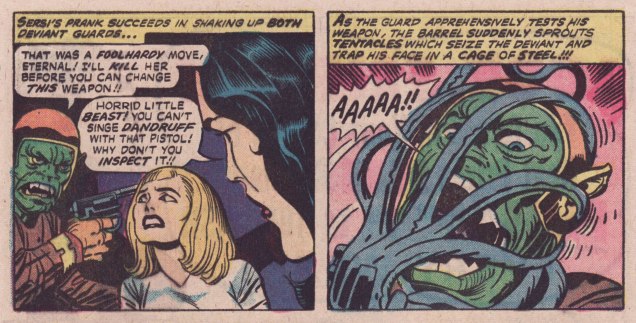
Now that we have part over with, shall we continue to the tentacular part of today’s post? Kirby didn’t do anything in half-measures, so I’d like to think that we have some epic, larger-than-life, cosmic tentacles on offer. As it turns out, there’s quite a lot of ’em scattered throughout Kirby’s mind-boggling career, so today I am concentrating on Kirby’s work for DC Comics in the 1970s.
Seriously, there’s all kinds in here. A sea ball of yarn is our exhibit A.
Sequence from O’Ryan Gang and the Deep Six, scripted and penciled by Jack Kirby, inked by Vince Colletta, and published in The New Gods no. 4 (August-September 1971).
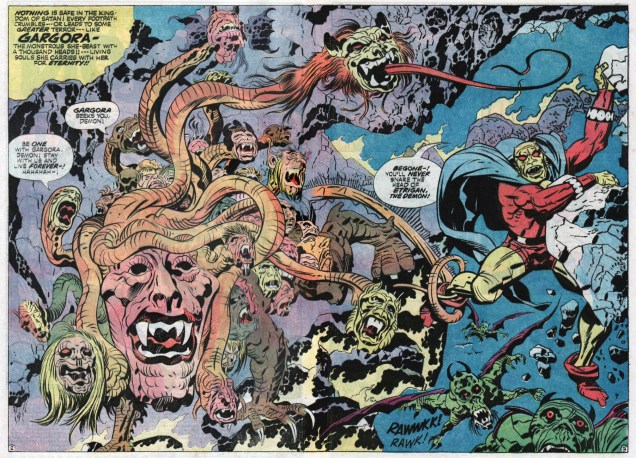
This may be a take on the old head-of-Medusa, but Gargora doesn’t mince words, and when she says someone can’t escape, well, she’ll deploy some tentacles to catch them:
Splash from Witchboy, scripted and penciled by Kirby, and inked by Mike Royer, and published in The Demon no. 14 (November 1973). Random fact of the day: Freud considered that the hair on Medusa’s head is often represented in form of snakes, because as snakes are penis symbols derived from the pubic hair, they serve to mitigate the horror of the female castration complex. …When someone tells me that are into Freudian theories, I back away slowly.
Some monsters crush you between their limbs – this is no different, but instead of two legs, there’s a “crushing mass of tentacles”. Don’t feel bad, Etrigan, no-one could break free of *that*.
Page from The One Who Vanished!!, scripted and penciled by Jack Kirby, and inked by William Stout and Mike Royer (don’t miss co-admin RG’s 3-part, exclusive interview with Mr. Royer!), published in The Demon no. 15 (December 1973).
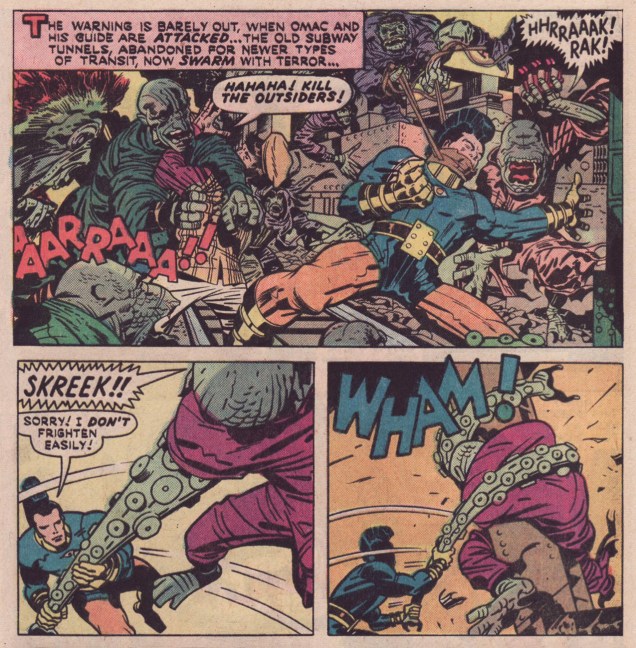
You might argue that these aren’t tentacles at all, but the creature is described as a “flying octopus”, and who am I to argue with Kirby’s description?
Page from The Busting of a Conqueror!, scripted and penciled by Jack Kirby, and inked by D. Bruce Berry, published in OMAC no. 4 (March-April 1975).Page from The Spy, scripted and penciled by Jack Kirby, and inked by D. Bruce Berry, published in OMAC no. 6 (July-August 1975).
One must have one proper sea monster in a Tentacle Tuesday, and this one’s a beauty:
Page from The Invasion of the Frog Men!, scripted by Michael Fleisher, penciled by Jack Kirby, inked by Mike Royer and published in The Sandman no. 5 (October-November 1975).
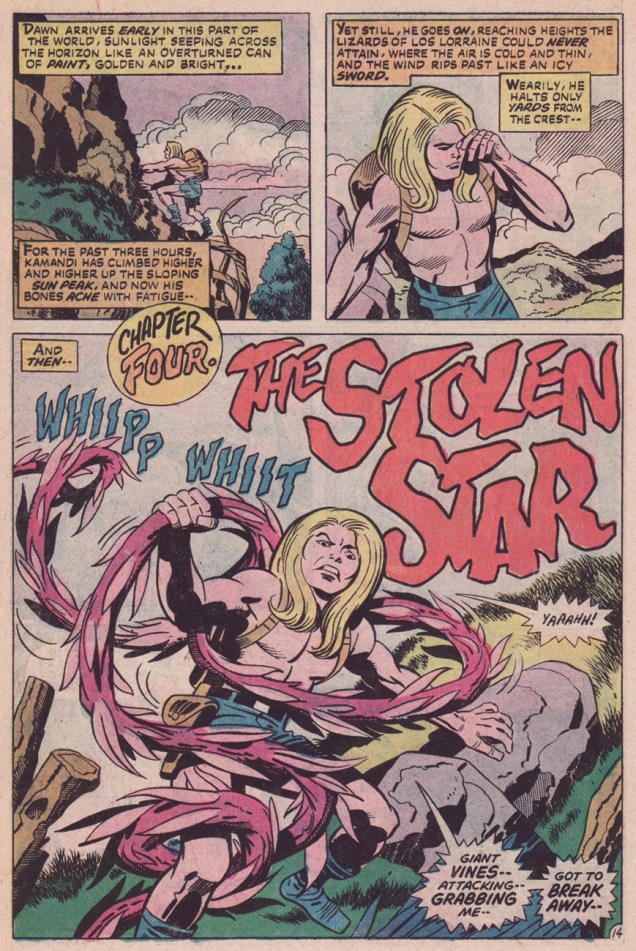
Last but not least, plant tentacles!
Page from The Lizard Lords of Los Lorraine!, scripted by Gerry Conway and Paul Levitz, pencilled by Jack Kirby, and inked by Mike Royer, published in Kamandi, The Last Boy on Earth no. 40 (April 1976). Kamandi was my first exposure to Kirby, and it bowled me over. It’s a good illustration of what he can do (and did over and over again), actually: create a universe with its own rules and a perfect internal logic. There are no boundaries in such a place, no limited number of characters – it just lives and breathes as it pleases, and one is but a passerby who gets to witness a few key scenes. Reading Kamandi teleported me into his world with such ruthlessness that I was quite disoriented when I’d have to stop reading.
« His incredibly unique art style and bombastic storytelling made him one of the most imitated creators in western comics history. Kirby Dots are named after the artist’s distinctive rendering of Battle Auras, also nicknamed, “the Kirby Krackle”. He died of heart failure in 1994 at the age of 76, or at least that’s what Galactus wants us to believe. Due to his speed in creating well-received comics, there exists something called the “Kirby Barrier”; breaking the barrier means that you’ve created a quality comic in under a week, a surprisingly difficult feat. » |source|
I think it safe to surmise that pretty much everyone is familiar with the light-coloured, pleasantly plump creatures collectively referred to as the Moomins. Even if you’ve never heard of Tove Marika Jansson, their creator, you’ve surely glimpsed a Moomintroll mug, a Snork Maiden tote, or a Little My t-shirt.
Tove Jansson (1914-2001) was a multi-faceted soul: comic strip artist, of course, but also novelist, painter and illustrator (one might argue that these all are related: point taken). She published her first Moomin book in 1945 (The Moomins and the Great Flood) to (eventual) great success; the eight books that followed were equally popular. All have been translated into forty-four languages. The Moomin comic strip, first designed for publication in the children’s section of Swedish newspaper Ny Tid, ran from 1947 to 1975, and was syndicated in 120 countries. (Here’s a detailed timeline of Moomins’ creation and development.) To Anglophone audiences, the strip is known thanks to The London Evening News, which picked it up in 1954.
The commercialization of the Moomin family, the ubiquity of Moomin merchandise overshadow the rest of Jansson’s career – but also cheapen the darling Moomins. (I should talk; I have two favourite Moomin mugs from which I drink kefir.) As with the best writing for children, Moomin stories are fun and easy to follow on the surface – but beneath that cheerful and cute exterior, complex themes are tackled, moral dilemmas remain unresolved, and the world is a confusing, unfair place.
Montréal’s Drawn and Quarterly is currently « reworking classic Moomin stories in full colour, with a kid-proof but kid-friendly size, price, and format » (to quote from their website) for their Enfant collection. « Enfant » means « child », but I think any adult with a sense of humour and just a pinch of childlike innocence will enjoy these stories. Drawn and Quarterly have heretofore published collections of London Evening News strips in black and white; and though the art is beautiful, I really like the way the strips came out in colour.
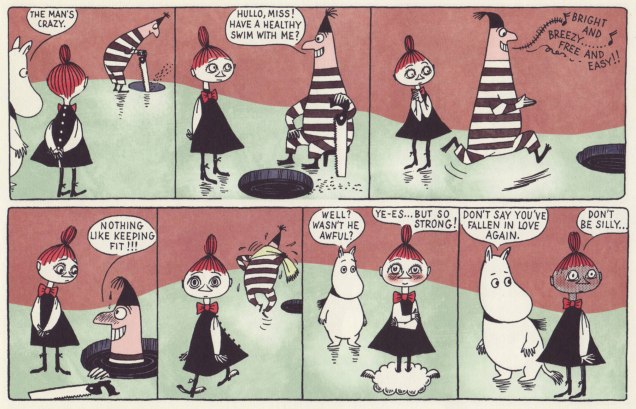
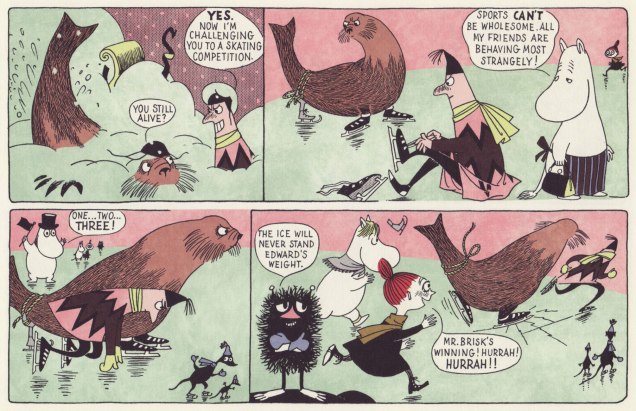
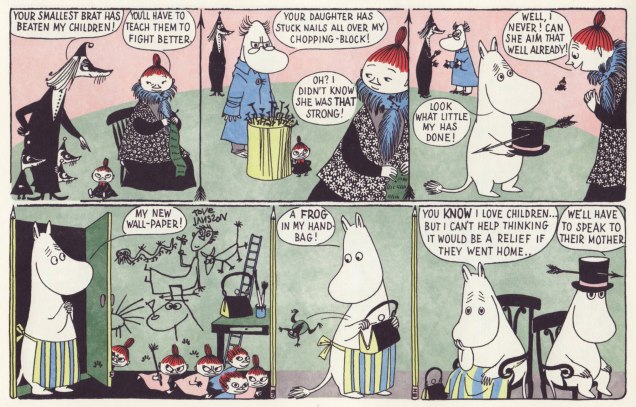
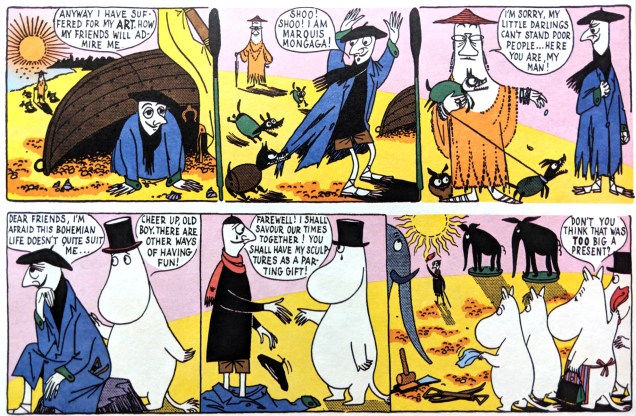
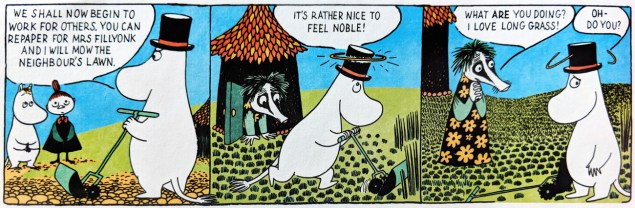
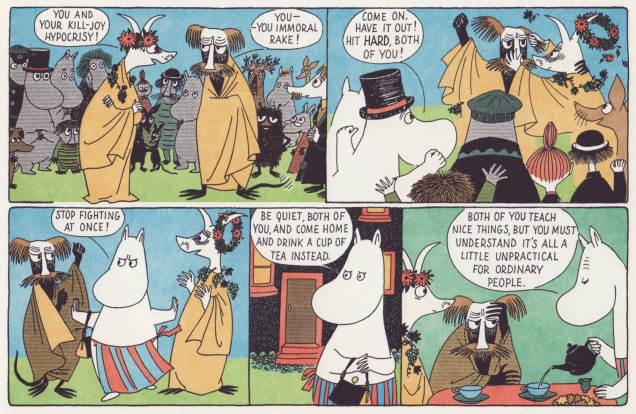
As little of this stuff is findable online, I’ve selected a few (well, quite a few) favourite pages to whet your appetite – a selection of goofy characters, hard life lessons and good old madcap fun.
Pages from Moomin’s Winter Follies
Moomin Builds a House. Little My makes her first appearance in this story. Some parenting advice from Elder Mymble, the mother of this red-haired hoarde: « I don’t like to keep scolding them. I just… pour some water over them. …Or lemonade. »
« Born in 1914, at the onset of World War I, Tove’s childhood and early adulthood took place in a time of intense political upheaval. Artists themselves, her parents were a part of the Swedish-speaking minority in Finland and in those first few years, when the world was at war, Tove and her mother stayed in Stockholm while her father remained in Finland, going on to fight in the Finnish civil war in 1918. That experience, some literary analysts say, is reflected in the missing Moominpappa, who appears only as an allusion in the first chapters of the first book. » (How Tove Jansson’s Moomins conquered readers’ hearts)
« As springtime dawns in Moominvalley and the first northern crocus opens, Moominpappa and Snorkmaiden, glamorized by the prospects of movie stars and gambling, insist the whole family take a trip down to the Riviera. Reluctantly Moomin and Moominmamma agree to go along, and the Moomins set off on a grand adventure, complete with butlers, luxury shops, indoor swimming pools, and duels at dawn. » Pages from Moomin on the Riviera.
« Following art school and travels abroad, Jansson drew cartoons for different outlets, including, for fifteen years, the satirical political paper Garm. (“Do as you like,” the editor told her. “Just make sure you hit them in the mouth.”) This is where the Moomins first surfaced publicly. Originally meaner-looking and troll-like creatures called Snorks, they began mostly as marginalia, a kind of signature, and might even be found loitering in a cartoon about the German Army’s evacuation of Lapland. » (The Hands That Made the Moomins)
Page from Moomin and the Sea.Misabel the maid is, as her name suggests, miserable. Afraid of any kind of non-conformist behaviour, scared of enjoying anything, she is anathema to Moomins’ approach to life. Pages from Moominmamma’s Maid.
« Tove’s entire life was filled with bold decisions: selling satirical cartoons mocking Hitler; opposing war; choosing not to marry or have children; and turning down Walt Disney’s offer to buy the Moomin brand. She was the writer, illustrator, designer and controlled the business side of her creation, not trusting anyone else to do it justice. » (Tove Jansson’s Feminist Legacy)
This sequence with a somewhat indignant cow is one of my favourite moments. Pages from Moomin and the Martians.
« In like spirit, Moomin hospitality excludes no one—except those prone to electrify the furniture or freeze Moominmamma’s roses. Guests include shrewish Fillyjonks addicted to cleaning; large graceless Hemulens obsessed with classifying and organising; and a philosophical Muskrat who believes only in the pointlessness of everything. » (Tove Jansson, Queen of the Moomins)
« When a charismatic prophet comes to town, the residents of Moominvalley are easily convinced to follow his doctrine for true happiness. Intrigued by their friends and neighbors’ lifestyle changes, the impressionable Moomins find themselves attempting to adopt the teachings of their new spiritual leader. But the freer they get, the more miserable they feel. Moominvalley’s state of divine chaos is further complicated by the prophet’s well-intentioned decree to free all of the jail’s inmates. » Moomin Begins a New Life.
« Over time, Jansson came to feel exhausted by the Moomins and that their success had obscured her other ambitions as an artist. In 1978, she satirized her situation in a short story titled “The Cartoonist” about a man called Stein contracted to produce a daily strip, Blubby, which has generated a Moomin-like universe of commercial paraphernalia—“Blubby curtains, Blubby jelly, Blubby clocks and Blubby socks, Blubby shirts and Blubby shorts.” “Tell me something,” another cartoonist asks Stein. “Are you one of those people who are prevented from doing Great Art because they draw comic strips?” Stein denies it, but that was precisely Jansson’s fear. » (Tove Jansson: Beyond the Moomins)
« Moomin’s pushy relations have come to stay, and in the process of getting them out, he unwittingly embarks on a quest for fame and fortune with his sly friend Sniff. But it’s much harder to get rich than either of them expects, whether it’s through selling rare creatures to the zoo, using a fortune-teller to find treasures, or making modern art. » Moomin and the Brigands.
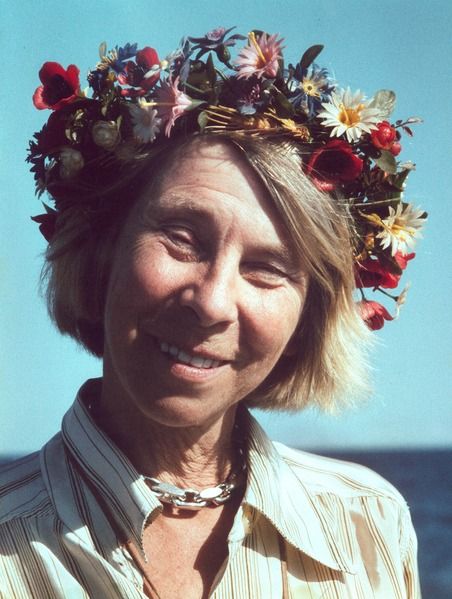
The only (other) thing I’ll add is that Tove Jansson was a lesbian, which tends to get glossed over by (bad) biographies of her. You can read an excellent essay about Jansson and her lifelong partner Tuulikki Pietilä here.
Tove Jansson photographed by her brother Per Olov.Jansson and Pietilä. Sweet!
« Tentacles lashing wildly with pain… the squirming squid releases a sudden gush of inky-black liquid… »
Just look at that… yet another Tentacle Tuesday has come crawling (unless it prefers to travel by jet propulsion) out! Today our handy time machine brings us, once again, to the Golden Age of comics (1930s to 1956), when war was very much on people’s minds, and tentacles were very much part of every decent comic artist’s repertoire.
More Fun Comics no. 83 (September 1942). Cover by George Papp, co-creator of Green Arrow and Congo Bill (with, respectively, Mort Weisinger and Whitney Ellsworth), and one of the main artists on DC’s Superboy feature between 1958 and 1968.Panels from « The Five Arrows », scripted by Joseph Greene and drawn by George Papp.
During WWII, it was not unusual to find the Axis powers represented by an octopus in caricatures and political cartoons. As a matter of fact, as The Octopus, a Motif of Evil in Historical Propaganda Maps argues, the octopus, scrawled onto all manners of maps by caricaturists, has represented the spread of evil since the 19th century. I highly recommend at least glancing through the aforementioned essay – aside from being fascinating from a historical perspective, it also has tentacles galore. Anyway, the following comic eschews any subtlety and depicts Hitler himself as the Octopus of Evil:
Blue Circle Comics no. 3 (September 1944), cover by Harold DeLay. That’s Maureen Marine bomb-diving into Hitler’s sorry ass. She has an interesting backstory, actually: a captain’s daughter who drowned when her dad’s ship was sunk by a Nazi U-boat, she was revived by Neptune (he must have liked her blonde hair) and became Queen of Atlantis, protector of the ocean, especially against despised Nazis.
There’s a great essay about Blue Circle Comics on Four Color Glasses. To quote, « Enwil’s “flagship” title was called Blue Circle Comics. It was a fairly common for publishers to use a color in conjunction with a shape or symbol for their comic book titles: Blue Circle, Red Circle, Red Band, Red Seal, Blue Ribbon, and Gold Medal were all titles from the Golden Age. In the case of Blue Circle Comics, though, the title did actually feature a character called the Blue Circle. » Read it here!
A recurring theme of octopus adventures is that there’s some treasure involved. I bet the lady would prefer to stay with the octopus troupe and their tender nuzzles than to be rescued by this odd assortment of cut-throats in sailor costumes… The chick en question is Harvey Comics’ Black Cat.
Speed Comics no. 40 (November 1945), cover by Rudy Palais.
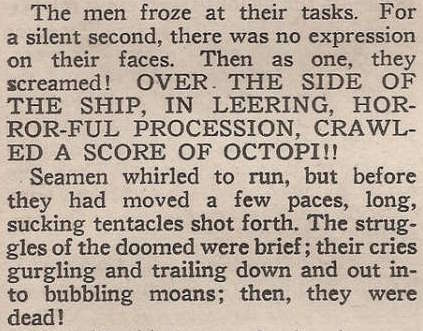
The title story turned out to be nothing but text… Though for readers with a decent imagination, a “score of octopi” and “bubbling moans” is definitely more than enough.
I bet you’re wondering how all this ends. Well, « Still, the octopi flopped forward!! CAPTAIN FREEDOM yanked the controls and the ship’s whirling airscrews roared into the octopi, sharp blades ripping tentacles from their bodies with murderous force! » Goodbye, trained octopi (which is not even the correct pluralization of an octopus).
Strange Worlds no. 2 (April 1951). Cover by Gene Fawcette.
« They were like octopuses — they scurred along on huge rubbery tentacles, and their bodies were nothing but huge heads in the midsts of these. Monstrous squawking beings coming at us from all directions! » Lovely writing, isn’t it? Nevermind that “scurred” is not an actual word. The title tale is actually an illustrated text story titled « Octopus-Kings of the Lost Planet », scripted by W. Malcolm White. Well, “scripted” is a bit strong.
« We decided that these descendants of a mighty but inhuman race had gone backwards in the course of the lost centuries. There were the Octopus-Kings of a Lost Planet — they had been rulers — but their own folly had lost them even the dignity of a solid body! »
Airboy, a.k.a. David Nelson, has been in some truly bizarre scraps in his time, so a fight to the death with tentacled monsters who want (as usual) to take over Earth is strictly routine. Created by writer Charles Biro and artist Al Camy, Airboy not only used his expertise in aviation to fight off Nazis, but also all manner of fantastical monsters. A quick look through the covers of Airboy Comics will reveal crazy scientist machinery, rabid tigers, gladiator fights, giant amœbas, pterodactyls, minotaurs, insect-shaped aliens, an invasion of man-eating rats, and so on. Pure entertainment! Airboy’s most memorable (and prettiest, by far) foe (and love interest) is Teutonic aviatrix Valkyrie, who eventually defected to the Allies’ side. She barely seems like a Golden Age creation – with her blouse splitting until her navel and her skin-tights pants, her costume leaves little to the imagination.
She was sexualized further in later incarnations – Dave Stevens’ version of her for Eclipse Comics is probably the hottest – but the Golden Age Valkyrie is more charming and earnest (IMHO), devoid of the nymphomaniacal arrogance appended to her personality in later years. Anyway, back to the topic:
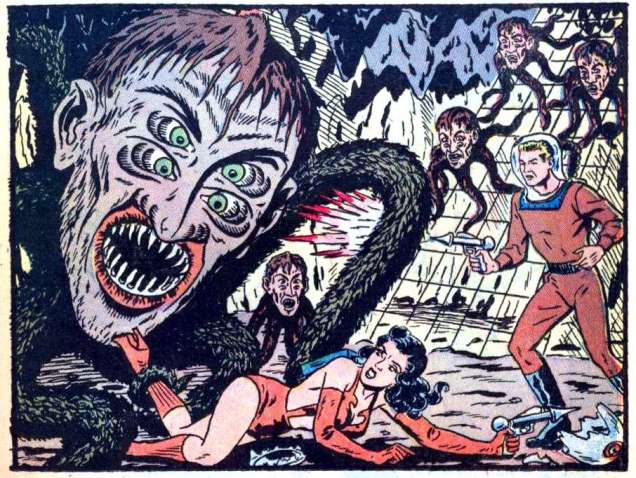
Airboy Comics no. 102 (August 1952). The octopus seems to be wearing glasses. « Excuse me, Sir, have you seen my book? »The title story, modestly titled « Invasion of the Tentacles » (no beating around the bush!), is drawn by Ernest Schroeder.
Weird Fantasy no. 21 (September-October 1953). Cover by Al Williamson and Frank Frazetta. The fur-trimmed boots are a nice touch!
The title story, « My Home… », scripted by Al Feldstein and drawn by Joe Orlando, is emotionally manipulative… and succeeds very well in breaking the readers’ hearts (or pissing them off, depending on your temperament). Read a synopsis of the plot, if you wish, or read the whole story here – who am I to give spoilers to those who don’t want ’em?
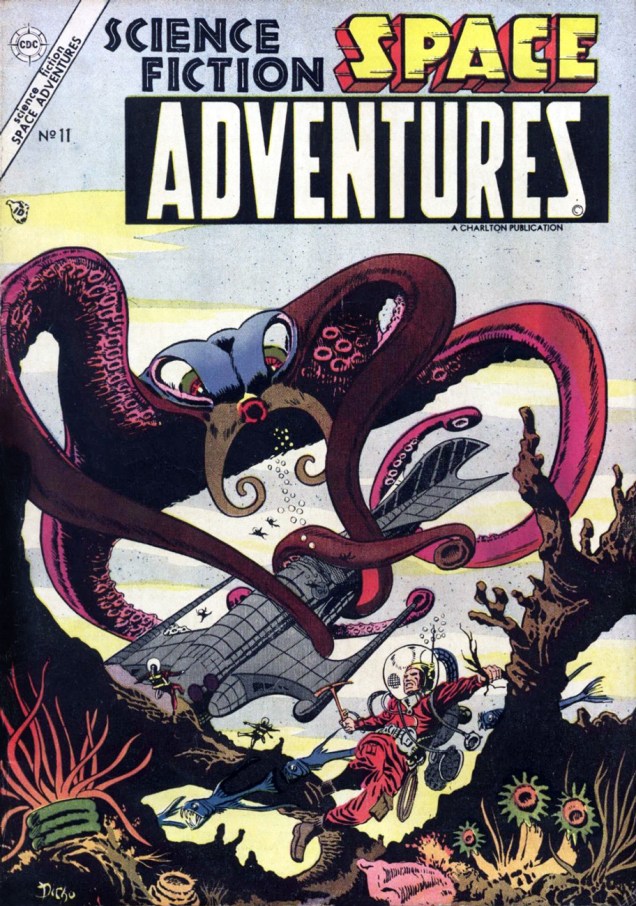
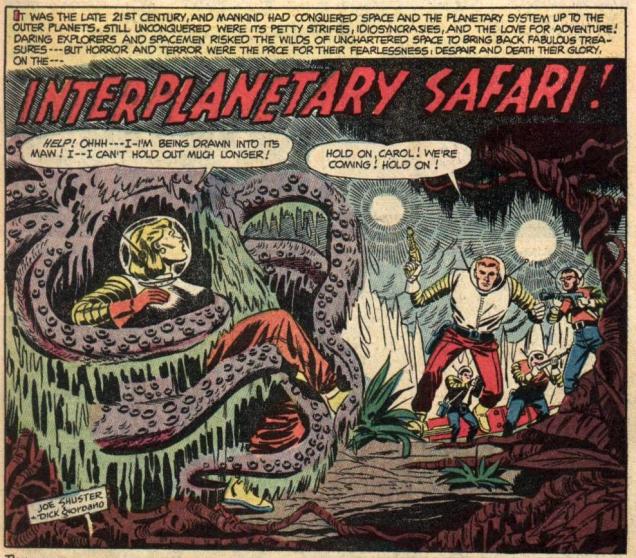
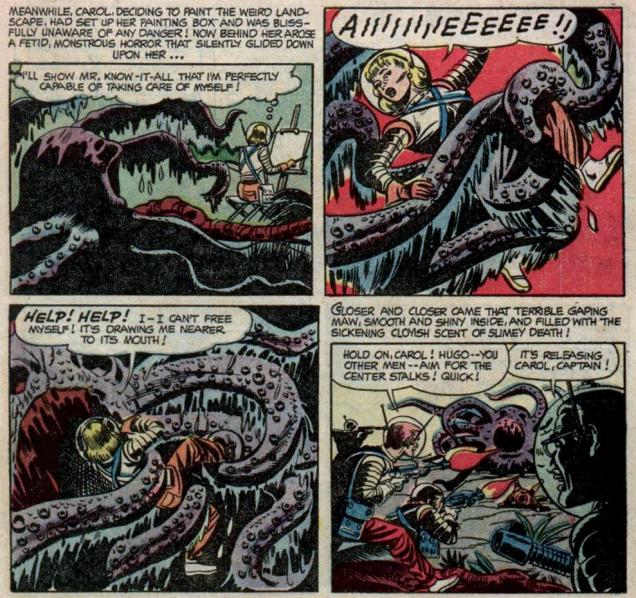
Space Adventures no. 11 (May-June 1954), cover by Steve Ditko.Ron Adams, explorer extraordinaire and famous hunter, goes to planet Xarto to capture a giant carnivorous plant (but if you called it an octopus, nobody would bat an eye). Panels from « Interplanetary Safari! », penciled by Bill Molno and inked Dick Giordano.
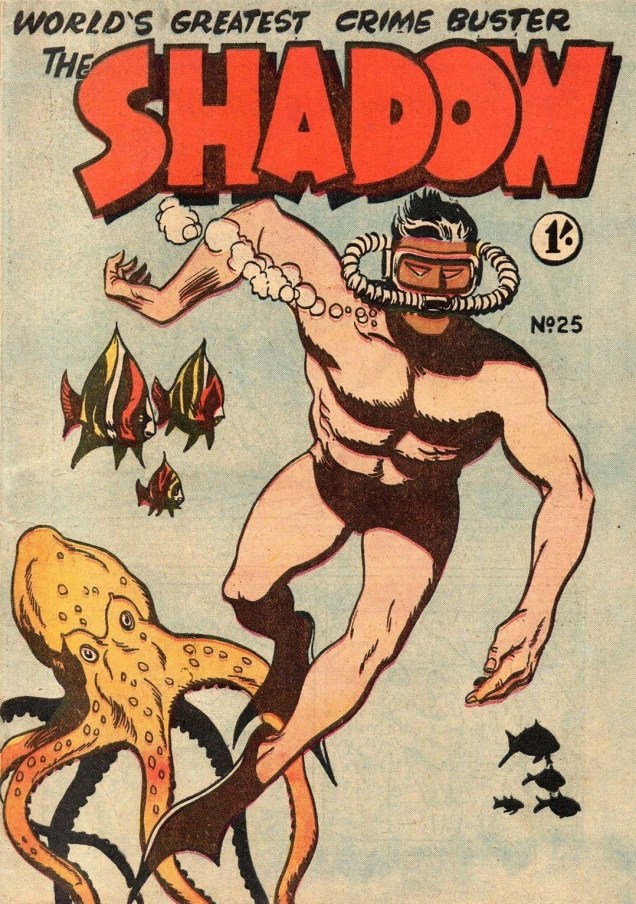
The Shadow no. 25 (September 1956), the child of Australian comic book publisher Frew Publications. The Australian Shadow has nothing to do with « Who knows what evil lurks in the hearts of men? »– this is just a guy who puts on a mask… and takes off his pants. The octopus seems astonished at the sight of bare man-flesh (if there are Speedos there, they’re well camouflaged).
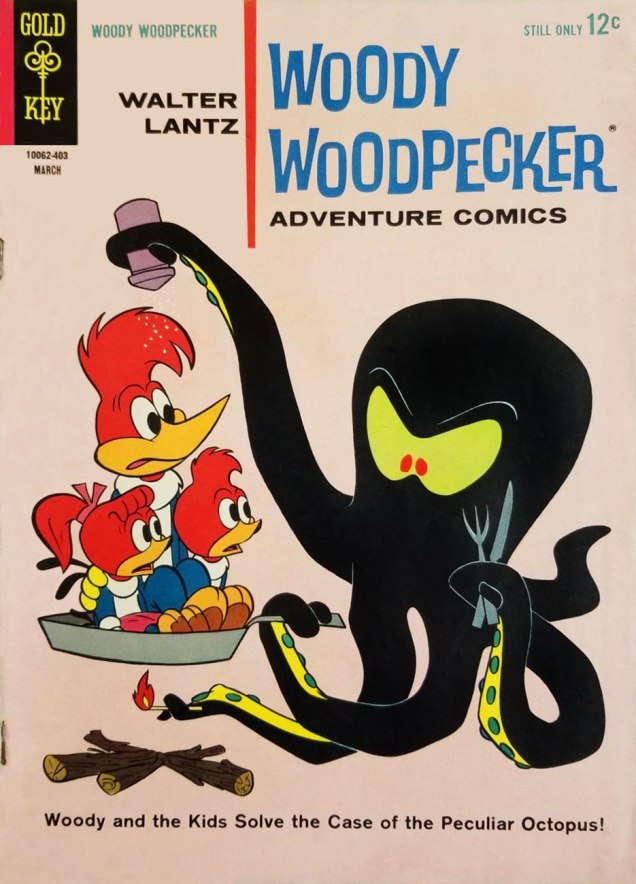
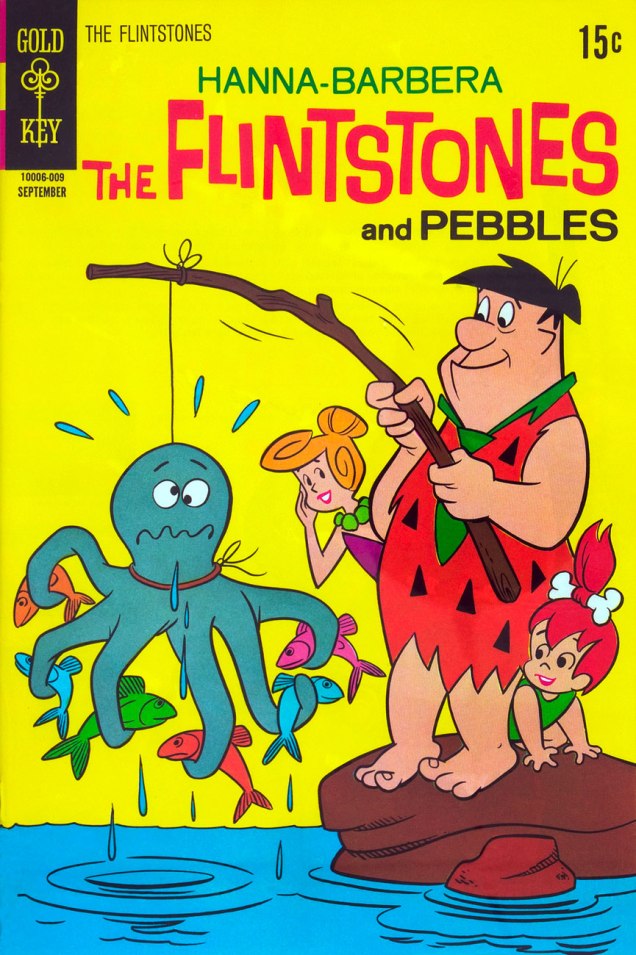
I’m on mini-vacation, away from all the big city violence, car noise and light pollution. One can actually see the stars out here! In honour of this mellow state of being, this Tentacle Tuesday is a friendly, gentle affair. It’s all about fishing and diving and, above all, chilling out with friends. (Sure, some folks almost get eaten, but it’s all in good fun.)
Oh, and my suggestion for summer reading (for people who are hard-pressed for time, but still want to impress others at the next cocktail party with their sparkling wit and erudition) is 20 Cool Octopus Facts.
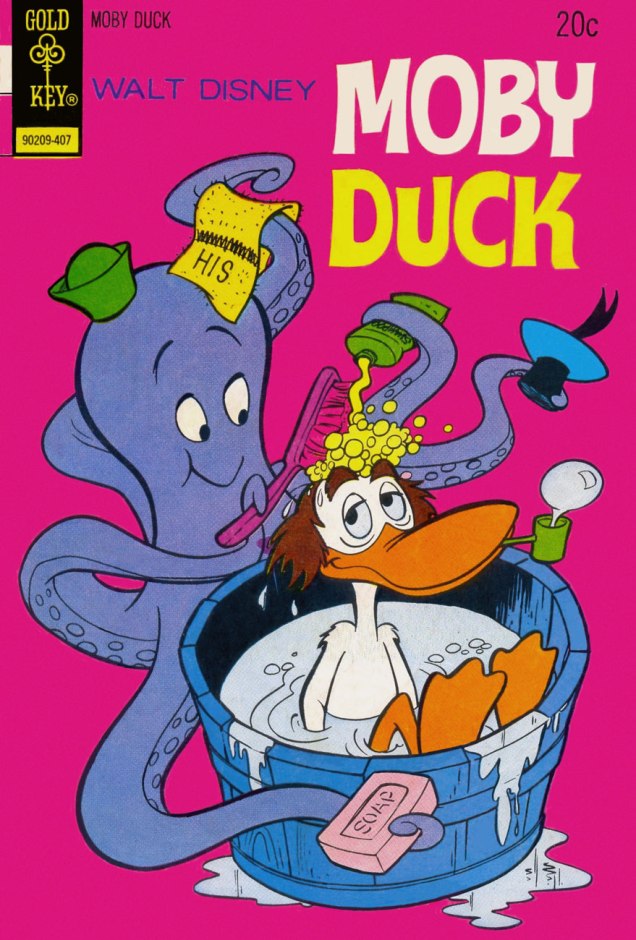
Walter Lantz Woody Woodpecker no. 79 (March 1964), cover by Phil De Lara.The Flintstones no. 60 (September 1970).Tweety and Sylvester no. 28 (January 1973).Moby Duck no. 14 (July 1974). Pencils by Pete Alvarado, inks by Larry Mayer.Woodsy Owl no. 6 (February 1975). Pencils by Paul Norris, inks by Larry Mayer.Yosemite Sam no. 43 (April 1977).Yosemite Sam no. 67 (July 1980).








































 « Over time, Jansson came to feel exhausted by the Moomins and that their success had obscured her other ambitions as an artist. In 1978, she satirized her situation in a short story titled “The Cartoonist” about a man called Stein contracted to produce a daily strip, Blubby, which has generated a Moomin-like universe of commercial paraphernalia—“Blubby curtains, Blubby jelly, Blubby clocks and Blubby socks, Blubby shirts and Blubby shorts.” “Tell me something,” another cartoonist asks Stein. “Are you one of those people who are prevented from doing Great Art because they draw comic strips?” Stein denies it, but that was precisely Jansson’s fear. » (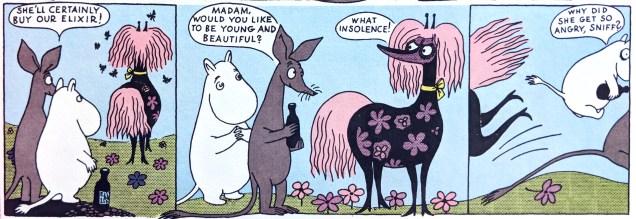











 Who's Out There?