Greetings all! Today we play whack-a-mole with a few warriors in loincloths – or at least that’s how I felt when looking for material in this post. Every time I found an instance of tentacles in some Conan the barbarian or Kull the destroyer tale, there was yet another one just an issue or a couple down the line. Let’s then consider this the end of a story begun with Tentacle Tuesday: the Savagery of Conan’s Savage Sword and continued with Tentacle Tuesday: Conan-o-rama: after this, I’ll be all Conan-ed out for a few years to come. So drink a shot of some concoction you like (be it coffee or the potent Zombie), and join me for this last foray into the dark, mysterious, predictable world of sword-and-sorcery heroes who run around half-naked (for better freedom of movement, no doubt).
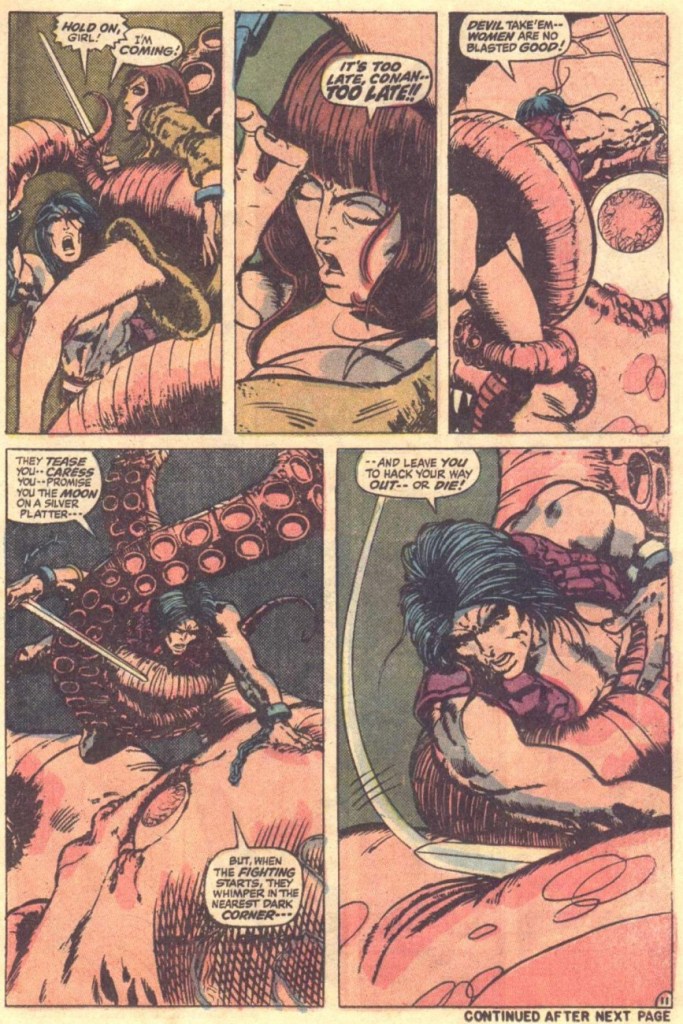
Poor octopus, by far the most tragic figure of this story… These two pages are from The Dweller in the Dark, scripted by Roy Thomas and illustrated by Barry Smith, was published in Conan the Barbarian no. 12 (December 1971, Marvel).
You can’t have it both ways – praising a woman for exhibiting quintessentially ‘feminine’ characteristics and then getting pissed off at her dismay and fright when grabbed by a murderous monster.
The Sunken Land, scripted by Denny O’Neil (from a short story by Fritz Leiber), is pencilled by Walter Simonson and inked by Al Milgrom. This story was published in Sword of Sorcery no. 5 (Nov-Dec 1973, DC). I like Leiber, and I’ve been meaning to get to the Gray Mouser for a while – but I’m reading Andrzej Sapkowski’s Witcher right now, and one sword-and-sorcery saga at a time seems reasonable.
Page from Flame Winds of Lost Khitai!, scripted by Roy Thomas, pencilled by John Buscema and inked by Ernie Chan, published in Conan the Barbarian no. 32 (November 1973, Marvel). Interestingly, barbarians seem to universally abhor striking a woman; an attempt at primitive ethics from the part of the scripters.
One more Conan before we move on to Kull…
Page from Isle of the Dead, scripted by Bruce Jones and illustrated by Val Mayerik, published in Conan the Barbarian no. 138 (September 1982, Marvel). This page has the rare distinction of having the warrior-hero being less clothed than the girl he’s with.
As promised, here’s Kull the destroyer, engaged in battle with an eighties octopus (check out that mohawk!)
Two pages from The Thing from Emerald Darkness, scripted by Doug Moench, pencilled by Ed Hannigan and inked by Alfredo Alcala. This story was published in Kull, the Destroyer no. 17 (October 1976, Marvel). Why does a traitor (that’s not ‘traiter’) deserve better than to die from tentacles? That seems like no worse a death than any other in battle.
A page from City of the Crawling Dead, scripted by Don Glut, pencilled by Ernie Chan, and inked by Rick Hoberg. It was published in Kull, the Destroyer no. 21 (June 1977, Marvel).
Just before you pass out from over-consumption of alcoholic drinks (I’m having a gin and tonic over here!), I’d like to enliven this parade of humdrum tentacles a bit with this Conan pin-up:
Sometimes tentacles are positioned so close to the head that one gets the impression they’re sprouting directly from it. Whether accidental or not, the result is quite horrific – sometimes in a good way, if one enjoys the creepy and bizarre. In this Tentacle Tuesday, we’ll come across literal cases of octopus-instead-of-head, beard-tentacles (stylish!) and alien cepha-cerebellum-pods, which I hope will catch on as a term.
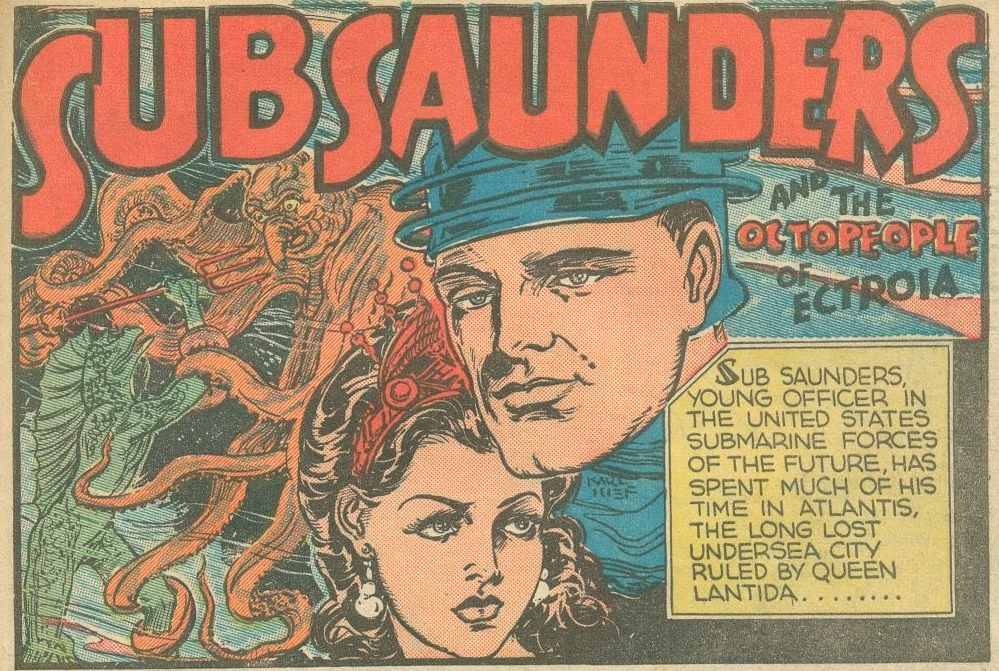
The following has been taken from The Octopeople of Ectroia, illustrated by Henry Kiefer, and published in Fantastic Comics no. 8 (July 1940, Fox Comics). If the introductory panel gives but a brief glimpse of the creature we are about to encounter…
… the splash page gives us an eyeful of her charms. Now we know what Baba Yaga would look like with tentacles instead of her usual limp grey tresses. Incidentally, a few days ago an enterprising fellow won enough support (and funding) from the Lego community to make his Lego Baba Yaga idea an (eventual) reality. She would come with her traditional hut on hen’s legs, a black cat and “everyday useful things” like horseradish drinks. Needless to say, I want one.
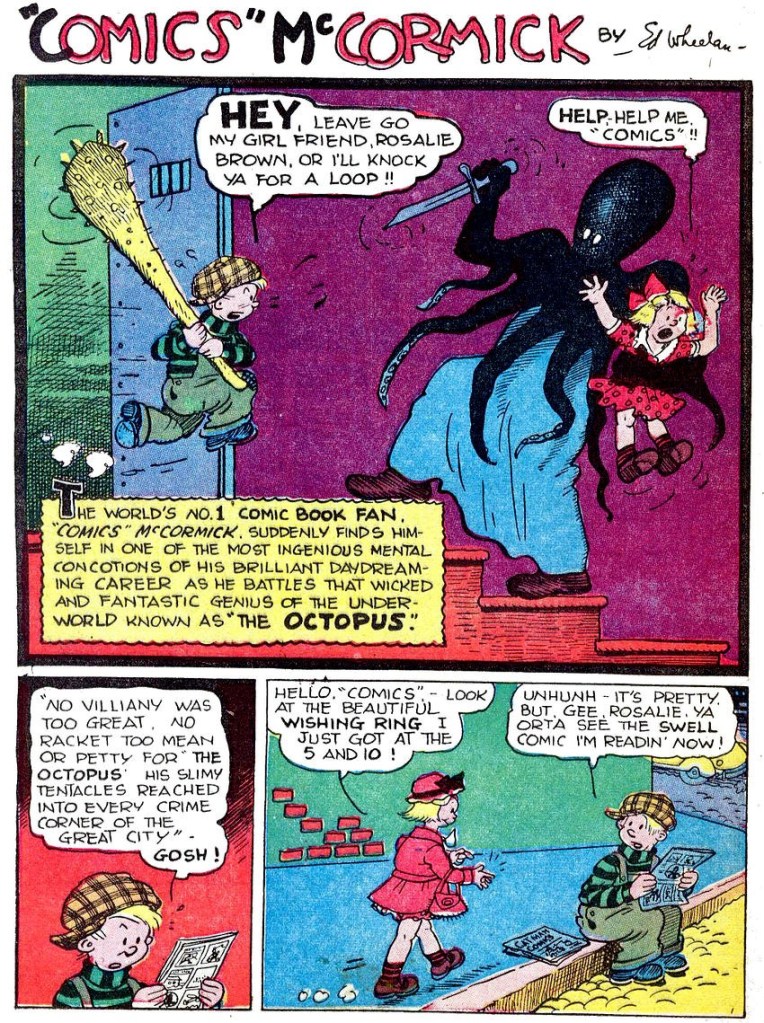
“Comics” McCormick has had more than just one encounter with cephalopod-headed men! The following is the cover of Fat and Slat no. 4 (Spring 1948, EC Comics), illustrated by Ed Wheelan.
And here is a page from The Octopus, printed in Terrific Comics no. 3 (May 1944, Helnit Publishing). Is it the same villain? Well, nearly: they’re Octopus-Man and Octopus, differentiated only by the costumes they sport under all those tentacles.
Edgar S. Wheelan (1888-1966) was the creator of Fat and Slat and “Comics” McCormick, and he is well remembered for his introduction of some cinematic techniques to comic strips. Of special significance is his Minute Movies, created for the George Matthew Adams Newspaper Service. This series of animated shorts not only had its stars (and continuity!), but also made full use of techniques that weren’t usually employed in comics, like close-ups, long shots and head shots with title cards.
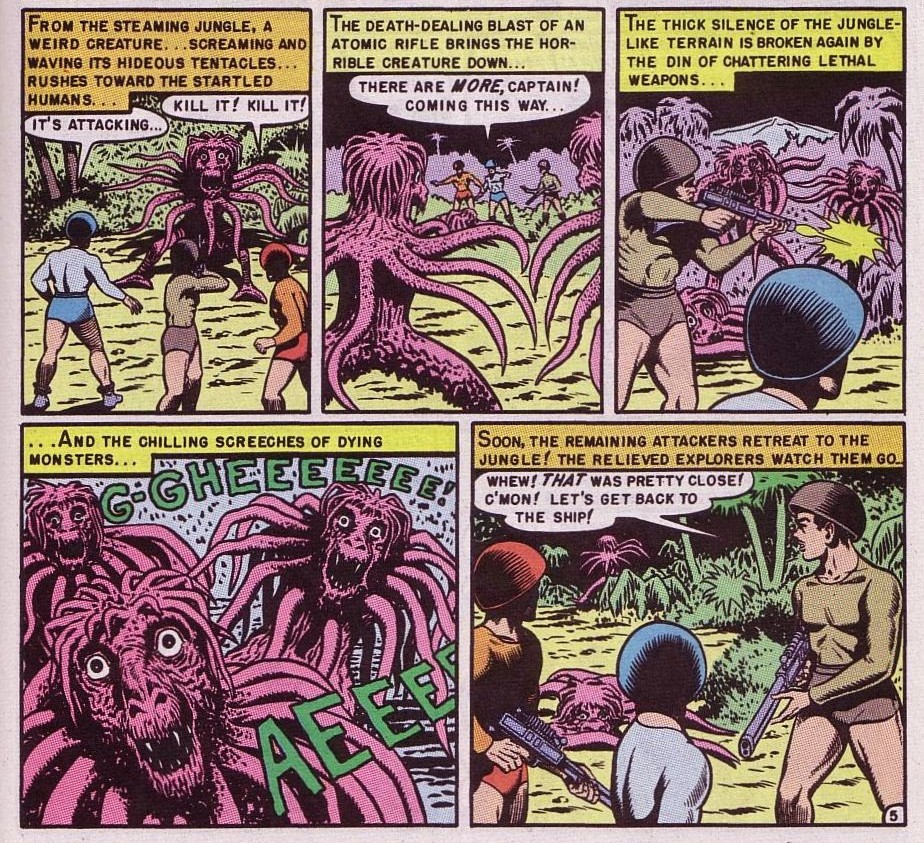
The following sequence is an oldie-but-goodie from the oft-quoted Origin of the Species!, scripted by Bill Gaines and Al Feldstein, and illustrated by Feldstein. It was first published in Weird Fantasy no. 8 (July-August 1951, EC Comics). For those of you who may not have read it and are wondering whether those tentacled beasts were somehow the progenitors of the human race… no, they weren’t. As for the plot, it raises more questions than it answers, which I believe is not atypical of a Feldstein tale (from those I’ve read, they tend to be like a movie with plenty of drama and special effects, but little sense).
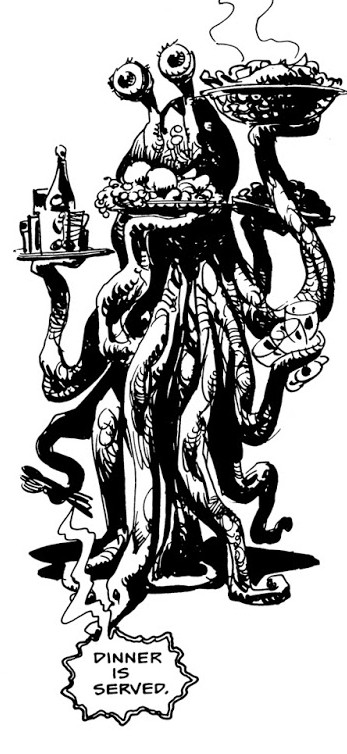
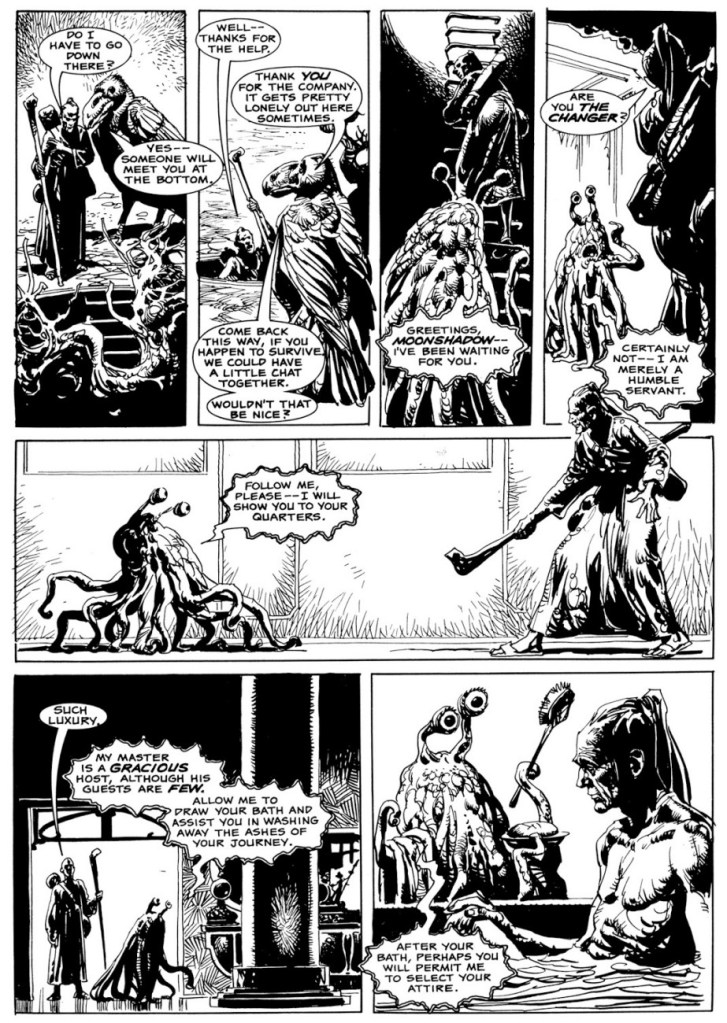
I recently came across a 3-part story published in Eerie numbers 91 to 93 that I quite liked: the tale of Moonshadow, the assassin who never failed, scripted by Bob Toomey and illustrated by José Ortiz. As luck would have it, two of the instalments were rife with tentacles!
The following page (and also the preceding panel) is from Suzanna Don’t You Cry, part 2 of the tale, published in Eerie no. 92 (May 1978, Warren).
Last but hardly least, a page from Kingdom of Ash, published in Eerie no. 93 (June 1978, Warren).
Fast forwarding some twenty years, we land in the middle of a pirate tale – and what suits a pirate more than a headful of tentacles (and a peg-leg)? This page is from Autopsy in B-Flat, written and illustrated by Gary Gianni and first published in Hellboy: Almost Colossus no. 1 (June 1997, Dark Horse) as a back-up feature. Gianni’s The Monstermen stories have since been collected separately.
What we gather from this dialogue is that octopus pirates like pork.
Finally, I think I promised some tentacles in lieu of beard, and the early stages of this guy’s transformation surely qualify:
This creature appears in the pages of Nocturnals: Black Planet (October 1998, Oni Press), with all plotting and art handled by auteur Dan Brereton. Actually the pages of this collection are so rife with tentacles that I’m going to force myself to be succinct.
Another instance of tentacles-as-hair:
Cover for Nocturnals: Black Planet (October 1998, Oni Press).
Thanks to friend Barney for pointing this last batch out!
Today we bring you a selection of edifying cartons that will (hopefully) teach you something about our friends the cephalopods. Like how to check that you really are looking at an octopus, for instance: like with most things in life, just ask!
Cartoon published in Mad Magazine no. 486 (February 2008) The author, in all senses of the word, is our beloved Al Jaffee.
I like the idea of learning from comics, but stories written specially to teach children (or the occasional adult) moral lessons or scientific facts often end up incredibly boring, insultingly condescending, or painfully obvious. However, (gently) throw an octopus into the mix, and I’ll be willing to consider it!
Of course sometimes the octopus is the student, albeit an undressed one.
Treasure Chest Vol. 21 no. 4 (October 21st, 1965). The cover is by Pete Hironaka, born in California to Japanese parents. Treasure Chest of Fun & Fact was a comic book series that was Catholic-oriented and featured inspirational Christian stories and such, but also ran stories about science, history, and just plain adventure, emphasizing values like teamwork, honesty, etc. throughout. No, it’s not as boring as it sounds! Most of the stories weren’t at all preachy, just kind to their characters, which is something I really appreciate. The title was distributed throughout parochial schools from 1946 to 1972.
Are there tentacles inside? Well, yes!
I am slightly disturbed by how angry Murphy is at the octopus’ supposed ignorance (especially since he’s so blatantly wrong). Art by Pete Hironaka.
I wish octopus lobotomy wasn’t on the menu, but what can you do…
On the topic of classrooms – octopuses have to write essays, too, just like any old student Joe. It’s a bit hard to hold a pencil with a tentacle, though.
I’ve never watched SpongeBob SquarePants, because the idea of a protagonist who’s some sort of dumb-looking kitchen sponge (I’m sorry, “sea sponge”) has never appealed to me. It may be brilliant, for all I know. However, whenever I encounter a SpongeBob comic, I’m always surprised at how good the stories are. Given that the calibre of some contributing artists and writers (Ramona Fradon, Tentacle Tuesday Master Hilary Barta, WOT favourite Stephen R. Bissette, Tony Millionaire of Many Tentacles, the aforementioned Al Jaffee, Michael T. Gilbert… come on, it’s like a who’s who of comics talent), this is actually less astonishing than one might expect – and the fact that Stephen Hillenburg, the creator, managed to attract such talent speaks well of him. Another fact, namely that that he worked as a teacher of marine science at the Ocean Institute of Dana Point (California) and decided to create an educational comic book depicting the life of anthropomorphic sea creatures, confirms that he’s one cool (sea) cucumber.
A cephalopod installment of Flotsam & Jetsam, scripted by Maric Wicks and illustrated by Nate Neal. This page was published in SpongeBob Comics no. 9 (June 2012, United Plankton Pictures)
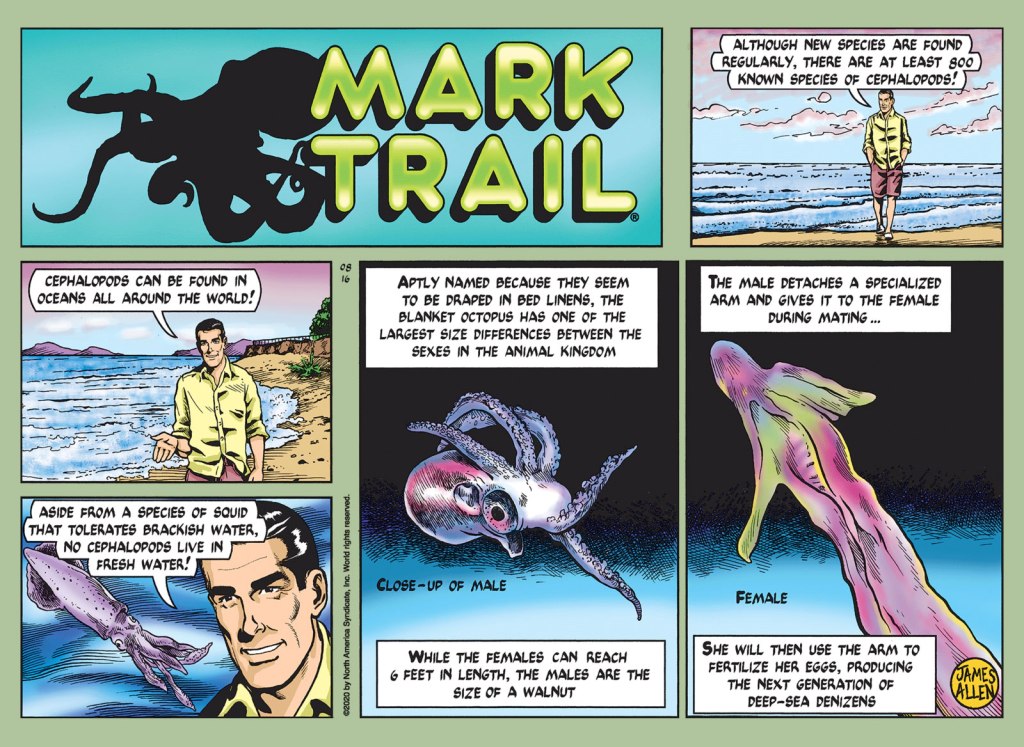
A final educational strip, although to be perfectly honest with you, a tad on the boring side. Mark Trail was created by Ed Dodd an eternity ago (which is to say, April 1946). Dodd was a national parks guide and (quite naturally, one would hope) an environmentalist, so his syndicated newspaper strip featured a lot of environmental disasters, mostly orchestrated by human hands (but the evil guys often received a satisfying punch in the mouth from Trail, a nature writer-cum-photographer – if only it were this easy in real life!)
This strip is from August 16th, 2020.
After passing through a few pairs of hands, the strip landed at the doorstep or artist James Allen, who began by assisting on the Sunday page in 2010, and formally took over in 2014, to continue until 2020, at which juncture he left his position by mutual agreement with the syndicate. After some years of reruns, Mark Trail is now continuing once again, this time with artist Jules Rivera at the helm.
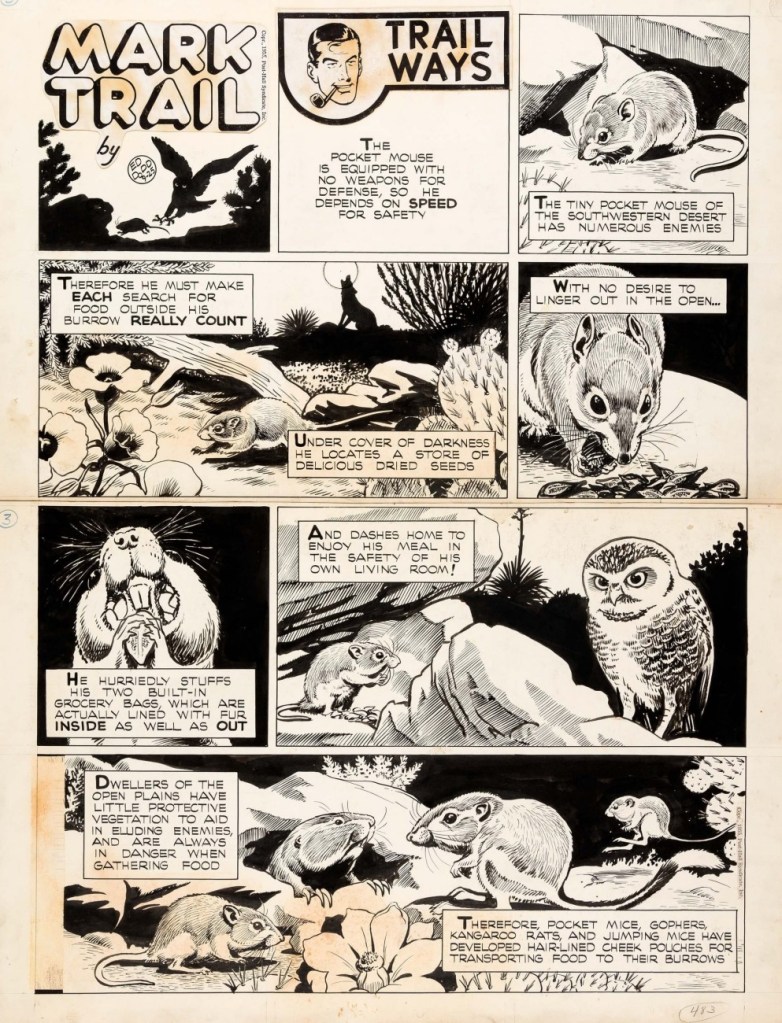
I admire Dodd’s art and plotting, and in my opinion the others who have continued the strip in recent years (from 1978 and onwards) lack his doigté and his talent to various degrees. For example, take a look at the original art for the Sunday strip of September 25, 1955:
Clearly drawn by someone who loved and understood animals. Art by Ed Dodd.
Of course it doesn’t help that the recent Sundays had garish (by my assessment) colours. For a more detailed story of Mark Trail, head over to this Daily Cartoonist article.
« The tentacles had burned where they’d touched our skin… and the oozing slime they’d rubbed into the wound didn’t help. We panted and trembled… »
I have little interest in werewolves, despite just having finished one in wool. I’d say I place them somewhere between Frankenstein’s monster (in which I have zero interest – sorry!) and Dracula (whom I am generally intrigued by, depending on whose version we’re talking about). Having said that, the bizarre concept of werewolf vs tentacles grabbed my imagination by its incongruity. “Grarr”, as the werewolf might say.
The author and her werewolf; he doesn’t have a name, yet.
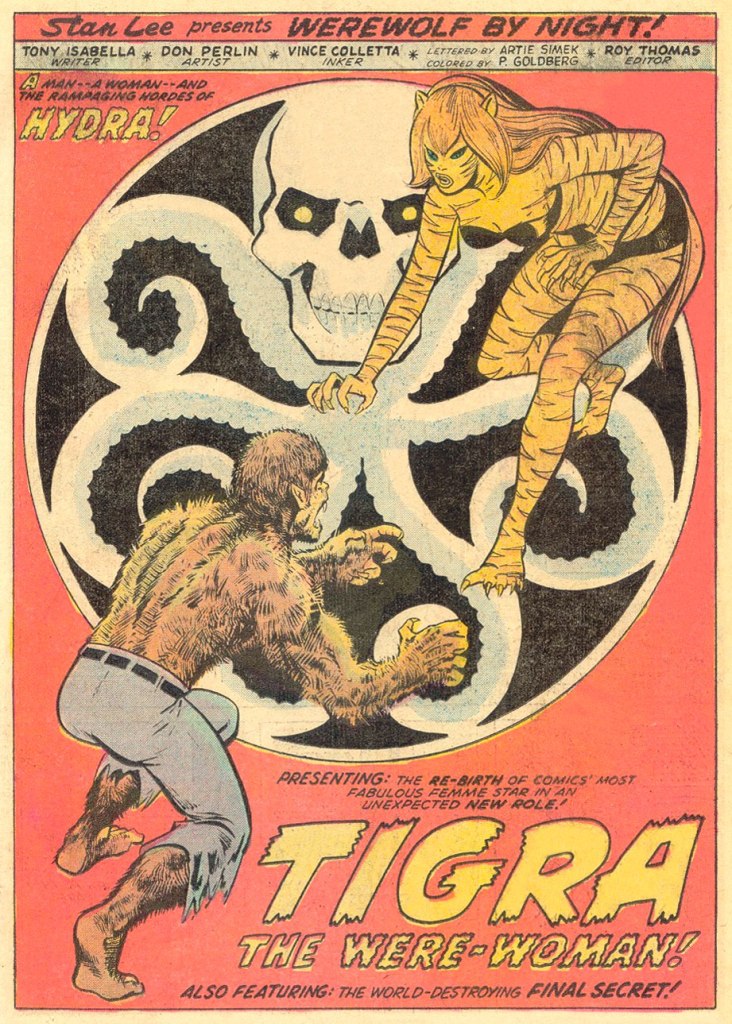
The Giant-Size Werewolf may not be as rife in tentacles as the Giant-Size Dracula, but it has its moments. “A man, a woman… and rampaging hordes” has a certain nice ring about it!
A page from Tigra the Were-Woman!, published in Giant-Sized Creatures no. 1 (July 1974). Script byTony Isabella, pencils by Don Perlin and inks by Vince Colletta.
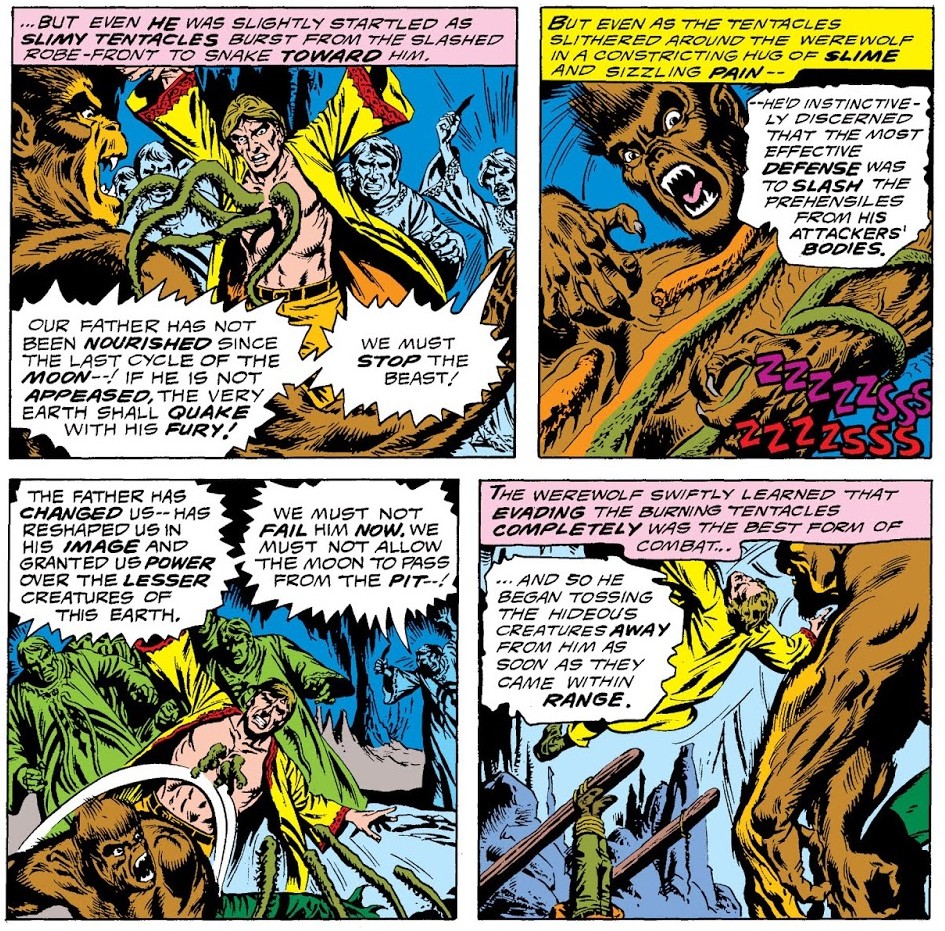
When the Moon Dripped Blood!, scripted by Doug Moench and illustrated by Yong Montaño, was published in Giant-Size Werewolf no. 4 (April 1975):
Anybody would be startled by slimy tentacles coming out from under a robe… slimy and burning, at that.
Doug Moench continues his tentacle shenanigans one month later in Werewolf by Night no. 7 (March 1975).
The Amazing Doctor Glitternight was scripted by Doug Moench and illustrated by Don Perlin:
Likely beating all records for how much text you can cram into one splash page.
The “yecch-monster” awakens as Glitternight somehow manages to exude both light and darkness, and simultaneously nourish and feed. I get the impression somebody was paid by the word for this story.
Has the werewolf ever heard that “words are very unnecessary“? Was it essential to inform us that he might have been stunned, or maybe paralyzed, and it doesn’t matter anyway, as both are just words?
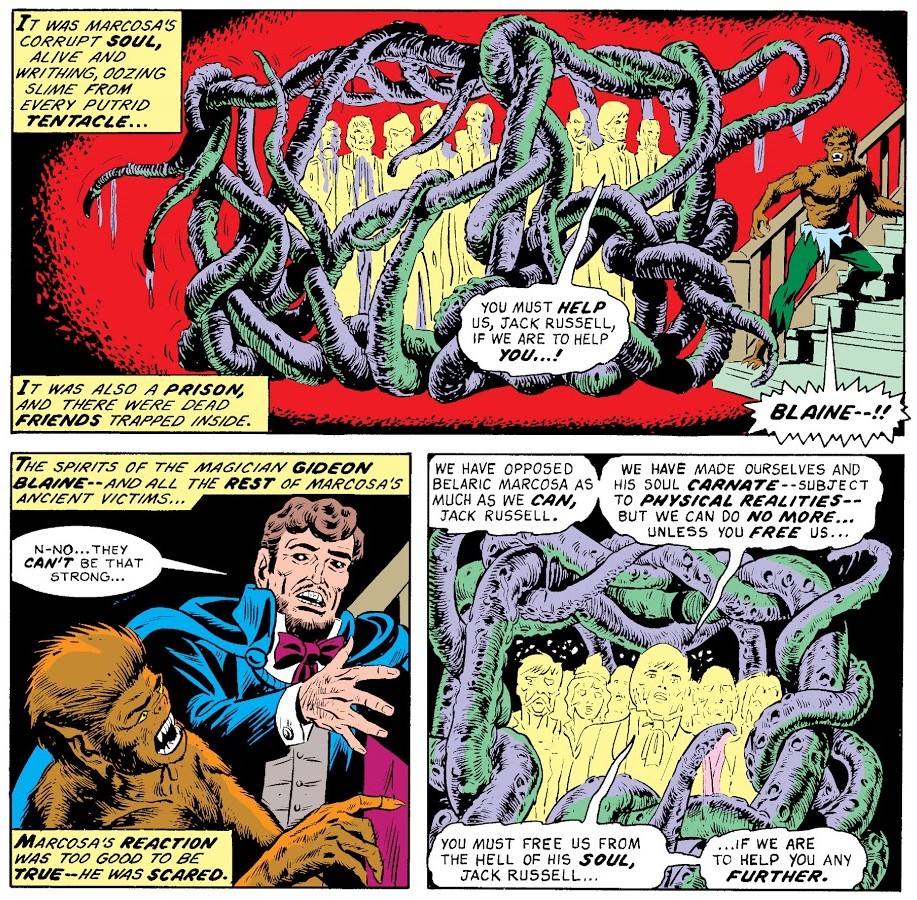
Next time the Werewolf encounters tentacles, it’s an epic, 2-issue tale of the desperate fight against ‘soul-eater’ Marcosa, an ectoplasmic wraith who occasionally takes a physical form and often deploys tentacles to do his dirty work for him.
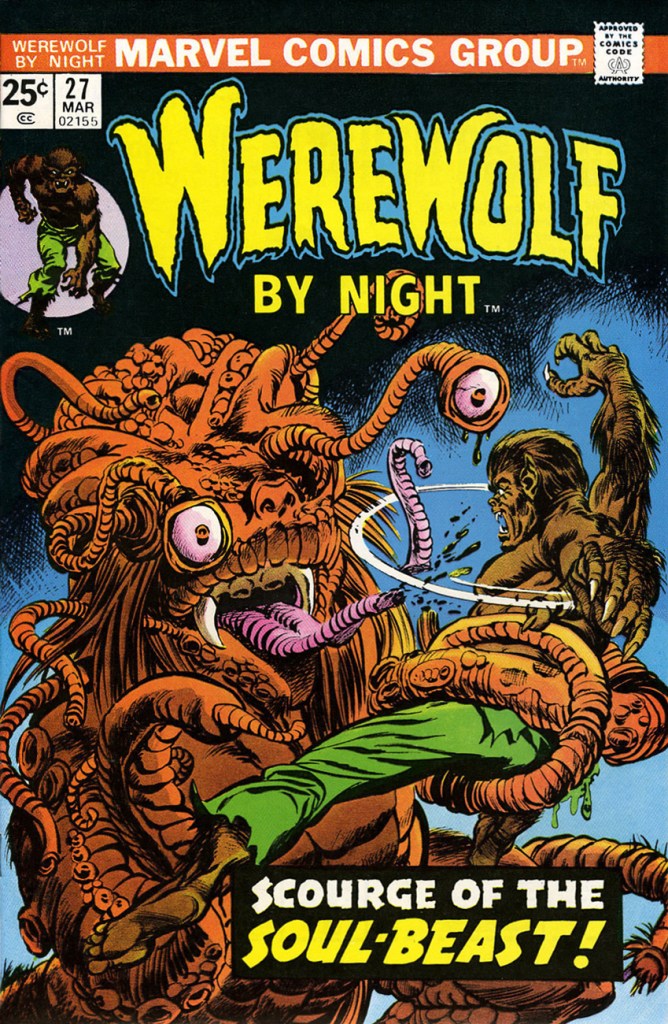
Werewolf by Night no. 36 (January 1976). Cover Don Perlin.
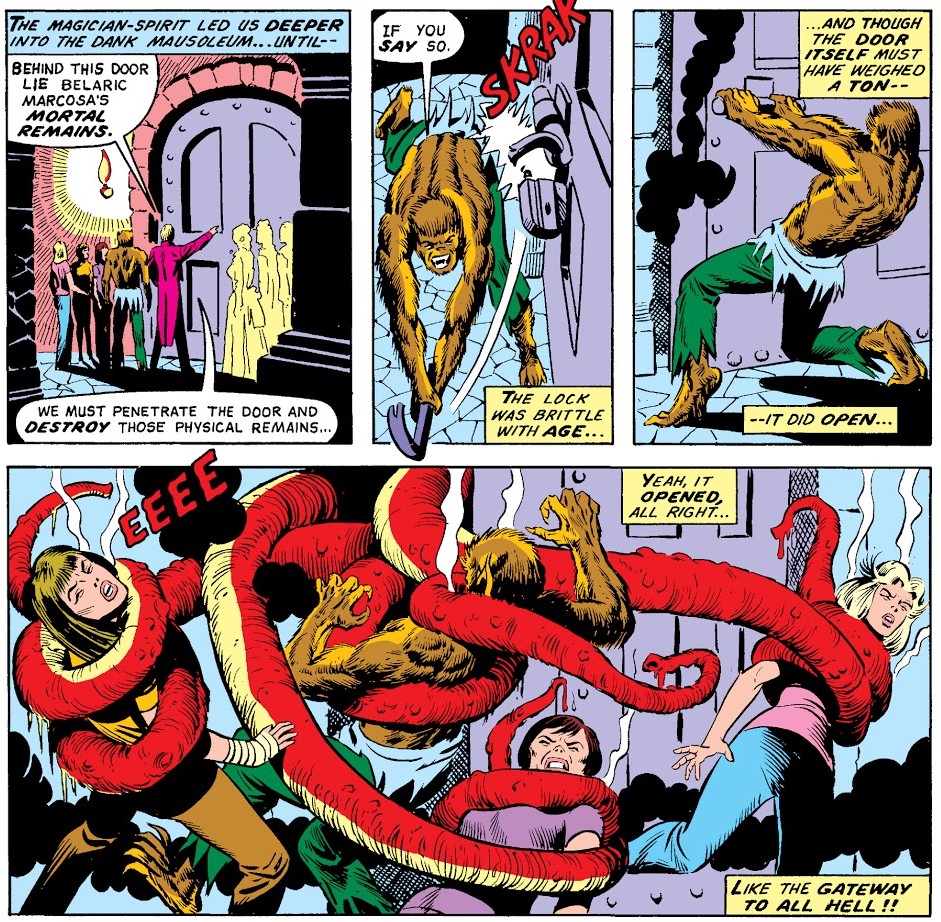
Marcosa in Death (plot-spoiler: death is not actually involved) was scripted by Doug Moench and illustrated by Don Perlin:
Moral of the tale: don’t open doors when you don’t know what’s behind them.
Marcosa doesn’t quite die despite all the gnashing of teeth and ripping of tentacles, so the story continues to its grim conclusion in the next issue. The End, scripted by Doug Moench and illustrated by Don Perlin, was published in Werewolf By Night no. 37 (March 1976).
Perlin goes wild drawing teeth! An orthodontist’s worst nightmare (or perhaps a nice little earner).
What other giant-sized topic will we continue with next time? Only time will tell! Stay tuned…
Tentacles have always been omnipresent in comics, but there’s been a true explosion of tentacular material in recent years. Sadly, the quantity is inversely proportional to the quality, and the comics market seems to be flooded with covers so aesthetically unappealing that I can’t bring myself to feature them. Still, I’ve been accumulating covers from 21st century – here are a few that I can get behind, albeit half-heartedly.
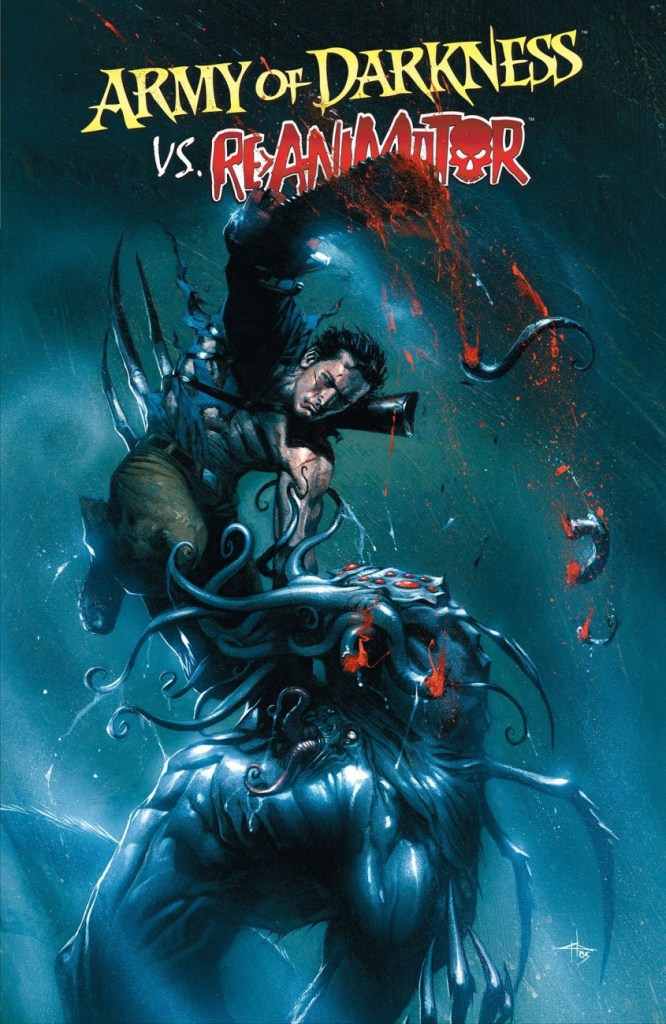
Army of Darkness vs. Re-Animator! (October 2006, Dynamite Entertainment). Cover by Canadian comics artist Nick Bradshaw.
As any story loosely based on an H. P. Lovecraft character (in this case Herbert West) and featuring a crossover as the main point of interest (in this case, West is fighting Ash Williams from the Evil Dead series), this is, not to put too fine a point to it, crap.
Great Pacific no. 16 (July 2014) – variant cover by Charles Paul Wilson III.
Great Pacific has been lauded as an interesting comic with a powerful message of environmental preservation, but this is the only cover I kind of like, the others being distinctly on the ugly side (albeit abounding with tentacles). I see comics as a great merging of words and images, so when the pictorial side leaves so much to be desired, my interest in reading the story is nil — I’ll go read a book instead.
I had low expectations for Professor DarioBava, but this was surprisingly a rather fun read, despite its extremely derivative nature, abounding, as publicity promised, naked women, monsters, exorcisms and lesbian scenes involving a nun in lingerie.
The art is not great but quite serviceable, involving a murky but non-offensive palette with some colour pops.
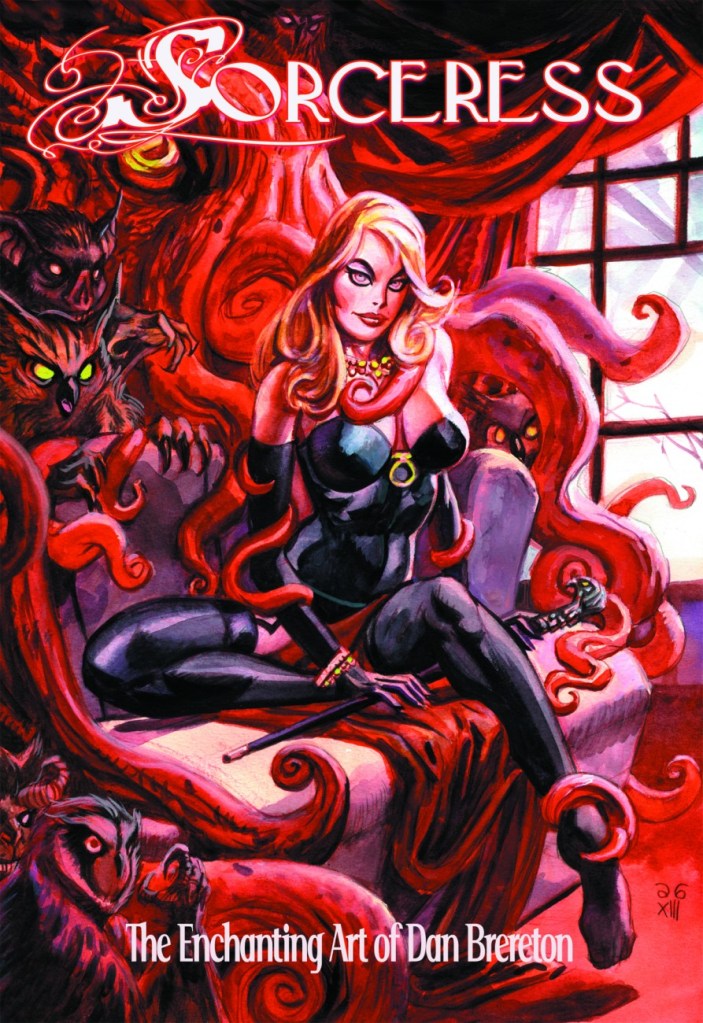
A collection ofDan Brereton art, published in November 2013 (Little Eva Ink).
I can actually say that I like Brereton’s painted and colourful style (co-admin RG demurs on that point), and as he seems to quite enjoy painting tentacles, his art will surely crop up again in one of my posts.
« Mer-Boy! You’re making me angry! »« You’re beautiful when you’re angry! »
Today’s batch of tentacles all come from the heads and hands of one team: scripts by Robert Kanigher, pencils by Ross Andru and inks by Mike Esposito. I make no secret of my dislike for Kanigher scripts when there are women involved*, but the Andru & Esposito team deliver some very nice art to go with the dubious plotting. Besides, we are concentrating on tentacles… though I can’t promise an occasional plot-jab. 🙄
*My complaints about his scripts are two-fold: that his plots make precious little sense is one, but that sort of nonsense is often fun to read, as long as one doesn’t take it seriously. However, the barrage of misogyny, not so much. I go on about it in some length in Don’t Let a Mysogynist Plan Your Wedding: Robert Kanigher and Wonder Woman’s Utterly Unsuitable Suitors, but if you need an immediate example, here are some example of great art and scripting claptrap. I just chose a random, non-tentacle issue from that era… the following panels are from The Cave of Secret Creatures, published in Wonder Woman no. 116 (August 1960).
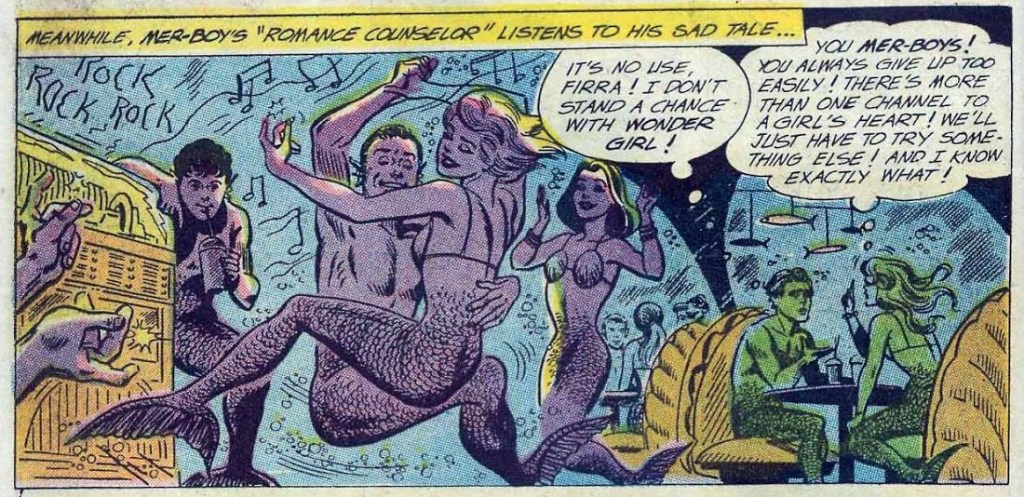
The pretty mermaid’s suggestion is to make Wonder Girl jealous by inviting her to a party and then proceeding to ignoring her altogether. Monumentally stupid? Yes. Is Firra being obtuse on purpose? It’s very possible. Remove the fantastical monsters and the whole superpowers thing, and these stories will read like a hackneyed romance comic.
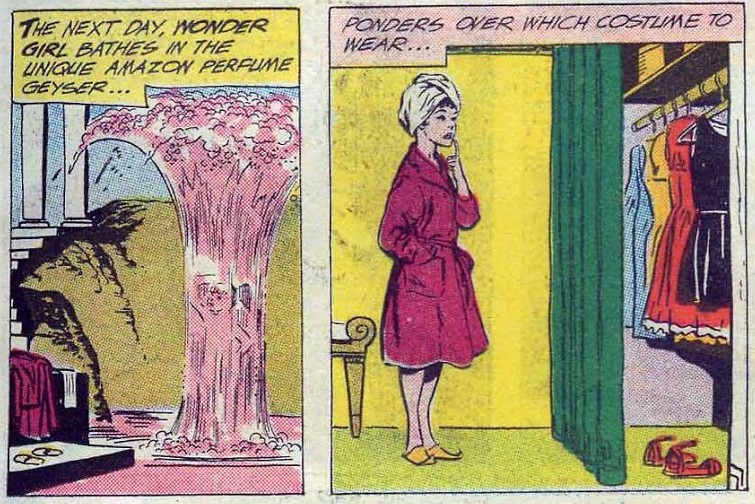
What’s the point of bathing in perfume (yikes, by the way) before going to an underwater party?
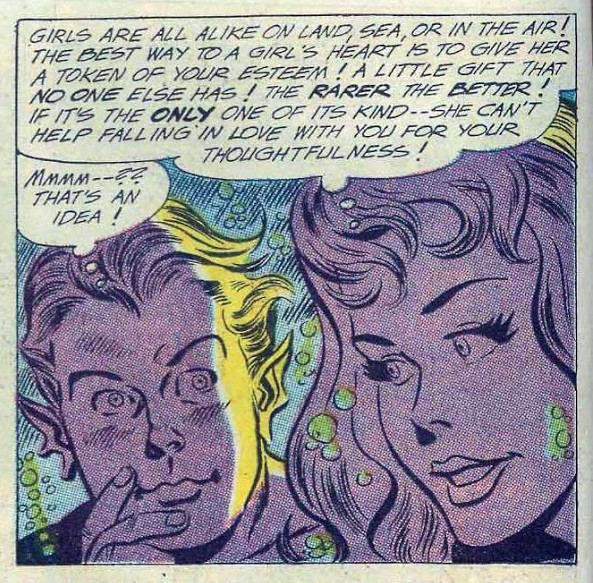
More bad advice from the mermaid. Have you ever heard ANY girl say that “girls are all alike”?
It’s too bad, because it’s really fun to spend some time with this underwater society of mer-teenagers hanging out, drinking seaweed sundaes, and gossiping.
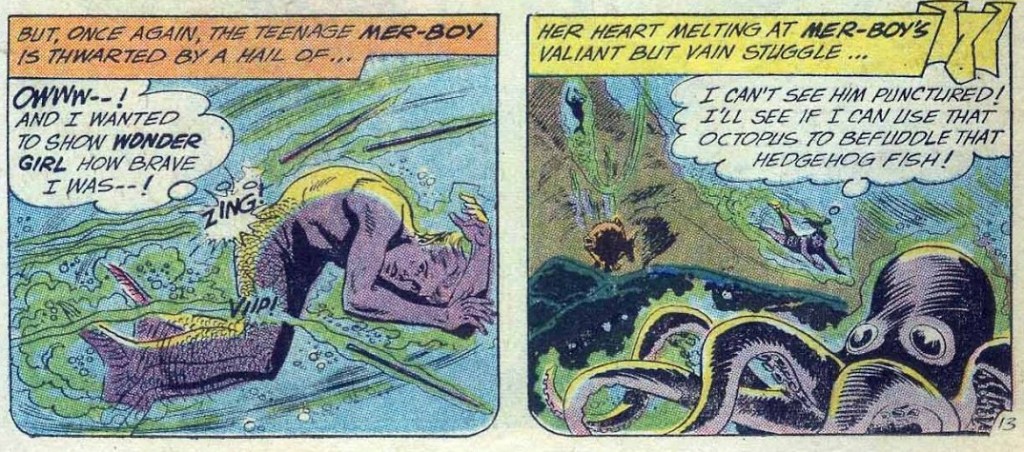
A page from Mer-Boy’s Secret Prize!, published in Wonder Woman no. 119 (January 1961).
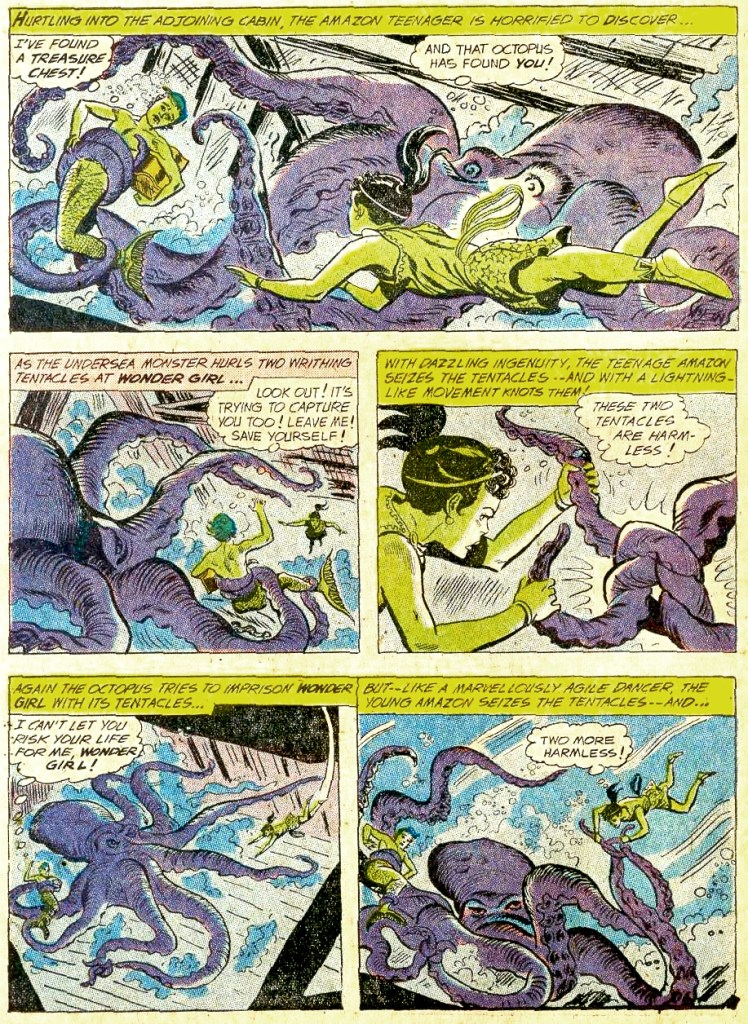
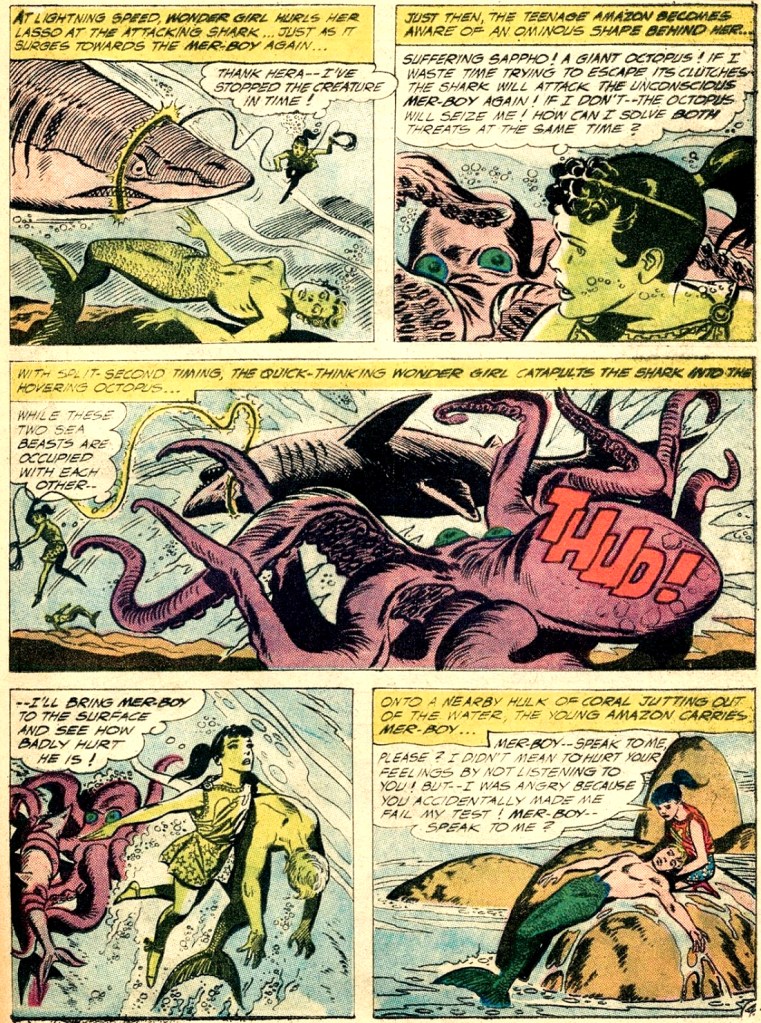
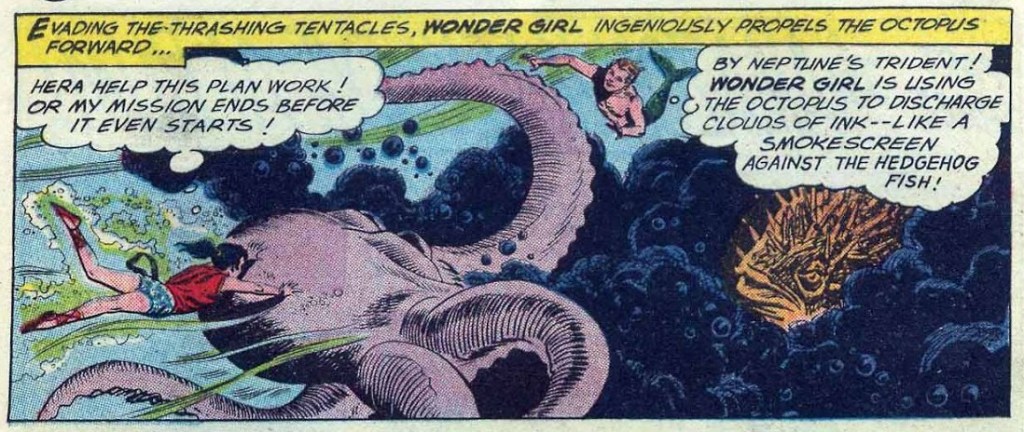
Anyway, I promised you some tentacles, and by Jove (or by Hera!) I shall deliver. Between issue no. 112 and issue 126, Wonder Girl (occasionally her grown-up counterpart, Wonder Woman) has fought more octopuses than one can shake a stick at.
Restraining order, anyone?
The reason for that is simple – the daft Mer-Boy (and the adult Mer-Man) is a frequent plot hinge of these stories, either harassing Wonder Girl for a kiss, quarrelling with her other (equally daft) suitors, or being in desperate need of rescuing when his imbecilic antics land him (yet again) in hot water. I guess that’s one thing I can say about the plotting – at least WG is not a damsel in distress… And I by far prefer him to Steve Trevor (the other suitor who often comes up in these things), whose behaviour is exemplified in, for instance, Wonder Woman no. 127 (January 1962) – he tricks Wonder Woman into agreeing to marry him by faking a serious wound, complains about the food she cooks for him, and then flies into a murderous rage when she takes off from their honeymoon to stop a nuclear missile. (Oh, and it was all a dream, by the way!)
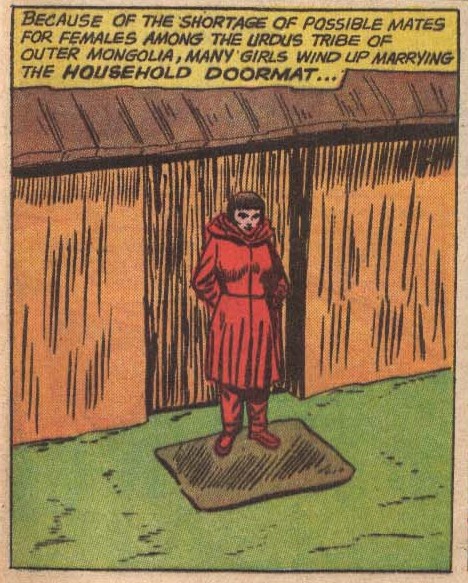
As if to emphasize the retrograde nature of these comics, each issue we are treated to a “marriage around the world” page detailing strange customs. For example, from Wonder Woman no. 128 (February 1962):
Artist unknown. I tried finding out if this was true and could find nothing at all, so the author of this was either talking out of his ass, or has special connections with Urdu tribes… Better to marry a doormat than to become one, I guess?
Page from The Chest of Monsters!, published in Wonder Woman no. 112 (February 1960). “Having to rescue Mer-Boy yet again”, part 300.
Page from Mer-Boy’s Undersea Party, published in Wonder Woman no. 115 (July 1960). Um, yes, rescuing Mer-Boy again.
Pages from Wonder Woman’s Impossible Decision, published in Wonder Woman no. 118 (November 1960). Oh, now it’s Steve who’s having problems, for a little variety!
In case you’re wondering what the Impossible Decision is, Wonder-Woman has to choose which of her suitors to save. Personally, I would let both of them plummet.
In a previous story, Wonder Woman has to choose between saving Steve or saving a whole world, so I think she’s no stranger to fucked-up situations, thanks to Mr. Kanigher.
Two excerpts from Amazon Magic-Eye Album! published in Wonder Woman no. 123 (July 1961)Admiring the action from a polite distance, Mer-Boy is useless as usual.
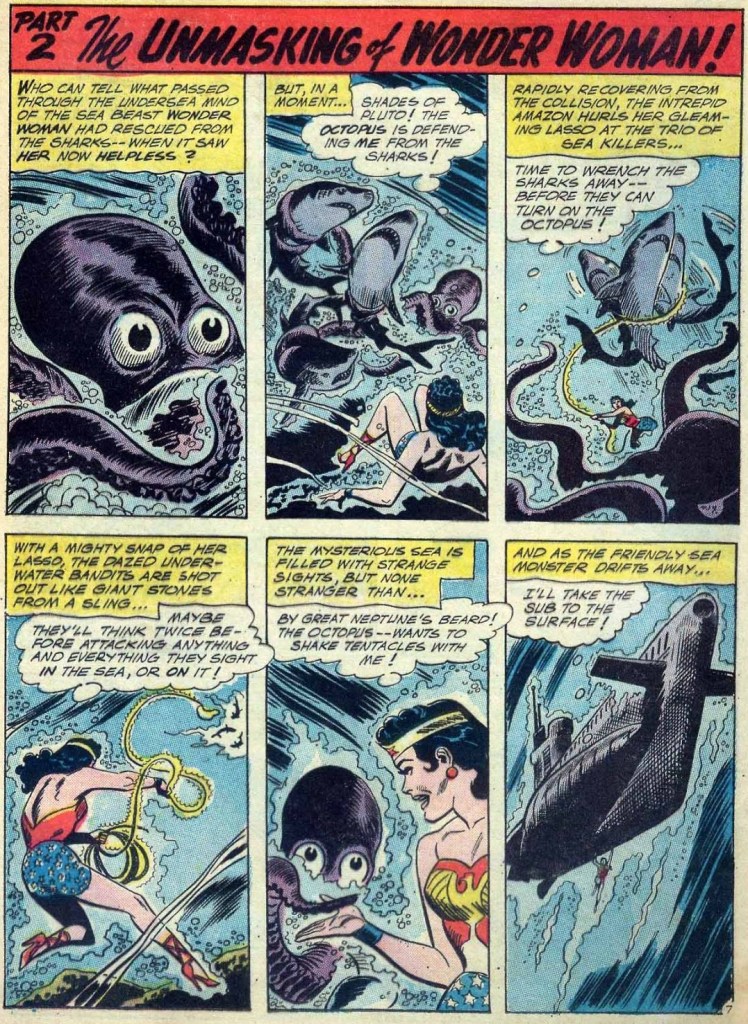
A page from The Unmasking of Wonder Woman! This story was published in Wonder Woman no. 126 (November 1961).
After Wonder Woman rescues the octopus from some bloodthirsty sharks, they become friends! Perhaps because for once, no suitor is involved.
May the gentleman octopus grant you a Happy New Year!
Greetings, pretty cephalopods and cephalopodettes! This is the last Tentacle Tuesday of the year, and as is my custom, I return to a sub-topic close to my heart: women entangled in tentacles. Nothing crass, mind you – we have our standards!
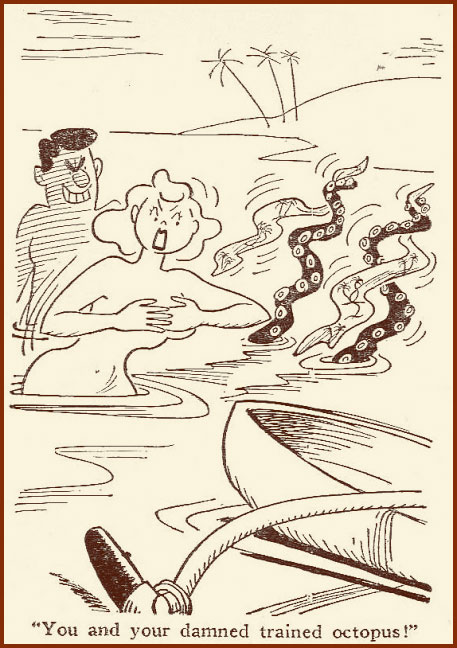
Original art for a cartoon published in Wham! (December 1954, Wolf Books). Art by George Wolfe. I imagine the three guys whose arms are grabbing her colliding with one another in the door frame…
As the signature attests, the artist is George Wolfe (1911 – 1993), who has had an illustrious, though mostly forgotten, career as a magazine cartoonist with published work in Esquire, Saturday Evening Post, New York Herald Tribune, etc. He also had a few syndicated comic strips under his belt, as well as winning several prestigious awards (namely, the Reuben, the highest award of the cartooning profession). Touring Tessie, created by Wolfe for Wolf Books (has a nice ring to it, doesn’t it?), was the so-called hostess of this magazine, and its main attraction. Do yourself a favour and head over to The Wolves of Broadway VII: The Alpha Female to peruse more Tessie cartoons and learn more about just what kind of gal she was.
Tessie is one again getting entangled in the clutches of an octopus… this time a more literal interpretation.
The image used for the cover of Wham! (April 1954, Wolf Books). Another trained octopus – working for his own account and calling the shots!
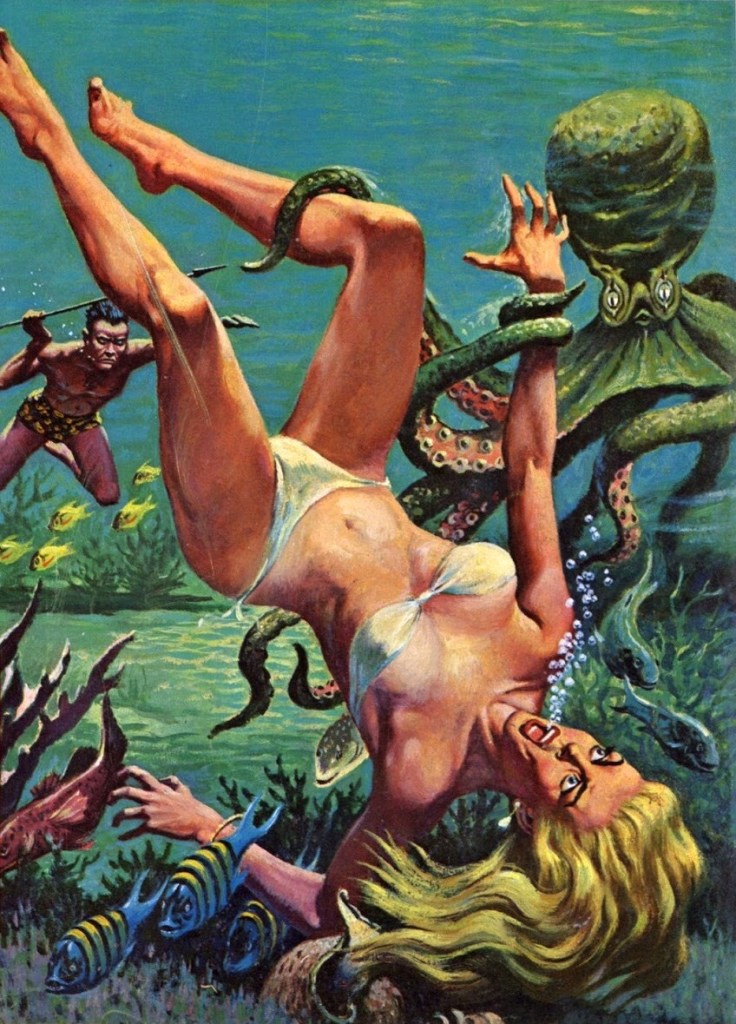
From the cartoony to a more realistic approach –
Detail from the original cover art of Bold Men vol. 5, no 2 (March 1961, Cape Magazine Management). Bold Men is an “interest magazine focusing on pictorials and adventure stories”, explains mycomicshop.com, but with this issue featuring stories like How Nazi Bormann’s Cruel Lust will Betray Him! and The Deadly Blonde Witch of Waikiki! , I’m not sure that “bold” is the right word here.
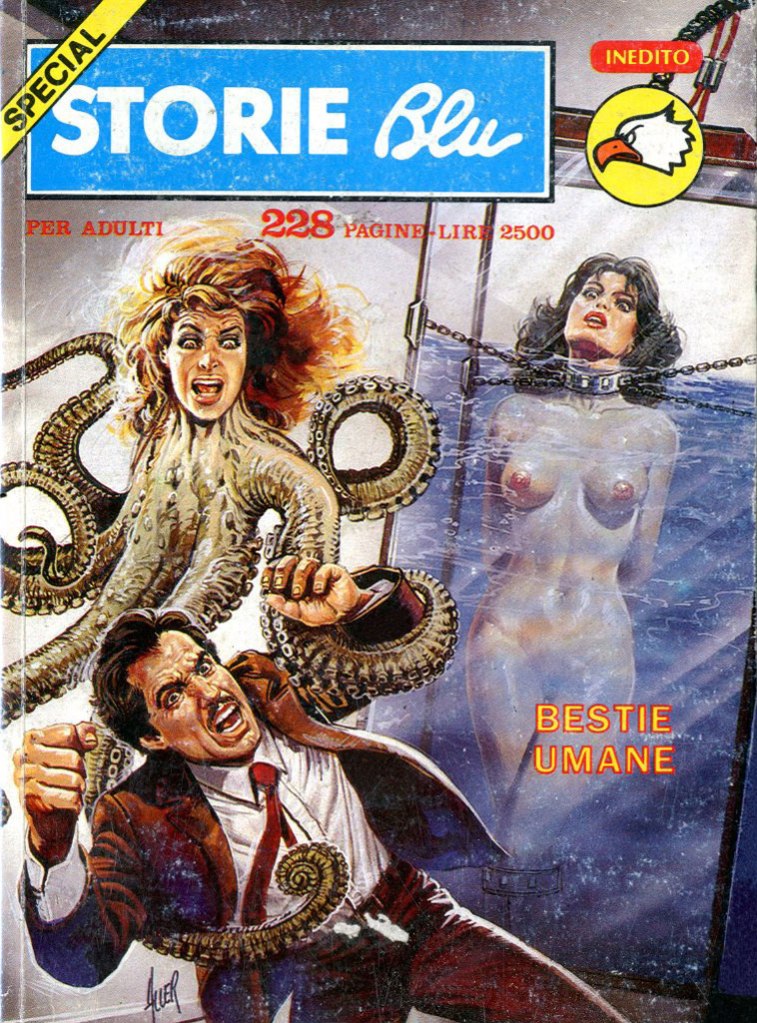
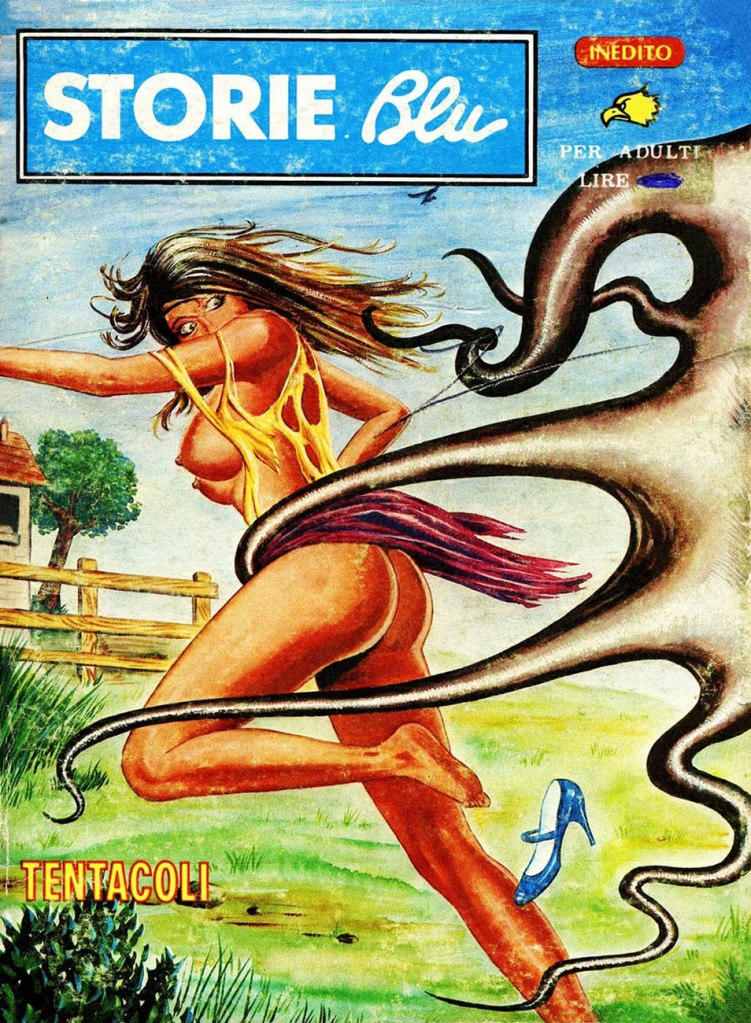
The following three covers are from Storie Blu, an Italian erotic, science-fiction comics series published by Ediperiodici (also known as ErreGI), Edifumetto’s main competitor in the adult comics sector. Ediperiodici disseminated a huge number of erotic series running the gamut from A all the way to B in terms of genre: erotic… horror, western, spy, jungle, military, fantasy, etc. If you want to get an idea of what the stuff looked like, take a peek at Lucifera, Maghella (in-house favourite) or Messalina.
Storie Blu ran between 1979 and 1990, for a respectable 122 issues and two supplements (click here for a full list in Italian).
Storie Blu no. 28 (1983, Ediperiodici). Psycho-monsters, announces the cover!
Storie Blu no. 39 (1983, Ediperiodici). This cover is a good example of the “what the hell is going on here” approach Italian erotica often prefers – RG commented that the tentacled female must be the guy’s ex-wife, and his current wife is in the fish-tank. Anything’s possible! Cover is by Giovanni Alessandri (not the grammarian from the 16th century, as you may have initially thought!), who went under Aller.
Storie Blu no. 81 (1986, Ediperiodici). The cover story was scripted by Carmelo Gozzo and illustrated by Alberto Giolitti (who, I believe, also drew this cover) – you can read a synopsis and take a look at some art here.
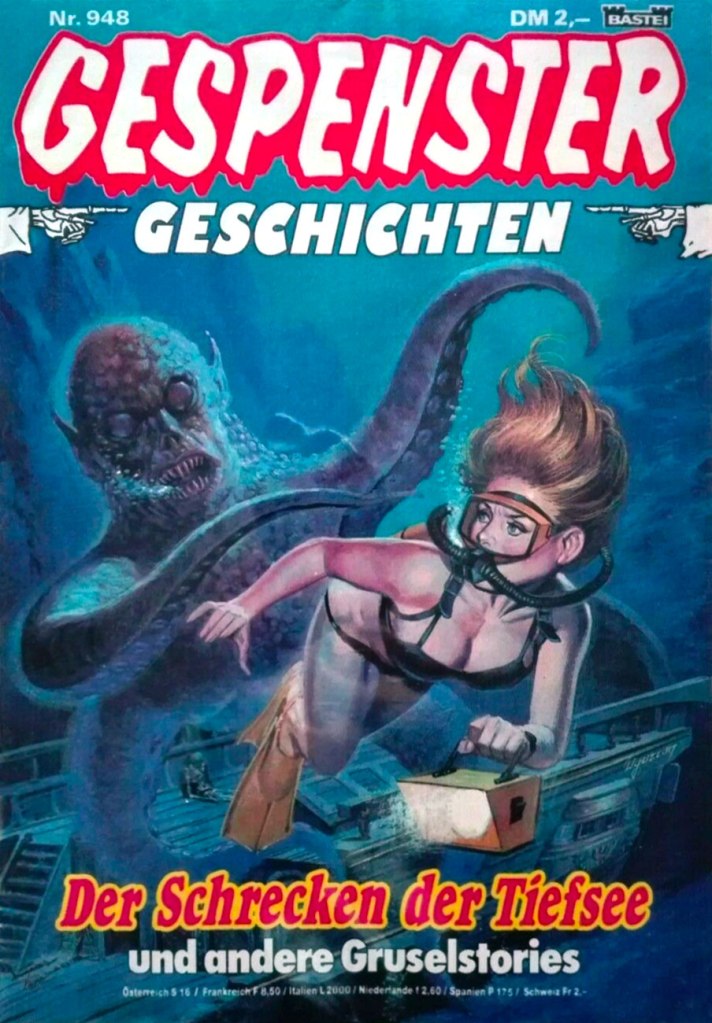
Moving on to another European country… Gespenster Geschichten‘s sister publication Spuk Geschichten already has a Tentacle Tuesday: A Torrent of Teutonic Tentacles.
Gespenster Geschichten no. 948 (1991, Bastei Verlag). Cover by Turkish painter/illustrator Ugurcan Yüce, who moved to Germany in his 30s and contributed quite a lot of covers to publishing house Bastei Verlag, which published (and continues to) many highly successful popular pulp and comic series.
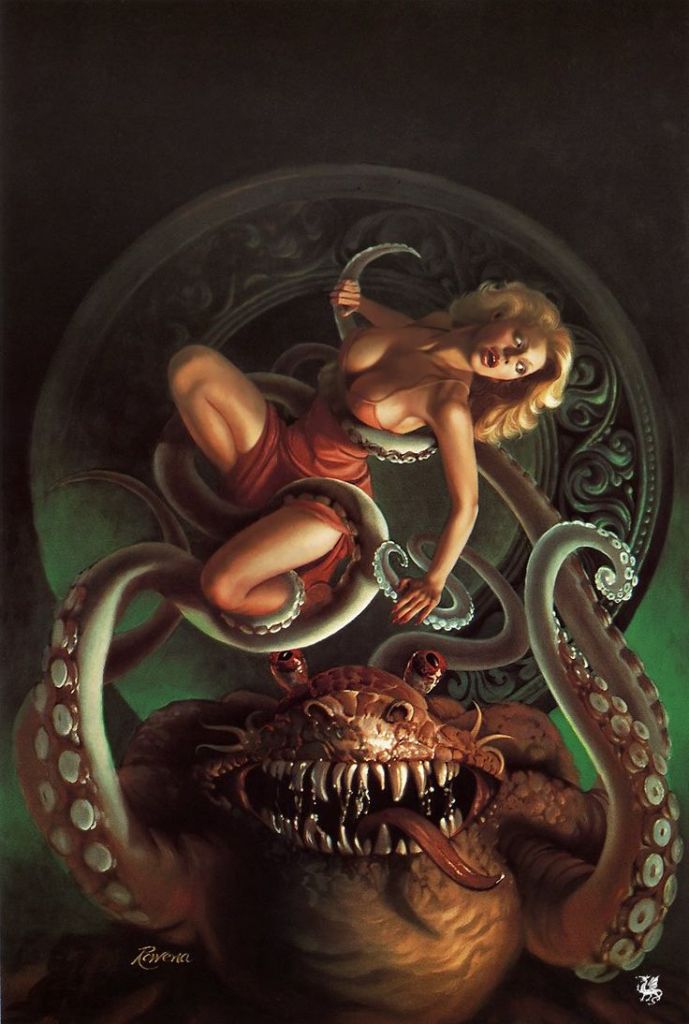
Just one more for the road, what do you say?
Painting by Rowena Morrill (whose name appropriately sounds like something out of some fantasy novel). This has been used as a cover for a German edition of Creepy… but I prefer to provide it sans captions or logos.
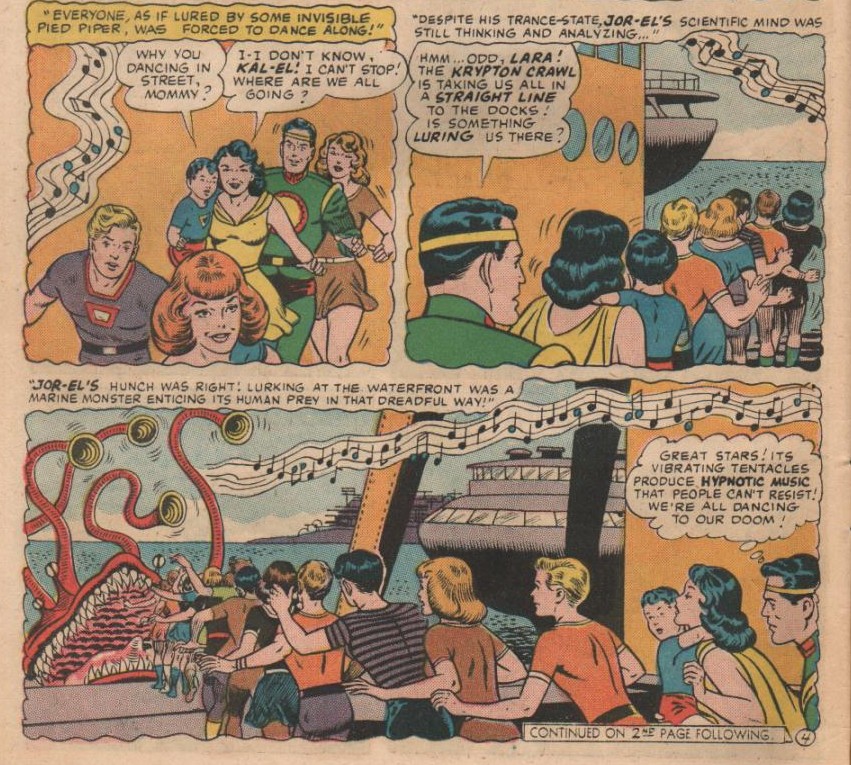
« The vibrating tentacles produce hypnotic music that people can’t resist! »
This is the last Tentacle Tuesday before Christmas, so wishing all of our lovely readers a splendid (and safe) evening, whether you celebrate Christmas specifically, something else altogether, or nothing at all.
As far as I’m concerned, one of the most important components to creating a holiday mood (aside from being with my family, of course) is music. If it’s played by an octopus, so much the better – and one not? Having a lot of arms is surely handy for playing many instruments at the same time. One must say this is a musical edition of Tentacle Tuesday – so put on a record, preferably of the old-school vinyl variety, and swing your tentacles (or whatever appendage you do possess) along!
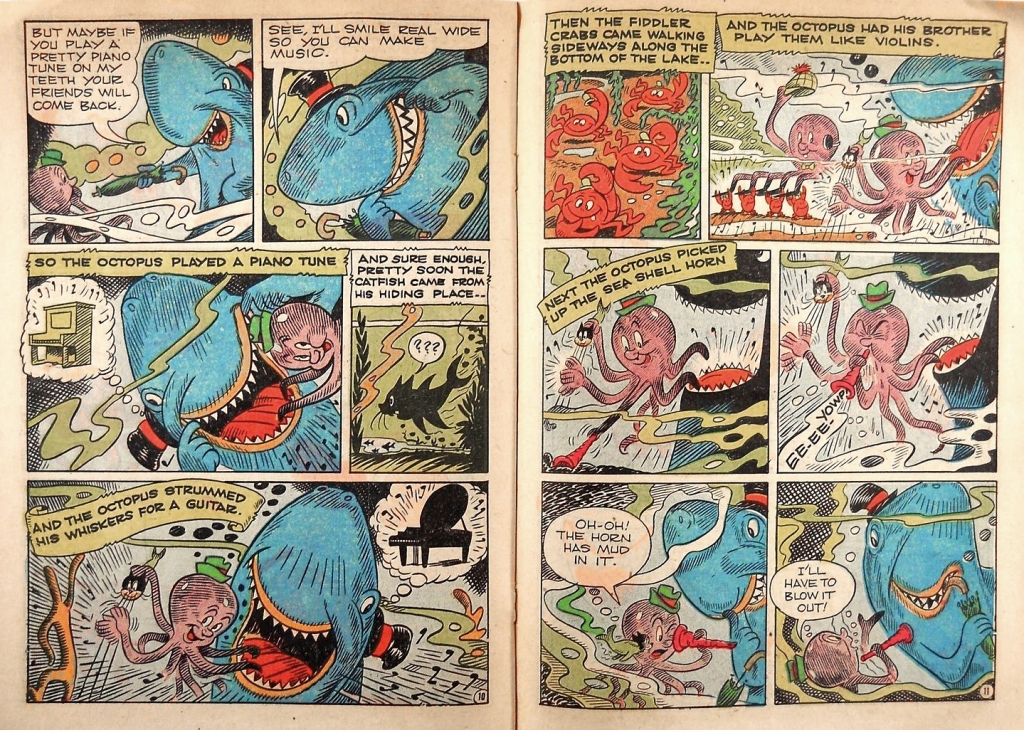
Grumpy Shark (1946, Belda Record & Publ. Co.) Written by Bob Bellemand illustrated by Mel Millar, this comic is part of the Talking Komics series issued by Belda Record & Publishing Co., in which a record was sold alongside the comic to delight both eyes and ears of its young audience. I didn’t know octopuses had whiskers – live and learn!
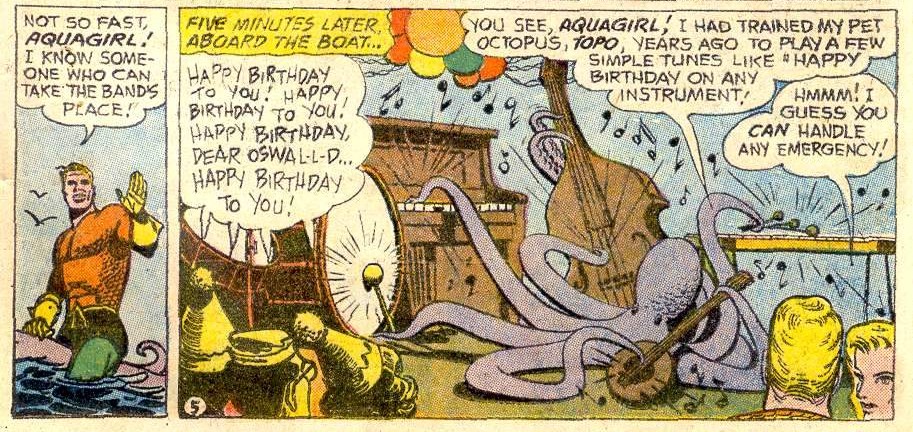
These panels, which I have been seeing all over the place with no attribution of artist or issue number (tssk, tssk) are taken from Aquaman Meets Aquagirl!, scripted by Robert Bernstein and illustrated by Ramona Fradon, and published in Adventure Comics no. 266 (November 1959, DC). Of course Topo, Aquaman’s pet octopus, is adorable as well as talented, and probably deserves his own post… but in the meantime, he has to share space with Aquaman’s other tentacled encounters.
Speaking of Topo… he’s been getting some attention recently, and unsurprisingly his musical talent is involved:
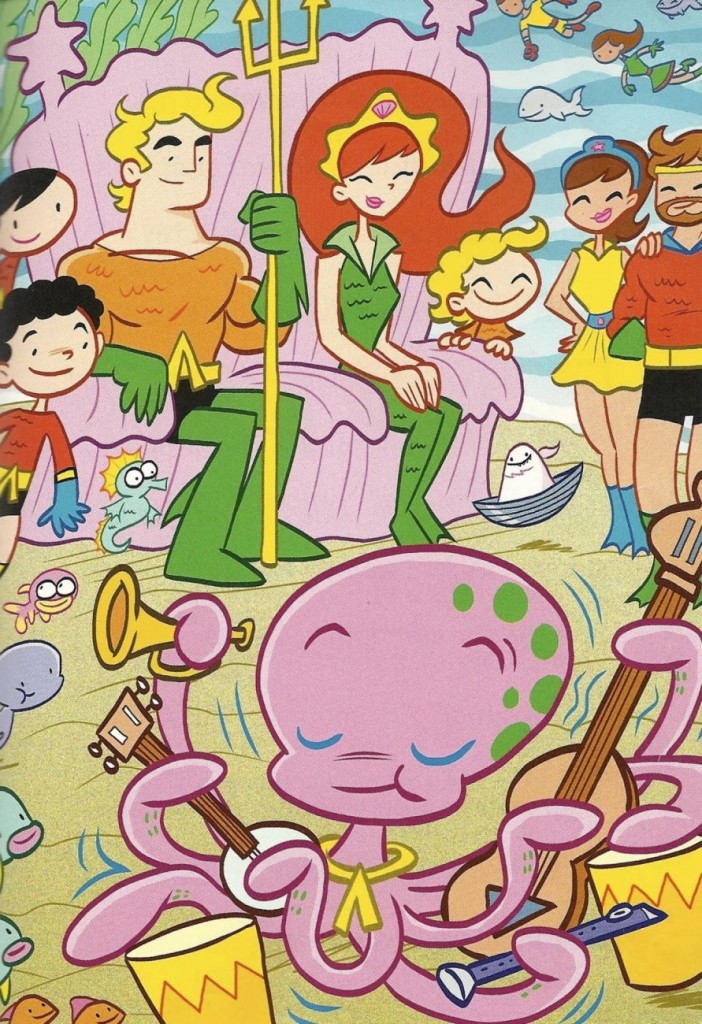
Page from Heroes of the High Seas (January 2011, Picture Window Books), scripted by J.E. Bright and illustrated by Art Baltazar. « Capstone Publishers and DC Comics have joined forces to produce a new children’s books series, DC Super-Pets. The series will focus on the super-powered pets of heroes like Superman, Aquaman, Wonder Woman, Batman, and Green Lantern… »
Page from The Swinging Superman!, scripted by Otto Binder, pencilled by Curt Swan and inked by George Klein, and published in Superman’s Pal, Jimmy Olsen no. 88 (October 1965, DC).
And to prove that octopuses dig LPs, too, I’ll include this nifty poster:
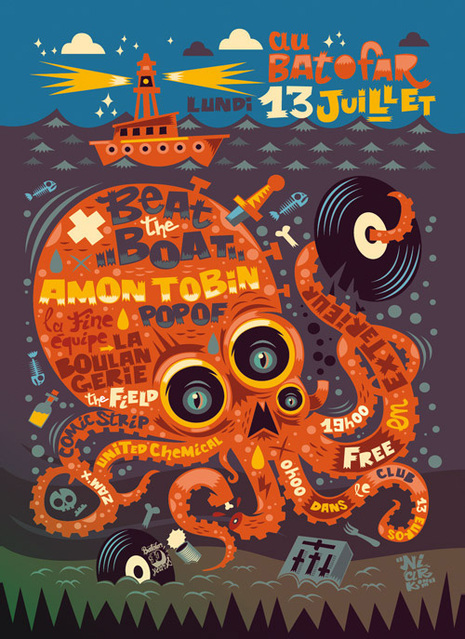
Poster by Sébastien Feraut (known as Niark1), a French illustrator. Visit his website!
On a connected subject, I heartily recommend this Soviet cartoon, which involves all manner of sea-creatures (yes, including several octopuses!) playing all sorts of instruments – don’t worry, it has subtitles in English.
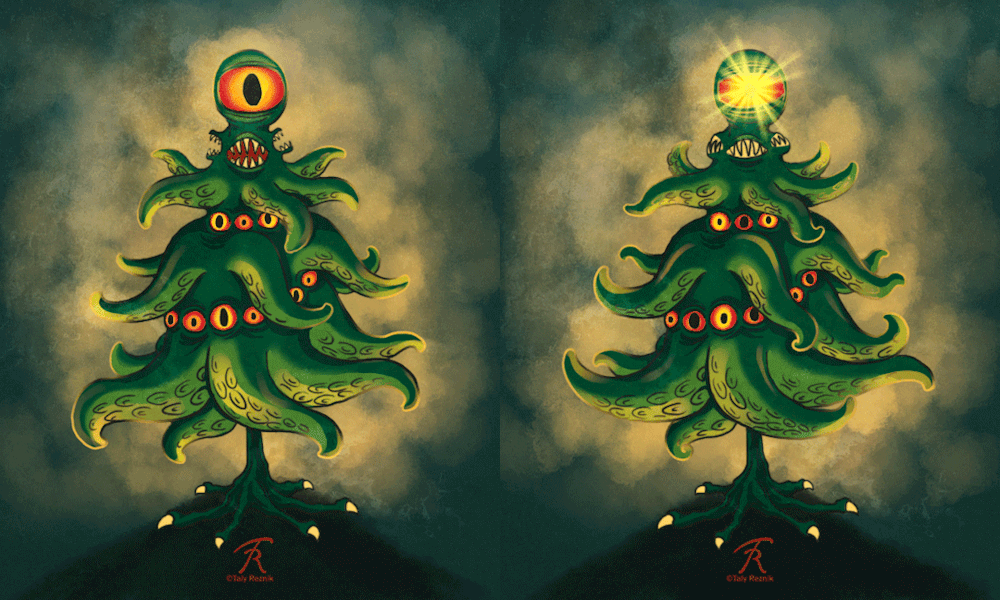
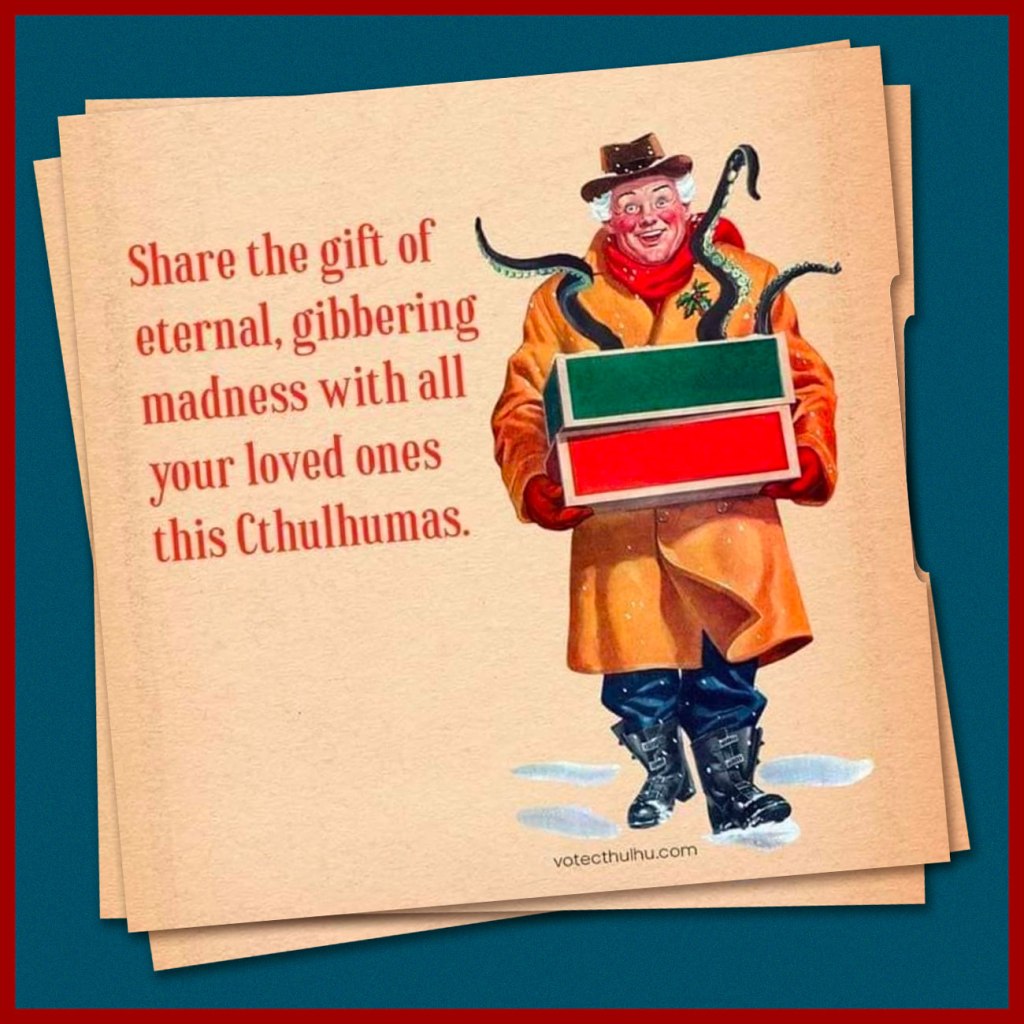
And finally — hope you’ve remembered to mail out all your Unholiday cards! Never forget that the ever-vigilant Cyäegha has its eye on you! [ artist unknown… so far ]
Today’s TT is like one of those 5$ grab bags: you don’t exactly know what you’re going to get, but there will at least one thing you’ll find amusing! Unless the store has cheapened out and stuffed it with nonsense nobody in their right mind would want. This offering, on the other had, is full of our favourite artists, and is not nearly as disparate as I first thought 😉
I don’t always have an over-arching idea for a post, inevitably ending up with plenty of odds and ends that don’t neatly fit into any one category. Actually, some of those “scraps” are the most enjoyable finds for me.
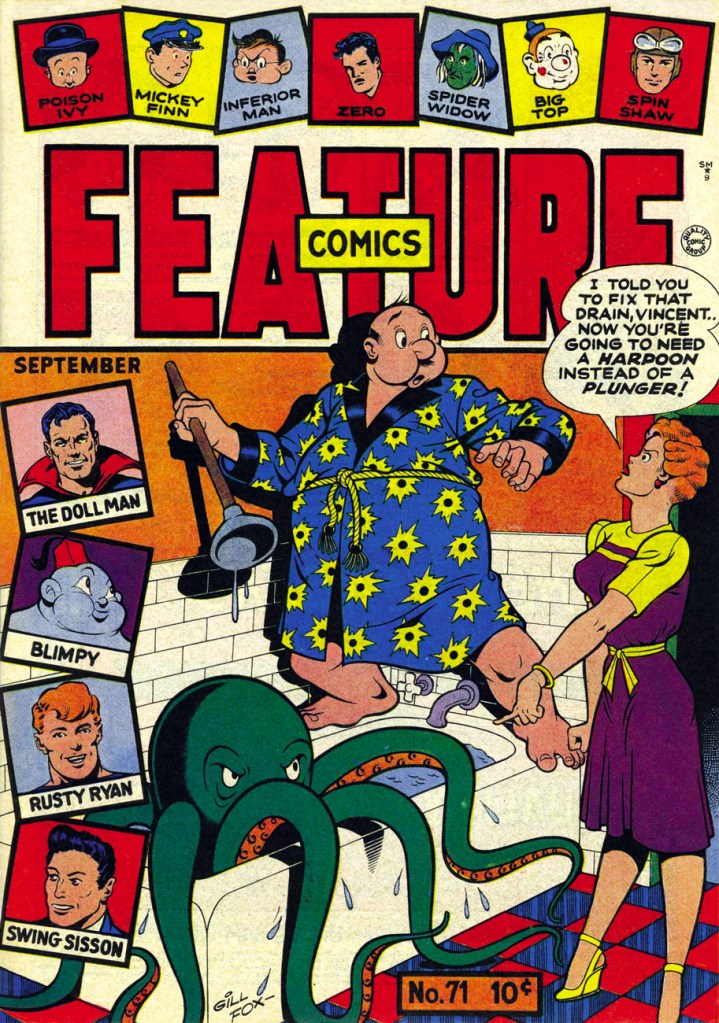
Feature Comics no. 71 (September 1943, Quality Comics). Cover by Gill Fox. The octopus-in-plumbing theme is an oldie-but-goodie; the undaunted housewife may yet regret her cavalier attitude towards the tentacled one, who probably wants to move in with his family.
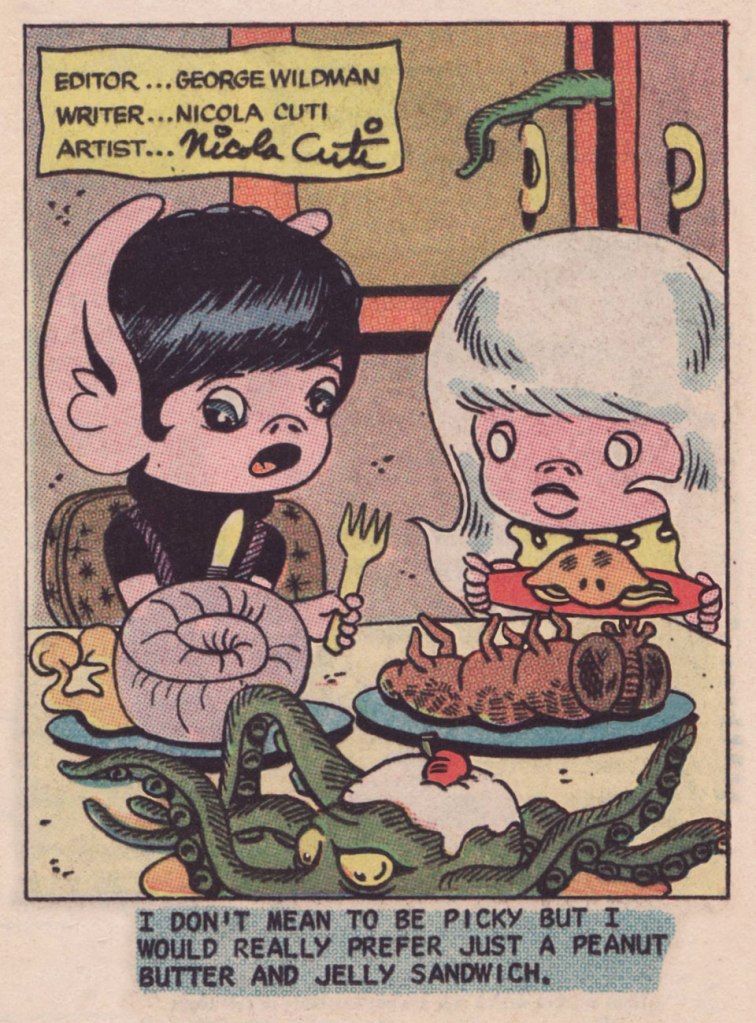
Nicola Cuti‘s Weirdlings was a charming little ‘filler’ gag page designed and drawn by him. This one was published in Haunted no. 14 (Sept. 1973, Charlton). I think the octopus, that appears to be still alive, would also prefer a good old PBJ sandwich.
Archie’s Pal Jughead no. 77 (October 1961). Cover by, dare I say legendary, Samm Schwartz; revisit (or discover!) some of the nicest covers he has drawn for Archie Comics in co-admin RG’s post.
Christmas is approaching fast, so naturally it occurred to me that I have never really done a proper H.P. Lovecraft Tentacle Tuesday. What, does the idea of a festive Cthulhu sound strange to you? But he’s the one who brings nameless horror… err, gifts to little children!
“For several years now, artist Amy L. Rawson has crafted a needle-felted Santa Cthulhu sculpture (often in collaboration with artist Brian East), changing the design each year.” Make sure to visit her website, all aglow with many more Santa Cthulhus and even a Mrs Santa Cthulhu!
I’d like to put us all in the proper chipper mindset, especially since cheer (festive or otherwise) is so hard to come by this horrendous year. For starters, I can make a few decorating suggestions. How about some Christmas ornaments with tentacles? Or perhaps a Cthulhumas wreath? You say your partner would most certainly object… Well, how about an ugly Cthulhu sweater to impress people at your next Zoom meeting? No, not your cup of tea, either? Some people are so hard to please! Well… in that case, let’s just check out some comics.
I actually think that there’s not much point in attempting to adapt Lovecraft stories into comics – it’s just too hard to do properly, and few (if any) people have managed it. How can you transform a description like « the words reaching the reader can never even suggest the awfulness of the sight itself* » into images on paper? Yet I can sympathize with artists who tried to do just that – the grandeur of Lovecraft’s visions is a compelling force. At the same time, he has become a bit of a ridiculous figure by now, his legacy awkwardly stuck between reports of his racism and misogyny and the current ubiquity of the characters he created. Oh yes, it’s tentacles all the way down for this father of our (nearly) collective tentacular obsession… down into memes and light-hearted pokes that abound online, spanning the range between ‘amusing’ and ‘blatantly stupid’. It is possible to buy a cuddly baby Cthulhu toy, for instance (and I would have purchased it, if it hadn’t gone out of stock).
First we’ll take a look at a few serious attempts to adapt HPL stories into comics… ones with tentacles, of course, as this is Tentacle Tuesday, after all. Let’s face it, there have been many, many comics series (and I do mean many) based on, vaguely or directly, on Lovecraft material… and the bulk of this has horrible (in my humble assessment) art, and stories to match. I’m really not interested in reading about how Lovecraft teamed up with Houdini to save Arthur Conan Doyle’s life, but it may be the coolest thing somebody has ever heard. Your own mileage may vary – for every Lovecraft fan who shudders at bad adaptations of his oeuvre, there’s one (or two) who just want to “get to the good stuff, not be derailed by a rambling description of the bloody countryside” (actual quote).
For a detailed look at comics adapting Lovecraft, head over to this Cthulhu Mythos Comics list.
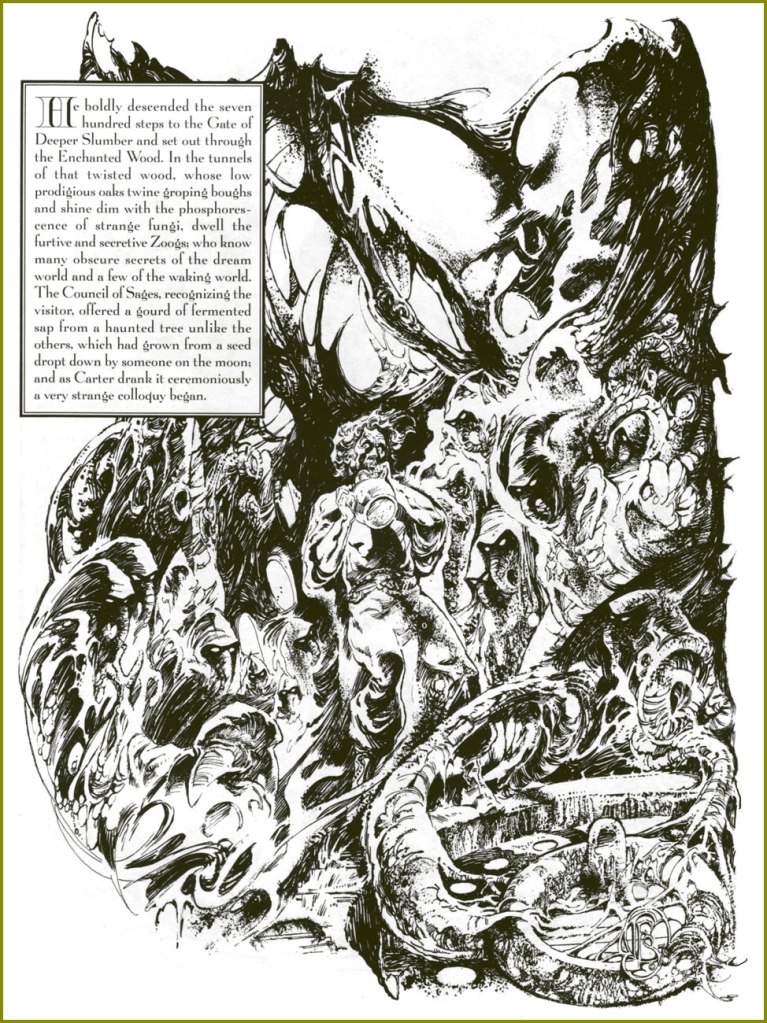
I’ll begin with Tom Sutton visuals – after all, he’s one of our esteemed Tentacle Masters.
The Cover of H.P. Lovecraft’s The Dream-Quest of Unknown Kadath: a Portfolio (1978), with Tom Sutton illustrations of this classic Lovecraft tale.
One has to admit that the sheer horror on the face of the man stuck amidst all these suggested-but-not-quite-clear monsters is supremely convincing!
On the other hand, Richard Corben opted to for clearly defined monsters when he illustrated Dagon:
Page from Dagon, a Lovecraft story adapted and illustrated by Richard Corben, published in Haunt of Horror: Lovecraft no. 1 (August 2008, Max Comics). I like Corben’s art much, much better in colour, so this leaves me rather cold.
Art (once again by Corben) that was used as a cover illustration for Haunt of Horror: Lovecraft no. 1. Read the issue here.
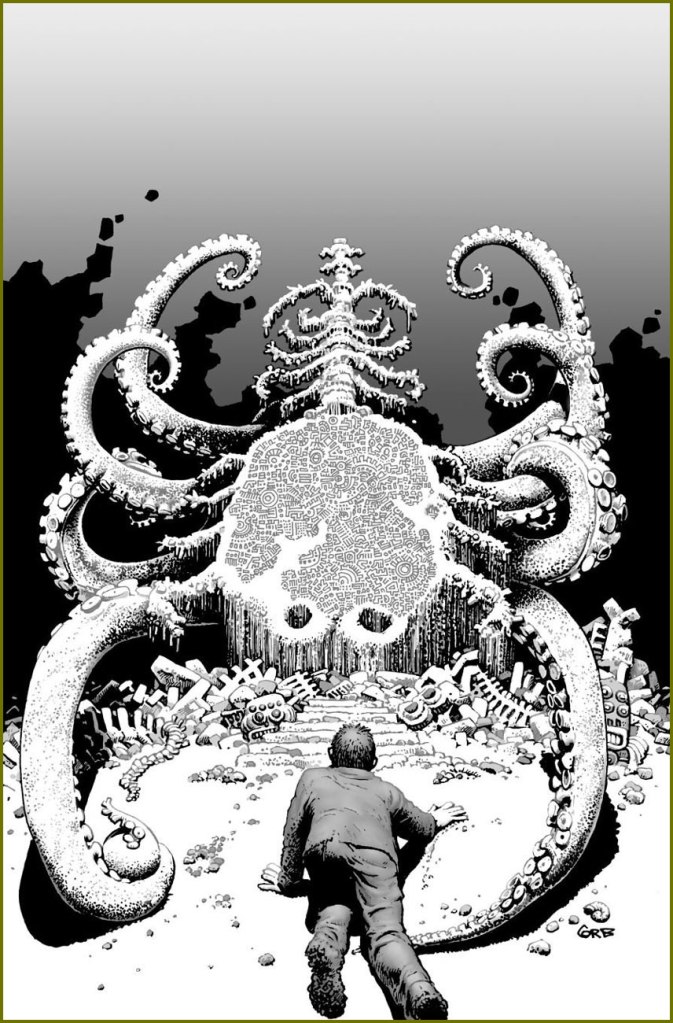
Lovecraft: The Myth of Cthulhu (2018, IDW). Cover by Esteban Maroto. Maroto did a very nice job of depicting out-worldly creatures in stark black and white, with just the right proportion between the well-defined and the merely suggested – have a look at the inside of this book over here.
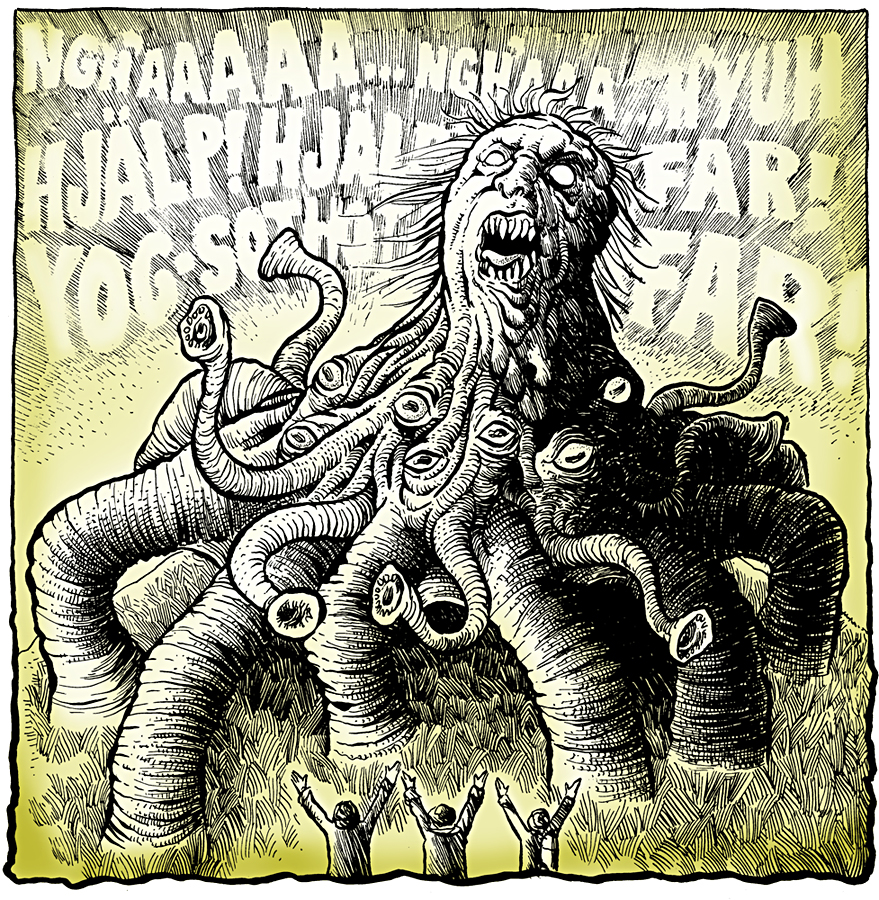
I’ll quote the artist, Richard Svensson: « This is actually a panel from my 10-page comic version of H. P. Lovecraft’s “The Dunwich Horror”. I did it for a small-press Swedish (mostly humorous) comic book Lovecraft anthology. Since there aren’t that many images around showing Wilbur Whateley’s mostly-invisible twin I thought I’d post my own attempt at portraying the unnamable.» A pretty good job, I think!
I don’t actually like Svensson’s art that much, with the exception of this comic, but I dig his animation work, for which he builds monsters out of clay! Watch Out of the Old Land, his latest from September, 2020.
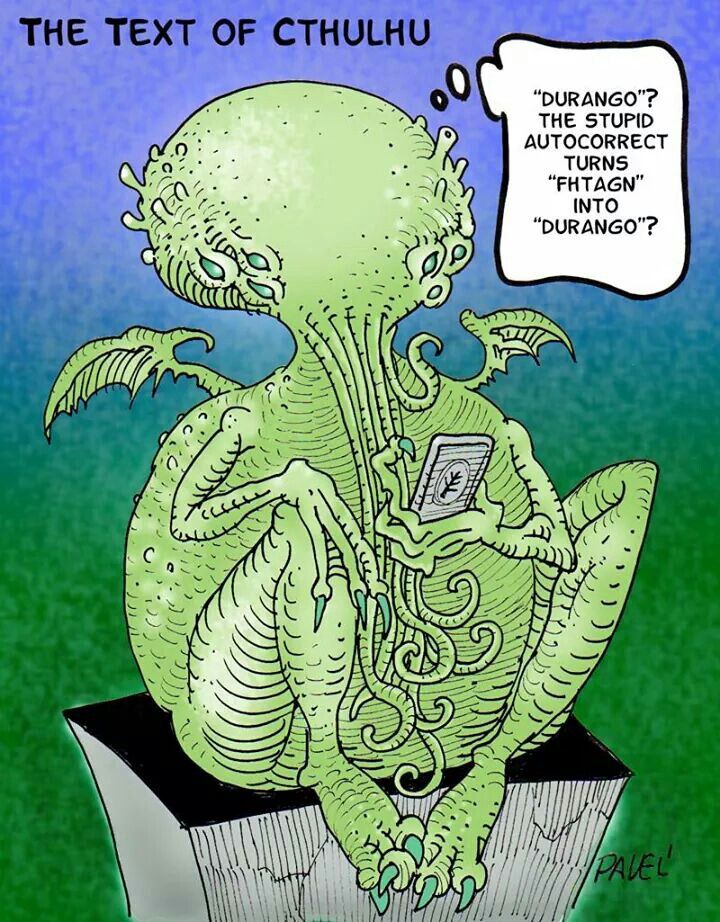
I mentioned earlier how the Great Old Ones have been repurposed as butts of jokes and tropes for memes. Well, I’m not here to share memes (other than very occasionally), but I do have a few nice illustrations-cum-cartoons to share.
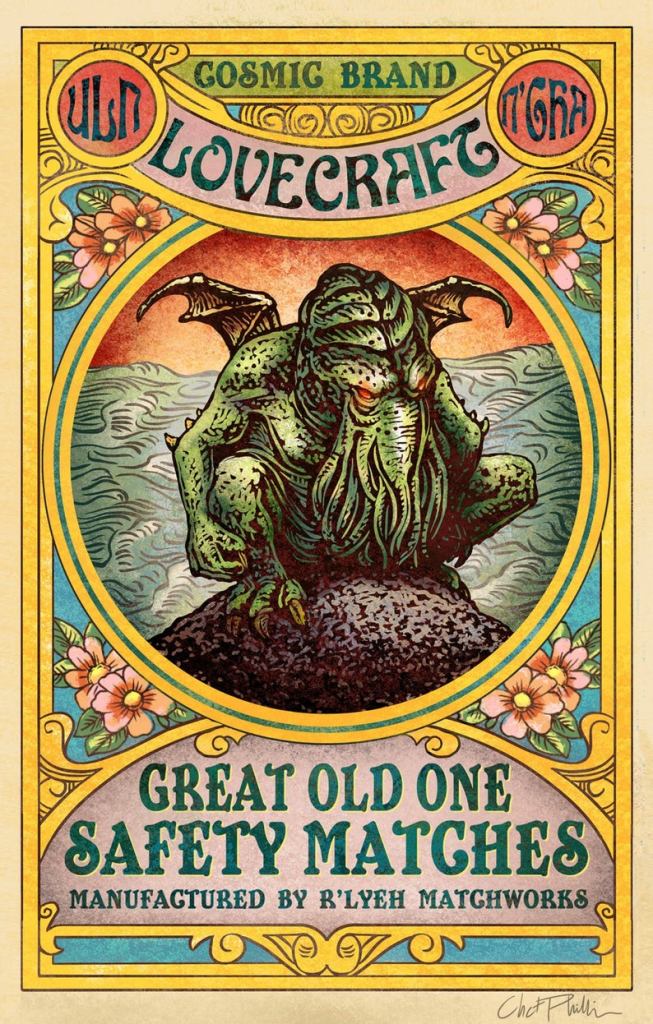
Matchbox design by Chet Phillips (2000); he has a done quite a few, and sells them as prints in his store. I haven’t really witnessed the age of colourful, stylish matchboxes, but I understand the people who collect them! It’s a very quaint and romantic topic.





























 Who's Out There?