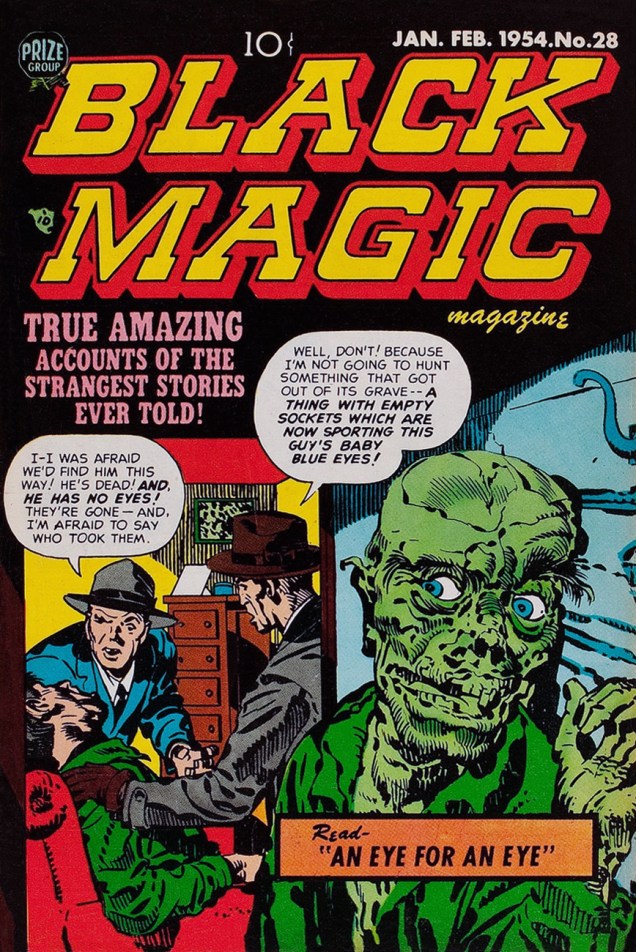
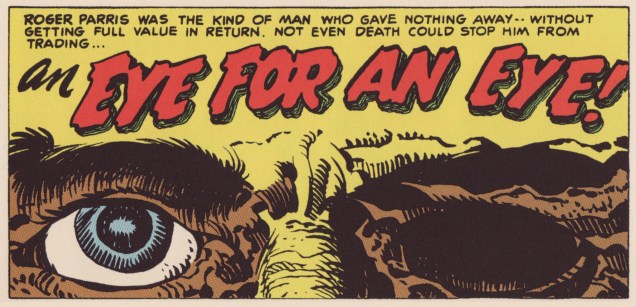
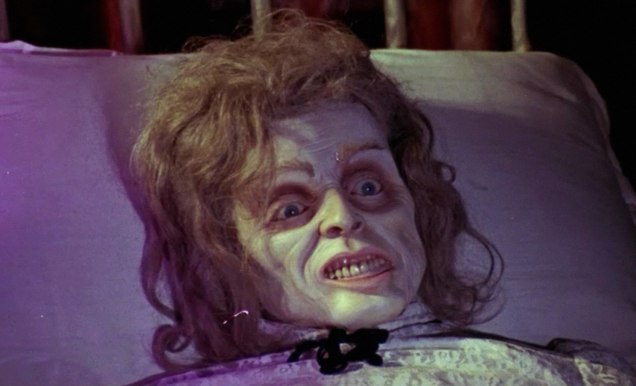
« Within the hour, Roger Parris’ eyes had been removed from his still warm corpse! »
Some specimens of walking corpse are kind enough to just snap your neck or rip out your throat, but not old Roger Parris… he was, and remains, a spiteful coot.
– RG
Some specimens of walking corpse are kind enough to just snap your neck or rip out your throat, but not old Roger Parris… he was, and remains, a spiteful coot.
– RG
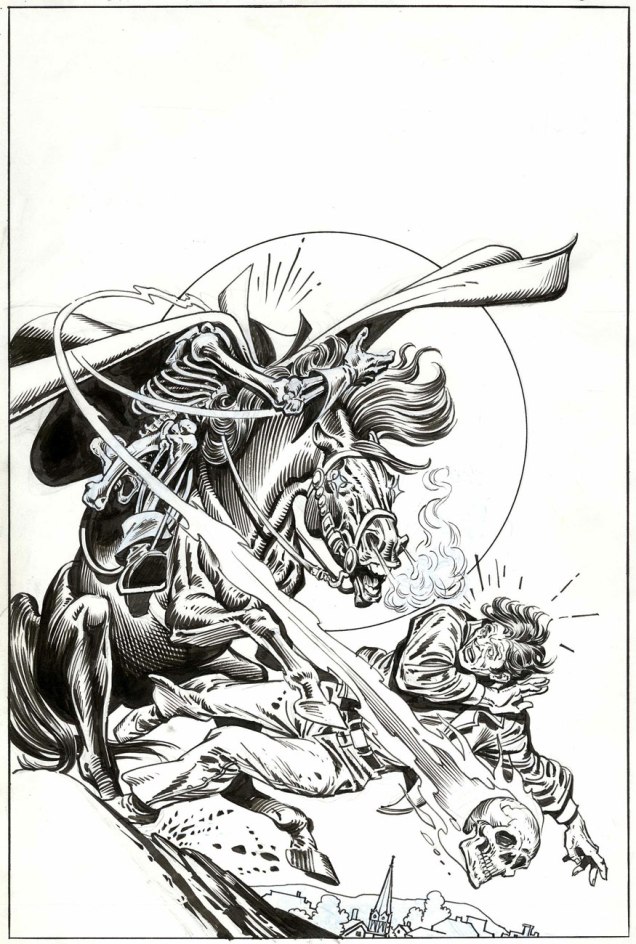
I won’t pretend that The Headless Horseman Rides Again is all that good a comic book, even by the standards of 1973 Marvel. It’s a clumsy narrative hodgepodge, a tangle of tough guy private dick clichés and your basic Scooby Doo plot, courtesy of Gary Friedrich (Ghost Rider, Son of Satan). But it’s agreeably moody in spots, considerably helped along by a solid art job by the prolific George Tuska (1916-2009), who’s not, for once at Marvel, saddled (ha!) with the likes of Vince Colletta. Here he’s smartly matched with the fine but generally undervalued Jack Abel (1927-1996), whose velvety strokes significantly add to the fittingly nocturnal ambiance.
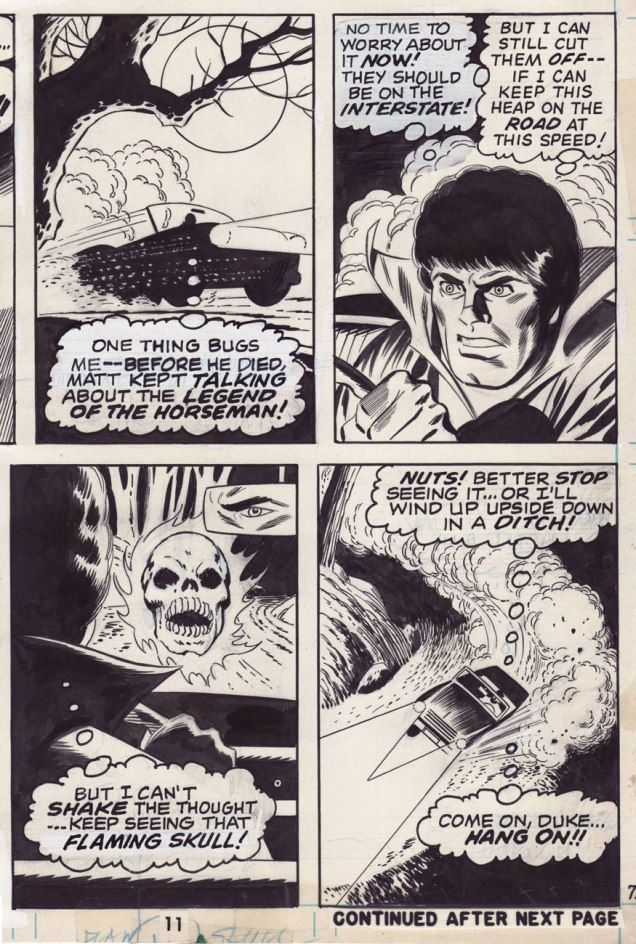
The issue bears your typical hyperkinetic Gil Kane 70s cover, winningly inked by Ernie Chua/Chan. This is Supernatural Thrillers no. 6 (Nov. 1973, Marvel).

– RG
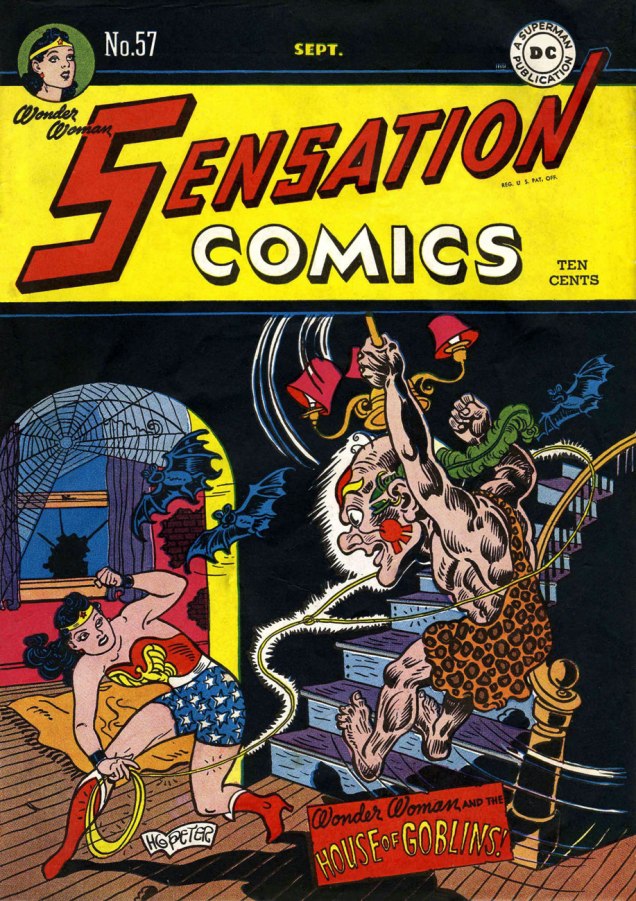
Here’s a real hallowe’en corker from the Golden Age of comics, featuring the ageless Wonder Woman, presented here by her original creative team… with a twist. While the story is credited to Charles Moulton (the nom de plume of William Moulton Marston), it was ghost-written by his former student and collaborator Joye Hummel (1924-), the first woman to write Wonder Woman’s adventures. She is frequently credited for being the first woman to script superhero comics, but nope, that’s at least three years after Tarpe Mills gave the world her Miss Fury.
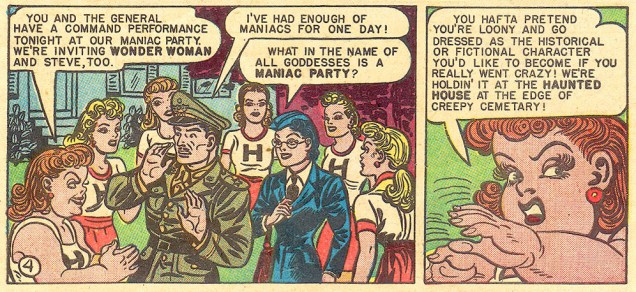
Unfortunately, Joye appears to have been left out of the recently-released biopic Professor Marston and the Wonder Women. Too complicated? I guess a ménage à trois is plenty to handle already.
Check out the film’s trailer (well, one of them, at any rate.)
– RG
Topps’ legendary Wacky Packages, the bane of school authorities at their peak in the 1970s, have been opening kids’ eyes in the art of tipping over sacred cows for generations. Since everyone’s presumably well-versed in the classics (essentially the initial 1967 and 1973-75 burst of creativity), it wouldn’t be a bad idea to showcase some newer fare. In the wake of an internet-fuelled wave of nostalgic popularity, the Wackies rose again with their All-New Series (2004-), and their quality is every bit as impressive as it ever was… thanks in part to a plethora of new products to lampoon, greater creative latitude for the perpetrators, a motley crew of grizzled veterans and homely new faces.
For your contemplation, here’s a trio of Hallowe’en-appropriate cards from new series 7 (2010).


Brent Engstrom, who painted nineteen cards for the 2010 series, shares some valuable insights (and preliminary sketches): http://monkeyboycomic.blogspot.ca/2010/08/wacky-packages-all-new-series-7-2010.html
And here’s the great Jay Lynch’s (1945-2017) account of how a set of Wacky Packages was created, from idea farm to market: http://wackypackages.org/history/production.html
– RG
Adapting Howard Phillips Lovecraft’s sinister literature to other media has always been as tempting as it is daunting. It absolutely requires the discernment to know when to hold back and when to go all out, and therein lies the difficulty: it’s a rare gift.
Eureka Productions’ Graphic Classics series of anthologies wisely chose, for the cover of its HPL entry (from 2002), a detail from Todd Schorr’s wry 1993 painting, H.P. Lovecraft’s Fried Seafood Cart.

Schorr, born in 1954 in New York City, first became aware of HPL in high school and « became totally consumed in his writings. » « When read now », continues Todd, « Lovecraft’s work still retains the same spine-shivering thrills I first experienced. »
More Schorr: http://www.toddschorr.com/
And a view of the full painting (taken in a gallery, pardon the reflections):

– RG
Egyptian-born (but of Greek descent) Basil Gogos (March 12, 1929 – September 13, 2017), may be most celebrated for his prodigious run of Famous Monsters of Filmland cover paintings. Ah, but that’s hardly all he’s done, and done well: advertising, paperback covers, film posters*, men’s adventure illustration…
His forays into the world of Uncle Creepy and Cousin Eerie were quite rare, so let’s savour them. This is Eerie no. 30 (November, 1970), depicting a scene from Don Glut and Jack Sparling‘s “The Return of Amen-Tut!”. Read it here.

…and here’s a look at Gogos’ original painting.

Thanks for all the colourful nightmares, Mr. Gogos!
*his Alain Delon looked more like Bob Guccione Sr., which frankly is no compliment. And is that supposed to be Ornella Muti? No cigar, Mr. Gogos. Still, the film (misleadingly) depicted here, « La mort d’un pourri » (1977), is a superior political thriller that anticipates several of the less savoury aspects of globalization. This is the original art from the Spanish poster… « Muerte de un corrupto ».


And here are Mr. Guccione, bon vivant and founder of Penthouse Magazine, and Ms. Muti, the quintessential Italian starlet of the 1970s, as she appears in the film.
– RG
John Pound, best known for his psyche-scarring work on the Garbage Pail Kids (not a bad entry in one’s résumé, unless you’re applying for a position in accounting), dabbled in underground comix in the 1970s. This useful primer in DIY makeup, inspired by the work of such classic monster makers as Dick Smith, Verne Langdon and Alan Ormsby, has the drawbacks of being a tad time-consuming and rather irreversible, but these are mere quibbles.


Originally published in The Gory Story Quarterly no. 2 1/2 (1972), edited by Ken Krueger, and reprinted in the much-easier-to-find-and-afford Ground Pound collection (1987, Blackthorne).
For further edification (and more genteel makeovers), this, in essence, is what was being lampooned. The Famous Monsters of Filmland Do-It-Yourself Monster Make-Up Handbook was a 1965 one-shot that’s nowadays rarer than Lady Effingham’s Eggs, presumably because all purchased copies were loved to bits. Let’s not forget to point out that this publication, like FMOF proper, was designed and hand-lettered by the incredible Harry Chester (who also designed Mad Magazine).

– RG
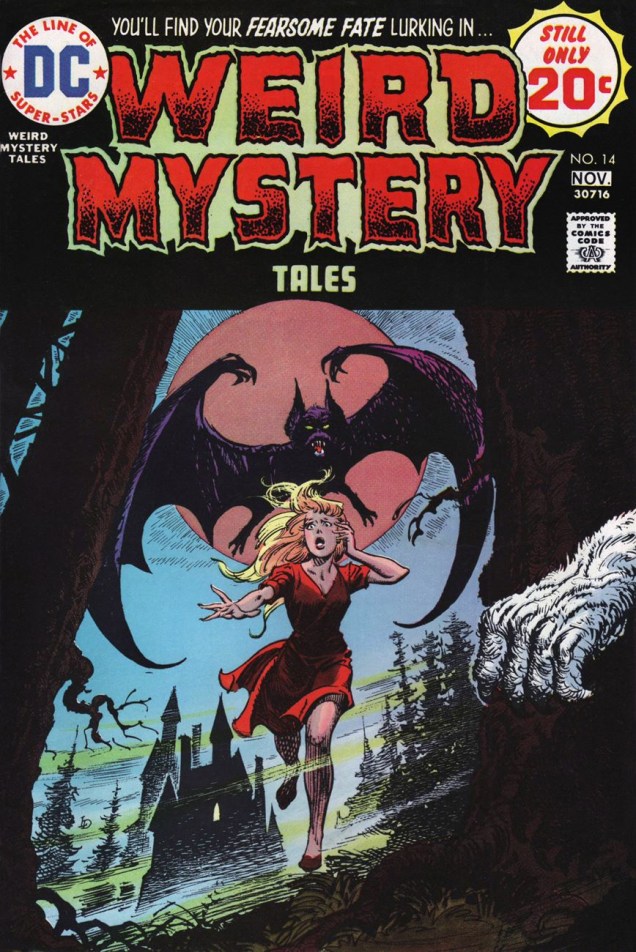
Always one of DC’s underdog mystery titles, Weird Mystery Tales was actually more consistent than its sister titles. Its relative lack of success was perhaps due to its original host, Destiny, being a bit of a flat tire. He was replaced with Eve (you know, Cain, Abel…) with this issue.
Still, the entire run is worth seeking out, thanks to contributions from Jack Kirby (okay, leftovers, but delicious leftovers from the unpublished second issue of his Spirit World magazine), Sheldon Mayer, Robert Kanigher, Steve Skeates, Alfredo Alcala (his and E. Nelson Bridwell’s adaptation of John Russell’s The Price of the Head is my pick for the title’s finest moment; it appears in this issue), Frank Robbins, Ruben Nunag Yandoc, Michael Wm. Kaluta… hey, it’s an anthology: you *know* the list goes on and on.
This is Weird Mystery Tales no. 14 (October-November, 1974). Cover by Luis Dominguez. Mute terror… isn’t it more effective?
– RG
Here’s one from early in the funnybook game. Eastern Color’s anthology title Famous Funnies (July, 1934 – July, 1955, 218 issues), is generally held to be the first true American comic book. This is October, 1939’s issue 63, with a cover by Victor E. Pazmiño (1899-1970), who often initialed his work VEP (not to be confused with Virgil Partch’s VIP). Our featured protagonists are Sam Smithers and his tormentor, Pigtails.

Should you have a little time on your hands, you can read this issue, and many others in the series, right here, through the auspices of the fine folks at comicbookplus.com.
-RG
(Does that only apply to red wine?)
As far as 80s reprint packages go, this was something special by any measure: first of all, though the spooky tales within were produced in the pre-code 1950s, they had never gone to press. The material was intended for the 15th issue of Pines/Standard/Better/Visual Editions’ Adventures Into Darkness, which was never published, presumably in the wake of the heavy-handed censorship of the newly-instituted Comics Code Authority. Why bother revising and releasing a book that likely wouldn’t even get distributed?
Second, the originals were adapted for the 3D process. The effect was quite the rage in 1953-54, but these particular 3D separations were created retroactively, in the 80s, by modern stereoscopy master and keeper of the flame Ray Zone (1947–2012) and Tony Alderson.
Third, these morbid tales weren’t just hackwork scarcely worthy of publication, at least art-wise: they feature such solid talents as George Roussos, Mort Meskin, Mike Sekowsky, Alex Toth and Gene Fawcette.
And finally, there’s that eyeball-caressing Dave Stevens (1955-2008) cover. The gone-too-soon creator of The Rocketeer also made his mark with a cherished handful of covers in those dark Reagan years, a mark that thankfully shows no sign of fading.

This is Seduction of the Innocent 3-D (Oct. 1985, Eclipse). Logo by Ken Steacy.
If you’re in the mood, a couple of 2D samples of the issue, perhaps? Try Harvest of Death or Death Dives Deep. Just tell dear Mr. Karswell we sent you!
– RG

