Shel Silverstein: Without Borders

« I’m not content when I’m traveling, but I’m not content when I’m not traveling. So I guess I’ll keep traveling. » – Shel Silverstein

Another one of those nice Jewish boy geniuses, Sheldon Allan Silverstein (1930-1999) was born eighty-eight years ago, on September 25, 1930, in Chicago, Illinois. Uncle Shelby lived life to the fullest, creatively in every respect. He tried his hand at many things, and what do you know? He succeeded at every often-unlikely turn, sometimes artistically if not commercially, but generally on both counts: cartoonist, singer, songwriter, screenwriter, poet, actor, playwright, children’s book author, bon vivant, raconteur and lover… yet his dad was never impressed. Old man Nathan wanted his son to join him in selling furniture. Some obstacles are just plain insurmountable.

Once more, faced with the daunting prospect of discussing a prolific and versatile creative soul, it seems well-advised to concentrate on a tiny area of his roadmap. And so…

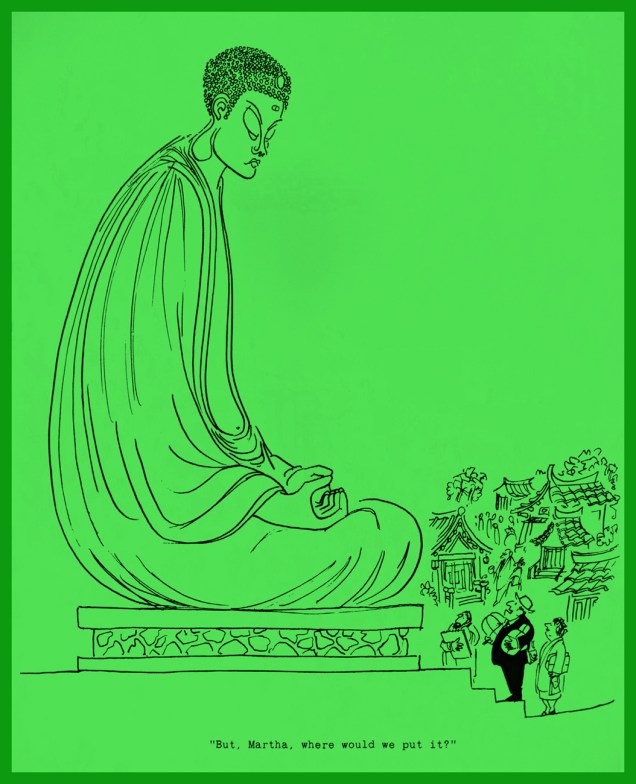
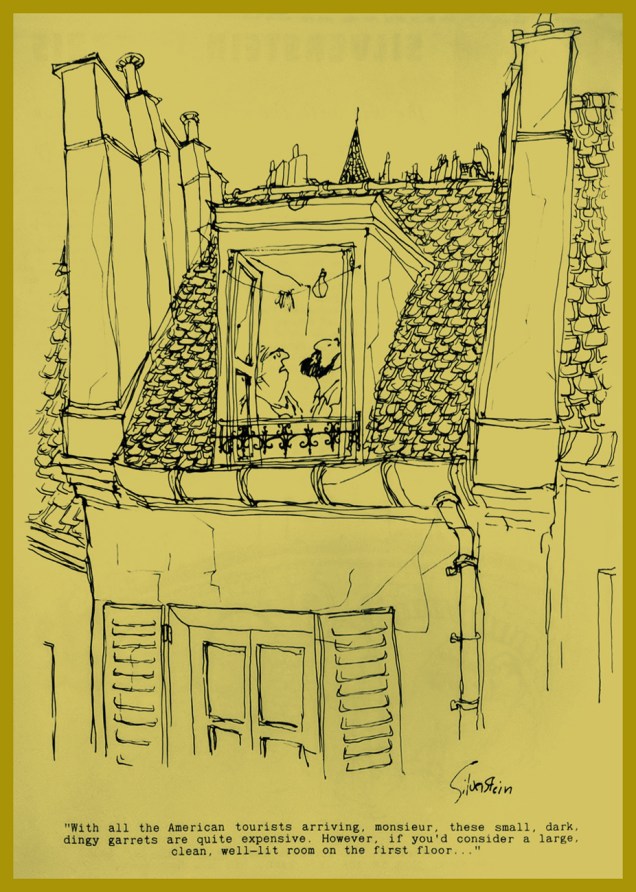
In 1957, Playboy magazine founder and esteemed patron of cartoonists Hugh Hefner entrusted Shel with a special assignment, that of roaming the Earth and recording his special impressions. The results, published between 1957 and 1968, were twenty-three travelogues brimming with the gregarious Silverstein spark and spirit. But he first had to be sold on the approach. According to Hefner, in his foreword to the definitive collection “Playboy’s Silverstein Around the World” (2006), « I envisioned something along the travel letters Ernest Hemingway submitted to Esquire — A sort of personal diary that would be dispatched from around the globe. Shel was uncomfortable in that role. He didn’t want to include himself, but I persisted. And I’m glad I did. What we got back in those drawings was narrative storytelling of a very personal manner. We saw Shel establish himself as a character.»
ShelBuddahA
From “Return to Tokyo” (May, 1957).
ShelGarretA
From “Silverstein in Paris” (January, 1958).
ShelMoscowA
From “Silverstein in Moscow” (March, 1958).
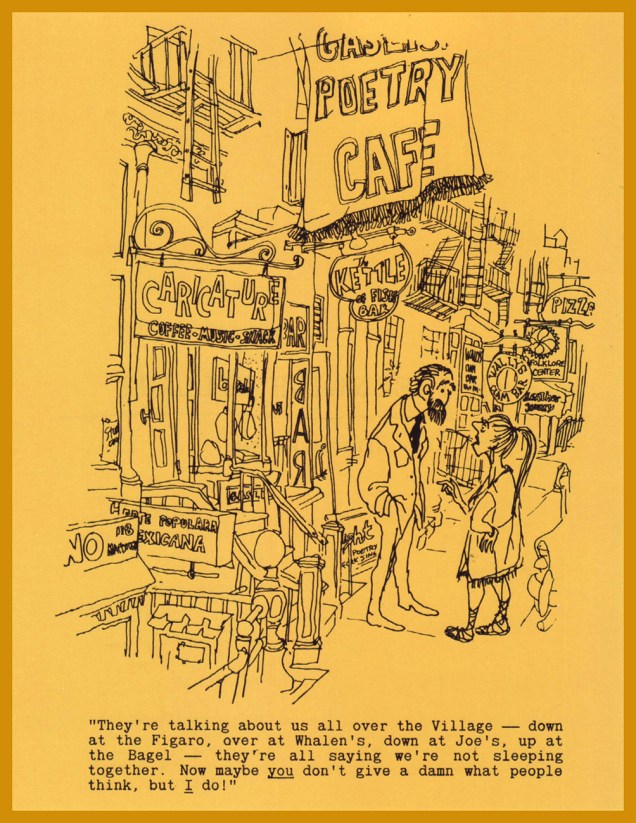
ShelGreenwichA
From “Silverstein in Greenwich Village” (September, 1960).
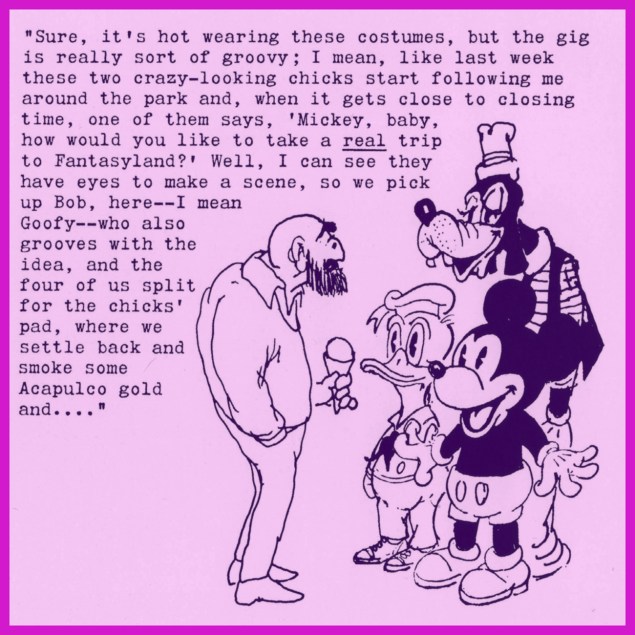
ShelGoofyA
From “Silverstein in Hollywood” (January, 1968).
ShelNewsstandA
From “Silverstein Among the Hippies” (August, 1968).
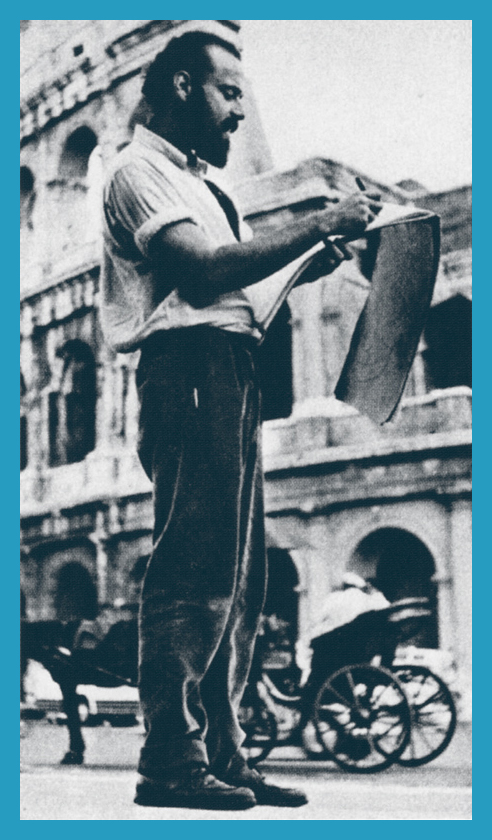
ShelPortraitA
Shel at work in Italy (1958); photograph by John Reid, Jr.

Let’s leave off with these revealing words from Playboy photographer Larry Moyer: « He was one of the funniest guys I ever knew — and it was never at anybody’s expense. A lot of humor is based on putting other people down. I don’t remember one time Shel ever put anybody down in his work — and that’s something. » That’s something indeed, now more than ever.

– RG
Buettner & Fallberg: Quick on the Draw

« I prefer drawing to talking. Drawing is faster, and leaves less room for lies. » – Le Corbusier

Carl Buettner (1905-1965) started out as an animator with Disney Studios and Harman-Ising Studio (founders of Warner Bros and MGM animation studios), then shifted to newspaper strips for a few years (Charlie McCarthy, 1938-40), then on to Western Publishing for the rest of his career, handling a bunch of Disney characters for Dell Comics (Joe Carioca, Bucky Bug, Dumbo The Flying Elephant, Bambi…) until the early 1950s, when he became editor of Western’s Little Golden Books line.

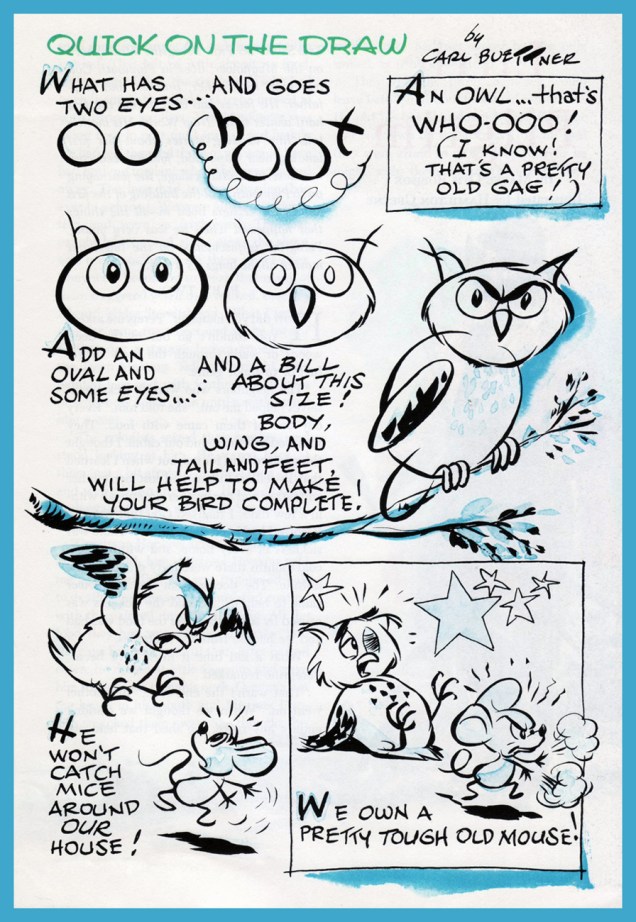
On the side, he kept his hand in with a nifty tutorial feature, “Quick on the Draw”, that ran in Western’s The Golden Magazine for Boys and Girls. Though he passed away early in 1965, Buettner’s QOTD ran well into the next year, since he was evidently working well ahead. The feature was then taken over by his fellow former Disney animator and scribbler Carl Fallberg (1915-1996). Fallberg spent most of his long career working on the scripting and story directing side, but he evidently kept his pencils sharp.

QuickDrawOwlA
From Golden Magazine Vol. 2 No. 10 (October, 1965)
QuickDrawElephantA
From Golden Magazine Vol. 2 No. 11 (November, 1965)
QuickDrawTrainA
From Golden Magazine Vol. 4 No. 4 (April, 1967). Fallberg was a lifelong “narrow gauge” railroad enthusiast. His delightful Fiddletown and Copperpolis cartoons, published in Railroad Magazine in the late ’40s to the early ’50s, were collected in 1985 and still in print (and affordable!) to this day.
QuickDrawArmadilloA
From Golden Magazine Vol. 4 No. 9 (September, 1967)
QuickDrawOstrichA
From Golden Magazine Vol. 4 No. 12 (December, 1967)

– RG

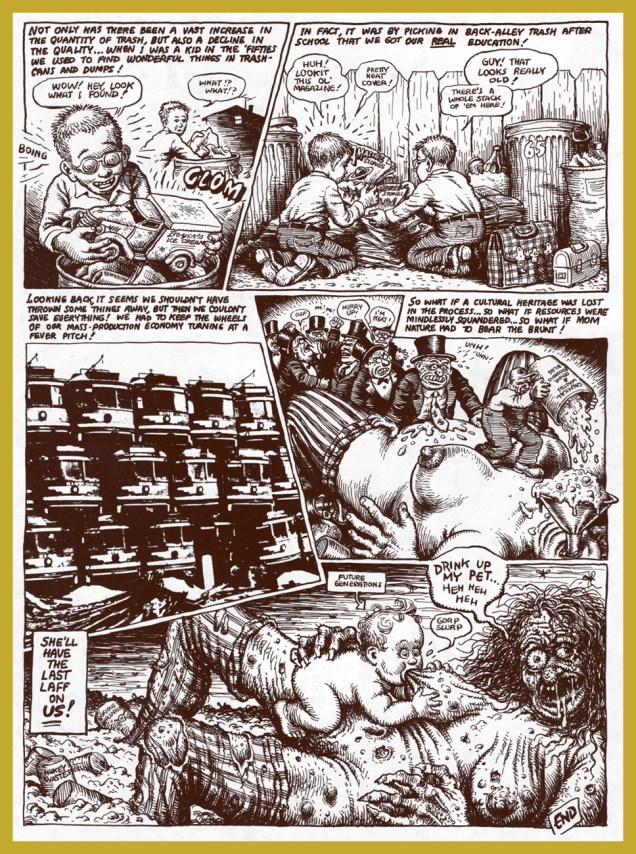
R. Crumb’s “Trash – What Do We Throw Away?” (1982)

« Maybe we could find some way to send barges of trash to the sun and incinerate it all. Hey, it’s an idea. It’s an idea! » — Adam West

Lately, I’ve noticed that crusty ol’ Bob Crumb is being pilloried… well, more than he usually is. It appears that some members of the, er, younger cartooning generation are taking offense, in the most tone-deaf,  irony-deprived and contextually-clueless way imaginable, to a half-a-century old, utterly static, wafer-thin and inaccurate idea of his work. « …old white cartoonists of the most explicitly homophobic, anti-feminist, racist, and controversial comics of 70s/80s ». Funny, I’d say that comment itself is more than slightly racist (not to mention ageist). Guess it’s open season on some targets.

Ah, but it’s a waste of time, saliva and ink trying to convince zealots of any stripe of anything. I don’t enjoy all of Crumb’s work myself, but when a particular piece doesn’t grab me, I just move along. But the medium would be much the poorer without his (in no particular order and just off the top of my head): A Short History of America, Introducing Kafka, Heroes of the Blues / Early Jazz Greats / Pioneers of Country Music card sets, his collaborations with Harvey Pekar in American Splendor, most of his Weirdo pieces, his album covers, « Ode to Harvey Kurtzman », Stoned Agin, his American Greetings cards, and… I’ll be here all night if I keep this up.

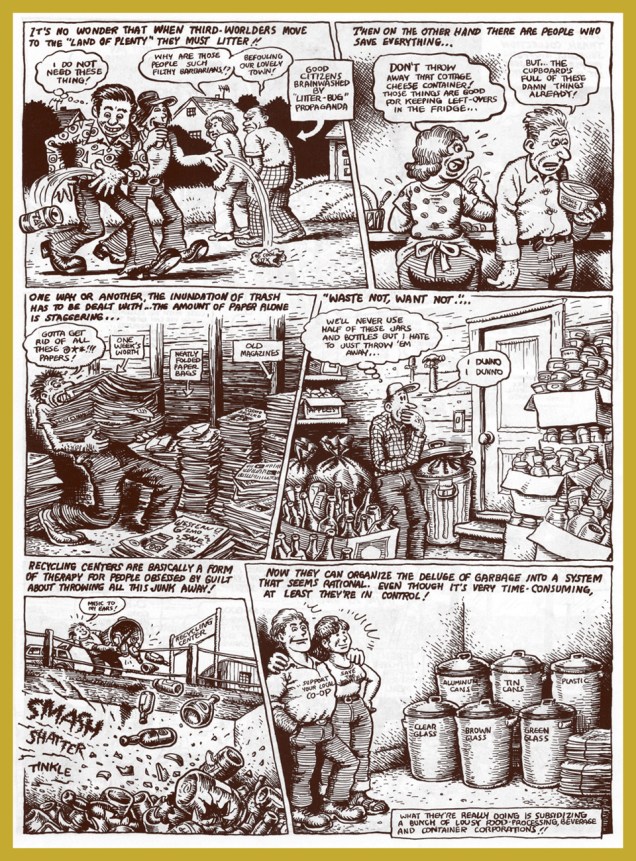
I was going  to feature what’s possibly my all-time favourite Crumb story, « The Religious Experience of Philip K. Dick » (Weirdo no. 17, Summer 1986), but lo and behold, it’s already available in full on the philipdick.com site… but as there’s no dearth of first-rate picks, here’s another comics essay from the pages of Weirdo (no. 6, Summer 1982). Please note how fair-minded and even-handed Crumb is here: I’m certainly guilty myself of a couple of the attitudes and behaviours depicted, but since the author’s challenge is so unflinchingly honest, his criticism becomes food for thought. He’s not interested in flattering the comfortable, including, most of the time, himself.

CrumbTrash01ACrumbTrash02ACrumbTrash03ACrumbTrash04A

I’ll leave you with some sage words from Alan Moore, who describes the circumstances of his love affair with Angelfood McSpade: « Firstly, and more obviously in the case of this particular image, there was the open sexuality. Not having led a terribly sheltered life, I was familiar with the images of sex to be found in the neighbourhood magazine racks, ranging from Playboy to the Fry-the-Krauts-on-Passion-Bridge ‘Men’s Sweat’ periodicals of the day, to the soft-core titillation of homegrown products like Parade. Judging from the drawings and photographs that graced these magazines’ covers, sex was something that was deadly serious, not to say faintly miserable, smothered as it was in commercial gloss and the self-conscious poutings of the ex-stenographers staked out across the centre spread.

Angelfood was different. She was wearing, in addition to the grass skirt, a big, pleased-with-herself smile rather than the slightly-concussed ‘Just Raped’ look that her cover girl contemporaries were starting to adopt. It was my first taste of the sexual openness of the psychedelic movement, and though it bears little relevance to my overall impression of Crumb’s work, it requires mention in these terms for the personal impact that it had upon me. This is not to say that its effect in other areas was not equally as marked. Sexuality aside, this drawing was subversive.

For one thing, it was subversive in the way it commented upon race. Many cartoonists since Crumb have referred back, ironically, to the stereotyped image of black people that dominated the cartoons of the past, but this was the first time I’d seen it done: the first time I’d seen a cartoon depiction of a Negro so exaggerated that it called attention to the racialism inherent in all such depictions. » (excerpted from “Comments on Crumb”, Blab no. 3, Fall 1988, Kitchen Sink.)

CrumbILoveYouKeepOn
Keep on Truckin’ and the copyright law rabbit hole

– RG

p.s. This was our 200th post… thanks for your interest and support!

Mother Earth’s Plantasia

« Unless you’re some kind of masochist, I would imagine that you’d like to begin your plant experience with the easy, almost impossible-to-kill group. »

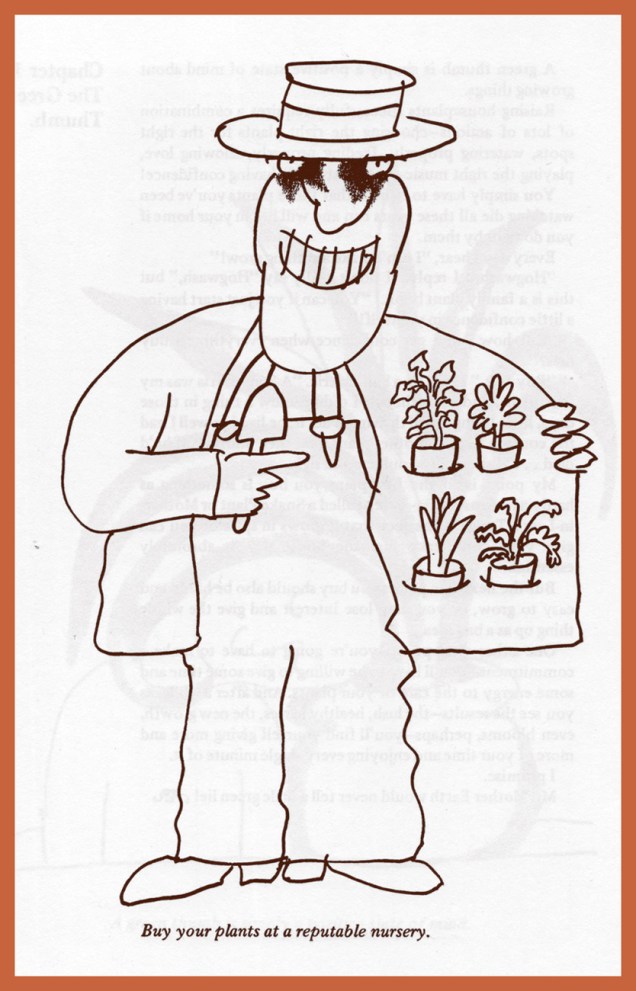
A sunny reminder of some of the plant world’s myriad of virtues, from 1973’s Mother Earth’s Hassle-free Indoor Plant Book by Lynn and Joel Rapp, a terrific little tome that bears the probably unique distinction of having yielded its own soundtrack. Not only that, but its own *excellent* soundtrack, Mother Earth’s Plantasia by Canadian-born songwriter, producer and electronic music pioneer Mort Garson. The LP was distributed through one of the wackiest marketing schemes I’ve ever encountered: it was given away with the purchase of a Simmons mattress from Sears. Uh?

PlantasiaRubinA
« A green thumb is simply a positive state of mind about growing things. »

I see Plantasia’s even been reissued a few years back on fancy 180 gram vinyl (along with other formats and impressive ancillary products). But you can hear it in its entirety without making the considerable financial investment, thanks to this lovely tribute on the Music Is My Sanctuary blog.

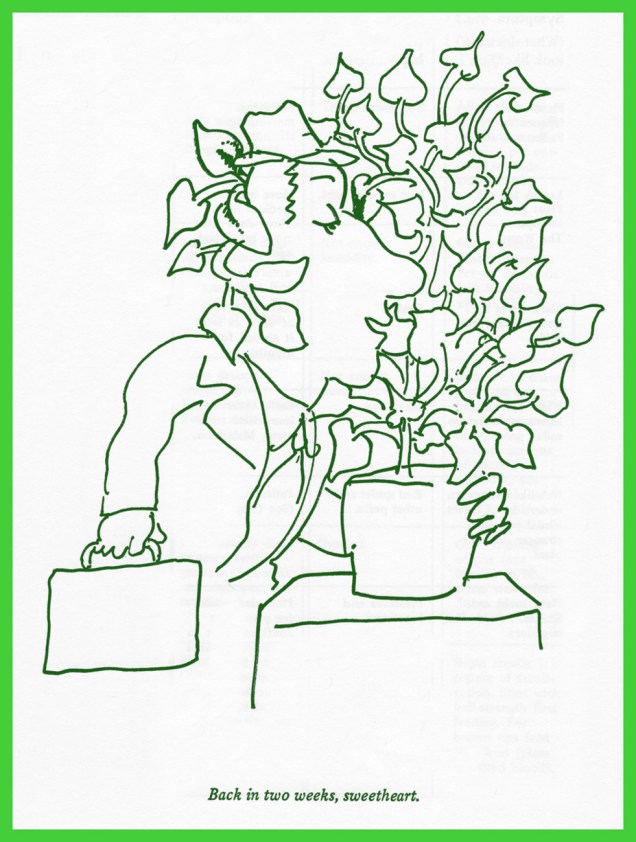
The book (and LP booklet) are illustrated by « Marvelous » Marvin Rubin… who quite deserves the sobriquet, if you ask me.

RubinPlantasia01A
« I was first introduced to Bromeliads by a 75-year-old semi-retired mechanic named Rafe ‘Frenchy’ DeLago. At least I thought I was. It turns out that I was actually first introduced to Bromeliads by my mother and the Dole Company, but neither my mother nor I knew it at the time. Truth is, my mother still doesn’t. You see, all pineapples are Bromeliads. In fact, all Bromeliads are pineapples! »

RubinPlantasia02A

RubinPlantasia03A
As confirmed by George Orwell’s sole comic novel, Keep the Aspidistra Flying.
RubinPlantasia04A
« Those plants will grow in your house, all right, but they’d grow better if you lived in a greenhouse. »
RubinPlantasia05A
« It is well known that plants grow best to classical music, but we have been told about a hip Dieffenbachia who loves The Rolling Stones. »
RubinPlantasia06A
« As people in the plant business, take it from us: the worst pest when it comes to killing plants is Homo sapiens. »

RubinPlantasia07A

– RG

Will Eisner’s The Spirit at Fiction House

« Our story opens on a rainy night on Central City’s waterfront… »

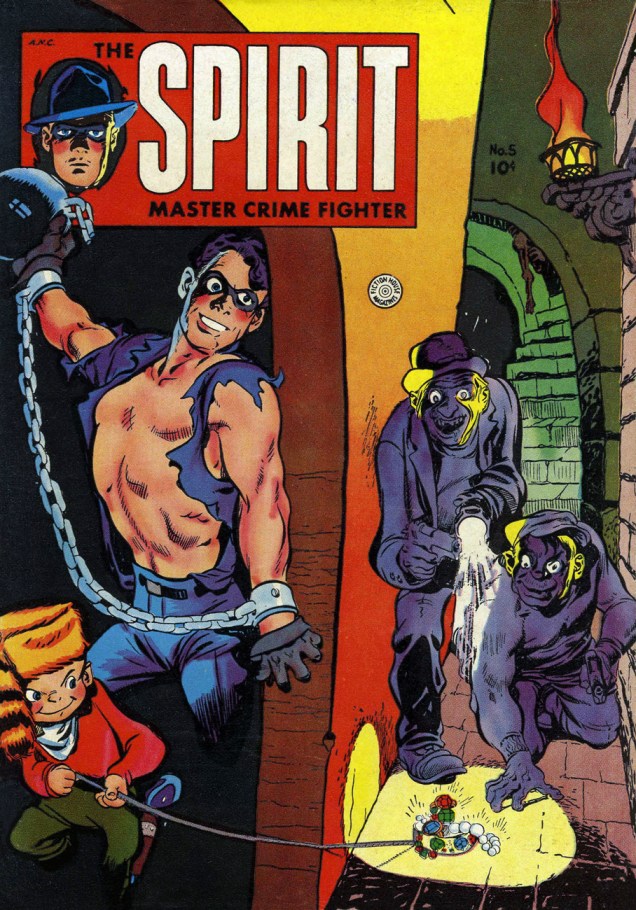
Continuing our chronicle of The Spirit’s wanderings from harbour to harbour over the decades, we make land today at pulp and comic book producer Fiction House, whose “Big Six” were the blandly-named but action-packed Fight Comics (86 issues, 1940–1954), Jumbo Comics (167 issues, 1938–1953), Jungle Comics (163 issues, 1940–1954), Planet Comics (73 issues, 1940–1953), Rangers Comics* (69 issues, 1941–1953) and Wings Comics (124 issues, 1940–1954). Compared to these, The Spirit’s five-issue stay was but a blip. Still, since FH’s art director was none other than Eisner’s old partner Samuel Maxwell “Jerry” Iger (1903-1990), this particular match is unsurprising.

Of course, it wasn’t common knowledge at the time, but these issues comprise little else but what came to be known as “the post-Eisner Spirit”, inarguably inferior work with the occasional highlight, generally a Jules Feiffer script let down by the visuals.

According to Eisner, interviewed in 1990 by Tom Heintjes: « Looking back, I have to say that it’s a blemish on my career that I allowed The Spirit to continue through this period, because I compromised the character just because I was busy with other things. That’s not to say that these are all bad stories, but they just don’t have the consistent outlook they had when I was directly involved. » « I look at these stories and I want to cringe – again, not because they’re bad, but because only the merest essence of the character is retained. »

If such is the case,  then it’s no small mercy that Will didn’t live to witness Frank Miller‘s masterwork of desecration.

SpiritFH1A
This is The Spirit no. 1 (Spring, 1952), featuring The Case of the Counterfeit Killer (Sept. 16, 1951), cover-featured The Curse of Claymore Castle (Nov. 4, 1951), The Plot of the Perfect Crime (Oct. 28, 1951), and Panic on Pier 8 (Aug. 19, 1951), each scripted by Feiffer. Cover artist unknown, but it’s a considerable improvement over the actual story.
SpiritFH2A
This is The Spirit no. 2 (Summer, 1952), reprinting The Amazing Affair of the First Man on Mars (Jan. 27, 1952), Contraband Queen (May 20, 1951), The Case of the Baleful Buddha (Nov. 18, 1951), and The $50,000 Flim-Flam (Apr. 15, 1951), the final three benefiting from some Eisner involvement. Again, cover artist unknown., but isn’t that gorgeously coloured?
SpiritFH3A
Ah, we’re getting more Eisner-ish, though not quite all the way. This is The Spirit no. 3 (1952), featuring The Walking Corpse (Mar. 9, 1952), It Kills by Dark (Feb. 24, 1952), The League of Liars (Nov. 25, 1951), and A Man Named Nero (Feb. 3, 1952). The first three are scripted by Feiffer, and the fourth is undermined; I wouldn’t brag about that one either.
SpiritFH4A
This is The Spirit no. 4 (1953), featuring The Last Prowl of Mephisto (Apr. 1, 1951), scripted and illustrated by a heavily-assisted and pressed for time Eisner; Design For Doomsday (Jan. 13, 1952), The Sword and the Savage (Sept. 2, 1951), and The Great Galactic Mystery (Apr. 20, 1952), these last three scripted by Feiffer. And another nearly-Eisner cover… he never would have made it this busy, I think.
SpiritFH5A
This is The Spirit no. 5 (1954), cover-featuring Dragnet for Johnny Buffalo (Apr. 8, 1951), and also The Target-Man in 16-A (July 22, 1951), Damsels in Distress (a relative oldie from August 3, 1947), and The Loot of Robinson Crusoe (July 8, 1951), scripts a toss-up or a collaboration between Feiffer and Eisner. Now this cover I can buy as the genuine Eisner article: it’s a characteristic composition for him, and it’s sloppy in all the right places. The Spirit’s sidekick in this instance is Walkalong Haggerty, who saves his hide in “Dragnet..

So concludes our masked crimefighter’s passage at Fiction House. Fortunately, the publisher’s art department and production values were top-notch, so accommodations were quite cozy. Next time out, we’ll see how The Spirit would fare at the hands of Harvey Comics and (separately) at those of that nefarious rascal, Israel Waldman, in the swinging Sixties.

-RG

*Fiction House’s Rangers Comics featured the excellent “The Secret Files of Dr. Drew“, which ran in issues 47 to 60 (1949-51); the feature was the combined work of several of Eisner’s top Spirit alumni, namely writer Marilyn Mercer, penciller-inker Jerry Grandenetti, and letterer Abe Kanegson. The first ten (of fourteen) episodes just about out-Eisnered Eisner, until he protested and put an end to that gorgeous nonsense. This lot was lovingly restored and collected by Michael “Mr. Monster” Terry Gilbert (2014, Dark Horse). If you ask me, it’s the sole reprint of vintage colour material bearing the Dark Horse brand worth a damn… because Gilbert handled the work himself.

Warren Sattler’s Travels With El Chivito

« They’re drinkin’ red-eye, playin’ stud poker, and havin’ a high old time! I’ll just hang around awhile… »

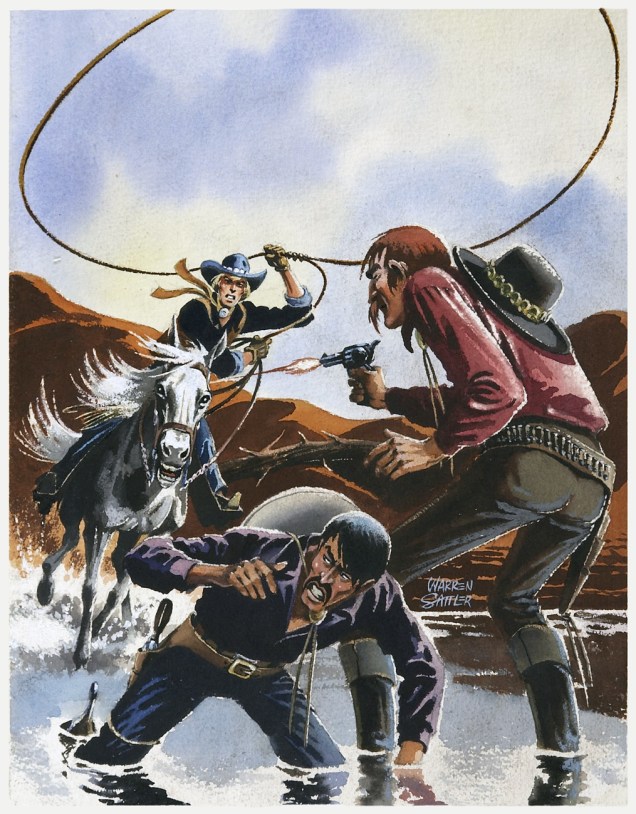
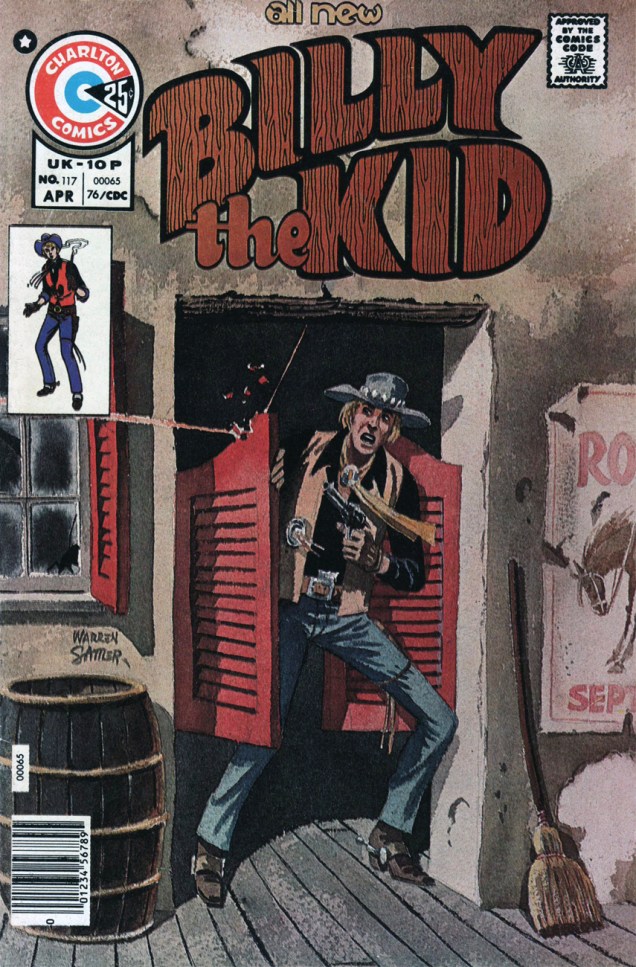
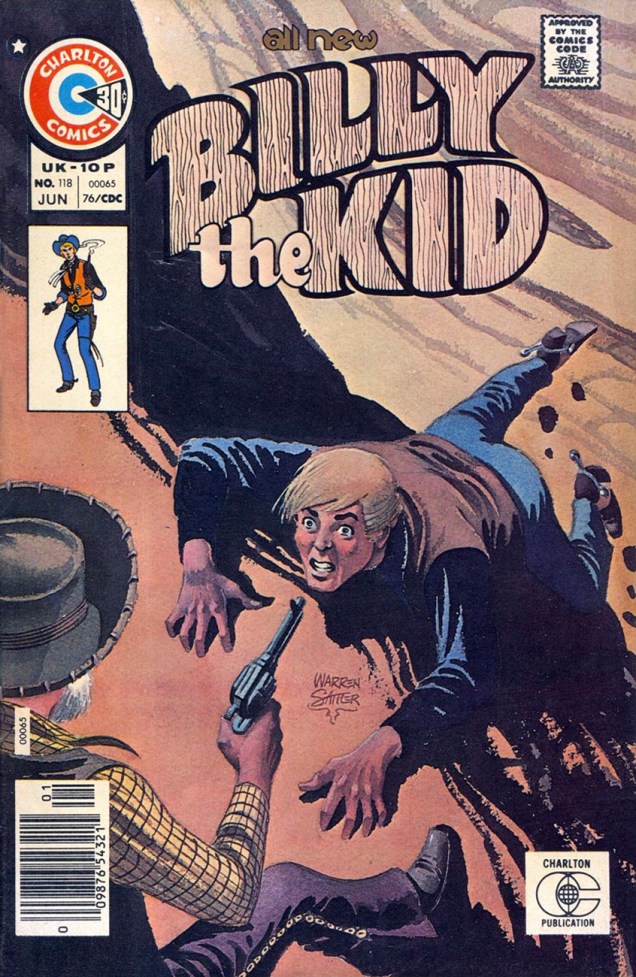
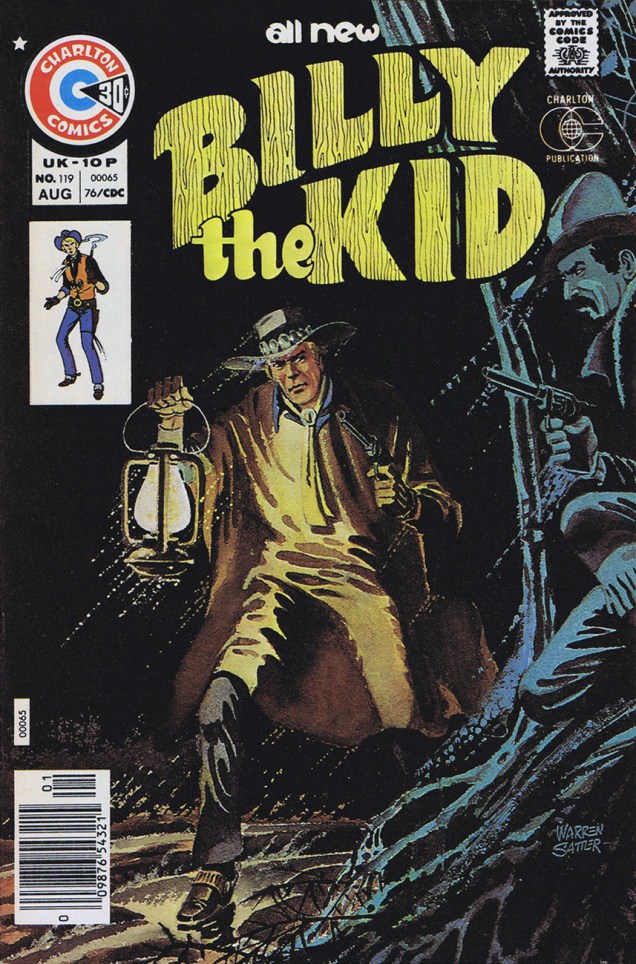
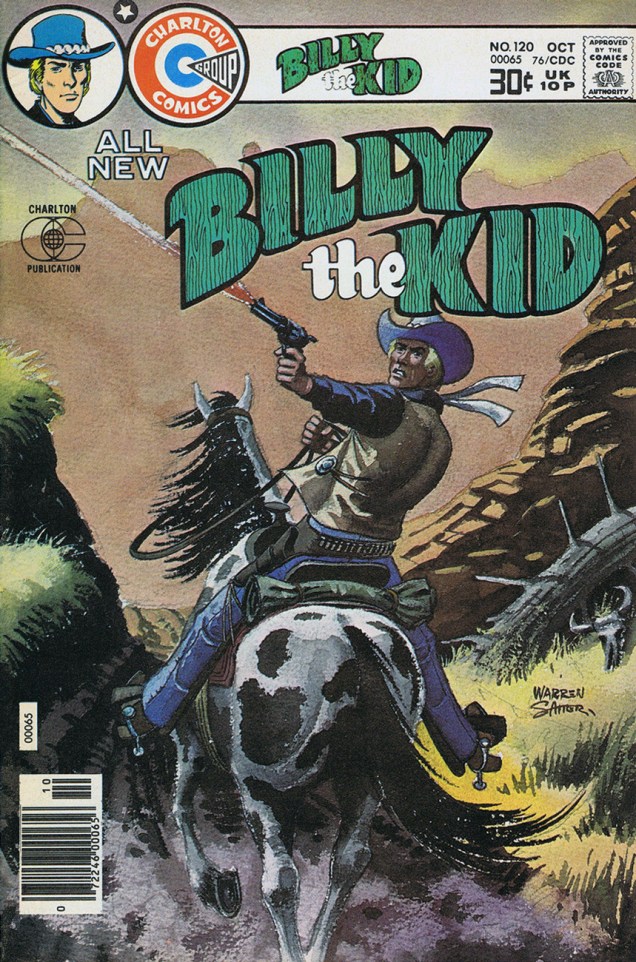
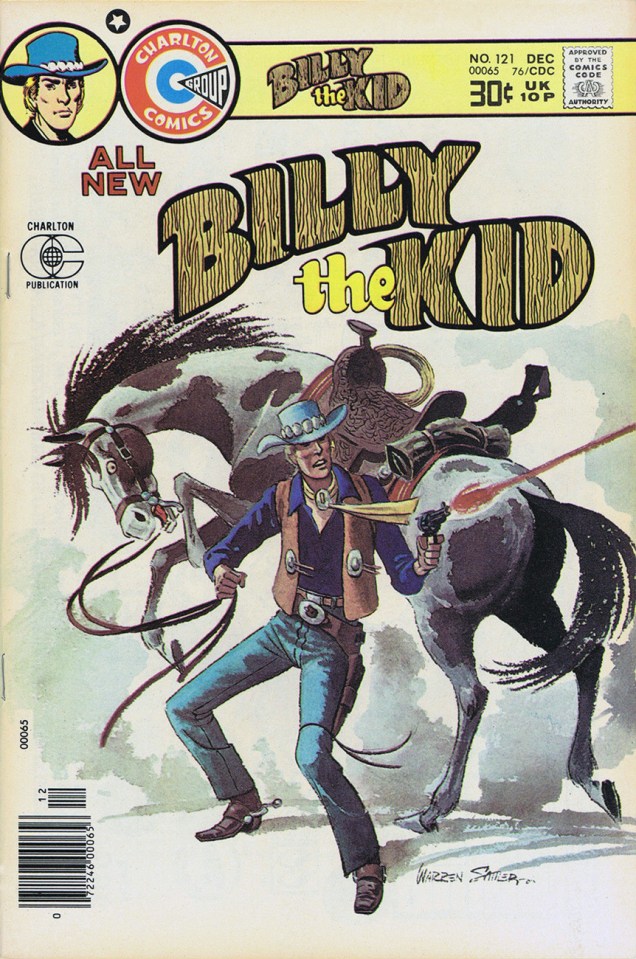
In the mid-1970s, thanks to Pat Boyette’s connections in Texas, Charlton Publications found themselves able to affordably produce painted covers, a development that several members of their iconoclastic stable of artists took full and glorious advantage of. Tom Sutton, Don Newton and Boyette were naturals, but Warren Sattler often gets unfairly sidelined from that esteemed lot… perhaps because he rarely worked for Charlton’s ghost books. Each of his cover paintings was produced for the publisher’s western / martial art adventure series, Yang, House of Yang, and Billy the Kid. And he alone worked in that most unforgiving of media, watercolours, wherein, unlike oils or acrylics, one requires unerring confidence and dexterity if you’re aiming to come up with anything above a muddy mess.

Today, Mr. Sattler (born September 7, 1934, in Meriden, Connecticut, where he resides to this day) celebrates his eighty-fourth birthday. Let’s wish him all the best!

Over the years, I’ve become quite enthused with Charlton’s long-running Billy the Kid series (1957-1983!), which featured over the years the artwork of such luminaries as John Severin, Maurice WhitmanRocco “Rocke” MastroserioJosé Delbo and of course Mr. Sattler. As far as I know, Joe Gill just about wrote the entire series, which is one of its chief pleasures: over a hundred issues of consistent characterization of young Bill Bonney as a peace-loving, unprejudiced champion of the underdog whom his amigos in Old México fondly nicknamed « El Chivito ». I know, hardly the real-life Bill Bonney, but what could one expect under the Comics Code Authority‘s heavy thumb?

Several of Mr. Sattler’s cover paintings have, thank goodness, survived destruction. They have to be viewed in person to be fully appreciated. For the nonce, we’ll make do with mere digital reproductions.

BTK112ORIG_A
For his first painted comic book cover (or second, Yang no. 7 appeared that same month), I believe Mr. Sattler got the proportions slightly wrong, so the cover art was cropped fairly tight horizontally, which still made for a striking, action-packed cover, but since we’ve got the original…
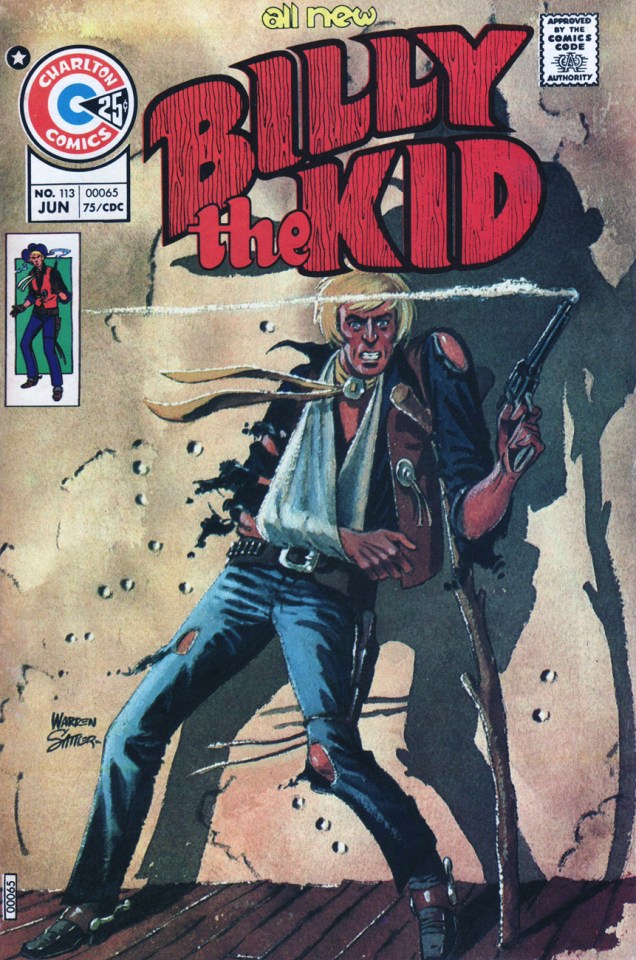
BTK113A
Two Billy adventures appear in this one: the cover-featured “The Good Life” and “The Spoilers!”
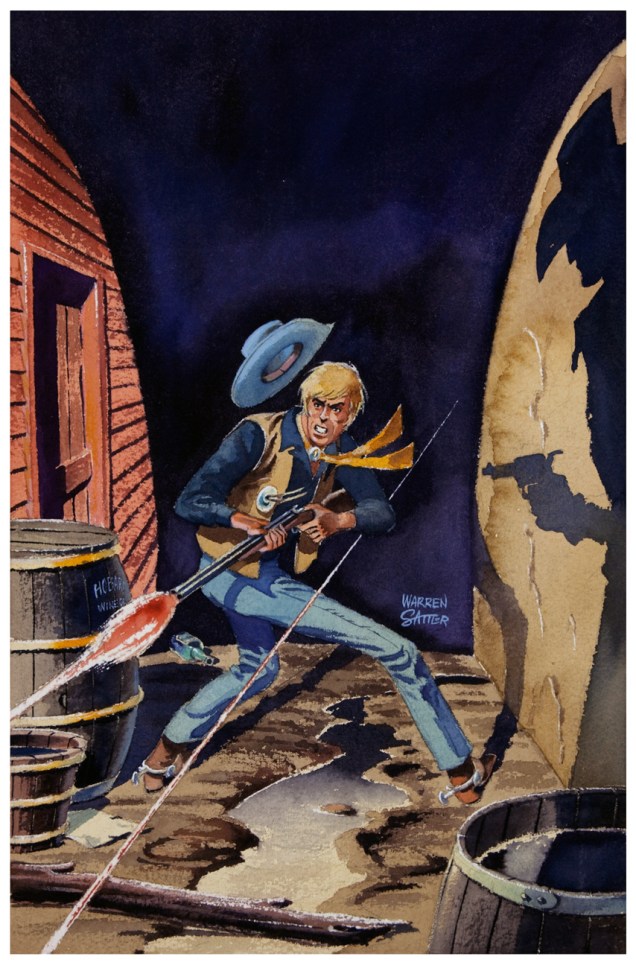
BTK114ORIG_A
This one was featured as the cover of Billy the Kid no. 114 (Oct. 1975), illustrating Gill and Sattler’s “Killers in the Shadows!”
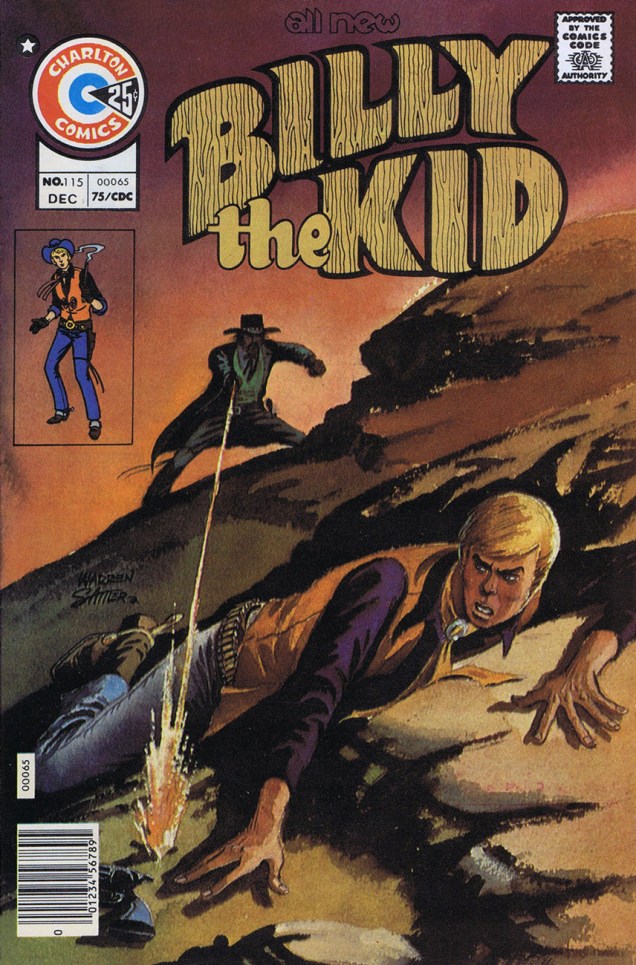
BTK115A
I’m sure Billy would be admiring the lovely light of dusk if he wasn’t being ambushed. Such a splendid and unusual (for comics) palette!
BTK116ORIG_A
The printed version of this painting, which appeared on the cover of Billy the Kid no. 116 (Feb. 1976), lost quite a bit of its subtlety in translation, so I’m happy to show you the original. I love that bit of yellow in the clouds, echoed in the bushwhacker’s shirt. For the first time, a solo Sattler Billy the Kid tale, “The Treasure”.

BTK117A

BTK118A
Beautiful composition, and an effective and economical way to convey height and distance. Note the cattle horns in the artist’s signature.
BTK119A
This one’s mood and palette bring to mind the work of Doug Wildey. A good thing, you understand. Excellent use of the « dry brush » technique for texture.
BTK120A
After several issues’ absence from the insides, Mr. Sattler reunites with Joe Gill on “Three for the Money!”
BTK121A
One final painted cover before Charlton rode off into the sunset…. for the first time.


SattlerBillyA
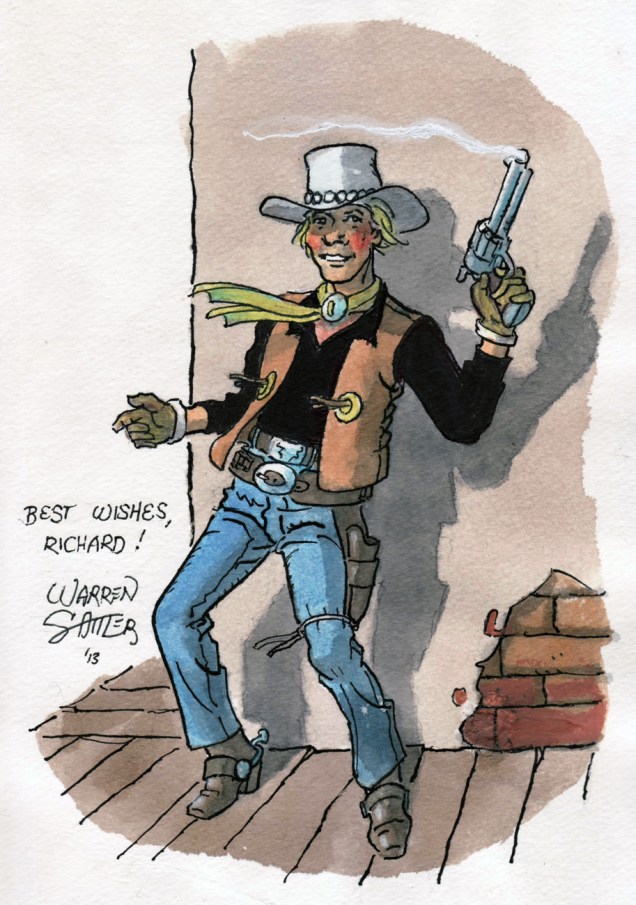
Mr. Sattler, a true prince of a man, created this piece especially for me a few years ago… without any request on my part! But you can bet I’ll always be grateful for this touching act of generosity and kindness.

As El Chivito’s many friends across the border would surely say, « ¡Que cumplas muchos más! », and thanks for everything!

-RG

Harvey Kurtzman, selon Marcel Gotlib

« Tous les merdeux ricanaient en se disant qu’une revue sans merdeux à la tête, ça ne marcherait jamais.* »

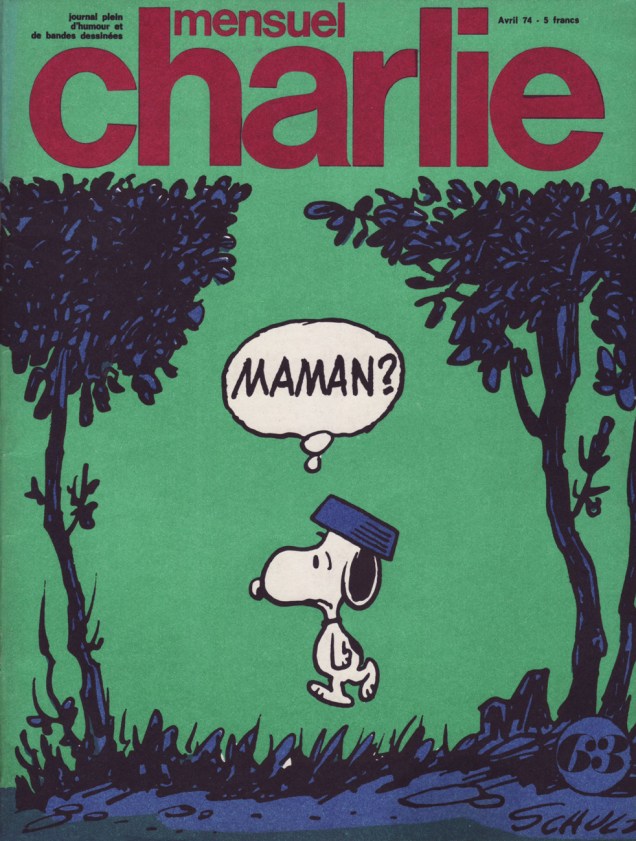
In issue 63 (April, 1974) of the recently rechristened « Charlie Mensuel » (to avoid confusion with its sister publication, Charlie Hebdo, yes, *that* Charlie Hebdo), insightful bandes dessinées critic and French national treasure Yves Frémion-Danet (b. 1947, Lyon), writing under his « Théophraste Épistolier » nom de plume, provided a classic essay accompanying a reprint of Harvey Kurtzman and Will Elder‘s « Goodman Gets a Gun », originally published in Help no. 16 (Nov. 1962, Warren). In his piece, Frémion posits that, with his 28 issues of Mad / Mad Magazine, Kurtzman’s brand of satire completely changed the rules of the game, and that despite an utter lack of commercial success and name recognition for himself and his work (reportedly, a French edition of Mad was published in 1965-66, for six or seven issues) on the continent, his influence on a significant swathe of the subsequent generation of French and Belgian cartoonists easily validates his vital importance.

PetitsMiquetsA
Théophraste Épistolier’s column’s logo, which translates as “Little Mickeys give you big ears”. A “Petit Miquet” is, in french, a generic name for cartoon characters from a dismissive and/or ignorant perspective. Someone to whom Mickey Mouse is the sole precursor of all Little Mickeys. Artwork by Gotlib.

Frémion spares no praise for Kurtzman’s acolytes Elder, Jack Davis, Basil Wolverton, Wally Wood and John Severin, and publisher Bill Gaines, but has nothing but contempt for editorial successor Al Feldstein (“vile copier”, “lumbering”, “regular”…). Frémion charts Kurtzman’s subsequent projects and associations, and his rôle in the rise of Underground Comix. Recommended reading… if you can read french.

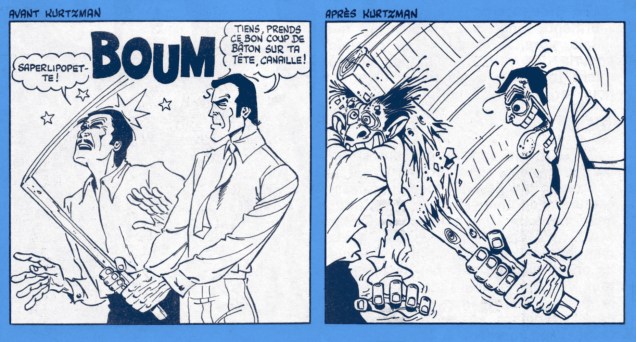
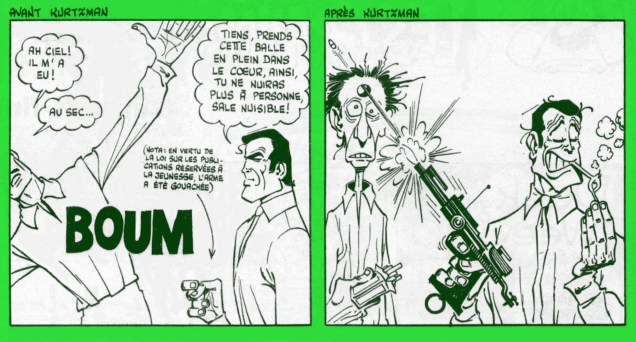
Ah, but that brings us to an apt illustration of that creaky adage, « A picture is worth a thousand words »: as it happens, the legendary Marcel Gotlib (b. 1934, d. 2016), speaking of influential, provided a quartet of original illustrations to put across what comics were like Before and After Kurtzman, commenting at once on American comics and on Franco-Belgian bande dessinée, with a snappy Gallic twist. Like Goofus and Gallant, but with far more tongue.

It took me a long time to come to terms with Gotlib. In my formative years, in Québec, his was such an outsize, smothering influence that one got quite sick of him. To be fair, not of him so much as his multitudinous, third-and-fourth-rate would-be clones. His style was easy to imitate, yet difficult to master. You see how that could easily careen off the rails?

GotlibKurtzman01AGotlibKurtzman02A

GotlibKurtzman03A
In the left panel, the pistol is missing, having been whited-out « in accordance with the law on publications intended for young people », a quite repressive set of regulations adopted in 1949.
GotlibKurtzman04A
More of the same: « Certain body parts have been whited-out. » Gotlib’s point is well made: when something relatively innocuous gets erased, the mind often fills the blanks with more perverse possibilities. Serves you right, censors.
Charlie63A
The issue in question. Charlie / Charlie Hebdo was published from Feb. 1969 to Feb. 1986, lasting, in fits and starts, 198 issues. It then merged with Pilote… and disappeared. Cover, of course, by Charles Schulz.

-RG

All the shitheads giggled, telling themselves that a magazine without an shithead in charge never would stand a chance. » – Théophraste Épistolier


Russ Heath and The War That Time Forgot

« Look! An undersea monster!
Spearing that torpedo like it
was a sardine! It’s a nightmare! »

Writer-editor Bob Kanigher, flanked by artists Ross Andru and Mike Esposito, drew first blood in « The War that Time Forgot », chronicled in DC’s Star Spangled War Stories beginning with issue 90 (May, 1960). The idea was scarily basic, but it was an irresistible premise, at least where young boys were concerned: let’s face it… soldiers vs dinosaurs. How might a T-Rex fare against a bazooka charge? Well…

The only time the series (what I’ve read of it… Andru and Esposito are no dream team of mine) did anything for me was a tale about two soldiers, one American and the other Japanese, stranded together on « Monster Island » and having to save each other’s sashimi. And this was before Lee and Toshirô got together on their own little slice of Hell in the Pacific, yet! I enjoyed the human interest aspect of the tale.

While I, like pretty much any other kid, was fascinated by dinosaurs early on, I quickly soured on inaccurate and fanciful depictions of the beasts. The War That Time Forgot is just one long, tedious dino-butchering exercise, be they harmless herbivores or kill-frenzied carnivores. Piss-poor palaeontology, that. Give me King Kirby‘s Devil Dinosaur any old time instead: that series runneth over with surreal, freewheeling fun, with nary a claim to accuracy in sight or in mind.

Ahem. The WTTF ran its course in SSWS until issue 137 (February-March, 1968), and was replaced by the far more nuanced Enemy Ace by Kanigher and Joe Kubert. Their all-time high, arguably in the case of Kubert, and without the faintest shadow of a doubt in Kanigher’s case.

So why am I writing about this series if I care so little about it? Well, when Andru (meh) or Kubert (great, true to form) weren’t handling cover duties, Russ Heath was. And while I’m fairly unmoved by Heath’s skill as a storyteller (too static, too measured), he was a first-rate cover artist, most strikingly for DC’s 1960s war books (and hey, Sea Devils) and Atlas’ 1950s westerns and horror titles.

So, in fond remembrance of Mr. Heath, who left us last week at the age of ninety-one, here’s a gallery of his Star Spangled War Stories covers featuring The War That Time Forgot. Thank you, sir.

SSWS122A
Star Spangled War Stories no. 122 (Aug. – Sept. 1965). Grey toning and colour by Jack Adler.
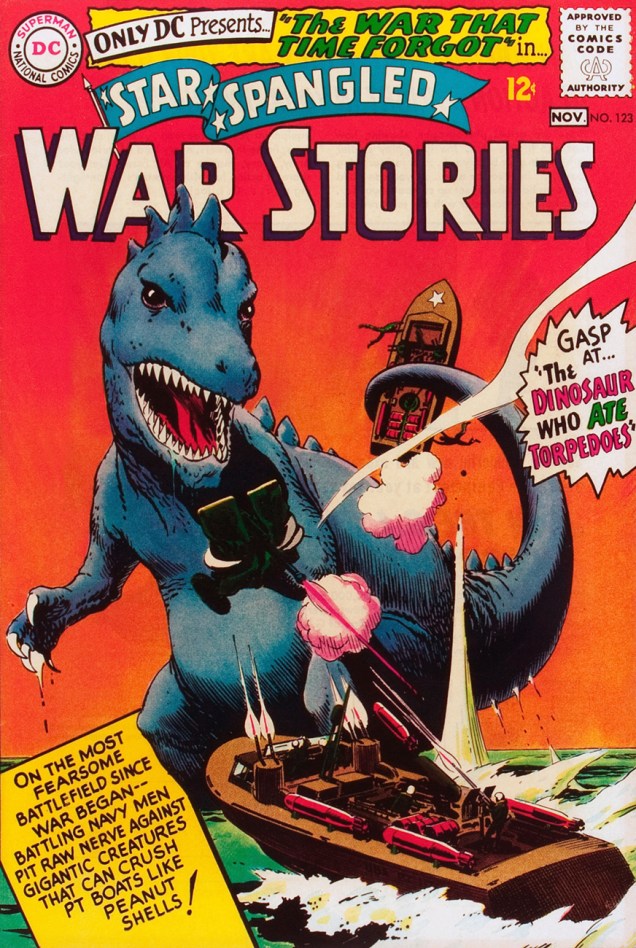
SSWS123A
Star Spangled War Stories no. 123 (Oct. – Nov. 1965). Dinosaurs love those orange skies, which set off their scales to fine advantage.
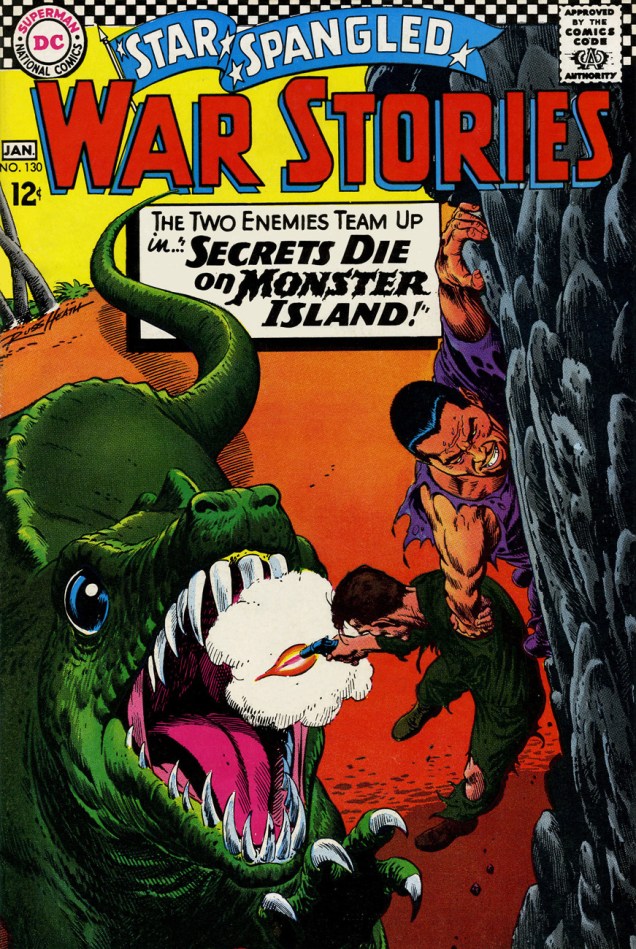
SSWS130A
Star Spangled War Stories no. 130 (Dec. 1966 – Jan. 1967). The first Japanese-American “Enemy Mine” team-up, but the Japanese guy gets no redemption before dying. Grey toning and colour by Jack Adler… probably my favourite cover of the lot.
SSWS131A
The Bird-Man provides a new wrinkle to bloodthirsty war criminal Curtis LeMay‘s « Bomb them back to the Stone Age » pronouncement. Star Spangled War Stories no. 131 (Feb. – Mar. 1967).
SSWS132A
Star Spangled War Stories no. 132 (Apr. -May 1967).
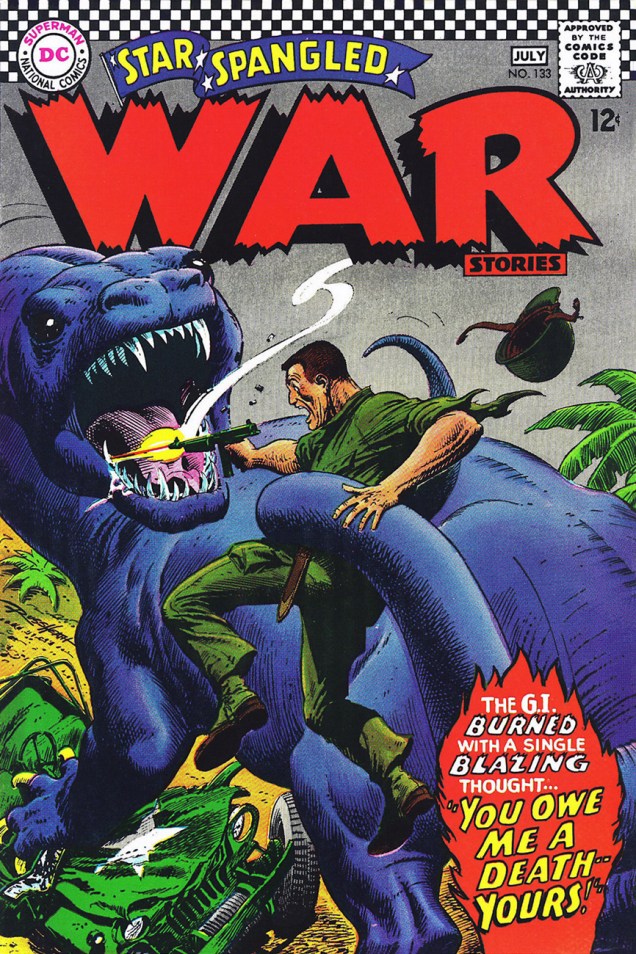
SSWS133A
Star Spangled War Stories no. 133 (June – July 1967).
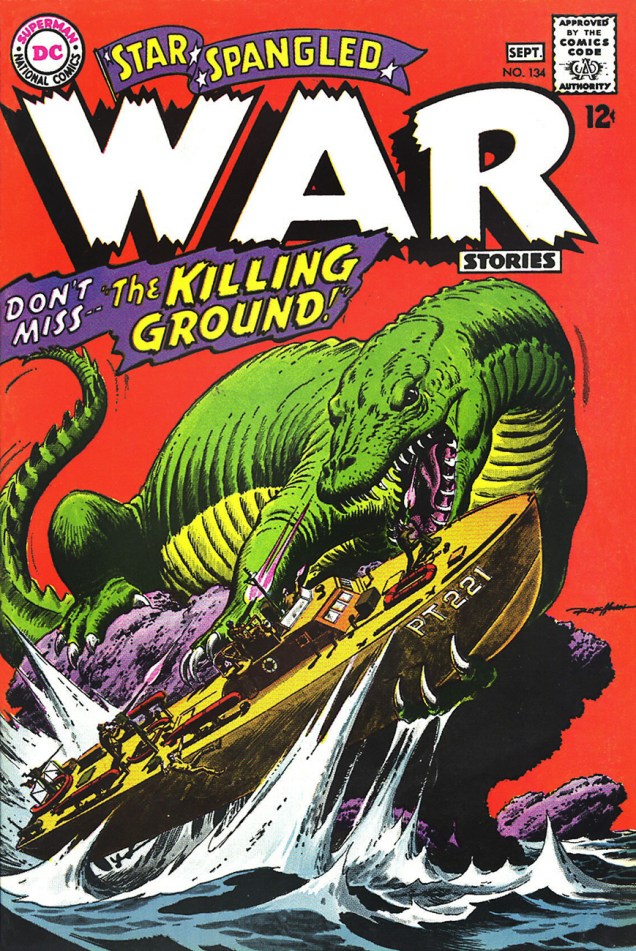
SSWS134A
Star Spangled War Stories no. 134 (Aug. -Sept. 1967). Once more, grey toning and colour by the indispensable Mr. Adler.
SSWS135A
Star Spangled War Stories no. 135 (Oct. – Nov. 1967).
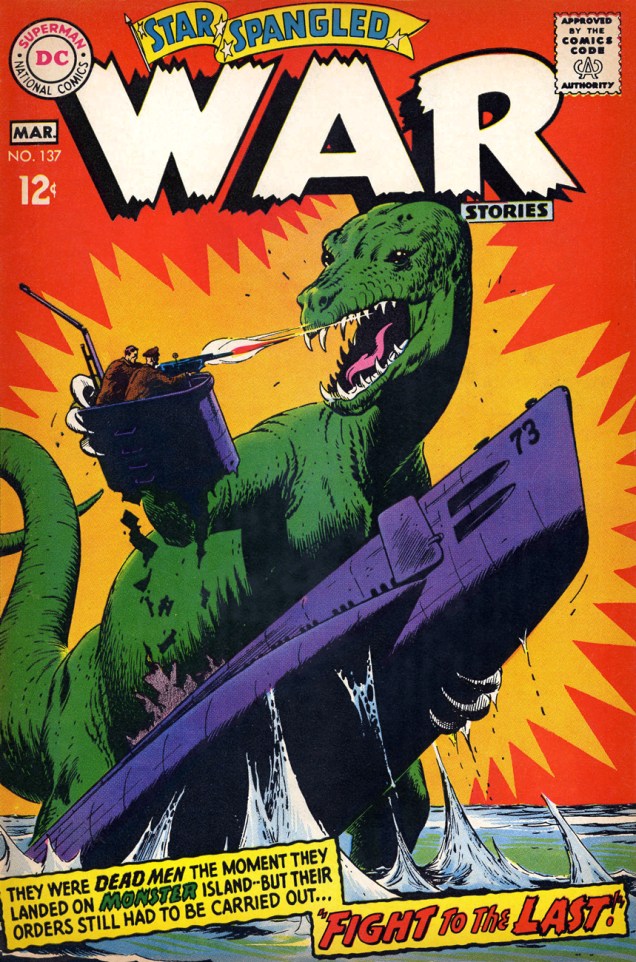
SSWS137A
Last call! Star Spangled War Stories no. 137 (Feb. -Mar. 1968).

Addendum to SSWS 131: apparently, « Bird-Man » started a trend, as everyone and his distant ancestor soon was riding a Pteranodon of his own. To wit: Tomahawk #109 (Mar. – Apr. 1967… just a month later).

Tomahawk109A
What do dinosaurs care about the American Revolutionary War? And yet the poor, noble Pteranodons all perish in the end… « for the cause » . Tomahawk no. 109 (March-April 1967), cover art by Bob Brown.

-RG

Treasured Stories: “The Night Dancer!” (1972)

« If i should sleep with a lady called death… » – E.E. Cummings

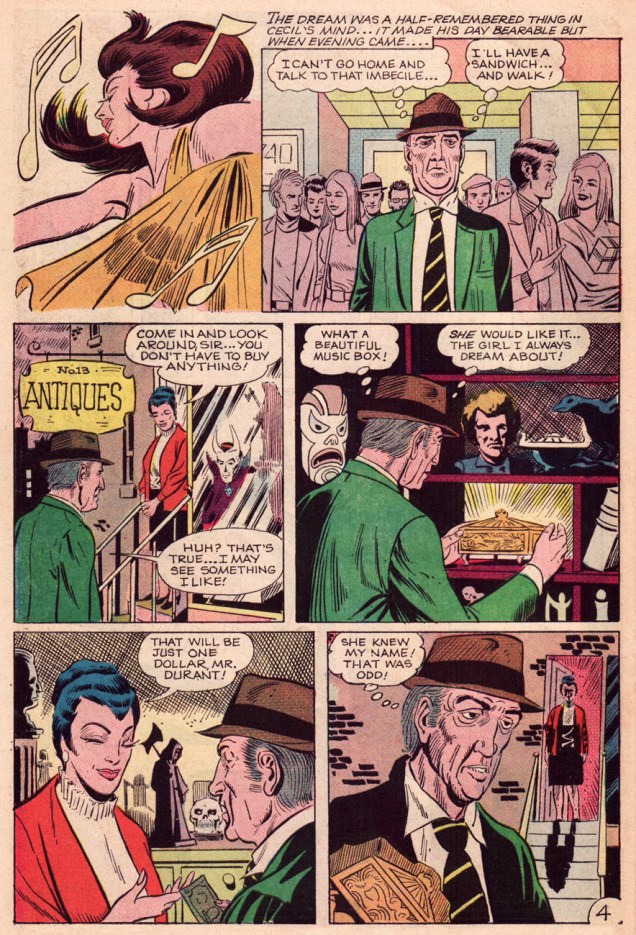
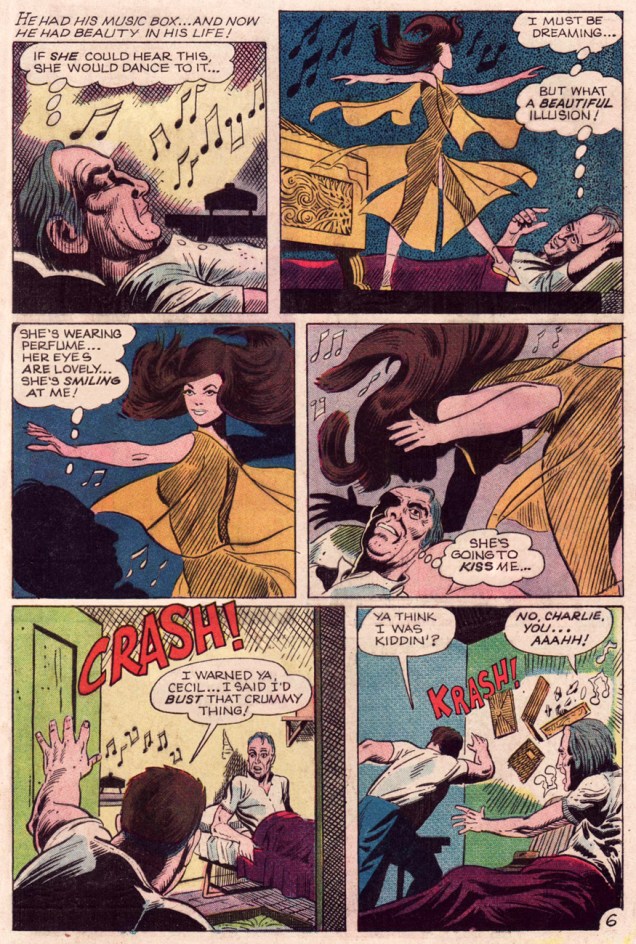
This time out, I’ve plucked a delicate story that’s resonated with me since our first encounter… somehow, the tragic plight of a lonely, vulnerable old man touched me deeply, even if I couldn’t have been more than ten years old when first I read it.

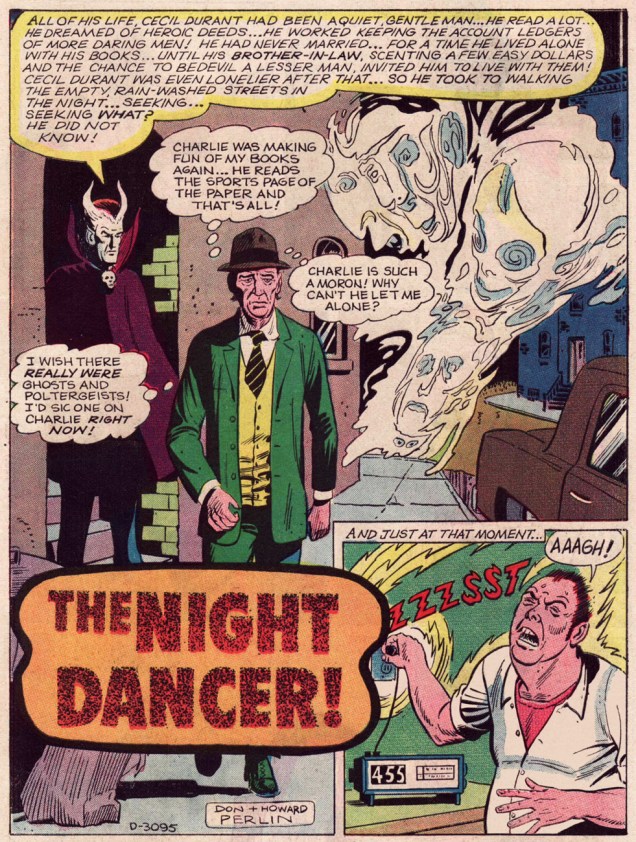
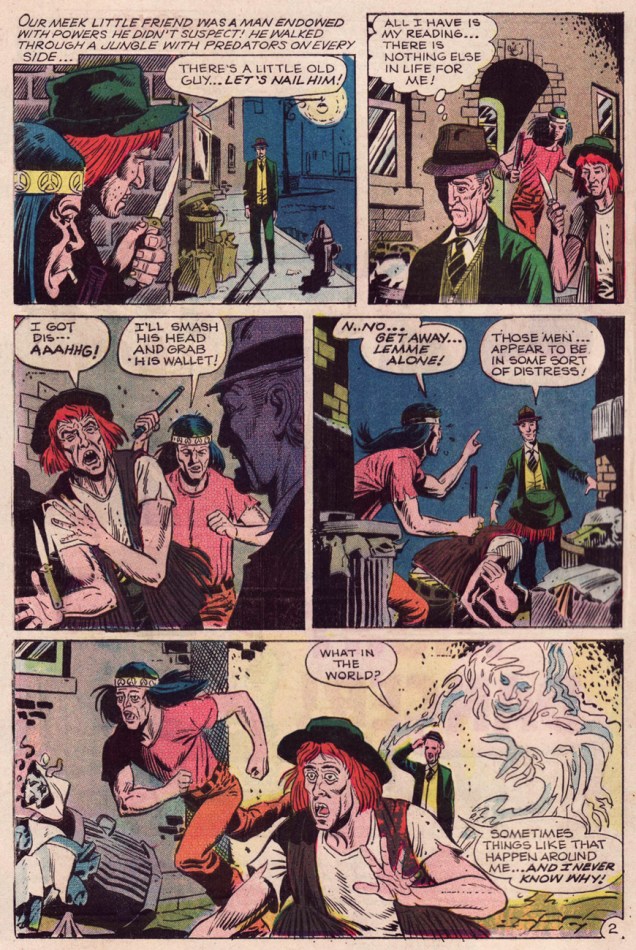
In the intervening years, witnessing the rise of elder abuse, the growing fragility of my own parents, and the sometimes desperate loneliness of acquaintances, old friends and strangers alike, Joe Gill and Don Perlin‘s The Night Dancer! (Ghostly Tales no. 99, Nov. 1972, Charlton) has steadily gained in poignancy. Its spirit, theme and mood remind me of some very fine tales by Joseph Payne Brennan*, who conveyed all too convincingly the quiet desperation of a near-destitute life lived with scant hope or companionship.

On a more cheerful note, it happens that (okay, it’s no accident) ‘Dauntless’ Don Perlin celebrates his eighty-ninth anniversary on this very day. While he’s most appreciated for his runs on Werewolf By Night, Ghost Rider, Moon Knight (his co-creation with writer Doug Moench) and The Defenders at Marvel Comics, I steadfastly cling to the notion that his finest efforts were brought to bear on hot rod and ghostly yarns for Charlton at the dawn of the 1970s. Judging by the results, I’d venture that he’s especially inspired by adventures set in the American Southwestern desert country. I’ll return to this topic in due time and present my case.

Without further tarrying ‘n’ foot dragging, meet our hapless protagonist, Cecil Durant… and his tormentors and benefactors.

PerlinDancer01APerlinDancer02APerlinDancer03APerlinDancer04APerlinDancer05APerlinDancer06APerlinDancer07APerlinDancer08A

While Mr. Perlin never became a superstar (and I suspect it never was his goal), the longevity of his career is easily explained: solid craft, excellent storytelling skills, a clean, unfussy line, and of course that supreme asset: reliability. Incidentally, co-credited Howard Perlin was Don’s young son, who was helping dad out around the studio that day.

Yom hu’ledet sameach, Mr. Perlin… and many happy returns!

– RG

*particularly The Way to the Attic (1967) and Mrs. Clendon’s Place (1984)

The Only Dirty Thing Ernie Bushmiller Ever Did

« On my entire street there were only two kids that went to high school… that was the equivalent in those days of making Phi Beta Kappa. »

On this, the one-hundred and thirteenth birth anniversary of the oft-misunderstood Ernie Bushmiller (23 August 1905 – 15 August 1982), was I going to go through a veritable mountain of Nancy strips, naïvely hoping to pare it down just the one? No sir, not me. Life’s too short.

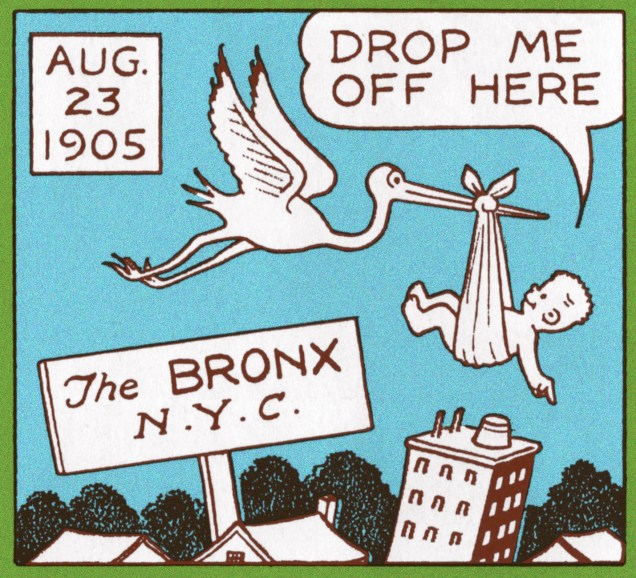
BushmillerStorkA

A tidy bit of autobiography from the pen of Mr. B.


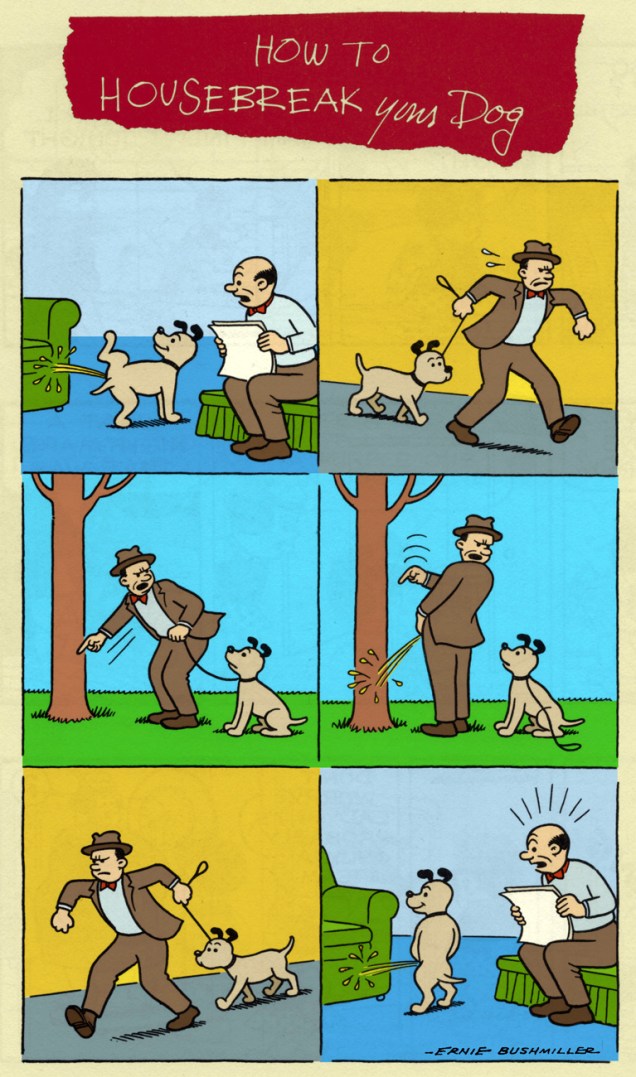
Instead, here’s an oddity that Ernie created, historians say, for the Dutch Treat Club* Yearbook (1961). Bushmiller referred to the often-imitated and bootlegged, now-famous cartoon as « the only dirty thing I ever did ».

BushmillerHousebreakA
I decided, a couple of years back, to colour the piece myself, and to restore Bushmiller’s signature. Can you believe the gall of some people? (Rhetorical question, I know.) Here at WOT, we firmly believe in proper authorial attribution.

Happy birthday, Mr. Bushmiller, and thanks for all the chuckles.

– RG
p.s. Thanks to Bushmiller scholar-cartoonist Mark Newgarden for doing the legwork as to provenance. I’m standing on the shoulders of giants, as usual! Oh, and since it’s quite relevant (and even if it wasn’t), if you’re a true-blue Bushmiller aficionado, you owe it to yourself to check out Messrs Paul Karasik and Newgarden’s « How to Read Nancy » (2017, Fantagraphics).

BushmillerGodwinA
A portrait of Ernie from the brush of his esteemed colleague Frank Godwin.

*If you’re, er… qualified, it’s not too late to join the Dutch Treat Club!