Joe Gravel’s Pop Culture Rampage

« Go to your bosom; Knock there, and ask your heart what it doth know » — William Shakespeare

Joe Gravel’s work came my way when, if memory serves, eBay suggested one his cartoons. As a fan of classic breakfast cereal mascots and vintage pinup art, this was as catnip to me.

I ordered his lovely Boob Berry keychain (shown below) — and Dracurella and Frankenbabe stickers and buttons, and my fate was sealed. Writing to thank him, I found Joe to be a gracious and erudite fellow, and so I kept an eye on his work from that point on.

Now, hypersexualization of superheroines and sundry cartoon characters is a bit of a cottage industry, and most of its fodder is quite devoid of interest. Another application of Sturgeon’s Law, if you will. Ah, but Mr. Gravel’s work is witty, accomplished, positive, and perhaps best of all, he doesn’t explain his jokes.

Joe was kind enough to answer my questions about his craft and inspiration… and here’s the result, peppered with some of his favourites and some of mine.
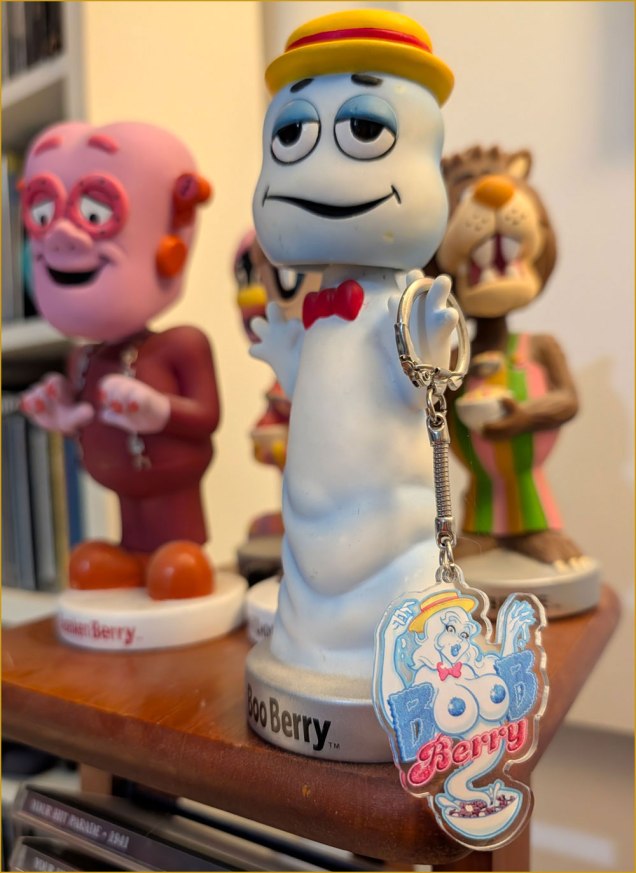
Boob Berry and her… progenitor (?).

WOT?- You draw from all genres, media and companies, yet maintain a consistency in style, and your own style at that. Does that come easy for you, or is it harder than it looks?

JG: Actually, I draw without any thought to staying in my style. It’s what comes naturally and what it has evolved to. 
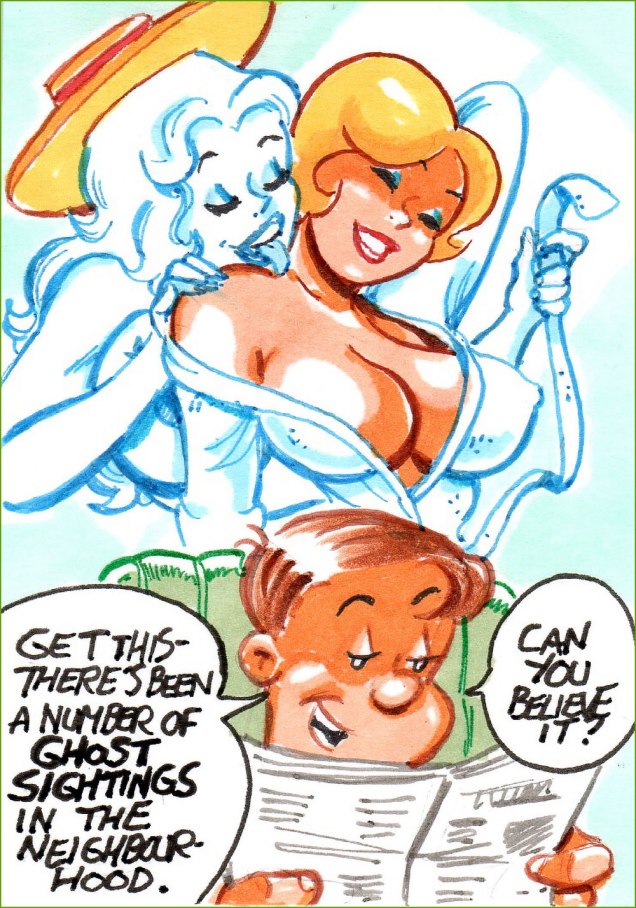
Boob Berry has a way with all the understandably frustrated ladies of the King Features neighbourhood, including Lois, Blondie, and Alice Mitchell.

WOT?- You often produce multi-panel sequences… which brings your work closer to a panel approach, rather than the pin-up/splash one some often encounters. Is that because you have a fuller narrative in mind, one that you pluck sequences from? 

JG: Occasionally I’ll have an idea that I can’t condense to a single card so I’ll expand it to a sequence of multiple cards/panels and post them as a single auction. Other times, I’ll do a single card and get a good response to the theme and then continue the narrative with other single card offerings. Were I more organized I’d have themes a bit better planned out. 🙂
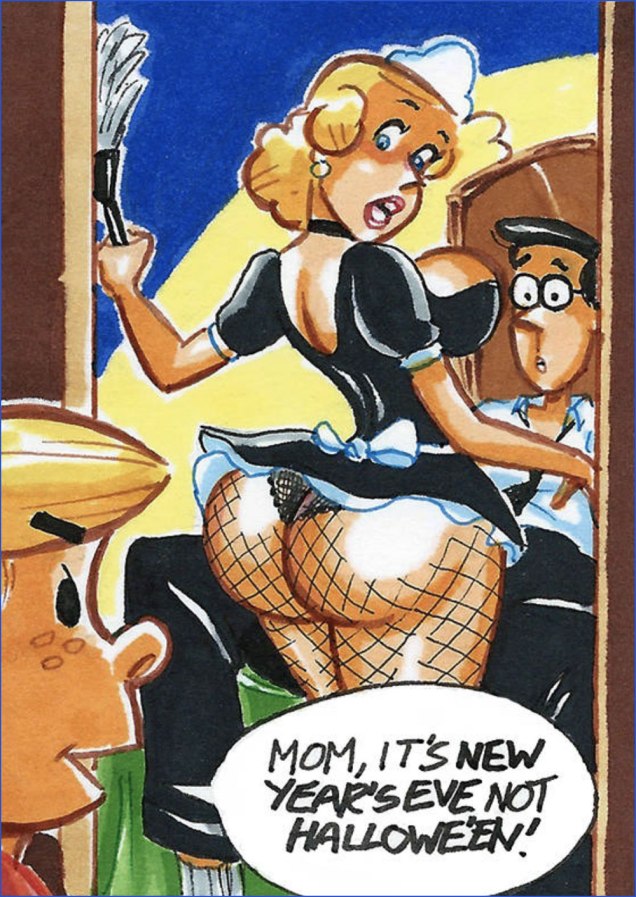
Speaking of Mrs. Mitchell… between that doltish husband and that demon offspring, how could she not use a little tenderness?

WOT?- Gender switches: who gets them and why?

JG: Gender switches are kind of random. Whichever character I figure would look good with a swapped gender is fair game.
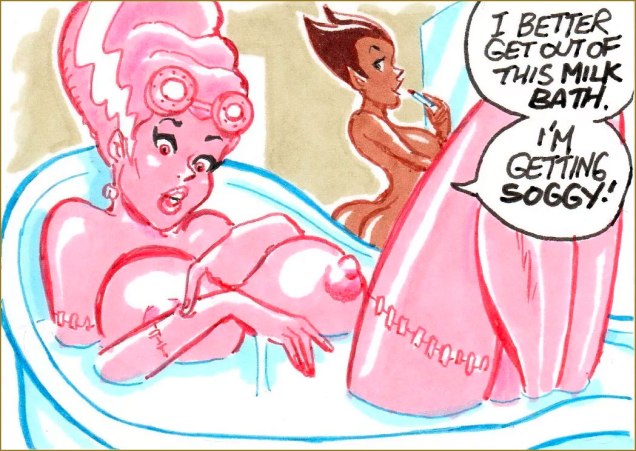
Meet Frankenbabe and Chocurella.

WOT?- The basic, but crucial question: what are some of your influences… and I presume they are numerous and varied. 

JG: My influences include the usual cast of characters from anyone who read comics in the 80s such as, John Byrne, Frank Miller, Walt Simonson and Michael Golden. Pinup influences include George Petty, Gil Elvgren and Peter Driben – among many others. Probably the biggest was the Harvey Kurtzman / Will Elder collaboration on Annie Fanny.
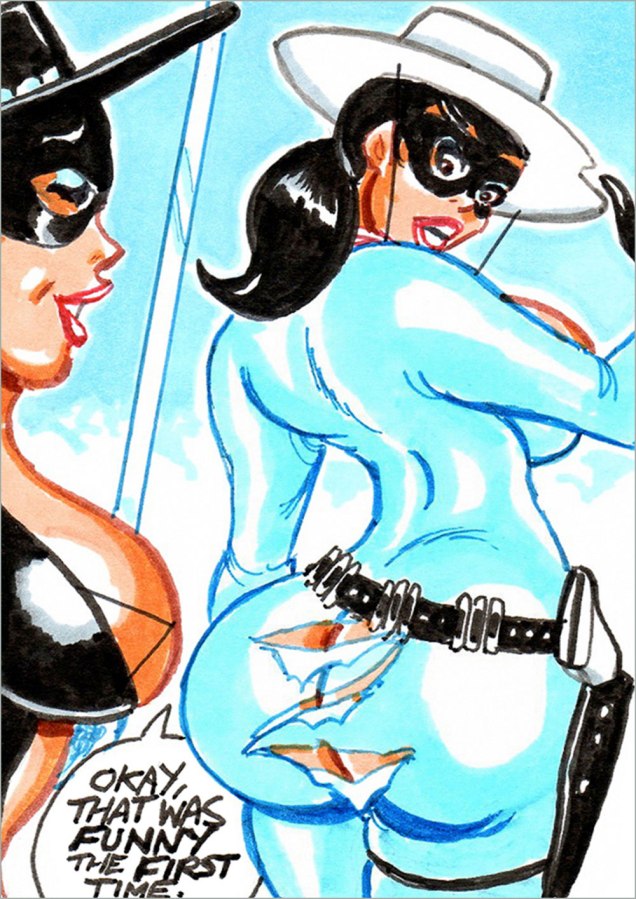
Gender notwithstanding, I take it no introductions are needed here.
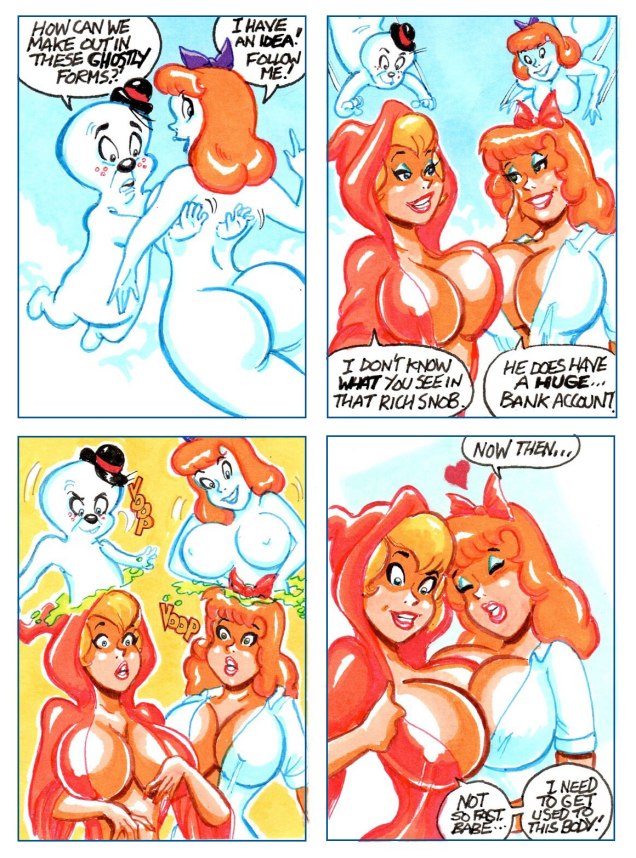
A rare instance of a multi-panel sequence, set in a slightly skewed version of the Harvey Comics universe.
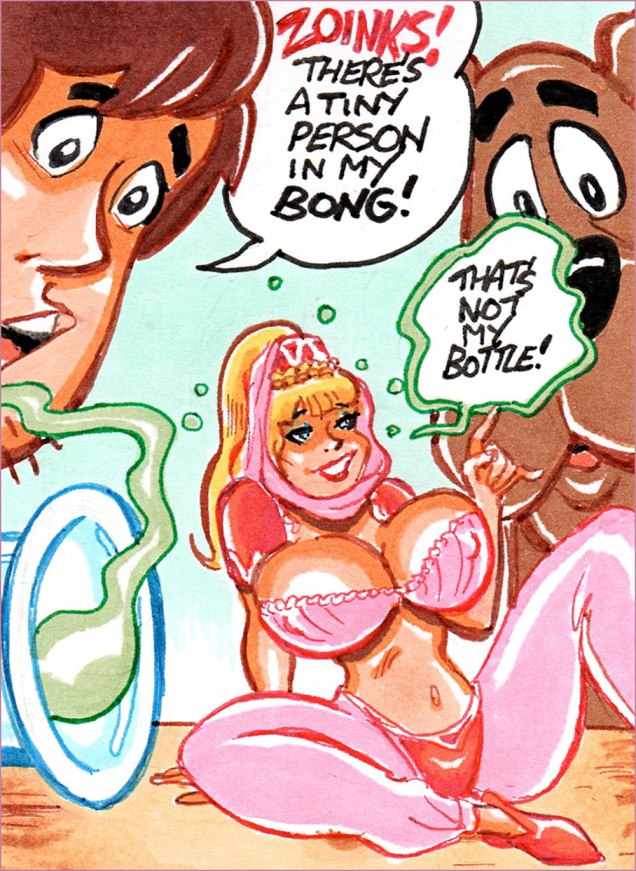
The 1960s TV crossover you never dared hope for?

WOT?-  As a complement to the previous question, can you tell us a bit about your habitual comics and media diet? 

JG: I don’t pick up many comics regularly these days though I have taken a liking to Mark Spears’ Monsters series. Besides that, I’ve started picking up the Criminal series by Ed Brubaker and Sean Phillips in trade format. Mostly I’m introduced to new artists through posts I see on Instagram and sometimes Tumblr.
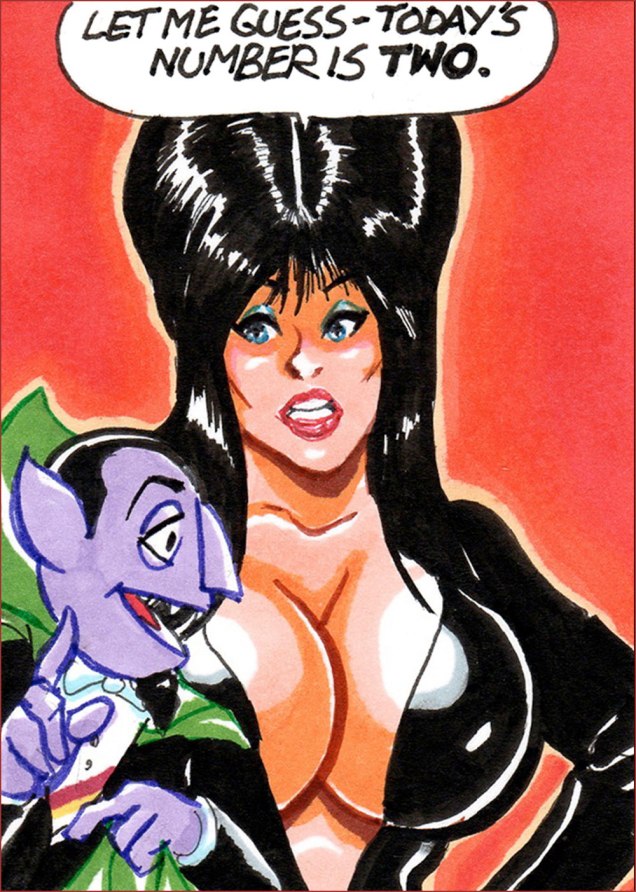
As the joke goes: « I was recently asked who my favorite vampire was. I replied “the Count from Sesame Street.” They told me, “he doesn’t count!” I replied, “I assure you, he does.” »
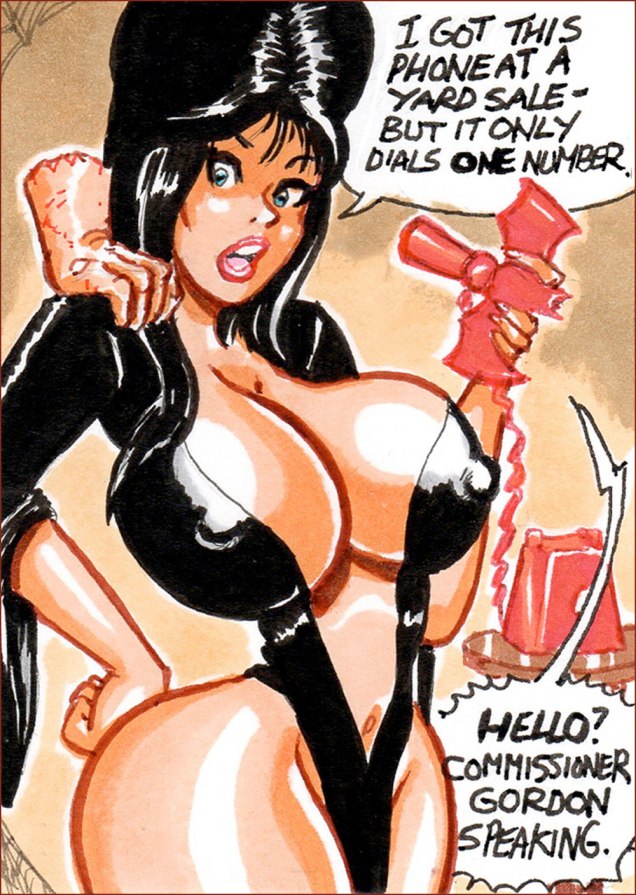
For some reason, Elvira also fits beautifully into the 1966 Batman TV show aesthetic. That’s inspiration.

WOT?- In this digital age, your choice of technique is unusual (and refreshing, if you ask me). Why markers?

JG: I choose markers for my work due largely to the ease of use and the speed it gives me compared to painting. I’m old school so while I dabble in digital art from time to time, I very much prefer the physical media.
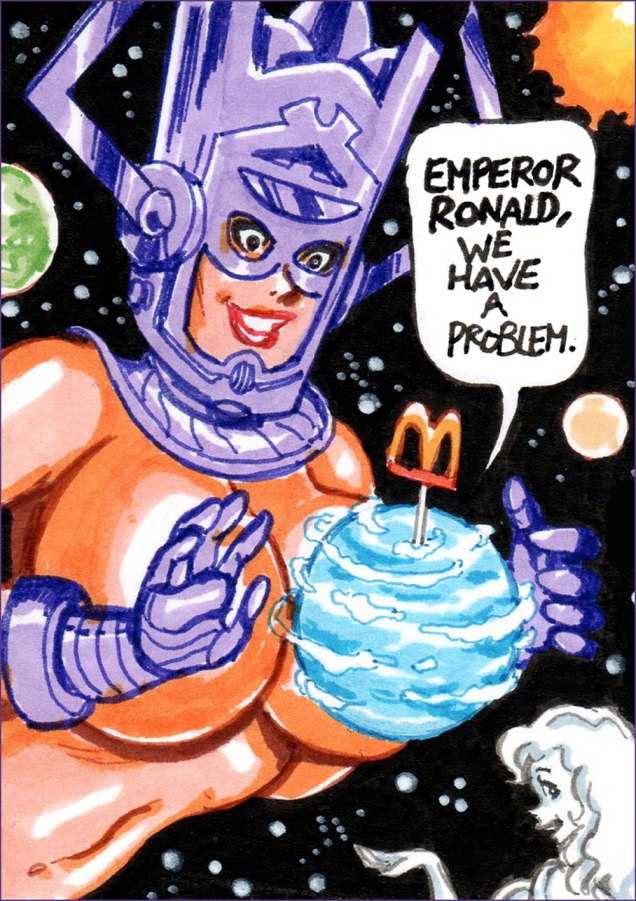
Kirby meets Kroc!

WOT?- In terms of planning and layout, are you more akin to, say, a Sergio Aragones or a Jack Kirby, who could start a drawing anywhere and make it work… or a Harvey Kurtzman, who needed a pile of preliminary drawings and overlays to achieve his goal? 

JG: For planning and layout, I’m on the opposite spectrum of Kurtzman :). Often I do my rough sketch on the sketch card and then refine the pencils from there. If I have multiple elements on a card, I’ll do a super rough thumbnail on a scrap piece of paper to help visualize what should go where.
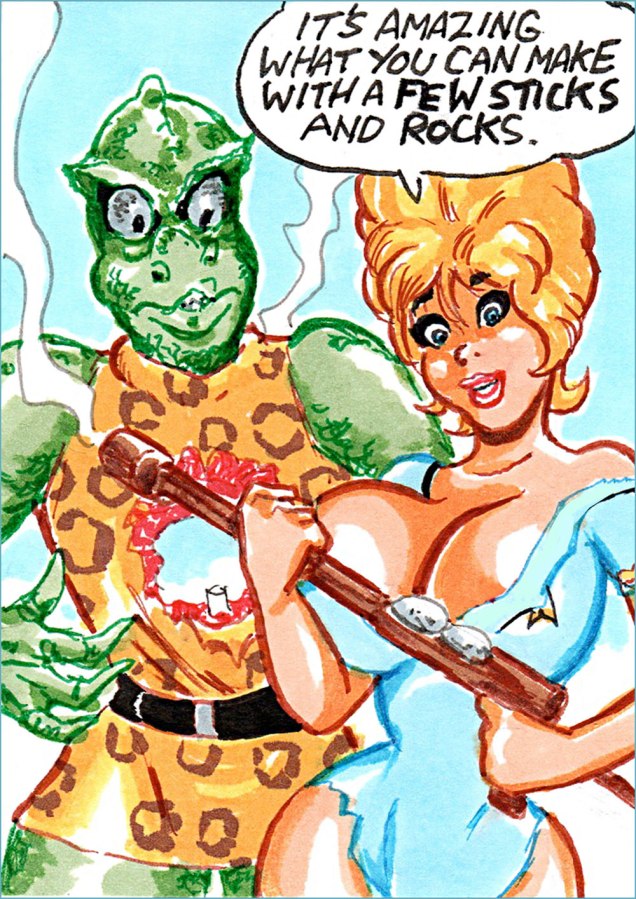
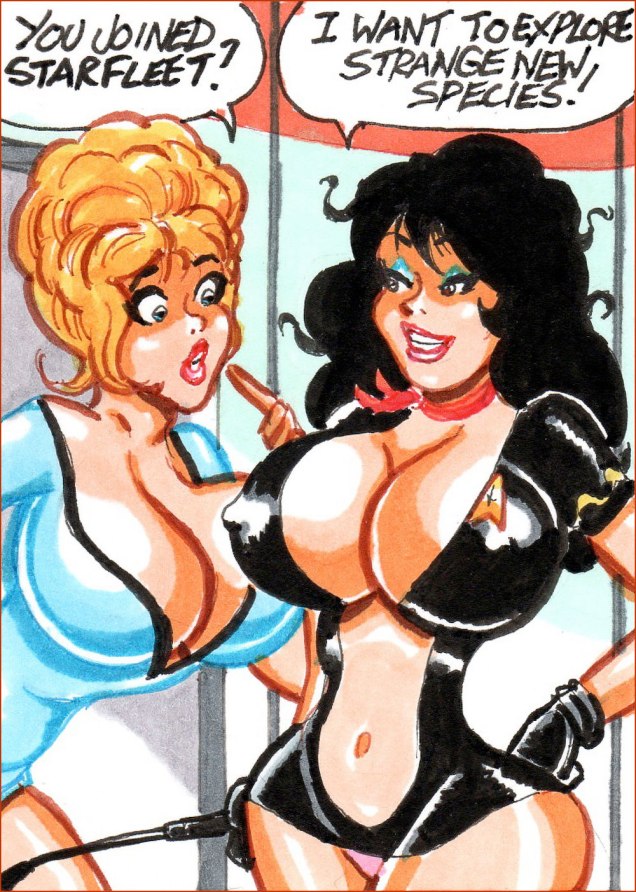
Speaking of gender switches: Star Trek’s James T. Kirk becomes Little Annie Fannie, and Gravel picked my favourite episode, Arena (based on Fredric Brown‘s 1944 short story of the same name) to put her through her paces.
Of course, who does Little Kirkie Fannie soon run into? Why, Frederic Mullally and Ron Embleton‘s Wicked Wanda, of course!

WOT?- Any collections planned? Since each panel is auctioned off individually, any collector of your work must be seething with frustration. Is there any hope on that front for the completists?

JG: A collection is a great idea. I’ve had a few people say that I should pull some of my storyline cards together for a booklet or PDF. My biggest hurdle is myself taking the time to do it. Having said that, I have a series going now that I’m going to make an effort to assemble into a sequential piece. Also, much of the time these ongoing series start out as one or two cards that I had gags for and if they’re well-received I continue the series without a pre-planned idea of where they go. Sometimes they just trail off. So, I’d like to get into the mindset of doing a rough arc in my head if an idea takes off.

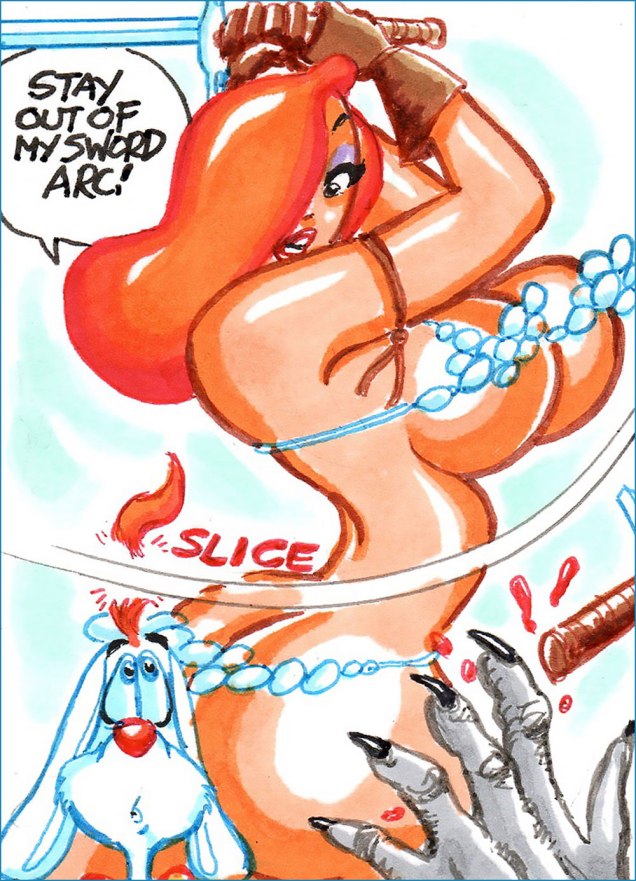
Jessica Rabbit as Red Sonja — why the hell not?

My heartfelt thanks to Joe Gravel for his time, patience and insight! Check out his latest creations, up for auction right here: https://www.ebay.com/usr/rocketred23

-RG
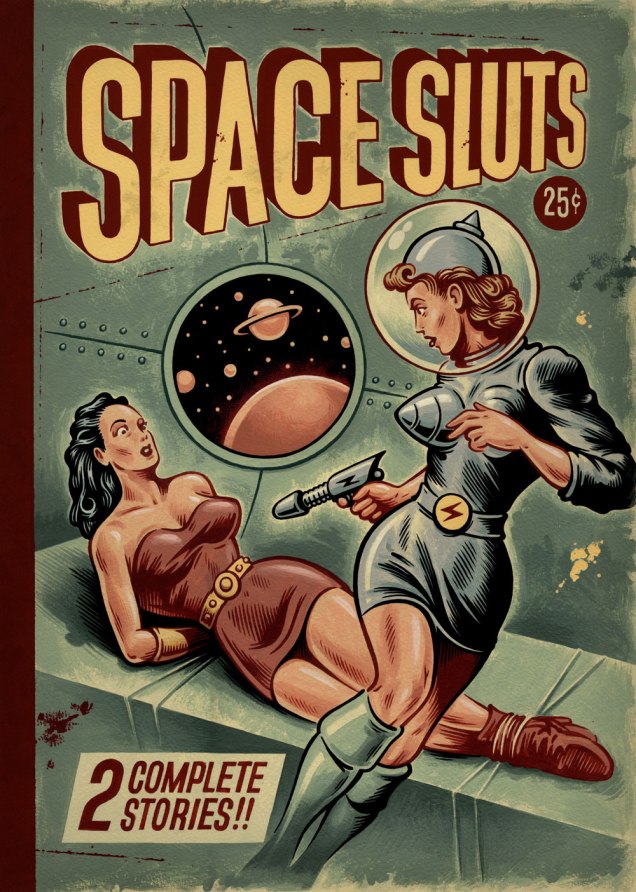
Anatomy of a Swipe

« Taking something from one man and making it worse is plagiarism. » — George Augustus Moore (1852-1933)

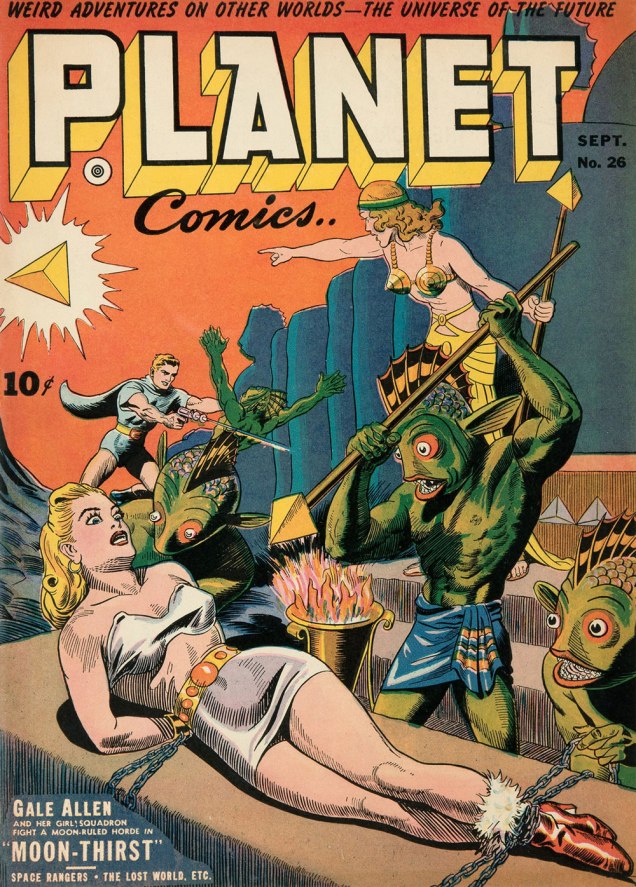
A fortnight or so ago, I came across an image that looked… familiar. It wasn’t slick enough to be AI, so I presumed it was a swipe. My first guess was Fiction House’s Planet Comics, but I initially came up empty. Then I realized my error: I was looking for a reproduction of the whole scene, involving both figures.

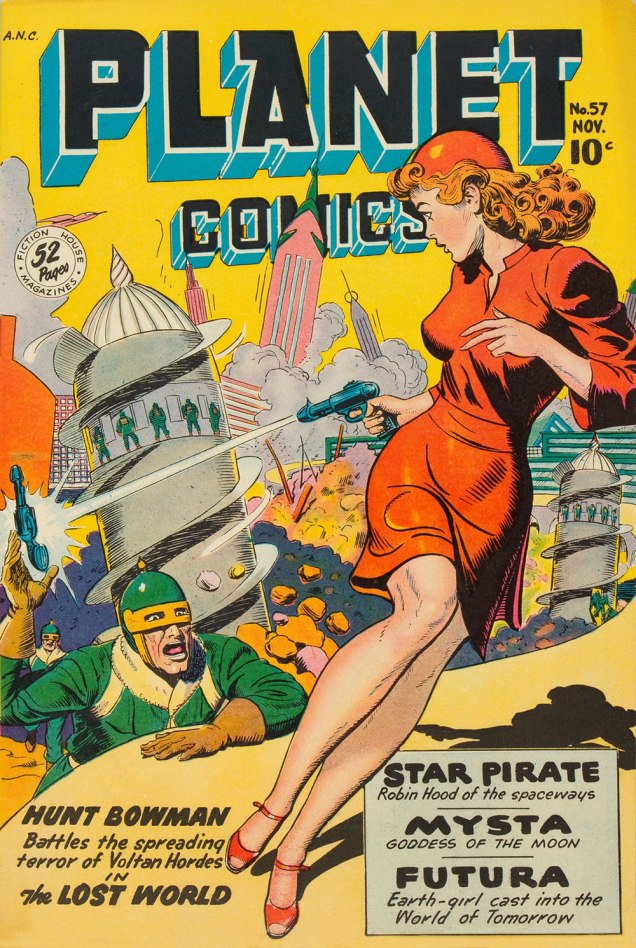
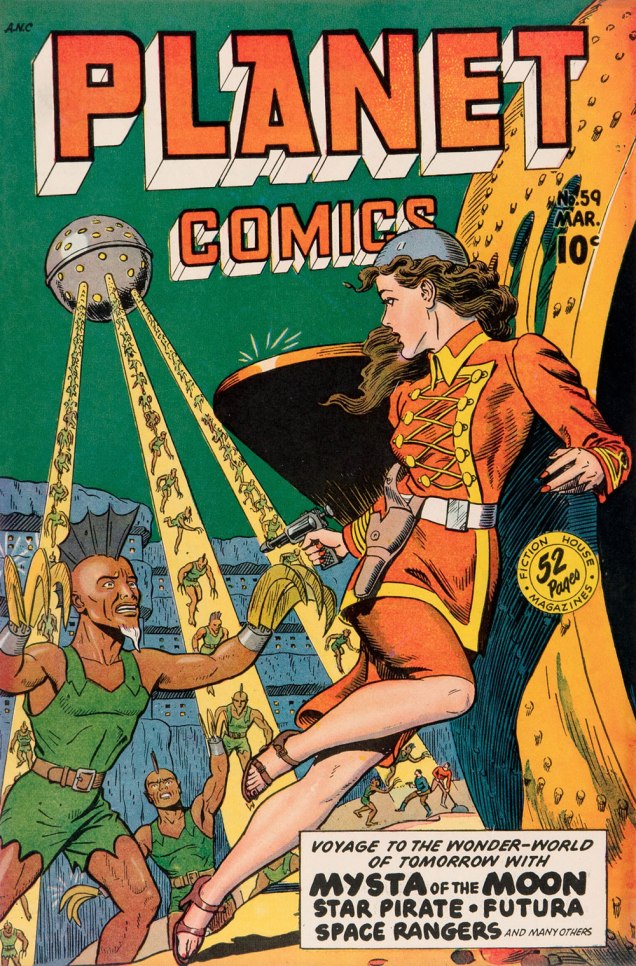
After a second pass… bingo: two issues of Planet Comics. At least the swiper was consistent: both covers were drawn by the same guy, Joe Doolin (1896-1967), a prolific pulp and comic book illustrator. Check out his interesting biography.

This is Planet Comics no. 26 (Sept. 1943, Fiction House), cover by Doolin. Frankly, it’s easy to imagine this one recycled, with minor changes, as a Sheena-style jungle scene, another of the publisher’s specialties.
As for the source of our second figure, here’s Planet Comics no. 57 (Nov. 1948, Fiction House), cover by Doolin.
This is Planet Comics no. 59 (Mar. 1949, Fiction House). A mere two issues later, Doolin virtually reused the same pose*, though obviously, he wasn’t so lazy as to not redraw it from scratch. Pretty nifty outfit on the heroine. Who are these bozos? Inbred descendants of the Savage Dragon and Razor Fist? Jeepers.

I mentioned the clumsy swipe in question to a long-time friend and colleague (salut, Éric!), who informed me that the ‘Space Sluts’ had been making the social media rounds (as they would), and that an alarming proportion of commenters had been fooled into thinking the piece was an artifact of some ancient origin, instead of a recent ‘creation’. No great shock there, as your average Joe Schmoe can’t recognize AI slop either when he sees it (but adores it indiscriminately).

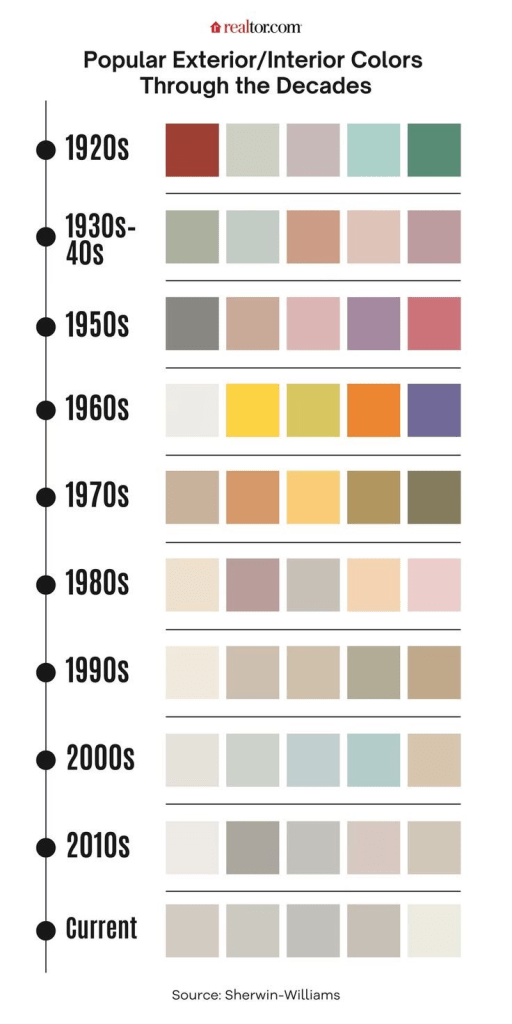
I mean, it’s all wrong: the depressing 21st century desaturated colours (denizens of our current dystopian nightmare shun bright, saturated colours (see graphic below) like a vampire eschews garlic), the telltale phoney brushstrokes of digital art, the incorrect cropping (no art would have been published with the space beyond the edges showing), methods of shading, the ‘dust and scratches’ being the same colour as the printed ink,.. I could go on all night, but I’ve got better things to do.

Then there’s the title. The art is insult enough, but was the shaming necessary? On Facebook, some mooncalf pointed out — incorrectly — that ‘slut’ didn’t have the meaning we’re familiar with until the 1960s. Nope (read on), but it likely wouldn’t have made it into print, and certainly not on the cover of a mainstream pulp magazine. I turn to a favourite reference work, Hugh Rawson‘s Wicked Words (1989, Crown) for the nitty-gritty:

As a side note, Doolin himself was no stranger to swipes, though technically these were above-board, publisher-commissioned recreations.

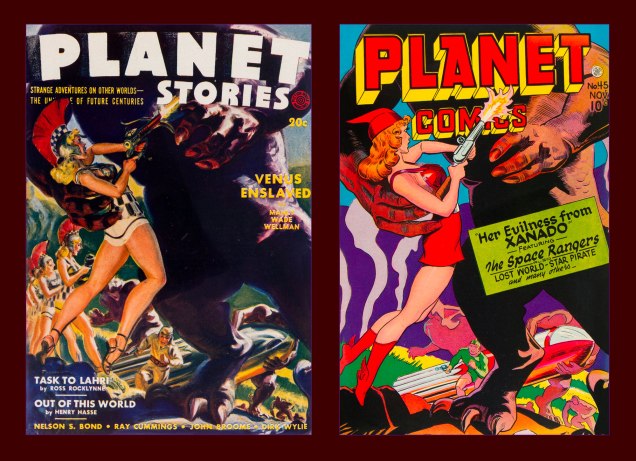
At left, Planet Stories no. 11 (Summer 1942, Fiction House), a cover painted by WOT? favourite Norm Saunders; at right, Planet Comics no. 45 (Nov. 1946, Fiction House), a line art remake by Doolin.
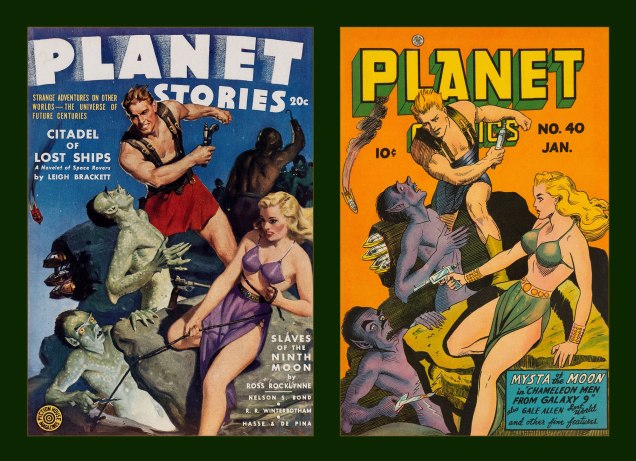
At left, Planet Stories no. 14 (Mar. 1943, Fiction House), a cover painted by Jerome George Rozen (1885-1987); at right, Planet Comics no. 40 (Jan. 1946, Fiction House), a line art remake by Mr. Doolin, with a couple of minor modifications tossed in.

-RG

*I expect more from Doolin than from, say, Ross Andru, who used the same basic pose on every single 1970s cover he drew, and I’m barely exaggerating.

At Eight o’clock in the Morning… They Live!

« Obey the government“, said one croak. “We are the government“, said another. » — Ray Faraday Nelson

I’ve been juggling several ideas for posts, most of them leaning more or less to the light-hearted and poetic, save one… and since that outlier is more suited to the current state of affairs, here goes.

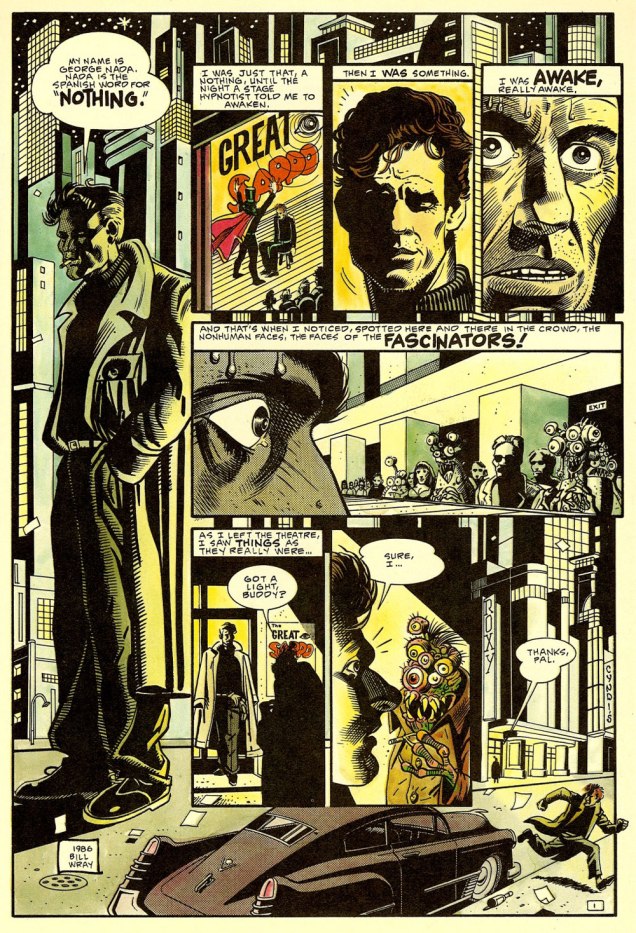
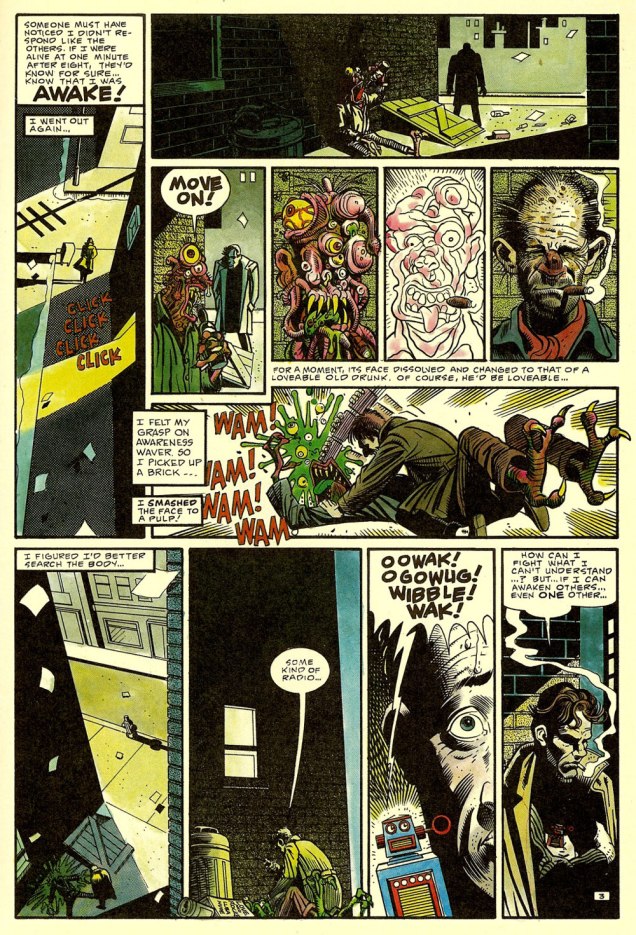
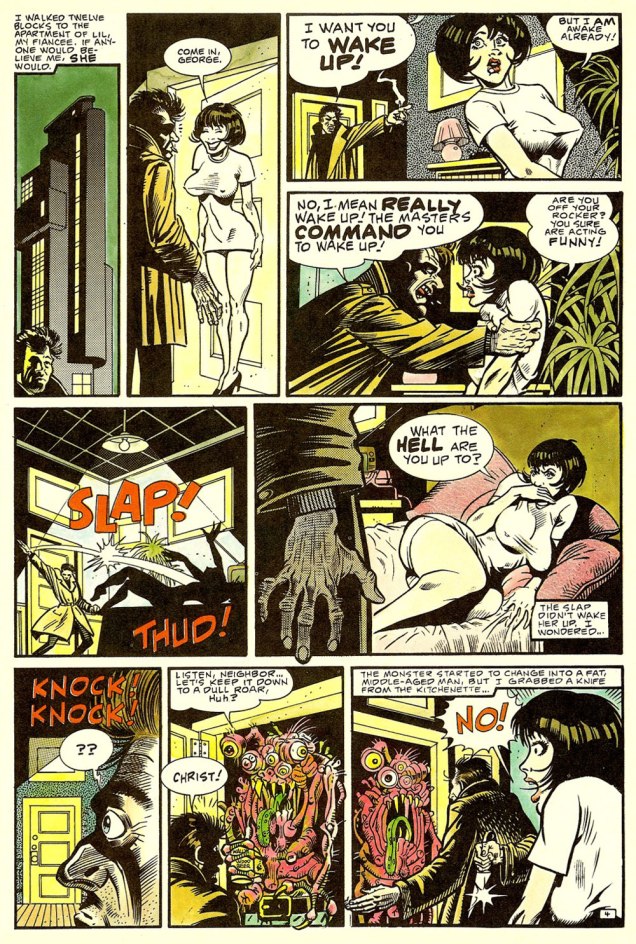
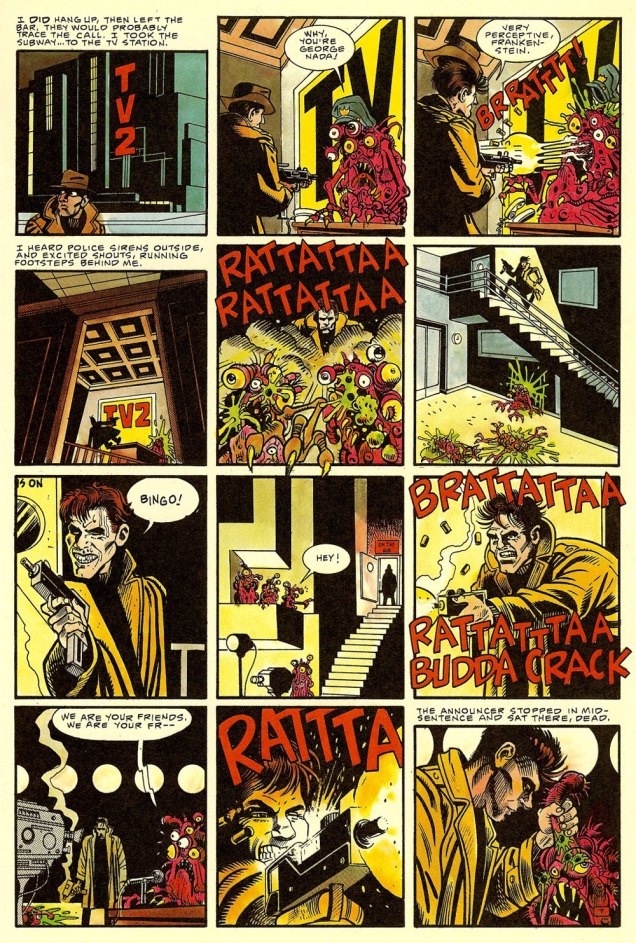
Nada appeared in Alien Encounters no. 6 (Apr. 1986, Eclipse; cat yronwrode, editor). An early work by cartoonist/animator and fine art painter* Bill Wray, he’s gloriously channelling all of his influences at once: Eisner, Steranko, Stout, Reese, Elder, and perhaps a smidgen of Thorne.

You guessed it, the story was adapted by John Carpenter for his 1988 film They Live, one of the great science-fiction films of that decade that bombed at the box office and were later reconsidered… more lucidly. Think Carpenter’s The Thing** (among others… poor guy!), Ridley Scott’s Blade Runner, and this one. At least it didn’t suffer a pointless remake or a Denis Villeneuve sequel. Yet.

Anyway, Carpenter recounted, in an interview published in the venerable American Cinematographer (Sept. 1988), soon after the film’s release: « They Live began three years ago with a comic book I bought called ‘Nada’. It was published by Eclipse Comics, a company which puts out very beautifully rendered science-fiction stories. This particular strip was taken from a short story called ‘Eight O’Clock in the Morning’ by Ray Nelson. » [ source ]

How refreshing it is to hear a filmmaker directly credit his source of inspiration, even if said source might be viewed as ‘low-brow’ by the holy arbiters of intellectual standing. Compare that to, say, avid comic book collector George Lucas, who brazenly pilfered elements from Jack Kirby’s Fourth World and Pierre Christin and Jean-Claude Mézières’ Valérian for his space opera, then pretended he’d been instead inspired by the scholarly comparative mythology theories of Joseph Campbell‘s Hero With a Thousand Faces. Riiight, George. And don’t get me started on Spielberg.

Related aside: on They Live‘s imdb.com page, some lout quite misunderstood the purpose of a FAQ — objectivity, for one thing — and took it upon himself to malign Ray Nelson’s essential contribution. To the question « What are the differences between the short story and the film? », he frothed forth:

Ahem. It seems to me that there just *might* be a slight difference, in terms of expansiveness, between a 94 minute motion picture… and a five page short story. Well, you be the judge: read it here, in its original context and everything!

-RG

*I simply must point out that, though I like Mr. Wray’s work as a cartoonist, I am in absolute awe of his paintings. Here’s how he helpfully puts it: « Making his living as a cartoonist who specialized in painted subjects, he spent many years coalescing a eclectic array of art styles, ultimately finding his voice in a contemporized reflection of traditional California regional painting that focus on humble subject matter rarely considered as fine art. » His paintings are so very *soulful*, demonstrating a glorious grasp of colour and composition, to say nothing of subject and technique. Take a leisurely look here.

**Farewell to The Thing actor T. K. Carter, who passed away just today. What a cast that was!